Your board meeting is in four days. Finance is still stitching together three spreadsheets to answer one question: are we default alive? By the time the deck is ready, half the numbers are already stale.
If that sounds familiar, you are not alone. According to Market Growth Reports (2026), more than 72% of finance departments globally now run at least one dedicated financial analysis software tool. The reason is simple. Manual models break the moment reporting becomes weekly, board-facing, and tied to real decisions about hiring, spend, and runway.
For a Series B founder, this is not about accounting hygiene. It is about getting board-ready numbers faster, defending growth efficiency under scrutiny, and giving finance or RevOps a system that scales without you babysitting every export. The gap most teams hit is the difference between recording what happened and analyzing what it means. Basic bookkeeping tells you the past. Real financial analytics software helps you forecast, track KPIs, model scenarios, and decide.
The market reflects the shift. Fortune Business Insights (2026) puts the global financial analytics market at USD 11.86B in 2026, on track to nearly triple by 2034. That growth is funded by finance teams tired of spreadsheet archaeology.
What's inside
This guide covers eight financial analysis tools built for KPI tracking, cash flow analysis, forecasting, budgeting, financial dashboards, and shareable reporting. Some are accounting-first. Some are dedicated FP&A software. Some lean into self-service analytics.
We selected tools based on four criteria that matter to a growing SaaS company: integration depth with your accounting systems and ERPs, reporting and visualization quality, planning features like scenario planning and what-if analysis, and fit for either founder-led or finance-led teams. Every pick here does more than record transactions. Each one helps you interpret them.
TL;DR
- Best all-around for founder-facing board reporting: Fathom, for clean KPI dashboards, cash flow, and shareable reports in one place.
- Best for self-service analytics: ThoughtSpot, when finance wants ad hoc, AI-assisted analysis without waiting on analysts.
- Best starting point (accounting-first): QuickBooks, before you graduate to deeper analysis tools.
- Best for scaling finance teams: Sage Intacct, for multi-entity operational reporting.
- Best for complex enterprise modeling: Oracle Essbase, for multidimensional what-if analysis.
- Best for ERP-connected finance: NetSuite, when finance data must tie tightly to operations.
- Best Excel-native FP&A: Datarails, for teams that live in spreadsheets but need control.
- Best dedicated planning layer: Workday Adaptive Planning, for structured budgeting and forecasting.
What is financial analysis software?
Financial analysis software is a category of tools that turn raw accounting and operational data into structured insight, forecasts, and reporting that support financial decisions. It sits a layer above bookkeeping.
Where accounting software records transactions, financial statement analysis software interprets them. The best tools combine several capabilities:
- KPI tracking: monitor ARR growth, NRR, burn multiple, gross margin, and CAC payback in one view.
- Cash flow analysis: see cash position, forecast runway, and spot shortfalls before they hit.
- Profitability analysis: break down margin by product, segment, or division.
- Financial modeling and forecasting: project revenue, expenses, and headcount forward.
- Financial dashboards and reporting and visualization: replace static exports with live, readable views.
- Scenario planning and what-if analysis: pressure-test hiring plans, growth bets, and spend cuts.
- Integrations with accounting systems and ERPs: pull clean data from QuickBooks, NetSuite, or your general ledger without manual re-entry.
- Collaboration and shareable reports: let finance, founders, and board members work from one source.
The distinction that trips up buyers: accounting software answers "what did we spend?" Financial planning software and analysis tools answer "what happens if we spend it differently?" Budgeting and forecasting is the bridge between the two.
When to use financial analysis software
When spreadsheets stop scaling
A spreadsheet model works fine at seed stage. It breaks when reporting becomes weekly and board-facing. Formulas drift. One broken cell reference quietly corrupts a forecast. Every month-end turns into a manual rebuild. When your finance lead spends more time reconciling tabs than interpreting numbers, you have outgrown the sheet.
When finance needs better visibility
Once your board asks for cleaner metrics, you need a system that tracks KPIs, cash flow, and runway continuously, not on demand. Financial forecasting software gives finance a live picture of burn rate trend and months of runway, so the answer to "are we default alive?" takes minutes, not days.
When leaders need scenario planning
Founders use what-if analysis to pressure-test decisions before they commit cash. What happens to runway if you hire three AEs next quarter? What if churn ticks up two points? Scenario planning turns those questions into modeled outcomes instead of gut calls, which matters most when a fundraise or a hiring freeze is on the table.
Comparison table
Here is how the eight tools compare on intent, core use case, pricing, and rating. Each fits a distinct buyer.
| # | Product | Intent | Key use case | Pricing | G2 rating |
|---|---|---|---|---|---|
| 1 | Fathom | Reporting and analysis | Board reporting, KPIs, cash flow forecasting | Free tier; paid plans by quote | 5/5 |
| 2 | ThoughtSpot | Self-service analytics | AI search, liveboards, ad hoc finance exploration | From $25/user/mo (Essentials) | 4.4/5 |
| 3 | QuickBooks | Accounting-first | Bookkeeping, invoicing, standard reporting | From $19/mo | 4.4/5 |
| 4 | Sage Intacct | Cloud financial management | Multi-entity accounting and reporting | Custom quote | 4.3/5 |
| 5 | Oracle Essbase | Enterprise modeling | Multidimensional analysis, what-if planning | Custom quote | 4.3/5 |
| 6 | NetSuite | ERP-connected finance | Unified financials, operations, BI | Custom quote | 4.1/5 |
| 7 | Datarails | Excel-native FP&A | Consolidation, reporting, planning | Custom quote | 4.6/5 |
| 8 | Workday Adaptive Planning | Dedicated planning | Budgeting, forecasting, workforce planning | Custom quote | 4.3/5 |
1. Fathom
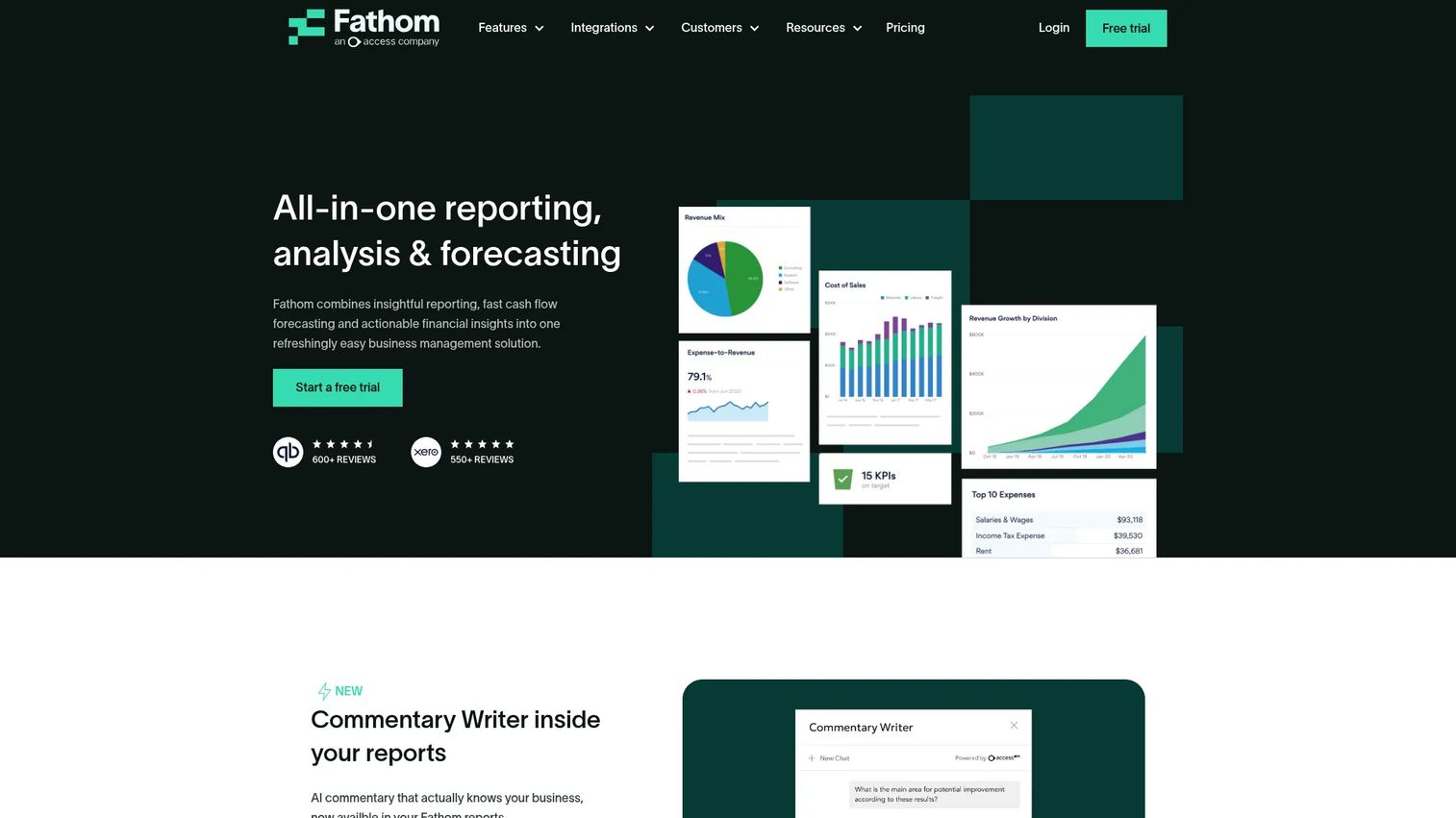
Fathom sits in the sweet spot for founders who want reporting and analysis in one place, without building it from scratch. It pulls from your accounting data and turns it into management reports, KPI dashboards, and cash flow forecasts you can actually hand to a board. Where most tools force you to choose between depth and clarity, Fathom leans into narrative: it helps you explain the numbers, not just display them.
Best for: accounting firms and SaaS finance teams that need board-ready reporting, KPI tracking, and consolidation without a heavy build.
Key strengths
- Management reporting and dashboards: turn ledger data into clean, shareable financial dashboards that finance and founders read the same way.
- Cash flow forecasting: model cash position forward so runway stops being a guessing game.
- Consolidated financial reporting: roll up multiple entities or divisions for divisional analysis and group-level profitability analysis.
Why choose Fathom: If your main pain is slow, ugly, manual board reporting, Fathom closes that gap faster than a full FP&A platform. Its Goalseek and divisional analysis features help you tie growth targets to the levers that move them, which is exactly the story a Series B board wants to hear. It is reporting-first, so heavy custom modeling lives elsewhere.
Fathom pricing: Fathom offers a Forever Free tier plus Fathom Pro and Fathom Portfolio plans, with a 14-day free trial and monthly pay-as-you-go billing. The pricing calculator does not publish fixed numeric prices, so exact costs depend on your entity count and plan. On G2, Fathom holds a 5/5 rating.
2. ThoughtSpot
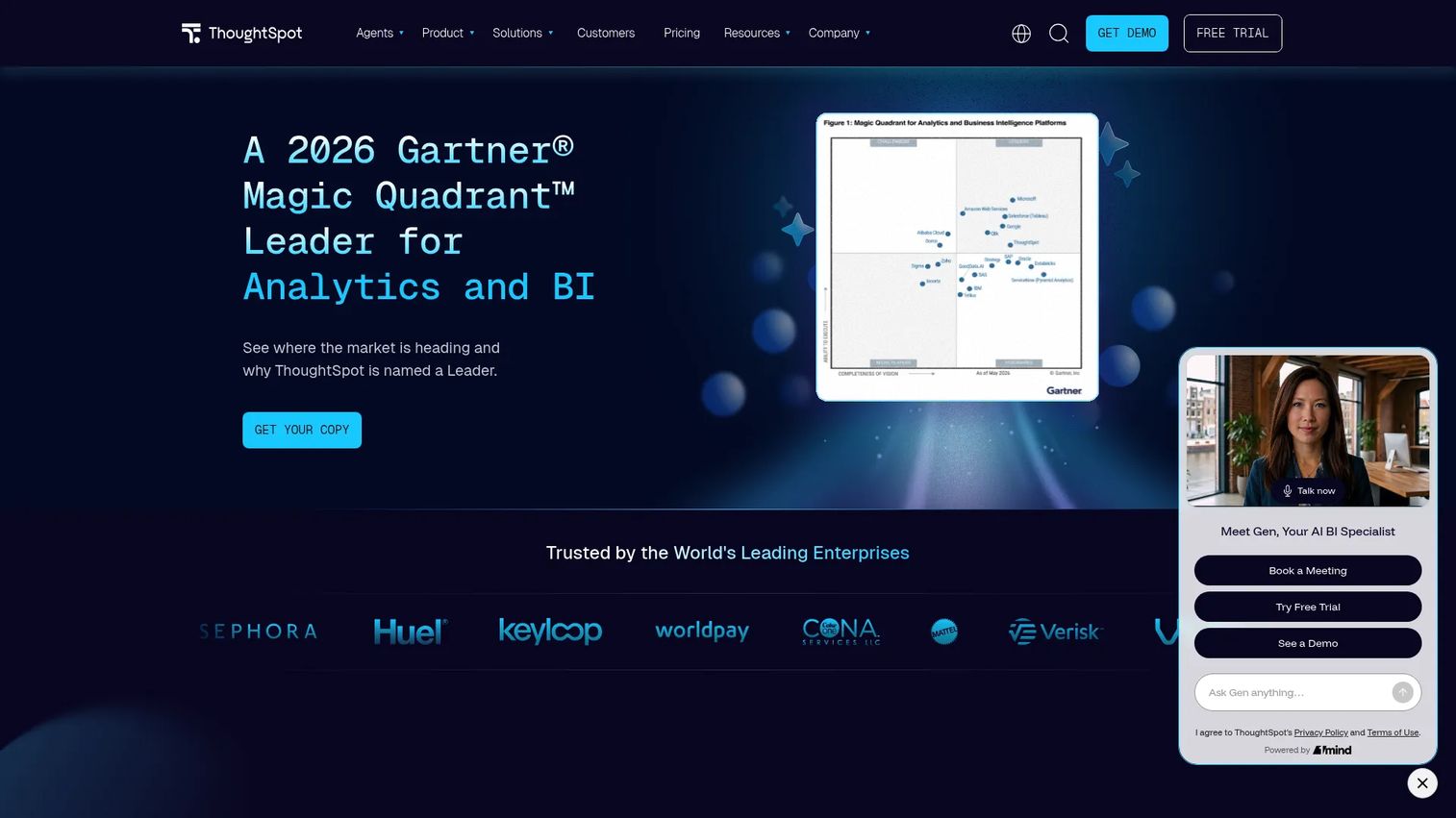
ThoughtSpot is business intelligence for finance built around search. Instead of waiting on an analyst to build a report, finance can type a question in plain language and get an answer, chart, and drill-down. Its SpotIQ engine surfaces anomalies and patterns automatically, and Liveboards keep the whole team looking at live data.
Best for: finance and RevOps teams that want self-service analytics and less dependency on a data team for every question.
Key strengths
- Search and AI-assisted analysis: ask questions in natural language and get governed answers, so ad hoc analysis does not require a ticket.
- Liveboards and interactive dashboards: build interactive financial dashboards the team can filter and explore, not just read.
- Embedded analytics SDK: push finance insights into other apps and shareable reports for wider collaboration.
Why choose ThoughtSpot: When your bottleneck is that every finance question routes through one overworked analyst, ThoughtSpot removes that dependency. It is stronger on exploration and visualization than on native budgeting and forecasting, so pair it with a planning tool if you need both. For teams drowning in dashboard requests, the AI-assisted analysis pays for itself in reclaimed analyst hours.
ThoughtSpot pricing: ThoughtSpot lists Essentials at $25 per user per month billed annually, a usage-based Pro plan from $0.10 per query, and custom Enterprise pricing. Developer access is free for one year and an Embedded free tier is available. On G2, ThoughtSpot holds a 4.4/5 rating.
3. QuickBooks
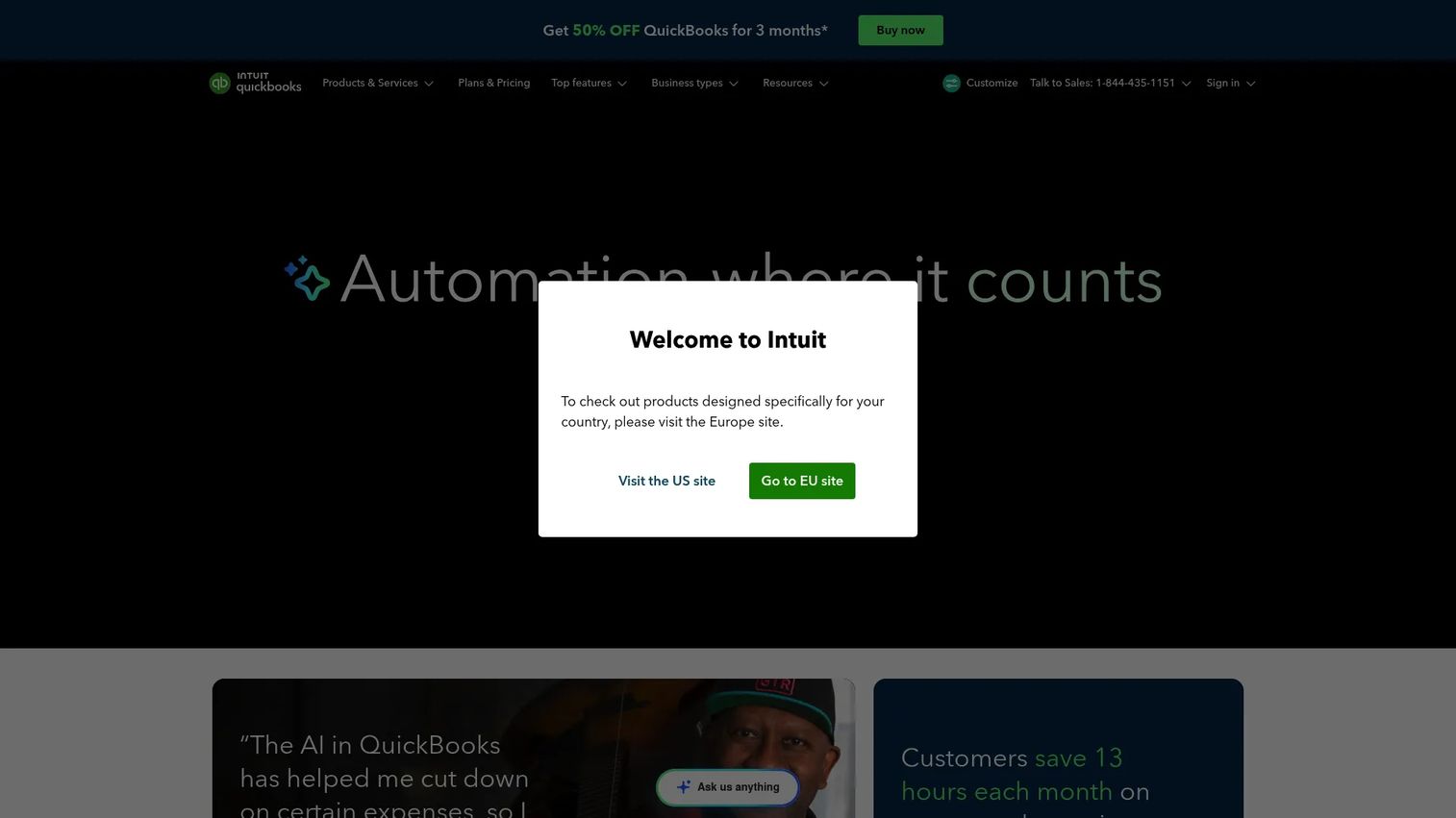
QuickBooks is where most companies start. It handles bookkeeping, invoicing, expense tracking, and standard financial reporting well, and it integrates with hundreds of tools. It is accounting-first, not FP&A-first, and that distinction matters. QuickBooks tells you what happened cleanly. It is not built for deep scenario planning or multidimensional forecasting.
Best for: small and early-stage businesses that need reliable cloud accounting before graduating to dedicated analysis tools.
Key strengths
- Automated bookkeeping: keep the ledger clean and current, which is the foundation every analysis tool depends on.
- Invoicing and getting paid: run AR and collections without bolting on another tool.
- Expense tracking and reporting: produce standard financial statements and basic reports on demand.
Why choose QuickBooks: For most Series B companies, QuickBooks is the source of truth that feeds everything else. It is the accounting layer your financial analysis software plugs into. When founders ask whether they need analysis tools or just accounting, the honest answer is often both: QuickBooks records, and a tool like Fathom or Datarails analyzes on top of it. The integrations with accounting systems across this list frequently mean integrating with QuickBooks specifically.
QuickBooks pricing: QuickBooks Online lists four paid plans: Simple Start at $19/mo, Essentials at $37.50/mo, Plus at $57.50/mo, and Advanced at $137.50/mo, all promotional monthly prices. There is a 30-day free trial and no public free tier. On G2, QuickBooks holds a 4.4/5 rating.
4. Sage Intacct
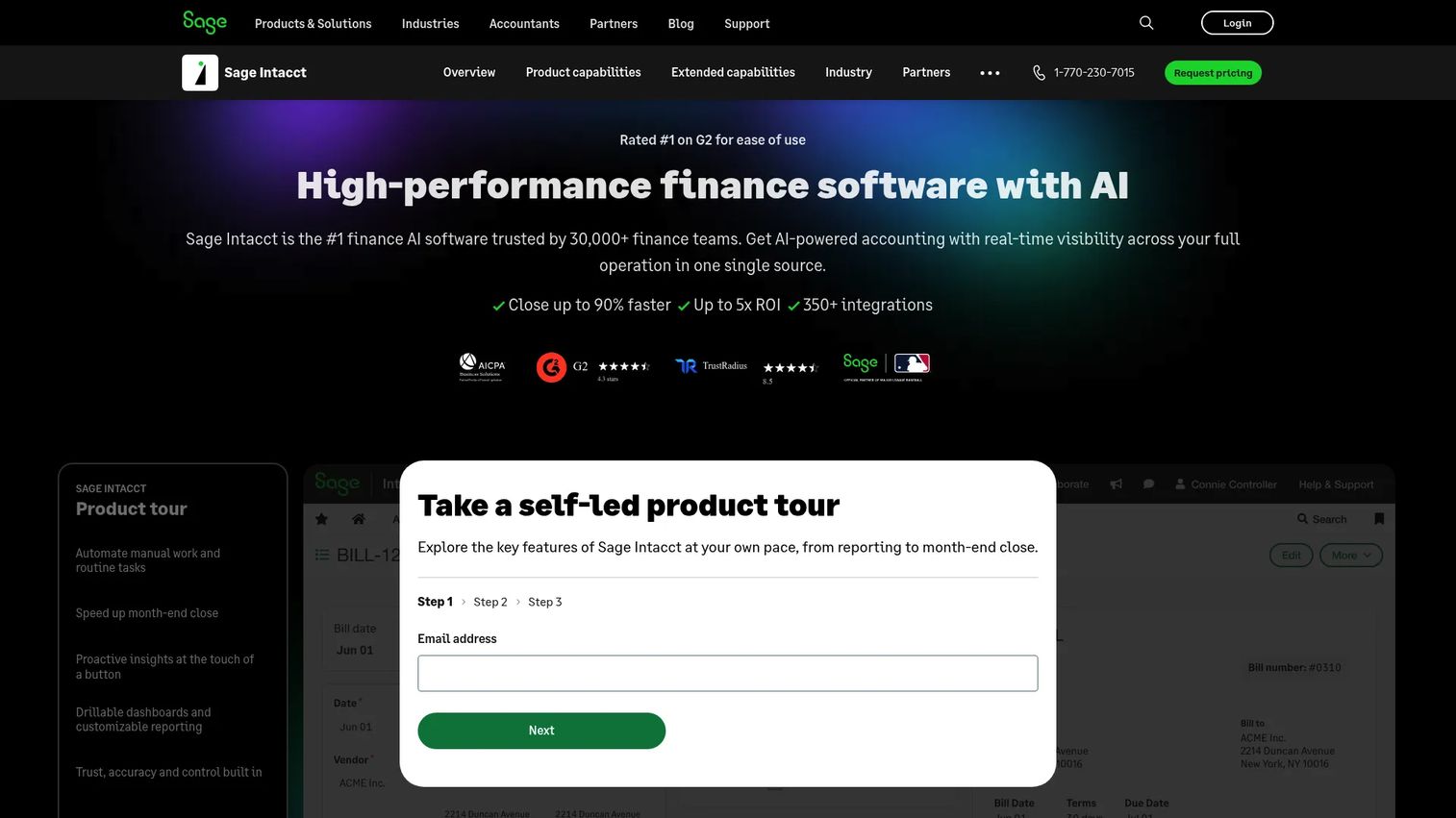
Sage Intacct is cloud financial management for finance teams that have outgrown basic accounting but are not ready for a full ERP. Its strength is operational reporting: real-time dashboards, dimensional reporting, and multi-entity accounting that gives finance a clean view across the business. For SaaS companies scaling into multiple entities or revenue streams, it handles the complexity QuickBooks starts to strain against.
Best for: growing SaaS and multi-entity finance teams that need stronger operational reporting and automation.
Key strengths
- AP and AR automation: cut manual work in payables and receivables so finance spends time on analysis, not data entry.
- Real-time dashboards and dimensions: slice financial data by dimension for granular reporting and visualization.
- Multi-entity accounting: consolidate across entities with API support and integrations with accounting systems and other tools.
Why choose Sage Intacct: When your finance team is manually consolidating across entities every month, Sage Intacct removes that grind with dimensional, real-time reporting. It sits between accounting software and heavier ERP reporting, which makes it a strong fit for the messy middle stage most Series B companies hit. It is finance-operations focused, so dedicated FP&A planning often pairs alongside it.
Sage Intacct pricing: Sage Intacct uses custom pricing based on modules, industry, and organization size, and directs buyers to request a quote rather than publishing public prices. On G2, Sage Intacct holds a 4.3/5 rating.
5. Oracle Essbase
Oracle Essbase is Oracle's multidimensional analytics and scenario-modeling engine, available in the cloud or on-premises. It is built for enterprise performance management: complex hierarchies, large data volumes, and modeling that would break a spreadsheet. If your analysis needs span many dimensions, entities, and drivers, Essbase is engineered for exactly that depth.
Best for: larger finance teams with complex modeling, consolidation, and forecasting needs.
Key strengths
- What-if analysis and scenario modeling: run sophisticated scenario planning across many variables at once.
- Hybrid query engine and complex hierarchies: model deep organizational structures without performance loss.
- Excel and Smart View integration plus REST API: keep finance in Excel while automating data flows, useful for variance analysis and profitability analysis.
Why choose Oracle Essbase: Essbase earns its place when your modeling has outgrown what dedicated planning tools comfortably handle. It is enterprise-grade OLAP, which means power and depth, paired with a steeper learning curve than lighter tools on this list. Most Series B companies do not need this yet, but teams heading toward complex, multidimensional planning will find few tools match its ceiling.
Oracle Essbase pricing: Oracle offers Essbase for Oracle Cloud Infrastructure, but does not display a public numeric price on its price list; deployment and licensing are quoted based on your environment. On G2, Oracle Essbase holds a 4.3/5 rating.
6. NetSuite
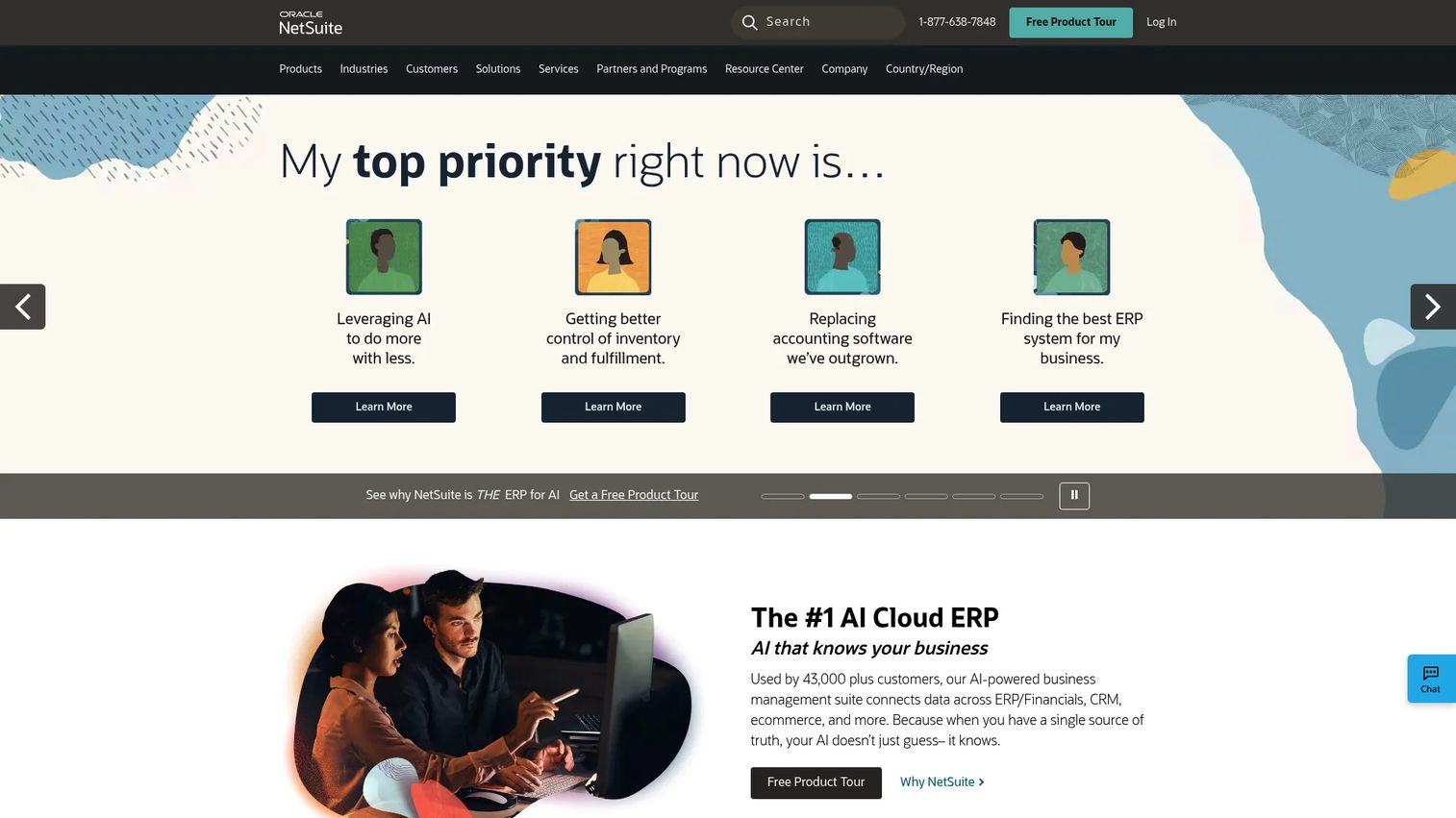
NetSuite is a full cloud ERP, and financial analysis is one part of a much larger system that also covers operations, commerce, and CRM. Its advantage for finance is that data lives in one place. Instead of stitching finance and operational data across tools, NetSuite ties them together, so ERP reporting and real-time dashboards reflect the whole business at once.
Best for: mid-market to enterprise companies that want finance data tightly connected to operations in one platform.
Key strengths
- Cloud ERP and global financial management: centralize financials across departments, entities, and currencies.
- Built-in business intelligence and dashboards: get real-time financial dashboards without exporting to a separate BI tool.
- SuiteCloud customization and integration: extend and connect the platform as your operations grow.
Why choose NetSuite: When tool sprawl is the problem and finance data is scattered across five systems, NetSuite consolidates it into one. That centralization is its core value and its commitment: it is a platform decision, not a point tool. For companies where finance, ops, and commerce data need to move together, the payoff is a single source that supports reporting, planning-adjacent workflows, and cash flow analysis in one place.
NetSuite pricing: NetSuite does not publish public pricing; cost depends on modules, users, and configuration, and is quoted through sales. On G2, NetSuite holds a 4.1/5 rating.
7. Datarails
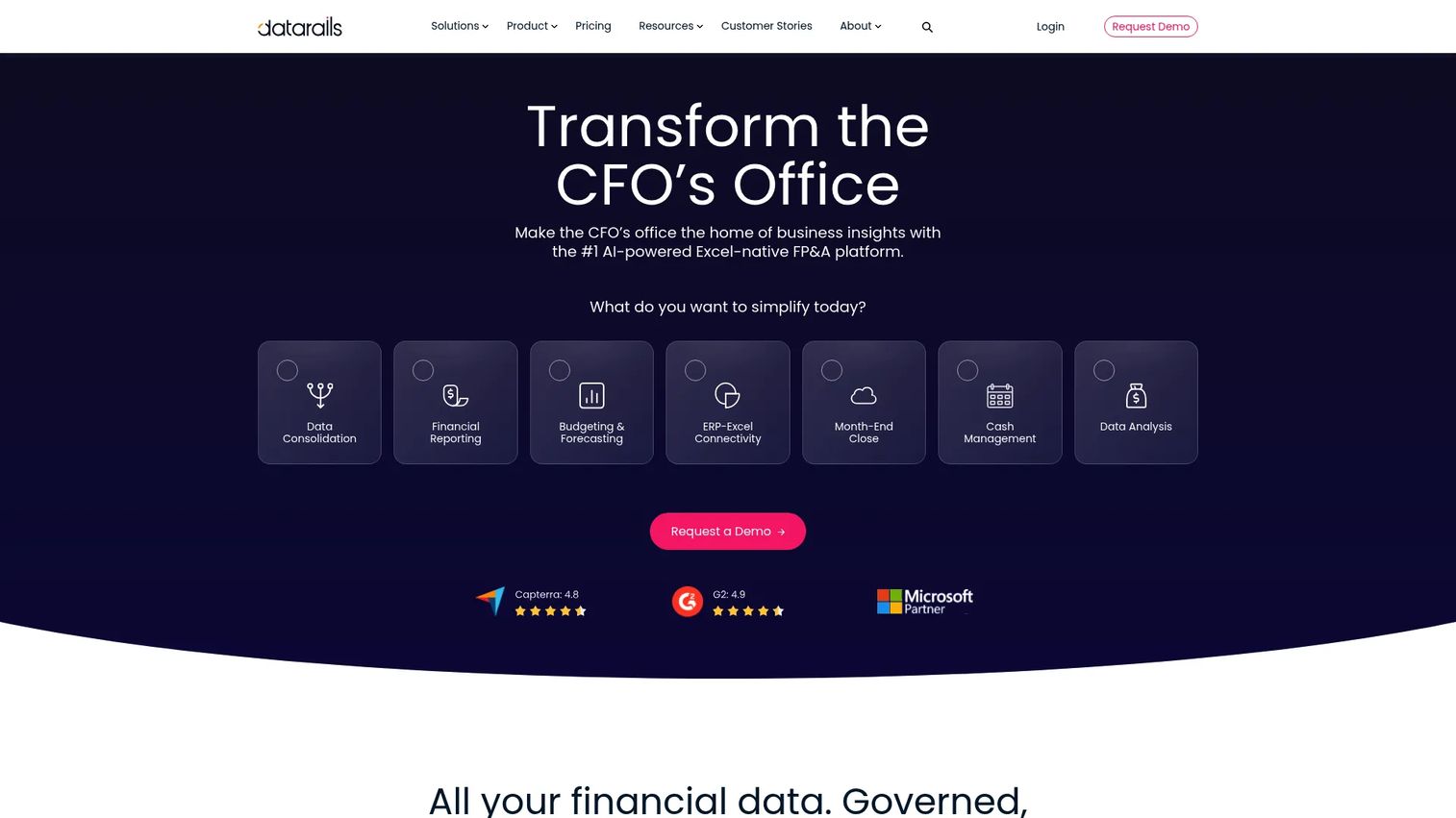
Datarails is FP&A software built for finance teams that live in Excel but need control, consolidation, and automation on top of it. Instead of forcing your team off spreadsheets, it keeps them in the tool they know while automating the manual parts: data consolidation, reporting, and planning. For SaaS finance teams modernizing from manual models, that Excel-native approach removes the biggest adoption hurdle.
Best for: finance teams that want Excel-based FP&A automation with consolidated reporting and planning.
Key strengths
- Excel-native FP&A: keep working in Excel while Datarails consolidates data and enables drill-downs automatically.
- Unlimited dashboards, reporting, and planning: build board reporting and financial dashboards without per-report limits.
- FinanceOS suite: add cash management, spend control, and month-end close alongside AI-assisted analysis.
Why choose Datarails: If your finance lead resists new tools because "everything is already in Excel," Datarails is the path of least resistance. It automates consolidation and reporting without a rip-and-replace, which shortens time to first value. It is FP&A-focused, so pair it with your accounting system of record rather than expecting it to replace one.
Datarails pricing: Datarails uses custom quote pricing across three plans: FP&A Professional, FP&A Premium, and FP&A Expert. Expect an annual platform fee plus a one-time implementation fee; there is no public numeric price and no free tier. On G2, Datarails holds a 4.6/5 rating, the highest on this list.
8. Workday Adaptive Planning
Workday Adaptive Planning is a dedicated planning layer for finance teams that want structure around budgeting, forecasting, and scenario planning. It goes beyond finance into workforce and operational planning, so headcount modeling and financial forecasting live in the same system. For teams that want a repeatable planning process instead of an annual spreadsheet scramble, it brings the process discipline.
Best for: finance teams needing unified planning, forecasting, and consolidation with strong process structure.
Key strengths
- AI-powered budgeting and forecasting: run scenario planning and what-if analysis with modeling built for it.
- Workforce planning and headcount modeling: tie hiring plans directly to financial forecasts and runway.
- Operational planning plus close and consolidation: connect planning, variance analysis, and board reporting in one platform.
Why choose Workday Adaptive Planning: When budgeting and forecasting is a chaotic, once-a-year event, Workday Adaptive Planning turns it into an ongoing, collaborative process. Its workforce planning is a standout for SaaS companies where headcount is the largest line item. It is a dedicated planning platform, so it pairs with your accounting or ERP system rather than replacing it.
Workday Adaptive Planning pricing: Workday does not publish public pricing; cost varies by configuration and is quoted through sales, and a free trial is available. On G2, Workday Adaptive Planning holds a 4.3/5 rating.
What to look for before you buy
Before you commit budget, run each option against these criteria.
Integration depth
The tool is only as good as the data feeding it. Check how deeply it connects to your accounting systems, ERP, spreadsheets, and CRM. Shallow integrations mean manual re-entry, which reintroduces the exact problem you are trying to solve. Confirm it pulls from QuickBooks, NetSuite, or your general ledger cleanly.
Reporting and board readiness
Ask whether the output is something you would actually put in front of a board. Look at reporting and visualization quality, how fast reports refresh, and whether shareable reports keep finance, founders, and investors on the same numbers. Slow or ugly reporting defeats the purpose.
Planning and scenario depth
If you need scenario planning and what-if analysis, verify the tool models it natively rather than bolting it on. Test how easily you can pressure-test a hiring plan or a churn assumption and see the runway impact. Budgeting and forecasting should be a workflow, not a workaround.
Fit for your team and stage
A 50-person company does not need a 5,000-person platform. Match the tool to whether your finance function is founder-led or has a dedicated FP&A hire. First-win speed matters: if it takes a quarter to see value, that is a cost. Choose the tool your team will actually adopt.
Conclusion
The right financial analysis software depends on the job you are hiring it for. If you need clean, founder-facing board reporting fast, Fathom is the most direct path. If finance wants self-service analytics without an analyst bottleneck, ThoughtSpot fits. QuickBooks remains the accounting foundation most of these tools plug into, while Sage Intacct and NetSuite handle operational and ERP-connected finance at scale. For planning, Datarails keeps you in Excel, Workday Adaptive Planning brings process structure, and Oracle Essbase covers the most complex modeling.
Do not try to solve everything at once. Pick the one tool that replaces the most manual weekly reporting work first. For most Series B founders, that means the reporting and forecasting layer that answers "are we default alive?" in minutes instead of days. Get that win, prove the ROI to your board, then expand. Finance automation compounds: the first system you get right makes the next decision faster.
FAQs
Financial analysis software turns accounting and operational data into insight, forecasts, and reporting that support decisions. It is used for KPI tracking, cash flow analysis, budgeting and forecasting, profitability analysis, and board reporting. Unlike accounting software, which records transactions, it interprets them and helps you plan forward.
They overlap but are not identical. FP&A software focuses specifically on financial planning and analysis: budgeting, forecasting, and scenario planning. Financial analysis software is broader and can include reporting, business intelligence, and analytics tools alongside planning. Most FP&A tools are financial analysis software, but not every analysis tool is a full FP&A platform.
Early on, accounting software alone is usually enough to keep the books clean. You need dedicated analysis tools once reporting becomes weekly and board-facing, once you need forecasting and runway visibility, and once scenario planning drives hiring and spend decisions. Most Series B companies run both: accounting software records, and financial analysis software interprets on top of it.
Prioritize integration depth with your accounting systems and ERP, board-ready reporting and visualization, native forecasting and scenario planning, and clear cash flow and runway visibility. Match the tool to your stage and team. A founder-led finance function needs different depth than one with a dedicated FP&A hire.
Datarails is Excel-native by design, letting finance keep working in spreadsheets while automating consolidation and reporting. Oracle Essbase integrates tightly with Excel through Smart View. Most other platforms support Excel import and export, but Excel-native tools are the strongest fit for teams whose models already live in spreadsheets.
They let you model outcomes before committing cash. What-if analysis shows how runway shifts if you hire faster or churn rises. Goalseek-style features work backward from a target to the drivers that reach it. Budget sensitivity testing reveals which assumptions matter most, so you make decisions on modeled outcomes instead of gut feel.
The most important integrations are your accounting systems, such as QuickBooks, and your ERP, such as NetSuite, since they supply the core financial data. Spreadsheet connections keep existing models usable. CRM data adds revenue and pipeline context, and BI connections extend reporting. Weak integrations force manual re-entry and undermine the whole system.
Yes, in specific places. AI helps with natural-language querying, anomaly detection, data classification, and summarizing large datasets, which saves real analyst hours. It is genuinely useful for surfacing patterns you would otherwise miss. Human judgment still owns the interpretation, the assumptions behind a forecast, and the decision the numbers inform.