Your product event fires. A user completes onboarding. A payment clears. A fraud pattern forms across three accounts in 90 seconds.
The question is whether your stack knows about it now or tomorrow morning.
Batch jobs are fine for monthly reports. They break down the moment timing changes the outcome, and in product development, timing changes the outcome constantly. According to Mordor Intelligence (2026), the event stream processing market is projected to grow from $1.61 billion in 2025 to $2.96 billion by 2031, driven by teams that can no longer afford to wait for nightly syncs to act on live signals.
Product managers evaluating streaming infrastructure aren't doing it for fun. They need onboarding triggers that fire while the user is still active, fraud detection that works before the transaction clears, and product analytics pipelines that don't introduce a 24-hour lag into every experiment. The right event stream processor changes what your product can do, not just how fast your data warehouse refreshes.
This guide compares 15 event stream processing software tools across open-source engines, managed cloud services, enterprise platforms, and specialized observability pipelines.
What's inside
This guide is for product managers, data platform leads, and engineering managers choosing event streaming infrastructure for product analytics, lifecycle triggers, fraud detection, and real-time personalization.
Tools were selected based on:
- Real-time processing capability and latency profile
- Scalability for production workloads
- Deployment model (open source, managed cloud, enterprise)
- Integration fit with data warehouses, analytics tools, and observability stacks
- Operational maturity and community or vendor support
TL;DR
- Best open-source event broker: Apache Kafka, the established backbone for durable, high-throughput event streaming
- Best open-source stream-processing engine: Apache Flink, strong for stateful, low-latency event-time computation
- Best managed Kafka platform: Confluent, for teams that want enterprise Kafka without building every operational layer
- Best Kafka-compatible alternative: Redpanda, a simpler operational profile with Kafka API compatibility
- Best cloud-native options: Amazon Kinesis Data Streams (AWS), Google Cloud Dataflow (GCP), and Azure Stream Analytics (Azure)
- Best enterprise streaming analytics: SAS Event Stream Processing, for governance-heavy and industrial IoT workloads
What is event stream processing software?
Event stream processing software continuously ingests, analyzes, transforms, and routes event data as it is created, so teams can act on live signals instead of waiting for batch jobs.
An event is a record of something that happened: A click, a signup, a payment, a sensor reading. A stream is a continuous flow of those records. Event stream processing computes over those records while they are still moving, rather than storing them first and querying them later. The timing of the signal changes the product outcome, which is what makes streaming different from warehouse analytics.
Core capabilities to evaluate:
- Event ingestion and durable storage
- Stateful computation over event windows
- Windowing and aggregation
- Filtering and enrichment
- Stream joins across data sources
- Pattern detection across event sequences
- Replay for reprocessing historical events
- Fault tolerance and checkpointing
- Monitoring and alerting
- Connector integrations
- Schema governance
Architecture taxonomy:
| Concept | What it means | Product example |
|---|---|---|
| Event broker | Moves and stores event streams | Apache Kafka, Redpanda |
| Stream processor | Computes over event streams | Apache Flink, Apache Spark |
| Managed stream service | Runs streaming infrastructure in a cloud model | Amazon Kinesis Data Streams, Google Cloud Dataflow |
| Enterprise streaming analytics | Adds governance, visual modeling, and monitoring | SAS Event Stream Processing |
Most production architectures use a broker and a processor together. Kafka moves events reliably; Flink computes over them continuously. Understanding which layer you need prevents choosing the wrong tool for the wrong problem.
When to use event stream processing software
React to product behavior while the user is still active
Activation triggers, usage-based prompts, and in-product personalization all depend on receiving signals while the session is open. A nightly warehouse sync arrives after the user has already churned or succeeded without your nudge. Stream processing closes that gap, giving product teams the instrumentation to fire onboarding flows at the moment of need rather than the morning after.
Detect risk before the pattern becomes expensive
Fraud detection, anomaly detection, and payment risk scoring require correlating events across multiple records in real time. A single transaction looks fine in isolation. The pattern across three accounts in 90 seconds does not. Stream processors with stateful computation and windowing can detect those patterns before the window closes.
Run analytics on operational data as it moves
IoT telemetry, infrastructure logs, customer activity streams, and supply-chain signals generate continuous high-throughput data that batch pipelines handle poorly. State management, fault tolerance, and replay capability matter here. For PMs building big data analytics on top of operational signals, the choice of streaming layer affects both data freshness and engineering maintenance overhead.
Event stream processing software comparison
The table below compares all 15 tools by primary fit, key differentiator, pricing model, and G2 rating. Pricing and ratings reflect vendor pricing pages and G2 listings verified at generation time. Open-source projects carry infrastructure costs despite free licenses. For tools without a public numeric price, the pricing model and billing drivers are noted.
| # | Product | Best for | Key differentiator | Pricing | G2 rating |
|---|---|---|---|---|---|
| 1 | Apache Kafka | Distributed event streaming backbone | Mature ecosystem and durable event log | Free open source; managed costs vary | 4.5/5 |
| 2 | Apache Flink | Stateful stream processing | Low-latency event-time processing | Free open source; managed costs vary | 4.4/5 |
| 3 | Confluent | Managed Kafka and Flink platform | Enterprise Kafka with governance and connectors | From $0/month (usage-based) | 4.4/5 |
| 4 | Redpanda | Kafka-compatible streaming, simpler ops | Kafka API without ZooKeeper overhead | From $0.10/hour (Serverless) | 4.7/5 |
| 5 | SAS Event Stream Processing | Enterprise streaming analytics | Low-code analytics with edge and cloud deployment | Quote-based | 4.1/5 |
| 6 | Amazon Kinesis Data Streams | AWS-native streaming ingestion | Managed shard-based streaming service | From $0.015/shard hour | 4.3/5 |
| 7 | Google Cloud Dataflow | GCP stream and batch processing | Apache Beam-based managed processing | From $0.06 per unit (batch) | 4.2/5 |
| 8 | Azure Stream Analytics | Azure-native real-time analytics | SQL-based streaming on Azure | Streaming unit-based; amounts not displayed | N/A |
| 9 | Apache Spark | Unified batch and streaming | Large-scale analytics with Structured Streaming | Free open source; managed costs vary | 4.3/5 |
| 10 | Apache Storm | Distributed real-time computation | Low-level topology model for stream processing | Free open source | 3.7/5 |
| 11 | Aiven for Apache Kafka | Managed Kafka, multi-cloud | Hosted Kafka across AWS, GCP, Azure | From $0/month (Free tier) | 4.3/5 |
| 12 | Cloudera DataFlow | Enterprise hybrid pipelines | Flow management edge-to-cloud with Apache NiFi | From $0.30/CCU (usage-based) | 3.5/5 |
| 13 | Cribl Stream | Observability telemetry routing | Route and shape telemetry before downstream | Free up to 1TB/day; Standard and Enterprise on request | 4.3/5 |
| 14 | DataBahn | Security data pipeline management | Agentic telemetry routing and cost control | Quote-based | 4.8/5 |
| 15 | Axual Platform | Governed enterprise Kafka | Self-service Kafka with governance controls | Quote-based; capacity-based annual plans | 4.5/5 |
Best 15 event stream processing software tools for 2026
1. Apache Kafka
Apache Kafka is an open-source distributed event streaming platform built for high-performance data pipelines, streaming analytics, and data integration. It functions as a durable event log: Producers write records to topics, and consumers read them at their own pace. Most streaming architectures treat Kafka as the backbone that other tools build on top of, not the layer that computes over events itself.
Best for: Teams that need a proven, fault-tolerant event backbone for high-throughput ingestion, configurable retention, replay, and broad ecosystem integration.
Key features
- Distributed commit log with configurable topic retention
- Consumer groups for parallel, scalable event consumption
- Kafka Connect for integrating databases and external systems
- Kafka Streams API for lightweight, embedded stream processing
- Producer, Consumer, Admin, and Streams APIs
Why choose Apache Kafka: Kafka's maturity and ecosystem depth make it the default event broker for most production streaming architectures. It pairs best with a dedicated processor like Flink for stateful computation. If your team needs a durable, widely-supported event backbone, Kafka is the clearest starting point.
Apache Kafka pricing: Kafka itself is free under the Apache license. Running it in production means paying for compute, storage, networking, and engineering time, or choosing a managed service. Confluent, Aiven, and Redpanda all offer hosted Kafka with different operational tradeoffs.
G2 rating: 4.5/5
2. Apache Flink
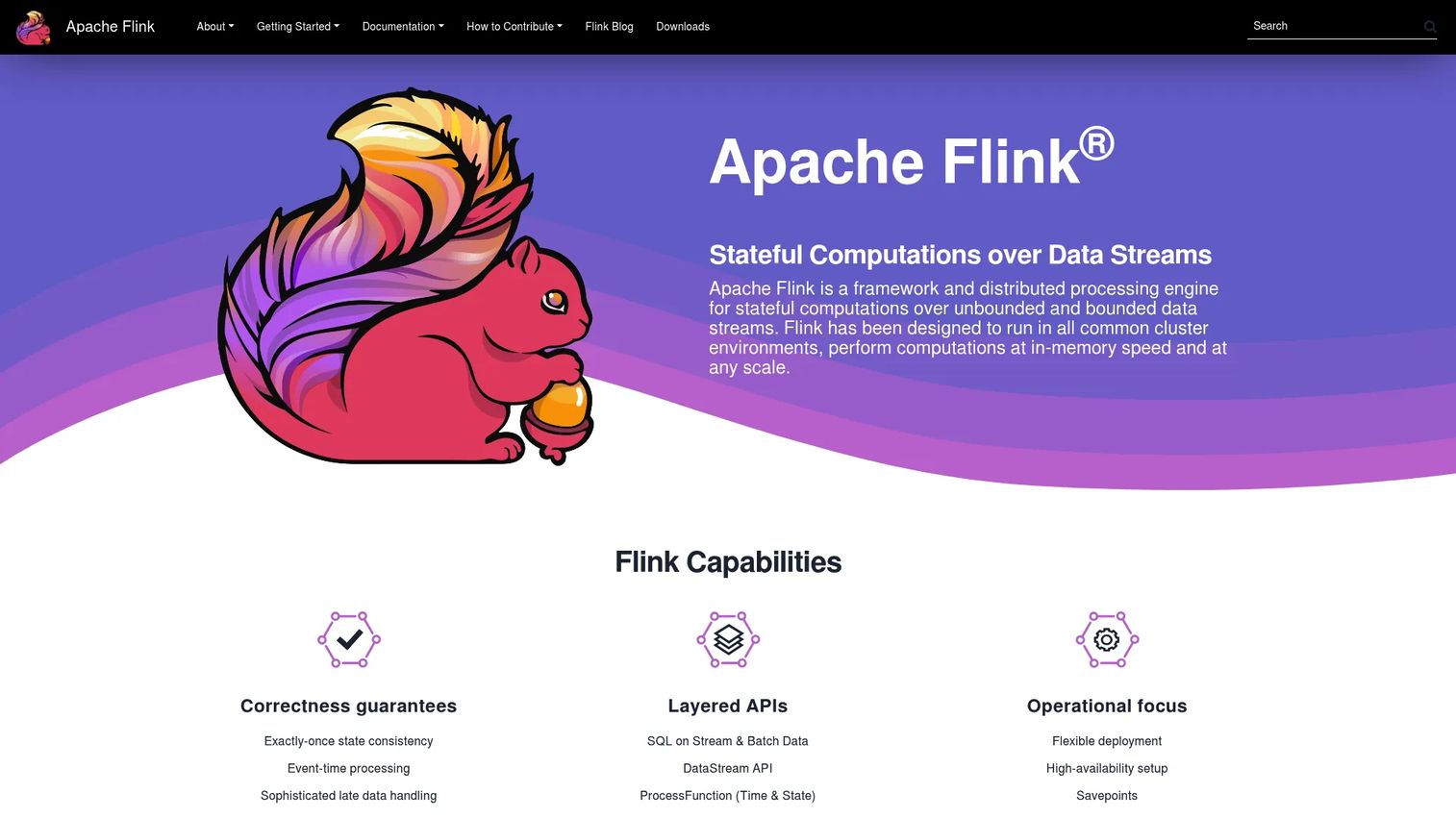
Apache Flink is an open-source distributed processing engine built for stateful computations over bounded and unbounded data streams. It handles event-time semantics natively, meaning it processes events based on when they occurred rather than when they arrived. Flink is the engine of choice when workloads require more than event transport, including fraud detection, real-time personalization, and continuous analytics.
Best for: Engineering teams that need event-time processing, stateful operators, windowing, and high-throughput streaming analytics at scale.
Key features
- Event-time processing with late-data handling
- Stateful operators with exactly-once consistency
- Incremental checkpointing for fault tolerance
- Windowing: Tumbling, sliding, session, and global windows
- SQL, Table API, and DataStream API for batch and streaming
Why choose Apache Flink: Pick Flink when the workload requires computation, not just transport. It complements Kafka well: Kafka stores and moves events reliably, while Flink processes and analyzes them continuously. For PMs measuring product analytics with low latency, Flink reduces the gap between user action and actionable insight.
Apache Flink pricing: Free under the Apache license. Managed Flink is available through cloud providers and vendors including Confluent and AWS. Managed costs depend on compute resources and the hosting provider's pricing model.
G2 rating: 4.4/5
3. Confluent
Confluent commercializes Kafka-based data streaming with cloud, platform, and self-managed options. It bundles managed Kafka, managed Flink, stream governance, a connector ecosystem, and AI features into a single platform. Confluent's value proposition is reducing the operational work of running Kafka at enterprise scale while adding governance and compliance controls that open-source Kafka does not include out of the box.
Best for: Enterprises that want managed Kafka with governance, connectors, and Flink processing without building every layer themselves.
Key features
- Managed Apache Kafka across cloud providers
- Managed Apache Flink for stateful stream processing
- Stream governance: Data quality, security, and schema management
- 500+ pre-built connectors for databases and SaaS applications
- AI capabilities for real-time context and streaming agents
Why choose Confluent: Confluent is the right call when Kafka is central to your data architecture and the team needs enterprise-grade operations and support. For product teams, the connectors and governance layer make it easier to standardize event schemas across teams without treating every product event as a custom pipeline problem.
Confluent pricing: Confluent Cloud uses consumption-based pricing. The Basic cluster starts at $0/month, Standard clusters run approximately $385/month, and Enterprise clusters run approximately $895/month. Actual costs scale with usage, so heavy workloads will exceed those base rates.
G2 rating: 4.4/5
4. Redpanda
Redpanda is a Kafka-compatible real-time streaming platform that eliminates ZooKeeper and uses a single binary architecture for simpler operations. It supports the full Kafka API, meaning existing Kafka producers and consumers work without code changes. Teams typically choose Redpanda when they want Kafka-compatible workloads but want to reduce the operational complexity of running a full Kafka cluster.
Best for: Engineering and data teams that want high-throughput, Kafka-compatible streaming with a more manageable operational footprint.
Key features
- Kafka API compatibility without ZooKeeper
- Single binary architecture
- Tiered storage with Apache Iceberg support
- 300+ pre-built data connectors
- Managed Serverless, Dedicated, and BYOC deployment options
Why choose Redpanda: Redpanda is worth evaluating when your infrastructure team wants fewer moving parts around event ingestion and Kafka API compatibility matters. The operational simplification can reduce the engineering opportunity cost of maintaining streaming infrastructure, which matters for product teams waiting on event pipeline work before they can ship features.
Redpanda pricing: Serverless clusters start at $0.10/hour base compute, with ingress from $0.045/GB and egress from $0.04/GB. Dedicated and BYOC plans use usage-based pricing and require a sales conversation for specific rates.
G2 rating: 4.7/5
5. SAS Event Stream Processing
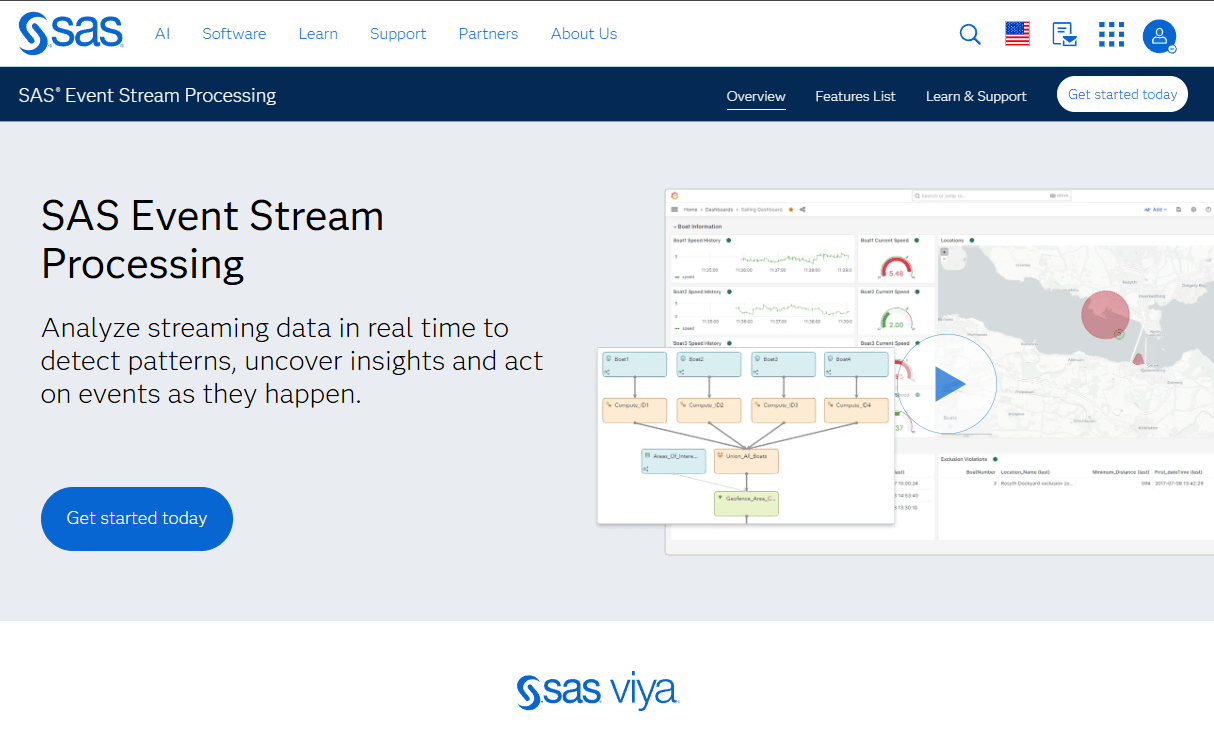
SAS Event Stream Processing is an enterprise streaming analytics platform focused on real-time pattern detection, AI scoring, and operational decision-making. It supports structured and unstructured data, containerized deployment across edge and cloud environments, and low-code stream design for analysts and engineers working in shared environments. Industrial IoT, manufacturing risk, and fraud detection are strong use cases.
Best for: Enterprises that need streaming analytics with governance, visual modeling, ML scoring, and edge-to-cloud deployment.
Key features
- Low-code streaming window design and reusable components
- AI and ML scoring on live event streams
- Edge, cloud, and on-premises containerized deployment
- Git-based version control for streaming models
- Real-time visualization through Grafana integration
Why choose SAS Event Stream Processing: SAS fits organizations where business analysts and data engineers need to collaborate on streaming models without each writing bespoke code. If your use case involves high-volume operational data with governance requirements, and particularly if you work in industrial, financial services, or manufacturing contexts, SAS offers depth that cloud-native services don't match on the analytics layer.
SAS Event Stream Processing pricing: SAS does not display product-specific pricing. Pricing is quote-based, and the buying process starts by contacting SAS sales. Cost drivers typically include deployment model, event throughput, and enterprise support requirements.
G2 rating: 4.1/5
6. Amazon Kinesis Data Streams
Amazon Kinesis Data Streams is a managed AWS service for continuously capturing and processing streaming data. It replicates data synchronously across three Availability Zones with configurable retention up to 365 days, and integrates directly with AWS Lambda, Amazon Managed Service for Apache Flink, and other AWS analytics services. For teams already running on AWS, it removes the infrastructure setup required to get event ingestion working quickly.
Best for: AWS-native teams that need managed streaming ingestion for product events, logs, clickstreams, or transaction data.
Key features
- Managed shard-based and on-demand streaming
- Synchronous replication across three Availability Zones
- Data retention up to 365 days
- Enhanced fan-out for up to 20 dedicated consumers
- Server-side encryption with AWS KMS
Why choose Amazon Kinesis Data Streams: Choose Kinesis when your product events, telemetry, and operational logs already live in AWS. It reduces the infrastructure work of getting event ingestion running and integrates naturally with AWS Lambda for processing or Amazon Managed Service for Apache Flink for stateful computation. Teams evaluating payment processing infrastructure often find Kinesis a natural fit for event capture within the AWS stack.
Amazon Kinesis Data Streams pricing: Pricing is usage-based and region-dependent. On-demand Standard starts at $0.015 per stream hour; on-demand Advantage is $0.032/GB ingested and $0.016/GB retrieved; provisioned capacity runs $0.015 per shard hour in US-East. Actual costs vary by throughput, retention, and retrieval pattern.
G2 rating: 4.3/5
7. Google Cloud Dataflow
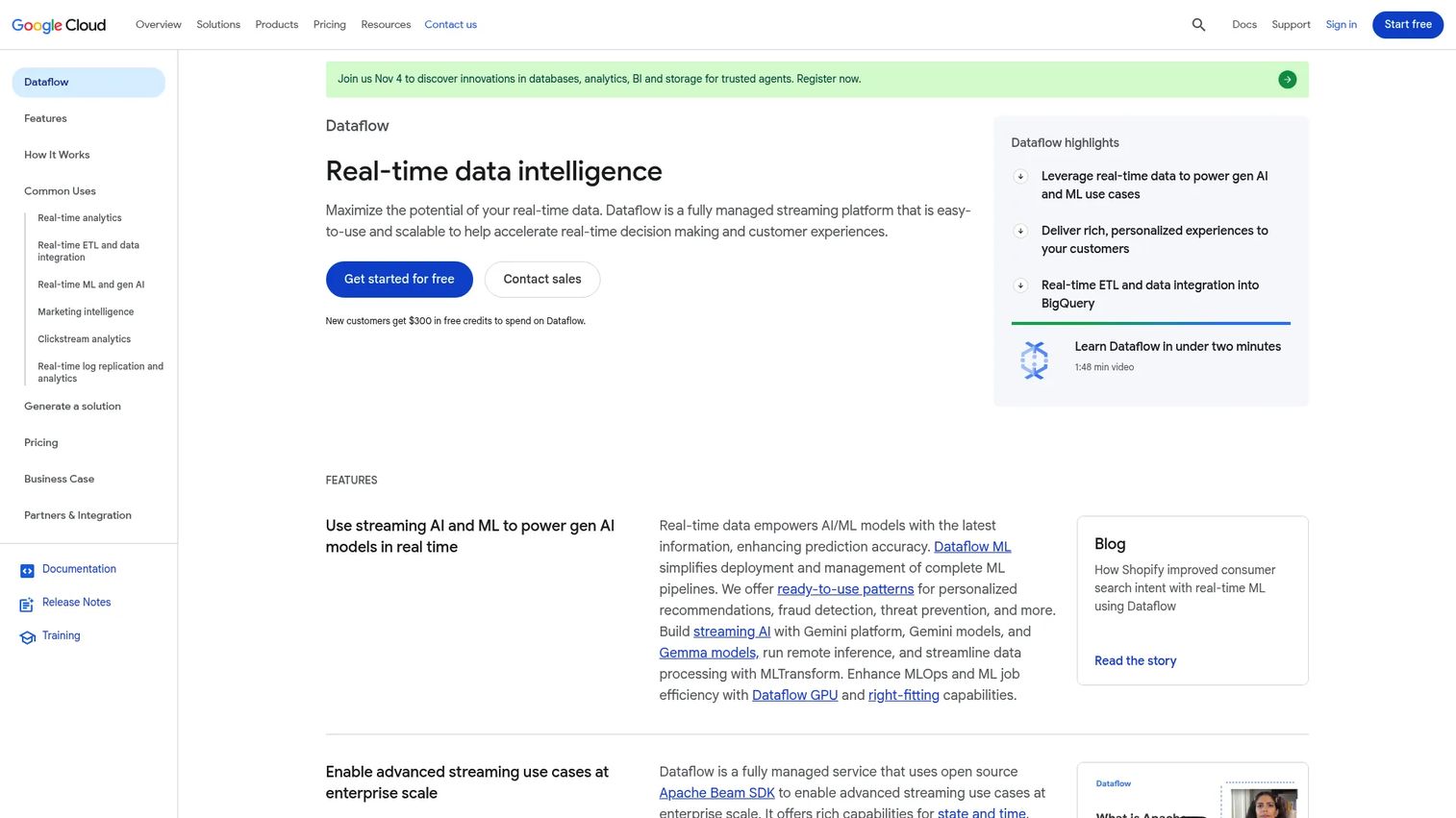
Google Cloud Dataflow is a fully managed service for unified stream and batch processing based on Apache Beam. The Apache Beam model means pipelines are portable: You write once and can run on Dataflow or other Beam runners. Dataflow handles autoscaling and resource management automatically, which reduces the infrastructure overhead for teams running mixed stream and batch workloads on Google Cloud.
Best for: Google Cloud teams that want managed stream and batch processing with Apache Beam portability and autoscaling.
Key features
- Apache Beam unified programming model
- Autoscaling and serverless execution
- Stream and batch processing from a single pipeline
- Dataflow templates and visual job builder
- Monitoring, diagnostics, and cost estimation tooling
Why choose Google Cloud Dataflow: Dataflow is the right choice when Google Cloud is your platform and you want a single processing model across batch and streaming without managing clusters. PMs whose product analytics and personalization pipelines depend on timely processing from behavioral events benefit when that processing runs reliably and without engineering intervention on scaling.
Google Cloud Dataflow pricing: Pay-as-you-go, billed by consumed resources. Batch starts at $0.06 per unit, streaming at $0.089 per unit. Committed use discounts are available for streaming workloads: 1-year at $0.0712/unit and 3-year at $0.0534/unit.
G2 rating: 4.2/5
8. Azure Stream Analytics
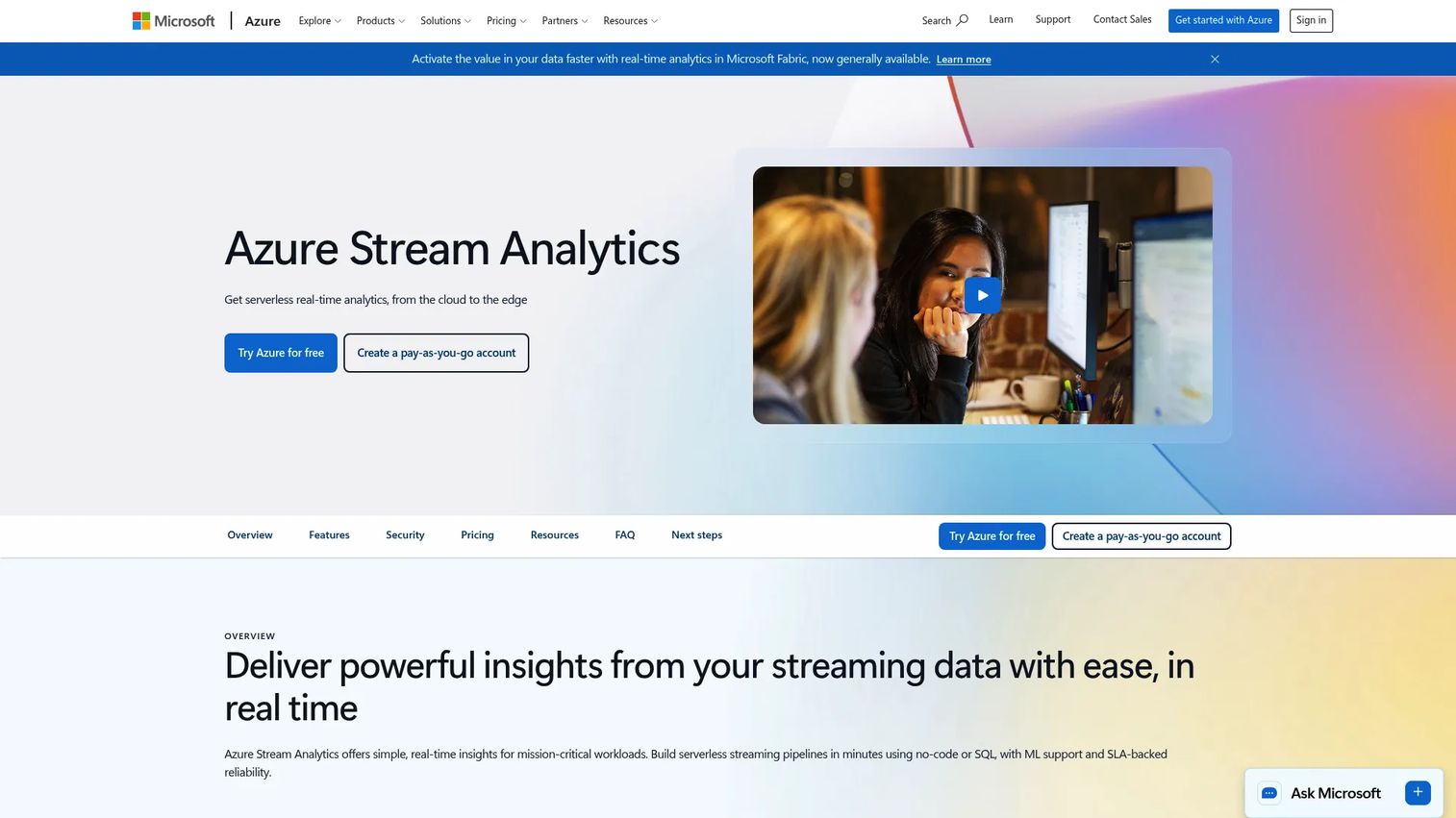
Azure Stream Analytics is a fully managed, serverless real-time analytics service that processes fast-moving streaming data from Azure event sources using familiar SQL syntax. It integrates with Azure Event Hubs and Azure IoT Hub for ingestion, and outputs results to Power BI, storage, or downstream processing services. Analysts and data engineers who know SQL can write streaming queries without adopting a lower-level streaming framework.
Best for: Microsoft Azure teams that want SQL-based real-time analytics without managing stream-processing clusters.
Key features
- SQL-based stream-processing pipeline authoring
- Built-in ML capabilities for anomaly detection
- Cloud and edge deployment with elastic scaling
- Azure Event Hubs and IoT Hub integration
- Power BI output for real-time dashboards
Why choose Azure Stream Analytics: Choose it when Azure is your established platform and your team wants analysts to write streaming queries without infrastructure overhead. It's a practical path to real-time product signals for organizations already deep in the Microsoft stack. The SQL model also reduces the learning curve compared to code-first stream processors.
Azure Stream Analytics pricing: Pricing uses a streaming unit model billed hourly. Microsoft's pricing page lists Standard V2 (minimum 1/3 streaming unit) and Dedicated V2 (minimum 12 streaming units) tiers, but numeric amounts are not displayed on the pricing page and require the Azure pricing calculator or a Microsoft conversation for specifics.
9. Apache Spark
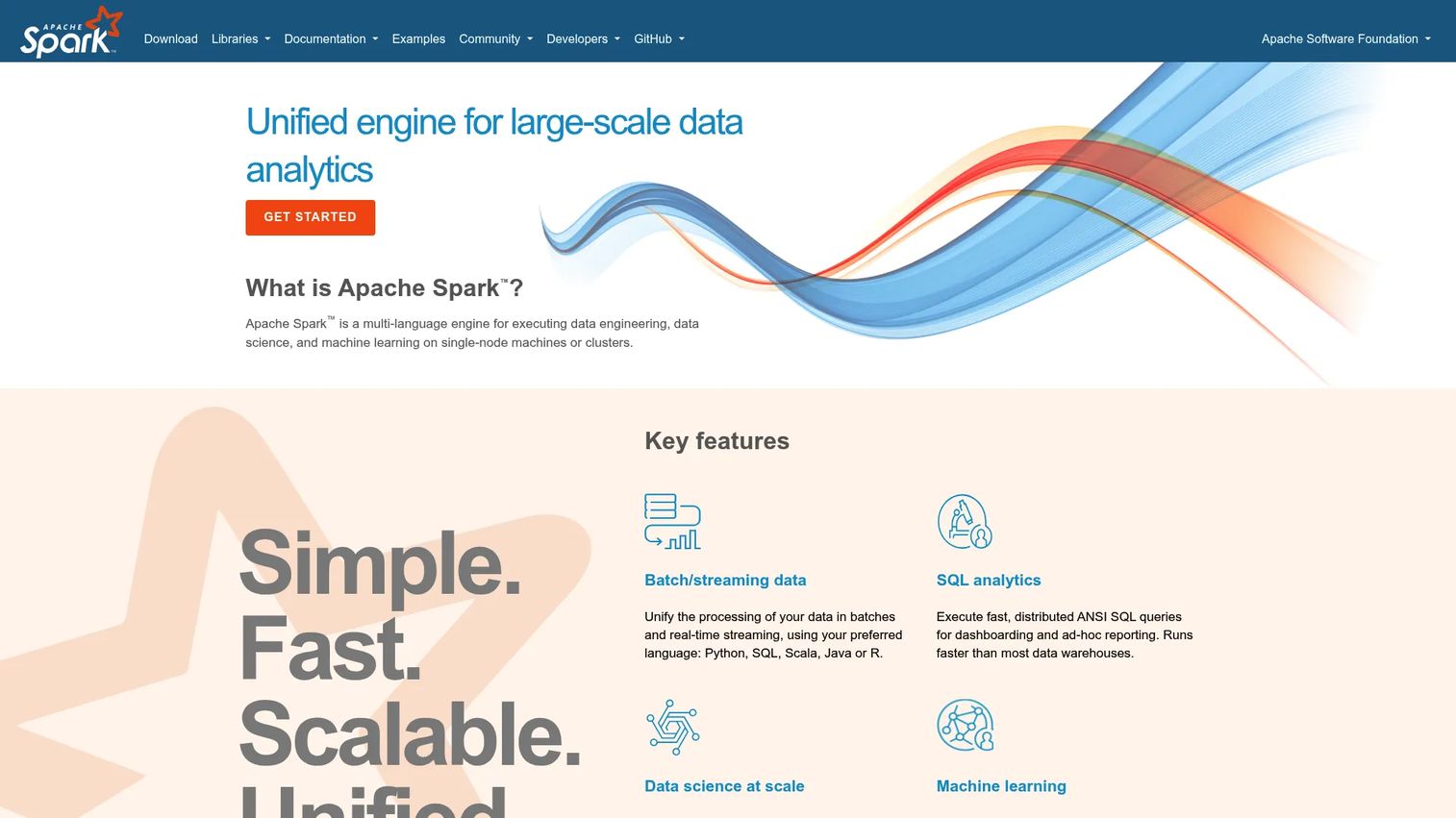
Apache Spark is a unified analytics engine for large-scale data processing that supports both batch and streaming workloads through its Structured Streaming model. Teams that already run Spark for batch analytics can extend that investment into streaming without adopting a separate engine. Structured Streaming treats a live stream as an unbounded table, which simplifies the programming model for engineers familiar with DataFrame APIs.
Best for: Data teams already using Spark for batch analytics who need to extend those workloads into streaming with a shared toolchain.
Key features
- Structured Streaming on a unified DataFrame model
- Batch processing with Spark SQL and DataFrames
- MLlib for machine learning at scale
- GraphX for graph-processing workloads
- Large connector base for data lakes and warehouses
Why choose Apache Spark: Spark is the strongest choice when your data team has existing Spark investment and the streaming workload connects tightly to lakehouse or warehouse analytics. The shared toolchain reduces the opportunity cost of learning a new framework. For product teams building on predictive analytics foundations, Spark's MLlib and streaming combination is particularly coherent.
Apache Spark pricing: Free under the Apache license. Production costs come from compute, storage, and the managed platform running it, whether that's Databricks, AWS EMR, Google Dataproc, or a self-hosted cluster.
G2 rating: 4.3/5
10. Apache Storm
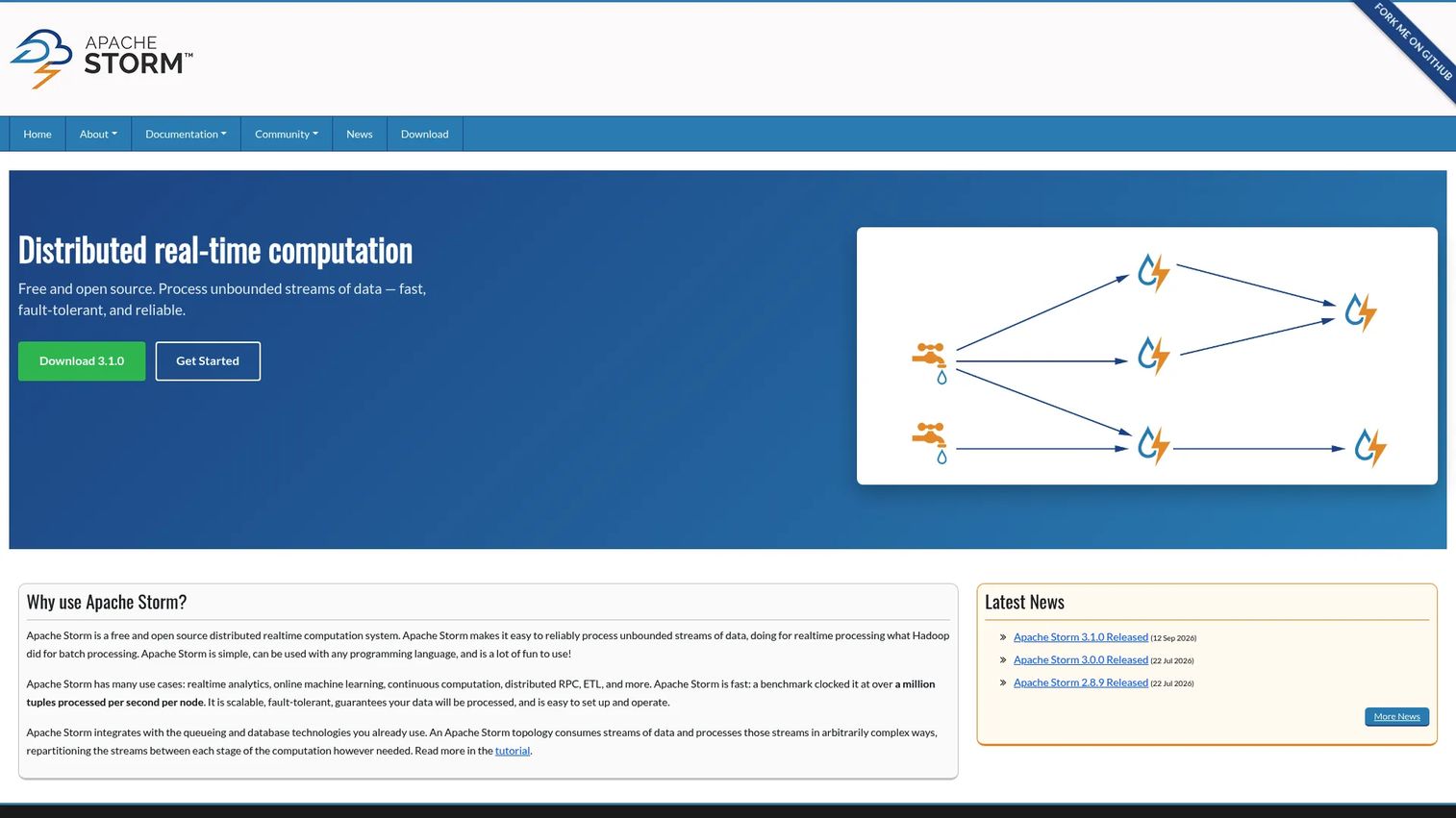
Apache Storm is a free, open-source distributed real-time computation system for processing unbounded data streams. It uses a topology model built from spouts (data sources) and bolts (processing steps), and guarantees at-least-once message processing. Storm is an established technology with a long production track record, though newer managed and stateful processing options have largely supplanted it for greenfield projects.
Best for: Engineering teams maintaining existing Storm topologies or organizations with established Storm expertise.
Key features
- Stream topologies built from spouts and bolts
- Guaranteed message processing with fault tolerance
- Distributed, scalable real-time computation
- Multi-language support via Thrift interface
- Integrations with Kafka, HDFS, JDBC, and Redis
Why choose Apache Storm: Storm is most relevant when your organization already runs Storm workloads and migration cost outweighs the benefits of switching. For new projects, Flink, Spark Streaming, and managed cloud services offer more modern state management, exactly-once semantics, and lower operational overhead. Evaluate Storm honestly against those options before committing to it for a new use case.
Apache Storm pricing: Free under the Apache license. Operating costs come from compute infrastructure and the engineering time required for maintenance and upgrades.
G2 rating: 3.7/5
11. Aiven for Apache Kafka
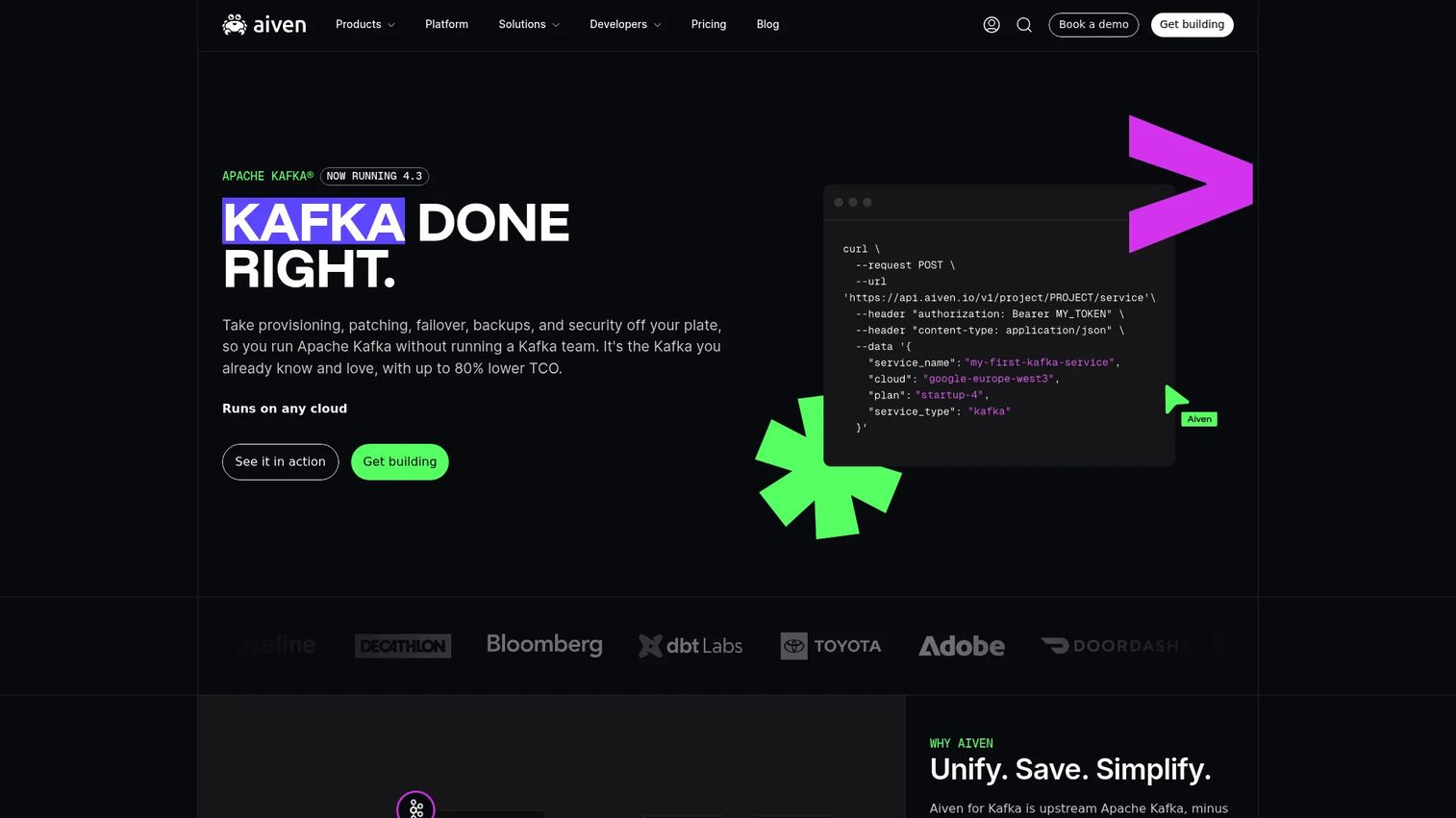
Aiven for Apache Kafka provides fully managed Apache Kafka across AWS, Google Cloud, Azure, and other cloud providers. It includes automatic failure recovery, multi-availability-zone clusters, managed Kafka Connect, Schema Registry, REST proxy, and MirrorMaker 2 for cross-cluster replication. Teams that want managed Kafka operations without locking into a single cloud hyperscaler find Aiven a practical option.
Best for: Teams that want managed Kafka with cloud provider flexibility and minimal operational overhead.
Key features
- Managed Kafka with automatic failure recovery
- Multi-cloud availability across AWS, GCP, Azure, and others
- Kafka Connect with managed source and sink connectors
- Schema Registry and REST proxy
- Diskless topics using cloud object storage
Why choose Aiven for Apache Kafka: Aiven is worth evaluating when Kafka is the right architecture but your team wants managed operations and the flexibility to run across clouds or switch providers later. For product teams waiting on event infrastructure before shipping features, reducing the setup and maintenance burden on the data engineering team has a real opportunity cost impact.
Aiven for Apache Kafka pricing: Free tier available at $0/month for limited throughput. Developer plans start at $35/month ($0.04/hour). Professional production plans start from $180/month ($3.84/hour) with storage and networking potentially billed separately.
G2 rating: 4.3/5
12. Cloudera DataFlow
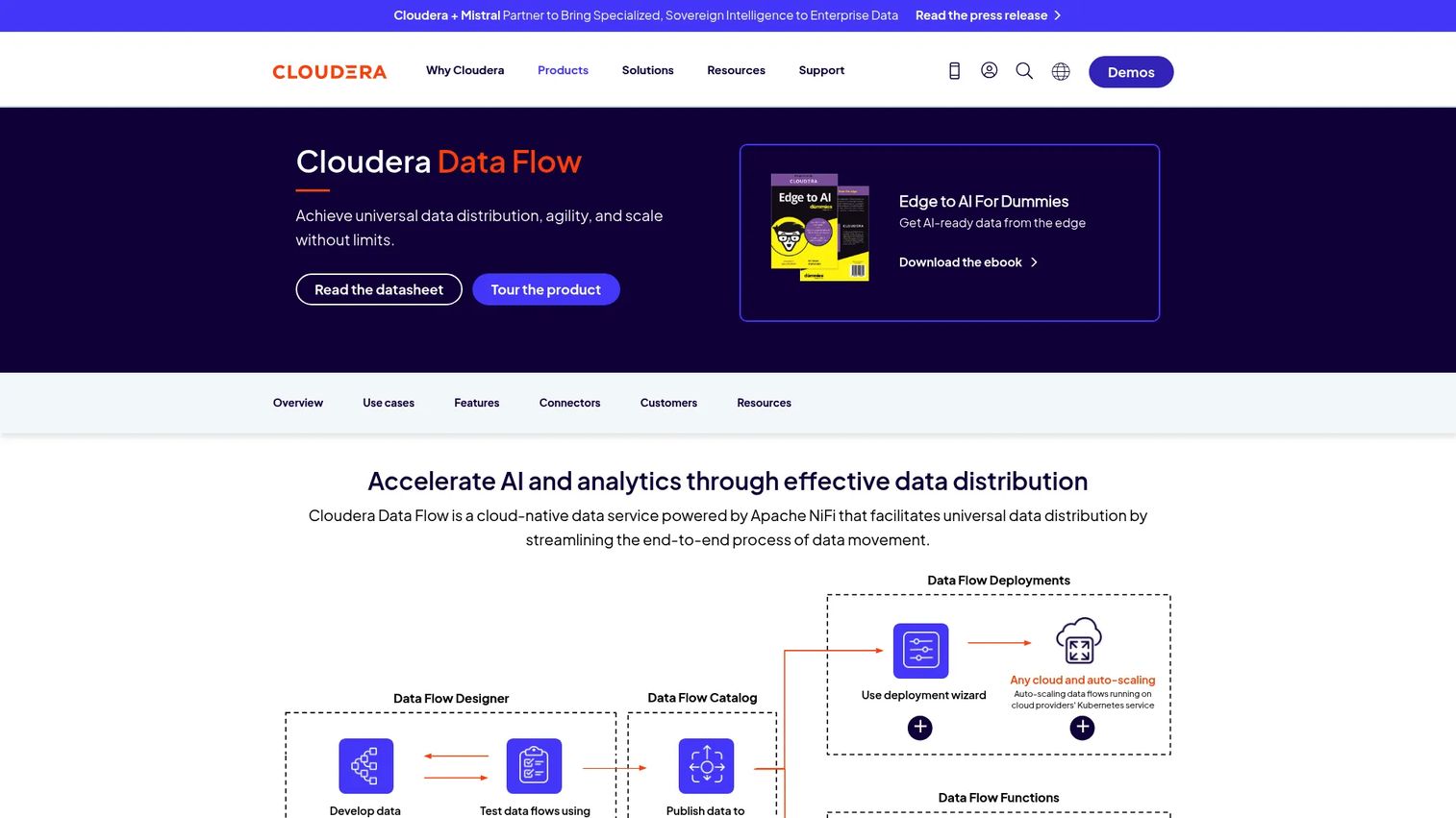
Cloudera DataFlow is a cloud-native universal data distribution service powered by Apache NiFi. It supports data movement across on-premises, cloud, edge, and AI destinations through 450+ connectors, a visual Flow Designer, ReadyFlows, and serverless Functions on AWS Lambda, Azure Functions, and Google Cloud Functions. Cloudera's positioning is enterprise data movement with governance rather than low-latency analytics.
Best for: Enterprises with hybrid data environments that need governed streaming pipeline management across edge, cloud, and on-premises infrastructure.
Key features
- 450+ connectors for universal source and destination connectivity
- Flow Designer and built-in ReadyFlows for rapid pipeline creation
- Auto-scaling, fault-tolerant flow deployments
- Serverless Functions on AWS Lambda, Azure Functions, and GCP Functions
- Central monitoring dashboard with KPI alerts
Why choose Cloudera DataFlow: Cloudera fits when event stream processing is part of a broader enterprise data movement strategy with governance, compliance, and hybrid deployment requirements. Teams with complex environments and existing Cloudera investments will find tighter integration. For best customer data platform evaluations that include on-premises sources, Cloudera's edge-to-cloud coverage is relevant.
Cloudera DataFlow pricing: Usage-based pricing at $0.30 per Cloudera Compute Unit (CCU) for deployments and test sessions. Functions start at $0.10 per billable invocation with volume discounts. Infrastructure and cloud provider costs are additional.
G2 rating: 3.5/5
13. Cribl Stream
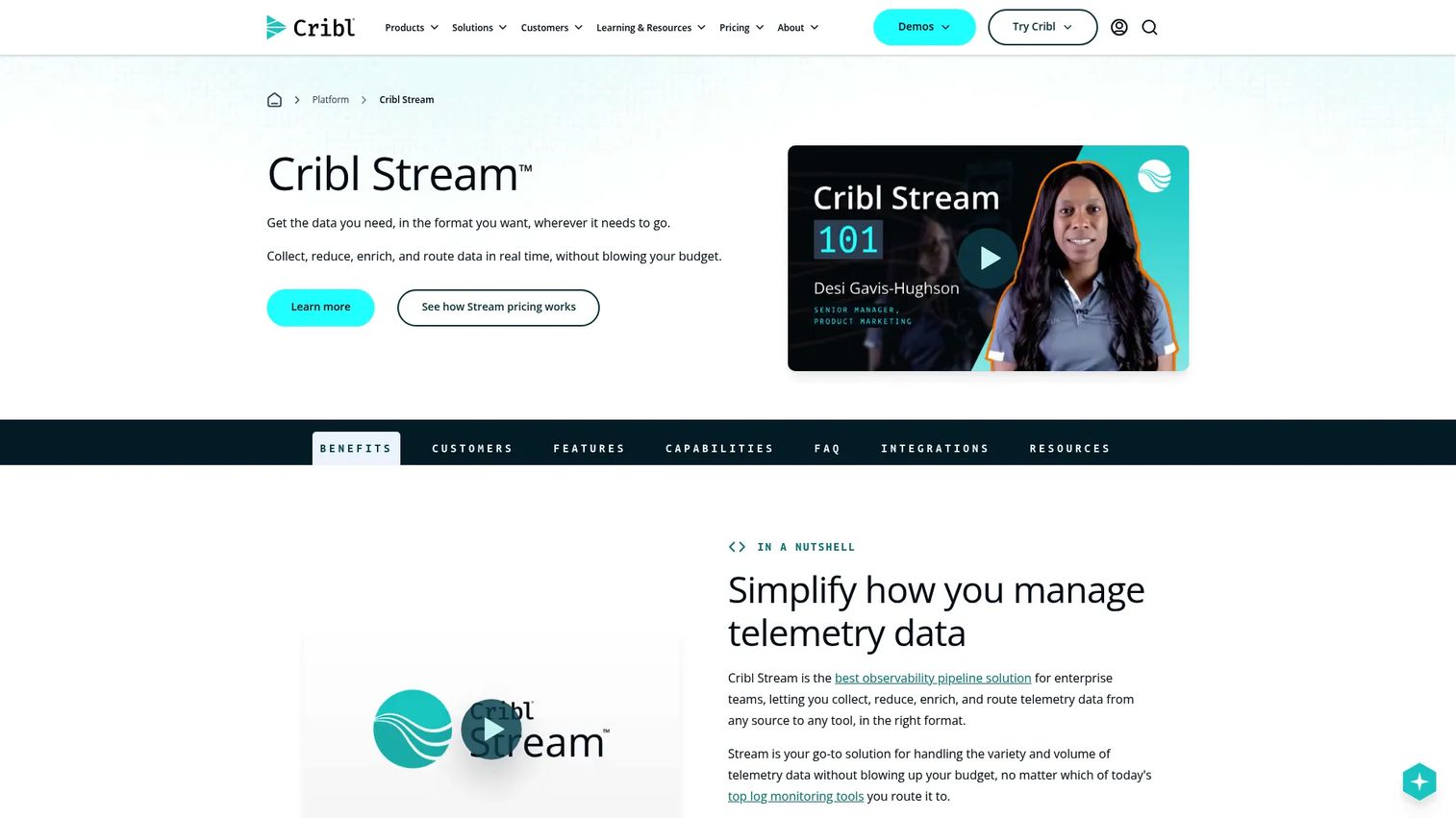
Cribl Stream is an observability pipeline solution that collects, reduces, enriches, transforms, and routes telemetry data from 80+ sources to analytics, security, and storage destinations. It sits between your telemetry sources and downstream tools, letting teams filter, sample, and shape data before it reaches expensive SIEM or observability platforms. AI-assisted schema mapping and transformation are part of the current feature set.
Best for: Enterprise IT, security, and observability teams that need vendor-neutral telemetry routing, cost reduction, and data shaping before downstream ingestion.
Key features
- Collection from 80+ telemetry sources and destinations
- Filtering, sampling, aggregation, and transformation
- Data enrichment using lookups and external sources
- Replay from Cribl Lake, S3, and low-cost storage
- AI-assisted schema mapping and filtering
Why choose Cribl Stream: Cribl addresses a specific problem: Controlling telemetry volume and cost before it reaches expensive downstream tools. It's more observability-pipeline focused than general product event processing. If your core challenge is managing log and metrics sprawl rather than product event computation, Cribl solves a different problem than Kafka or Flink. Teams also looking at marketing analytics stacks sometimes evaluate Cribl for routing behavioral event data.
Cribl Stream pricing: Free tier covers up to 1TB/day with no license required. Standard and Enterprise plans are credit-based and support up to 5TB/day and unlimited data volume respectively. Monetary prices for Standard and Enterprise are not displayed on the pricing page.
G2 rating: 4.3/5
14. DataBahn
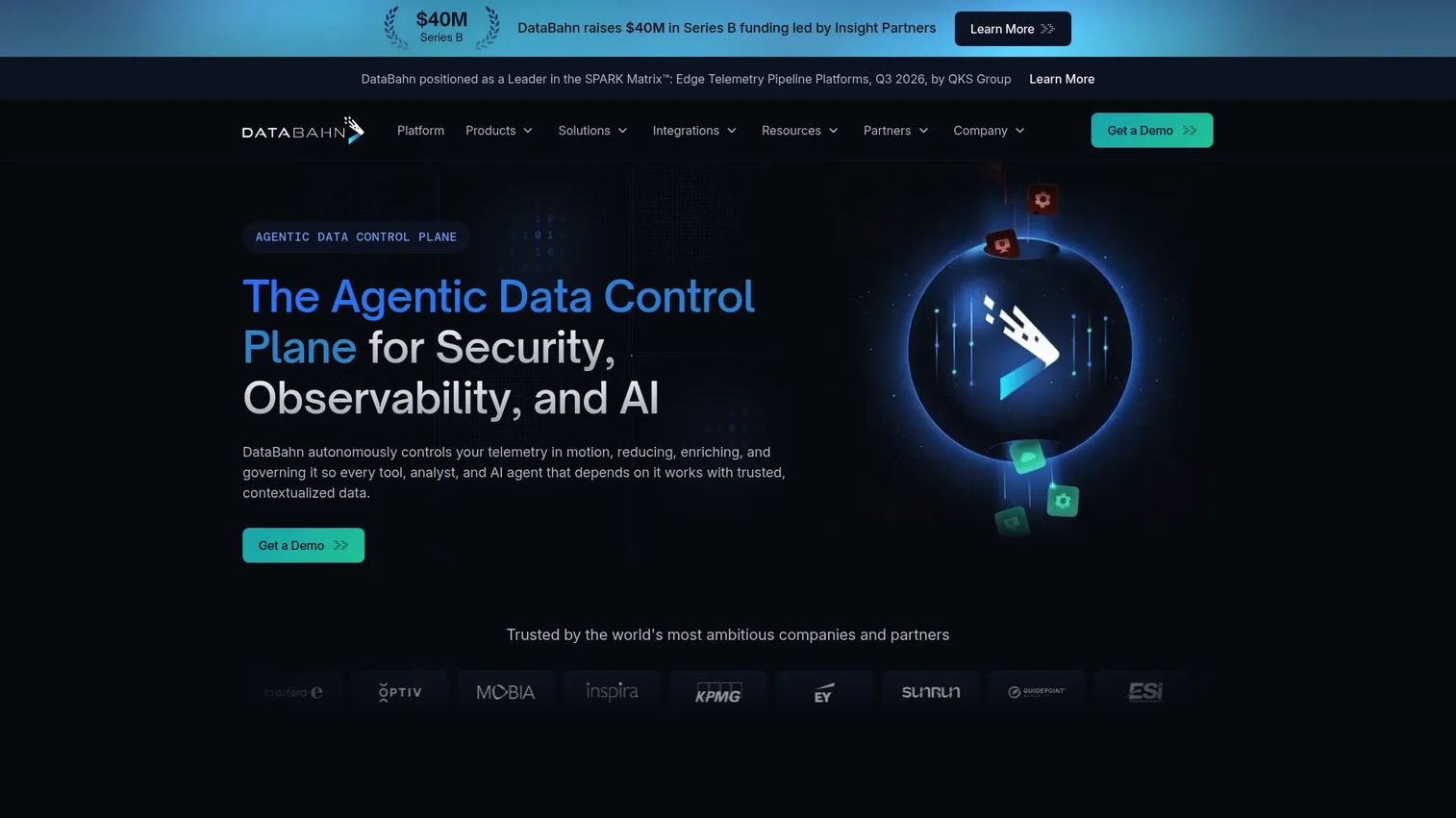
DataBahn is an agentic data control plane for security, observability, and AI that collects, routes, enriches, governs, and acts on telemetry. Its architecture includes Smart Edge for data collection, Highway for AI-driven routing and transformation, Cruz for autonomous pipeline monitoring, and Reef for contextual graph correlation. The platform is built for enterprise security and observability teams dealing with high-volume, high-cost telemetry pipelines.
Best for: Security and platform teams managing high-volume security event streams, SIEM integration, and AI-ready data pipelines.
Key features
- Smart Edge for agentless collection and mesh architecture
- Highway for AI-driven telemetry filtering, routing, and cost optimization
- Cruz for autonomous pipeline parsing and troubleshooting
- Reef for contextual graph correlation and multi-source enrichment
- In-stream sensitive-data protection and threat detection
Why choose DataBahn: DataBahn fits when event stream processing sits inside a security operations context and the team needs AI-assisted pipeline optimization alongside vendor-neutral routing. It addresses a narrower problem than general-purpose brokers or processors, focusing on security telemetry cost and routing rather than product event analytics. Reviews on G2 reflect a small but highly satisfied user base.
DataBahn pricing: DataBahn does not display pricing on its website. Buyers should request a demo to start a pricing conversation. Cost drivers likely include ingest volume, deployment model, and number of downstream destinations.
G2 rating: 4.8/5
15. Axual Platform
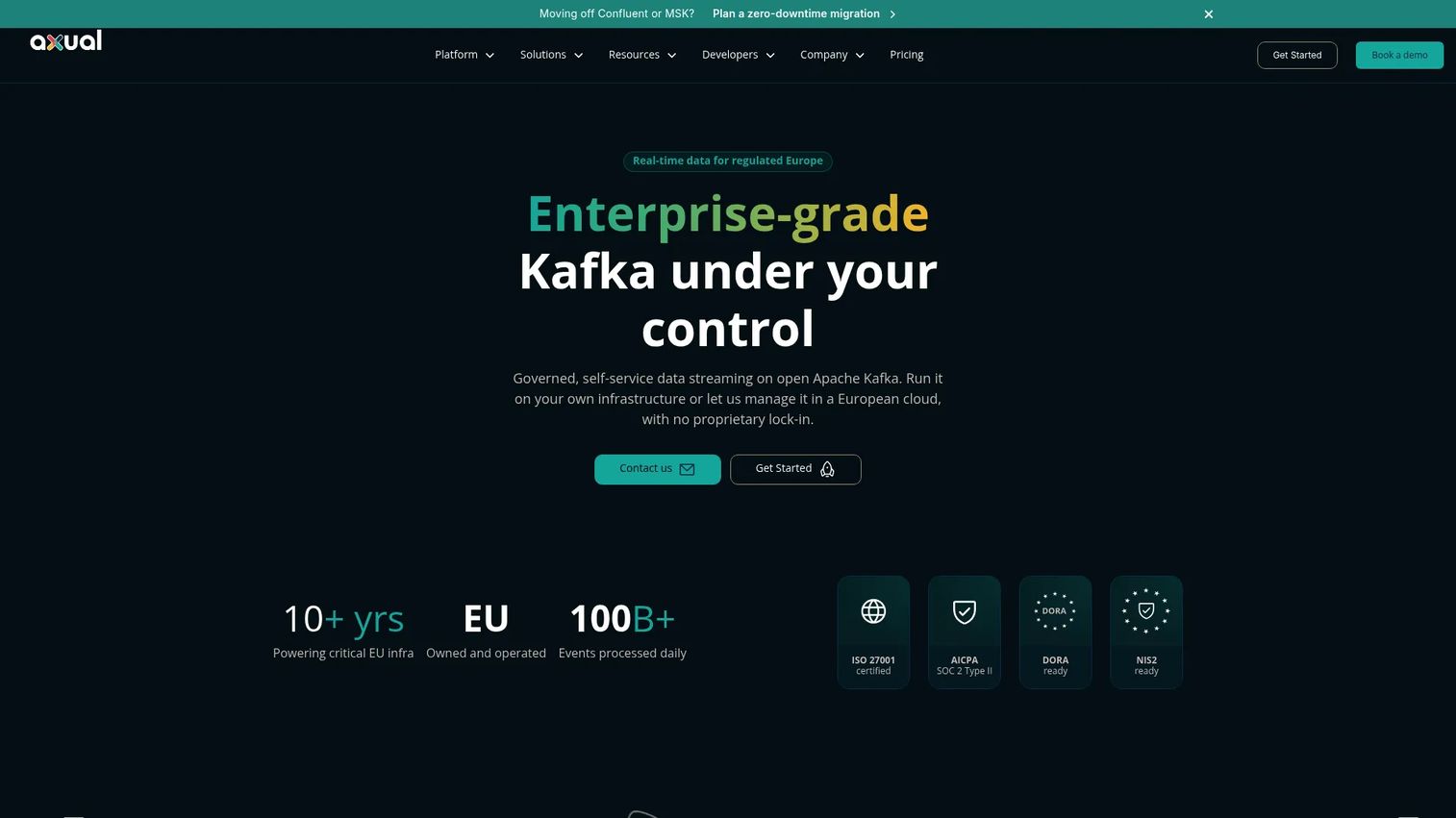
Axual Platform is an enterprise Apache Kafka platform with governance, self-service, and access controls for event streaming across teams. It supports Kafka and Strimzi, adds topic and schema governance, self-service connectors, RBAC and ABAC access controls, IAM/SSO, mTLS, and SAML/OAuth, and deploys across on-premises, cloud, hybrid, and Kubernetes environments. The platform is designed for regulated enterprises that need multiple teams to publish and consume event streams without turning Kafka access into a manual ticket queue.
Best for: Regulated enterprises standardizing governed Kafka adoption across multiple product and data teams.
Key features
- Apache Kafka and Strimzi-based streaming platform
- Topic, schema, and access governance
- Self-service connectors and Terraform provider
- RBAC/ABAC, IAM/SSO, mTLS, and OAuth security
- On-premises, cloud, hybrid, and Kubernetes deployment
Why choose Axual Platform: Axual solves the governance problem that raw Kafka doesn't address: How do multiple teams produce and consume event streams safely without creating a configuration mess or a security gap. For PMs working in regulated industries where data visualization and reporting derive from governed event streams, Axual provides the organizational controls that make Kafka adoption scale beyond a single team.
Axual Platform pricing: Pricing is not displayed. Plans are billed annually using capacity-based pricing. Axual Cloud, on-premises/customer-cloud, and Strimzi support are the three deployment options. Contact Axual sales for specific rates.
G2 rating: 4.5/5
Considerations when choosing event stream processing software
Know whether you need a broker, a processor, or both
Kafka and Redpanda move and store event streams. Flink and Spark compute over them. Most production architectures use both layers: A broker for durable ingestion and a processor for stateful analytics. Choosing only a broker when your workload requires windowing or joins means adding that layer later under pressure.
Define latency and throughput requirements before shortlisting tools
Ask your engineering team concrete questions before choosing: How many events per second does the workload generate, what p95 latency matters for the product decision, how long must data be retained, and how much replay does the product need. Those numbers eliminate options quickly. A tool that handles 100K events/second with 50ms latency is wrong for a use case that needs sub-10ms.
Evaluate state management and failure handling seriously
Checkpointing, replay, failover behavior, and exactly-once semantics separate enterprise-ready processors from lighter-weight options. Product managers should ask what happens when a processing job fails during a launch or a billing workflow. If the answer involves manual intervention or data loss, that's a reliability risk with real downstream impact on activation and retention metrics.
Check integration fit with your actual stack
Evaluate connectors for data lakes, warehouses, CRM systems, observability platforms, and CI/CD tooling before committing. Avoid "integrates with everything" claims and instead confirm the specific integrations your product analytics and lifecycle messaging systems require. Schema registry support matters if multiple teams produce events that downstream consumers need to parse reliably.
Plan ownership, monitoring, and release cadence alignment
Streaming systems degrade without clear ownership. Schema changes break consumers. Processing jobs go stale as the product changes. PMs should align event definitions and schema versioning with engineering and data teams before going to production, not after. The release cadence of your streaming pipeline should match the release cadence of the product features it supports.
Conclusion
The event stream processing landscape runs from free open-source frameworks to fully managed enterprise platforms, and the right choice depends on the architecture role you need filled, not the vendor name.
Kafka and Flink remain the foundational open-source pair to understand: Kafka for durable event transport, Flink for stateful computation. Confluent, Redpanda, and Aiven each make that pair more operationally accessible in different ways. Amazon Kinesis Data Streams, Google Cloud Dataflow, and Azure Stream Analytics serve teams committed to their respective cloud platforms. SAS Event Stream Processing and Cloudera DataFlow address enterprise governance and hybrid deployment requirements that cloud-native services don't cover. Cribl Stream and DataBahn solve narrower, observability and security-focused routing problems.
Start from the workload. Define whether you need a broker, a processor, or a managed analytics layer. Then match the tool to those requirements, not the other way around.
If your next step is showing complex software clearly to buyers or internal teams, create an interactive product demo with Guideflow.
Start your journey with Guideflow today!
FAQs
Event stream processing software ingests and processes continuous event data in real time, as events occur, rather than storing them first and querying in batch. Events include clicks, transactions, sensor readings, signups, and log records. The software analyzes, transforms, enriches, and routes those events while they are still moving, enabling decisions that depend on timing.
Event streaming moves and stores events reliably, typically using a broker like Kafka or Redpanda. Event stream processing computes over those events, applying windowing, joins, aggregations, and stateful logic to produce derived results. Most production architectures combine both layers rather than treating them as alternatives.
Kafka is primarily an event streaming platform and distributed event log, not a stream processor. It handles ingestion, retention, and delivery reliably. Kafka Streams provides lightweight embedded processing, but teams that need stateful computation, complex windowing, and joins typically pair Kafka with a dedicated processor like Apache Flink or Apache Spark Structured Streaming.
Product teams benefit from event stream processing when timing changes the outcome of the product decision. Common cases include firing onboarding activation triggers while the user is still active, detecting fraud patterns before a transaction clears, sending entitlement updates immediately after a billing event, and personalizing in-product paths based on live behavioral signals rather than yesterday's warehouse snapshot.
Apache Flink is the strongest option for stateful, low-latency analytics over event streams. Apache Spark Structured Streaming fits teams already running Spark for batch workloads. For cloud-native deployments, Amazon Kinesis Data Streams, Google Cloud Dataflow, and Azure Stream Analytics each reduce infrastructure management. The right answer depends on latency requirements, existing cloud commitments, and whether the team needs stateful computation or primarily managed ingestion.
Kafka stores and transports event streams reliably with configurable retention and replay. Flink processes and analyzes them continuously with stateful operators, windowing, and exactly-once semantics. If events need to move reliably, think Kafka. If events need continuous computation, think Flink. Many teams use both together and should plan for that combination from the start rather than adding Flink as an afterthought.
Latency profile, throughput ceiling, and state management are the three that cut the shortlist fastest. Beyond those, windowing support, replay capability, fault tolerance and checkpointing, connector integrations with your existing stack, monitoring and alerting, and schema governance all matter for production reliability. PMs evaluating these tools should also ask about maintenance overhead across release cadence changes, since streaming pipelines that fall behind product updates create data quality problems.
Managed platforms reduce the operational burden of provisioning, scaling, upgrading, and recovering streaming infrastructure. For most product and data teams, that reduction in engineering overhead is worth paying usage-based costs. The tradeoff is higher per-unit cost at volume and some degree of cloud lock-in. Teams with existing infrastructure engineering capacity and cost sensitivity may prefer open-source self-hosted options. Teams prioritizing time-to-value and low maintenance overhead typically find managed services the faster path to production.