A clinician finishes a full clinic day, then opens the laptop again at 9 p.m. to close 14 open charts. That second shift has a name in the research: pajama time. It is one of the clearest drivers of clinician burnout, and it is the exact problem AI medical scribe software is built to remove.
The category has moved fast. Healthcare AI usage among U.S. physicians rose from 38% in 2023 to 66% in 2024, according to DocVA (2026), with AI scribe tools leading much of that adoption. The market backs the shift: the U.S. AI medical scribing market was $397 million in 2024 and is forecast to reach $2.96 billion by 2033 at a 25.1% CAGR, per Grand View Research (2024).
Here is the catch. Most buyers evaluate an ai medical scribe the way they evaluate a consumer app: they watch a slick demo, like the note it produces once, and sign. Then the real questions surface. Does it write back into the chart, or into a copy-paste buffer? Does note accuracy hold up on a multi-problem visit? Is the BAA real, or a checkbox?
If you evaluate software for a living, you already know the pattern. The tool that wins is rarely the one with the best output on a clean input. It is the one that fits the workflow, survives the release cadence of your EHR, and gives you something to measure.
This guide compares 14 ai scribe software options for 2026 the way a product manager would: by workflow fit, ehr integration, compliance posture, note accuracy, and specialty coverage. No hype about "revolutionary" AI. Just the buying criteria that decide whether a rollout sticks.
What's inside
This guide is for clinicians, practice owners, ops leaders, and the product and IT teams who evaluate documentation software on their behalf.
Every tool on the list does the core job: it listens during a visit, drafts a structured note, supports review and edit, and moves that note toward the chart. We chose and ordered tools using four criteria that matter more than feature counts:
- Workflow fit: how little the clinician has to change to get value
- Compliance posture: BAAs, data handling, and secure healthcare documentation
- Accuracy and specialty coverage: note quality across common and complex visits
- Integration depth: how the note reaches your EHR
TL;DR
- Best overall for broad clinical workflows: Freed pairs real-time note generation with visit prep and ICD-10 and CPT coding support in one clinician-friendly product.
- Best for specialty-focused practices: DeepScribe leans into specialty-oriented documentation, SmartPrep, and customization.
- Best for independent practices: NoteV offers low per-provider pricing and fast drafting without an enterprise contract.
- Best for EHR-heavy teams: Sunoh.ai and OmniMD AI Scribe fit clinics that need a wide integration surface or a documentation layer inside a broader EHR suite.
- Best for compliance-first buyers: Transcribe Health ships a BAA on every plan, including its free tier.
- Best for enterprise and coding support: Abridge, Ambience Healthcare, Suki AI, and Nuance DAX Copilot target health systems that need documentation plus revenue-cycle workflows.
What is medical scribe software
Medical scribe software is a tool that listens to a patient encounter, drafts a structured clinical note from the conversation, and helps the clinician review, edit, and sync that note into an electronic health record. Modern versions use ambient clinical documentation, meaning the clinician talks naturally to the patient and the software captures the visit in the background.
That last point separates ambient scribes from older tools. Medical dictation software transcribes what you deliberately speak into it. Ambient documentation listens to a natural conversation between clinician and patient, then structures it into a note format like SOAP or H&P. The clinician does not narrate the chart; the software infers it.
Most medical scribe software shares a common set of capabilities:
- Listens during visits: captures the encounter through a phone, tablet, or desktop mic
- Drafts structured notes: produces SOAP, H&P, or specialty-specific note formats
- Supports review and edit: puts a draft in front of the clinician before anything is final
- Syncs to EHR workflows: pushes the finished note into the chart, natively or through a paste or FHIR path
- May include coding or prep features: suggests ICD-10, CPT, or E/M codes, or pre-charts from prior visit data
- Handles compliance: operates under a BAA with defined data retention and access controls
The review-before-sync step is the part product teams underrate. A scribe that drafts fast but forces a full manual rewrite has not saved charting time. The tools that win make the path from draft to sign-off short, and give the clinician confidence the note is right before it hits the record.
When to use medical scribe software
Reduce after-hours charting
The clearest trigger is pajama time. When clinicians are closing notes at night, an ambient scribe that drafts during the visit removes most of that work. It also lets the clinician stay present with the patient instead of typing through the appointment. If your primary metric is documentation time per encounter, this is the use case that moves it.
Standardize notes across a team
One clinician's shorthand is another's mystery. When a practice grows, note consistency becomes a real problem for coding, referrals, and continuity of care. Scribe software with shared templates and structured output enforces a common note pattern across providers. The value here is less about speed and more about every note reading the same way, no matter who saw the patient.
Support specialty workflows
A dermatology visit, a behavioral health session, and a cardiology follow-up produce very different notes. A specialty-specific scribe understands the terminology, the exam structure, and the documentation expectations of each field. Cardiology, dermatology, oncology, primary care, behavioral health, and urgent care all benefit from a tool tuned to their patterns rather than a generic template that needs heavy editing.
Medical scribe software comparison
The table below compares all 14 tools by fit, differentiator, pricing, and G2 rating. Use it to shortlist quickly, then read the sections for the two or three that match your practice. Where a vendor does not publish a price or a verified G2 rating, the field is left open rather than estimated.
| # | Product | Best for | Key differentiator | Pricing | G2 rating |
|---|---|---|---|---|---|
| 1 | NoteV | Independent clinicians | 20+ note formats, 50+ EHR integrations | From $29/mo | - |
| 2 | SigXA | Diverse patient populations | Real-time transcription, ambient assistant | 7-day free trial | - |
| 3 | eCareScribe | EHR-embedded teams | Ambient drafting with SMART on FHIR/HL7 | 30-day free trial | 4.5/5 |
| 4 | Transcribe Health | Compliance-first buyers | BAA on every plan, free tier | Free; Solo $56/provider/mo | - |
| 5 | Ambient Scribe | FHIR-based clinics | Patient instructions, real-time transcript | Custom | - |
| 6 | DeepScribe | Specialty practices | SmartPrep, coding, customization | Free; Basic $15/mo | 4.1/5 |
| 7 | Freed | Broad clinical workflows | Scribe plus coding and clinician assistant | From $39/mo | 5.0/5 |
| 8 | Sunoh.ai | EHR-heavy clinics | Wide EHR and device coverage | $149/user/mo | - |
| 9 | OmniMD AI Scribe | Suite-based clinics | Scribe inside EHR/RCM platform | Custom | 4.2/5 |
| 10 | Suki AI | Enterprise workflows | Ambient docs plus assisted coding | Custom | - |
| 11 | Nabla Copilot | Modern clinician UX | At-cursor dictation, dot phrases | Free trial | - |
| 12 | Abridge | Enterprise health systems | Conversation-shaped documentation | Custom | 5.0/5 |
| 13 | Ambience Healthcare | Large health systems | Pre-, in-, and post-visit workflows | Custom | - |
| 14 | Nuance DAX Copilot | Established healthcare buyers | Microsoft healthcare ecosystem | Custom | - |
Best 14 medical scribe software for 2026
1. NoteV
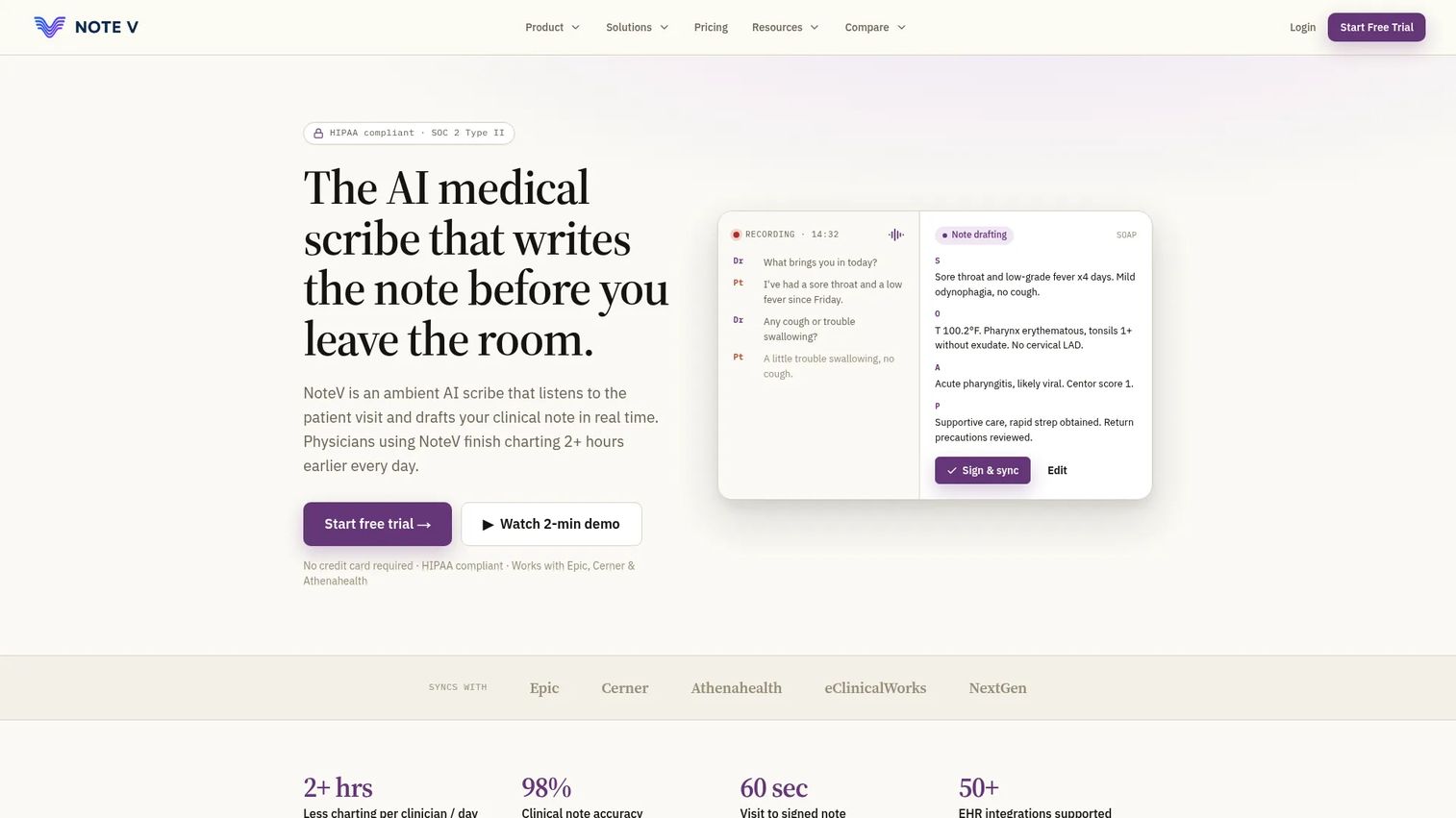
NoteV is ambient AI clinical documentation built for clinics and solo clinicians who want medical-term accuracy without a long implementation. It drafts notes from the patient conversation and syncs them to the chart. The pitch is fast drafting plus broad EHR reach, which matters when you do not want the note trapped in a copy-paste buffer.
Best for: Independent clinicians and small practices that need affordable AI notes with wide EHR sync.
Key strengths
- Ambient AI clinical documentation from natural conversation
- 20+ note formats including SOAP and H&P
- EHR integration with Epic, Cerner, Athenahealth, eClinicalWorks, and 50+ systems
Why choose NoteV: For a solo provider or small team, the combination of low entry pricing and a deep EHR integration list removes the two most common blockers to adoption: cost and chart write-back. It fits practices that want to start documenting differently this week, not next quarter.
NoteV pricing: A 14-day free trial, an Individual plan at $29 per month ($23/mo billed annually), a Practice plan at $49 per user per month ($39/mo billed annually), and Enterprise with custom pricing.
2. SigXA
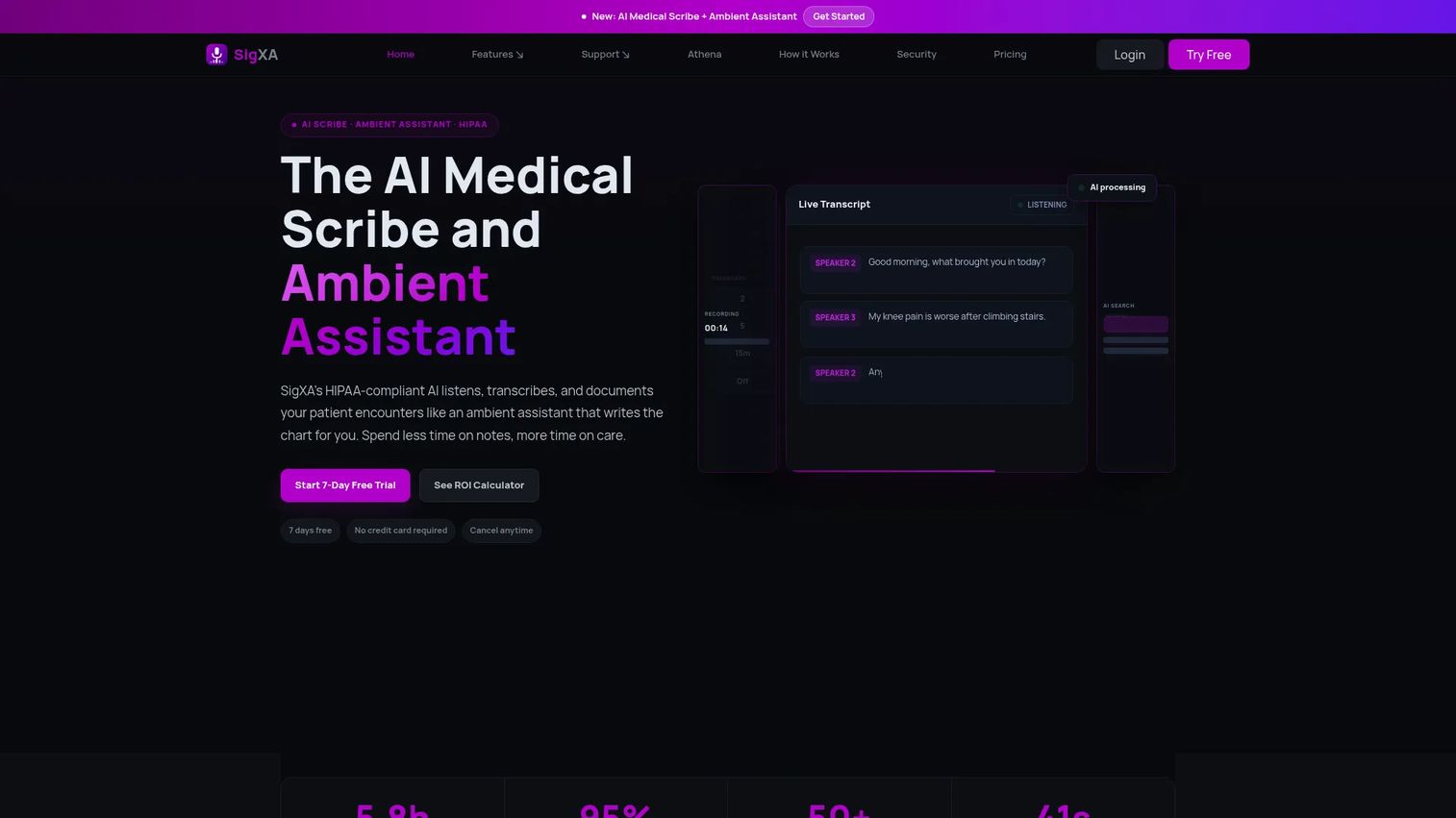
SigXA positions itself as an AI medical scribe and ambient assistant for clinical documentation. It handles real-time transcription, generates SOAP notes, and hands the note off to the EHR. For clinics serving multilingual or diverse patient populations, ambient capture that works across natural speech is the draw.
Best for: Clinics that want HIPAA-aligned note drafting and a straightforward EHR handoff.
Key strengths
- Real-time transcription during the visit
- SOAP note generation from the encounter
- EHR integration for note handoff
Why choose SigXA: SigXA suits teams that want the core ambient scribe job done well without a heavy configuration project. If your patient mix is varied and you need reliable capture of natural conversation, it is worth a trial.
SigXA pricing: A 7-day free trial is advertised, with clinic and group plans available on request. Public per-seat pricing is not listed on the site.
3. eCareScribe
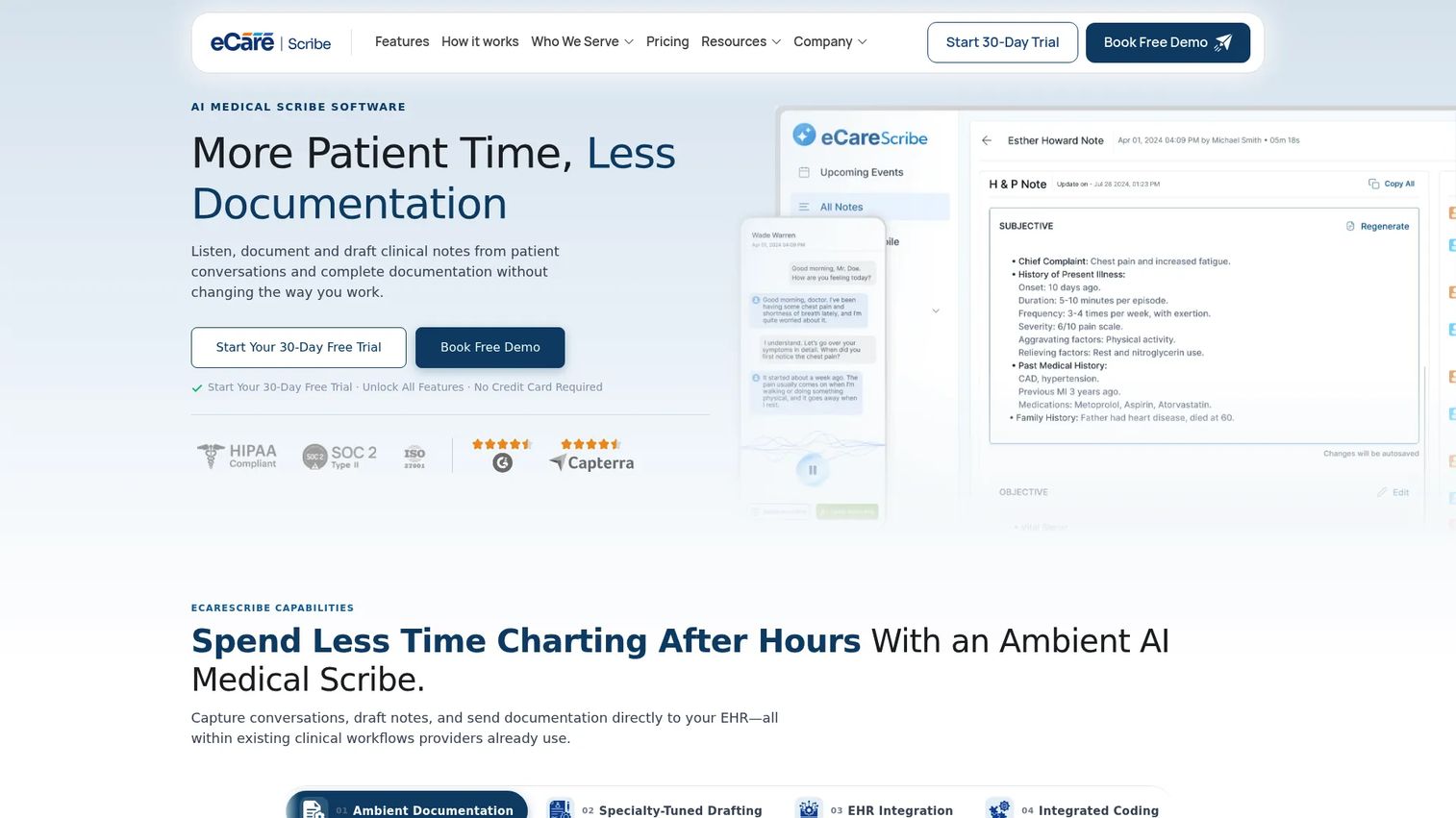
eCareScribe is ambient AI note drafting built to sit inside existing EHR workflows rather than beside them. It captures the visit, drafts a clinical note, and connects through SMART on FHIR, HL7, or native connectors. For teams that treat integration depth as a first-order requirement, that connector list is the headline.
Best for: Clinics and healthcare organizations that want ambient drafting embedded in their current EHR workflow.
Key strengths
- Ambient listening and clinical note drafting
- Specialty-tuned documentation workflows
- EHR integration via SMART on FHIR, HL7, or native connectors
Why choose eCareScribe: If your evaluation criteria are dominated by how cleanly the note lands in the chart, eCareScribe's connector approach is built for that. The specialty tuning means less editing on visits that would otherwise need a rewrite.
eCareScribe pricing: A 30-day free trial or pilot is available with no credit card required. Public dollar pricing is not shown; the site routes buyers to a demo and contact flow.
4. Transcribe Health
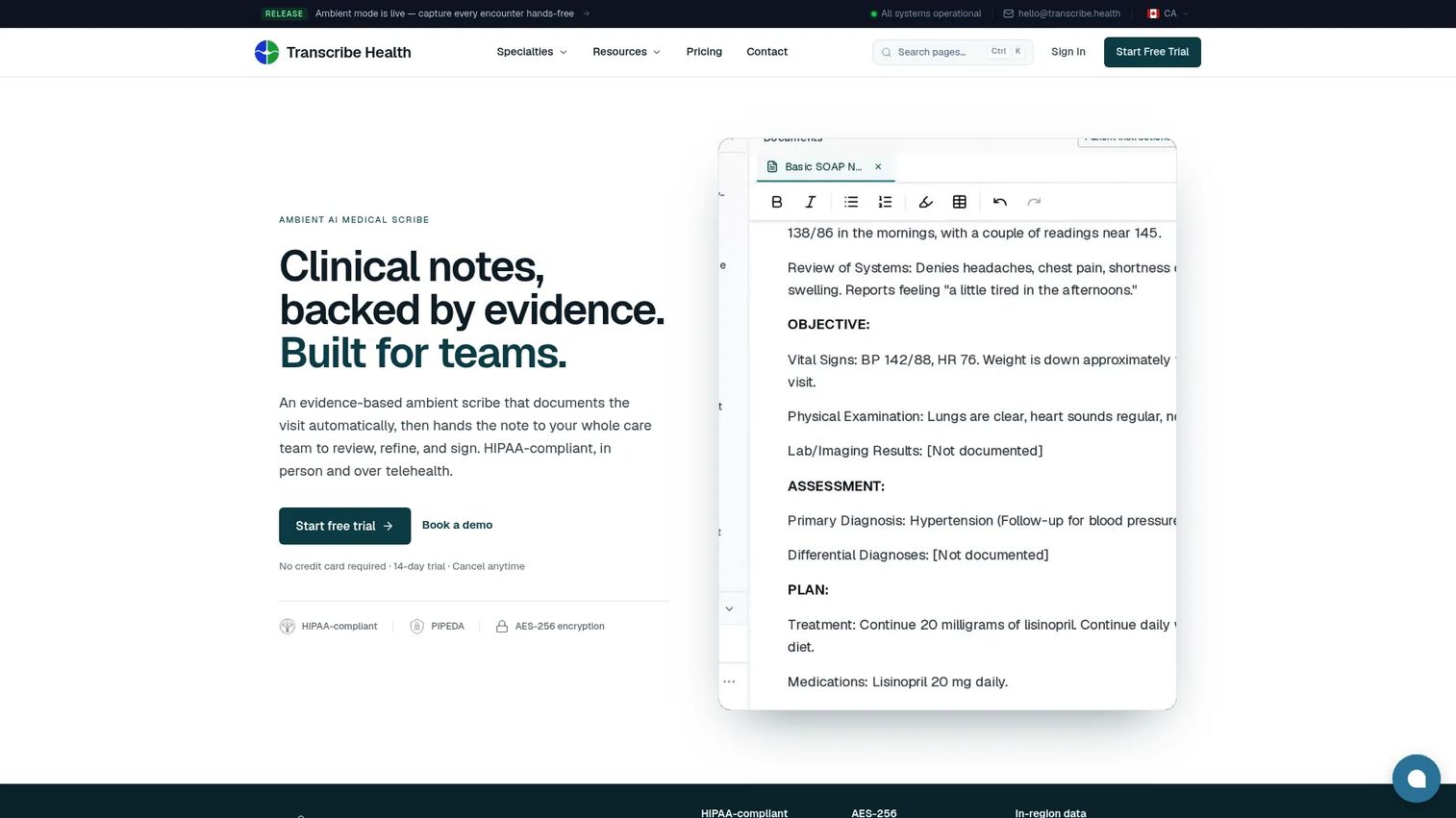
Transcribe Health is HIPAA-compliant ambient scribe and clinical note software with an unusually clean compliance story: a BAA is included on every plan, including the free tier. It captures visits, drafts SOAP and free-text notes, and supports telehealth and EHR workflows.
Best for: Healthcare teams that put compliance and secure healthcare documentation at the top of the checklist.
Key strengths
- Ambient clinical transcription
- SOAP and free-text note templates
- EHR integrations and telehealth capture
Why choose Transcribe Health: Most vendors gate the BAA behind a paid or enterprise tier. Transcribe Health includes it everywhere, which lowers the barrier for a compliant pilot. That makes it a strong first tool to test when procurement wants a signed agreement before any patient audio is captured.
Transcribe Health pricing: A free plan at $0, a Solo plan at $56 per provider per month (billed annually at $670/year), and a custom Enterprise plan. Every plan includes a BAA and ambient transcription.
5. Ambient Scribe
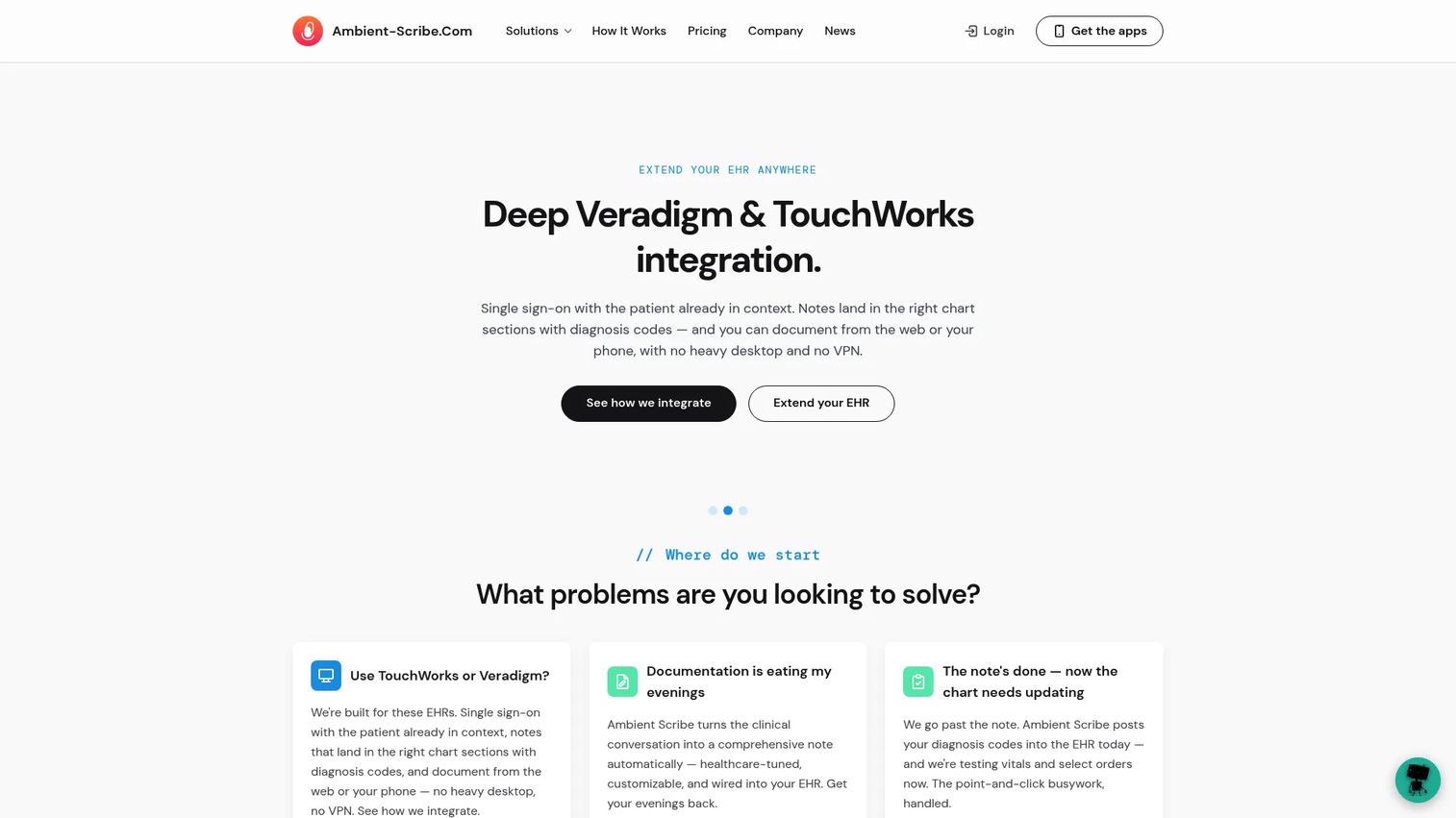
Ambient Scribe is an AI clinical documentation platform built around EHR-ready workflow. It generates a real-time transcript and note, produces patient instructions, and integrates with FHIR-compatible systems. The patient instructions feature is a nice touch for practices that want the after-visit summary handled in the same pass.
Best for: Clinics and healthcare organizations that need ambient documentation with FHIR-based EHR integration.
Key strengths
- Real-time transcript and note generation
- Automated patient instructions
- EHR integrations with FHIR-compatible systems
Why choose Ambient Scribe: If your systems speak FHIR and you want documentation plus patient-facing instructions in one workflow, Ambient Scribe covers both. The enterprise licensing model fits groups that prefer a flat license over per-seat math.
Ambient Scribe pricing: Pricing is custom enterprise licensing, with per-seat to flat-license options sized by group. No public numeric starting price is listed.
6. DeepScribe
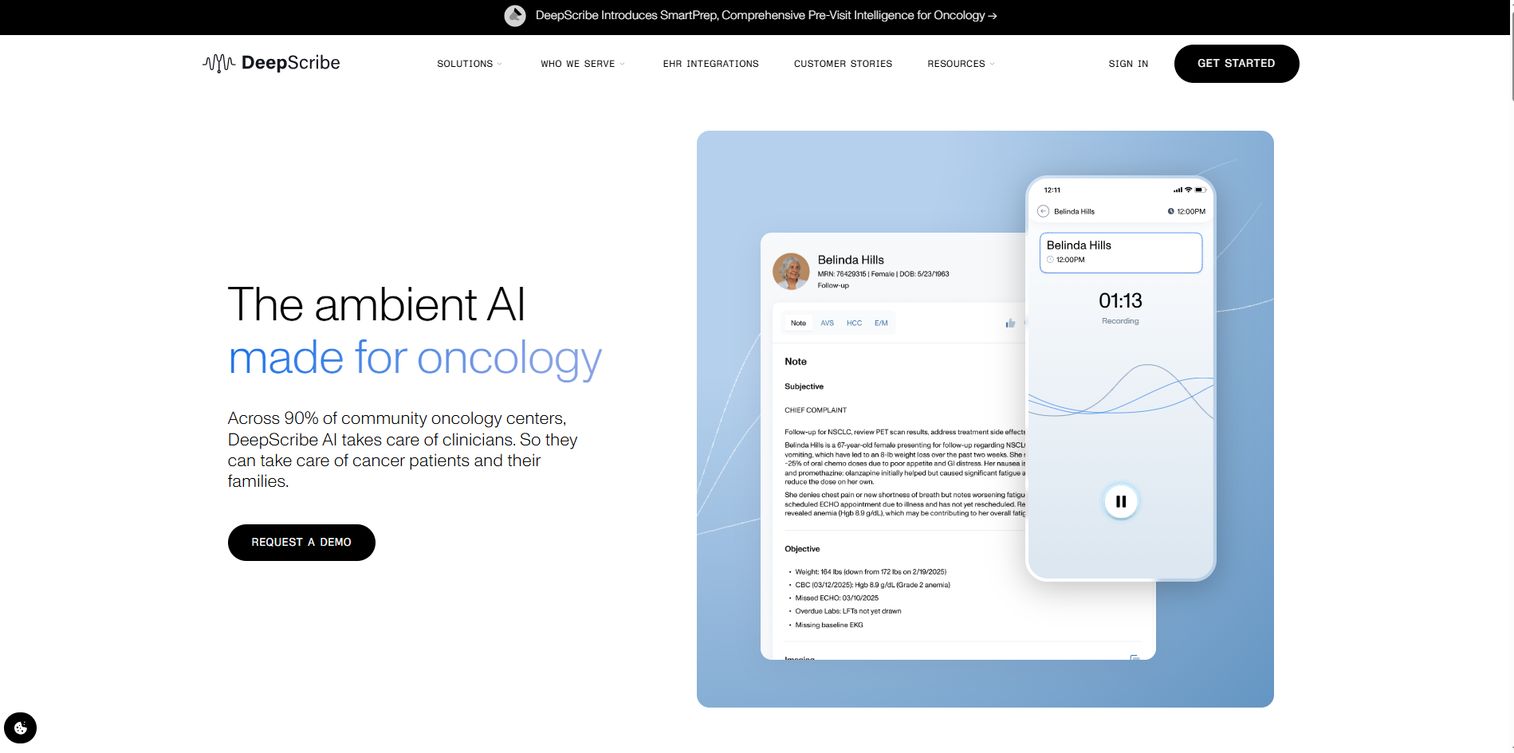
DeepScribe is best known for specialty care documentation, with SmartPrep, AI coding, and deep customization. It is strong for teams that need specialty-oriented notes and want to shape how the scribe behaves per clinician and per visit type. Position it as a specialist's tool rather than the default first pick.
Best for: Specialty practices that need specialty-tuned documentation and workflow customization.
Key strengths
- Specialty care documentation and SmartPrep
- AI coding support
- Customization by clinician and visit type
- Embedded workflow options
Why choose DeepScribe: When note patterns vary sharply by specialty, a generic template creates editing work. DeepScribe's customization and prep features cut that down for teams whose documentation is anything but standard. Enterprise packaging is available for larger groups.
DeepScribe pricing: A Free plan at $0, a Basic plan at $15 per month, and a Pro plan at $29 per month, with monthly and yearly billing and yearly savings up to 34%. G2 rating: 4.1/5.
7. Freed
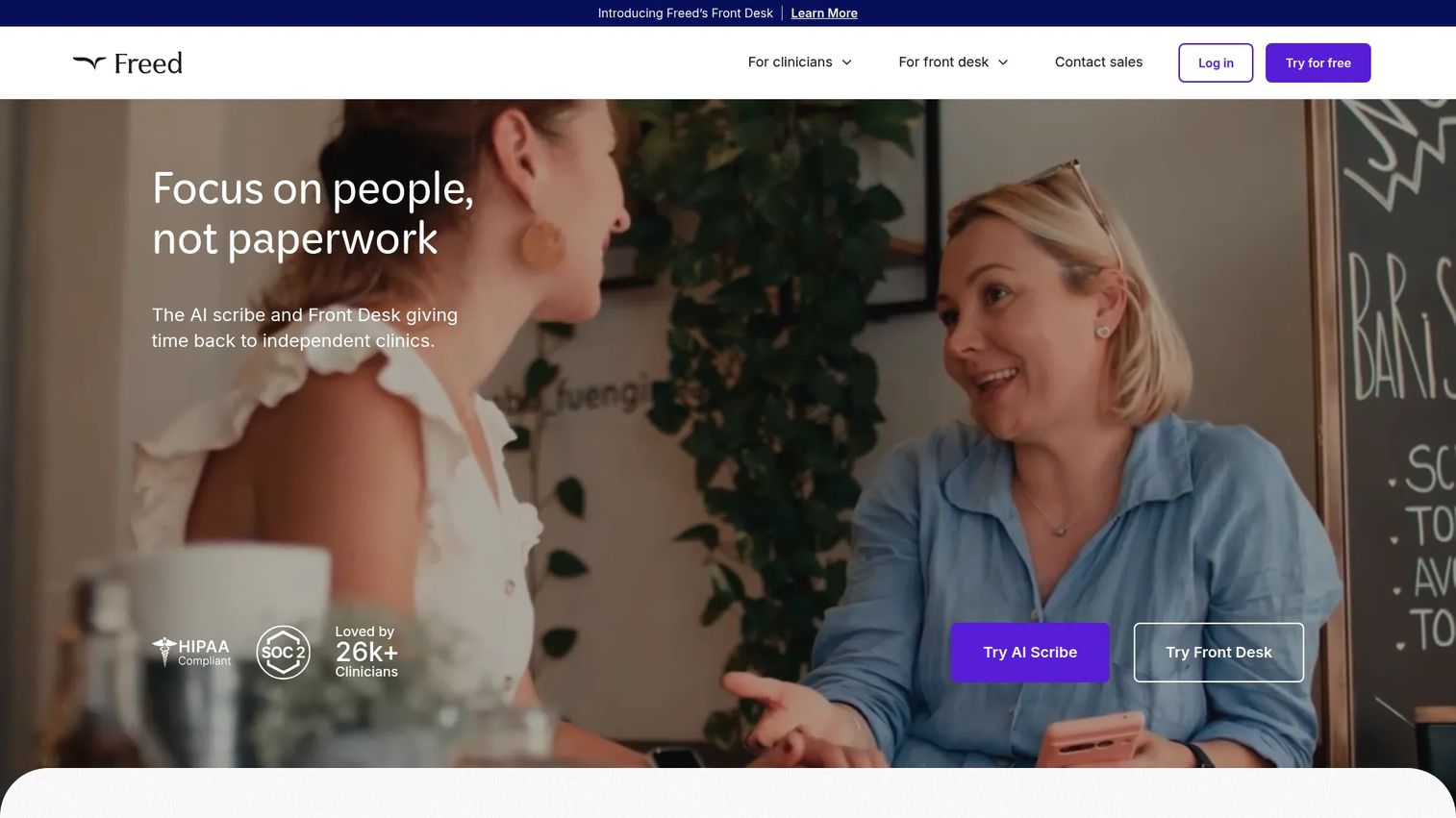
Freed is the broadest clinician-facing bundle on this list. Beyond real-time note generation, it adds visit prep, ICD-10 and CPT coding support, a clinician assistant with medical knowledge, and a separate front-desk automation product. For independent practices that want more than a note generator, that range is the appeal.
Best for: Clinicians and small practices that want an AI scribe plus a charting and coding assistant.
Key strengths
- AI scribe for real-time note generation
- Specialty-specific templates
- EHR push integration
- Clinician assistant with medical knowledge
- ICD-10 and CPT coding support
Why choose Freed: Freed works well when the goal is not just faster notes but a lighter overall documentation load, coding included. The wider bundle means a small practice can consolidate several jobs into one tool rather than stitching together point solutions.
Freed pricing: A Starter plan at $39 per month, Core at $79 per month, and Premier at $119 per month ($104/mo billed annually), plus custom Groups pricing. A 7-day free trial is available with no credit card required. G2 rating: 5.0/5.
8. Sunoh.ai
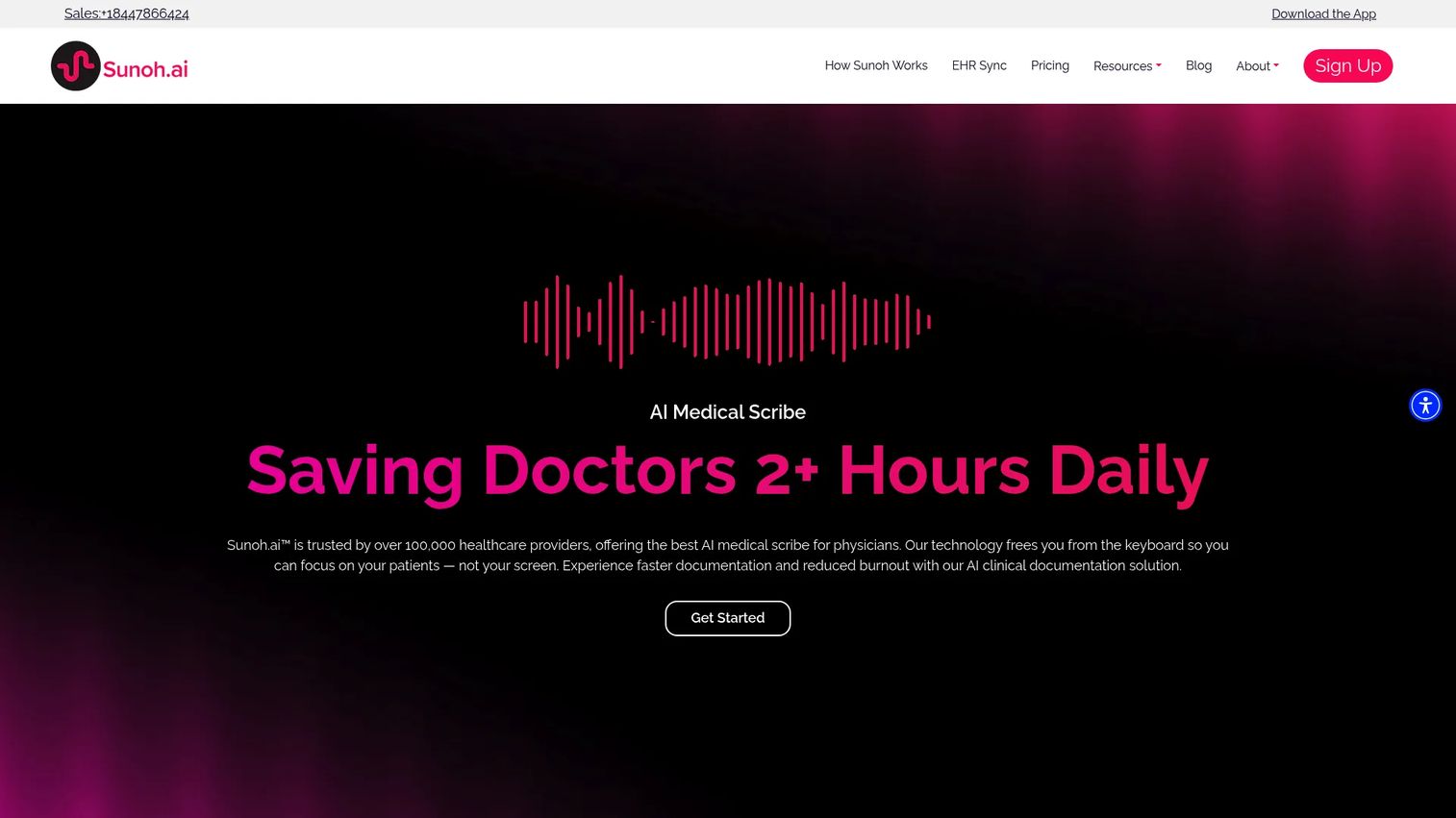
Sunoh.ai is an EHR-agnostic AI scribe built around ambient listening and a wide integration surface. It drafts SOAP and progress notes with a review-and-edit step before EHR import, assists with order entry, and works across mobile, iPad, web, and EHR workflows. The breadth is the point for clinics with a mixed device and system environment.
Best for: Clinics that need an EHR-agnostic scribe with broad device and system coverage.
Key strengths
- Ambient listening and voice recognition for clinical notes
- Draft SOAP and progress notes with review and edit before import
- Order entry assistance and mobile, iPad, web, and EHR support
Why choose Sunoh.ai: If your practice runs across multiple devices and EHRs, Sunoh.ai's coverage reduces the "does it work here?" problem. The explicit review-before-import step keeps the clinician in control of what lands in the chart.
Sunoh.ai pricing: A limited-time offer of $149 per user per month is shown on the pricing page. No fuller tier ladder is published.
9. OmniMD AI Scribe
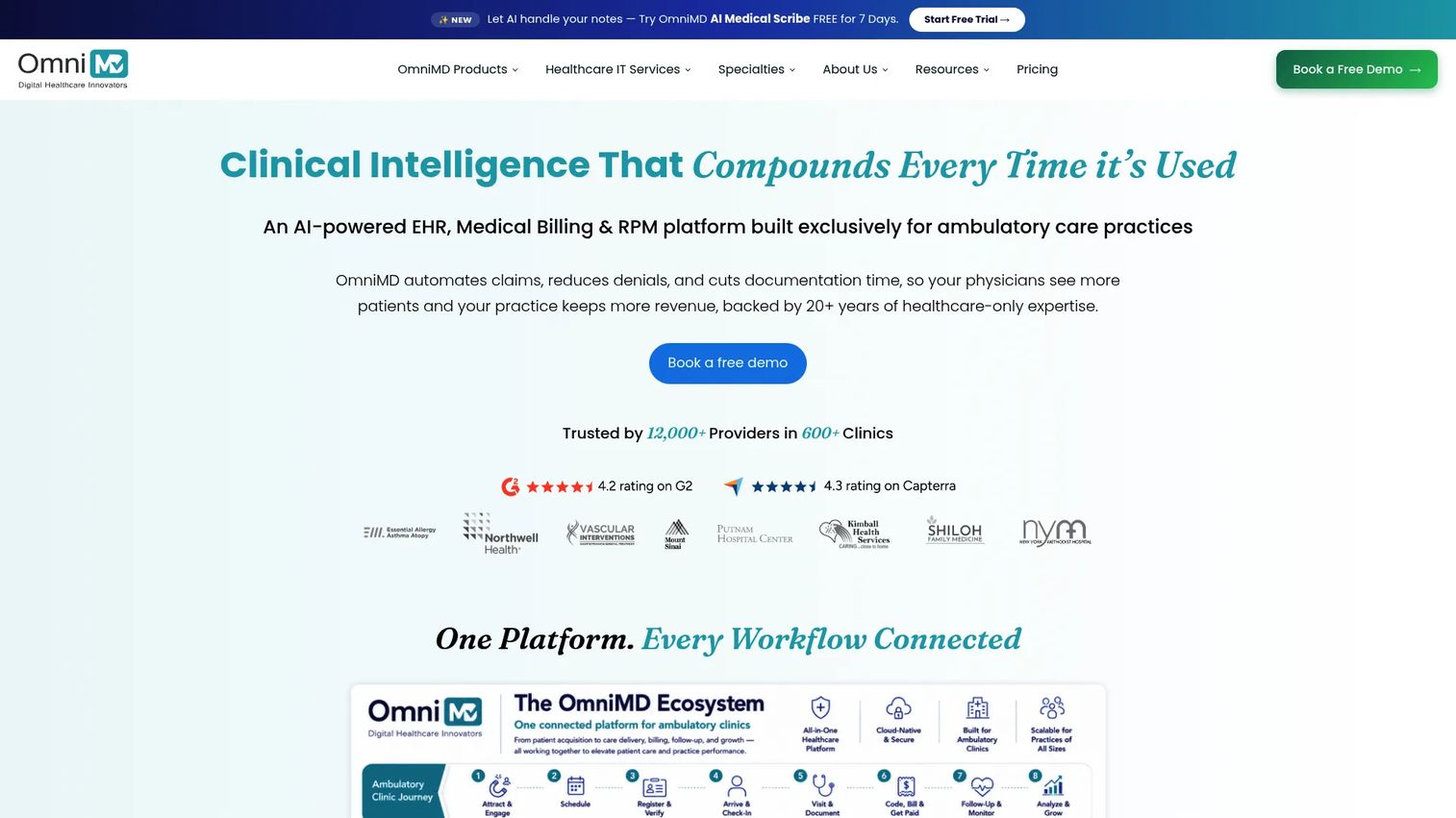
OmniMD AI Scribe is the AI documentation layer inside OmniMD's broader EHR and revenue-cycle platform. It handles real-time medical voice transcription, separates clinician and patient speakers, and generates specialty-adapted notes that feed the surrounding suite. For clinics already invested in a full platform, an in-house scribe removes an integration project.
Best for: Clinics that want AI-assisted documentation inside a broader EHR and RCM platform.
Key strengths
- Real-time medical voice transcription
- Speaker separation between clinician and patient
- Specialty-adapted note generation and EHR integration
Why choose OmniMD AI Scribe: The value is consolidation. If you are evaluating or already running the OmniMD suite, the scribe is native rather than bolted on, which shortens implementation and keeps one vendor accountable. It belongs on any shortlist a buyer builds during platform research.
OmniMD AI Scribe pricing: Pricing is customized across EHR Essentials, Growth Clinics Suite, and Enterprise and Multi-Location plans, with a free 7-day trial for the AI Medical Scribe. No public dollar amounts are listed. G2 rating: 4.2/5.
10. Suki AI
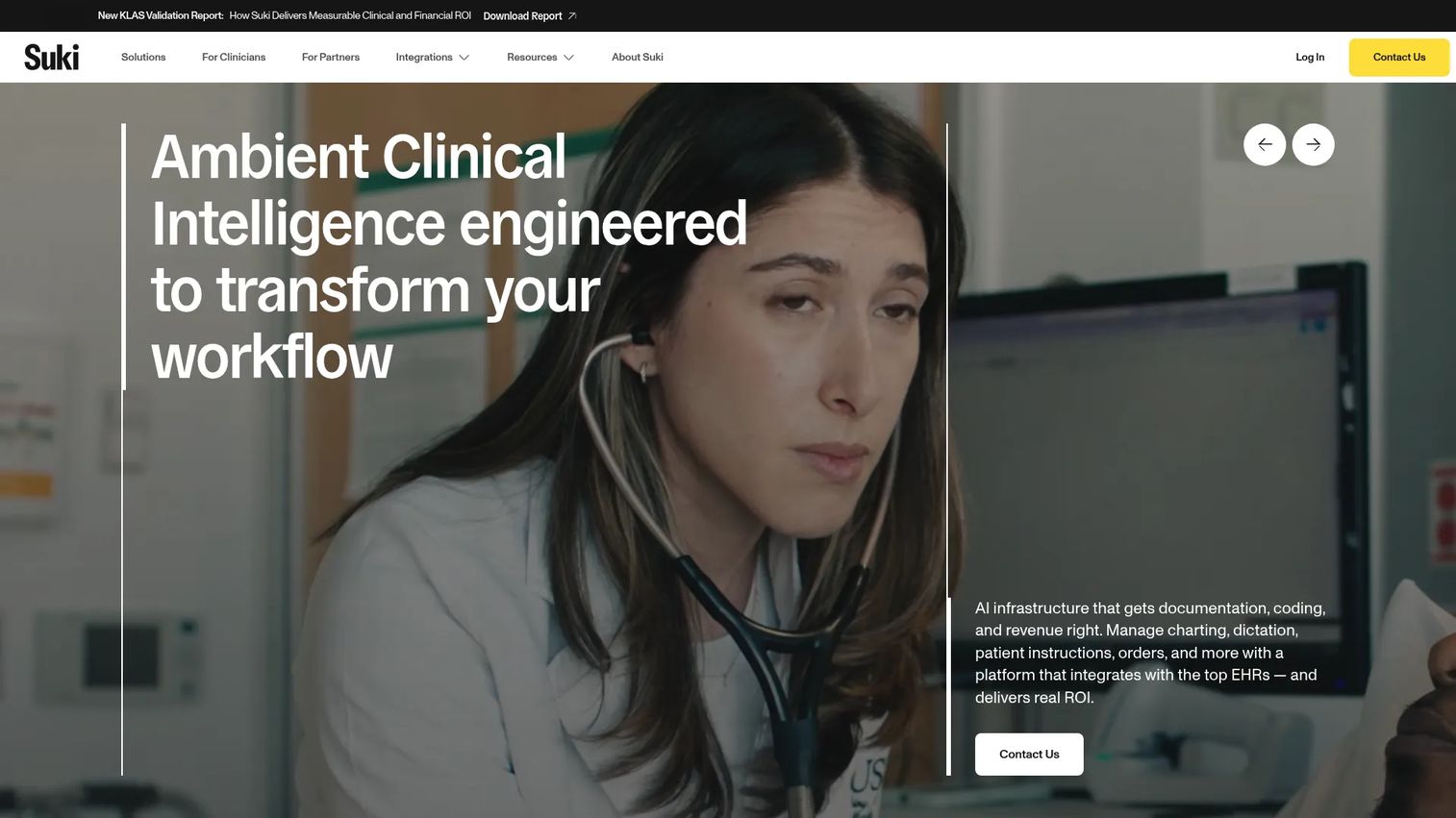
Suki AI is an AI assistant for healthcare that captures clinical conversations and turns them into documentation plus workflow support. It goes past note drafting into assisted revenue cycle work (ICD-10, HCC, CPT, E/M coding) and clinical reasoning with patient summaries and Q&A. That scope makes it a candidate in enterprise-style evaluations.
Best for: Healthcare organizations and clinicians seeking ambient documentation with workflow and coding assistance.
Key strengths
- Ambient documentation from clinical conversations
- Assisted revenue cycle: ICD-10, HCC, CPT, and E/M coding
- Clinical reasoning with patient summaries and Q&A
Why choose Suki AI: Suki fits teams that want the scribe and the coding and reasoning layers from one assistant. If your evaluation weighs downstream revenue-cycle impact alongside charting time, that combined scope is the reason to look.
Suki AI pricing: Public pricing is not shown on the site; buyers are directed to contact sales.
11. Nabla Copilot
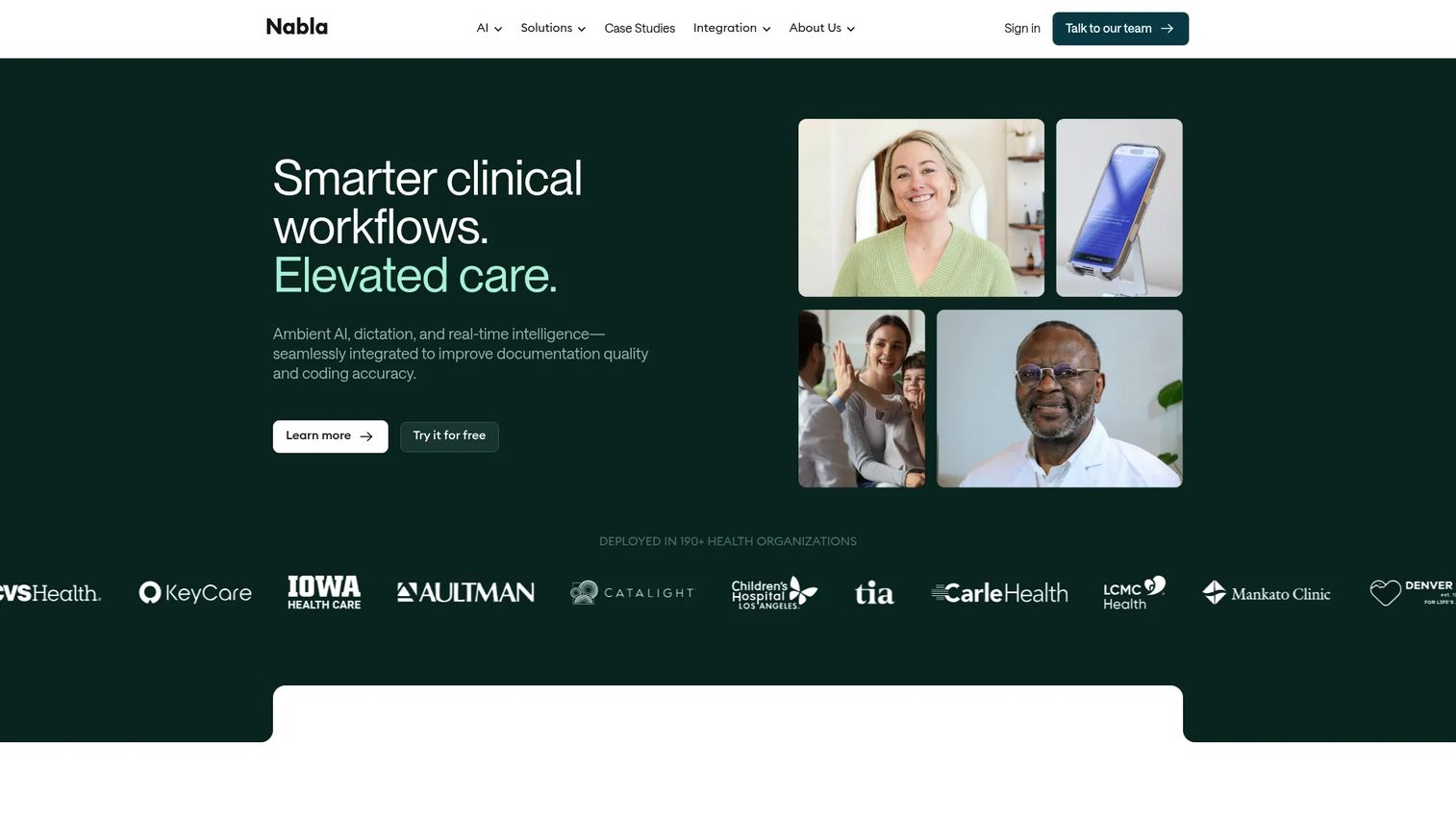
Nabla Copilot is a clinical AI assistant focused on ambient note generation with a modern, clinician-friendly interface. It generates notes from encounters, offers at-cursor and anchor dictation inside EHR workflows, and supports custom instructions, dot phrases, and note formatting. The dictation-in-context feature suits clinicians who live inside their EHR.
Best for: Clinicians and organizations that want fast documentation with a modern, flexible interface.
Key strengths
- Ambient AI note generation from encounters
- At-cursor and anchor dictation inside EHR workflows
- Custom instructions, dot phrases, and note formatting
Why choose Nabla Copilot: The dot phrases and custom instructions let clinicians shape output to their own style, which reduces edits over time. If your team values a clean interface and in-EHR dictation, Nabla is built for that daily experience.
Nabla Copilot pricing: A free trial is available and buyers are directed to contact sales. Public pricing is not disclosed on the site.
12. Abridge
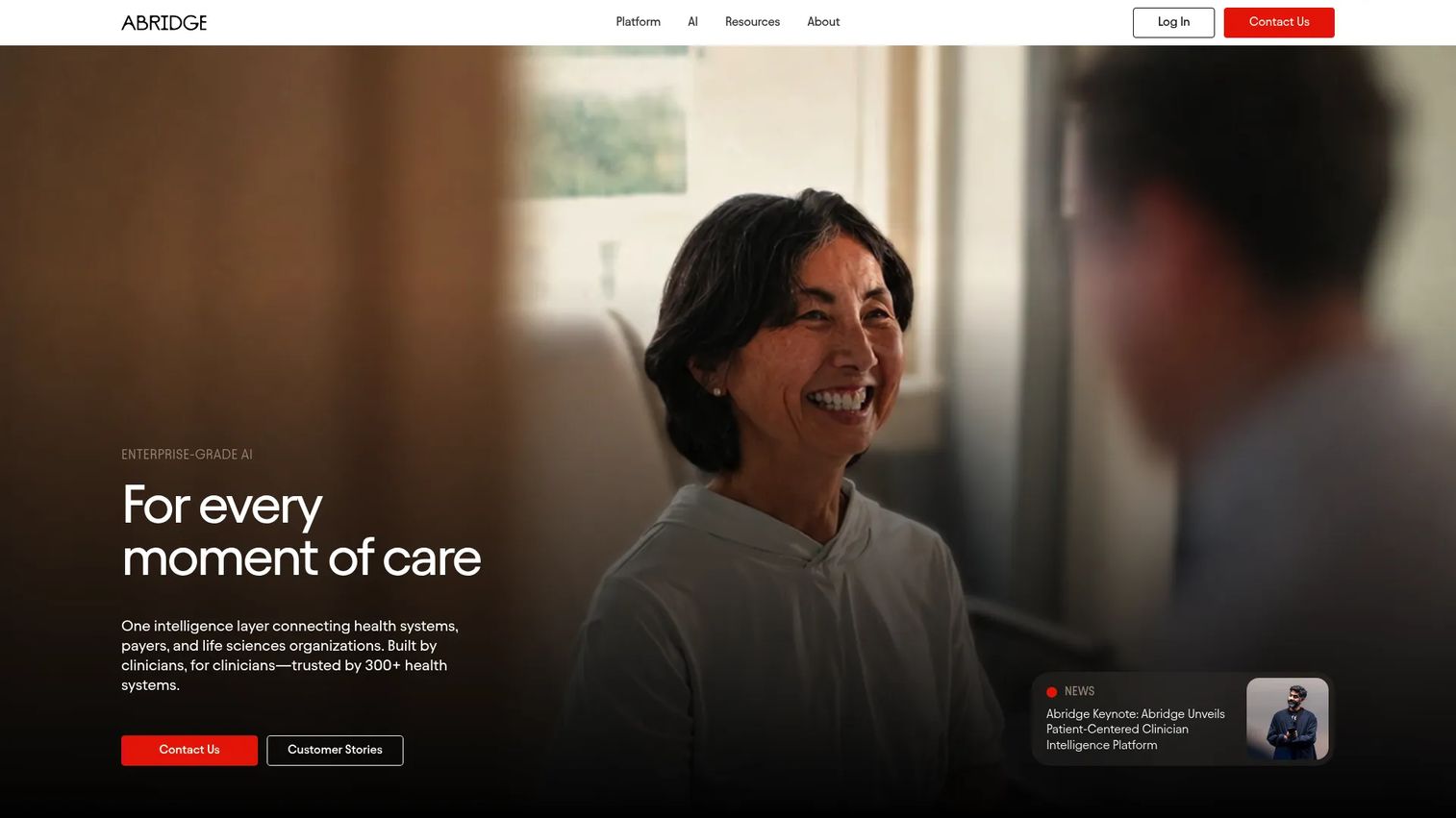
Abridge is an AI platform for clinical conversations that turns patient encounters into documentation and downstream workflows. It pairs AI-powered clinical documentation with decision support shaped by the conversation and revenue-cycle documentation and coding support. Its enterprise footprint makes trust and adoption the core evaluation questions.
Best for: Enterprise health systems that need ambient documentation plus workflow and coding support.
Key strengths
- AI-powered clinical documentation
- Clinical decision support shaped by the conversation
- Revenue cycle documentation and coding support
Why choose Abridge: For a large system, the questions are governance, clinician adoption, and how well the note supports coding and billing downstream. Abridge is built for that scale and pairs documentation with the workflow layers enterprise buyers expect. G2 rating: 5.0/5, based on a small review sample.
Abridge pricing: Public pricing is not listed; Abridge uses a contact-sales model typical of enterprise health system deals.
13. Ambience Healthcare
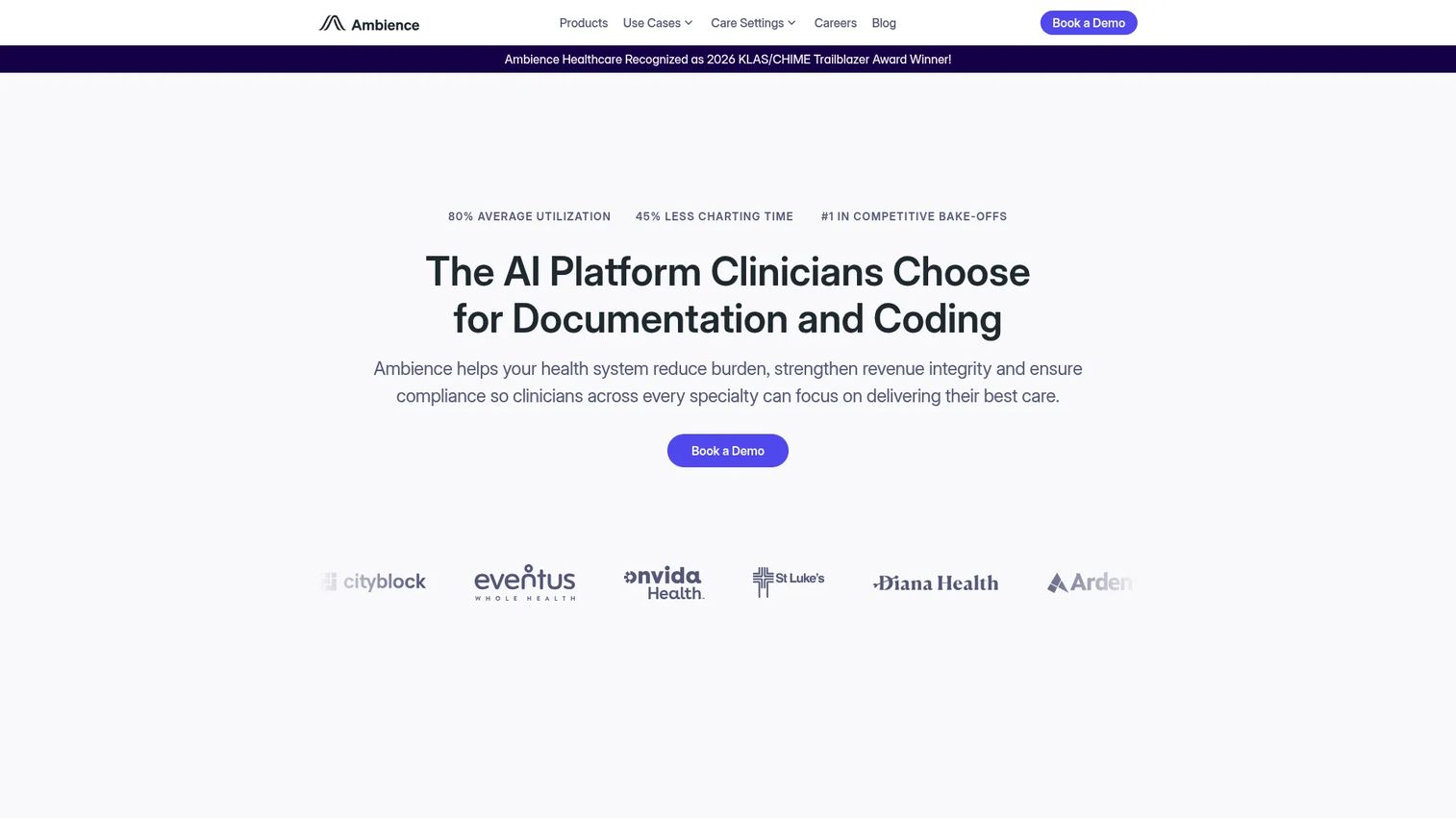
Ambience Healthcare is an AI platform for clinical documentation, coding, and workflow support across care settings. It handles real-time ambient documentation, coding and revenue integrity, and pre-visit, in-visit, and post-visit workflow tools. That full-encounter coverage is aimed squarely at larger health systems.
Best for: Health systems and clinical teams seeking documentation and coding automation across the visit.
Key strengths
- Real-time ambient documentation
- Coding and revenue integrity support
- Pre-visit, in-visit, and post-visit workflow tools
Why choose Ambience Healthcare: The pre-, in-, and post-visit coverage means the platform touches the whole encounter, not just the note. For a health system trying to standardize documentation and coding across departments, that breadth is the differentiator worth evaluating.
Ambience Healthcare pricing: Public pricing is not listed; the site runs a demo and contact-led sales flow.
14. Nuance DAX Copilot

Nuance DAX Copilot is an AI clinical documentation assistant with deep Microsoft healthcare ecosystem associations; its ambient listening capabilities are now folding into Microsoft Dragon Copilot. It generates ambient documentation, surfaces information from transcripts and trusted medical references with citations, and automates coding suggestions, referral letters, and after-visit summaries.
Best for: Healthcare organizations seeking enterprise-grade AI clinical documentation automation.
Key strengths
- Ambient documentation and note generation
- Information surfacing from transcripts and references with citations
- Automated coding suggestions, referral letters, and after-visit summaries
Why choose Nuance DAX Copilot: Established healthcare buyers evaluate it for the enterprise track record and the Microsoft ecosystem alignment. If your organization already runs Microsoft healthcare tooling, the integration story and automation depth are the draw.
Nuance DAX Copilot pricing: Public pricing is not displayed; the current product page uses a contact-us model, with the product moving under the Microsoft Dragon Copilot umbrella.
Considerations
Shortlisting is easy. A rollout that clinicians actually keep using is the hard part. Run every finalist through this checklist before you commit.
EHR integration
Verify how the note reaches the chart. Native write-back beats copy-paste, and a documented FHIR or HL7 path matters more than a marketing claim of "works with your EHR." Ask what happens on a multi-visit day and how the integration survives your EHR's release cadence. A scribe that breaks after every EHR update creates the maintenance burden you were trying to avoid.
HIPAA and security
Confirm you get a signed BAA before any patient audio is captured. Ask how long audio and transcripts are retained, whether data is used for model training, and whether the vendor holds SOC 2. A hipaa compliant claim is a starting point, not proof. The vendors that make this easy, like the ones bundling a BAA into every plan, lower your compliance and procurement friction.
Accuracy and specialty fit
Test note accuracy on your hardest visits, not the demo case. Multi-problem encounters, heavy accents, interrupted conversations, and specialty terminology are where quality shows. A specialty-specific scribe should need little editing on your common visit types. If you run a specialty practice, weight this criterion above almost everything else.
Workflow overhead
Measure the path from draft to sign-off. If the clinician has to rewrite every note, the tool has moved work rather than removed it. The best fit produces a draft clinicians trust enough to review quickly and sign. Features like citation-linked notes and pause-resume reduce that review cost.
Reporting and measurement
Decide what you will measure before the pilot, not after. Track documentation time per encounter, note quality, and clinician satisfaction. Verify the vendor gives you adoption and usage data, because a tool nobody opens after week two will not show up in your charting-time numbers.
Conclusion
The right ai medical scribe depends on your practice, not on which vendor demos best.
For broad clinical workflows, Freed covers the most ground, pairing real-time notes with coding and a clinician assistant. For specialty care, DeepScribe and its customization fit practices whose notes vary sharply by field. For independent practices, NoteV offers low entry pricing and fast drafting without an enterprise contract. For EHR-heavy teams, Sunoh.ai and OmniMD AI Scribe handle wide integration surfaces or a documentation layer inside a full suite. For enterprise health systems that need documentation plus revenue-cycle workflows, Abridge, Ambience Healthcare, Suki AI, and Nuance DAX Copilot are built for scale.
Do not buy on a single clean demo. Shortlist two or three tools, run a real pilot in your own clinic, and measure the same three things across all of them: charting time per encounter, note quality on hard visits, and clinician satisfaction. The tool that wins those numbers is the one that fits your workflow, not the one with the best marketing.
FAQs
Medical scribe software listens to a patient encounter, drafts a structured clinical note, and helps the clinician review, edit, and sync it to an EHR. Modern ai medical scribe tools use ambient documentation, so the clinician talks naturally to the patient while the software captures and structures the note in the background.
It can be, but you have to verify it rather than assume it. A hipaa compliant vendor should sign a BAA before capturing any patient audio, define how long data is retained, and clarify whether recordings are used for model training. Some vendors, like Transcribe Health, include a BAA on every plan, which makes a compliant pilot easier to start.
Ambient clinical documentation captures the natural conversation between clinician and patient through a device microphone, then uses AI to structure that conversation into a note format like SOAP or H&P. Unlike dictation, the clinician does not narrate the chart. The software infers the note from the visit and presents a draft for review before anything reaches the record.
Medical dictation software transcribes what you deliberately speak into it, word for word. An AI scribe uses ambient documentation to listen to a natural clinician-patient conversation and generate a structured note from it. Dictation captures your voice; an ambient scribe interprets the visit and drafts the chart for you.
High-documentation and high-volume fields see the clearest gains: primary care, cardiology, dermatology, oncology, behavioral health, and urgent care. Each has distinct note patterns and terminology, so a specialty-specific scribe that understands those conventions needs far less editing than a generic template.
Many tools do. NoteV lists Epic among 50+ EHR integrations, and several vendors connect through SMART on FHIR or HL7, which Epic supports. Confirm whether integration means native write-back into the chart or a copy-paste path, and ask how it holds up through Epic's update cycle before you commit.
The most direct metric is documentation time per encounter, tracked before and after rollout. Clinics also watch after-hours charting (pajama time), note completion rates, and clinician satisfaction scores. Set a baseline before the pilot and compare the same metrics across every tool you test.
Evaluate ehr integration depth, compliance posture (BAA, retention, SOC 2), note accuracy on your hardest visits, workflow overhead from draft to sign-off, and whether the vendor gives you usage and adoption data. Then run a pilot against charting time, note quality, and clinician satisfaction rather than deciding on a single demo.