A practice can survive a weak scheduling workflow for a while. Scaling becomes a different problem when clinicians chart in one system, staff manage intake in another, and billing teams chase errors after every claim run.
Ambulatory software selection touches every layer of an outpatient operation: Care delivery speed, front-office workload, cash flow, and patient access. According to ASTP/ONC (2024), 91% of U.S. office-based physicians now use a certified EHR, which means the market is no longer about adoption. The real question is whether the platform a practice chose five years ago still fits its current complexity, specialty mix, and revenue-cycle demands.
The category label "ambulatory software" covers electronic health records, practice management, revenue cycle management, and patient engagement. Buying decisions fail when teams compare feature checklists without testing a complete outpatient workflow. Which platform actually fits the care model, billing complexity, specialty needs, and implementation capacity of your organization?
This guide helps you answer that.
What's inside
- Ten ambulatory EHR software platforms evaluated for 2026
- Selection criteria: Outpatient workflow support, specialty fit, revenue-cycle depth, interoperability, and scalability
- A verified comparison table with current pricing and G2 ratings
- Guidance segmented by practice type: Independent practices, specialty groups, multi-location organizations, and enterprise outpatient networks
- A demo checklist covering what to validate before you sign
TL;DR
- Best overall for integrated ambulatory operations: athenahealth, for practices that want EHR, practice management, RCM, and patient engagement under one vendor relationship
- Best for established multi-specialty practices: eClinicalWorks, with transparent per-provider pricing and broad clinical workflow coverage
- Best for specialty practices: ModMed, with specialty-designed templates and the highest G2 rating in this group (4.5/5)
- Best for independent and growing practices: AdvancedMD, with the most publicly detailed pricing on the market, starting at $130/provider/month
- Best for enterprise outpatient networks: EpicCare Ambulatory, for health-system-connected clinical environments; Oracle Health for large organizations needing enterprise-scale data and governance
What is ambulatory software?
Ambulatory software is the group of digital systems outpatient healthcare organizations use to document care, manage appointments, coordinate patient communication, submit and follow up on claims, and exchange health data across providers and facilities.
The global ambulatory care medical software market was valued at $9.17 billion in 2025, according to Mordor Intelligence (2025). Cloud deployment now accounts for 62.8% of that market, which means most new deployments run on vendor-hosted infrastructure rather than on-premises servers.
How ambulatory software differs from inpatient software
Ambulatory systems center on scheduled visits, recurring patient relationships, documentation speed, and revenue-cycle efficiency. Inpatient systems center on hospital admissions, bed management, acute-care orders, and discharge coordination. The workflows diverge sharply at the point of registration, and the billing rules differ at nearly every claim line.
EHR, EMR, practice management, and RCM explained
| Term | What it typically covers | Why it matters in selection |
|---|---|---|
| EHR | Longitudinal patient records and clinical workflows | Determines charting, orders, results, referrals, and care coordination |
| EMR | Often used as a synonym for EHR, sometimes narrower in scope | Confirm the vendor's exact clinical coverage before shortlisting |
| Practice management | Scheduling, registration, eligibility, billing, collections, reporting | Shapes front-office and financial workflows |
| RCM | Claims, payment posting, denials, coding support, accounts receivable | Affects cash flow, billing staffing, and operational reporting |
Core capabilities to look for
- Clinical documentation and specialty templates
- E-prescribing, lab ordering, imaging, and referral workflows
- Scheduling, patient intake, reminders, and portal access
- Eligibility verification, charge capture, claims submission, denial workflows, and payment posting
- Interoperability through HL7, FHIR, and vendor-supported interfaces
- Role-based access, auditability, multi-location reporting, and governance controls
Don't buy on the demo alone. Require each vendor to walk through a complete patient journey from intake through claim submission and follow-up, using your actual visit types.
When to use ambulatory software
Replace disconnected clinical and billing workflows
Staff repeatedly re-entering demographic, insurance, or charge data is the clearest signal. An integrated platform can reduce those handoffs, but only if your team tests how its workflows actually move from appointment to claim in your specific setting.
Support specialty-specific care delivery
Dermatology, ophthalmology, orthopedics, gastroenterology, and behavioral health practices each have different documentation requirements, imaging workflows, procedure coding, and follow-up patterns. Prioritize vendors that can demonstrate a live run-through of your most common visit type, not a generic template tour.
Coordinate multi-location outpatient operations
Multi-site groups need centralized scheduling, provider templates, patient communication, and location-level reporting. Before signing, validate how the platform handles organizational hierarchy, billing ownership across entities, and whether location-level data is actually accessible in dashboards your operations team will use.
Use ambulatory EHR systems when your practice shows these signs:
- Charge lag is growing quarter over quarter
- Claims require repetitive manual correction before submission
- Staff switch between disconnected systems multiple times per appointment
- Patient intake creates front-desk bottlenecks during peak hours
- A specialty expansion requires templates and workflows the current platform cannot support
- Leadership cannot pull location-level or provider-level operational reports without manual extraction
Ambulatory software comparison
The tools below were evaluated on care-setting fit, clinical and specialty workflow depth, practice management and RCM scope, interoperability approach, pricing transparency, and verified G2 ratings. Pricing and ratings were verified in October 2026 from each vendor's official pricing page and current G2 listing. Several enterprise ambulatory EHR vendors price through sales-led contracts; for those, the table notes cost drivers rather than a flat rate.
| # | Product | Best for | Key differentiator | Pricing | G2 rating |
|---|---|---|---|---|---|
| 1 | athenahealth | Broad ambulatory practices | Integrated EHR, practice management, RCM, and patient engagement | Custom, collections-aligned | 3.6/5 |
| 2 | eClinicalWorks | Multi-specialty ambulatory organizations | Transparent per-provider pricing with AI-native EHR and nationwide interoperability | From $499/provider/month | 3.7/5 |
| 3 | NextGen Healthcare | Mid-market and enterprise ambulatory groups | Configurable EHR and practice management with ambient AI documentation | Contact sales | 3.8/5 |
| 4 | AdvancedMD | Independent and growing practices | Most detailed specialty-specific pricing of any platform in this list | From $130/provider/month | 3.6/5 |
| 5 | ModMed | Specialty medical practices | Specialty-specific clinical workflows with the highest G2 rating in this group | Contact sales | 4.5/5 |
| 6 | EpicCare Ambulatory | Health-system outpatient networks | Deep enterprise clinical integration across ambulatory and hospital settings | Enterprise contract | 4.2/5 |
| 7 | Oracle Health | Large enterprise health systems | Enterprise clinical, administrative, and data exchange footprint | Contact sales | Not verified |
| 8 | Veradigm EHR | Multi-location and multi-specialty practices | Customizable ambulatory workflows with HCC alerts and RAF/risk scoring | Contact sales | 3.4/5 |
| 9 | Greenway Health | Independent practices and specialty groups | AI-enabled EHR and RCM with HL7, FHIR, and CommonWell connectivity | Contact sales | 3.3/5 |
| 10 | Nextech | Ophthalmology, dermatology, and related specialties | Specialty-specific charting, AI documentation (Cora Scribe), and integrated payments | Contact sales | 4.3/5 |
Best 10 ambulatory software tools for 2026
1. athenahealth
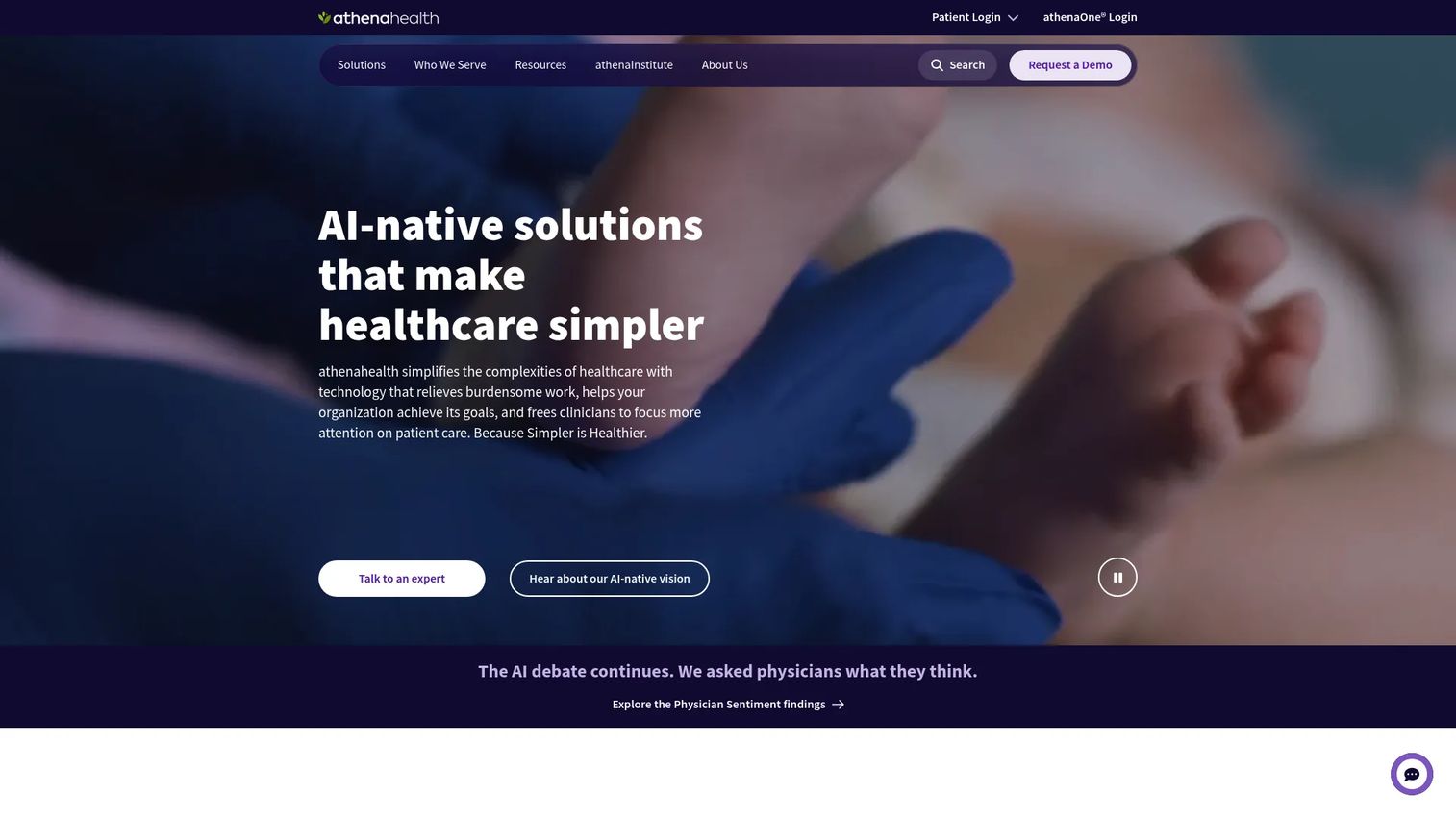
athenahealth provides an AI-native ambulatory healthcare platform called athenaOne, combining electronic health records, practice management, revenue cycle management, and patient engagement in one connected environment. The platform is positioned for practices that want a single vendor relationship across clinical documentation, front-office workflows, billing, and patient communications. athenahealth describes its pricing as aligned with organizational collections, with minimal upfront costs and no long-term contracts.
Best for: Independent practices and growing ambulatory groups that want EHR, practice management, RCM, and patient communication under one vendor with no long-term contract lock-in.
Key features
- Ambulatory EHR with customizable clinical workflows and data integration
- Practice management covering billing, claims, coding, authorizations, and RCM services
- Patient engagement through portal, mobile app, telehealth, payments, reminders, and secure messaging
- Interoperability and connected-network tools across provider and payer relationships
- AI-native clinical tools supporting documentation and workflow automation
Why choose athenahealth: It belongs on your shortlist if your practice needs clinical, financial, and patient-facing workflows coordinated by a single platform, and you want contract flexibility tied to actual collections rather than a fixed per-seat fee.
athenahealth pricing: Pricing is custom and collections-aligned; athenahealth does not publish flat rates. Cost drivers include provider count, locations, RCM services, interface needs, and implementation scope. Ask for a total first-year cost projection, not just a percentage of collections quote.
G2 rating: 3.6/5
2. eClinicalWorks
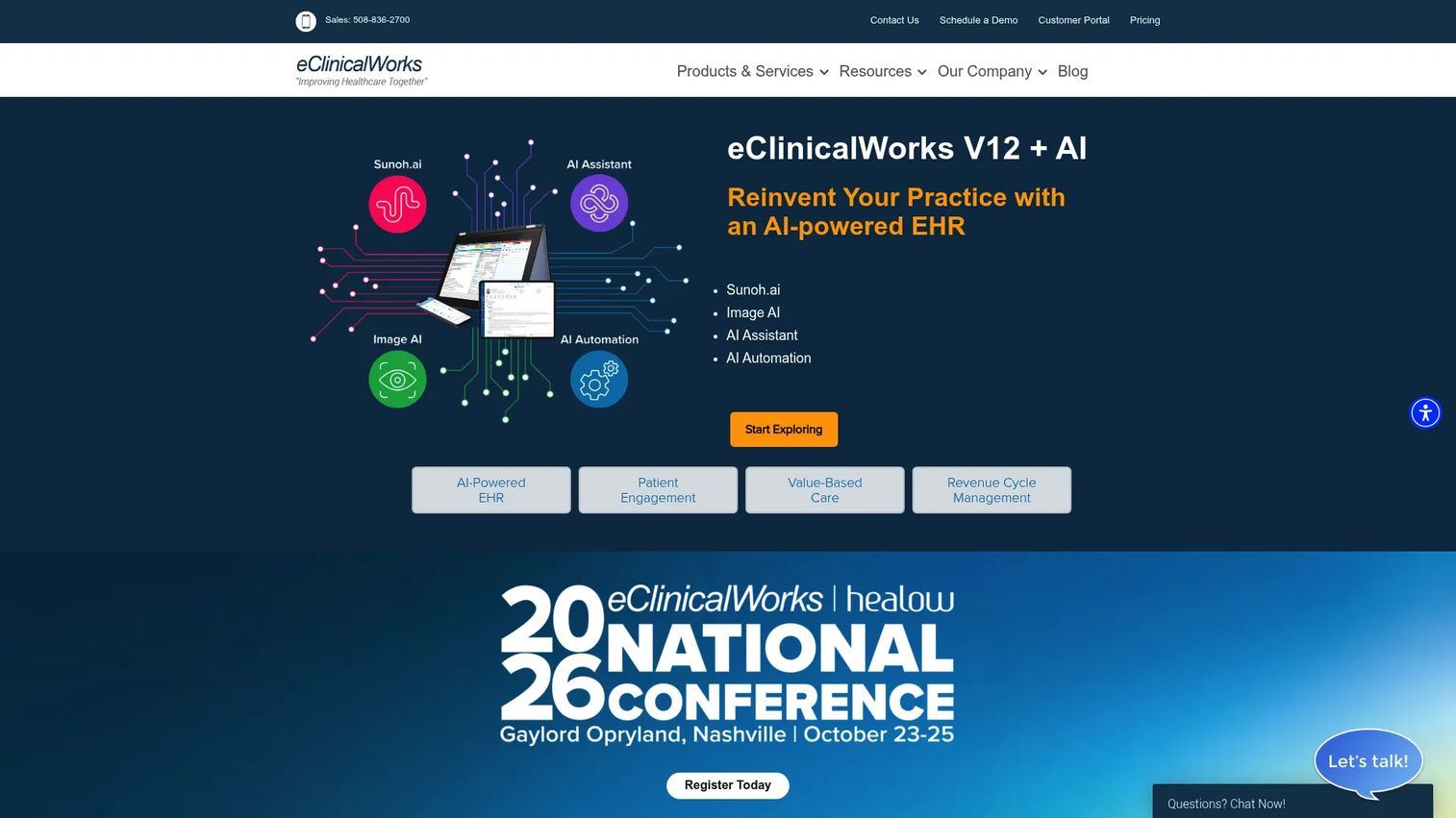
eClinicalWorks is one of the few ambulatory EHR vendors that publishes per-provider pricing on its website, which makes it easier to model total cost early in an evaluation. The platform covers electronic health records, practice management, patient engagement, population health tools, and revenue cycle management. Its AI suite includes Sunoh.ai for ambient documentation, Eva for clinical assistance, and healow Genie for patient interaction.
Best for: Established multi-specialty ambulatory practices that need broad clinical and administrative functionality with predictable per-provider pricing.
Key features
- AI-powered EHR and electronic medical records with ambulatory clinical workflows
- Practice management and revenue cycle management covering claims, coding, and collections
- Patient portal, telehealth, digital check-in, and healow patient app
- AI tools including Sunoh.ai ambient documentation and healowIQ analytics
- Interoperability through Carequality and CommonWell nationwide networks
Why choose eClinicalWorks: The transparent pricing structure lets operations teams model multi-year costs before engaging sales. Validate workflow usability directly with clinicians, front-office staff, and billers during the evaluation, since breadth of features does not guarantee fit for every specialty.
eClinicalWorks pricing: EHR Only starts at $499/provider/month. EHR with Practice Management is $599/provider/month. RCM as a Service runs at 2.9% of practice collections. No listed start-up costs for practices under ten providers; larger practices may incur implementation fees.
G2 rating: 3.7/5
3. NextGen Healthcare
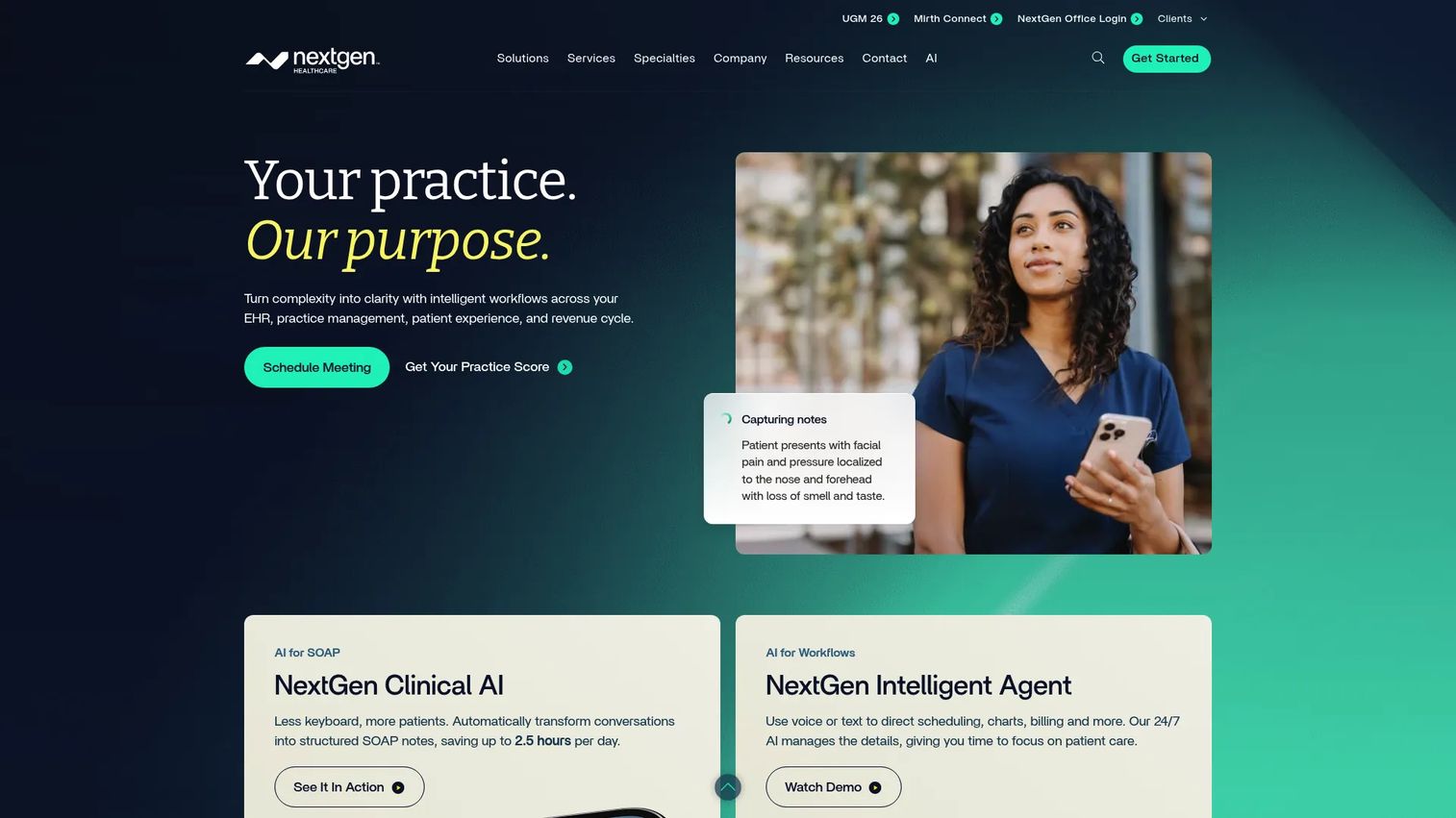
NextGen Healthcare provides an integrated ambulatory EHR and practice management platform for medical groups that need configurable clinical workflows, patient engagement, analytics, and revenue cycle support. The platform includes ambient AI documentation, telehealth, interoperability through Mirth and APIs, and self-scheduling tools for patients. It is positioned for mid-market and enterprise ambulatory organizations that have multiple providers or locations.
Best for: Mid-market and enterprise ambulatory groups that need workflow configuration depth and organizational reporting across multiple providers or sites.
Key features
- Configurable ambulatory EHR and practice management with clinical decision support
- Ambient AI documentation and clinical AI assistance
- Patient engagement: Self-scheduling, digital intake, secure messaging, portal, and payments
- Revenue cycle management, billing, claims, and analytics reporting
- Interoperability via APIs, Mirth Connect, and health data exchange integrations
Why choose NextGen Healthcare: It suits practices that need more than basic charting and scheduling, particularly those where operational complexity or multi-site requirements mean configuration depth matters as much as out-of-the-box simplicity.
NextGen Healthcare pricing: Pricing requires contacting sales; no flat rates are displayed on the official website. Cost drivers include provider count, locations, selected modules, interface fees, implementation scope, and contract duration.
G2 rating: 3.8/5
4. AdvancedMD
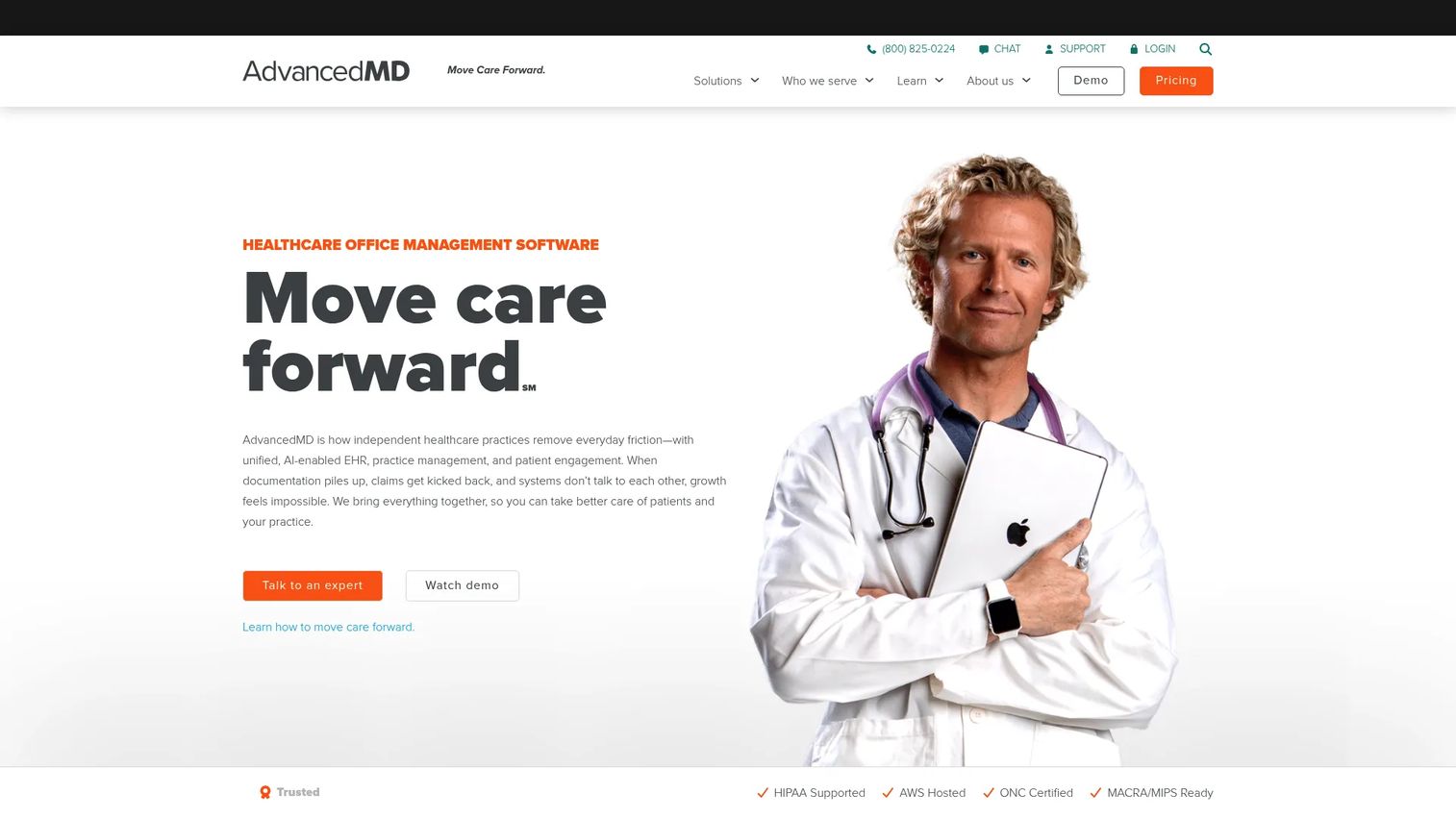
AdvancedMD publishes more pricing detail than almost any other ambulatory software vendor in this group, with specialty-specific tiers listed directly on its pricing page. The cloud-based platform covers EHR, practice management, scheduling, medical billing, patient engagement, and revenue cycle management. A free 30-day trial is available through the AdvancedMD Now entry offering.
Best for: Independent physician practices and growing outpatient groups that want integrated EHR and billing workflows with publicly transparent, specialty-specific pricing.
Key features
- Cloud-based EHR with customizable templates and e-prescribing
- Practice management: Scheduling, insurance verification, billing, claims, and reporting
- Patient engagement: Online scheduling, portal, intake, reminders, and payments
- Telehealth and integrated revenue cycle management
- AI clinical documentation and coding assistance
Why choose AdvancedMD: The specialty-specific pricing model lets smaller practices understand cost structure without a sales conversation. Validate reporting depth, specialty template coverage, and interface costs during your trial before committing to a plan.
AdvancedMD pricing: AdvancedMD Now starts at $130/provider/month. Medical specialty packages run $429 to $1,070/provider/month. Mental health plans run $130 to $399/provider/month. RCM services are 4 to 8% of collections. Per-encounter pricing is also available from $0.87 per claim for practice management. Bundles can reduce total cost by up to 40%.
G2 rating: 3.6/5
5. ModMed
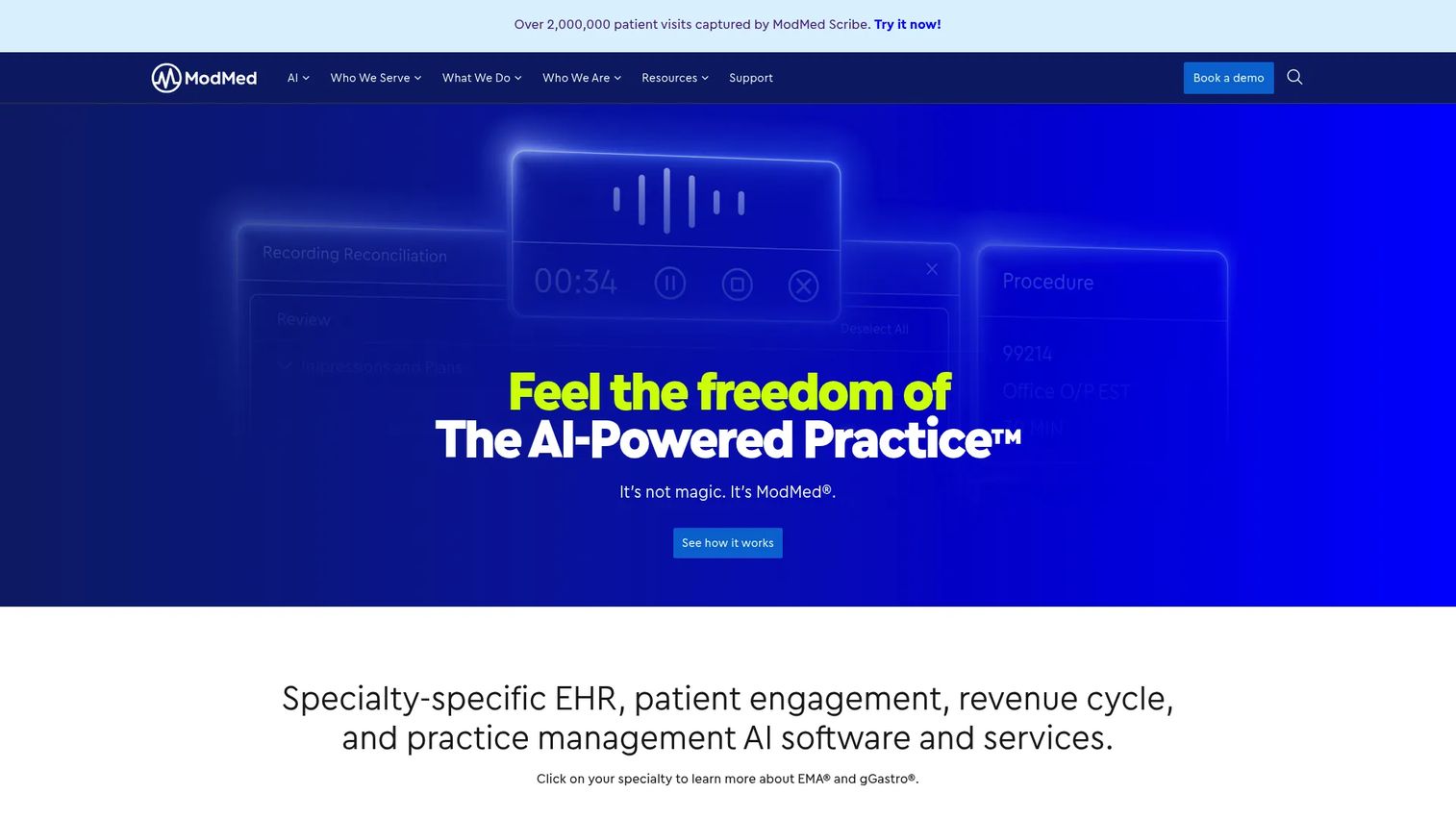
ModMed builds specialty-specific software rather than a general ambulatory EHR with specialty add-ons. The platform combines EHR, practice management, revenue cycle, patient engagement, analytics, and AI-powered documentation through ModMed Scribe 2.0. Its clinical workflows are designed around how specific specialties actually document and bill, which reduces the configuration burden a generic EHR places on specialty practices.
Best for: Specialty medical practices that need an EHR and practice management platform built around their specialty's clinical vocabulary, procedures, and billing patterns.
Key features
- Specialty-specific cloud EHR with adaptive clinical workflows and suggested coding
- AI-powered documentation through ModMed Scribe 2.0
- Practice management: Scheduling, billing, claims, and revenue cycle workflows
- Patient portal, kiosk, mobile app, secure messaging, reminders, and digital paperwork
- Analytics, MIPS tracking, inventory management, image management, and telehealth
Why choose ModMed: The highest G2 rating in this group (4.5/5) reflects strong specialty-specific satisfaction. A generic platform can work for some organizations, but specialty practices should test whether ModMed handles their most frequent visit type and billing scenario without workarounds before comparing it on price.
ModMed pricing: ModMed does not display pricing on its website. Contact sales for specialty-specific package details. Cost drivers include specialty, provider count, modules selected, RCM services, and implementation scope.
G2 rating: 4.5/5
6. EpicCare Ambulatory
EpicCare Ambulatory is the outpatient EHR environment from Epic, commonly deployed by health systems that need consistent clinical architecture across ambulatory and hospital settings. Its interoperability covers HL7, DICOM, FHIR, and IHE-supported interfaces. EpicCare Ambulatory makes the most sense when outpatient clinical operations connect directly to an existing Epic enterprise environment.
Best for: Health-system-owned clinics and large ambulatory networks where outpatient care must align with enterprise clinical governance and data architecture.
Key features
- Ambulatory clinical documentation and enterprise clinical record management
- Medication ordering, e-prescribing, and clinical integrations
- Health information exchange and interoperability via HL7, DICOM, FHIR, and IHE interfaces
- Referral and care coordination workflows across ambulatory and hospital settings
- Multi-site governance controls and organizational reporting
Why choose EpicCare Ambulatory: It belongs in the evaluation when the practice's outpatient strategy connects to a larger health-system technology environment. For smaller independent practices, the implementation footprint and contract scale are likely disproportionate to the operational need.
EpicCare Ambulatory pricing: Enterprise contracts are sales-led and shaped by organizational scope, existing Epic agreements, implementation, hosting, integrations, training, and support. Epic does not publish flat rates on its website.
G2 rating: 4.2/5
7. Oracle Health
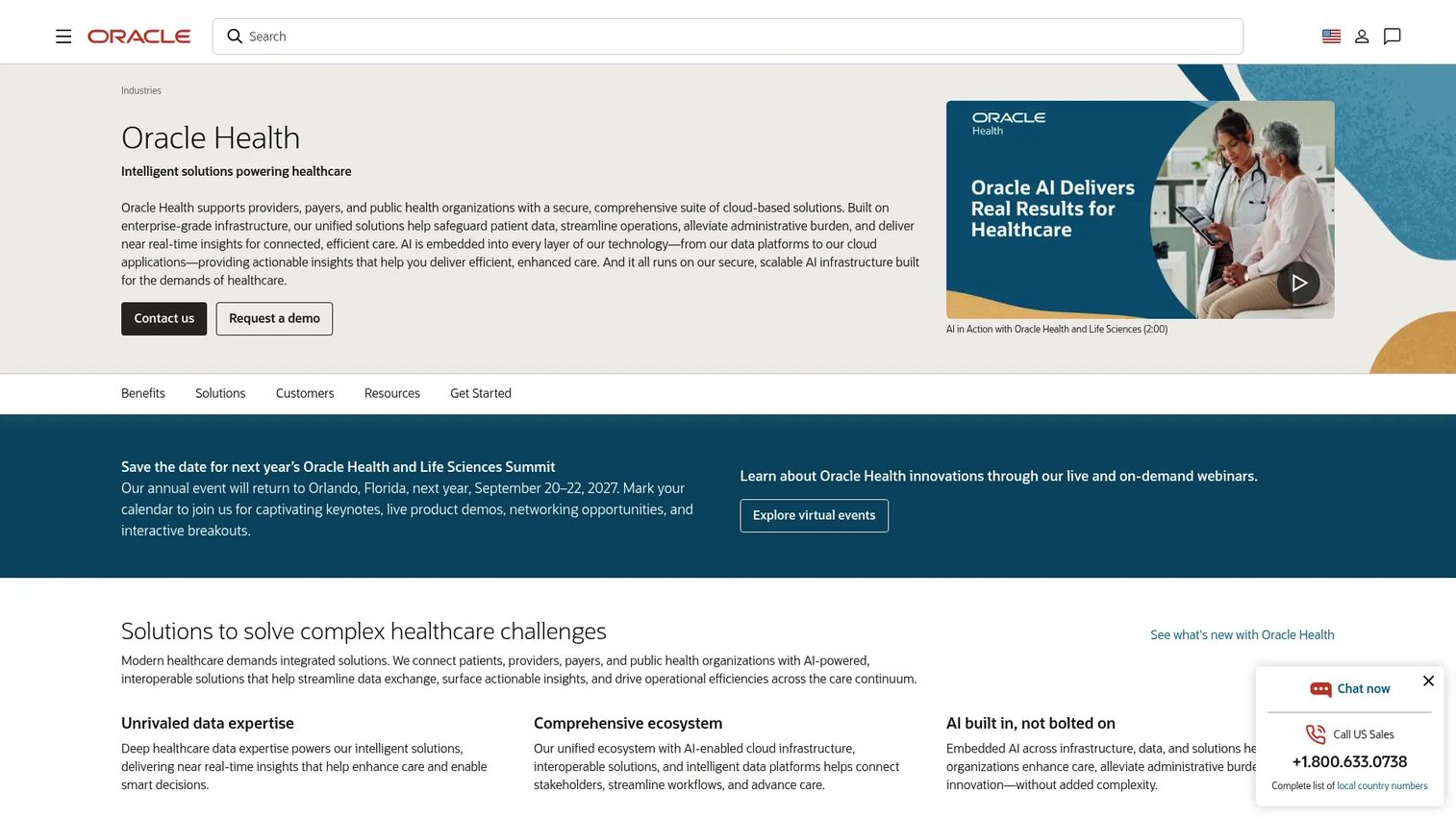
Oracle Health provides cloud-based healthcare software for providers, payers, and public health organizations. Its platform covers AI-enabled EHR, clinical decision support, patient portal and consumer communications, healthcare analytics, and interoperability and data exchange. Oracle publishes prices for selected certified health IT API and developer services, while core clinical products require a sales conversation.
Best for: Large health systems that need outpatient operations connected to enterprise clinical data infrastructure, governance controls, and broader organizational IT architecture.
Key features
- AI-enabled electronic health records and clinical workflow automation
- Clinical decision support integrated into provider workflows
- Patient portal and consumer communication tools
- Healthcare analytics and organizational reporting
- Interoperability and data exchange capabilities
Why choose Oracle Health: Frame this evaluation around enterprise architecture, current installed systems, interoperability requirements, and implementation capacity. Ask to see outpatient workflow demonstrations, not only architecture diagrams, before advancing a shortlist decision.
Oracle Health pricing: Core clinical products are quote-based. Oracle does publish fees for selected API services: The Continuum ASP shared environment bulk data API is $1,000/year, the Oracle Health Millennium Platform Environment Access is $5,000/year, and OPN Membership is $500/year. Full product pricing depends on modules, implementation scope, existing contracts, hosting, and support terms.
8. Veradigm EHR
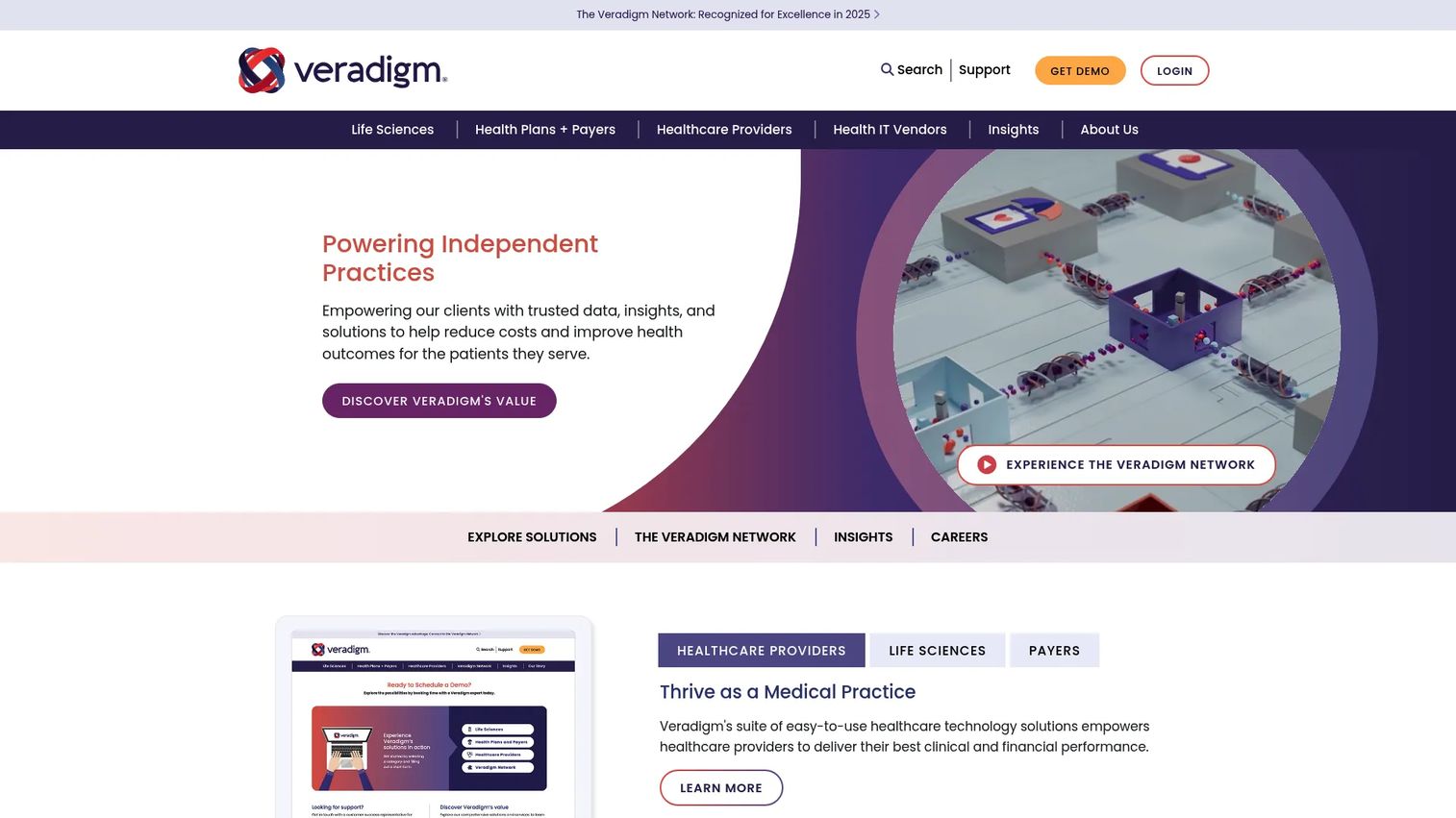
Veradigm EHR is a scalable ambulatory electronic health record system for multi-location and multi-specialty practices. It offers customizable workflows and specialty-specific content, one-click templates, smart lists, and automated reporting. Clinical functionality includes integrated telehealth, mobile access, HCC alerts, RAF/risk score tracking, PDMP integration, and prescription price transparency tools.
Best for: Multi-location and multi-specialty ambulatory practices that need customizable clinical workflows with value-based care and risk-coding support built in.
Key features
- Customizable ambulatory EHR workflows and specialty-specific clinical content
- One-click templates, smart lists, and automated reporting tools
- HCC alerts, RAF/risk scores, and PDMP integration for value-based care workflows
- Integrated telehealth, mobile access, and prescription price transparency
- Health data connectivity and patient and provider workflow tools
Why choose Veradigm EHR: It fits practices that are managing value-based contracts or risk-coding requirements alongside standard ambulatory workflows. Test the complete handoff from clinical documentation through billing and reporting before making a decision.
Veradigm EHR pricing: Veradigm does not display pricing on its website. Contact sales for current packaging and implementation options. Reviewer ranges on G2 reflect variation by practice size and configuration; the cost structure includes factors like provider count, modules, and interface setup.
G2 rating: 3.4/5
9. Greenway Health
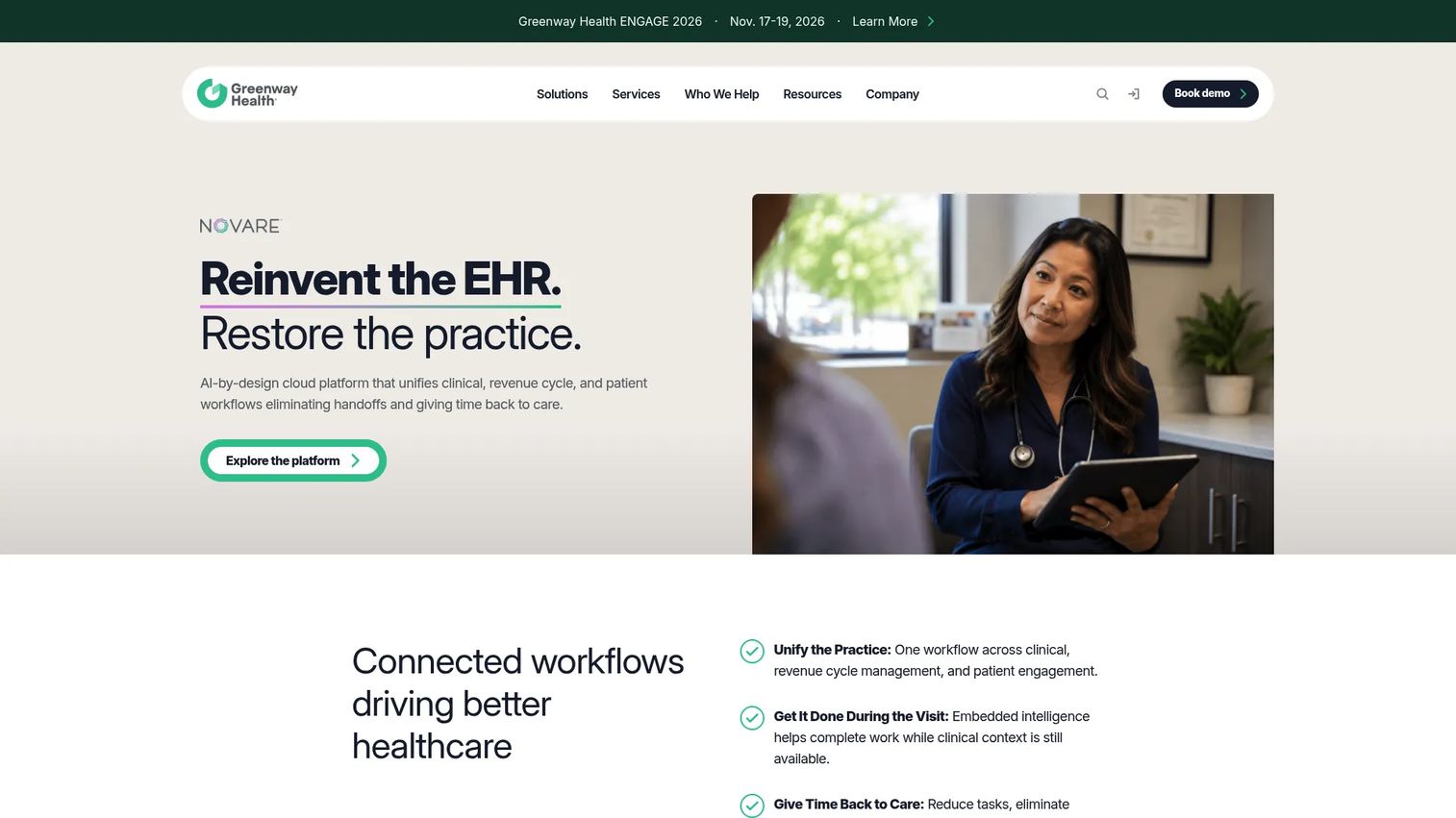
Greenway Health provides AI-enabled ambulatory EHR, practice management, revenue cycle management, and patient engagement technology for outpatient organizations. The platform supports cloud-based workflows, patient scheduling, secure messaging, digital forms, and interoperability through HL7, FHIR APIs, C-CDA, and CommonWell connectivity. Automated case reporting is also included.
Best for: Independent practices and specialty groups that need ambulatory EHR, practice management, and revenue-cycle support with modern interoperability built in.
Key features
- Cloud-based ambulatory EHR and practice management workflows
- Patient engagement: Scheduling, secure messaging, digital forms, and patient portal
- Billing and revenue cycle management with reporting capabilities
- Interoperability through HL7, FHIR APIs, C-CDA, CommonWell, and automated case reporting
- Specialty practice configuration options
Why choose Greenway Health: Operating-model fit matters more than a long features list here. Greenway suits practices that need clinical and financial workflow breadth without the implementation overhead of an enterprise platform. Validate specialty template coverage, billing workflow, and reporting before committing.
Greenway Health pricing: Greenway describes subscription pricing but directs prospects to contact sales for current rates. Cost drivers include provider count, location count, modules, RCM services, and implementation scope. G2 reviewer context reflects variation across practice sizes; ask for a total-cost-of-ownership estimate for year one and year three.
G2 rating: 3.3/5
10. Nextech

Nextech provides cloud-based specialty medical software covering EHR, practice management, patient experience, payments, CRM, and revenue cycle tools. It is purpose-built for ophthalmology, dermatology, plastic surgery, med spas, and orthopedics. Nextech's Cora Scribe brings AI-powered documentation specifically to ophthalmology workflows, and its integrated payments system uses flat-rate transaction pricing with automatic reconciliation.
Best for: Specialty practices in ophthalmology, dermatology, plastic surgery, and related fields that need an EHR built around specialty-specific charting, imaging, and billing workflows.
Key features
- Specialty-specific EHR with configurable charting and clinical workflows
- Practice management: Scheduling, billing, reporting, patient tracking, and workflow automation
- Integrated telemedicine, e-prescribing, referral management, and ASC charting
- AI-powered Cora Scribe documentation for ophthalmology
- Integrated patient payments with flat-rate transaction pricing and automatic reconciliation
Why choose Nextech: Narrow workflow depth is more valuable than broad but generic coverage when your specialty has distinct procedure documentation, imaging, coding rules, and patient flow. The best test is a live run-through of a typical patient visit from scheduling through claim submission.
Nextech pricing: Nextech does not display pricing on its website. Contact sales for specialty-specific package details. There is no free tier; prospects are directed to schedule a demo. Cost drivers include specialty, provider count, modules, and implementation requirements.
G2 rating: 4.3/5
Considerations when choosing ambulatory software
Match the platform to the care setting
A primary care group, outpatient specialty practice, ambulatory surgery center, and health-system clinic share the label "ambulatory" but require different systems. Define the care model first. Then ask vendors to demonstrate the highest-volume visit type, the most complex billing scenario, and the reporting view your operations team actually needs.
Test a complete workflow, not isolated screens
Do not accept a vendor demonstration that shows only attractive clinical screens. Ask for one continuous scenario: Appointment booking, eligibility verification, patient intake, clinical documentation, orders, charge capture, claim submission, payment posting, denial correction, patient follow-up, and location-level reporting. The gaps between steps reveal integration quality.
Calculate implementation and interface costs
Subscription fees rarely capture the total first-year cost. Evaluate implementation fees, data migration, staff training, e-prescribing setup, lab and imaging connections, clearinghouse services, custom reporting, patient communication modules, and interface maintenance. Get a total-cost-of-ownership estimate for year one and year three before comparing quotes.
Confirm interoperability and data portability
Ask how the platform supports HL7, FHIR, health information exchange, lab connectivity, imaging, and referral data. Require clarity on the format, timeline, and fees for exporting your data if the organization changes vendors. Data portability is a cost-containment issue, not just a technical one.
Make adoption measurable from day one
Set baseline metrics before go-live: Note completion time, charge lag, clean-claim rate, denial rate, days in accounts receivable, no-show rate, and portal adoption. Require the vendor to confirm which of those metrics their platform surfaces in standard dashboards and which require a custom report or data extract.
Conclusion
No single ambulatory software platform fits every outpatient organization. The right match depends on care setting, specialty mix, billing complexity, implementation capacity, and how quickly your team can adopt a new workflow.
athenahealth suits practices that need integrated operations with flexible contract terms. eClinicalWorks works for multi-specialty groups that value transparent per-provider pricing. NextGen Healthcare fits mid-market and enterprise ambulatory organizations that need configuration depth. AdvancedMD gives independent practices detailed, specialty-specific pricing they can model before calling sales. ModMed earns the top G2 rating in this group for a reason: Specialty practices that test it against their actual workflows usually know quickly whether it fits.
For enterprise outpatient networks, EpicCare Ambulatory and Oracle Health are evaluated based on existing health-system architecture rather than standalone product merit. Veradigm EHR and Greenway Health serve practices managing value-based care or seeking modern interoperability at ambulatory scale. Nextech is the clearest choice for ophthalmology and dermatology practices that want a platform built around their specialty, not adapted to it.
Build a shortlist of three platforms. Run the same high-volume patient-to-payment workflow in each live demonstration. The platform that fits your team's daily work will be clearer than the one with the longest feature list.
For more context on how SaaS teams and healthcare software vendors approach product evaluation and buyer enablement, explore related resources from Guideflow.
Start your journey with Guideflow today!
FAQs
Ambulatory software is the group of digital systems outpatient healthcare organizations use to document clinical care, manage appointments, coordinate patient communication, submit claims, and exchange health data across providers and facilities. The category includes EHR, practice management, revenue cycle management, and patient engagement tools, either sold together as a suite or as separate point products.
Ambulatory EHR tools support outpatient settings: Scheduled visits, recurring patient relationships, practice billing, patient access, and referral coordination. Inpatient systems center on hospital admissions, bed management, acute-care orders, nursing documentation, and discharge workflows. The two system types overlap in large health systems but are designed around fundamentally different care models.
EHR is one major component, but not the whole category. A full ambulatory software platform also includes scheduling, patient intake, eligibility verification, billing, claims management, denial workflows, patient portal access, reporting, and interoperability. Many vendors bundle some or all of these into a single platform; others sell them as separate modules.
Vendors use these terms differently. EMR often refers to the digital version of a patient's chart within a single practice. EHR typically implies a broader, longitudinal record that can move across providers and settings. In practice, most vendors in this list use EHR as the primary label. Confirm with each vendor what their specific product covers clinically before assuming the terms are interchangeable.
Start with the workflows that create the most staff time or revenue leakage today. For most practices, that means clinical documentation speed, scheduling and intake efficiency, charge capture accuracy, clean-claim rate, and denial resolution time. Interoperability matters when your patients move across care settings or when lab and imaging connections are slow. Specialty templates matter when your current platform forces clinicians to adapt generic forms to specialty-specific documentation needs.
Cost varies across four main drivers: Provider count, locations, clinical and billing modules selected, and whether you use managed RCM services. eClinicalWorks starts at $499/provider/month for EHR Only. AdvancedMD starts at $130/provider/month for its entry offering, with specialty packages running $429 to $1,070/provider/month. Most other platforms in this list price through sales conversations. Always compare total first-year cost, including implementation, interfaces, training, and clearinghouse fees, rather than the subscription quote alone.
Smaller practices should prioritize predictable pricing, low implementation burden, clear billing workflow support, and a vendor with documented migration support if they move from their current system. AdvancedMD's transparent pricing and free 30-day trial make it easier to evaluate before committing. eClinicalWorks' per-provider pricing is also straightforward to model for a small team. Both are worth running against a live workflow demonstration before shortlisting.
Specialty practices should assess whether the platform was built for their specialty or adapted from a general-purpose EHR. ModMed is built specifically for specialties with clinical workflows, procedure documentation, and billing logic designed for each specialty it serves. Nextech targets ophthalmology, dermatology, and related fields with the same approach. The best test is a vendor demonstration of your most common visit type from scheduling through claim submission. A platform that handles that smoothly without configuration workarounds is a stronger fit than one with a longer feature list.
Ask to see a continuous workflow rather than individual screens. Specific requests that separate strong platforms from weak ones:
- Show a complete appointment-to-claim workflow for the practice's highest-volume visit type
- Show how staff correct a denied claim and resubmit it
- Show patient intake and portal communication from the patient's perspective
- Show lab, imaging, and referral integration with a real-time example
- Show reporting by location, provider, and payer in the standard dashboard
- Explain what data export looks like and what fees or timelines apply if the practice changes vendors
Set baselines before go-live so you can measure actual impact. Track note completion time per provider, charge lag in days, clean-claim rate on first submission, denial rate by payer, days in accounts receivable, no-show rate, portal adoption percentage, and staff time spent on duplicate data entry. These metrics tell you where the current system creates the most friction and give you a way to evaluate whether the new platform improves the numbers that matter most.