A deal doesn't stall because someone forgot to work hard. It stalls because the purchase agreement is in one inbox, the addendum is in a text thread, the inspection deadline lives in someone's head, and the compliance checklist is a spreadsheet only one person knows how to read.
That's [the real problem. Not document storage. Visibility.
When a brokerage runs 40 deals a month across a dozen agents, every transaction has a dozen moving parts and every part is a potential miss. A blown contingency date can void a deal or trigger liability. A missing signature can delay a closing. The global real estate transaction management software market reached USD 2.1 billion in 2024 and is forecast to hit USD 5.4 billion by 2033, according to Verified Market Reports (2024)](https://www.verifiedmarketreports.com/product/real-estate-transaction-management-software-market/), because operators finally accepted that ad hoc tracking doesn't scale.
Good transaction management software for real estate fixes the visibility gap. It centralizes contracts, deadlines, tasks, compliance review, and reporting so a broker can see every deal's status without chasing anyone. This guide breaks down seven platforms, how their pricing models differ, and where each one fits by team size and workflow complexity.
What's inside
This guide is for broker-owners, transaction coordinators, team leads, and ops-minded operators choosing a real estate transaction management system that fits how their business actually runs.
We selected and compared seven tools based on four criteria that matter most when you're evaluating operational software:
- Workflow depth: how well it handles documents, tasks, deadlines, and multi-agent closings.
- Compliance support: review trails, checklists, approvals, and audit readiness.
- Integrations: connections to CRM, MLS, e-signature, and accounting tools.
- Pricing clarity: whether the model is seat-based, transaction-based, or quote-based, and how it scales.
TL;DR
Short on time? Here are the decision shortcuts:
- Best overall for brokers and teams: Dotloop, for broad workflow coverage, eSign, and mobile transacting.
- Best for production-based pricing: Paperless Pipeline, unlimited users, pay by transaction volume.
- Best for simple affordability: ListedKit AI, usage-based pay-per-intake with no subscription.
- Best for enterprise brokerage ops: SkySlope, compliance and back-office scale.
- Best for AI-assisted contract automation: ListedKit AI, contract reading and auto-built timelines.
- Best for back office and accounting: Brokermint, commission automation and reporting.
What is real estate transaction management software?
Real estate transaction management software is a system that centralizes and tracks every step of a property transaction, from contract to close, so agents, coordinators, and brokers manage documents, deadlines, tasks, compliance, and communication in one place.
It differs from general file storage in one important way. Dropbox holds files. A real estate transaction management system holds files and understands the deal around them: who signed what, which contingency date is next, whether the compliance checklist is complete, and which agent owns the next task.
Core capabilities most real estate transaction management tools share:
- Document management: store, organize, and version contracts and disclosures per deal.
- Task and deadline tracking: automated checklists tied to contract dates and contingencies.
- E-signatures and forms: built-in or integrated signing plus state and association form libraries.
- Compliance review and audit trail: approval workflows, review queues, and a logged history of every action.
- Reporting and broker visibility: pipeline dashboards, deal status, and production reporting.
- Integrations: connections with CRM, MLS, e-signature, and accounting or back-office systems.
The strongest real estate brokerage management software turns a scattered set of files into a governed, repeatable process every agent follows the same way.
When to use it
Not every agent needs a full platform. A solo agent closing three deals a quarter can survive on folders and a calendar. The moment you're running volume across multiple people, ad hoc breaks down. Here's when real estate deal management software earns its place.
Use it to standardize closings across agents
When each agent handles closings their own way, quality depends on who touched the deal. One coordinator uses a checklist, another works from memory, a third improvises. A transaction management platform enforces one repeatable process: the same checklist, the same required documents, the same deadline logic on every deal. That consistency is what lets a brokerage grow headcount without growing risk.
Use it to reduce compliance risk
Missed steps are expensive. A skipped disclosure or a broker sign-off that never happened can trigger a fine, a lawsuit, or a voided commission. Real estate back office software with review queues, required-field checks, and a full audit trail catches gaps before closing. When an auditor or attorney asks what happened on a file, you produce a timestamped record instead of reconstructing it from email.
Use it to cut admin work
Coordinators spend hours on data entry, follow-up, and chasing signatures. Automation and form autofill remove most of it. Contract dates populate task lists automatically. Reminders fire on their own. Forms prefill from deal data. The result is fewer manual touches per file and more capacity per coordinator, which is the whole point of buying brokerage software in the first place.
Comparison table
Pricing models vary widely here. Some tools charge per seat, some charge by transaction volume, some charge per intake, and some publish no public price at all. Read the pricing column with that in mind. The table puts the most broadly relevant tools first.
| # | Product | Best for | Key differentiator | Pricing | G2 rating |
|---|---|---|---|---|---|
| 1 | Dotloop | Brokers and teams needing end-to-end workflow | eSign, forms, and mobile transacting in one place | From $29/user/month | - |
| 2 | Paperless Pipeline | Brokerages wanting predictable pricing | Transaction-volume pricing, unlimited users | From $69/mo | 4.6/5 |
| 3 | SkySlope | Enterprise brokerages and back office | Compliance auditing and forms at scale | SkyTC from $299/deal | 4.4/5 |
| 4 | Open to Close | Teams wanting customization | Fully customizable fields and automation | From $99/mo | - |
| 5 | ListedKit AI | AI-assisted contract intake | Reads contracts, auto-builds timelines | From $9.99/intake | 4.8/5 |
| 6 | Brokermint | Back office and accounting | Commission automation and reporting | Custom pricing | - |
| 7 | Rechat | All-in-one agent and broker ops | Transaction management inside a full platform | Custom pricing | 4.7/5 |
Best 7 real estate transaction management software for 2026
1. Dotloop
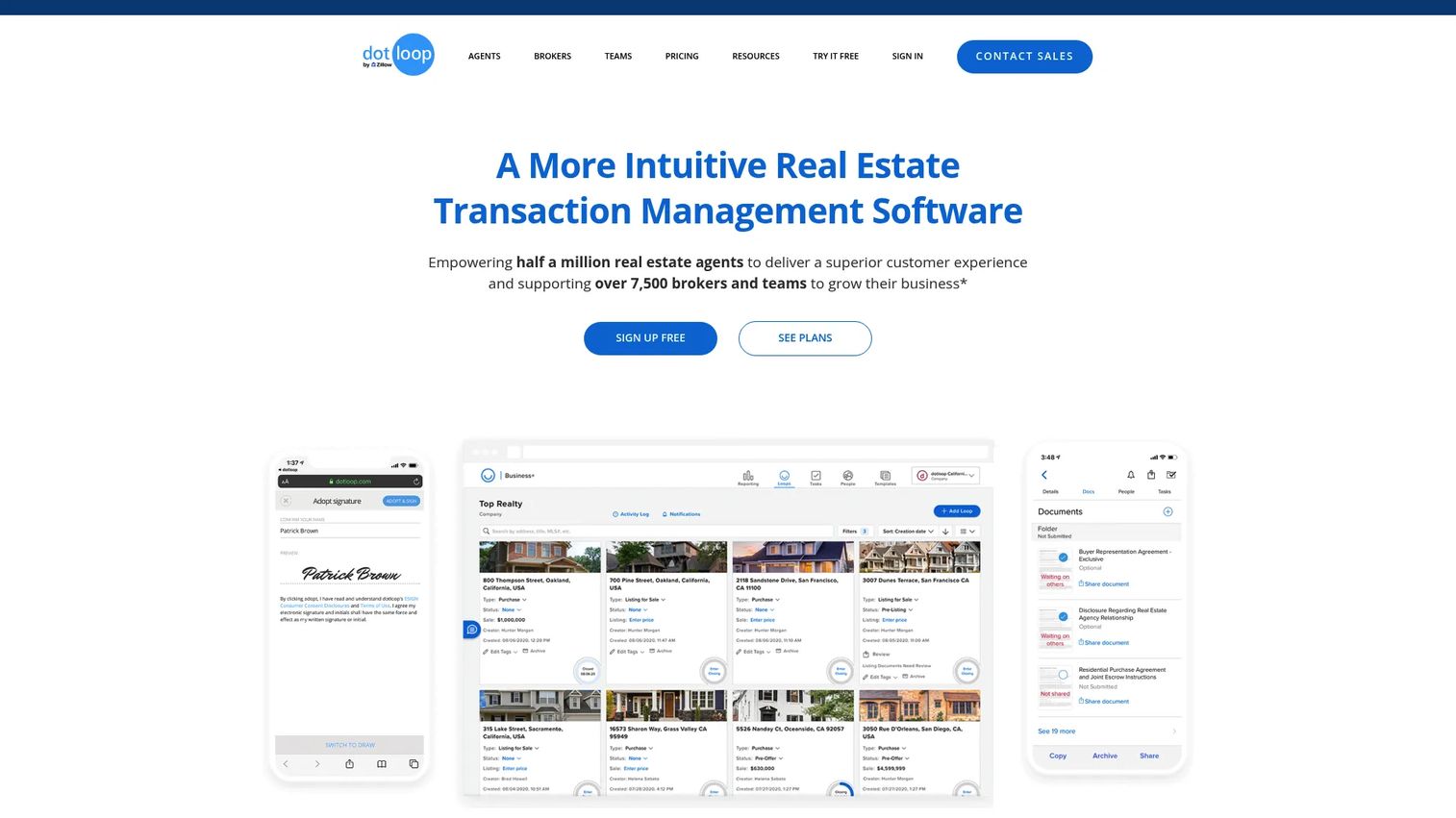
Dotloop is one of the most widely used real estate broker software platforms, built to handle a transaction end to end. Agents create, edit, eSign, store, and track documents inside a single deal workspace, and brokers get real-time visibility into where every file stands. It leads this list because it covers the broad middle of what most teams need without forcing them to bolt on separate signing or forms tools.
Best for: agents, teams, and brokerages that want transaction management and eSign in one workflow.
Key strengths
- Create, edit, eSign, store, and track transactions end to end
- Team collaboration with admins acting on behalf of others
- 60+ app integrations
- Mobile-first transacting for on-the-go signing
- Real-time deal visibility for brokers
Why choose Dotloop: it fits teams that want one place for the entire transaction rather than stitching together a signing tool, a storage tool, and a tracker. The admin-acts-on-behalf feature is genuinely useful for coordinators managing files across multiple agents.
Dotloop pricing: paid plans start at $29 per user per month. A free trial is available so you can test the workflow before committing seats.
2. Paperless Pipeline
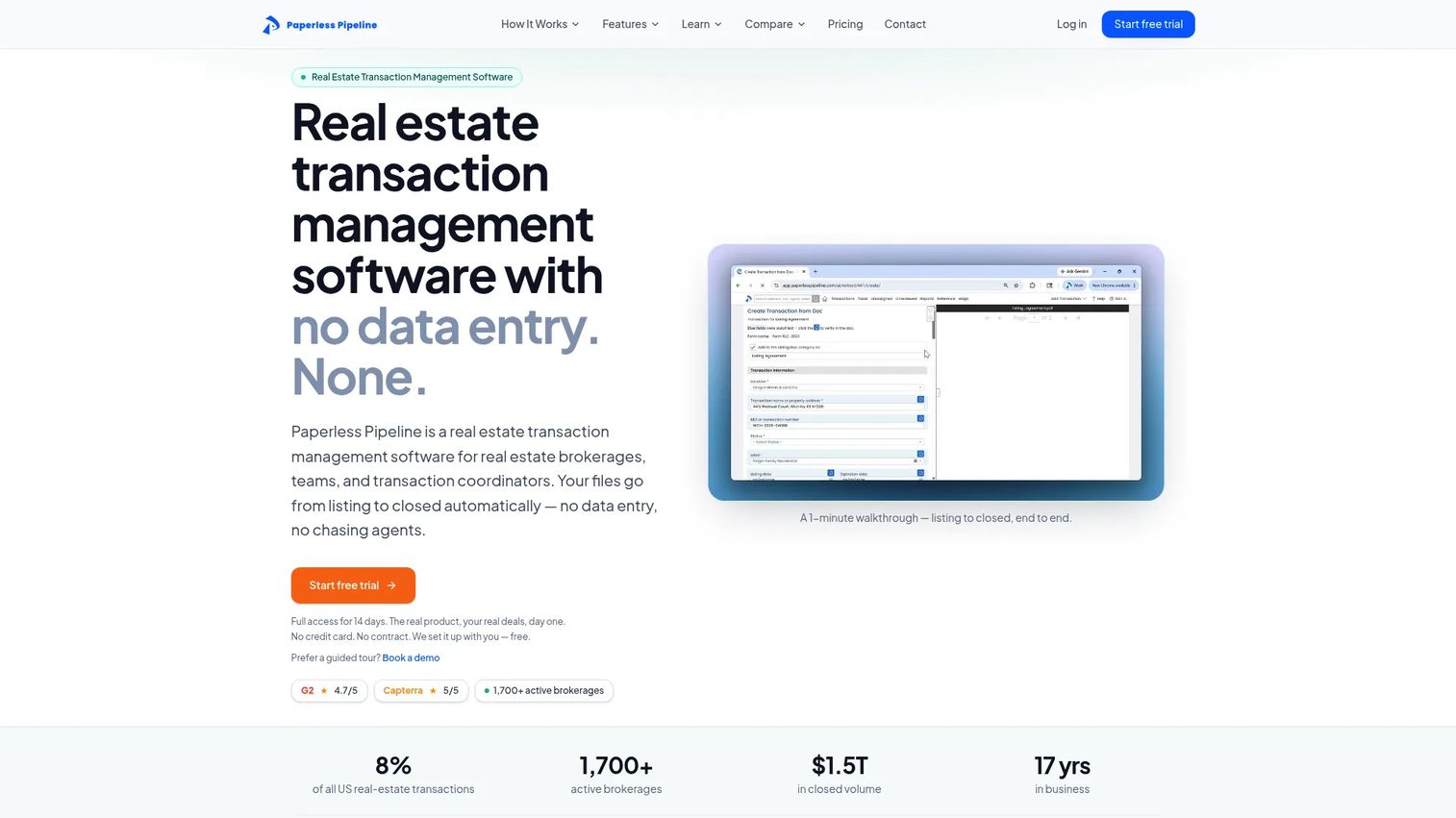
Paperless Pipeline takes a different pricing approach that a lot of brokerages prefer: you pay by transaction volume, not by seat. Add every agent for free and pay only for the deals you actually run. For a growing brokerage that hires seasonally or carries a long tail of low-volume agents, that model keeps costs tied to production instead of headcount.
Best for: high-volume brokerages and transaction coordinators who want predictable, production-based pricing.
Key strengths
- Unlimited users on every plan
- Transaction-volume pricing that scales with deals
- Document and transaction management
- Checklist and due-date automation
- Audit trail and optional commission module
Why choose Paperless Pipeline: if your seat count fluctuates but your deal volume is steadier, transaction-based pricing is easier to forecast. Free setup, no contract, and unlimited storage lower the switching cost.
Paperless Pipeline pricing: plans are tiered by monthly transaction volume, starting at $69/mo for up to 5 transactions and scaling to $715/mo for 450-plus unlimited transactions. All tiers include unlimited users and storage. The Commission Module is an optional add-on at +$64/mo.
3. SkySlope

SkySlope is built for brokerage-scale operations where compliance and audit readiness matter as much as transaction tracking. It pairs transaction management with custom checklists, compliance auditing, and built-in e-signature and forms, which makes it a strong fit for larger brokerages that need governance baked into every file. It's a common pick for teams treating real estate back office software as a compliance control, not just a filing cabinet.
Best for: brokerages needing transaction management, compliance auditing, and back-office workflow at scale.
Key strengths
- Transaction management across the brokerage
- Custom checklists and compliance auditing
- Built-in e-signature and forms
- Audit-ready record of every action
- Workflow automation for back-office teams
Why choose SkySlope: the compliance depth is the draw. If a state audit or a broker of record needs a clean paper trail on demand, SkySlope's auditing tools are designed for exactly that.
SkySlope pricing: SkyTC, its transaction coordination product, is publicly priced at $299 per deal. Full suite pricing for larger brokerages is quoted directly, so contact SkySlope for a plan scoped to your office.
4. Open to Close

Open to Close is the pick when you want to shape the platform around your process rather than adapt to someone else's. It leans hard into customization: custom fields, merge fields, email and task templates, automation, portals, and granular user permissions. Teams that have a specific closing workflow and don't want to compromise on it get the flexibility here without a heavy enterprise implementation.
Best for: real estate teams that want customizable transaction management and automation without a long setup.
Key strengths
- Customizable fields and merge fields
- Email and task templates with automation
- Document management and client portals
- Granular user permissions
- Deadline and task control
Why choose Open to Close: if off-the-shelf checklists never quite match how you work, the customization is worth it. You build the workflow once and it runs every deal your way.
Open to Close pricing: plans start at $99/mo (Grow), then $199/mo (Pro) and $399/mo (Scale). Each plan includes one user, with additional users at $69/user/mo. A 30-day free trial is offered.
5. ListedKit AI
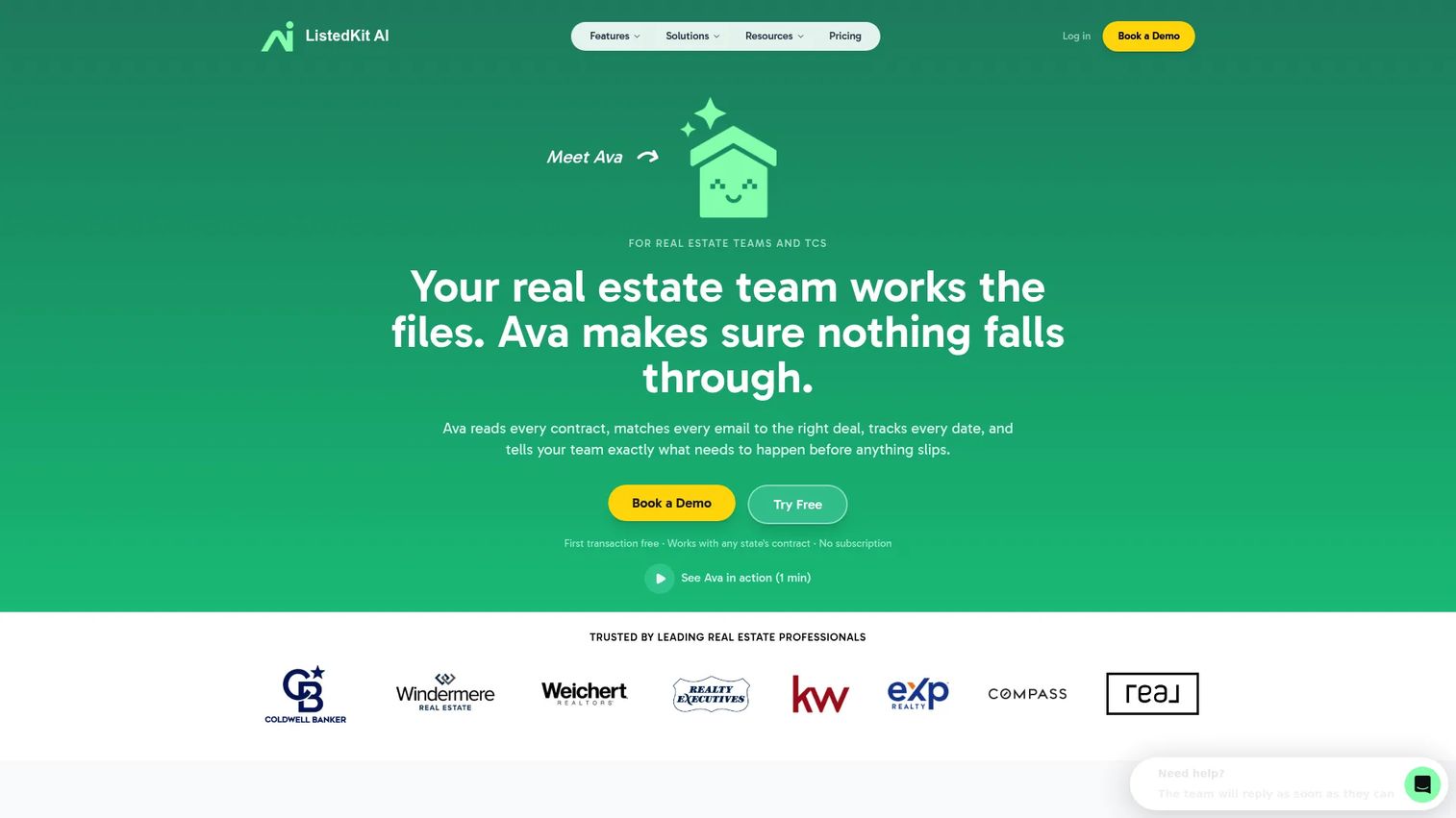
ListedKit AI changes the shape of the workflow. Instead of a coordinator manually keying dates and building a task list from a signed contract, ListedKit reads the contract, extracts dates, parties, and terms, and auto-builds the timeline and tasks. It also matches inbox emails to the right deal and tracks deadlines and compliance. For teams where contract intake is the bottleneck, that's the difference between an hour of setup and a few minutes of review.
Best for: brokers, teams, and transaction coordinators who want automation around contract intake and file setup.
Key strengths
- Reads contracts and extracts dates, parties, and terms
- Auto-generates timelines and tasks
- Matches inbox emails to the right deal
- Tracks deadlines, tasks, and compliance
- Broker-level workflow visibility
Why choose ListedKit AI: the AI intake removes the most tedious, error-prone step in file setup. When one coordinator covers a lot of agents, guided setup instead of manual data entry is what makes the coverage sustainable.
ListedKit AI pricing: usage-based with no subscription or monthly fees. The first transaction is free, then $9.99 per intake after that. That model suits teams that want costs to track directly with deal count.
6. Brokermint
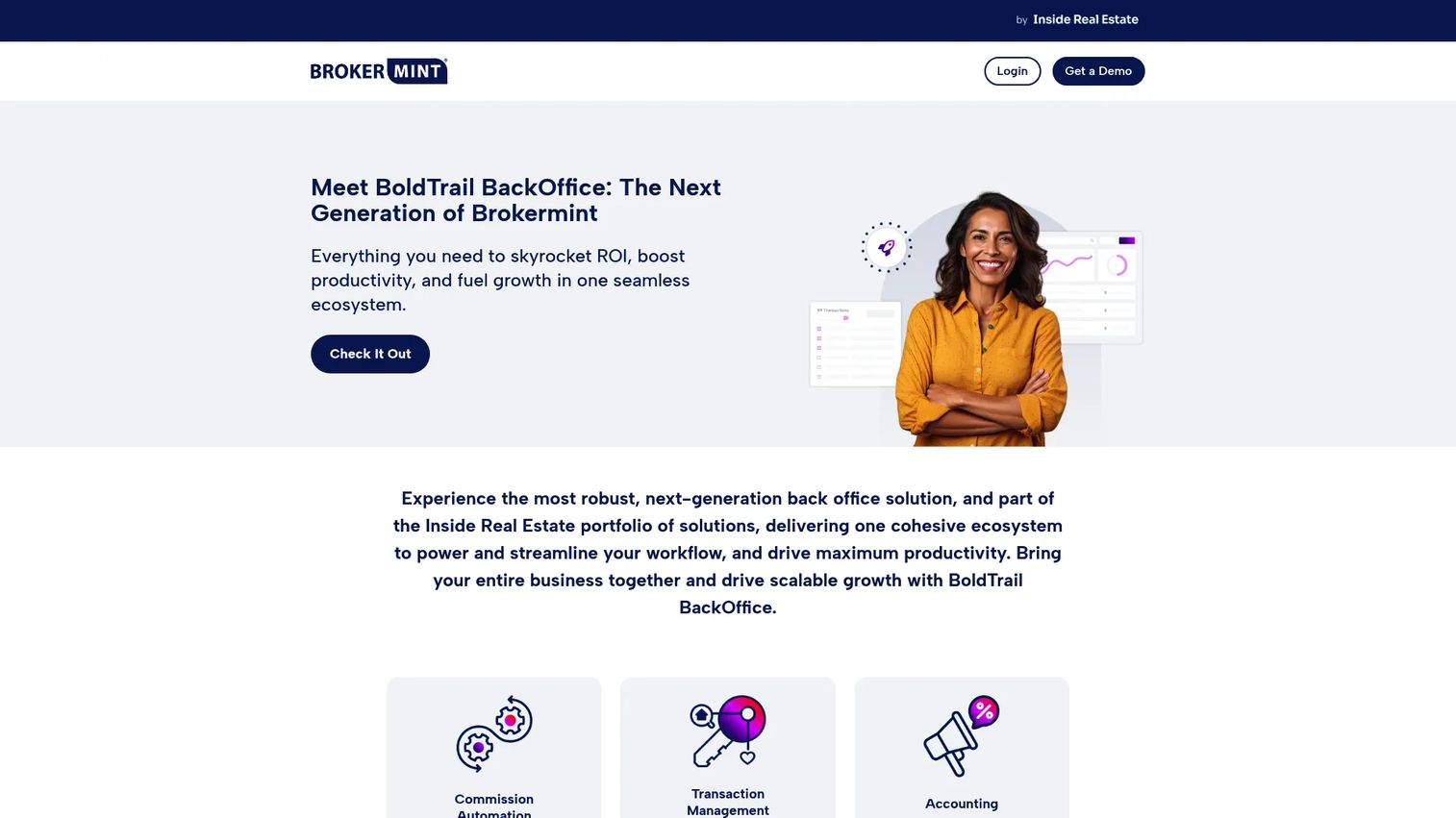
Brokermint, now branded as BoldTrail BackOffice, is less a transaction-only tool and more a back-office operating system built around transactions. It combines transaction management with commission automation, accounting, agent management, and reporting. For brokerages where the pain isn't tracking a deal but paying agents correctly and closing the books, this is the real estate brokerage management software that covers the whole back office.
Best for: brokerages that need back-office operations and accounting alongside transaction workflow.
Key strengths
- Transaction management
- Commission automation
- Accounting and financial reporting
- Agent management
- Reporting and analytics
Why choose Brokermint: it fits larger brokerages and back-office teams that have outgrown running transactions in one tool and commissions in a spreadsheet. Consolidating both under one system removes the reconciliation work between them.
Brokermint pricing: two plans are published, Standard and Professional, with pricing quoted directly rather than listed. Contact Brokermint for a scope tied to your agent count and back-office needs.
7. Rechat

Rechat positions itself as an AI-powered operating system for brokers and agents, with transaction management as one part of a broader platform. Its Deals module handles listing, offer, and transaction management with an AI assistant called Lucy, while Studio covers marketing and People handles CRM. It fits teams that want transaction management tied tightly to daily agent workflows rather than living in a standalone tool.
Best for: brokerages and teams wanting an all-in-one CRM, marketing, and transaction platform.
Key strengths
- Deals module for listing, offer, and transaction management
- Lucy AI assistant across workflows
- Studio for websites, social, print, ads, and email
- People CRM for contacts, leads, and tasks
- Broad integration support
Why choose Rechat: if you'd rather run the whole business in one platform than connect a transaction tool to a separate CRM and marketing stack, Rechat's breadth is the appeal. The tradeoff is that a broad platform asks you to adopt more than transactions alone.
Rechat pricing: Rechat directs prospects to request a demo rather than publishing public prices. Contact Rechat for a quote scoped to your team.
Considerations
Before you commit, run every shortlisted tool through the same checklist. The differences that matter show up in operations, not in feature lists.
Match the pricing model to your business shape
Seat-based pricing rewards small, stable teams. Transaction-based pricing rewards brokerages with fluctuating headcount and steadier deal volume. Per-intake pricing suits low-volume or seasonal operations. Map the model to how your business actually grows, not to a sticker price.
Check integration depth, not just integration count
"60+ integrations" means nothing if the two you need aren't among them. Confirm the tool connects to your CRM, your MLS feed, your e-signature provider, and your accounting system in the way you actually use them. A shallow integration you have to babysit is worse than none.
Test the compliance and audit trail
Ask to see the audit log. Can a broker of record pull a complete, timestamped history of a file in one click? Do required-field checks block a deal from closing with a missing disclosure? Compliance features are only real if they hold up under an actual audit.
Estimate the real cost of switching
Migration, retraining, and workflow rebuild all cost time. A tool that saves two hours per file but takes a quarter to adopt may still win, but budget the ramp honestly. Free setup, contract-free terms, and a real trial lower that cost meaningfully.
Conclusion
The right real estate transaction management system depends on how your business is shaped, not on which tool has the longest feature list.
Choose Dotloop for broad broker and team fit with eSign and mobile transacting built in. Choose Paperless Pipeline if you want production-based pricing that scales with deals instead of seats. Choose ListedKit AI if contract intake is your bottleneck and AI-driven setup would give a coordinator hours back per file. Reach for SkySlope when enterprise compliance is the priority, Brokermint when back office and accounting matter most, and Rechat when you want transactions inside an all-in-one operating platform.
Start with two decisions: your pricing model and your workflow complexity. Those two answers narrow seven tools down to two or three fast. Then run a trial on real deals, not a sandboxed demo, because the only test that matters is whether your coordinators and agents actually adopt it.
FAQs
It's software that centralizes and tracks every step of a property deal, from signed contract to close, including documents, deadlines, tasks, compliance review, and communication. Unlike plain file storage, it understands the deal around the files: who signed what, which contingency is next, and whether the compliance checklist is complete.
Focus on five things: workflow depth for documents and deadlines, compliance features like audit trails and approval queues, reporting that gives brokers real-time visibility, integrations with your CRM, MLS, and accounting stack, and a pricing model that matches how your business grows. Feature count matters less than whether those five hold up under your actual volume.
No. A CRM manages relationships and pipeline: leads, contacts, and follow-up before a deal exists. Transaction management software manages execution: the documents, deadlines, and compliance once a deal is under contract. Many teams run both, and some platforms like Rechat combine them, but they solve different jobs.
It depends on your shape. Seat-based pricing is predictable when headcount is stable, but it punishes brokerages carrying low-volume agents. Transaction-based pricing, like Paperless Pipeline's, ties cost to production, which suits fluctuating headcount and steadier deal flow. Per-intake pricing, like ListedKit AI's, fits low-volume or seasonal operations best.
Many do. Tools like Dotloop and SkySlope include built-in e-signature so signing happens inside the same workspace as the documents. Others integrate with a dedicated signing provider. If keeping signing and document tracking in one place matters to you, confirm the tool has native eSign rather than a bolt-on.
Yes, most connect to a CRM, MLS feeds, and accounting or back-office systems through integrations. Back-office-focused platforms like Brokermint go further by building commission automation and accounting directly into the same system, which removes the reconciliation work between transaction data and the books.
There's no single winner, only a best fit. Small teams that want the whole transaction in one workflow lean toward Dotloop. Teams with fluctuating headcount favor Paperless Pipeline's transaction-based pricing. Low-volume or seasonal operations often prefer ListedKit AI's pay-per-intake model, which keeps cost tied directly to the number of deals you actually run.