
A rep opens a deal, needs the current pricing one-pager, and searches three drives, two Slack threads, and an inbox. Ten minutes later they send the version from last quarter. The prospect notices the old logo.
That is the tax on scattered content, and it is real money. Sales reps spend a meaningful slice of every week hunting for the right asset instead of selling. Worse, when they cannot find it fast, they build their own. Now you have five versions of the same battlecard, none of them approved, all of them in the field.
The global sales content management software market was valued at roughly USD 2.5 billion in 2024 and is expected to reach USD 5.8 billion by 2033, according to Verified Market Reports (2024). That growth tracks a single problem: content sprawl kills consistency, and inconsistency kills win rates.
The fix is not more content. It is a sales content management system that centralizes assets, governs versions, surfaces the right file in the seller's workflow, and tells you what actually gets used. This guide ranks the platforms that do that well.
What's inside
This guide compares the top sales content management tools for enablement leaders, RevOps, and product marketing teams who own readiness, consistency, and adoption.
We selected and ranked each platform on four criteria that matter most for sales content management for sales teams:
- Governance: version control, approvals, ownership, and content expiration
- Integrations: CRM integration plus email, chat, and conferencing surfaces
- Analytics: content analytics tied to usage by asset, stage, and segment
- Rep adoption: in-workflow delivery and low-friction findability
Pricing and ratings reflect verified, current values at the time of writing.
TL;DR
- Best for enterprise governance and AI search: Highspot combines governed content, AI-powered answers, and analytics for large GTM teams.
- Best for large enablement organizations: Seismic pairs governed content delivery with automation, personalization, and training.
- Best for balanced content and field adoption: Showpad blends content management, buyer engagement, and rep-facing usability.
- Best for in-workflow, just-in-time enablement: Spekit surfaces content and answers inside the tools reps already use.
- Best for deal-stage content and buyer engagement: Dock ties a sales content library to digital sales rooms and order forms.
- Best fit for most teams: the platform your reps actually open every day. A smaller, well-governed library that lives in the workflow beats a massive one nobody trusts.
What is sales content management software?
Sales content management software is a platform that centralizes sales collateral, controls its versions, surfaces the right asset inside the seller's workflow, and tracks how content gets used and how it influences deals.
Think of it as the operating layer between the assets marketing and product marketing create and the moment a rep needs them in a live deal. A good sales content management platform does not just store files. It governs them, personalizes delivery, and measures sales content performance so you can prove impact.
Core capabilities to expect:
- Centralized content library: one source of truth for decks, one-pagers, battlecards, case studies, and email templates
- Search and findability: fast retrieval by keyword, stage, persona, or industry
- Content governance: version control, approvals, ownership, and expiration dates
- Content analytics: usage by asset, stage, and segment, plus engagement signals
- Personalization: content recommendations mapped to deal context
- Integrations: CRM integration, email, chat, conferencing, and knowledge bases
- Permissions and security: role-based access for sensitive pricing and launch material
The category overlaps with the broader sales enablement content management space, which folds in training, coaching, and readiness. Some tools do both. Others focus tightly on the sales content library and distribution. Where you land depends on whether content or readiness is the fire you are fighting.
When to use sales content management software
Centralize scattered sales collateral
You know the symptom. The pitch deck lives in one drive, the security one-pager in an inbox, the competitive battlecard in a pinned Slack message from March. Reps stitch together their own decks because finding the approved one takes too long.
A centralized content library ends the scavenger hunt. It kills duplicate versions, retires stale assets, and gives every rep the same starting point. When product marketing updates messaging, the change propagates once instead of living in forty personal copies.
Improve rep adoption with in-workflow delivery
Reps ignore any tool that adds clicks. If the content library is a separate tab they have to remember to open, usage stays low no matter how good the assets are.
In-workflow delivery flips that. When the right case study surfaces inside the CRM record, or a battlecard pops up in the seller's chat during a live deal, adoption climbs because the content meets the rep where the work already happens. Findability inside the workflow is often the real adoption lever, not library size.
Govern launches and content updates
Product launches, messaging shifts, and new competitive threats all create the same risk: old material still circulating in the field. Without version control and expiration, a rep sends last quarter's pricing to a live opportunity.
This is where governance earns its keep. Approvals gate what goes live, ownership makes someone accountable for freshness, and expiration dates automatically retire dated assets. During a launch, that difference shows up in message consistency across every deal in flight.
Comparison table
Here is how the eight platforms stack up on fit, differentiation, pricing, and rating. Governance and adoption leaders sit near the top.
| # | Product | Best for | Key differentiator | Pricing | G2 rating |
|---|---|---|---|---|---|
| 1 | Highspot | Enterprise GTM enablement | AI search plus governed content and analytics | Contact sales | 4.7/5 |
| 2 | Seismic | Large enablement organizations | Content automation and personalization at scale | Contact sales | Not listed |
| 3 | Showpad | Balanced content and field adoption | Buyer engagement plus rep-facing usability | Request a quote | 4.6/5 |
| 4 | Bigtincan | Configurable enablement stack | AI-assisted delivery with mobile-friendly access | Contact sales | 4.3/5 |
| 5 | Spekit | In-workflow enablement | Just-in-time content in the flow of work | Contact sales | 4.7/5 |
| 6 | Dock | Deal-stage content and buyer rooms | Digital sales rooms tied to content | Free plan; paid from $350/mo | 4.6/5 |
| 7 | DocSend | Secure sharing and tracking | Document analytics with access controls | From $10/user/mo | 4.6/5 |
| 8 | HubSpot Content Hub | HubSpot-native content teams | CRM-adjacent content and publishing | Free plan; Starter from $10/mo | 4.5/5 |
Best 8 sales content management software for 2026
1. Highspot

Highspot is an AI-powered go-to-market enablement platform that unifies content, training, coaching, engagement, and analytics. It is built for teams that need control and adoption at scale, not just a bigger folder structure. The AI-powered search and answers layer is the standout: reps ask a question and get the right asset instead of scrolling a taxonomy.
Content governance runs deep here. You get versioning, ownership, and analytics that connect content usage to deal outcomes. Digital Sales Rooms give buyers a single branded space, and Sales Plays tie the right content to the right stage. For enablement leaders drowning in sprawl, the governance and search combination is the reason to look.
Best for: mid-market and enterprise GTM teams that need governed content plus adoption at scale.
Key strengths
- AI-powered search and answers for fast retrieval
- Content governance with versioning and ownership
- Digital Sales Rooms for buyer engagement
- Sales Plays mapped to deal stages
- Analytics, scorecards, and content recommendations
Why choose Highspot: if governance, AI search, and content analytics are your top priorities and you have the budget for an enterprise platform, Highspot covers the full readiness-to-execution loop in one place.
Highspot pricing: pricing is customized by capabilities, use cases, organization size, and complexity. Plans include Equip and engage, Train and practice, and Coach and reinforce, all contact-sales. No public numeric price or free tier is listed.
2. Seismic

Seismic is an AI-powered sales enablement platform built for large enablement organizations with broad content and training needs. It leans into governed content delivery, automation, and personalization, so a rep gets the right asset assembled for the right deal without manual rework.
The platform pairs sales content management with learning and coaching, buyer engagement, and enablement intelligence. That breadth is the point: if your mandate spans content, readiness, and measurement across a big team, Seismic keeps those motions in one system. Content automation is the differentiator, generating tailored, on-brand collateral at scale instead of one deck at a time.
Best for: enterprise go-to-market teams that need content, training, and buyer engagement unified.
Key strengths
- Governed sales content management
- Content automation and personalization at scale
- Learning and coaching for readiness
- Buyer engagement surfaces
- Enablement intelligence and analytics
Why choose Seismic: it fits larger organizations where content, training, and coaching all need to live together and scale across many reps and segments.
Seismic pricing: Seismic does not publish pricing on its site and directs visitors to request a demo. Plan details and starting prices are handled through sales conversations.
3. Showpad

Showpad is an AI-native revenue effectiveness platform that balances governed content management with strong rep-facing usability. It targets the sweet spot where sales teams need both organized content and field adoption, not one at the expense of the other.
The platform covers content management, sales readiness, buyer engagement, and analytics, with Showpad Genie AI helping reps surface and personalize the right material. The reason to shortlist Showpad is usability: content governance matters, but so does whether reps actually open the tool. Showpad invests heavily in the seller experience so adoption does not stall.
Best for: enterprise sales and enablement teams that want governed content plus high field adoption.
Key strengths
- Content management with governance
- Sales readiness and coaching
- Buyer engagement spaces
- Analytics and insights on content usage
- Showpad Genie AI for surfacing content
Why choose Showpad: if past rollouts stalled because reps ignored the content library, Showpad's focus on rep-facing usability is the deciding factor.
Showpad pricing: Showpad offers Professional and Advanced plans, licensed per user and customizable. The pricing page shows plan names and directs visitors to request a quote rather than a public starting price.
4. Bigtincan
Bigtincan is an AI-powered revenue enablement platform for teams that want broad enablement functionality with content management at the core. It is highly configurable, which suits organizations with specific workflow requirements that off-the-shelf tools do not cover.
The platform brings together content management, training, coaching, and digital sales rooms, layered with AI-assisted analytics and relationship intelligence. Mobile-friendly access is a genuine differentiator for field teams who work off tablets and phones between meetings. If your reps live in the field and need content that travels, that mobility matters.
Best for: enterprise teams that need a configurable revenue enablement platform with content at the center.
Key strengths
- Content management with permissions
- AI-assisted analytics and reporting
- Training, coaching, and digital sales rooms
- Relationship intelligence and integrations
- Mobile-friendly content access
Why choose Bigtincan: it fits teams that want to configure the platform to their exact motion and value mobile access for field-heavy selling.
Bigtincan pricing: the pricing page shows platform editions, including Essential and Elite, plus support packages, but no public price. Visitors are directed to contact sales for a quote.
5. Spekit

Spekit is an AI-native revenue enablement platform built around one idea: put governed knowledge, content, and coaching in the flow of work. Instead of asking reps to leave their workflow, Spekit surfaces the right answer or asset inside the tools they already use.
That in-workflow delivery is the whole pitch, and it is a strong one for adoption-first teams. The GTM Knowledge Engine, embedded enablement, and agentic coaching mean reps get just-in-time enablement at the exact moment of need. Deal Rooms and learning paths round it out. If rep behavior and fast access are your obsession, Spekit was designed for exactly that.
Best for: high-growth B2B revenue teams that prioritize in-workflow enablement and adoption.
Key strengths
- GTM Knowledge Engine for governed content
- Embedded enablement in the flow of work
- Agentic coaching and actions
- Deal Rooms and learning paths
- Analytics and broad integrations
Why choose Spekit: it wins when your deciding factor is whether reps actually use content, because it meets them inside their daily tools rather than in a separate destination.
Spekit pricing: Spekit uses demo and contact-sales CTAs rather than published plan pricing. Reach out directly for tier details and a quote tailored to your team size.
6. Dock
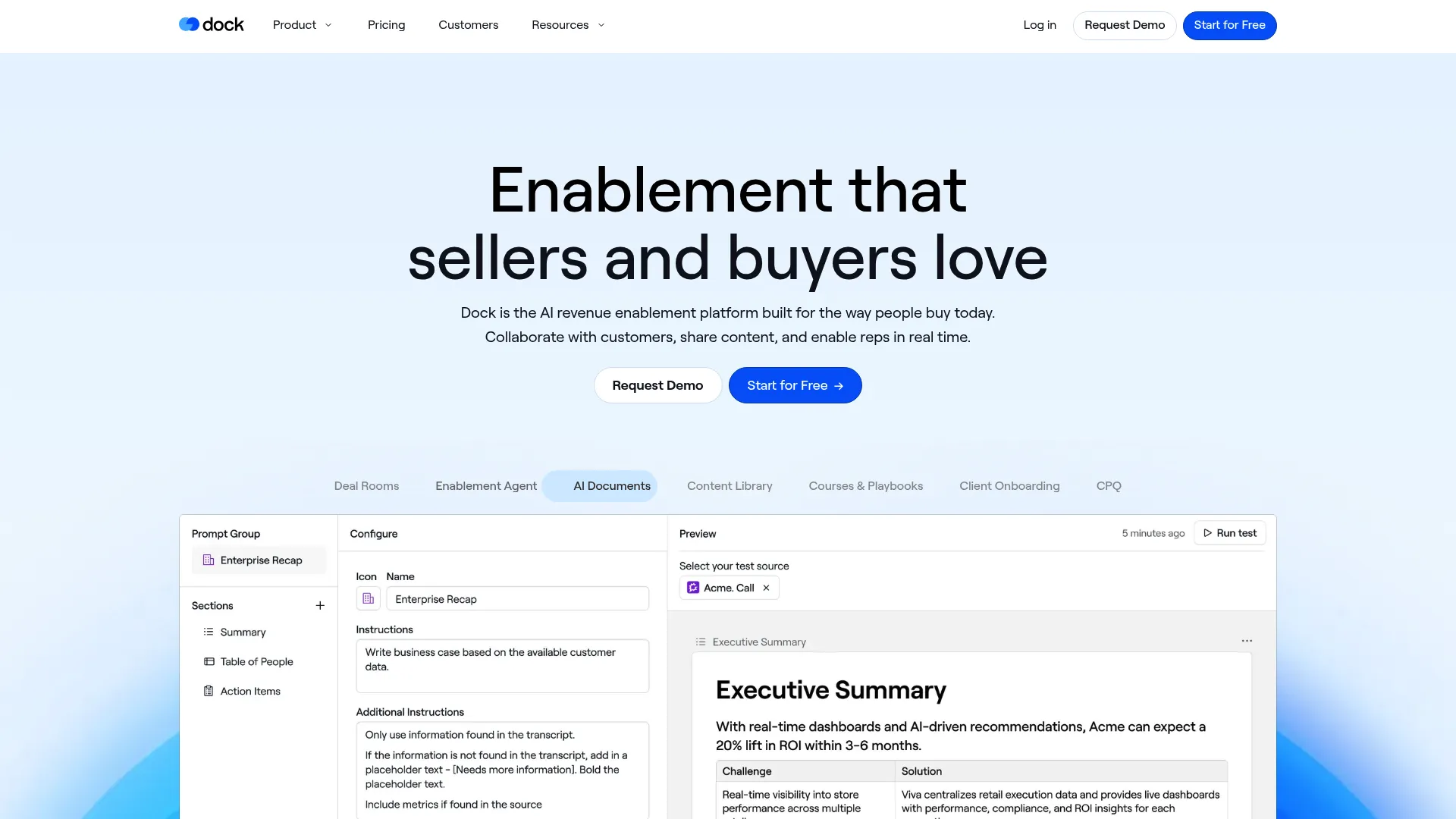
Dock is a customer-facing revenue workspace that ties content management to deal execution and buyer engagement. Instead of organizing content only for internal reps, Dock builds branded spaces where buyers and sellers collaborate through the deal.
Digital sales rooms are the core: shared workspaces with content, mutual action plans, and order forms in one place. AI-assisted workspaces, content management, and automations keep everything current, and integrations sync content from your existing drives. This fits teams that want the sales content library connected directly to how deals actually progress, not sitting in a separate silo.
Best for: revenue teams that need a branded buyer portal with content and order-form workflows.
Key strengths
- Digital sales rooms for buyer collaboration
- Content management with AI-assisted workspaces
- Mutual action plans and order forms
- Salesforce and HubSpot integrations
- Drive and SharePoint sync
Why choose Dock: it fits teams that want content management tied to deal execution and buyer-facing engagement rather than an internal-only library.
Dock pricing: Dock offers a free forever plan. Standard is $350 per month, Premium is $1,000 per month billed annually, and Enterprise is custom on an annual contract. Paid plans add seats and features.
7. DocSend

DocSend is secure file sharing and virtual data room software with document analytics and access controls. It is the pick when controlled distribution and engagement visibility matter more than a full enablement suite.
Where a broad platform manages the whole content lifecycle, DocSend focuses on secure sharing and tracking. You send a document, control who sees what, and watch exactly how prospects engage page by page. Virtual data rooms (Spaces) add permissions and audit trails for sensitive material. For teams that live in deal documents and fundraising decks, that engagement analytics layer is the draw.
Best for: teams that need secure sharing, engagement tracking, and data rooms for deals or fundraising.
Key strengths
- Secure file sharing with access controls
- Document and video analytics
- Virtual data rooms with permissions
- Audit trails for sensitive content
- Page-by-page engagement tracking
Why choose DocSend: it fits when secure, trackable distribution of individual documents is the priority over a full sales content management platform.
DocSend pricing: Personal is $10 per user per month, Standard is $45 per user per month, Advanced is $150 per month, and Advanced Data Rooms is $180 per month. A 14-day free trial is available.
8. HubSpot Content Hub
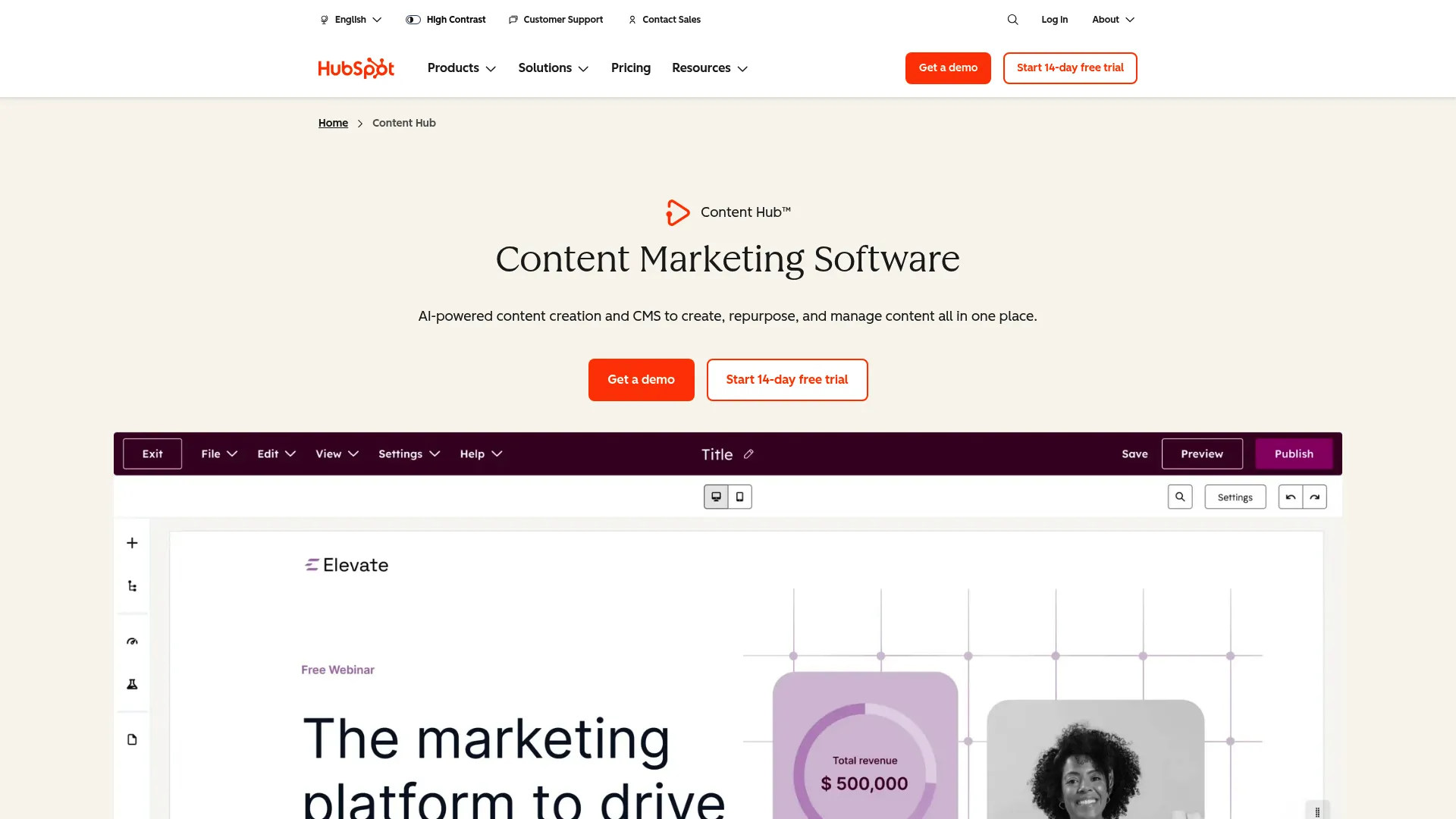
HubSpot Content Hub is AI-powered content marketing software for creating, managing, and personalizing content experiences. It fits teams already committed to the HubSpot ecosystem that want content organization adjacent to their CRM without a separate enablement platform.
The strength here is CRM adjacency and simpler content workflows. Content lives close to the customer record, and AI features help with blog creation, remixing, and SEO. It leans more toward content marketing than deep sales enablement, so it suits lighter enablement needs where the priority is publishing and CRM proximity rather than governed sales collateral management at enterprise scale.
Best for: teams that want an all-in-one CMS and content marketing platform with AI, inside HubSpot.
Key strengths
- Free website and landing page tools
- AI blog creation and content remixing
- SEO recommendations and analytics
- Personalization by contact
- CRM-adjacent content workflows
Why choose HubSpot Content Hub: if you already run on HubSpot and need content organization near the CRM with lighter enablement requirements, it keeps everything in one familiar place.
HubSpot Content Hub pricing: Free is $0 per month. Starter is $10 per seat per month, Professional is $500 per month with three seats, and Enterprise is $1,500 per month with five seats.
Considerations
Before you commit, pressure-test each platform against the criteria that break deals in practice.
Governance and version control
Ask how the tool handles approvals, expiration, and ownership. Content freshness matters as much as library size. A tool that lets stale battlecards linger will hurt you more than one with fewer assets. Confirm you can assign owners, set expiration dates, and enforce approval workflows before anything reaches the field.
CRM and workflow integration
The platform has to fit the seller's existing process, not fight it. Check whether content is accessible from Salesforce, email, chat, and conferencing tools. CRM integration is where adoption is won or lost. If reps have to leave the deal record to find the asset, they often will not.
Analytics and adoption signals
Look for content analytics that break usage down by asset, stage, and segment. Then ask the harder question: how does the platform connect content to outcomes? Direct attribution is imperfect, but usage patterns and engagement signals tell you what reps trust and what buyers actually open.
Ease of maintenance
Every system carries a hidden workload. Someone has to update assets, permissions, metadata, and reporting. Estimate that admin time honestly before you buy. A platform that needs a full-time librarian to stay clean is only worth it if you have the headcount to staff it.
Security and permissions
Confirm role-based access, compliance coverage, and the ability to restrict sensitive content. Competitive battlecards, pricing, and launch materials should not be visible to everyone. Match permission granularity to how tightly you need to control who sees what.
Conclusion
The right sales content management platform is the one your reps actually open, not the one with the biggest library.
For enterprise teams that need governance, AI search, and analytics in one place, Highspot leads. Large enablement organizations balancing content and training will find Seismic fits the mandate. If field adoption keeps stalling your rollouts, Showpad's rep-facing usability is the answer, and Spekit wins when in-workflow, just-in-time enablement is the whole point. For deal-stage content tied to buyer engagement, Dock connects the library to how deals close, while DocSend covers secure, trackable distribution and HubSpot Content Hub suits HubSpot-native teams with lighter needs.
Start with your real bottleneck. If it is content chaos, prioritize governance. If it is low adoption, prioritize in-workflow delivery. Shortlist two platforms, run a pilot with a real deal team, and measure usage before you sign.
Want to show your product instead of just sharing files about it? Interactive demos let buyers experience your product at their own pace through a guided path, and they pair naturally with your content library across sales follow-ups, landing pages, onboarding, and partner enablement. Start your journey with Guideflow today!
FAQs
Sales content management software centralizes sales collateral, controls versions, and distributes the right asset to reps inside their workflow. It also tracks how content gets used and which assets influence deals. The category spans library centralization, governed distribution, and content analytics so enablement teams can prove impact rather than just store files.
A CRM stores pipeline data, contacts, and deal records. Sales content management organizes and delivers sales collateral like decks, battlecards, and case studies. They solve different problems. The best sales content management tools integrate tightly with your CRM so content surfaces inside deal records, rather than trying to replace the system of record.
Prioritize content governance, search and findability, content analytics, personalization, permissions, and workflow integration. Governance keeps assets fresh and approved. Analytics show what gets used. But adoption matters as much as storage: the best-governed library still fails if reps never open it, so in-workflow delivery is often the deciding feature.
Track content usage by asset, stage, and segment, plus rep adoption and ramp impact. Then connect those signals to win rate and sales cycle length where you can. Direct attribution is imperfect, so lean on behavior signals: which assets reps trust, which buyers open, and where content moves deals forward.
Enterprise buyers usually prioritize content governance, security, and analytics at scale. Frame the decision around those criteria rather than brand names. Platforms with deep versioning, role-based permissions, AI search, and outcome-linked analytics fit enterprise complexity best. Match the platform to your governance and compliance requirements before weighing feature breadth.
Yes, when it lives in the seller's workflow and surfaces the right content at the right moment. Reps ignore tools that add clicks. Low-friction access is often the real adoption lever, more than library size. Look for in-workflow delivery inside the CRM, email, and chat, so content meets reps where the work already happens.
It is usually a shared ownership model. Marketing and product marketing often own content creation and messaging. Sales enablement owns discoverability, governance, and usage in the field. That split works when the tool gives enablement control over versioning, approvals, and expiration while letting marketing publish, so both teams operate from a single source of truth.