A new submission lands in a shared inbox. Then another. A reviewer says yes, goes quiet for six weeks, and needs three reminders. An author emails asking where their paper stands, and nobody can answer without opening four threads and a spreadsheet.
That is the daily reality for editorial teams running journals on email and manual tracking. The admin does not scale. Review cycles stretch. Version confusion creeps in, and someone eventually edits the wrong file.
The category exists to fix exactly this. The global manuscript management software market reached USD 1.34 billion in 2024 and is forecast to grow at a 13.7% CAGR through 2033, according to Dataintelo (2024). The broader academic publishing software market hit USD 2.9 billion in 2024, per OpenPR / HTF Market Intelligence (2024). Journals and presses are moving off ad hoc tooling because the manual approach breaks under real submission volume.
This guide compares six platforms that handle manuscript intake, peer review management, editorial decisions, and publication handoff. It skips the sales pitch and focuses on what each tool does, where it fits, and how it prices.
What's inside
This guide is for editorial directors, journal managers, university press operators, and publishing teams evaluating manuscript tracking software before a procurement decision.
We picked these six platforms on the criteria that matter when you actually run journals:
- Workflow coverage: submission, peer review, decision, and publication handoff in one system
- Implementation speed: how fast a team gets live without heavy IT lift
- Editorial collaboration: reviewer routing, notes, templates, status visibility
- Hosted delivery: fully hosted, self-hosted, or hybrid
- Fit for scale: single journal, multi-title portfolio, or enterprise publishing operation
TL;DR
- Best for small teams needing fast setup: Scholastica, hosted peer review and OA hosting with transparent per-submission pricing.
- Best for broad application workflows: Submittable, if you also run grants, awards, or CSR programs alongside editorial work.
- Best for modular journal operations: JAMS, all-in-one submission and publishing with a free starter tier.
- Best for open-source flexibility: OJS, the widely used open-source journal platform from PKP.
- Best for large editorial operations: Aries Systems, configurable end-to-end workflow for complex portfolios.
- Best for modern open access publishing: Janeway, built for academically oriented and OA-focused teams.
What is manuscript submission software
Manuscript submission software is a platform that manages the full editorial lifecycle of a scholarly article, from author intake through peer review, editorial decision, and handoff to production or publication.
It replaces the email-and-spreadsheet approach with a single system of record. Authors submit files and metadata through a structured form. Editors assign reviewers, track decisions, and communicate with authors inside one workflow. This category overlaps with journal management software, submission management software, and editorial workflow software, though each term emphasizes a slightly different slice of the same job.
Core features to expect:
- Submission forms and file intake: structured metadata capture and manuscript uploads
- Editorial and reviewer workflow management: assignment, routing, and reminders
- Anonymous or blinded review support: single, double, or open peer review models
- Decision letters and version tracking: templated communication and revision history
- Reporting and audit trails: turnaround times, reviewer performance, decision logs
- Integration and hosting options: fully hosted delivery, self-hosted control, or hybrid
The strongest peer review management software handles the middle of this workflow well, because that is where review cycles stall. The strongest editorial workflow software also carries the post-decision handoff, so accepted manuscripts do not fall into a gap between acceptance and publication.
When to use
Streamline incoming submissions
Use manuscript submission software when a shared inbox and a spreadsheet stop keeping up. Once submission volume climbs, files get lost, metadata gets inconsistent, and status becomes a guess. Centralizing intake gives every submission a single record, a clear owner, and a visible stage. That alone removes a large share of the back-and-forth that eats editor time.
Coordinate peer review
Use it when reviewers, editors, and authors need a shared workflow instead of parallel email threads. Reviewer chasing is the classic bottleneck. Automated routing, invitation tracking, and reminder scheduling cut the manual follow-up that stretches review cycles for weeks. A shared status view also means an editor can answer "where is this?" without reconstructing a thread.
Move from acceptance to publication
Use it when accepted manuscripts need a clean handoff to production, hosting, or open access publishing. The post-decision workflow matters as much as intake. A platform that carries an accepted paper into production, tracks its version, and pushes it to your open access journal software keeps the whole pipeline auditable instead of dropping the manuscript into a manual process.
Comparison table
The table below compares each platform on workflow scope, hosted delivery, and editorial fit. Pricing and ratings reflect verified public values at the time of writing; several vendors publish quote-based pricing, and some scholarly platforms do not carry a current G2 listing.
| # | Product | Best for | Key differentiator | Pricing | G2 rating |
|---|---|---|---|---|---|
| 1 | Scholastica | Small to mid journals | Hosted peer review plus OA hosting and production | $10/submission (scholarly), $7.35 (law) | Not listed |
| 2 | Submittable | Broad application workflows | Grants, awards, CSR, and editorial in one platform | Quote-based | 4.5/5 |
| 3 | JAMS | Modular journal operations | All-in-one workflow with free starter tier | Free up to 20 accepted, then $27 each | 4.5/5 |
| 4 | OJS | Open-source flexibility | Self-hosted, extensible, community-supported | Free (open source) | Not listed |
| 5 | Aries Systems | Large editorial operations | Configurable end-to-end editorial workflow | Quote-based | Not listed |
| 6 | Janeway | Open access publishing | Modern OA-first journal platform | Contact for hosting | Not listed |
Best 6 manuscript submission software for 2026
1. Scholastica
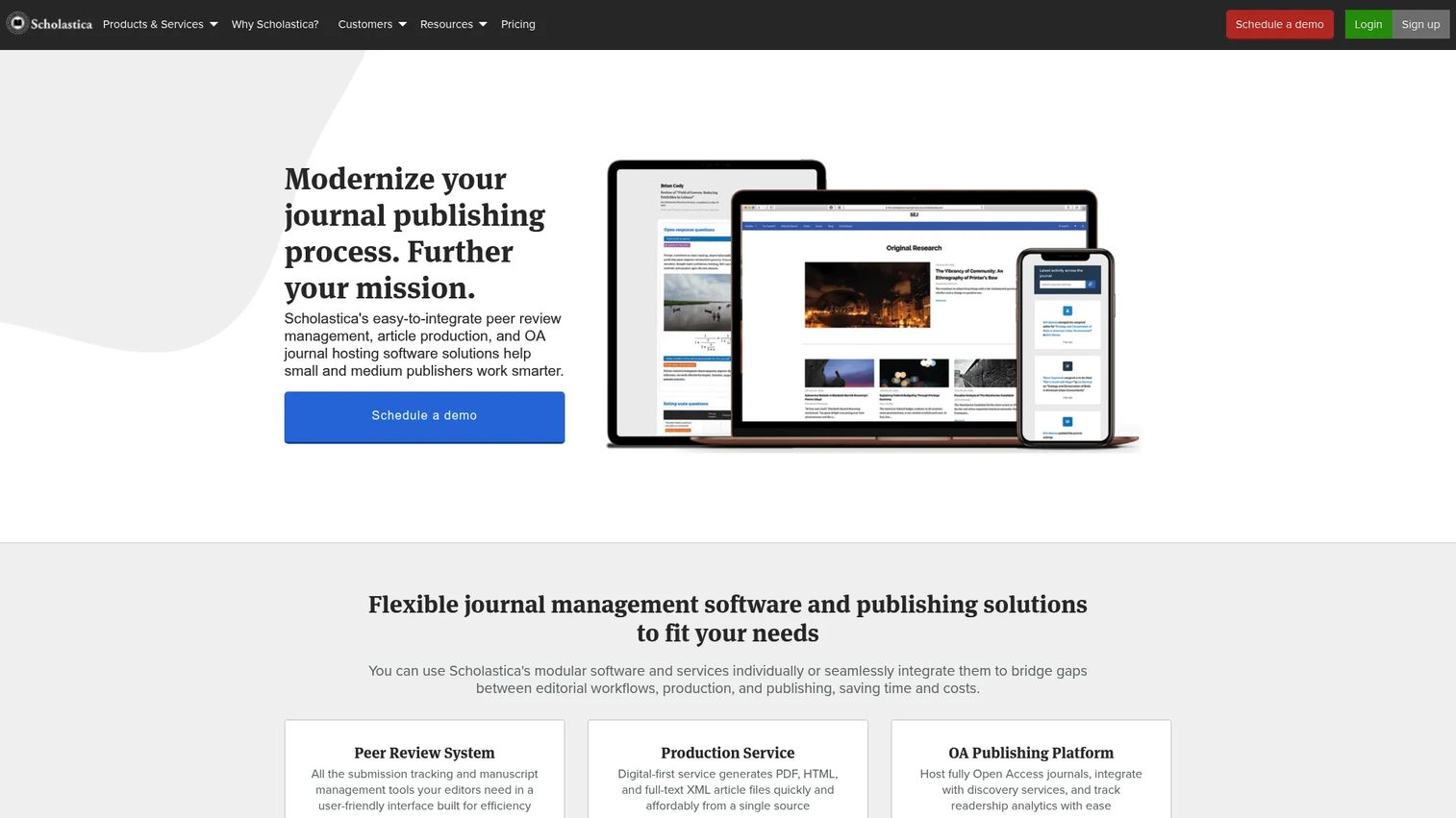
Scholastica is academic journal publishing software built around three connected products: a peer review system, article production services, and open access journal hosting. It targets small and mid-sized publishers that want to modernize without standing up their own infrastructure. The pitch is speed and low IT burden, which lands well with teams that do not have a developer to spare.
Where it fits: journals that need hosted peer review management and a clean path to publication without heavy setup. You get submission intake, reviewer coordination, and decision tracking in one place, then optional production and OA hosting on top. Smaller editorial teams pick it because they can get live quickly and price it per submission rather than committing to a large annual platform fee.
Key strengths
- Peer review management: intake, reviewer routing, decisions
- Article production: typesetting and formatting services
- Open access journal hosting on a dedicated platform
- Hosted delivery with low IT overhead
Why choose Scholastica
Choose Scholastica if you run a single journal or a small portfolio and want hosted peer review plus a route to open access publishing without managing servers. It fits teams that value fast setup over deep enterprise configuration.
Scholastica pricing
The peer review system is $10 per submission for scholarly journals and $7.35 per submission for law reviews, plus a $500 annual fee. Production services are usage-based at $7 per 500 words. The OA publishing platform is $1,549 per year per journal.
2. Submittable
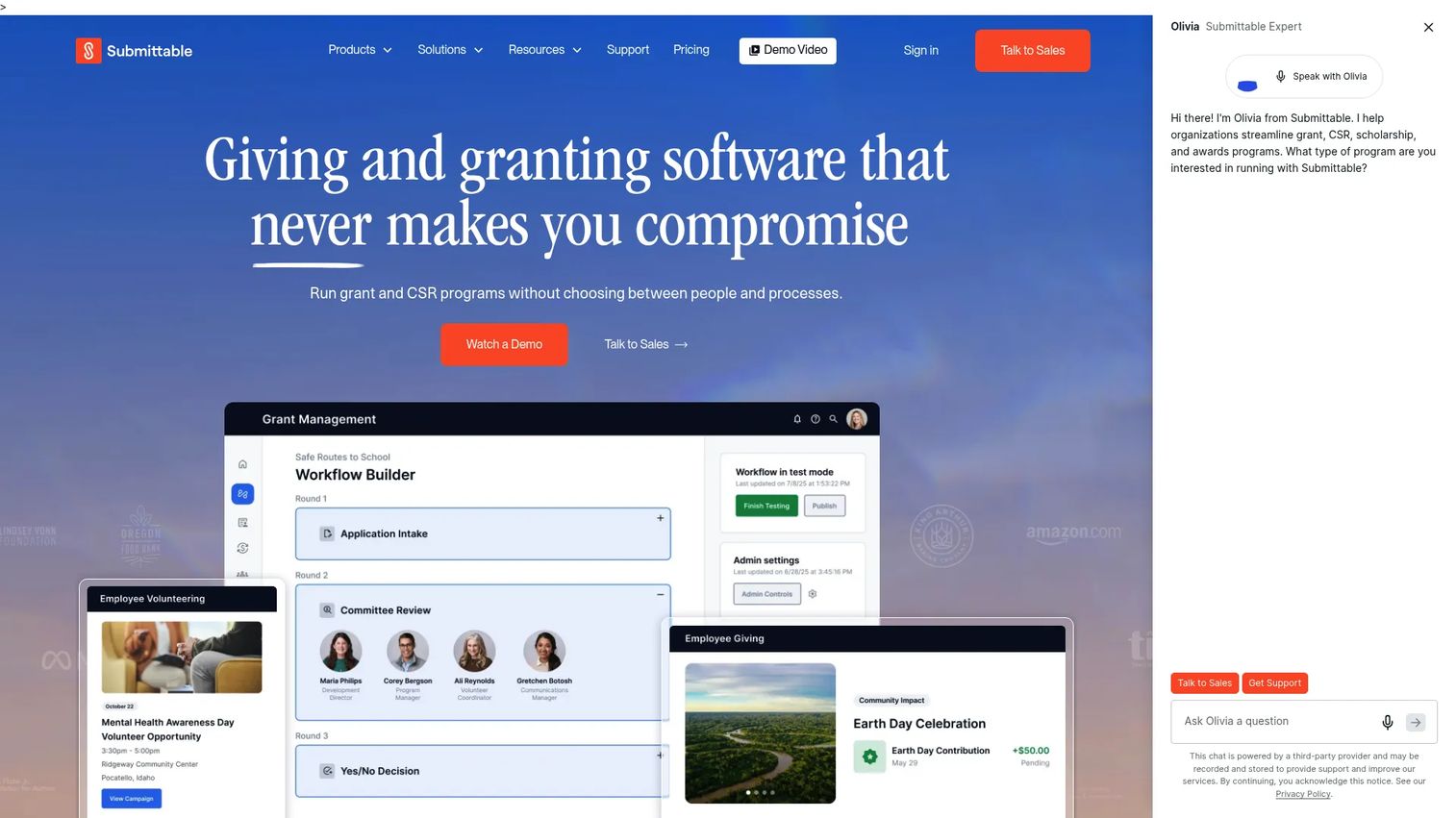
Submittable is cloud-based submission management software that spans grants, scholarships, awards, CSR programs, and editorial workflows. Its strength is breadth: if your organization runs more than journal submissions, one platform can handle the full range of application intake and review. The form builder, review tools, and reporting are built to reduce admin across many program types.
Where it fits: teams that manage editorial submissions alongside other application workflows and want a single system rather than a journal-only tool. Publishers running literary journals, prize programs, or grant cycles get consistent intake, reviewer assignment, and decision tracking across all of them. That consolidation is the reason to look at it over a purpose-built peer review platform.
Key strengths
- Grant and application management across program types
- CSR and philanthropy program workflows
- Form builder, review tools, and reporting
- Collaboration and workflow support at scale
Why choose Submittable
Choose Submittable if editorial work is one of several application-driven programs you run. It consolidates intake and review under one roof, which reduces tool sprawl for organizations that would otherwise stitch together separate systems.
Submittable pricing
Submittable uses quote-based pricing across its grant and application management, CSR, and enterprise offerings. The pricing page directs prospects to book a meeting to scope features and capacity.
Submittable holds a 4.5 out of 5 rating on G2.
3. JAMS
JAMS is a journal management platform that covers submission, peer review, production, website hosting, billing, and editorial services. Hosted and run by MDPI, it takes a modular approach with transparent pricing, which is rare in this category. Journals can start free and add capabilities as they grow, which suits teams that want to avoid a large upfront commitment.
Where it fits: journals that want end-to-end workflow coverage with clear per-manuscript pricing and strong support. The submission and peer review workflow handles intake through decision. Production services, website hosting, and billing infrastructure round out the path to publication. The free starter tier makes it a practical entry point for a new or small journal testing a real platform.
Key strengths
- Submission and peer review workflow
- Production services and website hosting
- Built-in billing infrastructure
- Editorial services and support
Why choose JAMS
Choose JAMS if you want modular, all-in-one journal management software with pricing you can read on the page. The free tier lowers the barrier for small journals, and the per-accepted-manuscript model scales predictably.
JAMS pricing
The Starter plan is free for up to 20 accepted manuscripts, then $27 per accepted manuscript. The Premium plan is $36 per accepted manuscript from the first accepted manuscript. A per-submission option is available on a quote basis.
JAMS holds a 4.5 out of 5 rating on G2.
4. OJS
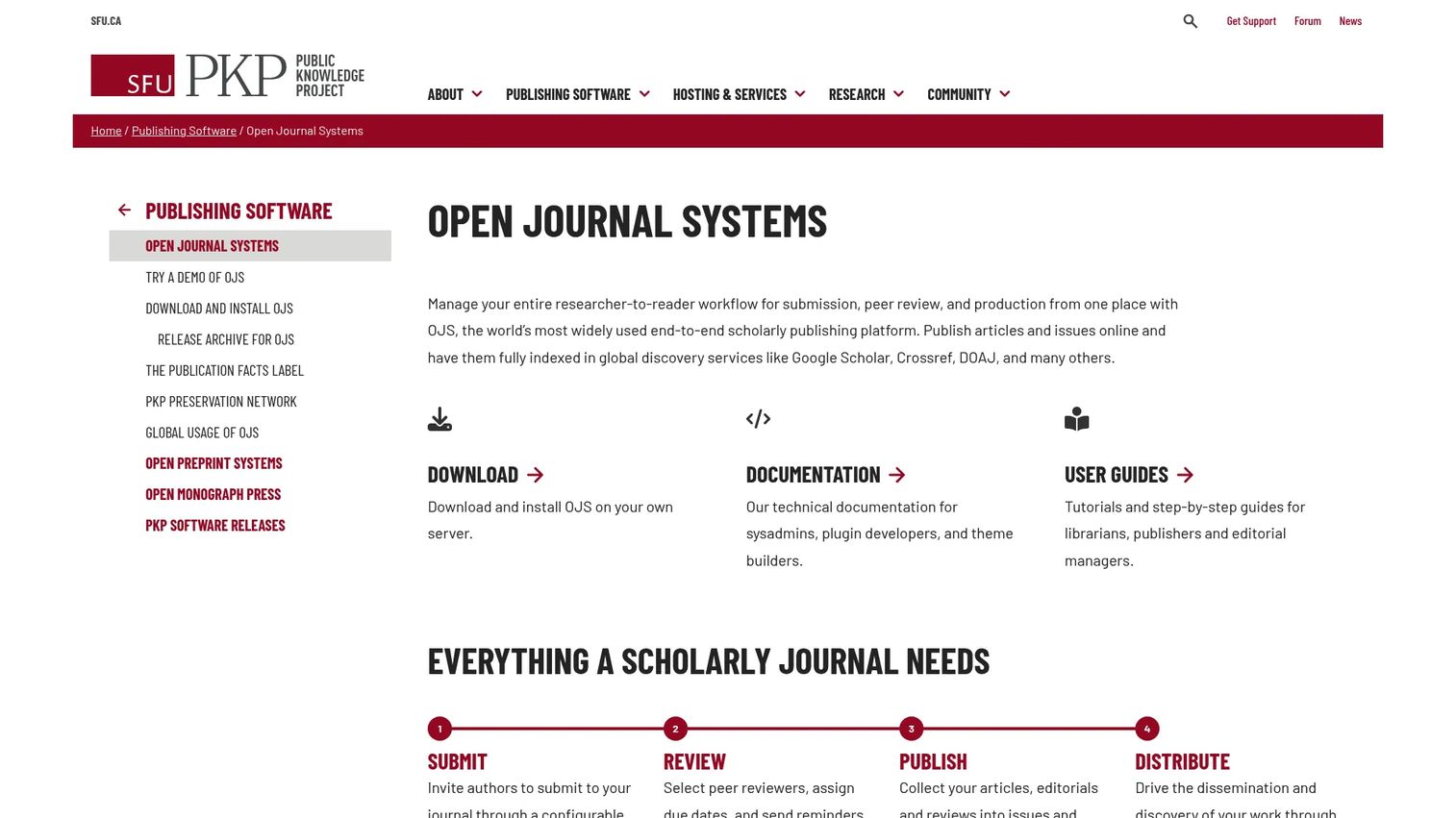
OJS, Open Journal Systems, is open-source scholarly journal publishing software from the Public Knowledge Project. It manages submission, peer review, production, and online publication, and it is downloadable to install on your own server. As one of the most widely deployed journal platforms worldwide, it has deep community support and a large extension ecosystem.
Where it fits: teams with technical resources, or a hosting partner, that want full control over their editorial workflow software and no license fees. Because it is open source, you can extend and customize it to match your process. PKP also offers paid hosting and support for teams that prefer a managed setup over self-hosting.
Key strengths
- Submission and peer review workflow
- Issue publishing with discovery and indexing
- Open-source and fully extensible
- Large community and plugin ecosystem
Why choose OJS
Choose OJS if you want open-source flexibility and either have technical resources in-house or work with a hosting partner. It is a strong fit for journals that value control and customization over a fully managed, hands-off setup.
OJS pricing
OJS is free, open-source software you download and install yourself. There is no software license cost. PKP offers paid hosting and support plans for teams that prefer a managed deployment; those are quoted separately.
5. Aries Systems
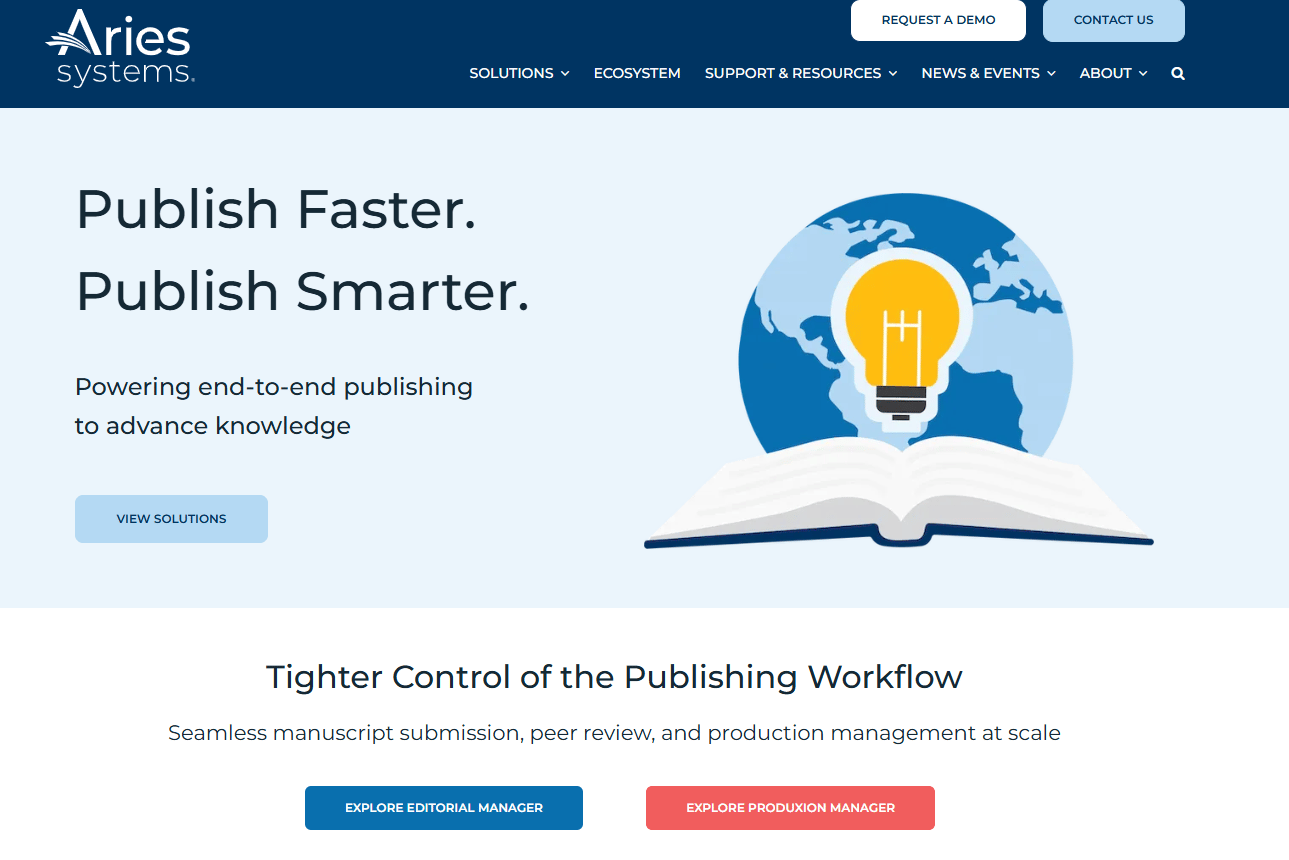
Aries Systems makes cloud-based workflow software for scholarly publishing, centered on Editorial Manager for manuscript submission and peer review, and ProduXion Manager for production tracking. It is built for configurability, with customizable workflows and role-based access that suit complex editorial governance. Larger publishers choose it when a one-size-fits-all tool cannot model their process.
Where it fits: large journal portfolios and publishing operations with intricate review models and multiple stakeholder roles. The platform depth handles high submission volume, layered decision workflows, and production tracking at scale. This is the category for organizations where editorial governance itself is the hard problem, not just intake.
Key strengths
- Editorial Manager for submission and peer review
- ProduXion Manager for production tracking
- Customizable workflow configurations
- Role-based access for complex governance
Why choose Aries Systems
Choose Aries Systems if you run a large portfolio or an enterprise publishing operation that needs configurable end-to-end editorial workflow control. It fits teams whose review models are too complex for lighter-weight tools.
Aries Systems pricing
Aries Systems uses quote-based pricing. Cost depends on factors like annual submission volume and the features you add, and the vendor directs prospects to contact sales for a scoped quote.
6. Janeway

Janeway is a modern journal publishing platform built with open access and academically oriented publishing in mind. It covers submission, review, and hosting with a focus on flexibility for community-driven and OA-first teams. Developed in a scholarly-led environment, it appeals to journals that want a contemporary platform aligned with open publishing values.
Where it fits: open access journals and academically oriented teams that want a modern, flexible open access journal software platform. It handles the editorial workflow from submission through hosting, with an emphasis on OA publishing models. Teams that prioritize community governance and open infrastructure tend to gravitate to it over commercial-first tools.
Key strengths
- Modern journal publishing workflow
- Open access publishing support
- Journal hosting built in
- Flexible, community-oriented setup
Why choose Janeway
Choose Janeway if you run open access journals and want a modern platform aligned with OA and community publishing. It fits academically led teams that value flexibility and open infrastructure.
Janeway pricing
Janeway is offered as a hosted open access publishing platform; teams contact the project to scope hosting and support for their journals. Pricing is arranged directly rather than published as fixed tiers.
Considerations
Before you commit to any manuscript submission software, run the finalists through this checklist.
Workflow depth
Confirm the platform covers the full cycle: submission, peer review, decision, and publication handoff. A tool that handles intake well but drops the post-acceptance workflow forces you back into manual process at the worst possible moment. Map your actual editorial stages against what the software supports before signing.
Hosting and IT burden
Verify whether the platform is fully hosted, self-hosted, or hybrid. Cloud-hosted manuscript submission software gets you live fastest with minimal IT involvement. Self-hosted options like OJS give you control and no license cost but assume technical resources or a hosting partner. This single decision drives most of your implementation timeline.
Editorial collaboration
Look for reviewer routing, invitation tracking, decision templates, and clear status visibility. These are the features that shorten review cycles in practice. If editors still have to chase reviewers by hand, the platform has not solved the bottleneck that likely drove your search.
Publication types supported
Make sure the platform fits your specific context: single journal, multi-title portfolio, university press, literary journal, or open access publishing. A tool tuned for large commercial portfolios may be heavy for one journal, and a lightweight tool may not model a complex governance structure.
Support and implementation
Validate onboarding, data migration, training, and the ongoing support model before buying. Migrating historical submissions and reviewer records is often the hardest part of a switch. Ask how migration works, what training is included, and how support responds during your live review cycles.
Conclusion
The right manuscript submission software depends on three things: how complex your editorial workflow is, whether you want hosting managed for you, and the scale you publish at.
Small and mid journals that want speed and low IT burden fit Scholastica or JAMS, both of which price transparently and get you live fast. Organizations running editorial work alongside grants or awards fit Submittable. Teams that want open-source control and have technical resources fit OJS. Large portfolios with complex governance fit Aries Systems. Open access and community-led journals fit Janeway.
Pick one or two finalists that match your workflow depth and hosting preference, then run a real submission through each. Test the reviewer flow, the decision step, and the publication handoff with your own data. That hands-on trial tells you more than any feature list. From there, confirm migration and support terms before you commit.
Start your journey with Guideflow today!
FAQs
Manuscript submission software focuses on the editorial lifecycle: intake, peer review, and decisions. Journal management software is broader and often adds production, hosting, billing, and website management on top. In practice the terms overlap, and many platforms like JAMS and Scholastica cover both the submission workflow and the wider journal operations.
For most small journals, yes. Cloud-hosted manuscript submission software removes the IT burden of servers, updates, and security, which small editorial teams rarely have the resources to handle. Hosted options like Scholastica or JAMS get you live quickly and price by usage. Self-hosting only makes sense when you have technical resources or a dedicated hosting partner.
Yes, peer review management is the core of most of these platforms. They support single-blind, double-blind, and open review models, with reviewer invitation tracking, automated reminders, and decision letter templates. Reducing the manual reviewer chasing that stalls review cycles is the main reason editorial teams adopt this software in the first place.
University presses should prioritize workflow depth across multiple title types, configurable review models, and a clean production handoff. Presses often run journals and monographs with different processes, so flexibility matters. Aries Systems handles complex portfolios well, while OJS offers customization for presses with technical resources.
Open-source software like OJS is a strong choice for teams that want control, customization, and no license fees. It has deep community support and a large plugin ecosystem. It fits best when you have in-house technical resources or a hosting partner. If you prefer a fully managed, hands-off setup, a hosted commercial platform will be a faster path.
It varies with hosting model and data migration. A hosted platform with a fresh start can be live in days to a few weeks. Migrating historical submissions, reviewer records, and past decisions adds time, often the largest part of the timeline. Self-hosted setups depend on your technical resources and configuration needs.
Reviewer routing, invitation and reminder automation, decision letter templates, version tracking, and clear status visibility matter most day to day. Reporting and audit trails matter for accountability and turnaround analysis. The features that remove manual follow-up and give editors a single view of every submission deliver the most value.
Compare on your real volume. Per-submission and per-accepted-manuscript models like Scholastica and JAMS are easy to project against your annual output. Quote-based vendors like Submittable and Aries Systems require a scoping conversation, so ask for pricing tied to your submission volume and feature needs. Factor in hosting, production, and migration costs, not just the core license.