Your tower crew is waiting on a work order that lives in someone's inbox. Your fiber rollout is stalled because the network record hasn't been updated in three weeks. Finance is running a project status report that doesn't match what operations sees on the ground. These are not communication problems. They are systems problems, and telecom operations software exists to close that gap.
The global OSS/BSS market was valued at $24.70 billion in 2025 and is forecast to reach $54.06 billion by 2031, according to Mordor Intelligence (2025). That growth reflects how hard operators are pushing to move off fragmented spreadsheets, disconnected contractor reports, and status meetings that eat time without producing answers.
This guide compares 15 tools across field execution, network records, fiber planning, site portfolios, enterprise field service, and project controls. It is written for founders and senior operators who need fewer handoffs and cleaner visibility, and who will forward the useful parts to a VP or Head of Field Delivery.
What's inside
This guide is for telecom operators, fiber builders, infrastructure contractors, and executives evaluating software to replace manual status tracking and disconnected field workflows.
- Selection criteria: telecom operational fit, field execution depth, network or asset data handling, mobile capabilities, and integration with ERP, CRM, and GIS tools
- Who it covers: field execution tools, GIS and network mapping platforms, enterprise field service systems, and construction and project controls software
- What it does not cover: generic helpdesk tools or generic accounting software with no telecom operational relevance
- Pricing and G2 ratings are drawn from live vendor sources and noted where unavailable
TL;DR
- Best for telecom field execution and O&M: Scoop focuses on telecom work packages, mobile workflows, closeout evidence, and recurring operations and maintenance contracts
- Best for telecom site and infrastructure portfolios: Sitetracker handles high-volume deployments with site lifecycle tracking and Salesforce-native architecture
- Best for fiber construction management: Vitruvi connects design through closeout with GIS-native field execution and AI-assisted quality inspection
- Best for GIS-led network operations: IQGeo gives operators a map-first view of network assets, field workflows, and planning across telecom and utility networks
- Best for enterprise field service at scale: Salesforce Field Service connects dispatch, work orders, and mobile technicians to CRM data, with plans starting at $30 per user per month
- Best for capital project controls: Oracle Primavera Cloud handles CPM scheduling, cost management, and risk analysis for large infrastructure programs
What is telecom operations software?
Telecom operations software helps telecom operators, network contractors, and infrastructure teams plan, dispatch, execute, document, and report on the work required to build, maintain, and optimize telecom networks.
The category spans several operational layers. No single tool covers all of them, which is why buying decisions require matching the tool to the actual bottleneck first.
Operational layers the category covers:
- Telecom field service management and dispatch
- Fiber and network planning and design
- GIS and network asset records
- Work order and job management
- Closeout documentation and evidence collection
- Operations and maintenance contract management
- Project portfolio controls and scheduling
- Site, lease, and infrastructure portfolio management
- Integration with CRM, ERP, billing, and accounting systems
- Dashboards and audit-ready reporting
Key capabilities to look for
- Work orders and dispatch with mobile access
- Offline field functionality and automatic sync
- GIS and network map layers
- Telecom asset and inventory records
- Crew, contractor, and equipment tracking
- Closeout evidence capture (photos, forms, sign-offs)
- SLA and O&M contract reporting
- ERP, CRM, billing, and accounting integrations
- Dashboards built for executive and board-level reporting
Category boundary
Telecom operations software runs day-to-day field execution and operational workflows. Telecom management software is a broader label that includes expense audits, vendor contracts, and compliance. Telecom network software often focuses on design, mapping, inventory, and optimization rather than field work. Generic project management software handles timelines and tasks but lacks the network asset depth that telecom field teams need.
When to use telecom operations software
Coordinate field crews without chasing updates
When field status lives in text messages, contractor emails, and spreadsheet columns that no one trusts, dispatch and scheduling decisions fall behind. Software with mobile work orders, real-time crew updates, and ETA visibility gives operations leaders a live picture without weekly status calls.
Keep network and asset records current
Network maps, fiber routes, site equipment records, lease details, and maintenance histories get stale fast. When field teams can't trust the records, troubleshooting slows down and new builds inherit inaccurate data. Tools that tie field activity to network asset records keep the source of truth synchronized.
Prove work completion with clean documentation
Closeout delays block invoicing and create audit risk. Field crews need a structured way to capture photos, complete safety forms, run QA checks, and produce service-level documentation that customers and auditors will accept. The right tool makes evidence collection part of the field workflow, not an afterthought.
Telecom operations software comparison
The table below is a shortlist organized by operational fit. Needs differ significantly by motion: Field execution, network design, GIS records, construction management, enterprise field service, and project portfolio controls each call for a different kind of tool. Use the table to identify your category first, then read the item sections for the detail your operations leader will need.
| # | Product | Best for | Key differentiator | Pricing | G2 rating |
|---|---|---|---|---|---|
| 1 | Scoop | Telecom field execution and O&M | Telecom work packages, mobile workflows, closeout evidence | Contact sales | Not available |
| 2 | Sitetracker | Telecom site and infrastructure portfolios | Site lifecycle management for high-volume deployments | Custom pricing | 4.3/5 |
| 3 | Vitruvi | Fiber and telecom construction | GIS-native build management from design through closeout | Contact sales | 4.3/5 |
| 4 | IQGeo | GIS-led network operations | Map-first network inventory with field workflows | Contact sales | Not available |
| 5 | Comsof Fiber | Fiber network planning and design | Automated FTTx planning and cost scenario modeling | Contact sales | Not available |
| 6 | Render Networks | Network deployment automation | Geospatial construction workflow and digital as-builts | Contact sales | Not available |
| 7 | Accruent Siterra | Telecom site asset management | Site, lease, project, and asset tracking | Contact sales | 3.8/5 |
| 8 | VETRO FiberMap | Fiber network mapping and inventory | Cloud-native fiber mapping with strand-level editing | Contact sales | Not available |
| 9 | 3-GIS | Fiber network management | GIS-connected fiber design, work orders, and asset records | Contact sales | 4.5/5 |
| 10 | Salesforce Field Service | Enterprise telecom dispatch and scheduling | CRM-native dispatch with AI scheduling | From $30/user/month | 4.3/5 |
| 11 | IFS Cloud | Complex enterprise field service | ERP, asset management, and field service in one platform | Custom pricing | 4.3/5 |
| 12 | ServiceNow Strategic Portfolio Management | Strategic portfolio and capital program governance | Investment planning, roadmaps, and executive dashboards | Custom pricing | 4.1/5 |
| 13 | Fieldwire | Telecom construction field coordination | Plans, punch lists, tasks, and jobsite documentation | Free; paid from $39/user/month | 4.5/5 |
| 14 | Smartsheet | Flexible project tracking and dashboards | Spreadsheet-style work management with automation | From $9/member/month | 4.5/5 |
| 15 | Oracle Primavera Cloud | Capital project controls and scheduling | CPM scheduling, risk analysis, and portfolio planning | Contact sales | Not available |
Best 15 telecom operations software tools for 2026
1. Scoop
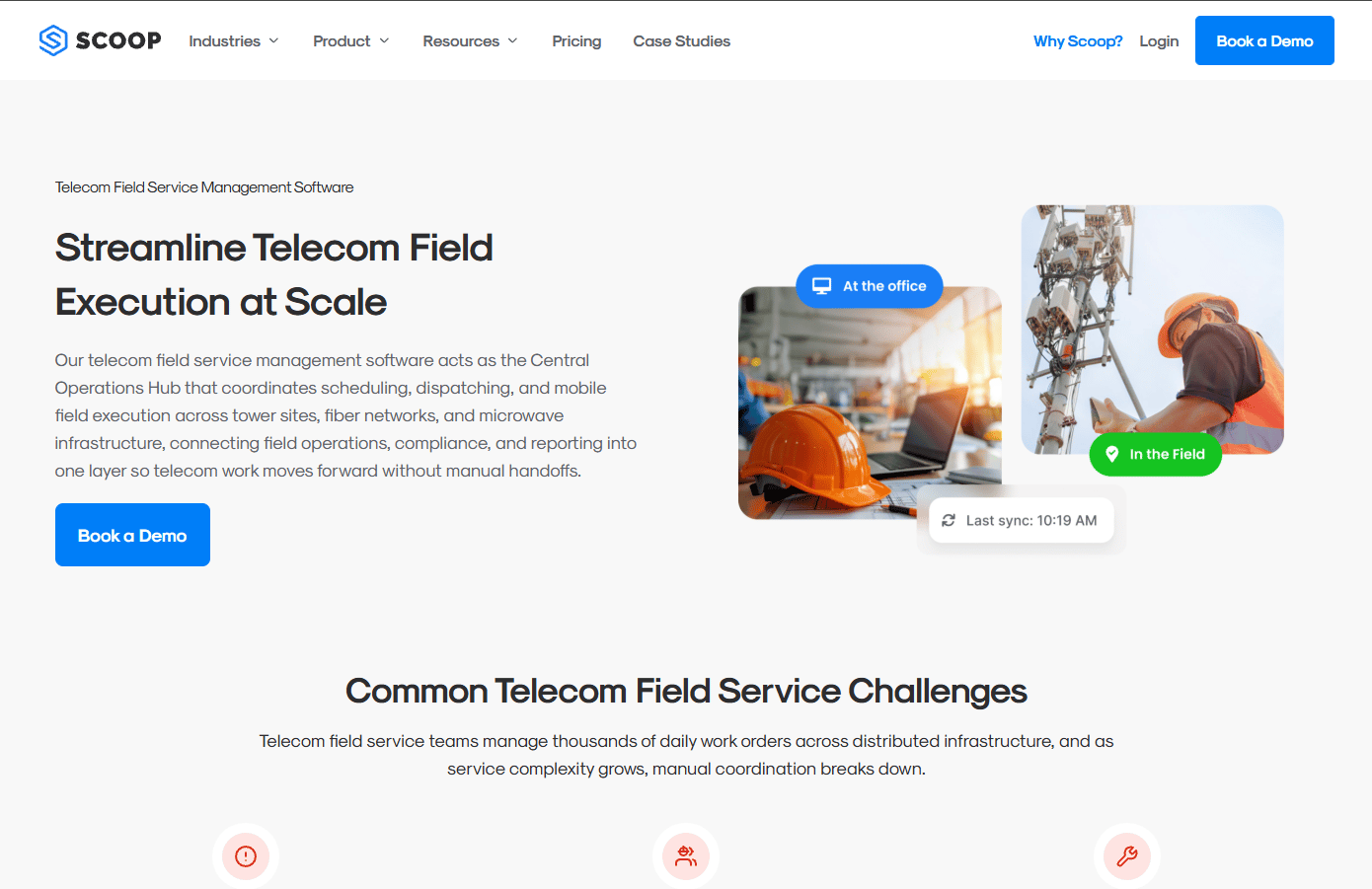
Scoop is a field execution platform built specifically for telecom, utility, and infrastructure work. It organizes field work into telecom work packages, manages mobile execution, captures closeout evidence, and tracks recurring O&M contract obligations across active programs. The platform supports stage gates, approvals, safety workflows, and the kind of field-to-office reporting that keeps operations leaders off the phone chasing updates.
Best for: Telecom contractors and operators whose bottleneck is field execution, not planning.
Key features
- Telecom work packages with stage gates and approvals
- Mobile field workflows with offline capability
- Closeout evidence capture: Photos, forms, sign-offs
- O&M contract and recurring work tracking
- Field-to-office reporting and progress visibility
Why choose Scoop: If your team loses time on status calls, missed handoffs, and incomplete closeout packages, Scoop is built to fix that before it reaches the invoice. It fits operations teams that need field accountability baked into the workflow, not bolted on after.
Scoop pricing: Pricing is handled through sales. Contact Scoop directly with your field crew count and program scope to get package details.
2. Sitetracker

Sitetracker is an asset lifecycle management platform for infrastructure owners, operators, and contractors managing high-volume distributed projects. It tracks site lifecycle from planning through operations, coordinates vendors, manages project milestones, monitors asset portfolios, and delivers executive dashboards across large infrastructure programs. The platform is built natively on Salesforce, which simplifies integration for teams already running sales or service operations on that stack.
Best for: Telecom operators managing many sites, leases, vendors, and deployment milestones across a distributed portfolio.
Key features
- Site lifecycle tracking from permitting through operations
- Vendor coordination and milestone management
- Asset portfolio visibility across sites and projects
- Document management with field access
- Salesforce-native architecture for CRM alignment
Why choose Sitetracker: When site volume makes manual tracking impossible and executive reporting requires a live view across the full infrastructure portfolio, Sitetracker handles the breadth. It is a stronger fit for portfolio-scale operators than for small contractors tracking a handful of jobs.
Sitetracker pricing: Custom pricing. Ask sales for details by deployment scope, seat count, and modules required.
G2 rating: 4.3/5
3. Vitruvi

Vitruvi is an AI-powered, GIS-native construction management platform for linear infrastructure. It runs fiber, utility, water, and oil-and-gas construction programs from design import through field production, inspections, closeout, and invoicing. The platform imports GIS, CAD, and PDF designs, generates structured work from them, and gives field crews mobile access with offline capability. An AI Field Inspector reviews photos and flags pass/fail on quality checks automatically.
Best for: Fiber builders and telecom construction teams that need one operational view connecting construction, finance, and field delivery.
Key features
- GIS, CAD, and PDF design import with structured work generation
- Mobile field execution with offline capability and production reporting
- AI Field Inspector for photo-based quality validation
- Inspections, closeouts, invoicing, accounts receivable, and accounts payable
- Integrations with ArcGIS, NetSuite, Salesforce, and VETRO
Why choose Vitruvi: Generic project management tools track tasks; Vitruvi tracks linear infrastructure builds with network routes and field quantities at the core. It is the right fit for teams where the gap between planned and built creates cost and reporting problems.
Vitruvi pricing: Launch, Business, and Enterprise plans are available. Launch requires a minimum of two standard users; Business requires ten; Enterprise requires fifty. Contact sales for pricing by plan.
G2 rating: 4.3/5
4. IQGeo
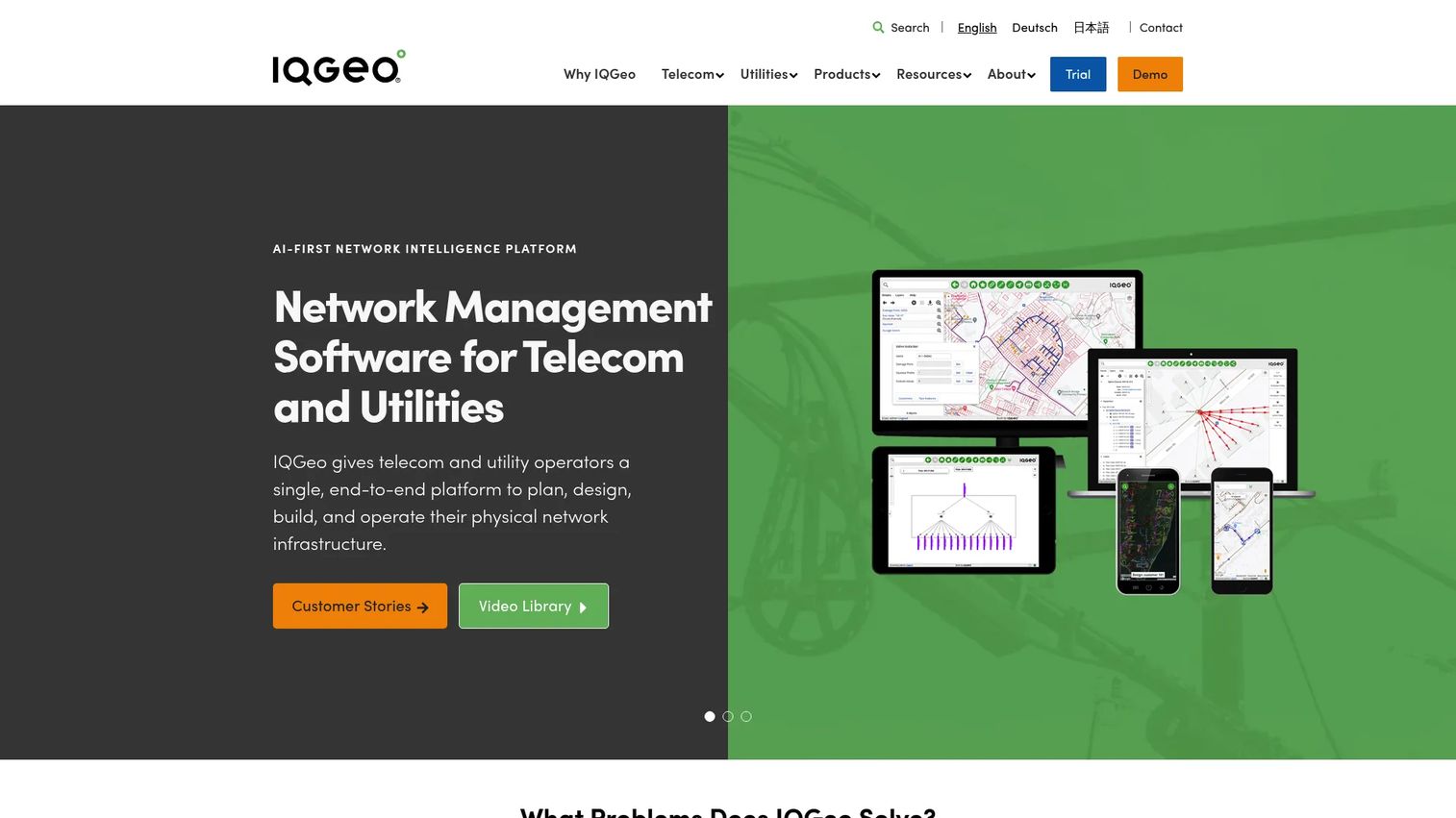
IQGeo is an AI-powered geospatial network management platform for telecom, fiber, electric, and gas utility operators. It models physical and logical network assets on a shared map, supports end-to-end planning, design, construction, and operations workflows, and gives field teams online and offline mobility. AI-powered visual validation automates field-work quality inspection. The platform serves as the operating system when the map is where network decisions get made.
Best for: Telecom and utility operators that need GIS-first network visibility across planning, build, maintenance, and field operations.
Key features
- End-to-end network planning, design, construction, and operations
- Geospatial network asset modeling with shared network view
- Online and offline field mobility for crews
- Digital workflow and task automation
- AI visual validation for field-work quality inspection
Why choose IQGeo: When the map has to drive both office planning and field execution, and when network data needs to stay synchronized across those two contexts, IQGeo is built for that job. It fits operators where network asset accuracy is a revenue and reliability issue.
IQGeo pricing: Pricing is not displayed. IQGeo references Insight, Professional, and Enterprise editions. Contact sales with your network size, user count, and module requirements.
5. Comsof Fiber
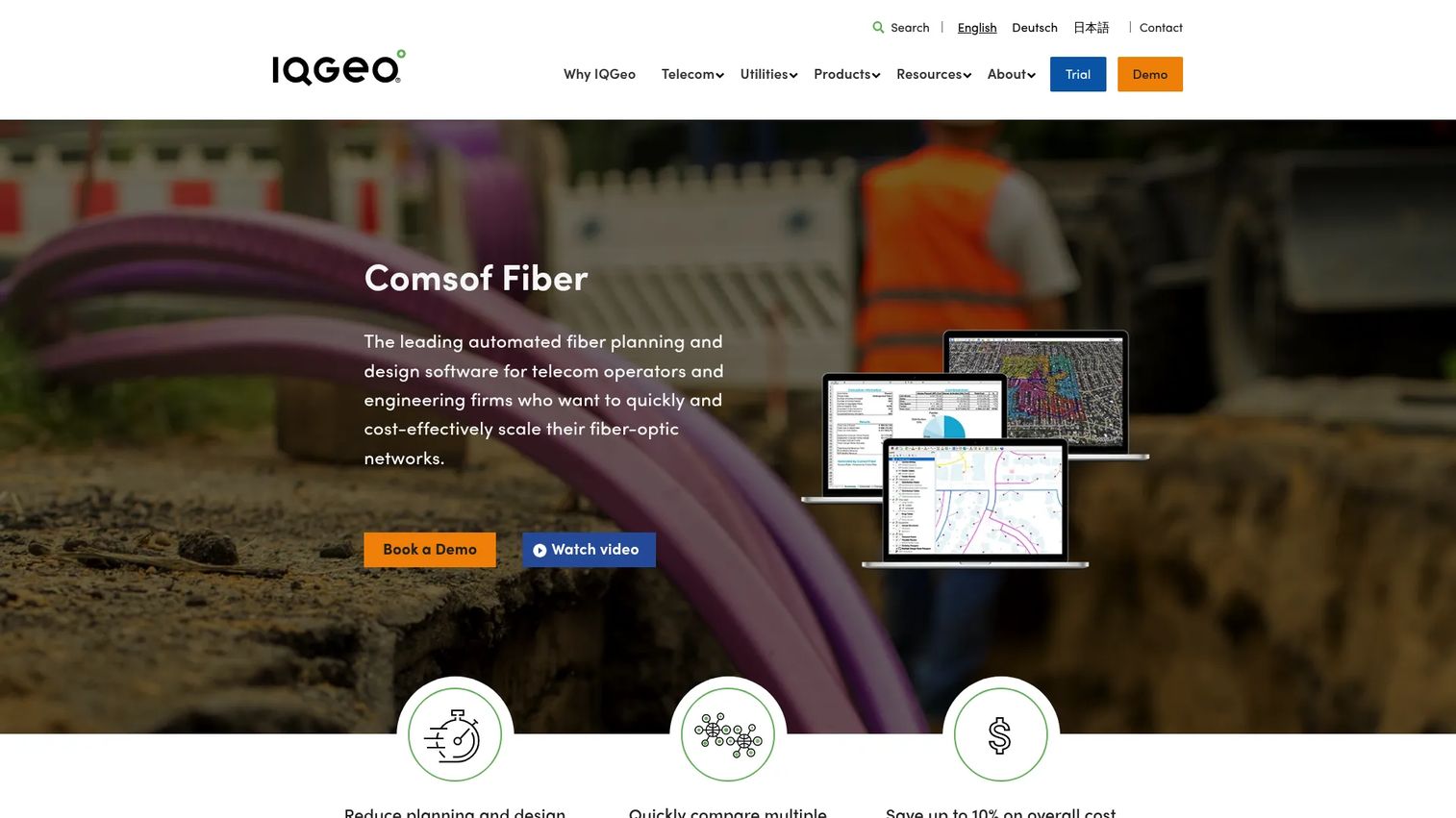
Comsof Fiber is GIS-based automated fiber network planning and design software, now distributed through IQGeo. It automates FTTx route planning, generates cost and scenario comparisons for different network architectures, validates network designs, and produces detailed bills of materials and job packs. The tool ingests GIS data and handles both greenfield and brownfield deployments.
Best for: Fiber planning teams that need to compare network designs and costs before construction begins.
Key features
- Automated FTTx fiber route planning
- Greenfield and brownfield deployment support
- Cost scenario modeling and network architecture comparison
- Bills of materials and job pack generation
- GIS data inputs and third-party system integration
Why choose Comsof Fiber: Money spent on bad fiber designs is very hard to recover. Comsof Fiber helps teams evaluate routing and architecture options before the first trench is dug, which reduces change orders and cost overruns downstream.
Comsof Fiber pricing: Contact IQGeo sales with your planning scope and module needs.
6. Render Networks
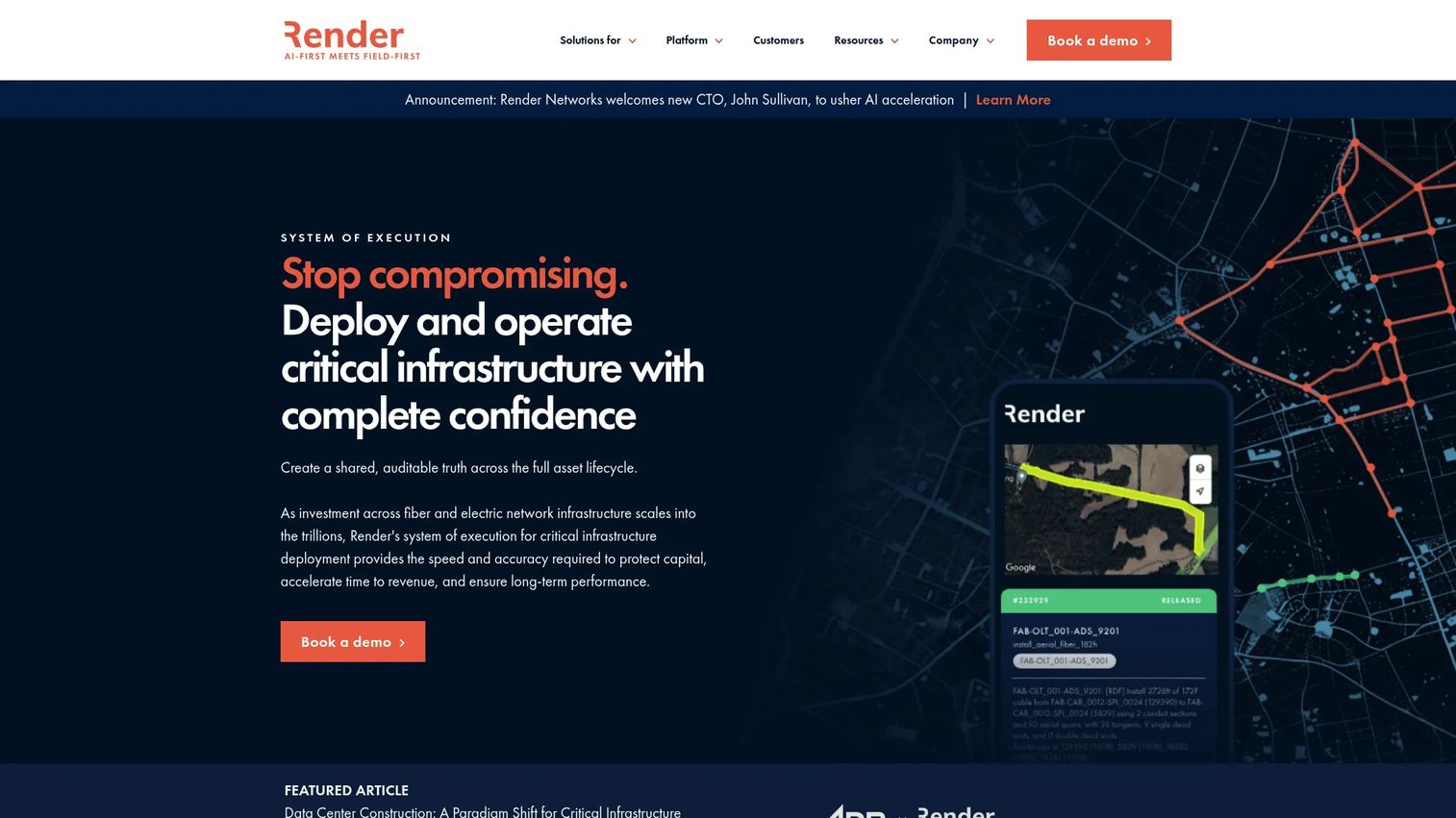
Render Networks provides a system of execution for fiber, electric, and critical infrastructure network deployment. It connects design through construction, verification, and operations using geospatially organized digital work packages. Automated blueprinting generates work scope from network designs, field crews update progress in real time, and digital as-built completion packs replace paper closeouts. The platform also supports scheduling, forecasting, and invoice enablement.
Best for: Network deployment teams managing large-scale fiber or electric buildouts where location-based work packaging is the operational backbone.
Key features
- Automated blueprinting and work-scope creation from designs
- Geospatial work allocation for field crews
- Real-time field progress updates and change management
- Digital as-built completion packs
- Scheduling, forecasting, analytics, and invoice enablement
Why choose Render Networks: When construction coordination depends on where the work is, not just what the task is, geospatial work packaging changes how much time contractors spend on status reporting versus actual field progress. It fits teams trying to move from manual production tracking to automated deployment workflows.
Render Networks pricing: Pricing is available on request per the vendor's terms. Contact Render Networks with your deployment size and operational scope.
7. Accruent Siterra
Accruent Siterra is enterprise telecom site lifecycle management software. It handles integrated management of sites, assets, projects, and leases from a single configurable platform. Workflows, schedules, critical-date tracking, and project forecasting are all configurable. Bulk operations and cascading updates make it practical at portfolio scale, and site-based licensing keeps costs tied to the asset count rather than user count.
Best for: Telecom operators, tower companies, and infrastructure organizations managing large portfolios of sites, leases, vendors, and assets.
Key features
- Integrated site, asset, project, and lease management
- Configurable workflows, schedules, and critical-date tracking
- Project forecasting and portfolio reporting
- Bulk and cascading operations for large portfolios
- Site-based licensing model
Why choose Accruent Siterra: When the operations complexity comes from site volume, lease obligations, and vendor accountability rather than from field crew dispatch, Siterra is better matched than a generic field service tool. It belongs on the shortlist when telecom infrastructure management is the core job.
Accruent Siterra pricing: Contact sales. Accruent directs prospective customers to request a demo for pricing by portfolio size, modules, and users.
G2 rating: 3.8/5
8. VETRO FiberMap

VETRO FiberMap is cloud-based fiber network management software for planning, designing, deploying, and managing fiber infrastructure. It offers a browser-based map viewer, strand-level fiber editing, equipment connection mapping, project and plans management, custom map themes, and deployment reports. Import and export integrations connect VETRO to other operational systems, and fiber workflow automation reduces manual data entry for teams managing active networks.
Best for: Internet service providers, broadband operators, municipalities, and utilities that need a cloud-based source of truth for fiber network maps and records.
Key features
- Browser-based map viewer with strand-level fiber editing
- Fiber network design with equipment connection mapping
- Project and plans management with deployment reports
- Custom map themes and symbology
- Data import and export with workflow automation
Why choose VETRO FiberMap: Fiber records stored in static files or legacy GIS tools create troubleshooting delays and planning errors. VETRO gives fiber operators a live, editable map that field teams and planners access from the same source, which matters most when network changes are frequent and accurate records drive service reliability.
VETRO FiberMap pricing: Pricing is handled through the vendor. Contact VETRO with your network size and operational requirements.
9. 3-GIS
3-GIS provides GIS-based telecom and utility network management software for planning, designing, documenting, analyzing, and operating fiber, copper, and utility networks. It centralizes physical and logical network asset modeling, supports fiber network design with work orders and construction work packets, and handles signal-path tracing, wavelength documentation, route analysis, outage identification, and reporting. The platform suits enterprise-scale operators managing complex multi-technology networks.
Best for: Fiber operators and engineering teams managing large, complex network inventories where GIS connectivity to asset records is non-negotiable.
Key features
- Centralized physical and logical network asset modeling
- Fiber network design with work orders and construction work packets
- Signal-path tracing and wavelength documentation
- Route analysis, outage identification, and reporting
- Integrations with enterprise and operational systems
Why choose 3-GIS: When network records need to support both planning decisions and active maintenance, and when the asset data has to be accurate enough for engineering teams to trust it in the field, 3-GIS provides the structure that spreadsheets and legacy GIS deployments cannot.
3-GIS pricing: Contact 3-GIS sales with your network scale, user roles, and implementation needs.
G2 rating: 4.5/5
10. Salesforce Field Service

Salesforce Field Service is enterprise field service management software for dispatch, scheduling, work orders, mobile technician operations, and service record management. The platform now operates under the Agentforce Field Service branding in some contexts. It sits natively on the Salesforce platform, which means field service data ties directly to CRM records, customer histories, and service contracts. AI-powered scheduling and route optimization reduce dispatcher workload.
Best for: Enterprise telecom organizations that already run customer and service operations on Salesforce and need field service tightly connected to CRM data.
Key features
- AI-powered intelligent scheduling and route optimization
- Work order management with lifecycle tracking
- Offline-capable mobile technician app
- Dispatcher console with real-time visibility
- Asset and inventory tracking connected to CRM records
Why choose Salesforce Field Service: If your field service needs to know what a customer owes, what service agreements are active, and what was done on their last visit, all in one screen, Salesforce Field Service earns its place. The CRM-native architecture is the differentiator; teams that do not run Salesforce will find the value proposition smaller.
Salesforce Field Service pricing: Frontline Workforce Management starts at $30 per user per month, billed annually. Dispatcher and Technician roles are $175 per user per month. Bundled Field Service+ editions range from $250 to $650 per user per month depending on the included CRM, AI, and contact-center capabilities.
G2 rating: 4.3/5
11. IFS Cloud

IFS Cloud is an AI-powered enterprise platform spanning ERP, enterprise asset management, supply chain management, and field service management in a composable architecture. It suits asset-intensive organizations where field service, spare parts, service contracts, workforce scheduling, and financial management all need to come from one system rather than several integrated point tools.
Best for: Large telecom or infrastructure organizations managing complex assets, service contracts, and workforce planning across multiple operational domains.
Key features
- Enterprise resource planning with financial management
- Enterprise asset management across full asset lifecycle
- Field service management with workforce scheduling
- Supply chain and parts management
- Embedded Industrial AI with composable architecture
Why choose IFS Cloud: When the operational scope goes beyond dispatch and into asset lifecycle management, service contract profitability, and workforce utilization across a large organization, IFS Cloud fits better than a pure field service tool. The tradeoff is implementation complexity; plan for a structured deployment, not a week-one setup.
IFS Cloud pricing: Custom pricing through sales. Contact IFS with your product modules, user count, and implementation scope.
G2 rating: 4.3/5
12. ServiceNow Strategic Portfolio Management
ServiceNow Strategic Portfolio Management is AI-powered enterprise portfolio planning software for aligning strategy, investments, resources, and delivery programs. It covers portfolio planning and prioritization, strategic goals and roadmaps, project and demand management, financial and cost management, and executive dashboards. SPM Advanced and SPM Prime are the available packages.
Best for: Telecom organizations managing large capital programs, digital transformation portfolios, and multi-team strategic initiatives where governance and investment visibility are the primary need.
Key features
- Portfolio planning, prioritization, and investment governance
- Strategic planning with goals, targets, and roadmaps
- Demand, resource, financial, and cost management
- Executive dashboards with cross-portfolio visibility
- AI-assisted planning and insight generation
Why choose ServiceNow Strategic Portfolio Management: This is a governance and investment tool, not a field execution tool. It earns its place when leadership needs to see which network programs are on track, which are consuming budget without producing results, and how the portfolio aligns to strategy. It is less relevant for teams whose primary problem is dispatch or closeout documentation.
ServiceNow Strategic Portfolio Management pricing: Custom pricing through sales. ServiceNow lists SPM Advanced and SPM Prime packages but provides no numeric figures. Contact sales for quote details.
G2 rating: 4.1/5
13. Fieldwire

Fieldwire is jobsite management software for construction teams to coordinate work, manage drawings, run punch lists, and track field documentation. It is not telecom-specific, but many telecom construction teams use it for plan viewing, task management, field photos, inspection records, and RFI workflows. The platform is accessible and fast to deploy, with a free Basic tier that covers core coordination features.
Best for: Telecom construction crews that need fast, practical jobsite coordination and documentation without buying a telecom-specific platform.
Key features
- Plan viewing with version control and auto-hyperlinking
- Task management, punch lists, and inspections
- Markups, photos, and as-built capture
- Digitized forms for reports, timesheets, and RFIs
- Scheduling and PDF report generation
Why choose Fieldwire: If the work is construction-heavy and the team needs jobsite task management and photo documentation without network-specific asset records, Fieldwire is a practical and fast-to-adopt choice. Teams that need fiber route tracking or GIS-connected asset management will outgrow it.
Fieldwire pricing: Basic plan is free per user. Pro starts at $39 per user per month, billed annually. Business is $64 per user per month. Business Plus is $89 per user per month. Custom contracts are available for larger teams.
G2 rating: 4.5/5
14. Smartsheet

Smartsheet is an enterprise work management platform for project tracking, dashboards, automation, and cross-functional collaboration. It supports grid, Gantt, card, and calendar views, generates reports and dashboards, runs automated workflows, and integrates with Microsoft 365, Google Workspace, Salesforce, Jira, and Power BI. It is not telecom-specific, and it does not handle network assets or GIS. Many operations teams use it as a stepping stone when replacing spreadsheets.
Best for: Teams that need better project visibility and reporting quickly, without committing to a telecom-specific platform yet.
Key features
- Grid, Gantt, card, and calendar project views
- Dashboards, reports, and automated workflows
- Forms and AI-powered formula and insight generation
- Resource management and workload tracking
- Enterprise security controls including SSO and customer-managed encryption
Why choose Smartsheet: Smartsheet is a useful operational upgrade from email and spreadsheets when the process is early-stage or cross-functional. Network-specific teams managing GIS records, fiber inventory, or field closeout evidence will hit its limits quickly, but it earns its place for program reporting and stakeholder dashboards.
Smartsheet pricing: Pro starts at $9 per member per month, billed annually. Business is $19 per member per month. Enterprise and Advanced Work Management use custom pricing.
G2 rating: 4.5/5
15. Oracle Primavera Cloud
Oracle Primavera Cloud is a cloud-based construction and engineering project platform for shared planning, scheduling, resource management, risk management, and portfolio management. It handles CPM schedule management, field production planning, resource and capacity planning, risk registers with Monte Carlo analysis, capital planning, and mobile task management. It is built for capital-intensive programs where project controls rigor is a requirement, not an option.
Best for: Telecom operators and contractors managing large capital infrastructure programs where CPM scheduling, risk management, and cost control are non-negotiable.
Key features
- Contract and CPM schedule management
- Field production planning and scheduling
- Resource management and capacity planning
- Risk registers, qualitative scoring, and Monte Carlo analysis
- Portfolio management and capital planning
Why choose Oracle Primavera Cloud: When telecom operations involve major capital programs with multi-year schedules, budget accountability, and risk reporting for boards or investors, Primavera Cloud provides the project controls depth that field service tools and generic project managers cannot. It is not a dispatch tool; it is a capital program governance tool.
Oracle Primavera Cloud pricing: Contact Oracle sales for module, user, and contract term details.
Considerations when choosing telecom operations software
Match the tool to the operational bottleneck
Buying a GIS tool when dispatch is the problem, or a generic project tracker when network records are stale, adds cost without fixing the root issue. Name the specific bottleneck first. Field execution, network data accuracy, construction closeouts, site portfolio visibility, and capital program governance each call for a different kind of tool.
Check mobile and offline field workflows
Telecom field crews routinely work in areas with weak or no connectivity. Ask vendors to demonstrate offline access, automatic sync behavior, photo capture, form completion, and work order updates in a no-signal environment before signing. A tool that requires a cell signal for every field action will create friction where field teams can least afford it.
Verify network and asset data depth
For operators managing fiber routes, equipment records, lease portfolios, and maintenance histories, the depth of asset inventory software capability matters more than general task tracking. Evaluate how each tool handles GIS layers, fiber inventory, site records, and equipment lifecycle, and ask how data is synchronized when field teams make changes.
Test integrations before signing
The tools your operations team chooses will need to exchange data with CRM, ERP, billing, accounting, and document storage systems. For capital project management software in particular, ask who owns the integration, how frequently data syncs, and what happens when a sync fails. Founders should verify this before the contract is signed, not after go-live.
Demand reporting that survives board scrutiny
The system should give your VP of Operations a live view of field progress, blockers, costs, crews, and closeouts without manually stitching five dashboards together. Ask vendors to demonstrate a reporting workflow using data from a real telecom program, not a sanitized demo dataset. If the report takes more than a few clicks to produce, your operations leader won't use it.
Conclusion
The right tool for telecom operations depends on where the work is breaking down.
For field execution and O&M, Scoop is built around the specific shape of telecom work. Sitetracker handles high-volume site and infrastructure portfolios. Vitruvi is the strongest fit for fiber construction from design through closeout. IQGeo, VETRO FiberMap, and 3-GIS each address GIS and network record problems from different angles, with IQGeo covering the broadest operational scope and VETRO and 3-GIS focused more tightly on fiber inventory. Salesforce Field Service and IFS Cloud cover enterprise field service, with Salesforce winning on CRM integration and IFS winning on asset-intensive complexity. ServiceNow Strategic Portfolio Management belongs at the leadership level for capital program governance. Fieldwire and Smartsheet work as practical, fast-to-deploy tools for construction coordination and project reporting. Oracle Primavera Cloud is the choice when capital project controls are the primary need.
For a founder or senior operator building a shortlist, the practical sequence is: Name the bottleneck, pick two or three tools that address it directly, ask each vendor to run through a real workflow from your operations, and compare setup time, mobile experience, reporting, integrations, and total cost. That evaluation will surface the right fit faster than any feature comparison spreadsheet.
FAQs
Telecom operations software helps telecom operators, network contractors, and infrastructure organizations plan, dispatch, execute, document, and report on the work required to build, maintain, and optimize telecom networks. The category covers field service management, work order management, GIS and network asset records, fiber planning, construction management, and project portfolio controls.
Telecom operations software runs the day-to-day work: Dispatch, work orders, field crews, network records, and closeout documentation. Telecom management software is a broader label that often includes expense audits, vendor contract management, compliance tracking, and telecom asset lifecycle management. Some platforms cover both, but the operational focus differs significantly.
Field crews need mobile work orders, offline access, photo capture, forms, dispatch visibility, and structured closeout evidence. The right fit depends on the type of work. O&M and recurring field service work suits Scoop or Salesforce Field Service. Fiber construction benefits from Vitruvi or Render Networks. Teams that need a fast, low-cost start for jobsite coordination can begin with Fieldwire.
Fiber rollouts touch planning, construction, and network records in sequence. Comsof Fiber handles automated planning and cost modeling before construction begins. Vitruvi and Render Networks manage construction execution from design through closeout. VETRO FiberMap and 3-GIS maintain the network records once the build is complete. IQGeo spans all three phases if a single platform is preferred.
Not always. Dispatch-focused field service teams can operate without GIS if location data is not driving work allocation or asset decisions. GIS becomes essential when fiber routes, network assets, site locations, or service areas determine how work is planned and executed. For any team managing telecom network asset management or fiber inventory, map-first tools like IQGeo, VETRO FiberMap, and 3-GIS provide the data structure that spreadsheets cannot.
Pricing varies widely. Fieldwire offers a free basic plan, with paid tiers starting at $39 per user per month. Smartsheet Pro starts at $9 per member per month. Salesforce Field Service starts at $30 per user per month for workforce management roles and rises to $650 per user per month for bundled enterprise editions. Most purpose-built telecom platforms, including Scoop, Sitetracker, Vitruvi, IQGeo, and IFS Cloud, price by quote based on user count, modules, network size, and implementation scope.
The integrations that create the most operational value connect field data to the systems leadership already uses to run the business. CRM and ERP connections let field activity flow into revenue tracking and project financials. GIS and network inventory integrations keep asset records current when field work changes the network. Billing and accounting integrations accelerate invoicing after closeout. Ask vendors who owns the integration, how often data syncs, and what the error-handling process looks like.
Pick one real workflow from your current operations, ideally the one that causes the most status chasing, and ask each shortlisted vendor to demonstrate it with your data. Evaluate how the mobile experience works in a low-connectivity scenario, what a VP-level report looks like, and what the integration setup requires from your team. The vendors who can run your workflow without a scripted demo are worth more of your time than those who can only show feature walkthroughs.