Your team launches an awards program to build community, recognize customers, or create pipeline. Then the real work shows up: Category rules scattered across a spreadsheet, entry questions buried in a form builder, judge assignments flying around in email, and a winner decision nobody can audit.
This is the structural problem awards management software solves. The right platform centralizes submissions, judging, communications, payment collection, and reporting into one system your marketing or operations lead can own from day one. G2 tracks 34 products in the Awards Management Software category as of October 2026, with an average category rating of 4.59 out of 5, which tells you this market is maturing fast and buyer expectations are rising with it.
The question most founders face is not whether to buy a platform. It is which platform survives contact with a growing program, a skeptical finance team, and an operations owner who was not in the original buying conversation.
This guide gives you the shortlist.
What's inside
This guide compares 10 awards platforms against criteria that matter for founder-led or founder-delegated programs:
- Entry and judging workflow depth: From basic form collection to multi-round blind review with scoring rubrics
- Payment and internationalization support: Entry-fee collection, currency handling, tax rules, and localized experiences
- Operational handoff readiness: Whether a marketing, community, or partnerships manager can run the next cycle without routing exceptions through you
- Fit by program model: Awards-only platforms versus broader application systems covering grants, scholarships, and conference abstracts
Pricing and G2 ratings were verified in October 2026 from vendor pricing pages and live G2 listings.
TL;DR
- Best for complex, paid-entry awards with global participation: Award Force covers multi-currency entry fees, multilingual programs, and mature judging workflows from $3,250 USD per year
- Best for modern awards with public voting and winner showcase: Evalato supports multiple voting types, winner galleries, and 40-plus languages starting at €2,500 per program
- Best for associations and enterprise application programs: OpenWater Application and Review Cloud handles CRM and AMS integrations at custom-quoted pricing
- Best for contests, abstracts, and flexible program formats: Judgify offers a free Basic tier per event and Pro at $699 per event, fitting teams that run varied program types
- Best for grants and awards under one process: Submittable and SurveyMonkey Apply handle multi-program application management, though both require a sales conversation for subscription pricing
- Best entry-level price point with awards focus: Reviewr starts at $500 per year plus per-entry rates, making it a workable option for smaller programs that need more than a form tool
What is awards management software?
Awards management software is a platform for running an awards, recognition, contest, nomination, or competition program from application setup through judging, winner selection, and reporting.
What an awards platform manages
Purpose-built award management software typically covers the full program lifecycle:
- Branded award websites and entry portals
- Nomination, application, and submission forms with conditional logic
- File uploads, eligibility rules, and entry-fee collection
- Judge invitations, assignments, scoring rubrics, and conflict-of-interest controls
- Multi-round review, score normalization, and winner selection
- Entrant communications and automated status updates
- Reports, exports, audit trails, and winner recognition assets
Awards software versus forms and spreadsheets
The gap between a dedicated awards platform and a stitched-together manual process becomes visible the moment you have more than one judging round.
| Workflow | Forms and spreadsheets | Awards management software |
|---|---|---|
| Entry collection | Manual exports and validation | Configurable forms, categories, eligibility rules |
| Judging | Email coordination, separate score sheets | Assigned panels, rubrics, and structured scoring workflows |
| Winner selection | Manual consolidation | Centralized results with audit trail |
| Payments | Separate payment process | Entry-fee workflows with payment gateways |
| Reporting | Manual data cleanup | Live dashboards, exports, and progress tracking |
A founder should finish reading this section knowing the category is justified whenever more than one judging round is involved, paid entries are expected, or the program is meant to run annually with a different operator each cycle.
When to use awards management software
Run a repeatable customer or community awards program
Annual, quarterly, or partner recognition programs outgrow spreadsheets the moment you add a second award category or a second judging round. The real cost is not the admin time per cycle. It is the institutional knowledge that walks out the door when the person who ran it last year moves to a different role. A dedicated platform preserves process, templates, and judge history so the next cycle starts from a known state.
Coordinate fair judging across multiple reviewers
Blind reviews, weighted rubrics, multiple rounds, and conflict-of-interest controls cannot be replicated reliably in a shared spreadsheet. Once your program grows to 25 to 50 entries, manual judge coordination creates both quality risk and perception risk. An awards judging platform assigns reviewers, enforces access rules, normalizes scores, and produces a defensible record of the selection process.
Collect entry fees or serve international entrants
Payment gateways, tax handling, multi-currency support, and localized application flows each add operational complexity that general-purpose form tools were not built to manage. If your awards program generates revenue or serves entrants outside your home market, the administrative overhead of stitching together a payment processor and a form builder typically exceeds the cost of a purpose-built awards platform within the first cycle.
You have outgrown a manual process when:
- More than one award category exists
- More than one judging round is required
- Entry volume exceeds 25 to 50 submissions
- Entrants or judges repeatedly request status updates
Awards management software comparison
No platform wins every scenario. The right choice follows from the program's complexity, entry volume, monetization model, review depth, and integration requirements. Use the table below to orient your shortlist, then read the individual sections before booking demos.
| # | Product | Best for | Key differentiator | Pricing | G2 rating |
|---|---|---|---|---|---|
| 1 | Award Force | Complex, paid-entry, branded awards with global reach | Mature multi-currency and multilingual awards workflows | From $3,250 USD/year | 4.5/5 |
| 2 | Evalato | Modern awards with voting, winner showcase, and broad language support | Multiple voting types, winner galleries, 40+ languages | From €2,500/program | 4.8/5 |
| 3 | OpenWater Application and Review Cloud | Associations and enterprise programs with system integrations | Configurable review workflows with CRM and AMS integrations | Custom pricing | 4.4/5 |
| 4 | Judgify | Contests, academic abstracts, and flexible award formats | Free Basic tier per event; public voting built in | Free Basic; $699/event Pro | 4.5/5 |
| 5 | AwardStage | Branded awards programs with event ticketing | End-to-end awards workflow including payments and ticketing | From $3,150 USD/year | 4.7/5 |
| 6 | Submittable | Grants, CSR, and awards in a single application platform | Multi-program management with financial tracking | Custom pricing | 4.5/5 |
| 7 | SurveyMonkey Apply | Scholarships, grants, and structured award applications | Configurable eligibility logic and reviewer automation | Custom pricing | 4.4/5 |
| 8 | Reviewr | Smaller programs needing structured review at a lower entry cost | Per-entry pricing model with rubric-based scoring | From $500/year + per entry | 4.4/5 |
| 9 | Submit.com | Governments, universities, and foundations managing application workflows | No-code submission management with multi-phase workflows | From €5,995/year | 4.8/5 |
| 10 | Sessionboard Awards | Conference-linked awards sharing data with speaker and session workflows | Unified speaker and entrant records across programs | Custom pricing | N/A |
Pricing and G2 ratings verified in October 2026 from vendor pricing pages and live G2 listings.
Best 10 awards management software tools for 2026
The ranking reflects end-to-end awards workflow coverage, operational handoff readiness for founder-led teams, judging depth, entry experience, and support for complex programs. The best fit depends on whether your program is awards-only, part of a broader application operation, or connected to events and association management software.
1. Award Force

Award Force is a purpose-built awards platform covering entries, judging, payments, reporting, branding, and international programs. It is designed for organizations that treat their awards program as a meaningful channel, not a one-time campaign. The platform handles free-to-enter and paid-entry programs, with configurable forms, multiple judging modes, and multilingual support across more than 8 currencies.
Best for: Organizations running high-volume, paid-entry, branded, or multilingual award programs where judging fairness and entrant experience both matter.
Key features
- Configurable entry forms with conditional logic and 20+ question types
- Multiple judging modes: Qualifying, Top Pick, VIP Judging, and Voting
- Multilingual program support across dozens of languages
- Multi-currency entry-fee collection with discount and pricing rules
- Integration marketplace and API access for connecting existing tools
Why choose Award Force: It is the strongest fit when judging fairness, entrant experience, global participation, and payment collection all need to work reliably in the same program cycle. The platform's depth earns its place when the alternative is patching together separate systems for forms, payments, and judge management.
Award Force pricing: Growth starts at $3,250 USD annually and covers free-to-enter programs with up to 10,000 annual entries. Pro starts at $6,500 USD annually and adds custom branding, domains, multilingual support, entry fees, hosted video, and integrations. Premier is available by custom quote for higher submission volumes and enterprise requirements.
G2 rating: 4.5/5 (G2, October 2026)
2. Evalato
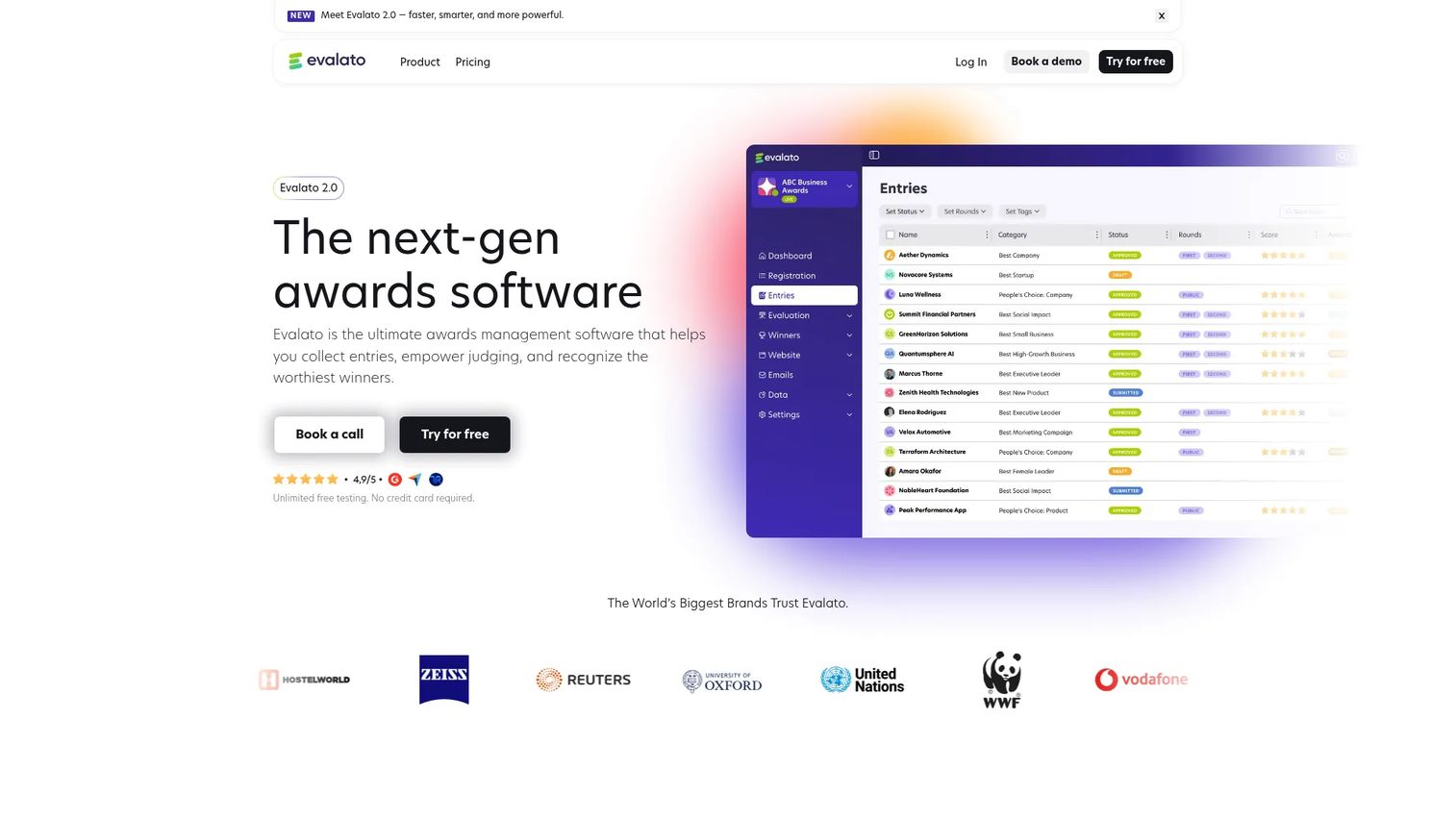
Evalato is a dedicated awards platform built for collecting entries, managing judging, and recognizing winners. It supports branded submission websites, drag-and-drop entry forms, multiple voting types, score normalization, winner galleries, and real-time reporting. The platform covers 40-plus languages and 160-plus currencies, which matters when your awards program spans international entrants or sponsors.
Best for: Teams running awards where public engagement, winner promotion, and a polished entrant experience are part of the program's growth model.
Key features
- Customizable entry forms and branded submission websites
- Multi-round judging with multiple voting types and score normalization
- Entry-fee collection with discount and tax rules
- Winner galleries, tags, and real-time results pages
- 40+ supported languages and 160+ currencies
Why choose Evalato: Choose it when the awards program is a public-facing growth asset rather than an internal recognition exercise. The combination of voting options, winner showcase features, and strong international coverage makes it a natural shortlist candidate for programs with community engagement or sponsor visibility goals.
Evalato pricing: Programs are priced per cycle rather than annually. Grow 50 (up to 50 entries, valid 365 days) starts at €2,500. Grow 100 runs €3,500 and Grow 200 runs €4,500. The Pro tier at €5,500 adds advanced branding, judging, and integration features. Enterprise pricing is available by custom quote. Unlimited free testing is available before launching a paid program.
G2 rating: 4.8/5 (G2, October 2026)
3. OpenWater Application and Review Cloud
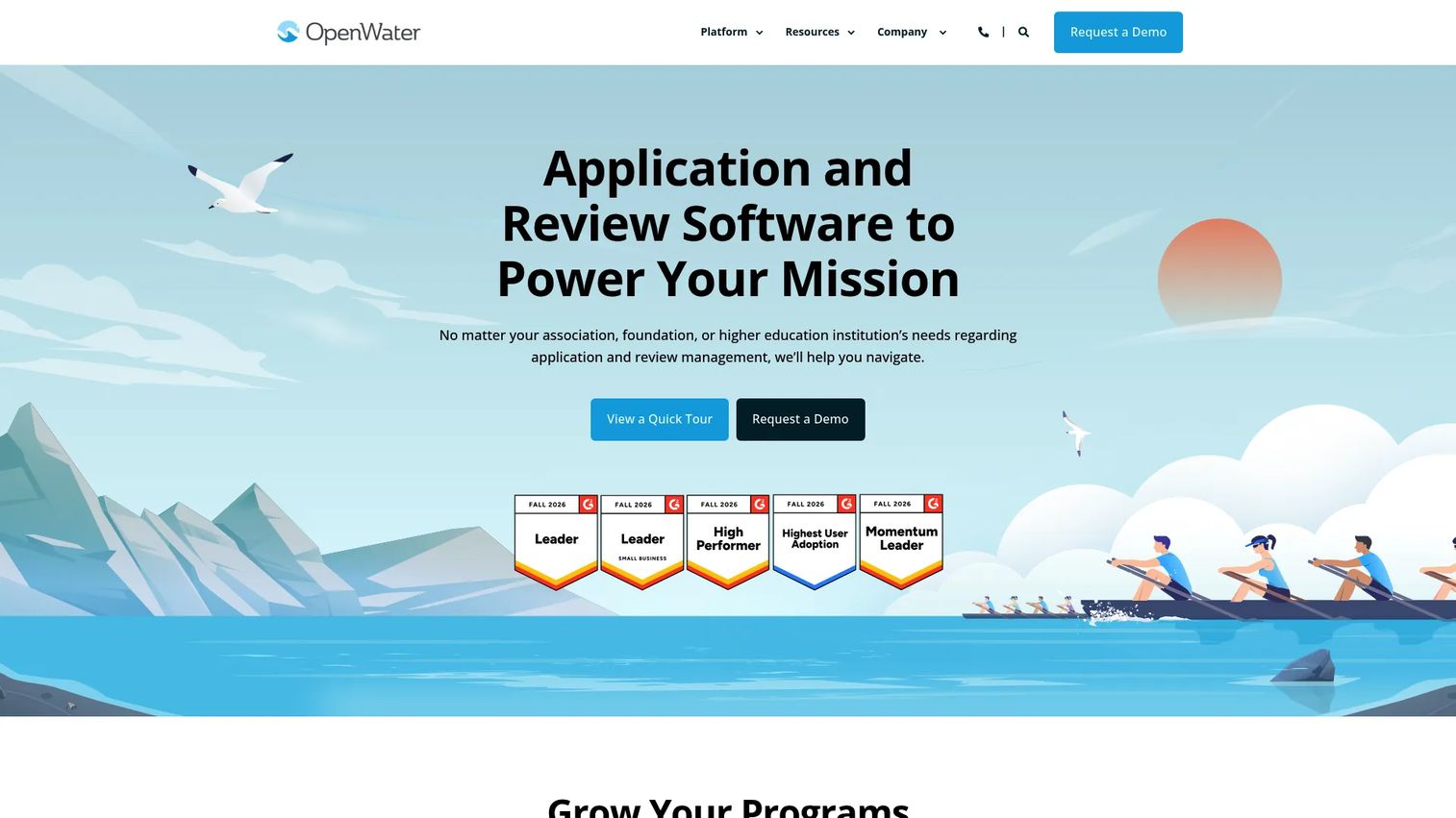
OpenWater Application and Review Cloud is an application and review platform used for awards, grants, scholarships, abstract management software workflows, and other structured programs. It covers configurable forms, multi-round review stages, automated communications, public galleries, voting, and reporting. The platform's integration depth, covering CRM, AMS, and payment systems, makes it a natural fit for associations and enterprise teams with existing systems of record.
Best for: Associations, membership organizations, and enterprise teams where awards connect to CRM records, association directories, or multiple linked programs.
Key features
- Drag-and-drop application forms with eligibility rules
- Multi-round reviewer portals with scoring and comments
- Automated email communications for applicants and reviewers
- CRM and AMS integrations
- Public galleries, voting, and program dashboards
Why choose OpenWater Application and Review Cloud: It becomes compelling when the awards program cannot be managed independently from membership data, conference records, or other application programs running on the same organization's infrastructure. For a standalone customer awards program, the integration overhead may exceed what is needed.
OpenWater Application and Review Cloud pricing: Pricing is not displayed and requires contacting the sales team. The cost is driven by program count, review complexity, integration requirements, and support tier. Request a scoped quote based on your next program cycle before comparing to flat-rate alternatives.
G2 rating: 4.4/5 (G2, October 2026)
4. Judgify
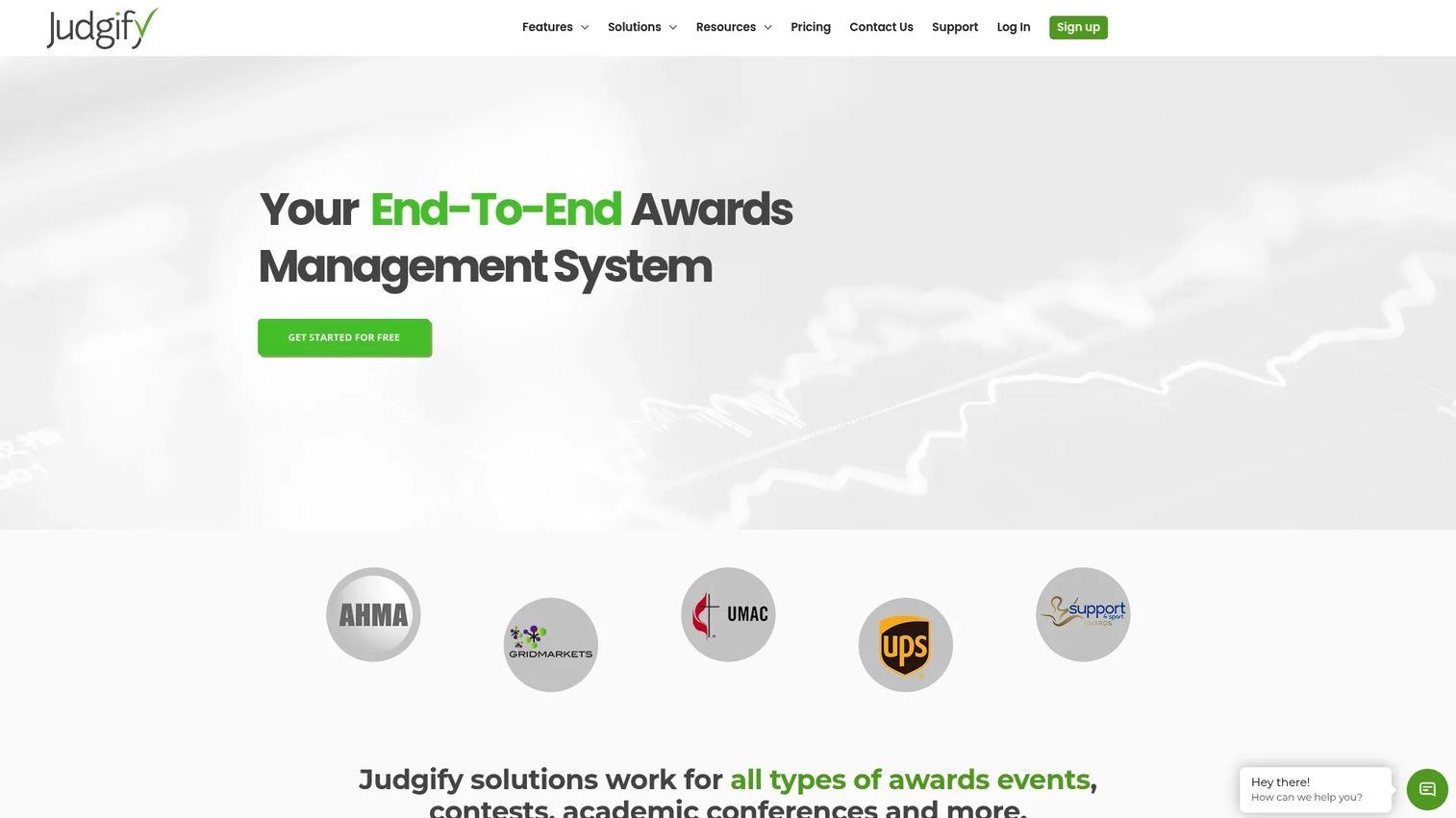
Judgify is an awards, contest, and abstract management platform that handles entry collection, customizable forms, multi-round judging, public voting, custom branding, and analytics. It supports varied submission formats, making it useful for teams that run customer awards alongside academic abstract programs or community competitions under one system. The free Basic tier per event makes it accessible for first programs or experimental formats before committing to annual spend.
Best for: Teams that need one platform for traditional awards, creative contests, academic abstract programs, or community competitions with mixed submission types.
Key features
- Custom entry and nomination forms with order management
- Multi-round scoring with configurable scorecards and judge assignment controls
- Public voting with social login integration
- Custom branding, vanity URLs, and custom domains
- Program analytics and reporting
Why choose Judgify: Choose it when program formats vary across cycles or when blending expert panel judging with audience voting is part of the program design. The per-event pricing model also suits organizations that run one or two awards cycles per year and want to avoid annual platform commitment before volume justifies it.
Judgify pricing: Basic is free per event and includes 100 submissions, 5 categories, 5 MB file size, and 1 private judging round. Pro runs $699 per event and covers 500 submissions, 25 categories, 50 MB files, and 5 private judging rounds plus 1 public voting round. Pro Unlimited costs $2,399 per year for unlimited Pro events. Enterprise pricing is available by custom quote for unlimited submissions and judging rounds.
G2 rating: 4.5/5 (G2, October 2026)
5. AwardStage
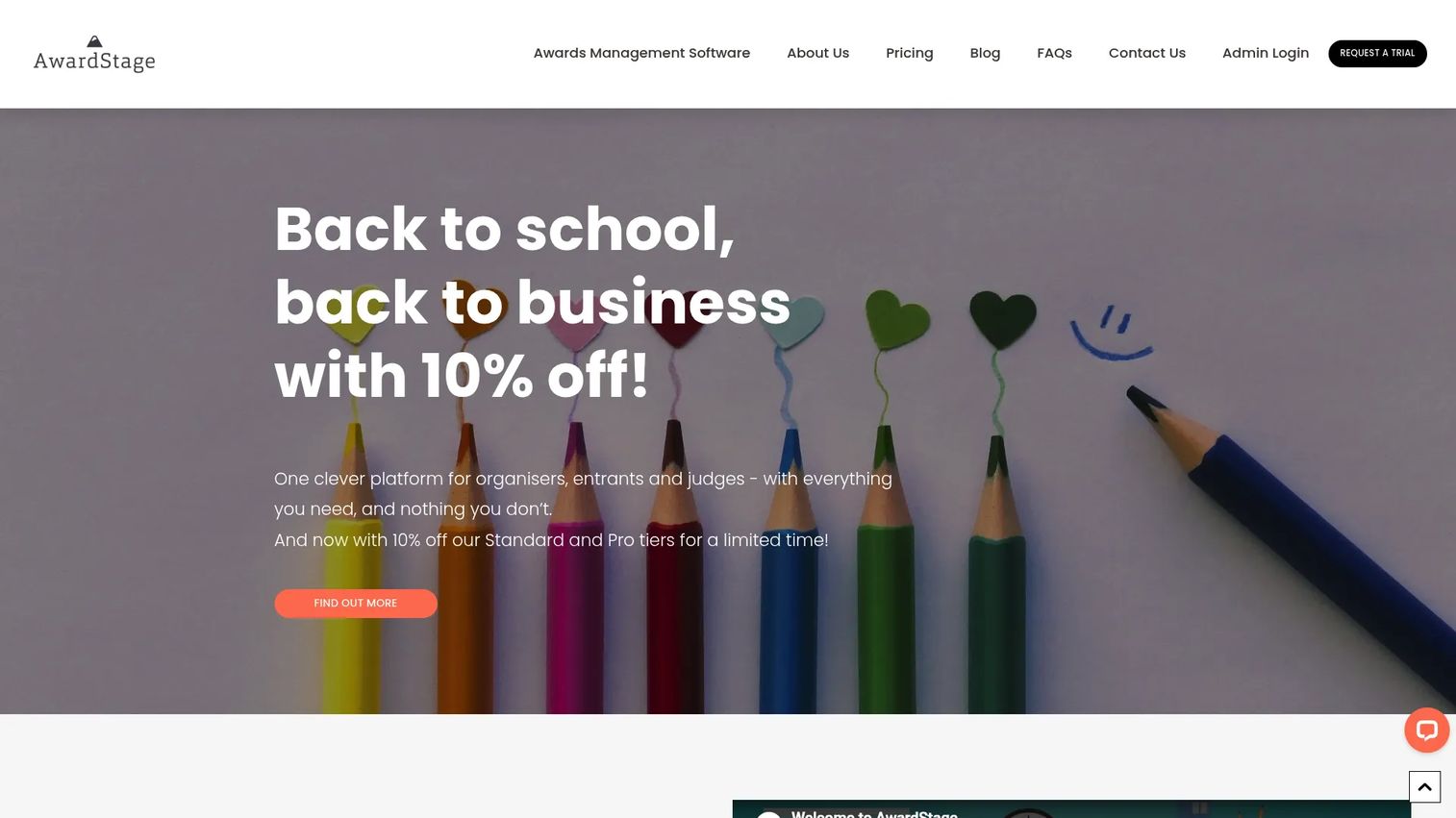
AwardStage is a purpose-built awards platform covering branded website setup, drag-and-drop entry forms, flexible judging and multi-criteria scoring, online payments, event ticketing, and program reporting. The ticketing module is a practical addition for programs that include a ceremony or event as part of the winner recognition cycle. A 14-day free trial is available before committing to an annual plan.
Best for: Marketing, event, or association teams running a focused awards program where branded participant experience and event ticketing both matter.
Key features
- Custom awards website builder and content management
- Drag-and-drop entry form builder with flexible categories
- Jury assignment, multi-criteria scoring, and judging workflows
- Online payment collection for paid entries
- Event ticketing module and program dashboards
Why choose AwardStage: It earns a shortlist spot when the awards program includes a physical or virtual ceremony and you want entry management and event ticketing to share the same platform. The Standard plan covers up to 249 submissions, which works for a first program cycle before moving to Pro at the 250-plus submission tier.
AwardStage pricing: Standard covers up to 249 submissions and runs $3,150 USD per awards program per year. Pro covers 250 to 999 submissions at $4,690 USD per year. Enterprise supports unlimited submissions across multiple awards programs with custom pricing. A 14-day free trial is available.
G2 rating: 4.7/5 (G2, October 2026)
6. Submittable
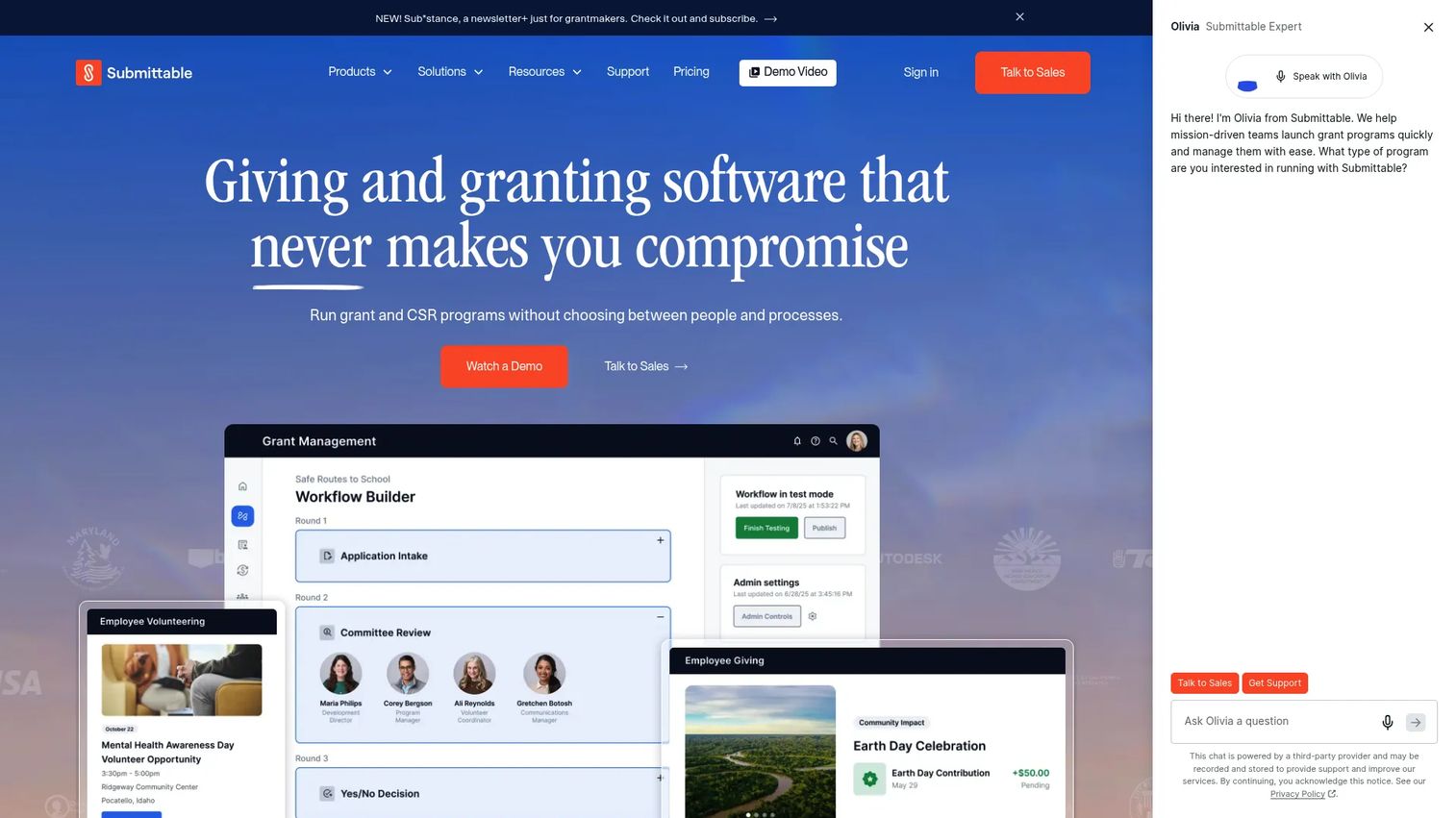
Submittable is an application-management platform used across grants, awards, scholarships, and corporate social responsibility programs. It covers drag-and-drop form building, automated multi-stage review workflows, financial tracking, dynamic reporting, and two-way API integrations. It is a better fit when awards are one program type within a larger application operation, rather than the primary or only program the team runs.
Best for: Companies, foundations, and nonprofit organizations managing grants, CSR giving, volunteering programs, and awards under one operational process.
Key features
- Drag-and-drop application and form builder
- Automated multi-stage review workflows with panel management
- Financial tracking and management across programs
- Dynamic and audit-ready reporting with data exports
- Two-way API and integration support
Why choose Submittable: Choose it when broader application management matters as much as awards-specific features. If your organization runs a corporate giving or community investment program alongside customer awards, Submittable's multi-program administration reduces the need for separate tools per program type.
Submittable pricing: Platform pricing is customized and requires a sales conversation. The publicly listed charge of $0.99 plus 5% applies to payment collection per submission, not the platform subscription. Subscription cost is driven by organization size, program scope, and feature requirements. Budget accordingly for an annual contract discussion rather than a self-serve signup.
G2 rating: 4.5/5 (G2, October 2026)
7. SurveyMonkey Apply
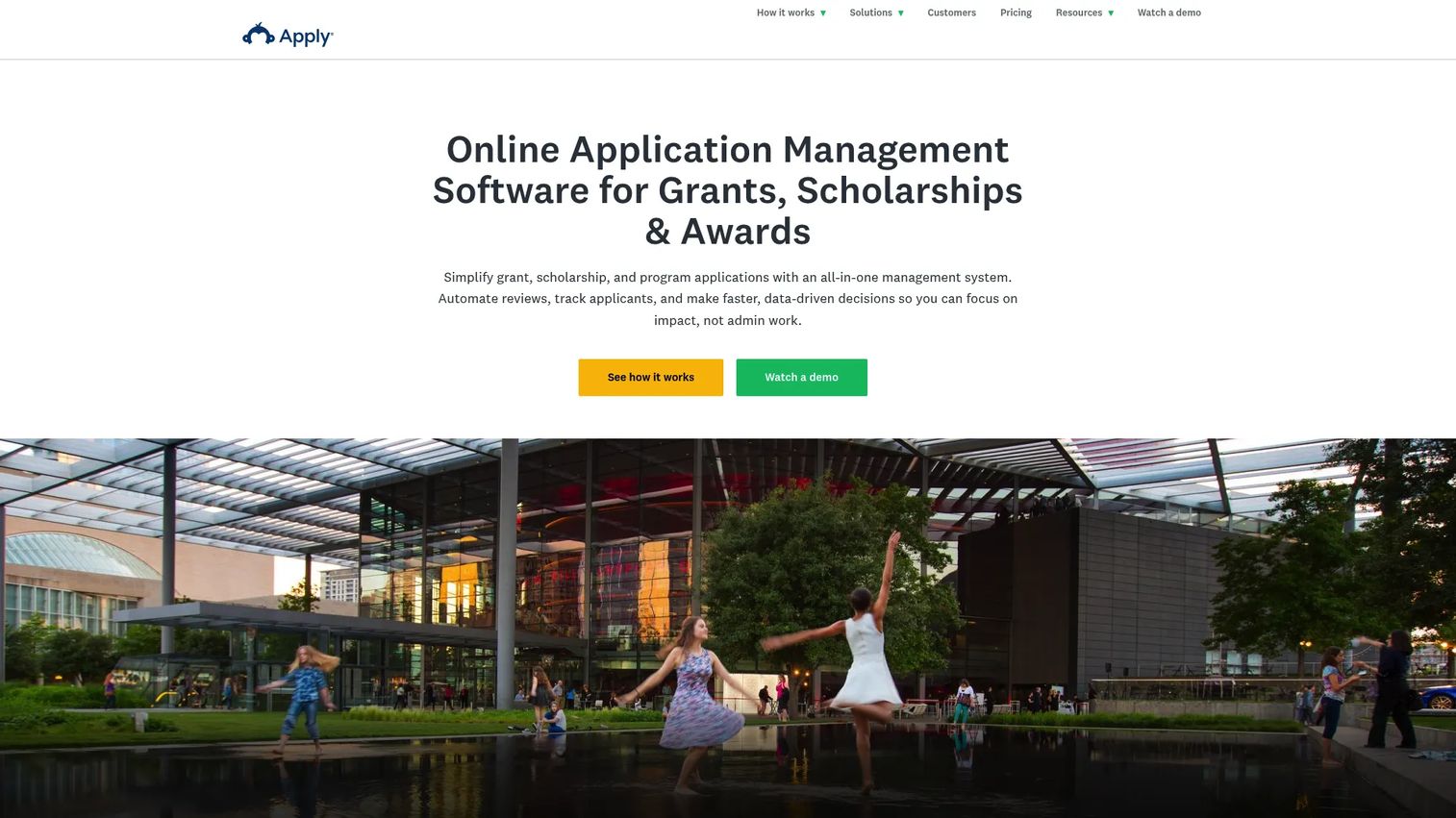
SurveyMonkey Apply handles complex application programs including scholarships, grants, awards, and fellowships. It supports online application portals with dynamic forms, eligibility and conditional logic, reviewer assignments, automated communications, and reporting. The Pro plan supports up to 1,000 applicants across a single program; Enterprise supports up to 5,000 applicants across 10 programs.
Best for: Organizations with rigorous eligibility screening, multi-stage review requirements, and structured application governance where process control matters more than public-facing award promotion.
Key features
- Configurable application workflows with conditional logic and document uploads
- Eligibility screening and automated application routing
- Reviewer portal with simple and advanced review options
- Automated status communications for applicants and reviewers
- Reporting, exports, and Salesforce integration
Why choose SurveyMonkey Apply: It fits organizations where the awards process is part of a structured selection program with compliance, audit, or governance requirements. The Salesforce integration and single sign-on support make it practical for enterprise teams with existing CRM infrastructure.
SurveyMonkey Apply pricing: All plans require a sales conversation for pricing. Pro covers up to 1,000 applicants and 1 program; Enterprise covers up to 5,000 applicants and 10 programs; Enterprise Plus supports unlimited applicants. All plans include free implementation for the first 5 programs and a complimentary SurveyMonkey Advantage plan for the first year.
G2 rating: 4.4/5 (G2, October 2026)
8. Reviewr
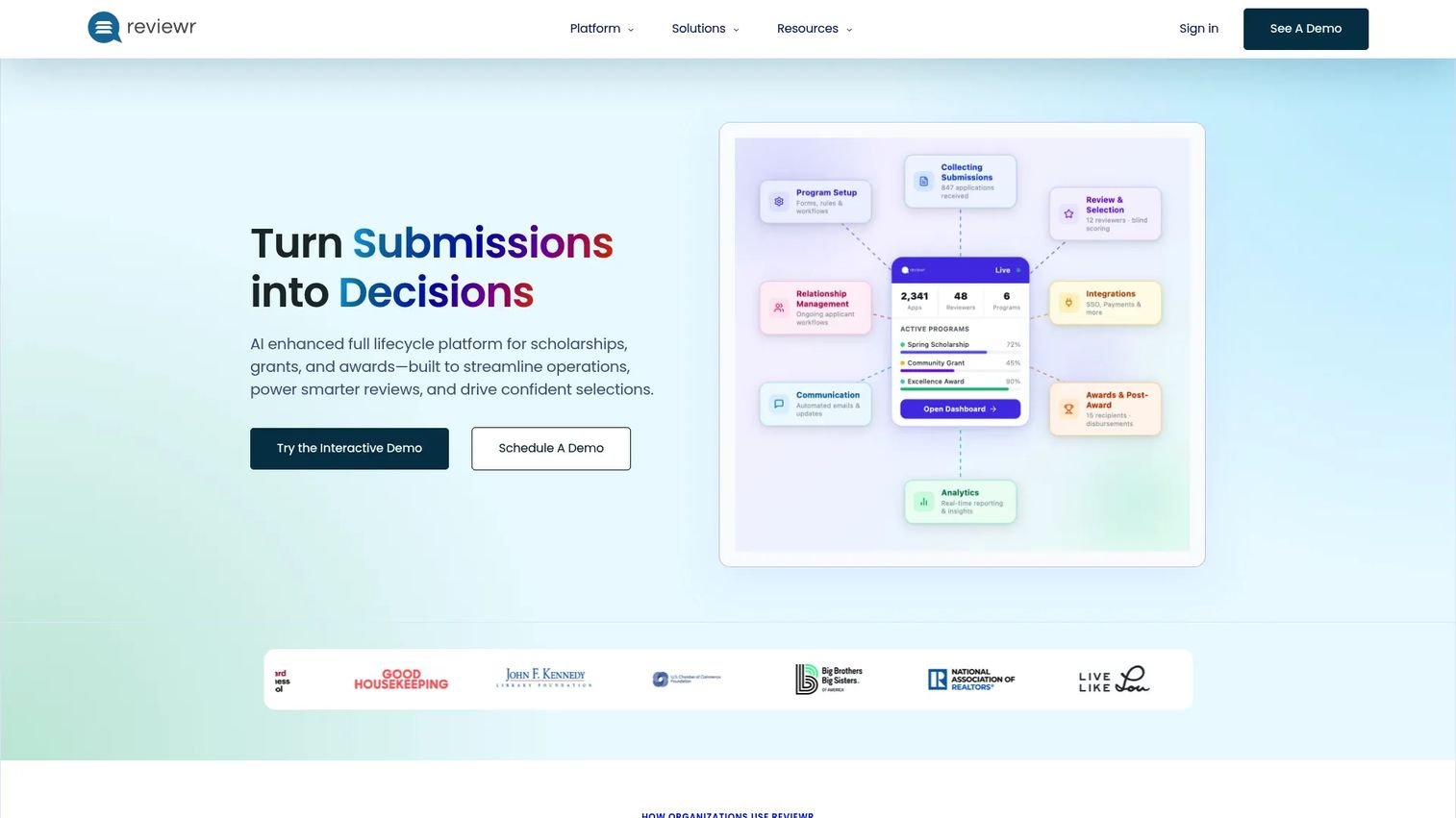
Reviewr is a lifecycle management platform for scholarship, grant, award, fellowship, and competition programs. It covers drag-and-drop forms with conditional logic and save-and-resume, reviewer assignments with blind review and rubric-based scoring, score normalization, applicant messaging, reference-letter tracking, and post-award management. The per-entry pricing model makes it accessible for smaller programs that need structured evaluation but cannot justify a flat annual platform fee at launch.
Best for: Smaller program teams that need more control than a standard form tool provides and want a workable price point before entry volume grows.
Key features
- Drag-and-drop forms with conditional logic and file uploads
- Blind review, structured scoring rubrics, and score normalization
- Reviewer assignment controls and reference-letter tracking
- Workflow automation and applicant messaging
- Post-award management and reporting exports
Why choose Reviewr: The per-entry pricing structure means cost scales with actual program volume rather than a fixed annual commitment, which suits programs in early growth stages. Evaluate whether the Prestige tier's custom pricing will still fit once entry volume grows, or whether a flat-rate platform becomes more cost-effective at scale.
Reviewr pricing: Basic runs $500 per year plus $1 to $10 per entry depending on volume. Standard runs $1,200 per year plus per-entry rates. Prestige pricing requires contacting Reviewr directly. The per-entry rate structure means total annual cost tracks program size rather than a fixed subscription.
G2 rating: 4.4/5 (G2, October 2026)
9. Submit.com
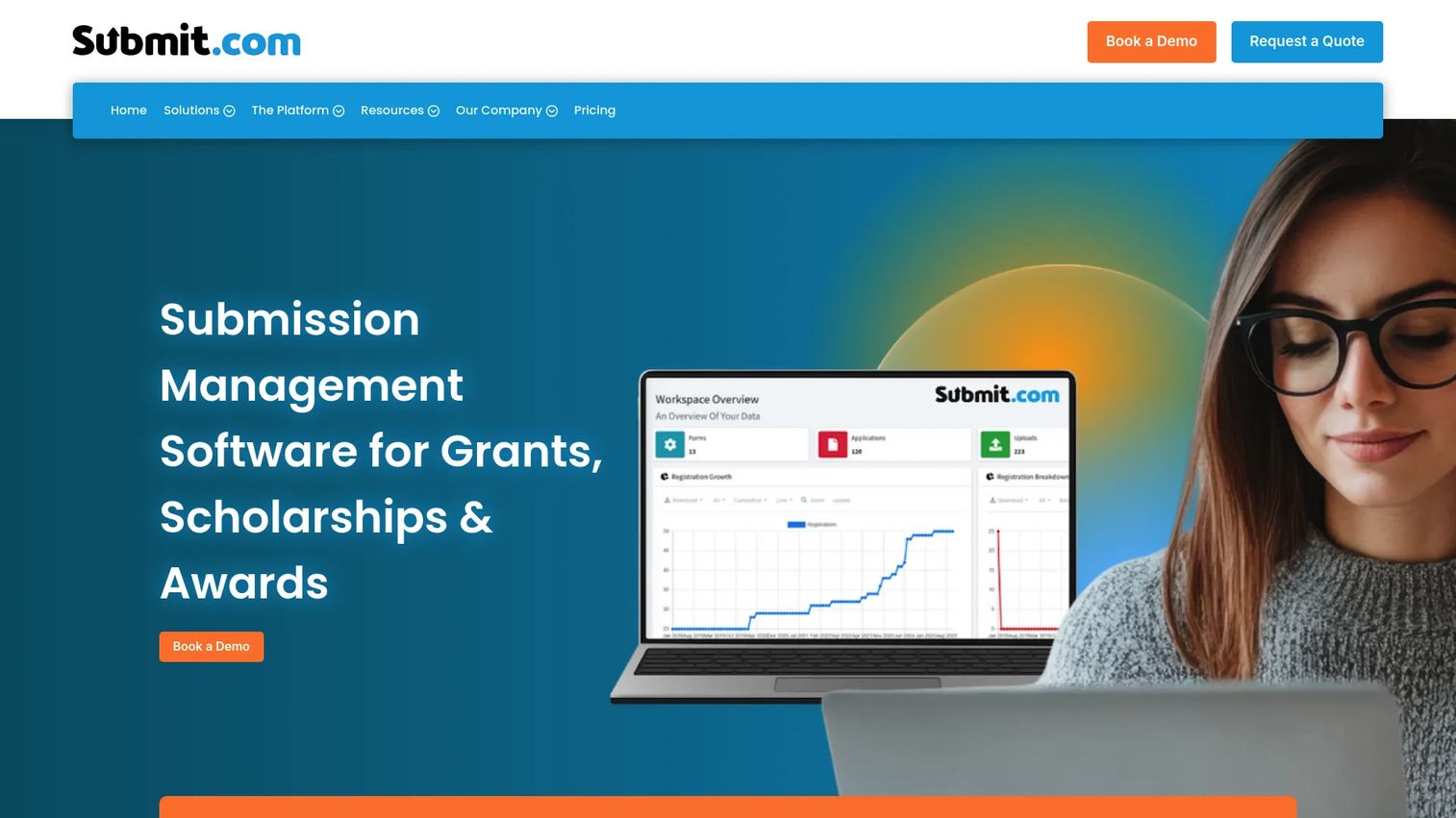
Submit.com is a no-code submission management platform used by governments, universities, foundations, and nonprofits for grants, awards, scholarships, and other structured application programs. It covers customizable smart forms with conditional logic, multi-phase submissions, automated scoring and routing, role-based permissions, external reviewer access, dashboards, audit trails, and API integrations. The platform earned a 4.8/5 G2 rating, reflecting strong satisfaction among its core audience.
Best for: Governments, universities, and foundations managing structured application, review, and award application software workflows with audit and compliance requirements.
Key features
- Smart forms with conditional logic and eligibility screening
- Multi-phase submissions and connected review workflows
- Automated scoring, tagging, and rejection routing
- Role-based permissions with external reviewer access
- Dashboards, audit trails, and API integrations
Why choose Submit.com: It fits organizations where submission governance and auditability are non-negotiable requirements. The multi-phase workflow and automated routing reduce manual review coordination at scale. Ask whether the business model behind your program, particularly paid submissions or sponsor reporting, is supported before committing to the Starter tier.
Submit.com pricing: Starter runs €5,995 per year and supports up to 1,000 applicants, 20 reviewers, 5 admins, and 1 program. Pro covers up to 5,000 applicants and 5 programs with pricing available on request. Enterprise covers unlimited applicants and 5 or more programs, also priced on request.
G2 rating: 4.8/5 (G2, October 2026)
10. Sessionboard Awards
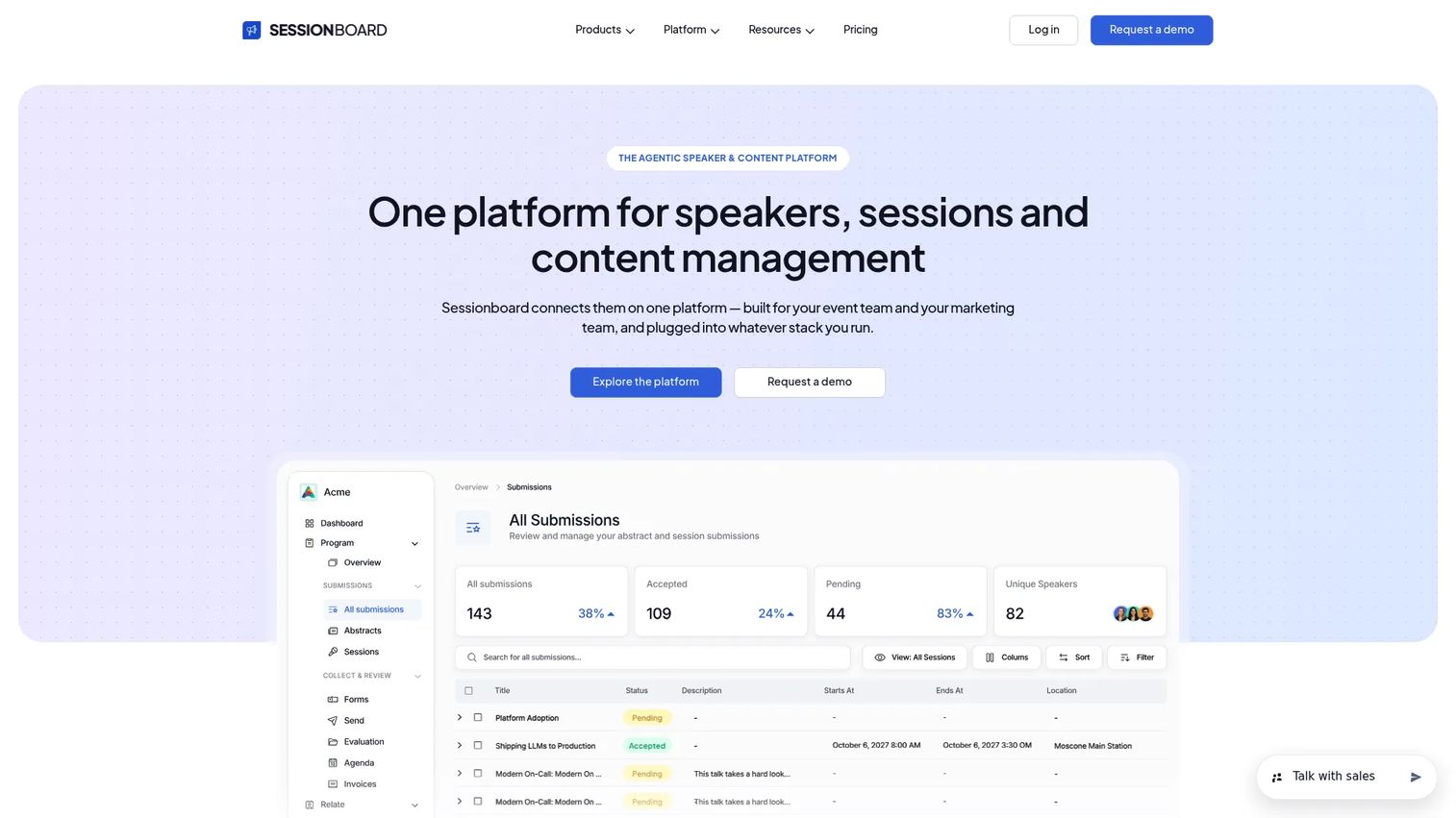
Sessionboard Awards is built for associations and event teams running awards programs connected to speaker, session, and conference content workflows. The platform supports branded submission portals, configurable judging and scoring rubrics, multi-round reviews, and automated communications. Its core differentiation is shared contributor records, so award entrants who are also conference speakers, presenters, or abstract submitters do not create duplicate entries, repeated emails, or broken reporting across programs.
Best for: Conference organizers, associations, and event-led businesses where award entrants overlap with speakers, presenters, or content contributors.
Key features
- Branded submission portals with draft saving and status tracking
- Configurable judging, scoring rubrics, and multi-round reviews
- Shared speaker and entrant records across programs
- Automated communications for submissions, finalists, and winners
- Awards and abstract workflow management connected to event data
Why choose Sessionboard Awards: It is the right choice when the awards process is structurally tied to conference programming or speaker management and cannot cleanly separate. For a standalone customer or community awards program without a connected event, a dedicated awards-only platform will give you a more focused workflow.
Sessionboard Awards pricing: Pricing is custom and requires contacting Sessionboard. Awards is positioned as an add-on to the broader Sessionboard platform. The total cost reflects program scope, submission volume, and whether the awards capability is bundled with session and speaker management modules.
Considerations when choosing awards management software
Match the platform to your program model
A program with public voting, paid entries, and an annual winner ceremony has different requirements from a grant or scholarship program with eligibility screening and compliance reporting. Awards-only platforms optimize for entrant experience, judging workflows, and winner recognition. Broader application platforms optimize for governance, multi-program administration, and review automation. Buying the wrong category costs time and money in configuration that the platform was not built to support.
Test the judge experience before you sign
Request a live review of judge invitations, mobile usability, scorecards, comment fields, conflict controls, blind judging, and multi-round workflows. An awards judging platform that creates friction for reviewers will produce drop-off and score gaps regardless of how polished the administrator dashboard looks. This is the most commonly skipped evaluation step and the one that generates the most post-implementation regret.
Price the full program, not the entry tier
Entry price is the starting point, not the total cost. Variables that change the annual bill include entry volume, file storage, best payment processing software add-ons, custom branding, language support, API access, and premium support tiers. Ask for a modeled annual quote based on your projected next program cycle before comparing two platforms on headline price alone.
Verify integrations and data portability
Confirm which CRM, email, accounting, and automation platforms are supported natively versus through API. Also confirm CSV export formats, data ownership terms, retention periods, and how the platform handles program data if you switch providers. These questions rarely come up in a demo but routinely surface during contract renewal discussions.
Assign an operating owner before you buy
The platform reduces founder dependency only if one named person owns templates, configuration, judge onboarding, reporting, and annual refresh. Include this ownership question in your buying plan. A platform that requires the founder to troubleshoot judge access or regenerate reports each cycle has not solved the delegation problem, regardless of its feature set.
How to choose the right awards management software for your team
If you run a high-stakes paid-entry awards program
Award Force and Evalato are the strongest starting points. Award Force's Growth plan at $3,250 USD annually handles free-to-enter programs; Pro at $6,500 adds paid entries, custom branding, and integrations. Evalato's per-program pricing suits teams that want to match cost to cycle volume rather than pay a flat annual fee. Both platforms cover international entrants and multi-round judging. The decision between them often comes down to whether the program is run once per year on a fixed budget (Evalato's per-program model fits) or whether the organization runs multiple cycles or volumes that justify an annual commitment (Award Force's annual tiers fit better).
If awards are part of a wider application operation
OpenWater Application and Review Cloud, Submittable, and SurveyMonkey Apply are the candidates to evaluate. OpenWater fits associations with CRM or AMS data that the awards process must connect to. Submittable fits corporate or foundation programs where grants, giving, and awards run on the same operational infrastructure. SurveyMonkey Apply fits organizations with structured eligibility logic and governance requirements. All three require a sales conversation for pricing, so build discovery calls into the timeline before your next program cycle.
If you run contests, public voting, or mixed submission formats
Judgify and Evalato both support public voting alongside panel judging. Judgify's free Basic tier per event lets you test the format before committing to Pro at $699 per event. Evalato's voting features sit within a broader awards workflow. Test both with a real award category and a small group of judges before signing.
If awards are tied to conferences or speaker programs
Sessionboard Awards is the only platform in this list built specifically for that overlap. Before evaluating it, confirm whether the awards program genuinely shares submitters with your speaker or abstract management process. If the programs are administratively separate, a dedicated awards platform will give you a cleaner and more focused workflow.
Conclusion
The best awards management software is the platform your team can hand off to an operator, trust during judging, and afford across the full program lifecycle.
Award Force suits complex, branded, paid-entry programs where international reach and judging depth justify the annual investment. Evalato fits programs where public engagement and winner promotion are part of the growth model. OpenWater Application and Review Cloud earns consideration when awards connect to association or enterprise systems. Judgify works for teams running varied program formats with a preference for per-event pricing. AwardStage covers the awards-plus-event-ticketing case. Submittable and SurveyMonkey Apply handle grants, scholarships, and awards under one process when governance matters more than public-facing promotion. Reviewr offers a lower entry cost for smaller programs. Submit.com fits public-sector and institutional programs with strict audit requirements. Sessionboard Awards belongs on the list when conference and awards data cannot be cleanly separated.
Pick three platforms that match your program model. Recreate one real award category in each, invite a test judge, and compare the experience before signing an annual agreement.
Start your journey with Guideflow today!
FAQs about awards management software
The right starting point depends on entry volume, number of categories, judge count, and whether payments or public voting are required. Judgify's free Basic tier per event and Reviewr's $500 per year starting price are the lowest barriers to entry among dedicated awards platforms. Organizations with fewer than 100 entries per cycle and straightforward judging requirements can run a full program on either without a multi-thousand-dollar annual commitment.
Many platforms support payment gateways for paid entry programs, including Award Force, Evalato, Judgify, and AwardStage. Verify payment processing fees, supported currencies, discount code handling, tax rules, refund workflows, and reconciliation exports before signing. Some platforms charge a percentage of collected fees on top of the subscription cost, so read the payment terms carefully.
Purpose-built award judging software typically supports blind review (hiding entrant identity from judges), weighted scoring rubrics, score normalization across judge panels, conflict-of-interest controls, and multi-round workflows where early scores do not bias later rounds. Audit trails record who scored what and when. The platform supports fair process design, but clear judging criteria defined before the program launches are what make the process defensible.
Several platforms in this list support public voting alongside panel judging, including Evalato, Judgify, and OpenWater Application and Review Cloud. Before enabling public voting, verify how the platform handles voter verification, duplicate-vote prevention, vote weighting relative to the panel score, and accessibility for international voters. Public voting works well for community engagement and winner promotion but requires controls to prevent manipulation.
Awards platforms typically emphasize entrant experience, judging workflows, winner selection, public recognition, payment collection, and branded award sites. Grant management platforms prioritize eligibility screening, application review, funding decisions, compliance reporting, and grant lifecycle tracking. The operational center of gravity is different: Awards software is designed around the entrant journey and public outcome; grant software is designed around the funder's review and disbursement process. Submittable and SurveyMonkey Apply sit at the intersection and support both, which is why they appear in this list for organizations with mixed program needs.
Annual cost is driven by submission volume, number of programs, judging complexity, payment requirements, language and currency support, integrations, and support tier. Award Force starts at $3,250 USD per year for the Growth plan. AwardStage starts at $3,150 USD per year for up to 249 submissions. Reviewr starts at $500 per year plus per-entry rates. Evalato prices by program cycle rather than annually, starting at €2,500 for up to 50 entries. Submit.com starts at €5,995 per year. OpenWater, Submittable, and SurveyMonkey Apply all require a sales conversation before a price is available.
Several platforms in this list support abstract submissions alongside awards and review panels, including OpenWater Application and Review Cloud, Judgify, and Sessionboard Awards. If your organization manages both conference content and awards programs, Sessionboard Awards is the only platform here built specifically to share contributor records across those workflows. For organizations using abstract management software separately from their awards platform, test whether the submission and review experiences are consistent enough across tools before committing to a split-system approach.