You opened a call for speakers three weeks ago. The submissions are scattered across an inbox, a shared drive, and a spreadsheet nobody trusts. Two reviewers never got their assignments. One abstract got scored twice. And you still have to notify 340 authors before the program goes live.
That is not a talent problem. It is a workflow problem. Manual intake creates delays, missed reviews, and inconsistent communication, and every gap compounds as the event date gets closer.
The category built to fix this sits inside a fast-growing market. The global event management software market is projected to reach USD 15.5B in 2024 and grow at a 17.4% CAGR through 2029, according to MarketsandMarkets (2026). Abstract management is a specialized slice of that spend, and the tools have matured enough that spreadsheet chaos is now a choice, not a necessity.
This guide compares eight platforms that collect submissions, run peer review, make decisions, notify authors, and push accepted content into sessions. The goal is to help you shortlist faster.
What's inside
This guide is for conference organizers, scholarly association staff, academic event teams, and event ops leaders comparing vendors.
We selected platforms based on:
- Workflow depth from submission to decision
- Peer review tooling: rubrics, reviewer assignment, blind review, conflict handling
- Communication automation for reminders and acceptance notifications
- Integrations, security, and session publishing handoff
The article compares eight vendors, explains what the category does, and gives you a buyer's checklist so you can match a platform to your event size and review complexity.
TL;DR
- Best for call for speakers workflow: Whova
- Best for scholarly conference review workflows: Ex Ordo
- Best for all-in-one event platform fit: OpenWater
- Best for broader event management system buyers: Cadmium
- Best for budget or smaller event teams: Fourwaves or Dryfta
- Best for balanced academic conference workflows: Oxford Abstracts or Confex
- Best for associations and nonprofits: Cadmium or OpenWater
Pick based on review complexity, event size, and whether you need accepted abstracts to flow straight into sessions.
What is abstract management software?
Abstract management software is an online system for collecting, reviewing, deciding on, and communicating around abstract or proposal submissions for conferences and academic events.
It replaces the patchwork of forms, spreadsheets, and email threads that most teams start with. A generic form collects text. An abstract management system routes that text through a structured review workflow, tracks every decision, and keeps authors informed at each stage.
It also differs from a broader conference management software suite. Abstract management is the intake-to-decision engine. A full event management system may wrap registration, payments, and an event app around it, but the abstract layer is where submission and peer review actually happen.
Core capabilities to expect:
- Submission portal customization: branded forms for authors, with fields for text, files, and co-author data
- Reviewer assignment and scoring: route submissions to the right reviewers with rubrics
- Blind review and conflict handling: hide author identities and flag conflict of interest automatically
- Decision workflows and notifications: approve, reject, or request revisions, then trigger acceptance notifications
- Session and speaker publishing handoff: move accepted abstracts into agenda, speaker, or event app modules
The same online abstract submission software often handles adjacent calls too: posters, awards, scholarships, funding applications, and demos. If you run more than one call type, that breadth matters.
Teams that show a complex product to a review committee sometimes pair these workflows with an interactive demo so evaluators can experience a tool at their own pace through a guided path. It is a small parallel, but the same principle applies: structured self-serve beats a static file.
When to use abstract management software
Run a call for speakers without spreadsheet chaos
A call for speakers generates submissions fast, and volume is where manual tracking breaks. Abstract submission software centralizes every submission in one portal, tags them by track, and routes each to the right reviewer automatically. No more asking "who has this one?" in Slack.
Manage peer review at scale
Peer review is the core job. Blind review hides author names, rubrics standardize scoring, and reviewer assignment spreads the load evenly. When 200 abstracts need three reviews each, a review workflow that handles conflict of interest and reviewer allocation saves days of coordination.
Turn accepted submissions into event content faster
The work does not end at the decision. Accepted abstracts have to become sessions, speakers, and agenda entries. The best platforms push accepted content straight into session publishing so you never re-key data from one system into another.
Comparison table
Here is a quick side-by-side. Sort your shortlist by review complexity first, then event size. Pricing and G2 ratings shift over time, so verify current figures on each vendor's site before you commit.
| # | Product | Best for | Key differentiator | Pricing | G2 rating |
|---|---|---|---|---|---|
| 1 | Whova | Call for speakers workflow | Submission plus event app handoff | Quote-based; free attendee app | 4.8/5 |
| 2 | Cadmium | Associations and nonprofits | Event plus continuing education platform | Custom quote | 4.5/5 |
| 3 | OpenWater | All-in-one application and review | Awards, abstracts, grants in one system | Custom quote | 4.4/5 |
| 4 | Ex Ordo | Scholarly conference review | Painless peer review and reviewer allocation | Contact sales | 4.8/5 |
| 5 | Fourwaves | Academic and research events | Free tier plus all-in-one platform | From $0/year | 4.8/5 |
| 6 | Oxford Abstracts | Balanced academic conferences | Abstracts plus ticketing and program builder | From $890/event | Not rated |
| 7 | Confex | Scientific and medical meetings | End-to-end conference operations | Contact vendor | Not rated |
| 8 | Dryfta | Universities and all-in-one stacks | White-label sites plus abstract review | From $1,499/year | 4.7/5 |
Best abstract management software for 2026
1. Whova
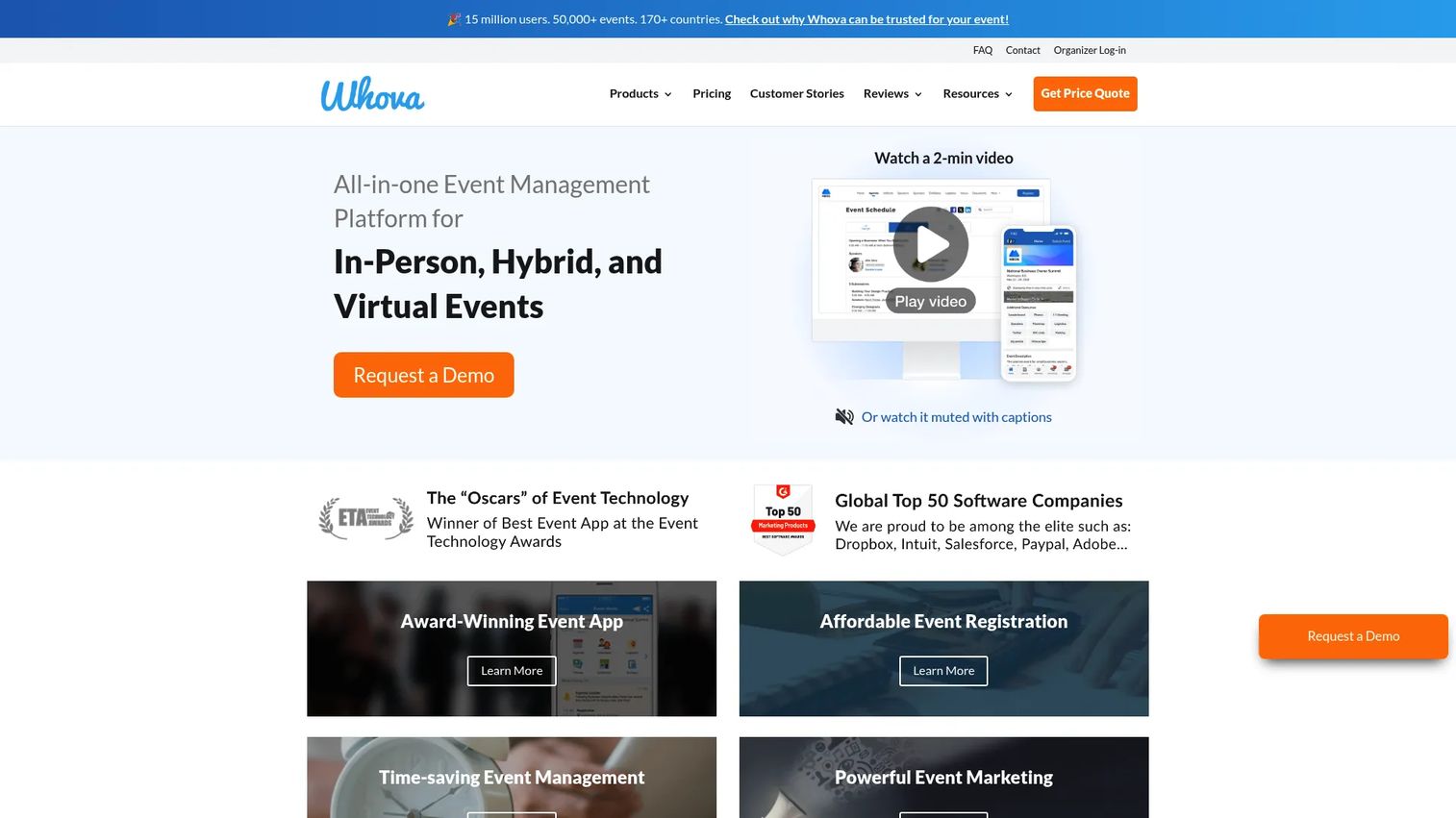
Whova is an all-in-one event management platform for in-person, virtual, and hybrid events, with a strong abstract and call for speakers workflow inside it. It handles submission collection, review assignment, and conflict detection, then hands accepted content off to its event app. Teams running conferences that need both intake and attendee engagement in one place gravitate here.
Best for: Event organizers who want the call for speakers workflow and the attendee experience in a single platform.
Key strengths
- Registration and agenda management in one system
- Speaker management from submission to stage
- Attendee networking and live announcements
- Call for speakers with review assignment
- Event app handoff for accepted sessions
Why choose Whova: Choose Whova when the abstract workflow is one piece of a larger event you are running, and you want submission, review, and the attendee app under one roof rather than stitched together.
Whova pricing: Pricing is quote-based; organizers request a price that fits their budget. Attendees can download and use the event app for free.
2. Cadmium
Cadmium is an integrated event management and continuing education platform built for associations and professional organizations. Abstract management sits inside a broader event management system, alongside learning management and speaker, exhibitor, and abstract workflows. That makes it a fit for teams whose events feed continuing education credits and year-round programming.
Best for: Associations and professional organizations running events plus continuing education programs.
Key strengths
- Event management across the full lifecycle
- Learning management for continuing education
- Speaker, abstract, and exhibitor management
- Configurable review workflow
- Association and nonprofit fit
Why choose Cadmium: Choose Cadmium when abstract management is part of a wider association stack, and you need submission review to connect to CE credits, member data, and multi-event planning rather than living on its own.
Cadmium pricing: Public pricing is not listed. Cadmium directs prospects to submit an RFP or request a demo for a custom quote.
3. OpenWater
OpenWater is application and review software for awards, abstracts, grants, scholarships, and fellowships. It covers the full end-to-end abstract workflow: a branded submission portal, drag-and-drop forms, multi-round review, and a session builder. That range makes it strong for associations and higher-ed teams that run several call types beyond speakers.
Best for: Associations, foundations, and higher-ed teams managing complex application and review workflows.
Key strengths
- Application website creation with branding
- Drag-and-drop form builder for any call type
- Multi-round review for layered decisioning
- Session builder for accepted content
- AI-powered workflow assistance
Why choose OpenWater: Choose OpenWater when you manage more than abstracts, awards, grants, and scholarships in the same year, and want one submission portal and review workflow to handle all of them.
OpenWater pricing: OpenWater says pricing is subscription-based and custom quoted. It directs prospects to request a quote rather than publishing a public price.
4. Ex Ordo
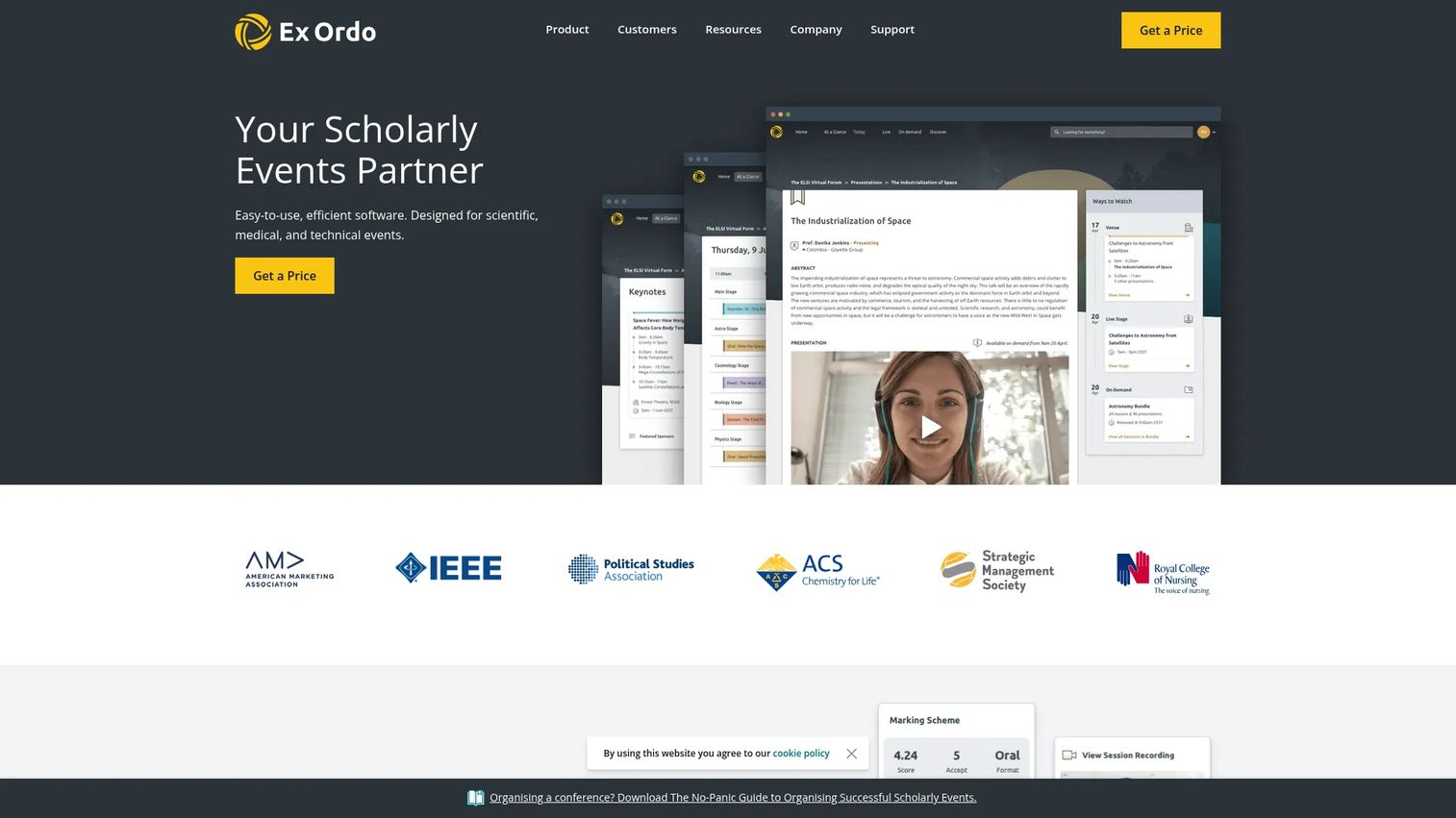
Ex Ordo is conference management software built specifically for scholarly events, covering abstracts, peer review, registration, and virtual or hybrid delivery. It leans hard into reducing organizer stress: reviewer allocation, blind review, and communication automation are the core of the pitch. Academic, scientific, and medical conferences are its home turf.
Best for: Scholarly conference organizers managing abstracts, peer review, registration, and event delivery.
Key strengths
- Abstract submission and peer review workflows
- Reviewer allocation with conflict handling
- Registration, payments, and attendee communications
- Virtual and hybrid event hosting
- Live and on-demand content delivery
Why choose Ex Ordo: Choose Ex Ordo when peer review depth is your top priority and you want a platform designed around the review workflow rather than one where review is bolted onto a general event tool.
Ex Ordo pricing: Pricing is not publicly listed. The pricing page directs organizers to contact sales for a detailed quote.
5. Fourwaves
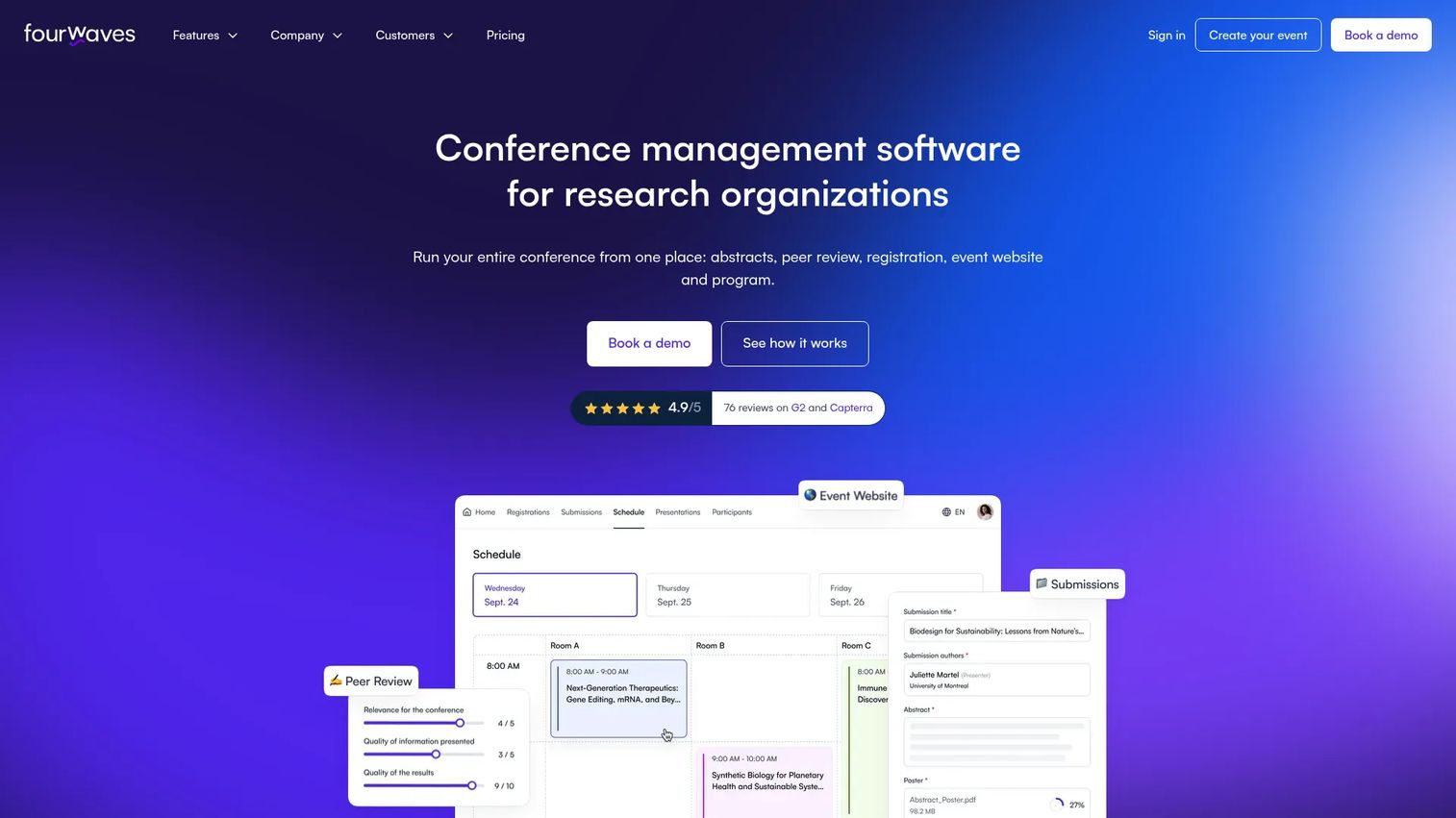
Fourwaves is conference management software for academic and scientific events, with abstract management, an event website builder, and registration in one platform. Its published pricing and free tier make it approachable for smaller or mid-sized events that still need a real submission portal and review workflow. Organizer controls stay simple without cutting the essentials.
Best for: Academic and scientific conference organizers needing an all-in-one platform at a clear price.
Key strengths
- Event website builder for the conference site
- Abstract management and submissions
- Registration, payments, and email communication
- Poster and presentation handling
- Transparent, published pricing tiers
Why choose Fourwaves: Choose Fourwaves when you want published pricing and a free starting point, plus an all-in-one platform that scales from a small workshop to a mid-sized research conference.
Fourwaves pricing: Free plan at $0/year. Essential is $999/year, Advanced is $1,999/year, and Pro is $5,299/year. Custom plans and add-ons are available, with pricing viewable in USD, CAD, or EUR.
6. Oxford Abstracts
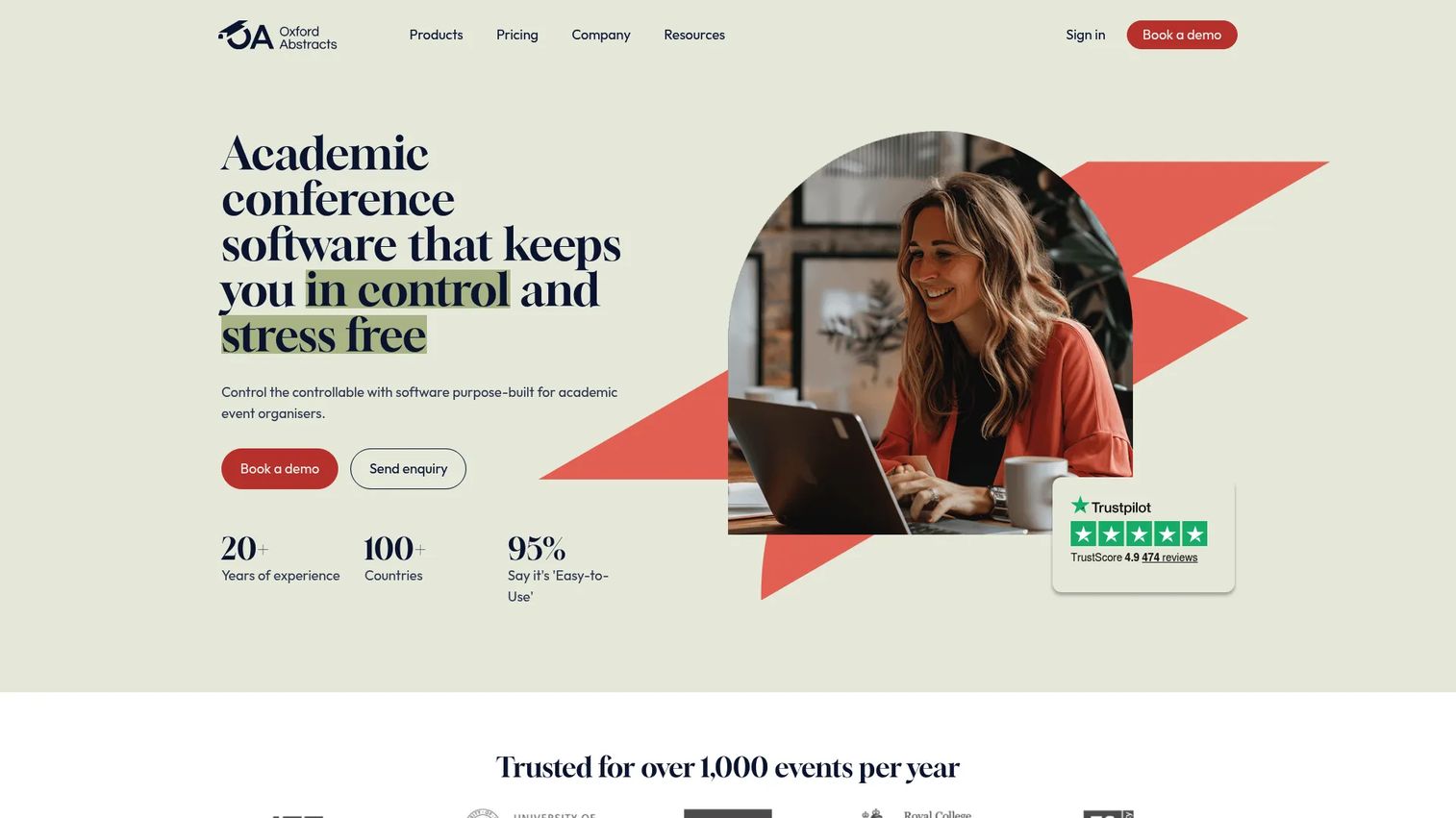
Oxford Abstracts is an academic conference platform covering abstract management, review, decisions, ticketing, and a conference program builder. It balances submission and review flexibility with event organization features like a poster gallery and attendee networking. That balance makes it a solid pick for academic and professional conferences that want both sides handled well.
Best for: Academic and professional conference organizers managing abstracts and event workflows.
Key strengths
- Abstract submission, review, and decisions
- Built-in ticketing with Stripe and PayPal
- Conference program builder
- Poster gallery and attendee networking
- Flexible review configuration
Why choose Oxford Abstracts: Choose Oxford Abstracts when you want a balanced platform that treats abstract review and event operations as equal priorities, with per-event pricing that scales from abstracts-only to a full conference.
Oxford Abstracts pricing: Abstract Management is $890/event, Standard Conference is $2,290/event, and Professional Conference is $3,450/event. A free package and trial option is available on the site.
7. Confex
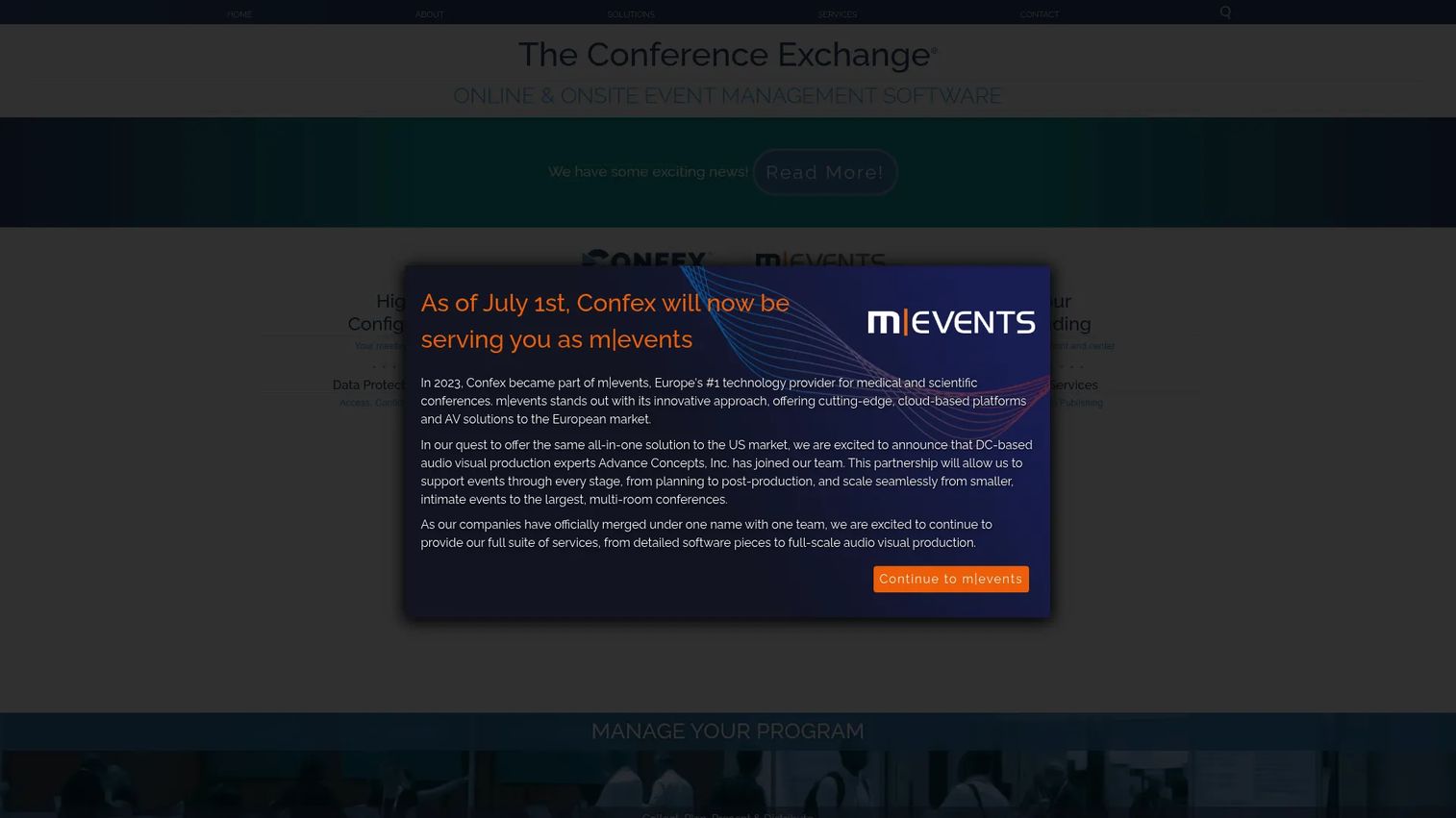
Confex is event management software for conferences and scientific or medical meetings, with abstract collection and review management inside broader conference operations. It suits teams that want a straightforward conference workflow from submission through registration and exhibitor management. The platform is built around the operational reality of large scientific programs.
Best for: Scientific and medical conference organizers needing end-to-end event management.
Key strengths
- Abstract collection and submission
- Review management for committees
- Conference planning and scheduling
- Registration and exhibitor management
- Scientific and medical meeting focus
Why choose Confex: Choose Confex when you run large scientific or medical meetings and want abstract review to sit inside a full conference operations platform rather than a standalone submission tool.
Confex pricing: Public pricing is not listed on the site. Contact the vendor directly for a quote based on your event.
8. Dryfta
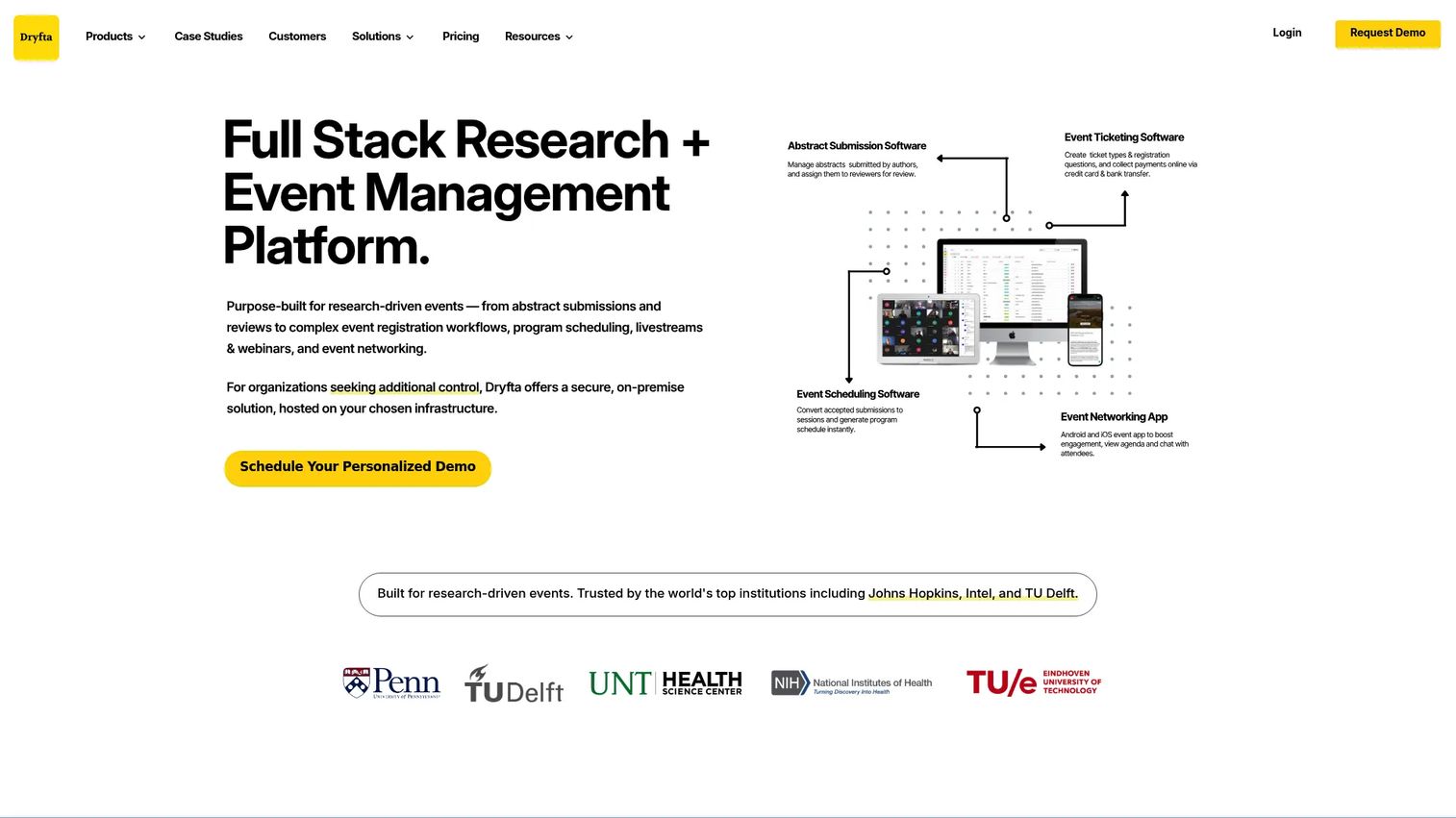
Dryfta is event management software for universities, conferences, and enterprises, with abstract submission, peer review, and notifications inside a configurable all-in-one stack. It adds white-label event websites and integrations for teams that want to own the branding end to end. Universities and conference teams that need one platform for everything are the natural fit.
Best for: Universities and conference teams needing a configurable all-in-one event platform.
Key strengths
- Event registration and ticketing
- Abstract submission and peer review
- White-label event websites
- Notifications and acceptance emails
- Integrations across the event stack
Why choose Dryfta: Choose Dryfta when you want a configurable, white-label platform that puts abstract review, registration, and your branded conference site under one roof for a full academic program.
Dryfta pricing: The Small plan is $1,499/year. A Large plan is available on a contact-for-pricing basis, and Dryfta offers both pay-as-you-use and annual options. A free trial is available.
Considerations
Before you commit, run each shortlisted platform through this checklist.
Review workflow depth
Check how rubrics are built, whether blind review is truly double-blind, and how reviewer assignment works at volume. Conflict of interest detection matters when reviewers and authors overlap in a small field. The deeper the review workflow, the less manual coordination lands on your desk.
Submission portal flexibility
Look at form customization, branding, and support for multiple call types. If you run posters, awards, and scholarships alongside speaker submissions, one flexible submission portal beats three separate tools. Confirm the online abstract submission software handles your field types and file uploads.
Communication automation
Verify reminder scheduling, acceptance and rejection emails, and status updates to authors. Manual notifications are where teams lose hours and consistency. Good automation sends the right acceptance notifications at the right stage without you touching each one.
Session publishing and event handoff
Confirm that accepted abstracts move cleanly into agenda, speaker, or event app modules. This is where an integrated event management system earns its price. Re-keying accepted content by hand is slow and error-prone.
Security and reliability
Review access control, compliance posture, uptime history, and support responsiveness. A submission deadline is not the moment to discover a support gap. Ask about SLAs and data handling before you sign.
Conclusion
The right abstract management software depends on what your event actually needs. If your abstract workflow lives inside a larger event, start with Whova. If peer review depth is the priority, look at Ex Ordo first. Teams running awards, grants, and abstracts together should shortlist OpenWater, and associations balancing events with continuing education should evaluate Cadmium.
Budget-conscious and smaller academic teams have real options in Fourwaves and Dryfta, both with published pricing. Oxford Abstracts and Confex round out balanced picks for academic and scientific conferences.
Match the platform to three things: event size, review complexity, and how cleanly accepted abstracts need to reach your sessions. Then test your top two with a real call before the deadline pressure hits.
Start your journey with Guideflow today!
FAQs
Abstract management software is an online abstract submission software that collects, reviews, decides on, and communicates around conference or proposal submissions. It replaces spreadsheets and email threads with a structured submission portal, peer review tooling, and automated author notifications.
Authors submit abstracts through a branded submission portal. The system assigns each submission to reviewers, applies rubrics and blind review, collects scores, and routes them to a decision. Once decided, it sends acceptance notifications and pushes accepted content into session or speaker modules.
Review workflow depth, submission portal flexibility, communication automation, and session publishing handoff. Rubrics, reviewer assignment, and conflict of interest handling drive the peer review side. Automated acceptance notifications and clean event handoff drive the operational side.
Yes, though they overlap. An abstract management system focuses on submission, peer review, and decisioning. A broader event management system or conference management software adds registration, payments, and an event app around that core. Many platforms in this list do both.
Most can. Platforms with a flexible form builder support abstract collection for posters, awards, scholarships, funding applications, and demos, not just speaker submissions. If you run several call types a year, confirm the submission portal supports each one before buying.
Match the platform to event size, review complexity, and publishing needs. Prioritize review workflow depth if peer review is heavy, and integrations if accepted abstracts must reach sessions automatically. Test your top two shortlisted tools with a real call for speakers before you commit.
Look for access control, compliance posture, uptime history, and responsive support. Reviewer data and unpublished submissions are sensitive, so ask about data handling and SLAs. Confirm the abstract review software restricts reviewer and author visibility appropriately during blind review.
The strongest platforms do. Accepted abstracts should flow into agenda, speaker, or event app modules without manual re-entry. Confirm this session publishing handoff before purchase, since re-keying accepted content by hand is the most common source of late-stage errors.