Last updated: October 2026
Your QA team needs to test a billing flow with realistic customer accounts. Security will not approve copying production records into staging. Engineering now has to choose between slow manual cleanup and test data that misses the edge cases that matter.
This is the core tension in modern product development. Release quality depends on representative data, but lower environments should not expose sensitive production values. NIST Special Publication 800-188 (2023) describes masking as a de-identification technique that helps make datasets usable while reducing privacy risk. That framing captures exactly what product teams need: Data that works without data that reveals.
The global data masking market reached $1.13 billion in 2025 and is projected to nearly triple to $2.99 billion by 2033, according to Grand View Research (2026). Enterprise teams already represent 68.1% of that spend, per Mordor Intelligence (2026). The category is growing because the problem is not going away.
This guide cuts through the feature lists and gives you a practical shortlist of 10 data masking software tools, with selection guidance for test data management, analytics, SaaS sandbox protection, and enterprise governance.
What's inside
This guide compares 10 data masking tools for product managers evaluating how to protect sensitive production data across development, QA, analytics, training, and sandbox workflows.
Items were selected based on:
- Masking method: Whether the tool supports static masking, dynamic masking, or both
- Data fidelity: Whether masked records preserve realistic formats, distributions, and referential integrity
- Source-system coverage: Which databases, applications, and cloud platforms the tool connects to
- Operational fit: How the tool maps to release cadence, engineering ownership, and maintenance overhead
Prices and G2 ratings reflect verified sources. Contact each vendor to confirm current packaging before procurement.
TL;DR
- Best overall for test data management: Delphix for enterprise teams that need masked, production-like data refreshed across development and QA environments
- Best for relationship-aware masking: K2view Data Product Platform for large environments where entity-level consistency across linked records matters
- Best for Informatica-centered governance: Informatica Cloud Data Masking for organizations standardizing masking policies across existing Informatica pipelines
- Best for Oracle estates: Oracle Data Masking and Subsetting for teams running Oracle Database and Oracle security tooling
- Best for Salesforce sandboxes: Salesforce Data Mask & Seed for product and RevOps teams protecting data in Salesforce development and testing workflows
- Best for cloud analytics governance: Immuta Data Security Platform for data-heavy organizations needing policy-driven access controls across cloud data platforms
What is data masking software?
Data masking software changes sensitive values into protected, representative values so teams can use data in development, testing, analytics, training, and controlled-access workflows without exposing the original records.
According to NIST's glossary, masking is a de-identification technique applied to reduce re-identification risk while preserving the dataset's operational usefulness. For product teams, the practical question is: Does the masked data behave realistically enough to catch the bugs that matter?
What data masking software protects
- Personally identifiable information (PII): Names, email addresses, phone numbers, national identifiers
- Payment and financial data: Card numbers, account details, transaction records
- Health and employee records: Medical history, payroll, benefits, performance data
- Customer account details: Login credentials, subscription status, usage history
- Commercially sensitive operational data: Pricing models, partner agreements, revenue records
Common masking techniques
- Substitution: Replace real values with realistic alternatives from a reference set
- Randomization: Generate random values within the field's valid range
- Shuffling: Redistribute existing values across rows, breaking the link to identity
- Redaction: Replace characters with a fixed symbol or blank
- Tokenization: Swap sensitive values with non-sensitive tokens that map back through a secure vault
- Pseudonymization: Replace identifiers consistently so the same person always maps to the same pseudonym
- Nulling or deletion: Remove field values entirely where they serve no testing purpose
- Data subsetting: Extract a representative slice of records rather than copying the full dataset
- Synthetic data generation: Create statistically realistic records with no link to real individuals
Static vs dynamic data masking
Static masking creates a transformed copy of the data and writes it to a lower environment. It is the standard approach for QA databases, staging systems, analytics workbenches, and training tenants. The masked copy is persistent and independent of production.
Dynamic masking intercepts queries or application requests at runtime and changes what specific users see based on their role or policy context. It does not move or copy data. Organizations that need to restrict what analysts, support agents, or contractors see in a shared system often rely on dynamic controls.
Neither approach is universally better. Static masking fits persistent lower-environment copies; dynamic masking fits controlled access to live or shared data. Many organizations use both for different workflows.
Why referential integrity matters
Masking breaks tests when it breaks relationships. A customer ID, order history, payment record, support ticket, and permission set must still resolve consistently after masking. If a customer record points to an order that no longer maps back, the test scenario produces false results. Enterprise tools address this through relationship discovery and coordinated masking across linked tables.
| Approach | Best use case | Persistent copy | Relationship preservation |
|---|---|---|---|
| Static masking | QA, staging, analytics, training | Yes | Yes, when configured |
| Dynamic masking | Role-based live access control | No | Not applicable |
| Tokenization | Cross-system consistent pseudonyms | Depends on vault design | Requires coordination |
| Synthetic data | New environments with no production link | Yes | Configurable |
When to use data masking software
Build and test with production-like data
QA, staging, and regression testing all depend on data that behaves like production. When engineers write test cases against oversimplified mock records, they miss edge cases in billing logic, permissions models, and multi-role workflows. AI software testing tools can accelerate test generation, but the underlying data quality determines whether those tests catch real defects. Masked production data closes that gap without copying real customer records into lower environments.
Protect SaaS sandbox and training environments
Sandbox tenants for Salesforce, CRM, HR, and finance systems often need recognizable business workflows to be useful for development and training. Seeding them with production records creates exposure; seeding them with generic mock data creates gaps in test coverage. Masking fills both requirements: Realistic workflows, no real identifiers.
Give analysts and AI teams controlled data access
Analytics, data science, and model experimentation teams need access to useful datasets. Dynamic masking and persistent masked copies both address this, with different operational models. The key question is which fields must remain useful after protection. Stripping too much makes the dataset analytically worthless; stripping too little creates re-identification risk. Clear access control software policies and masking rules must work together here.
Use data masking when:
- Engineering needs production-like records for release validation
- A QA or staging environment holds copies of any production database
- Analysts or data science teams access datasets containing PII
- A Salesforce or CRM sandbox needs realistic but safe records
- Training environments expose employees to production system workflows
- An AI or machine learning project requires sensitive operational data
Data masking software comparison
No single tool covers every environment. This shortlist spans database-native masking, enterprise test data management, Salesforce sandbox protection, privacy platforms, and cross-system data governance. Use the table to filter by fit, then read the item sections for selection guidance.
Pricing and G2 ratings verified October 2026 from each vendor's pricing page and G2 listing.
| # | Product | Best for | Key differentiator | Pricing | G2 rating |
|---|---|---|---|---|---|
| 1 | Delphix | Enterprise test data management | Data virtualization plus masking workflows | Contact for quote | N/A |
| 2 | K2view Data Product Platform | Relationship-aware enterprise masking | Entity-based data products with referential integrity | Contact for quote | 4.6/5 |
| 3 | Informatica Cloud Data Masking | Informatica-centered governance | Cloud-native persistent and dynamic masking | Contact for quote | 4.4/5 |
| 4 | Oracle Data Masking and Subsetting | Oracle Database estates | Oracle-native masking, subsetting, and sensitive-data discovery | From $230 (perpetual license) | 4.5/5 |
| 5 | IBM InfoSphere Optim | Complex enterprise data estates | Test data management, subsetting, and privacy controls | Contact for quote | 4.6/5 |
| 6 | Protegrity Data Security Platform | Cross-platform privacy controls | Field-level tokenization, masking, and centralized policies | Contact for quote | 4.5/5 |
| 7 | PK Protect | Broad enterprise data protection | Discovery, masking, and encryption across endpoints and cloud | Contact for quote | N/A |
| 8 | EPI-USE Labs Data Redact | SAP and HR data environments | Privacy redaction for SAP with referential integrity preserved | Contact for quote | N/A |
| 9 | Salesforce Data Mask & Seed | Salesforce sandbox data | Salesforce-native masking and seed data workflows | 10% of net spend | 4.5/5 |
| 10 | Immuta Data Security Platform | Cloud analytics access governance | Policy-driven dynamic masking and attribute-based access controls | Contact for quote | 4.3/5 |
10 best data masking software tools for 2026
1. Delphix
Delphix is an enterprise DevOps data platform combining data virtualization with masking, profiling, and tokenization. It creates space-efficient virtual database copies that teams can refresh on demand, with masking applied as part of the provisioning workflow. Organizations with frequent release cycles and multiple parallel environments use Delphix to keep lower-environment data current without repeatedly copying full production datasets.
Best for: Product and engineering teams at large enterprises that need refreshed, masked, production-like data across development, QA, and staging without long provisioning cycles.
Key features
- Virtual databases with space-efficient masked copies
- Data masking, profiling, and tokenization for compliance
- Automated environment refresh and data replication
- Data subsetting to reduce lower-environment footprint
- Multi-cloud and on-premises deployment support
Why choose Delphix: If release cadence is constrained by how long it takes to provision a realistic test environment, Delphix addresses that specific bottleneck. It is a stronger fit for teams running test data programs at scale than for organizations that only need to mask one or two databases.
Delphix pricing: Delphix uses usage-based pricing measured by the amount of data managed. Contact Delphix sales for a quote. No free tier or trial details are available.
2. K2view Data Product Platform
K2view Data Product Platform structures enterprise data around business entities, building what it calls Micro-Databases that unify all records for a given customer, policyholder, or account across source systems. Masking, tokenization, and privacy controls apply at the entity level, which means a customer's records across CRM, billing, and support all receive coordinated protection in one operation. Real-time delivery through APIs, streaming, and CDC supports both operational and analytical consumers.
Best for: Large enterprises where a customer, employee, or account entity spans multiple systems and end-to-end test scenarios require consistent, realistic data across all of them.
Key features
- Entity-based Micro-Databases for unified business-entity data
- AI-assisted data cataloging, discovery, classification, and modeling
- Entity-level masking, tokenization, and access controls
- Low-code integration across operational, analytical, and AI workloads
- Real-time data delivery via APIs, streaming, CDC, and SQL
Why choose K2view Data Product Platform: Teams testing multi-step workflows, such as a customer placing an order, receiving an invoice, and contacting support, need all three records to resolve consistently. K2view's entity model handles that coordination. It is better suited to complex, cross-system environments than to single-database masking requirements.
K2view Data Product Platform pricing: Contact K2view for pricing. No public tier structure or free evaluation option was listed at the time of verification.
G2 rating: 4.6/5 (verified October 2026).
3. Informatica Cloud Data Masking
Informatica Cloud Data Masking is a cloud-native masking capability within the Informatica Intelligent Data Management Cloud. It applies masking transformations during mapping executions and supports both static (persistent) and dynamic approaches. Masking algorithms include substitution, blurring, sequential randomization, shuffling, and nullification, along with built-in formats for credit card numbers, Social Security numbers, email addresses, and phone numbers.
Best for: Enterprise teams already standardizing data workflows on Informatica that want masking policies governed centrally alongside their existing data management pipelines.
Key features
- Persistent and dynamic data masking within Informatica IDMC
- Built-in masking formats for common PII field types
- Repeatable output for deterministic masked values
- Centralized rule management across cloud and database sources
- Referential integrity support across connected datasets
Why choose Informatica Cloud Data Masking: Keeping masking close to existing Informatica pipelines reduces the number of tools teams must maintain and keeps masking rules in the same governance layer as other data policies. Buyers should evaluate source coverage and confirm which connectors are included in their license before selection.
Informatica Cloud Data Masking pricing: Informatica uses consumption-based IPU pricing. Contact Informatica for a quote specific to your data volume and connector requirements. No product-specific starting price is displayed.
G2 rating: 4.4/5 for Informatica Dynamic Data Masking (verified October 2026).
4. Oracle Data Masking and Subsetting

Oracle Data Masking and Subsetting helps organizations discover sensitive data, apply masking rules across Oracle and non-Oracle databases, and create smaller, referentially intact subsets for testing and development. It operates in-database, in-export, and heterogeneous modes, and integrates with Oracle Data Safe and Oracle Enterprise Manager. Predefined masking formats cover common data types, and teams can define custom formats for application-specific identifiers.
Best for: Database and product teams operating primarily within Oracle Database environments that need masking and data subsetting to remain within Oracle's existing security and management tooling.
Key features
- Sensitive-data discovery and application data modeling
- Predefined and custom masking formats for Oracle and non-Oracle databases
- Goal-based and condition-based data subsetting
- In-database, in-export, and heterogeneous deployment modes
- Referential integrity protection across masked subsets
Why choose Oracle Data Masking and Subsetting: When core applications, databases, and security teams already operate in Oracle's ecosystem, staying within Oracle controls reduces integration overhead and keeps masking policies under the same governance as other Oracle security features. Teams with significant non-Oracle infrastructure should validate cross-platform coverage before committing.
Oracle Data Masking and Subsetting pricing: Oracle offers perpetual licensing. The Named User Plus license starts at $230 per user, and the Processor license is $11,500 per processor. Separate Software Update License and Support fees apply. Contact Oracle for current packaging and support terms.
G2 rating: 4.5/5 (verified October 2026).
5. IBM InfoSphere Optim
IBM InfoSphere Optim manages enterprise data across its full lifecycle, covering test data management, data masking, privacy protection, data subsetting, archiving, and application retirement. It supports relational databases across applications, operating systems, and hardware platforms, making it a fit for organizations with long-lived, heterogeneous application portfolios. Masked subsets preserve referential integrity, which keeps test scenarios coherent across parent-child records.
Best for: Large enterprises with complex relational data across legacy and modern systems that need a unified program for test data management, privacy controls, and data archiving.
Key features
- Test data management across applications and database platforms
- Data masking and privacy protection rules for non-production use
- Relationally intact data subsetting and migration
- Application retirement and data consolidation support
- Archiving, indexing, querying, and restoration of historical data
Why choose IBM InfoSphere Optim: Organizations where product teams share customer entities across multiple applications need reusable masking controls that work consistently across old and new systems. The decision depends on implementation resources, source-system breadth, and long-term ownership within the data platform team.
IBM InfoSphere Optim pricing: Contact IBM for pricing. No public plan structure or pricing figures were available on IBM's product pages at the time of verification.
G2 rating: 4.6/5 based on 5 reviews (verified October 2026).
6. Protegrity Data Security Platform
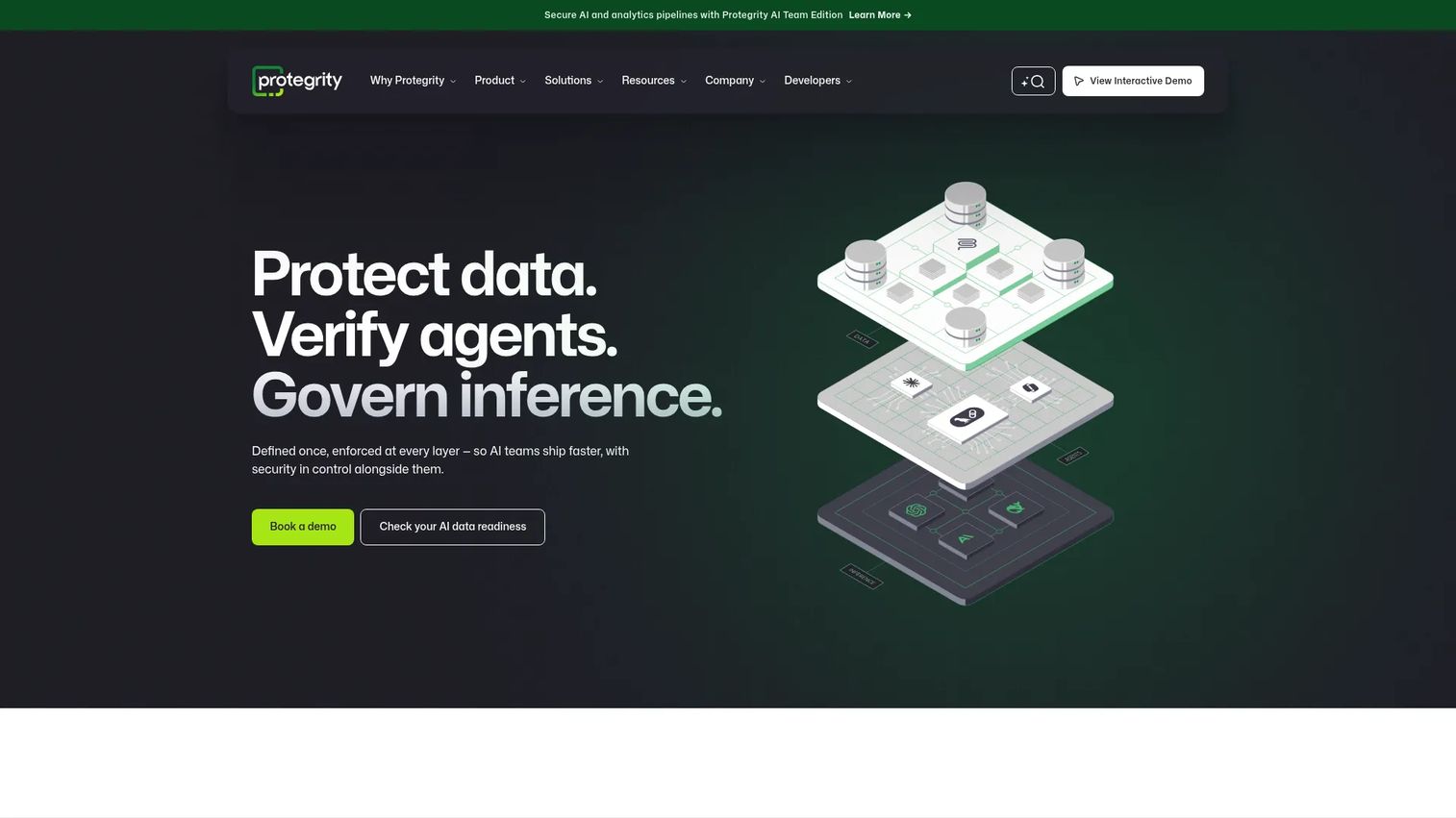
Protegrity Data Security Platform applies field-level protection across data warehouses, cloud platforms, SaaS applications, databases, mainframes, and files. Its centralized policy engine governs tokenization, encryption, masking, anonymization, and pseudonymization from one place, so the same sensitive field receives consistent treatment wherever it appears. The platform also supports synthetic data generation for AI workflows and includes centralized audit logging and monitoring.
Best for: Enterprises that need consistent, field-level privacy controls across a wide range of data platforms and access scenarios, including analytics, AI experimentation, and operational systems.
Key features
- Sensitive-data discovery and classification across structured and unstructured sources
- Centralized policy management with role-, region-, and data-type-based controls
- Field-level tokenization, encryption, masking, and pseudonymization
- Synthetic data generation for AI and analytics workflows
- Centralized auditing, monitoring, and policy enforcement
Why choose Protegrity Data Security Platform: Shared-data environments where product, analytics, and operations teams need different views of the same records benefit from Protegrity's single-policy model. Product teams should confirm how it connects to their test-data workflow, since Protegrity focuses on protection rather than test data provisioning specifically.
Protegrity Data Security Platform pricing: Protegrity offers Developer, Team, and Enterprise editions. Pricing is not shown on the website; contact Protegrity for a quote.
G2 rating: 4.5/5 based on 14 reviews (verified October 2026).
7. PK Protect
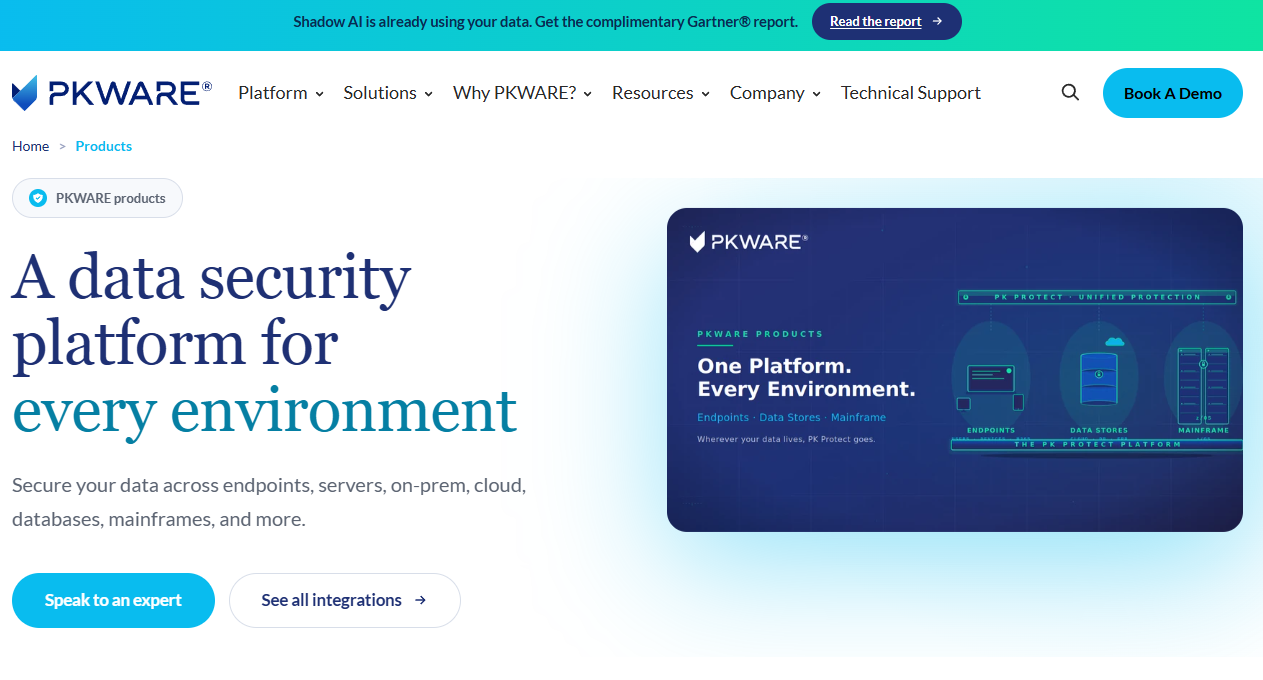
PK Protect is an enterprise data security platform from PKWARE that discovers, classifies, and protects sensitive data across endpoints, databases, cloud repositories, Microsoft 365, and IBM z/OS mainframes. Protection methods include persistent encryption, masking, and redaction. Centralized policy management means controls applied in one environment propagate to others, which reduces the risk of inconsistent handling across distributed data stores.
Best for: Organizations with sensitive data spread across endpoints, databases, cloud storage, and mainframe environments that need centralized, consistent protection policies.
Key features
- Sensitive-data discovery and classification across environments
- Persistent encryption, masking, and redaction
- Cross-platform coverage: Endpoints, databases, cloud, Microsoft 365, and z/OS
- Centralized policy management for consistent handling
- Enterprise deployment across on-premises and cloud infrastructure
Why choose PK Protect: Product organizations with data spread across multiple applications, warehouses, and operational systems benefit from a platform that applies consistent controls without requiring separate configurations per environment. Validate connector coverage and operational ownership before committing to ensure the platform addresses your specific data sources.
PK Protect pricing: Contact PKWARE for pricing. No public pricing structure was available on the PK Protect pages at the time of verification.
8. EPI-USE Labs Data Redact
EPI-USE Labs Data Redact is a component of EPI-USE Labs' Data Privacy Suite for SAP. It redacts sensitive or personally identifiable fields in SAP records while preserving referential integrity, so the underlying business records and reporting structures remain intact after redaction. The workflow accepts redaction submissions from other Data Privacy Suite components, with review steps, role separation, and audit logging built into the process.
Best for: Organizations running SAP that need to redact employee, payroll, HR, or personally identifiable records from production systems to support GDPR, CCPA, or similar privacy programs.
Key features
- Sensitive-field redaction in SAP records without breaking referential integrity
- Role separation and review workflow for redaction submissions
- Audit logging for redaction actions
- Integration with Data Disclose and Data Retain within the Data Privacy Suite
- Support for business record retention with identifying data removed
Why choose EPI-USE Labs Data Redact: When the workflows your team needs to test involve SAP-based permissions, payroll, approvals, or employee lifecycle events, generic masking tools may not understand the underlying data model. EPI-USE Labs is built specifically for SAP's structure, which reduces implementation risk in SAP environments. It is purpose-built for SAP and is not designed as a general-purpose masking platform.
EPI-USE Labs Data Redact pricing: Contact EPI-USE Labs for pricing and evaluation options. No pricing figures are available without a direct sales conversation.
9. Salesforce Data Mask & Seed
Salesforce Data Mask & Seed is a Salesforce-native application for masking sensitive data and seeding realistic or mock records into sandbox environments. It includes proactive PII detection and masking recommendations, custom anonymization patterns, field-level transformations, data classification-based masking, and scheduled job support. The seed capability lets teams generate production-like records for testing lead routing, account workflows, automations, and integrations without exposing real prospect or customer data.
Best for: Product managers, admins, developers, and RevOps teams working inside Salesforce sandbox workflows who need protected, production-like data for development, testing, and training cycles.
Key features
- Sandbox masking with field-level transformations and custom anonymization patterns
- Seed data creation using reusable templates
- Proactive PII detection and masking recommendations
- Data classification-based masking with scheduling support
- Preview records and monitor sandbox data size
Why choose Salesforce Data Mask & Seed: For teams whose primary sensitive-data exposure is in Salesforce, this is the most direct path to protected sandbox data. It is Salesforce-native, which reduces implementation complexity. It is not designed to govern data across external databases or applications beyond Salesforce.
Salesforce Data Mask & Seed pricing: Salesforce lists Data Mask & Seed at 10% of net spend. Contact Salesforce to confirm current packaging and whether your edition includes or requires this add-on.
G2 rating: 4.5/5 in the G2 Data Masking category for Salesforce Platform (verified October 2026).
10. Immuta Data Security Platform
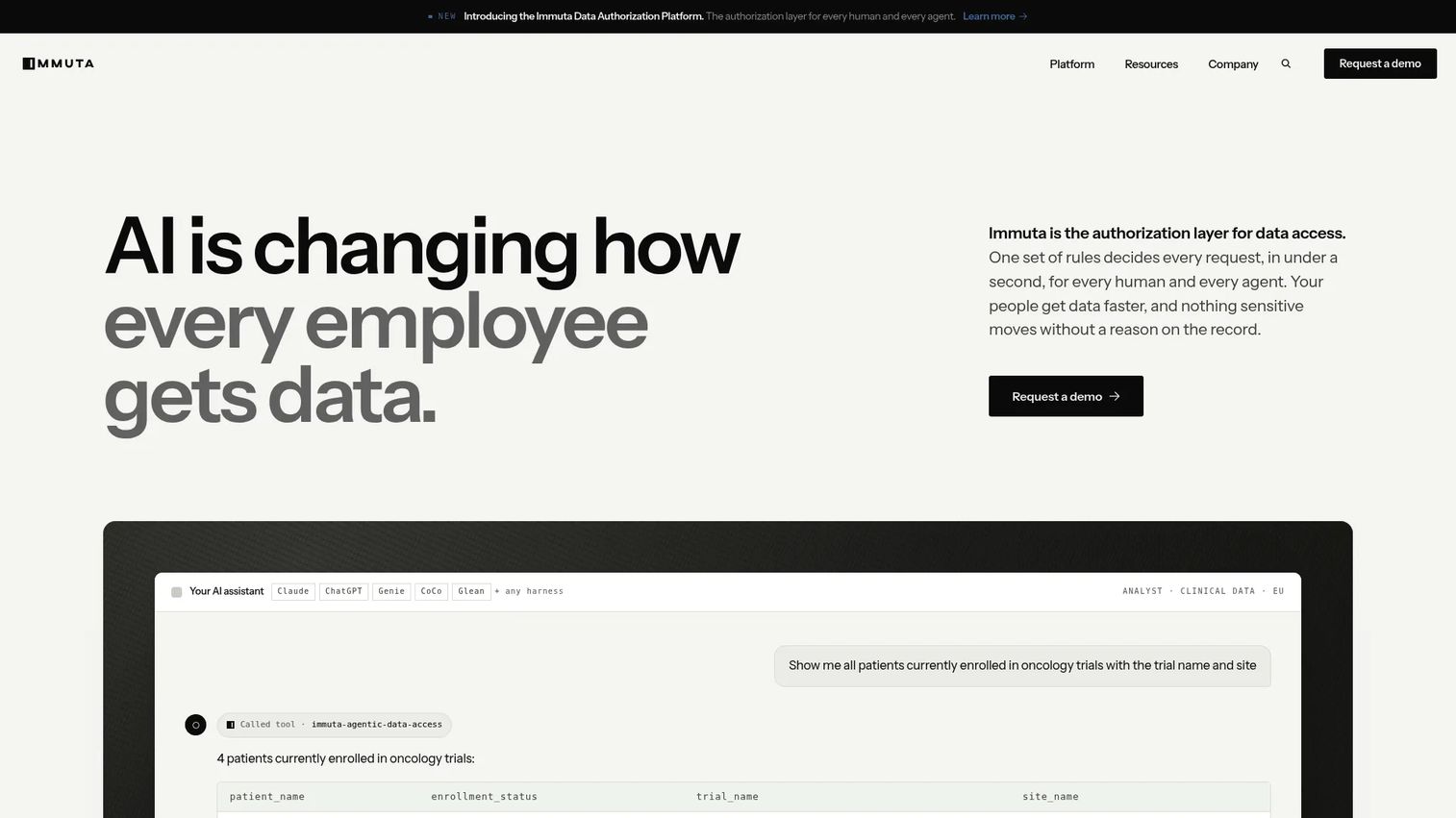
Immuta Data Security Platform governs data access across data warehouses, lakehouses, databases, cloud storage, APIs, and SaaS systems through policy-based controls. It applies attribute-based access control with row-level restriction and column-level masking, enforced at query time without moving data. Continuous monitoring, audit trails, risk detection, and compliance reporting give data platform and security teams visibility into who accessed what and when.
Best for: Data-heavy organizations that need policy-driven access governance and dynamic column-level masking across cloud analytics platforms, with different user roles seeing different views of the same datasets.
Key features
- Sensitive-data discovery and classification
- Policy-based access control with row-level restriction and column-level masking
- Attribute-based access controls for fine-grained governance
- Continuous monitoring, audit trails, and risk detection
- Integrations with cloud data platforms including Snowflake, Databricks, and BigQuery
Why choose Immuta Data Security Platform: Product analytics, experimentation, and AI teams that need access to useful data without full visibility into sensitive attributes benefit from Immuta's dynamic approach. Teams seeking persistent masked copies for QA environments should compare Immuta's workflow against dedicated test-data platforms, since Immuta focuses on access governance rather than lower-environment provisioning.
Immuta Data Security Platform pricing: Contact Immuta for pricing. No public pricing is listed on the Immuta website.
G2 rating: 4.3/5 (verified October 2026).
Considerations when choosing data masking software
Start with the data flow, not the feature list
Map where production data moves before evaluating tools. Include QA databases, staging environments, analytics workbenches, training tenants, support tools, SaaS sandboxes, and AI experimentation pipelines. The right tool depends on which of those paths carries the highest exposure risk and the most engineering cost to manage. Related cloud data security software can address the network layer, but masking protects the data itself.
Decide whether you need static or dynamic masking
Static masking fits persistent lower-environment copies where teams need a dataset they can work with repeatedly. Dynamic masking fits controlled access to shared or live data where different roles should see different values. Some organizations need both. Getting this wrong creates either unnecessary complexity or gaps in protection.
Test referential integrity with a real product workflow
Ask vendors to demonstrate how masked data handles a workflow your product actually runs, such as a user account linked to orders, permissions, billing records, and support history. Generic demo datasets hide integrity gaps. Your audit management software may flag inconsistencies post-deployment that a proper referential integrity test would have caught earlier.
Check data discovery and policy ownership
Identify who defines which fields are sensitive, who approves masking rules, and who validates changes when the product schema changes after a release. Without clear ownership, masking policies drift. Good access review software practices apply here too: Someone should periodically verify that the masking configuration still reflects current data structures.
Measure maintenance against release cadence
For product managers, this is the question that matters most. Ask how often masking rules need updates after a schema change, whether environment refreshes can be automated, and what breaks when a new table or field is added to the product. A masking workflow that requires manual engineering work after every release adds maintenance debt that compounds across every sprint.
Conclusion
The right data masking software depends on where your sensitive data lives and how your team provisions lower environments.
Delphix serves enterprise test data programs where environment refresh speed directly affects release cadence. K2view fits organizations where customer or account entities span multiple systems and end-to-end test fidelity requires coordinated masking across all of them. Informatica Cloud Data Masking makes sense for teams already standardizing data governance on the Informatica platform. Oracle Data Masking and Subsetting is the natural fit for Oracle-first environments. Salesforce Data Mask & Seed handles Salesforce sandbox protection without adding external infrastructure. Immuta governs dynamic access across cloud analytics workflows for teams that need different roles to see different data without moving it.
Before booking vendor calls, document one high-risk workflow. Include the source systems, the sensitive fields involved, the lower environment where the data lands, and the specific test scenario that fails or gets skipped today. Use that workflow as your evaluation script. It will expose gaps in referential integrity, source coverage, and maintenance overhead that a product demo will not surface on its own.
Start your journey with Guideflow today!
FAQs about data masking software
Data masking software transforms or hides sensitive values in a dataset while keeping the data usable for approved purposes such as testing, development, analytics, or training. Techniques vary by tool and use case, ranging from substitution and shuffling to tokenization and synthetic data generation. The goal is always the same: Protect the original record while preserving enough realism for the intended workflow.
Static masking creates a transformed copy of the data, written to a persistent location such as a QA database or analytics environment. Dynamic masking intercepts queries at runtime and changes what a specific user sees based on their role or access policy, without copying or moving any data. Organizations often use static masking for lower-environment provisioning and dynamic masking for controlled access to shared production systems.
Yes. Many enterprise tools are designed to maintain relationships across connected records during the masking process. A customer ID, linked orders, payment records, and support tickets can all receive coordinated masking so the relationships still resolve correctly. Buyers should validate this with a workflow that includes parent-child records and cross-system identifiers before committing to a platform.
No. Encryption protects data that can be decrypted with the right key, keeping the original value intact and recoverable. Tokenization replaces sensitive values with non-sensitive tokens that map back through a secure vault. Masking changes or obscures values in ways that may not be reversible, depending on the technique used. Some platforms combine two or more of these approaches for different field types or workflows.
Yes, and this is one of the most common use cases for data masking tools. The value comes from preserving realistic field formats, value distributions, and referential relationships without copying real identifiers into a lower environment. Product teams running multi-step test scenarios on billing, permissions, or onboarding flows particularly benefit from data that behaves like production.
Focus on data fidelity (does masked data produce realistic test scenarios), source-system coverage (which databases and applications the tool connects to), referential integrity support, automation of environment refreshes, policy ownership workflows, and how much engineering work a schema change requires. The engineering opportunity cost of maintaining a masking program that requires manual intervention after every release is often underestimated during procurement.
It can, but the approach matters. Persistent masked copies let data science teams work with representative datasets without accessing production records. Dynamic masking lets analysts see useful data while hiding specific sensitive columns. The question to resolve before selecting a tool is which fields must remain statistically accurate for the intended analysis, since over-masking can reduce the dataset's analytical value.
No. Masking can support a privacy or security program, but compliance depends on the organization's full set of policies, access controls, retention practices, audit processes, contractual obligations, and applicable laws. A masking tool does not make an organization compliant with any specific regulation. Teams should treat masking as one control within a broader program, and route legal and regulatory questions to qualified counsel and their security team.