


Your buyer wants a quote. Your rep sends the wrong package. Two weeks later, procurement flags a pricing error and the deal stalls in legal review.
That loop is the tax on complex deals. Reps spend more time turning product complexity into a clean recommendation than they spend selling. Every extra round of quote revision adds days to a cycle that was already too long.
The global guided selling platform market was $3.2B in 2025, projected to reach $7.8B by 2034 at a 12.4% CAGR, according to MarketIntelo (2026). That growth is not hype. It reflects a real problem: buying committees are bigger, catalogs are deeper, and reps need decision support to recommend the right thing faster.
Guided selling software attacks that friction directly. It scores inputs, applies recommendation logic, and hands the rep (or the buyer) a next-best action instead of a blank quote screen. For an AE working mid-market or enterprise deals, that means fewer quote errors, shorter back-and-forth, and cleaner handoffs into quote-to-cash. If you show product value visually, pairing guidance with an interactive product experience also removes the friction of explaining what a buyer could simply see.
What's inside
This guide is for AEs, RevOps leads, and sales enablement teams evaluating guided selling tools for 2026. We focused on tools that map to real deal execution, not abstract AI promises.
We selected each guided selling platform based on:
- CRM and CPQ fit: how cleanly it connects to your system of record and quote workflow
- Recommendation quality: how the tool scores inputs and generates next-best actions
- Ease of adoption: whether reps actually use it inside their existing workflow
- Pricing transparency: what you can verify before a sales call
Every price and G2 rating below was checked against a live source. Where a vendor gates pricing, we say so.
TL;DR
- Best overall for CRM-centric teams: HubSpot Sales Hub, with AI guided selling and next-best actions inside the CRM.
- Best for Salesforce-heavy quoting: Salesforce CPQ, for native product selection and quote generation.
- Best for enterprise configuration complexity: SAP CPQ, for structured product and pricing workflows.
- Best for quote-to-cash motions: DealHub CPQ, for CRM-connected CPQ plus subscription and billing.
- Best for lean or Zoho-native stacks: Zoho CRM, for affordable guided flows without heavy admin.
- Best for eCommerce product selection: Outfindo, for guided buying and product data enrichment.
- Best for complex catalog recommendation: Excentos, for product finders and configurator-style flows.
What is guided selling software?
Guided selling software is a system that helps a seller or a buyer reach the right product, package, quote, or next step by gathering inputs, scoring them, and generating a recommendation. It sits between raw product complexity and a clean decision.
There are two sides to the category, and most AEs need to understand both. Rep-facing guided selling gives sellers next-best-action prompts, deal guidance, and quote assistance inside the CRM or CPQ. Buyer-facing guided selling, common in eCommerce and B2B self-serve, walks a prospect through questions and returns a tailored recommendation.
Under the hood, most tools follow the same loop:
- Data gathering: collect inputs from the rep, the buyer, or the CRM record
- Scoring: apply recommendation logic, rules, or AI to rank options
- Recommendation generation: surface the right product, package, or configuration
- Next-best action: tell the rep or buyer what to do next
Core features to expect across a guided selling solution:
- Recommendation and product configuration logic
- CPQ or quoting integration for accurate pricing
- CRM integration for context and follow-up
- Sales playbook automation and workflow rules
- AI guided selling for scoring and personalization
- Analytics on recommendation quality and conversion
The CPQ guided selling variant focuses on configuration accuracy and quote speed. The eCommerce variant focuses on buyer guidance and conversion. Both reduce the same core friction: choosing correctly under complexity.
When to use guided selling software
Reduce quote errors in complex deals
When a rep has to assemble a multi-product quote with dependencies, manual quoting invites mistakes. A guided selling system applies configuration rules so incompatible options never make it into the quote. For enterprise AEs, that means fewer redlines from procurement and fewer cycles lost to correcting a bad quote.
Help reps recommend the right package faster
New reps rarely know which package fits which buyer. Guided selling encodes that logic so the recommendation is consistent across the team, not dependent on tribal knowledge. This shortens ramp time and keeps discounting disciplined, which protects average deal size.
Support self-serve product selection in eCommerce
Buyers increasingly want to choose without a call. A buyer-facing guided selling tool asks the right questions and returns a tailored product, lifting conversion on the site. This is guided selling in eCommerce, and it doubles as an intent signal your team can act on.
Comparison table
The table below ranks seven guided selling tools by relevance to AE and revenue workflows. Pricing reflects publicly listed or third-party verified figures at the time of writing. Where a vendor gates pricing behind a sales conversation, the table says so. Treat G2 ratings as a directional signal, not a final verdict.
| # | Product | Best for | Key differentiator | Pricing | G2 rating |
|---|---|---|---|---|---|
| 1 | HubSpot Sales Hub | CRM-native teams | AI guided selling inside the CRM | Free; paid from $10/seat/mo | 4.4/5 |
| 2 | Salesforce CPQ | Salesforce-heavy orgs | Native guided quote and product selection | From $75/user/mo (third-party) | 4.2/5 |
| 3 | SAP CPQ | Enterprise configuration | Structured configure-price-quote workflow | From USD 98.00/mo | 4.1/5 |
| 4 | DealHub CPQ | Quote-to-revenue teams | CRM-connected CPQ plus billing | Request-based pricing | 4.7/5 |
| 5 | Zoho CRM | Lean or Zoho stacks | Affordable CRM with guided flows | Free up to 3 users; paid tiers | 4.1/5 |
| 6 | Outfindo | eCommerce selection | Guided buying and product data enrichment | From 99 €/month | 4.8/5 |
| 7 | Excentos | Complex catalogs | Product finders and configurator flows | Custom pricing | Not published |
Best guided selling software for 2026
1. HubSpot Sales Hub
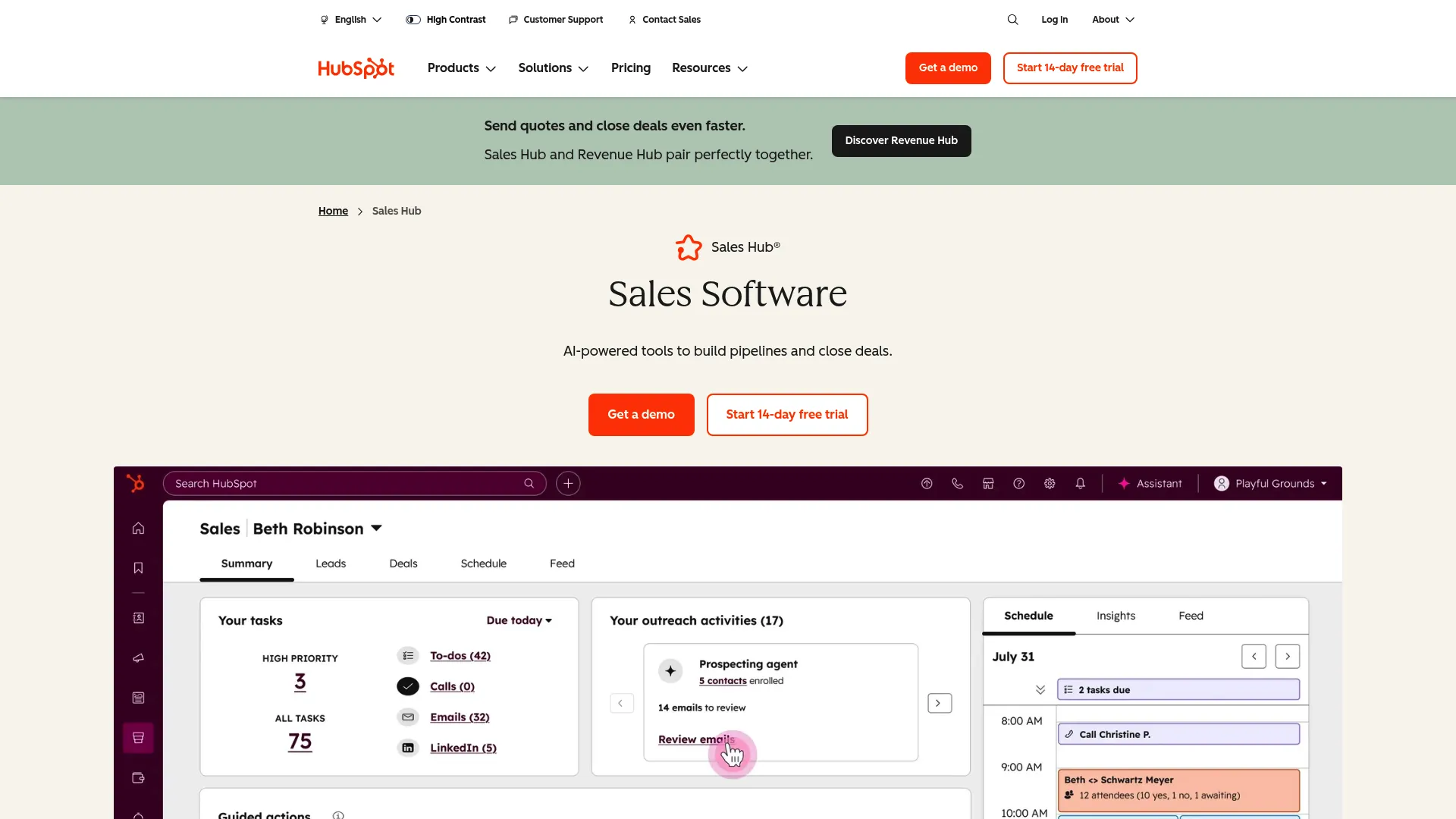
HubSpot Sales Hub is AI-powered sales software for pipeline building, guided selling, and closing deals inside HubSpot's CRM. For AEs already living in HubSpot, guided selling shows up as next-best actions, deal guidance, and prospecting prompts without a separate tool to learn. That CRM-native footprint is the main reason it leads this list for teams that value adoption over deep configuration.
The value is concentration. Instead of stitching guidance, automation, and forecasting across tabs, reps get sales playbook automation and recommendation prompts where they already work. Guided selling capabilities live in the Professional and Enterprise editions.
Best for: Teams that want an all-in-one sales hub with guided selling and CRM-native workflows.
Key strengths
- AI guided selling with next-best actions
- Deal pipelines and sales automation
- Conversation intelligence and forecasting
- Sales analytics and reporting
Why choose HubSpot Sales Hub: Choose it when CRM-native adoption matters more than heavy CPQ configuration. It fits SMB and mid-market AEs who want guidance and forecasting in one system. Teams needing deep multi-product configuration will lean toward a dedicated CPQ.
HubSpot Sales Hub pricing: Free tier available. Starter starts at $10 per seat per month, Professional at $100 per seat per month, and Enterprise at $150 per seat per month. Guided selling features sit in Professional and above.
2. Salesforce CPQ
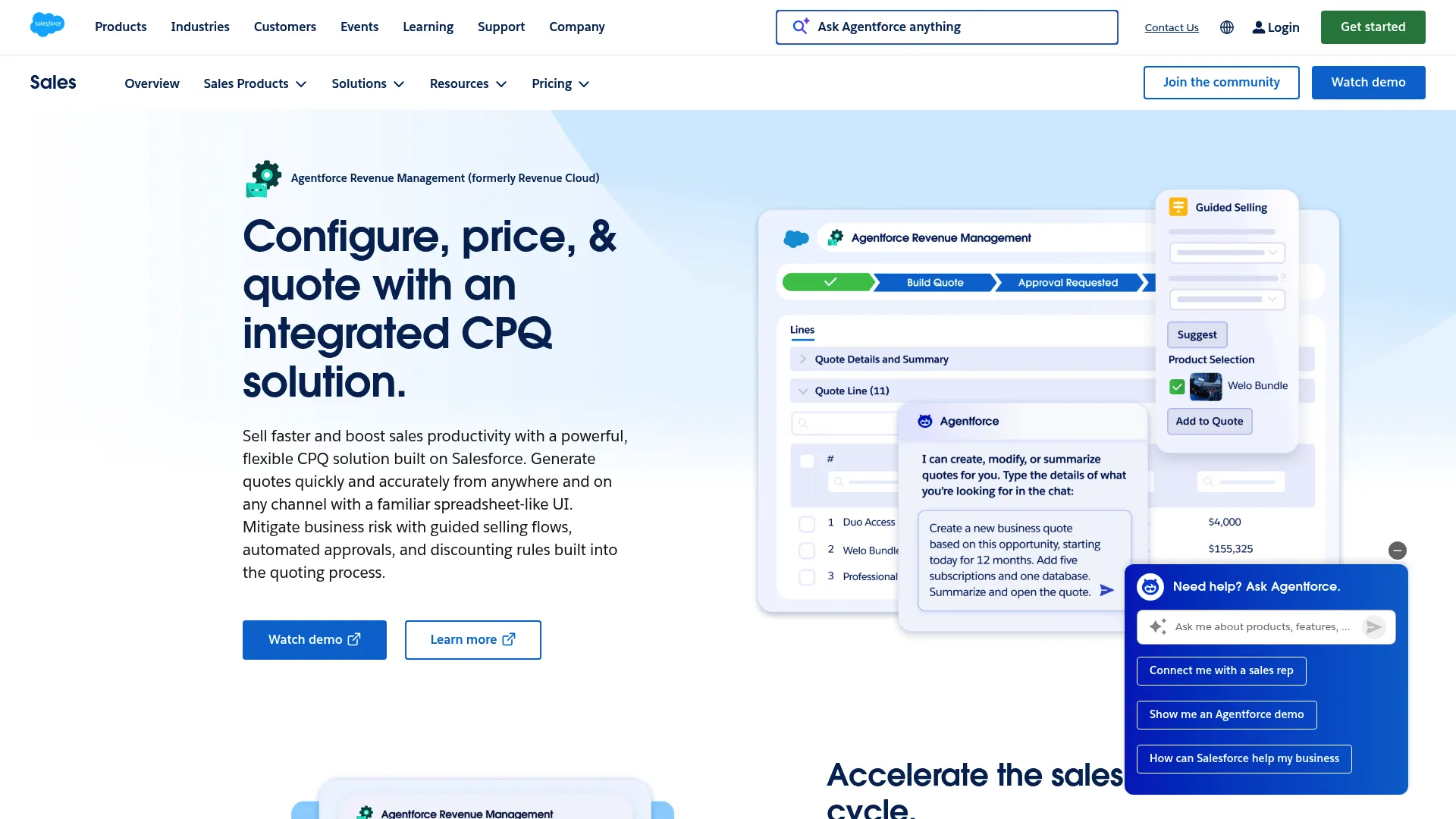
Salesforce CPQ is Salesforce's configure-price-quote solution for creating accurate quotes and managing product pricing workflows. Here, guided selling means a native flow that walks reps through product selection and quote creation using centralized product and pricing data. For a Salesforce-heavy org, the appeal is that guidance and quoting live inside the same record the AE already manages.
The strength is the add-products flow. Reps answer configuration questions, and the system surfaces the right bundle with pricing rules applied, reducing quote errors on complex deals. That tight CRM coupling is why Salesforce shops rarely look elsewhere for quoting.
Best for: Teams that need Salesforce-native quoting, pricing rules, and contract or renewal workflows.
Key strengths
- Guided quote generation
- Centralized product and pricing data
- Support for multiple pricing methods and discounting
- Native Salesforce CRM integration
Why choose Salesforce CPQ: Choose it when your system of record is already Salesforce and quote accuracy is the bottleneck. It fits mid-market and enterprise AEs managing multi-product deals. Teams outside the Salesforce ecosystem will find better fit elsewhere.
Salesforce CPQ pricing: Salesforce does not publish a standalone CPQ price on its product page. Third-party listings report CPQ at $75 per user per month and CPQ Plus at $150 per user per month, with billing tiers above that quoted on request. Verify current packaging with Salesforce directly.
3. SAP CPQ
SAP CPQ is configure-price-quote software for managing complex sales quoting and pricing. Guided selling here is a structured configuration workflow: reps move through product configuration, pricing and discount management, then quote generation and approvals. That rigor suits manufacturing-style catalogs where a wrong configuration is expensive.
The strength is handling deep product complexity with guided selling layouts and configurator support. For enterprise AEs, the tradeoff to weigh is implementation and admin fit, since structured configuration rewards teams with the resources to model their catalog well.
Best for: Enterprises that need to automate complex product configuration, pricing, and quote creation.
Key strengths
- Product configuration for complex catalogs
- Pricing and discount management
- Quote generation and approvals
- Guided selling configuration layouts
Why choose SAP CPQ: Choose it when product complexity is the primary friction and you run an enterprise or manufacturing motion. It fits AEs whose deals stall on configuration accuracy. Smaller teams without configuration modeling resources will find it heavier than needed.
SAP CPQ pricing: SAP publishes a standard edition at USD 98.00 monthly. The pricing page also references partner-only editions and add-ons, so confirm the full packaging for your deployment with SAP.
4. DealHub CPQ
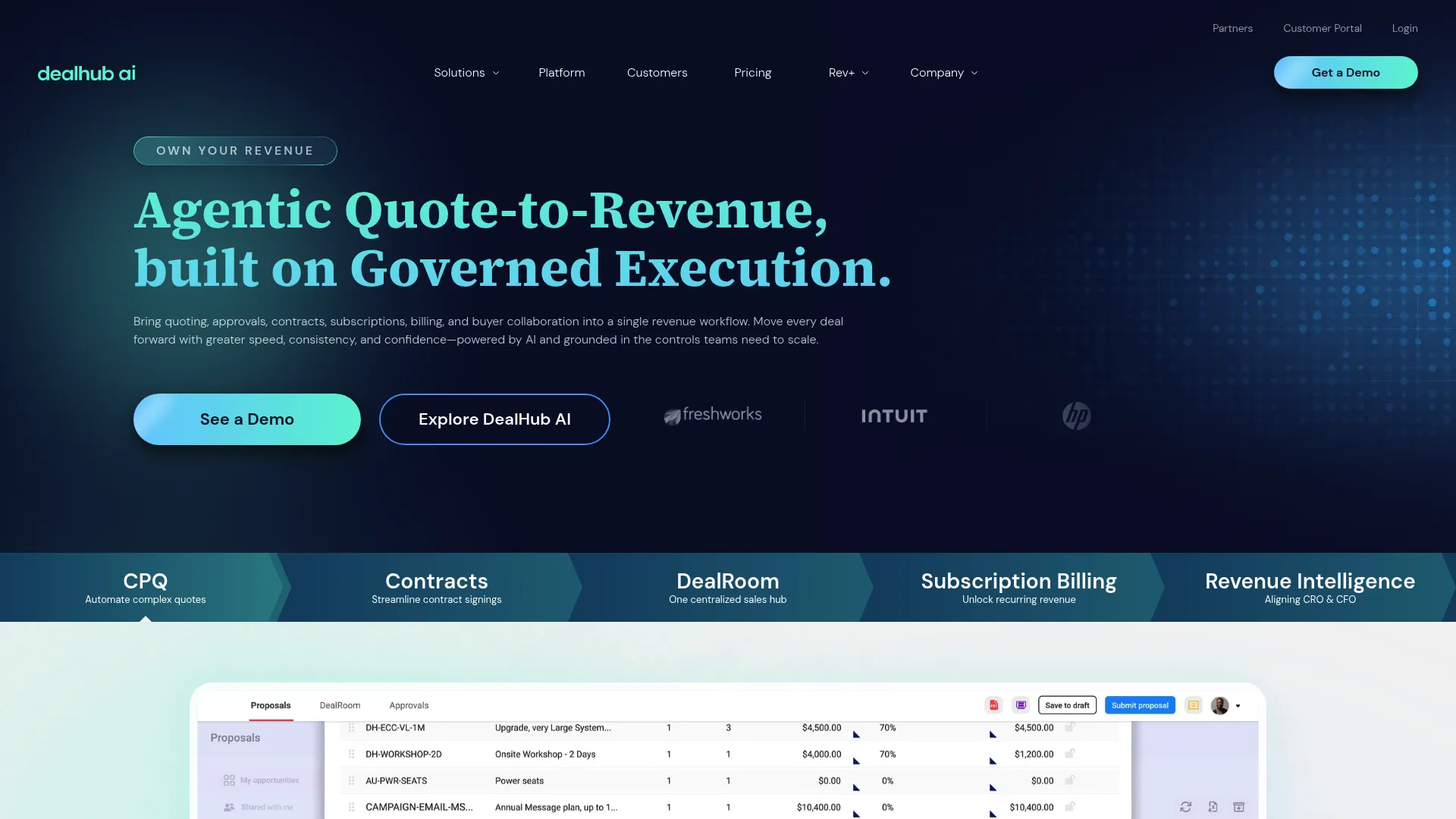
DealHub CPQ is an AI-powered quote-to-revenue platform with CPQ, contract management, subscriptions, billing, and revenue intelligence. Guided selling here is part of a broader quote-to-cash motion: AI CPQ walks reps through guided quote configuration with approval-aware pricing, then carries the deal into subscriptions and billing. For revenue teams that want CRM-connected CPQ without stitching tools together, that end-to-end coverage is the draw.
The strength is tighter deal execution. Because configuration, contracts, and billing sit in one workflow, AEs spend less time reconstructing where a deal stands. Its 4.7/5 G2 rating is the highest among the CPQ tools here.
Best for: Mid-market and enterprise revenue teams needing CPQ plus broader quote-to-revenue workflows.
Key strengths
- AI CPQ with guided quote configuration
- Approval-aware pricing
- Subscription lifecycle management
- Billing and revenue operations across quote-to-bill
Why choose DealHub CPQ: Choose it when you want guided quoting and downstream revenue workflow in one platform. It fits AEs running subscription and renewal-heavy motions. Teams that only need lightweight guidance may find it more than the moment requires.
DealHub CPQ pricing: DealHub does not list public pricing. Its pricing page uses a request-pricing and demo flow, so you will need to contact the vendor for a quote scoped to your team.
5. Zoho CRM
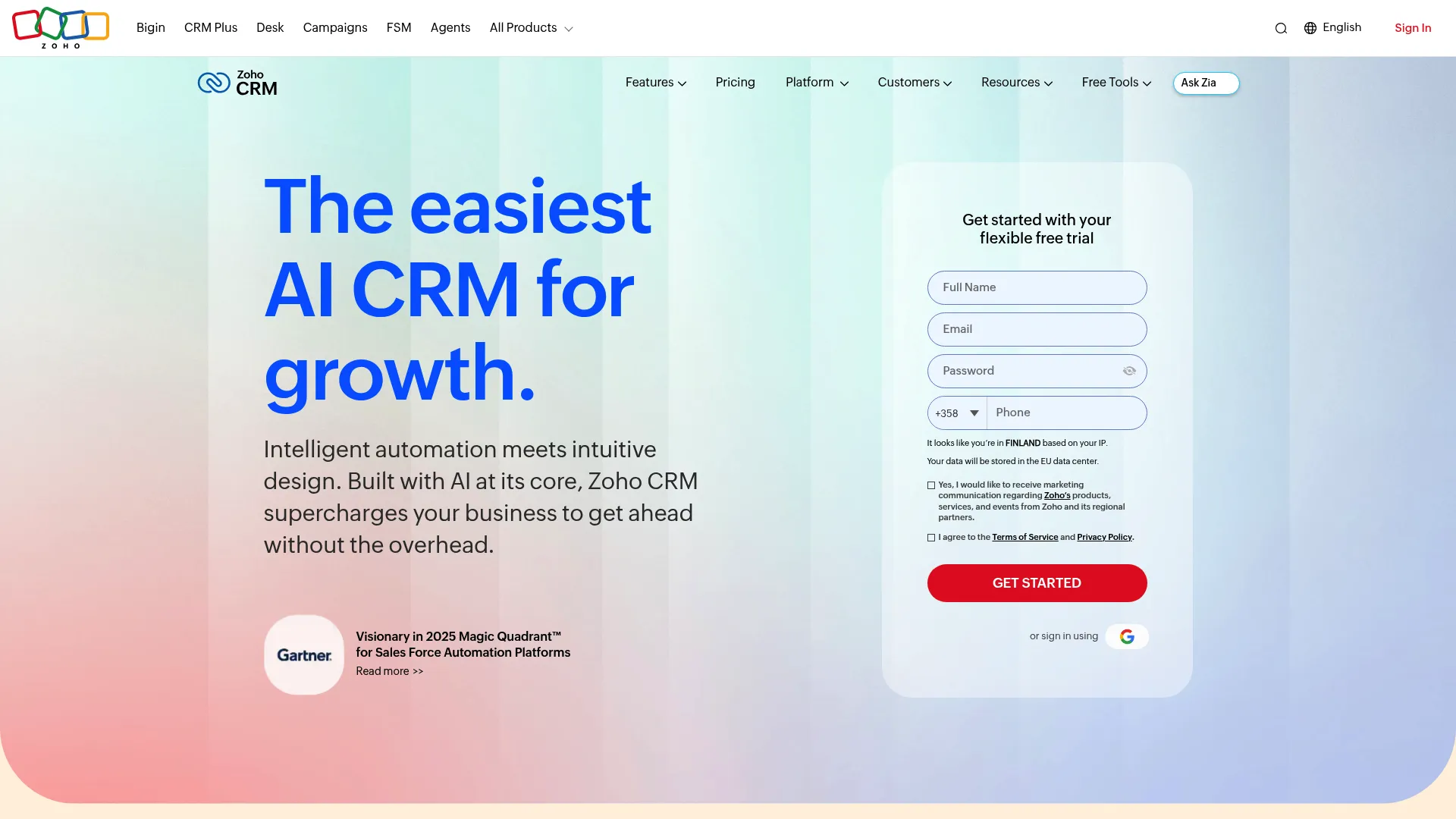
Zoho CRM is a cloud-based CRM for sales, marketing, and service teams. Guided selling shows up through practical workflow rules and CPQ-adjacent flows that give reps structure without heavy admin overhead. For smaller teams or Zoho-centric stacks, the appeal is getting guided flows and sales workflow automation at a price that fits a lean budget.
The strength is accessibility. Reps who need consistent next steps and structured deal handling get it without a large implementation. That makes Zoho a practical entry point into guided selling for SMB AEs.
Best for: Teams that want an affordable, customizable CRM with sales, service, and marketing workflows.
Key strengths
- Sales tools and pipeline workflows
- Service capabilities
- Marketing tools
- Customizable guided flows without heavy admin
Why choose Zoho CRM: Choose it when budget and simplicity matter and your stack already leans Zoho. It fits SMB AEs who need structure without a long rollout. Enterprise teams with deep configuration needs will want a dedicated CPQ alongside it.
Zoho CRM pricing: A free edition covers up to 3 users. Paid team-user pricing is listed as an add-on billed annually, and Zoho publishes additional paid editions. Confirm your local currency and edition on Zoho's pricing page.
6. Outfindo
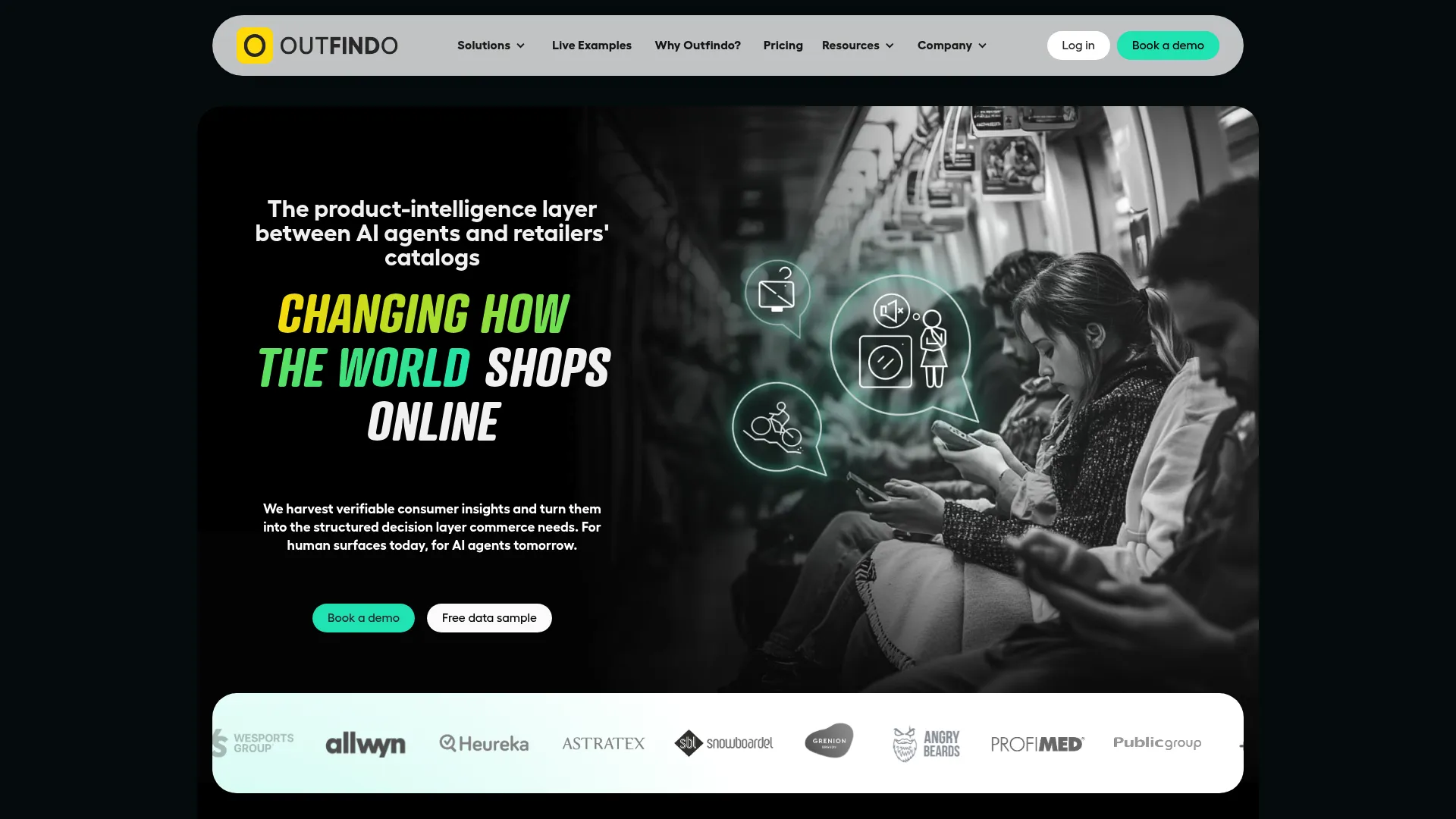
Outfindo is AI-powered guided selling and product data enrichment software for eCommerce. Instead of guiding a rep, it guides the buyer: a product selection guide asks the right questions and returns a tailored recommendation with real-time filtering and price updates. This is guided selling in eCommerce, built to turn browsing intent into a confident purchase.
The strength is bridging shopping intent and conversion. When a catalog is large and buyers are unsure, Outfindo narrows the field to a clear choice, which lifts conversion and reduces returns. Its 4.8/5 G2 rating is the highest on this list.
Best for: E-commerce teams that want guided selling and product data enrichment.
Key strengths
- Product selection guide for buyers
- Product content and data enrichment
- Real-time filtering and price updates
- AI-driven recommendation flows
Why choose Outfindo: Choose it when your friction is buyer product selection on a storefront, not rep quoting. It fits eCommerce and self-serve B2B teams. Sales-led orgs needing CPQ inside the CRM will look to the tools above.
Outfindo pricing: Plans start at 99 €/month for Essential, with Plus at 599 €/month and a Product Guide plan at 599 €/month. Product data enrichment is priced at 1 €/SKU, and a custom plan is quote-based. A free trial and a free data sample are available.
7. Excentos
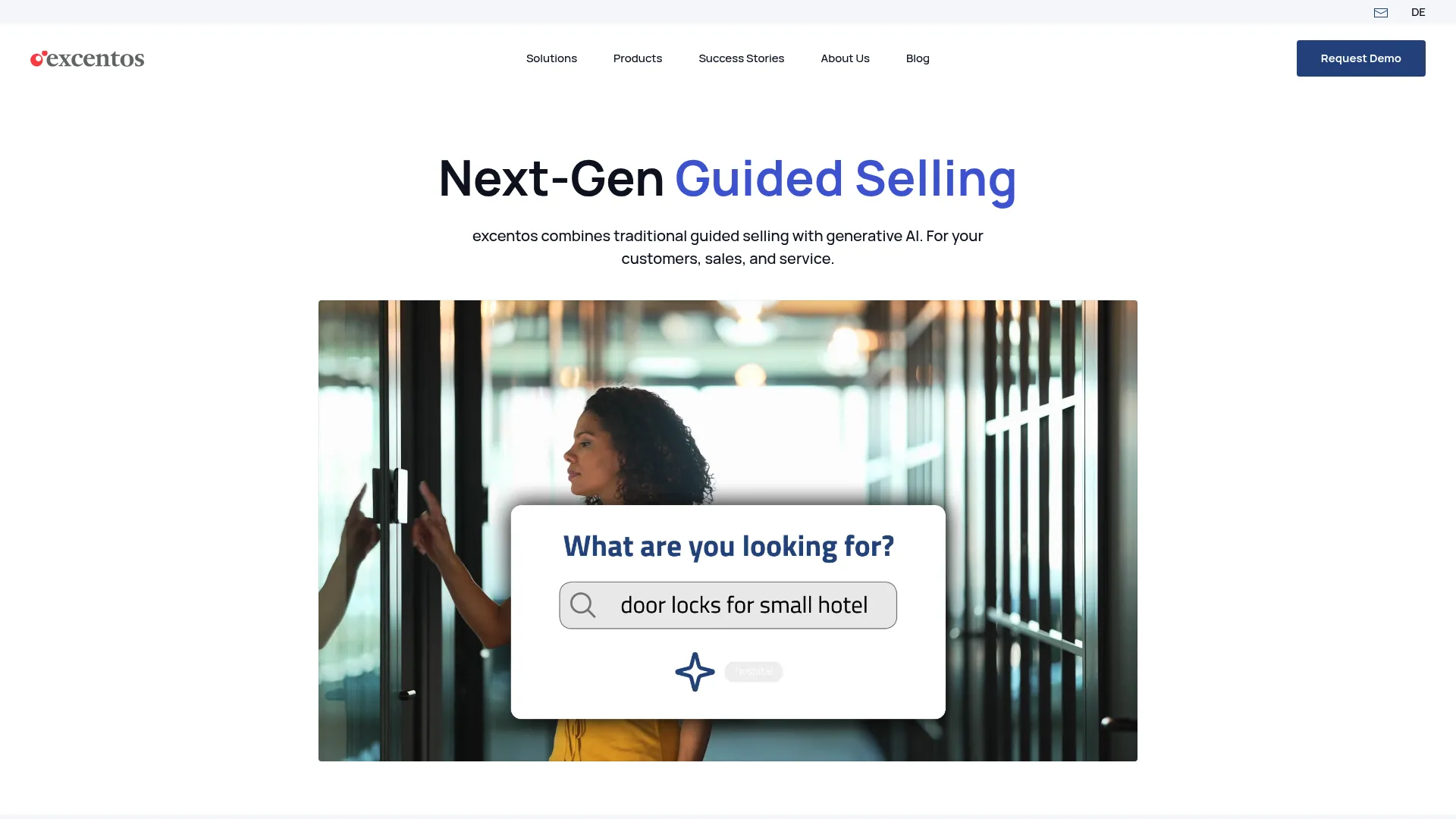
Excentos is guided selling software for product finders, configurators, and related digital advisory experiences. Its no-code Workbench lets teams build product guides, and product finder flows walk buyers to a recommendation using recommendation logic and AI features like intelligent reasoning. For teams where product selection across a complex catalog is the main friction, that configurator-style depth is the point.
The strength is configurable recommendation logic for complex catalogs. When buyers face too many variants to choose confidently, Excentos structures the decision into a guided path. It suits B2B teams that need advisory flows without engineering every step.
Best for: B2B teams needing a configurable guided-selling and product-finder solution.
Key strengths
- No-code Workbench for building product guides
- Product finder and guided recommendation flows
- AI features such as intelligent reasoning
- Data optimization for catalogs
Why choose Excentos: Choose it when complex product selection is the decisive friction and you want configurator-style flows without heavy build work. It fits B2B and eCommerce teams with deep catalogs. Sales-led CRM quoting needs are better served by the CPQ tools above.
Excentos pricing: Excentos lists three editions, Start, Professional, and Enterprise, plus a personalized quote option. Public numeric pricing is not shown, so request a quote scoped to your catalog and volume.
Considerations
Before you commit to any guided selling platform, run this checklist against your actual deal motion.
CRM and CPQ integration depth
Guidance is only as good as the data behind it. Verify that the tool reads and writes to your CRM cleanly and, if you quote complex products, that its CPQ integration handles your pricing rules. Ask for a live test against your own product catalog, not a canned demo.
Recommendation quality and governance
A recommendation engine is only useful if reps trust it. Check how the logic is built, who owns the rules, and how easily you can update them as packaging changes. Weak governance means the recommendations drift out of date and reps stop using them.
Ease of adoption for reps
If the tool adds tabs or steps, reps route around it. Confirm the guidance appears inside the workflow they already use, whether that is the CRM record or the quote screen. Adoption, not features, decides whether the tool moves your win rate.
Data quality and maintenance burden
Bad inputs produce bad recommendations. Ask who maintains product data, pricing, and rules, and how often. A tool that needs constant manual upkeep becomes shelfware once the person who set it up moves on.
Reporting and revenue impact
You bought this to change a number: cycle length, quote accuracy, or win rate. Confirm the analytics tie recommendation activity to those outcomes. If you cannot measure impact, you cannot defend the spend at renewal.
Conclusion
The right guided selling tool depends less on the leaderboard and more on your motion. If your team lives in the CRM and adoption is the priority, HubSpot Sales Hub keeps guidance and forecasting in one place. If your bottleneck is quote accuracy in a Salesforce or enterprise environment, Salesforce CPQ and SAP CPQ bring structured configuration to complex deals. For teams that want quoting and downstream revenue workflow together, DealHub CPQ covers quote-to-cash in one platform.
Lean or Zoho-centric teams get practical guided flows from Zoho CRM without heavy admin. And if your friction is buyer product selection rather than rep quoting, Outfindo and Excentos bring guided selling in eCommerce and complex-catalog recommendation logic to the storefront.
Start with the friction that costs you the most: quote errors, slow recommendations, or buyer indecision. Shortlist two tools that attack it, then test both against your real catalog before you sign. If part of your challenge is showing product value before a buyer commits, pairing guidance with an interactive experience is worth building into the same evaluation.
Start your journey with Guideflow today!
Start your journey with Guideflow today!
FAQs
Guided selling software helps a seller or buyer reach the right product, package, or quote by gathering inputs, scoring them, and returning a recommendation with a next-best action. It reduces the friction of choosing correctly under product complexity. In sales, it usually connects to the CRM and CPQ so guidance flows into the actual quote.
Sales automation moves tasks forward: it sends the sequence, updates the record, and triggers the follow-up. Guided selling decides what the right move or recommendation is in the first place. Automation handles execution; guidance handles the decision. Most modern tools combine both, but they solve different problems.
No. CPQ guided selling is one major use case, focused on configuration and quote accuracy in complex deals. But guided selling also covers rep next-best actions inside a CRM and buyer-facing product selection in eCommerce. The common thread is recommendation logic, not the quoting step specifically.
AI guided selling improves the scoring layer. Instead of static rules, it weighs signals like buyer behavior, deal context, and past outcomes to rank recommendations. That makes next-best actions more relevant and lets the system adapt as data grows. It also powers personalization in buyer-facing flows, tailoring recommendations to each shopper.
Yes. Guided selling in eCommerce uses a product finder or selection guide to ask a buyer questions and return a tailored recommendation. It lifts conversion on large or confusing catalogs and reduces returns by matching buyers to the right product. Tools like Outfindo and Excentos are built specifically for this buyer-facing motion.
Prioritize CRM and CPQ integration depth, recommendation quality, and adoption inside the existing workflow. The tool should reduce quote errors, shorten recommendation time, and tie its activity to a metric you own, like cycle length or win rate. If reps have to leave their workflow to use it, adoption suffers.
Guided selling reads context from the CRM, applies recommendation and configuration logic, then feeds an accurate quote into the CPQ. From there, quote-to-cash carries the deal through contracts, subscriptions, and billing. Platforms like DealHub CPQ connect these stages so the AE does not reconstruct deal state across tools.
The common ones are data quality, rule governance, and adoption. Bad product or pricing data produces bad recommendations, so someone must own and maintain it. Rules also drift as packaging changes, which means clear ownership matters. Finally, if the guidance does not appear where reps already work, they route around it.