Engineering can ship a convincing prototype quickly. The framework decision only becomes expensive six months later, when the roadmap adds authentication, audit trails, role permissions, background jobs, or a public API for a mobile client.
Python is now used by 57.9% of Stack Overflow survey respondents, up seven percentage points from the prior year (Stack Overflow Developer Survey, 2025). Web development accounts for 23% of Python's primary use cases (Python Developers Survey, 2024). That gives product and engineering teams a wide ecosystem to navigate, and most framework lists make it harder by cataloging everything instead of helping you choose.
Choose the framework that makes your next 12 months of product work cheaper, not the one that makes the first endpoint shortest.
This guide focuses on that decision: Which framework fits your product boundary, your release cadence, and your team's maintenance capacity.
What's inside
This guide is for product managers and engineering leads choosing a Python web framework for an active product. Items were selected based on four criteria:
- Active maintenance: Current releases and documented support timelines
- Category fit: Clear use case, whether full stack, API first, async, or dashboard
- Ecosystem maturity: Documented extensions, hiring familiarity, and integration depth
- Operational clarity: Instrumentation, security, and long-term ownership characteristics
TL;DR
- Best for mature SaaS applications: Django, because its built-in admin, ORM, and auth patterns reduce custom assembly work on recurring application needs
- Best for typed API products: FastAPI, because generated OpenAPI documentation and Pydantic validation give teams visible API contracts from day one
- Best for flexible small services: Flask, because the core stays small and teams select their own components
- Best for Python-only dashboards and internal tools: Dash for analytical interfaces, Reflex for full-stack interactive apps
- Best for explicit async workloads: Quart, Sanic, Starlette, aiohttp, or Litestar, depending on API scope and deployment architecture
What are Python web frameworks?
A Python web framework is a set of libraries and conventions that helps teams build, run, and maintain web applications, APIs, dashboards, or browser-based internal tools with Python.
What a framework typically provides
- URL routing and request handling: Maps incoming HTTP requests to application logic
- Templates or UI components: Renders HTML or reactive interfaces for browser clients
- Authentication and authorization patterns: Manages sessions, tokens, and access control
- Database integration or extension points: ORM, query builders, or connection management
- Input validation and serialization: Parses and validates request data before it reaches application code
- Testing tools and deployment compatibility: Ships utilities for unit and integration testing
- Documentation or API schema generation: Produces OpenAPI specs or admin interfaces depending on framework scope
The main framework categories
The 12 frameworks in this guide fall into four functional groups:
- Full stack frameworks: Django, Reflex, Pyramid
- Microframeworks: Flask
- API and async frameworks: FastAPI, Litestar, Quart, Falcon, Sanic, Starlette, aiohttp
- Dashboard frameworks: Dash
WSGI vs ASGI
| Execution model | What it means | Common examples | Best fit |
|---|---|---|---|
| WSGI | Synchronous Python web interface | Django, Flask, Pyramid | Server-rendered apps, standard services |
| ASGI | Async-capable interface for concurrent connections | FastAPI, Quart, Starlette, Sanic, Litestar | APIs, streaming, WebSockets, I/O-heavy services |
ASGI does not automatically mean a faster product. Performance depends on database access, serialization, caching, infrastructure, and code design.
When to use a Python web framework
Build a customer-facing SaaS application
When the roadmap already includes role-based access, structured data models, admin workflows, and multi-segment user flows, teams need a framework that handles these patterns without custom assembly. Django fits first. Pyramid works when architectural composability is a higher priority than convention.
Publish a typed API for web, mobile, or partner integrations
API documentation, typed validation, and observable contracts matter when external clients depend on your service. FastAPI's generated OpenAPI docs reduce the gap between backend and frontend teams. Litestar, Falcon, Starlette, and aiohttp suit teams that want more control over the abstraction level.
Ship a dashboard, prototype, or internal tool
Treat a data interface differently from a general product application. Reflex suits Python-centered teams building interactive UIs without a separate JavaScript workflow. Dash fits analytical dashboards and data exploration interfaces. A product company can standardize on a core application framework while using a specialized framework for internal analytics. Do not force one framework across every workload.
Python web frameworks comparison
Use this table as a screening device. Eliminate obvious mismatches before reading all 12 entries.
| # | Product | Best for | Key differentiator | Pricing | G2 rating |
|---|---|---|---|---|---|
| 1 | Django | Full-stack SaaS applications | Batteries-included architecture with admin and ORM | Free and open source | 4.5/5 |
| 2 | Flask | Flexible services and small web apps | Minimal WSGI core with a large extension ecosystem | Free and open source | 4.5/5 |
| 3 | FastAPI | Typed APIs and backend services | Automatic OpenAPI documentation and Pydantic validation | Free and open source | Not listed on G2 |
| 4 | Reflex | Python-driven full-stack web apps | Python-first UI with managed hosting options | Free tier; Pro from $25/month | Not listed on G2 |
| 5 | Pyramid | Configurable business applications | Small core that expands as application requirements grow | Free and open source | 4.4/5 |
| 6 | Litestar | Typed ASGI APIs and services | Modern typing with built-in dependency injection | Free and open source | Not listed on G2 |
| 7 | Quart | Async web apps with Flask-style patterns | ASGI and async-first approach familiar to Flask users | Free and open source | Not listed on G2 |
| 8 | Falcon | High-control API services | Lean API-focused architecture with WSGI and ASGI support | Free and open source | Not listed on G2 |
| 9 | Sanic | Async services and real-time endpoints | Async server-focused web framework with built-in server | Free and open source | Not listed on G2 |
| 10 | Starlette | Lightweight ASGI services | Minimal ASGI toolkit underlying many API stacks | Free and open source | Not listed on G2 |
| 11 | aiohttp | Async HTTP clients and servers | Client and server capabilities in one async library | Free and open source | Not listed on G2 |
| 12 | Dash | Analytical dashboards and data applications | Python-based analytical UI with Plotly integration | Free and open source; hosted plans from $29/month | 4.8/5 |
Framework status, pricing, and review listing availability verified in October 2026 from official project documentation and G2 where applicable.
Best Python web frameworks for 2026
1. Django
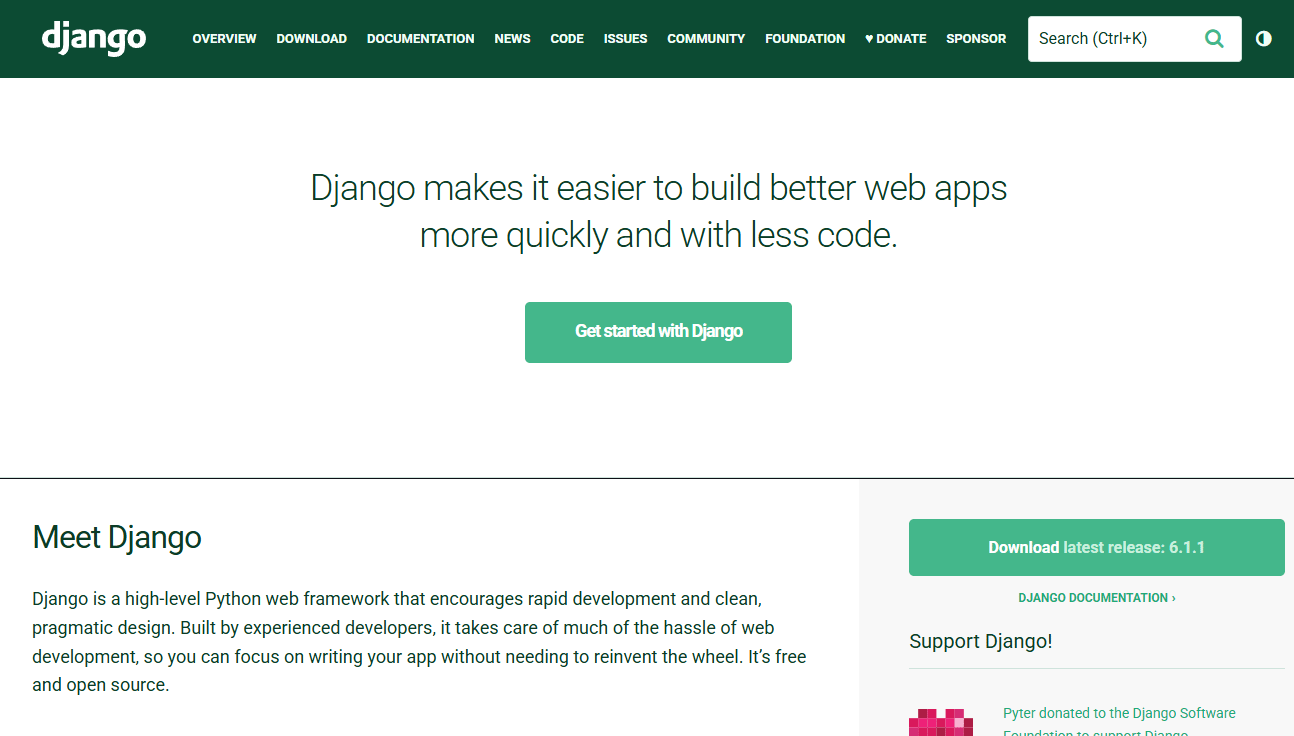
Django is a high-level, batteries-included Python web framework built for rapid development of secure, database-driven applications. Its built-in admin interface, ORM, authentication system, and template engine mean teams can build a working application with role-based access before writing custom infrastructure. According to the Python Developers Survey (2024), 35% of Python developers use Django, making it the most familiar hiring target among full-stack options.
Best for: Product teams building customer-facing SaaS with complex data models, role-based access, and internal operational needs.
Key features
- Built-in ORM and database migrations
- Automatic admin interface for data management
- Authentication, sessions, and permission system
- Template rendering and form handling
- Security defaults: SQL injection, XSS, CSRF, and clickjacking protection
Why choose Django: Django earns its place when the next four quarters of roadmap include structured data, admin workflows, or user management. The opportunity cost of building those primitives from scratch on a smaller framework is real.
Django pricing: Free and open source under the BSD license. Operational costs come from cloud infrastructure, observability tooling, and any third-party services the application integrates with.
G2 rating: 4.5/5 based on 174 reviews (G2, October 2026).
2. Flask
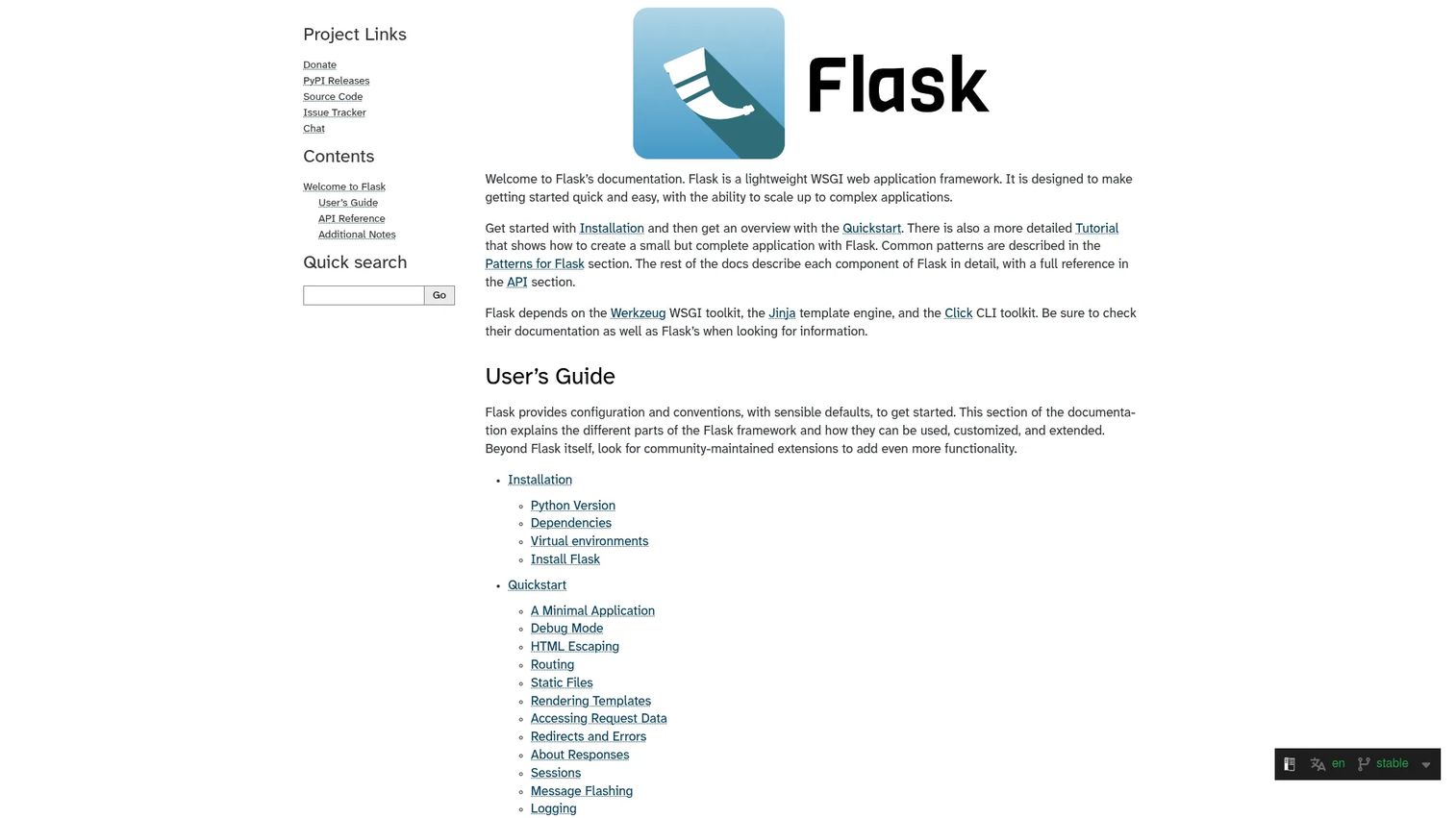
Flask is a lightweight WSGI microframework that provides a minimal core and leaves most architecture choices to the team. Its official documentation describes it as lightweight and extensible, built on Werkzeug for request handling and Jinja for templating. Flask was used by 34% of Python Developers Survey respondents in 2024, close behind Django, which reflects both its age and its hiring familiarity.
Best for: Teams building a focused service, prototype, or small web application where component selection is a deliberate engineering decision.
Key features
- Lightweight WSGI application core
- Jinja template rendering
- Werkzeug request utilities
- Click-based command-line interface
- Extension-based architecture for adding auth, databases, and more
Why choose Flask: Flask suits teams with well-defined engineering conventions. Flexibility is useful when the product boundary is narrow; it becomes a planning risk if the roadmap quickly adds complex permissions or multi-domain data models without an established pattern.
Flask pricing: Free and open source under the BSD 3-Clause license. Costs depend on the extensions, infrastructure, and maintenance effort required by the assembled stack.
G2 rating: 4.5/5 (G2, October 2026).
3. FastAPI
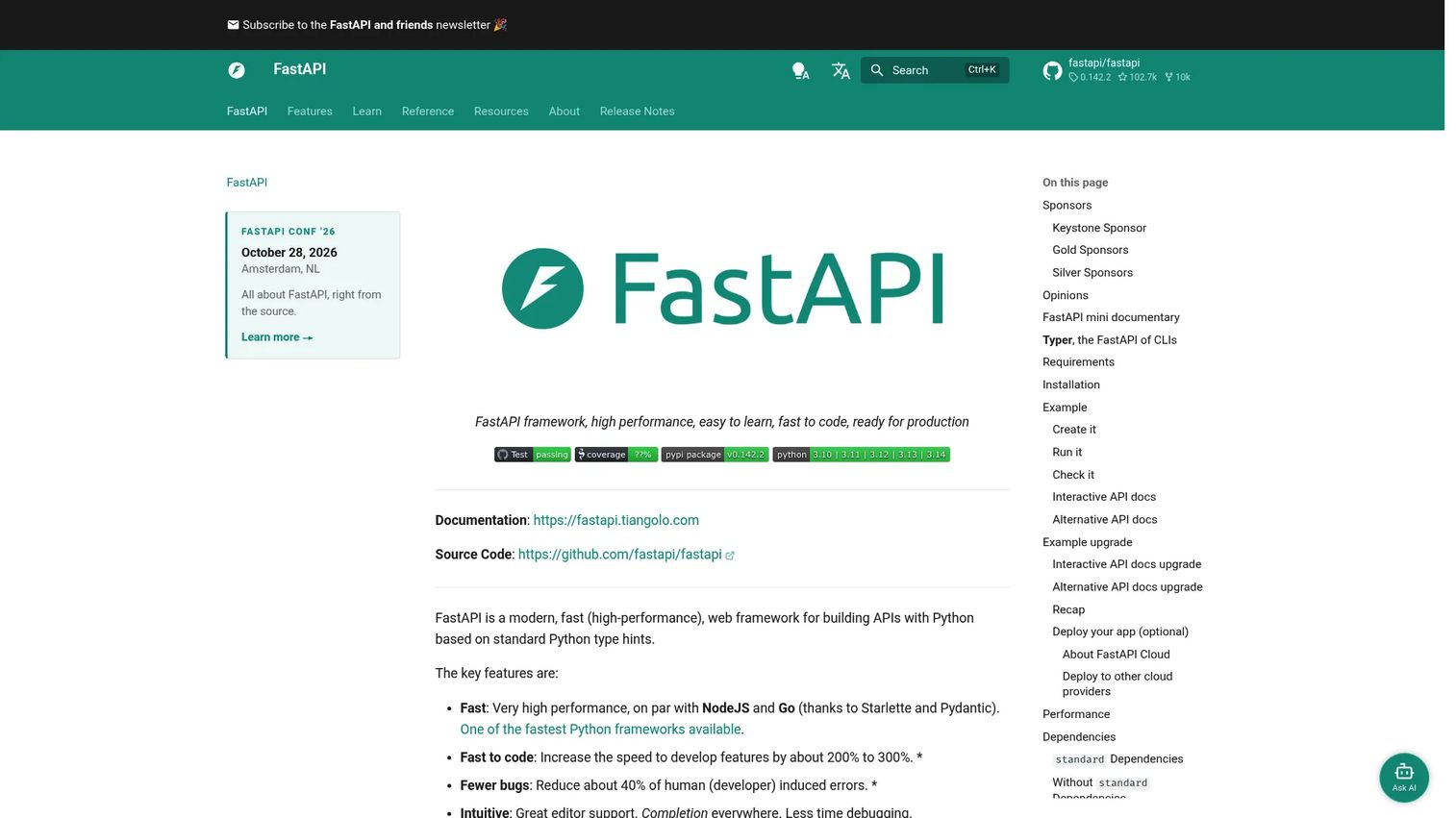
FastAPI is a modern Python API framework built on Starlette and Pydantic. It generates interactive API documentation through Swagger UI and ReDoc automatically, and validates request and response data using Python type hints. FastAPI was used by 38% of Python Developers Survey respondents in 2024, up from 29% in 2023, making it the fastest-growing framework in the list.
Best for: Product teams building APIs for web clients, mobile apps, partner integrations, or independent backend services.
Key features
- OpenAPI-based schema generation with Swagger UI and ReDoc
- Pydantic data validation and serialization
- Dependency injection system
- ASGI and WebSocket support
- OAuth2, JWT, and API key authentication patterns
Why choose FastAPI: Typed schemas and generated documentation create visible API contracts between backend and frontend teams. Require clear versioning and error-contract decisions before launch. Automatic documentation does not replace API governance.
FastAPI pricing: Free and open source under the MIT license. Budget for hosting, observability, and managed data services.
G2 rating: Not listed on G2.
4. Reflex
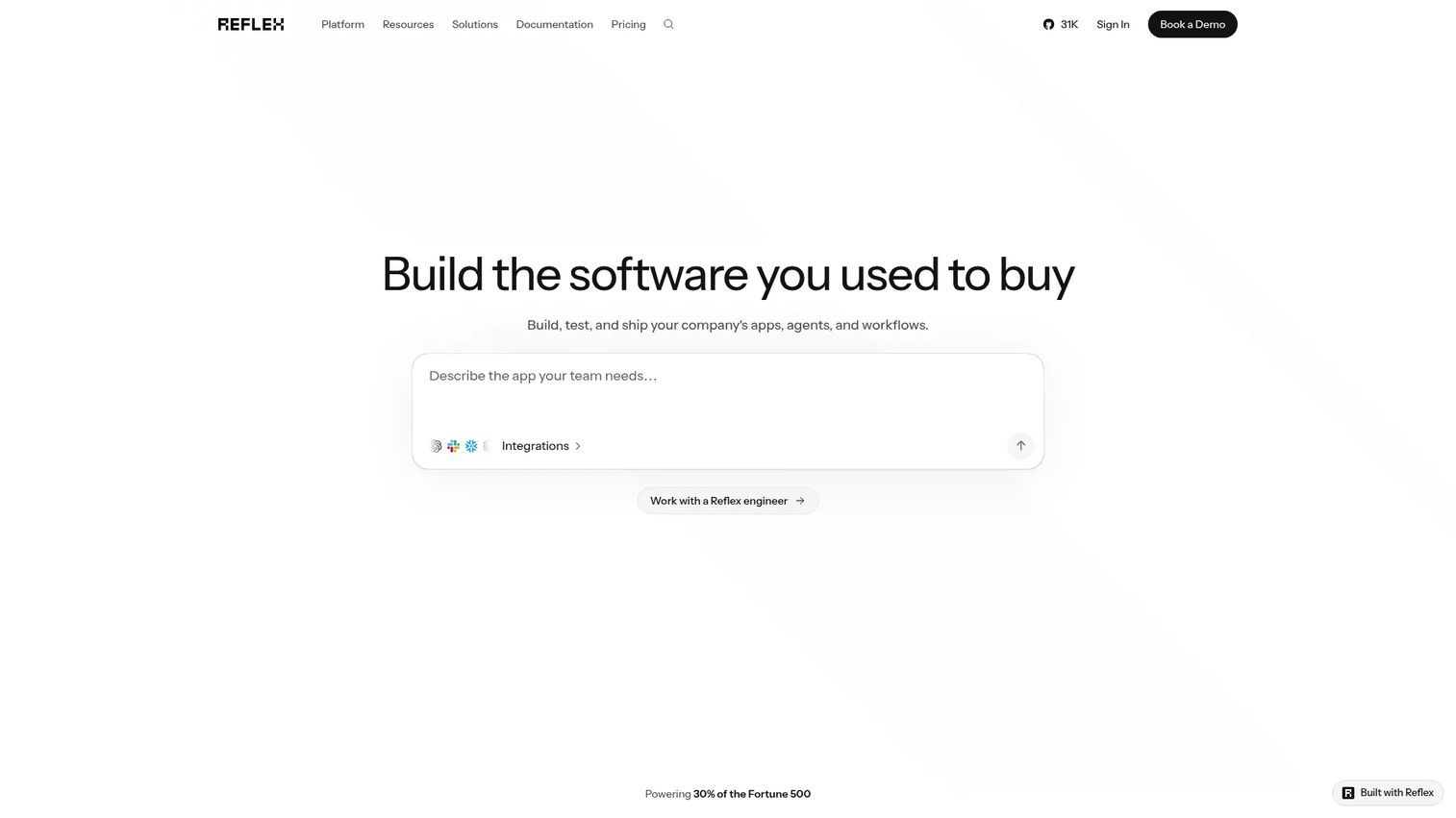
Reflex is a Python-first full-stack framework that compiles interfaces to React, letting developers build interactive web applications without switching to JavaScript. It includes reactive state management, a component library, and managed deployment options. Reflex suits Python-heavy teams that want to ship a useful interface without running a separate frontend workflow.
Best for: Python-centered teams creating internal tools, operational dashboards, data products, and web apps with interactive user interfaces.
Key features
- Python-first UI compiled to React
- Reactive state management
- Component library with extensible elements
- Authentication and managed database options
- Managed, cloud, and on-premises deployment
Why choose Reflex: Reflex reduces context switching for Python-heavy teams and is a strong fit for early product experiments and internal applications. Validate browser behavior, accessibility requirements, and custom component needs before standardizing it as a long-term customer-facing stack.
Reflex pricing: Free tier includes one published app with limited AI and hosting usage. Pro plans run $25, $50, $100, or $200 per month depending on allowance level. Enterprise pricing is custom.
G2 rating: Not listed on G2.
5. Pyramid
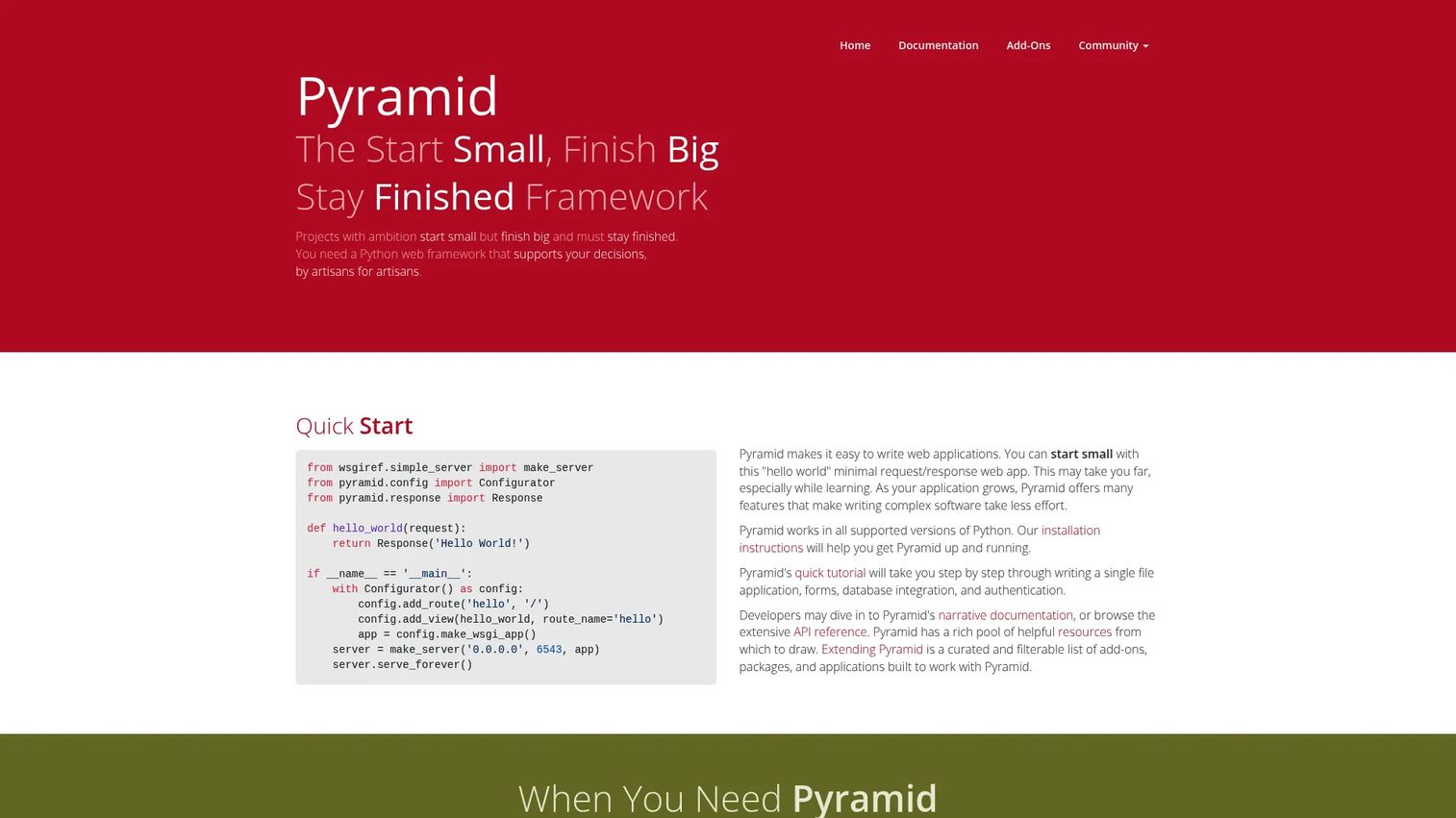
Pyramid is a configurable Python web framework with a small core and a "pay only for what you eat" philosophy, as described in its official documentation. Teams can start with a single file and expand through add-ons, templating choices, and database integrations as the application grows. It occupies the space between a microframework and a full-stack framework.
Best for: Experienced teams that need more structure than a minimal framework but want more architectural choice than an all-inclusive one.
Key features
- Route and view configuration system
- Security primitives for access control
- Static asset support
- Flexible templating choices
- Extensible add-on system with API stability
Why choose Pyramid: Pyramid fits teams that value composability and will actively own their conventions. It requires early documentation of standards; without that investment, architectural flexibility can produce inconsistency across squads.
Pyramid pricing: Free and open source under a BSD-like license. Costs come from the supporting stack and engineering time required to establish project conventions.
G2 rating: 4.4/5 (G2, October 2026).
6. Litestar
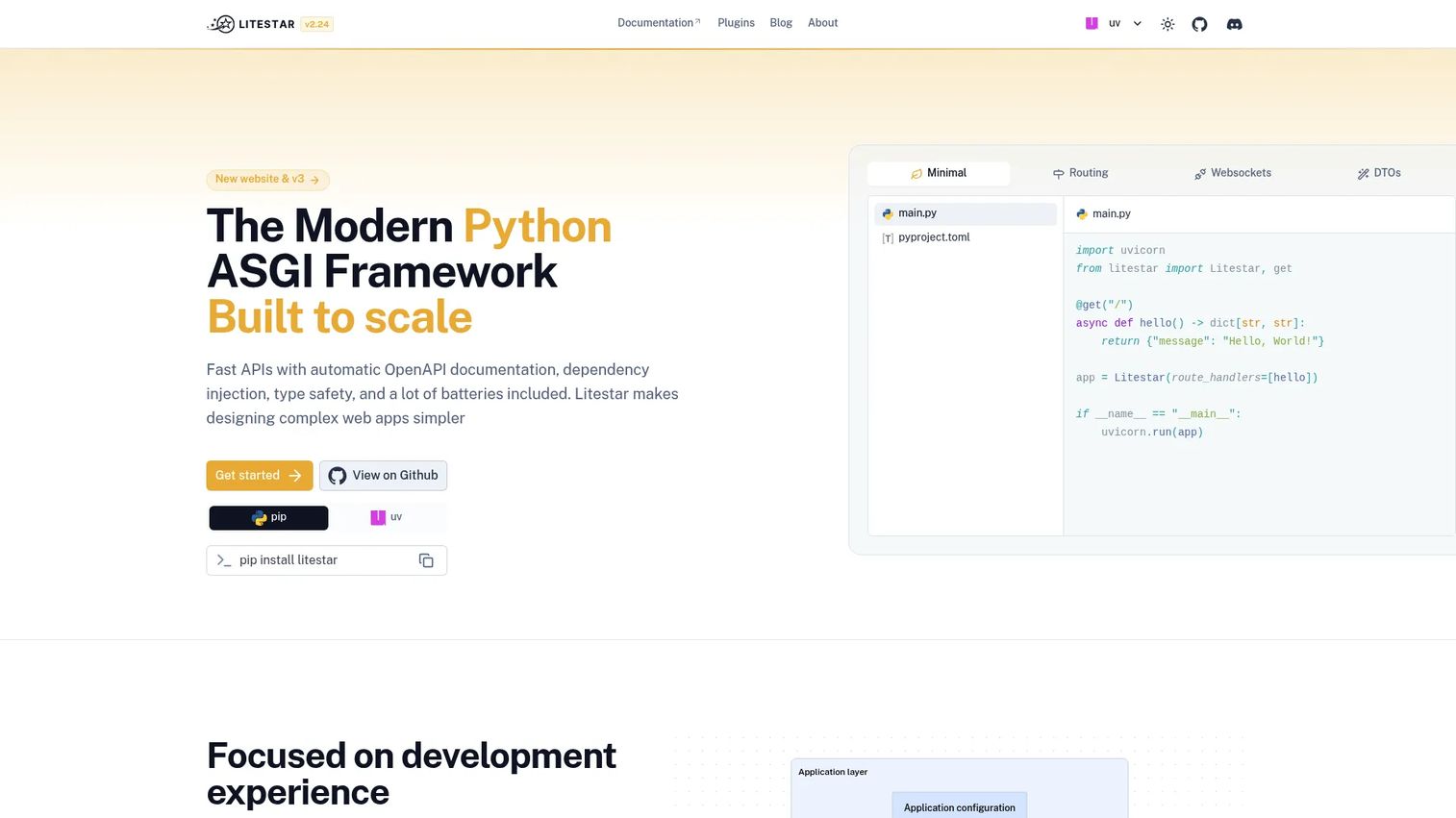
Litestar is a modern, typed ASGI framework for building APIs and web services. It provides dependency injection, OpenAPI schema generation, typed request handling, built-in middleware, and ORM integrations out of the box. Litestar positions itself as a structured alternative to bare ASGI toolkits for teams that want application-level conventions without adopting a full-stack framework.
Best for: Teams building ASGI API services with modern typing patterns and more built-in structure than a minimal toolkit.
Key features
- ASGI application support with built-in server compatibility
- Dependency injection and typed request handling
- Automatic OpenAPI schema generation
- Built-in middleware, WebSocket, and authentication support
- Plugin and controller patterns for larger codebases
Why choose Litestar: Litestar is a strong option for greenfield typed services where API quality and typing discipline matter more than hiring familiarity. Weigh ecosystem maturity and integration requirements against more established defaults before committing.
Litestar pricing: Free and open source under the MIT license.
G2 rating: Not listed on G2.
7. Quart
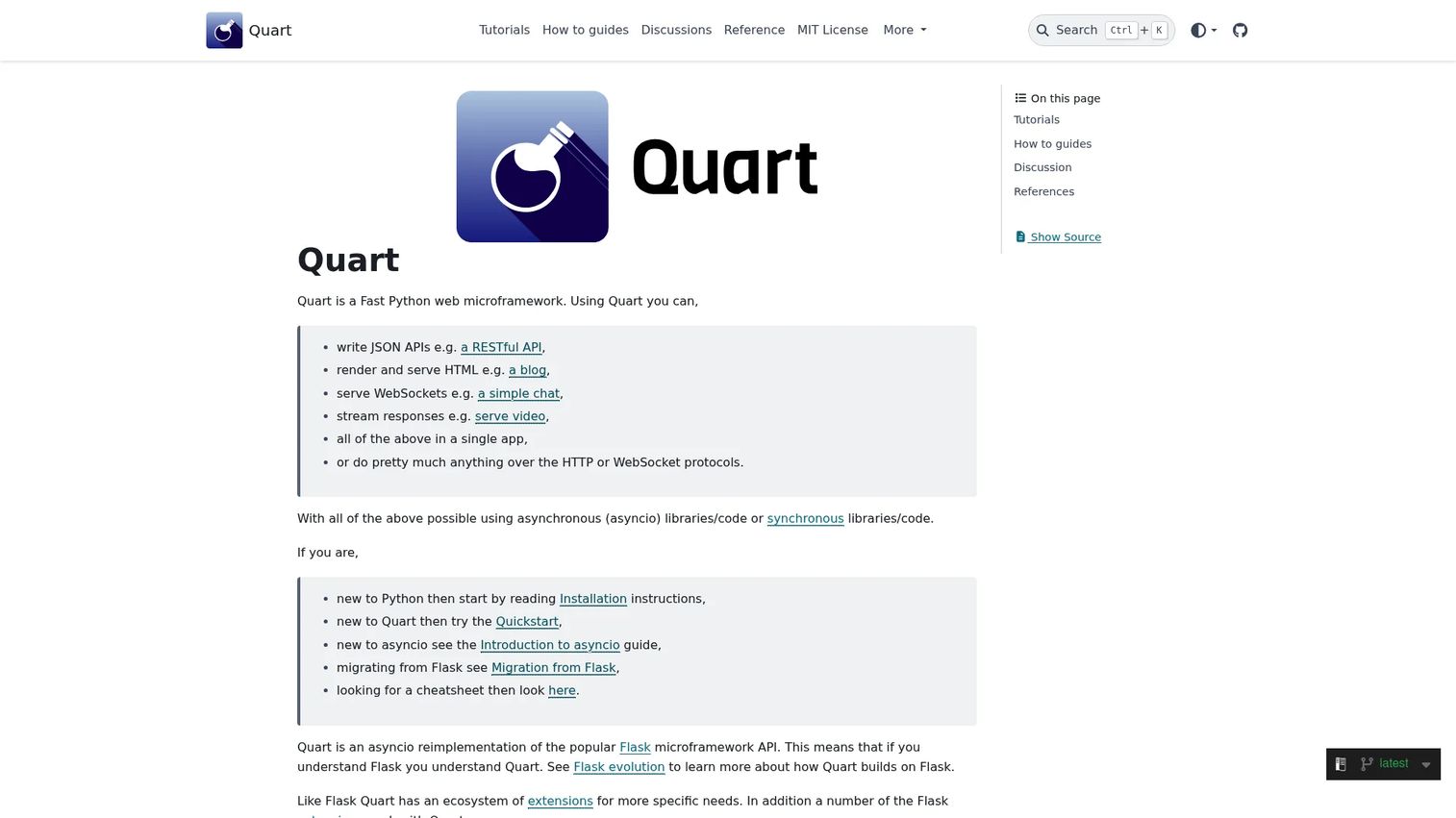
Quart is an asyncio reimplementation of the Flask API, designed for ASGI deployment with async and await support throughout. Teams familiar with Flask's routing and request model can adopt async patterns without learning an entirely new framework structure. Quart supports WebSockets, response streaming, and HTTP/2.
Best for: Teams that prefer Flask-style patterns but have a concrete async workload, streaming requirement, or WebSocket need.
Key features
- Async and await support throughout the request lifecycle
- ASGI deployment compatibility
- WebSocket support and response streaming
- Flask-inspired routing and request API
- Async test utilities
Why choose Quart: Quart gives teams a familiar conceptual model for async work. Validate extension compatibility and ASGI server requirements before treating it as a drop-in replacement for an existing Flask application. Switch when the product requirement creates a concrete async need, not to chase a trend.
Quart pricing: Free and open source. Infrastructure costs vary with the chosen ASGI server and observability tooling.
G2 rating: Not listed on G2.
8. Falcon
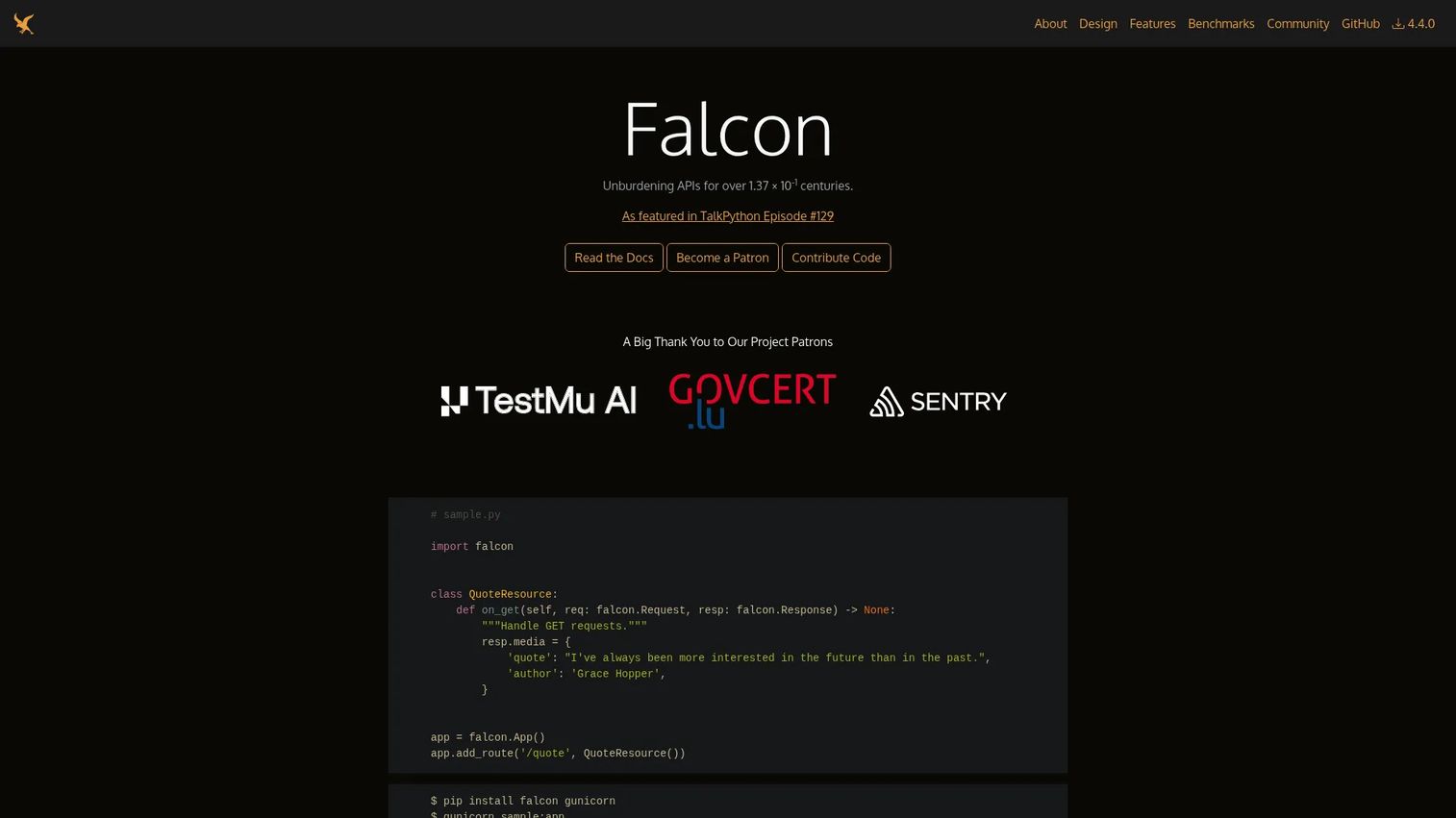
Falcon is a lean, API-focused Python framework for building application backends and microservices. It supports both WSGI and ASGI, provides RESTful routing, middleware hooks, and testing helpers, and is maintained as an Apache-licensed community project. Falcon's design prioritizes predictable request handling over built-in full-stack features.
Best for: Backend teams building focused APIs where a small framework surface and predictable request handling matter more than bundled features.
Key features
- WSGI and ASGI support with native asyncio
- RESTful routing and API resource modeling
- Middleware components and hooks
- WSGI and ASGI testing helpers and mocks
- CPython 3.9+ and PyPy 3.9+ compatibility
Why choose Falcon: Falcon fits a bounded API service where engineering teams are prepared to assemble authentication, persistence, and background work around it. Avoid treating it as the default for a customer-facing application with heavy administrative or content requirements.
Falcon pricing: Free and open source under the Apache license.
G2 rating: Not listed on G2.
9. Sanic
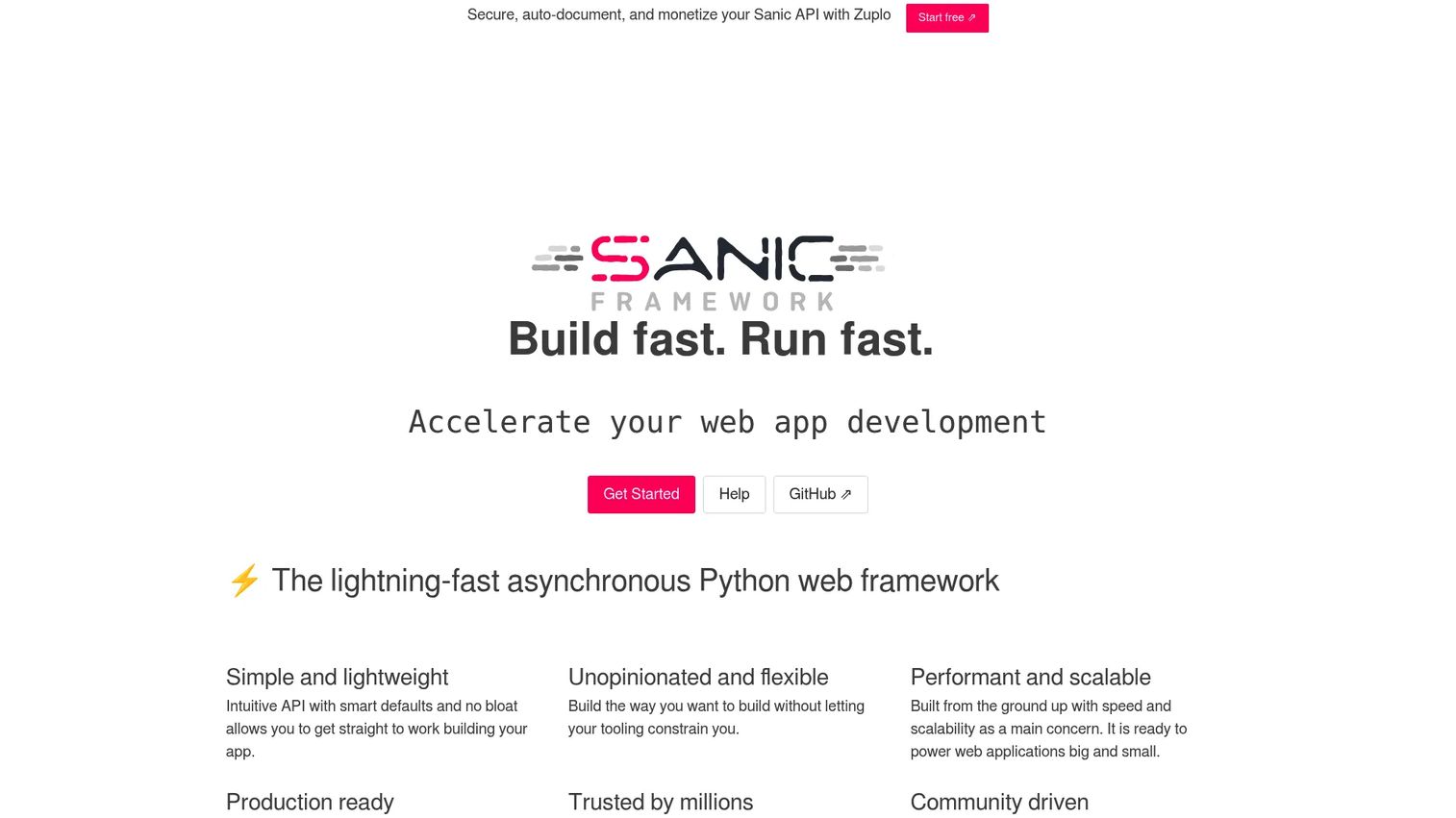
Sanic is an async Python web framework and production-ready server designed for high-concurrency services and real-time patterns. It ships with a built-in server, ASGI compliance, WebSocket support, and TLS, making it a self-contained option for async workloads. The framework suits services that spend significant time waiting on external I/O or handling many concurrent connections.
Best for: Teams building async APIs, event-driven endpoints, or real-time interactions where the concurrency pattern is explicit and documented.
Key features
- Built-in production-ready async web server
- ASGI compliance
- WebSocket and TLS support
- Middleware support and background task patterns
- Configurable worker and connection management
Why choose Sanic: Sanic earns its selection through an identified workload. Ask engineering to name the user behavior driving concurrency needs: Streaming status updates, real-time collaboration, or large volumes of slow external service calls. Choose on that answer, not on assumed speed.
Sanic pricing: Free and open source.
10. Starlette
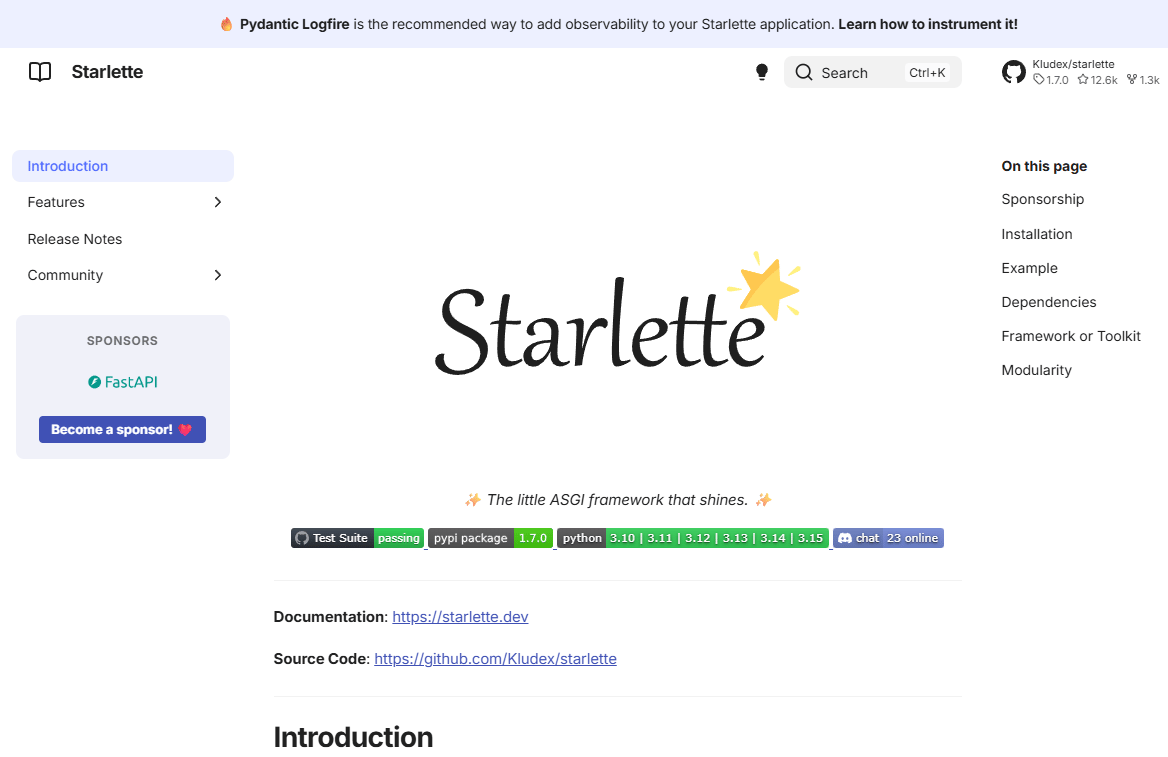
Starlette is a lightweight ASGI toolkit for building async web services in Python. FastAPI is built on Starlette, but Starlette functions independently as a minimal ASGI foundation with routing, middleware, WebSocket support, background tasks, and a test client. It is BSD-licensed and well-maintained. No screenshot was available at generation time.
Best for: Experienced backend teams that want direct control over an ASGI service without adopting a higher-level API framework.
Key features
- ASGI foundation for async services
- Routing and middleware
- WebSocket support and background tasks
- Streaming responses and static files
- Test client support
Why choose Starlette: Starlette works for teams that know which pieces they need and want to compose the rest. Strong technical flexibility does not reduce planning needs; require a clear ownership model for validation, API schemas, authentication, and observability before starting.
Starlette pricing: Free and open source under the BSD license.
11. aiohttp
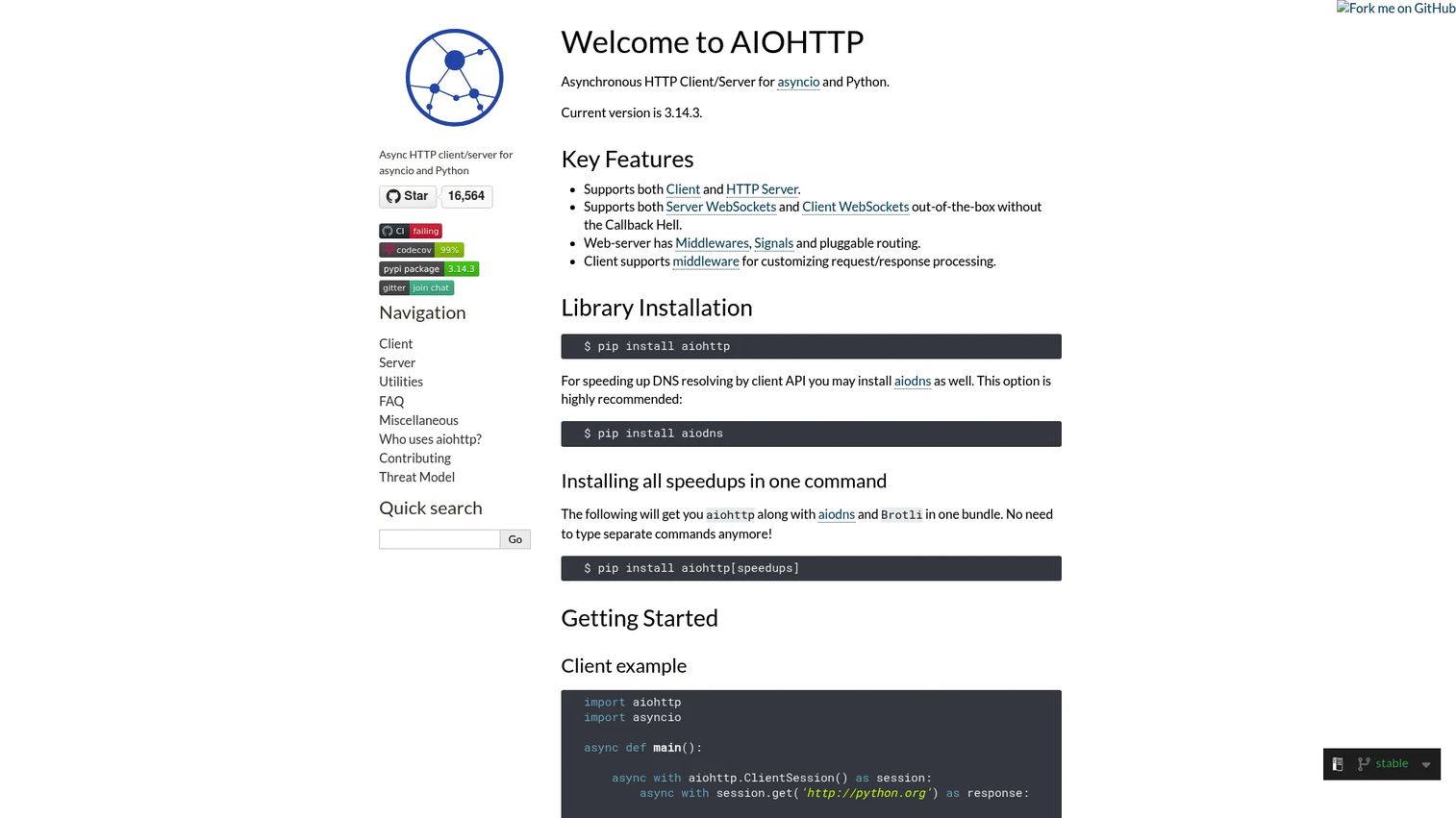
aiohttp is an asynchronous HTTP client and server framework for asyncio and Python, licensed under Apache 2. Its dual client-and-server model fits services that both expose HTTP endpoints and make substantial outbound requests to external systems. aiohttp also supports client and server WebSockets along with server middleware, signals, and pluggable routing.
Best for: Async backend services that both expose endpoints and make significant outbound HTTP calls to partner or third-party systems.
Key features
- Async HTTP server and client in one library
- Client and server WebSocket support
- Server middleware, signals, and pluggable routing
- Streaming response support
- Compatible with standard asyncio patterns
Why choose aiohttp: aiohttp fits I/O-heavy services where outbound integrations shape the architecture. When a product depends on multiple partner systems, resilient retry logic, timeout policies, and distributed tracing matter as much as framework selection.
aiohttp pricing: Free and open source under the Apache 2 license.
12. Dash
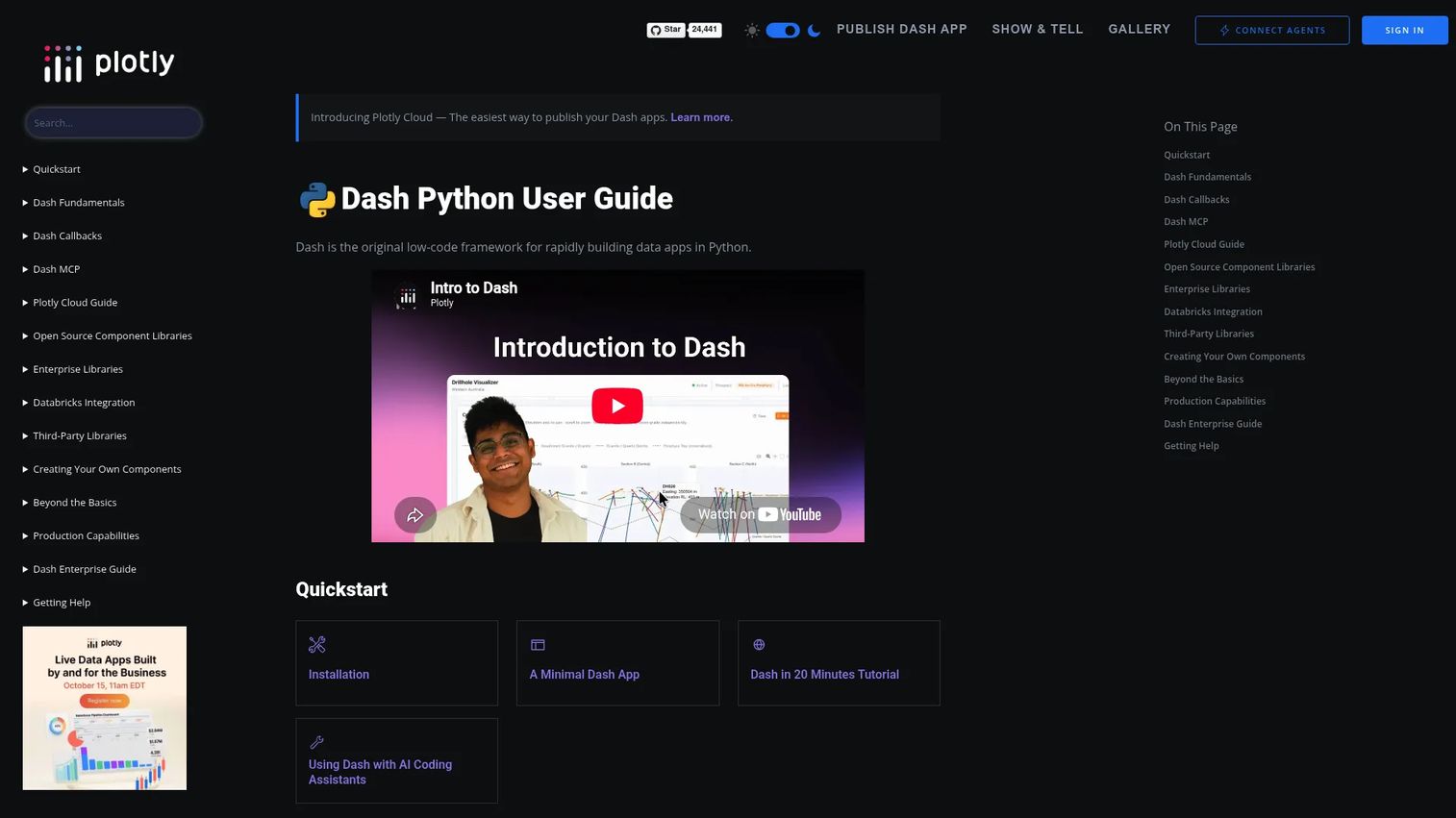
Dash is an open-source Python framework for building interactive analytical web applications. It uses a Python callback model to connect UI components including dropdowns, graphs, sliders, and tables to server-side logic, with Plotly powering the chart layer. Dash is purpose-built for data exploration interfaces rather than general product applications.
Best for: Product analytics interfaces, operations dashboards, embedded analytical tools, and internal data applications.
Key features
- Interactive data visualizations with 100+ UI components
- Python callback model for reactive server-side logic
- Plotly chart integration including AG Grid and DataTable
- Clientside callbacks for browser-side performance
- Deployment to Plotly Cloud or Dash Enterprise
Why choose Dash: Dash is a good fit when the user experience is analytical by nature. For broader SaaS workflows involving content management, complex permissions, or multi-step operational models, compare it against a full-stack framework first before standardizing.
Dash pricing: The core framework is free and open source under the MIT license. Plotly Cloud hosting starts free, with Pro plans at $29 per Creator seat per month (or $290 billed annually). Dash Enterprise is custom pricing.
G2 rating: 4.8/5 (G2, October 2026).
Considerations when choosing a Python web framework
Match the framework to the product boundary
Decide whether the framework powers the core customer application, a standalone API, an internal dashboard, or a bounded service. Avoid making one framework carry workloads that should remain separate. A product company can standardize on Django for its main application while using Dash for internal analytics.
Price the maintenance, not only the first release
The framework license is free. Operational costs come from engineering time, dependency upgrades, security patches, testing infrastructure, observability tooling, and custom integration work. Evaluate those costs before sprint one, not after the first major upgrade cycle.
Verify ecosystem and hiring fit
Choose frameworks your team can operate through turnover. Review documentation quality, release cadence, extension maturity, and how quickly new engineers can understand the architecture. FastAPI's hiring familiarity has grown sharply; Django's remains deep. For the API documentation tools and API testing tools that sit around your framework, hiring familiarity with the framework shapes the total stack.
Make execution model a requirement, not a trend
Use ASGI when product requirements call for async workloads, WebSockets, streaming, or high-concurrency I/O. Use WSGI-based patterns where they remain a clean fit. Choosing ASGI because it sounds modern adds architecture responsibility without a product benefit if the workload is synchronous.
Benchmark the actual workflow
Do not choose on synthetic throughput alone. Test the paths that shape customer experience: Authenticated requests, database queries, cache misses, large payloads, and error recovery. Application performance monitoring tools should measure these paths in a staging environment before committing to a framework for a new service.
How to choose the right Python web framework for your team
If you are building a full SaaS product with complex workflows
Start with Django. It provides proven patterns for data models, authentication, administration, forms, and a broad ecosystem. Choose Flask or Pyramid only when engineering has a clear reason to own more architectural decisions and can document those conventions from day one. Pyramid suits teams that want deliberate composability without Django's opinions.
If the roadmap centers on APIs and integrations
Start with FastAPI for typed APIs and generated documentation. The API generation software and API gateway software that sits in front of your service will depend on clean contracts; FastAPI's OpenAPI output makes those contracts explicit. Consider Litestar for teams that want structured application conventions, Falcon for narrow API services where control matters more than convention, and Starlette for teams building close to the ASGI layer.
If users need dashboards or internal tools before a full product build
Start with Dash for analytical experiences and Reflex for Python-first interactive applications. Confirm whether the interface will remain operational tooling or evolve into a customer-facing product. Scaling a Dash app into a general-purpose SaaS product typically requires rebuilding on a full-stack framework later.
If async requirements are explicit
Evaluate Quart, Sanic, Starlette, aiohttp, FastAPI, and Litestar against the actual concurrency model. Define the expected long-lived connections, streaming flows, WebSocket needs, and deployment environment before choosing. Pair this decision with API monitoring tools to measure async behavior in production from the first release.
Conclusion
No single framework wins across every product context.
Django is the durable full-stack choice for complex SaaS applications where data models, authentication, and administration are first-class concerns. Flask is the flexible option for teams building focused services with clear conventions. FastAPI is the strongest starting point for typed APIs. Reflex and Dash fit Python-centered teams shipping interactive applications and analytical dashboards. Pyramid, Litestar, Quart, Falcon, Sanic, Starlette, and aiohttp address more specific architectural needs and earn selection when the workload matches their strengths.
Before the next architecture meeting, write down the product workflows you must support in the next four quarters. Include authentication, admin operations, integrations, observability, data access, and release ownership. Then test two shortlisted frameworks against one meaningful workflow.
If you need to showcase what you build once the framework decision is made, Start your journey with Guideflow today!
FAQs
Django, Flask, and FastAPI are the strongest starting points, and the right choice depends on what the learner wants to build. Django is best for a full application with users, data, and admin workflows. Flask suits a simple service or prototype where explicit architecture choices help learning. FastAPI is the clearest path for someone building a documented API or working with typed Python.
Choose Django for a data-heavy SaaS product with authentication, administration, and standard business workflows. Its built-in patterns reduce the volume of custom infrastructure a team must maintain. Flask works when the product boundary is narrow and engineering can own the assembled stack. FastAPI is the strongest choice when the primary product surface is an API or service layer rather than a server-rendered application.
FastAPI is purpose-built for typed request validation and generated OpenAPI documentation, so it is often the natural choice for API-first products. Django can also serve APIs well, particularly when the application already uses Django's ORM, authentication, and admin workflows and adding an API layer is incremental. The question is whether the product is primarily an API or primarily an application.
WSGI is the conventional synchronous interface: Each request is handled sequentially, which suits most server-rendered applications and standard services. ASGI supports async request handling and additional protocols including WebSockets and streaming, enabling concurrent connections within a single process. Choose based on workload requirements and infrastructure, not on which standard sounds more current.
Reflex and Dash are the strongest candidates for Python-driven internal tools. Reflex fits teams that want an interactive UI without a JavaScript workflow. Dash excels when the tool centers on data exploration and analytical visualizations. Django also works well when the internal tool needs structured data administration, role permissions, and audit trails.
Dash is purpose-built for analytical dashboards and interactive data visualizations using Plotly. Reflex is worth considering when the dashboard is growing into a broader interactive application with stateful workflows. For dashboards that require heavy user management or integration with business data models, Django with a data visualization library is another path.
All 12 frameworks in this list are free and open source. The significant costs are operational: Cloud infrastructure, managed databases, observability and monitoring services, security tooling, and engineering time for maintenance, upgrades, and custom integrations. Open source licensing removes framework costs but does not remove total ownership cost.
Benchmark production-like workflows rather than raw requests per second. Include authenticated paths, database queries under realistic load, cache behavior on misses, payload sizes matching actual usage, concurrent user counts, external service calls, and error handling paths. Synthetic benchmarks measure the framework in isolation; production performance is shaped by database access patterns, serialization, infrastructure configuration, and observability overhead. Use application security testing software and application server software evaluations alongside framework benchmarks for a complete picture.