Your competitors changed their pricing page last week. You found out yesterday when a prospect mentioned it on a sales call.
That gap between what's happening in your market and when you actually hear about it is where deals get lost. Market intelligence software closes that gap by automatically tracking competitor moves, market trends, and customer signals so you can respond before opportunities slip away. This guide covers 14 tools that help you collect, analyze, and act on competitive insights, from dedicated CI platforms to website monitoring tools and everything in between.
What's inside
This guide covers the market intelligence software landscape for teams tracking competitors, spotting market trends, and turning insights into action. You'll find a clear definition of what market intelligence software actually does, plus the main platform categories worth considering. We've included a comparison table with pricing and G2 ratings, followed by in-depth reviews of 14 tools. Each review covers key strengths, ideal use cases, and what makes the tool worth evaluating. The final sections walk through buying considerations and how to translate intelligence into competitive advantage.
TL;DR
- What it is: Market intelligence software collects and analyzes data on competitors, market trends, and customer behavior to inform strategic decisions.
- Who uses it: Product marketing teams, sales enablement, and strategy leaders rely on market intelligence tools to refine positioning, win more deals, and plan launches.
- Top picks: Klue leads for sales-focused competitive intel. Visualping excels at tracking competitor pricing pages. BuzzSumo is the go-to for content and social trends.
What is market intelligence software
Market intelligence software automates the collection, analysis, and delivery of data about your competitive landscape. With the CI tools market projected to reach $1.46 billion by 2030, platforms in this category track competitor moves, market trends, customer sentiment, and industry shifts so you can make informed decisions without manually scouring the web.
The distinction from market research matters here. Market research typically involves point-in-time studies like surveys or focus groups. Market intelligence, on the other hand, provides ongoing, real-time monitoring of your environment.
Core capabilities include:
- Competitor tracking: Monitor pricing changes, product launches, messaging shifts, and marketing campaigns.
- Trend analysis: Identify emerging patterns, technologies, and conversations in your industry.
- Customer insights: Aggregate buyer behavior, review sentiment, and social media feedback.
- Alerting systems: Get notified via email or Slack when relevant changes occur.
When you need market intelligence tools
Adopting a market intelligence tool becomes critical when staying ahead of market shifts directly impacts growth. Here are the scenarios where market intelligence platforms deliver the most value:
- Entering new markets: You want to understand competitive dynamics, customer expectations, and pricing norms in unfamiliar territory.
- Losing deals to competitors: If your win rate is declining, you want to know why - 68% of deals now involve a direct competitor. Market intelligence tools help analyze competitor strengths to inform your sales strategy.
- Planning product launches: Successfully launching requires knowing how to position against existing solutions and understanding unmet customer needs.
- Making pricing decisions: Monitoring competitor pricing and promotions helps ensure your own pricing stays competitive.
- Preparing sales battlecards: Equipping your sales team with up-to-date, factual competitive information is crucial for winning deals - 71% of businesses using battlecards.
Types of market intelligence platforms
Competitive intelligence platforms
Competitive intelligence platforms focus specifically on tracking and distributing information about competitor activity. Competitive intelligence tools monitor pricing changes, positioning shifts, new features, hiring trends, and funding announcements. Tools like Klue and Crayon often include battlecard creation features to directly support sales enablement.
Pricing and product monitoring tools
Pricing and product monitoring tools specialize in tracking changes to competitor pricing, product catalogs, and promotional activities on an automated schedule. They're particularly useful for e-commerce, retail, and SaaS companies in dynamic pricing environments. Visualping and Centric Market Intelligence fall into this category.
Social listening and sentiment analysis
Social listening tools monitor brand mentions, customer sentiment, and trending topics across social media, forums, and review sites. Social listening platforms help you understand public perception of your brand and competitors while identifying emerging trends. BuzzSumo and Sprout Social are prominent examples.
Data aggregation and market research tools
Data aggregation platforms pull data from financial filings, news articles, patent databases, and industry reports into unified dashboards. They're designed for deep research and are often used by corporate strategists and financial analysts. AlphaSense and ZoomInfo represent this category.
What to look for in a market intelligence platform
Data quality and source coverage
The value of any intelligence platform ties directly to data quality. Ensure the tool provides accurate, timely information from sources relevant to your business. Ask during evaluation: Does the platform cover your key competitors? Does it have strong coverage in your industry vertical?
Real-time alerts and monitoring
In fast-moving markets, waiting for weekly reports means you're already behind. Look for platforms offering automated, real-time alerts for important competitor changes. The best tools let you customize alert frequency and delivery channels to fit your workflow.
AI and predictive analytics features
Modern platforms leverage AI to go beyond simple data collection. Look for AI-powered trend detection, anomaly identification, and predictive analytics. With a 76% year-over-year increase in AI adoption within CI teams, AI is critical for processing massive datasets and surfacing insights a human analyst might miss.
Integration with CRM and marketing tools
Intelligence is most powerful when integrated into tools your teams use daily. Key integrations include CRM systems like Salesforce and HubSpot, communication tools like Slack, and marketing automation platforms.
Actionable reporting and enablement
Raw data sitting in a dashboard is useless. The platform provides tools to turn data into actionable insights. Look for dynamic battlecard builders, shareable report templates, and easy export options.
Market intelligence software comparison table
| # | Product | Intent | Key use case | Pricing | G2 rating |
|---|---|---|---|---|---|
| 1 | Klue | Win/loss competitive intelligence | Sales battlecards and enablement | Custom pricing | 4.4/5 |
| 2 | Crayon | Competitive tracking automation | Marketing and PMM competitive programs | Custom pricing | 4.6/5 |
| 3 | AlphaSense | AI-powered market research | Deep research for strategy and finance | Custom pricing | 4.8/5 |
| 4 | Similarweb | Digital traffic analysis | Website and audience benchmarking | Free tier, from $125/mo | 4.5/5 |
| 5 | ZoomInfo | B2B contact and company data | Lead generation and sales intelligence | Custom pricing | 4.4/5 |
| 6 | Contify | AI-curated intelligence feeds | Enterprise-grade custom intel delivery | Custom pricing | 4.8/5 |
| 7 | Feedly | AI-powered news monitoring | Curated industry and competitor feeds | Starts at $18/mo | 4.5/5 |
| 8 | Visualping | Website change monitoring | Tracking competitor pricing and pages | Free tier, from $14/mo | 4.5/5 |
| 9 | Kompyte | Real-time competitive intelligence | Sales alerts and battlecard automation | Custom pricing | 4.3/5 |
| 10 | BuzzSumo | Content and social intelligence | Content marketing and trend analysis | Starts at $199/mo | 4.5/5 |
| 11 | Data.ai | Mobile app market intelligence | App store performance and analytics | Free tier, custom plans | 4.5/5 |
| 12 | Valona Intelligence | Strategic and innovation intelligence | Patent, M&A, and technology scouting | Custom enterprise | 4.6/5 |
| 13 | CI Radar | Managed competitive intelligence | Human-curated intel reports | Custom pricing | 4.3/5 |
| 14 | HubSpot | Integrated marketing and CRM | Basic competitor tracking for HubSpot users | Free CRM, from $20/mo | 4.4/5 |
1. Klue
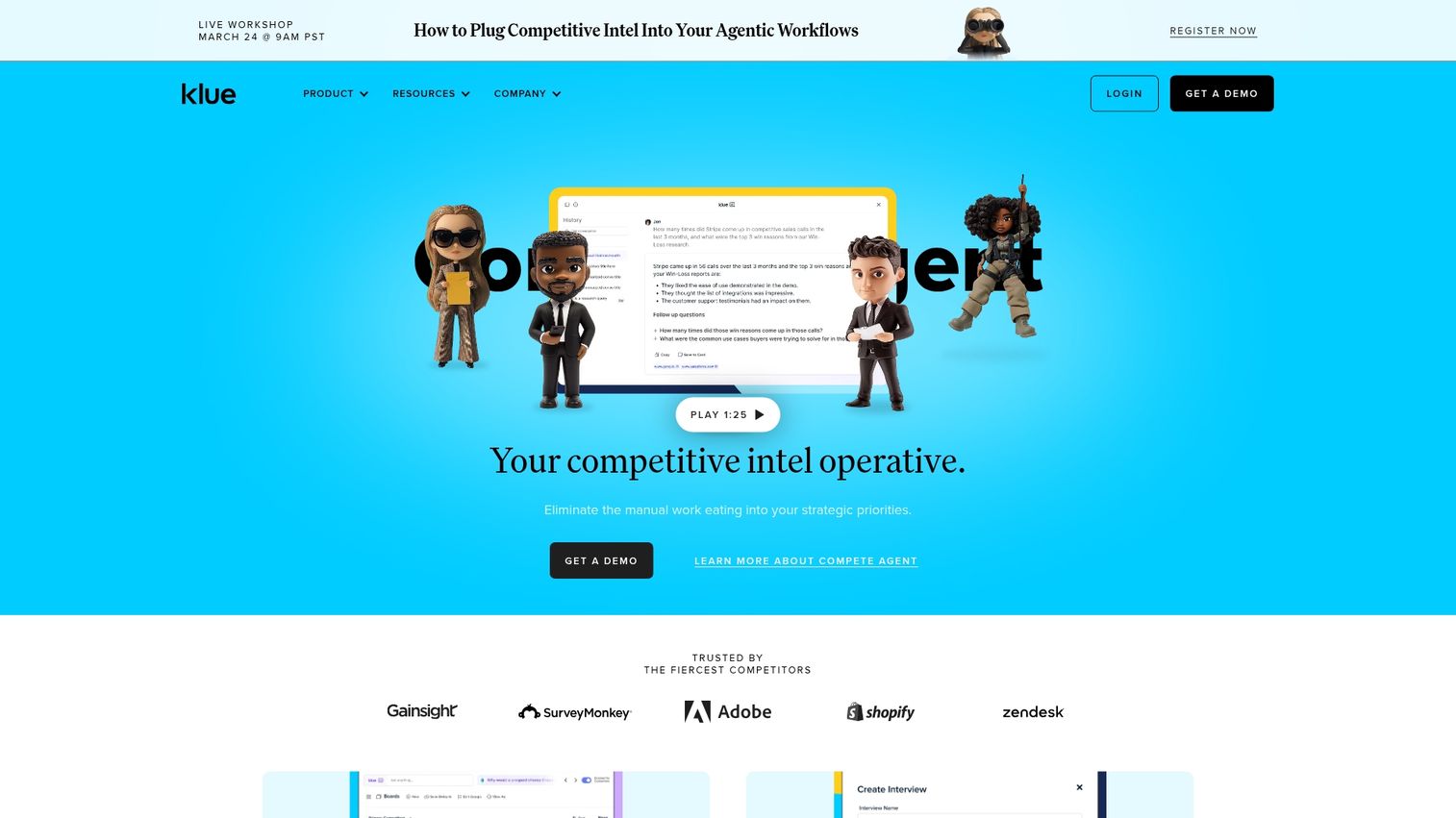
Klue is a competitive intelligence platform designed specifically for revenue teams. Its primary focus is collecting competitor intel and operationalizing it to help sales reps win more deals.
The platform's AI-powered engine automatically scours competitor websites, news articles, and social media to surface relevant updates. This intel flows into dynamic battlecard templates accessible directly within your CRM or via browser extension. Klue also excels at win/loss analysis, helping teams understand not just who they're winning or losing against, but why.
Best for: Sales enablement and product marketing teams at mid-market to enterprise companies that want robust battlecard systems.
Key strengths
- AI-powered engine for automated intelligence gathering
- Dynamic and customizable sales battlecard builder
- Deep integration with Salesforce and other CRMs
- Robust win/loss analysis and reporting features
2. Crayon
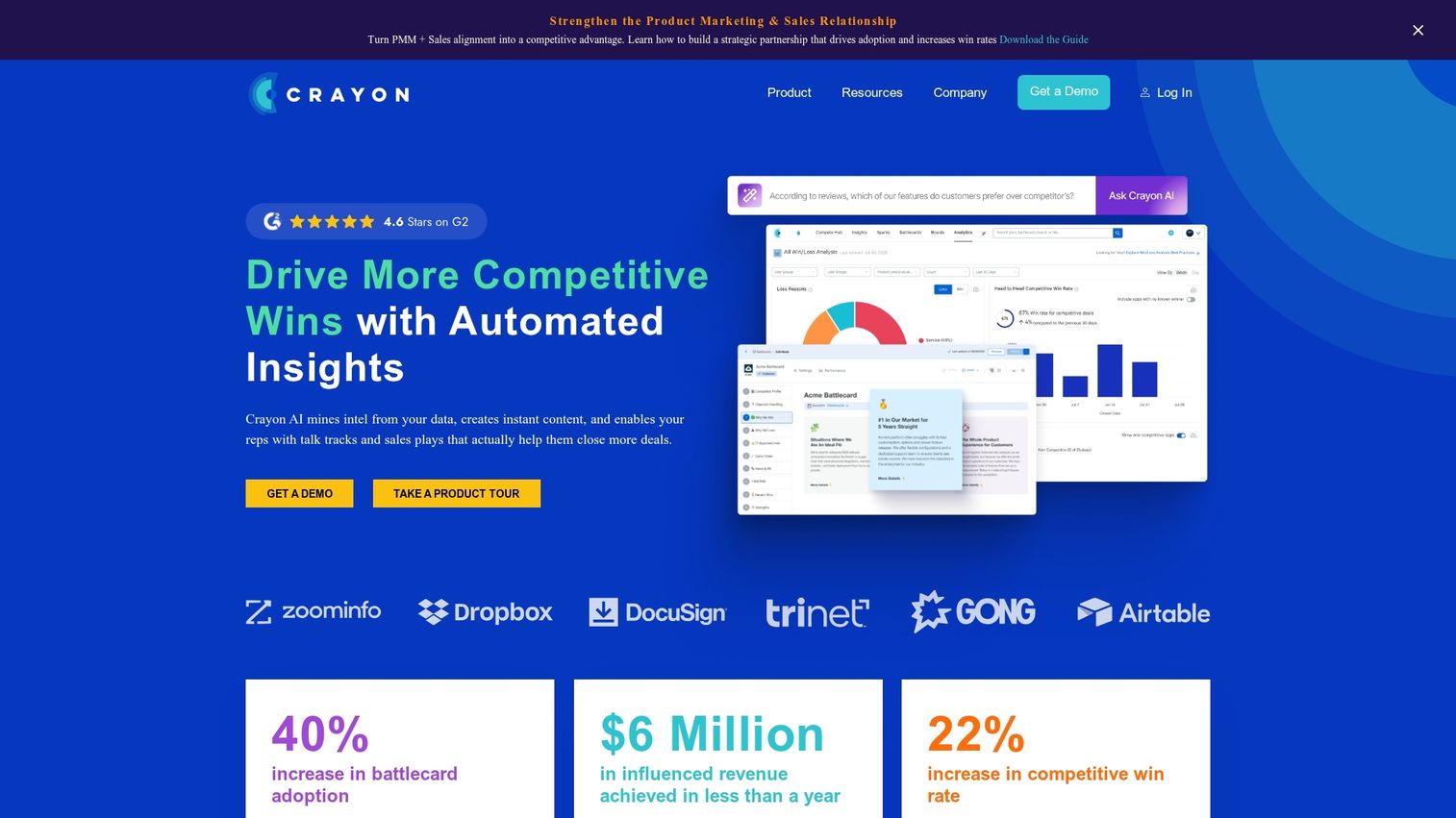
Crayon is a competitive intelligence automation platform built to help marketing and product marketing teams run comprehensive competitive programs. While Klue is more sales-centric, Crayon excels at providing a holistic view of the market landscape for strategic planning.
Crayon monitors over 100 data types across millions of sources, capturing everything from subtle website copy changes to new customer reviews and marketing campaign launches. Its "Complete" feature provides a historical view of any competitor's digital footprint, allowing you to analyze messaging evolution over time.
Best for: PMMs and marketers who want to track a wide range of competitor activities automatically.
Key strengths
- Extensive automated tracking of competitor digital footprints
- Detailed monitoring of website content and messaging changes
- Customizable market landscape dashboards and reports
- Strong focus on serving marketing and product marketing teams
3. AlphaSense
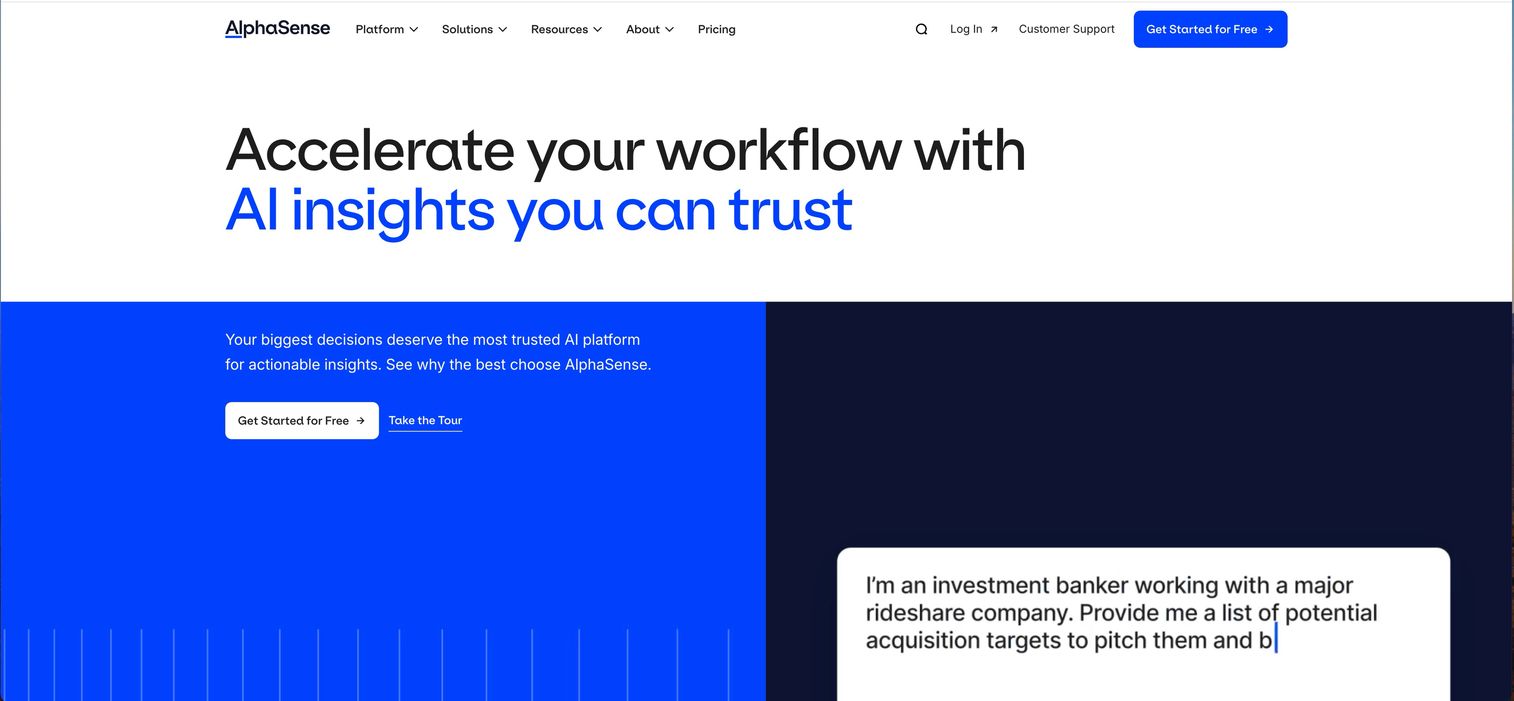
AlphaSense is an AI-powered market and financial intelligence platform designed for deep, qualitative research. Unlike tools focused on day-to-day competitor tracking, AlphaSense is built for analysts and corporate strategy teams who want insights from vast text-based content.
Its AI-driven search engine functions like a "Google for business." Users can ask natural language questions and get instant answers from millions of documents, including SEC filings, earnings call transcripts, and expert interviews. The platform's sentiment analysis technology gauges document tone and identifies positive or negative trends.
Best for: Organizations requiring in-depth analysis of market trends, M&A activity, and industry-specific research.
Key strengths
- AI-powered search across millions of financial and business documents
- Natural language processing for quick, precise answers
- Integrated sentiment analysis to gauge market tone
- Exclusive access to expert interview transcripts
4. Similarweb
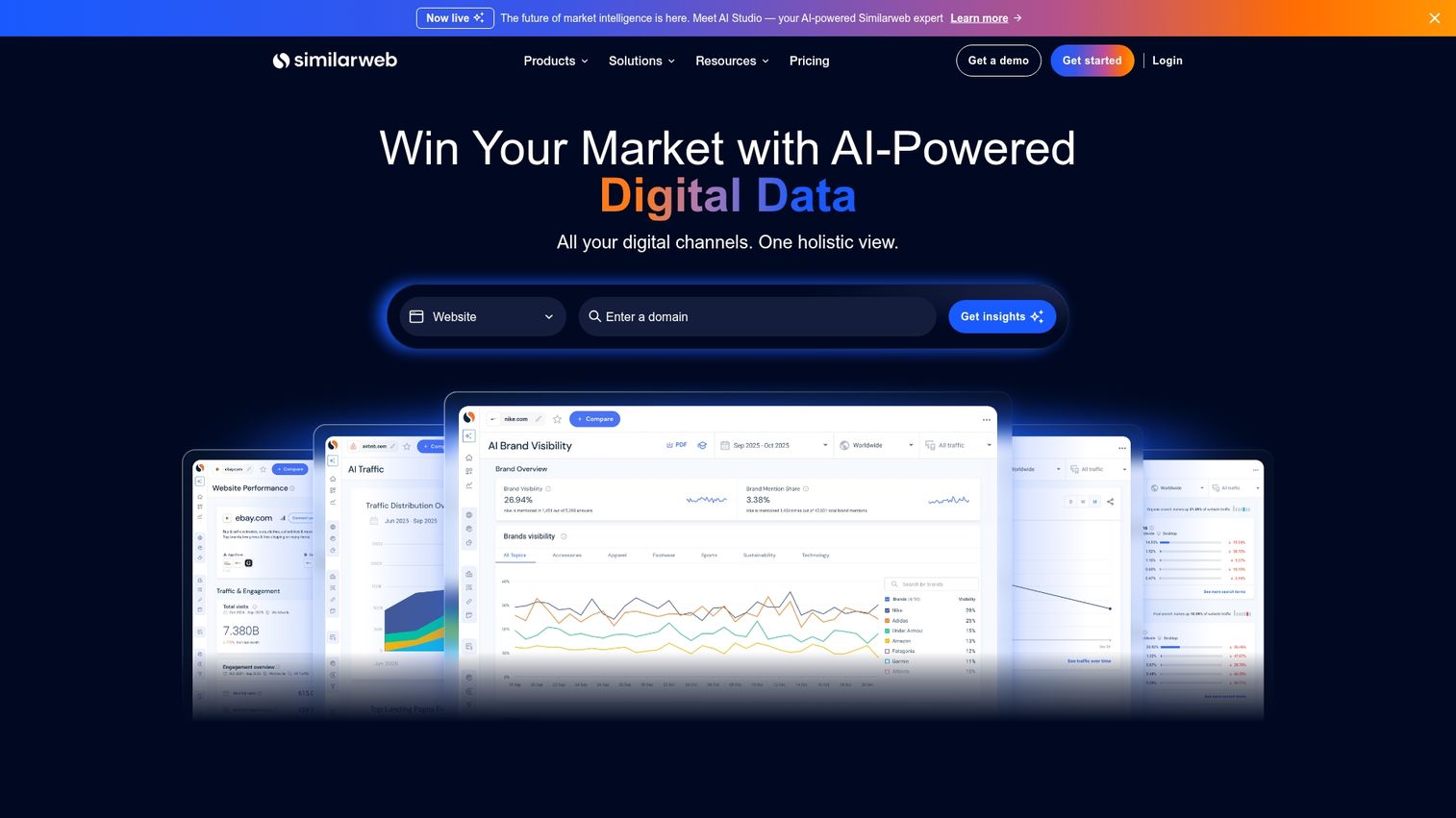
Similarweb is a digital market intelligence platform specializing in web traffic and online performance analysis. It's the go-to tool for marketing teams and digital strategists who want to benchmark their online presence against competitors.
You can see where a competitor's traffic comes from, which keywords they rank for, and what their audience engagement looks like. The keyword gap analysis feature reveals search terms your competitors rank for that you don't. This data is invaluable for SEO, content strategy, and paid acquisition teams.
Best for: Marketing teams wanting to benchmark digital performance and identify SEO opportunities.
Key strengths
- Detailed website traffic and engagement analytics
- Audience insights and demographic data
- Powerful keyword gap analysis for SEO opportunities
- Industry-wide digital performance benchmarking
5. ZoomInfo
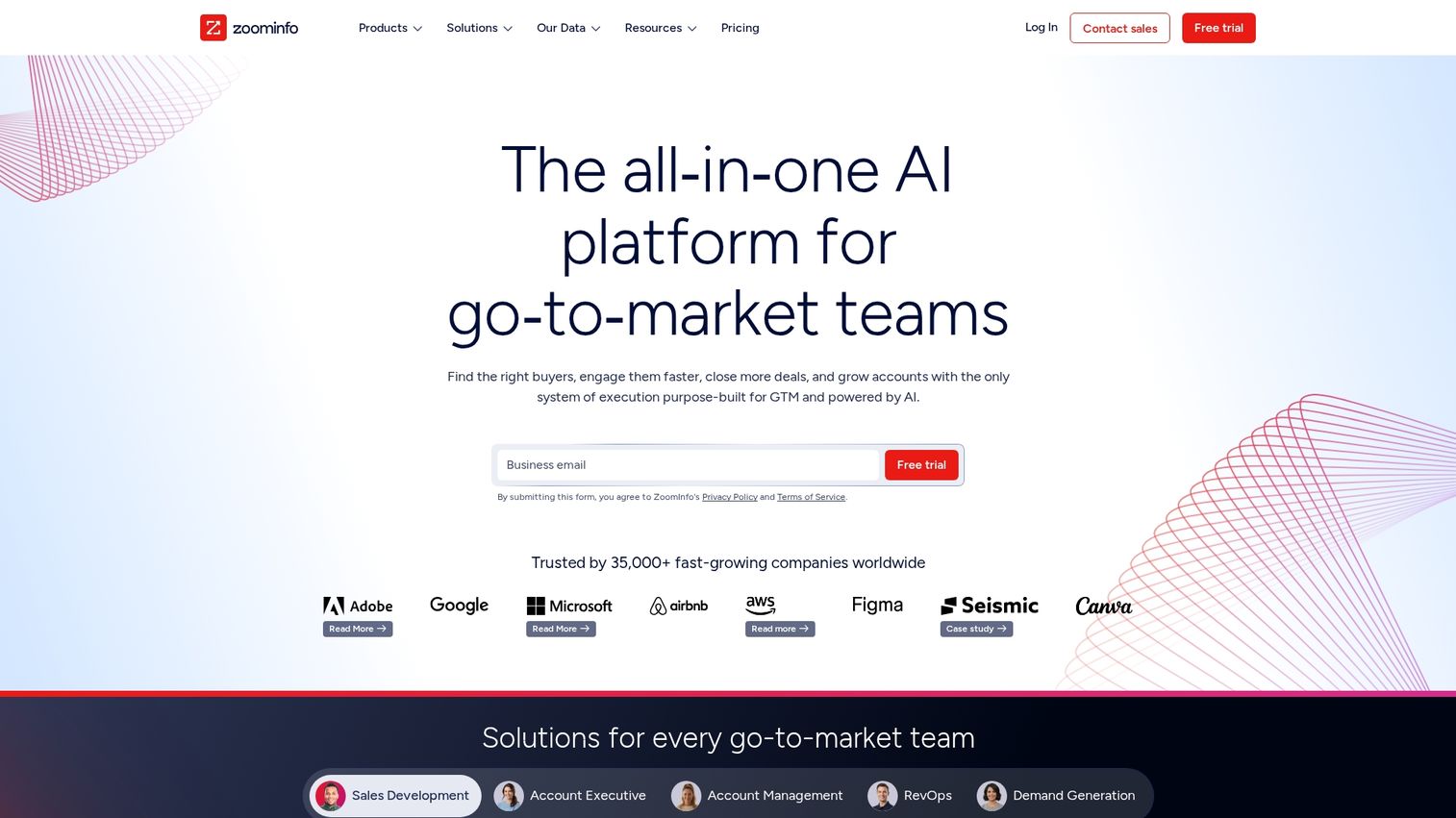
ZoomInfo is primarily known as a B2B intelligence and lead generation platform, but its vast database makes it a powerful market intelligence tool. It helps teams identify potential customers, understand their technology stack, and monitor buying signals.
Beyond contact data, ZoomInfo provides detailed company technographics, organizational charts, and intent data signaling when a company is actively researching solutions like yours. This combination of "who" with "what" and "when" allows revenue teams to be highly targeted in their outreach.
Best for: Sales, marketing, and demand generation teams that want contact data combined with deep account insights.
Key strengths
- Expansive and accurate B2B contact and company database
- Detailed company technographics and organizational charts
- Buyer intent data to identify accounts in-market
- Workflow automation to streamline lead generation
6. Contify
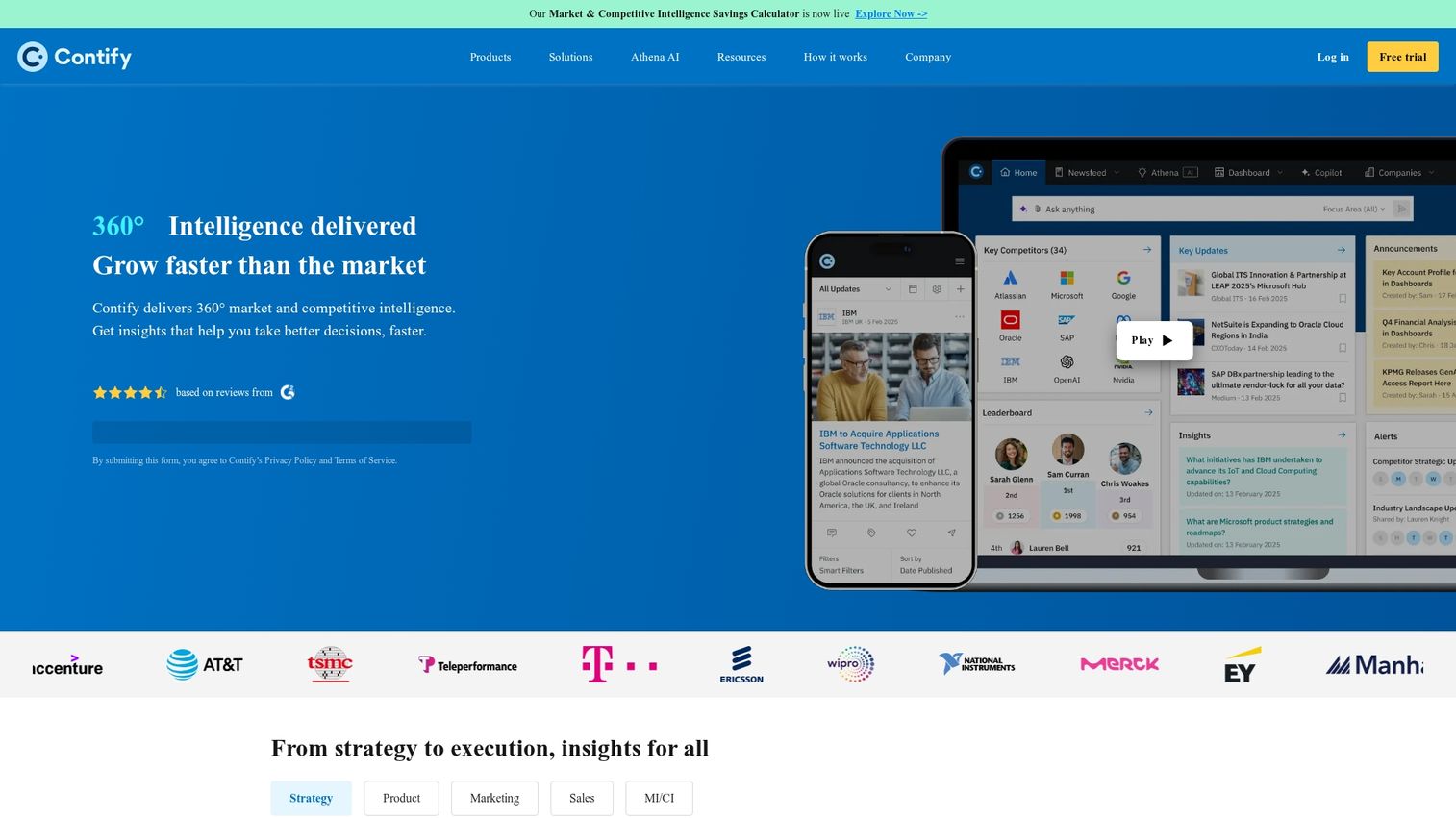
Contify is an enterprise-grade market and competitive intelligence platform combining AI-powered automation with human curation. It's designed for large organizations that want highly customized, noise-free intelligence feeds.
A key strength is its hybrid approach. The platform's AI engine scans thousands of sources, and human analysts then vet and enrich the findings. Contify can be tailored to track very specific topics, competitors, or market segments. Its robust API allows companies to integrate curated intelligence directly into internal portals.
Best for: Large organizations with complex intelligence requirements and multiple stakeholder groups.
Key strengths
- Hybrid model combining AI automation with human curation
- Highly customizable taxonomies to filter out noise
- News aggregation from thousands of vetted sources
- Robust API for seamless integration into internal systems
7. Feedly Market Intelligence
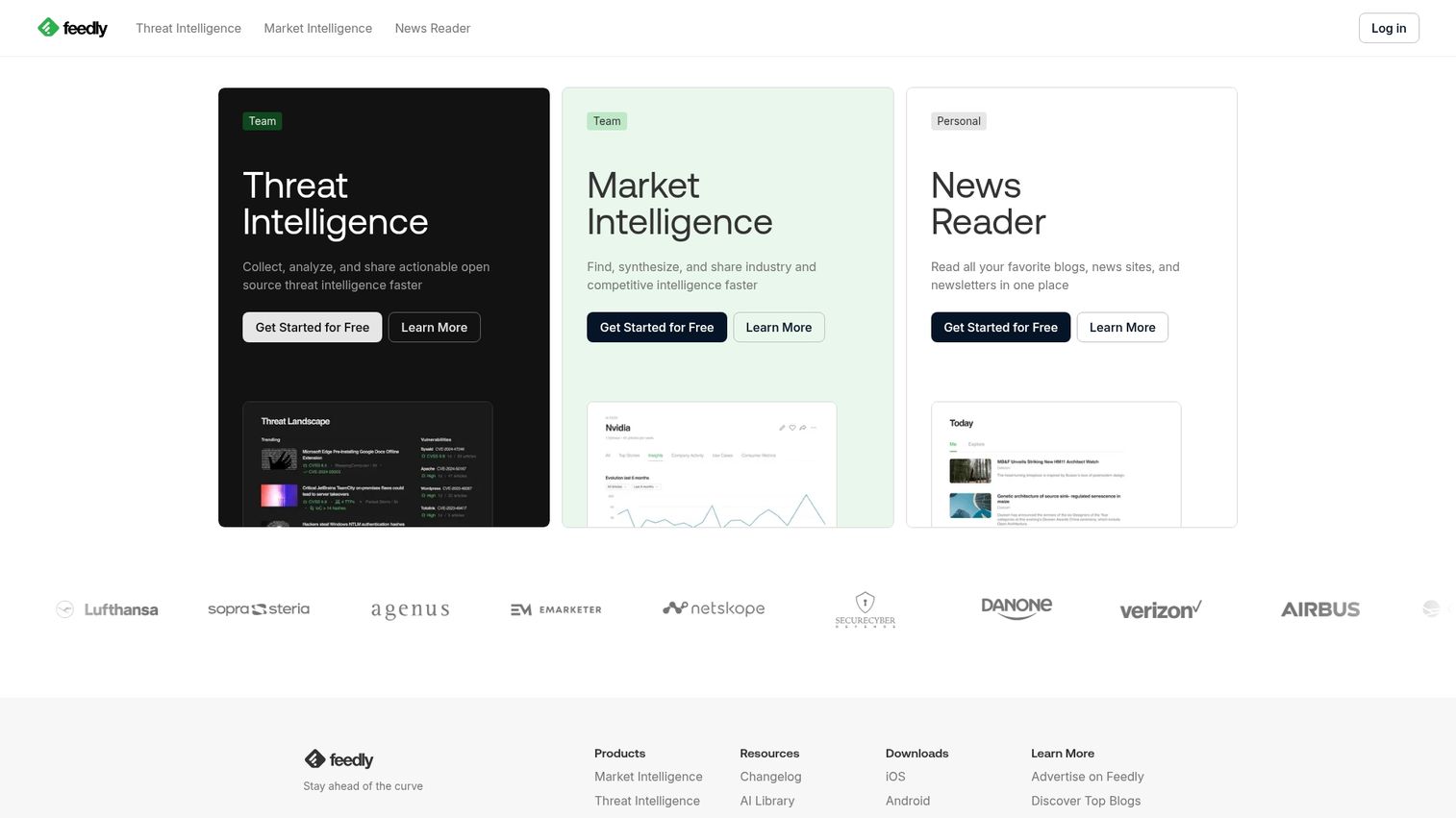
Feedly has evolved from a news aggregator into a powerful market intelligence tool with AI-powered features. Its AI engine, Leo, acts as a personal research assistant, reading and analyzing articles to prioritize the most relevant content.
You can train Leo to track specific companies, products, technologies, or business topics. Leo summarizes articles, identifies key trends, and filters out irrelevant noise. The "Competitive Intelligence Boards" feature lets you create dedicated dashboards for each competitor.
Best for: Teams and individuals who want to monitor industry news and track competitors without information overload.
Key strengths
- AI assistant (Leo) for prioritizing and summarizing content
- Ability to track specific companies, topics, and trends
- Team-oriented boards for collaboration and sharing insights
- Integration with tools like Slack and Trello
8. Visualping
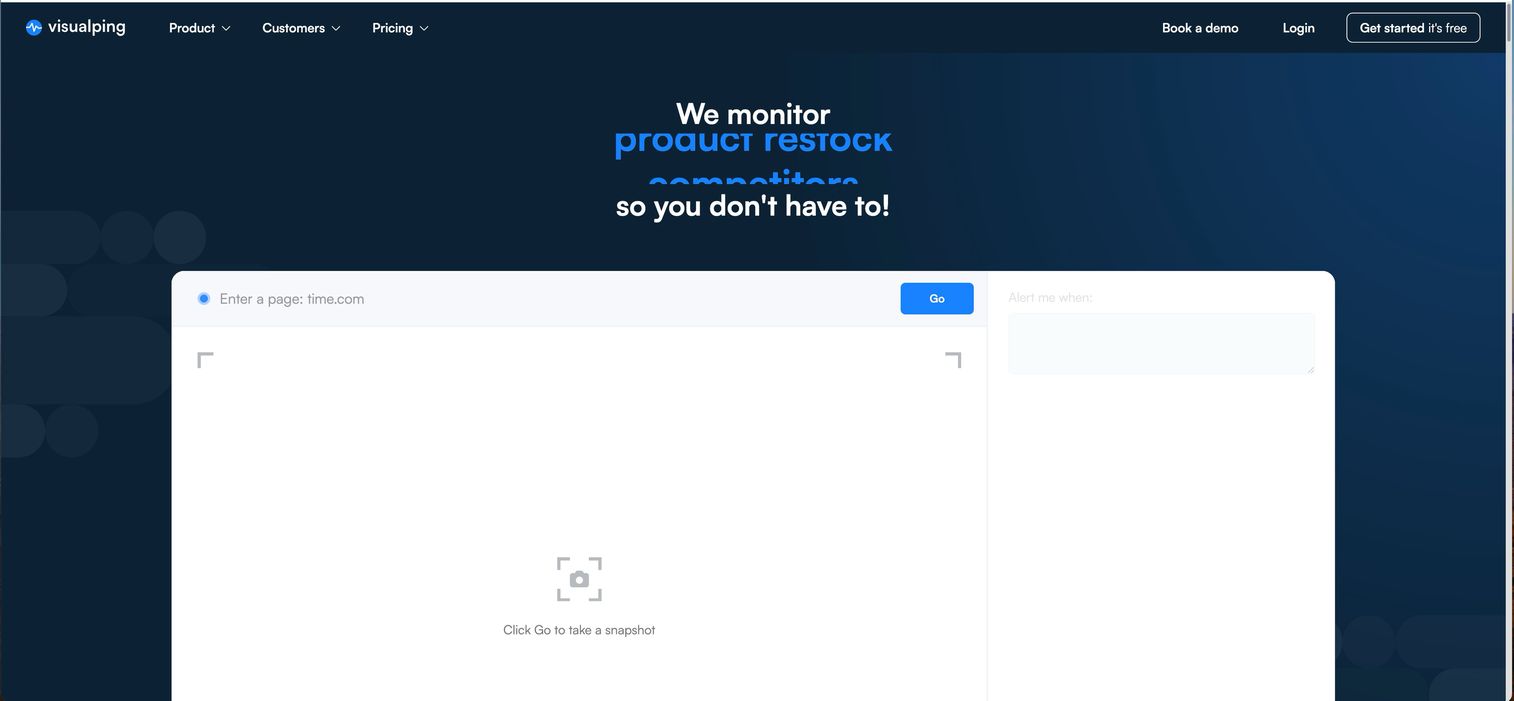
Visualping specializes in one thing: monitoring website changes. It's an accessible market intelligence solution for anyone tracking specific pages on a competitor's website, from pricing pages to careers pages for hiring trends.
The key strength is visual change detection technology. Instead of just tracking text, it takes screenshots at set intervals and highlights exact visual changes between versions. Users receive instant email or Slack alerts when changes are detected, complete with before-and-after screenshots.
Best for: Teams tracking competitor pricing pages, product catalogs, and messaging shifts.
Key strengths
- Visual-first change detection that highlights updates
- Scheduled, automated monitoring of any public webpage
- Real-time alerts via email, Slack, and other channels
- Archiving of historical screenshots to track changes over time
9. Kompyte
Kompyte is a competitive intelligence and sales enablement platform focused on delivering real-time insights to sales teams. It aims to connect intelligence gathering with sales execution.
The platform automatically tracks competitor websites, social media, and other digital channels, sending instant alerts to sales reps when key events occur. Its battlecard builder and win/loss analysis features help close the loop, ensuring field-level insights refine the overall competitive strategy.
Best for: B2B sales and marketing teams wanting automated competitor tracking combined with enablement tools.
Key strengths
- Automated, real-time tracking and sales alerts
- Strong Salesforce integration for in-workflow intelligence
- Easy-to-use battlecard builder for sales enablement
- Win/loss reporting to capture insights from the field
10. BuzzSumo
BuzzSumo is a content and social intelligence platform helping marketers understand what content resonates with their audience. While not a traditional CI tool, it provides deep insights into competitor content strategies and trending topics.
You can search for any topic or competitor and instantly see which articles, videos, or posts received the most social shares and engagement. BuzzSumo is also excellent for identifying trending topics before they become mainstream and finding key influencers to partner with.
Best for: Content marketers, SEO specialists, and PR professionals tracking content performance.
Key strengths
- Comprehensive content performance and engagement tracking
- Identification of trending topics and viral content
- Powerful influencer discovery and analysis tools
- In-depth competitor content strategy analysis
11. Data.ai
Data.ai (formerly App Annie) is the definitive market intelligence platform for the mobile app economy. It provides tools for tracking app store performance, user engagement, and market trends.
Companies can benchmark their app's performance against competitors, identify growth opportunities through ASO keyword analysis, and size new markets. Its platform provides a granular view of the mobile ecosystem unavailable elsewhere.
Best for: Mobile-first companies, app developers, and marketers competing in app stores.
Key strengths
- Accurate estimates for app downloads, revenue, and usage
- App Store Optimization (ASO) and keyword analysis tools
- Competitive benchmarking for mobile app performance
- Market sizing and trend analysis for the mobile economy
12. Valona Intelligence

Valona Intelligence is an AI-powered strategic intelligence platform designed for enterprise strategy, R&D, and innovation teams. It focuses on long-term aspects of market intelligence like technology scouting, M&A target identification, and patent analysis.
Valona automates the analysis of complex, unstructured data sources related to innovation. The platform monitors patent filings, tracks emerging technologies, and identifies potential acquisition targets. It helps organizations anticipate future market disruptions and identify growth opportunities.
Best for: Large corporations in technology-driven industries monitoring innovation landscapes.
Key strengths
- Advanced patent monitoring and technology scouting
- AI-powered M&A intelligence and target identification
- Automation of custom strategic research projects
- Focus on long-term strategic and innovation intelligence
13. CI Radar
CI Radar offers a service-based approach to competitive intelligence. It combines an automated monitoring platform with human analysts who curate and deliver intelligence reports.
The key strength is its human touch. Trained analysts review findings, filter out noise, and synthesize the most important insights into concise, actionable reports. This managed service model is ideal for executives and teams who want high-quality intelligence without operational overhead.
Best for: Teams wanting sophisticated CI programs but lacking internal resources to manage a platform.
Key strengths
- Managed service model with dedicated human analysts
- Human-curated reports and custom deliverables
- Automated monitoring platform as the data foundation
- Analyst support for interpreting findings
14. HubSpot Marketing Hub

HubSpot is an all-in-one CRM platform, and its Marketing Hub includes features serving as a basic market intelligence solution. It's best for businesses already invested in the HubSpot ecosystem wanting a consolidated view alongside light competitive tracking.
Within Marketing Hub, users can access a competitor tracking dashboard monitoring website traffic, marketing grades, and social media activity. The platform's SEO tools also provide insights into how your content ranks against competitors for key terms.
Best for: Small to mid-sized businesses already using HubSpot wanting basic competitive visibility.
Key strengths
- Integrated directly into the HubSpot CRM and marketing platform
- Competitor tracking dashboard for traffic and social metrics
- SEO tools for keyword and content performance comparison
- Consolidated view of competitive data alongside campaign analytics
Key buying considerations for market intelligence tools
Choosing the right tool requires looking beyond features to consider organizational fit. Here's a practical checklist:
- Budget alignment: Determine if you want a specialized point solution or a comprehensive platform. Platforms offer more capabilities but come with enterprise-level pricing.
- Team adoption: The most powerful tool is useless if nobody uses it. Prioritize tools with strong integrations and user-friendly design.
- Data freshness requirements: How quickly do you want to know about market changes? Real-time alerts matter more in fast-moving markets.
- Compliance and security: Ensure the platform complies with data privacy regulations and meets your organization's security standards.
- Build vs. buy tradeoffs: Consider the resources required to manage the tool. A managed service might be better if you lack internal resources.
Tip: The best intelligence is useless if it sits in dashboards nobody checks. Focus on how the tool delivers actionable insights into your team's daily workflows.
Turn market intelligence into competitive advantage
Collecting market intelligence is only the first step. The real value comes from acting on it. A constant stream of data on competitor moves and market trends is meaningless unless it empowers your teams to make smarter decisions.
This means updating your product positioning, creating resonant competitive content, and enabling your sales team with concrete proof points. The ultimate goal is translating what you know into what you can show your buyers.
Tools like Guideflow are designed for this final, crucial step. They help you transform competitive insights into compelling, interactive buyer experiences that demonstrate your value. By showing, not just telling, you turn abstract data into tangible differentiation that closes deals.
Start your journey with Guideflow today!
FAQs about market intelligence software
Costs range widely, from free tiers for basic website monitoring to six-figure enterprise contracts for comprehensive platforms. Dedicated competitive intelligence tools often require custom pricing based on users, competitors tracked, and data access.
Market intelligence is a broad category covering market trends, customer behavior, and industry dynamics. Competitive intelligence is a subset focusing specifically on tracking and analyzing competitor activities and strategies.
AI dramatically accelerates data collection and pattern detection but cannot fully replace human judgment on strategic implications. The best results come from a hybrid approach where AI-powered tools augment human analysts.
Core integrations include CRM systems (Salesforce, HubSpot) to deliver insights to sales, communication tools (Slack, Teams) for real-time alerts, and marketing automation platforms. Look for API access if you want custom workflows.
Key metrics include improvements in competitive win rates, reduction in time spent on manual research, and adoption rate of sales battlecards and intelligence assets by the sales team.
The four primary types are: competitor intelligence (tracking rivals), product intelligence (analyzing features and pricing), market understanding (monitoring trends and size), and customer understanding (analyzing buyer behavior and sentiment).
Implementation time varies greatly. Basic monitoring tools like Visualping can be set up in hours. Enterprise platforms with custom taxonomies and deep CRM integrations typically require several weeks of setup.
ChatGPT can assist with synthesizing information and analyzing text, but it cannot perform effective market research on its own. It lacks access to real-time data, proprietary databases, and verified competitive information that dedicated tools provide.