

Your team spent $18,000 on software last quarter. You found out in month-end close. Three weeks after the money was gone.
That gap between spend and visibility is where most scaling companies lose control. Cards get handed out. Receipts get chased over Slack. Reimbursements pile up in a shared inbox. By the time finance closes the books, the data is a snapshot of a decision you can no longer influence.
The corporate card platform market sat at an estimated $150 billion in 2025 and is projected to reach $280 billion by 2033 at an 8% CAGR, driven largely by the shift from reimbursements to real-time expense tracking, according to Ramp (2026). That shift is the whole story. Founders are not buying cards. They are buying the ability to see spend as it happens and enforce policy before money leaves the account, not after.
The problem is not "we need a card." It is that your finance stack has to support scale without becoming another system someone babysits. More freedom for the team to spend. Tighter control and cleaner reporting for finance. Those two demands usually fight each other, and the wrong tool makes both worse.
What's inside
This guide compares seven corporate card software platforms built for spend control, expense automation, approvals, and accounting sync. It is written for a Series B founder or finance lead choosing a system that reduces admin without adding stack weight.
We selected and ranked these platforms on:
- Real-time spend visibility across cards and expenses
- Policy enforcement and card controls that scale with headcount
- Integration depth with accounting and ERP systems
- Operational fit for a growing team, not a 5,000-person enterprise
TL;DR
- Best overall for scaling finance ops: Ramp, for broad automation across cards, expenses, AP, and procurement.
- Best for existing-card support and global spend: Payhawk, for multi-entity control and ERP sync without forcing a card switch.
- Best for free card programs: BILL Spend & Expense and Navan Business, both with no per-user software cost to start.
- Best modern startup platform: Brex, for card controls plus a wider operating layer.
- Best for AP-heavy and mid-market workflows: Airbase, for procure-to-pay depth in one place.
- Best for process-first finance teams: Emburse, for expense intelligence and policy enforcement.
- Best when travel is the spend problem: Navan, for travel booking tied to card and expense workflows.
What is corporate card software?
Corporate card software combines card issuance or card management with expense automation, receipt capture, approvals, policy controls, and accounting or ERP sync in one platform. Instead of handing out cards and reconciling statements later, finance sets rules once and the system enforces them at the moment of purchase.
The category replaces the old stack of physical cards, spreadsheet tracking, email approvals, and manual reimbursements. It turns spend from a lagging report into a live signal.
Core capabilities you should expect:
- Corporate cards: Physical and virtual cards with per-card and per-category limits.
- Card controls: Merchant restrictions, spend caps, and freeze or lock functions.
- Expense management: Automatic transaction capture, categorization, and coding.
- Receipt capture: Photo, email, or SMS receipt matching to transactions.
- Approval workflows: Multi-step routing based on amount, department, or policy.
- Policy enforcement: Rules that flag or block out-of-policy spend automatically.
- Real-time spend visibility: Dashboards showing spend as it happens, not at close.
- Accounting integrations and ERP integrations: Sync to your general ledger and close faster.
- Reimbursement workflows: Out-of-pocket and mileage claims handled in-app.
When to use corporate card software
Replace manual reimbursements
If your team still submits expenses through spreadsheets and email, you are paying for it in finance hours and slow closes. Corporate card software moves employee expense tracking into a single system. Spend gets coded as it happens, receipts attach at the source, and reimbursement workflows stop living in someone's inbox.
Improve real-time spend visibility
Founders and finance leaders make weekly decisions on data that is often weeks old. Real-time spend visibility changes what you can see and when. You catch a runaway SaaS renewal before it recurs, spot a department trending over budget mid-month, and walk into a board meeting with numbers that survive scrutiny.
Tighten policy and approvals
As headcount grows, informal spend rules break. What worked at 20 people fails at 80. Card controls and policy enforcement let you set limits per person, team, or merchant, and route approval workflows automatically. The team keeps its freedom to spend. Finance keeps the guardrails.
Comparison table
Here is how the seven platforms compare on fit, primary use case, entry pricing, and G2 rating. Pricing reflects publicly listed entry tiers at the time of writing.
| # | Product | Best for | Key use case | Pricing | G2 rating |
|---|---|---|---|---|---|
| 1 | Ramp | Scaling finance ops | All-in-one cards, expenses, AP, procurement | Free tier; $0/mo/user | 4.8/5 |
| 2 | Payhawk | Global and multi-entity spend | Existing-card support, ERP sync, approvals | From $299/mo | 4.5/5 |
| 3 | Brex | Modern startups | Card controls plus wider spend platform | Free tier; Premium $12/user/mo | 4.8/5 |
| 4 | BILL Spend & Expense | Free card program | Company cards with budgets and controls | $0 per user per month | 4.5/5 |
| 5 | Airbase | AP-heavy mid-market | Procure-to-pay, AP automation, cards | Quote-based | 4.7/5 |
| 6 | Emburse | Process-first finance | Expense intelligence and policy control | From $8 per user per month | 4.4/5 |
| 7 | Navan | Travel-heavy spend | Travel booking tied to card and expense | Free tier; Expense $15/user/mo | 4.7/5 |
1. Ramp
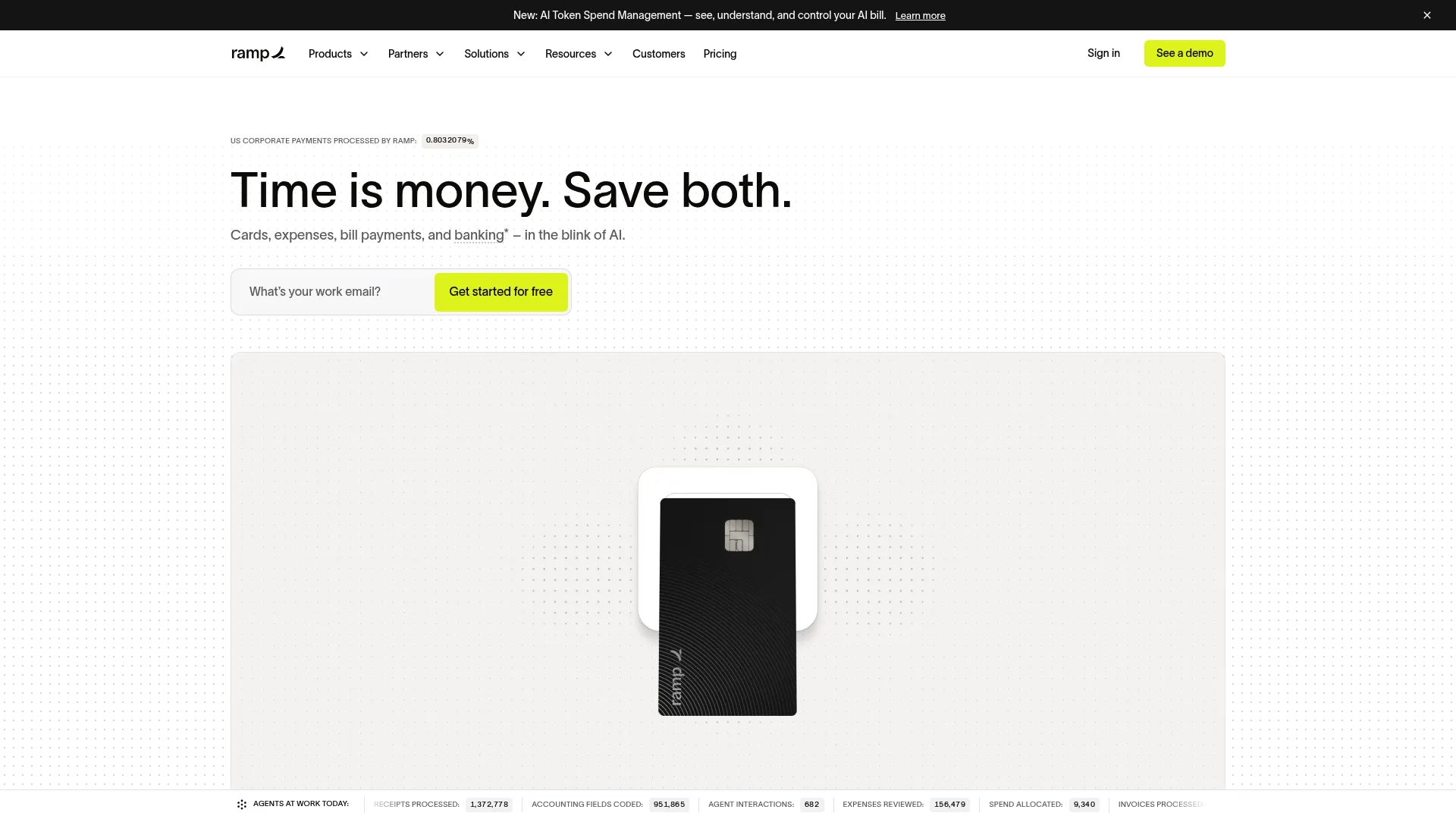
Ramp is the broadest finance platform on this list. It pulls corporate cards, expense management, accounts payable, procurement, and accounting automation into one control layer. The pitch to a founder is simple: fewer tools, more automation, and spend visibility that does not wait for close.
Where Ramp earns its place is automation-first design. It codes transactions, flags policy violations, and surfaces savings opportunities without a finance analyst manually working each line. For a team trying to prove efficient scale to a board, that operational leverage matters more than any single feature.
Best for: Teams that want an all-in-one spend management platform with heavy automation built in.
Key strengths
- Corporate cards with granular spend controls
- Expense management and reimbursements in one flow
- Accounts payable and procurement automation
- Real-time spend visibility and accounting sync
Why choose Ramp: If you are consolidating a scattered finance stack into one system, Ramp covers the most ground. It fits founders who want spend control, AP, and procurement under a single roof rather than stitching three vendors together.
Ramp pricing: Ramp Free starts at $0 per month per user. Ramp Plus adds advanced capabilities and includes a free 30-day trial. Enterprise pricing is available through sales.
2. Payhawk

Payhawk is the strongest pick when you want real-time visibility without necessarily switching cards. It is an AI-native spend management platform covering cards, expenses, bills, travel, and procurement, with a clear angle on existing-card support and global spend.
For a company with international operations, an existing banking relationship, or multiple legal entities, Payhawk removes the switching friction that stalls most card migrations. It handles multi-entity spend management, receipt automation, and approval workflows while syncing cleanly to your ERP and HRIS.
Best for: Finance teams that want one platform for spend controls, AP, procurement, and travel across entities.
Key strengths
- Spend management across cards, expenses, bills, travel, and procurement
- ERP and HRIS integrations
- Card controls, approvals, and reimbursement workflows
- Multi-entity and global spend support
Why choose Payhawk: Choose Payhawk when a card switch is a non-starter or when international and multi-entity spend is your real complexity. It gives global finance teams control without ripping out existing banking relationships.
Payhawk pricing: Public plans start at $299/mo for Travel, $449/mo for Cards & Expenses, $349/mo for Accounts Payable, and $499/mo for Procurement. A Growth program starts at £149/mo for eligible small businesses. There is no free tier.
3. Brex
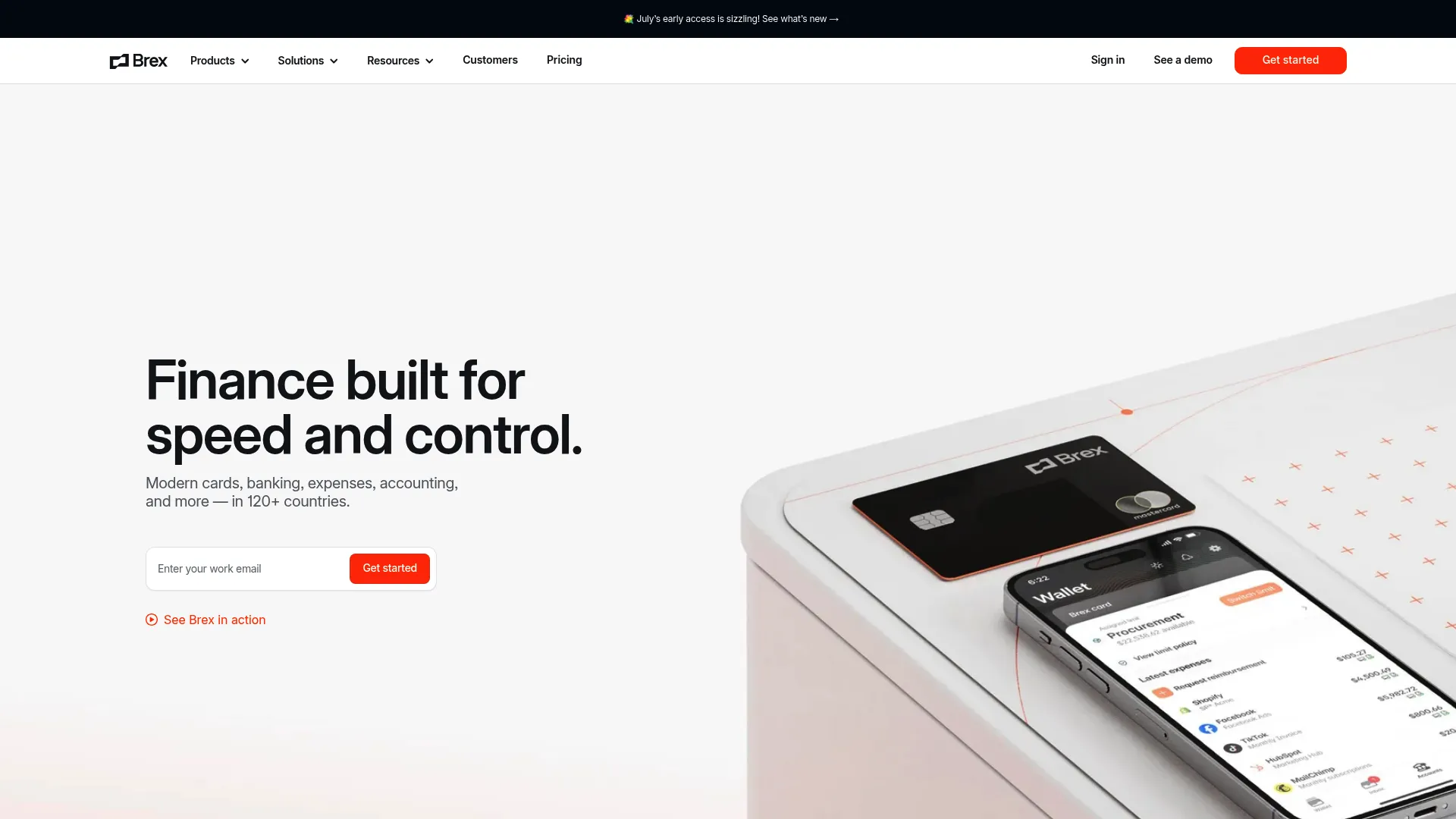
Brex is a modern spend platform built with startups and growth-stage companies in mind. It unifies corporate cards, expense management, bill pay, travel, and business accounts, so a lot of the finance stack lives in one place.
The appeal for founders is the operating-system feel. Cards come with global acceptance and local-currency billing, expense management runs on AI-powered rules, and accounting integrations keep close moving. Teams that want a broad platform from an early stage tend to like how much sits inside one login.
Best for: Companies that want an all-in-one spend platform with a modern, startup-friendly build.
Key strengths
- Corporate cards with global acceptance and local-currency billing
- Expense management with AI-powered rules, reporting, and approvals
- Bill pay, travel booking, and accounting integrations
- Business accounts alongside spend
Why choose Brex: Brex fits teams that value a wide operating layer and expect to grow into more of it. Companies with simpler needs may use only part of the platform, which is fine if you plan to expand usage over time.
Brex pricing: Essentials is $0 per user per month. Premium is $12 per user per month. Enterprise and Smart Card are custom pricing through sales.
4. BILL Spend & Expense
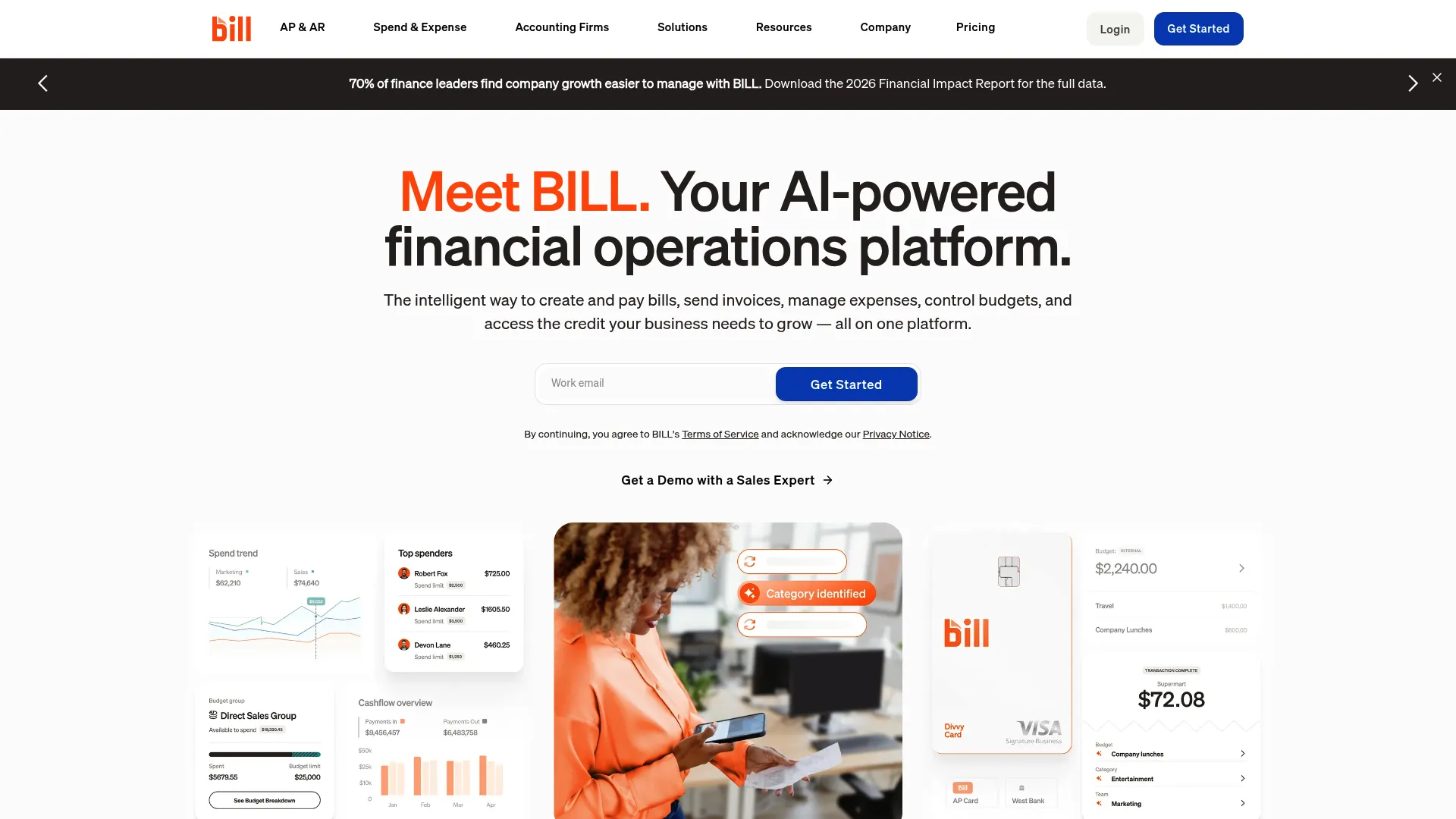
BILL Spend & Expense (formerly Divvy) is the low-friction option for companies that want company cards plus solid expense management without a software fee. It combines cards, budgeting, real-time controls, and automated approvals in one cloud platform.
The value here is getting started fast. You can hand out cards, set budgets, and enforce controls without a procurement cycle or a per-seat bill. Receipt capture and transaction categorization run on AI, and everything syncs to your accounting system. The tradeoff is depth: teams that need heavy procurement or multi-entity governance may want a broader platform.
Best for: SMBs and scaling teams that want unified card spend control and automated expense management at no software cost.
Key strengths
- Company cards with real-time spend controls
- AI-powered receipt capture and transaction categorization
- Automated approvals, reimbursements, and accounting sync
- Budget-based spend management
Why choose BILL Spend & Expense: Choose it when speed to start and zero software cost matter most. It handles cards, budgets, and expense tracking well, and you can move to deeper functionality later if needs grow.
BILL Spend & Expense pricing: $0 per user per month. BILL states there is no subscription or per-user software fee for Spend & Expense.
5. Airbase
Airbase is the strongest mid-market pick when spend management, bill pay, and approval workflows need to live in one place. It covers guided procurement, AP automation, expense management, and corporate cards under a single procure-to-pay platform.
For finance teams where the real work is approvals, purchase requests, and vendor payments, Airbase brings workflow depth that card-first tools do not. It supports multi-subsidiary and multi-currency operations, which matters as a company adds entities. If your spend problem is mostly cards and simple expenses, a lighter tool may be enough. If it is procure-to-pay, this is built for it.
Best for: Mid-market and enterprise teams needing one platform for spend controls, AP, procurement, and cards.
Key strengths
- Guided procurement and purchase request workflows
- Accounts payable automation
- Expense management and corporate cards
- Multi-subsidiary and multi-currency support
Why choose Airbase: Choose Airbase when procurement and AP are the center of gravity, not an afterthought. Its workflow depth fits teams that need real control over purchase-to-pay across subsidiaries.
Airbase pricing: Airbase lists Standard, Premium, and Enterprise plans, all quote-based. Contact sales for numbers tied to your team size and modules.
6. Emburse
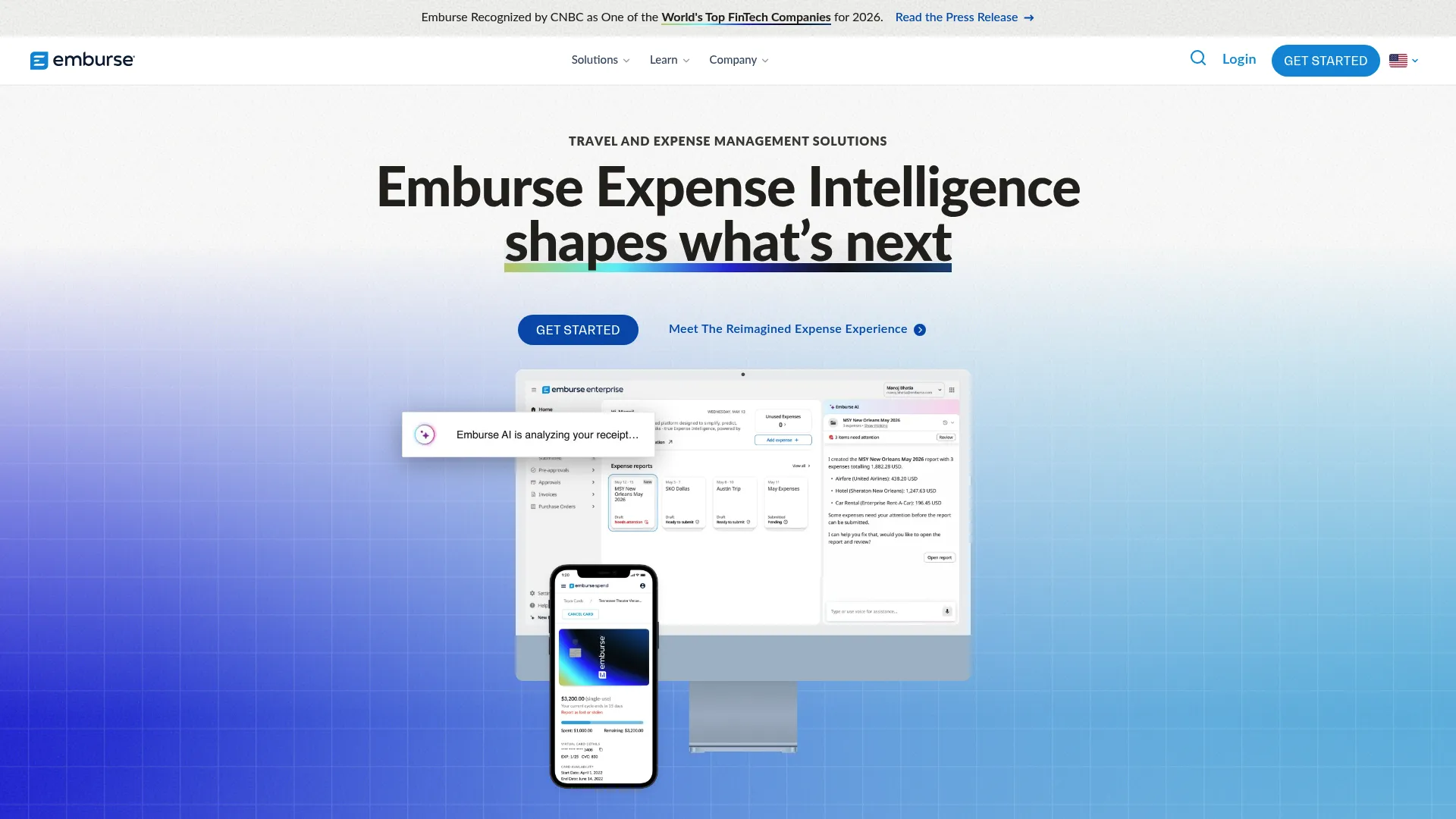
Emburse is the expense intelligence and spend control option for teams with more traditional, process-driven finance operations. It covers travel, expense, AP, and payments with a focus on real-time visibility and catching issues before submission.
Where Emburse fits is process rigor over flashy positioning. It emphasizes policy enforcement, approvals, and reporting, plus pre-submission expense intelligence that flags problems early. For organizations that care about global end-to-end T&E coverage and tight control, that discipline is the draw.
Best for: Organizations that need unified expense, travel, AP, and payments control with strong process enforcement.
Key strengths
- Real-time spend visibility
- Pre-submission expense intelligence
- Global end-to-end travel and expense coverage
- Policy enforcement and approvals
Why choose Emburse: Choose Emburse when your finance team runs on defined process and wants control over T&E at scale. It suits companies that value enforcement and reporting depth over a consumer-style product feel.
Emburse pricing: Emburse Spend starts at $8 per user per month on a monthly plan. Emburse Professional advertises flexible pricing without a public numeric price.
7. Navan
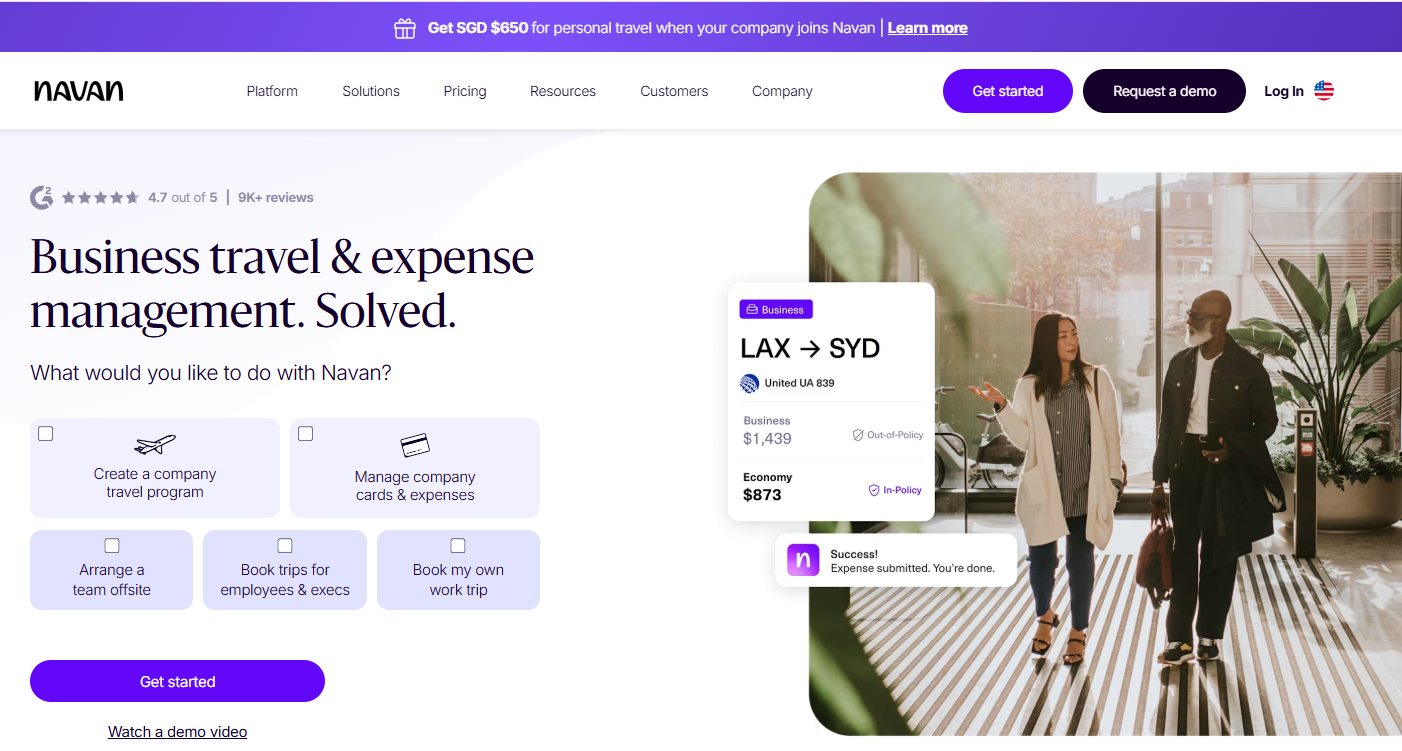
Navan (formerly TripActions) is the platform to reach for when travel is a major part of the spend problem. It ties business travel booking directly to corporate cards, expense management, and spend controls, so travel and expense stop being two disconnected systems.
For a company where employees fly, book hotels, and expense on the road often, Navan connects policy controls to the booking itself. Travelers book within policy, spend flows to the card, and expenses reconcile automatically. If travel is a minor line item, the travel-first design matters less. If it is a core cost, this is where it shines.
Best for: Companies that want an all-in-one platform for business travel and expense management.
Key strengths
- Business travel booking and management
- Expense management and reimbursements
- Corporate card and spend controls
- 24/7 travel support and Navan Rewards
Why choose Navan: Choose Navan when travel drives your spend and you want booking, cards, and expense in one workflow. It performs best for travel-heavy teams that need policy enforced at the point of booking.
Navan pricing: Navan Business is free for companies up to 300 employees. Navan Expense is free for the first 5 monthly expensing users, then $15 per user per month. Navan Enterprise is quote-based.
Considerations before you choose
Picking a corporate card platform is a stack decision, not just a card decision. Run every option through this checklist before you commit.
Real-time visibility and reporting
The whole point is seeing spend before close, not after. Check whether dashboards update live, how spend rolls up by team and category, and whether the reporting is clean enough to put in front of a board. If the data lags, you are back to reactive finance.
Card controls and policy enforcement
Look at how granular the controls get. Per-card limits, merchant category restrictions, and freeze functions should be standard. The real test is whether policy enforcement happens at the point of purchase, blocking or flagging out-of-policy spend automatically instead of after the fact.
Accounting and ERP integrations
Your platform has to sync cleanly to your general ledger. Confirm native support for your accounting system or ERP, how transaction coding maps to your chart of accounts, and how much of month-end close the sync actually removes.
Rollout and switching friction
Migration is the objection that kills most deals. Ask whether you can keep existing cards or must issue new ones, how long setup takes, and how quickly your team gets productive. First-week usability tells you more than a feature list.
Billing model and scale fit
Match the pricing to your stage. Free and low-cost tiers fit early scaling teams, while modular or quote-based pricing suits multi-entity and global operations. Confirm the model still makes sense at 3x your current headcount.
Conclusion
The right corporate card software reduces finance friction, improves visibility, and fits your existing stack without a painful migration. For a Series B founder, that last part matters most: you want a tool that earns its place in the first quarter, not one that becomes another system to manage.
If you want broad automation across cards, expenses, AP, and procurement, Ramp covers the most ground. If a card switch is off the table or you run global, multi-entity spend, Payhawk removes the friction. Want a modern all-in-one platform from an early stage? Brex fits. Need a free card program to start fast? BILL Spend & Expense or Navan Business. AP-heavy mid-market operations lean toward Airbase, process-first finance teams toward Emburse, and travel-heavy companies toward Navan.
Pick the one that maps to your actual spend problem today, not the longest feature list. Start with the platform that gives your finance lead cleaner data and your team fewer hoops, then expand usage as you scale.
If your broader challenge is showing product value to buyers without stitching together five tools, Guideflow helps teams build interactive product experiences fast. Start your journey with Guideflow today!
FAQs
Corporate card software combines company cards with expense automation, receipt capture, approvals, policy controls, and accounting sync in one platform. Instead of handing out cards and reconciling statements weeks later, finance sets rules once and the system enforces them at the moment of purchase, turning spend into a real-time signal.
You issue physical or virtual cards to employees with limits set per person, team, or merchant category. When someone spends, the transaction is captured automatically, coded, and matched to a receipt. Approval workflows route anything that needs review, policy rules flag or block out-of-policy spend, and everything syncs to your accounting system for close.
At minimum: corporate cards with granular card controls, real-time spend visibility, receipt capture, approval workflows, policy enforcement, expense automation, and accounting or ERP integrations. Reimbursement workflows for out-of-pocket spend and multi-entity support round out a platform built to scale with a growing team.
For most scaling teams, yes. Reimbursements are slow, manual, and invisible until close. Corporate cards with expense automation code spend as it happens, enforce policy before money leaves the account, and cut the finance hours spent chasing receipts. Reimbursement workflows still matter for out-of-pocket costs, but they become the exception, not the default.
Yes. Most platforms on this list offer native accounting integrations for tools like QuickBooks and ERP integrations for systems like NetSuite. The sync maps transaction coding to your chart of accounts and removes much of the manual work at month-end. Always confirm your specific accounting system is supported before committing.
It depends on your spend problem. Ramp and Brex both offer free tiers and broad automation that fit fast-scaling startups. BILL Spend & Expense and Navan Business let you start a card program at no software cost. If travel drives your spend, Navan fits; if you run multiple entities, Payhawk removes card-switching friction.
Card controls set limits before spend happens, not after. You cap amounts per card, restrict merchant categories, and freeze cards instantly. Policy enforcement flags or blocks out-of-policy purchases at the point of sale, and real-time spend visibility lets finance catch a department trending over budget mid-month instead of discovering it at close.
Ask whether you can keep existing cards or must issue new ones, how long rollout takes, and how quickly your team gets productive. Confirm the accounting and ERP integrations you rely on, how granular the card controls and policy enforcement get, and whether the billing model still fits at 3x your current headcount. Migration friction is what kills most switches, so test first-week setup before you commit.
.avif)