You run three scales, two yards, and a spreadsheet that four people edit at once. Receiving happens faster than anyone can log it. A customer calls asking where their last load of copper ended up, and it takes twenty minutes and two phone calls to reconstruct the answer. When an auditor shows up, someone spends a day pulling paper tickets from a filing cabinet.
That is the real cost of running recycling operations on manual recordkeeping. It is not one big failure. It is a hundred small gaps: material that moves without a record, weights logged wrong, inventory that never reconciles, compliance documentation scattered across email and folders. Each gap is survivable. Together, they cap how large you can grow before the admin load swallows your margin.
Recycling management software closes those gaps by tying intake, inventory, traceability, compliance, and shipping into one system. The market is moving in that direction fast. According to Bless and Den Services (2024), over 55% of municipalities worldwide now deploy at least one software-based system for route optimization, compliance reporting, or asset tracking, up from below 30% five years ago. Cloud-based deployment already accounts for 62.5% of all waste management software installations. The recycling software market itself is projected to grow at a 12.5% CAGR through 2033, per Verified Market Reports (2024).
This guide compares eight recycling management software solutions built for scrap, metal, and materials recovery operators who want end-to-end visibility instead of another spreadsheet. If your recycling operations manager software still lives in Excel, this is the shortlist to start from.
What's inside
This is a buyer's comparison for operators evaluating recycling software across scrap yards, metal recycling, paper and plastic recovery, and general materials handling. It is written for owners, operations leaders, and recycling operations managers who need to replace manual receiving and disconnected records with one system.
We selected and ranked tools on four operational criteria:
- Workflow depth across intake, sorting, processing, inventory, and shipping
- Traceability and documentation, including source-to-finish tracking and audit-ready records
- Barcode scanning or weight-based logging support at the scale and station
- Reporting, compliance, and multi-site inventory control for operations that run more than one location
Pricing and ratings reflect verified vendor sources at time of writing. Where a vendor gates pricing behind a quote, we say so plainly.
TL;DR
- Best all-in-one scrap and recycling operations platform: ReMatter, for operators who want ticketing, pricing, inventory, dispatch, and reporting in one place with no per-user or per-ticket fees.
- Best for scrap yard control and anti-theft compliance: ScrapWare, purpose-built for scrap and recyclable materials workflows.
- Best for ERP-style trading, orders, and settlement: CieTrade, for commodity traders and recyclers who live in buy/sell forms and pricing history.
- Best compliance-driven ticketing for scrap yards: ScrapRight, with a compliance engine wired into purchasing and ticketing.
- Best for barcode-heavy and multi-material operations: Nexus, with flexible deployment and support for scrap, metal, paper, plastic, and e-waste.
- Best for waste data, manifests, and regulatory documents: Wastebits, for operators who need compliance workflows and environmental data management.
What is recycling management software?
Recycling management software is a system that manages the full operational lifecycle of recycled materials, from collection and intake through sorting, processing, inventory, and shipping, while capturing the traceability and compliance records the business needs to run and prove its work.
Unlike general inventory tools, recycling business software understands material-specific workflows: gross and tare net weight tracking at the scale, grade-based pricing, source-to-finish traceability, and the regulatory documentation that scrap and waste operations are required to keep.
Core capabilities to expect:
- Collection and intake: scale ticketing, receiving workflows, and supplier records at the point material enters the yard.
- Sorting and processing: tracking material as it changes grade, form, or location during processing.
- Inventory and weight tracking: live inventory by commodity, with gross, tare, and net weight capture, often supported by recycling software with barcode scanning at the station.
- Traceability and documentation: source-to-finish traceability so any lot of material can be traced back to its origin and forward to its buyer.
- Compliance reporting: audit-ready documentation, anti-theft compliance records, ID and signature capture, and jurisdiction-specific reporting.
- Sales, shipping, and settlement support: purchase and sales orders, automated bills of lading, dispatch, and settlement tied back to inventory.
The strongest recycling software connects all six so a load logged at receiving flows through to a bill of lading and a compliance report without anyone re-keying data.
When to use recycling management software
Not every operation needs a full platform on day one. These are the signals that a system will pay for itself.
When spreadsheets break under receiving volume
A spreadsheet works until two scales are running and three people are logging tickets at once. Then you get overwrites, missed loads, and weights that never reconcile against inventory. When receiving volume outpaces manual logging, dedicated software captures each transaction at the point it happens, so the record is right the first time.
When you need traceability for audits and customers
Buyers and auditors increasingly ask where material came from and where it went. If reconstructing that chain means digging through paper tickets, you need source-to-finish traceability built into the system. Audit-ready documentation turns a day of filing-cabinet archaeology into a filtered report.
When multiple sites need the same inventory view
Running more than one yard on separate spreadsheets means you never trust the combined number. Multi-site inventory control gives every location a shared, live view of commodity positions, so you can move material, price it, and report on it as one operation instead of several disconnected ones.
When barcode scanning or weight-based logging is core to operations
If your throughput depends on fast, accurate capture at the scale, manual entry is the bottleneck. Recycling software with barcode scanning and integrated weight capture logs a transaction in seconds and ties it straight to inventory, pricing, and compliance records.
Comparison table
Here is how the eight tools compare on intent, primary use case, pricing, and rating. Use it to shortlist two or three before reading the full sections.
| # | Product | Intent | Key use case | Pricing | G2 rating |
|---|---|---|---|---|---|
| 1 | ReMatter | All-in-one scrap yard software | Ticketing, pricing, inventory, dispatch, and reporting per location | Quote-based (Essentials, Pro, Enterprise) | 4.7/5 |
| 2 | ScrapWare | Scrap and recycling operations | Purchases, sales, inventory, anti-theft compliance | Contact vendor | Not rated |
| 3 | CieTrade | Commodity trading and recycling ERP | Buy/sell trading, orders, pricing history, settlement | From $375/mo (via G2) | 5.0/5 |
| 4 | ScrapRight | Compliance-driven scrap yard software | Compliance engine, ticketing, inventory, reporting | From $698/mo | Not rated |
| 5 | Nexus | Multi-material recycling software | Pricing, inventory, reporting, multi-site inventory control | From $280/mo | Not rated |
| 6 | Wastebits | Waste and recycling compliance | Manifests, regulatory documents, environmental data | Free; Premium from $249/mo | Not rated |
| 7 | RecyclerGuard | Compliance-oriented transactions | ID scanning, signature and fingerprint capture, inventory | $2,500 one-time per system | 3.5/5 |
| 8 | GreenSpark | AI-powered scrap yard operations | Ticketing, dispatch, inventory, pricing, finance, reporting | Quote-based | Not rated |
Ratings and pricing reflect verified vendor and G2 sources at time of writing. Several vendors quote per location or per system rather than per user, so compare on total operational cost, not headline price.
1. ReMatter
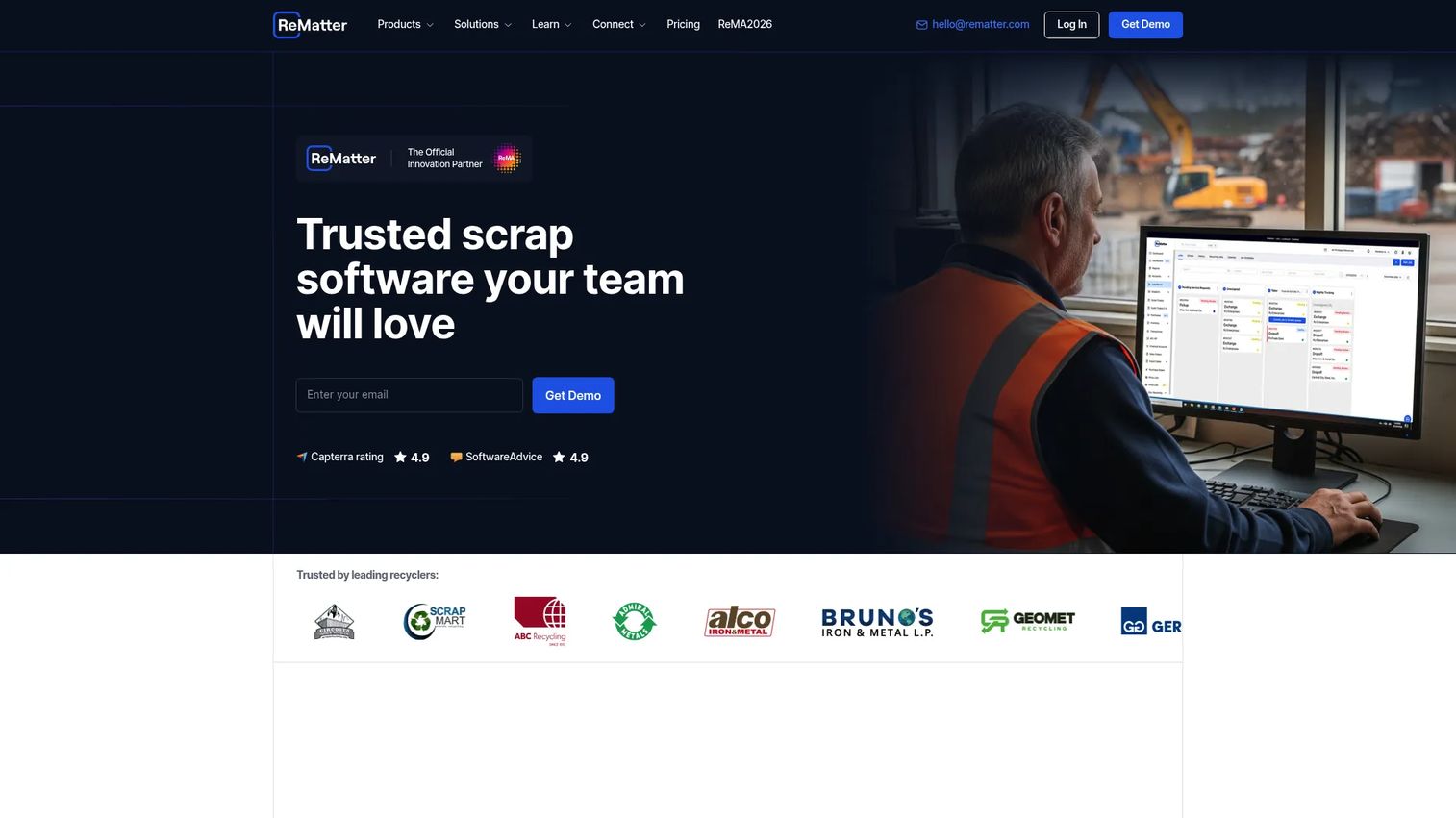
ReMatter is a scrap yard and recycling operations platform that pulls scale ticketing, pricing, inventory, orders, dispatch, and reporting into one system. It is built for scrap recyclers who want to run the whole yard, from the moment a supplier drives onto the scale to the moment material ships out, without stitching together separate tools for each step. The operator mobile app and hardware integrations mean the record starts at the point of transaction, not after the fact.
Best for: Scrap recyclers who want an all-in-one yard operations platform with predictable, location-based pricing.
Key strengths
- Scale ticketing with hardware integrations: capture weights and transactions at the scale, so receiving is logged accurately in real time.
- Customizable pricing and price lists: manage grade-based pricing that updates across the operation instead of living in someone's head.
- Inventory, orders, and dispatch in one flow: track commodity positions and move material to sales and shipping without re-keying data.
Why choose ReMatter: If your main pain is fragmentation, disconnected ticketing, spreadsheets, and separate accounting exports, ReMatter's appeal is that one transaction flows end to end. The pricing model matters here too: it is quoted per location with no per-user or per-ticket fees, so a busy yard is not penalized for high transaction volume or a growing team.
ReMatter pricing: Pricing is quote-based and offered in Essentials, Pro, and Enterprise plans, priced per location with add-ons available. There are no per-user or per-ticket fees, which suits high-throughput yards. No public dollar figure is listed; you request a quote based on your locations and modules. ReMatter carries a 4.7/5 rating.
2. ScrapWare
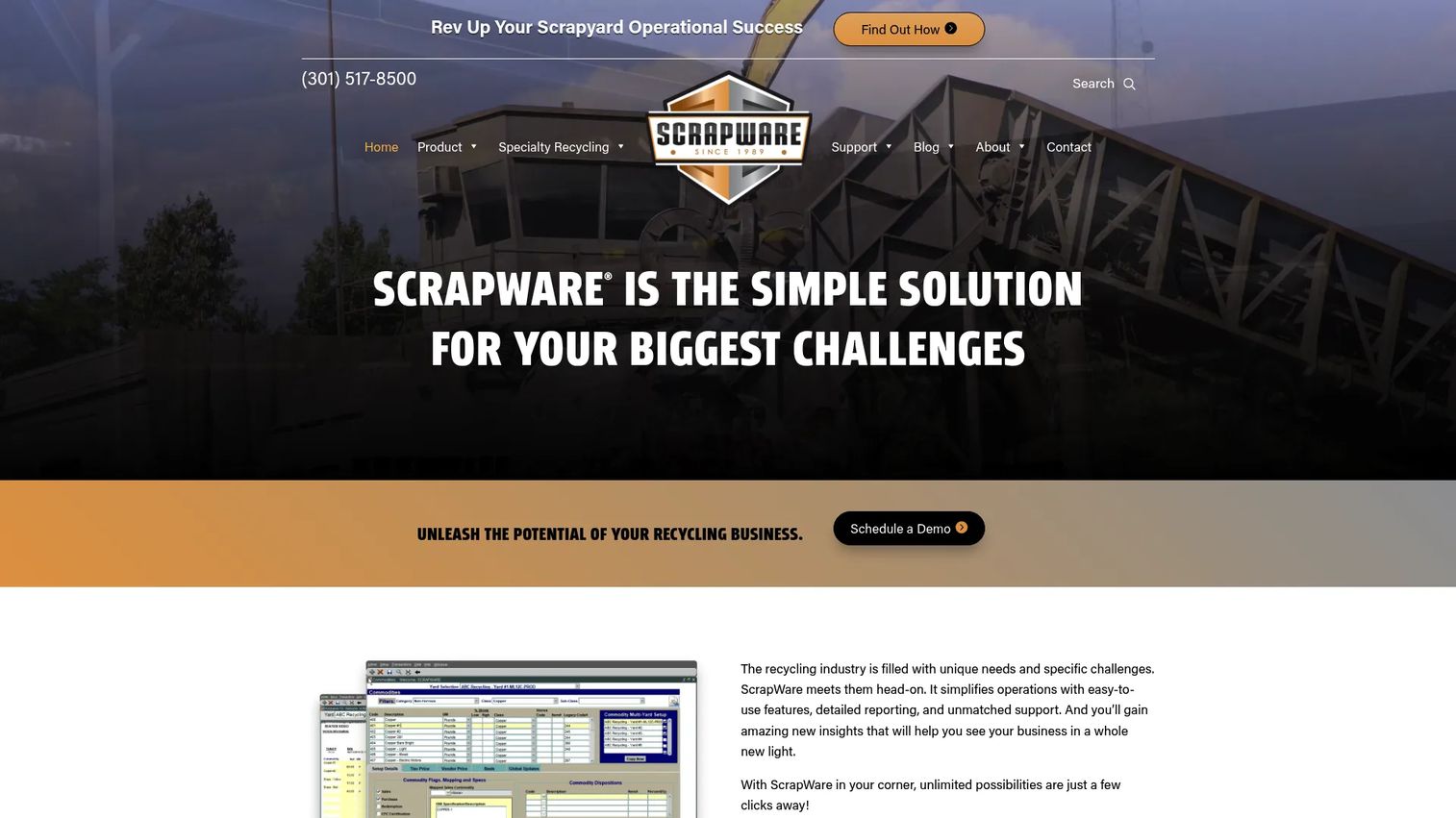
ScrapWare is recycling-industry software built specifically for scrap and recyclable materials operations. It has been focused on this niche long enough to reflect how scrap yards actually work, covering purchases, sales, inventory, quotes and contracts, and the anti-theft compliance records that scrap buying requires. For operators who want scrap metal recycling software that speaks their language rather than a repurposed generic tool, ScrapWare is a strong fit.
Best for: Scrap and recycling businesses that want deep, industry-specific yard, compliance, and operations control.
Key strengths
- Anti-theft compliance built in: capture the buyer records and documentation that scrap purchasing regulations require, without a bolt-on.
- Purchases, sales, and inventory in one ledger: keep buying, selling, and stock reconciled through a shared ledger interface.
- Quotes and contracts: manage commercial agreements alongside daily transactions so pricing commitments carry through to settlement.
Why choose ScrapWare: ScrapWare's value is depth in the scrap niche. If your operation lives and dies by compliant buying and clean inventory, a tool designed around those exact workflows removes the friction of adapting generic software to scrap rules. It fits operators who value fit-for-purpose control over broad, general-purpose flexibility.
ScrapWare pricing: ScrapWare does not publish a public price. The company uses a demo and contact-sales model, so pricing is quoted based on your operation. No current G2 star rating is available from a meaningful sample, so evaluate it through a direct demo against your own receiving and compliance workflows.
3. CieTrade
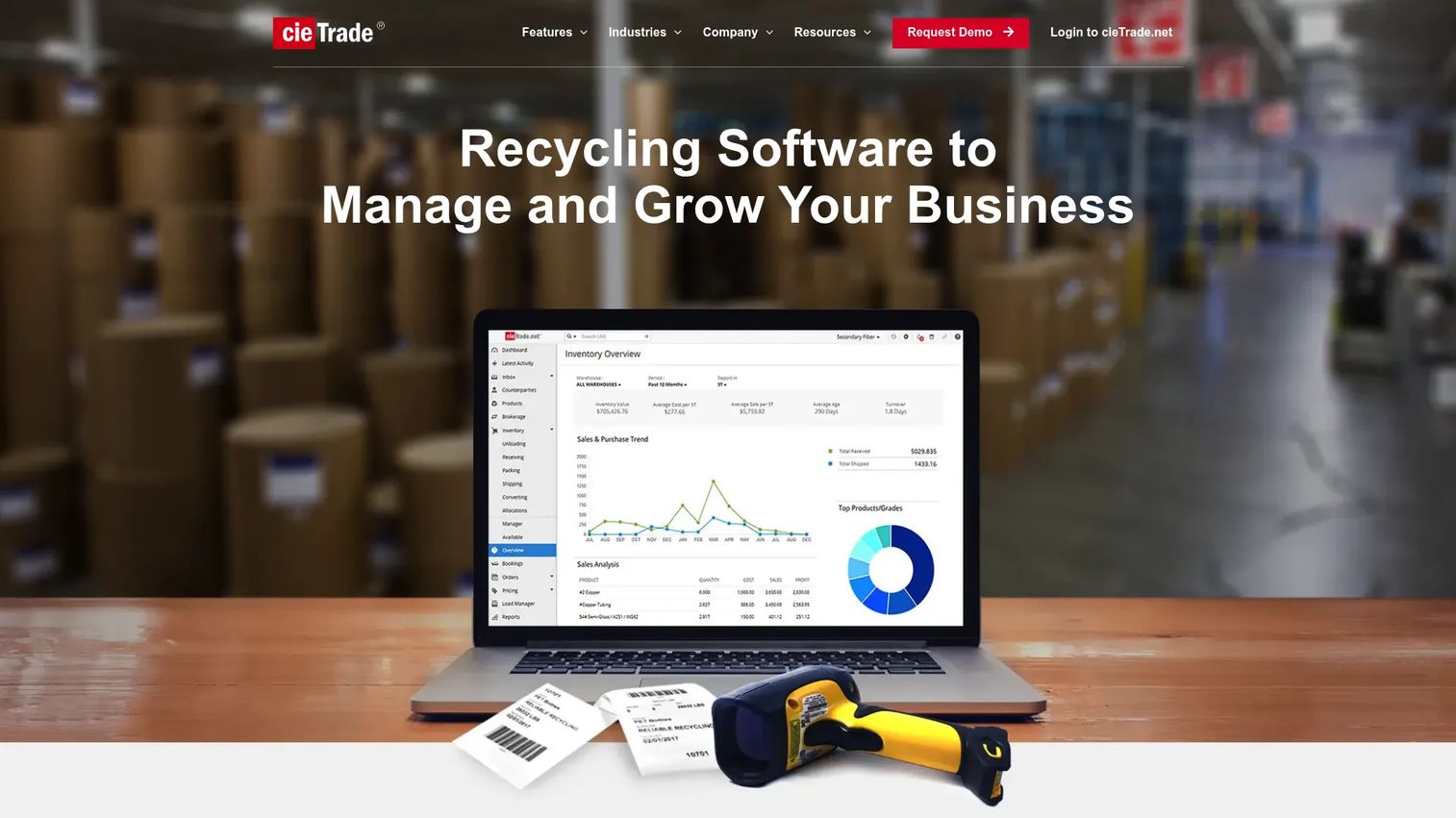
CieTrade is cloud software for commodity trading, recycling, and related material-handling operations. Where yard-first tools center on the scale, CieTrade centers on the deal: buy and sell trading forms, orders, pricing and pricing history, document generation, and settlement. That makes it the closest thing on this list to ERP-style control for recyclers who are as much traders as they are processors.
Best for: Commodity traders and recycling businesses that need an industry-specific operations platform built around orders and settlement.
Key strengths
- Buy/sell trading forms with pricing history: manage the commercial side of recycling with full visibility into how pricing has moved over time.
- Document generation and email automation: produce and send order documents and paperwork automatically, cutting manual admin.
- Self-service portal and accounting integration: give customers a portal and keep financials reconciled through accounting integration and mobile apps.
Why choose CieTrade: If your business is defined by trading volume, customer orders, and settlement as much as by physical processing, CieTrade's order-and-settlement backbone fits better than a pure yard tool. It suits operators who want customer order management, sales, and shipping tightly integrated with financial workflows.
CieTrade pricing: CieTrade prices based on concurrent users, with all core features included in the cloud subscription. The vendor site does not publish a figure, but G2 lists a starting price of $375/month billed monthly for up to three users, with no free tier. CieTrade holds a 5.0/5 rating.
4. ScrapRight
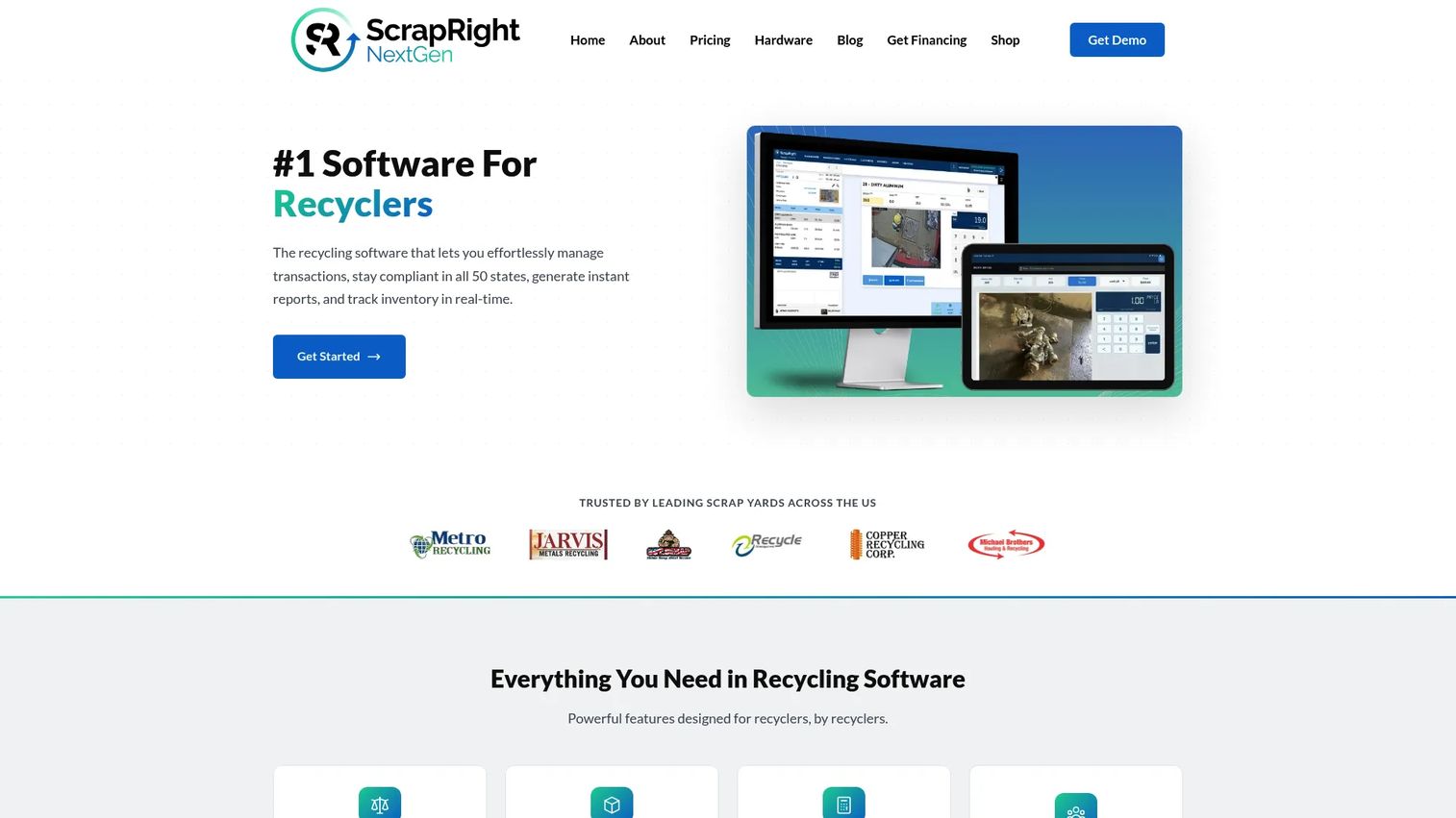
ScrapRight is recycling and scrap yard software built around compliance. Its compliance engine sits directly inside scrap purchasing and ticketing, so the records regulators want are captured as part of the transaction rather than reconstructed later. Add inventory control, reporting, mobile apps, and accounting integrations, and it works as a practical middle-market operations choice for yards that treat compliance as non-negotiable.
Best for: Scrap yards and recyclers that need compliance-driven ticketing and inventory workflows without enterprise overhead.
Key strengths
- Compliance engine wired into ticketing: capture required buyer and transaction records at the moment of purchase, producing audit-ready documentation.
- Inventory control and reporting: keep commodity positions accurate and reportable across the operation.
- Mobile apps and accounting integrations: log transactions in the field and keep financials synced.
Why choose ScrapRight: ScrapRight is a good fit when compliance risk is your main concern and you want a system that enforces clean records at the point of purchase. It sits between lightweight tools and heavier ERP platforms, giving mid-sized yards real workflow depth at a defined monthly cost.
ScrapRight pricing: Public pricing shows a Buy Side + Compliance plan and a Commercial Buy/Sell Suite at $698/month each, and an Enterprise (Full Software) plan at $1,998/month. Some pages also note a one-time $8,500 startup fee and an annual commitment. There is no free tier. G2 currently shows no rating from customer reviews, so weigh Capterra and direct references alongside a demo.
5. Nexus
Nexus is recycling software for scrap, metal, paper, plastic, and e-waste operations. Its breadth across material types makes it a strong pick for operators handling more than one commodity stream. Nexus supports pricing, inventory, reporting, and customer management, and it ships in cloud, local-install, and hybrid deployments, so you can match it to your IT reality rather than the other way around.
Best for: Scrap and recycling operators handling multiple material types who need flexible deployment and multi-site inventory control.
Key strengths
- Multi-material coverage: handle scrap, metal, paper, plastic, and e-waste in one system instead of separate tools per stream.
- Flexible deployment: choose cloud, local install, or hybrid to fit your infrastructure and connectivity.
- Compliance and reporting across jurisdictions: support reporting requirements for multiple jurisdictions and use cases.
Why choose Nexus: Nexus fits operations that are not purely scrap metal, or that run several material lines and want one platform across all of them. The deployment flexibility is genuinely useful for yards where connectivity is unreliable or where local control over data matters.
Nexus pricing: Public pricing lists a Nexus BASIC lease at $280/month for one yard and one station, a Nexus FULL lease at $499/month for one yard and one station, and an outright purchase at $14,500 per yard. Additional stations, installation, and training carry extra fees. A free trial is available. No G2 rating is currently published, so evaluate it through the trial against your material mix.
6. Wastebits
Wastebits is waste management software focused on compliance, tracking, manifests, and analytics. Where the scrap-first tools center on the scale, Wastebits centers on regulatory documentation and environmental data, which makes it a strong fit for operations where manifests and reporting carry the heaviest load. Its API connectivity with EHS and ERP systems lets it plug into a wider operational stack.
Best for: Waste and recycling operators who need compliance workflows and waste data management above pure yard ticketing.
Key strengths
- Manifest and regulatory document management: handle the paperwork that disposal and waste operations are required to keep, in one place.
- Real-time environmental data tracking: monitor and report environmental data as it happens.
- API connectivity with EHS and ERP systems: integrate waste data into broader environmental, health, safety, and ERP workflows.
Why choose Wastebits: If your compliance burden is defined by manifests and environmental reporting rather than scrap buying, Wastebits is built around exactly that. It suits disposal-heavy and waste-focused operations that want reporting and operational visibility as the primary outcome.
Wastebits pricing: Wastebits Insights offers Free, Premium, and Enterprise tiers. Premium is $199 per user per month billed annually, or $249 per user per month billed monthly. Enterprise is custom. Pricing was verified for Wastebits Insights specifically; other parts of the platform may be quoted separately. No current G2 rating from a meaningful review sample is available.
7. RecyclerGuard
RecyclerGuard is scrap yard and recycling center software and hardware built around compliance at the point of transaction. It bundles driver's license scanning, electronic signature capture, and an electronic fingerprint reader, so identity and compliance records are captured at the counter rather than logged afterward. For operators who want a defined, one-time cost and hardware included, it is a distinctive option.
Best for: Recycling centers and scrap yards that need compliance-oriented transaction software with identity capture hardware included.
Key strengths
- Driver's license scanning: capture seller identity fast and accurately at the point of purchase.
- Electronic signature and fingerprint capture: build a defensible compliance record for each transaction.
- Bundled hardware: the system includes ID scanner, fingerprint reader, signature pad, and cameras, so you are not sourcing devices separately.
Why choose RecyclerGuard: RecyclerGuard suits operators whose priority is airtight transaction-level compliance and who prefer a one-time hardware-inclusive purchase over a monthly subscription. It is focused on the buy-side compliance moment more than broad, multi-site operational management.
RecyclerGuard pricing: The public pricing page shows a $2,500 flat, one-time price per computer system, listed as a special against a $5,000 crossed-out price. That includes the computer system, ID scanner, fingerprint reader, signature pad, customer camera, and scale camera. There is no free tier. RecyclerGuard holds a 3.5/5 G2 rating from a small review sample, so cross-reference other sources before deciding.
8. GreenSpark
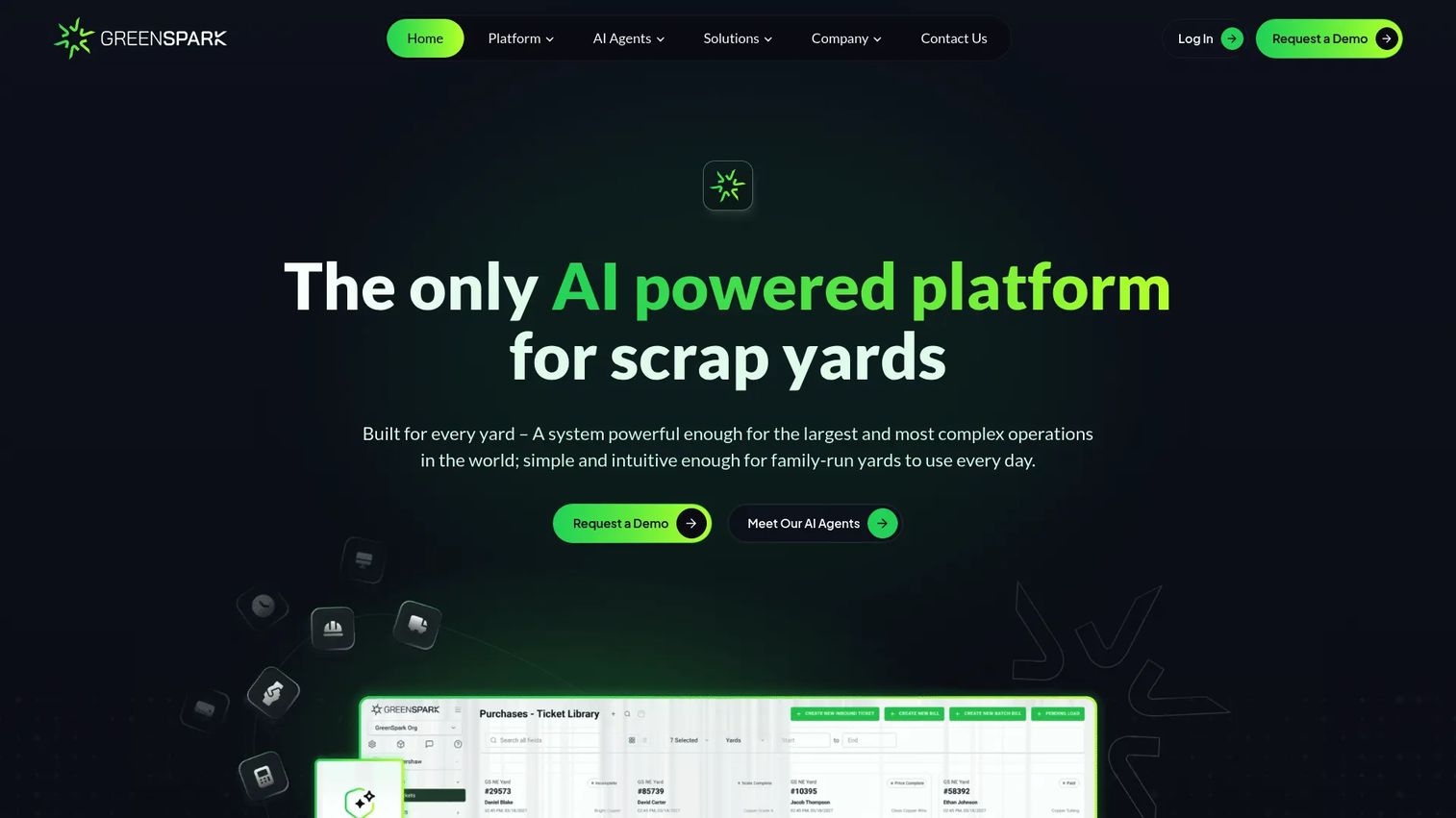
GreenSpark is AI-powered scrap yard and recycling operations software that brings ticketing, dispatch, inventory, pricing, exports, finance, and reporting into a single platform. It is built for operators who want to manage recycling activity end to end and layer in automation on top of the operational core. Its commercial tools and broad integration set make it a flexible fit for teams that want clarity across the whole operation.
Best for: Scrap yards and recycling operators who want an all-in-one platform with AI automation across operations.
Key strengths
- End-to-end operations in one platform: run ticketing, dispatch, inventory, pricing, exports, finance, and reporting together.
- Commercial tools: manage price lists, contracts, account history, and approvals for the commercial side of the business.
- Broad integrations: connect accounting, ERP, CRM, logistics, analytics, and yard hardware.
Why choose GreenSpark: GreenSpark fits operators who want a modern, integrated platform and are interested in AI agents handling repetitive operational work. The wide integration set means it can sit at the center of an existing stack rather than forcing a rip-and-replace. It suits teams prioritizing end-to-end clarity and automation.
GreenSpark pricing: GreenSpark does not publish public pricing. The company prices based on the number of yards and modules, with AI agents priced separately and no per-user or per-ticket fees. Request a quote scoped to your operation. No verified current G2 rating is available, so lean on a scoped demo and references.
What to look for before you buy
Before you shortlist, pressure-test each tool against how your operation actually runs.
Workflow depth end to end
Map your real flow: collection, intake, sorting, processing, inventory, and shipping. The right tool covers the steps you actually run without forcing manual workarounds between them. A gap at any stage means someone re-keys data, which is where errors and lost time live.
Traceability and audit-ready documentation
Ask whether you can trace any lot of material back to its source and forward to its buyer. Source-to-finish traceability and audit-ready documentation turn compliance from a fire drill into a filtered report. If a tool cannot reconstruct the chain in a few clicks, it will not save you when an auditor calls.
Barcode scanning and weight capture
If throughput depends on fast, accurate capture, confirm the tool supports recycling software with barcode scanning and integrated scale weights, including gross, tare, and net weight tracking. Manual entry at the scale is the most common hidden bottleneck in high-volume yards.
Multi-site inventory control
If you run more than one location, verify that inventory is shared and live across sites, not siloed per yard. Multi-site inventory control is the difference between trusting your combined commodity position and guessing at it.
Compliance reporting for your jurisdiction
Compliance reporting for recycling varies by region and material. Confirm the tool captures the records your regulators require, including anti-theft and identity data where applicable, and can produce the reports you actually file.
Conclusion
Every tool here solves the same core problem, replacing manual receiving and scattered records with one system, but they solve it for different operations.
For an all-in-one scrap yard platform with predictable per-location pricing, ReMatter is the strongest starting point. If deep scrap-niche control and anti-theft compliance matter most, look at ScrapWare. For trading-heavy recyclers who live in orders and settlement, CieTrade delivers ERP-style depth. ScrapRight fits mid-market yards that want compliance enforced at ticketing, while Nexus suits multi-material operations that need flexible deployment and multi-site inventory control. Wastebits owns the manifest and environmental-data angle, RecyclerGuard covers hardware-inclusive identity compliance, and GreenSpark brings AI automation to end-to-end recycling operations management.
Your next step: shortlist two or three based on your size and workflow complexity, then run a real demo using your own receiving, inventory, and compliance scenarios. Metal recycling software earns its place only when it handles your busiest day, not a vendor's clean example. Book demos, bring your messiest workflow, and choose the recycling business software that removes the most manual steps.
FAQs
It manages the operational lifecycle of recycled material, from intake and sorting through inventory, processing, and shipping, while capturing the traceability and compliance records the business needs. In practice, it replaces spreadsheets and paper tickets by logging each transaction at the scale, keeping live inventory, and producing audit-ready documentation and shipping paperwork automatically.
Prioritize workflow depth across intake, inventory, and shipping; source-to-finish traceability; barcode scanning and weight capture at the scale; compliance reporting for your jurisdiction; and multi-site inventory control if you run more than one yard. The right mix depends on your operation, but traceability and accurate weight logging are near-universal needs.
Yes. Scrap yard software is one of the most mature segments of the category, with tools like ReMatter, ScrapWare, ScrapRight, and RecyclerGuard built specifically for scrap workflows. Scrap metal recycling software typically adds scale ticketing, grade-based pricing, anti-theft compliance, and identity capture that generic tools do not handle.
It captures required records at the point of transaction, including seller identity, signatures, weights, and material details, so audit-ready documentation exists before you ever need it. Compliance reporting for recycling is then a matter of running a report rather than reconstructing history from paper tickets and email.
Focus on multi-site inventory control that gives every location a shared, live view of commodity positions, plus consolidated reporting across yards. You want to price, move, and report on material as one operation. Nexus and the broader ERP-style platforms are built for this.
If your throughput depends on fast, accurate capture at the scale or station, yes. Recycling software with barcode scanning logs a transaction in seconds and ties it directly to inventory, pricing, and compliance, removing the manual-entry bottleneck. For lower-volume operations, integrated weight capture may be enough on its own.
General inventory software tracks stock counts but does not understand material-specific workflows like gross and tare net weight tracking, grade-based pricing, scale integration, or scrap compliance rules. Recycling business software is built around those realities, including source-to-finish traceability and automated bills of lading tied to material movement.
If your business is defined by trading, orders, and settlement, an ERP-style platform like CieTrade fits the commercial workflow better. If your priority is fast, compliant yard operations at the scale, a scrap-yard-focused tool like ReMatter, ScrapWare, or ScrapRight gives you purpose-built depth. Shortlist based on where most of your daily work happens, then demo against real scenarios.