


One bad tenant costs more than a month of vacancy. Missed rent, an eviction filing, legal fees, unit damage, and the weeks it takes to turn the place over again. So you screen. But the moment you start comparing tools, every vendor makes the same three promises: fast results, trusted data, and compliant workflows.
They can't all be right for you.
The real job here is narrower than the marketing suggests. You want to reduce bad-tenant risk without making the application clunky, slow, or legally risky. That means a screening flow that is easy to send, quick to return, and clear enough to defend a denial or an approval. The tenant screening software market hit $3.2 billion in 2025 and is projected to reach $6.1 billion by 2034, according to MarketIntelo (2025), which tells you two things: there are a lot of options, and the differences between them are real.
This guide cuts through it. The distinction that matters most is not the brand name. It is the pricing model, the report bundle, and how the tenant background check fits your actual workflow.
What's inside
This guide covers eight tenant screening software options for 2026, evaluated for landlords, small property owners, and property managers who want a repeatable screening process. We chose tools that combine online tenant screening services with a usable rental workflow, and we compared them on four things:
- Report bundle: credit, background, eviction history, and income verification
- Workflow speed: how fast the invite-to-report loop closes
- Pricing model: free, landlord-paid, or applicant-paid
- Compliance handling: how the platform supports FCRA-friendly decisions
You will see which tenant screening services for landlords fit a free-first budget, an applicant-paid model, or an all-in-one property management stack.
TL;DR
- Best overall for most landlords: TurboTenant, for a free base plan that pairs listings, applications, and screening in one flow.
- Best free option: Innago, free property management with a built-in tenant background check and no monthly fee.
- Best for all-in-one property management: DoorLoop, for growing portfolios that need accounting, maintenance, and screening in one system.
- Best for tenant communication and rent workflows: RentRedi, for self-managing owners who want flat-rate, mobile-first operations.
- Best for faster decisions and applicant-paid screening: RentSpree, for sending a screening link and letting the applicant pay per report.
What is tenant screening software?
Tenant screening software is a tool that lets landlords and property managers collect a rental application, run a credit and background check, review eviction history, and verify income before approving a tenant. It replaces the manual, paper-and-email version of applicant screening with a single online workflow.
The core rental background check bundle usually includes four components:
- Credit report: payment history, debt, and a credit-based risk score pulled from a bureau
- Background check: criminal records and identity verification for the renter
- Eviction history check: prior eviction filings and judgments tied to the applicant
- Income verification: pay stubs, bank data, or documents that confirm the applicant can afford rent
A few operational points that shape which tool fits:
- Who pays: some platforms are free to the landlord and charge the applicant a fee, some charge the landlord per report, and some bundle screening into a subscription.
- How consent works: the applicant authorizes the tenant screening background check, and the platform verifies identity before releasing bureau data.
- Why speed matters: most tools return reports the same day, often within minutes once identity is confirmed, which keeps good applicants from walking to another unit.
North America accounts for 45.8% of tenant screening software revenue and property managers make up 42.3% of end users, per MarketIntelo (2025). That concentration is why most tools in this guide sit inside a broader property management workflow rather than selling screening alone.
When to use tenant screening software
Screen applicants before signing a lease
Run a background check for renters before you commit to a lease, not after. Consistent screening across every applicant is how you reduce risk and defend the decision later. A documented, repeatable process protects you more than a gut call. Apply the same criteria to everyone and let the report do the talking.
Move faster on vacant units
Vacancy is a daily cost. When three prospects are interested in the same unit, the landlord who returns a screening decision first usually wins the good tenant. Same-day and minute-level turnaround is not a nice-to-have here. It is the difference between filling the unit this week and re-listing next week.
Standardize approvals across properties
If you own more than one unit, inconsistent decisions become a liability. A repeatable landlord tenant screening workflow, with the same report bundle and the same approval criteria for every applicant, keeps your process defensible and easy to hand off. This matters most when you add units or bring on a property manager.
Comparison table
Read this table top to bottom by pricing model first. The fastest, most mainstream free and applicant-paid options sit near the top; the deeper all-in-one platforms sit lower. Pricing and G2 ratings below were verified against each vendor's live pricing page and G2 listing as of July 2026.
| # | Product | Best for | Key use case | Pricing | G2 rating |
|---|---|---|---|---|---|
| 1 | Zillow Rental Manager | Landlords in the Zillow rental flow | Free listings, applications, and screening | Free to landlord; $35 applicant fee | 3.9/5 |
| 2 | TenantCloud | Small teams wanting one platform | Rent, leasing, maintenance, and screening | From $15/mo (annual) | 4.4/5 |
| 3 | RentRedi | Self-managing, mobile-first owners | Flat-rate rent, listings, and screening | From $12/mo (annual) | 4.3/5 |
| 4 | RentSpree | Agents and landlords wanting fast screening | Applicant-paid screening reports | Free base; reports $39.99+ | 4.4/5 |
| 5 | Avail | DIY landlords with small portfolios | Application-to-screening workflow | Free; $9/unit Plus | 4.0/5 |
| 6 | Innago | Budget-conscious landlords | Free all-in-one management and screening | Free | 4.9/5 |
| 7 | TurboTenant | Independent landlords wanting all-in-one | Listing to application to screening | Free; paid from $12.42/mo | 4.5/5 |
| 8 | DoorLoop | Growing portfolios and structured teams | Full property operations plus screening | From $69/mo | 4.8/5 |
Best 8 tenant screening software tools for 2026
1. Zillow Rental Manager

Zillow Rental Manager is a free set of rental management tools for landlords and property managers, built into the platform where most renters already search. You can Zillow Rental Manager list a unit, collect applications, and run screening from one place, which suits landlords who want the listing and the tenant background check in a single flow.
Best for: landlords who want free listing, screening, and rent collection tools without a subscription.
Key strengths
- Free rental listings on a high-traffic marketplace
- Screening with applications, credit reports, and background checks
- Online rent collection via ACH, card, and debit
- Applicant-paid screening keeps landlord cost at zero
The screening bundle covers credit, background, and eviction-related history, and the applicant can attach income documents during the application. Because the workflow lives inside Zillow's rental flow, the invite-to-report loop is short: the renter applies where they found the listing, authorizes the check, and the report returns to you.
Why choose Zillow Rental Manager: if your listings already run on Zillow, keeping screening in the same tool removes a handoff and a second login. The applicant-paid model means you carry no per-report cost.
Zillow Rental Manager pricing: core landlord tools are free. Renters pay a $35 application fee that covers screening. Rent collection is free via ACH, 2.95% by credit card, or $9.95 by debit.
2. TenantCloud

TenantCloud is cloud-based property management software that puts screening inside a broader rental workflow. You can TenantCloud collect rent, handle maintenance, post listings, and run applicant screening from one account, which fits smaller teams that want a single system rather than a stack of point tools.
Best for: landlords and property managers who want rent collection, leasing, maintenance, and accounting in one platform.
Key strengths
- Online rent payments with a tenant portal
- Listings and rental applications in one flow
- Maintenance request management
- Accounting and bank reconciliation
Screening sits alongside the leasing tools, so an application can move into a tenant screening background check without leaving the platform. That continuity matters when you are managing several units and want one record of each applicant's history, not scattered email threads.
Why choose TenantCloud: it fits the owner who has outgrown spreadsheets but does not want a heavy enterprise system. Rent, maintenance, leasing, and screening live together, which reduces the operational friction of running a small portfolio.
TenantCloud pricing: plans start at $15/month billed annually, or $18/month billed monthly, on the Starter tier. Growth runs $29/month annual, Pro $50/month annual, and Business starts at $100/month. A 14-day trial is available.
3. RentRedi
RentRedi is landlord property management software built for self-managing owners who run operations from their phone. You can RentRedi collect rent, list units, screen tenants, and manage maintenance, with unlimited properties and tenants on every plan.
Best for: self-managing landlords who want flat-rate property management software.
Key strengths
- Unlimited properties, tenants, and teammates
- Rent collection with ACH, card, cash, autopay, and reminders
- Tenant screening built into the workflow
- Listings, messaging, and maintenance in one app
The flat-rate model is the draw. Instead of per-unit pricing, you pay one price and add as many units as you manage. Screening runs through the same rental application and screening flow, so the applicant applies, authorizes the background check for renters, and the report returns inside the app.
Why choose RentRedi: if you self-manage and want predictable cost as you grow, the flat rate removes the per-unit math. The mobile-first design fits owners who handle rent, messages, and screening between other jobs.
RentRedi pricing: one feature set across three billing terms. The annual plan is $12/month, the six-month plan is $20/month, and the monthly plan is $29.95/month. All plans include a 30-day money-back guarantee. Tenant screening and credit reports carry separate optional fees.
4. RentSpree
RentSpree is an online rental application, tenant screening, and rent collection platform used by landlords, real estate agents, and renters. You can RentSpree send a screening link to a prospect, and they complete the application and pay for the report, which makes it a fast, applicant-paid option.
Best for: landlords and real estate agents who need tenant screening and rental application workflows.
Key strengths
- Tenant screening reports on demand
- Online rental applications
- Shareable screening links for prospects
- Online rent collection
The share-a-link model is what sets it apart. You do not need to build a full property management account to start; you send a link, the applicant completes the tenant screening service steps, and the report comes back. That low setup makes RentSpree popular with agents who screen for multiple clients.
Why choose RentSpree: if your priority is speed and you want the applicant to carry the report cost, the link-based flow is direct. It fits agents and landlords who screen often but do not need a full management suite.
RentSpree pricing: the Basic plan is free. Landlord PRO is $6.99/month billed annually, or $8.99 monthly. RentSpree PRO is $15.83/month billed annually, or $19.99 monthly. Screening reports are priced separately: $39.99 for a standard report and $49.99 for a comprehensive report. Paid plans include a 30-day free trial.
5. Avail

Avail is online property management software aimed at DIY landlords. You can Avail syndicate listings, collect applications, run screening, sign digital leases, and track maintenance, with a free tier that covers unlimited units.
Best for: DIY landlords managing a small rental portfolio.
Key strengths
- Rental listing syndication across sites
- Tenant screening and applications
- Digital leases and rent collection
- Maintenance tracking
The application-to-screening path is the core value. A prospect applies, authorizes the tenant screening background check, and the credit, background, and eviction history flow back into the same file. For an independent landlord standardizing decisions across a few units, that consistency keeps approvals defensible.
Why choose Avail: it gives independent landlords a full workflow without a subscription requirement on the base plan. If you want listings, leases, and screening in one free tool and only upgrade for extras, Avail fits.
Avail pricing: the Unlimited plan is free for unlimited units. Unlimited Plus is $9 per unit per month and adds premium features like faster payments and custom leases.
6. Innago

Innago is free property management software for landlords and property managers, with no monthly fee, setup fee, or contract. You can Innago collect rent, screen tenants, and manage maintenance without paying for the platform itself, which appeals to budget-conscious owners.
Best for: landlords wanting a free all-in-one property management platform.
Key strengths
- Online rent collection
- Tenant screening included
- Maintenance management
- No monthly fee, setup fee, or contract
The pitch is simple: the software is free, and you get a real tenant background check bundle without a subscription. For landlords who want free tenant screening built into a working management tool rather than a standalone report purchase, Innago covers the core flow.
Why choose Innago: if cost is the deciding factor and you still want rent collection, maintenance, and screening in one place, the free model is hard to beat. It fits owners who want to avoid another monthly line item.
Innago pricing: free. There is no monthly fee, setup fee, or contract for the platform. Certain add-on services and applicant-paid screening fees may apply, but the software itself carries no subscription cost.
7. TurboTenant
TurboTenant is landlord property management software that runs the full path from marketing a rental to screening the applicant. You can TurboTenant advertise a unit, collect applications, screen tenants, collect rent, and manage leases and maintenance, with a free plan that covers the core workflow.
Best for: independent landlords and small property managers who want an all-in-one, low-cost rental management tool.
Key strengths
- Unlimited property listings and advertising
- Applications and tenant screening
- Online rent collection
- Maintenance request handling
The listing-to-application-to-screening path is the reason to pick it. You post the unit, collect applications, and move straight into a tenant screening background check without switching tools. The free base plan makes it a low-risk starting point for a landlord testing the application-to-screening flow before committing budget.
Why choose TurboTenant: it balances a genuinely useful free plan with paid upgrades for owners who want more. If you want one tool from listing to lease and prefer to start free, this covers the most ground at the lowest entry cost.
TurboTenant pricing: the Free plan is $0/month. Essentials is $12.42/month billed annually and Pro is $16.58/month billed annually for the base one-to-ten-unit tier, with higher annual prices for larger portfolios.
8. DoorLoop
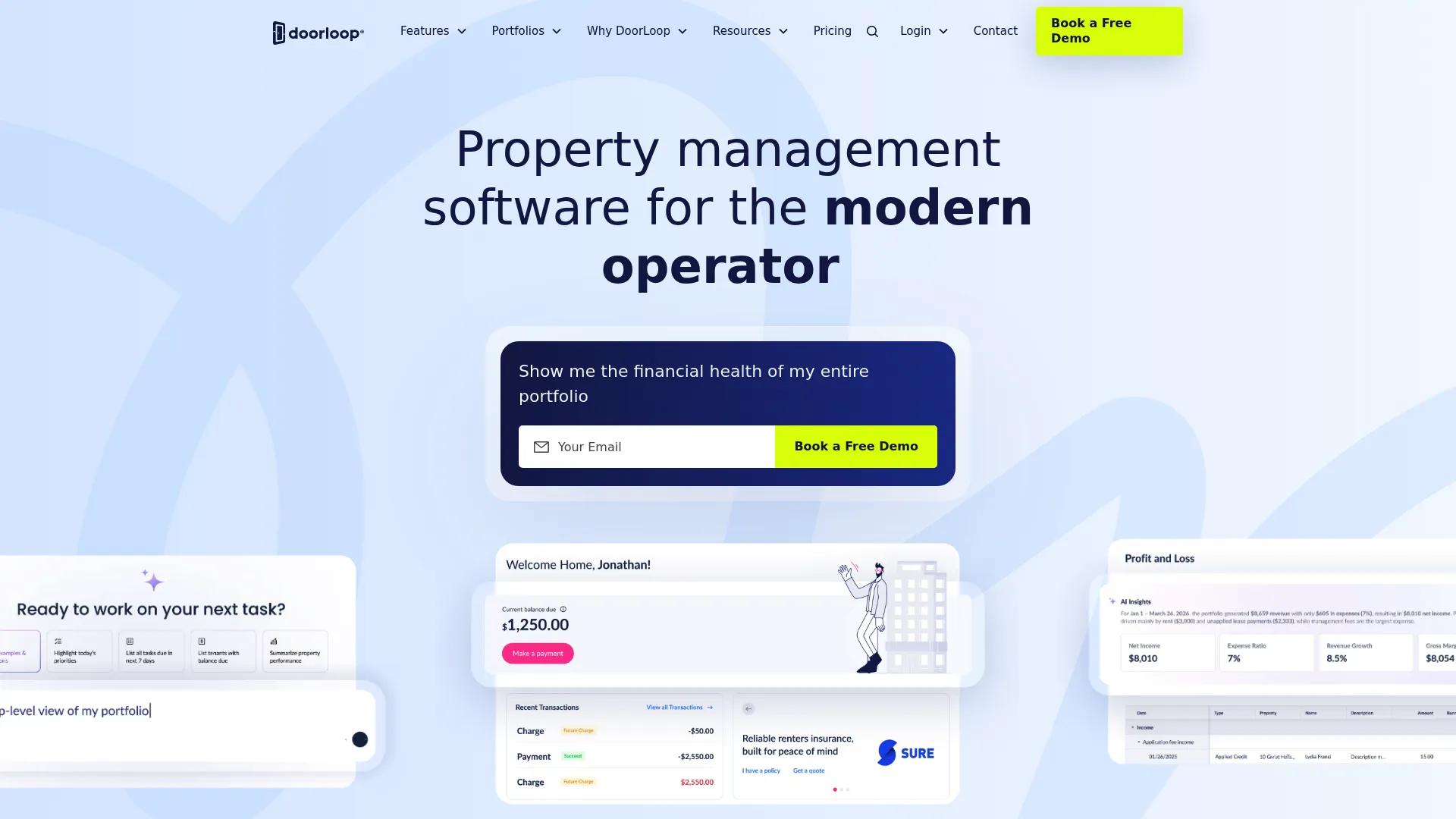
DoorLoop is property management software for landlords and managers who need deeper operational tooling than screening alone. You can DoorLoop run rent and fee payments, a tenant portal, screening, maintenance, and full accounting from one system, which fits growing portfolios and structured teams.
Best for: property managers and landlords who want an all-in-one rental operations platform.
Key strengths
- Online rent and fee payments
- Tenant portal and communication
- Tenant screening included
- Accounting, maintenance, and reporting
DoorLoop treats screening as one piece of a broader operation. For a portfolio that needs accounting, reporting, and structured processes, the tenant screening background check plugs into the same system as your books and maintenance. That integration is the value for teams managing many units.
Why choose DoorLoop: if you are scaling past a handful of units and want operations, accounting, and screening in one platform, DoorLoop gives you room to grow. It fits managers who want structure and reporting, not just a screening report.
DoorLoop pricing: the Starter plan is $69/month. Pro is $149/month and Premium is $209/month, both billed yearly. Pricing is unit-based and scales with portfolio size.
Considerations before you buy
Pricing model fit
Decide who pays before you decide which tool. Free-to-landlord with an applicant fee keeps your cost at zero and shifts it to the renter. Landlord-paid per report suits low-volume owners. A subscription makes sense once screening is part of a fuller management workflow. Match the model to how often you screen.
Report bundle depth
Confirm the bundle covers credit, criminal background, eviction history, and identity, and check whether income verification is included or extra. A thin report saves a few dollars and costs you real risk. For most landlords, eviction history and income verification are the two components worth paying for.
Workflow and turnaround speed
Test the invite-to-report loop yourself. How fast does the applicant get the link, authorize the check, and how quickly does the report return? On a hot unit, same-day results decide who signs. A clunky application also drives good applicants to drop off before they finish.
FCRA compliance support
The platform should support FCRA compliant screening with consent capture, identity verification, and adverse action notices. But the tool does not make the decision lawful; you do. Apply the same criteria to every applicant and keep documentation for any denial.
Multi-property repeatability
If you manage more than one unit, evaluate billing per portfolio, user permissions, and reporting. A tenant screening company that scales cleanly across properties saves you from rebuilding the process every time you add a door.
Conclusion
The right tenant screening software depends less on the brand and more on three things: who pays, what the report includes, and how the workflow fits your day.
For most landlords, TurboTenant covers the widest ground at the lowest entry cost, from listing to screening on a free base plan. If free is the deciding factor, Innago gives you screening inside a genuinely free management tool. For a growing portfolio that needs accounting and structure, DoorLoop is the fuller system. If you want fast, applicant-paid screening without a subscription, RentSpree's shareable link model is the most direct. And if you self-manage from your phone, RentRedi's flat rate keeps costs predictable as you add units.
Pick one, and test the application-to-screening flow with a single unit before you roll it out across your portfolio. The tool that returns a clear, defensible tenant screening background check the fastest, without frustrating good applicants, is the one worth keeping.
FAQs
You send an applicant an invite or a link, and they complete a rental application and consent to the check. The platform verifies identity, pulls the credit report, background records, and eviction history, then delivers the report to you. You review it against consistent criteria and make an approval or denial decision.
Most tenant screening services for landlords return results the same day, and often within minutes once identity is verified. Timing depends on the report type and how quickly the applicant completes identity verification. A comprehensive report with income verification can take longer than a basic credit-and-background pull.
It depends on the model. Some platforms are free to the landlord and charge the applicant an application fee that covers the report. Some charge the landlord per report. Others bundle screening into a monthly subscription. CFPB (2022) found that 68% of renters pay application fees used for tenant screening reports, so applicant-paid is common.
A standard tenant background check includes a credit report, criminal background records, eviction history, and identity verification. Many tools also offer income verification through pay stubs, bank data, or documents. The exact bundle varies by tool and by the report tier you choose.
The platform can support FCRA compliant screening by capturing consent, verifying identity, and helping you send adverse action notices. But compliance also depends on you. Apply the same lawful criteria to every applicant, document your decisions, and provide required notices when you deny an applicant based on a report.
A credit report is one component: it shows payment history, debt, and a credit-based score from a bureau. Tenant screening is the broader rental background check that adds criminal records, eviction history, identity verification, and often income verification. The credit report answers one question; screening builds the full risk picture.
Yes. Most tools let you share a rental application and screening link with a prospect who then completes the application and authorizes the check. Integrated workflows reduce drop-off and manual work because the application, consent, and report all live in one place instead of scattered emails.
Focus on repeatability. Check the billing model across a portfolio, user permissions for team members, and reporting that consolidates applicants across units. A tenant screening company that standardizes the same report bundle and criteria for every applicant keeps your decisions consistent and defensible as you add doors.