Your backlog item sounds contained: Classify support tickets, extract fields from uploaded documents, or make product search return results that users find useful. Then engineering asks the question that changes the scope: "Are we using an API, a library, or an LLM?"
The wrong answer creates recurring cost, unreliable output, poor instrumentation, or a feature that becomes expensive to maintain after launch. The global NLP market is projected to reach $47.37 billion in 2026 and grow to $117.57 billion by 2031, per Mordor Intelligence (2026), which tells you one thing clearly: Every major SaaS product is now making this decision. The gap between teams that ship a working language feature and teams that stall on model selection comes down to choosing the right category of tool before evaluating individual vendors.
NLP software is a product decision before it becomes a model decision.
What's inside
This guide helps product managers shortlist NLP tools across four distinct categories before handing a recommendation to engineering.
- Who it's for: SaaS PMs evaluating natural language processing software for a specific product workflow
- What's covered: Cloud NLP APIs, open-source libraries, model platforms, enterprise LLM providers, and annotation tools
- Selection criteria: Task fit, deployment model, data handling controls, engineering ownership cost, and pricing visibility
- What you'll get: A 12-tool NLP software comparison, verified pricing, and a buyer's checklist
TL;DR
- Best for flexible model access and production workflows: Hugging Face, for teams that need model discovery, open-source tooling, and hosted deployment options
- Best cloud API for Google Cloud environments: Google Cloud Natural Language API, for managed entity extraction, sentiment scoring, and content classification
- Best for AWS-native workloads: Amazon Comprehend, for product teams whose data and pipelines already run in AWS
- Best open-source NLP library for production Python pipelines: spaCy, for engineering teams that need deterministic pipeline control
- Best for generative language features: OpenAI, Cohere, and Anthropic Claude cover summarization, extraction, retrieval, and structured generation at different price points and context depths
- Best for annotation and evaluation data: Prodigy, when better training data is the actual bottleneck
What is NLP software?
NLP software helps applications interpret, classify, extract, search, summarize, generate, or respond to human language.
The category includes four meaningfully different product types. Treating them as interchangeable is how teams end up with the wrong architecture.
| Category | What it does | Typical PM use case |
|---|---|---|
| Cloud NLP APIs | Managed language analysis endpoints | Entity extraction, sentiment, classification |
| Open-source NLP libraries | Code-level building blocks for developers | Custom pipelines, parsing, domain-specific processing |
| Model and inference platforms | Pretrained models, hosting, fine-tuning, inference | Semantic search, custom models, retrieval-augmented generation |
| Enterprise LLM APIs | Large-model generation and reasoning | Summarization, AI copilots, extraction, Q&A |
| Annotation tools | Labeling and review workflows | Training data creation, evaluation dataset management |
Core NLP capabilities
The following tasks appear across the tools in this list. Knowing which ones your product actually needs narrows the field considerably:
- Named entity recognition
- Sentiment analysis
- Text classification
- Language detection
- Key phrase extraction
- Dependency parsing and part-of-speech tagging
- Semantic search and embeddings
- Summarization and text generation
- Retrieval-augmented generation
- Content moderation and PII detection
A PM editorial note
The model is one part of a working language feature. Production implementation also requires input validation, an evaluation dataset, user feedback collection, fallback behavior, privacy review, telemetry, and a named owner after launch. If those aren't planned before selecting a tool, the tool choice will be the least of your problems.
For context on how text analysis software fits alongside adjacent analytics tools, and how to think about product analytics software for measuring the impact of language features, those guides cover complementary decisions.
When to use NLP software
Automate text-heavy workflows
Ticket routing, document intake, feedback tagging, call-note summarization, and internal knowledge retrieval all involve large volumes of unstructured text that a human can't process at scale. NLP software handles classification and extraction so that volume stops being a bottleneck. Any automation here requires confidence thresholds and an escalation path for low-confidence outputs.
Improve search and discovery
Keyword search fails users when their query doesn't match document terms exactly. Semantic search and query understanding close that gap by matching meaning rather than string. Track zero-result rate, click-through rate, and task completion before and after deployment to measure whether relevance improved for your specific vocabulary.
Build language features into the product
AI copilots, field extraction, draft generation, and multilingual experiences all start with a single, measurable job. Pick the workflow with the highest user-facing failure cost first, build an evaluation set from real user inputs, then test two or three category-fit tools against the same success criteria before committing to an architecture. If a simple structured form or deterministic rule can solve the problem with lower maintenance cost, that should run first.
NLP software comparison
The tools below cover every category in the definition section. A cloud API and an open-source library are not comparable on the same dimensions, so the table notes the relevant category for each entry. Pricing and G2 ratings were verified in October 2026 from vendor pricing pages and live G2 listings.
| # | Product | Best for | Key differentiator | Pricing | G2 rating |
|---|---|---|---|---|---|
| 1 | Hugging Face | Model experimentation and deployment | Largest open-source model and dataset ecosystem | Free; PRO $9/mo | 4.4/5 |
| 2 | Google Cloud Natural Language API | Google Cloud product teams | Managed text analysis with pay-as-you-go pricing | From $0.10/1K units | 4.3/5 |
| 3 | Amazon Comprehend | AWS-native NLP workloads | Managed extraction and classification inside AWS | From $0.0001/100 chars | 4.2/5 |
| 4 | Microsoft Azure AI Language | Azure environments | Broad language services with Azure ecosystem fit | Free tier; paid usage-based | 4.3/5 |
| 5 | IBM Watson Natural Language Understanding | Enterprise text analytics | Structured extraction with IBM platform alignment | Free; Standard from $0.003/item | 4.2/5 |
| 6 | spaCy | Custom production NLP pipelines | High-performance Python NLP library | Free and open source | 4.5/5 |
| 7 | NLTK | NLP learning and prototyping | Broad educational toolkit and corpus access | Free and open source | N/A |
| 8 | Stanford CoreNLP | Java-based linguistic analysis | Deep linguistic annotations and parsing | Open source | 4.3/5 |
| 9 | Prodigy | Annotation and evaluation workflows | Active learning annotation with lifetime licensing | From $390 lifetime | N/A |
| 10 | OpenAI | Generative language product features | General-purpose models, structured outputs, API | Free; paid from $20/mo | 4.6/5 |
| 11 | Cohere | Enterprise retrieval and text generation | Reranking, embeddings, enterprise deployment | From $3/hr per instance | N/A |
| 12 | Anthropic Claude | High-context enterprise language workflows | Long-context models and controlled generation | Free; Pro from $17/mo | 4.4/5 |
Pricing and G2 ratings verified October 2026 from vendor pricing pages and live G2 listings.
Best 12 NLP software tools for 2026
1. Hugging Face
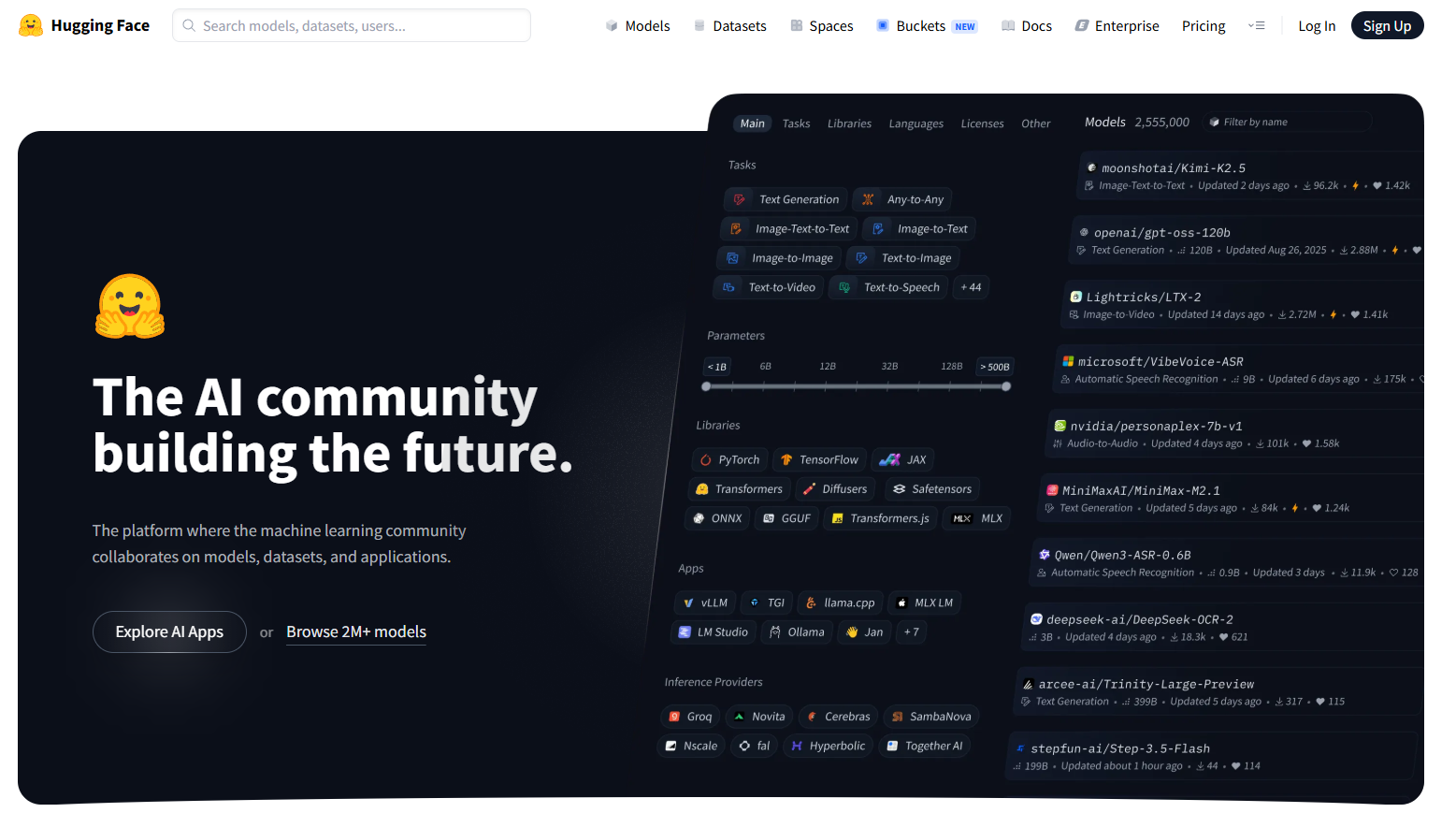
Hugging Face is an AI platform for discovering, sharing, collaborating on, and deploying machine-learning models, datasets, and applications. It hosts the largest publicly accessible collection of pretrained models and provides tooling for the full path from experimentation to production inference. Teams use it as a model hub, a dataset library, a hosting environment for ML applications (Spaces), and as the home of the Transformers library.
Best for: Product and ML teams that need model choice, portability, and a path from prototype to hosted deployment.
Key features
- Model Hub with hundreds of thousands of pretrained models
- Transformers library for Python-based model use
- Datasets library for training and evaluation data
- Inference Endpoints for hosted deployment
- Enterprise SSO, audit logs, and access controls
Why choose Hugging Face: The right choice when your roadmap requires testing multiple models against a domain-specific evaluation set and you want portability across providers. More model options means more governance decisions, so build a clear evaluation plan before the shortlist grows.
Hugging Face pricing: Free access covers individual model and dataset use. PRO runs $9 per month for individuals, Team costs $20 per month per user for collaborative features, and Enterprise is listed at $50 per month per user with advanced security and compliance. Compute and storage for hosted endpoints are billed separately by usage.
G2 rating: 4.4/5 based on 108 reviews.
2. Google Cloud Natural Language API
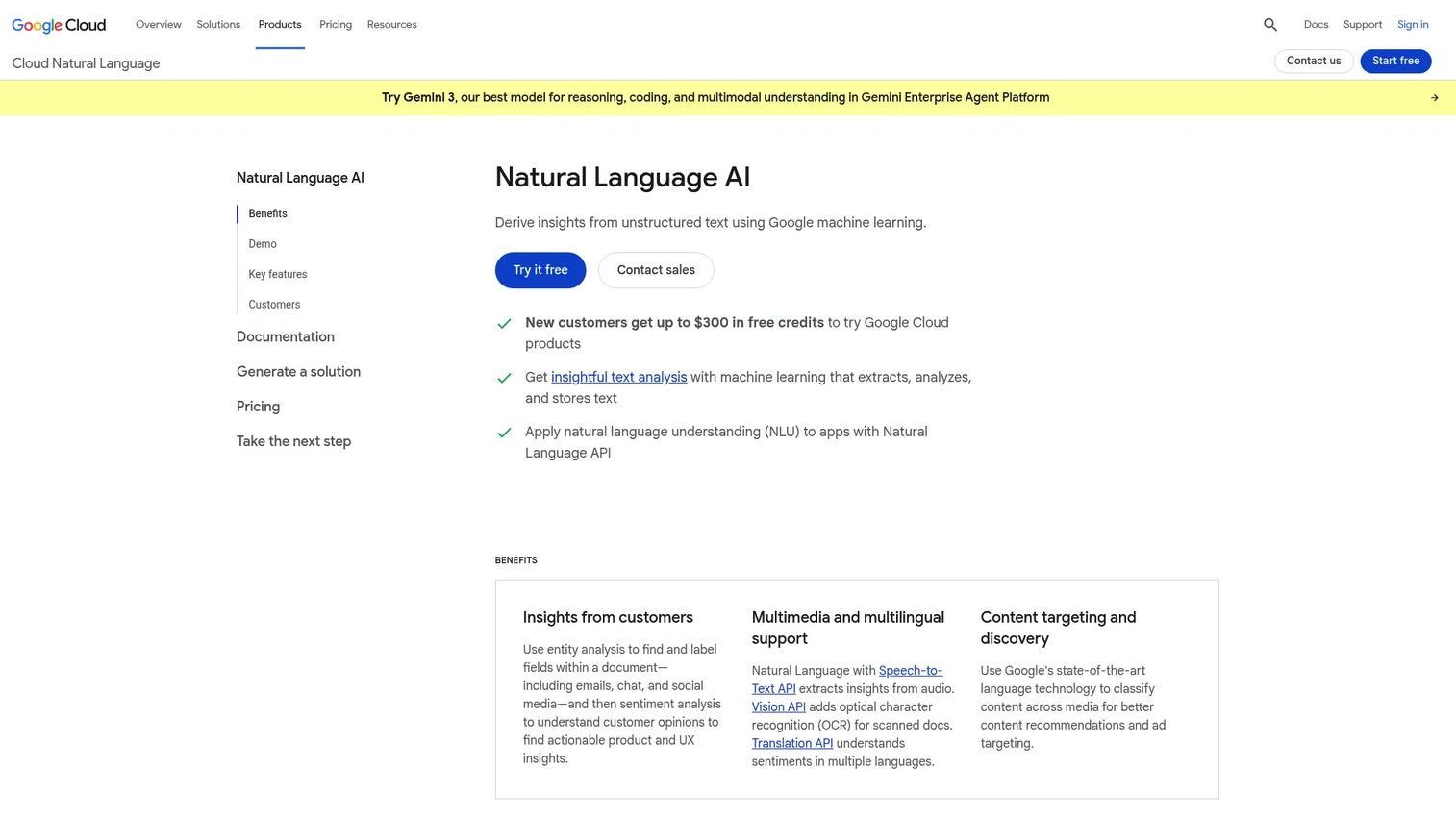
Google Cloud Natural Language API applies pre-trained machine learning to derive insights from unstructured text via managed API endpoints. It handles entity analysis, sentiment scoring, syntax analysis, content classification, and language detection without requiring teams to train or host their own models. For product teams already running on Google Cloud, it integrates directly with existing infrastructure and IAM controls.
Best for: Developers building Google Cloud applications that need structured text signals such as entity extraction, sentiment, and classification without managing ML infrastructure.
Key features
- Entity analysis and entity sentiment analysis
- Sentiment analysis at document and sentence level
- Syntax analysis: Tokenization and part-of-speech tagging
- Content classification into predefined categories
- Language detection across supported languages
Why choose Google Cloud Natural Language API: Strong fit when your product data and services already run on Google Cloud and the required tasks, entity analysis, sentiment, classification, map to the managed endpoints. Test output quality on your actual vocabulary, abbreviations, and user-generated text before treating benchmark accuracy as representative.
Google Cloud Natural Language API pricing: Usage-based, billed per 1,000-character unit. Content classification starts at $0.10 per 1,000-character unit at higher volumes; other features follow different per-unit rates. A free monthly allowance applies, and new customers may receive Google Cloud credits.
G2 rating: 4.3/5.
3. Amazon Comprehend
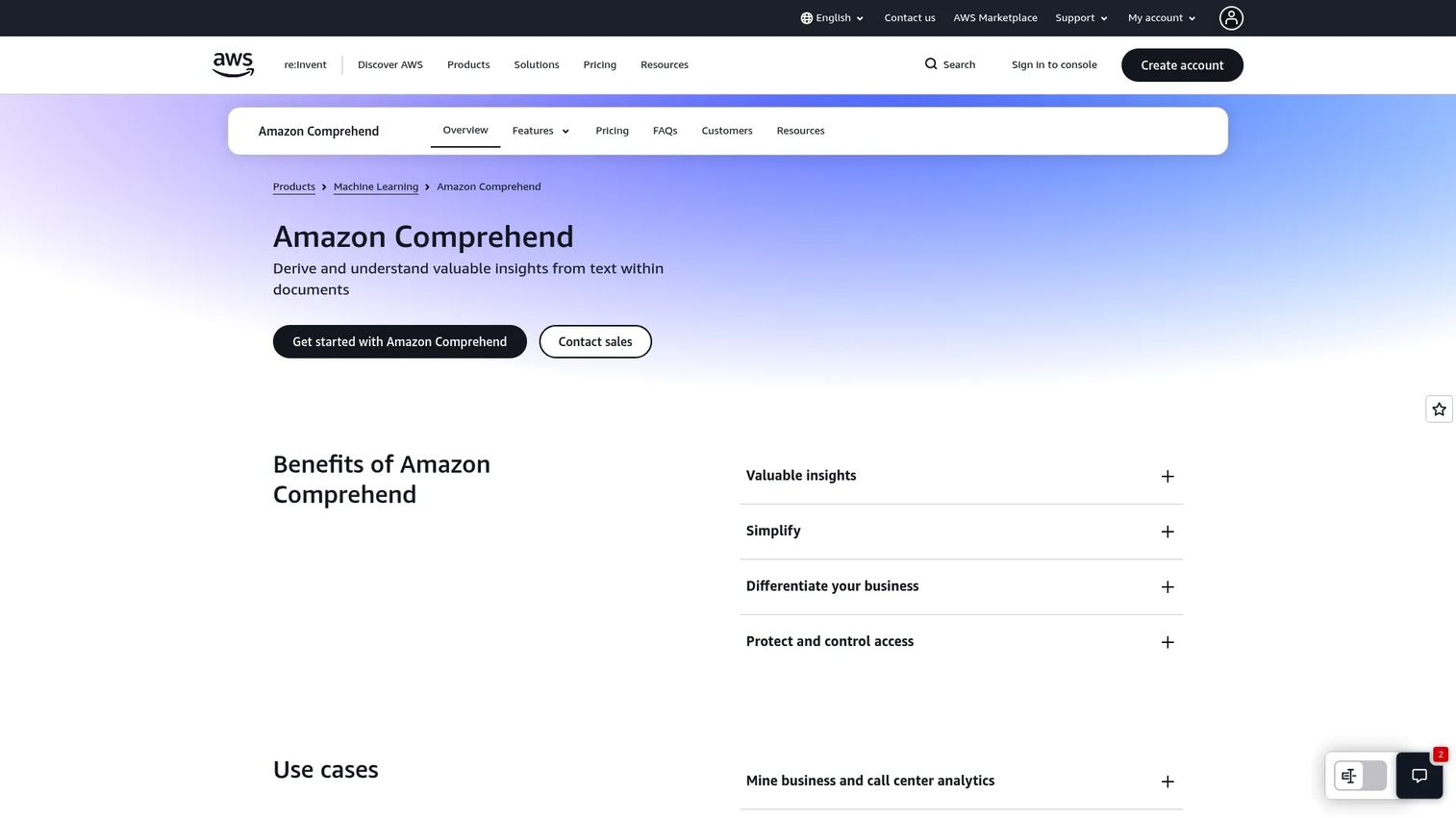
Amazon Comprehend is a managed NLP service that extracts insights from text and documents inside AWS pipelines. It covers entity recognition, sentiment analysis, key phrase extraction, PII detection and redaction, custom text classification, and language detection. Product teams that store data in S3, orchestrate workflows with Lambda or Step Functions, and log to CloudWatch can connect Comprehend directly without moving data to an external service.
Best for: SaaS teams whose text data, security controls, and downstream workflows already run on AWS.
Key features
- Entity recognition including custom entity models
- Sentiment and targeted sentiment analysis
- Key phrase extraction
- PII detection and redaction
- Custom text classification
Why choose Amazon Comprehend: The practical option when AWS is your operating environment and you want managed NLP without exporting data to a third-party service. Model the cost of analysis separately from the cost of storage, orchestration, monitoring, and human review; the AWS bill covers the API call, not the full feature delivery.
Amazon Comprehend pricing: Standard NLP APIs run $0.0001 per unit of 100 characters, with a three-unit minimum per request. A 12-month free tier covers 50,000 text units per eligible API per month. Custom model training runs $3 per hour; custom inference endpoints run $0.0005 per inference unit per second.
G2 rating: 4.2/5.
4. Microsoft Azure AI Language
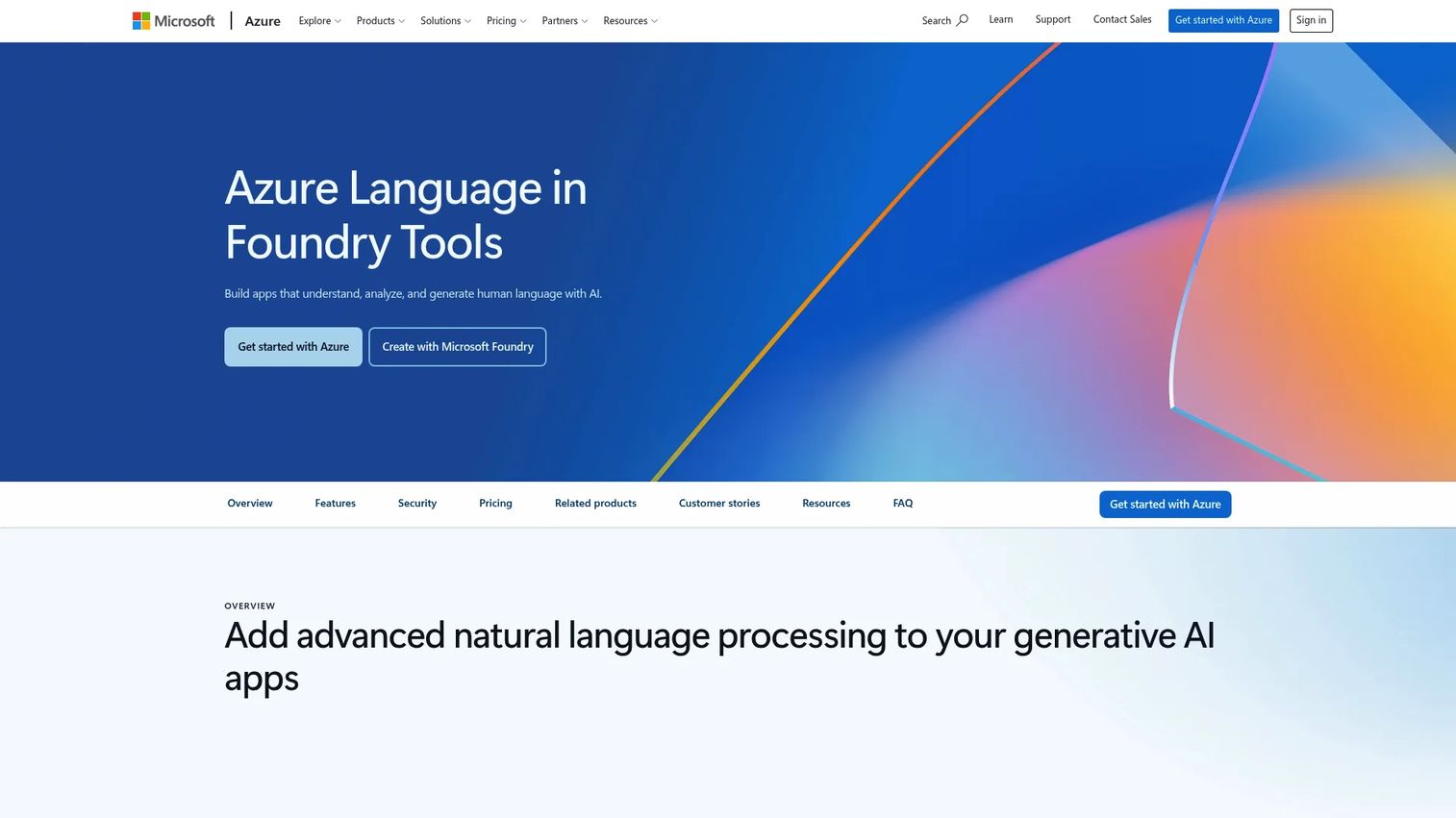
Microsoft Azure AI Language provides NLP capabilities for applications that need to understand, analyze, and generate text within the Azure ecosystem. It covers sentiment analysis, named entity recognition, PII detection and redaction, text summarization, question answering, and custom text classification. Microsoft has rebranded the service as Azure Language in Foundry Tools, reflecting its integration into the broader Azure AI Foundry platform.
Best for: Product teams shipping language features inside Azure environments that need enterprise identity management, data governance, and container-based deployment.
Key features
- Named entity recognition and personal data detection
- Text summarization at document and conversation level
- Question answering and custom language model support
- Text analytics for health workflows
- Container-based deployment for on-premises scenarios
Why choose Microsoft Azure AI Language: A practical option when Azure security, identity, and application hosting already shape the architecture. Confirm regional availability, language coverage for your user base, and the pricing tier required for your expected request volume before committing.
Microsoft Azure AI Language pricing: A free tier includes 5,000 shared text records per month across several capabilities. Standard and commitment-tier pricing for paid volumes was not rendered as numeric values on the pricing page at the time of verification; contact Microsoft or check the Azure pricing calculator for current per-transaction rates.
G2 rating: 4.3/5.
5. IBM Watson Natural Language Understanding
IBM Watson Natural Language Understanding is an API-based service that extracts meaning and metadata from unstructured text, including entities, keywords, categories, sentiment, emotion, relations, and semantic roles. It is part of the IBM Cloud AI portfolio and aligns with IBM's governance and compliance frameworks. Note that IBM has deprecated this service as of July 31, 2026, with end of support on July 31, 2027, and end of life on January 31, 2028. Teams currently using or evaluating it should plan a migration path.
Best for: Enterprises with existing IBM platform commitments that need governed language analysis before migrating to a successor service.
Key features
- Entity detection and keyword extraction
- Five-level content categorization
- Custom text classification
- Emotion and sentiment analysis
- Semantic-role and relation extraction
Why choose IBM Watson Natural Language Understanding: Relevant when procurement, governance requirements, and IBM platform alignment matter alongside text analytics. Given the deprecation timeline, factor migration cost and engineering effort into the total cost of ownership before choosing it for a new project.
IBM Watson Natural Language Understanding pricing: The Lite plan is free and covers 30,000 NLU items per month with one custom model. The Standard plan charges $0.003 per NLU item for the first 250,000 items per month, dropping to $0.001 per item from 250,001 to 5,000,000 items. Custom entity models cost $800 per model per month; custom classification models cost $25 per model per month.
G2 rating: 4.2/5.
6. spaCy
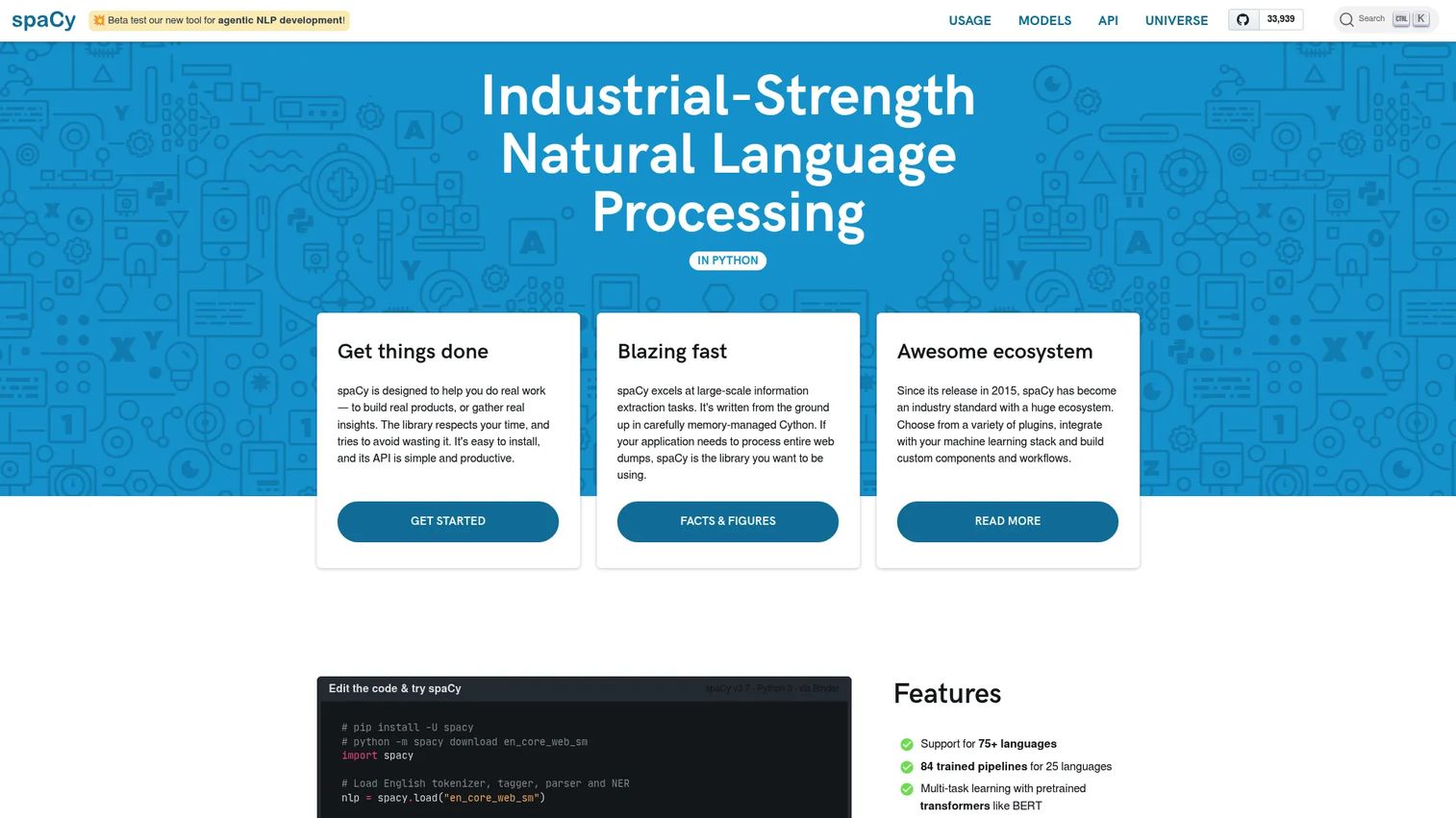
spaCy is an industrial-strength, open-source Python library for NLP. It provides production-ready pipelines for named entity recognition, dependency parsing, part-of-speech tagging, text classification, sentence segmentation, lemmatization, and custom model training. Unlike API-based tools, spaCy runs locally or on your own infrastructure, giving engineering teams full control over pipeline components, latency, and data handling.
Best for: Engineering teams building custom NLP workflows where pipeline control, local deployment, and deterministic behavior matter more than managed convenience.
Key features
- Named entity recognition and entity linking
- Dependency parsing and part-of-speech tagging
- Text categorization and custom model training
- Support for 75+ languages with pretrained pipelines
- Built-in visualizers for syntax and entity output
Why choose spaCy: The strongest open-source option when your product needs custom pipeline components alongside trained models and your team can own implementation, infrastructure, and model updates. A free library doesn't mean a free feature; budget engineering time for training data, monitoring, and release cadence maintenance.
spaCy pricing: Free and open source with no paid tiers. Commercial support and training options may be available separately from Explosion AI; verify terms on the official site.
G2 rating: 4.5/5.
7. NLTK
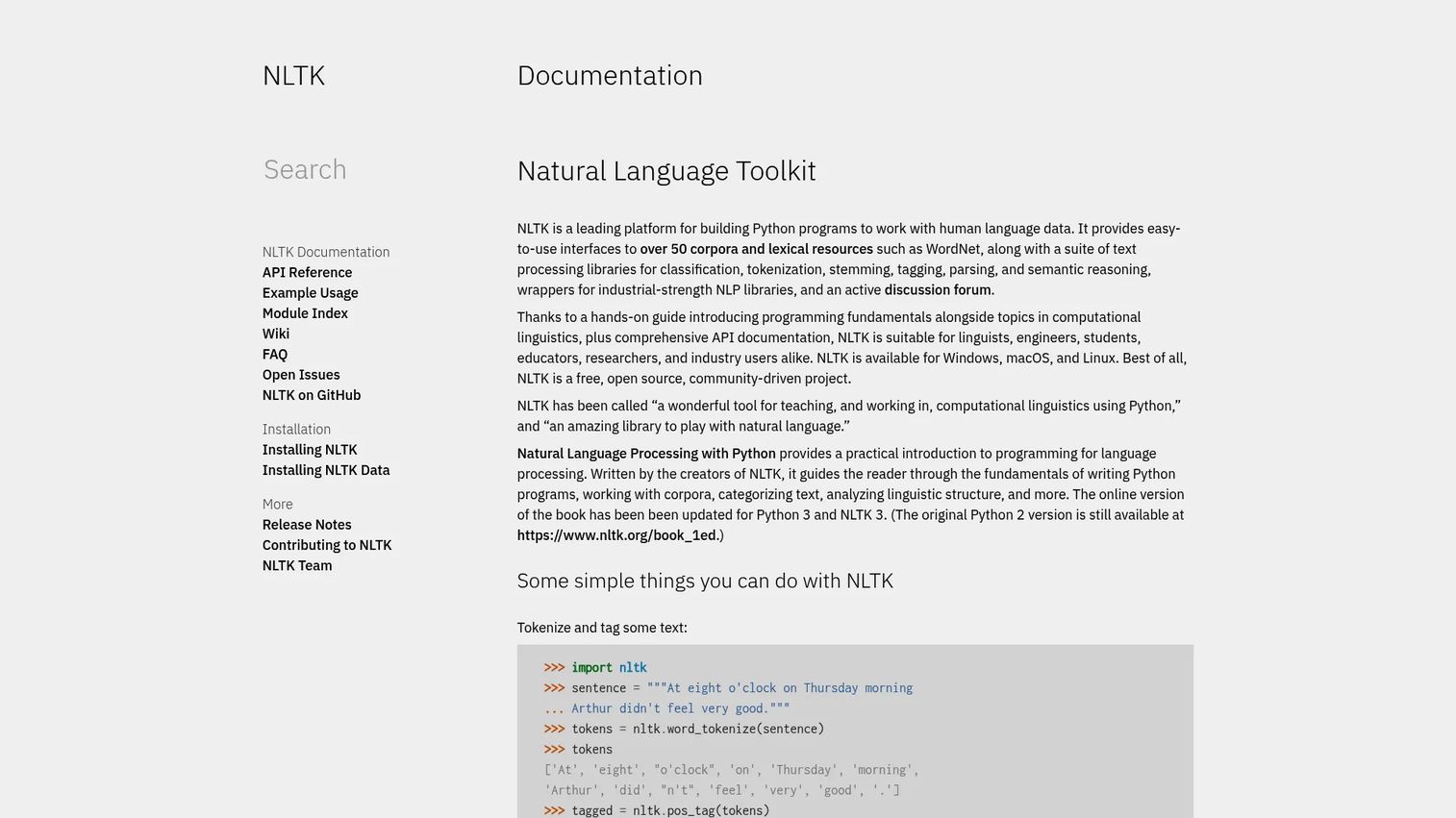
NLTK (Natural Language Toolkit) is a free, open-source Python platform for processing human language data. It includes access to corpora and lexical resources such as WordNet, and provides modules for tokenization, stemming, classification, tagging, parsing, and semantic reasoning. NLTK is widely used in academic NLP research and as a pedagogical toolkit for learning language processing concepts.
Best for: Product teams validating an NLP concept, researchers building a proof of concept, or engineers who need to explore language data before selecting a production-grade library.
Key features
- Text corpora and lexical resource access (including WordNet)
- Tokenization, stemming, and part-of-speech tagging
- Parsing and semantic reasoning modules
- Classification and clustering utilities
- Concordancing and collocation discovery tools
Why choose NLTK: Useful for understanding NLP building blocks and testing early logic. The breadth of included corpora makes it a practical exploration environment. Avoid treating a prototype built in NLTK as a production architecture without an engineering review, especially where latency and throughput matter.
NLTK pricing: Free and open source. No commercial pricing tiers exist.
8. Stanford CoreNLP
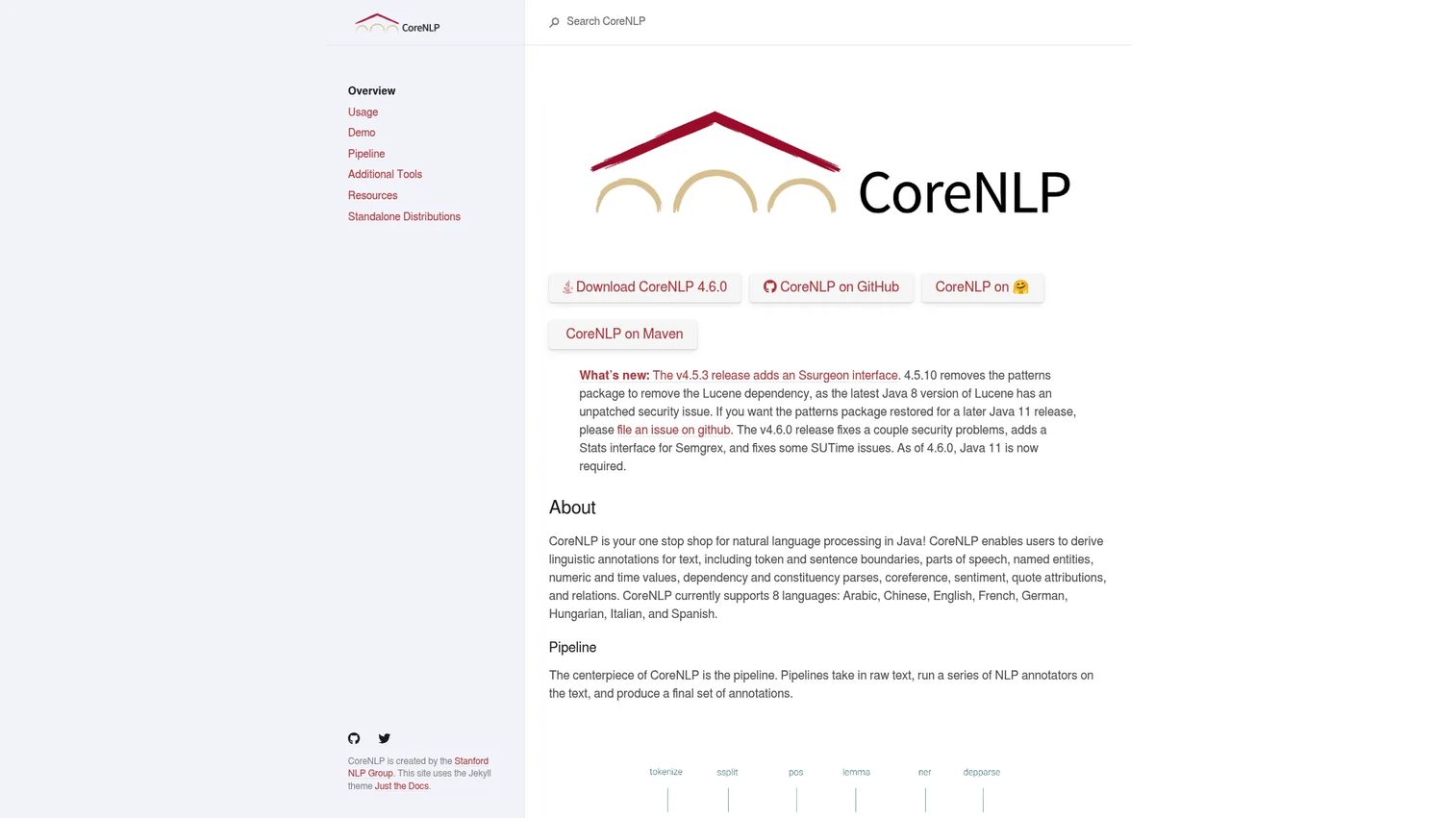
Stanford CoreNLP is an open-source Java toolkit for natural language processing and linguistic annotation. It covers tokenization, sentence splitting, part-of-speech tagging, lemmatization, named entity recognition, constituency and dependency parsing, coreference resolution, sentiment analysis, quote attribution, and relation extraction. It can be called via the command line, a Java API, or a web service, making it accessible to teams outside pure Python environments.
Best for: Teams with Java-based NLP implementations, researchers needing deep linguistic annotations, or engineers working on coreference resolution and structural parsing.
Key features
- Constituency and dependency parsing
- Coreference resolution
- Named entity recognition and relation extraction
- Part-of-speech tagging and lemmatization
- Command-line, Java API, and web service interfaces
Why choose Stanford CoreNLP: Worth evaluating when linguistic analysis depth is a product requirement, your team works in Java, or you need structural parsing capabilities that lighter libraries don't cover. Confirm language support, deployment requirements, and maintenance ownership before standardizing on a research-originated toolkit.
Stanford CoreNLP pricing: Open source. No official pricing page was found; review the Stanford NLP Group's licensing terms for commercial use requirements before deploying in a production environment.
G2 rating: 4.3/5.
9. Prodigy
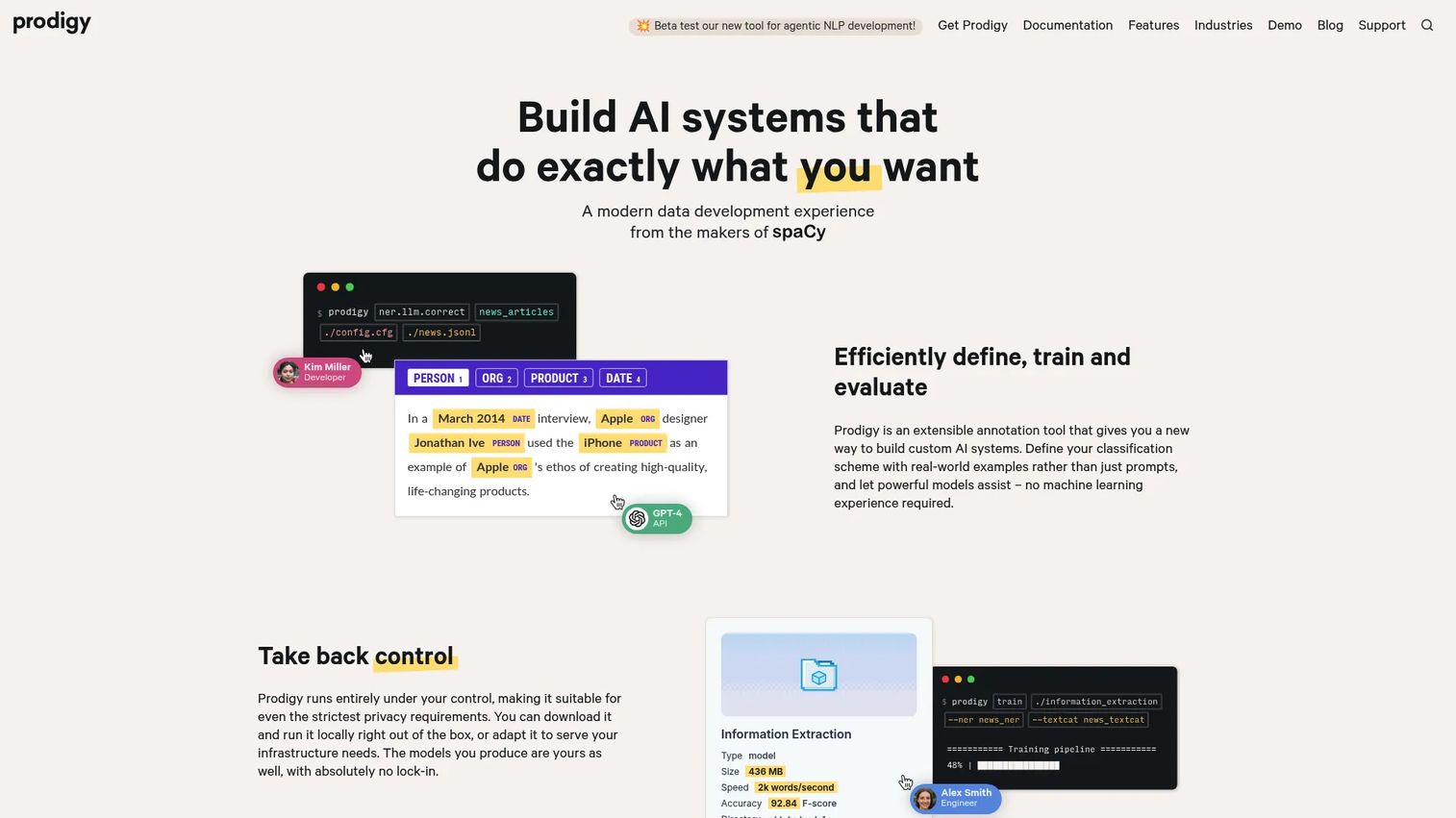
Prodigy is an extensible, self-hosted annotation tool for building custom AI and ML systems. It supports named entity recognition labeling, span categorization, text classification, computer vision annotation, model-in-the-loop active learning, and custom recipe development. It integrates directly with spaCy for training workflows and runs locally or on private infrastructure, keeping labeled data entirely within your environment.
Best for: Product and ML teams where the main bottleneck is not model access but trusted, domain-specific training and evaluation data.
Key features
- Active learning with model-in-the-loop labeling
- Custom annotation recipes for specialized workflows
- Named entity recognition, span, and text classification annotation
- Dataset export for downstream training
- Runs locally or on private infrastructure
Why choose Prodigy: The right tool when you have a model architecture but your labeled data doesn't reflect real user inputs well. Establish labeling guidelines before setting up the tool; inconsistent annotation guidelines produce misleading accuracy numbers and unstable releases. For teams thinking about AI governance tools alongside annotation, that's a parallel workstream worth planning early.
Prodigy pricing: Personal licenses cost $390 per lifetime seat (excluding tax) and include 12 months of free upgrades with unlimited annotators. Company licenses cost $490 per lifetime seat, available in packs of five seats, with the same upgrade and annotator terms.
10. OpenAI
OpenAI develops AI research and deployment products, including the ChatGPT application and an API platform that exposes general-purpose language models for product teams. PMs use the API for structured field extraction, document summarization, text classification, embeddings, tool calling, and retrieval-augmented generation, covering the generative language tasks most SaaS products need without training custom models.
Best for: Product teams that need a fast path from prototype to a measurable language feature experiment across multiple NLP use cases.
Key features
- Text generation via API for summarization, classification, and drafting
- Structured output support for field extraction and data formatting
- Embeddings for semantic search and retrieval pipelines
- Function and tool calling for agentic product features
- Model evaluation tooling for prompt and output testing
Why choose OpenAI: Covers the widest range of generative language tasks from a single API. Define evaluation sets, output validation logic, abuse handling, and fallback UX before release; a fast prototype path doesn't eliminate the need for those guardrails. Teams building adjacent API infrastructure may also find API generation software and API monitoring tools useful for managing what gets built on top.
OpenAI pricing: ChatGPT offers a Free plan at $0 per month, Plus at $20 per month, Pro at $200 per month, and Team at $25 per user per month billed annually ($30 billed monthly). API pricing is separate and usage-based by model, token count, and endpoint; check the OpenAI API pricing page for current per-token rates. Enterprise pricing requires contacting sales.
G2 rating: 4.6/5.
11. Cohere
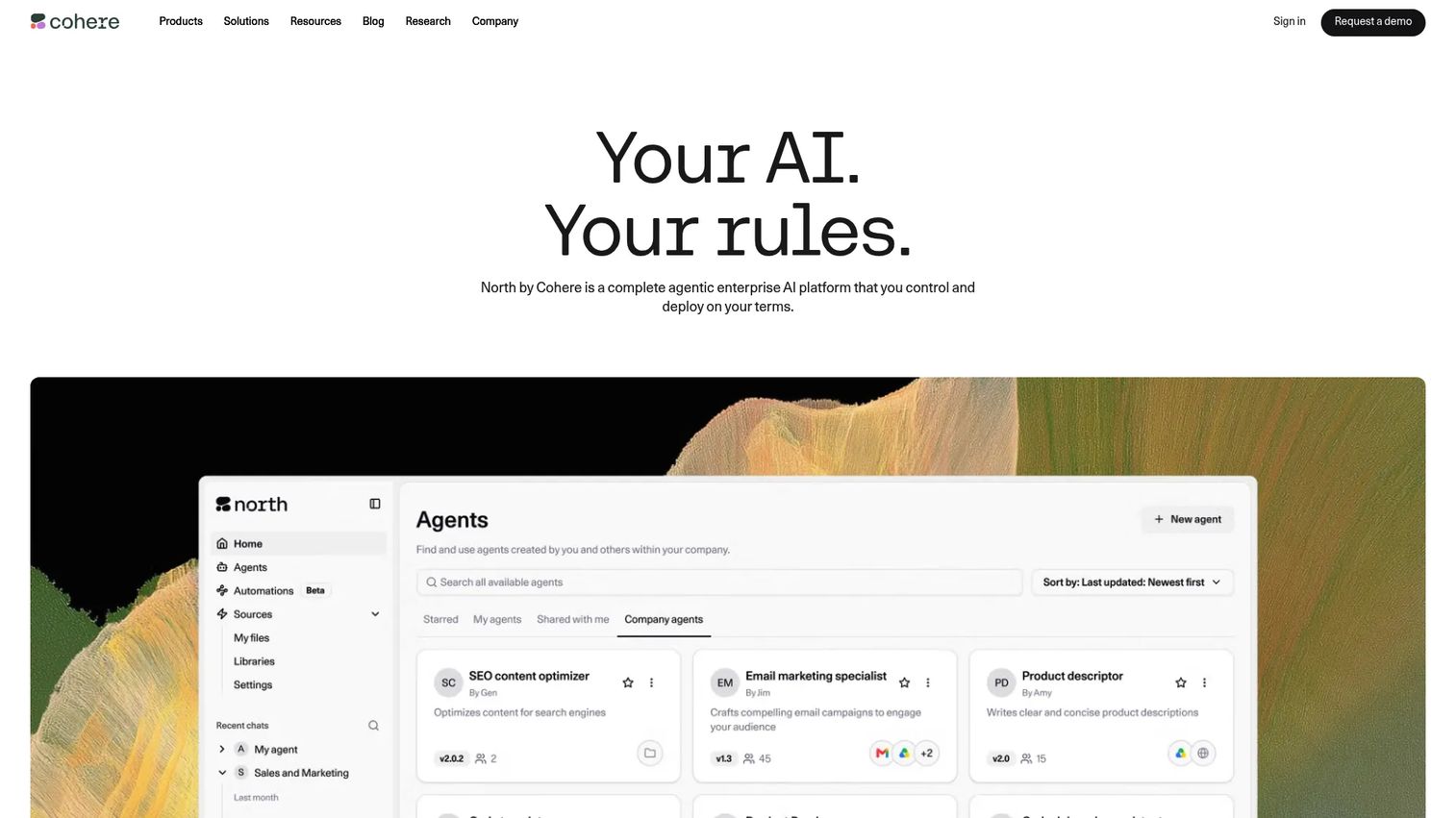
Cohere provides enterprise AI platforms for generative AI, retrieval, multilingual capabilities, and secure deployment. Its model portfolio covers text generation for reasoning and agentic workflows, enterprise search with embeddings and reranking, and private or on-premises deployment options. Product teams building knowledge-assistant features, document search, or enterprise retrieval pipelines use Cohere when search relevance and deployment control are primary product metrics.
Best for: Product teams building semantic search, retrieval-augmented generation, knowledge assistants, or grounded generation experiences where deployment environment control matters.
Key features
- Embedding models for semantic search and vector retrieval
- Reranking models for improving search result quality
- Text generation models with reasoning and agentic capabilities
- Enterprise deployment options including private cloud and on-premises
- Multilingual coverage across generation and retrieval tasks
Why choose Cohere: Strong when your product's quality metric is search relevance or retrieval accuracy rather than open-ended generation. Evaluate relevance using real customer queries at release; polished test prompts hide the search failures users encounter daily. For teams thinking through AI model deployment software options, Cohere's private deployment path is a distinguishing factor at enterprise scale.
Cohere pricing: Model Vault instances are priced per hour or per month. Embed 5 Fast (Small) runs $3 per hour or $2,000 per month per instance; Embed 5 Fast (Medium) runs $5 per hour or $3,250 per month per instance; Rerank 4 Pro (Large) runs $10 per hour or $6,500 per month per instance. North and Compass enterprise plans carry custom pricing. Free trial API keys are available.
12. Anthropic Claude

Anthropic Claude is an AI assistant built for writing, analysis, coding, research, and complex task completion. Product teams use the API for document analysis, summarization of long-form content, structured data extraction from complex policies or contracts, and high-context customer interactions where a session requires understanding large bodies of material before producing a response.
Best for: Product teams working with long documents, complex policies, multi-turn knowledge workflows, or customer interactions that require retaining detailed context across a session.
Key features
- Long-context processing for large documents and extended conversations
- Text and code generation with structured response support
- Document analysis including file handling and image analysis
- Web search with source citations
- API integrations and scheduled task support
Why choose Anthropic Claude: Useful when your roadmap includes workflows that require interpreting large document sets or maintaining context across detailed user requests. Long context increases what the model can read, not the reliability of every output. Build a real evaluation set with citation quality, extraction accuracy, and failure mode examples before committing to a production release. For teams also evaluating enterprise search software as a complementary layer, Claude's retrieval and document-understanding capabilities are worth comparing against purpose-built search tools.
Anthropic Claude pricing: Individual plans include Free at $0 per month, Pro at $17 per month billed annually ($20 month-to-month), Max 5x at $100 per month, and Max 20x at $200 per month. Team Standard seats run $20 per seat per month billed annually. Team Premium seats run $100 per seat per month billed annually. Enterprise costs $20 per seat per month on an annual contract plus usage at API rates.
G2 rating: 4.4/5.
Considerations when choosing NLP software
Match the tool to the language task
Start with the user job, not the vendor's marketing. Entity extraction, semantic search, summarization, and text classification each require different evaluation methods and architectural choices. Picking a model platform before defining the task often results in an overfit solution that's hard to maintain as the product evolves.
Decide who owns the operational burden
Managed APIs reduce infrastructure work but shift control to the vendor, including rate limits, model updates, and pricing changes. Open-source libraries increase control but move deployment, observability, upgrades, and incident handling to your team. Clarify ownership before the architecture is set, not after the first production incident.
Build your evaluation dataset before full rollout
Require a representative test set before any language feature goes to users. Track accuracy by segment, language, input source, and workflow type. A single blended accuracy score hides the failure modes that users encounter most. Include false-positive and false-negative examples, latency measurements, and user correction behavior in your evaluation criteria. Teams exploring best practices for analytics platforms will find that measurement discipline applies equally to NLP feature evaluation.
Check data handling and governance
Evaluate data retention policies, regional deployment options, access controls, PII handling, auditability, and model versioning before production data enters an external service. Involve your security and legal teams before this point, not as a final approval step. For teams thinking through the governance layer, AI governance tools covers that adjacent decision in detail.
Model the full cost of ownership
A free library can still carry the highest long-term cost if it requires significant engineering time, custom infrastructure, monitoring tooling, annotation work, and ongoing model maintenance. Add API usage, embedding generation, vector storage, inference infrastructure, annotation tooling, human review, and engineering support to your cost model before committing to a direction.
Conclusion
The right NLP software depends on one question: What is the product workflow, and who will own it after launch?
For structured language signals inside an existing cloud stack, Google Cloud Natural Language API, Amazon Comprehend, or Microsoft Azure AI Language each offer managed endpoints that reduce infrastructure work. For custom pipeline control with no licensing cost, spaCy is the production-ready choice; NLTK works well for validation and prototyping. For generative features, retrieval, or long-context analysis, OpenAI, Cohere, and Anthropic Claude each address different depth and deployment requirements. When better training data is the bottleneck, Prodigy solves that specific problem without requiring a new model platform. Hugging Face sits across all of these as a hub for model discovery, experimentation, and hosting.
The practical next step: Pick one high-frequency workflow with a measurable failure cost. Build an evaluation set from representative user inputs. Then test two or three category-appropriate tools against the same success criteria before locking in an architecture.
FAQs
NLP software is the broader category that includes both traditional language analysis and modern generative models. Traditional NLP handles structured tasks such as entity tagging, sentiment scoring, or dependency parsing with deterministic pipelines. Generative AI produces or transforms language, including summaries, answers, and drafts, using large language models. Many enterprise NLP tools now include both.
The best option depends on the product task and the team's operating model. Managed cloud APIs suit packaged analysis tasks where the team doesn't want to own infrastructure. Open-source libraries suit custom pipelines where engineering needs full control. LLM providers suit generative features. Evaluate tools against a shared dataset and a defined product metric rather than marketing benchmarks.
APIs reduce implementation work, provide managed versioning, and let teams ship faster. Libraries provide deployment flexibility, lower per-request cost at scale, and full pipeline customization. The deciding factors are your team's engineering capacity, data privacy requirements, latency targets, and how frequently the product workflow will change after launch.
Start with narrow, measurable workflows where failure has a clear user-facing cost. Ticket classification, semantic search, document field extraction, feedback tagging, and call-note summarization all have defined inputs, outputs, and quality criteria. A task with unclear success criteria will produce an unmeasurable feature, regardless of which tool powers it.
Build a test set from real user inputs, not polished internal examples. Human reviewers label a representative sample, and you measure precision, recall, and false-positive rate by segment, language, and input type. Set explicit thresholds for each. Latency and cost-per-request belong in the evaluation alongside accuracy, because a highly accurate feature that costs ten times more than expected at scale is still a product problem.
Yes, for defined use cases. Managed APIs and model providers can support early feature releases with limited ML expertise. The team still needs product ownership over evaluation, privacy review, release criteria, and monitoring after launch. What scales without an ML team is the model; what doesn't scale without ownership is the feature.
Open-source libraries carry no license fee but incur engineering, infrastructure, and maintenance costs. Cloud APIs typically charge by character, token, document, or request volume, with free tiers that cover experimentation. Enterprise contracts add governance, support, private deployment, and minimum commitment terms. For a full cost picture, add annotation, monitoring, human review, and ongoing engineering support to whatever the API bill shows. For more context on NLP pricing across text analysis categories, that guide covers adjacent tools with similar pricing models.
Many tools support multilingual workloads, but coverage varies by task and language. A model that performs well in English may produce significantly worse results on a specific dialect, domain vocabulary, or low-resource language. Test the specific languages your users write in, using real inputs from your product, before treating any vendor's multilingual claim as applicable to your use case.