Your security team wants to retire the VPN. Engineering still needs reliable access to internal tools, staging environments, and production-adjacent systems. That tension is not a VPN problem. It is an access-architecture problem.
NIST SP 1800-35, finalized in June 2025, documents Zero Trust implementations that include software-defined perimeter approaches as a practical way to replace broad network access with per-user, per-device, per-application controls. The model is proven. The harder question is which platform fits your infrastructure, identity stack, and operational capacity.
Broad VPN access grants a network path. That path is wider than most tasks require. It creates governance debt, complicates contractor and partner access, and makes it harder to give engineers what they need without exposing more than you intend.
The platforms in this guide take a different approach. They evaluate identity, device posture, and policy before any connection starts, then grant access to a specific resource rather than a network segment.
What's inside
This guide is for product managers, infrastructure leads, and platform engineers evaluating a move from VPN-centric access toward application-level Zero Trust controls. Tools were selected based on four criteria:
- Verified identity-based access and policy enforcement
- Support for hybrid and cloud application inventories
- Deployment fit across enterprise, developer-led, and open-source models
- Confirmed pricing and ratings from live sources
The list includes enterprise platforms, cloud-native controls, and open-source options.
TL;DR
- Best for large enterprise private-app access: Zscaler Private Access, with cloud-delivered ZTNA and user-to-app segmentation at scale
- Best for distributed hybrid deployments: Appgate SDP, with distributed gateway architecture and fine-grained policy controls
- Best for teams using Cloudflare's security stack: Cloudflare Access, with identity-aware access tied to Cloudflare's network
- Best modern VPN replacement: Twingate, with resource-level access and a free tier that starts with 5 users
- Best open-source, developer-led option: OpenZiti, free and embeddable directly into applications
- Best for Google Cloud-hosted applications: Google Identity-Aware Proxy, with native IAM integration and no VPN required
No single platform wins every scenario. The right fit depends on your identity infrastructure, private application inventory, and operating model.
What is software defined perimeter?
Software-defined perimeter (SDP) is an identity-centric security approach that creates encrypted, least-privilege connections between verified users or devices and specific applications, while keeping protected infrastructure undiscoverable to unauthorized parties.
The Cloud Security Alliance SDP specification defines SDP around identity-centric policy enforcement, dynamic perimeters, and the principle that resources stay invisible until trust is established. NIST SP 800-207 treats this approach as one implementation path within Zero Trust Architecture.
How SDP works
- A user or workload requests access to a named application or resource
- The platform evaluates identity, authentication state, device posture, and policy
- A controller decides whether the request qualifies
- A gateway or connector creates an encrypted connection to the approved resource
- Access stays constrained to that resource and is reevaluated under policy
Core SDP capabilities
- Identity-based authentication and device verification
- Per-application access policies with dynamic revocation
- Encrypted user-to-resource connections
- Infrastructure hiding from unauthorized parties
- Central policy management and audit logging
SDP, Zero Trust, and ZTNA
These terms overlap but are not identical. Zero Trust Architecture (per NIST SP 800-207) is the broader security model. SDP is one implementation pattern for identity-centric, resource-specific connectivity. ZTNA is the market category name most vendors use for private application access products. Microsegmentation addresses internal east-west controls and often complements SDP. SASE and SSE can bundle ZTNA with web and network security services.
SDP versus VPN
| Dimension | VPN | SDP or ZTNA |
|---|---|---|
| Visibility | Grants network access after auth | Hides resources until trust is verified |
| Access scope | Network segment | Specific application or resource |
| Authorization | At connection time | Per request, with ongoing policy |
| App segmentation | Requires additional controls | Built into access model |
| Operational fit | Broad access, simpler routing | Narrower access, more policy design |
Many organizations run both during migration. A phased approach, starting with lower-risk internal applications, reduces disruption.
When to use software defined perimeter tools
Replace broad access to private applications
Internal admin portals, development systems, staging environments, and private APIs all carry more exposure than they need to under a flat VPN model. SDP tools let you define who reaches what, at the application layer, without publishing services to the internet. For product managers, this reduces the governance debt that accumulates when engineers and support teams share the same network path.
Secure third-party and contractor access
Project-based access benefits from time-bound, identity-governed controls. Agency partners, implementation consultants, and support vendors typically need access to one system, not a network segment. SDP platforms let you model that intent in policy rather than fighting it in firewall rules.
Support hybrid and multicloud environments
Teams running applications across data centers, AWS, Google Cloud, Azure, and Kubernetes need access controls that follow the application, not the network. An SDP platform reduces policy drift by enforcing identity and context rules centrally while connectors or gateways sit near each protected environment. This matters for release cadence: Access policy changes should not require firewall tickets.
Software defined perimeter tools comparison
"SDP" is used differently across vendors. Some platforms implement the full Cloud Security Alliance model with Single Packet Authorization and dark services. Others are ZTNA products or encrypted overlay networks that solve the same buyer problem with different architecture. The table below reflects verified pricing and ratings as of October 2026.
| # | Product | Best for | Key differentiator | Pricing | G2 rating |
|---|---|---|---|---|---|
| 1 | Appgate SDP | Hybrid enterprise access | Distributed gateway and fine-grained policy controls | MSP model from $5/seat/month; enterprise custom | 4.8/5 |
| 2 | Zscaler Private Access | Large enterprise private-app access | Cloud-delivered ZTNA with user-to-app segmentation | Custom quote | 4.5/5 |
| 3 | Cloudflare Access | Cloudflare-stack deployments | Identity-aware access tied to Cloudflare's network | Free up to 50 users; $7/user/month after | Not listed on G2 |
| 4 | Twingate | Modern VPN replacement | Resource-based access with free tier for small teams | Free (up to 5 users); Teams $5/user/month | 4.7/5 |
| 5 | Tailscale | Engineering-led private networking | WireGuard-based mesh with identity-aware ACLs | Free personal; Standard $8/user/month | 4.6/5 |
| 6 | OpenZiti | Open-source, developer-led zero trust | Application-embedded zero-trust overlay | Free and open source | Not listed |
| 7 | NetFoundry | Managed zero-trust overlay | Enterprise-managed OpenZiti with vendor support | Custom quote; 30-day trial available | 4.0/5 |
| 8 | Google Identity-Aware Proxy | Google Cloud applications | Native IAM integration for GCP resources | Core features free; enterprise capabilities paid | 4.4/5 |
| 9 | Palo Alto Prisma Access | Broad SASE and ZTNA programs | Integrated private access within a full SASE platform | Custom quote | 4.3/5 |
| 10 | Akamai Enterprise Application Access | Distributed enterprise app access | App-level access across complex hybrid environments | Custom quote; free trial available | 4.4/5 |
Pricing and ratings verified October 2026 from each vendor's official pricing page and live G2 listing.
Best 10 software defined perimeter tools for 2026
1. Appgate SDP
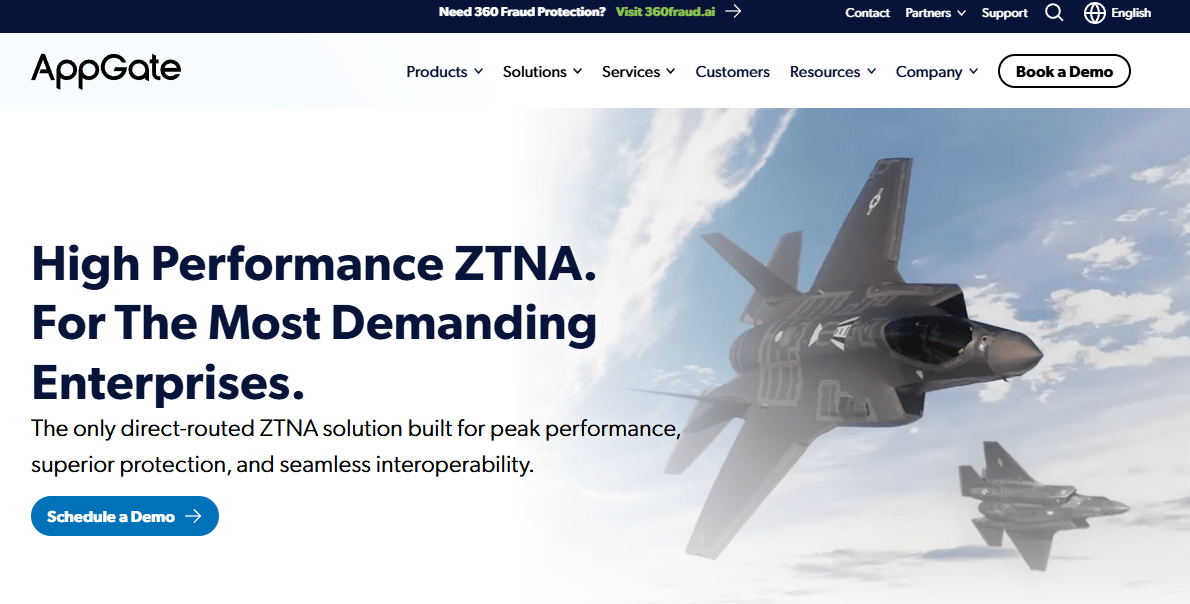
Appgate SDP is a dedicated Zero Trust Network Access platform designed for organizations that need fine-grained, policy-driven access across hybrid infrastructure. It implements Single Packet Authorization, which keeps protected resources invisible until a trust decision is made. Access decisions combine identity, device posture, and contextual signals before any connection opens.
Best for: Enterprises with mature IAM stacks that need detailed access policies across on-premises environments and cloud workloads.
Key features
- Single Packet Authorization: Resources stay dark until trust is verified
- Dynamic least-privilege policies with micro-segmentation
- Device posture checks and contextual access controls
- Client, headless, always-on, and clientless access modes
- Identity provider integrations: LDAP, OIDC, RADIUS, SAML
- REST API and script-based automation
Why choose Appgate SDP: It suits security teams ready to invest in policy design and governance. The distributed gateway architecture holds up well across complex hybrid environments where other ZTNA products rely on a single cloud service edge.
Appgate SDP pricing: The MSP partner model runs from $5/seat/month. Standard enterprise licensing requires a direct quote from Appgate. Cost drivers include user count, gateway count, deployment environments, and support tier.
G2 rating: 4.8/5.
2. Zscaler Private Access
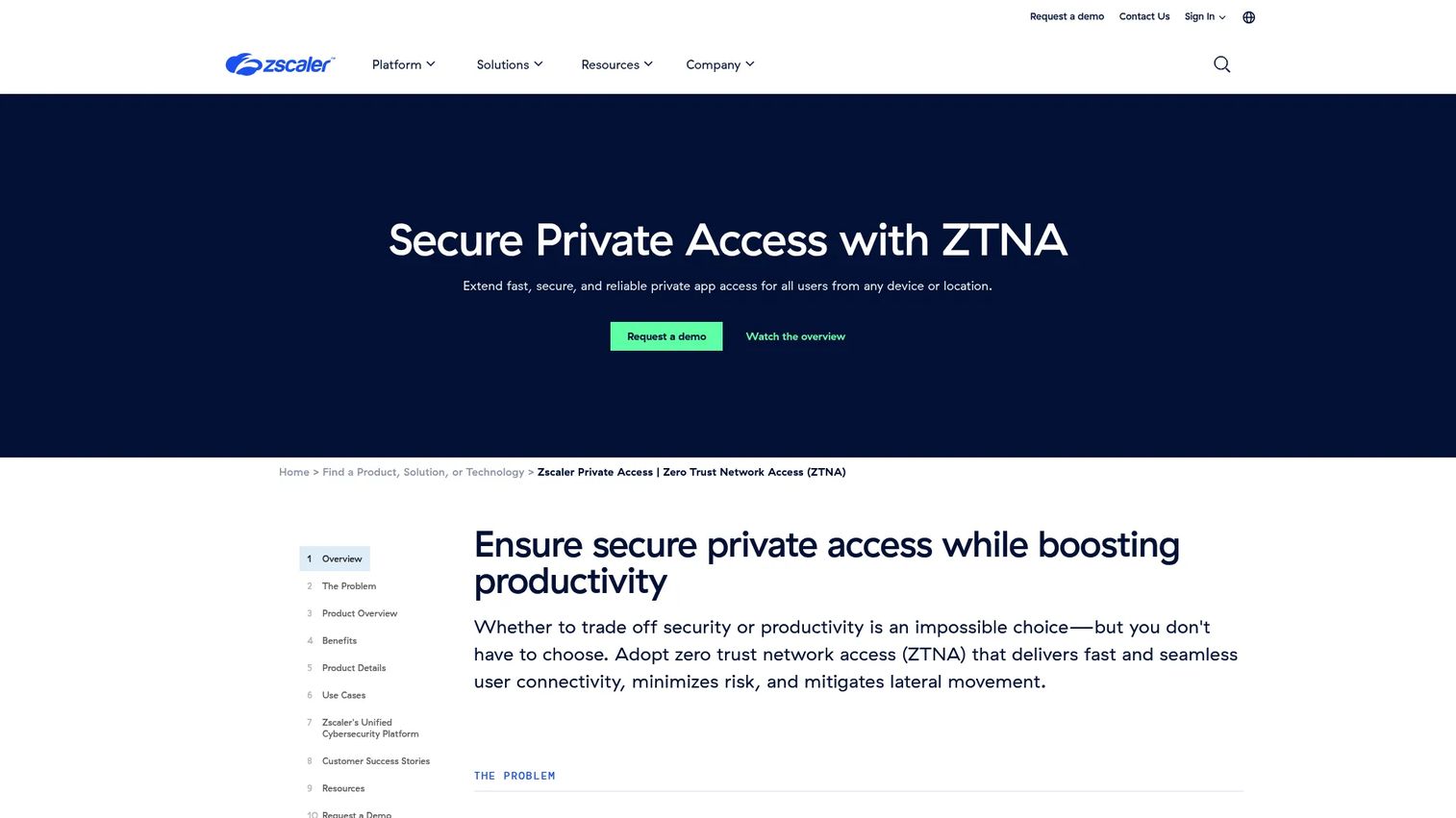
Zscaler Private Access is a cloud-delivered ZTNA platform that connects authorized users directly to private applications without placing them on the corporate network. Applications stay off the internet. Access is granted per user, per app, per session based on identity and context. It is built for organizations replacing VPN-centric access across large, distributed workforces.
Best for: Large enterprises moving from VPN access to cloud-delivered private application controls across global user populations.
Key features
- AI-powered user-to-app segmentation
- Browser-based access for unmanaged devices and third parties
- Privileged remote access for RDP, SSH, and VNC
- Context-aware policy enforcement with inline inspection
- Private application connectors for hybrid and cloud environments
Why choose Zscaler Private Access: It fits organizations standardizing on a cloud-delivered Zero Trust platform across security, web, and access controls. Adoption typically involves architecture work and identity integration. Teams should plan for that investment rather than treating it as a drop-in VPN replacement.
Zscaler Private Access pricing: Zscaler does not display prices on its website. ZPA is available as a standalone product and within the Essentials and Zscaler platform bundles. Contact Zscaler for commercial terms.
G2 rating: 4.5/5.
3. Cloudflare Access
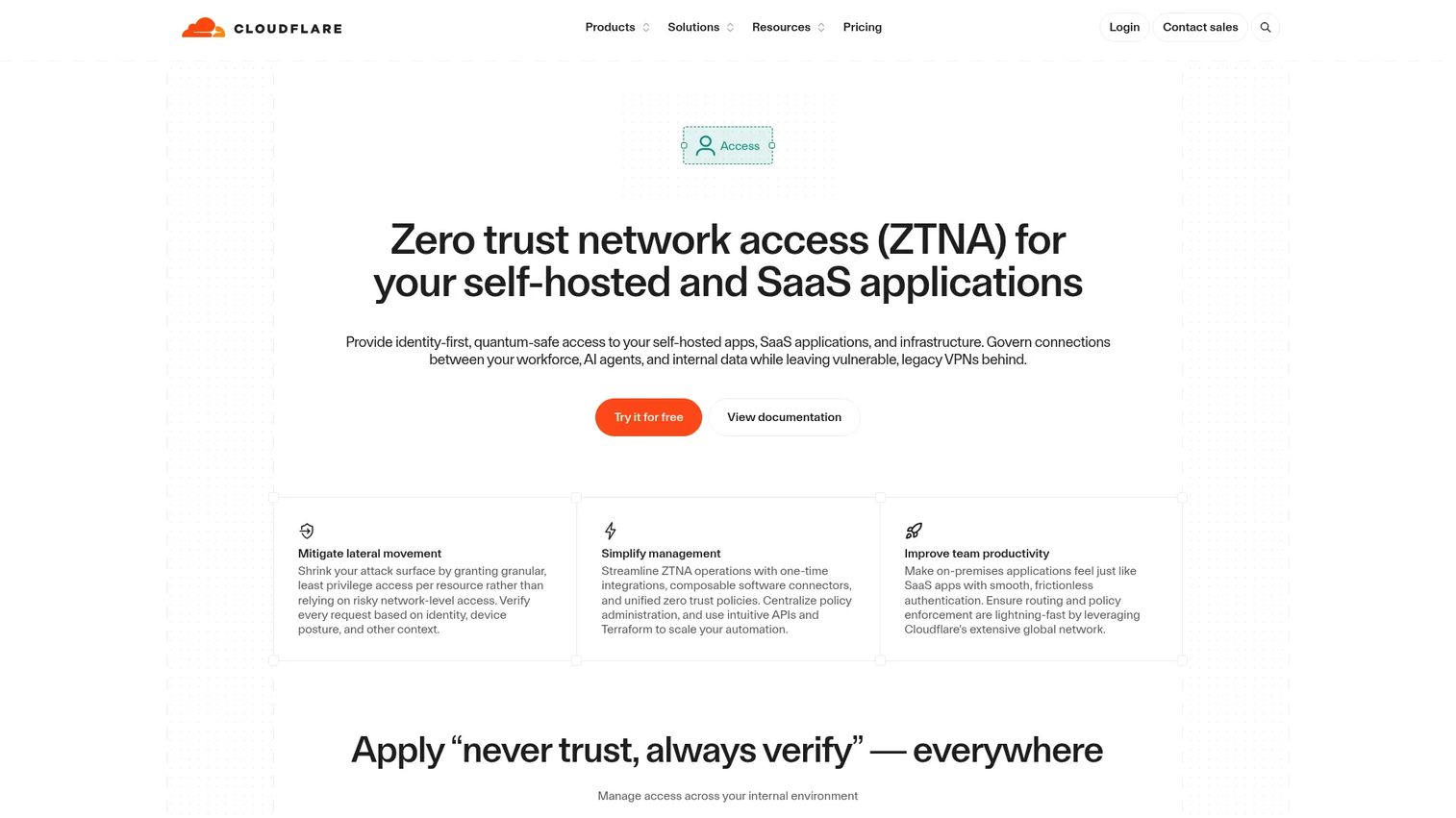
Cloudflare Access is part of Cloudflare's Zero Trust platform and provides identity-aware access to internal web applications, SSH, RDP, private network services, and SaaS administration paths. It uses Cloudflare Tunnel to connect origin servers without exposing inbound ports. Teams already running Cloudflare for DNS or application security can extend the same control plane to internal applications.
Best for: Teams that want access controls integrated with an existing Cloudflare edge and application-security footprint.
Key features
- Identity provider integrations: SAML and OIDC, including multiple IdPs simultaneously
- Application-level access rules with device posture checks
- Browser-based SSH and VNC access without a client
- Cloudflare Tunnel: No inbound firewall rules required
- Split tunneling and granular traffic policies
Why choose Cloudflare Access: Product and platform teams benefit from a common control plane for customer-facing and internal applications, without managing separate access infrastructure. The free tier works for teams under 50 users proving out the model before committing to paid plans.
Cloudflare Access pricing: Free for up to 50 users. Pay-as-you-go plans run $7/user/month billed annually. Contract plans with full features and enterprise support are priced on request.
4. Twingate
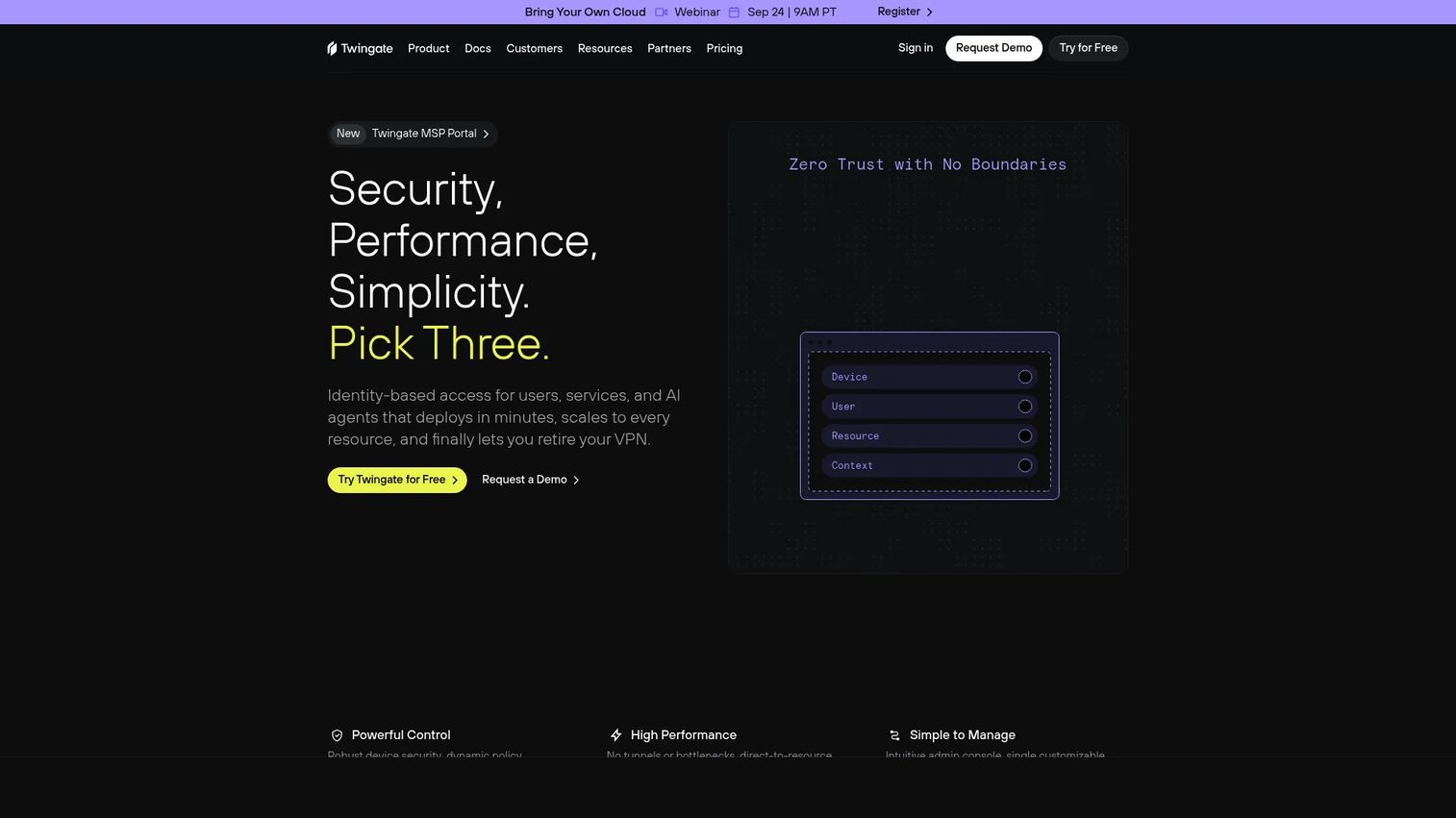
Twingate replaces broad VPN access with resource-level connectivity. Users connect to named resources through connectors that sit near each protected system. No inbound firewall ports are required, and no split tunneling workarounds are needed. From a product manager's view, the operational benefit is concrete: Define who reaches which system, audit it, and revoke it without touching firewall rules.
Best for: Mid-market and enterprise teams replacing traditional VPN workflows for internal tools, staging systems, and developer access.
Key features
- Resource-based access policies with per-resource controls
- Connector-based private access: No inbound ports
- Identity provider integration with device trust controls
- Privileged access for Kubernetes, SSH, databases, and web apps
- Audit logs and activity reporting
Why choose Twingate: It focuses on the private-access rollout without requiring a full SASE program. The free Starter tier supports up to 5 users, which lets small teams validate the access model before expanding. Mapping resources and assigning ownership before migration is the upfront work.
Twingate pricing: Starter is free for up to 5 users. Home plan is $15/month. Teams plan is $5/user/month supporting up to 100 users. Business plan is $10/user/month for up to 500 users. Enterprise pricing is custom.
G2 rating: 4.7/5.
5. Tailscale
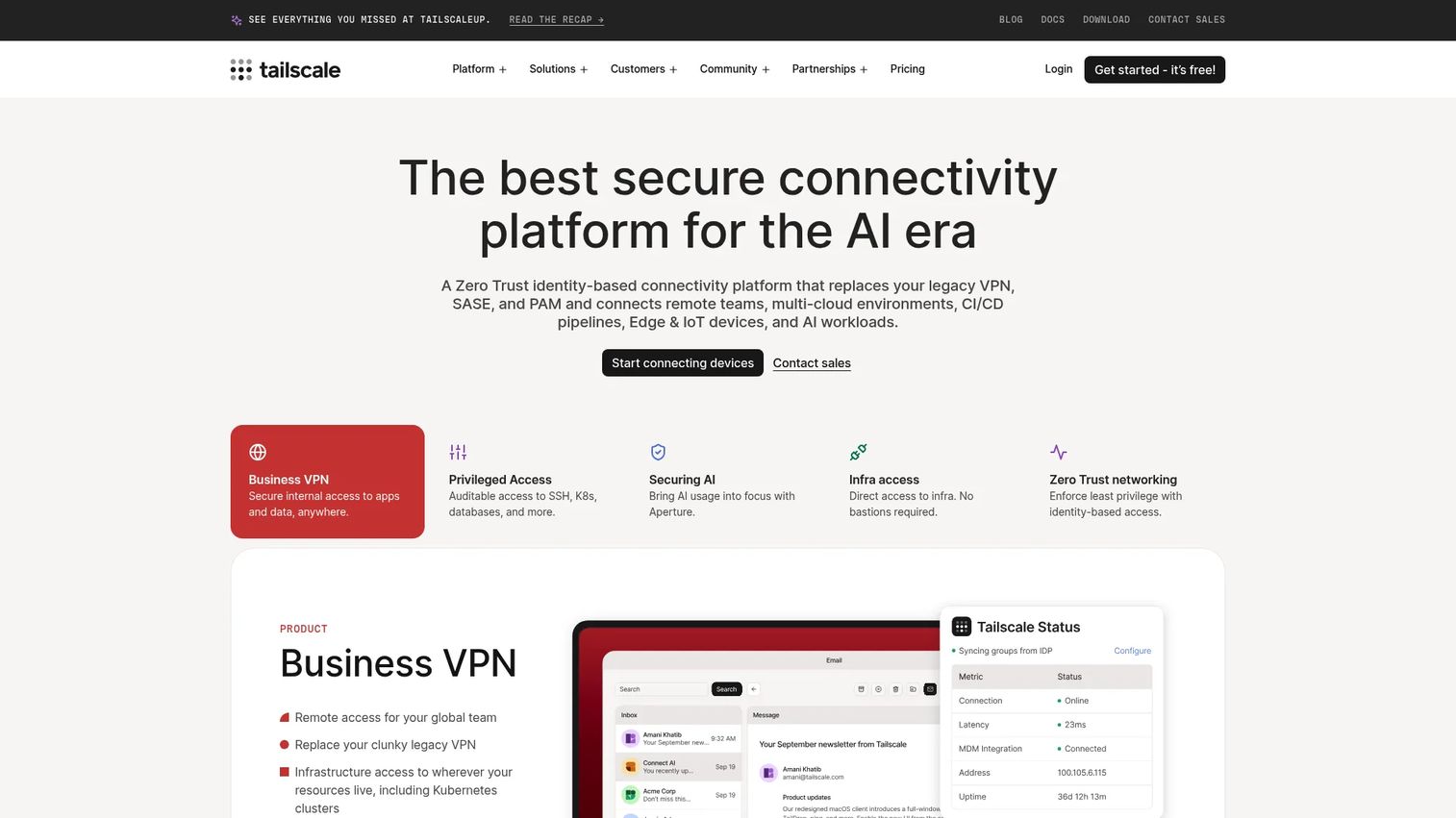
Tailscale builds a WireGuard-based encrypted mesh network with identity-aware access controls. Every device gets an identity. Access between devices, services, and environments is governed by ACL policies. It is not a conventional app-proxy ZTNA product. Tailscale connects devices and workloads directly, which suits infrastructure and engineering workflows more than user-facing application access controls.
Best for: Engineering-led teams needing secure device, service, and environment connectivity with strong developer adoption.
Key features
- WireGuard-based peer-to-peer encryption
- ACL-based access policies with RBAC
- Tailscale SSH, Funnel, MagicDNS, and subnet routers
- Audit logs, network flow logs, and session recording
- SSO, SCIM, device approval, posture management, and MDM integrations
Why choose Tailscale: It fits developer workflows well: Reaching staging systems, internal tools, homelabs, and distributed cloud resources securely. Teams should assess whether the mesh networking model meets their enterprise compliance and administration requirements before expanding beyond engineering use cases.
Tailscale pricing: Personal plan is free for individuals. Standard is $8/user/month. Premium is $18/user/month. Enterprise pricing is custom. Tagged resources cost $1/month each.
G2 rating: 4.6/5.
6. OpenZiti
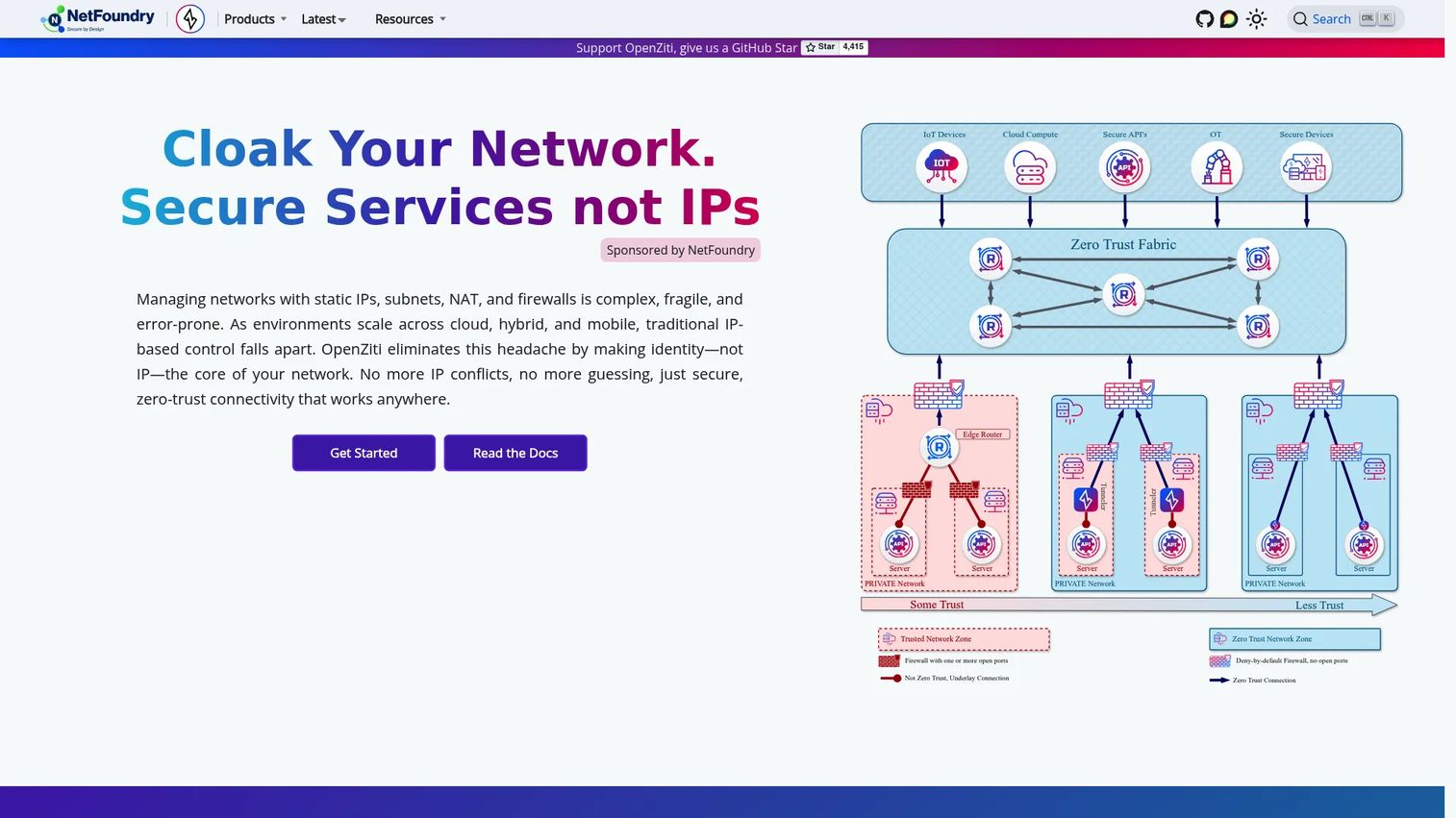
OpenZiti is an open-source zero-trust networking platform that embeds application-level security directly into services. Instead of placing a proxy in front of an application, OpenZiti lets teams bake zero-trust connectivity into the application itself using SDKs and tunnelers. Services have no open inbound ports. Identity-based access and encrypted overlay routing are handled at the application layer.
Best for: Platform engineering and security teams that want open-source, programmable zero-trust networking with full architecture control.
Key features
- Open-source zero-trust overlay mesh networking
- Application-embedded connectivity via SDKs
- Dark services: No open inbound ports required
- End-to-end encryption with identity-based access control
- Private DNS and automation support
Why choose OpenZiti: It fits teams that need more than user-to-app access and want to embed zero-trust controls into distributed services, edge deployments, or machine-to-machine connectivity. This route shifts design, deployment, and operational responsibility to your own team. NetFoundry provides a managed commercial platform if you want vendor support around OpenZiti.
OpenZiti pricing: Free and open source. Hosting and operational costs depend on your infrastructure. Commercial managed offerings are available through NetFoundry.
7. NetFoundry
NetFoundry is the commercial managed platform built around OpenZiti. Where OpenZiti requires self-hosting and operational ownership, NetFoundry provides the control plane, support, and enterprise management layer. It targets organizations securing distributed machine workloads, APIs, AI agents, and embedded software without VPNs, inbound ports, or firewall redesigns.
Best for: Organizations that need managed zero-trust overlay networking across distributed workloads without operating every component themselves.
Key features
- Outbound-only mutually authenticated connections with no inbound ports
- Identity-based least-privilege policy and workload reachability controls
- SDKs and tunnelers for embedded and unmodifiable workloads
- Central control plane with event, audit, metrics, and telemetry
- NetFoundry-hosted or self-hosted deployment options
Why choose NetFoundry: It fits teams that need more than remote workforce access. Use cases include distributed applications, edge deployments, OT and IoT workloads, and machine-to-machine connectivity. A 30-day trial is available. Confirm required engineering skills and support expectations before purchase, since this is a more specialized platform than conventional ZTNA products.
NetFoundry pricing: Custom pricing. A 30-day free trial is available. Contact NetFoundry for commercial terms, minimum commitments, and support tiers.
G2 rating: 4.0/5.
8. Google Identity-Aware Proxy
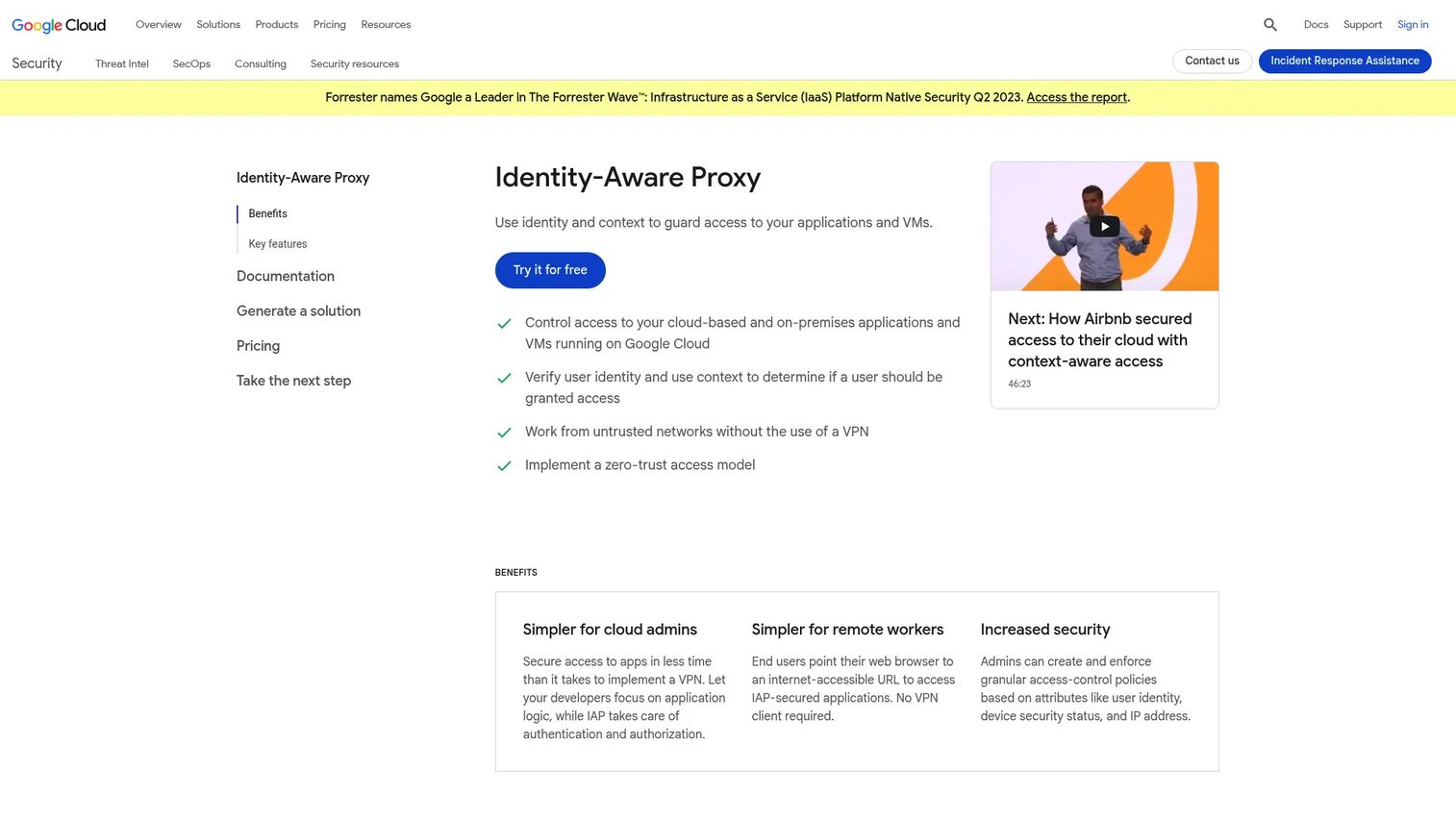
Google Identity-Aware Proxy (IAP) is a native Google Cloud access control layer for web applications, cloud resources, and virtual machines. It uses identity and context, not network topology, to decide who reaches a resource. TCP forwarding handles SSH and RDP access to VMs. No VPN is required. Its scope is specific: Applications and resources hosted in Google Cloud.
Best for: Product and platform teams protecting internal web applications and VMs hosted on Google Cloud using native identity controls.
Key features
- Centralized access control for Google Cloud applications and resources
- TCP forwarding for SSH and RDP access to VMs
- Context-aware access policies: Identity, device attributes, IP, URL paths, and time
- IAM policy integration with Google Cloud logging
- Protection for cloud and on-premises applications via IAP Connector
Why choose Google Identity-Aware Proxy: It suits teams already running key internal tools in Google Cloud who want to use native identity and policy controls without adding a separate access platform. Hybrid environments, where applications span GCP and other infrastructure, may need additional access products or architecture to cover the full inventory.
Google Identity-Aware Proxy pricing: Core IAP features for Google Cloud resources are available at no charge. Underlying networking and compute services (such as load balancing) may incur charges. Enterprise features, including proxying non-GCP resources and using device attributes in access levels, are paid capabilities.
G2 rating: 4.4/5.
9. Palo Alto Prisma Access
Palo Alto Prisma Access is a cloud-delivered SASE platform that includes Zero Trust Network Access alongside secure web gateway, CASB, and firewall capabilities. It is not a standalone SDP tool. Teams evaluate it when private application access is one component of a broader network-security consolidation, particularly where Palo Alto products are already deployed.
Best for: Large enterprises standardizing access, network security, and branch connectivity through a broader SASE program.
Key features
- Zero Trust Network Access with user and device context
- Secure Web Gateway and Cloud Access Security Broker
- Prisma Agent for unified workforce connectivity
- Remote Browser Isolation and Firewall as a Service
- Global security service edge for distributed locations
Why choose Palo Alto Prisma Access: It fits organizations where security architecture already includes Palo Alto products or where the goal is broader consolidation across access, web filtering, and network policy. Evaluating it purely for SDP means assessing more than you need. A full SASE evaluation is a different scope than a focused private-access decision.
Palo Alto Prisma Access pricing: Palo Alto does not display prices on its website. Commercial terms require contacting sales.
G2 rating: 4.3/5.
10. Akamai Enterprise Application Access
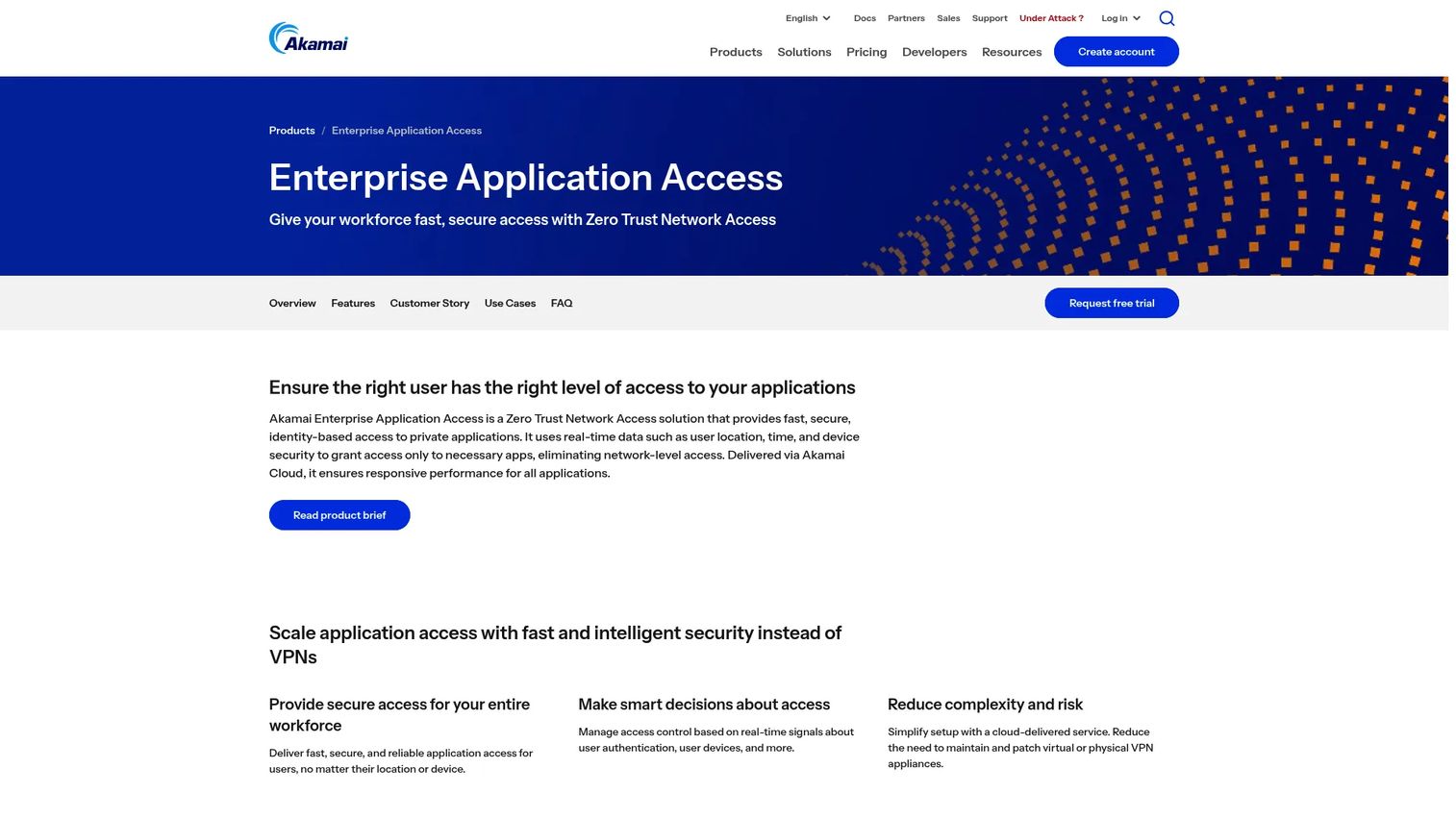
Akamai Enterprise Application Access is a Zero Trust Network Access service that provides identity-and context-based access to private applications without network-level exposure. Private application connectors sit near protected applications. The access decision uses identity provider integration, device posture, and adaptive policy. Akamai's global edge network delivers the access service, which benefits organizations with geographically distributed users.
Best for: Enterprises with globally distributed applications and an established Akamai footprint who need application-level access across complex hybrid environments.
Key features
- Identity- and context-based access with adaptive policy controls
- Private application connectors for hybrid and multicloud apps
- Clientless access for web, RDP, and SSH applications
- Device posture-based adaptive access
- Integration with Akamai MFA and Secure Internet Access Enterprise
Why choose Akamai Enterprise Application Access: It suits distributed app estates where edge delivery matters and where teams already use Akamai for application delivery or security. A free trial is available. Confirm whether access requires a wider Akamai platform contract, since commercial packaging may bundle it with other services.
Akamai Enterprise Application Access pricing: Custom pricing. A free trial is available. Contact Akamai for commercial terms and packaging.
G2 rating: 4.4/5.
Considerations when choosing software defined perimeter tools
Identity and device signal quality
The access policy is only as accurate as the signals feeding it. Confirm which identity providers (SAML, OIDC, LDAP), MFA factors, device posture tools, and endpoint-management systems each platform supports. A platform that cannot ingest your existing identity signals requires additional integration work before policies can enforce what you intend.
Application inventory and policy ownership
Map private applications before purchase. Identify each application, its owner, its user group, the authentication path, the hosting environment, and upstream dependencies. An access policy cannot be written for applications the team has not catalogued. This is the upfront work that most platform evaluations underestimate.
Hybrid and multicloud deployment fit
Check where connectors and gateways can be placed. Confirm high-availability options, cloud-region coverage, Kubernetes support, and data-center compatibility. Product and engineering teams should assess whether access policy changes will affect release workflows or support operations.
Observability and audit requirements
Confirm what the platform records: Session logs, policy decisions, connector health, user activity per application. Check integration paths into your SIEM, identity, and analytics stack. Platforms that generate data without routing it into existing tooling create visibility gaps. See also access review software for complementary governance tooling.
Migration path from VPN
Start with lower-risk internal applications, validate authentication and support workflows, then expand. Keep emergency access and business-continuity paths explicit. Migration is not a single switchover. The opportunity cost of a poorly planned cutover is measured in incident response and user trust. Related reading: access control software for broader access governance context.
Conclusion
No platform covers every scenario equally. The decision comes down to infrastructure fit, identity architecture, and how much operational ownership your team can sustain.
Appgate SDP fits hybrid enterprises with detailed policy requirements. Zscaler Private Access fits large-enterprise ZTNA programs at scale. Cloudflare Access fits teams already working within Cloudflare's security stack. Twingate is the clearest VPN replacement for mid-market teams that want resource-level access without a broader SASE commitment. Tailscale fits engineering-led connectivity and developer workflows. OpenZiti and NetFoundry fit teams building zero-trust into distributed services and machine workloads. Google Identity-Aware Proxy fits GCP-hosted internal applications using native controls. Palo Alto Prisma Access and Akamai Enterprise Application Access both suit broader enterprise security programs where private access is one component of a larger consolidation.
Start with a practical inventory: List the private applications and environments people need to reach, who needs access, and what identity signals you already have. Then test two platforms against the same access policy, identity flow, and support scenario before committing.
For related security tooling decisions, see our guides on application security testing software, cloud compliance tools, and best AI security posture management tools.
Start your journey with Guideflow today!
FAQs
A software-defined perimeter is an identity-centric security approach that brokers encrypted, least-privilege access to specific applications or resources, while keeping protected infrastructure undiscoverable to unauthorized parties. Unlike a VPN, which grants network-level access after authentication, an SDP platform evaluates identity, device posture, and policy before creating any connection. The Cloud Security Alliance SDP specification and NIST SP 800-207 both document this model as a practical implementation of Zero Trust Architecture.
They overlap significantly but are not identical. SDP is an architecture pattern, defined by the Cloud Security Alliance, that emphasizes dark networks, Single Packet Authorization, and identity-centric connectivity. ZTNA is the market category name most vendors use for private application access products that apply the same underlying principles. Most commercial ZTNA products implement SDP concepts without using the SDP term explicitly.
A VPN typically grants access to a network segment after authentication, giving the user a path to multiple resources within that segment. An SDP platform grants access to one specific application or resource per session, based on identity, device state, and policy evaluated at the time of the request. The network itself stays hidden. Many organizations run both during migration, starting SDP with lower-risk internal applications while keeping VPN for legacy protocols and administrative workflows.
Not in every environment. Legacy protocols that require network-level access, administrative workflows that depend on broad IP reachability, and endpoint types not supported by available clients may still require VPN for specific paths. The answer depends on your application inventory, device management coverage, emergency access requirements, and compliance obligations. A piloted rollout, starting with a well-understood set of internal applications, shows where SDP works cleanly and where gaps exist before committing to full migration.
The main components are an endpoint or client, an identity provider, a policy controller or control plane, a gateway or connector placed near the protected resource, and the protected application itself. The controller evaluates access requests using identity and context signals from the identity provider and endpoint. The gateway or connector creates the encrypted connection if the policy allows. Vendor terminology varies: Controllers may be called policy engines or brokers, and gateways may be called connectors, nodes, or relays.
Focus on how access policy changes affect release cadence and support operations. Key questions: Does the platform require engineering involvement to add or modify access rules? How does the platform handle access for staging environments during active development? What observability does it provide into who accessed what and when? Does it integrate with the company's existing identity provider and device-management tools? And how much operational overhead does policy maintenance create across frequent product releases?
Open-source platforms like OpenZiti can be appropriate when the team has the engineering capacity to deploy, secure, observe, and support the infrastructure. The software cost is zero, but the operational cost, including hosting, engineering time, security hardening, and support, is real. Managed products like NetFoundry provide a vendor-operated control plane and enterprise support around the same underlying technology, which suits teams that want the architecture without the self-hosting responsibility.
SDP platforms typically use connectors or gateways placed near protected applications in each environment, whether on-premises, AWS, Google Cloud, Azure, or Kubernetes. Identity and policy controls remain centralized while each connector handles traffic for the resources in its environment. This lets teams enforce consistent access policy across a distributed application inventory without requiring VPN tunnels between environments. See also cloud backup software and best identity verification software for adjacent infrastructure decisions.