Your sprint ends. The team files into the retro. Someone writes "communication" on the board for the third time this quarter. Thirty minutes later, you close the meeting with four action items that nobody owns.
That pattern is not a people problem. It is a process and tooling problem. According to an empirical study published on Arxiv in 2025, 84% of software development teams conduct retrospectives every two weeks, and 79% use structured retro boards to capture discussion points. The data says most teams are showing up. The gap is in what happens after.
For Product Managers, the cost is concrete: Misaligned sprints, unresolved blockers, and a team health signal you cannot quantify for your roadmap review. Good retrospective software closes that gap by collecting input anonymously, structuring discussion, and converting it into tracked action items with clear owners, not just sticky notes on a whiteboard.
What's inside
This guide covers 7 sprint retrospective tools evaluated for their ability to produce measurable follow-through, not just structured conversation. It is written for Product Managers and agile practitioners who need retros that connect to execution.
Selection criteria:
- Anonymous input and psychological safety: Does the tool support anonymous cards and voting?
- Action tracking: Can you assign owners and track completion across sprints?
- Templates and facilitation flow: Does it support multiple retro formats beyond Start/Stop/Continue?
- Integrations: Does it connect to Jira, Trello, Slack, or Confluence?
- Team health measurement: Does it surface longitudinal health signals, not just one-session feedback?
TL;DR
- Best overall for health checks plus retros: Echometer combines retrospectives, 1:1 meetings, and team health surveys in one platform, rated 4.8/5 on G2
- Best for remote agile teams: Parabol structures the full agile meeting loop (retros, standups, planning poker) with built-in knowledge capture
- Best free retro board: EasyRetro offers a permanently free tier with 100+ templates and Jira/Trello exports
- Best for enterprise governance: TeamRetro includes SSO, SCIM, audit logs, and structured health check dashboards
- Best for lowest price per team: Reetro's Pro Unlimited plan covers unlimited teams at $49/month flat
- Best for planning poker bundled with retros: GoRetro pairs sprint boards with planning poker and a sprint capacity calculator
What is retrospective software?
Retrospective software is a dedicated tool for running structured post-sprint (or post-project) team reviews that collect feedback, surface blockers, prioritize issues, and convert discussion into tracked action items.
A retro board is not a whiteboard with columns. The best sprint retrospective tools handle the full loop: Before the session, during facilitation, and after.
Core capabilities to look for:
- Anonymous input: Cards submitted without names attached, so quieter team members contribute without social pressure
- Retro templates: Pre-built formats including 4Ls, Sailboat, Mad/Sad/Glad, Start/Stop/Continue, and SMG
- Dot voting: Participants vote on cards to surface the highest-priority items without debate
- Action item tracking: Assign owners, set due dates, and track completion across future sprints
- Team health checks: Recurring surveys that track morale, process health, and blockers over time
- Integrations: Sync action items to Jira, export to Confluence, or push alerts to Slack
- Facilitation controls: Timers, reveal modes, and moderation tools for the session host
For Product Managers specifically, the differentiator is the output layer. A retro that produces anonymous feedback without assignment is useful for one meeting. A retro that produces owned action items, visible across sprints, with a measurable health trend is useful for your roadmap.
How retro tools fit agile team workflows
According to Echometer's analysis of State of Scrum data (2023), 81% of Scrum teams hold a retrospective after each sprint, with an average duration of about 1 hour 11 minutes. That is a significant investment per cycle. The question is whether the tooling makes that time compound across quarters, or whether each retro starts from scratch.
Tools with action tracking and health check history give you the instrumentation to answer that question with data.
When to use retrospective software
Run a sprint retro after each iteration
Dedicated retro software structures the session so the facilitator spends time on discussion rather than logistics. Templates, timers, and reveal modes keep the retro moving without the host manually managing cards and votes. This is where tools with strong facilitation controls pay off.
Capture input from remote or hybrid teams
Distributed teams cannot pass sticky notes. Anonymous digital boards remove the bottleneck of synchronous participation, and asynchronous input modes let teammates in different time zones contribute before the live session begins. For hybrid setups, look for tools that work equally well on mobile and desktop.
Turn discussion into tracked action items
This is where most retro workflows break down. After the session closes, action items often live in a Slack message or a doc that nobody revisits. Tools with native action tracking, Jira integration, or exportable task lists convert the retro from a conversation into a backlog item, which is the only output that actually changes team behavior across sprints.
Retrospective software comparison
The table below compares all 7 tools on the criteria that matter most for agile teams evaluating a retro tool in 2026. Pricing reflects verified figures from each vendor's pricing page as of August 2026.
| # | Product | Best for | Key differentiator | Pricing | G2 rating |
|---|---|---|---|---|---|
| 1 | Echometer | Health-focused retros and 1:1s | Retros plus 1:1 meeting software in one | From €29/mo per team | 4.8/5 |
| 2 | Parabol | Remote agile meeting workflows | Full agile loop: Retros, standups, planning poker | Free up to 2 teams | 4.6/5 |
| 3 | EasyRetro | Simple retro boards with exports | 100+ templates and Confluence/Jira exports | Free tier available | 4.3/5 |
| 4 | TeamRetro | Enterprise retros with governance | SSO, SCIM, audit logs, health dashboards | From $20.83/mo | 4.5/5 |
| 5 | Neatro | Recurring improvement rituals | Team Radars plus action tracking Kanban | Free tier available | 4.9/5 |
| 6 | Reetro | Budget-conscious teams | Pro Unlimited plan for all teams at $49/mo | Free tier available | 4.0/5 |
| 7 | GoRetro | Retros plus planning poker | Sprint capacity calculator bundled in | From $29/mo per team | 4.5/5 |
Best retrospective software for 2026
1. Echometer
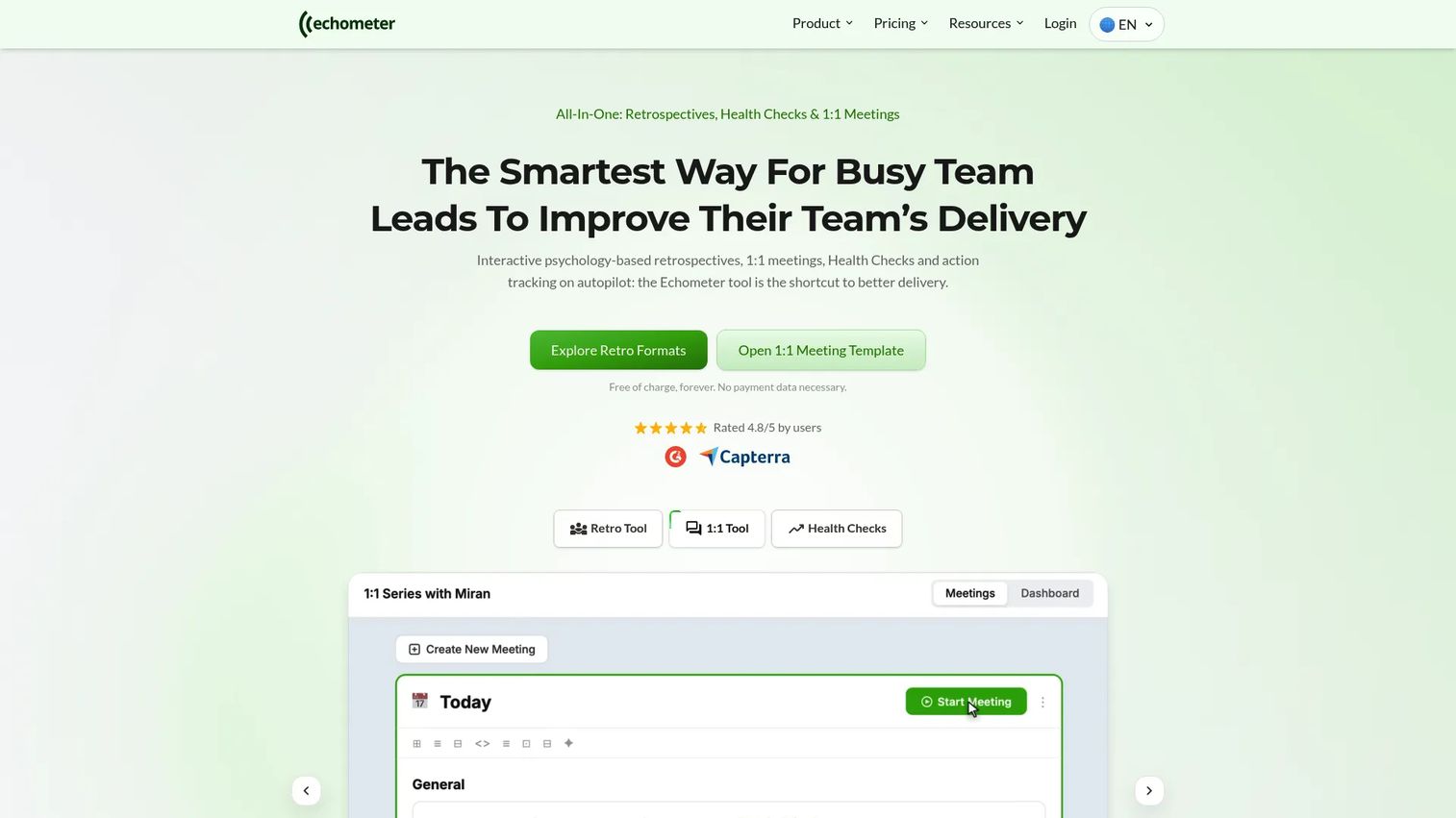
Echometer is a SaaS platform for team retrospectives, health checks, and 1:1 meetings, built specifically for agile teams and managers who need structured meeting cadences. It covers retrospective collaboration (whiteboards, retro boards, surveys), health check tracking, and 1:1 meeting management with templates, live notes, AI summaries, and coaching tips. The platform positions itself around longitudinal team health, giving managers a data layer that accumulates across sprints rather than resetting each session.
Best for: Agile teams and engineering managers who want retrospectives and structured 1:1s in a single platform, with measurable health trends over time.
Key strengths
- Health checks and team surveys: Track team morale and process signals across sprints
- Retro templates: Multiple formats including Sailboat and health-check-integrated formats
- 1:1 meeting software: Templates, live notes, and AI meeting summaries included
- Action item tracking: Progress measurement across retrospective sessions
- Facilitation support: Tools for session hosts to manage timing and discussion flow
Why choose Echometer: If your retro goal is not just one clean session but a quarter-over-quarter health signal you can bring to a roadmap review, Echometer is the strongest option in this list. The combination of retros and 1:1s in one platform reduces the overhead of maintaining two separate workflows, which matters when you are already managing release cadence and backlog prioritization.
Echometer pricing: The Retro and Health Check Tool has a free tier. The paid Pro plan runs €29 per month per team on annual billing. The 1:1 Tool Starter is also free; Pro costs €29 per month per facilitator license (annual) or €35 per month (monthly); Business runs €49 per month per facilitator license (annual) or €60 per month (monthly). Pricing is in EUR.
G2 rating: 4.8/5
2. Parabol

Parabol is an open-source agile meeting platform covering retrospectives, standups, sprint planning poker, and team knowledge management. Its retrospective flow supports anonymous suggestions, grouped discussion, and dot voting, with the ability to create tasks directly from retro cards during the session. Parabol emphasizes knowledge capture as a first-class outcome, so retro discussions accumulate into a searchable team record rather than disappearing after the call ends.
Best for: Remote and hybrid teams that run structured agile meeting workflows and want discussion to feed directly into their task backlog.
Key strengths
- Anonymous card submission: Participants submit input without names revealed until the host chooses
- In-session task creation: Convert retro discussion points into tasks without leaving the tool
- Template library: Multiple retro formats plus standup and estimation templates
- Integrations: Connects to Jira, GitHub, and GitLab for task sync
- Meeting knowledge base: Searchable history of past retros and decisions
Why choose Parabol: Parabol is the right fit when your team already runs standups and sprint poker and wants one tool to cover all structured agile meetings. The in-session task creation removes the post-retro copy-paste step that causes action items to get lost.
Parabol pricing: The Starter plan is free for up to 2 teams. The Team plan costs $8 per active user per month. Enterprise pricing requires contacting Parabol directly.
G2 rating: 4.6/5
3. EasyRetro
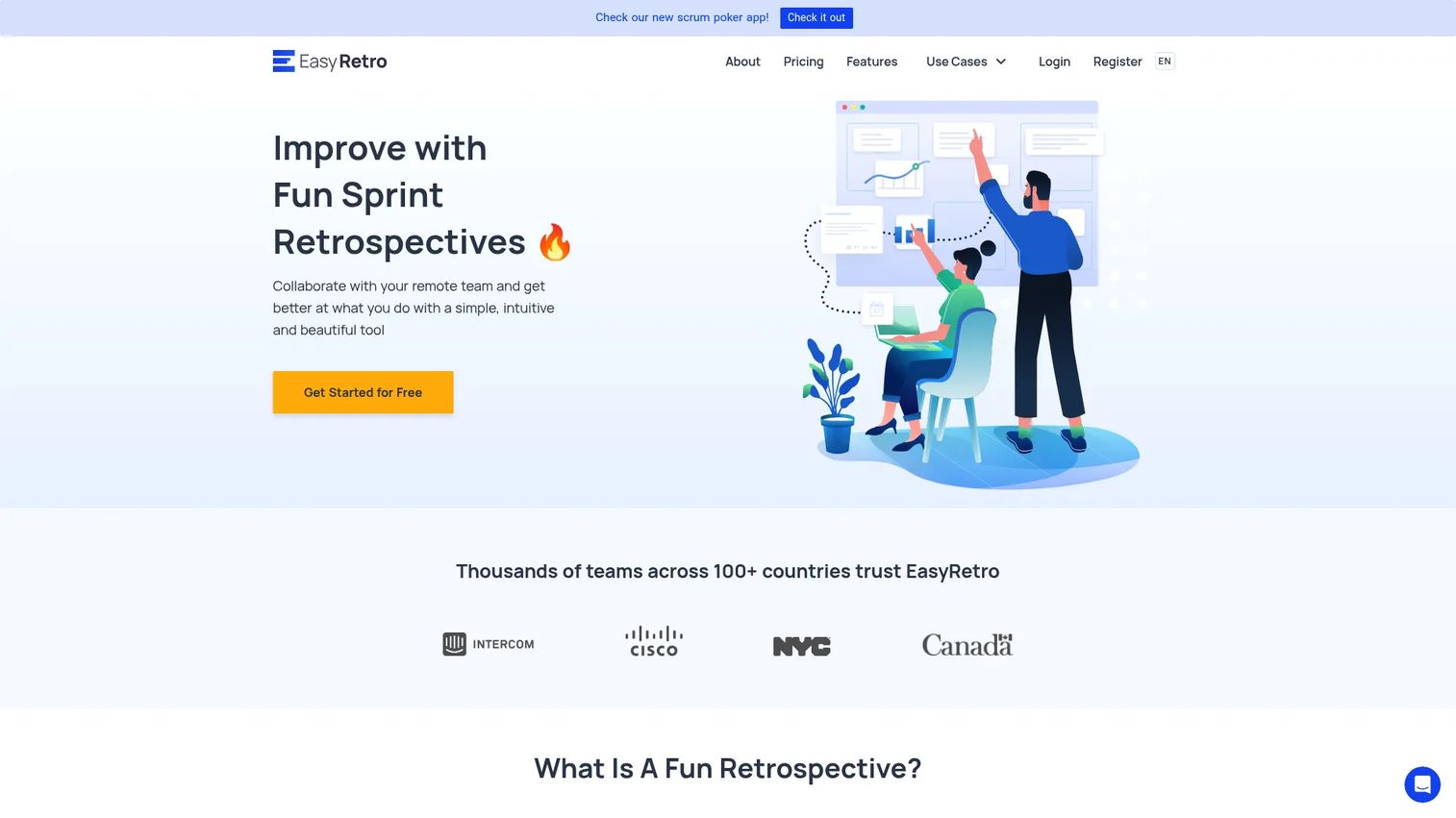
EasyRetro is an online sprint retrospective board tool focused on simplicity and fast session setup. It offers over 100 templates, unlimited columns, voting, drag-and-drop card organization, and exports to Confluence, Jira, PDF, CSV, Excel, and DOCX. The free tier is genuinely functional, not a truncated preview, which makes it a common starting point for teams adopting their first dedicated retro tool.
Best for: Teams that want a lightweight retro board with strong export options and a low adoption barrier, especially those already using Confluence or Jira.
Key strengths
- 100+ templates: Covers formats from 4Ls and Sailboat to custom configurations
- Export options: Confluence, Jira, PDF, CSV, PNG, Excel, and DOCX
- Voting and sorting: Dot voting with card grouping and priority sorting
- Board customization: Unlimited columns and public or private boards
- Free tier: Permanently available with core retro functionality
Why choose EasyRetro: The export coverage is the practical differentiator here. If your team documents decisions in Confluence or syncs action items to Jira, EasyRetro handles that without manual copy-pasting. The free tier means no budget conversation is needed to get started.
EasyRetro pricing: The Free plan is $0 per month with core retro functionality. The Team plan is $21 per month (billed annually). Business is $50 per month, Large Business is $75 per month, and Enterprise starts from $125 per month, all billed annually. Monthly billing is available with a 7-day free trial.
G2 rating: 4.3/5
4. TeamRetro
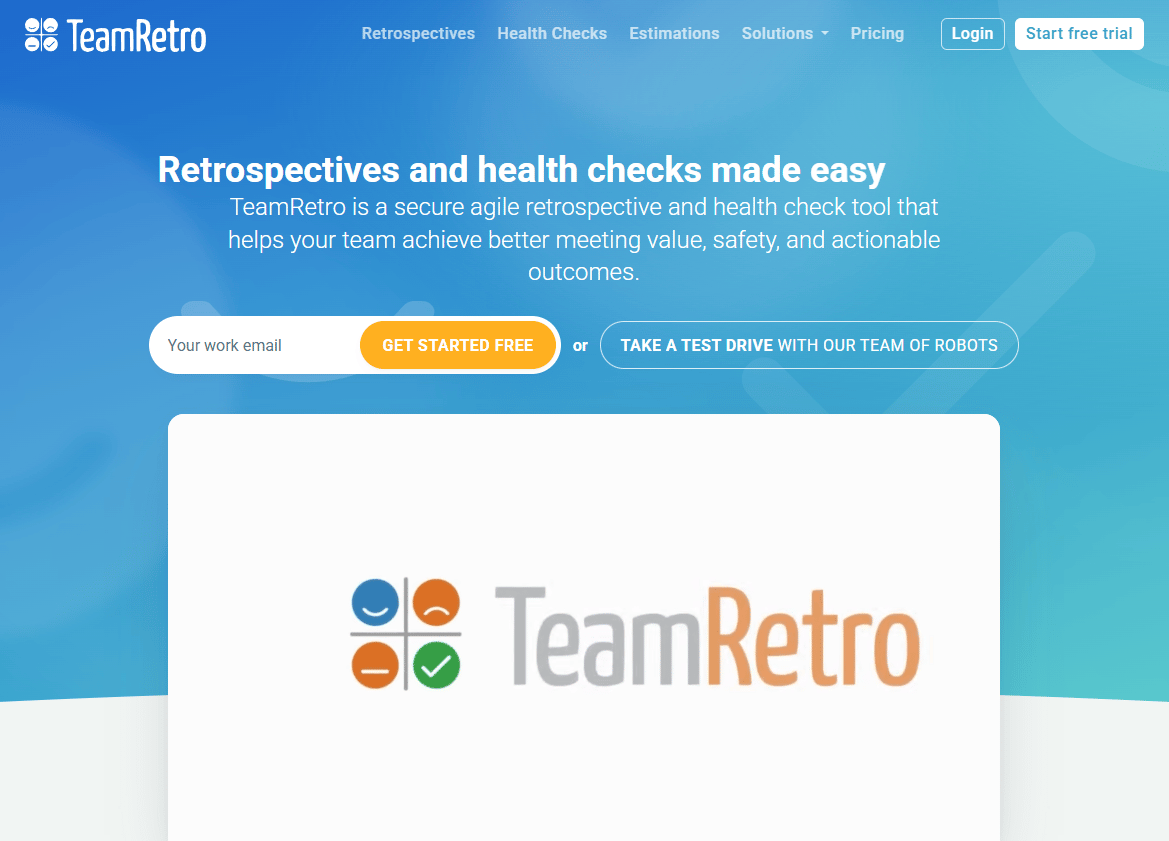
TeamRetro is a secure agile retrospective and health check platform that adds enterprise-grade governance features including SSO, SCIM provisioning, and audit logs alongside its retro and estimation tools. Health check dashboards track team maturity over time with trend reporting, and the facilitation controls give session hosts timer management, anonymous voting, and structured reveal modes. TeamRetro also includes agile estimation (planning poker) as part of its core package.
Best for: Agile teams at organizations with security requirements or manager-level reporting needs, where retro outputs need to be auditable and health trends need to be visible at the team or department level.
Key strengths
- Health checks and maturity models: Dashboards and trend tracking across retro cycles
- Enterprise security: SSO, SCIM, and audit logs included
- Multiple retro formats: Templates plus custom workflow support
- Planning poker: Agile estimation built into the same tool
- 30-day free trial: No permanent free tier, but a meaningful trial window
Why choose TeamRetro: The security and governance layer is what separates TeamRetro from simpler boards. If your organization requires SSO for all SaaS tools or needs audit-ready records of team health data, TeamRetro handles that without a custom integration.
TeamRetro pricing: The Single Team plan costs $20.83 per month (billed annually at $250/year). Small Organization is $50 per month (billed at $600/year). Large Organization starts from $75 per month (billed at $900/year). Enterprise requires contacting TeamRetro directly for teams of 10 or more. No permanent free tier; a 30-day free trial is available.
G2 rating: 4.5/5
5. Neatro
Neatro is an agile retrospective platform built around continuous team improvement. It covers retrospectives, Team Radars (a health and maturity model visualization), and an action tracking Kanban board that makes follow-through visible between sessions. The platform is structured for recurring improvement rituals rather than one-off retro sessions, which makes it well-suited to teams that want a consistent cadence.
Best for: Agile teams that run regular retrospectives and want a tool that makes improvement progress visible across sprints through Radars and a dedicated action tracking view.
Key strengths
- Team Radars: Visual health and maturity model tracking over time
- Retrospective templates: Multiple formats for different retro styles
- Action tracking Kanban: Dedicated board for managing retro action items between sessions
- Collaboration tools: Real-time participation for distributed teams
- Free tier: Permanently available with core functionality
Why choose Neatro: The Radar feature makes Neatro distinct. Where other tools track health via surveys or ratings, Neatro visualizes team capability across multiple dimensions on a radar chart, which is useful for quarterly reviews and roadmap conversations where you need to show team health trajectory.
Neatro pricing: The Free plan is $0 forever. Premium costs $23.20 per month per team (billed annually at $278.40). Pro costs $31.20 per month per team (billed annually at $374.40). Enterprise requires contacting Neatro directly.
G2 rating: 4.9/5
6. Reetro
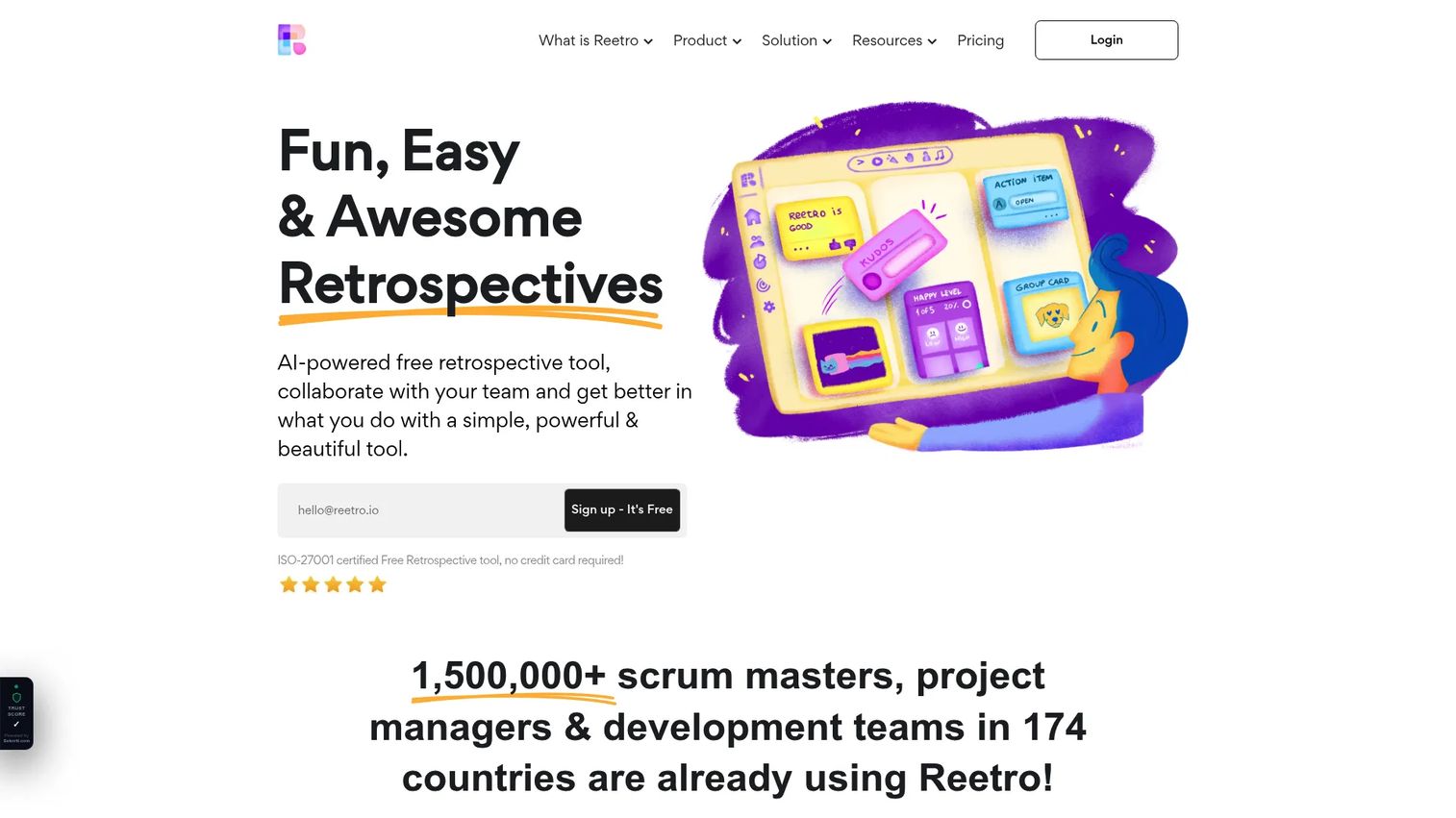
Reetro is an AI-powered retrospective and team collaboration tool that covers anonymous feedback, action tracking with export to agile tools, surveys, polls, health checks, kudos, and AI analytics. The platform's pricing model is its practical differentiator: The Pro Unlimited plan covers unlimited teams and users at a flat $49 per month, which scales well for organizations running retros across multiple squads.
Best for: Teams that want a broad retro feature set including surveys and health checks at a flat monthly rate that does not scale per team.
Key strengths
- Anonymous feedback: Cards submitted without names for psychological safety
- Action tracker: Track and export action items to agile tools
- Surveys and health checks: Pulse checks beyond the retro session
- Kudos: Team recognition built into the same workflow
- AI-powered analytics: Meeting summaries and pattern identification
Why choose Reetro: The Pro Unlimited plan is the reason to consider Reetro when you manage multiple teams. Paying per team for each squad's retro tool adds up quickly; a flat $49 per month removes that variable.
Reetro pricing: The FREE plan is $0 per month. The PRO plan costs $10 per month per team. The PRO UNLIMITED plan is $49 per month, covering unlimited teams and users.
G2 rating: 4.0/5
7. GoRetro
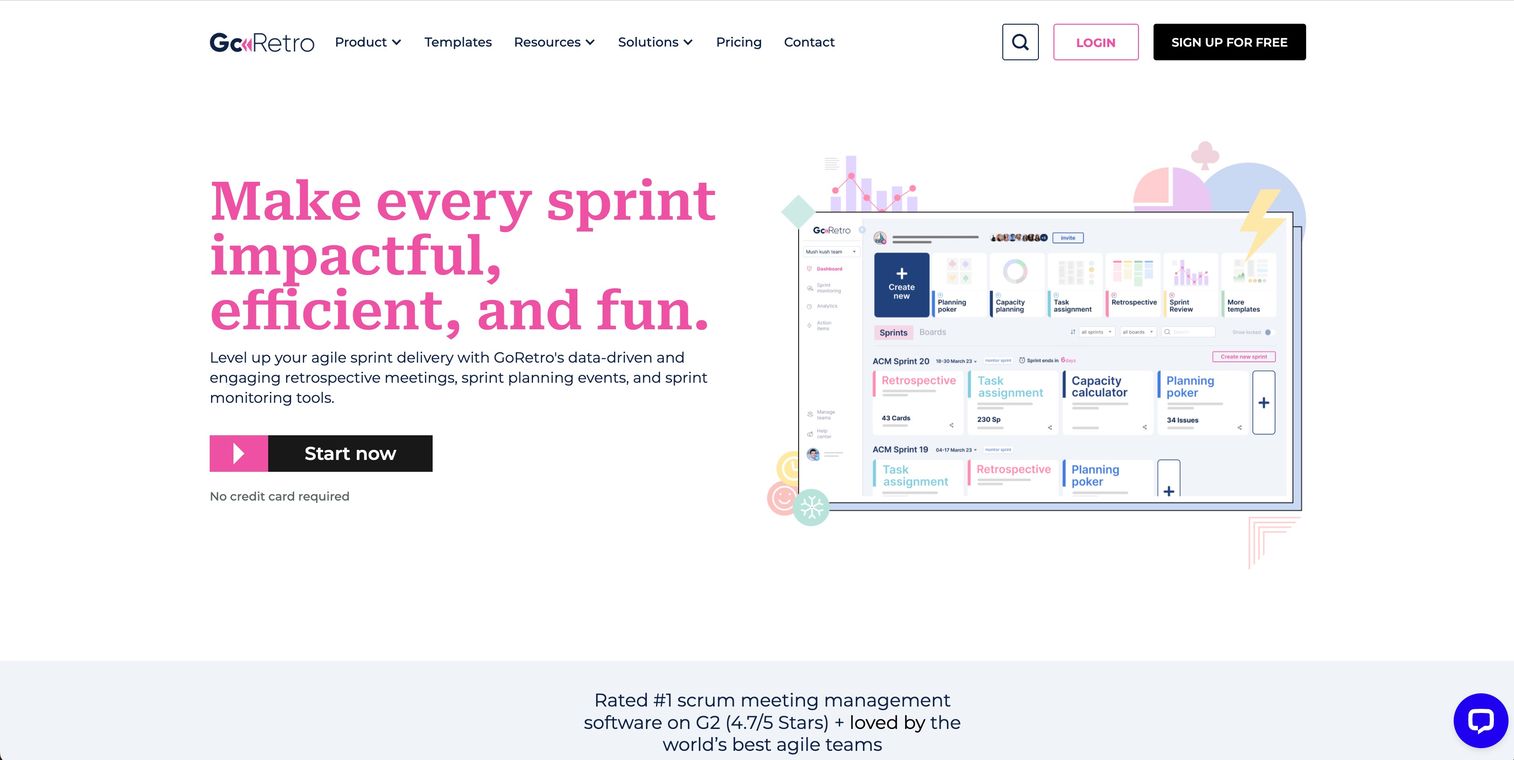
GoRetro is an online agile retrospective and sprint planning tool covering retrospective boards, planning poker, and a sprint capacity calculator. The current official domain is goretro.ai. GoRetro supports anonymous input, dot voting, and easy sharing, with a focus on keeping the setup lightweight so teams can start a board quickly without configuration overhead.
Best for: Agile teams that want a sprint retro tool bundled with planning poker and sprint capacity tracking, without a complex setup process.
Key strengths
- Sprint retrospective boards: Anonymous input, voting, and discussion grouping
- Planning poker: Estimation built into the same platform
- Sprint capacity calculator: Plan sprint load alongside the retro workflow
- Easy sharing: Board links shareable without account requirements for participants
Why choose GoRetro: The planning poker and capacity calculator combination makes GoRetro useful beyond the retro itself. If your team wants to consolidate sprint ceremonies into fewer tools, GoRetro covers estimation and capacity planning without a separate subscription.
GoRetro pricing: A 30-day free trial is available. The Premium plan costs $29 per team per month (billed annually at $348/year). Sprint Pro costs $49 per team per month (billed annually at $588/year). The Organization plan requires contacting GoRetro directly.
G2 rating: 4.5/5
What to look for before you buy retrospective software
Anonymous input and psychological safety
Anonymous cards are the single biggest factor in whether quieter team members actually contribute. Verify that the tool hides card authors from all participants during the input phase, not just from the facilitator. Some tools reveal authorship after voting or grouping, which changes the dynamic significantly.
Action tracking and ownership
The most common failure mode in retros is well-documented: Action items leave the session in a slide or Slack message and never get done. Look for tools that assign owners, set due dates, and carry items into the next session if they are incomplete. Integration with Jira or your existing task system is a meaningful upgrade over a built-in list that lives only inside the retro tool.
Templates and facilitation flow
A good template library covers more than Start/Stop/Continue. Teams rotate formats to prevent retro fatigue, and formats like Sailboat or 4Ls surface different types of feedback than the default three-column board. Check whether the tool supports timer controls, reveal modes (so all cards appear at once rather than one by one), and grouped discussion.
Integrations with Jira, Trello, and Slack
For Product Managers, the retro has to connect to the rest of the workflow. Action items that sync to Jira become backlog items with owners. Exports to Confluence keep documentation current without manual copy-paste. Slack alerts notify the team when action items are due. Verify which integrations exist at each pricing tier, as some are gated behind higher plans.
Team health measurement
Single-session retros tell you what went wrong this sprint. Recurring health checks tell you whether the team is improving quarter over quarter. If you are responsible for a team's execution quality over time, look for tools that track health signals longitudinally so you can show a trend, not just a snapshot.
How to choose the right retrospective software
Most teams land in one of four situations.
If you are managing a single squad that wants a structured retro board with no budget commitment, start with EasyRetro or Neatro. Both have functional free tiers, solid template libraries, and enough action tracking to handle a typical sprint cadence.
For remote or hybrid teams that run the full agile ceremony loop (retros, standups, estimation), Parabol's free Starter tier covers two teams with no time limit and integrates with Jira and GitHub out of the box.
If team health measurement is part of your mandate, Echometer is the clearest option. The combination of retros, health check surveys, and 1:1 meeting tools means you can track team morale and process quality across the quarter, not just retrospectively after something breaks.
For organizations with SSO requirements or multiple squads that need audit-ready reporting, TeamRetro handles governance without requiring a custom setup. Reetro's Pro Unlimited plan is worth evaluating as a cost-efficient alternative when you need to cover many teams at a flat rate.
Start with a 30-day trial on whichever tool fits your situation, run two full retro cycles, and check whether action items are getting completed before you commit to an annual plan.
Start your journey with Guideflow today!
FAQs
Parabol and EasyRetro both handle distributed teams well. Parabol supports asynchronous input before the live session, which matters when participants are across time zones. EasyRetro's shareable board links let participants join without account creation, which reduces the friction of getting everyone into the same tool quickly.
Anonymous input, action tracking with owner assignment, and Jira or Slack integration consistently matter most for teams that want retros to produce real follow-through. Templates and facilitation controls (timers, reveal modes) matter for facilitators who run retros frequently and need to keep sessions moving. Team health tracking matters if your goal is longitudinal measurement rather than single-session feedback.
The best retro tools convert discussion cards directly into assigned tasks with owners and due dates. Tools like Parabol let you create tasks from retro cards without leaving the session. Reetro includes a dedicated action tracker that exports to agile tools. Without this layer, action items typically end up in a Slack message that nobody revisits before the next sprint.
For most teams, yes. Research on psychological safety consistently shows that team members are more likely to surface real problems when their names are not attached to feedback. Anonymous input modes are standard in dedicated retro tools, but the implementation varies. Some tools reveal authorship after voting closes, which is a meaningful difference from full anonymity throughout the session.
EasyRetro exports directly to Jira and Confluence. Parabol syncs tasks to Jira, GitHub, and GitLab. TeamRetro offers Jira integration for action item export. GoRetro supports basic integrations. Reetro's action tracker exports to agile tools including Jira. For Trello users, check each vendor's current integration page, as Trello support varies by plan tier.
Keep the session to the sprint length's natural rhythm: A two-week sprint warrants a session of around 60 to 75 minutes, which aligns with the average of about 1 hour 11 minutes found in Scrum team research (Echometer, 2023). Use a template that rotates format from the previous retro to prevent stale discussion. Collect cards anonymously, group them, vote on priorities, and spend most of the session on the top two or three items rather than touching every card. Close with assigned action items before ending the call.
According to an empirical study published on Arxiv in 2025, 84% of software development teams conduct retrospectives every two weeks, which aligns with a typical two-week sprint cadence. Teams on longer release cycles sometimes run retros monthly. The key is consistency: A retro tool's health check and action tracking features only compound in value when the cadence is regular enough to generate a trend.
A retro board structures a single session: Input, group, vote, discuss, and assign. A health check is a recurring survey (often monthly or quarterly) that tracks team signals like morale, process clarity, and collaboration quality over time. Some tools like Echometer and TeamRetro include both. Running only retro boards gives you session-level feedback. Adding health checks gives you a longitudinal signal that shows whether team quality is improving across quarters.