You already know backlinks matter. The hard part is operational. Research eats Monday. Outreach follow-ups fall through the cracks by Wednesday. By Friday, you're pulling a report from a spreadsheet that has 11 tabs and three owners.
According to BuzzStream and Citation Labs (2025), only 29% of practitioners say their link-building efforts are actually successful, and only 40% feel their reports demonstrate the value of that work. The gap between effort and outcome usually comes down to tooling, not strategy.
The fix is not more software. It is the right stack for your specific bottleneck, whether that is finding prospects, getting contact data, running outreach, or monitoring what you've earned. This guide cuts through the overlap and helps you build a workflow that proves impact without paying twice for the same data.
What's inside
This guide covers 15 SEO link building tools across five workflow categories. It is written for digital marketers, SEO managers, and growth teams who need backlinks as part of a broader acquisition strategy.
- Backlink research and competitive analysis: Find link opportunities and audit competitor profiles
- Outreach and relationship management: Run campaigns without losing follow-ups
- Email discovery: Get verified contacts before you hit send
- Backlink monitoring: Track new, lost, and changed links after campaigns go live
- Internal linking and technical audits: Fix site structure so external links work harder
Tools were selected based on SERP presence, workflow fit, pricing transparency, and practical value for growth marketing teams. Pricing and ratings reflect figures verified at time of writing.
TL;DR
- Best overall backlink research: Ahrefs, with the strongest link gap and competitor analysis workflows
- Best all-in-one SEO suite: Semrush, for teams that want backlink analytics inside a broader SEO program
- Best link quality metrics: Majestic, for Trust Flow and Citation Flow-based publisher vetting
- Best outreach automation: Pitchbox, for agencies and high-volume link building teams
- Best content-led outreach: Respona, pay-per-placement model with managed editorial workflows
- Best free starting point: Google Search Console, first-party link data at no cost
- Best lightweight monitoring: Linkody, for lost-link alerts without an enterprise subscription
What is link building software?
Link building software helps marketers find backlink opportunities, qualify prospects, run outreach campaigns, monitor earned links, and report the SEO impact of backlinks.
Core jobs link building tools handle
Different tools cover different parts of the workflow. No single platform does all of these well:
- Backlink analysis (what links point to your site and competitors)
- Competitor backlink research (finding gaps between their link profile and yours)
- Prospect discovery (finding sites likely to link to your content)
- Publisher qualification (vetting domain quality before outreach)
- Contact discovery (finding editor emails and site owners)
- Outreach management (sending personalized sequences and tracking replies)
- Digital PR sourcing (connecting with journalists covering your topic)
- Backlink monitoring (tracking link status after campaigns go live)
- Internal link optimization (distributing authority across your own pages)
- Broken link discovery (finding dead pages for replacement outreach)
Metrics used in link building tools
The main metrics you'll encounter across SEO backlink tools: Domain Rating (Ahrefs), Domain Authority (Moz), Trust Flow and Citation Flow (Majestic), Spam Score (Moz), referring domain counts, anchor text distribution, link velocity, and follow versus nofollow status. These metrics help prioritize prospects. They do not replace manual checks on traffic, editorial quality, and topical relevance.
Where link building software fits in a marketing stack
Link building tools sit between your SEO suite and your outreach workflow. Research tools feed into contact discovery tools, which feed into outreach platforms, which should push engagement data into your CRM or analytics stack. A well-integrated stack removes the spreadsheet in the middle. Most growth teams already pay for one SEO suite. The question is what specialist tools are worth adding versus what your existing subscription already covers.
When to use link building tools
Find competitor backlink gaps
Pull a list of domains linking to your top three competitors but not to you. This is the fastest way to identify realistic prospects, since these publishers have already demonstrated willingness to link in your category. Run the gap report against category pages, top-ranking blog posts, and resource pages to build a prioritized outreach list.
Run outreach without losing follow-ups
A spreadsheet breaks the moment your campaign has more than 30 or 40 prospects. Contact ownership gets lost. Follow-up timing falls out of sync. Teams send duplicate emails. Outreach tools solve this with templates, suppression lists, reply tracking, and campaign history that any team member can access.
Monitor earned links after campaigns go live
Winning a link does not end the job. Links get removed during site redesigns, change from followed to nofollowed, or redirect to unrelated pages. Set up monitoring as soon as a campaign starts converting. Catching a lost link within days is recoverable. Catching it six months later is usually not.
Link building tools comparison
The table below covers all 15 tools with pricing and G2 ratings verified from vendor pages and G2 listings. Moz Link Explorer has no reviewed G2 listing for the standalone product, so N/A is used. HARO's domain resolves to a flooring company, not an SEO platform, so its current status as a journalist outreach service is noted separately in its item section.
| # | Product | Best for | Key differentiator | Pricing | G2 rating |
|---|---|---|---|---|---|
| 1 | Ahrefs | Backlink research and link gap analysis | Large database with Site Explorer and Link Intersect | From $29/mo | 4.5/5 |
| 2 | Semrush | All-in-one SEO suite with link building workflows | Backlink analytics, Backlink Gap, and outreach in one platform | From $117.33/mo (annual) | 4.4/5 |
| 3 | Majestic | Link quality metrics and historical data | Trust Flow, Citation Flow, and deep link graph | From €46.99/mo | 4.3/5 |
| 4 | Respona | Managed editorial link placements | Pay-per-result pricing with done-for-you outreach | From $100/placement | 4.8/5 |
| 5 | Pitchbox | Agency outreach at scale | Outreach automation with AI personalization and CRM | From $210/mo (annual) | 4.7/5 |
| 6 | Hunter.io | Email discovery and verification | Domain Search and bulk email verification | Free; paid from $34/mo | 4.4/5 |
| 7 | BuzzStream | Relationship-based outreach management | Outreach CRM with contact history and team collaboration | From $49/mo | 4.2/5 |
| 8 | BuzzSumo | Content research and digital PR prospecting | Journalist database and content performance analysis | From $199/mo (annual) | 4.5/5 |
| 9 | Moz Link Explorer | DA-based backlink analysis | Domain Authority and Spam Score for publisher qualification | Part of Moz Pro | N/A |
| 10 | Linkody | Backlink monitoring | Lost-link alerts and lightweight reporting | From €13.90/mo | 4.5/5 |
| 11 | Google Search Console | Free owned-site link data | First-party Google data for verified properties | Free | 4.7/5 |
| 12 | HARO (Connectively) | Journalist request monitoring | Source-matching for editorial mentions | Verify current status | N/A |
| 13 | Screaming Frog | Technical audits and broken link discovery | Site crawler for broken links and redirect chains | Free (up to 500 URLs); £199/year paid | 4.7/5 |
| 14 | Link Whisper | Internal link optimization for WordPress | AI-powered internal link suggestions and orphan page detection | From $8/mo (annual) | 4.5/5 |
| 15 | AIOSEO | WordPress SEO with internal linking | Link Assistant and redirect manager inside WordPress | From $49.50/year | 4.8/5 |
Best 15 link building tools for 2026
1. Ahrefs
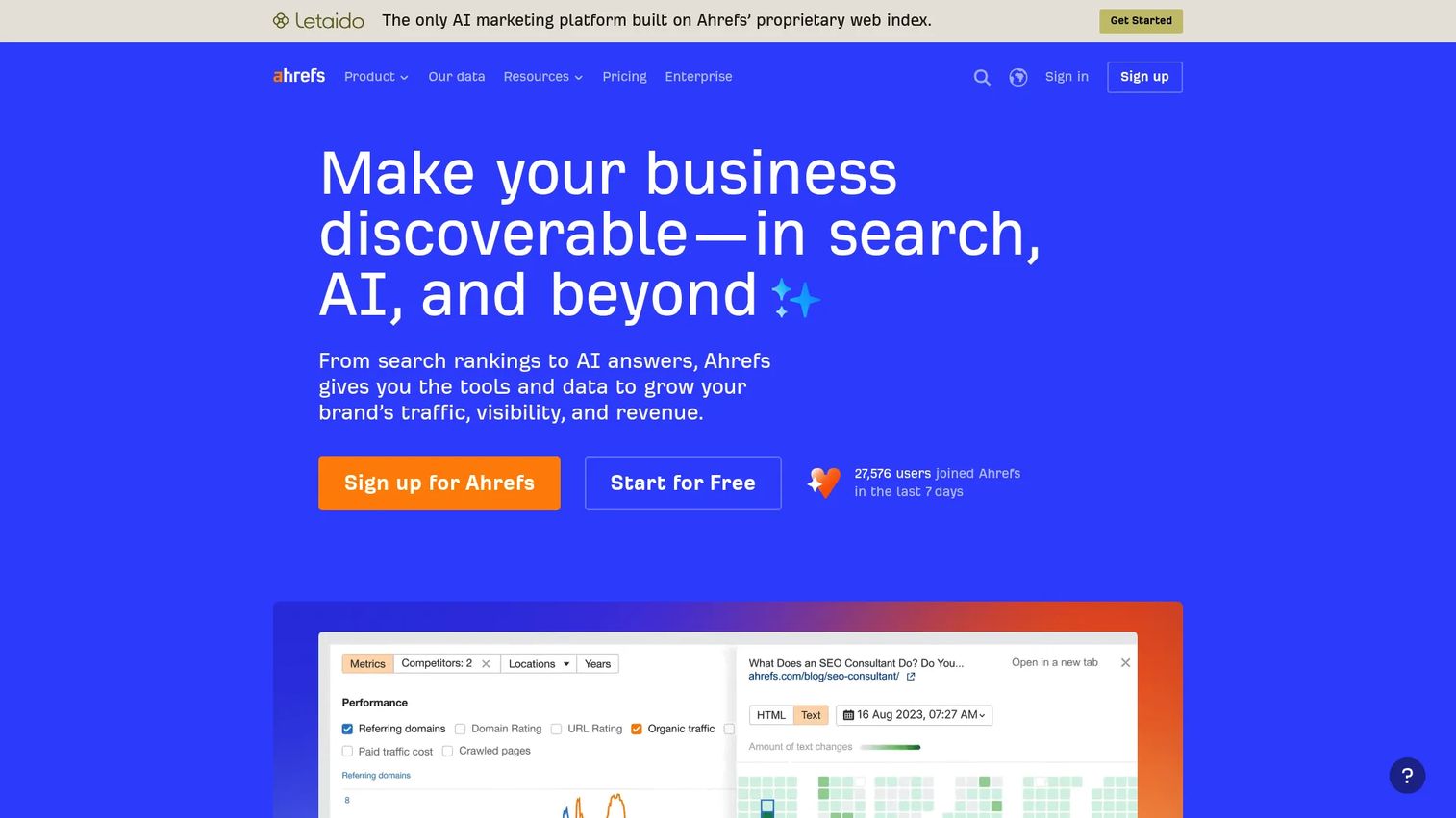
Ahrefs is an AI-powered SEO and marketing platform built around one of the largest backlink databases available. Marketers use Site Explorer to audit their own link profiles, run Link Intersect to find domains linking to competitors but not to them, and use Content Explorer to identify content formats that attract the most referring domains in a given topic. The platform also covers keyword research, rank tracking, and site auditing, which makes it a strong consolidation candidate for teams paying separately for research and audit tools.
Best for: SEO teams whose main bottleneck is competitive backlink research and link gap analysis.
Key features
- Site Explorer backlink reports
- Link Intersect for competitor gap analysis
- Best by Links page-level reports
- Content Explorer for link prospecting
- Lost backlink alerts
Why choose Ahrefs: Choose Ahrefs when link intelligence is the campaign foundation and you need to understand a competitor's full link profile before building your outreach list. It is not a dedicated outreach CRM, so pair it with a contact and sequencing tool for complete workflow coverage.
Ahrefs pricing: A free tier is available with limited access. Paid plans start at the Starter tier ($29/month), with Lite at $129/month, Standard at $249/month, Advanced at $449/month, and Enterprise at $1,499/month (annual commitment required). Annual billing saves up to 17% on eligible plans.
G2 rating: 4.5/5
2. Semrush
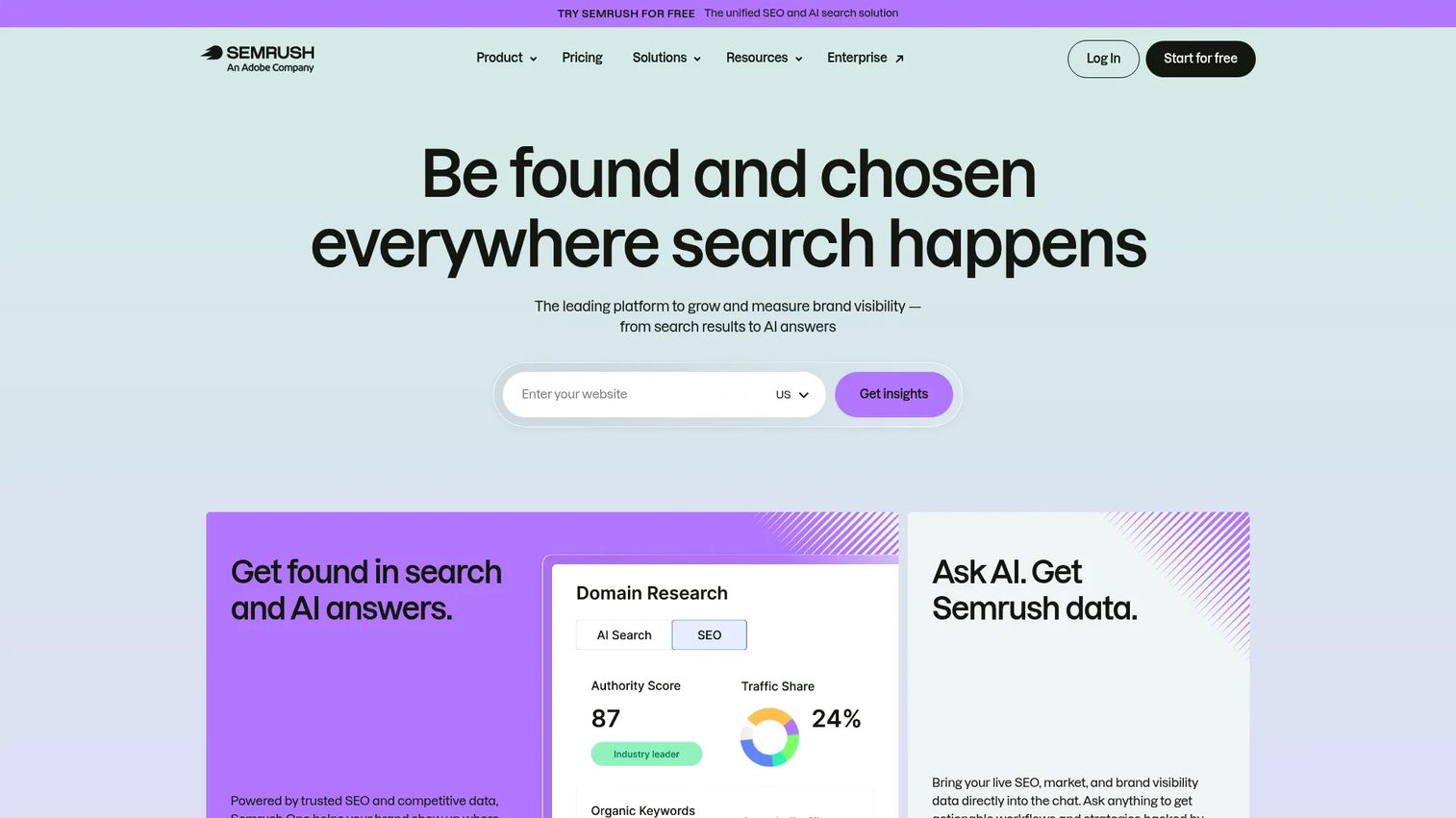
Semrush is a brand visibility and digital marketing platform covering keyword research, technical site auditing, rank tracking, content workflows, paid media, and backlink analytics under one subscription. For link building specifically, it offers Backlink Analytics for profile auditing, Backlink Gap for competitor comparisons, a dedicated Link Building Tool for managing outreach, and a Toxicity Score for identifying spammy links. The consolidation case is strong for growth teams already running SEO reporting and keyword tracking.
Best for: Growth teams that want link building inside a broader SEO program without managing separate tools for every job.
Key features
- Backlink Analytics for full profile audits
- Backlink Gap for multi-competitor comparison
- Link Building Tool with outreach tracking
- Toxicity Score for disavow workflows
- Rank tracking and site auditing in the same platform
Why choose Semrush: Choose Semrush when link building is one part of an SEO program rather than the entire job. Its outreach features are not as deep as dedicated platforms, but its ability to connect backlink data, keyword rankings, and content gaps in one workflow reduces the number of tools you're paying for.
Semrush pricing: A free tier is available. Paid SEO plans start at $117.33/month billed annually (equivalent to $139/month billed monthly). The Starter plan runs $165.17/month annually, Pro+ at $248.17/month annually, and Advanced at custom pricing through sales. Add-ons such as additional users start at $45/month.
G2 rating: 4.4/5
3. Majestic
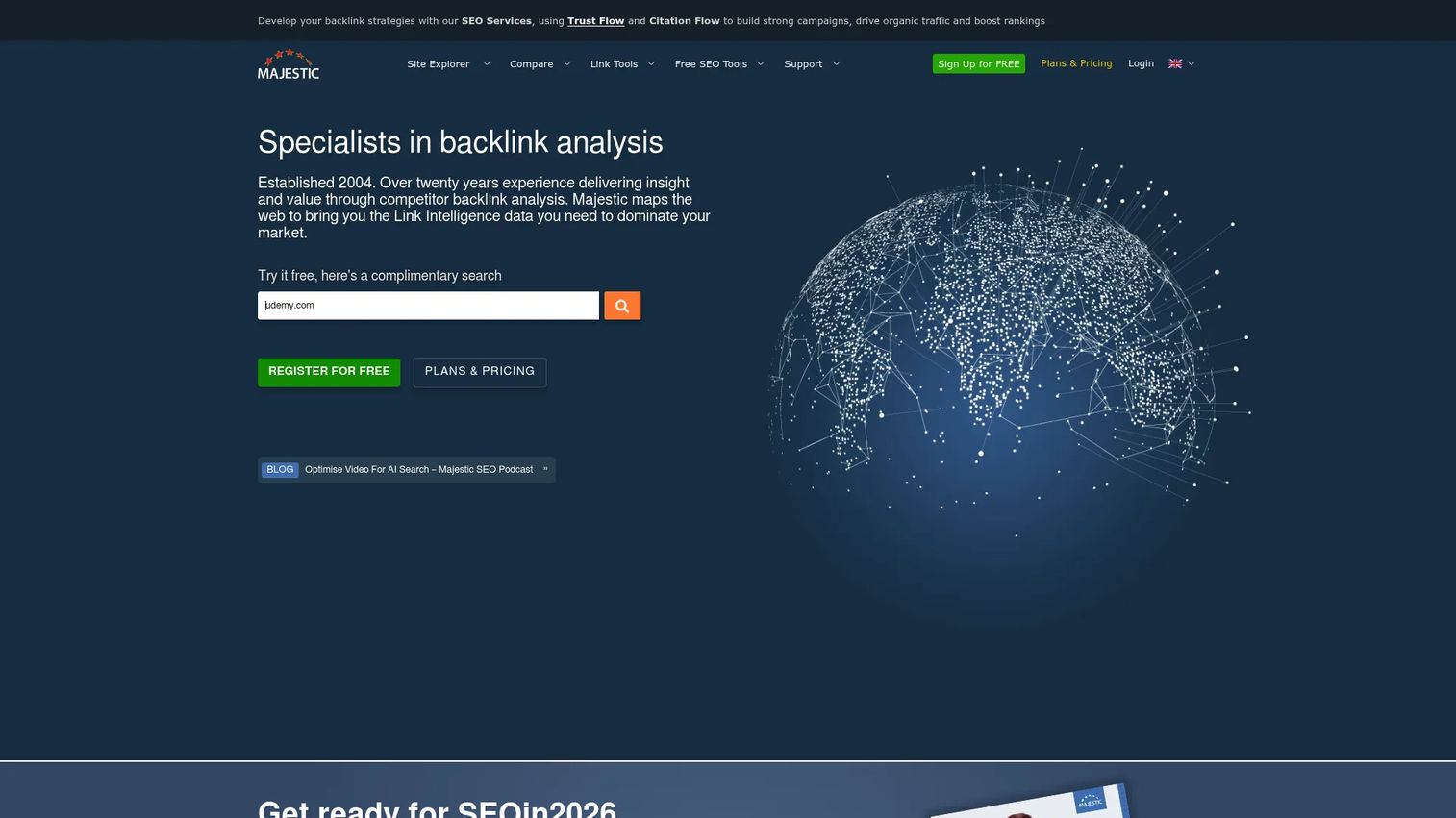
Majestic is a specialist backlink intelligence platform built around its own link graph and proprietary metrics. Trust Flow measures the quality of links pointing to a domain based on proximity to trusted seed sites. Citation Flow measures raw link volume regardless of quality. Using both together gives a sharper picture of a site's link profile than raw domain counts alone. Majestic also maintains a Historic Index, which captures links that may have been removed from the web but existed at a point in time, useful for spotting link patterns competitors built years ago.
Best for: SEOs who need link quality metrics and historical backlink context for publisher vetting and competitor research.
Key features
- Trust Flow and Citation Flow metrics
- Site Explorer with full link history
- Topical Trust Flow for niche relevance scoring
- Historic Index for long-term link pattern analysis
- Competitor site comparison reports
Why choose Majestic: Choose Majestic when link quality assessment is the primary job and you want a database focused on the link graph rather than a full SEO suite. It is especially useful for agencies vetting publisher quality before outreach.
Majestic pricing: Pricing is in EUR. The Lite plan starts at €46.99/month (or €39.16/month equivalent billed annually). The Pro plan is €94.99/month (or €79.16/month equivalent billed annually). A free signup with limited access is available.
G2 rating: 4.3/5
4. Respona
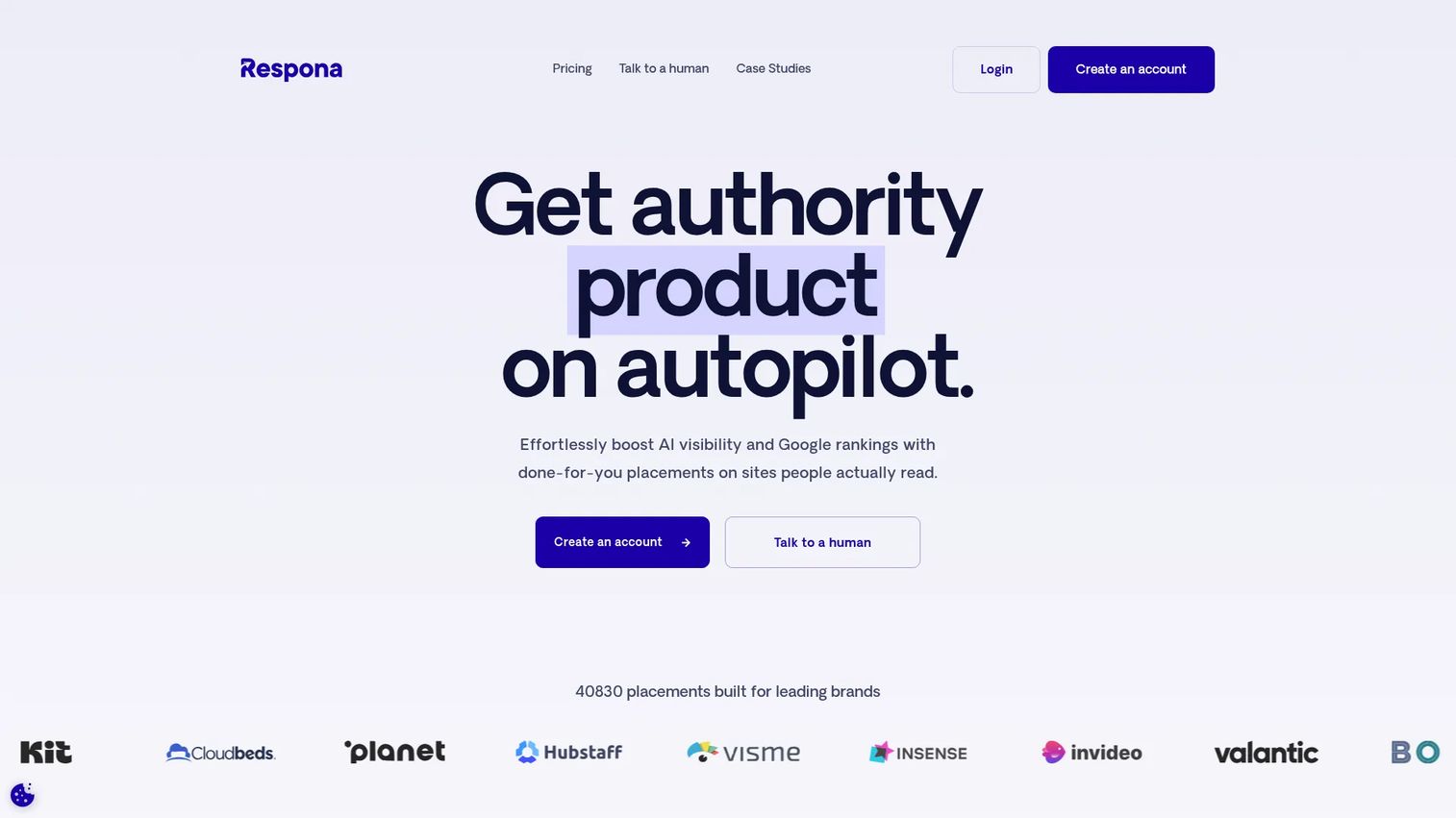
Respona operates as a done-for-you link building service rather than a self-serve outreach tool. The team handles publisher prospecting, outreach, content creation, and placement publishing on your behalf. Placements include product reviews, listicles, contextual insertions, news mentions, and comparison guides. You approve domains before any placement goes live, and you control anchor text, target URLs, and content requirements. This model suits teams that want editorial links without managing outreach operations internally.
Best for: B2B brands and in-house teams that want managed editorial link placements without building an outreach function.
Key features
- Done-for-you publisher prospecting and outreach
- Editorial placement types: Reviews, listicles, contextual, news
- Domain approval controls before publication
- Customizable anchor text and URL targeting
- Content requirements and approval workflows
Why choose Respona: Choose Respona when your team wants results without the operational overhead of running outreach campaigns. The pay-per-placement model means you pay for links delivered rather than for a subscription you may underuse.
Respona pricing: Pricing is per placement based on publisher Domain Rating. Starter placements (DR 20+) run $100 each. Standard (DR 30+) is $160, Authority (DR 40+) is $240, Power (DR 50+) is $400, and Elite (DR 60+) is $500 per placement. Bulk discounts are available.
G2 rating: 4.8/5
5. Pitchbox
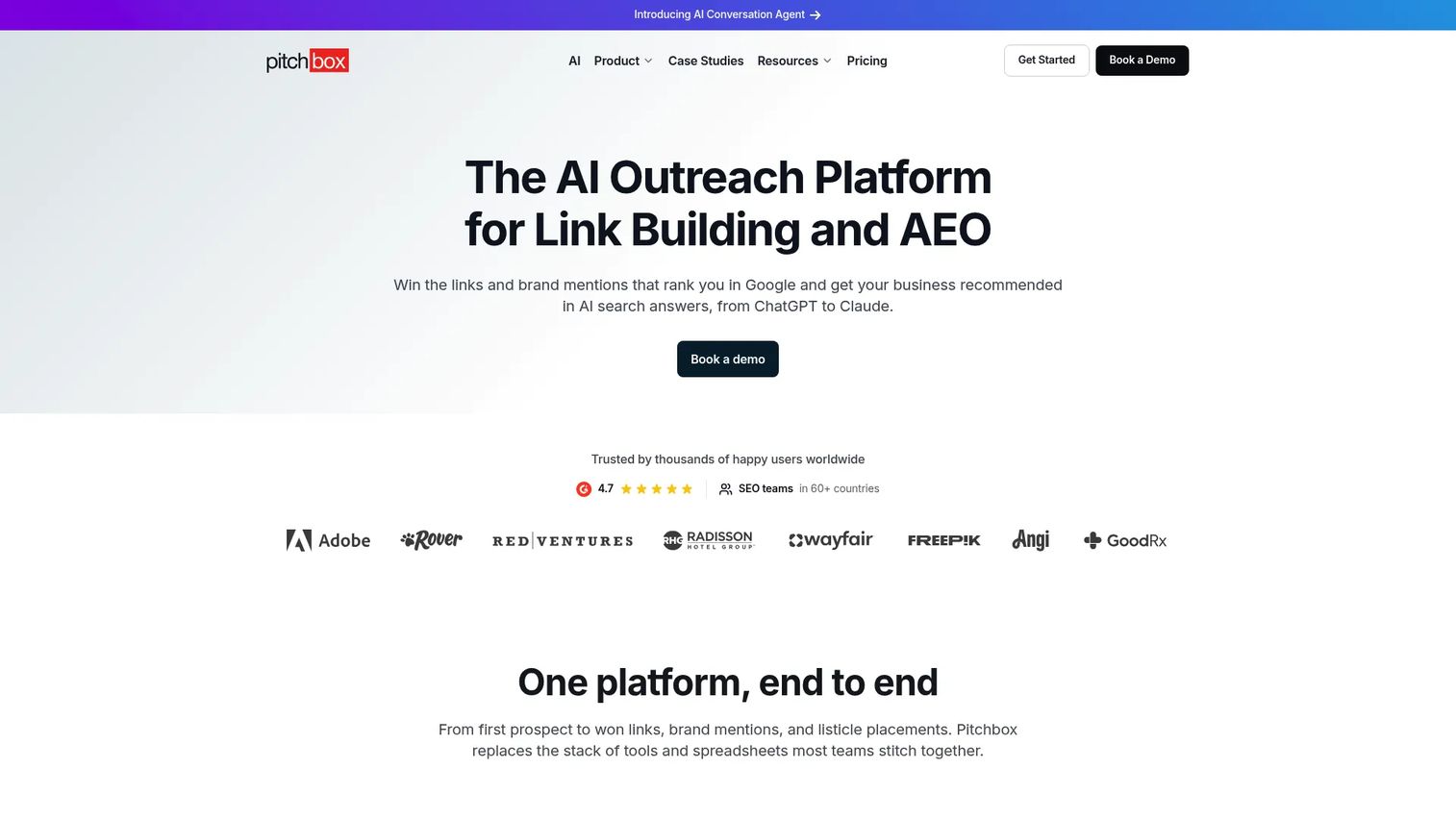
Pitchbox is an AI-powered outreach platform built for agencies and in-house teams running high-volume link building and digital PR campaigns. It combines prospect discovery with verified contact data, AI-generated and AI-personalized email sequences, automated follow-ups, a CRM with a unified inbox, and deliverability monitoring. The platform also includes link monitoring, so won links can be tracked after placement without switching to a separate tool.
Best for: Agencies and larger SEO teams running outreach campaigns at scale with multiple users and pipeline visibility requirements.
Key features
- Prospect discovery with verified contact data
- AI personalization and AI Reply Agent
- Automated outreach sequences and follow-ups
- CRM with unified inbox and team collaboration
- Link monitoring and campaign reporting
Why choose Pitchbox: Choose Pitchbox when campaign volume and team workflow management are the primary concerns. Its outreach depth and reporting go beyond simpler email tools, and it covers the full cycle from prospecting to link monitoring in one platform.
Pitchbox pricing: Plans are billed annually. Pro starts at $210/month (monthly equivalent is $300/month). Advanced is $420/month annually ($600/month monthly). Scale is $825/month annually ($1,200/month monthly). Enterprise Platform pricing is by sales inquiry. Free trials are available.
G2 rating: 4.7/5
6. Hunter.io
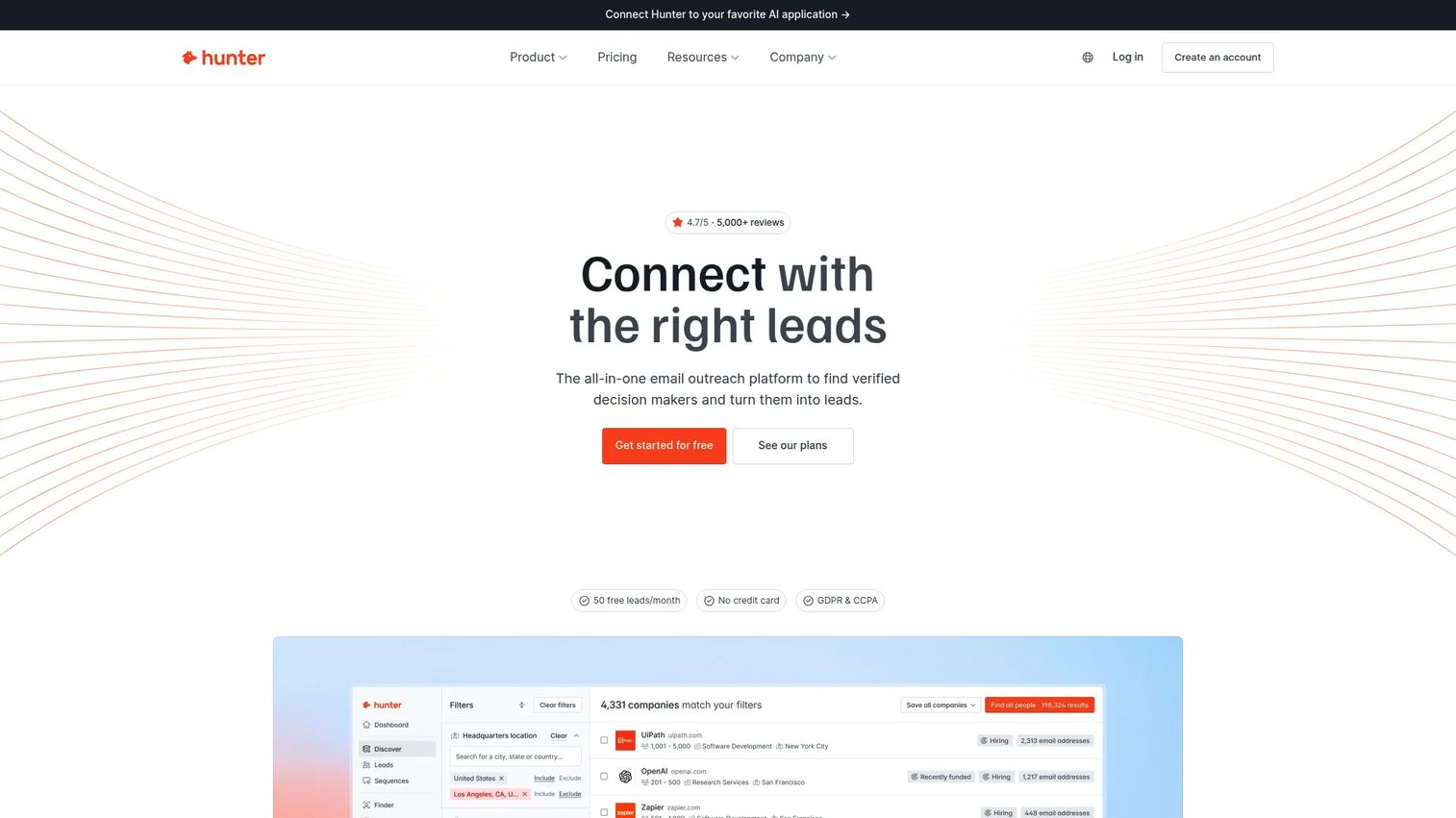
Hunter.io is an email discovery and outreach platform focused on helping teams find, verify, and reach professional contacts at any domain. For link building, the main use case is Domain Search: Type in a website and get a list of publicly discoverable email addresses associated with it, along with confidence scores and job title context. Hunter also supports bulk verification, cold email sequences, lead enrichment, and CRM-style lead management. A browser extension and Google Sheets add-on fit it into existing research workflows.
Best for: Marketers who already have a list of target prospects and need verified contact data before they can run outreach.
Key features
- Domain Search for finding site contact emails
- Email Finder for individual lookups
- Bulk email verification
- Cold email sequences with tracking
- Google Sheets add-on and browser extension
Why choose Hunter.io: Choose Hunter when contact discovery is the gap, not prospect research. It pairs well with backlink research tools that surface link opportunities and outreach platforms that manage the campaign. Hunter covers the step in between.
Hunter.io pricing: A free plan includes 50 credits per month. Paid plans start at $34/month (monthly billing) for the Starter tier. Growth is $104/month and Scale is $209/month. Enterprise pricing is custom. Yearly billing is approximately 30% cheaper.
G2 rating: 4.4/5
7. BuzzStream
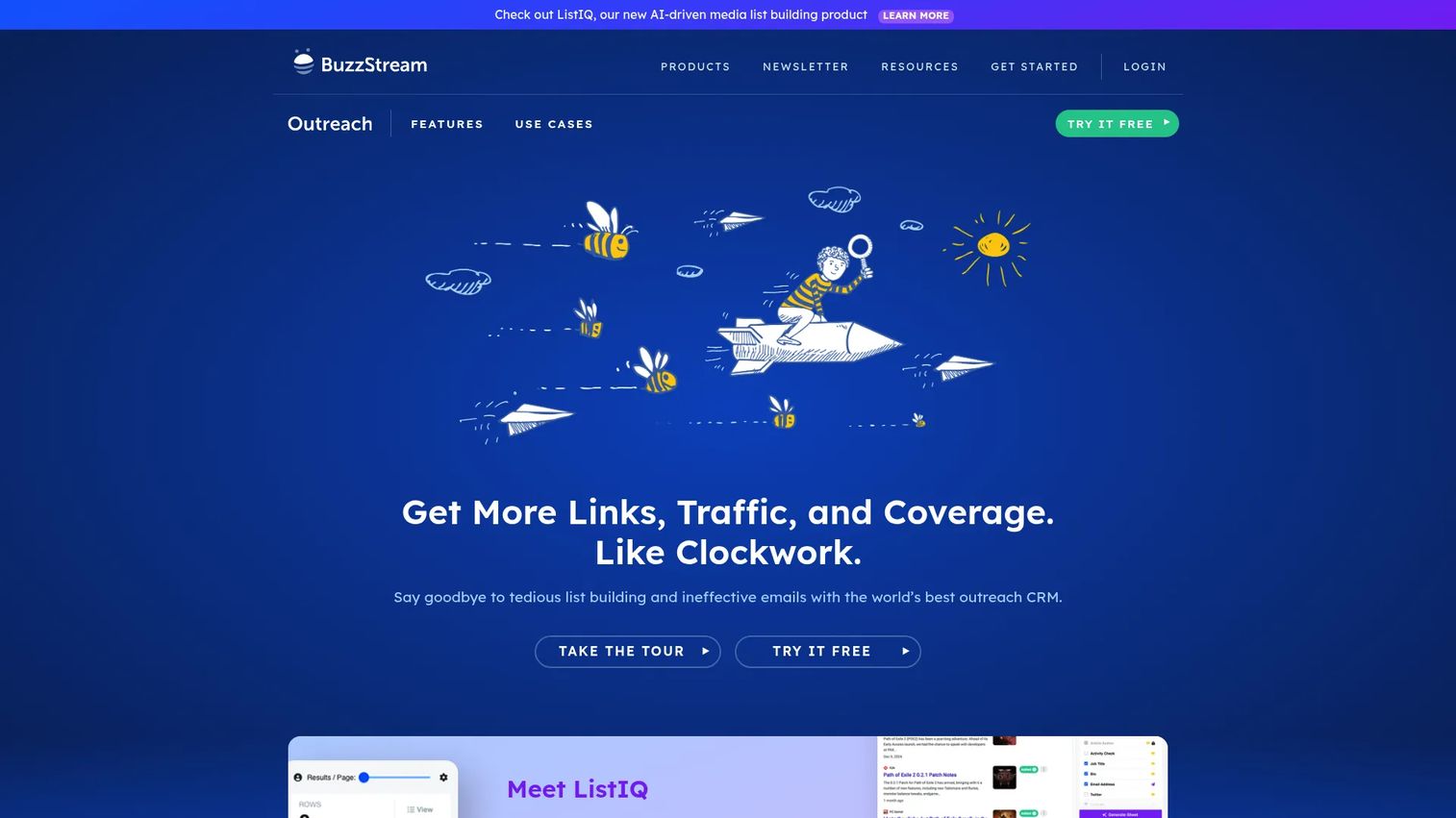
BuzzStream is an outreach CRM built specifically for digital PR, link building, and content promotion workflows. Where generic email tools track sends and opens, BuzzStream tracks the full relationship: Contact history, campaign notes, previous touches, response status, and team annotations. This matters for link building because the same editor may appear across multiple campaigns over time. Knowing what was sent, who sent it, and what the response was prevents duplicate outreach and lost context.
Best for: Teams that want relationship history alongside outreach management, especially across multiple ongoing campaigns.
Key features
- Outreach CRM with full contact history
- Prospect research and contact discovery
- Email templates with personalization and scheduling
- Automated follow-up sequences
- Team notes and collaboration features
Why choose BuzzStream: Choose BuzzStream when relationship continuity matters and you want to avoid sending duplicate outreach to contacts you've already engaged. It suits content-led link building programs where the same publishers are contacted regularly.
BuzzStream pricing: No free tier, but a free trial is available. Starter is $49/month (1 user, 500 contacts). Growth is $174/month (3 users, 25,000 contacts). Professional is $424/month (6 users, 100,000 contacts). Custom plans start at $999/month.
G2 rating: 4.2/5
8. BuzzSumo
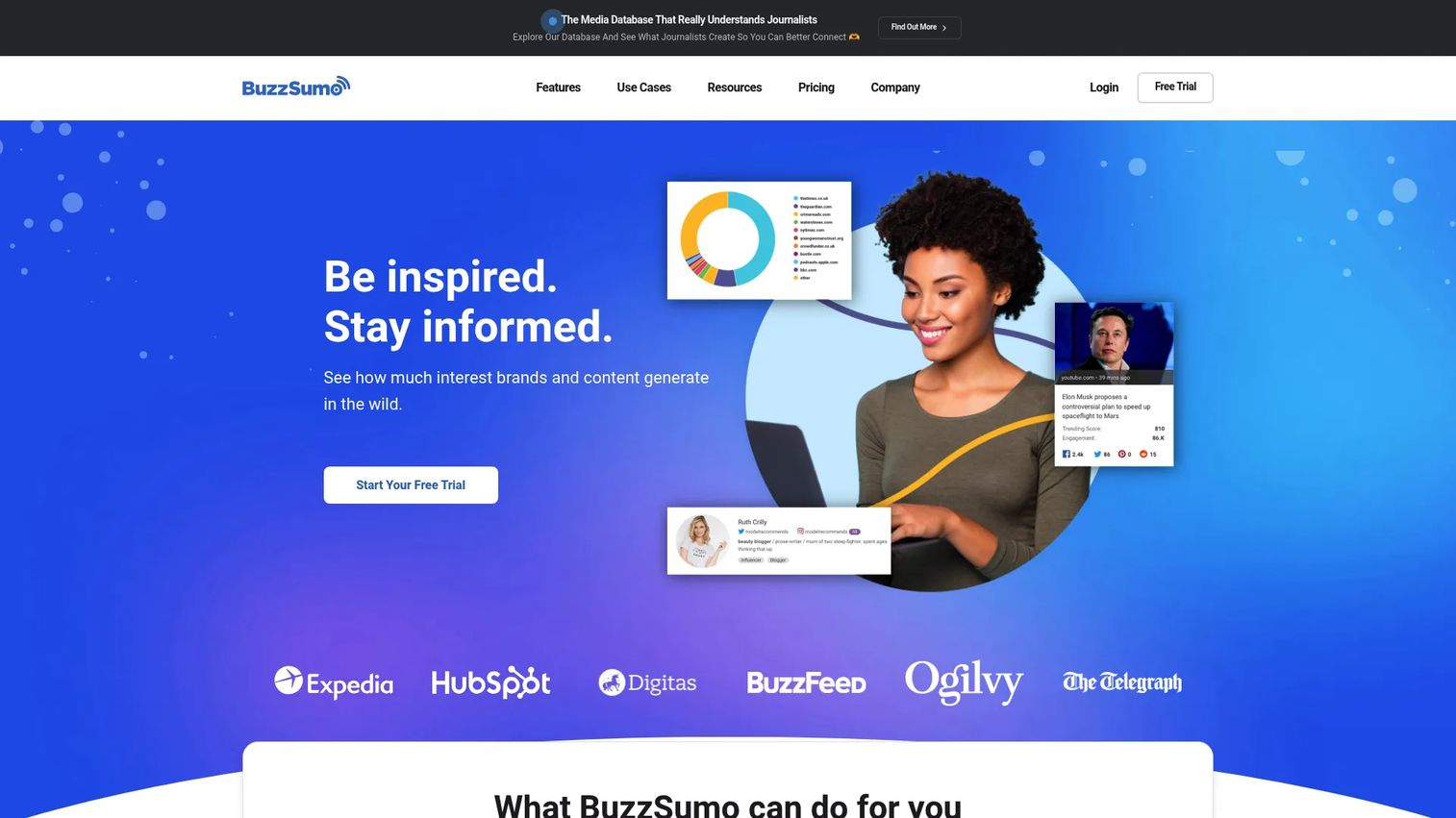
BuzzSumo is a content research and media intelligence platform used by PR and marketing teams to understand what earns attention in a given topic, who covers it, and which content formats generate the most engagement. For link builders, its value is in pre-campaign research: Identifying linkable asset formats, finding journalists actively covering a topic, tracking brand and competitor mentions, and surfacing trending content worth targeting.
Best for: Content marketers and digital PR teams building campaigns around linkable assets and journalist relationships.
Key features
- Content Analyzer for performance benchmarking
- Journalist and influencer database
- Question Analyzer for identifying content gaps
- Brand monitoring for unlinked mention discovery
- Trending content feeds by topic
Why choose BuzzSumo: Choose BuzzSumo before outreach starts. It answers whether your content concept is worth building and who you should pitch it to, which makes downstream outreach more targeted.
BuzzSumo pricing: No free plan; a 30-day free trial is available. Plans are billed annually. Content Creation starts at $199/month. PR and Comms is $299/month. Suite is $499/month. Enterprise is $999/month.
G2 rating: 4.5/5
9. Moz Link Explorer
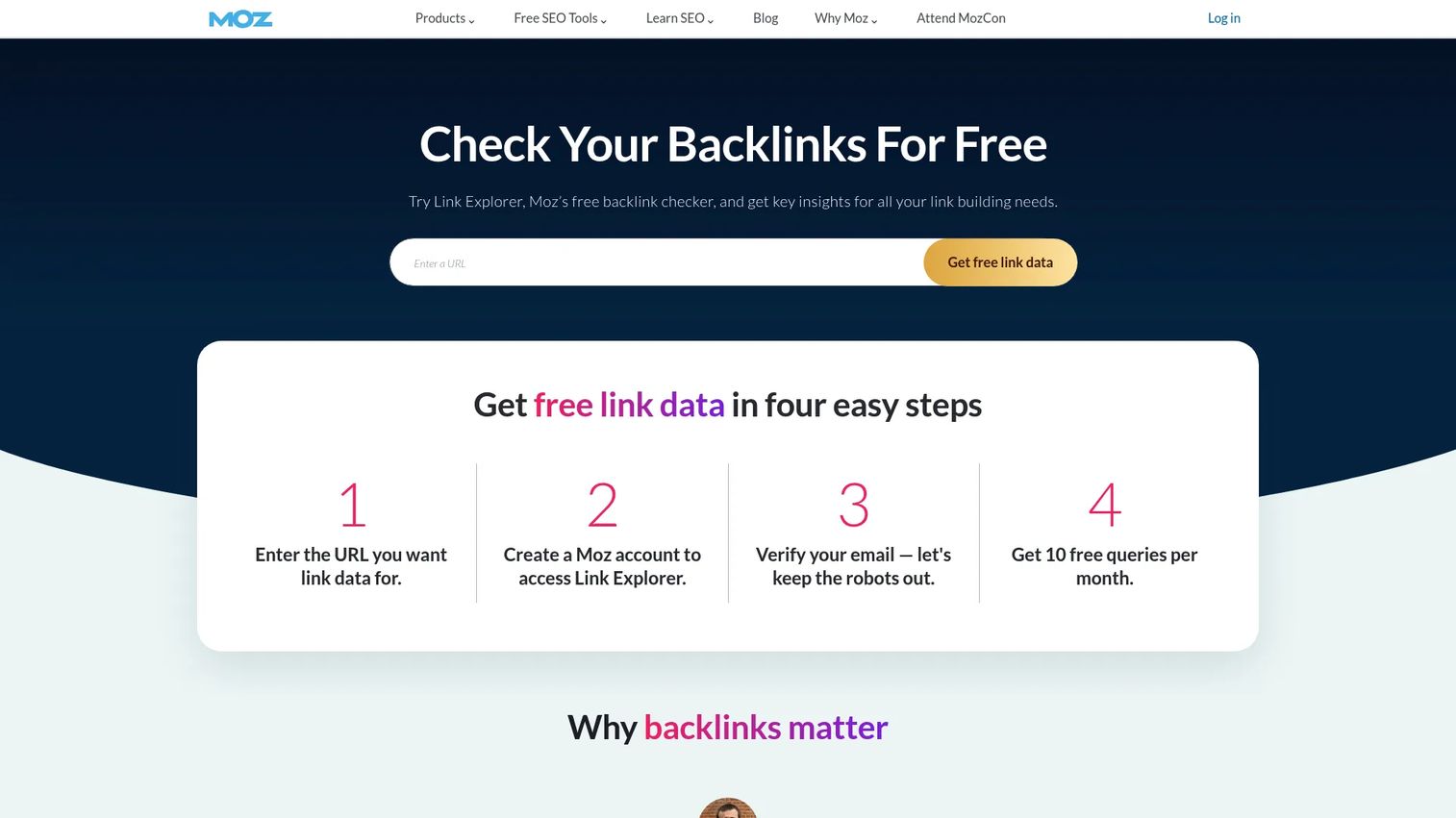
Moz Link Explorer is Moz's backlink analysis tool, centered around Domain Authority, Page Authority, and Spam Score. These metrics have become a shared language across SEO, PR, and partnerships teams, which makes Moz useful when you need to explain link quality to stakeholders outside the SEO function. The tool sits inside Moz Pro and supports linking domain analysis, anchor text reporting, and competitor link profiles.
Best for: Teams that use DA and Spam Score as standard reporting metrics or need to communicate link quality in those terms.
Key features
- Domain Authority and Page Authority scoring
- Spam Score for quality filtering
- Linking domain analysis
- Anchor text distribution reports
- Competitive link profile comparison
Why choose Moz Link Explorer: Choose Moz when DA is already embedded in your reporting language or when stakeholders outside SEO use it as a reference point. It is not the strongest standalone backlink database, but it integrates naturally with Moz Pro's broader keyword and audit workflows.
Moz Link Explorer pricing: Moz Link Explorer is part of Moz Pro. Pricing could not be verified from the official Moz pricing page at time of writing. Check the current plans directly at moz.com/pricing.
G2 rating: N/A (no reviewed standalone listing on G2 at time of writing)
10. Linkody
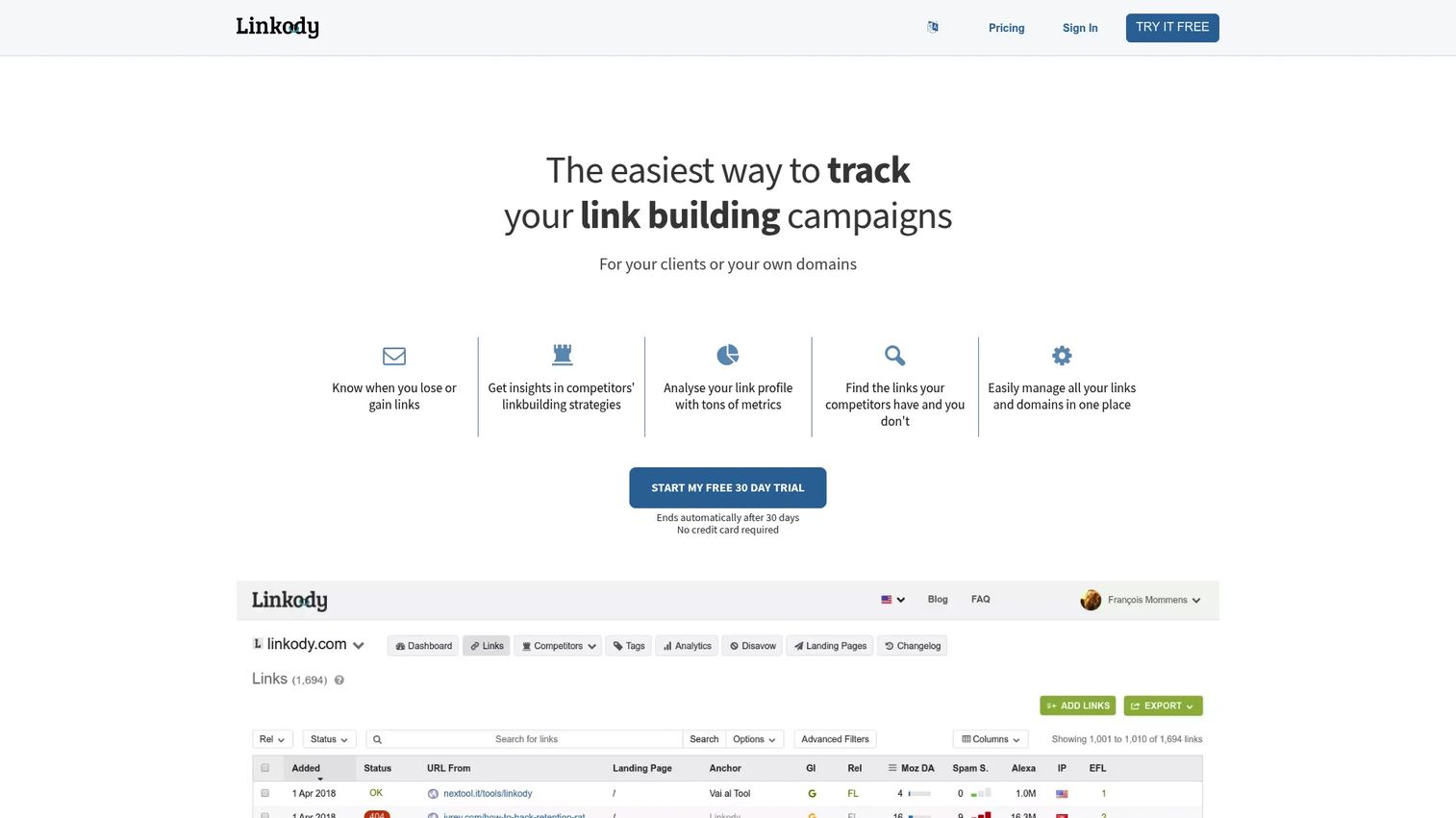
Linkody is a backlink monitoring platform designed for teams that need to track links after campaigns go live without paying for a full SEO suite. It monitors your link profile continuously, sends email notifications when links are added or lost, tracks anchor text changes, and pulls SEO metrics from multiple sources including Ahrefs DR, Moz DA and PA, Trust Flow, and Citation Flow. The disavow export feature is useful for teams managing link cleanup alongside active building.
Best for: Small teams, consultants, and agencies that need reliable backlink monitoring without the cost of a larger platform.
Key features
- 24/7 backlink monitoring with email alerts
- Lost-link notifications
- Competitor backlink tracking and link intersect
- Anchor text change tracking
- Disavow list export
Why choose Linkody: Choose Linkody when monitoring is the gap, not research or outreach. It is especially useful after campaigns go live and you need to protect what you've earned. Plans are priced in EUR and cover multiple domains.
Linkody pricing: All plans include a 30-day free trial. The Webmaster plan starts at €13.90/month. Advanced is €22.90/month, Pro is €45.90/month, Agency is €90.90/month, and Agency XL is €138.90/month. Annual billing includes three months free.
G2 rating: 4.5/5
11. Google Search Console
Google Search Console is Google's free tool for verified site owners to monitor search performance, index coverage, and the links Google reports pointing to their properties. For link building, the Links report shows top linked pages, top linking sites, and anchor text, pulled directly from Google's index. It is not a prospecting platform and does not give competitor data, but it is the only tool that shows you exactly what Google sees as links to your site.
Best for: Every site owner, as the free baseline for understanding what links Google reports for your verified properties.
Key features
- Links report with top linked pages and linking sites
- Anchor text data from Google's index
- Exportable reports in CSV format
- Integration with Google Analytics 4
- Index coverage and Core Web Vitals monitoring
Why choose Google Search Console: Use it before you buy anything else. It gives you a free baseline for owned-site link reporting and helps you understand which pages are already earning links, so you can decide where to focus prospecting efforts.
Google Search Console pricing: Free.
G2 rating: 4.7/5
12. HARO (Connectively)
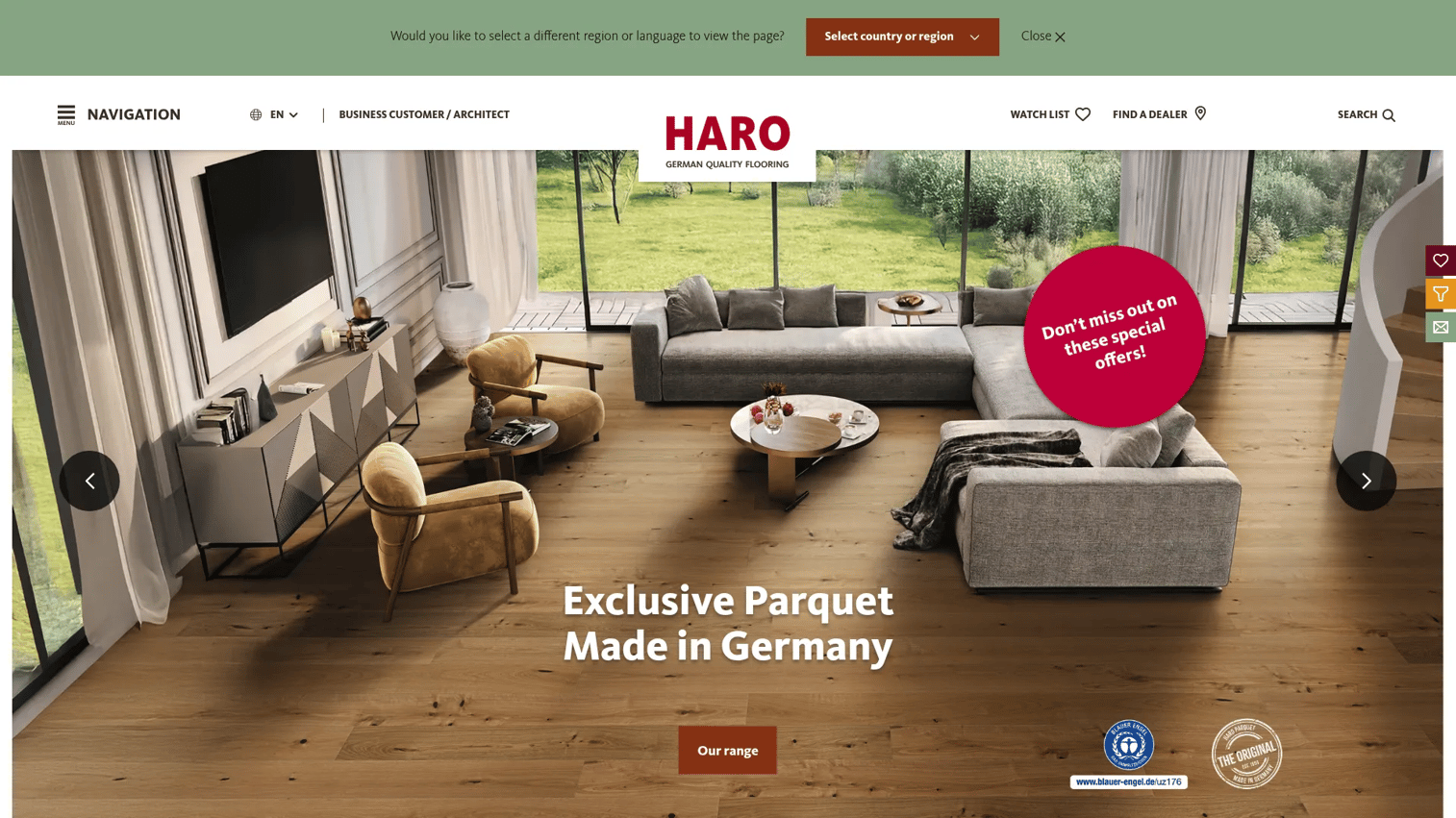
HARO (Help a Reporter Out) was for many years the primary platform for connecting journalists with expert sources seeking editorial mentions. The service was rebranded as Connectively and has since gone through ownership and operational changes. As of research at time of writing, the domain haro.com resolves to a German flooring brand, and the original source-matching workflow appears to have moved or been discontinued. Before including this workflow in a campaign plan, verify the current status of Connectively or identify the journalist request platform that has replaced it.
Best for: Founders, marketers, and subject matter experts who can respond quickly with specific, quotable input on topics journalists are actively covering.
Key features
- Journalist source request matching
- Email alerts for relevant topic categories
- Pitch submission to media contacts
- Opportunity filtering by industry and outlet type
- Editorial mention potential without direct outreach
Why choose HARO/Connectively: When your team has genuine expertise and can respond fast, earned editorial mentions from credible outlets carry authority that outreach-sourced links often do not. The model works best when speed and specificity are both present.
HARO pricing: Current pricing and platform status should be verified before budgeting. The original HARO free and paid tiers may no longer be active under the current platform owner.
G2 rating: N/A
13. Screaming Frog
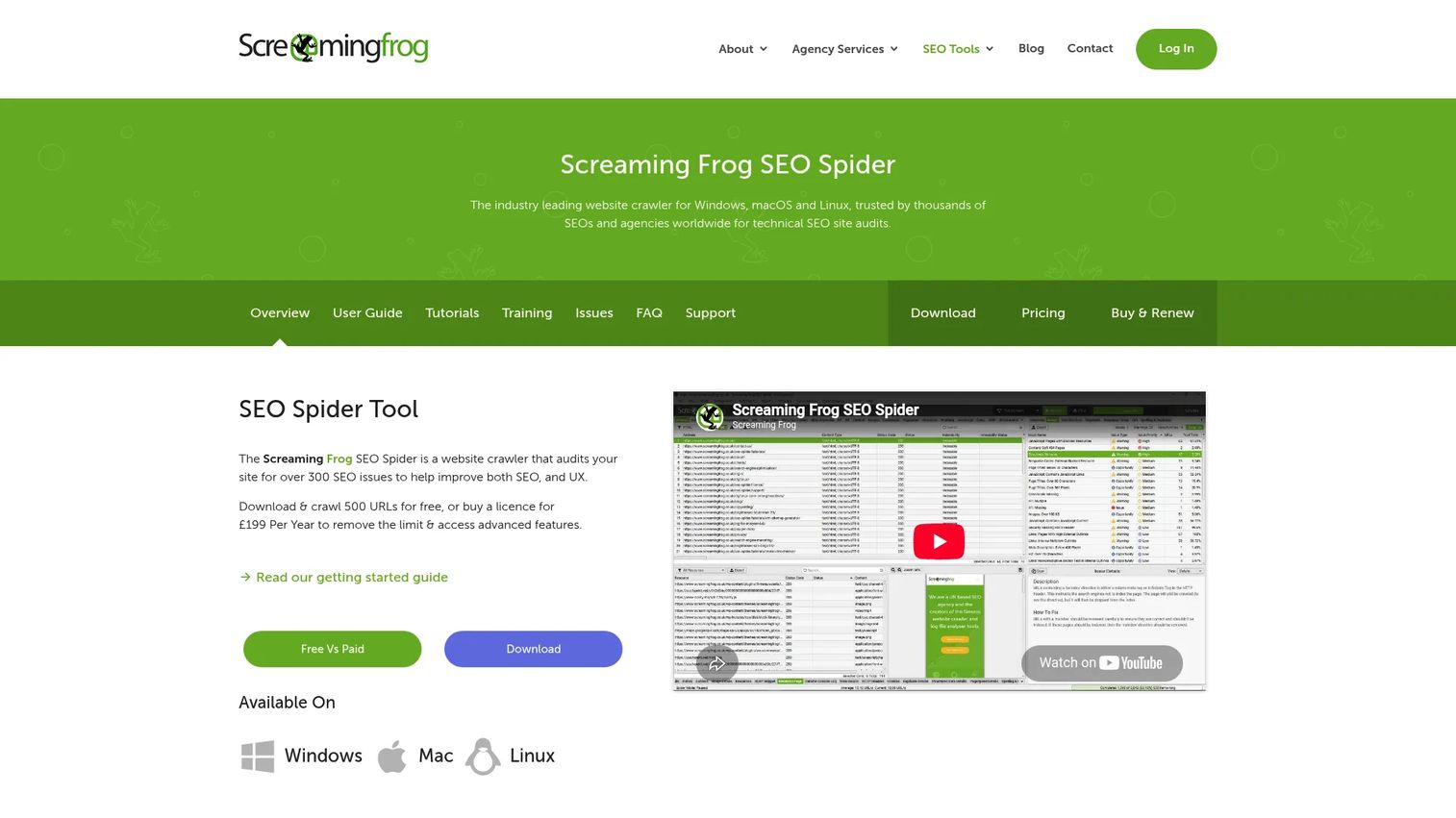
Screaming Frog SEO Spider is a desktop website crawler used by technical SEOs for auditing site structure, finding broken links, analyzing redirect chains, and identifying internal linking gaps. For link building, its primary role is in broken link campaigns: Crawl a competitor or publisher site to find dead pages, then pitch your content as a replacement. It also surfaces inlink data, helping you see which pages receive the most internal links and where authority is being directed.
Best for: Technical SEOs running broken link building campaigns and site-wide link health audits.
Key features
- Full site crawl with broken link reports (404s and other errors)
- Redirect chain identification
- Inlinks data per page
- JavaScript rendering for dynamic sites
- Custom extraction for data scraping
Why choose Screaming Frog: Choose Screaming Frog when link building opportunities start with technical discovery rather than content research. The broken link workflow alone justifies the license cost for teams running regular campaigns.
Screaming Frog pricing: The free version crawls up to 500 URLs per session. The paid annual license is £199 per user per year. Volume discounts apply for 5 or more licenses.
G2 rating: 4.7/5
14. Link Whisper
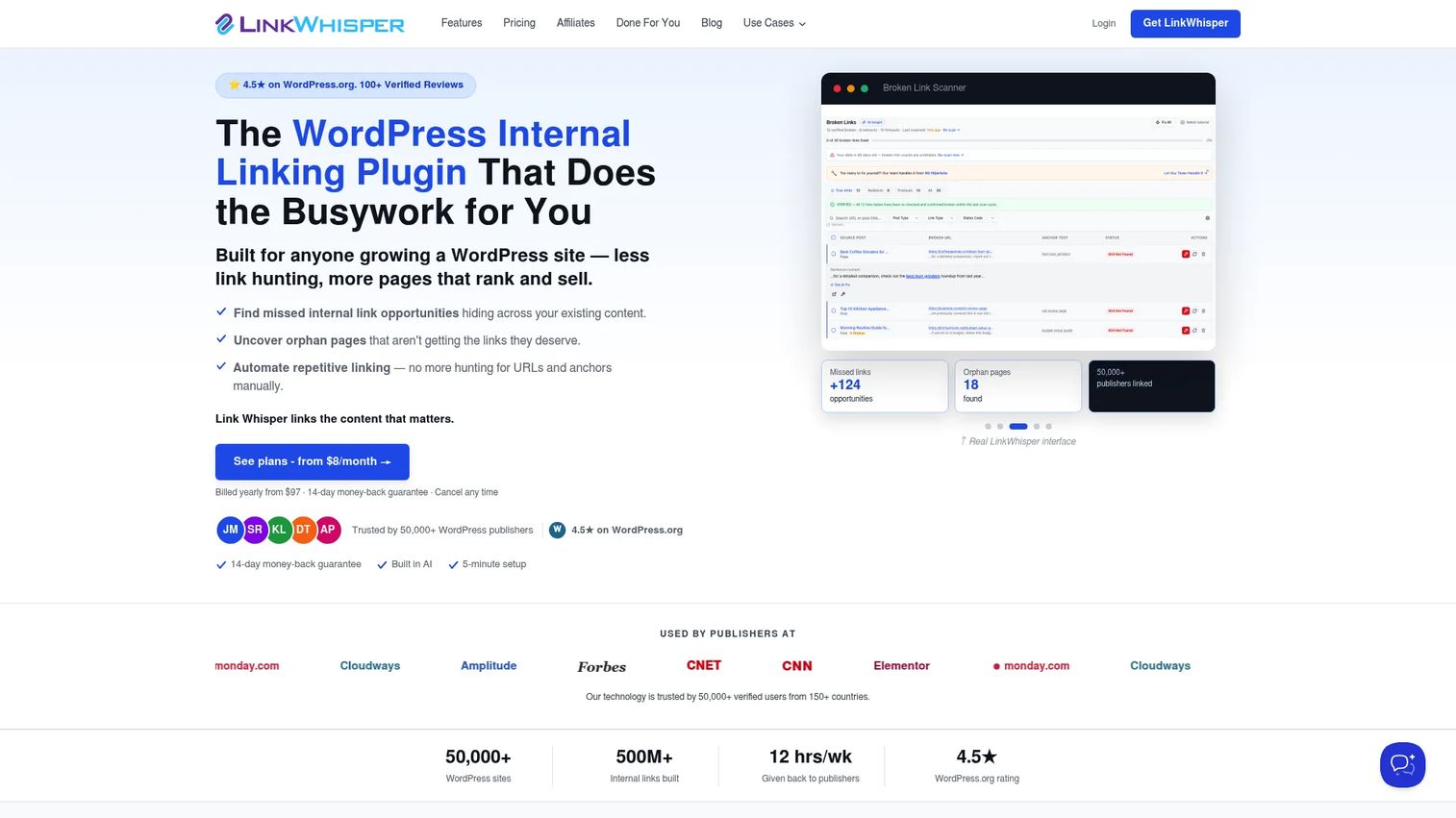
Link Whisper is a WordPress plugin that automates internal link management. It scans your content and surfaces AI-powered suggestions for where internal links could be added, identifies orphaned pages receiving no internal links, and allows you to set auto-linking rules so specific keywords always point to a designated page. For link building programs, internal links are how you direct the authority from won backlinks toward the pages you most want to rank.
Best for: WordPress sites with large content libraries where internal link distribution is weak or unmanaged.
Key features
- AI-powered internal link suggestions
- Orphaned content reports
- Auto-linking rules by keyword
- Anchor text controls
- Google Search Console integration for traffic context
Why choose Link Whisper: Choose Link Whisper when your external link building is working but rankings are not moving as expected. Weak internal link distribution is often the reason authority does not translate into rankings. It is WordPress-specific, so it does not apply to other CMS environments.
Link Whisper pricing: Plans are billed annually. Starter covers one site at $8/month ($97/year). Growth covers three sites at $197/year. Pro covers ten sites at $297/year. Agency covers fifty sites at $497/year.
G2 rating: 4.5/5
15. AIOSEO
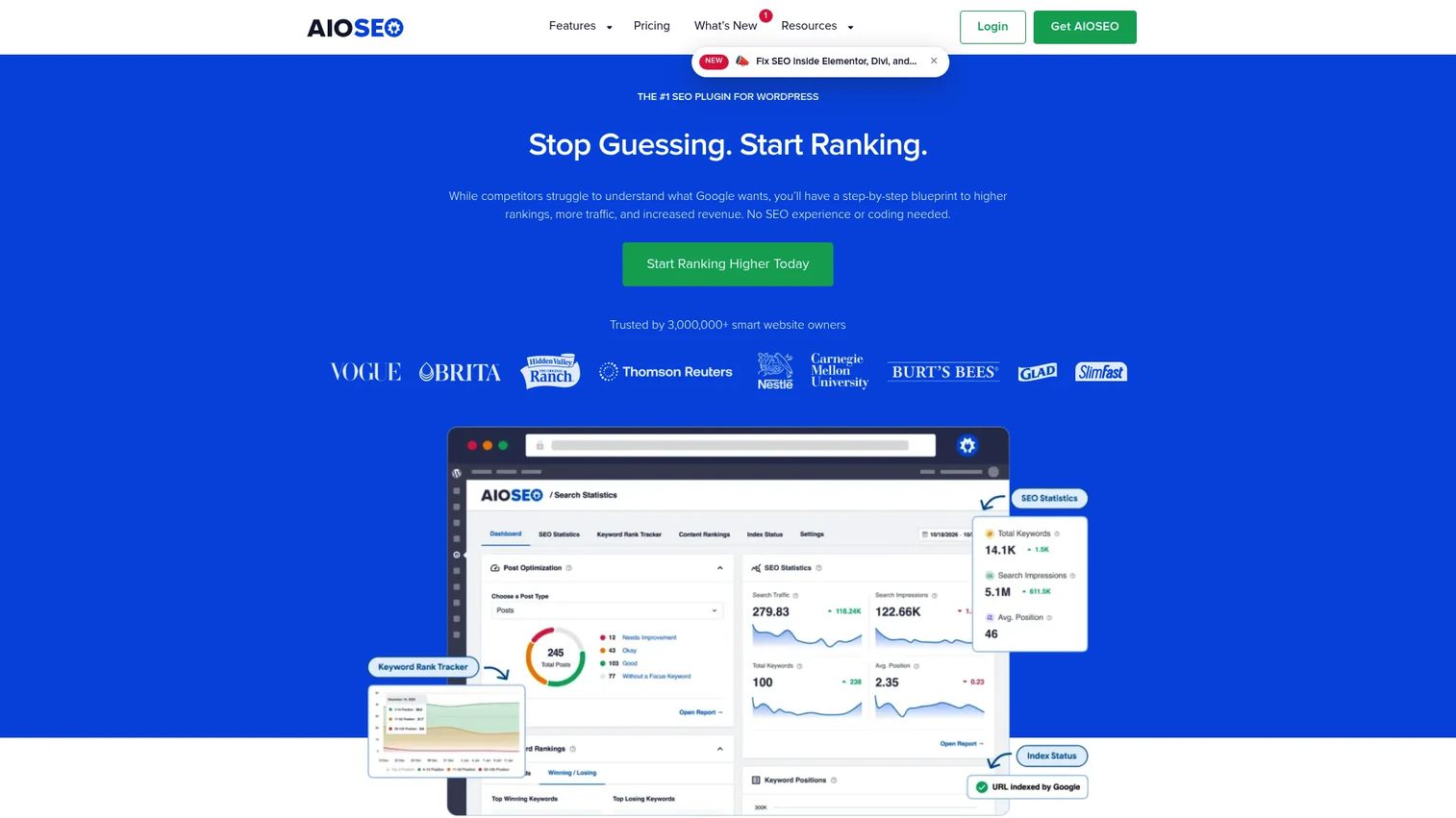
AIOSEO is a WordPress SEO plugin covering on-page optimization, schema markup, local SEO, WooCommerce SEO, sitemaps, and a redirect manager. The Link Assistant feature scans your site for internal link opportunities and surfaces suggestions similar to Link Whisper, but within the broader AIOSEO plugin context. For WordPress marketers who want SEO, redirects, and internal linking inside a single plugin rather than multiple separate tools, AIOSEO consolidates that work.
Best for: WordPress marketers who want on-page SEO, redirect management, and internal link workflows managed inside one plugin.
Key features
- Link Assistant for internal link suggestions
- Redirect Manager for 301 and other redirect types
- TruSEO on-page analysis and scoring
- Schema markup and local SEO
- Search Statistics dashboard
Why choose AIOSEO: Choose AIOSEO if your stack already includes or needs a comprehensive WordPress SEO plugin and you want internal linking included rather than adding a separate tool. It is not a replacement for a backlink database or outreach platform.
AIOSEO pricing: A free version is available. Paid plans start at $49.50/year for one site (Basic). Plus covers three sites at $99.50/year. Pro covers ten sites at $199.50/year. Elite covers up to 100 sites at $299.50/year. These are introductory first-year prices; renewals are at the full rate.
G2 rating: 4.8/5
Considerations when choosing link building tools
Start with the bottleneck
Before evaluating any tool, name the specific step where your link building program stalls. If the bottleneck is finding prospects, invest in Ahrefs, Semrush, Majestic, or Moz Link Explorer. If outreach management is the problem, compare Pitchbox, Respona, and BuzzStream. If contact data is missing, add Hunter.io. If monitoring is the gap, start with Linkody and Google Search Console alongside your existing research tool.
Avoid paying twice for backlink data
Ahrefs, Semrush, Majestic, and Moz all maintain independent link databases. Each charges for access to their index. Before adding a second platform, compare database overlap, export limits, and reporting depth against what your current subscription covers. For most growth marketing teams, one strong research platform covers the core jobs.
Check outreach compliance and deliverability
Outreach tools vary significantly in how they handle suppression lists, unsubscribe requests, and sender reputation management. Blasting generic templates at high volume damages deliverability and reply rates. When evaluating platforms, check whether they support personalization at the contact level, suppress previous replies, and give visibility into bounce and spam complaint rates.
Vet publishers beyond third-party metrics
Domain Rating, Domain Authority, Trust Flow, and Citation Flow are filters, not final answers. A site with a high DR and no real traffic, no editorial standards, and a poor outbound link profile is not worth targeting. Manual checks on organic traffic trends, topical relevance, recent publishing frequency, and outbound link quality take five minutes per site and prevent wasted outreach.
Match pricing to campaign volume
A team building ten to fifteen links per month does not need the same stack as an agency running hundreds of outreach campaigns weekly. Evaluate seat counts, credit limits, monitored domain caps, project limits, and export volumes before committing to a plan. Tools that price per seat can become expensive quickly as teams grow.
Conclusion
The best link building stack covers your specific bottleneck without duplicating data you're already paying for. Start with Ahrefs or Semrush for backlink research and competitive gap analysis. Add Majestic or Moz Link Explorer if link quality vetting requires a second database. For outreach, compare Pitchbox for high-volume agency campaigns and BuzzStream for relationship-focused programs. When contact data is the missing piece, Hunter.io fills that gap without replacing your research tool. After campaigns go live, Linkody and Google Search Console cover monitoring at opposite ends of the budget spectrum. For WordPress sites, Link Whisper handles internal linking and AIOSEO adds redirect management and on-page SEO in one plugin. Screaming Frog belongs in any workflow where broken link opportunities are part of the strategy.
The 2025 BuzzStream and Citation Labs survey found 56% of practitioners plan to increase link-building investment this year. The teams that see returns will be the ones who buy for the bottleneck, not the ones who buy the most tools.
Start your journey with Guideflow today!
If your marketing team sells a complex SaaS product, backlinks drive traffic but do not close the gap between arrival and understanding. Guideflow lets teams build interactive demos that prospects can explore on their own, before a call, so the traffic your link building earns converts rather than bounces.
FAQs
Link building tools help marketers research backlink opportunities, find contact information, run outreach campaigns, monitor earned links, and report SEO impact. The category spans backlink databases, outreach platforms, email finders, monitoring services, and technical crawlers. Most campaigns require more than one tool because no single platform covers all five jobs equally well.
Start with Google Search Console to see what links Google already reports for your site. Once you understand your baseline, add a backlink research tool to identify competitor gaps and a simple outreach tool to manage your first campaigns. Ahrefs Starter ($29/month) or Semrush's free tier are reasonable first paid options before committing to higher tiers.
Agencies typically need research, outreach management, team collaboration, and client reporting. Pitchbox handles high-volume outreach with team workflow controls. Ahrefs and Semrush cover research and reporting. Linkody or Google Search Console handle monitoring. BuzzStream suits agencies running relationship-based digital PR programs. The specific combination depends on campaign volume and client reporting requirements.
Google Search Console is the strongest free option for owned-site link data. It shows top linked pages, top linking sites, and anchor text from Google's index at no cost. Beyond that, Ahrefs offers a free tier with limited access, and Hunter.io's free plan provides 50 credits per month for email discovery.
Backlink analysis tools show who links to a given domain and how those links compare across competitors. They answer the research question. Outreach software manages the campaign that follows: Finding contacts, sending personalized emails, tracking replies, automating follow-ups, and recording relationship history. The two categories solve different problems and are often used together.
Ahrefs is generally stronger for pure backlink research and competitive link gap analysis. Semrush is stronger when link building is one part of a broader SEO program that also includes keyword research, rank tracking, and site auditing. Pricing is a real differentiator: Ahrefs starts lower for entry-tier access, while Semrush's paid plans begin higher but consolidate more workflow into one subscription.
Automation is safe when it supports personalization, follow-up timing, and team organization. It creates risk when used to send generic bulk outreach at high volume, acquire links from irrelevant or low-quality sites, or ignore Google's link spam policies. The tools themselves are neutral; the risk comes from how they are used.
Internal links do not create external backlinks. They distribute authority that external backlinks bring in, surfacing pages that might otherwise receive little of that value. If your external link building is producing results but target pages are not ranking as expected, weak internal link distribution is a common cause. Tools like Link Whisper and AIOSEO address this within WordPress without requiring changes to your outreach strategy.