You closed more deals this quarter. Finance still cannot tell you what is owed, which files are missing, or which agent split changed after the offer.
That gap is where brokerage operations break. The CRM tracks leads and pipeline activity, but the moment a deal moves toward contract, a different set of workflows takes over: Transaction files, commission calculations, document approvals, compliance checklists, and payout disbursements. Most brokerages run those workflows in spreadsheets, disconnected email threads, or a CRM that was never designed for them.
The global brokerage management software market reached $4.8 billion in 2025, growing at a projected 7.8% annually through 2034, according to Dataintelo (2025). That growth reflects a real operational problem brokerages are finally treating as a systems problem rather than a headcount problem.
This guide covers seven platforms built specifically for real estate brokerage back office operations, with verified pricing and G2 ratings to help you shortlist before booking a single sales call.
What's inside
This guide is for brokerage founders, operations leaders, and technology buyers who need a back office system, not another CRM. Tools were selected based on four criteria:
- Back office depth: Commission calculation, transaction tracking, agent administration, and payout workflows
- Accounting connectivity: QuickBooks sync, trust accounting, or full general-ledger support
- Compliance and document management: File completeness, checklist workflows, and audit trails
- Operational visibility: Reporting by agent, office, transaction type, and expected revenue
TL;DR
- Best for commission and back office depth: BrokerSumo handles agent billing, payouts, and QuickBooks sync in a focused back office system
- Best for transaction compliance and commission accuracy: TotalBrokerage combines structured transaction workflows with commission calculation and brokerage reporting starting at $50/month
- Best for independent and growing brokerages: Brokermint offers Standard and Professional plans with ACH payouts and accounting on the higher tier
- Best for a broader real estate operating stack: BoldTrail BackOffice connects back office functions to CRM and broader platform capabilities
- Best for established accounting operations: Lone Wolf Back Office and BrokerWolf serve brokerages where GAAP-compliant financials and configurable commission plans carry the most weight
- Best for CRM plus operations in one platform: Lofty suits brokerages where lead management and agent productivity are as pressing as back office administration
What is brokerage management software?
Brokerage management software is an operations platform that helps real estate brokerages manage transactions, commission rules, agent records, compliance tasks, financial workflows, and reporting from a shared system.
A CRM manages the front end: Leads, contacts, outreach, and pipeline activity. Brokerage management software manages what comes after a deal moves toward contract. Most brokerages need both. The question is whether to connect separate systems or adopt a broader suite.
| CRM typically owns | Brokerage management software typically owns |
|---|---|
| Leads and contact activity | Transactions and commission records |
| Follow-ups and sales pipeline | Splits, caps, fees, and disbursement workflows |
| Campaign attribution | Document review, compliance, and approvals |
| Prospect communication | Agent administration and brokerage financial reporting |
Core capabilities to look for in this category:
- Transaction and file management with checklist and audit trail support
- Commission split, cap, fee, and override calculation with configurable plans
- Agent onboarding, roster management, and recurring billing
- Document collection, approval workflows, and compliance tracking
- Accounting integration, reconciliation, and payout support
- Brokerage reporting by office, agent, transaction type, and revenue
- Role-based permissions and access controls
- Integrations with e-signature, accounting, payment processing, and CRM tools
What this category does not replace: A dedicated property management platform for rentals, an MLS or IDX system, a full enterprise accounting suite in every case, or a marketing automation platform built for lead nurture.
When to use brokerage management software
Replace spreadsheet-based commissions
Manual commission calculations break down when brokerages add cap rules, sliding splits, referral fees, team overrides, or multiple payout schedules. Each exception handled in a spreadsheet is an exception someone has to catch, verify, and explain. A platform with configurable commission plans makes the logic auditable and repeatable.
Create a transaction-to-payout operating system
The strongest fit for this category is a brokerage where deal data needs to flow into compliance review, commission calculation, agent billing, and payout, without manual rekeying at each step. If your operations team re-enters data more than once per transaction, that is the workflow a back office platform is designed to own.
Give operations leaders real-time visibility
Growing brokerages need a reliable view of pending closings, missing documents, expected commissions, agent performance, and exception queues. That visibility is what lets a new VP of Operations inherit the business without asking the founder for every exception.
You likely need a platform if any of these apply:
- More than one person reviews transactions
- Commission rules vary by agent or team
- Accounting reconciliation happens after closing rather than during
- Agents routinely ask operations for status updates
- Leadership cannot get reliable reporting without exporting to a spreadsheet
Brokerage management software comparison
No single platform wins every operating model. Some emphasize commissions and accounting depth. Others extend into CRM, transaction coordination, or broader brokerage operations. Shortlist based on where the actual bottleneck sits: Commission complexity, compliance gaps, accounting architecture, or agent administration.
| # | Product | Best for | Key differentiator | Pricing | G2 rating |
|---|---|---|---|---|---|
| 1 | BrokerSumo | Commission-heavy brokerages | Back office with agent billing, ACH payouts, and QuickBooks sync | Contact for pricing | Not listed on G2 |
| 2 | TotalBrokerage | Compliance-focused residential brokerages | Transaction oversight plus commission calculations from $50/month | From $50/month | 4.5/5 |
| 3 | Brokermint | Independent and growing brokerages | Transaction management with ACH payouts on Professional plan | Contact for pricing | Not listed on G2 |
| 4 | BoldTrail BackOffice | Brokerages using a broader real estate stack | Connected back office with CRM sync and commission automation | Contact for pricing | 4.3/5 |
| 5 | Lone Wolf Back Office | Larger brokerages standardizing operations | GAAP-compliant accounting, payroll, and 100+ scheduled reports | Contact for pricing | 3.0/5 |
| 6 | BrokerWolf | Brokerages with complex internal accounting | Automated commission plans and real-time general-ledger postings | Contact for pricing | 3.0/5 |
| 7 | Lofty | Brokerages needing CRM plus operating workflows | AI-powered CRM with transaction management and lead generation | Contact for pricing | 4.3/5 |
Best 7 brokerage management software tools for 2026
No platform replaces every other system. The right choice depends on commission complexity, compliance requirements, accounting architecture, team size, and whether the brokerage needs CRM in the same environment.
1. BrokerSumo
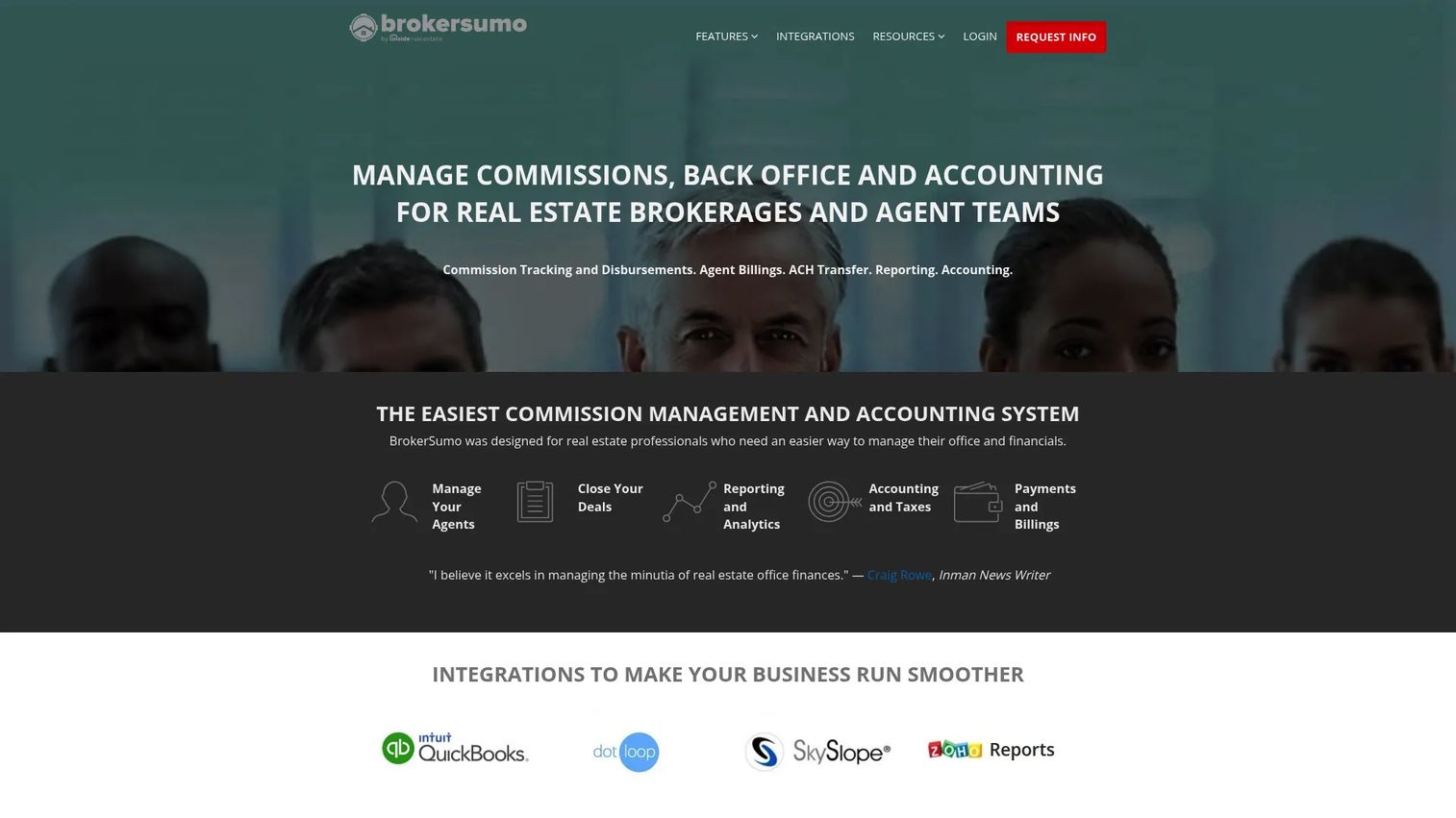
BrokerSumo is a brokerage back office platform built around the operational core: Transaction tracking, commission disbursements, agent billing, ACH payments, and QuickBooks synchronization. It covers the workflows that sit between a deal going under contract and an agent receiving their payout.
Best for: Brokerages with varied commission plans, agent fees, and payout schedules that need connected back office reporting without a heavy CRM layer on top.
Key features
- Commission splits, caps, and flat-fee plan configurations
- Transaction pipeline tracking and disbursement management
- Agent onboarding and recurring billing
- ACH payment workflows to agents and vendors
- QuickBooks integration and accounting synchronization
Why choose BrokerSumo: The platform maps tightly to the operational core of a brokerage. If the bottleneck is commissions, payout accuracy, and accounting sync rather than lead generation, BrokerSumo is worth evaluating before adding broader suite software.
BrokerSumo pricing: BrokerSumo does not post pricing on its website. Contact their team directly for plan details and implementation costs.
2. TotalBrokerage

TotalBrokerage is a residential real estate brokerage management platform built around structured transaction workflows, compliance, commission calculations, and agent administration. It centralizes the operational tasks that typically run across disconnected tools.
Best for: Residential brokerages that need stronger transaction oversight, compliance visibility, and accurate commission calculations with a clear path from contract to close.
Key features
- Transaction management with document and compliance workflows
- E-signature and forms built into the transaction process
- Commissions, accounting, and disbursement calculations
- Agent onboarding, management, and HR tools
- API, webhooks, and Zapier integrations for connecting existing tools
Why choose TotalBrokerage: Teams that lose time to manual data entry, incomplete files, and late-stage commission corrections will find the compliance and transaction structure relevant. The Lite plan lets smaller brokerages get started without a long-term contract.
TotalBrokerage pricing: The Lite plan starts at $50/month for 4 seats or $100/month for 10 seats, billed month to month with no contract. Standard plans start at $150/month on a one-year contract. Enterprise plans start at $1,000/month for larger or custom deployments.
TotalBrokerage holds a 4.5/5 rating on G2 from 22 reviews
3. Brokermint
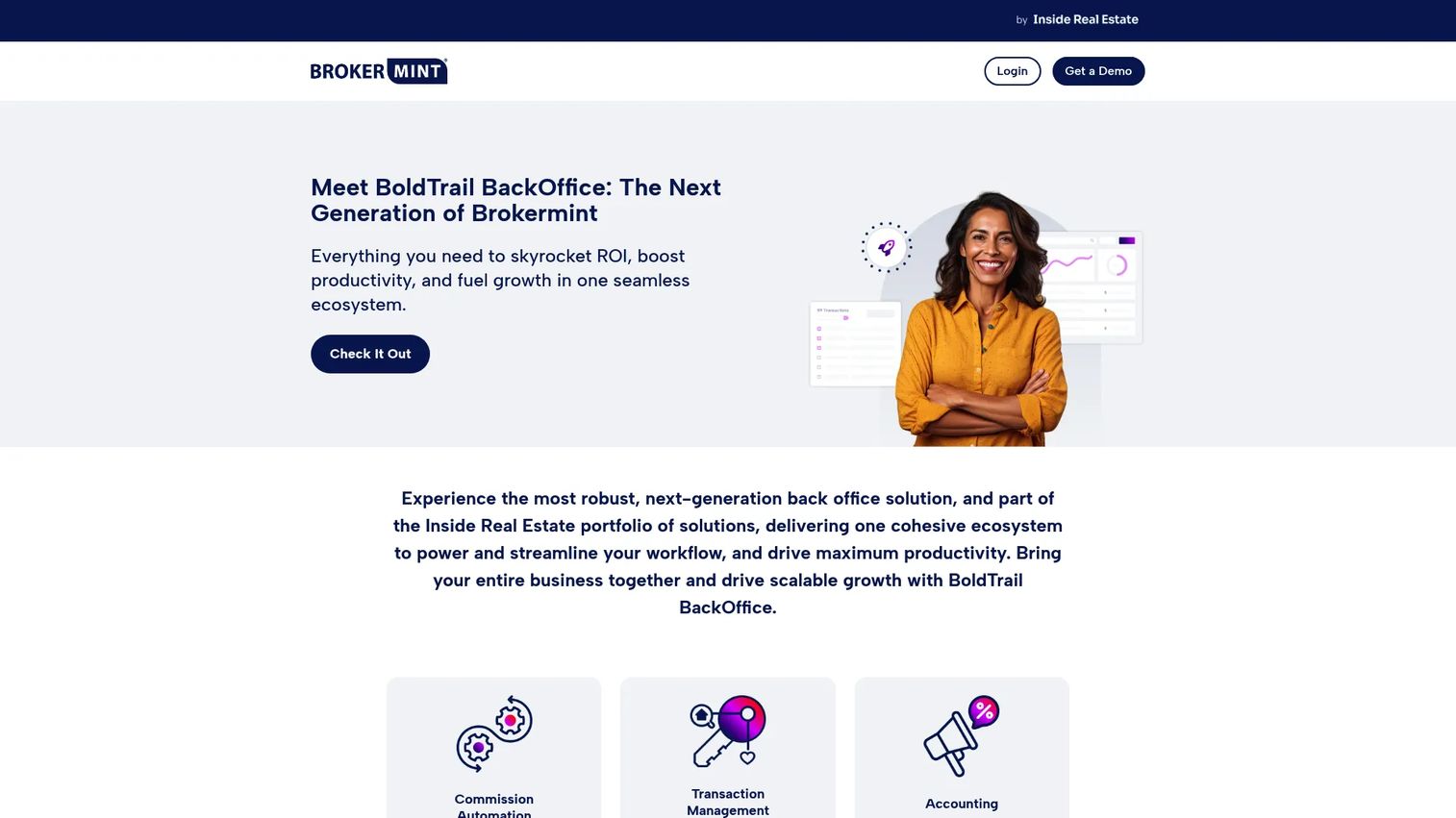
Brokermint is a cloud-based back office platform designed for residential real estate brokerages. It covers transaction management, commission automation, agent administration, and accounting, with two plan tiers that let brokerages add capabilities as they grow.
Best for: Independent brokerages and regional firms that need a practical back office system focused on commissions and transactions before expanding into a larger suite.
Key features
- Transaction management with checklists, e-signature, forms, and offer management
- Commission automation for splits, fees, and sliding-scale plans
- Agent management and onboarding controls
- Accounting, agent billing, and next-day ACH payments (Professional plan)
- MLS and QuickBooks integrations on Standard; API access and SSO on Professional
Why choose Brokermint: The Standard plan covers transaction and commission workflows for brokerages moving off spreadsheets. The Professional plan adds accounting, agent billing, and ACH payouts for teams ready to run the full back office in one system. This is a strong fit for a first operations hire who needs a system they can own and run without engineering support.
Brokermint pricing: Brokermint offers Standard and Professional plans. Prices are not posted on the website. Contact Brokermint directly for current plan costs and onboarding fees.
4. BoldTrail BackOffice
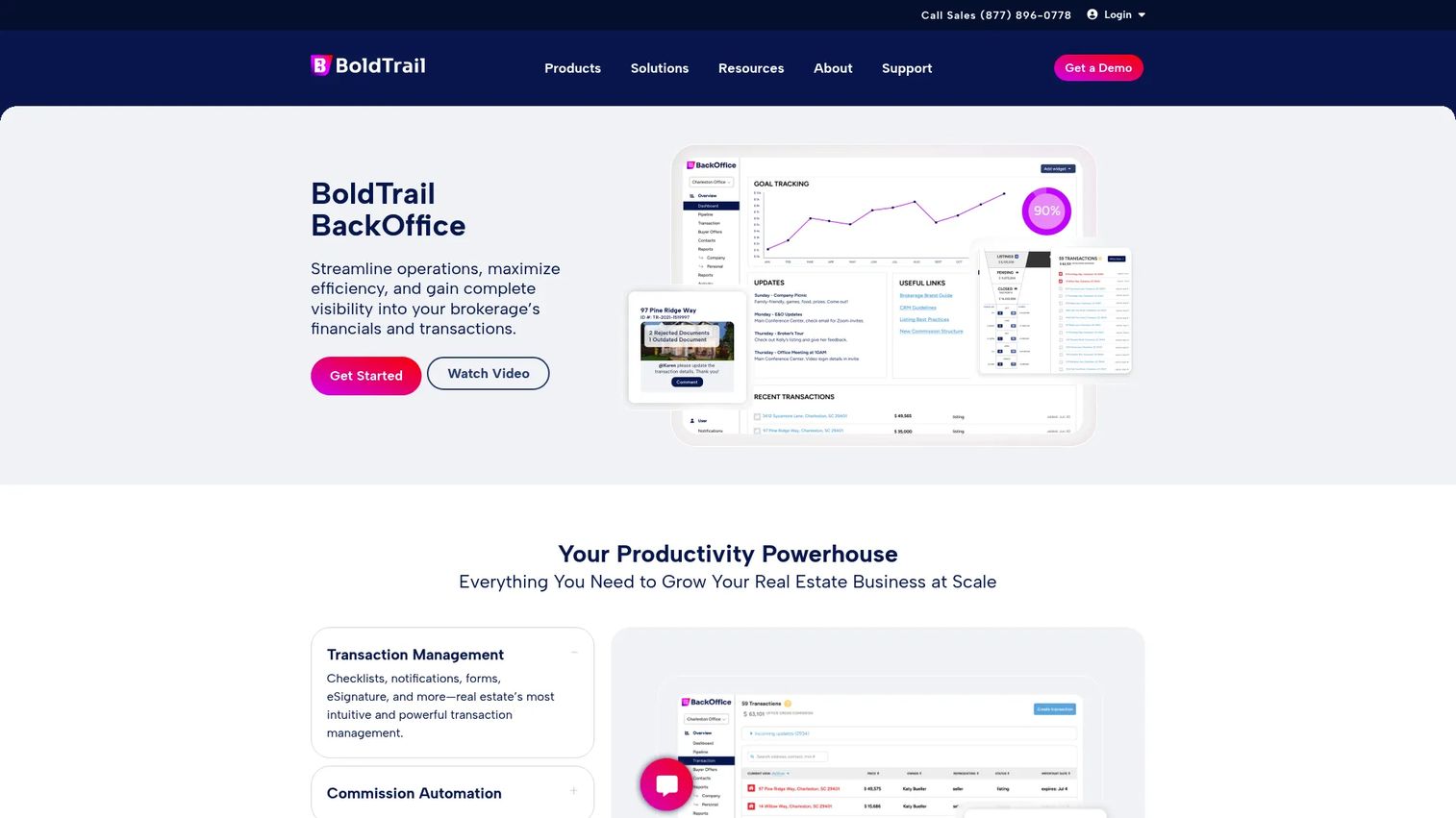
BoldTrail BackOffice is a back office platform that connects transaction management, commission automation, and agent administration to a broader real estate technology environment. It suits brokerages that want back office functions connected to CRM and front office workflows rather than running them in a standalone system.
Best for: Brokerages that want back office workflows linked to a broader platform for lead management, agent productivity, and business operations.
Key features
- Transaction management and commission automation
- E-signature and template management
- Agent onboarding and CRM or contact synchronization
- Reporting and business visibility dashboards
- QuickBooks integration
Why choose BoldTrail BackOffice: The case is strongest when the brokerage already sees value in a broader platform and wants the back office layer to connect naturally to front office activity. Verify which modules are included in the base package versus sold separately before committing.
BoldTrail BackOffice pricing: Pricing is not posted on the BoldTrail website. The platform directs prospects to sales for customized packages. Contact BoldTrail directly for a quote.
BoldTrail BackOffice holds a 4.3/5 rating on G2
5. Lone Wolf Back Office

Lone Wolf Back Office is part of a larger real estate software portfolio. The back office product combines native GAAP-compliant accounting, commission automation, trust and escrow accounting, payroll, and over 100 scheduled and custom reports. It targets brokerages that need accounting ownership inside the platform rather than through a third-party sync.
Best for: Larger brokerages or multi-office organizations that need standardized operational workflows with native accounting, payroll, and certified franchise reporting.
Key features
- Native GAAP-compliant financials with audit trails
- Commission automation with customizable commission structures
- Integrated trust and escrow accounting
- Agent and staff payroll for US and Canada operations
- 100+ scheduled and custom reports with franchise reporting integrations
Why choose Lone Wolf Back Office: The accounting depth makes this worth evaluating when the brokerage needs the general ledger, payroll, and trust accounting in one system rather than split across QuickBooks and a back office tool. Examine implementation scope, module packaging, and data migration before starting.
Lone Wolf Back Office pricing: Pricing is not posted on the website. Contact Lone Wolf directly for current package details and contract requirements.
Lone Wolf Back Office holds a 3.0/5 rating on G2 from 21 reviews
6. BrokerWolf

BrokerWolf is a real estate brokerage accounting and back office platform built for tracking transactional, operational, and financial data. It covers automated commission plans, agent billing, accounts payable and receivable, real-time general-ledger postings, bank reconciliations, and management reporting.
Best for: Brokerages with complex internal accounting structures, custom commission rules, and reporting requirements that need a configurable back office system rather than a sync-dependent integration.
Key features
- Automated and unlimited commission plan configurations
- Agent management and billing workflows
- Accounts payable and receivable
- Real-time general-ledger postings and bank reconciliations
- Management and production reporting
Why choose BrokerWolf: The fit is strongest where accounting logic, branch reporting, and commission configuration carry more weight than CRM or marketing automation. Before committing, walk the vendor through the brokerage's hardest commission scenario, not only the standard demo case.
BrokerWolf pricing: Pricing is not available on the website. Contact BrokerWolf for current quote and implementation details.
BrokerWolf shares a G2 listing with Lone Wolf Back Office, which shows a 3.0/5 rating
7. Lofty

Lofty is an AI-powered real estate platform combining CRM, lead generation, IDX websites, marketing automation, transaction management, and related tools. It is distinct from the back office specialists above: The primary value proposition is lead-to-close pipeline management, with transaction management included rather than central.
Best for: Brokerages where lead management, agent productivity, and front office workflow are as pressing as back office administration, and where consolidating CRM and transactions matters more than deep commission configurability.
Key features
- AI-powered CRM with Sales Agent, Social Agent, and Homeowner Agent capabilities
- IDX websites and landing pages with lead routing and follow-up automation
- Smart Plans marketing automation and Power Dialer
- Transaction management with mobile app and reporting
- Lead generation through Google PPC, Facebook Dynamic Ads, and direct mail
Why choose Lofty: The platform makes sense when the highest operational cost comes from lead leakage, slow follow-up, and agent adoption rather than commission complexity. Confirm whether the transaction management module handles the brokerage's specific commission structures, compliance requirements, and accounting workflows before treating it as a back office replacement.
Lofty pricing: Lofty lists Agent, Team, Broker, and Enterprise plans but does not post prices. All plans require contacting Lofty for pricing. Additional costs apply for lead generation, Power Dialer, and other add-ons.
Lofty holds a 4.3/5 rating on G2
Considerations when choosing brokerage management software
Match the platform to your operational bottleneck
Identify the central problem before evaluating tools. Commission complexity, transaction compliance, accounting reconciliation, agent administration, and CRM adoption each point to a different platform category. Buying a broad suite to solve a single narrow process adds cost and implementation risk without proportional return.
Test your hardest commission scenario
Ask each vendor to model a real deal: Caps, split exceptions, referral fees, team overrides, deductions, and payout timing all in one calculation. A default commission demo shows the easy case. The hard case is what the platform will face every week after go-live.
Map the system of record before migration
Decide where contacts, transaction files, accounting records, commission history, agent data, and documents will live. Confirm export options, data retention, audit history, and data ownership before signing. Historical records need to be accessible during a migration without stopping active closings.
Check integration depth, not logo count
Verify the actual workflow between CRM, accounting software, e-signature, payment processing, and reporting. Ask whether data syncs bidirectionally, which fields transfer, and how errors surface and get resolved. A logo on an integrations page does not confirm a reliable two-way sync.
Price the full operational rollout
The subscription cost is one part of the total. Include implementation, data cleanup, migration, training, payment processing fees, and the cost of future agent growth. A platform priced per agent can change materially as the brokerage scales.
Conclusion
Brokerage management software is an operations decision, not a generic software purchase. The platforms above serve different operating models, and the best fit depends on where the brokerage is actually breaking.
BrokerSumo and Brokermint are strong candidates for brokerages focused on commission calculations, agent billing, and back office accounting workflows. TotalBrokerage suits teams that need structured transaction oversight and compliance from a clear entry price point. BoldTrail BackOffice and Lofty are worth evaluating when broader platform consolidation matters as much as back office depth. Lone Wolf Back Office and BrokerWolf serve brokerages where native accounting, payroll, and configurable commission logic carry the most weight.
The best evaluation approach is practical: Bring one recently closed transaction, one difficult commission calculation, and one month-end reporting request into every vendor demo. If the platform cannot handle those three tests without manual workarounds, it will not remove the operational bottleneck.
If you build or sell complex SaaS products, Guideflow lets buyers explore your product through interactive demos before they book a call.
Start your journey with Guideflow today!
FAQs about brokerage management software
A CRM manages leads, contacts, outreach, and pipeline activity through a sales cycle. Brokerage management software manages the operational layer that starts when a deal moves toward contract: Transaction files, commission calculations, compliance checklists, document approvals, and payout workflows. Many brokerages use both through an integration, with the CRM owning front office activity and the back office platform owning everything from contract to disbursement.
Most platforms in this category include commission functionality, but the depth varies considerably. Basic tools handle flat splits and simple caps. Configurable platforms support sliding scales, referral fees, team overrides, deductions, and custom payout timing. Test the hardest commission scenario in the brokerage before committing to any plan.
Some platforms sync with QuickBooks rather than replace it. Others, like Lone Wolf Back Office, include native GAAP-compliant accounting and general-ledger functionality that may reduce the need for a separate accounting tool. Before deciding, clarify which system will own the general ledger, reconciliation, tax reporting, accounts payable, and year-end financial statements.
Pricing varies across this category. TotalBrokerage publishes plans starting at $50/month for small teams. Most other platforms require a direct quote. Total cost depends on agent count, office count, transaction volume, required modules, implementation, payment processing fees, and support tier. Compare the full first-year cost, including migration and training, rather than the headline subscription price alone.
Start with the workflow that creates the most recurring risk: Commissions, transaction files, compliance, or accounting reconciliation. Small teams often benefit more from clear ownership and straightforward adoption than from a large suite of features that go unused. TotalBrokerage's Lite plan or Brokermint's Standard plan are practical starting points for brokerages under 10 agents moving off spreadsheets.
Most platforms support document collection, checklist workflows, approvals, and transaction file oversight. Verify whether the platform covers state-specific requirements, broker supervision workflows, document retention policies, and integrations with e-signature tools. According to the National Association of REALTORS® 2025 Technology Survey, 79% of REALTORS® use e-signature technology, so e-signature integration is a baseline expectation rather than a premium feature.
A connected stack works well when each system has a clear job and a reliable data sync between them. A broader platform reduces duplicate entry and reporting gaps when the handoffs between separate tools are where data breaks down. The decision comes down to whether the brokerage has an integration problem or a process ownership problem.
Implementation timing depends on data cleanup, commission plan configuration, integrations, historical records, training, and how many offices and agents migrate at once. A phased rollout is more reliable than a hard cutover. Run commissions and financial reports in parallel on both the old and new system before fully switching, so errors surface before they affect agent payouts.