Your roadmap says ship faster. Your infrastructure says wait for the storage team, the networking team, the virtualization team, and the operations team to align.
That coordination overhead is the real cost of traditional three-tier infrastructure. Separate compute, storage, and networking layers mean separate specialists, separate tools, and separate upgrade cycles. Every customer deployment becomes a configuration exercise. Every edge site needs local expertise. Every release cycle competes with infrastructure maintenance windows.
Hyperconverged infrastructure (HCI) consolidates those layers into a software-defined cluster that runs on commodity x86 servers, with a single control plane for configuration, capacity, and lifecycle operations. According to GlobeNewswire (2026), the global HCI market reached $21.4 billion in 2025 and is projected to grow at a 23.3% CAGR through 2032. That growth reflects a genuine shift in how product and infrastructure teams think about deployment consistency, operational risk, and release reliability.
This guide is for product managers and infrastructure architects who need to evaluate HCI platforms against real deployment requirements, not just datacenter theory.
What's inside
- A plain-English definition of hyperconverged infrastructure HCI architecture
- Seven platforms compared by workload fit, deployment model, and operational approach
- Use cases covering VDI, edge computing, remote office branch office HCI, private cloud infrastructure, and hybrid cloud infrastructure
- A buyer checklist covering roadmap alignment, scale options, security, and day-two operations
- Selection criteria: Architecture fit, lifecycle management approach, cloud alignment, and pricing transparency
TL;DR
- Best for enterprise private cloud and hybrid multicloud: Nutanix Cloud Platform covers VMs, containers, and edge with centralized management
- Best for Dell-standardized data centers: Dell VxRail integrates tightly with Dell hardware lifecycle and VMware-oriented operations
- Best for remote office and branch simplicity: HPE SimpliVity combines built-in data protection with centralized remote management
- Best for Microsoft-centered infrastructure teams: Microsoft Azure Stack HCI (now Azure Local) connects on-premises clusters to Azure management and services
- Best for distributed edge sites with small IT teams: Scale Computing HyperCore starts at $5,600/year for a three-node cluster with built-in HA
- Best for enterprise modernization with vendor governance: IBM Hyperconverged Infrastructure suits organizations where support ownership and systems integration are selection drivers
What is hyperconverged infrastructure?
Hyperconverged infrastructure is an IT architecture that combines compute, storage, virtualization, networking, and centralized management into a software-defined cluster running on industry-standard servers.
Traditional three-tier infrastructure separates each of these domains. A storage array team manages the SAN. A networking team manages switches and fabric. A compute team manages server provisioning. Converged infrastructure packages those components into a validated reference architecture, but each domain still operates somewhat independently.
HCI takes a different approach. Local disks across clustered nodes are pooled into shared software-defined storage. A hypervisor runs virtual machines and manages resource allocation across the cluster. Software-defined networking delivers virtualized network services and policy controls. A single management control plane handles configuration, monitoring, capacity planning, and lifecycle operations.
Core HCI components
- Compute: CPU and memory across clustered commodity x86 servers
- Hyperconverged storage: Local disks pooled via software into shared storage accessible cluster-wide
- Hypervisor: Runs virtual machines and controls resource allocation
- Software-defined networking: Virtualized network services and policy enforcement
- Centralized management: Unified control plane for operations, monitoring, and lifecycle
How HCI differs from traditional and converged infrastructure
| Model | Storage | Management | Typical operational pattern |
|---|---|---|---|
| Traditional three-tier | Dedicated SAN or NAS | Multiple domain tools | Specialist teams manage separate layers |
| Converged infrastructure | Often dedicated, pre-validated | Shared reference architecture | Integrated stack, components retain separate management |
| Hyperconverged infrastructure | Software-defined, node-local | Centralized control plane | Software-managed cluster with scale-out growth |
Why product managers should care
HCI is not a feature decision. It is a deployment and operating model decision that affects release reliability, new environment setup time, and the number of engineering interrupts your team absorbs. If your product roadmap includes private cloud deployment, edge workloads, or regulated environments, the infrastructure model shapes what you can promise customers and how quickly you can deliver it.
When to use hyperconverged infrastructure
Standardize repeatable private cloud deployments
When a product needs consistent infrastructure across customer sites, regions, or internal teams, environment variance becomes a release risk. HCI clusters can be configured once and replicated predictably. Product and platform teams spend less time debugging environment-specific issues and more time on the roadmap.
Support remote office and edge workloads
Remote office branch office HCI deployments benefit from compact clusters with centralized visibility. Edge computing scenarios need local processing for latency, connectivity, or data residency reasons, and HCI can deliver that without requiring a full local operations team at each site. Centralized management keeps oversight where your team can act on it.
Run VDI and business-critical virtual machines
VDI infrastructure is a well-established HCI use case because the workload profile, many concurrent VMs with consistent resource needs, matches what HCI clusters do well. Business application VMs benefit similarly. Storage-intensive databases and GPU-heavy workloads still require workload-specific validation before committing to an HCI deployment.
Hyperconverged infrastructure platform comparison
The table below is a shortlist for initial evaluation. Pricing reflects the most recent verified figures from vendor sources (October 2026). Where a vendor sells through configuration and partner channels, the table shows "Contact vendor." G2 ratings reflect current listings at time of publication.
| # | Product | Best for | Key differentiator | Pricing | G2 rating |
|---|---|---|---|---|---|
| 1 | Nutanix Cloud Platform | Enterprise private and hybrid multicloud | Unified VM, container, and edge management | Contact vendor | 4.5/5 |
| 2 | Dell VxRail | Dell and VMware-centered data centers | Integrated appliance with Dell lifecycle support | Contact vendor | 4.3/5 |
| 3 | HPE SimpliVity | Branch offices and data protection | Built-in deduplication, backup, and recovery | Contact vendor | 4.4/5 |
| 4 | Microsoft Azure Stack HCI | Microsoft-centered infrastructure | Azure-connected HCI with Arc management | $23.3/core/month (Windows Server guest subscription) | 4.2/5 |
| 5 | Cisco HyperFlex | Cisco-centered environments | Cisco infrastructure alignment and policy operations | Contact vendor | Not verified |
| 6 | Scale Computing HyperCore | Edge and smaller IT teams | Simplified HCI for distributed sites | From $5,600/year (3-node, 5-year term) | 4.7/5 |
| 7 | IBM Hyperconverged Infrastructure | Enterprise modernization programs | IBM services and enterprise support alignment | Contact vendor | Not verified |
Best 7 hyperconverged infrastructure platforms for 2026
1. Nutanix Cloud Platform
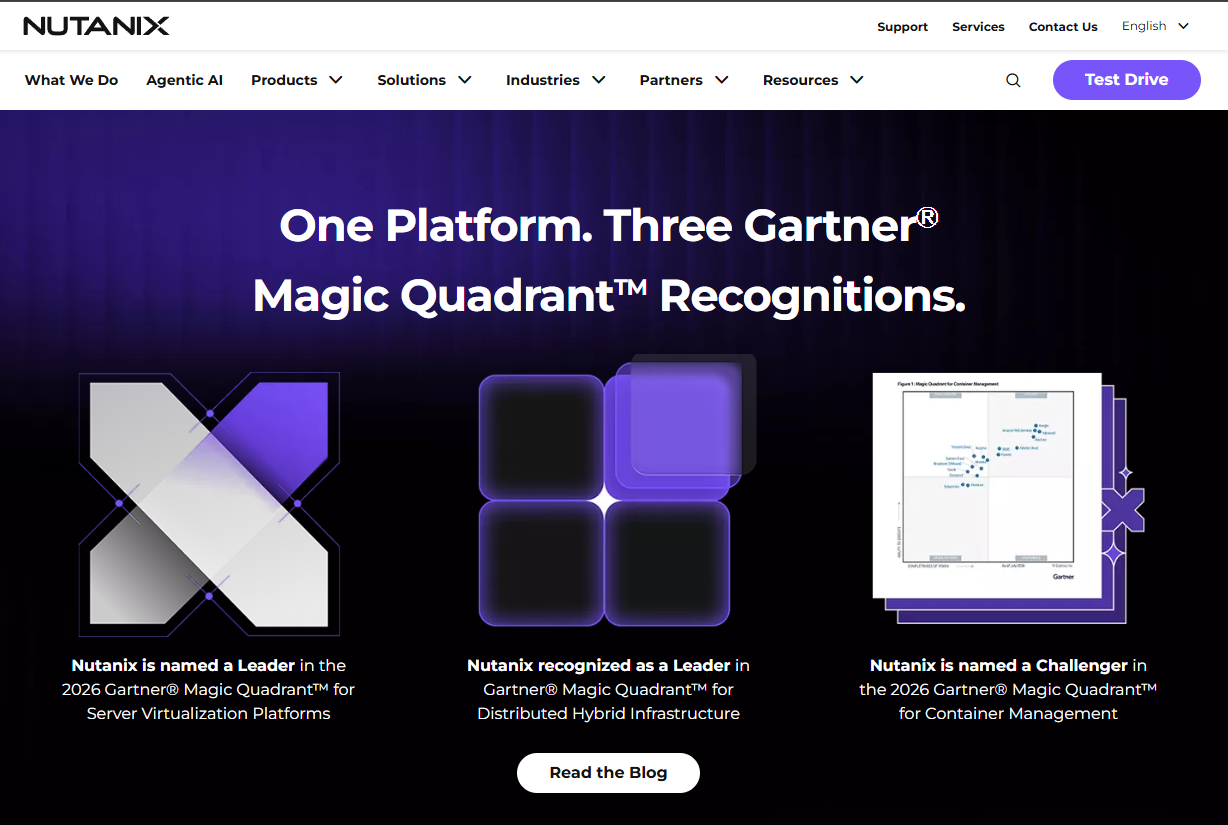
Nutanix Cloud Platform is a hybrid multicloud platform for running applications and managing data across private clouds, public clouds, and edge environments. It combines compute, storage, virtualization, and networking under a centralized management layer with one-click operations and lifecycle automation. Teams use it to standardize infrastructure across sites without requiring specialized domain expertise at each location.
Best for: Product and platform teams that need consistent infrastructure patterns across customer environments, internal data centers, and edge deployments.
Key features
- Software-defined storage pooled across clustered nodes
- Centralized lifecycle management with one-click operations
- Unified support for virtual machines and containers
- Intelligent operations with self-service and cost governance
- Built-in disaster recovery, snapshots, and data encryption
Why choose Nutanix Cloud Platform: Nutanix suits organizations where operational consistency across multiple deployment sites matters as much as raw infrastructure performance. Validate your hypervisor strategy, licensing model, and cloud connectivity requirements before procurement.
Nutanix Cloud Platform pricing: Nutanix sells through vendor and partner channels using configuration-based pricing. For Nutanix Cloud Clusters (NC2), pay-as-you-go rates start at $3.744/hour per node on AWS (i3.metal, NCI Pro); AWS infrastructure charges are separate. On-premises NCP pricing requires a quote through Nutanix or an authorized partner.
G2 rating: 4.5/5
2. Dell VxRail
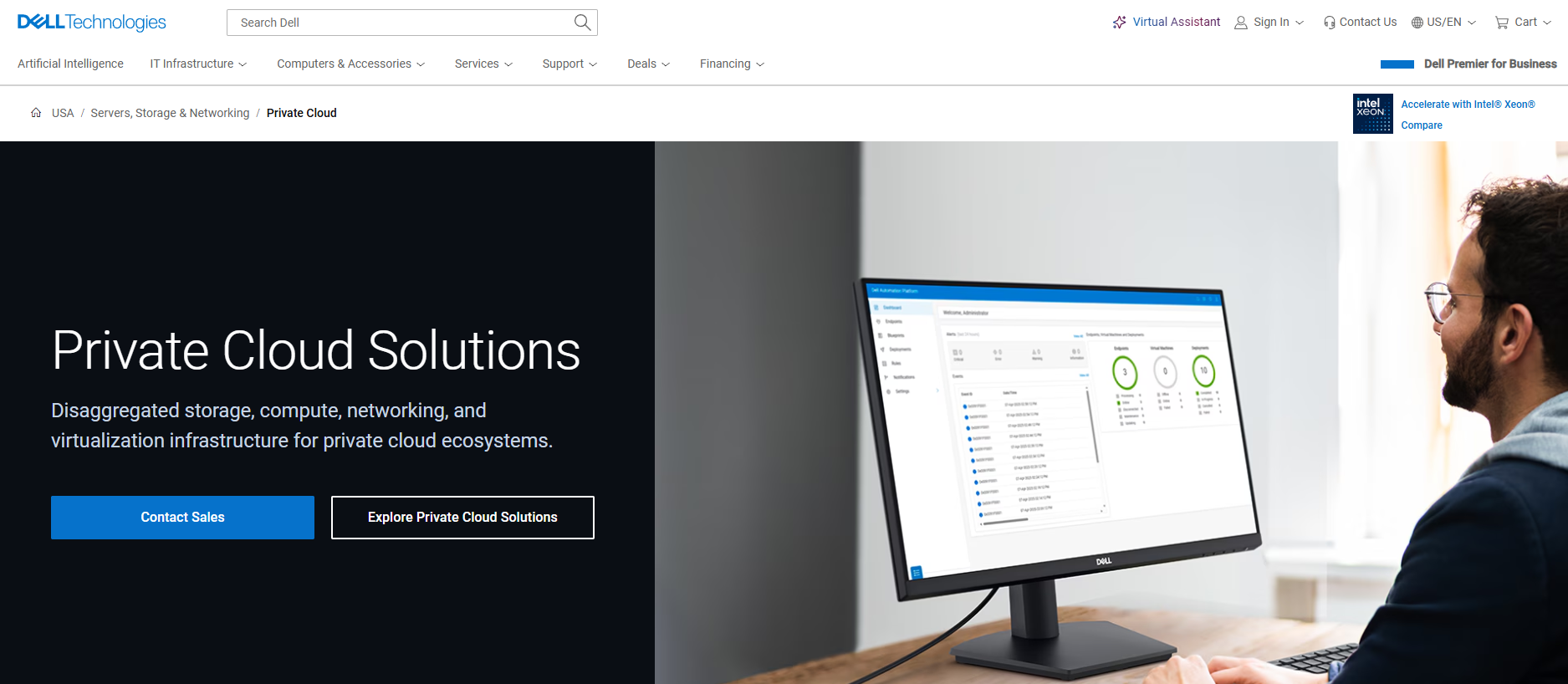
Dell VxRail is a fully integrated hyperconverged appliance family combining PowerEdge hardware with VMware software for virtualization, compute, storage, and centralized management. It is built for organizations that have standardized on Dell hardware and want to extend that investment into an HCI operating model. VxRail Manager automates deployment, configuration, and cluster expansion.
Best for: Data center teams that want integrated HCI hardware and lifecycle operations within an existing Dell infrastructure standard.
Key features
- Automated deployment and configuration through VxRail Manager
- Automated cluster scale-out and node expansion
- Centralized monitoring, diagnostics, and lifecycle management
- VMware vSphere, vCenter Server, and vSAN integration
- Configurable compute, memory, storage, GPU, and networking options
Why choose Dell VxRail: VxRail fits teams that value appliance-style procurement, established Dell support relationships, and a VMware-native operational model. Product managers should assess how the VMware licensing posture affects long-term architecture flexibility before committing.
Dell VxRail pricing: Dell configures VxRail pricing by node model, storage configuration, software licensing, and support duration. Contact Dell or a Dell partner for a configuration quote.
G2 rating: 4.3/5 based on 41 reviews
3. HPE SimpliVity
HPE SimpliVity combines compute, storage, networking, virtualization, and data protection into a single HCI system. The platform is designed for distributed environments where teams need centralized visibility without maintaining a full local infrastructure team at every site. Built-in inline deduplication, compression, and data optimization reduce storage overhead, while integrated backup and recovery capabilities address data protection requirements without separate tooling.
Best for: Organizations operating remote offices, retail locations, or field sites that need reliable VM infrastructure and simplified data protection.
Key features
- Integrated compute, storage, and storage networking
- Built-in backup, restore, and disaster recovery
- Inline deduplication, compression, and data optimization
- VM-centric management and mobility
- HPE InfoSight predictive analytics
Why choose HPE SimpliVity: The combination of data efficiency and built-in recovery simplifies the operational handoff between infrastructure and product teams at distributed sites. IT teams get centralized oversight; product teams get predictable environment behavior across locations.
HPE SimpliVity pricing: HPE sells SimpliVity through configuration-based quotes. Pricing reflects node model, storage configuration, software licensing, and support package selection. Contact HPE or an HPE partner for a current quote.
G2 rating: 4.4/5
4. Microsoft Azure Stack HCI
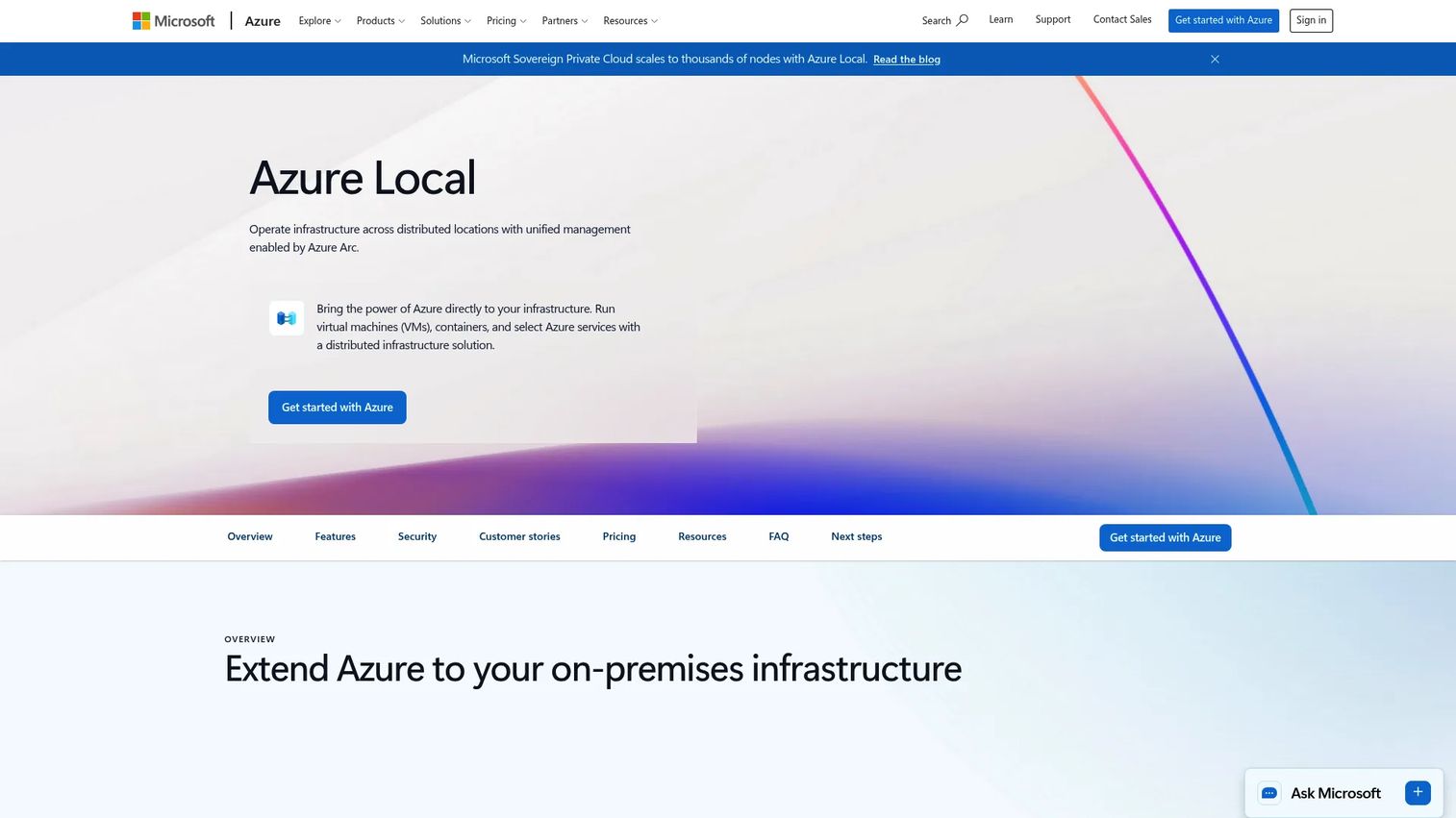
Microsoft Azure Stack HCI is now branded as Azure Local. It is Microsoft's distributed infrastructure solution for running virtual machines, containers, and Azure services on customer-owned hardware. Clusters are managed through Azure Arc and the Azure portal, giving teams a consistent operational experience across on-premises and cloud workloads. The platform supports both connected and disconnected operations, which matters for sovereign or air-gapped deployment scenarios.
Best for: Teams that already run Windows Server and Azure services and want on-premises HCI managed through the Azure control plane.
Key features
- Azure Arc-based management for on-premises clusters
- Windows and Linux VM support with Azure-consistent tooling
- Azure Kubernetes Service enabled by Azure Arc
- Support for connected and disconnected operations
- BitLocker encryption, application control, and Microsoft Defender integration
Why choose Microsoft Azure Stack HCI: If your organization's identity, monitoring, and governance stack is already in Azure, Azure Local provides a consistent operating model across sites without introducing a separate management plane. Subscription commitment and hardware partner selection are the two factors that most affect total cost.
Microsoft Azure Stack HCI pricing: Azure Local uses a subscription model plus validated hardware from partner vendors. The base host-service tier fees (L1 and L2) require a quote from Microsoft. The Windows Server guest subscription is $23.3/physical core/month. A 60-day free trial is available. Contact your Microsoft account representative for L3 pricing.
G2 rating: 4.2/5
5. Cisco HyperFlex
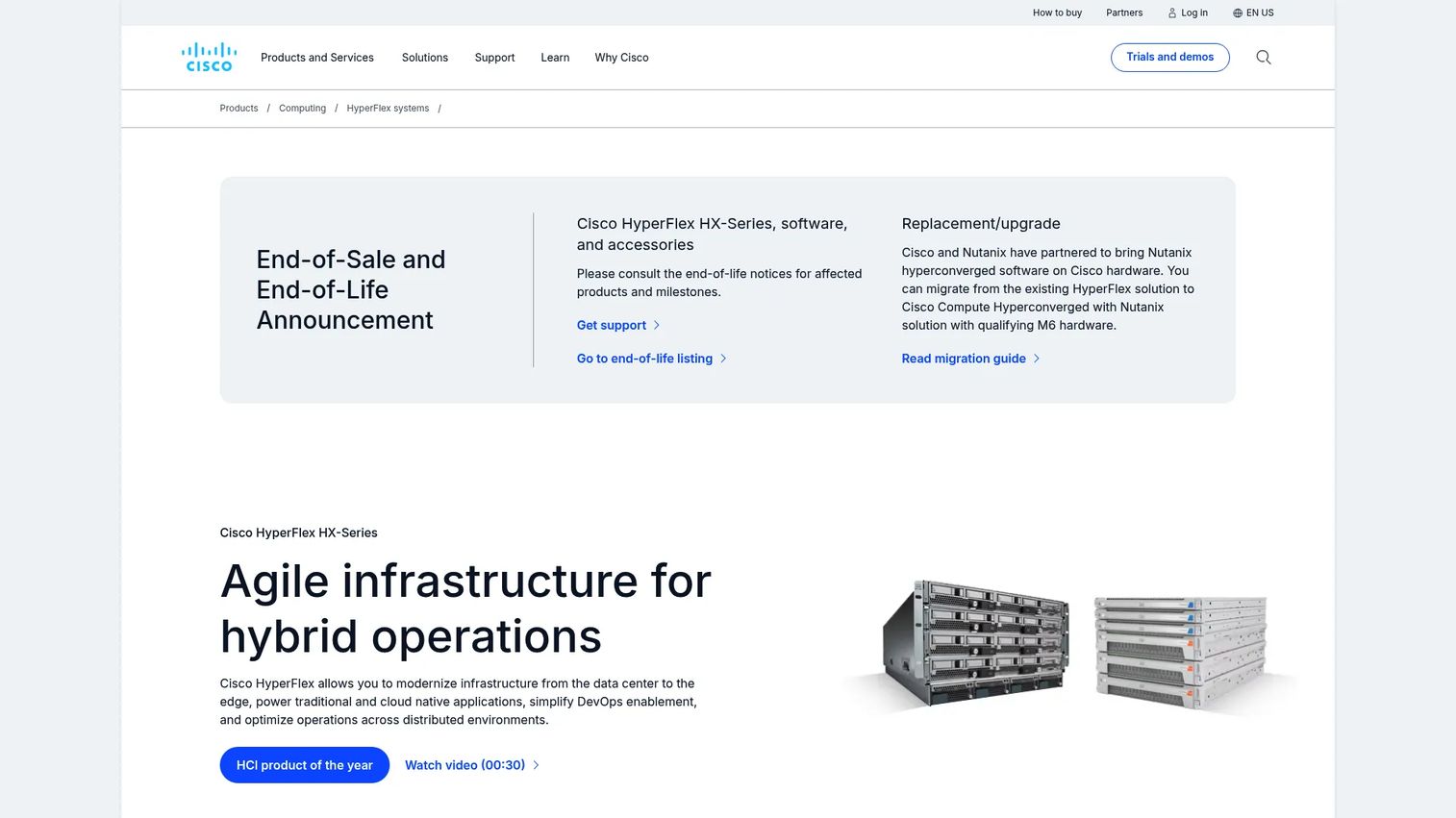
Cisco HyperFlex is an HCI platform combining compute, storage, networking, and the Cisco HX Data Platform for centralized management. It supports VMware vSphere, Microsoft Hyper-V, and containerized workloads managed through Kubernetes. The platform includes inline deduplication, compression, replication, thin provisioning, snapshots, and space-efficient clones. Scale-out architecture allows independent scaling of compute and storage nodes.
Best for: Infrastructure teams with established Cisco data center operations who want HCI aligned with existing Cisco networking and policy investments.
Key features
- Scale-out architecture with independent compute and storage scaling
- Inline deduplication, compression, replication, and snapshots
- VMware vSphere, Microsoft Hyper-V, and Kubernetes support
- Centralized management with Cisco HX Data Platform
- Data center policy integration
Why choose Cisco HyperFlex: Existing Cisco standards reduce operational change for teams already managing Cisco networking and compute. Before selecting HyperFlex as a net-new standard, confirm current product roadmap status, support lifecycle, and how it fits your long-term architecture plan.
Cisco HyperFlex pricing: Cisco handles pricing through its sales and partner channels. Configuration, hardware, software licensing, and support requirements all shape the final cost. Contact Cisco or a Cisco partner for a current configuration quote.
6. Scale Computing HyperCore
Scale Computing HyperCore integrates virtualization, distributed storage, high availability, and data protection into a single HCI platform. It is designed for organizations that need reliable infrastructure at distributed locations without adding a heavy local operations burden. The platform includes automated self-healing storage, replication, failover and failback, REST API access, and Ansible compatibility for teams that want infrastructure-as-code workflows.
Best for: Remote offices, edge deployments, retail sites, and organizations with limited on-site IT support.
Key features
- Built-in virtualization and VM management
- Distributed storage with high availability and self-healing automation
- Replication, failover and failback, snapshots, and VM recovery
- REST API access and Ansible compatibility
- Automated storage tiering and live virtual drive expansion
Why choose Scale Computing HyperCore: HyperCore suits product managers who need dependable deployments outside central engineering control. The platform's centralized fleet management and automated recovery reduce the operational dependency on local site staff. For organizations evaluating cloud cost optimization software alongside infrastructure decisions, HyperCore's predictable per-node pricing model makes total cost modeling straightforward.
Scale Computing HyperCore pricing: The Professional Essentials package starts at $5,600/year based on a five-year contract term, covering a three-node configuration with the HyperCore Data Protection Suite, high availability, integrated storage, virtualization, and support. Contact Scale Computing for configurations beyond the three-node entry tier.
G2 rating: 4.7/5 for SC// HyperCore Virtualization Suite
7. IBM Hyperconverged Infrastructure
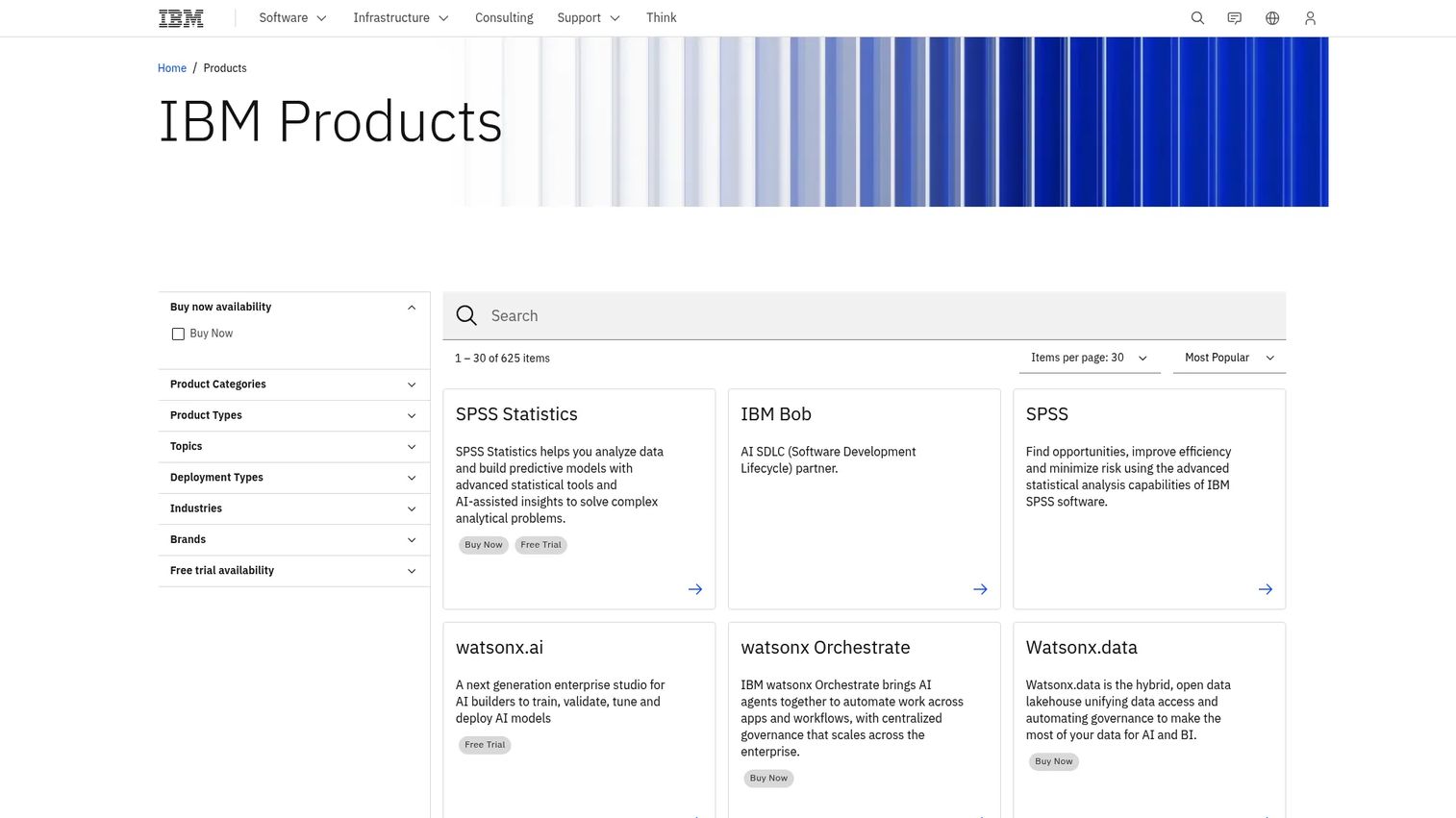
IBM Hyperconverged Infrastructure is now associated with IBM Fusion HCI, positioned for enterprise modernization programs that need integrated infrastructure, services, and support. The offering aligns with broader IBM technology investments including hybrid cloud architectures. Organizations evaluating IBM in this category typically prioritize support ownership, systems integration governance, and modernization services alongside the base HCI architecture.
Best for: Large enterprises managing complex modernization programs, regulated environments, or hybrid infrastructure estates where vendor support and integration governance drive the decision.
Key features
- Integrated compute and storage architecture
- Enterprise support and professional services
- Hybrid cloud alignment
- Virtual machine workload support
- Data center modernization pathway
Why choose IBM Hyperconverged Infrastructure: This option fits organizations where procurement governance, systems integration complexity, and long-term support accountability matter as much as the technical architecture. For teams also evaluating cloud data security software requirements as part of a modernization program, IBM's enterprise support structure can simplify vendor responsibility boundaries.
IBM Hyperconverged Infrastructure pricing: Enterprise pricing is configuration-based and reflects capacity, services, support terms, and overall infrastructure scope. The IBM product URL at time of publication redirects to the general IBM catalog. Contact IBM or an IBM Business Partner directly for current Fusion HCI configuration and pricing.
Considerations when choosing hyperconverged infrastructure
Match the platform to your workload profile
VDI, branch office virtual machines, and general business applications tend to run well on HCI clusters. Storage-intensive databases, GPU-dense AI workloads, and applications that require independent compute and storage scaling need deeper architecture validation before committing to a platform. Run workload-specific testing before finalizing a purchase.
Model day-two operations before committing
Evaluate software and firmware upgrade workflows, node replacement procedures, capacity planning tools, monitoring and alerting capabilities, and backup and disaster recovery options. Support ownership across hardware and software layers is often more complex than it appears in vendor materials. Clarify which vendor owns each escalation path before signing.
Understand your scale options
Three paths exist: Scale-out adds nodes to grow cluster capacity; scale-up adds higher-density resources within a node where supported; disaggregated HCI allows more independent compute and storage growth on platforms that support it. The right path changes the total cost of ownership trajectory and affects how quickly you can respond to roadmap demand.
Treat security as part of the operating model
Identity controls, network segmentation, encryption at rest and in transit, vulnerability management, audit logging, and hardware lifecycle processes all need coverage. HCI platforms can support each of these, but the configuration and operational discipline are your team's responsibility. Infrastructure controls support the product security posture; they do not replace application security design. Teams evaluating AI security posture management tools alongside infrastructure should map responsibility boundaries clearly.
Calculate total cost across the full lifecycle
Model node acquisition and refresh cycles, hypervisor and management licensing, storage growth, network requirements, support contracts, data protection overhead, and staff time for deployment and maintenance. "Lower TCO" claims are only meaningful when the inputs are specific to your configuration and usage pattern.
How to choose the right hyperconverged infrastructure platform
Choose for hybrid cloud alignment
Nutanix Cloud Platform and Microsoft Azure Stack HCI are the two platforms most suited to hybrid cloud operating models. The deciding factor is your existing cloud control plane. Teams running Azure services, Windows Server identity, and Microsoft monitoring tools will find Azure Local's Arc-based management familiar. Organizations that want cloud flexibility without a commitment to a single hyperscaler tend to favor Nutanix.
Choose for appliance-style data center operations
Dell VxRail fits teams that have already standardized on Dell hardware and want a single vendor managing appliance lifecycle. Assess your VMware licensing posture and the platform's long-term roadmap before treating VxRail as a multi-year standard.
Choose for edge and remote office consistency
HPE SimpliVity works well where built-in data protection and centralized remote management are priorities alongside the HCI cluster. Scale Computing HyperCore suits distributed sites with limited local IT capacity, particularly when predictable per-node pricing and automated recovery matter more than deep cloud integration.
Choose for enterprise modernization governance
IBM Hyperconverged Infrastructure belongs in evaluations where support ownership, procurement governance, and systems integration services are selection criteria alongside the architecture. Build a weighted scorecard with infrastructure, security, product delivery, and finance stakeholders before selecting.
Conclusion
HCI is a software-defined operating model, not a hardware purchase you make once and forget. The right platform depends on your workload mix, deployment footprint, cloud strategy, and who owns operations after the cluster is running.
For product managers, the evaluation starts with a practical question: Which infrastructure model reduces environment variance and release risk without creating a new class of engineering interrupts? Nutanix covers the broadest range of hybrid and multicloud scenarios. Dell VxRail and HPE SimpliVity serve organizations with existing vendor standards. Azure Local is the clear fit for Microsoft-native teams. Scale Computing HyperCore is the most accessible entry point for distributed edge deployments. Cisco HyperFlex and IBM Hyperconverged Infrastructure serve established Cisco and IBM environments, respectively.
Run a proof of concept against representative workloads before committing. Infrastructure decisions made on vendor presentations alone tend to surface surprises during the first production deployment.
Complex infrastructure is hard to explain in static diagrams. Use interactive product education to help internal teams and customers understand technical workflows before they enter a live environment.
Start your journey with Guideflow today!
FAQs about hyperconverged infrastructure
Hyperconverged infrastructure is a software-defined cluster that combines compute, storage, virtualization, networking, and management on standard server nodes. Instead of managing separate storage arrays and infrastructure layers, teams operate a single cluster with one control plane. HCI reduces the number of specialist teams required to keep infrastructure running.
Converged infrastructure packages integrated compute, storage, and networking components into a validated reference architecture, but each domain often retains its own management tools. HCI uses software to pool local resources across clustered nodes and manages everything from a centralized control plane. Both reduce integration work compared to three-tier infrastructure, but HCI typically simplifies day-two operations more deeply.
HCI can serve as a foundation for private cloud, but the terms are not interchangeable. Private cloud also requires self-service capabilities, identity controls, service management processes, and operational governance. HCI provides the infrastructure layer; the private cloud operating model sits on top of it.
Virtual machines, VDI infrastructure, remote office systems, business applications, edge services, and many private cloud workloads perform well on HCI. Storage-intensive databases, GPU-heavy AI workloads, and applications that need to scale compute and storage independently require workload-specific testing before deployment.
HCI can reduce reliance on a dedicated SAN by pooling local storage through software-defined storage across the cluster. For most VM and VDI workloads, that approach is sufficient. Specialized performance requirements, specific storage protocols, or very high capacity targets may still warrant a dedicated storage array alongside or instead of HCI.
Scale-out growth adds nodes to the cluster, expanding compute and storage together. Scale-up growth adds higher-density components within existing nodes where the platform supports it. Disaggregated HCI allows more independent compute and storage scaling on platforms that implement it. The right path depends on whether your workloads hit compute limits or storage limits first.
HCI platforms support identity controls, encryption, network segmentation, update management, and audit logging. Security outcomes depend on architecture decisions, configuration discipline, application controls, and ongoing operational practices. The platform provides the tools; the team's implementation determines the posture. HCI does not replace application security design or independent security review processes. Teams working on application security testing requirements should map infrastructure and application controls separately.
Compact clusters and centralized management make HCI well-suited to distributed sites where local IT capacity is limited. Site connectivity, local support availability, workload criticality, and recovery time requirements still drive the final architecture decision. For high-criticality edge workloads, confirm that the platform supports the recovery objectives your product team has committed to customers.