Launching a new insurance product sounds straightforward until it isn't. Rating changes need to go through one system, policy servicing through another, billing through a third, and the claims workflow sits in a tool that hasn't talked to the others since a consultant left in 2019. Every exception routes back to you.
That's the operating model problem most insurance carriers, MGAs, and insurtechs are actually solving when they search for a core platform. The global insurance software market reached $15.03 billion in 2026 and is forecast to grow at 6.31% annually through 2031, according to Mordor Intelligence (2026). Yet 78% of insurance organizations planned to increase technology spending in 2025, per Wolters Kluwer - which means most are still mid-transition, not post-transformation.
The real decision isn't whether to modernize. It's whether to choose an enterprise suite, a modular cloud core, or an API-first system, and which architecture fits the lines of business, implementation capacity, and operating model you're building toward.
What's inside
This guide is for insurance carriers, MGAs, founders building embedded insurance products, and transformation leaders evaluating core platform options. Eight platforms are reviewed across the following criteria:
- Core coverage: Policy, billing, claims, underwriting, and rating
- Cloud architecture and deployment model
- API and integration depth
- Implementation exposure and total ownership cost
- Fit by insurer segment (large carrier, regional, MGA, digital-first)
TL;DR
- Best for large, complex P&C carriers: Guidewire InsuranceSuite, for mature core operations across policy, billing, and claims
- Best for cloud-oriented P&C carriers: Duck Creek Suite, with configurable core processes and a cloud delivery model
- Best for U.S. P&C and specialty depth: Insurity Suites, built specifically for carriers, MGAs, and TPAs
- Best for modernization across insurance lines: Majesco, combining core administration with digital and data capabilities
- Best for global, multi-line insurers: Sapiens, with a broad portfolio across P&C, life, pension, and reinsurance
- Best for API-first digital insurance: Socotra, built for teams that need a composable cloud core
- Best for regional carriers and MGAs: BriteCore, a right-sized cloud core for growing insurers
- Best for core plus digital engagement: EIS, connecting core operations to customer and distribution experience
What is insurance suites software?
Insurance suites software is an integrated platform that manages core insurance workflows, typically policy administration, billing, claims, underwriting, rating, product configuration, data, and customer servicing.
Unlike point tools that handle one workflow in isolation, an insurance suite creates a shared operating layer. A policy change flows through rating, produces a billing update, and is visible in claims, all without manual reconciliation between disconnected systems.
What an insurance suite typically includes
- Policy administration: Quote, bind, endorse, renew, and cancel
- Billing: Premiums, collections, installment plans, commissions, and payment processing
- Claims: Intake, assignment, adjudication, settlement, and fraud detection
- Underwriting: Rules, rating, risk analysis, and product configuration
- Customer portals, agent and broker tools, and communications
- Reporting, analytics, and operational dashboards
- Integrations with payment systems, document generation, identity providers, CRM, and distribution partners
Insurance suite vs. adjacent categories
Not every insurance software category solves the same job. Buyers often compare systems that aren't equivalent.
| Category | Primary job | Typical buyer | Where it fits |
|---|---|---|---|
| Insurance suite | Runs core policy, billing, claims, and related workflows | Carrier, MGA, large insurer | System of record for insurance operations |
| Policy administration system | Manages policy lifecycle and product rules | Carrier or MGA | Often a core suite module |
| Insurance CRM | Manages relationships, leads, and service interactions | Sales, service, distribution | Complements core operations |
| Agency management system | Runs agency or brokerage workflows | Agency or broker | Focused on distribution |
| Claims software | Manages claims operations | Carrier or TPA | Can be standalone or a suite module |
A full carrier core suite and an agency management system do not solve the same job. Evaluate them on separate shortlists.
When to use insurance suites software
Replace disconnected core systems
Policy, billing, claims, and reporting data live in separate tools, and every product change requires manual reconciliation across all of them. A core suite creates a single source of operational truth, so endorsements, billing adjustments, and claims updates stay in sync without workarounds.
Launch or expand insurance products
A carrier, MGA, or embedded insurer needs to configure a new line of business, update rating rules, or open a new distribution channel without a custom development cycle. A configurable insurance suite lets product teams model changes in the platform rather than queuing engineering work for every revision.
Modernize without a big-bang migration
Leadership needs cloud infrastructure and cleaner data for board reporting, but a full system replacement in one program is too risky. Many platforms on this list support phased rollouts where one operational domain (claims, for example) migrates first, with others following on a sequenced schedule.
Insurance suites software comparison
Platform fit varies significantly by insurer segment, lines of business, geographic footprint, and internal implementation capacity. The table below gives a fast shortlist. Every pricing entry reflects verified vendor positioning: All eight platforms sell through enterprise contracts without standard published rates.
| # | Product | Best for | Key differentiator | Pricing | G2 rating |
|---|---|---|---|---|---|
| 1 | Guidewire InsuranceSuite | Large P&C carriers | Deep suite across policy, billing, and claims | Contact for quote | 4.1/5 |
| 2 | Duck Creek Suite | Cloud-oriented P&C carriers | Configurable P&C core with cloud delivery | Contact for quote | 4.7/5 |
| 3 | Insurity Suites | U.S. P&C carriers, MGAs, TPAs | Insurance-focused depth across specialty lines | Contact for quote | 3.7/5 |
| 4 | Majesco | Insurers modernizing core and digital | Cloud platform across core, digital, and data | Contact for quote | 3.0/5 |
| 5 | Sapiens | Global, multi-line insurers | Broad portfolio across P&C, life, and reinsurance | Contact for quote | N/A |
| 6 | Socotra | Digital-first insurers and insurtechs | Cloud-native, API-first insurance core | Contact for quote | N/A |
| 7 | BriteCore | Regional P&C carriers and MGAs | Right-sized cloud core for growing insurers | Contact for quote | 4.3/5 |
| 8 | EIS | Insurers combining core with digital engagement | Cloud-native core with customer engagement focus | Contact for quote | 4.6/5 |
Best 8 insurance suites software platforms for 2026
This list is ordered by broad category relevance, not as a universal ranking. A large P&C carrier replacing mature core systems, a startup MGA launching its first product, and a multinational life insurer operating across jurisdictions should each build a different shortlist.
1. Guidewire InsuranceSuite
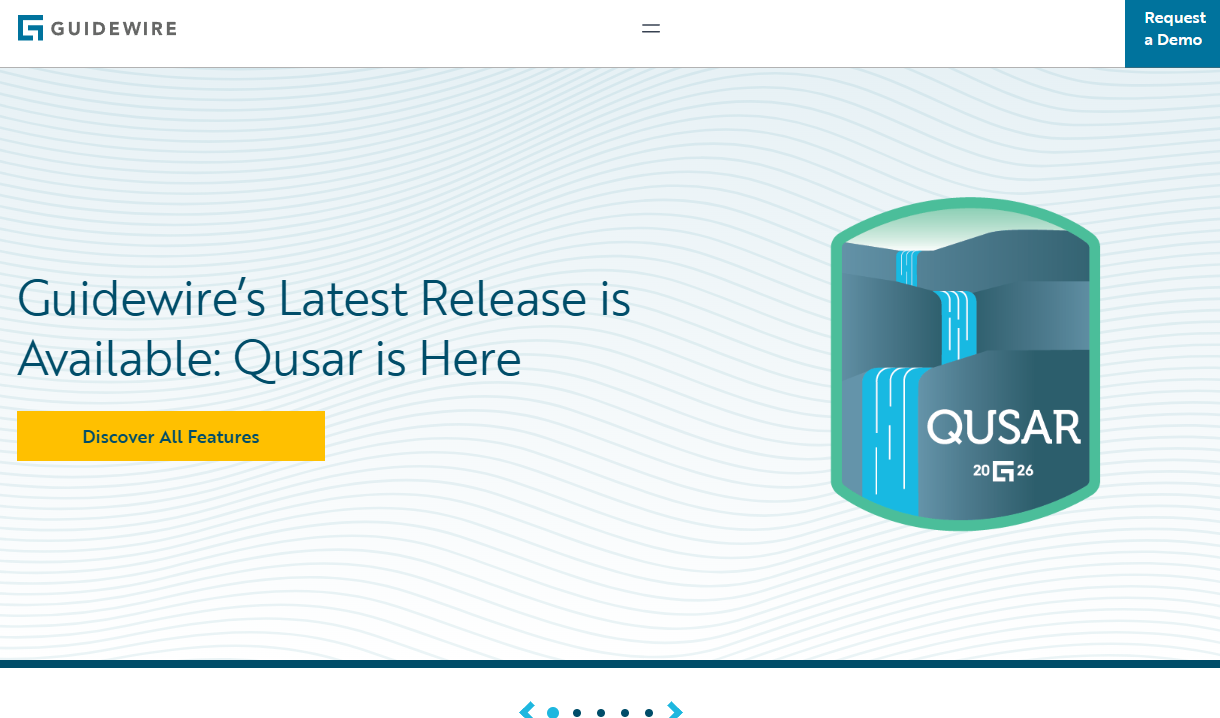
Guidewire InsuranceSuite is a core platform for property and casualty insurers covering policy administration, billing, claims, pricing, and underwriting. The three primary operational modules, PolicyCenter, BillingCenter, and ClaimCenter, connect to a shared cloud platform and marketplace ecosystem. Guidewire is widely used by mid-sized and large P&C carriers that need integrated core operations.
Best for: Large P&C carriers replacing or consolidating mature core systems across multiple products, jurisdictions, or distribution models.
Key features
- PolicyCenter: Full policy lifecycle from quote through renewal and product configuration
- ClaimCenter: Claims from first notice of loss through settlement and adjudication
- BillingCenter: Direct, agency, installment, and usage-based billing and payments
- PricingCenter: Unified pricing and rating environment
- InsuranceSuite Cloud APIs: REST-based integrations across core modules
Why choose Guidewire InsuranceSuite: This is the platform for carriers where operational complexity is already enterprise-scale. The depth of the suite, the implementation partner ecosystem, and the maturity of the underlying modules make it a serious evaluation candidate for large P&C programs. Treat it as a multi-year operating infrastructure decision, not a software purchase.
Guidewire InsuranceSuite pricing: Guidewire directs buyers to request a call or schedule a demo. Expect the total cost to include platform subscription, implementation services, data migration, cloud hosting, partner fees, and ongoing administration. Model all five layers before comparing proposals.
G2 rating: 4.1/5
2. Duck Creek Suite
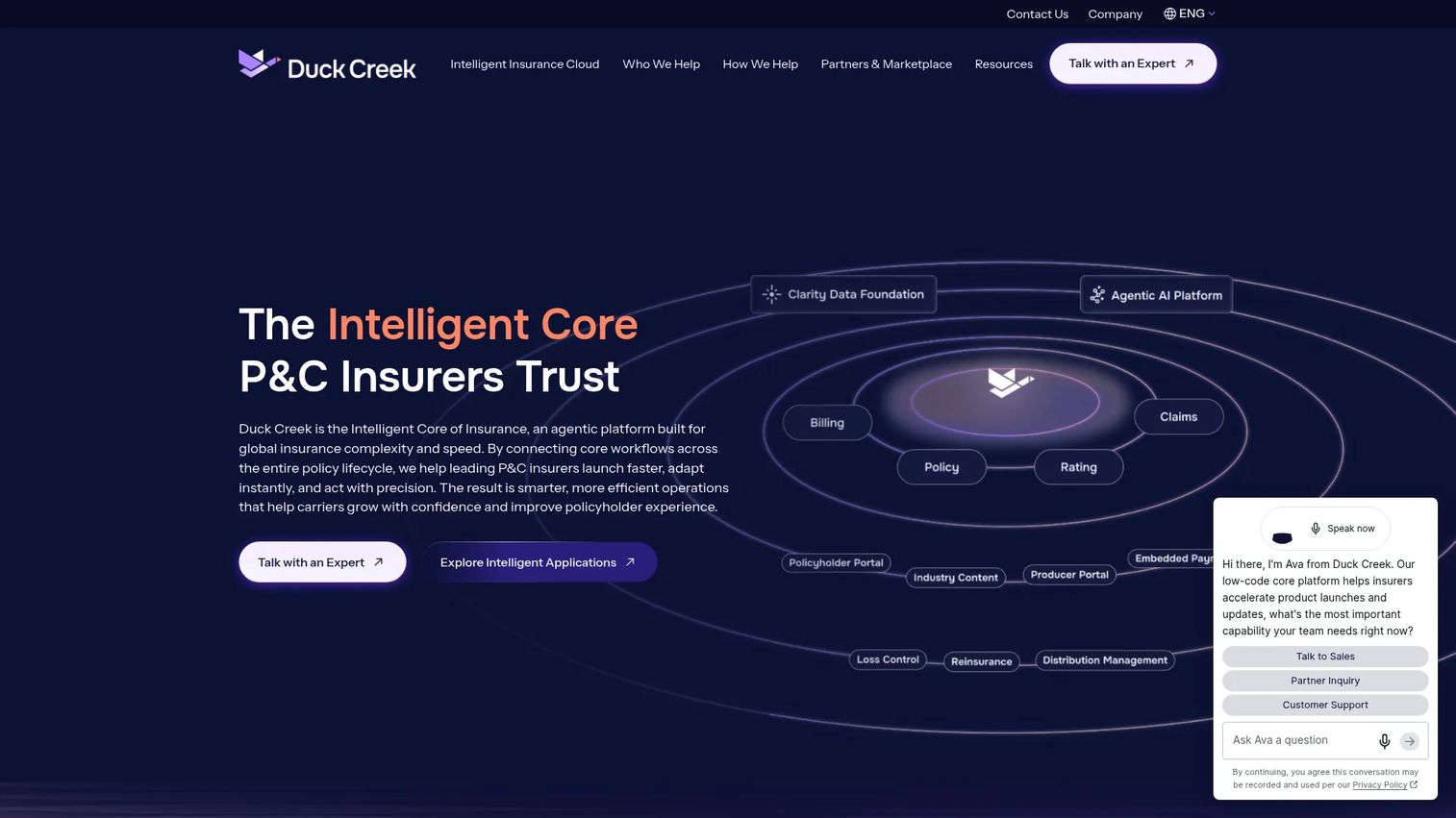
Duck Creek Suite is an integrated P&C insurance platform covering policy administration, billing, claims, rating, and distribution management. The platform supports both cloud and standalone deployment and is built for insurers that need broad core functionality with configurable workflows. It holds a 4.7/5 rating on G2, one of the stronger scores in this category.
Best for: P&C insurers that need comprehensive core functionality with a cloud delivery model and configurable insurance processes.
Key features
- End-to-end policy lifecycle management
- Configurable insurance rating and product modeling
- Billing for premiums, receivables, and payment plans
- Claims processing with workflow and mobile support
- Distribution and producer management
Why choose Duck Creek Suite: Duck Creek earns consideration when the business needs enterprise breadth alongside a cloud operating model. The configuration depth is a practical advantage for carriers with complex product portfolios. Before committing, examine how the release management process works and whether your internal team has the capacity to own configuration changes over time.
Duck Creek Suite pricing: Duck Creek sells through an enterprise sales model. When requesting a proposal, ask specifically about product module scope, implementation partner costs, environment requirements, and multi-year renewal assumptions. G2 reviewers have not reported specific dollar ranges.
G2 rating: 4.7/5
3. Insurity Suites
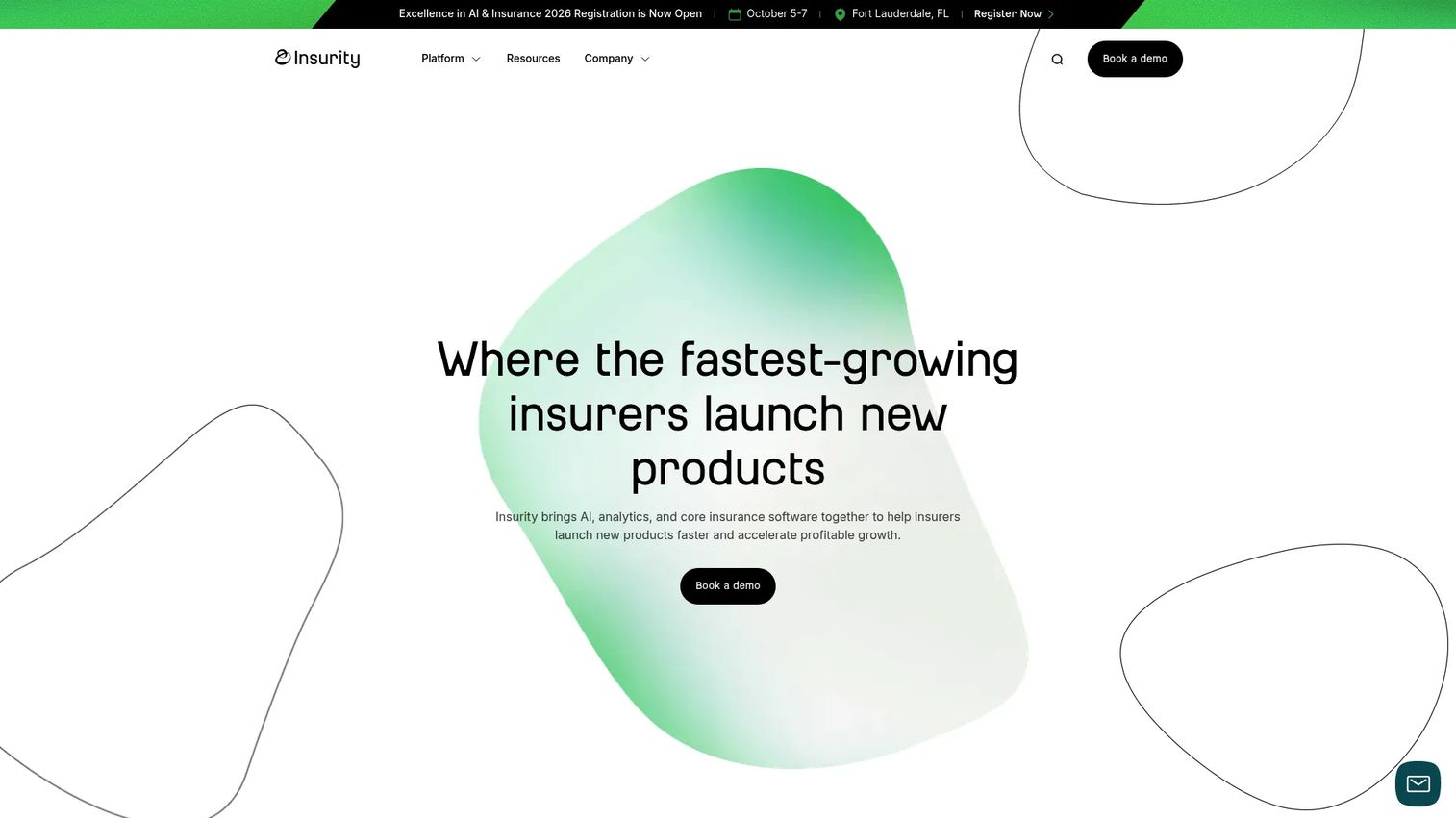
Insurity provides a cloud-based portfolio of insurance software for P&C carriers, MGAs, brokers, and TPAs. The platform covers policy administration, billing, claims, underwriting, analytics, and AI-assisted automation. Its API-first architecture and cloud-native deployment support organizations that want insurance-specific operational depth without evaluating only the largest enterprise programs.
Best for: U.S. P&C carriers, specialty insurers, and MGAs that want insurance-specific software depth, particularly organizations outside the top-tier multinational carrier segment.
Key features
- Policy, billing, claims, and accounting capabilities
- Configurable workflows, rules, and browser-based interfaces
- API-first integrations and cloud-native deployment
- AI-powered underwriting, fraud detection, and automation
- Regulatory intelligence and bureau content
Why choose Insurity Suites: Insurity's focus on vertical specialization means the platform vocabulary, compliance support, and product configuration model all reflect insurance operations rather than generic enterprise software adapted for insurance. If vertical fit matters more than brand recognition, it earns a shortlist position. Confirm which specific suite modules cover your lines of business before proceeding.
Insurity Suites pricing: Insurity directs buyers to book a demo or contact sales. Request product-by-product scope, implementation assumptions, data migration requirements, and support model details during initial conversations. G2 reviewers have not reported specific pricing ranges.
G2 rating: 3.7/5
4. Majesco
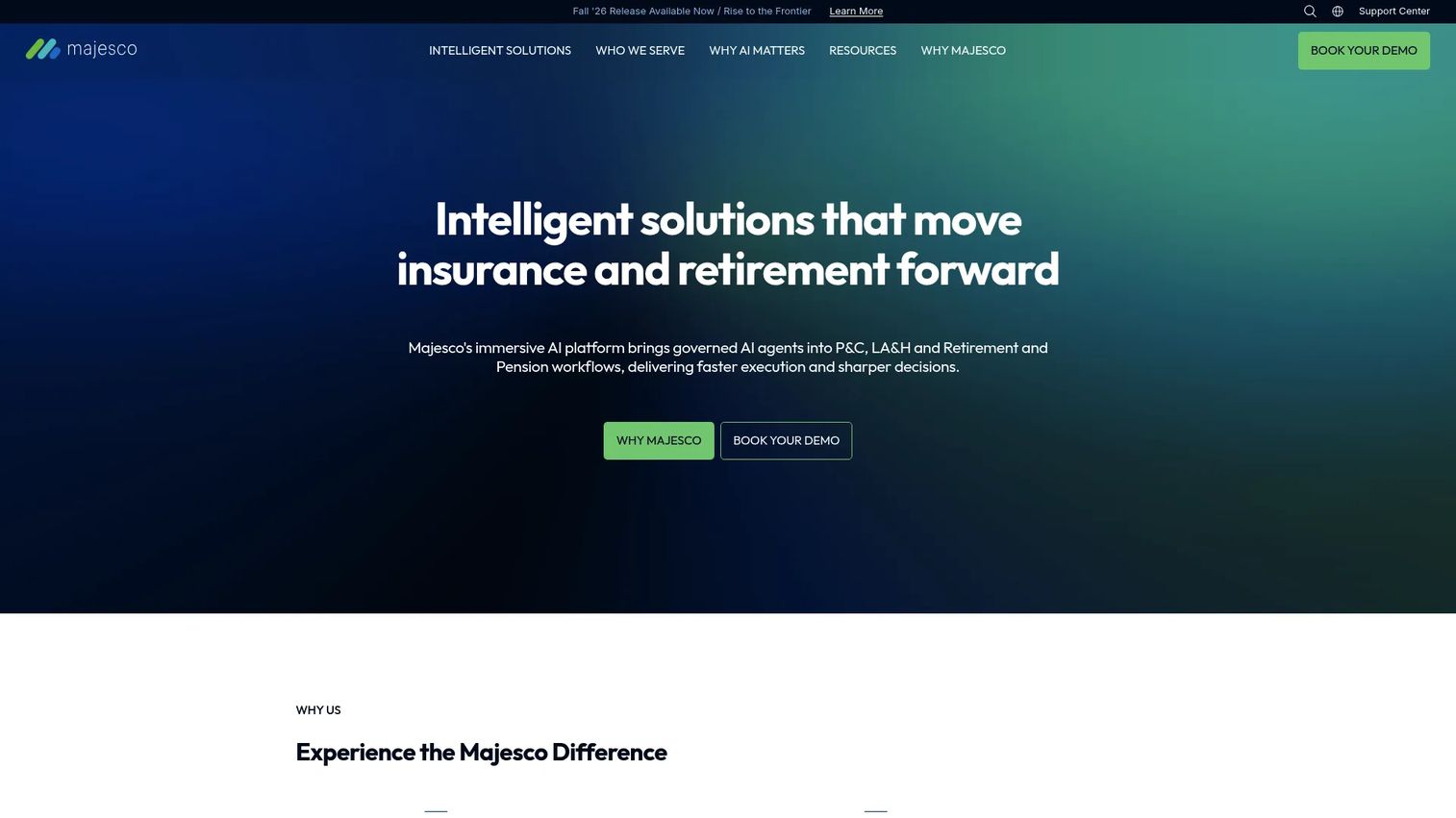
Majesco is a cloud-based insurance platform covering core administration, product configuration, digital engagement, and data and analytics across P&C, life, annuity, health, and retirement lines. The platform embeds generative AI and agentic AI across underwriting, policy administration, billing, and claims workflows. Majesco positions its platform for carriers modernizing both operational systems and customer-facing experiences at the same time.
Best for: Insurers that need to modernize legacy core systems while simultaneously improving product agility, digital experiences, and access to operational data.
Key features
- Cloud-native policy, billing, and claims administration
- Embedded generative AI and agentic automation
- Product, rate, rule, and workflow configuration
- Digital portals for customers and agents
- Support for P&C, life, annuity, health, and retirement
Why choose Majesco: The platform is particularly useful when the modernization business case has two components: Replacing aging core systems and improving the customer and producer experience in the same program. Avoid treating the digital engagement layer as separate from the core administration decision. They need to move together.
Majesco pricing: Majesco states that pricing is tailored to each organization. Ask for core module costs, digital module costs, data product fees, services estimates, migration scope, and regional deployment requirements in the initial RFP. G2 reviewers have not reported specific price ranges.
G2 rating: 3.0/5
5. Sapiens

Sapiens is a cloud-first insurance software provider with a broad portfolio spanning property and casualty, life and pensions, reinsurance, financial management, and compliance operations. The platform includes low-code product configuration, AI-powered automation across the insurance lifecycle, and digital engagement capabilities. Sapiens operates across multiple geographies and serves carriers with complex multi-line requirements.
Best for: Global insurers with multiple lines of business, complex regional requirements, or a need to evaluate P&C alongside life, pension, or reinsurance operations from a single software provider.
Key features
- Low-code insurance product configuration across multiple lines
- AI-powered automation across underwriting, policy, billing, claims, and renewal
- Cloud-native digital portals and self-service experiences
- Insurance-specific data consolidation, analytics, and natural-language reporting
- Multi-geography deployment and compliance support
Why choose Sapiens: This is a portfolio decision as much as a platform decision. Evaluate the specific business line, geography, and product edition rather than assuming uniform fit across all operations. Sapiens earns evaluation when expansion crosses insurance lines or markets and your team needs to avoid assembling a separate core stack for every operating unit.
Sapiens pricing: Sapiens uses quote-based enterprise pricing. Request line-of-business-specific scoping, localization requirements, implementation capacity, hosting model, and required interfaces when engaging the sales team. No current G2 overall rating was available for verification.
6. Socotra
Socotra is a cloud-native, API-first insurance core platform built for policy administration, billing, and digital experience. The platform supports full policy lifecycle management, billing integrated with general ledger and payment systems, modular portals for customers and agents, and fully documented APIs with CI/CD tooling for engineering teams. Socotra is positioned for digital-first insurers, insurtechs, and embedded insurance programs that want to build differentiated experiences around an open core.
Best for: Digital-first insurers, embedded insurance programs, and technical teams building differentiated customer or partner experiences around an API-first core.
Key features
- Full policy lifecycle with reusable product configuration
- Billing integrated with general ledger and payment administration
- Modular portals for customers, agents, and internal teams
- Fully documented APIs and CI/CD integration tools
- AI-assisted product configuration and underwriting
Why choose Socotra: Socotra fits when the product strategy depends on building and iterating front-end experiences or distribution workflows faster than a traditional suite allows. The trade-off is that the team needs engineering ownership and integration discipline to get full value from the API-first architecture.
Socotra pricing: Socotra sells through enterprise engagement. Ask for platform fees, API usage assumptions, implementation support scope, and the portion of integration work retained by your internal engineering team. No G2 rating was available due to insufficient review volume.
7. BriteCore
BriteCore is a cloud-native, AI-embedded insurance platform for P&C carriers and MGAs. The platform covers policy administration, billing, claims, product configuration, rating, underwriting rules, document templates, and digital portals for agents and policyholders. BriteCore describes its pricing model as usage or production volume-based, which can align cost to premium growth rather than a flat enterprise license.
Best for: Regional P&C carriers, mutual insurers, and growing MGAs that need a modern cloud core without the program scale designed for a top-tier multinational carrier.
Key features
- Policy administration, billing, and claims management
- Configurable product definition, rating, and underwriting rules
- Agent and policyholder portals with mobile support
- Reporting, analytics, and API access
- Cloud-native deployment with AI embedded across workflows
Why choose BriteCore: A right-sized platform can deliver more operating leverage than the broadest suite when product complexity and internal capacity are lower. BriteCore earns its shortlist position for regional carriers and MGAs that want modern infrastructure without designing a program for a tier-one insurer. The volume-based pricing model is worth examining if premium growth is a key forecast assumption.
BriteCore pricing: BriteCore uses usage or production volume-based pricing rather than a standard per-seat or flat-rate model. Request a proposal tied to your current and projected premium volume, lines of business, hosting requirements, and optional modules. No specific dollar amounts are displayed.
G2 rating: 4.3/5
8. EIS
EIS is a cloud-native, API-first insurance platform combining core operations with customer and distribution engagement. The platform covers policy administration, billing, claims, product configuration, and digital customer experiences, built on an open API and event-driven architecture. EIS holds a 4.6/5 rating on G2, though this reflects a small review base.
Best for: Insurers that want to modernize core operations while placing customer, agent, and partner engagement closer to the center of the platform strategy.
Key features
- Policy administration and product configuration
- Billing and claims management
- Customer-centric data and persona-based portals
- Open APIs and event-driven architecture
- Workflow, business rules, analytics, and reporting
Why choose EIS: EIS fits when the modernization business case explicitly includes redesigning the customer or producer experience, not just replacing core administration. The open architecture and engagement focus make it relevant for carriers whose growth thesis depends on connecting core operations with a differentiated distribution model. Validate the review base and request reference calls with carriers at a comparable stage.
EIS pricing: EIS sells through enterprise engagement with no standard rates displayed. Model implementation scope, core module coverage, digital experience requirements, integration work, and planned product expansion before comparing proposals from multiple vendors.
G2 rating: 4.6/5
Considerations when choosing insurance suites software
Match the platform to your operating model
A regional personal-lines carrier, a specialty MGA, and a multinational insurer operate at different scales of complexity. Start with lines of business, distribution model, jurisdictional requirements, and internal technical capacity. The platform shortlist follows from those constraints.
Model total ownership, not only the contract
The license is one cost layer. Add implementation services, data migration, integration development, environments, training, release management, internal administration headcount, and long-term support. Buyers who skip this step often discover the true annual cost is two to four times the subscription figure.
Test product configuration before you sign
Ask a business user, not an engineer, to model a representative insurance product change during the evaluation. Track how rating, underwriting rules, documents, billing, and claims respond. If configuration requires professional services for every revision, your operating team will be dependent on the vendor for years.
Inspect the integration architecture
Evaluate APIs, event models, documentation quality, data export options, payment integrations, and partner ecosystem depth. A core platform should reduce integration debt over time. If the integration model is primarily professional services-driven, price that into the total ownership model.
Require a phased implementation plan before signing
Request a realistic deployment sequence with measurable milestones, not a slide deck with phases. A credible plan defines migration ownership, parallel-run periods, data-quality gates, training timelines, launch governance, and the first working business outcome after go-live. A vendor that can't produce this before contracting is telling you something important.
Conclusion
Insurance suites software is not a software purchase. It's an operating-model decision that shapes how your teams configure products, service policyholders, process claims, and access operational data for the next several years.
Guidewire and Duck Creek suit large P&C carriers with the implementation capacity to match their program scale. Insurity serves U.S. carriers and MGAs that want vertical depth without the enterprise program overhead. Majesco fits modernization programs that need core and digital to move together. Sapiens earns evaluation when the business spans multiple insurance lines or geographies. Socotra is built for teams whose product strategy requires an API-first composable core. BriteCore offers a right-sized cloud option for regional carriers and growing MGAs. EIS connects core operations with customer and distribution engagement for carriers whose growth model depends on the experience layer.
A practical next step: Build a shortlist of three platforms, issue the same scenario-based evaluation packet to each, and score them against product configuration speed, integration architecture, migration risk, and total five-year ownership cost. The platform that wins on those criteria is the one your next operating leader can run without rebuilding it.
FAQs
Insurance suites software is an integrated platform that manages core insurance workflows including policy administration, billing, claims management, underwriting, rating, and product configuration. Unlike standalone point tools, a suite creates a shared operational layer where changes in one domain, such as an endorsement, flow through billing and become visible in claims without manual reconciliation.
A policy administration system (PAS) focuses primarily on the policy lifecycle: Quote, bind, endorse, renew, and cancel. An insurance suite typically adds billing, claims management, underwriting rules, customer portals, analytics, and integration infrastructure. Many suites include a PAS as one component, but the broader suite covers more of the carrier's operational surface.
Large P&C carriers typically need platforms with mature policy, billing, and claims modules, a strong implementation partner ecosystem, and support for multi-line complexity across jurisdictions. Both Guidewire InsuranceSuite and Duck Creek Suite are frequently evaluated at this segment. The right choice depends on lines of business, internal implementation ownership, and cloud architecture preferences.
MGAs should prioritize speed to launch new products, configurable underwriting workflows, distribution integrations, and a cost model that scales with premium rather than fixed enterprise fees. BriteCore and Socotra are both relevant options. Insurity also serves the MGA segment with insurance-specific depth.
All eight platforms on this list price through negotiated enterprise contracts. The license fee is only one component. Model implementation services, data migration, integration development, cloud hosting, training, release management, and internal administration headcount to arrive at a realistic five-year total ownership figure.
A core suite can connect with CRM and agency management systems, but they typically serve different users and workflows. Carriers use core suites for operational insurance workflows. CRM serves sales and service interactions. Agency management systems run brokerage or agency operations. Whether integration or replacement is the right answer depends on whether your organization is a carrier, MGA, broker, or agency, and which users are driving each decision.
Duration varies significantly based on scope, data quality, number of products being migrated, integration count, regulatory filing requirements, migration approach, and whether the rollout is phased or all-at-once. A realistic phased program for a mid-sized carrier typically spans 18 to 36 months, but this is not a benchmark. Request a scenario-based implementation estimate from each vendor using your actual product and data profile.
Ask the vendor to walk through a specific scenario relevant to your operation: Launching a new product, updating a rating rule, servicing an endorsement, collecting a payment, handling a first notice of loss claim, exporting data to your analytics environment, integrating a distribution partner, and managing a product release. Scenario-based evaluation reveals configuration ownership, integration maturity, and operational dependencies that standard product demos are designed to avoid.
Claims management software handles the claims lifecycle, from intake and assignment through adjudication and settlement. In an insurance suite, claims management is typically a core module rather than a standalone product. Carriers evaluating suites should confirm whether the claims module covers their specific workflow, fraud detection requirements, and integration with reserve and payment systems.
Cloud deployment introduces data residency, access control, and audit trail requirements that vary by jurisdiction and line of business. During platform evaluation, ask each vendor about their security certifications, data residency options, role-based access controls, encryption standards, and audit logging. Review these requirements with your security and compliance teams before finalizing a cloud deployment model.