Your product data lives in seven places. The ERP holds SKUs and pricing. The ecommerce platform has descriptions someone wrote eighteen months ago. Marketing keeps the "real" launch copy in a Google Doc. The PDFs your channel partners use are two versions behind. And every time you launch, someone reconciles all of it by hand.
That fragmentation is the actual problem behind most product content failures. It is why a product page says one thing and a marketplace listing says another, why a regional site ships with English placeholder text, and why a launch slips because nobody could agree on the approved spec. The work is not creative. It is reconciliation. And reconciliation does not scale.
Product information management software exists to end that reconciliation tax. The global PIM market reached USD 5.48 billion in 2025 and is projected to hit USD 20.66 billion by 2034, growing at a 15.0% CAGR through 2034, according to Fortune Business Insights (2026). That growth tracks a simple shift: more channels, more SKUs, more languages, and far less tolerance for inconsistency.
For a product marketing manager, this is not a back-office concern. Consistent positioning across every touchpoint, faster launches with fewer stakeholder surprises, governed assets, and localized content that ships on time all depend on whether your product data has a single source of truth. If you are weighing how product content connects to broader content marketing and content creation operations, a PIM system is the foundation underneath all of it. This guide compares the eight best PIM platforms so you can shortlist the right one for your catalog, your channels, and your governance needs.
What's inside
This guide compares eight product information management solutions built for teams that need to centralize, enrich, govern, and syndicate product content at scale. It is written for buyers in middle-to-late evaluation, not for readers just learning the category, though the background sections will catch you up fast if you need them.
We selected and ranked these PIM systems on four criteria that matter most for complex catalogs and cross-functional teams:
- Central product data management: one governed source of truth for attributes, assets, and relationships.
- Workflow and governance: roles, approvals, version control, and audit trails.
- Integration depth: clean connections to ERP, CRM, ecommerce, and content systems.
- Multichannel publishing: reliable product data syndication to every channel and region.
TL;DR
Short on time? Here are the fast picks for different needs:
- Best overall for product experience: Akeneo, with strong PIM, DAM, and syndication in one platform.
- Best for retail syndication at scale: Salsify, built around publishing product content to retailers and marketplaces.
- Best for enterprise product data governance: Informatica Product 360, backed by multidomain master data management.
- Best for content orchestration across retail ecosystems: Syndigo, with deep data quality and network reach.
- Best for AI-assisted enrichment: inriver, with AI-driven content orchestration and flexible plans.
- Best for open-source flexibility: Pimcore, a composable platform with a free Community Edition.
- Best for configurable mid-market hosting: Agility PIM, with SaaS, on-premises, and private cloud options.
- Best for modern PIM and DAM in one: Pimberly, a cloud platform with AI enrichment and transparent pricing.
What product information management software is
Product information management software is a system that centralizes, enriches, governs, and syndicates all the product data a company needs to market and sell across distribution channels. In plain terms, it is the single place your product content lives, gets approved, and flows out to every channel from one governed source.
A PIM system manages far more than a product name and price. The data inside a mature product information management system typically includes:
- Basic product data: SKUs, titles, identifiers, pricing references, and categorization.
- Digital assets: images, videos, spec sheets, and documents tied to each product.
- Technical attributes: dimensions, materials, compliance data, and compatibility fields.
- Marketing attributes: descriptions, value propositions, feature copy, and SEO fields.
- Localized content: translations and region-specific variants of every field.
- Taxonomy and relationships: categories, variant structures, cross-sells, and bundles.
The point of product data management is not storage. It is governance. A PIM enforces which fields are required, who can edit them, what gets approved, and when content is ready to publish. That is what separates a real product information management solution from a shared drive full of spreadsheets.
Why product information management exists
The category exists because product data fragments by default. Without a central system, the same product information gets re-entered across systems, drifts out of sync, and slows every launch. PIM software solves a few specific failures:
- Fragmented systems: product data scattered across ERP, ecommerce, CRM, and local files.
- Duplicate work: the same attributes re-keyed by different teams for different channels.
- Inconsistent content: a description that reads one way on the site and another on a marketplace.
- Slow updates: a single spec change requiring manual edits in a dozen destinations.
A PIM replaces that chaos with a single source of truth and reliable multichannel publishing. Edit once, govern once, and syndicate everywhere. For omnichannel product content, that single-source model is the entire value proposition.
PIM vs adjacent systems
PIM overlaps with several adjacent categories, and the distinctions matter when you scope a buy. Here is how the systems differ in plain language.
| System | What it manages | When it matters |
|---|---|---|
| PIM | Product content, attributes, and syndication to channels | You need consistent product data across many channels |
| MDM | All master data domains (customer, supplier, product, location) | You need enterprise-wide data governance beyond products |
| PXM | Product experience: PIM plus channel-optimized storytelling | You want product content tuned per channel and audience |
| CMS | Website pages and editorial content | You manage marketing pages, not structured product data |
| PDM | Engineering and design files (CAD, BOM) | You manage product development, not commercial content |
| DAM | Digital assets (images, video, documents) | You centralize creative files, often inside or beside a PIM |
Many modern platforms blur these lines. Several PIM vendors now bundle DAM, and some position themselves as PXM or master data management platforms. For most PMM teams, the practical question is simpler: do you need a governed source of truth for product content that publishes everywhere? If yes, you need a PIM. If you also need governance across customer and supplier data, you are in master data management territory.
When to use a PIM system
Not every team needs a dedicated PIM. Here is how to tell when product information management software earns its place in your stack.
You manage large or variant-heavy catalogs
Scale and complexity are the clearest triggers. When SKU counts climb into the thousands, products carry dozens of variants, and content ships in multiple languages, manual product data management breaks down. A PIM handles SKU explosion, variant structures, multilingual content, and frequent updates without the spreadsheet sprawl. If a single attribute change forces edits across ten destinations, a PIM pays for itself fast.
You need consistent product content across channels
The moment your product appears on an ecommerce site, multiple marketplaces, sales collateral, and regional websites, consistency becomes a real problem. A PIM keeps the same approved content flowing to every channel from one source. For a PMM, this is launch readiness and message consistency in practice. The spec you approved is the spec that ships, on every surface, in every region, at the same time.
You need cross-functional workflow and governance
When product content involves multiple contributors, approval chains, and compliance requirements, governance stops being optional. A PIM gives you roles, review cycles, version control, and audit trails. PMM teams care because product content is a shared asset that marketing, product, legal, and localization all touch. Clear ownership and approval workflows prevent the message drift that fragments positioning across channels. If you are also evaluating how this connects to broader marketing resource management and contract lifecycle management workflows, governance is the common thread.
Comparison table
Here is a side-by-side view of the eight PIM platforms in this guide, sorted by relevance to product information management software. Pricing and ratings reflect publicly available data; several vendors price through sales conversations, which is common in enterprise PIM.
| # | Product | Intent | Key use case | Pricing | G2 rating |
|---|---|---|---|---|---|
| 1 | Akeneo | Product experience management | Centralize, enrich, and activate product data across channels | Free Community Edition; paid editions by quote | 4.4/5 |
| 2 | Salsify | Retail syndication | Publish product content to retailers and marketplaces | From $1,500/month (third-party reported) | 4.4/5 |
| 3 | Informatica Product 360 | Enterprise PIM and MDM | Govern and syndicate product data at enterprise scale | Consumption-based, by quote | 3.7/5 |
| 4 | Syndigo | Content orchestration | Manage and syndicate content across retail ecosystems | By quote | 4.4/5 |
| 5 | inriver | AI-assisted enrichment | Orchestrate product content with AI across channels | Customizable plans, by quote | 4.1/5 |
| 6 | Pimcore | Open-source flexibility | Composable PIM, MDM, DAM, and DXP in one | Free Community; Professional $9,900/yr | 4.5/5 |
| 7 | Agility PIM | Configurable mid-market | Centralize and syndicate with flexible hosting | Annual subscription, by quote | Not enough reviews |
| 8 | Pimberly | Modern PIM and DAM | Enrich and distribute product data and assets | From $36,000/yr | 4.4/5 |
1. Akeneo
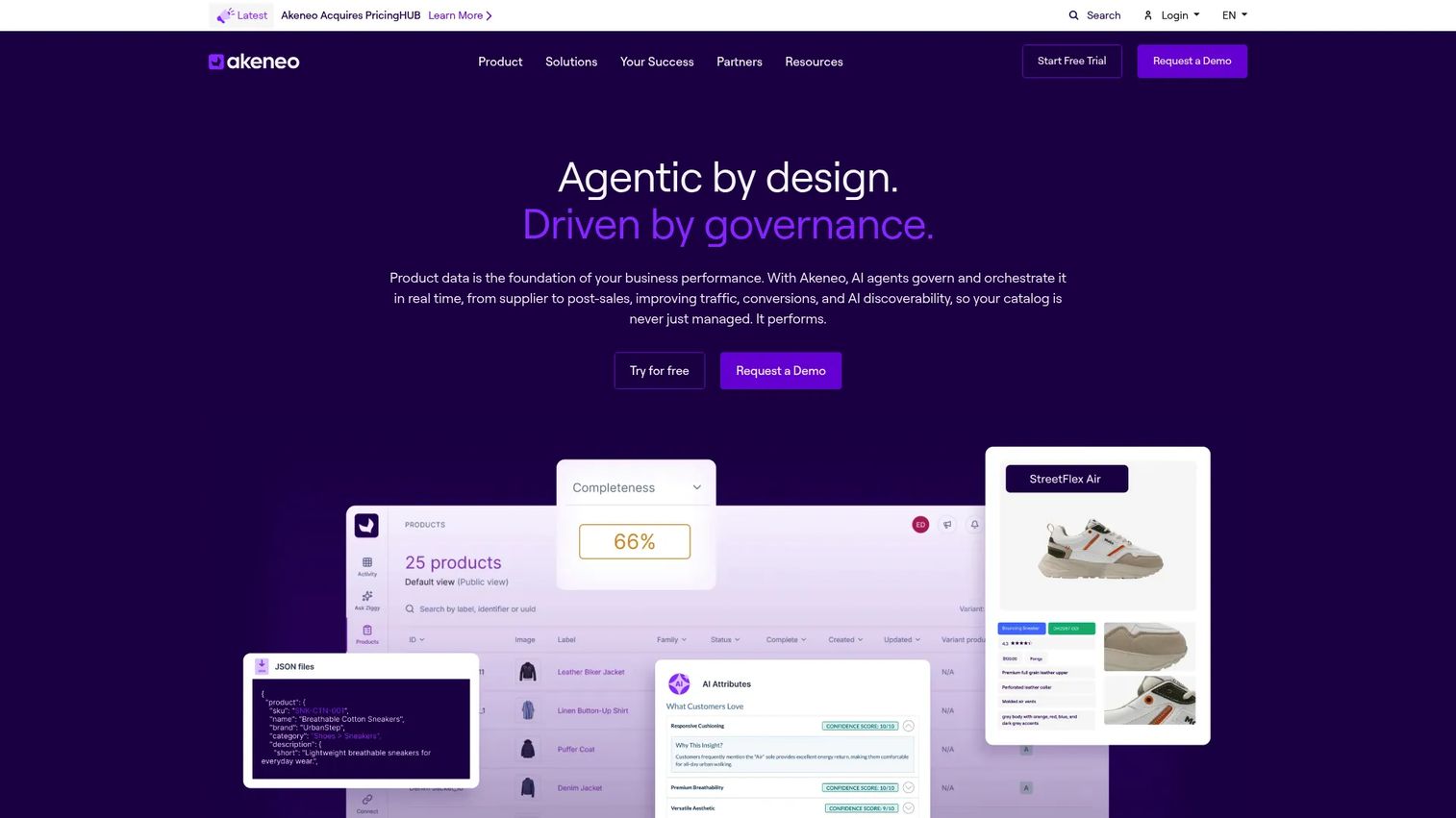
Akeneo is a product experience (PX) platform for centralizing, enriching, activating, and optimizing product information across channels. It pairs core PIM capabilities with digital asset management and product syndication, which makes it a strong fit for teams that want structured product content operations in one place rather than stitched together across tools. The platform is widely adopted by brands and retailers that need to manage product data across distribution channels at scale.
For a PMM, Akeneo's appeal is the combination of governance and reach. You define required attributes, enforce completeness, route content through approval, and then activate it across ecommerce, marketplaces, and partner channels from a single source.
Best for: Brands and retailers that need a SaaS PIM and PXM platform to manage and activate product data across many channels.
Key strengths
- PIM and PXM in one: Centralize product data and tune it for channel-specific experiences without exporting to another tool.
- Built-in DAM: Manage images, videos, and documents alongside the product records they belong to.
- Product syndication: Activate approved content across ecommerce, marketplaces, and partner channels from one source.
Why choose Akeneo: Akeneo fits teams that want product experience management, not just data storage. The free Community Edition lets technical teams evaluate the core engine before committing, while the paid editions add the governance, enrichment, and activation depth that complex catalogs demand. It is a balanced choice for PMM teams that care about both data quality and channel-ready storytelling.
Akeneo pricing: Akeneo offers a free Community Edition at $0, which is open-source and self-managed. The commercial editions, including Growth, Advanced, and Premium, are priced through a quote rather than publicly listed, so you contact Akeneo for pricing on the managed SaaS packages. Billing on paid editions is annual.
2. Salsify

Salsify is a product experience management platform built for brands and retailers to centralize, enrich, syndicate, and optimize product content across commerce channels. Its center of gravity is syndication: getting accurate, complete product content onto retailer sites and marketplaces fast. For teams that sell through a wide retail and marketplace network, that distribution muscle is the main draw.
In a PMM workflow, Salsify shines at the launch-and-channel-consistency stage. When a product ships, the approved content propagates to every connected retailer and marketplace, so what buyers see on third-party sites matches what you intended.
Best for: Enterprise brands and retailers managing product information and syndication across many commerce channels at scale.
Key strengths
- Central source of truth: One governed home for product content that feeds every downstream channel.
- AI-powered workflows: Automate enrichment and content translation to speed up multichannel publishing.
- Retailer syndication: Publish directly to retailers and marketplaces with channel-specific requirements handled.
Why choose Salsify: Choose Salsify when retail and marketplace distribution is the core of your business and product data syndication is where you feel the most pain. Its strength is moving complete, compliant product content out to a large network of commerce endpoints. For brands that live on third-party shelves, that focus is worth more than a broader but shallower toolset.
Salsify pricing: Salsify does not publish plan pricing on its own site and runs a sales-led process. Third-party sources report a starting price around $1,500 per month, billed by agreement. There is no free tier, so expect a custom quote based on catalog size, channels, and syndication volume.
3. Informatica Product 360
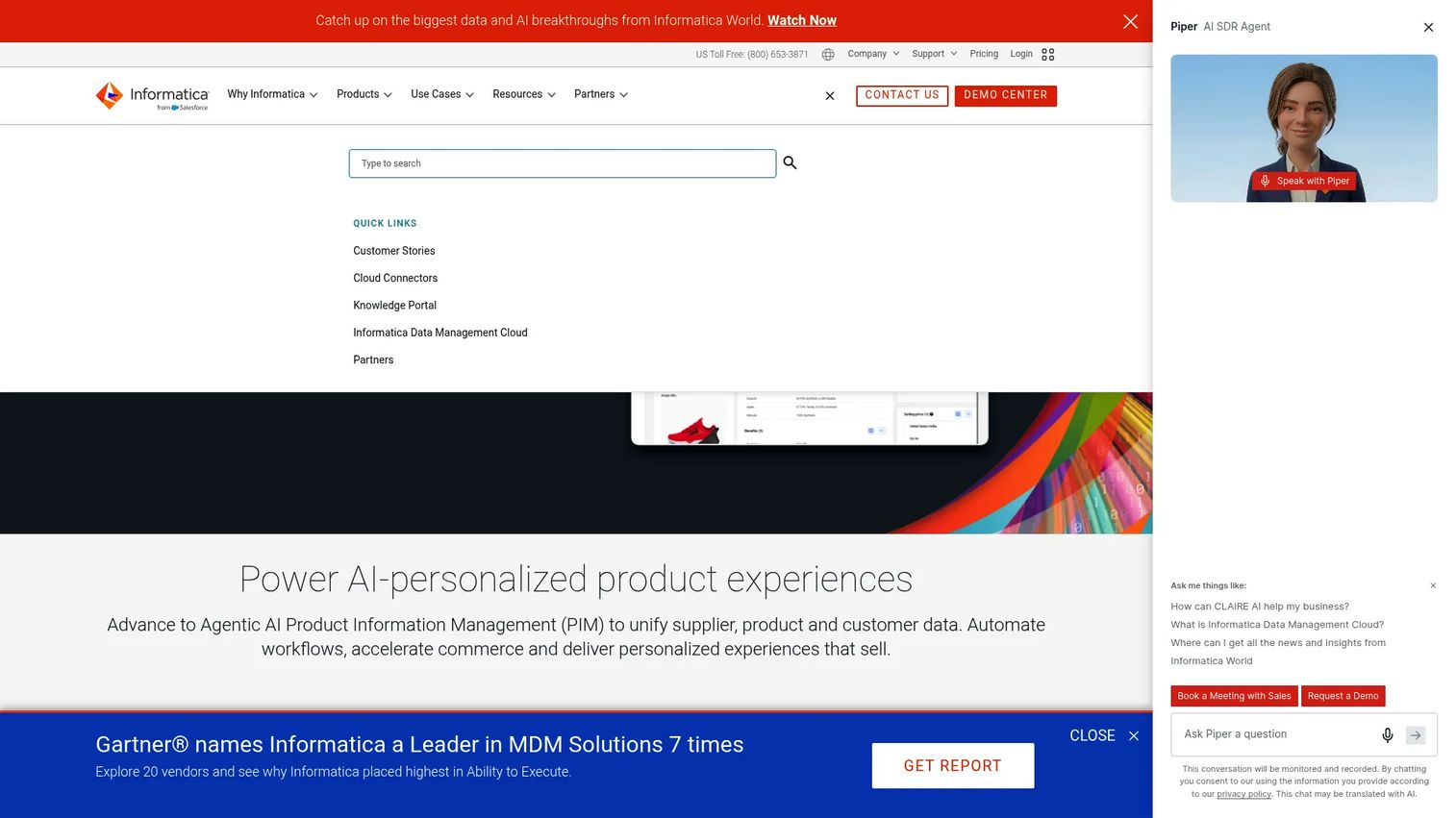
Informatica Product 360 is an enterprise-grade, AI-powered PIM built for commerce and omnichannel product experiences. It sits inside Informatica's broader multidomain master data management platform, which is the key distinction: product data governance here is backed by the same data management foundation that handles customer, supplier, and other master domains. For large organizations that already think in terms of enterprise data governance, that integration is the point.
For PMM teams inside complex enterprises, Product 360 brings heavyweight workflow, collaboration, and intelligent syndication. It is built for environments where product data quality and governance are non-negotiable across thousands of SKUs and many channels.
Best for: Enterprises managing and syndicating product data across many channels with broader master data management needs.
Key strengths
- Agentic AI PIM: AI assists enrichment, classification, and data quality across large catalogs.
- Multidomain MDM and PIM: Govern product data on the same platform that manages other master data domains.
- Intelligent syndication: Distribute governed product content across channels with built-in quality controls.
Why choose Informatica Product 360: Choose Product 360 when your PIM decision is really part of a larger data governance strategy. Lighter-weight PIM platforms focus on product content alone; Product 360 connects product data to enterprise master data management. That makes it a fit for organizations that need governance to span more than products, and that have the scale to justify an enterprise platform.
Informatica Product 360 pricing: Informatica uses consumption-based pricing and does not publish numeric prices for Product 360. Buyers contact sales for a quote scoped to data volume and usage. There is no public free tier, which is typical for enterprise PIM and master data management platforms.
4. Syndigo

Syndigo is an enterprise product experience cloud for managing, syndicating, and optimizing product data and content. Its strength is content orchestration across a large retail and ecommerce network, paired with data quality controls and analytics. For brands and retailers that need product content to flow accurately across many commerce ecosystems, Syndigo's network reach is a major asset.
For a PMM, Syndigo fits the omnichannel product content challenge directly. It centralizes product data, enforces quality, and pushes compliant content out to retail and ecommerce destinations, then reports on how that content performs.
Best for: Large brands and retailers needing product content, syndication, and commerce data management across ecosystems.
Key strengths
- Product Experience Cloud: A unified platform for brands and retailers to manage product content end to end.
- PIM and syndication: Centralize product data and distribute it across a broad commerce network.
- Content management and analytics: Manage digital assets and measure how product content performs.
Why choose Syndigo: Choose Syndigo when network reach and data quality are your priorities. Its orchestration across retail and ecommerce ecosystems suits brands that need content to land accurately on many third-party destinations. The analytics layer also helps PMM teams connect product content quality to downstream commerce performance, which is rare in the category.
Syndigo pricing: Syndigo does not publish public pricing figures. Its product pages list plans and prompt buyers to view plans through a sales conversation, so pricing is quote-based and scoped to your catalog, channels, and network needs.
5. inriver
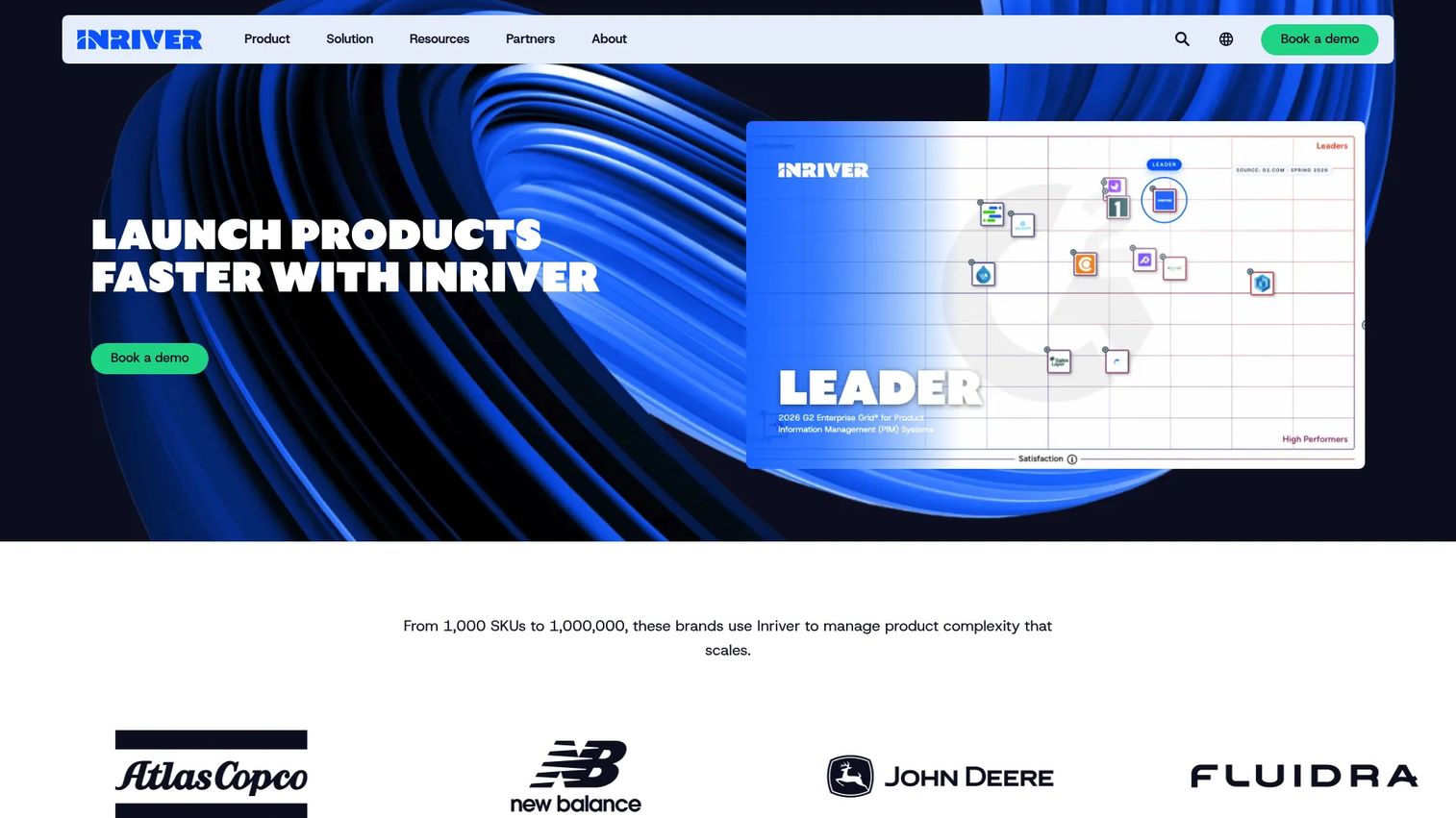
inriver is a cloud-based PIM built for scalable product storytelling and content operations. It centers on AI-driven product content orchestration, handling ingestion, enrichment, syndication, and optimization across channels. The platform suits teams balancing structured product data with channel-specific output, which is exactly the tension PMM teams live with during multichannel publishing.
For launch consistency and content governance, inriver gives PMM teams a system to manage the full lifecycle of product content. The AI-assisted enrichment is the standout: it speeds the slow, manual work of filling and refining attributes across a large catalog.
Best for: Mid-market to enterprise teams managing complex product information across many channels.
Key strengths
- AI-driven orchestration: Automate and accelerate product content enrichment across the catalog.
- Full content lifecycle: Ingest, enrich, syndicate, and optimize product data in one platform.
- Tiered, customizable plans: Foundation, Core, Professional, and Enterprise tiers scale with your needs.
Why choose inriver: Choose inriver when AI-assisted enrichment and scalable content operations matter most. Its orchestration approach fits teams that treat product content as ongoing storytelling rather than static records. The tiered plan structure also gives growing teams a path to scale without re-platforming, which appeals to mid-market PMM teams planning ahead.
inriver pricing: inriver offers four tiers, Foundation, Core, Professional, and Enterprise, all fully customizable. The vendor does not publish numeric prices and invites buyers to get in touch for a scoped quote. Expect pricing to track catalog complexity, channels, and feature depth.
6. Pimcore

Pimcore is an open digital platform that combines product information management with master data management, digital asset management, customer data, digital experience, and ecommerce capabilities. Its composable, API-driven architecture makes it the flexible choice for teams with technical resources who want to model product data their own way and integrate deeply with surrounding systems.
For PMM teams in organizations with engineering support, Pimcore's flexibility is the draw. You are not locked into a fixed data model; you build the taxonomy, relationships, and workflows your catalog actually needs.
Best for: Organizations needing a composable data and experience platform with PIM, MDM, and DAM capabilities.
Key strengths
- All-in-one platform: PIM, MDM, DAM, CDP, DXP, and an ecommerce framework in a single system.
- Composable architecture: API-driven and flexible for custom data models and omnichannel experiences.
- Flexible deployment: Cloud, on-premise, and PaaS options to match your infrastructure.
Why choose Pimcore: Choose Pimcore when flexibility and consolidation matter and you have the technical resources to use them. The open-source Community Edition lets teams prototype and validate the data model before investing, and the broader platform can replace several point tools. It rewards teams ready to commit to a configurable, developer-friendly approach rather than a fixed SaaS workflow.
Pimcore pricing: Pimcore publishes transparent pricing. The Community Edition is free, Professional is $9,900 per year, Enterprise is $29,900 per year, and PaaS starts at $39,900 per year. The free Community Edition makes Pimcore one of the most accessible entry points for technically capable teams evaluating PIM.
7. Agility PIM
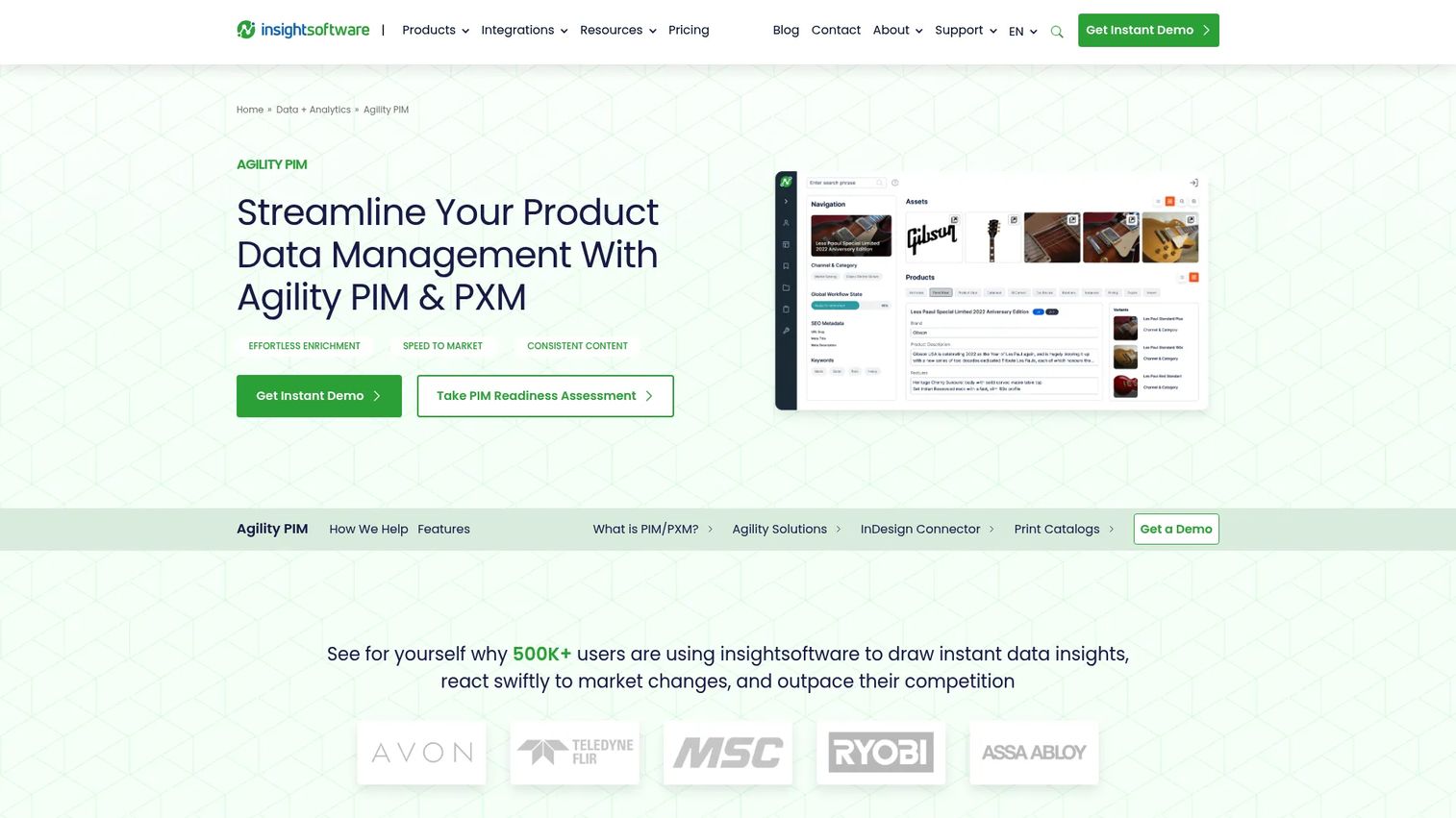
Agility PIM is a product information management platform from insightsoftware for centralizing, enriching, and syndicating product data across channels. Its practical appeal is configurability paired with flexible hosting, which makes it a workable option for mid-market and ecommerce-heavy environments that want a PIM tuned to their setup rather than a one-size-fits-all SaaS.
For PMM teams, Agility PIM helps speed product data updates and publishing without forcing a rigid structure. The unlimited products, channels, and languages model means scale does not trigger surprise constraints as your catalog grows.
Best for: Mid-market or enterprise teams needing a configurable PIM with flexible hosting options.
Key strengths
- AI-assisted enrichment: Speed up the work of filling and refining product attributes.
- Unlimited scale: Unlimited products, SKUs, export channels, API connections, and languages.
- Flexible hosting: SaaS, on-premises, or private cloud deployment to fit your requirements.
Why choose Agility PIM: Choose Agility PIM when hosting flexibility and configurability are priorities. Teams with specific infrastructure or data residency requirements benefit from the SaaS, on-premises, and private cloud options. The unlimited model also suits ecommerce-heavy teams that expect catalogs, channels, and languages to keep expanding.
Agility PIM pricing: Agility PIM does not publish numeric pricing. The model is an annual subscription with role-based user licensing and a 36-month initial term, available as SaaS or installed software. Contact insightsoftware for a quote scoped to your users and hosting choice.
8. Pimberly
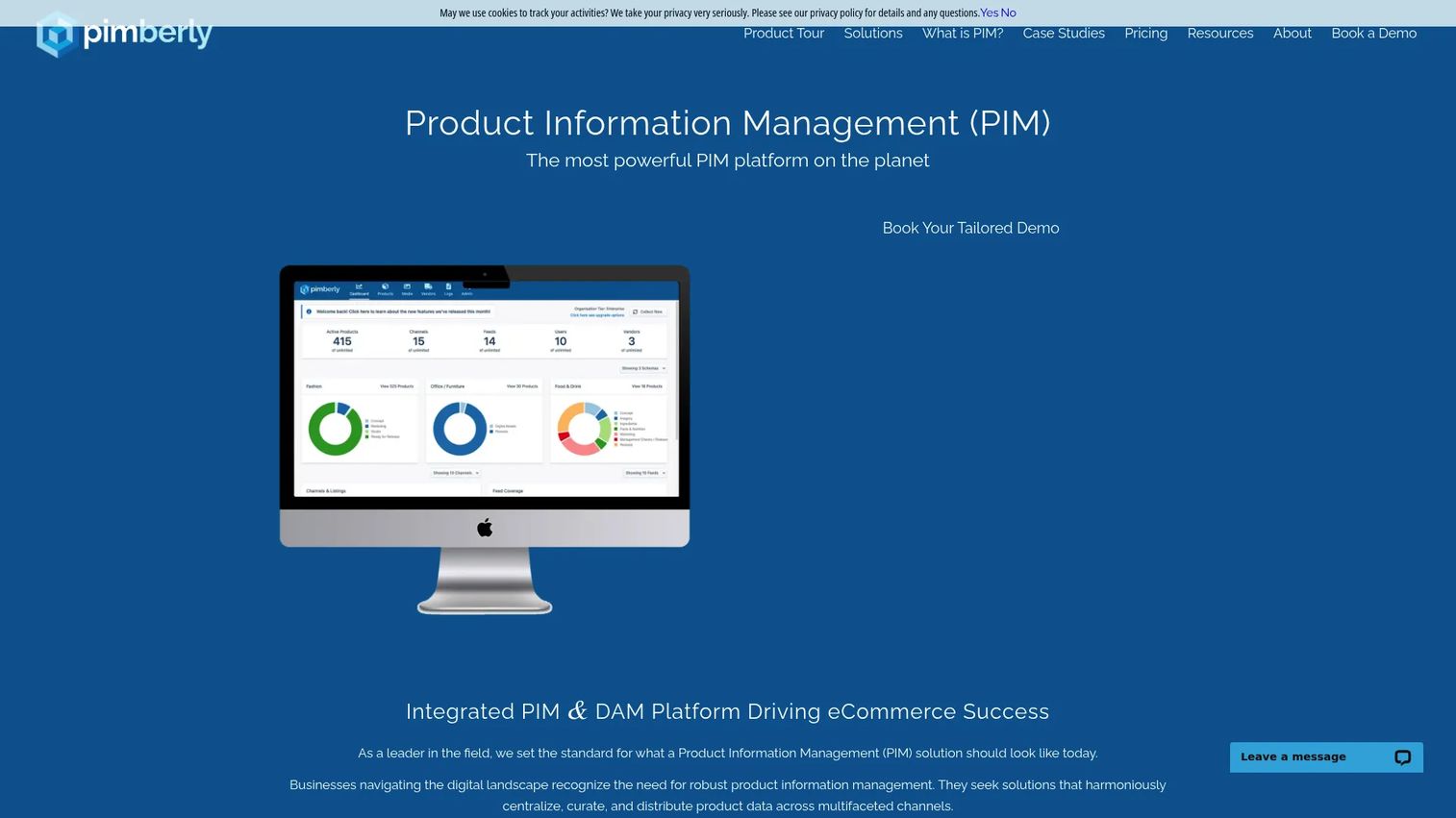
Pimberly is a cloud-based PIM and DAM SaaS for managing, enriching, and distributing product information and digital assets. It pairs a modern workflow layer with AI-powered enrichment and a transparent pricing model, which sets it apart from the many enterprise platforms that hide all pricing behind sales. For teams that want a current PIM and DAM in one, with operational efficiency built in, Pimberly is a strong candidate.
For PMM teams, Pimberly supports collaboration, enrichment, and omnichannel delivery in one place. The unlimited import and export channels and multi-brand, localization support map directly to the consistency and localization challenges that come with scaling product content.
Best for: Mid-market and enterprise teams managing complex product data and digital assets across many channels.
Key strengths
- PIM and DAM in one: Manage product content and digital assets on a single platform.
- AI-powered enrichment: Automate product data enrichment and classification at scale.
- Unlimited channels and localization: Unlimited import and export channels plus multi-brand and localization support.
Why choose Pimberly: Choose Pimberly when you want a modern, cloud-native PIM and DAM with pricing you can actually see before talking to sales. The combined product content and asset management suits teams tired of stitching tools together, and the localization and multi-brand support fits PMM teams managing content across regions and product lines.
Pimberly pricing: Pimberly publishes pricing in USD: Regular at $36,000 per year, Pro at $60,000 per year, Corporate at $90,000 per year, and Enterprise by quote. All plans are billed annually, and optional add-ons are priced separately. There is no free tier.
How to choose the best PIM software
Once you have a shortlist, evaluate it against the criteria that actually predict fit. Here is the buyer's checklist for product information management solutions.
Catalog complexity and scale
Match the platform to your real catalog, not your current one. Count SKUs, variants, attributes, and languages, then project where they will be in two years. A platform that handles 5,000 SKUs comfortably may strain at 50,000. Verify how the system models variants and relationships, since that structure is hard to change later.
Integration depth
Your PIM is only as useful as its connections. Confirm clean integration with your ERP, CRM, ecommerce platform, and content systems. Ask about prebuilt connectors versus custom API work, and check whether sync is real-time or batched. Weak integration recreates the fragmentation you bought the PIM to fix.
Governance and workflow
Map the platform's roles, approvals, and version control to how your team actually works. Who edits, who approves, who publishes? Confirm audit trails and field-level permissions if compliance matters. Strong product data governance is what keeps positioning consistent as more people touch the content.
Multichannel publishing and localization
Check that the platform syndicates to your specific channels, marketplaces, and regional sites. For global teams, confirm how it handles translations and region-specific variants. The goal is omnichannel product content that ships accurately everywhere, at the same time, without manual reconciliation.
Conclusion
The best PIM is the one that matches your catalog complexity, integration needs, governance requirements, and publishing scale, not the one with the longest feature list. Akeneo and inriver suit teams that want product experience management with strong enrichment. Salsify and Syndigo lead for retail and marketplace syndication at scale. Informatica Product 360 fits enterprises that need product data governance tied to broader master data management. Pimcore rewards technical teams wanting open-source flexibility, while Pimberly offers a modern PIM and DAM with pricing you can see upfront. Agility PIM gives mid-market teams configurable hosting options.
The practical next step is to shortlist two or three platforms and pressure-test them against your real workflow: your channels, your approval chains, your integration stack, and the implementation effort each demands. Run a proof of concept with your actual product data, not a vendor demo dataset. The platform that handles your messiest catalog cleanly is the one worth buying.
To build the case internally, connect the PIM decision to the metrics your stakeholders track: launch speed, message consistency, and time saved on reconciliation. That framing turns a data tool into a go-to-market investment, which is how PMM teams win budget. If you want to see how product content connects to broader content marketing execution, mapping your stack end to end will sharpen the business case.
FAQs
PIM software centralizes, enriches, governs, and syndicates product data from one source. It collects product attributes, assets, and copy in a single system, enforces approval and quality rules, and then publishes consistent content to every channel. The result is one governed source of truth that feeds your site, marketplaces, sales collateral, and regional pages.
Master data management governs all critical data domains across an enterprise, including customer, supplier, location, and product data. PIM focuses specifically on product content and how it reaches channels. A PIM is often a component of, or integrates with, a broader MDM strategy. If you only need a governed source of truth for product content, a PIM is enough; if you need governance across many domains, you are in MDM territory.
It depends on catalog complexity. If you sell a handful of products on one channel, a PIM may be overkill. But once you manage thousands of SKUs, many variants, multiple marketplaces, and several languages, manual product data management breaks down. That is the point where a PIM system stops being optional and starts paying for itself in consistency and launch speed.
A PIM holds basic product data such as SKUs and titles, technical attributes like dimensions and compliance fields, and marketing attributes like descriptions and SEO copy. It also stores digital assets, localized content for each region, and the taxonomy and relationships that connect categories, variants, and bundles. In short, everything needed to market and sell a product across channels.
Evaluate four things: catalog complexity, integration depth, governance and workflow, and multichannel publishing. Match the platform to your real and projected SKU counts, confirm clean connections to your ERP, CRM, and ecommerce systems, and map its roles and approvals to how your team works. Then run a proof of concept with your own product data before committing.
No. While large enterprises are projected to hold 54.72% of the PIM market in 2026 according to Fortune Business Insights, small and mid-market teams benefit too. The deciding factor is product content complexity, not company size. A mid-market brand with a sprawling, multilingual catalog across many channels may need a PIM more than a large company with a simple one.
No, because they solve different problems. A content management system handles website pages and editorial content. A PIM manages structured product data, attributes, assets, and relationships, then syndicates that content to many channels including, but not limited to, your website. Many teams run both: the PIM governs product content, and the CMS publishes the marketing pages around it.
For product marketing, prioritize launch readiness, approval workflows, localization, and message consistency. You want a system that keeps the approved spec identical across every channel and region, routes content through clear review cycles, and ships localized variants on time. A PIM that supports those four things turns product content from a reconciliation chore into a reliable go-to-market asset.