You're preparing for a board update, a new market entry, or a partner diligence request. Someone asks which registrations are current, which commitments are overdue, and what changed after the last health authority question. The answer is spread across four spreadsheets, a shared drive, and one person's inbox.
This is the operational reality for most growing life sciences organizations. According to RegASK (2025), 42% of regulatory affairs professionals said their organization had missed a regulatory requirement, and 62% reported the volume of regulations they must track had increased over the prior year. The global regulatory information management market reached $2.5 billion in 2025, according to Grand View Research (2026), which tells you this problem is not niche.
The fix is a system that turns scattered regulatory records into structured, governed data with clear ownership. That is what regulatory information management software does. This guide helps you choose the right RIM platform for where your company is now and where it is headed.
What's inside
This guide evaluates eight RIM platforms for life sciences organizations managing product registrations, submissions, health authority correspondence, and lifecycle data. Items were selected based on four criteria:
- Structured regulatory data and registration management capability
- Submission, dossier, and correspondence workflow depth
- Global portfolio visibility and reporting
- Fit for stage, from emerging biotech and medical device teams to global operations
All pricing and ratings were verified before publication. Most RIM vendors use quote-based enterprise pricing, so expect to run a scoped engagement rather than a self-serve checkout.
TL;DR
- Best overall for global life sciences operations: Veeva Vault RIM, for organizations needing connected registrations, submissions, and regulatory content on a unified cloud platform
- Best for AI-forward end-to-end regulatory operations: ArisGlobal LifeSphere Regulatory, with GenAI and agentic capabilities built into its regulatory ecosystem
- Best for MedTech, diagnostics, and pharma lifecycle management: IQVIA SmartSolve RIM, with regulatory intelligence across 89+ countries
- Best for configurable regulatory workflows and IDMP readiness: Ennov RIM, with automatic linkage across product, registration, and submission data
- Best for modular, flexible RIM architecture: LORENZ RIM, for teams assembling capability around defined requirements
- Best for quality-centered regulated environments: MasterControl Regulatory Excellence, connecting regulatory and quality processes
- Best for medical device registration and market access: Rimsys, with four tiers and no per-user fees
- Founder shortcut: Build your shortlist around the questions your team must answer weekly. What is approved where? What is due next? Who owns the response?
What is regulatory information management?
Regulatory information management (RIM) is the structured management of product, registration, submission, correspondence, and commitment data across a regulated product's lifecycle.
RIM software acts as the operating layer for Regulatory Affairs. It connects structured product data, regulatory documents, submission plans, health authority exchanges, and ownership workflows in a single governed environment.
What RIM software typically manages
- Product and medicinal product data
- Country registrations and market authorizations
- Submission plans, dossiers, and publishing status
- Health authority questions, correspondence, and commitments
- Regulatory change impacts and lifecycle events
- Deadlines, ownership, approvals, and audit trails
- Portfolio reporting across products and markets
- Regulatory intelligence and requirement monitoring (where available)
RIM software vs adjacent systems
A document repository and a RIM platform are not the same thing. The table below clarifies where each system's job ends.
| System type | Primary job | What it usually misses without RIM |
|---|---|---|
| Generic document management | Store and control files | Product and registration relationships |
| Quality management software | Manage quality processes and evidence | Global registration and submission lifecycle data |
| GRC platform | Manage enterprise controls and risk | Life sciences specific registrations, dossiers, and authority interactions |
| Regulatory information management system | Connect regulatory data, documents, workflows, and lifecycle activity | Requires defined data ownership and process discipline |
A RIM platform does not replace regulatory judgment. It gives your team a reliable system for turning judgment into owned work, trackable decisions, and defensible records. For founders evaluating a compliance and regulatory operations stack, the key question is not "which platform has the most features?" It is "which platform lets a new VP Regulatory answer Monday morning questions without calling a spreadsheet owner?"
When to use regulatory information management software
Move beyond spreadsheets and shared drives
Use RIM software when your team cannot confidently reconcile registration status, submission deadlines, and commitment records across products or markets. Spreadsheet-based operations can work in the earliest stage, but they break down when regulatory data must be reused across submissions and regions. The bottleneck is not effort. It is data that lives in formats that cannot be queried, owned, or audited.
Prepare for global filings, approvals, or product changes
Use RIM software when a company adds countries, products, or submission types. Country-specific requirements, registration linkages, and cross-functional ownership need connected data, not a new tab. A contract lifecycle management platform or a quality system will not fill this gap, because neither is built to manage the relationship between a registered product and its submission history across jurisdictions.
Create a defensible record for diligence and audits
Use RIM software when a board, commercialization partner, or acquirer needs clarity on regulatory readiness. Investors and partners want to see traceability, documented commitments, recurring deadlines with owners, and a clear picture of what is approved and where. A governed RIM system produces that record. A spreadsheet does not survive due diligence scrutiny.
Regulatory information management tools comparison
All eight tools operate in the RIM category, but they differ by implementation model, portfolio complexity, life sciences segment, and adjacent capabilities. The table below summarizes the field.
| # | Product | Best for | Key differentiator | Pricing | G2 rating |
|---|---|---|---|---|---|
| 1 | Veeva Vault RIM | Global pharma and biotech operations | Unified RIM applications across registrations, submissions, archive, and content | Quote-based | 4.6/5 |
| 2 | ArisGlobal LifeSphere Regulatory | AI-forward regulatory organizations | Modular ecosystem with GenAI and agentic AI across RIM, submissions, labeling, and intelligence | Quote-based | Not listed on G2 |
| 3 | IQVIA SmartSolve RIM | MedTech, IVD, and pharma teams | AI-enabled RIM with regulatory intelligence across 89+ countries | Quote-based | Not listed on G2 |
| 4 | Ennov RIM | Configurable regulatory and quality operations | Automatic linkage across substances, products, registrations, activities, and documents | Quote-based | Not listed on G2 |
| 5 | LORENZ RIM | Teams wanting modular RIM components | Flexible combination of submission, content, product data, lifecycle, and validation tools | Quote-based | Not listed on G2 |
| 6 | MasterControl Regulatory Excellence | Quality-centric life sciences organizations | Connects regulatory work with quality, controlled documents, and product lifecycle processes | Quote-based | 4.4/5 |
| 7 | Rimsys | Emerging and mid-market medical device teams | Four-tier platform covering registrations, UDI, submissions, and regulatory intelligence with no per-user fees | Quote-based | 4.7/5 |
| 8 | Amplexor Life Sciences | Global submission and regulatory content operations | Regulatory content, publishing, and managed services depth for complex global programs | Quote-based | Not listed on G2 |
Best 8 regulatory information management tools for 2026
1. Veeva Vault RIM
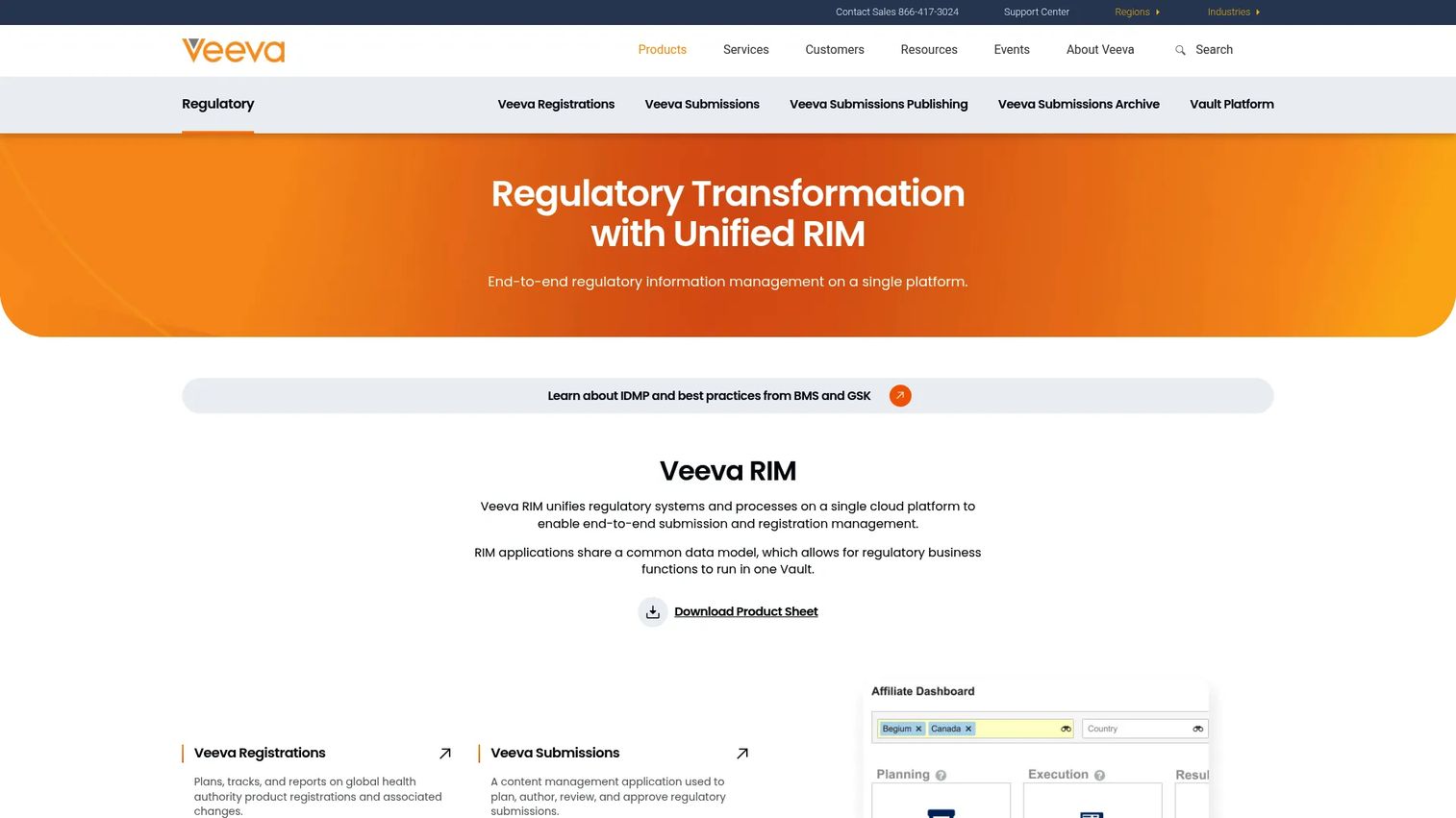
Veeva Vault RIM is a cloud-based regulatory information management platform covering the end-to-end submission and registration lifecycle. It runs on a shared data model across applications for registrations, submissions, publishing, archive, and regulatory content. Organizations use a single environment rather than stitching together point tools.
Best for: Large pharmaceutical, biotech, and global life sciences teams standardizing regulatory operations across many products and markets.
Key features
- Global registration planning, tracking, and portfolio reporting
- Submission planning, authoring, review, and approval workflows
- Compliant submission publishing and archival of regulatory applications
- Health authority correspondence and commitment records
- Shared regulatory data model across all Vault applications
Why choose Veeva Vault RIM: Veeva fits organizations making regulatory data a company-level capability rather than a small team process. The tradeoff is real: Broad operational standardization requires strong governance, implementation ownership, and sustained change management. If your regulatory leader does not have a defined operating model yet, the platform's scope will outpace your readiness.
Veeva Vault RIM pricing: Veeva does not display pricing on its product pages. Essentials packaging is available for Submissions and Submissions Archive, with Submissions Publishing as an optional add-on. Expect an enterprise procurement process with scope driven by modules, portfolio size, markets, integrations, and validation requirements.
G2 rating: 4.6/5
2. ArisGlobal LifeSphere Regulatory

ArisGlobal LifeSphere Regulatory is a cloud-based regulatory platform that unifies regulatory data, content, and workflows across the product lifecycle. Its modular architecture spans RIM, submissions, regulatory documents, labeling, analytics, health authority interactions, and regulatory intelligence. The platform's NavaX layer adds GenAI and agentic AI capabilities across regulatory workflows.
Best for: Large life sciences organizations that need end-to-end regulatory information, submissions, labeling, and compliance management with AI-assisted workflows.
Key features
- Regulatory information management covering planning, tracking, and registration management
- Product data compliance for xEVMPD and IDMP requirements
- Submission planning, compilation, publishing, and validation
- Labeling change management and compliance tracking
- GenAI and agentic AI capabilities powered by NavaX
Why choose ArisGlobal LifeSphere Regulatory: The breadth of its regulatory ecosystem makes it a strong fit when your regulatory data needs to connect with safety, quality, clinical, and medical operations as the company scales. Keep AI capability claims tied to the specific NavaX modules your team will actually configure, not to a general promise.
ArisGlobal LifeSphere Regulatory pricing: ArisGlobal does not publish pricing. Cost depends on selected modules, regions, product lines, users, implementation scope, and validation requirements. Contact the vendor for a scoped proposal.
3. IQVIA SmartSolve RIM
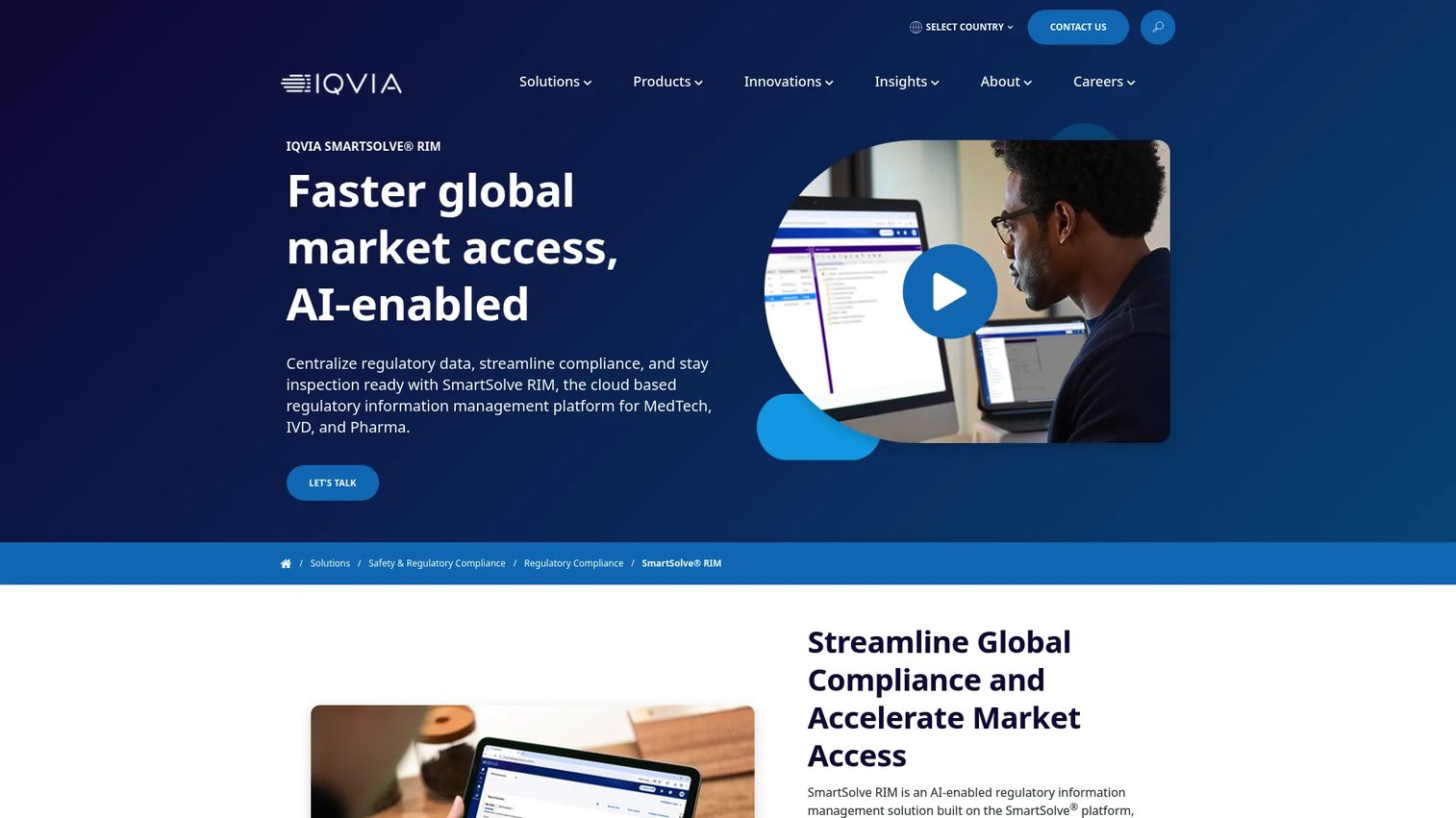
IQVIA SmartSolve RIM is an AI-enabled, cloud-based RIM platform serving MedTech, IVD, and pharmaceutical organizations. It centralizes regulatory information, manages global submissions and registrations, tracks approvals and renewals, and connects to real-time regulatory intelligence across more than 89 countries. Quality management integrations extend its reach into compliance operations.
Best for: MedTech, diagnostics, and pharmaceutical companies with formal regulatory operations, cross-functional compliance requirements, and complex product-market combinations.
Key features
- Global submission and registration management
- Approval and renewal tracking
- Centralized regulatory certificate storage
- Real-time regulatory intelligence across 89+ countries
- Quality management integrations
Why choose IQVIA SmartSolve RIM: The combination of lifecycle visibility and regulatory intelligence coverage makes it relevant when your regulatory readiness needs to become a source of commercial velocity. Teams that need a RIM platform tied to wider product lifecycle operations will find more connection points here than in narrower registration-only tools.
IQVIA SmartSolve RIM pricing: IQVIA does not publish pricing. Key variables include product type, countries covered, selected modules, data migration scope, and integration requirements. Request a scoped quote directly from the vendor.
4. Ennov RIM
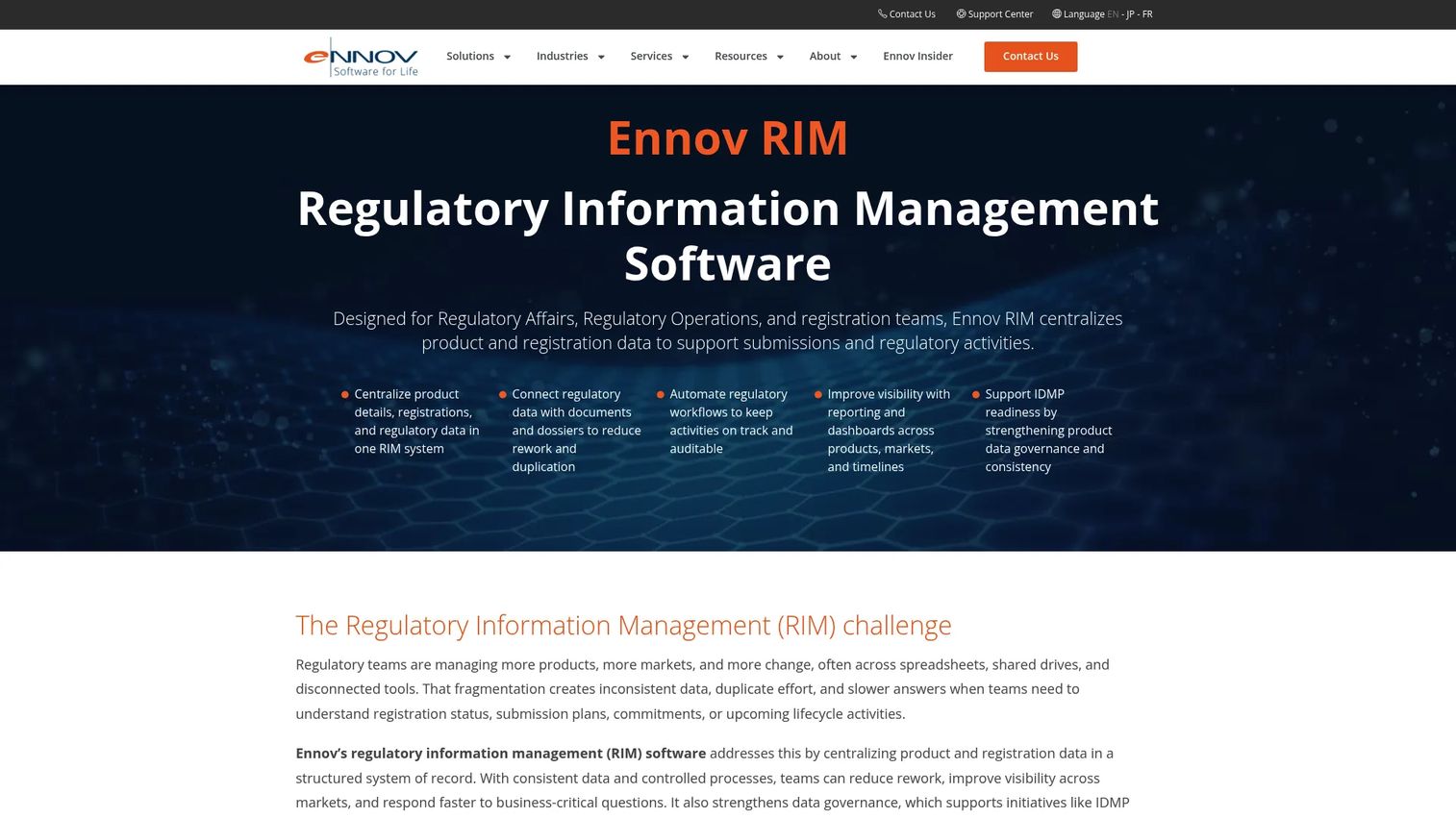
Ennov RIM is purpose-built regulatory information management software that centralizes product details, registrations, submissions, correspondence, commitments, and ongoing lifecycle activities. A standout structural feature is its automatic linkage among substances, products, registrations, activities, dossiers, submissions, and related documents. The platform also supports 21 CFR Part 11 compliance and XEVMPD submissions.
Best for: Regulatory Affairs and Regulatory Operations teams at pharmaceutical, biotech, and medical device organizations managing global product registrations and submissions who need configurable workflows and connected data.
Key features
- Centralized product, registration, and regulatory data management
- Market authorization and registration management
- Automatic linkage across substances, products, registrations, and documents
- Correspondence and commitment tracking
- Configurable workflows, dashboards, and role-based access
Why choose Ennov RIM: Ennov is worth evaluating when your team needs a controllable regulatory system rather than another document repository. The connection between structured data, dossier workflows, and reporting gives regulatory leaders a clear answer on portfolio status without manual reconciliation. It is a credible option for companies that need global process discipline while preserving flexibility across regulatory and document management workflows.
Ennov RIM pricing: Ennov does not publish pricing. Implementation scope typically depends on selected regulatory modules, portfolio complexity, deployment preferences, integrations, and validation requirements. Contact the vendor for a proposal.
5. LORENZ RIM
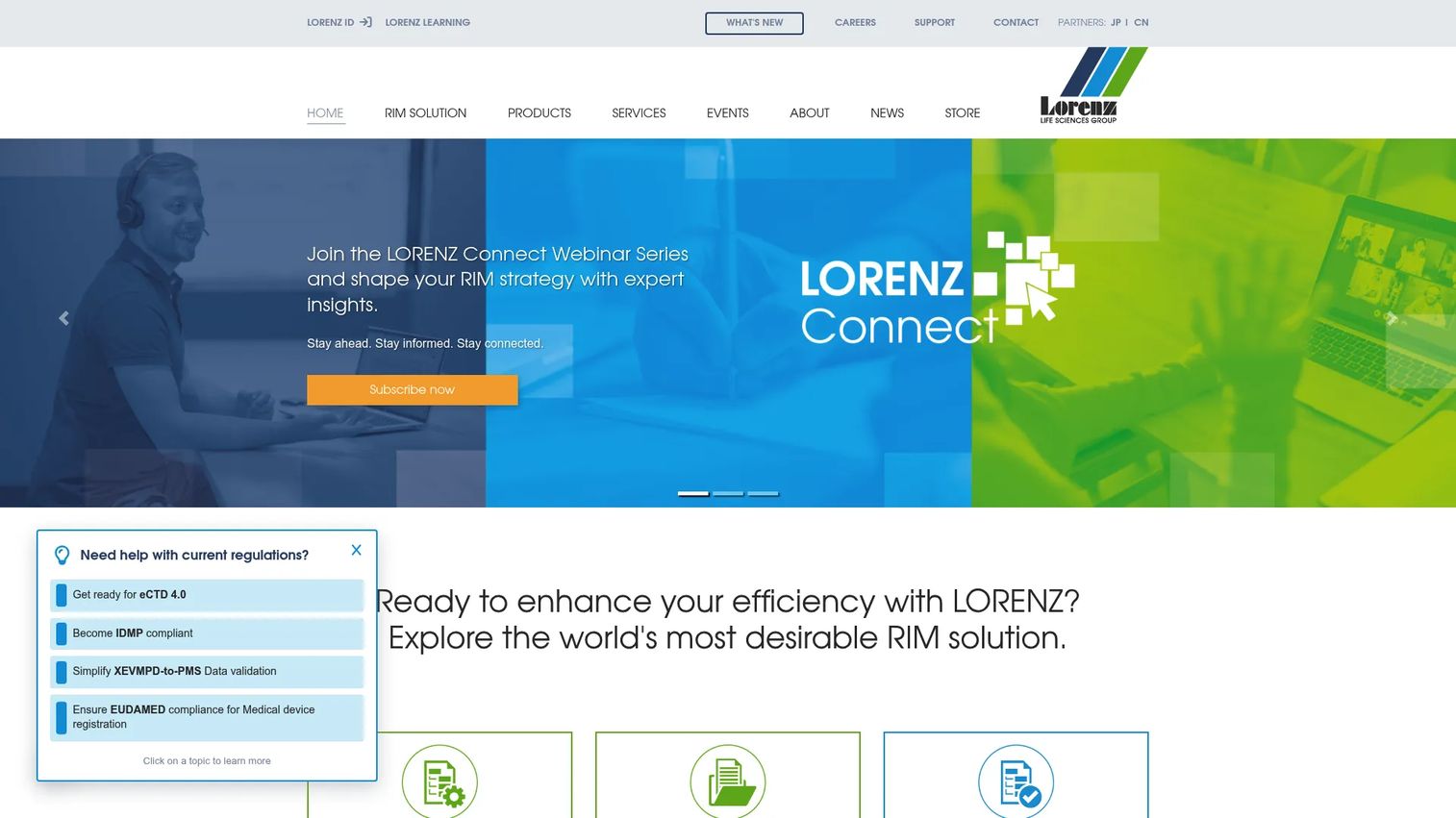
LORENZ RIM provides a modular regulatory information management approach. Teams can combine components for submission management, regulatory content management, product information, lifecycle management, submission validation, and workflow automation. Its docuBridge products use pay-per-sequence, licensing, or subscription models depending on the edition.
Best for: Pharmaceutical and life sciences regulatory teams that want to assemble a RIM environment around specific defined capabilities rather than adopting a single monolithic suite.
Key features
- Submission management and publishing
- Regulatory content lifecycle controls
- Product information and IDMP preparation
- Submission validation capabilities
- Business automation and third-party integrations
Why choose LORENZ RIM: The modularity is the point. Teams with well-defined requirements around eCTD, content, validation, product information, and lifecycle processes can buy only what they have operational capacity to use. The key evaluation question is whether modular selection simplifies the operating model or creates additional vendor and integration coordination overhead.
LORENZ RIM pricing: LORENZ directs prospects to contact the company for pricing. Package composition determines cost, and individual docuBridge products carry different commercial models. Verify current options directly with the vendor.
6. MasterControl Regulatory Excellence

MasterControl Regulatory Excellence is a life sciences platform with regulatory operations capabilities built around its broader quality management infrastructure. It connects regulatory workflows with controlled documents, quality events, training, and product lifecycle processes in a single environment. The platform focuses on digital regulatory dossier compilation, agency submissions, global registrations, and centralized visibility across geographies and partners.
Best for: Life sciences organizations where quality leadership has strong ownership of regulated processes and regulatory work must stay tightly connected to the broader quality management operating model.
Key features
- Digital regulatory dossier compilation and management
- Agency submissions and global registrations management
- Centralized visibility across geographies, teams, and partners
- Integration of regulatory and quality management processes
- Template management and automated workflows
Why choose MasterControl Regulatory Excellence: Consider this when your company's immediate scaling constraint is quality system maturity and regulatory information must connect directly to that operating model. Before committing, validate the depth of country registration tracking, submission publishing, and health authority workflow capabilities against your specific RIM requirements, since the platform's strength is the quality-regulatory connection rather than submission depth alone.
MasterControl Regulatory Excellence pricing: MasterControl states that pricing is tailored to each organization's requirements and does not publish a schedule. Contact the vendor to scope modules, user counts, and implementation.
G2 rating: 4.4/5
7. Rimsys
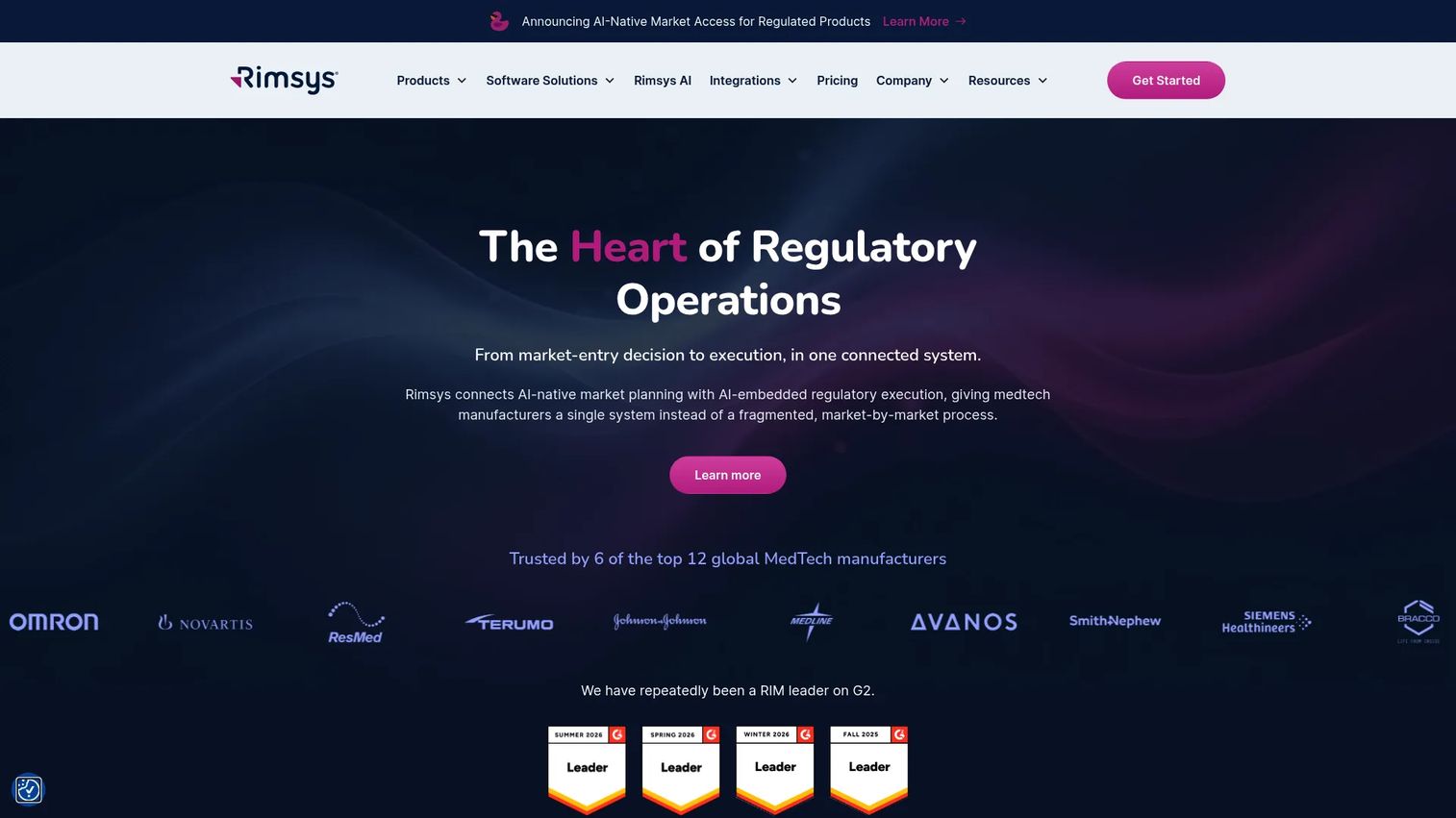
Rimsys is a unified regulatory information management platform for MedTech manufacturers. It connects market planning, global registrations, submissions, UDI management, regulatory intelligence, and change management in a single environment. The platform offers four tiers (Core, Plus, Pro, Optimized) with add-ons for Impact Assessments, Standards and Essential Principles, Universal UDI, Intelligence, and Connect. There are no per-user fees.
Best for: MedTech regulatory affairs and operations teams managing global product portfolios, submissions, registrations, UDI compliance, and cross-functional change workflows.
Key features
- Global product registration and approval lifecycle management
- Regulatory submission planning, authoring, tracking, and execution
- UDI management with machine-to-machine transmission
- Regulatory intelligence and impact assessment
- Standards, Essential Principles, and GSPR traceability
Why choose Rimsys: It is a strong option for a medical device startup or mid-market company scaling into multiple jurisdictions and trying to avoid a spreadsheet-driven regulatory function. The tiered, no-per-user-fee model gives growing teams a clearer cost path than seat-based enterprise software. If you need deep submission publishing or cross-functional content controls beyond the MedTech core, validate that coverage before signing.
Rimsys pricing: Rimsys does not publish numeric pricing. Four tiers are available, with add-ons that extend capability. Contact the team for a tailored quote based on portfolio size, regions, and selected modules. No free tier is offered.
G2 rating: 4.7/5
8. Amplexor Life Sciences

Amplexor Life Sciences is a life sciences provider with regulatory content, submission, labeling, and localization depth. Its offering spans centralized regulatory data management, submission management, compliance monitoring, collaboration tools, and customizable reporting. Managed services options extend the engagement beyond platform licensing into operational execution support.
Best for: Global pharmaceutical, biotech, and medical device organizations with high-volume submissions, multilingual regulatory content, labeling work, and complex publishing requirements where technology and operational support are both needed.
Key features
- Centralized regulatory data management
- Regulatory submission management
- Compliance monitoring
- Collaboration tools
- Customizable reporting and analytics
Why choose Amplexor Life Sciences: Evaluate it when regulatory information management depends heavily on large-scale submission production, content transformation, or multilingual operations. The managed services option matters when a company needs external execution capacity alongside the platform, not just software. Most relevant for organizations that have reached global commercialization complexity.
Amplexor Life Sciences pricing: Amplexor does not publish pricing. The engagement model can be platform licensing, professional services, managed operations, or a combination. Confirm current terms directly with the vendor.
Considerations when choosing regulatory information management software
Match the system to your regulatory operating model
Do not choose based on feature volume. First document where regulatory information originates, who owns it, where it gets approved, and which teams need the resulting record. The platform should reinforce the operating model you actually have, not one you plan to build later.
Separate RIM requirements from document management requirements
A document repository is not a RIM system. Confirm that the platform can connect product data, registrations, submissions, authority interactions, obligations, and lifecycle activity. Ask each vendor to show how it answers: "Which registrations expire in the next two quarters?" and "What changes affect this product family?"
Validate implementation and migration scope early
The hard work in a RIM project is often data cleanup, taxonomy design, legacy migration, validation, integrations, and adoption. Require a phased implementation plan with named owners, milestones, data assumptions, and success criteria. Vendors who cannot give you this before signing are telling you something important about the implementation risk.
Look for a credible path from today's use case to the next stage
Early teams may start with registration tracking. Global organizations typically need publishing, correspondence, intelligence, IDMP, labeling, and regulatory analytics. The platform whose expansion path fits your portfolio and commercialization plan is more valuable than the one with the longest current feature list.
Assess integration fit with your existing stack
RIM data does not live in isolation. Your regulatory system should connect to quality management, document control, ERP, and your reporting infrastructure. Weak integrations mean duplicate data entry and a source-of-truth problem that grows worse as the portfolio expands. Platforms like Rimsys and MasterControl are explicit about quality system connections. Validate that others on your shortlist are too.
Conclusion
The right regulatory information management system depends on your product type, global footprint, submission model, quality system maturity, and how much your regulatory operations need to scale.
Here is a practical shortcut for each context:
- Veeva Vault RIM: When regulatory operations are becoming a company-level capability requiring unified registrations, submissions, and content
- ArisGlobal LifeSphere Regulatory: When you need AI-forward modular operations that connect regulatory, safety, and quality data as you grow
- IQVIA SmartSolve RIM: When you need lifecycle visibility across a global product portfolio, with regulatory intelligence built in
- Ennov RIM: When configurable data linkages, workflows, and reporting matter more than suite depth
- LORENZ RIM: When modular component selection fits a well-defined immediate problem
- MasterControl Regulatory Excellence: When the quality-regulatory connection is the central scaling challenge
- Rimsys: When you are a medical device company building from a product registration and market access foundation
- Amplexor Life Sciences: When global submission volume and managed services support are both part of the requirement
Build your shortlist around the questions your regulatory team must answer repeatedly. What is approved where? What is due next? What changed? Who owns the response? The platform that answers those questions reliably, without a manual reconciliation run, is the one that earns a place in your stack.
You can find related guides on asset lifecycle management software and best product management tools on the Guideflow blog. For teams building the software that runs in regulated environments and looking for a way to show complex workflows to evaluators and partners, Start your journey with Guideflow today!
FAQs
Regulatory information management (RIM) software is a system for managing structured regulatory data, product registrations, submissions, health authority correspondence, commitments, and lifecycle activities in one governed environment. It differs from a generic document repository by connecting product and registration relationships, not just storing files. The core job is giving regulatory teams a reliable source of record for decisions and deadlines.
RIM manages an organization's internal regulatory data and operational workflows, covering what is registered, what is submitted, and what is due. Regulatory intelligence monitors external regulatory requirements, guidance changes, and new authority publications. Some platforms, including ArisGlobal and IQVIA SmartSolve RIM, include both capabilities. Others focus on operational RIM and rely on separate intelligence feeds.
A small team may start with controlled trackers, but should evaluate RIM software when it manages multiple products, jurisdictions, submissions, or recurring authority commitments. The trigger is operational, not headcount. When regulatory data must be reused across submissions and markets, or when a financing or partnership event requires a defensible audit trail, a governed RIM system becomes the more defensible choice.
The goal is to replace spreadsheets as the operating system for critical regulatory data, not necessarily to eliminate every export or analysis workbook. The RIM platform should become the governed source of record for registrations, commitments, submission status, and deadlines. Teams will still produce exports for reporting and analysis, but those outputs should flow from the system rather than substitute for it.
A RIM platform should track product data, market authorizations, country registrations, submission plans, dossier status, health authority correspondence, commitments, deadlines, ownership, and audit history. The exact data model depends on product type and markets. For a medical device company, UDI management and Essential Principles traceability may also be in scope. For a pharmaceutical organization, xEVMPD, IDMP readiness, and eCTD publishing status are common additions.
Implementation duration depends on data cleanup requirements, selected modules, legacy migration complexity, validation scope, integrations, and the number of workflows being standardized. A phased rollout beginning with the highest-risk workflow, typically registration tracking or submission planning, is more reliable than a full-scope launch. Vendors who present a defined timeline before understanding your data state are estimating, not planning.
RIM is strongest in pharmaceuticals, biotech, medical devices, diagnostics, and other life sciences organizations. Rimsys and IQVIA SmartSolve RIM, for example, are built explicitly for medical device and MedTech contexts. Broader regulated industries may need a GRC or compliance platform instead, unless they manage product registrations and authority submissions in a life sciences context, in which case a purpose-built RIM system is the more operationally appropriate choice.
Choose a full suite when your team needs a common data model across registration, submission, publishing, archive, and related workflows, and when you have the implementation capacity to configure it. Choose a modular approach when the team has a well-defined immediate problem, a clear integration strategy, and limited appetite for a large upfront configuration project. LORENZ RIM and Rimsys's tiered model are examples of approaches that let teams start with a defined scope and expand from there.