Your last digital PR campaign produced solid coverage. Three top-tier placements, a handful of syndications, and a reporter who seemed genuinely interested. Then leadership asked what moved. Traffic? Backlinks? Branded search? Leads?
You went looking for answers across six different tabs.
That gap between coverage and proof is where most digital PR campaigns lose their business case. According to Research and Markets (2026), the global PR tools market reached $13.8 billion in 2025, yet 83% of digital PR professionals still rely on media databases as their primary journalist discovery method (Superlinks, 2024). The workflow is fragmented: Ideation lives in one tool, outreach in another, monitoring somewhere else, and reporting in a deck nobody updates.
This guide maps 17 digital PR tools across each stage of that workflow so you can build a stack that proves impact, not just activity.
What's inside
This guide is for growth marketers, SEO leads, and PR practitioners who need to run campaigns and show measurable results. Tools were selected based on recurring SERP mentions and practical workflow fit, then evaluated against four criteria:
- Campaign stage coverage: Does it solve ideation, outreach, monitoring, or measurement?
- Pricing and accessibility: Are costs defensible for the team size?
- Measurement depth: Can it connect outputs to links, traffic, or pipeline?
- Marketing team fit: Does it reduce manual work rather than add another login?
The guide includes a side-by-side comparison table with verified pricing and G2 ratings, plus a buyer's checklist for digital marketers proving ROI.
TL;DR
- Best for SEO and backlink measurement: Ahrefs tracks referring domains, rank changes, and competitor link gaps after campaigns go live
- Best free monitoring starter: Google Alerts delivers keyword-based web mention alerts at zero cost
- Best for campaign ideation: BuzzSumo surfaces content angles with proven social traction before you pitch
- Best for outreach workflow: BuzzStream manages contacts, email sequences, and follow-up history without spreadsheets
- Best for enterprise media intelligence: Cision or Meltwater for teams needing monitored coverage at scale with executive reporting
- Best for client-ready reporting: CoverageBook turns coverage and link data into shareable reports
What is digital PR software?
Digital PR software helps marketing and communications teams plan, pitch, monitor, and measure online campaigns across media coverage, backlinks, brand mentions, referral traffic, and search visibility.
Traditional PR focused primarily on media relations and offline reputation management. Digital PR extends that work into measurable online channels: Search rankings, link profiles, referral traffic, branded search demand, and audience behavior. The two overlap in media relationships, but digital PR ties outcomes directly to metrics that marketing and revenue teams track.
Digital PR also intersects with SEO. Earned coverage generates backlinks and authority signals. Journalist placements drive referral traffic. Research-led campaigns create branded search demand. Tools in this category help track those SEO effects alongside the coverage itself.
Key capabilities to look for in digital PR tools:
- Media and journalist databases with current contact data
- Outreach sequencing and relationship history tracking
- Trend discovery and topic validation before production
- Brand and campaign mention monitoring
- Backlink analysis and referring domain tracking
- Coverage reporting with shareable dashboards
- Sentiment analysis and share-of-voice reporting
- Search visibility measurement, including AI citation tracking where available
How digital PR connects to marketing outcomes:
Outputs include coverage placements, backlinks, and press mentions. Audience outcomes include referral traffic, branded search lift, and social engagement. Business impact, where trackable, covers lead generation, assisted conversions, and pipeline influence. Tools in this list cover all three layers, though no single tool covers all three equally well.
When to use digital PR tools
Plan campaigns around proven audience demand
Spending creative resources on a campaign angle before validating search demand or media interest is how PR campaigns die quietly. Digital PR tools help you check whether a topic has search traction, social engagement, rising queries, or journalist interest before the brief is written. Topic validation at this stage cuts wasted pitching time and improves story relevance.
Pitch journalists without losing relationship context
Managing outreach in spreadsheets breaks when a team runs multiple simultaneous campaigns. A contact pitched last month, the reporter who covered your competitor twice, the journalist who responded but never published: None of that context survives a handoff without a CRM built for PR workflows. Tools designed for outreach track pitch history, response rates, and follow-up timing so relationship context carries across campaigns.
Prove impact beyond coverage screenshots
Coverage screenshots convince no one in a quarterly business review. Leadership wants to see backlinks earned, referral traffic driven, branded search changes, and any pipeline touched. PR measurement tools connect campaign outputs to those marketing outcomes, giving you data that holds up in attribution conversations.
Digital PR tools comparison
Before scanning the full list, use this table as a buyer shortcut. All pricing and ratings reflect verified figures from vendor pricing pages and current G2 listings.
| # | Product | Best for | Key differentiator | Pricing | G2 rating |
|---|---|---|---|---|---|
| 1 | Ahrefs | Backlink and SEO visibility tracking | Deep backlink index with competitor link gap analysis | From $29/mo | 4.5/5 |
| 2 | Google Alerts | Free mention monitoring | Keyword-based web alerts from Google | Free | N/A |
| 3 | BuzzSumo | Campaign ideation | Content discovery by topic and engagement | From $199/mo (billed annually) | 4.5/5 |
| 4 | BuzzStream | Outreach and relationship management | PR outreach CRM with follow-up tracking | From $49/mo | 4.2/5 |
| 5 | Google Trends | Trend and topic validation | Free search interest data by region and time | Free | N/A |
| 6 | Google Search Console | Owned-site organic measurement | First-party search performance and link data | Free | 4.7/5 |
| 7 | HARO | Reactive PR and expert sourcing | Journalist query emails for expert responses | Free | N/A |
| 8 | Terkel (Featured.com) | Expert quotes and thought leadership | Journalist and podcast opportunity matching with AI pitch drafting | Free tier; paid from $39/mo | 4.9/5 |
| 9 | JustReachOut | DIY journalist outreach | Journalist search, AI pitch writing, and follow-up automation | From $98/mo (billed annually) | 4.6/5 |
| 10 | Muck Rack | Media database and journalist research | Journalist profiles with pitching, monitoring, and reporting | Custom pricing | 4.5/5 |
| 11 | JournoLink | Small business press release distribution | Press release creation and journalist connection | Contact for pricing | N/A |
| 12 | Mentionlytics | Brand and social mention monitoring | Web and social listening with sentiment and AI visibility tracking | From $69/mo | 4.9/5 |
| 13 | CoverageBook | PR coverage reporting | Fast, shareable coverage reports with metrics and visuals | From $99/mo | 4.7/5 |
| 14 | Cision | Enterprise PR management | Media database, distribution, monitoring, and analytics | Contact sales | 3.9/5 |
| 15 | Meltwater | Media intelligence and social listening | Global monitoring, social listening, and influencer management | From $10,000/year | 4.1/5 |
| 16 | Prowly | PR CRM and newsroom | Media database, pitch management, and online newsroom | Contact for pricing | 4.2/5 |
| 17 | Prezly | Newsroom and media relations | Story publishing, contact CRM, email campaigns, and analytics | From 100€/mo (billed annually) | 4.3/5 |
Best 17 digital PR tools for campaigns in 2026
1. Ahrefs
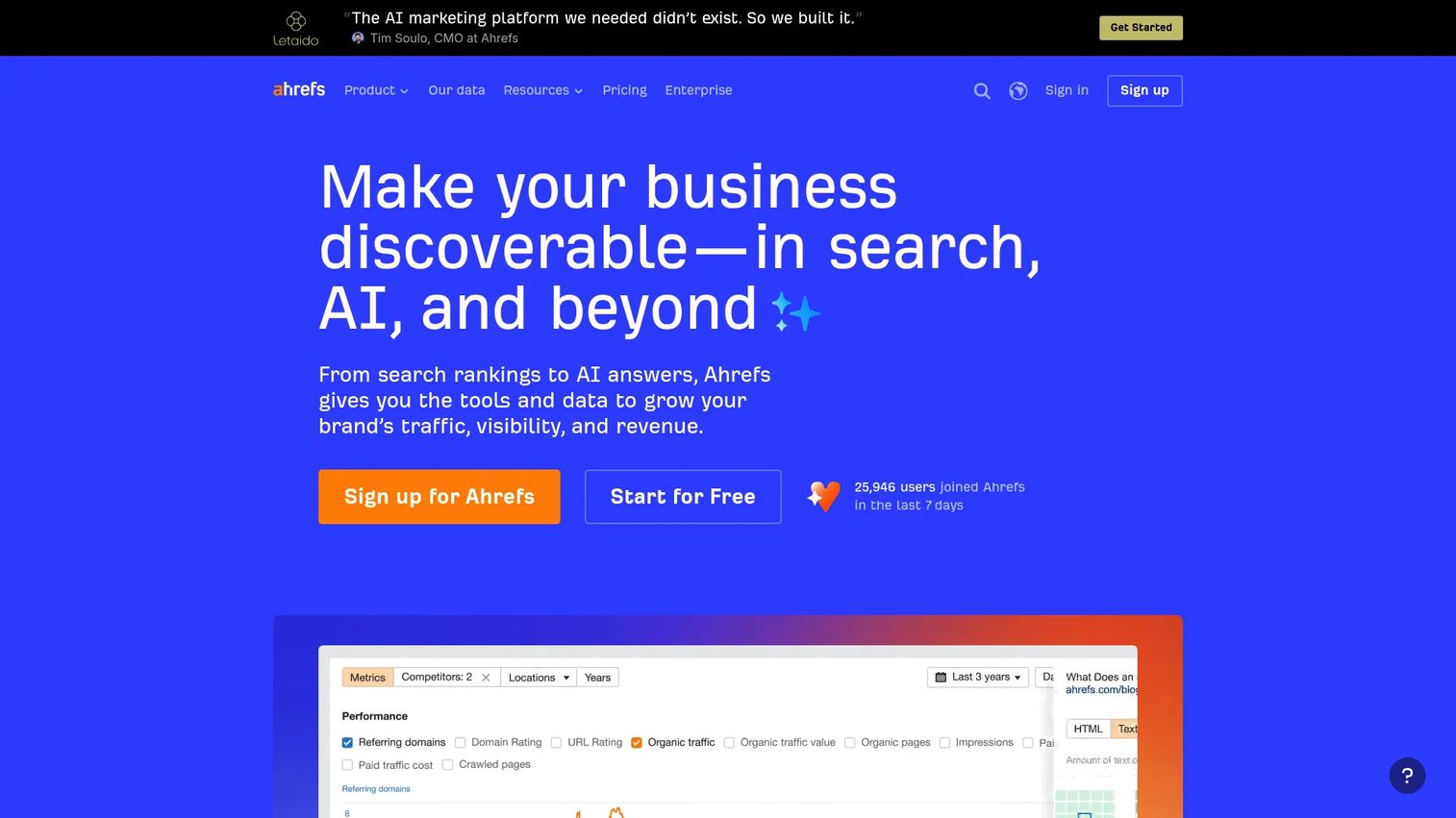
Ahrefs is an SEO and competitive intelligence platform built around one of the web's largest backlink indexes. For digital PR teams, it answers the question leadership always asks: Which publications actually linked, how authoritative are they, and did competitor coverage outpace yours? It also includes Brand Radar for tracking how your brand appears in AI-generated search results.
Best for: SEO-led digital PR teams measuring referring domains, link quality, and organic visibility after campaigns go live.
Key features
- Site Explorer: Backlink profiles and referring domain analysis
- Keywords Explorer: Search demand and topic research
- Content Explorer: Find top-performing content by topic
- Rank Tracker: Monitor keyword positions over time
- Brand Radar: AI search visibility tracking
Why choose Ahrefs: Choose Ahrefs when link quality and organic growth are your primary PR success metrics. It is not an outreach CRM, so pair it with BuzzStream or a media database for the pitching side of campaigns.
Ahrefs pricing: Plans start at $29/month for the Starter tier (monthly billing). Lite starts at $129/month, Standard at $249/month, and Advanced at $449/month. A free Ahrefs account provides limited access to Site Explorer and Site Audit. Annual billing saves up to 17%.
G2 rating: 4.5/5
2. Google Alerts
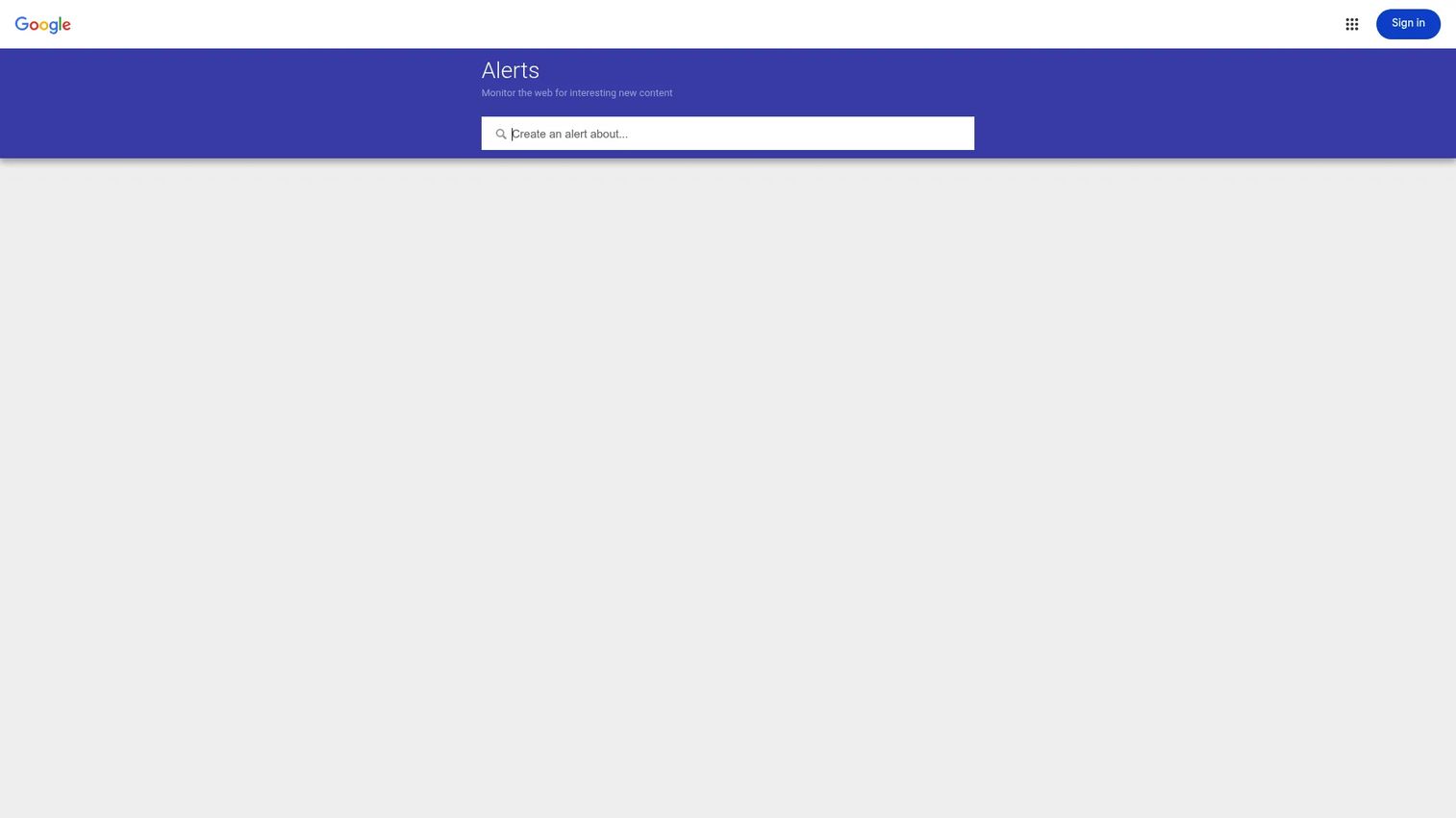
Google Alerts monitors the web for new content matching any keyword you specify and delivers results by email. Setup takes under two minutes. The service covers news, blogs, web pages, video, books, and discussions, with controls for delivery frequency, source type, language, and region.
Best for: Small teams or solo practitioners starting with free brand, journalist, campaign, or competitor monitoring.
Key features
- Keyword and topic alert creation
- Delivery frequency: As-it-happens, daily, or weekly
- Source filtering: News, blogs, web, video, books, discussions
- Language and region settings
- Email notification delivery
Why choose Google Alerts: Choose Google Alerts as a no-cost baseline when you need to track new web mentions without a monitoring budget. It will not replace dedicated sentiment analysis, share-of-voice reporting, or social listening.
Google Alerts pricing: Free. No paid tier exists.
3. BuzzSumo
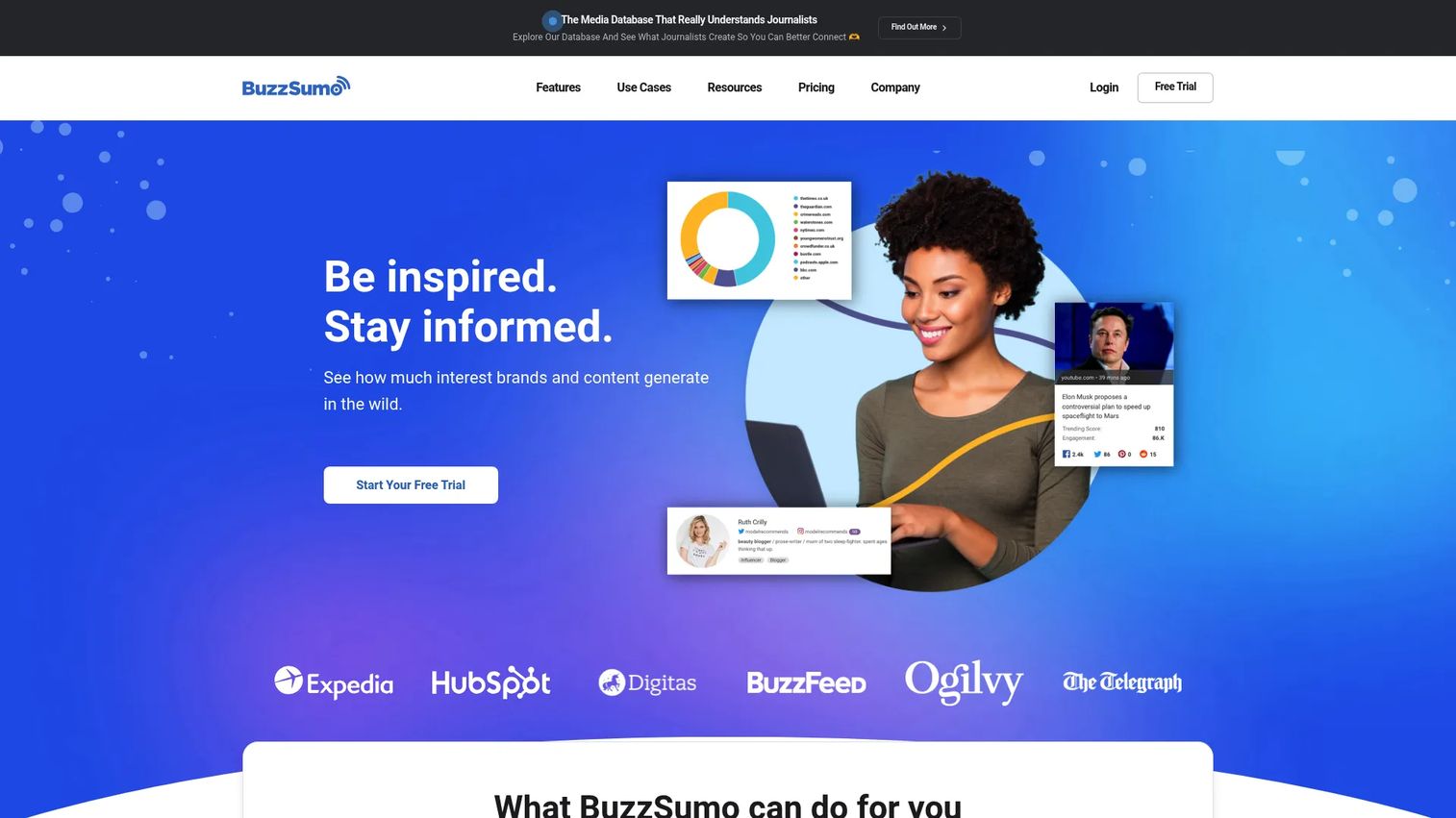
BuzzSumo helps marketers find stories that already have audience traction before investing in creative production. Its content discovery and media monitoring tools surface which topics drive engagement, which journalists cover a beat, and what competitors have earned coverage for. For digital PR, it is strongest at the ideation stage.
Best for: Marketers and PR teams building data-led or social-led campaign angles that need to resonate with journalists.
Key features
- Content discovery by topic, format, and engagement score
- Trending topic alerts and feeds
- Journalist profiles and influencer research
- Question analysis for audience insight
- Backlink analysis for content performance
Why choose BuzzSumo: Choose BuzzSumo when the hardest part of your campaign is finding the right angle. It excels before outreach begins, not as an ongoing monitoring or reporting platform.
BuzzSumo pricing: Plans start at $199/month on the Content Creation tier (billed annually). PR and Comms is $299/month, Suite is $499/month, and Enterprise is $999/month (annual billing only). A free trial is available.
G2 rating: 4.5/5
4. BuzzStream
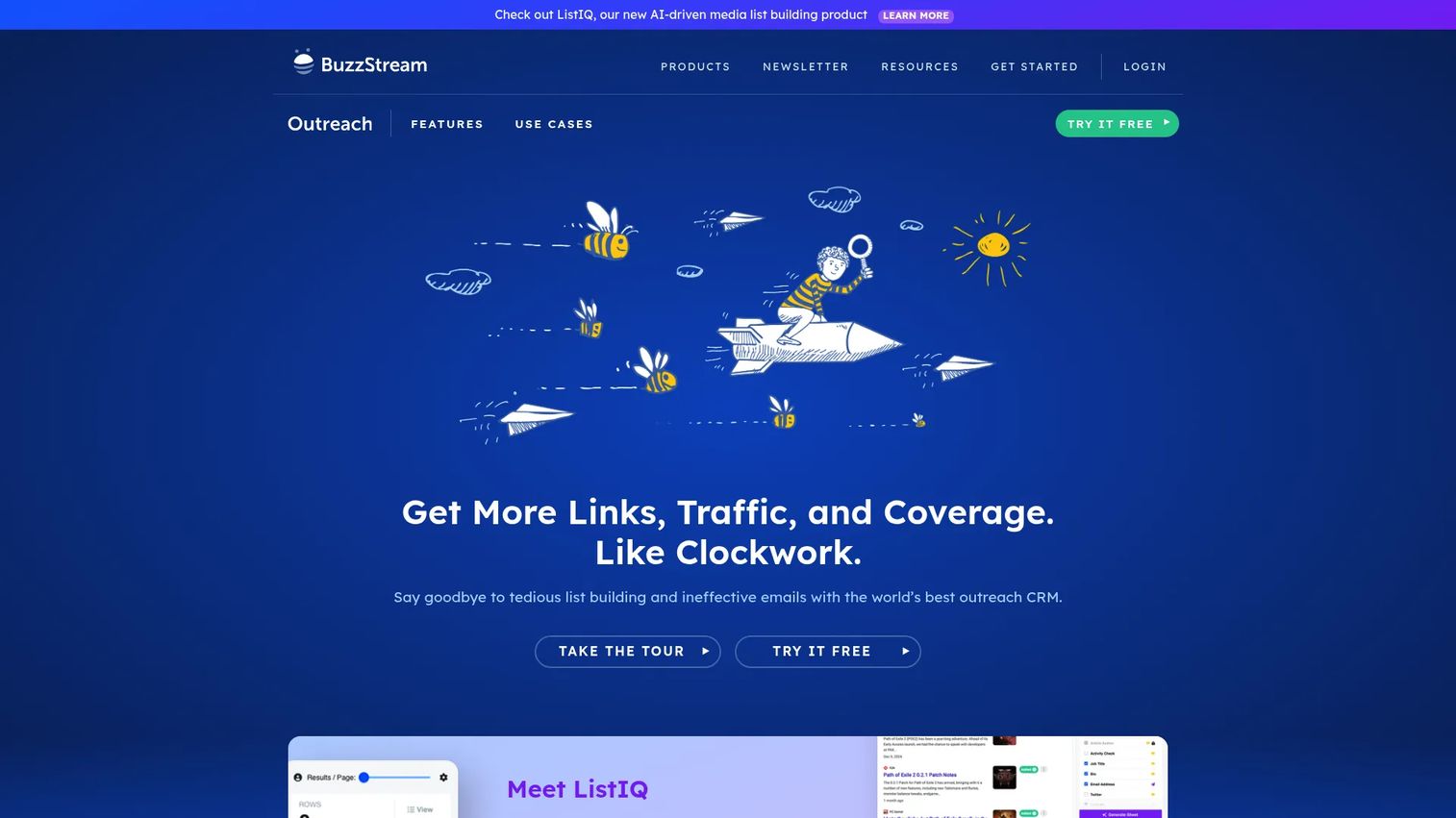
BuzzStream is an outreach CRM for digital PR and link-building campaigns. It centralizes contact discovery, email templates, follow-up scheduling, link monitoring, and team collaboration in one place. When a spreadsheet breaks down at 200 contacts, BuzzStream is the natural next tool.
Best for: Teams pitching journalists, bloggers, publishers, and niche media contacts across multiple simultaneous campaigns.
Key features
- Contact discovery and prospect research
- Email templates and automated follow-up sequences
- Outreach pipeline and response tracking
- Team collaboration and inbox sharing
- Link monitoring and reporting
Why choose BuzzStream: Choose BuzzStream when managing contact history and follow-up timing is breaking your outreach process. It works best for teams with a clear pitching motion already defined.
BuzzStream pricing: Starter starts at $49/month (1 user, 500 contacts). Growth is $174/month (3 users, 25,000 contacts). Professional is $424/month (6 users, 100,000 contacts). Custom plans start at $999/month for 12 or more users. A free trial is available.
G2 rating: 4.2/5
5. Google Trends
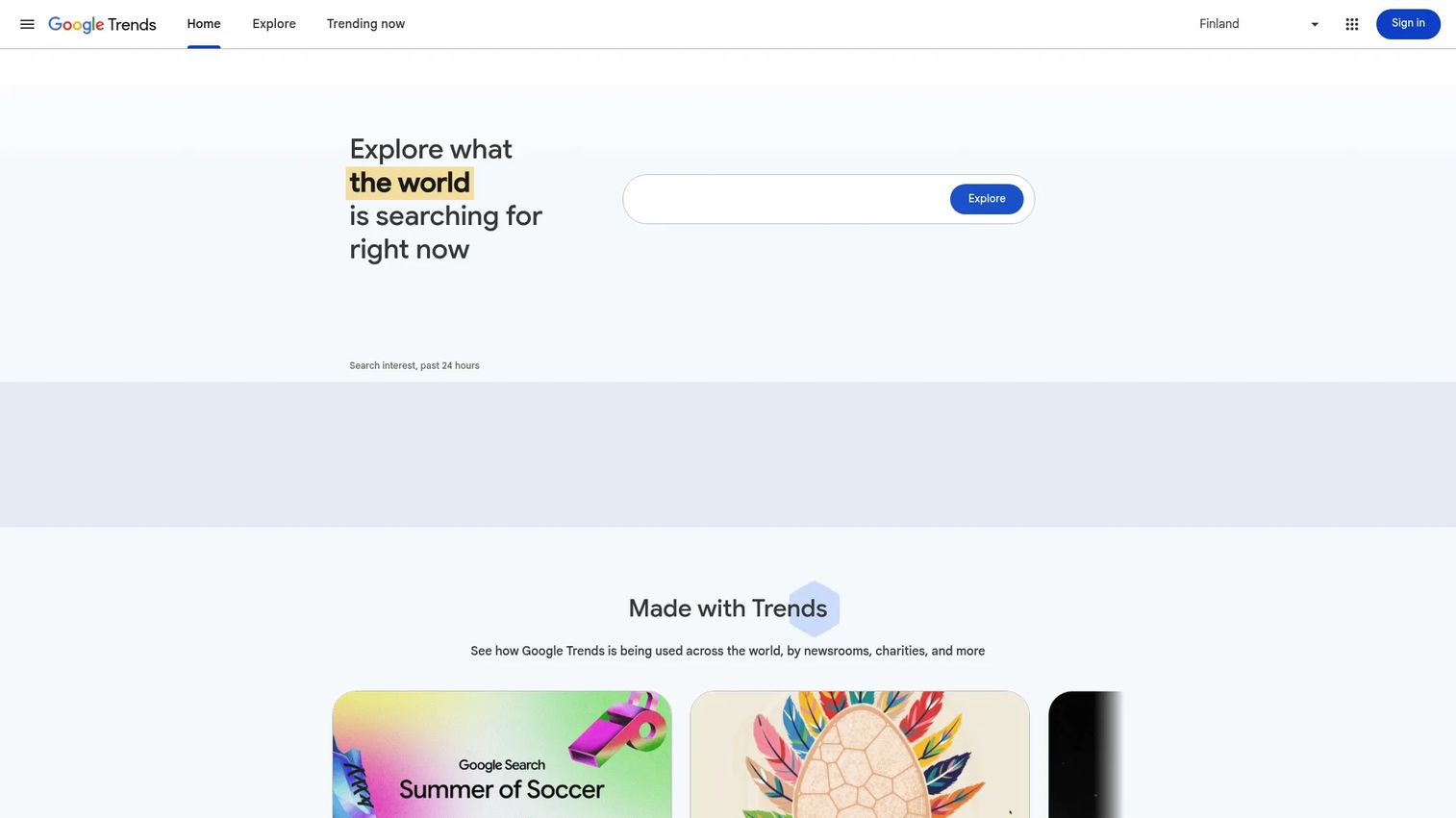
Google Trends shows how search interest in any topic changes over time, by region, and relative to competing topics. For digital PR, it answers one question before the campaign brief is written: Does anyone actually care about this right now? It is a free validation layer, not a database or CRM.
Best for: Campaign ideation and regional timing checks before committing creative resources.
Key features
- Search interest trends over customizable time periods
- Side-by-side topic comparisons
- Regional and city-level interest breakdowns
- Related and rising query discovery
- Embeddable trend data for reports
Why choose Google Trends: Use Google Trends during ideation to avoid building campaigns around stale or niche topics. It is not a PR database or outreach tool.
Google Trends pricing: Free.
6. Google Search Console
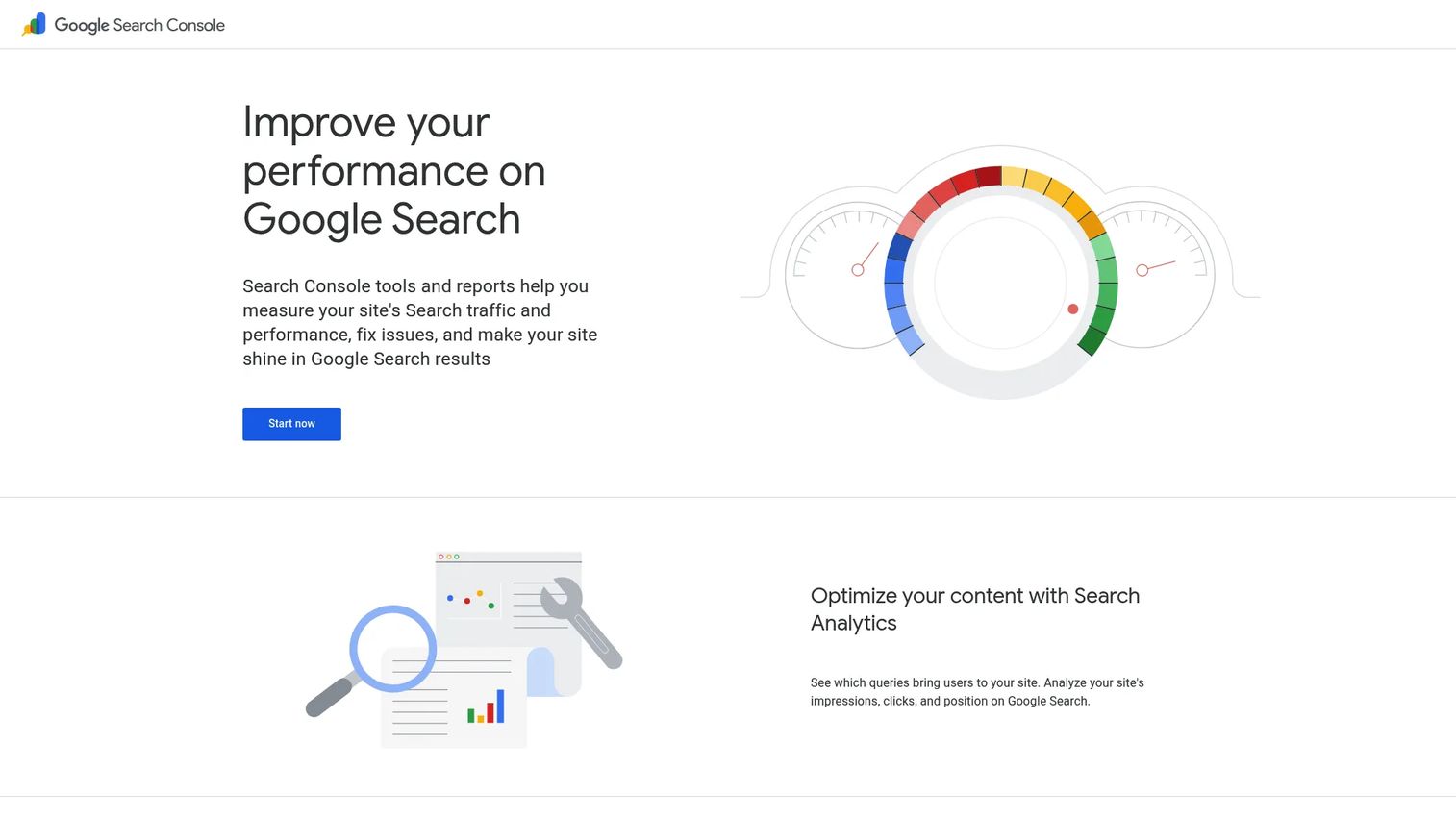
Google Search Console is Google's first-party tool for monitoring how your site performs in organic search. After a PR campaign goes live, it shows whether branded queries increased, which pages picked up referral-driven impressions, and what external sites link to your content. It is the measurement layer most marketers already own but underuse for PR attribution.
Best for: Teams measuring owned-site organic performance changes after digital PR campaigns.
Key features
- Search performance reporting: Queries, clicks, impressions, and CTR
- Page-level performance tracking
- Link reports showing external linking sites
- Crawl and indexing issue alerts
- Core Web Vitals and experience data
Why choose Google Search Console: Choose it because it shows precisely how Google indexes and values your site after coverage earns links. It will not monitor third-party publications or manage journalist relationships.
Google Search Console pricing: Free. The API is also free, subject to usage limits.
G2 rating: 4.7/5
7. HARO
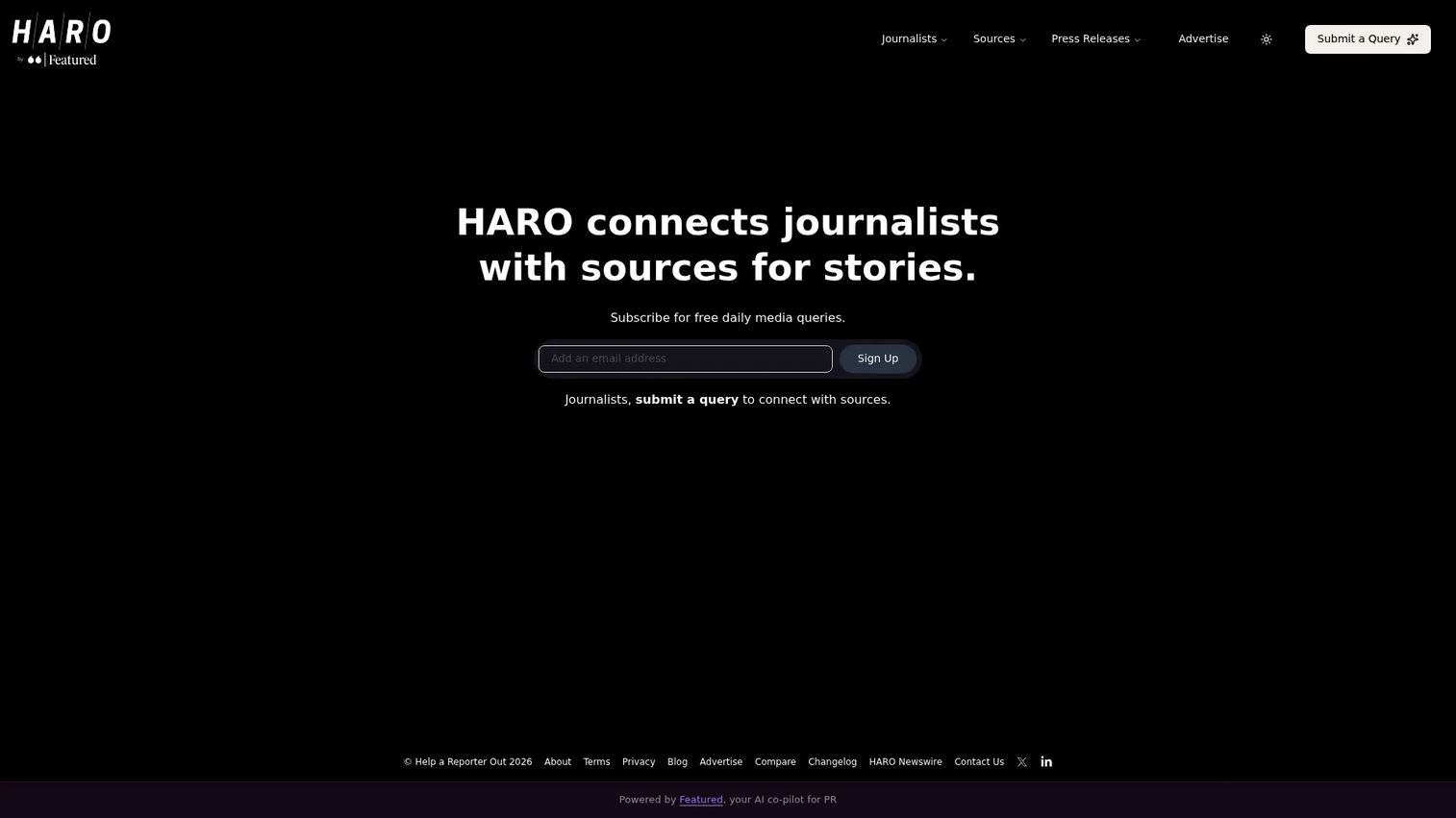
HARO (Help a Reporter Out) sends three email digests per weekday containing journalist source requests across topic categories. Sources respond directly to journalists seeking expert commentary for articles already in production. The service also uses AI detection to flag low-quality pitch submissions. HARO is a reactive PR tool: Journalists come to you with a specific need.
Best for: Marketers and subject-matter experts responding to active journalist requests for earned mentions and quotes.
Key features
- Weekday journalist query email digests
- Category-based query filtering
- Masked email addresses for source replies
- AI-generated content detection for pitches
- Journalist profile verification
Why choose HARO: Choose HARO-style workflows when your team can respond quickly with specific expertise. Speed and relevance determine success here far more than outreach volume.
HARO pricing: Free for sources and journalists. Supported by newsletter advertising; advertiser placements are a separate product.
8. Terkel (Featured.com)
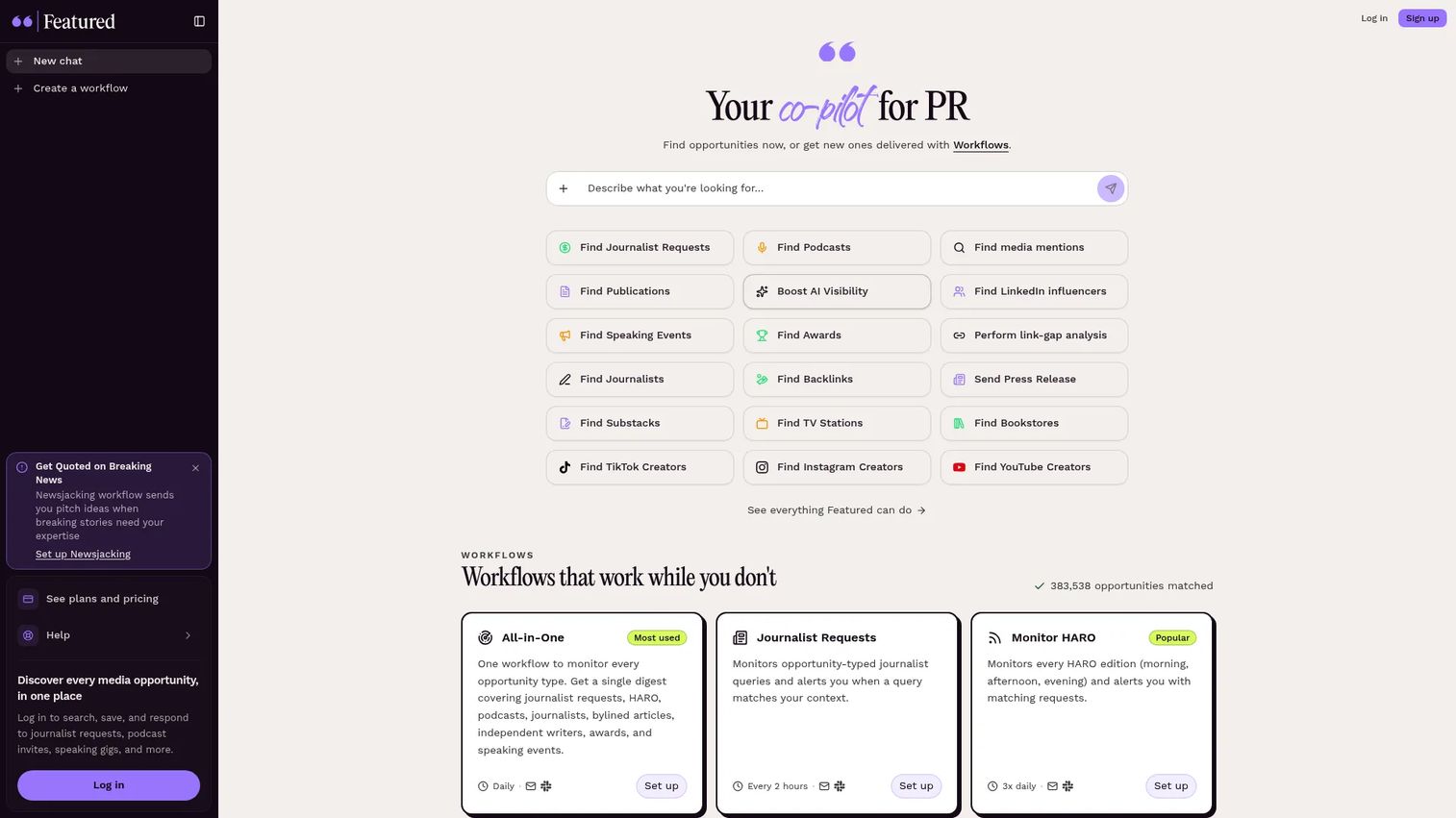
Terkel.io now redirects to Featured.com, a PR platform for discovering journalist and podcast opportunities, drafting pitches with AI assistance, and tracking earned media. It goes beyond question-and-answer matching to include competitor visibility tracking and workflow automation. The platform works for solo practitioners through enterprise agency teams.
Best for: Founders, marketers, and subject-matter experts building a consistent flow of earned media through expert commentary.
Key features
- Journalist request matching and opportunity discovery
- Podcast outreach and booking opportunities
- AI-assisted pitch drafting
- Workflow automation for follow-ups
- Media monitoring and competitor visibility tracking
Why choose Terkel (Featured.com): Choose it when thought leadership is a core part of your PR strategy. The AI pitch drafting and opportunity matching reduce the manual overhead of monitoring multiple source-request channels.
Terkel pricing: Free plan available. Paid plans start at $39/month (Lite, billed monthly) or $29/month billed annually. Pro is $99/month or $79/month annually. Team plans start at $199/month. Enterprise pricing is custom.
G2 rating: 4.9/5
9. JustReachOut
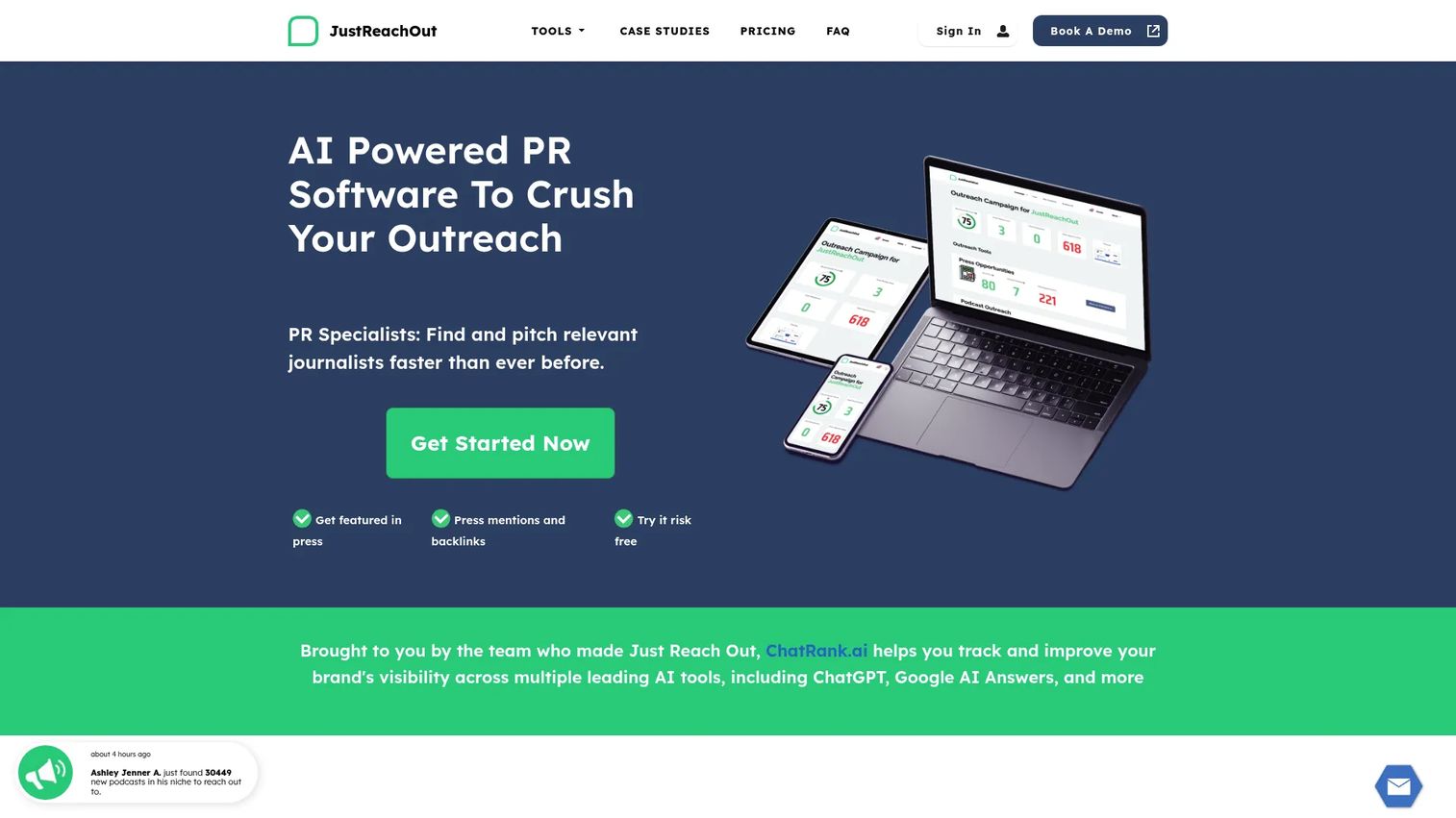
JustReachOut is a DIY PR outreach platform combining journalist search, AI-generated pitch writing, human-verified email addresses, and automatic follow-up scheduling. It aggregates press opportunities from six sources and covers podcast outreach and broken-link building alongside traditional media pitching.
Best for: Startups and small marketing teams running their own PR outreach without an agency or full enterprise media database.
Key features
- Journalist database with search and contact data
- AI-generated personalized pitch drafts
- Automated follow-up scheduling
- Press opportunity aggregation from six sources
- Podcast and guest post outreach
Why choose JustReachOut: Choose JustReachOut when you need guidance and workflow in the same tool. It is especially useful for teams learning PR execution, not only teams trying to maximize pitch volume.
JustReachOut pricing: Plans start at $98/month on the Starter Outreach tier (billed annually) or $147/month billed monthly. Advanced Outreach is $165/month annually. Ultimate Outreach is $331/month annually. A 7-day free trial is available on monthly plans.
G2 rating: 4.6/5
10. Muck Rack
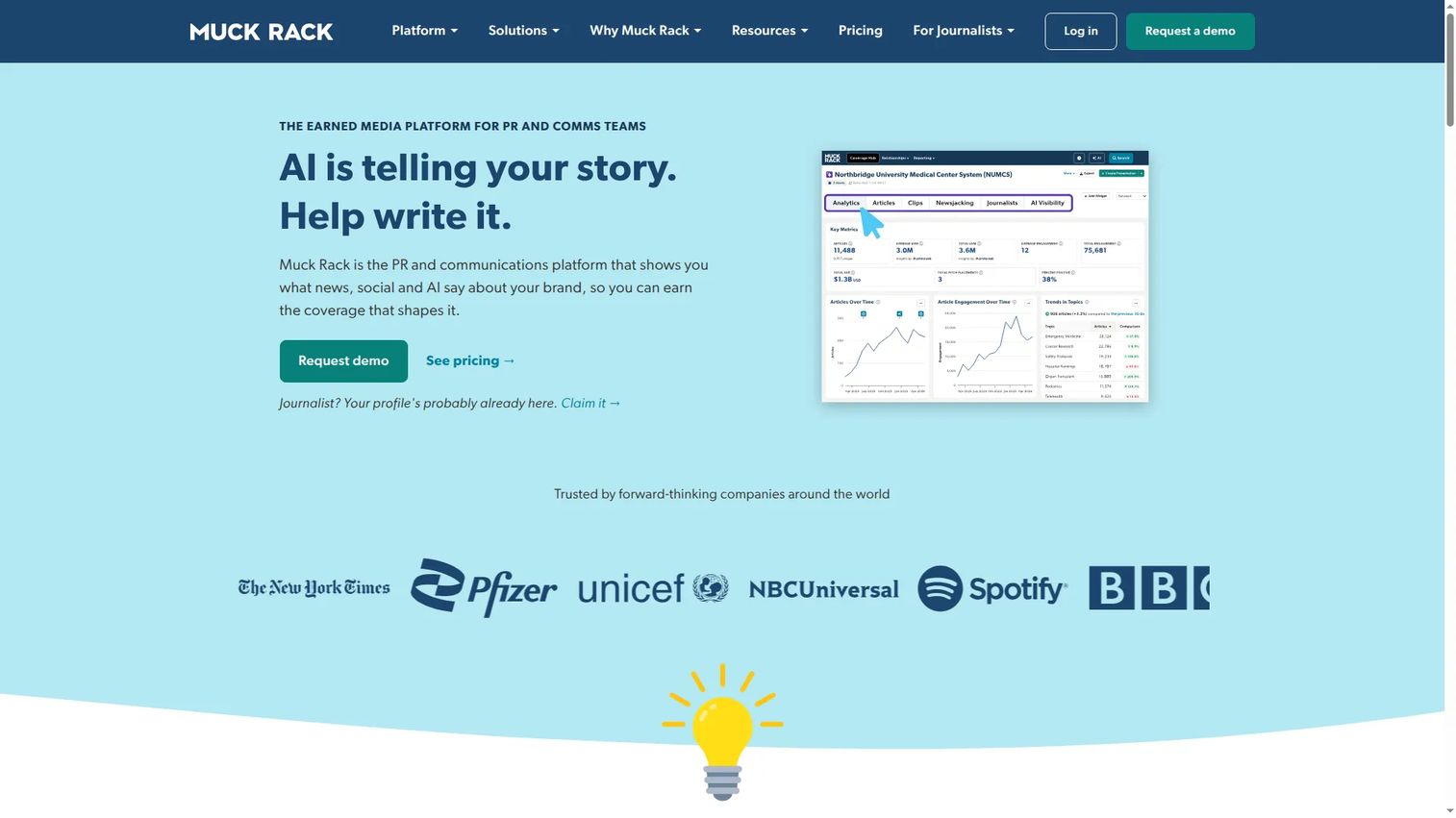
Muck Rack is an AI-powered PR platform combining a media database, pitching tools, monitoring, and reporting for communications teams. Its journalist profiles pull in recent coverage, beat focus, and social activity, which helps teams pitch relevant angles. An AI Search Agent and AI Media List Agent assist with journalist discovery and list building.
Best for: PR and communications teams managing journalist relationships, media lists, and earned-media measurement across campaigns.
Key features
- Journalist database with profiles, beats, and recent coverage
- Media list building and pitch management
- Media monitoring and coverage alerts
- PR analytics and campaign reporting
- AI Search Agent for journalist discovery
Why choose Muck Rack: Choose Muck Rack when contact accuracy and relationship history directly determine campaign success. It is a larger investment than lightweight outreach tools, but the journalist profile depth justifies it for teams running multiple campaigns simultaneously.
Muck Rack pricing: Three plans are available: Starter, Standard, and Premier. Pricing is custom and depends on users, modules, and monitoring scope. Free tools are available for journalists. Contact Muck Rack for a quote.
G2 rating: 4.5/5
11. JournoLink
JournoLink is a PR platform for small businesses that need to distribute press releases and connect with journalists without an agency. It supports press release creation, distribution to media contacts, journalist request browsing, and basic press release analytics.
Best for: Small businesses that need accessible PR outreach and press release support without enterprise platform complexity.
Key features
- Press release creation and distribution
- Journalist and media database access
- Journalist request browsing
- Press release performance analytics
- Small-business PR workflow support
Why choose JournoLink: Choose JournoLink when your team needs practical access to journalist attention without the overhead of a full PR platform. It is especially relevant for smaller UK-focused businesses getting started with proactive media relations.
JournoLink pricing: Contact JournoLink for current plan details.
12. Mentionlytics
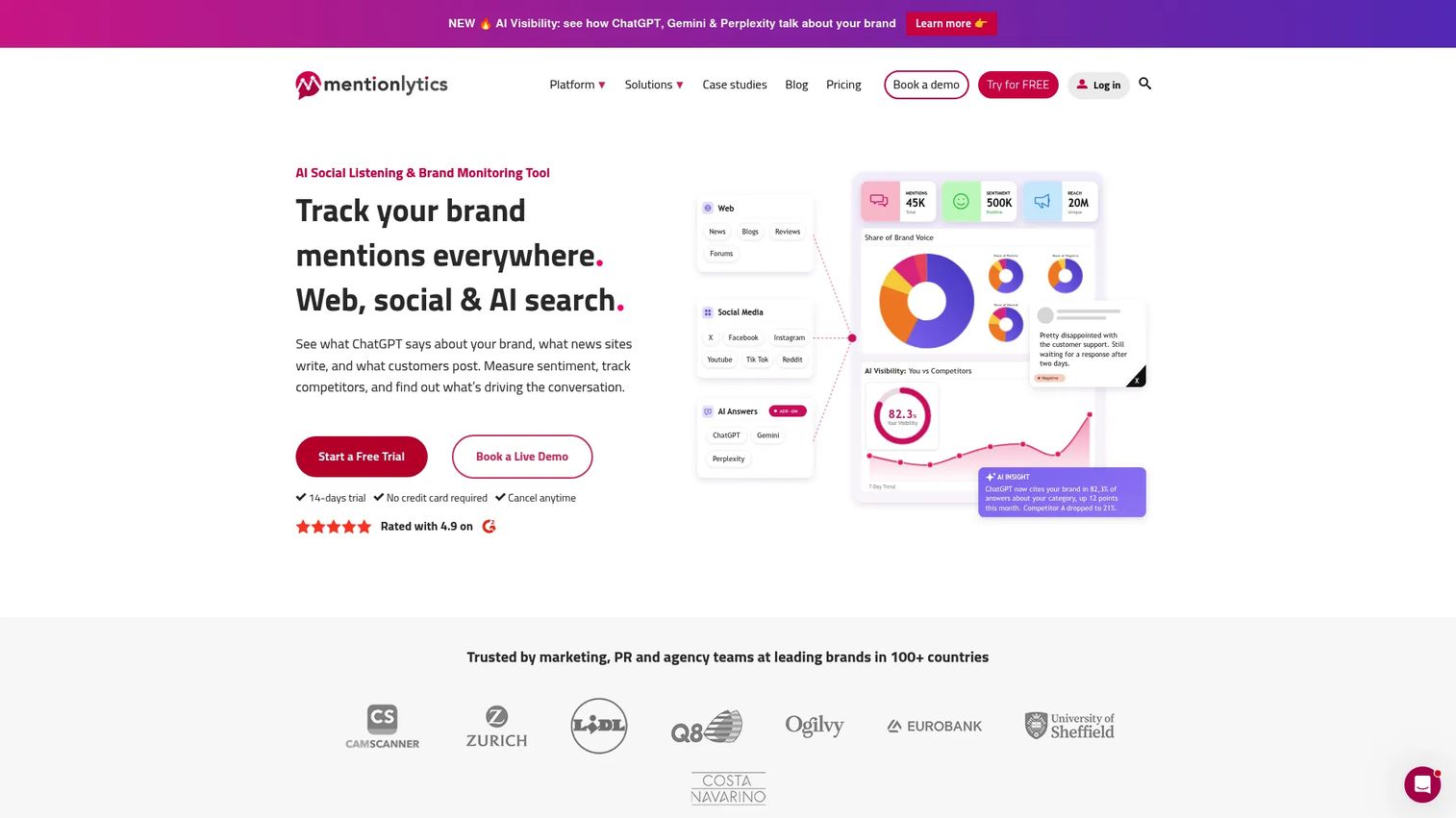
Mentionlytics monitors web mentions, social media conversations, sentiment, competitor activity, and AI platform visibility from a single dashboard. Its AI visibility tracking extends beyond traditional web monitoring to cover how brands appear inside major AI-generated search environments, which is an emerging measurement layer for digital PR teams.
Best for: Marketers tracking brand mentions, campaign keywords, competitor coverage, and emerging AI search visibility.
Key features
- Web and social media mention monitoring
- AI sentiment and emotion analysis
- Competitor tracking and share-of-voice reporting
- AI visibility tracking across major AI platforms
- Customizable dashboards and report exports
Why choose Mentionlytics: Choose Mentionlytics when social conversations and web mentions both matter to your campaign measurement. The AI visibility tracking layer is a differentiator for teams watching how their brand surfaces in generative search results.
Mentionlytics pricing: Basic starts at $69/month (billed monthly). Essential is $169/month, Advanced is $299/month, Pro is $499/month. Business starts at $749/month (billed annually) and Enterprise from $1,299/month (billed annually). A 14-day free trial is available.
G2 rating: 4.9/5
13. CoverageBook
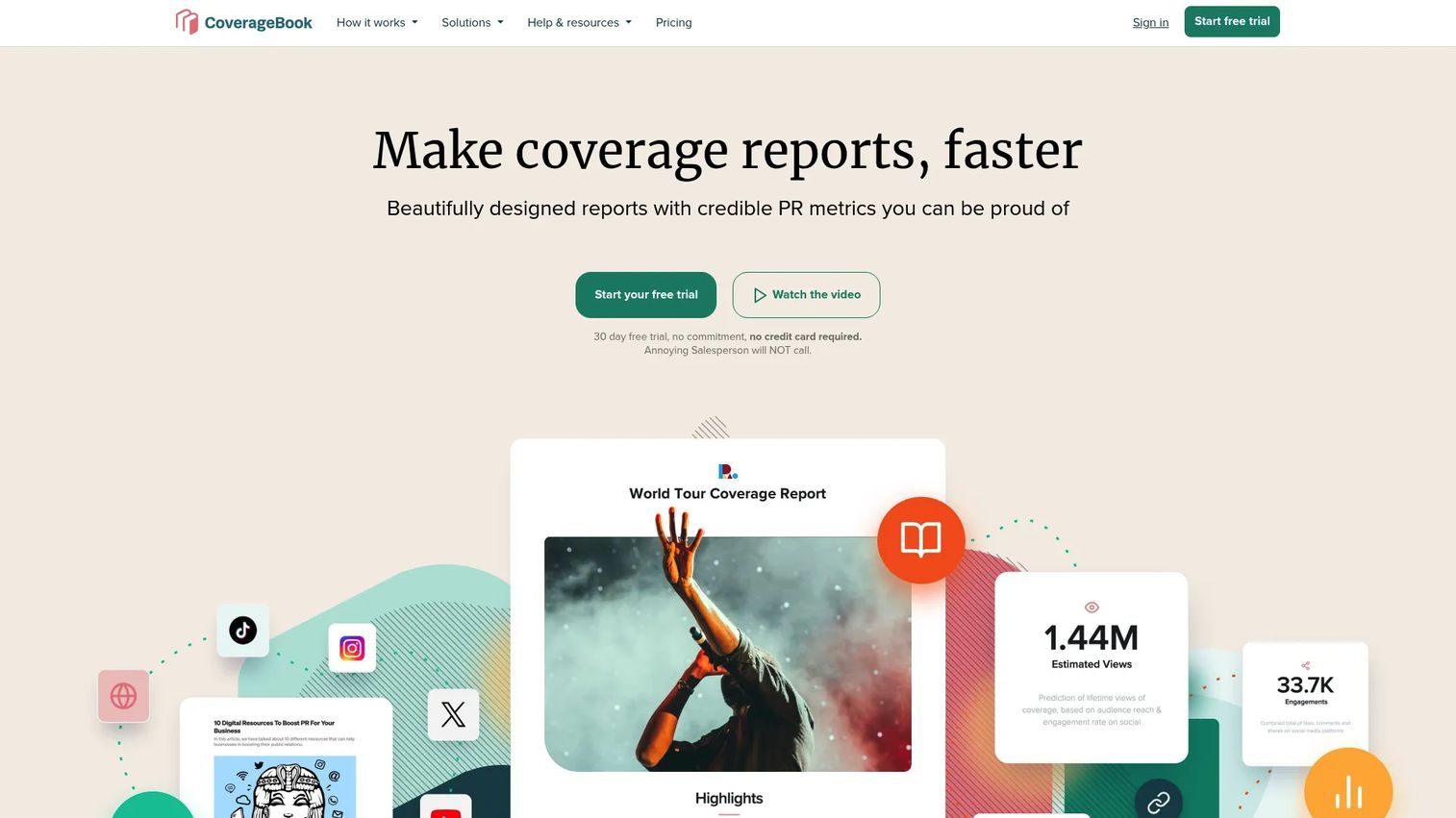
CoverageBook automates the worst part of campaign reporting: Screenshotting coverage, pulling metrics, and building a deck that looks like it took all week. It captures screenshots automatically, pulls engagement and link metrics, and generates shareable online reports. For agency teams and in-house PR leads sending monthly stakeholder updates, it removes hours of manual assembly.
Best for: PR agencies and in-house communications teams packaging coverage results for clients or leadership.
Key features
- Automated screenshots and metrics for online articles
- Customizable report layouts: Full-page, grid, and list views
- Online shareable report links and PDF export
- Excel and CSV metrics export
- Monthly clip allowances by plan tier
Why choose CoverageBook: Choose CoverageBook when reporting consumes more time than the campaign review warrants. It is a packaging and presentation tool, not an outreach or monitoring platform.
CoverageBook pricing: Bronze starts at $99/month (100 clips). Bronze Plus is $169/month, Silver is $229/month, and Gold is $599/month (1,200 clips). Enterprise pricing is contact sales. Annual plans include one month free. A 30-day free trial is available without a credit card.
G2 rating: 4.7/5
14. Cision
Cision is an enterprise PR platform covering media monitoring across print, online, TV, radio, social, podcasts, and magazines. Its CisionOne suite combines journalist outreach, media analytics, social listening, AI-powered query and summarization tools, and branded reporting. For large communications teams running multiple programs simultaneously, it provides the infrastructure to coordinate media relations at scale.
Best for: Enterprise PR and communications teams with complex, multi-channel media relations requirements and reporting obligations.
Key features
- Real-time media monitoring across print, digital, TV, radio, social, and podcasts
- Journalist database and media contact management
- Media analytics, dashboards, and branded reporting
- Social listening and audience engagement tools
- AI-powered insights and content assistance
Why choose Cision: Choose Cision when your PR program operates across many channels and needs enterprise-grade governance, reporting, and media intelligence. Smaller teams often find it more platform than they need and get more from specialized tools.
Cision pricing: Packages include Journalist Outreach, Media Monitoring, Media Monitoring plus Social, and the CisionOne Suite. All are priced through sales consultation. Contact Cision for a quote.
G2 rating: 3.9/5
15. Meltwater

Meltwater is a media and social intelligence platform for teams that need global monitoring coverage, social listening, influencer management, and executive reporting in one contract. It tracks media coverage, social conversations, consumer insights, and competitor activity, with AI visibility tracking for teams watching generative search impact.
Best for: Teams tracking brand reputation, media coverage, and social conversations at global scale with executive reporting requirements.
Key features
- Global media monitoring across news, online, and broadcast
- Social media monitoring and listening
- AI search visibility tracking
- Influencer discovery and campaign management
- Competitive intelligence and PR reporting dashboards
Why choose Meltwater: Choose Meltwater when digital PR overlaps with reputation monitoring, social intelligence, and global media coverage. It is a broad platform, so the value scales with the number of monitoring use cases your team needs to cover.
Meltwater pricing: Starter plans begin around $10,000/year. Pro plans start around $25,000/year. Enterprise starts around $130,000/year. Final pricing depends on capabilities, coverage scope, users, integrations, and contract terms. No free tier or trial was verified.
G2 rating: 4.1/5
16. Prowly
Prowly is an all-in-one PR platform covering media research, outreach, monitoring, and impact tracking. It has been integrated into the Semrush ecosystem as the AI PR Toolkit. Its AI-cited media database, pitch drafting assistance, and competitive PR intelligence (share-of-voice, sentiment, and competitor benchmarking) make it practical for teams that pitch and publish regularly.
Best for: Teams wanting media relations workflow and an online newsroom without jumping to full enterprise PR software.
Key features
- AI-cited media database with journalist profiles and filters
- AI-assisted email and press release drafting
- Media monitoring for news, blogs, and forums with AI summaries
- Competitive PR intelligence and share-of-voice reporting
- Email engagement tracking and scheduled follow-ups
Why choose Prowly: Choose Prowly when your team pitches frequently and needs a practical media relations hub. Its integration into the Semrush ecosystem is useful for teams already running SEO workflows there.
Prowly pricing: Contact Prowly or Semrush for current plan costs.
G2 rating: 4.2/5
17. Prezly
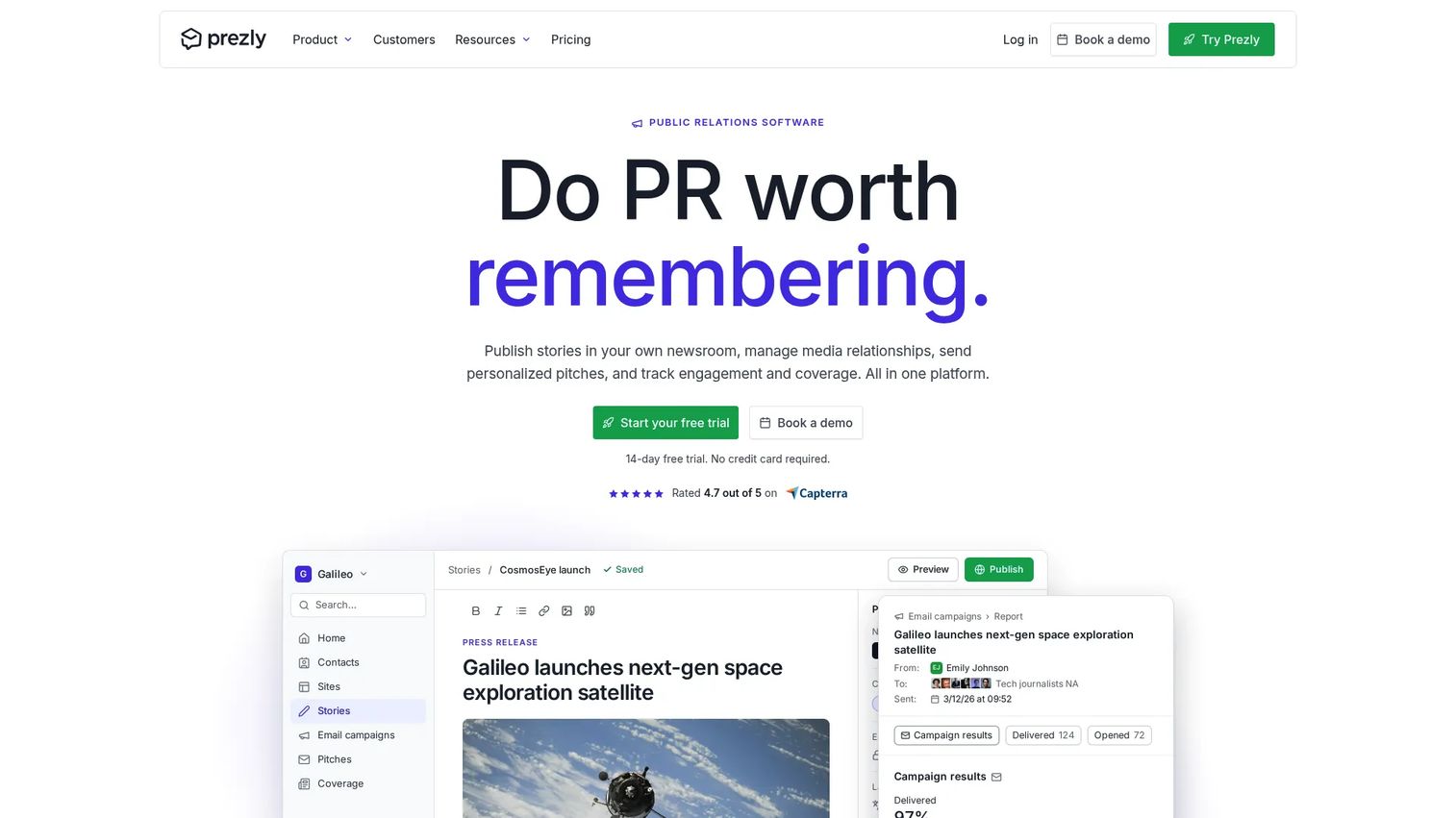
Prezly combines branded newsroom publishing, media contact management, personalized email outreach, and coverage analytics in one platform. Teams use it to publish multimedia stories for journalists, run targeted email campaigns to contact lists, and track who opens what. The newsroom functions as a press destination while the CRM handles the outreach side.
Best for: PR teams building branded newsrooms and managing relationship-based outreach where the two belong in the same workflow.
Key features
- Branded online newsroom with multimedia story publishing
- PR CRM with contact and media list management
- Personalized 1:1 email pitches and bulk email campaigns
- Analytics and media coverage tracking
- Localization support and custom domain sending (Standard and above)
Why choose Prezly: Choose Prezly when publishing polished PR stories and managing contact relationships need to work together. It suits teams that treat the newsroom as an active part of their media relations strategy, not a static press page.
Prezly pricing: Essential starts at 100€/month (1 user, up to 5,000 contacts, billed annually). Standard is 250€/month (2 users, up to 10,000 contacts). Enterprise is custom. A 14-day free trial is available with no credit card required. Pricing is in euros.
G2 rating: 4.3/5
Considerations when choosing digital PR tools
Match the tool to the campaign stage
A monitoring platform will not manage outreach follow-ups, and a reporting tool will not find journalists. Before evaluating any tool, map where your workflow actually breaks: Ideation, contact research, pitching, tracking coverage, measuring links, or packaging results for stakeholders. Buy the tool that solves the specific gap.
Check whether it replaces work or adds another tab
Growth marketers consolidating their stack ask one question: What does this replace? The right PR tool should replace a manual spreadsheet, a cobbled-together reporting deck, or a monitoring setup that only delivers email alerts. If the tool adds a workflow step without removing one, the ROI case gets harder to make.
Measure outcomes beyond coverage volume
Coverage counts and media impressions satisfy a press clipping report, not a growth marketing QBR. Push every vendor to show how their tool tracks backlinks earned, referral traffic driven, branded query lift, and assisted conversions. These are the metrics that connect PR spend to pipeline.
Verify integrations with the current stack
Before signing a contract, confirm how the tool pushes data into your existing stack. CRM sync, analytics platform connectors, SEO tool integrations, and reporting exports all affect whether campaign data lives in one place or creates another silo.
Balance free tools with the operational cost of manual work
Free tools handle early-stage monitoring and validation well. The real cost of staying on free tools as campaigns scale is the manual work hours spent on tasks a paid platform automates. Evaluate what breaks when your campaign cadence doubles.
Conclusion
No single digital PR tool covers every stage from ideation to proof. The practical approach is to build a stack by workflow layer.
For search and backlink measurement, Ahrefs and Google Search Console give you the organic-side picture before and after coverage goes live. For ideation and timing, BuzzSumo and Google Trends tell you whether a topic has the demand to pitch. For outreach, BuzzStream, JustReachOut, Muck Rack, Prowly, and Prezly each handle different scales and relationship depths. For monitoring, Mentionlytics covers web and social in one dashboard, while Cision and Meltwater serve teams with enterprise monitoring needs. For reporting, CoverageBook turns raw coverage into shareable results without the manual assembly. For baseline monitoring at zero cost, Google Alerts and HARO are the starting point.
Pick tools by the workflow stage they solve, then connect the measurement layer to metrics leadership tracks. That is how PR campaigns stop ending with screenshots and start producing defensible attribution.
If your digital PR campaign drives traffic to a static landing page, the story stops too early. Use interactive product experiences when campaigns need prospects, journalists, or analysts to see your product in action rather than read about it. A demo center gives you a branded hub to send earned traffic somewhere worth exploring.
Start your journey with Guideflow today!
FAQs
Digital PR tools help marketing and communications teams plan, execute, and measure online PR campaigns. They cover journalist databases, outreach workflows, brand monitoring, backlink tracking, coverage reporting, and business impact measurement. The category spans free tools like Google Alerts and enterprise platforms like Cision, depending on team size and campaign complexity.
Ahrefs is the strongest choice for measuring backlinks earned through digital PR. It tracks referring domains, link quality, competitor link profiles, and organic visibility changes after a campaign goes live. Google Search Console complements it with first-party link data for your own domain.
Google Alerts, Google Trends, and Google Search Console together cover free monitoring, topic validation, and owned-site measurement. HARO adds reactive PR opportunity access at no cost. Free tools handle the early stages well; paid tools become necessary when campaigns require outreach management, deeper monitoring, or client-ready reporting.
Digital PR earns backlinks, which pass authority signals to your domain. Coverage on high-authority publications can drive referral traffic and trigger branded search queries. Tools help track those effects: Ahrefs shows new referring domains, Google Search Console shows organic performance changes, and monitoring tools flag unlinked mentions that could become link opportunities.
BuzzStream handles outreach CRM and follow-up at scale. JustReachOut combines journalist search with AI pitch drafting for smaller teams. Muck Rack provides deep journalist profiles for teams where relationship accuracy matters most. Prowly and Prezly both include pitching alongside newsroom and monitoring features.
Use a layered framework. Outputs are the coverage placements, mentions, and backlinks. Audience outcomes are referral traffic, branded query lift, and social engagement. Business impact, where attribution allows, covers leads, assisted conversions, and pipeline influence. Tools like CoverageBook package outputs; Ahrefs and Google Search Console surface the organic outcomes; your CRM and analytics platform handle the business impact layer.
PR analytics tools are a subset of the broader digital PR category. They focus specifically on monitoring, reporting, and measurement rather than journalist discovery or outreach. CoverageBook and Mentionlytics skew toward the analytics end. Tools like BuzzStream or JustReachOut focus on execution rather than measurement.
Some do. Mentionlytics includes AI visibility tracking that monitors how a brand appears across major AI-generated search environments. Meltwater also includes AI visibility features. Ahrefs has Brand Radar for tracking AI search appearances. The category is still developing, and coverage varies significantly by platform. Verify which AI platforms a tool monitors and how results are reported before making it a purchase criterion.