You finished the track. You mastered it. Now you have to get it onto Spotify, Apple Music, TikTok, and YouTube, plus a few dozen stores you have never heard of. That last step is where most independent artists lose time, money, and clarity.
The distributor you pick decides three things you will feel every single release. How fast your music reaches stores. How clearly you can see and collect what you earn. And how much admin you inherit when a track has three collaborators and a cover license attached. More than 80% of global music consumption now happens through digital platforms, and over 65% of artists prefer digital distribution models, according to Global Growth Insights (2025). So this is not a niche decision anymore. It is the operational core of releasing music.
Here is the problem with most "best music distribution software" lists. They dump platform logos and call it a day. They skip the part that actually costs you money: whether you pay per release or per year, whether you keep 100% ownership, and how the payout mechanics work when royalties get split. This guide fixes that. We compare the main music distribution services the way a growth marketer would compare a stack, by pricing model, coverage, rights, and release operations, so you can choose with confidence instead of guessing.
What's inside
This guide is built for independent artists, small labels, and creator teams choosing a distributor. We compared eight of the most recognized music distribution companies against four criteria that decide real outcomes: pricing structure (per-release, annual subscription, or commission), DSP and store reach, ownership and royalty handling, and release speed. Every price and feature here comes from each vendor's own current pages, not memory. We skipped tools that only handle mastering or promotion without real digital music distribution. What you get is a clean decision framework, not a logo parade.
TL;DR
- Best for high-volume releasers who want to keep 100% ownership: DistroKid, with unlimited uploads on a flat annual subscription.
- Best music distribution service for artists who want structured plans plus publishing help: TuneCore.
- Best for low-frequency releasers who prefer pay-once economics: CD Baby, with one-time per-release pricing.
- Best modern subscription with operational extras: Amuse.
- Best for creators who want distribution plus production tools: LANDR.
- Best for cover songs and split-heavy releases: Soundrop, at a low per-track price.
- Best free entry point with a brand and sync ecosystem: UnitedMasters.
Among the best music distributors, the right pick depends on how often you release, not which name is loudest.
What is music distribution software?
Music distribution software is a service that delivers your recordings and metadata to digital streaming platforms and stores, then collects and reports the royalties those platforms pay. It is the layer between your finished master and the listener's app. Instead of negotiating with each platform directly, you upload once and the distributor handles delivery, ingestion, and payout tracking across every store it partners with.
Most independent music distribution companies share a common feature set, though the pricing and depth vary widely:
- Digital delivery to DSPs: distribution to Spotify, Apple Music, TikTok, YouTube, Amazon Music, and dozens more stores from a single upload.
- Royalty collection and reporting: the distributor gathers streaming and download revenue, then reports it to you on a set cadence.
- Royalty splits: automated payment sharing so collaborators, producers, and featured artists get paid their agreed percentage directly.
- Rights and ownership handling: most keep you as the master owner and simply route payouts, though terms differ by plan.
- Metadata and release management: ISRC and UPC codes, release scheduling, and store-specific formatting.
- Publishing administration: an optional layer that collects mechanical and performance royalties you would otherwise leave on the table.
The pricing model is the fault line. Some charge an annual subscription for unlimited releases. Some charge per release, one time, forever. A few take a commission on earnings. That single choice shapes your economics more than any feature.
When to use each pricing model
Choose annual subscription for frequent releases
If you drop singles monthly or run an active release calendar, a flat annual plan almost always wins on cost per release. You pay once and upload as much as you want. Release speed tends to be fast, and you keep predictable overhead. This is the model for artists treating music like a steady output, not an occasional event.
Choose per-release pricing for low-volume schedules
If you release one or two projects a year, paying per release makes more sense than a recurring subscription you barely use. You pay once for a single or album, and that release stays live without an annual renewal hanging over it. The math is simple: low frequency plus pay-once economics equals less waste.
Choose split-friendly tools for collaborative and cover releases
If your releases involve multiple collaborators or cover songs, prioritize automated royalty splits and built-in cover licensing. The right tool routes each person's share directly and handles the mechanical license so you are not chasing payments or clearing rights manually. Payout mechanics matter more here than raw store count.
Comparison table
Here is a compact view of the eight music distribution companies in this guide, ranked by relevance to independent artists comparing pricing models and coverage.
| # | Product | Intent | Key differentiation | Pricing | G2 rating |
|---|---|---|---|---|---|
| 1 | DistroKid | High-volume unlimited releases | Unlimited uploads, keep 100% earnings | From $24.99/year | Not verified |
| 2 | TuneCore | Structured plans plus publishing | Artist revenue splits, release tracker | From $24.99/year | 4.2/5 |
| 3 | CD Baby | Pay-once per release | One-time fee, no subscription | From $9.99 one-time | Not verified |
| 4 | Amuse | Modern subscription with extras | ASAP release, royalty advances | From $23.99/year | Not verified |
| 5 | LANDR | Distribution plus production tools | AI mastering, plugins, samples | From $8.25/month | 2.5/5 |
| 6 | Soundrop | Cover songs and split-heavy | Cover licensing, per-track pricing | $4.99 per track | 3.7/5 |
| 7 | ReverbNation | DIY promotion plus distribution | Marketing hub, free tier | Free, paid from $10.79/mo | Not verified |
| 8 | UnitedMasters | Free entry plus brand ecosystem | Sync and brand deals, free plan | Free, paid from $19.99/year | Not verified |
1. DistroKid
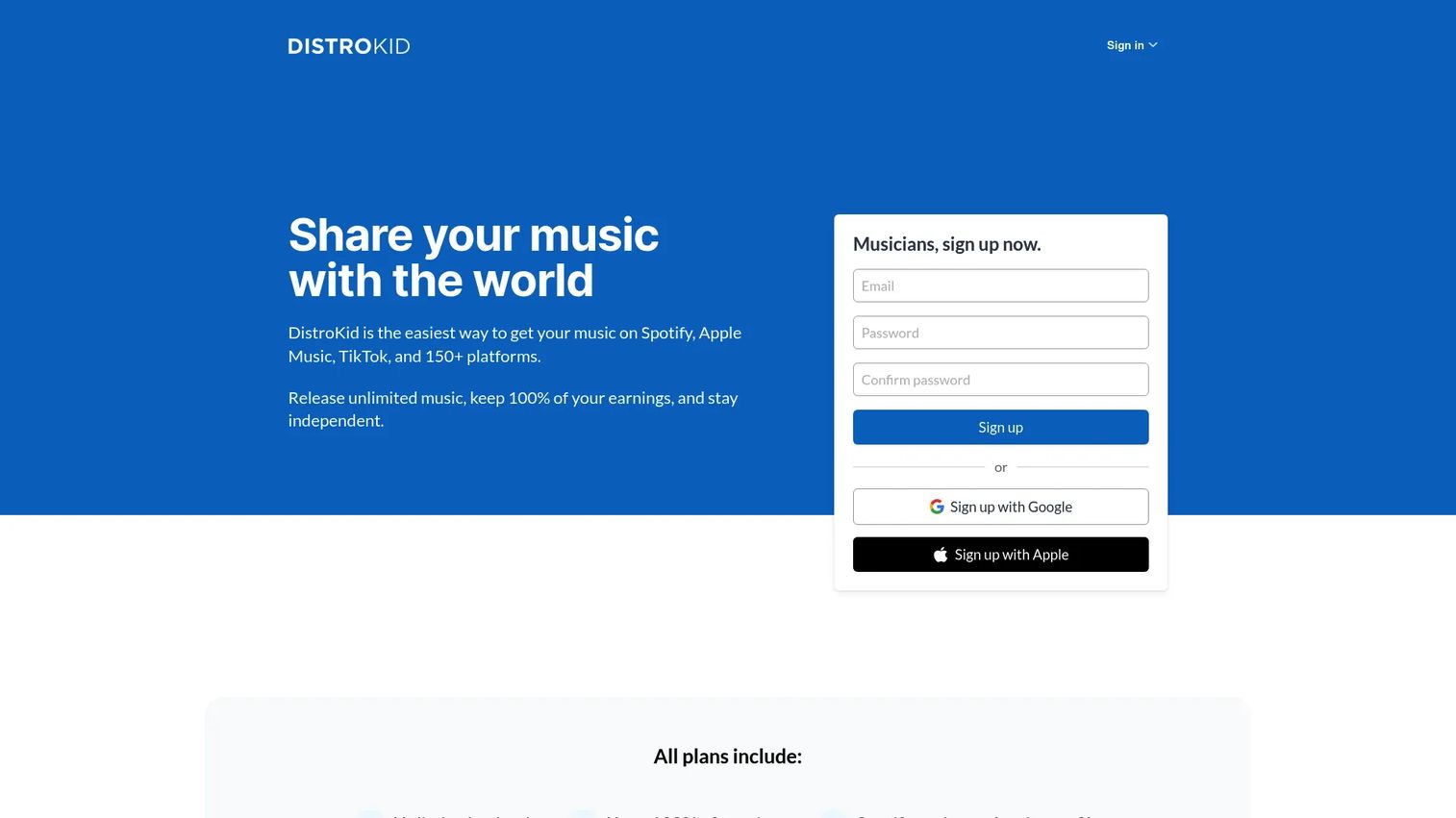
DistroKid is the go-to name for independent musicians who release often. Its whole model is built around unlimited uploads on a flat annual subscription, so the more you release, the cheaper each release effectively gets. It delivers to more than 150 platforms and lets you keep your earnings, which is the retention story most high-volume artists care about.
Best for: high-volume independent artists who want unlimited distribution and simple royalty splitting.
Key strengths
- Unlimited uploads: release as many singles and albums as you want on one annual plan, with no per-release fee.
- Royalty splits: route collaborator shares automatically so each contributor gets paid directly.
- Broad platform coverage: distribution to 150+ platforms including Spotify, Apple Music, TikTok, and YouTube.
Why choose DistroKid: If you release music on a steady cadence, the unlimited model is hard to beat on cost per release. The tradeoff versus pay-per-release tools is the annual renewal, but for anyone dropping more than two or three tracks a year, the math tips heavily in DistroKid's favor. It is the default recommendation for prolific artists who want to keep 100% ownership.
DistroKid pricing: DistroKid runs on three annual plans. Musician is $24.99 billed annually, Musician Plus is $44.99 billed annually, and Ultimate is $89.99 billed annually. There is no free tier, and all plans are billed yearly. The step-up tiers add features like more artist names per account and additional customization.
2. TuneCore
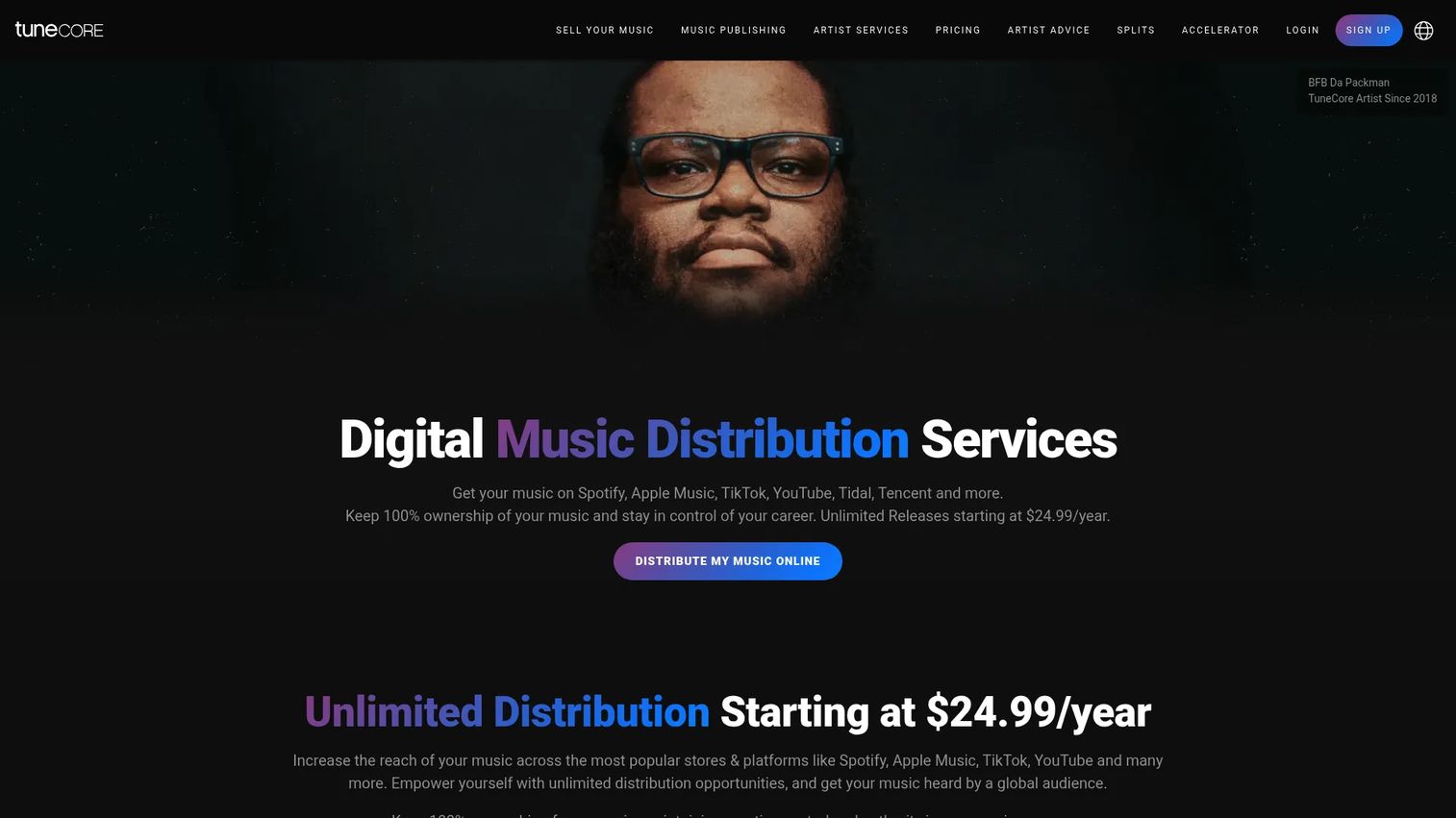
TuneCore is a music distribution and artist services platform built for independent artists and labels who want structure. It offers unlimited annual distribution to 150+ digital stores, plus publishing administration to collect royalties you would otherwise miss. The plan tiers and pay-per-release options give you flexibility depending on how you release.
Best for: independent musicians and labels who want distribution plus artist workflow tools and publishing help.
Key strengths
- Wide store reach: unlimited distribution to 150+ digital stores including Spotify, Apple Music, TikTok, and YouTube.
- Artist revenue splits: divide earnings among collaborators directly inside the platform.
- Release tracker: monitor where and when your release goes live across stores.
Why choose TuneCore: TuneCore fits artists who want clear, structured plans and the option to add publishing administration for deeper royalty collection. It supports both annual subscriptions and pay-per-release singles and albums, so you can match the pricing to your release pattern. That flexibility, plus the workflow tooling, is what sets it apart for artists thinking about long-term catalog management.
TuneCore pricing: TuneCore lists three unlimited annual plans: Rising Artist at $24.99/year, Breakout Artist at $44.99/year, and Professional at $54.99/year. It also offers pay-per-release options, with a Single at $24.99/year and an Album at $44.99/year. There is no free tier. TuneCore holds a 4.2/5 rating on G2.
3. CD Baby
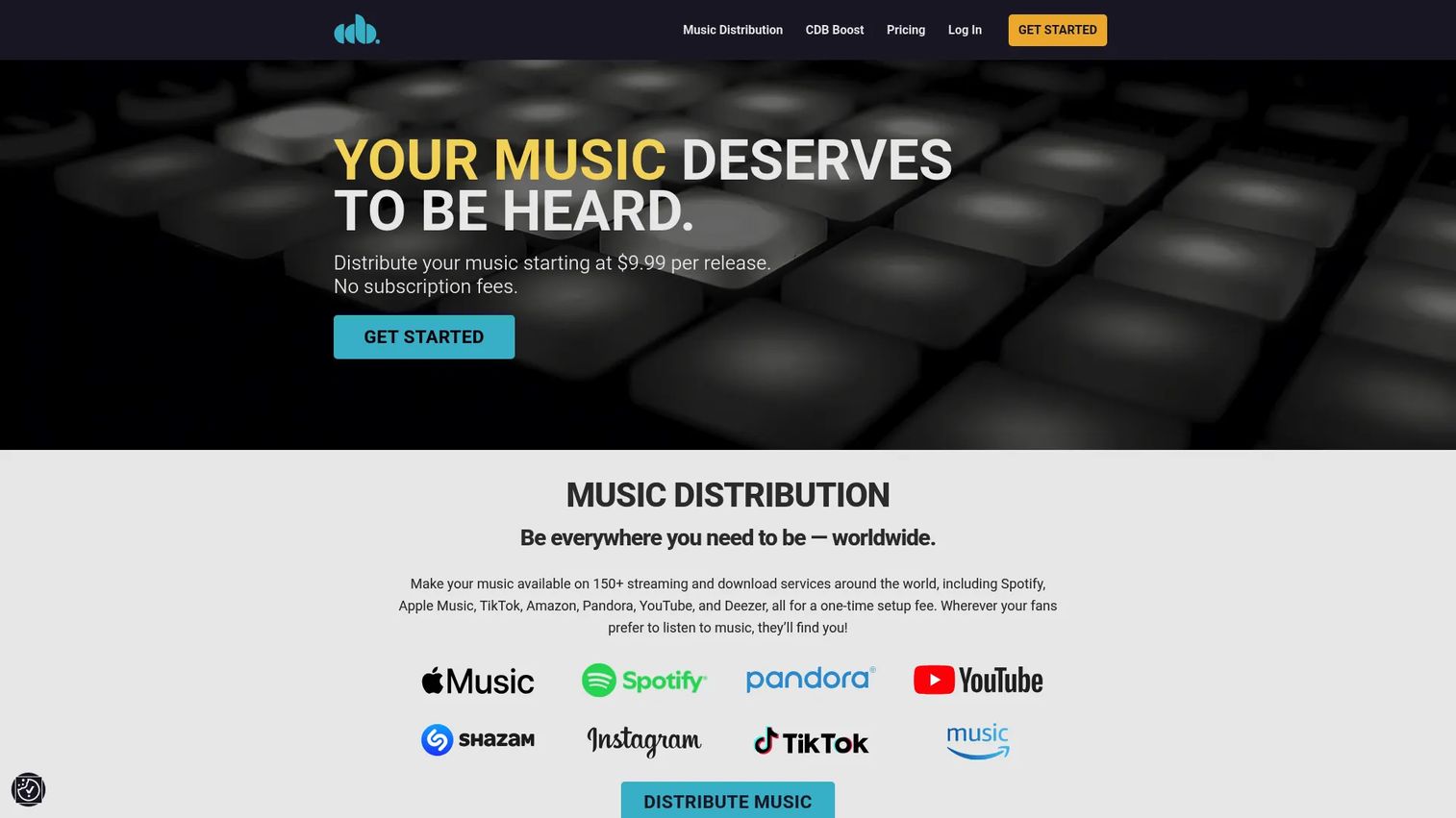
CD Baby is built for artists who prefer pay-once economics over recurring subscriptions. You pay a one-time fee per release, and that release stays live with no annual renewal. It distributes to major streaming platforms and includes options for social video monetization and royalty collection add-ons.
Best for: independent artists and labels who release infrequently and want one-time-fee music distribution.
Key strengths
- One-time per-release pricing: pay once for a single or album, with no recurring or subscription fees.
- Broad streaming delivery: distribution to major streaming platforms and stores.
- Monetization add-ons: optional social video monetization and royalty collection services.
Why choose CD Baby: If you release once or twice a year, CD Baby's pay-once model removes the pressure of an annual subscription you barely use. There are no recurring fees, so a release you paid for years ago keeps earning without renewal. For low-frequency releasers who want simple, permanent economics, this is the cleanest fit on the list.
CD Baby pricing: CD Baby states there are no recurring or subscription fees. A Single Release is $9.99 one-time and an Album Release is $14.99 one-time. Optional add-ons include CD Baby Boost at $39.99 and FastForward at $29.99, both one-time. There is no free tier.
4. Amuse
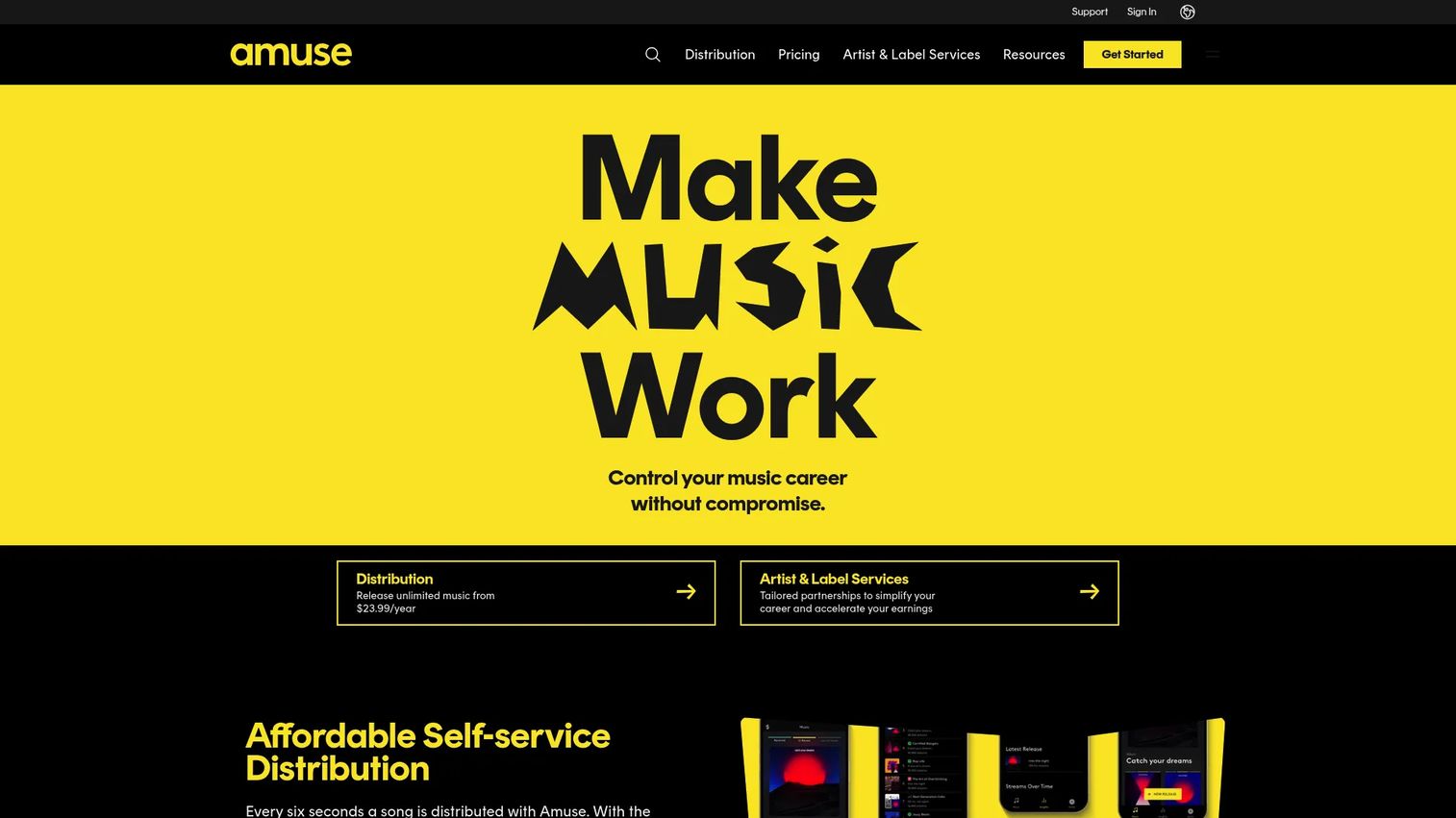
Amuse is a modern music distribution and artist services platform for independent musicians and small teams. It combines unlimited distribution with operational extras like fast release turnaround, royalty advances, and daily streaming insights. The subscription tiers scale by how many artists you manage.
Best for: independent artists and small teams who want a modern subscription model with extra operational tools.
Key strengths
- Unlimited distribution: deliver to major streaming services and social platforms with no per-release cap.
- ASAP release: get music live in 24 hours or less on supported plans.
- Royalty advances and insights: access advances and daily streaming data to manage cash flow and performance.
Why choose Amuse: Amuse suits artists who want more than plain delivery. The royalty advances and daily insights turn it into an operational tool, not just a pipe to the stores. Its tiered plans, structured by artist count, make it a fit for solo creators scaling into small collaborative teams who want release speed and cash-flow flexibility in one place.
Amuse pricing: Amuse offers three annual plans. Artist is $23.99 billed annually and covers one artist. Artist Plus is $39.99 billed annually for two artists. Professional is $59.99 billed annually for three or more artists, with premium features. All plans include unlimited distribution, and there is no free tier.
5. LANDR
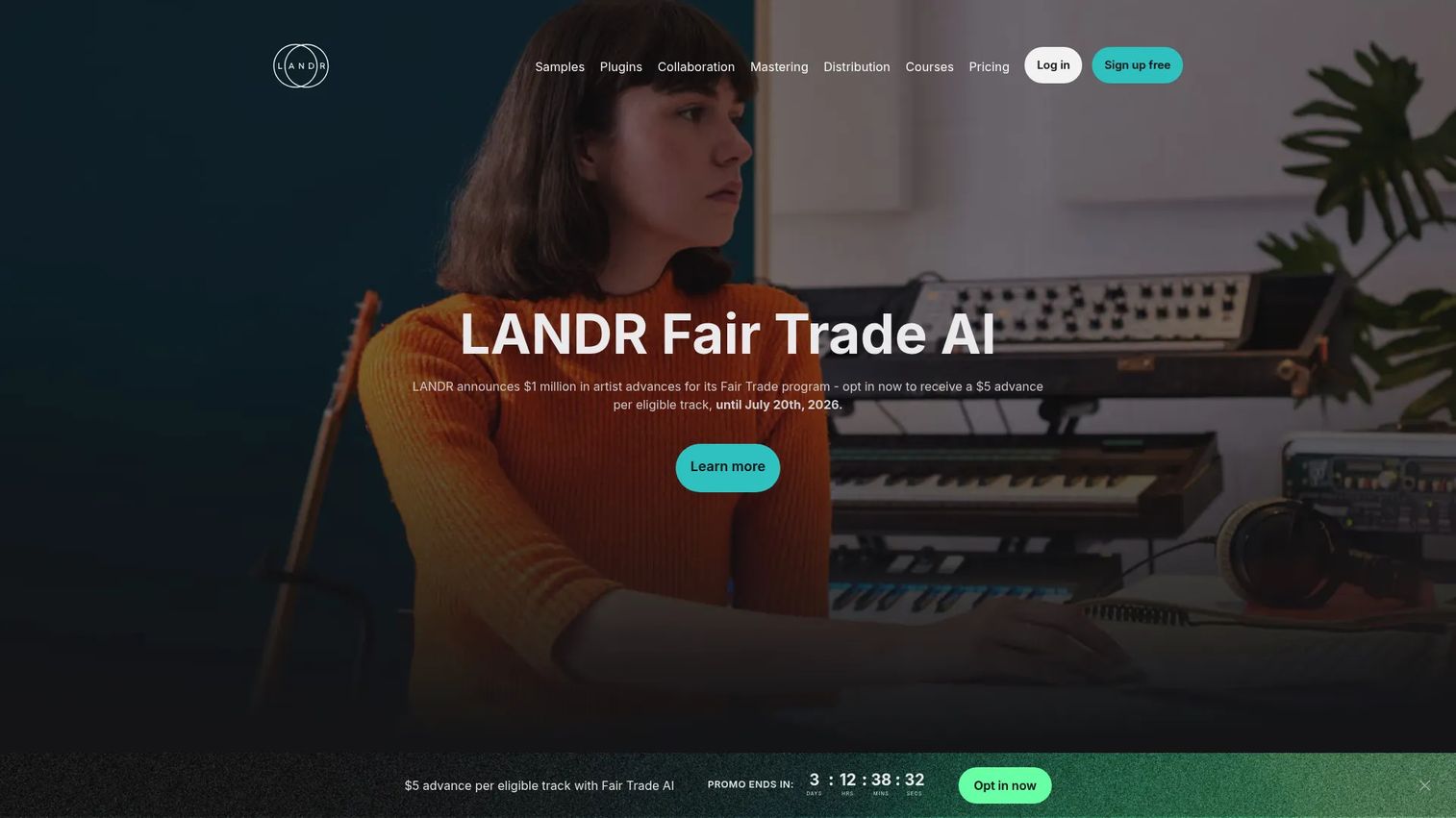
LANDR is an AI-powered music creation platform that bundles distribution with production tools. Beyond delivering to 150+ stores, it offers AI mastering, plugins, samples, courses, and collaboration features. It is the pick for creators who want one subscription covering more than just release logistics.
Best for: independent musicians who want an all-in-one toolset for mastering, creating, and releasing music.
Key strengths
- AI mastering: master tracks in the browser or inside your DAW before release.
- Distribution to 150+ stores: deliver to major streaming services from the same platform you master on.
- Production ecosystem: plugins, samples, courses, and collaboration tools in one subscription.
Why choose LANDR: LANDR fits creators who want to consolidate mastering, production, and distribution rather than stitch together separate tools. If you are already paying for mastering software and a distributor, bundling them can simplify your stack. The distribution tiers sit alongside the broader Studio subscription, so the value scales with how much of the creation suite you use.
LANDR pricing: LANDR pricing starts at $8.25/month for its Studio tiers, with a free account available to sign up. On the distribution side, Distribution Basic is $24/year and Distribution Pro is $45/year. The Studio tiers (Essentials, Standard, and Pro) are billed monthly or yearly. LANDR holds a 2.5/5 rating on G2, based on a small number of reviews.
6. Soundrop
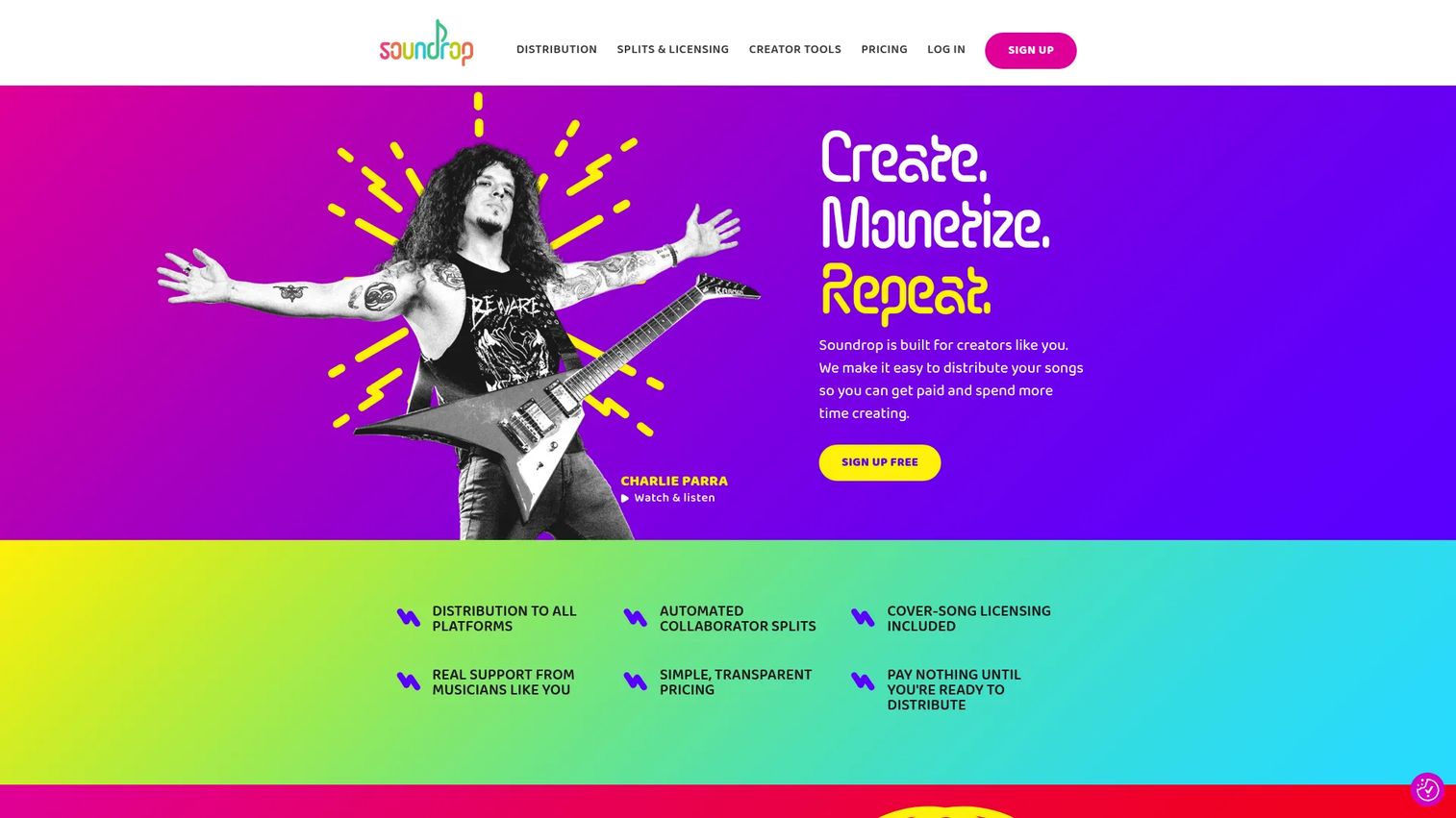
Soundrop is a music distribution platform for independent creators, with a clear specialty in cover songs and split-heavy releases. It offers a free account and per-track distribution at a low flat price, with automated collaborator royalty splits and cover-song licensing built in.
Best for: independent artists distributing tracks, including cover songs, who need clean split payouts.
Key strengths
- Automated royalty splits: collaborator shares are calculated and paid out automatically.
- Cover-song licensing: cover licensing is included, so you can release covers without clearing rights separately.
- Per-track distribution: pay $4.99 per track with no recurring fees.
Why choose Soundrop: Soundrop is the sharpest fit when your releases lean on covers or multiple collaborators. The built-in cover licensing and automated splits handle the two things that create the most admin headache for these releases. It publishes monthly revenue statements and keeps a percentage of revenue earned, which makes the payout mechanics transparent for split-heavy catalogs.
Soundrop pricing: Soundrop offers a free account, with distribution priced at $4.99 per track and no recurring fees. Soundrop states it keeps 15% of revenue earned. Soundrop holds a 3.7/5 rating on G2.
7. ReverbNation
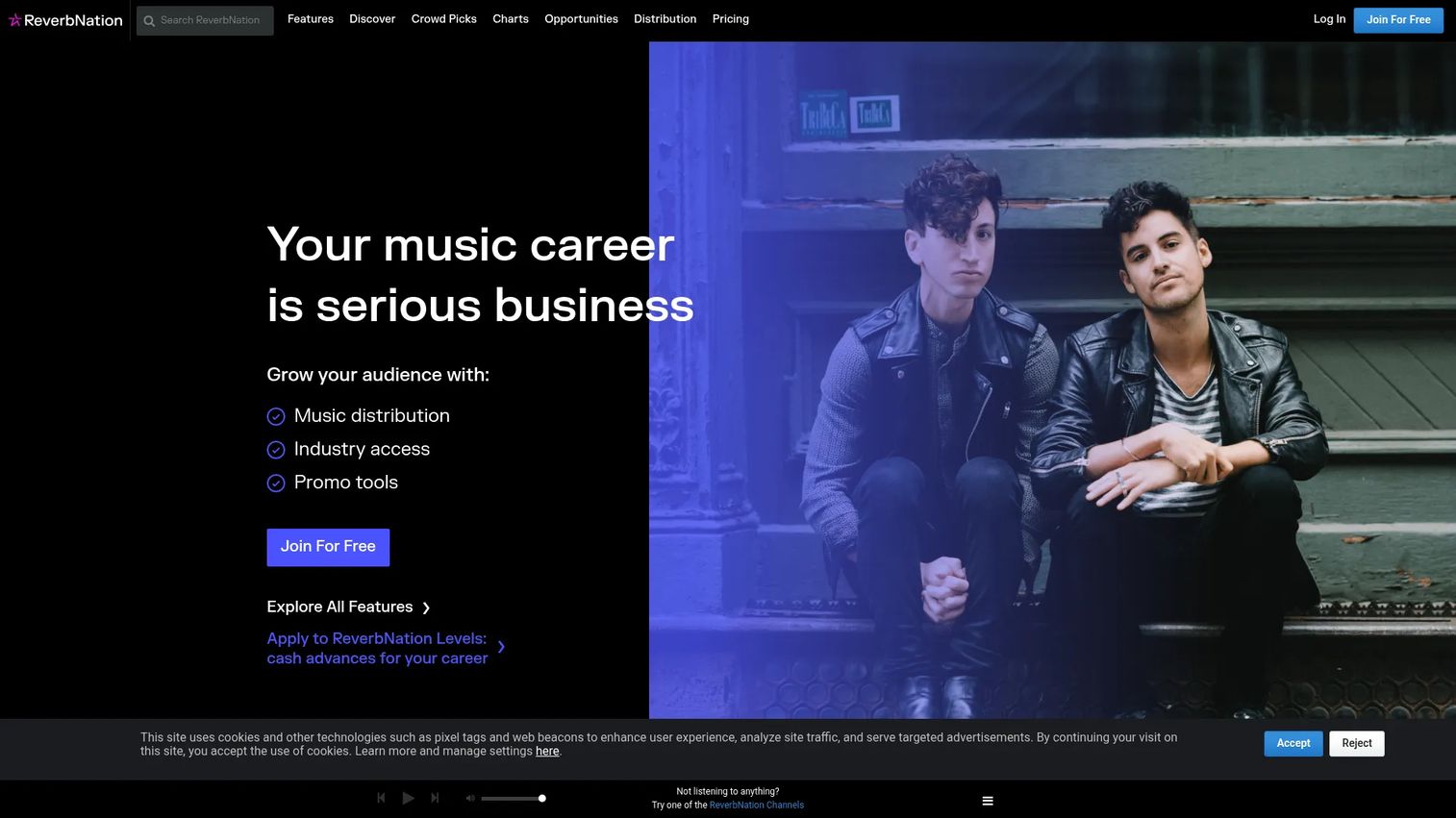
ReverbNation is a music marketing and distribution platform for independent artists, with digital distribution available as part of a broader DIY promotion hub. It combines an artist profile, unlimited song hosting, and email and social marketing tools, so distribution lives inside the same ecosystem you use to promote.
Best for: independent artists already using ReverbNation who want distribution inside one promotion ecosystem.
Key strengths
- Artist profile: a hosted profile to centralize your music and presence.
- Unlimited songs: host unlimited tracks within the platform.
- Marketing tools: built-in email and social marketing to promote releases.
Why choose ReverbNation: ReverbNation fits artists who value promotion and distribution living together rather than as separate tools. If you already run your fan outreach through its marketing features, adding distribution keeps everything in one place. The free tier lets you start without commitment, then step up to paid plans as your release and promotion needs grow.
ReverbNation pricing: ReverbNation offers three artist plans: Free at $0/month, Basic at $10.79/month or $129.50/year, and Premium at $16.62/month or $199.50/year. Annual billing brings discounted yearly rates for the paid tiers. A free plan is available.
8. UnitedMasters
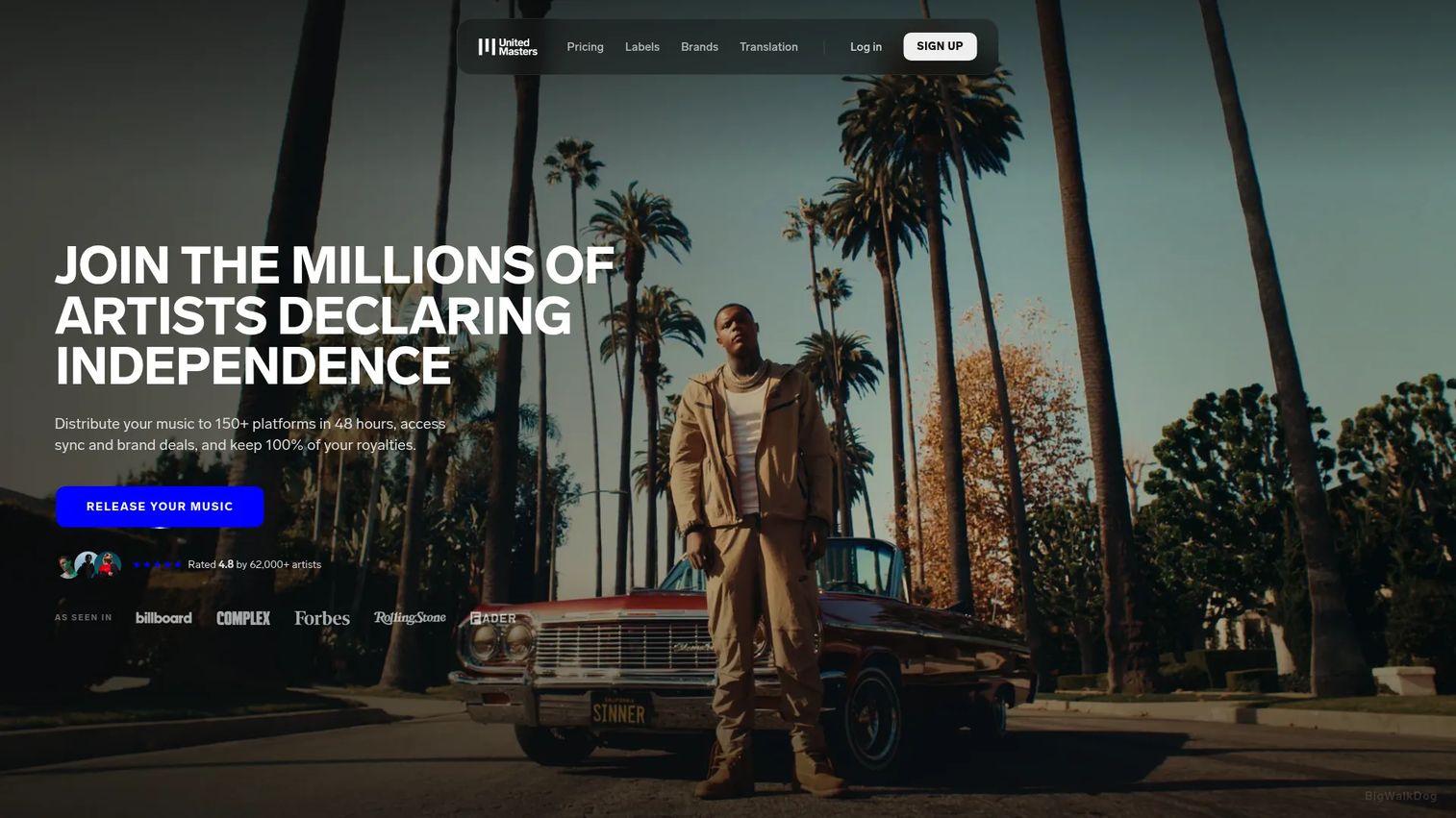
UnitedMasters is a music distribution and artist services platform aimed at independent artists who want distribution plus a brand and sync ecosystem. It delivers to 35+ services, handles royalty splits and wallet cash-out, and layers on tools like MasterLinks, ArtistPages, and fan management. A free plan makes it a low-barrier entry point.
Best for: independent artists who want music distribution alongside brand deals and sync opportunities.
Key strengths
- Free distribution tier: start distributing on the free DEBUT plan with no upfront cost.
- Royalty splits and cash-out: split royalties among collaborators and cash out from a wallet.
- Brand and fan tools: MasterLinks, ArtistPages, and fan management extend beyond plain distribution.
Why choose UnitedMasters: UnitedMasters fits artists who want a more label-like, brand-facing ecosystem than a pure distributor offers. The sync and brand-deal angle can open revenue paths beyond streaming, and the free entry point lowers the risk of trying it. For artists building a brand as much as a catalog, it packages distribution and monetization in one place.
UnitedMasters pricing: UnitedMasters offers a free DEBUT plan, DEBUT+ at $19.99/year, and SELECT at $59.99/year. A PARTNER tier is invite-only. The free tier makes it easy to start distributing before committing to a paid plan.
Considerations before choosing a distributor
Before you commit, run every option through this short checklist. These are the criteria that decide real outcomes, not marketing copy.
Pricing model fit
Match the model to your release frequency. Frequent releasers save with an annual subscription, while low-volume artists usually come out ahead on per-release pricing. Do the math on cost per release across a full year before deciding.
Ownership and rights
Confirm you keep your master rights and 100% of your earnings under the plan you pick. Most independent music distribution companies leave you as the owner and simply route payouts, but terms vary, so read the ownership language rather than assuming.
Royalty splits and payout mechanics
If you collaborate, check how splits are calculated and paid. Automated, direct splits save hours of manual accounting. Also confirm payout cadence and any revenue percentage the platform keeps, so there are no surprises.
Store coverage and release speed
Verify the DSP list covers the platforms your audience actually uses, and check how fast releases reach stores. Coverage of 150+ stores is common, but release speed and specific store support differ enough to matter.
Conclusion
The best music distribution service is the one that matches how you release, not the one with the biggest logo wall. If you drop music often and want to keep 100% ownership, DistroKid's unlimited annual model gives you the lowest cost per release. If you release once or twice a year, CD Baby's pay-once economics remove wasted subscription spend. TuneCore is the pick when you want structured plans plus publishing administration, and Amuse adds royalty advances and fast turnaround for artists who want operational extras.
For collaborative and cover-heavy catalogs, Soundrop's automated splits and cover licensing are the sharpest fit among the best music distributors. LANDR consolidates mastering and distribution for creators who want one stack, ReverbNation ties distribution to promotion, and UnitedMasters pairs a free entry point with a brand and sync ecosystem.
Your next step is simple: total up how many releases you plan this year, then pick the pricing model that costs the least per release while giving you the ownership and split handling you need. Start with the pricing math, and the right music distribution software choice usually makes itself.
FAQs
Music distribution software delivers your recordings and metadata to digital streaming platforms and stores, then collects and reports the royalties they pay. Instead of dealing with each platform directly, you upload once and the distributor handles delivery to Spotify, Apple Music, TikTok, YouTube, and dozens more, plus payout tracking. It is the layer between your finished master and the listener's app.
It depends entirely on how often you release. An annual subscription wins when you release frequently, because the flat fee spreads across unlimited uploads and lowers your cost per release. Per-release pricing wins for low-volume artists who release once or twice a year and would waste money on a subscription. Do the yearly math before deciding.
Most independent music distribution companies leave you as the owner of your masters and simply route payouts to you. They act as a delivery and collection service, not a rights buyer. That said, ownership terms vary by platform and plan, so always read the specific language before signing up rather than assuming you keep everything.
Release speed varies by distributor and plan, but most deliver to stores within a few days to a couple of weeks when you schedule ahead. Some platforms offer expedited release, with music live in as little as 24 hours on supported plans. To be safe, schedule releases two to four weeks out so stores have time to process and prepare your release.
There is no single best music distributor for everyone, because it depends on release frequency and needs. High-volume artists tend to favor unlimited annual plans, low-frequency releasers prefer pay-once options, and collaborative or cover-heavy artists prioritize automated splits and cover licensing. The best music distribution service for you is the one whose pricing model matches how you actually release.
Yes, distributors collect the streaming and download royalties that stores pay, then report and pass them to you on a set cadence. Some also offer publishing administration as an add-on, which collects mechanical and performance royalties you would otherwise miss. Payout mechanics, including cadence and any revenue percentage the platform keeps, differ by provider, so confirm the details.
Yes, you can move your catalog between distributors, but the process takes planning. You typically release the music from your current distributor, then redeliver it through the new one, ideally keeping the same ISRC codes so streaming history stays intact. Time the switch carefully to avoid gaps where your music is offline, and confirm how each platform handles takedowns and redelivery.
Check four things: the pricing model against your release frequency, whether you keep master rights and 100% of earnings, how royalty splits and payout mechanics work if you collaborate, and store coverage plus release speed. Music distribution for independent artists lives or dies on these operational details, so verify them on each vendor's current pages before you commit.