
You built a target list of 200 accounts on Monday. By Thursday, 60 of those companies have wrong employee counts, three have been acquired, and a dozen sit in the wrong industry bucket. You are personalizing outreach against records that no longer describe reality.
That is the real cost of stale company data. It does not show up as one bad email. It shows up as reply rates that drift down, meetings that get booked with the wrong-fit accounts, and AEs who quietly stop trusting the pipeline you hand them.
B2B account and contact data decays at roughly 30% per year, according to Landbase (2025). Almost a third of what you loaded last quarter is already wrong. Yet 87% of B2B marketers say firmographic data is their most underused asset, per the same 2025 Landbase report. The data exists. Most teams just are not using it to prioritize, segment, and personalize the way they could.
The right firmographic data software fixes both problems at once. It gives you cleaner company records, and it puts those records where you already work: your CRM, your sequencer, your list-building flow. This guide compares eight tools against the criteria that matter for an SDR's day, not an analyst's spreadsheet.
What's inside
This guide is built for SDRs, sales ops, and RevOps teams choosing a firmographic data provider in 2026. We picked eight tools and judged each against four things:
- Data coverage and depth: how many companies, how many attributes per record
- Data freshness: how often records get refreshed and re-verified
- Workflow fit: whether it plugs into your CRM and sequencer without extra tabs
- Enrichment and sales usability: how cleanly it enriches records and supports real prospecting
You get a comparison table, a tool-by-tool breakdown, and a buyer's checklist at the end.
TL;DR
- Best for enterprise coverage: ZoomInfo, for teams that need deep company data plus buying signals in one platform.
- Best for account-based targeting: Demandbase, for RevOps teams orchestrating ABM across sales and marketing.
- Best for broad enrichment workflows: Apollo, for SDRs who want prospecting and enrichment in one accessible tool.
- Best for established business records: D&B Hoovers, for teams that value verified company intelligence and financial depth.
- Best for flexible B2B datasets: Techsalerator, for teams needing global or hard-to-source data delivered their way.
- Best for lightweight prospecting: Lusha, for SDRs who want fast enrichment without heavy setup.
- Best for enrichment automation: Clearbit, for teams wiring real-time enrichment into forms and CRM.
- Best for compliance-conscious outreach: Cognism, for teams prospecting into EMEA with data governance in mind.
What is firmographic data software?
Firmographic data software is a category of B2B data tools that collect, verify, and deliver company-level attributes, so sales and marketing teams can segment, target, and prioritize accounts. Think of it as the demographic data of the business world, applied to organizations instead of people.
The firmographics definition covers the descriptive traits of a company. Where firmographic data software earns its keep is turning those traits into records you can filter, score, and push into a workflow.
Core firmographic data fields include:
- **Industry classification:** SIC, NAICS, or vendor-specific vertical tags
- Company size: employee count and headcount ranges
- Revenue: annual revenue bands or estimates
- Geography: headquarters location, regions, and office footprint
- Ownership structure: public, private, subsidiary, or parent relationships
- Business maturity: funding stage, growth signals, and company age
How SDRs actually use business firmographic data:
- List building: filter the total addressable market down to accounts that match your ICP
- Lead qualification: score inbound leads by fit before spending a touch
- Territory planning: split accounts cleanly by region, size, or vertical
- Personalization: tailor outreach by industry, headcount, or funding stage
- Routing: send the right accounts to the right rep automatically
One more signal worth pairing in: technographics. Firmographic data tells you what a company is. Technographic data tells you what it runs, the tools and platforms in its stack. Combining firmographic and technographic data sharpens both targeting and messaging, so you reach the right company with a reason that lands.
When to use firmographic data software
Build target account lists faster
When you are staring at a blank list and a quota, firmographic filters cut the guesswork. Set your ICP parameters for industry, size, revenue, and geography, then pull a clean set of accounts that match. You spend your morning reaching out, not researching who to reach out to.
Clean up inbound lead scoring and qualification
Inbound leads arrive with half-filled forms and vague company names. Firmographic enrichment fills the gaps so you can score fit in seconds. A form fill from a 12-person shop and a 5,000-person enterprise should not get the same treatment, and clean firmographics make that call for you.
Personalize outreach by industry, size, and geography
Generic messages get generic reply rates. When your records carry accurate industry, headcount, and location, you can open with a line that actually fits the account. Segmentation at the firmographic level is what makes personalization at volume possible.
Prioritize accounts by fit and buying potential
Not every account in your territory deserves the same effort. Firmographic data lets you rank accounts by fit, so you concentrate touches on the companies most likely to convert. Layer in growth signals like funding stage, and you catch accounts at the moment they are most likely to buy.
Comparison table
The table below sorts the eight tools by how closely they fit an SDR and RevOps prospecting motion, from broad go-to-market platforms to focused enrichment tools. Read "best for" as the primary buyer, and treat pricing as a starting point, since most enterprise data vendors quote based on seats, credits, and coverage. Verify current pricing and ratings on each vendor's site before you commit.
| # | Product | Best for | Key differentiator | Pricing | G2 rating |
|---|---|---|---|---|---|
| 1 | ZoomInfo | Enterprise coverage | Company data plus intent signals in one platform | Quote-based; free trial offered | 4.5/5 |
| 2 | Demandbase | Account-based targeting | ABM orchestration across sales and marketing | Quote-based | 4.4/5 |
| 3 | Apollo | Broad enrichment workflows | Prospecting plus enrichment in one tool | Free; paid from $49/user/mo | 4.7/5 |
| 4 | D&B Hoovers | Established business records | Verified company and financial intelligence | From $49/mo (Essentials) | 4.1/5 |
| 5 | Techsalerator | Flexible B2B datasets | Global datasets, custom delivery formats | Quote-based | Limited reviews |
| 6 | Lusha | Lightweight prospecting | Fast, credit-based enrichment | Free tier; credit-based | 4.3/5 |
| 7 | Clearbit | Enrichment automation | Real-time enrichment now part of HubSpot | Quote-based | Not listed |
| 8 | Cognism | Compliance-conscious outreach | Strong EMEA data with governance focus | Quote-based | 4.5/5 |
Best 8 firmographic data software tools for 2026
1. ZoomInfo
ZoomInfo is a go-to-market intelligence platform serving B2B sales, marketing, recruiting, and operations teams. It pairs deep company and contact data with buying signals, so you can find fit accounts and see which ones are showing intent. For SDRs, that combination means less time deciding who to work and more time working them.
Best for: B2B teams that need broad company data, intent signals, and go-to-market automation in one place.
Key strengths
- Verified B2B company and contact data
- Real-time buying signals and intent data
- AI-driven workflow automation and enrichment
- Deep firmographic filters for ICP building
- CRM sync for clean, current records
Why choose ZoomInfo: If your motion depends on both wide coverage and intent layered on top, ZoomInfo puts both in the same workspace. It fits teams that have grown past point tools and want firmographic data and buying signals under one login.
ZoomInfo pricing: ZoomInfo uses quote-based pricing tailored to seats, credits, and coverage. A free trial is publicly offered. Check the ZoomInfo pricing page for a current quote against your team size.
2. Demandbase

Demandbase is an account-based go-to-market platform spanning sales, marketing, advertising, and data. It unifies first-party and third-party data with intent signals, so account teams can target and orchestrate around the accounts that matter. For RevOps teams running ABM, firmographics here are the foundation of segmentation, not a bolt-on.
Best for: Enterprise B2B teams coordinating account-based go-to-market across sales and marketing.
Key strengths
- AI-powered account intelligence
- Sales, marketing, advertising, and data modules
- Intent data unified with firmographic data
- Account segmentation for ABM programs
- First-party and third-party data blended together
Why choose Demandbase: Choose Demandbase when your firmographic data needs to drive coordinated plays across teams, not just fill CRM fields. It fits organizations where marketing and sales work the same account list and need one source of truth.
Demandbase pricing: Demandbase uses quote-based pricing. The pricing page describes a platform fee plus a flat fee per user, customized to your setup. Contact Demandbase for a plan scoped to your account volume.
3. Apollo
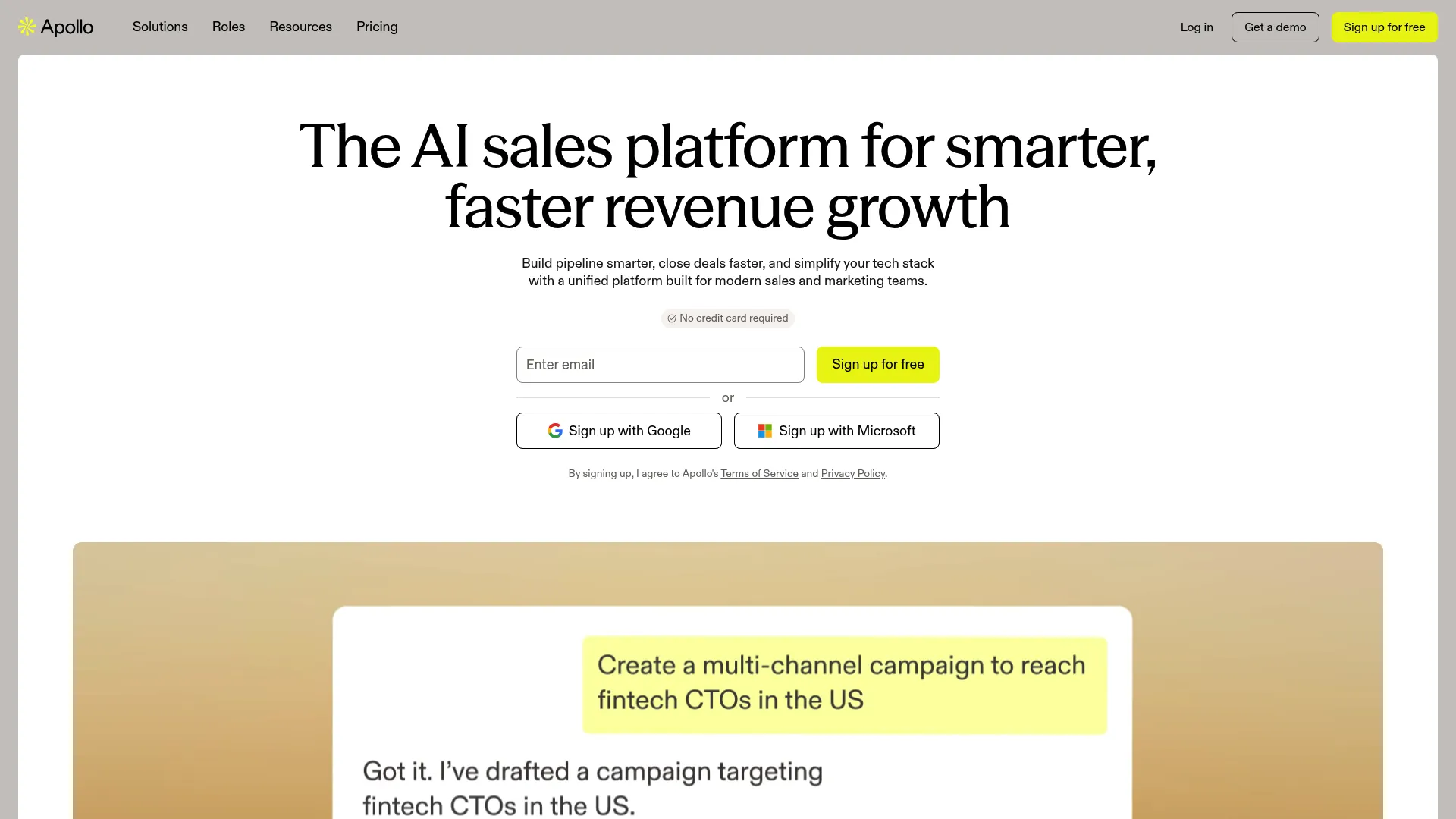
Apollo is an AI-powered go-to-market platform that combines prospecting, outreach, data enrichment, and deal execution. For SDRs, the draw is having a company and contact database sit next to the sequencer that works it. You filter by firmographics, build a list, and start outreach without switching tools.
Best for: B2B sales teams that want prospecting and outreach living in one accessible platform.
Key strengths
- B2B contact and company database
- Sales engagement automation and sequences
- Dialer with call workflows and CRM sync
- Firmographic filters for list building
- Free tier for testing before you commit
Why choose Apollo: Apollo fits SDR teams that value workflow consolidation and an accessible price point. If you want firmographic data and the outreach engine in the same tab, this covers both without a heavy enterprise contract.
Apollo pricing: Apollo offers a free plan at $0 for one user. Paid tiers include Basic at $49 per user per month, Professional at $79 per user per month, and Organization at $119 per user per month for three users. Pricing is confirmed on Apollo's site.
4. D&B Hoovers
D&B Hoovers is a B2B sales intelligence and prospecting platform from Dun & Bradstreet. Its edge is the depth and lineage of its company records, built on decades of verified business data. For teams that care about accurate firmographics and financial detail, the established business records carry weight.
Best for: Sales and RevOps teams prospecting into target accounts with verified company, contact, and intent data.
Key strengths
- Company and contact data for prospecting
- Buyer intent and opportunity signals
- AI-powered prospect scoring and list building
- Deep financial and firmographic detail
- Verified records with strong data lineage
Why choose D&B Hoovers: Choose D&B Hoovers when data accuracy and company intelligence depth outrank everything else. It fits teams selling into larger accounts where financial and ownership detail informs the pitch.
D&B Hoovers pricing: D&B Hoovers Essentials publishes plans starting at $49 per month, or $529 per year on the annual plan, with company and contact credits. Broader enterprise plans emphasize a free trial and are quoted directly.
5. Techsalerator
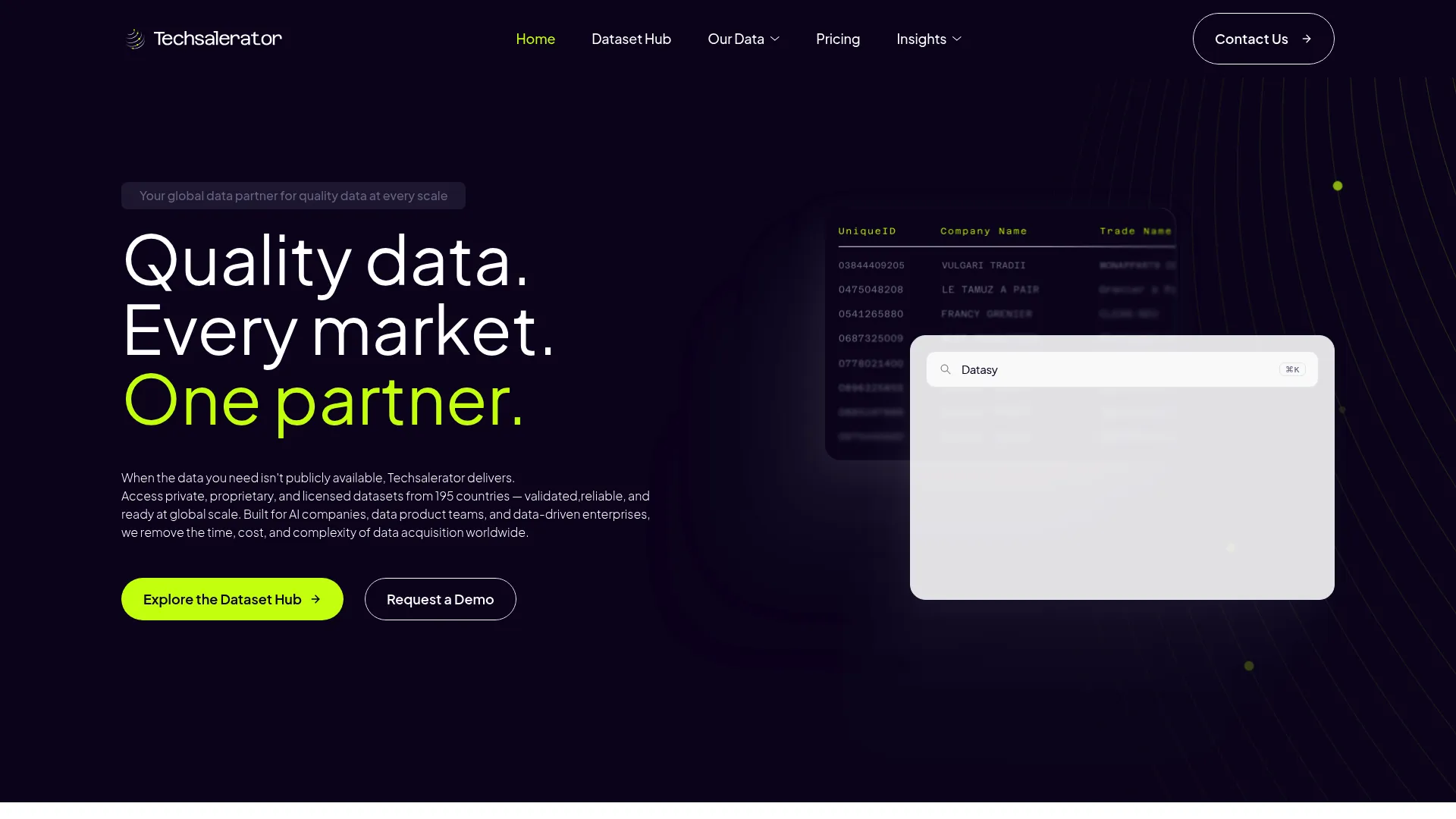
Techsalerator is a global data marketplace and private dataset provider covering B2B, B2C, geospatial, and alternative data. It reaches 195 countries and delivers data through DataShop, APIs, CSV, JSON, Excel, and S3. For teams that need hard-to-source or region-specific firmographic data, the flexibility is the point.
Best for: Enterprises needing global, hard-to-source datasets with custom delivery.
Key strengths
- Private, proprietary, and licensed datasets across 195 countries
- Delivery via DataShop, APIs, CSV, JSON, Excel, and S3
- Coverage across B2B, B2C, geospatial, and alternative data
- Custom dataset sourcing for niche needs
- Flexible formats that fit into existing pipelines
Why choose Techsalerator: Choose Techsalerator when standard providers do not cover your region or vertical, and you need data delivered in a specific format. It fits data and RevOps teams building custom enrichment pipelines rather than working inside a single UI.
Techsalerator pricing: Techsalerator does not display public pricing and directs buyers to request a quote. Pricing depends on the datasets, coverage, and delivery method you need.
6. Lusha
Lusha is a B2B data and intelligence platform for go-to-market teams. It focuses on speed and simplicity, giving SDRs quick access to verified contact and company data with buying signals attached. When you want to enrich a record and move on without a setup project, Lusha is built for that pace.
Best for: Sales teams that need fast B2B contact data, enrichment, and buying signals.
Key strengths
- Verified contact and company data
- Buying signals for prospect timing
- CRM and workflow integrations
- Credit-based model that scales with use
- Fast enrichment with minimal setup
Why choose Lusha: Lusha fits SDRs and smaller teams that want lightweight enrichment without a long onboarding. If your priority is speed to a clean record, its simplicity is the draw.
Lusha pricing: Lusha uses a credit-based model. The Free plan includes up to 40 credits per month. The Scale plan is customizable, and larger teams are directed to Sales for Custom pricing.
7. Clearbit
Clearbit is a B2B data enrichment and buying-intent tool now part of HubSpot. Its strength is real-time enrichment: leads, contacts, and accounts get filled in automatically as they enter your systems. For teams that want firmographic data to flow into forms and CRM without manual lookups, Clearbit wires that in.
Best for: B2B teams that need enrichment, visitor identification, and form optimization.
Key strengths
- Real-time enrichment for leads, contacts, and accounts
- Anonymous visitor identification via Reveal
- Form shortening and autofill
- Firmographic attributes pushed into CRM automatically
- Deep fit for HubSpot-centric stacks
Why choose Clearbit: Choose Clearbit when enrichment should happen automatically at the point of capture, especially if you run on HubSpot. It fits marketing and RevOps teams that want firmographics filled in the moment a lead arrives.
Clearbit pricing: Clearbit no longer publishes a public pricing table, and its site notes the tool has joined HubSpot. Pricing is scoped through HubSpot. Check Clearbit's pricing page for current details.
8. Cognism
Cognism is a B2B sales intelligence platform for prospecting, CRM enrichment, and data-as-a-service. It is known for strong European coverage and a governance-forward approach to data, which matters when your outreach crosses into EMEA. For teams balancing reach with compliance, that focus stands out.
Best for: Mid-market and enterprise B2B teams prospecting in Europe and beyond.
Key strengths
- Sales prospecting with contact and company data
- CRM enrichment for clean records
- Data-as-a-service via API or bulk delivery
- Strong EMEA firmographic coverage
- Governance-conscious data sourcing
Why choose Cognism: Choose Cognism when your motion reaches European accounts and data governance is a real requirement, not an afterthought. It fits teams that need coverage and compliance orientation together.
Cognism pricing: Cognism uses quote-based pricing with plan names including Standard, Pro, CRM Enrichment, and Data-as-a-Service. Prices are tailored by product, team setup, usage, and delivery. Contact Cognism for a scoped quote.
Considerations
Before you sign, run each shortlisted vendor through this checklist. The differences that matter show up in trials, not in feature pages.
Verify data freshness and refresh cadence
Ask how often records are re-verified, not just how many records exist. With B2B data decaying near 30% a year, per Landbase (2025), a huge database that refreshes slowly can be worse than a smaller one that updates constantly. Test freshness on accounts you already know.
Check coverage by region and industry
A provider strong in North American tech may thin out in EMEA manufacturing. Pull sample records for your actual target segments and count how many come back complete. Coverage claims are averages; your ICP is specific.
Confirm CRM and sequencer integrations
Data that lives in a separate tab creates work instead of removing it. Confirm the tool pushes clean records into your CRM and enriches inside your sequencer. For an SDR juggling seven tabs, native integration is the difference between adoption and abandonment.
Evaluate how firmographics pair with technographics
Firmographic and technographic data are stronger together. Check whether the provider offers technographics, or integrates cleanly with one that does, so you can target by both company profile and tech stack in the same query.
Review governance, compliance, and export controls
If you prospect into EMEA, data governance is not optional. Confirm how the vendor sources and maintains data, what compliance frameworks it aligns with, and how export controls work for your team's size and region.
Conclusion
Cleaner company data is not a nice-to-have. It is the difference between reply rates that hold and pipeline your AEs actually trust. Every tool here solves the firmographic problem; the right one depends on your motion.
If you need broad coverage plus intent, ZoomInfo covers the most ground. For account-based orchestration, Demandbase ties firmographics to coordinated plays. Apollo suits SDRs who want prospecting and outreach in one place, while Lusha and Clearbit fit teams that want fast or automated enrichment. D&B Hoovers brings verified depth, Techsalerator brings flexible global datasets, and Cognism brings EMEA strength with governance built in.
Do not decide on a feature page. Take your two or three finalists, run the same 50-account list through each, and count how many records come back complete, current, and correctly classified. The winner is the one that hands you the cleanest list with the fewest wasted touches.
FAQs
SDRs use it to build target account lists, qualify inbound leads by fit, plan territories, and personalize outreach by industry, size, and geography. In practice, it replaces manual company research so you spend your day reaching out instead of looking things up. The payoff is fewer wasted touches on wrong-fit accounts.
Industry, employee count, revenue band, and geography do most of the heavy lifting for list building and qualification. Ownership structure and funding stage add signal when you want to catch accounts at a growth moment. Start with the four core fields, then layer in the rest as your segmentation matures.
Firmographic data describes what a company is: industry, size, revenue, location. Technographic data describes what a company uses: the software and platforms in its stack. Combining firmographic and technographic data lets you target the right company and open with a reason tied to their tech, which sharpens both fit and messaging.
B2B data decays at roughly 30% per year, per Landbase (2025), so continuous refresh beats an annual scrub. Prioritize providers that re-verify records on an ongoing basis rather than in periodic batches. For inbound leads, enrich at the point of capture so records are current when you act on them.
Fit scoring only works when the underlying company attributes are accurate. Clean firmographics let you score an inbound lead in seconds instead of researching the company by hand. A 12-person shop and a 5,000-person enterprise should not get the same treatment, and good data makes that call automatically.
Smaller teams often favor accessible, low-setup options. Apollo pairs firmographic filters with outreach in one tool and offers a free plan to test. Lusha focuses on fast, credit-based enrichment with a free tier. Both let a small team get clean records without a long onboarding or enterprise contract.
Pull sample records for accounts you already know well and compare fields against reality. Count how many come back complete and correctly classified, and test the same accounts across two providers during a trial. Accuracy on your specific target segments matters more than any headline coverage number.
Yes. Firmographic data is the foundation of ICP building and account segmentation, which are the starting point for any account-based motion. Tools built for ABM unify firmographics with intent data so sales and marketing work the same account list, coordinating plays around the accounts most likely to convert.