Pay equity used to be a once-a-year fire drill. Someone in HR exported a spreadsheet, ran a regression, fixed the worst outliers, and filed the analysis until next year. That model is breaking.
State-level pay transparency laws now require posted salary ranges in much of the United States. The EU Pay Transparency Directive pushes member states toward gender pay gap reporting and "right to information" obligations that land in 2026 and 2027. Your compensation data is no longer something you analyze once. It is something regulators, candidates, employees, and your own board can ask about at any time.
For a founder, this is not an HR problem. It is a governance problem. A single unexplained pay gap that surfaces during due diligence, a board meeting, or an employee complaint can stall a fundraise or trigger legal exposure. The Research and Markets pay equity software market analysis (2024) projects the category growing at a 5 to 15% CAGR through 2030, driven mostly by these new transparency laws. The buyers driving that growth are not chasing dashboards. They want a defensible, repeatable system for monitoring pay equity continuously, proving compliance, and handling remediation without turning every quarter into a spreadsheet project.
This guide ranks the best pay equity software for teams that need exactly that. We focus on methodology, remediation depth, global coverage, and audit-ready reporting, because those are the factors that decide whether your pay equity solutions hold up under scrutiny.
What's inside
This guide covers software that ingests compensation data, runs statistical pay analysis to find unexplained gaps, simulates remediation, and produces reporting you can defend to regulators and your board. It is written for HR and total rewards leaders, compliance-minded operators, and founders who treat compensation as a system, not a one-time audit.
We selected and ranked vendors on four criteria:
- Methodology and statistical rigor - defensible models, not just charts
- Remediation depth - simulation, budget modeling, and prioritization
- Global and legal coverage - multi-jurisdiction reporting and pay transparency readiness
- Data integration and governance - HRIS integration, security, and audit trails
Pricing for most of this category is quote-based. Where a vendor publishes figures or a G2 rating exists, we cite it. Verify current numbers with each vendor before you sign.
TL;DR
- Best for enterprise remediation and global compliance: PayParity. Its R.O.S.A. engine optimizes remediation spend, and its reporting is built for multi-jurisdiction pay transparency.
- Best for governed pay decisions at scale: Syndio. Strong for large enterprises that want pay equity baked into every compensation decision, not just an annual review.
- Best for a clean analyze-close-report-sustain workflow: PayAnalytics. Straightforward, usability-first, with strong global pay transparency support.
- Best for teams already running broader compliance programs: Affirmity. Pairs pay equity with affirmative action and workforce compliance reporting.
- Best for compensation structure plus equity analysis: beqom Pay Equity. Fits enterprises that want comp planning and equity in one platform.
- Best for highly configurable comp operations: Compport, and best for mid-market total rewards: Barley and CompUp.
If you want a parallel framework for evaluating governance and risk tooling, our roundup of the best AI cybersecurity solutions uses the same defensibility-first lens applied here.
What is pay equity software?
Pay equity software is a category of HR and compensation technology that ingests workforce and pay data, applies statistical analysis to surface unexplained pay differences, simulates and prioritizes remediation, and generates compliance and audit-ready reporting across jurisdictions.
The core workflow is consistent across vendors, even when the labels differ:
- Ingest compensation data. Connect to your HRIS, payroll, and comp planning systems and normalize job architecture, levels, locations, and demographics.
- Analyze gaps. Run statistical pay analysis (usually regression-based) to separate explainable pay differences from unexplained ones tied to gender, race, or other protected characteristics.
- Simulate remediation. Model corrections, prioritize adjustments, and tie them to a real budget rather than a wish list.
- Monitor over time. Re-run analysis on a schedule or on events like merit cycles, promotions, and new hires.
- Generate reports. Produce equity reporting for leadership, regulators, and jurisdiction-specific frameworks.
Key capabilities buyers should expect from modern workplace equity software:
- Statistically valid pay gap analysis with model transparency
- Intersectional analysis, not just single-variable cuts
- Remediation simulation tied to budget constraints
- Multi-country, multi-currency global pay equity support
- HRIS integration with payroll and comp planning systems
- Role-based access controls and an audit trail
- Pay transparency reporting aligned to current and emerging laws
Why continuous pay equity monitoring matters in 2026
A one-time audit tells you where you stood on the day you ran it. The moment you process the next merit cycle, hire a cohort, or close an acquisition, that snapshot is stale. Continuous pay equity monitoring treats equity as a live metric. You catch drift as it happens, document the decisions behind every adjustment, and walk into a board meeting or compliance review with a current answer instead of a six-month-old one.
This matters more in 2026 because the reporting cadence is no longer annual everywhere. The EU Pay Transparency Directive and a growing patchwork of state laws mean multi-jurisdiction teams face overlapping deadlines. Software that supports ongoing monitoring and multi-jurisdiction reporting turns that complexity into a managed process instead of a recurring scramble.
What to look for in pay equity software
Not every tool that charts salaries is built for defensibility. These are the pay equity software features that separate a real system from a dashboard.
Methodology and statistical rigor
The output of a pay equity analysis can end up in a regulator filing or a legal proceeding, so the methodology has to hold up. Look for tools that run statistically valid regression analysis, expose how the model works, and support root-cause analysis. You want to understand which variables explain a gap and which do not. A tool that only shows you a red number without the model behind it cannot defend the conclusion. Model transparency is the difference between "we think there's a gap" and "here is the statistical basis for the gap and the factors driving it."
Remediation workflow
Finding gaps is the easy part. Closing them under a finite budget is the hard part. Strong pay remediation features let you simulate corrections, model the budget impact, and prioritize which adjustments deliver the most equity per dollar. A good remediation workflow ties directly to approval processes and documents the rationale behind every change. That documentation is what makes your decisions defensible later. Tools that stop at "here are the gaps" leave the actual work on your plate.
Global and legal coverage
If you employ people in more than one country, global pay equity coverage stops being optional. Look for multi-country analysis, currency handling, and reporting templates mapped to specific jurisdictions. The EU Pay Transparency Directive is the obvious near-term driver, but Australia, Japan, and a widening set of regions have their own gender pay gap reporting requirements. A tool that handles jurisdiction-by-jurisdiction reporting saves you from rebuilding the analysis for every country you operate in.
Data integration and governance
Pay equity software is only as good as the data feeding it. Prioritize HRIS integration with systems like Workday, SAP, ADP, and UKG, plus connections to payroll and comp planning. Then look at governance: role-based permissions, an audit trail of who changed what, and security controls that match enterprise procurement standards. Compensation data management is sensitive by definition. Access controls and a clean audit trail are what let you share results with legal, finance, and the board without exposing raw pay data to the wrong people.
When to use pay equity software
Preparing for pay transparency reporting
When a reporting deadline is coming, whether it is a state pay data filing or an EU directive obligation, software lets you get ahead of it. Instead of assembling data under time pressure, you run the analysis early, fix what you find, and produce the report on schedule. Teams that wait until the deadline turn a manageable process into a crisis.
Running annual or quarterly pay reviews
Recurring analysis beats a one-off spreadsheet audit every time. Run your pay gap analysis on a fixed cadence and you catch drift before it compounds. A quarterly or biannual review tied to merit cycles and promotions keeps equity from silently eroding between annual checkpoints. The software handles the repeat runs so the process does not depend on one person remembering to rebuild a model.
Remediating pay gaps after a review
Once a review surfaces gaps, the software helps you model corrections against a real budget, prioritize adjustments, and document every decision. That documentation matters as much as the adjustment itself. When someone asks why a specific raise happened, you have the rationale on record instead of reconstructing it from memory months later.
Comparison table
Here is how the eight platforms compare at a glance. Pricing across this category is largely quote-based, so confirm current figures and ratings with each vendor before you commit. Ratings are pulled from G2 where available.
| # | Product | Intent | Key differentiation | Pricing | G2 rating |
|---|---|---|---|---|---|
| 1 | PayParity | Enterprise pay equity and compliance | R.O.S.A. remediation spend optimization, intersectional analysis | Quote-based | Not listed |
| 2 | Syndio | Governed pay decisions at scale | Real-time pay decision guidance across the comp lifecycle | Quote-based | 4.5/5 |
| 3 | PayAnalytics | Workflow-driven analysis and reporting | Analyze-close-report-sustain workflow, global transparency | Quote-based | Not rated |
| 4 | Affirmity | Compliance-led workforce equity | Pay equity plus affirmative action and EEO reporting | Quote-based | Not rated |
| 5 | beqom Pay Equity | Comp management plus equity | Equity analysis inside a broader compensation platform | Quote-based | 4.7/5 |
| 6 | Compport | Configurable compensation operations | Highly flexible comp planning with pay equity built in | Quote-based | 4.7/5 |
| 7 | Barley | Mid-market total rewards | Pay bands and comp reviews with equity analysis | From $5/user/mo | Not rated |
| 8 | CompUp | Scaling comp and equity workflows | Comp planning, benchmarking, and equity analysis | Quote-based | 4.9/5 |
The 8 best pay equity software platforms for 2026
1. PayParity
PayParity is Trusaic's enterprise pay equity software, built to analyze, remediate, and report pay disparities across a global workforce. It positions itself squarely at large organizations that need defensible methodology and multi-jurisdiction compliance in one platform. Where many tools stop at surfacing gaps, PayParity is designed around closing them and proving the result.
Best for: Large enterprises that need rigorous pay equity analysis, remediation, and compliance reporting across multiple countries.
Key strengths
- R.O.S.A. remediation engine: Models the most cost-effective set of pay adjustments, so you close gaps without overspending the remediation budget.
- True intersectional analysis: Goes beyond single-variable cuts to examine how gender, race, and other characteristics combine, which is where many gaps actually hide.
- Global reporting compliance: Streamlined pay data reporting mapped to multiple jurisdictions, including EU pay transparency obligations.
Why choose PayParity
If your primary concern is walking out of a compliance review or due diligence with a defensible, fully documented answer, PayParity is built for that scenario. Its strength is the combination of statistical rigor, an optimization-driven remediation engine, and reporting designed for multiple legal frameworks at once. It fits enterprise HR and compensation teams that operate across borders and cannot afford a methodology that falls apart under scrutiny.
PayParity pricing: PayParity does not publish public pricing. The product is sold through a demo and sales conversation, with packaging tailored to workforce size and the jurisdictions you operate in. Request a quote and confirm scope before budgeting.
2. Syndio
Syndio is enterprise pay governance software that spans pay equity analysis, real-time pay decision guidance, and compensation compliance. Its angle is operationalizing pay equity, not treating it as a once-a-year report. Syndio is widely used by large enterprises that want equity considerations embedded into the moment a pay decision is made.
Best for: Large enterprises that want governed pay decisions and continuous pay equity workflows rather than a periodic audit.
Key strengths
- Real-time pay decision guidance: Flags equity risk at the point of a raise, offer, or promotion, so gaps are prevented rather than discovered later.
- Pay equity analysis: Statistically grounded gap analysis that holds up to scrutiny from legal, finance, and the board.
- HRIS integration: Connects to your core systems so analysis runs on current data instead of stale exports.
Why choose Syndio
Syndio earns its place when you want pay equity to be a governance layer over every compensation decision, not a backward-looking review. Its buyer-enablement approach and strong evaluation rigor make it a natural fit for total rewards teams that need to defend pay decisions continuously. It carries a 4.5/5 rating on G2, reflecting solid adoption among enterprise compensation teams.
Syndio pricing: Syndio does not display public pricing; the site uses request-a-demo CTAs. Pricing is scoped to your workforce size and the modules you need, so plan for a sales conversation to get a figure.
3. PayAnalytics
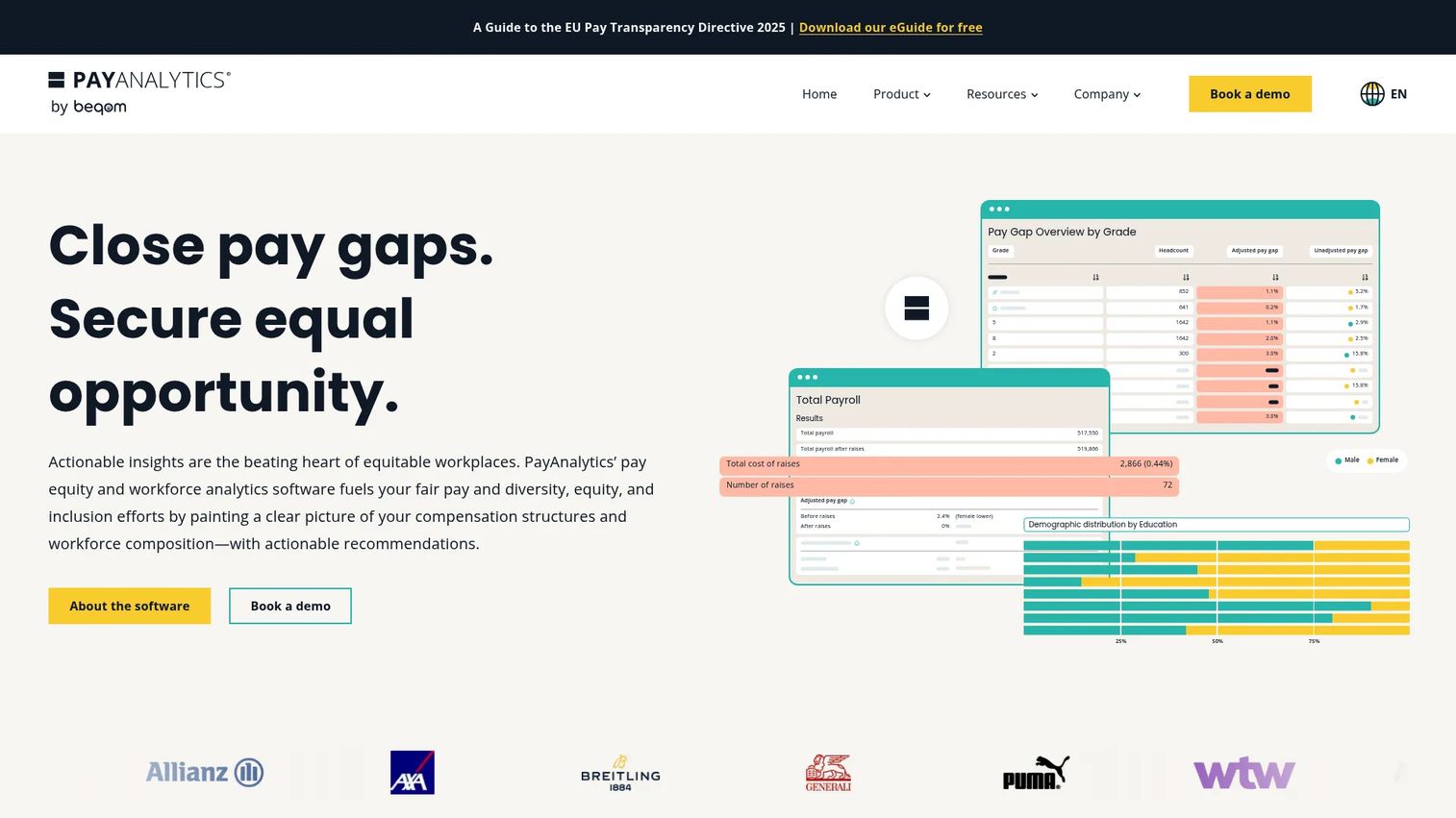
PayAnalytics is pay equity and workforce analytics software organized around a clean workflow: analyze gaps, close them, report results, and sustain equity over time. Its appeal is usability. Teams that want a straightforward path from data to defensible report without heavy configuration tend to gravitate here.
Best for: HR and compensation teams that want a simple, repeatable analyze-close-report-sustain workflow with strong global support.
Key strengths
- Workflow-driven analysis: A guided path from raw data to remediation keeps the process repeatable rather than ad hoc.
- Pay transparency and reporting: A library of built-in reports supports compliance across multiple countries and frameworks.
- Workforce analytics: Goes beyond gap detection to give context on workforce composition and pay structure.
Why choose PayAnalytics
PayAnalytics is the pick when usability and a clean global workflow matter more than deep custom configuration. Its analyze-close-report-sustain model maps neatly onto the way most teams actually run pay equity, and its global transparency reporting suits multi-country employers. It is a strong fit for teams that want to operationalize pay equity quickly.
PayAnalytics pricing: Pricing is subscription-based and quote-driven, varying by the total number of employees analyzed. The minimum subscription is one year, and the vendor notes no extra charge for additional users. There is no free tier, so request a quote sized to your headcount.
4. Affirmity
Affirmity is workforce analytics and compliance software, with pay equity sitting alongside affirmative action planning and federal reporting. Its strength is breadth for organizations that already run broader compliance programs and want pay equity managed in the same place rather than as a standalone tool.
Best for: Mid-market and enterprise HR teams managing workforce compliance, affirmative action, and pay equity together.
Key strengths
- Workforce analytics and compliance platform: Brings pay equity into a wider compliance program rather than treating it in isolation.
- Affirmative action plan automation: Automates a labor-intensive compliance obligation many enterprises already carry.
- EEO-1 and VETS 4212 reporting: Built-in federal reporting reduces the manual assembly that usually surrounds these filings.
Why choose Affirmity
Affirmity makes the most sense when pay equity is one piece of a larger compliance mandate. If your team already owns affirmative action planning and federal reporting, consolidating pay equity into the same platform reduces tool sprawl and keeps governance under one roof. It fits teams that value compliance breadth over a single-purpose pay equity tool.
Affirmity pricing: Affirmity does not publish public pricing. Packaging appears to be quote-based and scoped to your compliance needs and workforce size, so engage their team for a tailored figure.
5. beqom Pay Equity
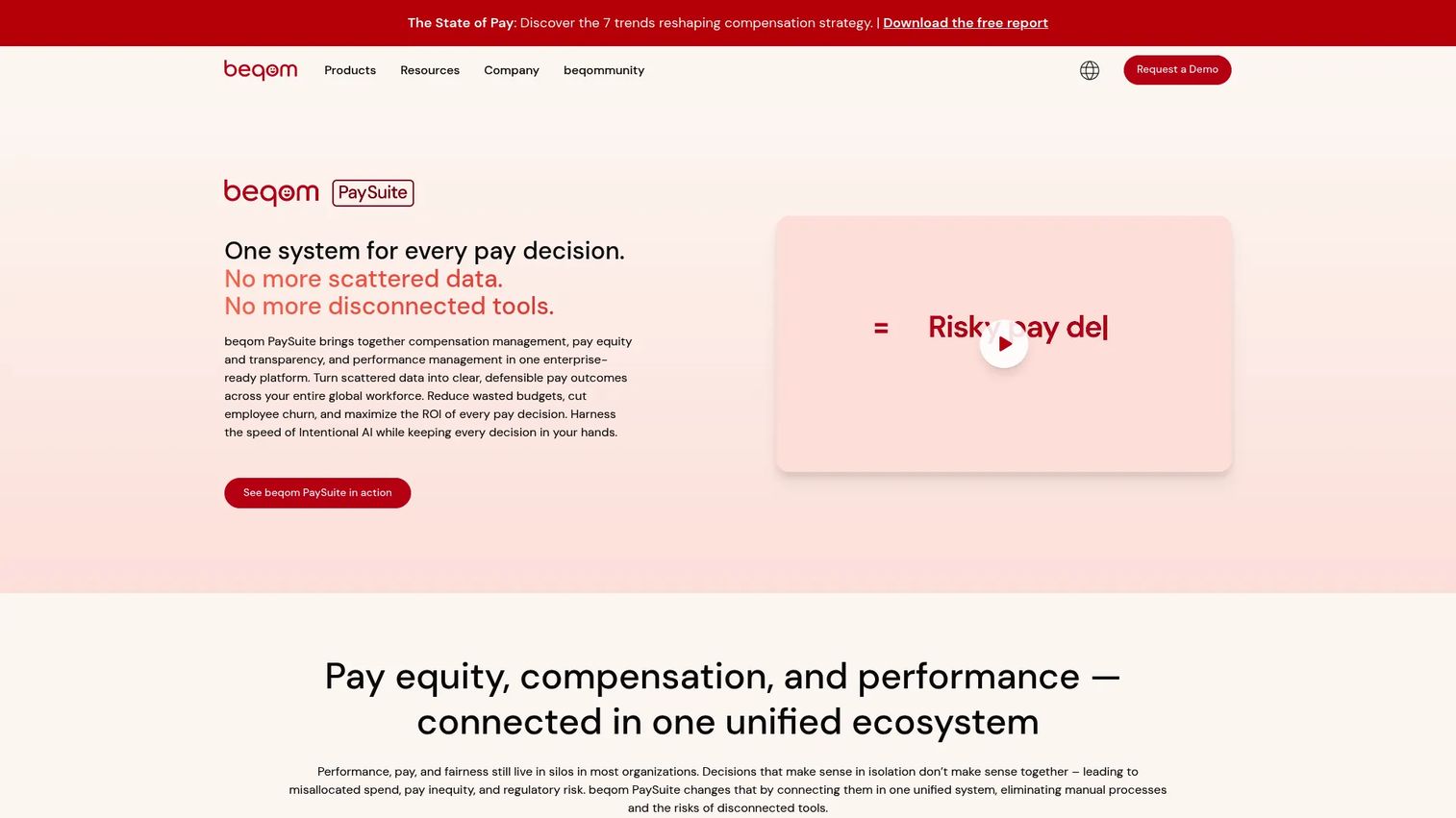
beqom Pay Equity brings pay equity analysis and transparency into beqom's broader compensation management platform. That positioning matters: teams that want compensation structure, planning, and equity analysis in one system rather than stitching tools together are the natural audience. It serves enterprises that treat equity as part of total compensation governance.
Best for: Large enterprises that want pay equity analysis, remediation, and compliance reporting inside a broader compensation platform.
Key strengths
- Pay equity analysis: Statistical gap analysis integrated with the compensation data already managed in beqom.
- Workforce analytics: Contextual analytics that connect equity findings to pay structure and planning.
- Remediation recommendations: Surfaces prioritized adjustments so teams move from finding gaps to closing them.
Why choose beqom Pay Equity
Choose beqom when you want equity analysis to live next to compensation planning and structure rather than in a separate tool. For enterprises managing global compensation, having planning and equity in one platform simplifies governance and keeps data consistent. It holds a 4.7/5 rating on G2, reflecting strong satisfaction among enterprise users.
beqom Pay Equity pricing: beqom does not list public pricing; product pages direct visitors to book a demo. Expect enterprise, quote-based packaging scoped to your compensation footprint.
6. Compport
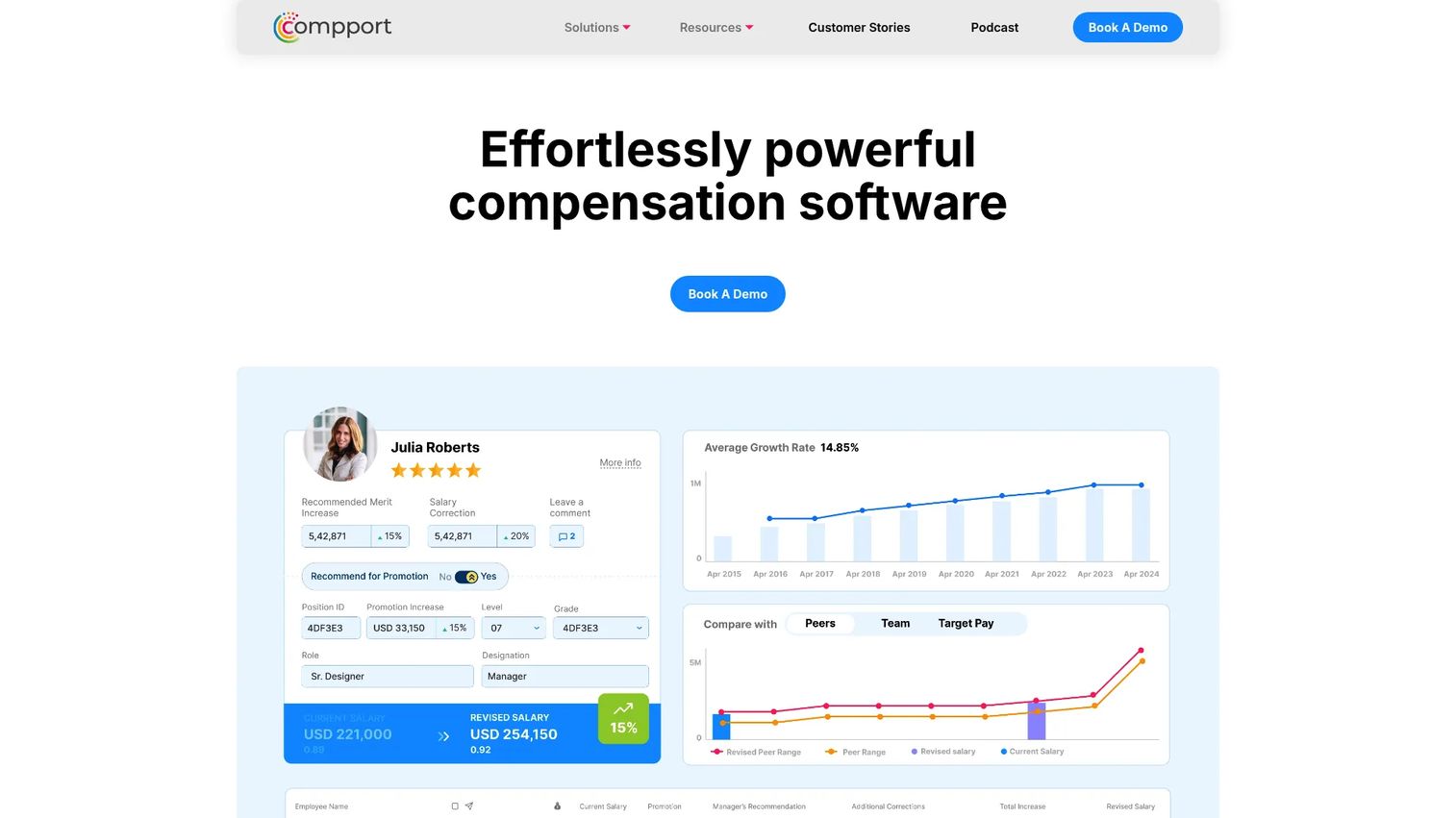
Compport is a total compensation management platform covering merit cycles, bonus planning, sales incentives, and pay equity. Built from the ground up to be highly configurable, it suits large organizations that want broad compensation operations with equity analysis included rather than bolted on.
Best for: Large organizations needing configurable compensation planning and rewards management with pay equity built in.
Key strengths
- Merit cycles and salary reviews: Runs the core comp processes where equity drift most often originates.
- Bonus planning and sales incentives: Extends governance beyond base pay into variable compensation.
- Pay equity management and total rewards statements: Ties equity analysis to the broader rewards picture employees actually see.
Why choose Compport
Compport fits teams that need flexible, configurable compensation operations and want pay equity handled within that system. Its configurability is the draw for organizations with complex pay structures across regions and roles. It carries a 4.7/5 rating on G2, indicating strong adoption among enterprise rewards teams.
Compport pricing: Compport does not publish numeric pricing. The site indicates employee-based and product-based pricing with tailored packages, accessed through a demo request. Scope your headcount and module needs before requesting a quote.
7. Barley
Barley is compensation management software for HR and total rewards teams, now part of Workleap, covering pay bands, compensation reviews, analytics, and pay equity analysis. It sits closer to comp operations than to pure-play pay equity, which makes it worth evaluating for mid-market teams that want both in one tool.
Best for: HR and total rewards teams managing compensation cycles, pay structure decisions, and equity analysis at mid-market scale.
Key strengths
- Pay bands management: Structured pay bands give equity analysis a consistent framework to measure against.
- Compensation reviews and analytics: Runs the recurring comp cycles where equity needs ongoing attention.
- Pay equity analysis with benchmarking: Pairs gap analysis with benchmarking data and a total rewards portal.
Why choose Barley
Barley is a fit when pay equity is part of a broader comp management need rather than a standalone compliance mandate. Mid-market teams that want pay bands, reviews, and equity analysis in one place will find it practical. Be honest with yourself about depth: if you need heavy multi-jurisdiction remediation, pair it with a dedicated pay equity tool. For comp operations with equity built in, it covers the ground well.
Barley pricing: Under Workleap, the Compensation plan is listed at $5/user/mo with a 100-user minimum. There is no free tier. Additional Workleap product plans and add-ons are available on the pricing page, so confirm the full bundle for your team.
8. CompUp
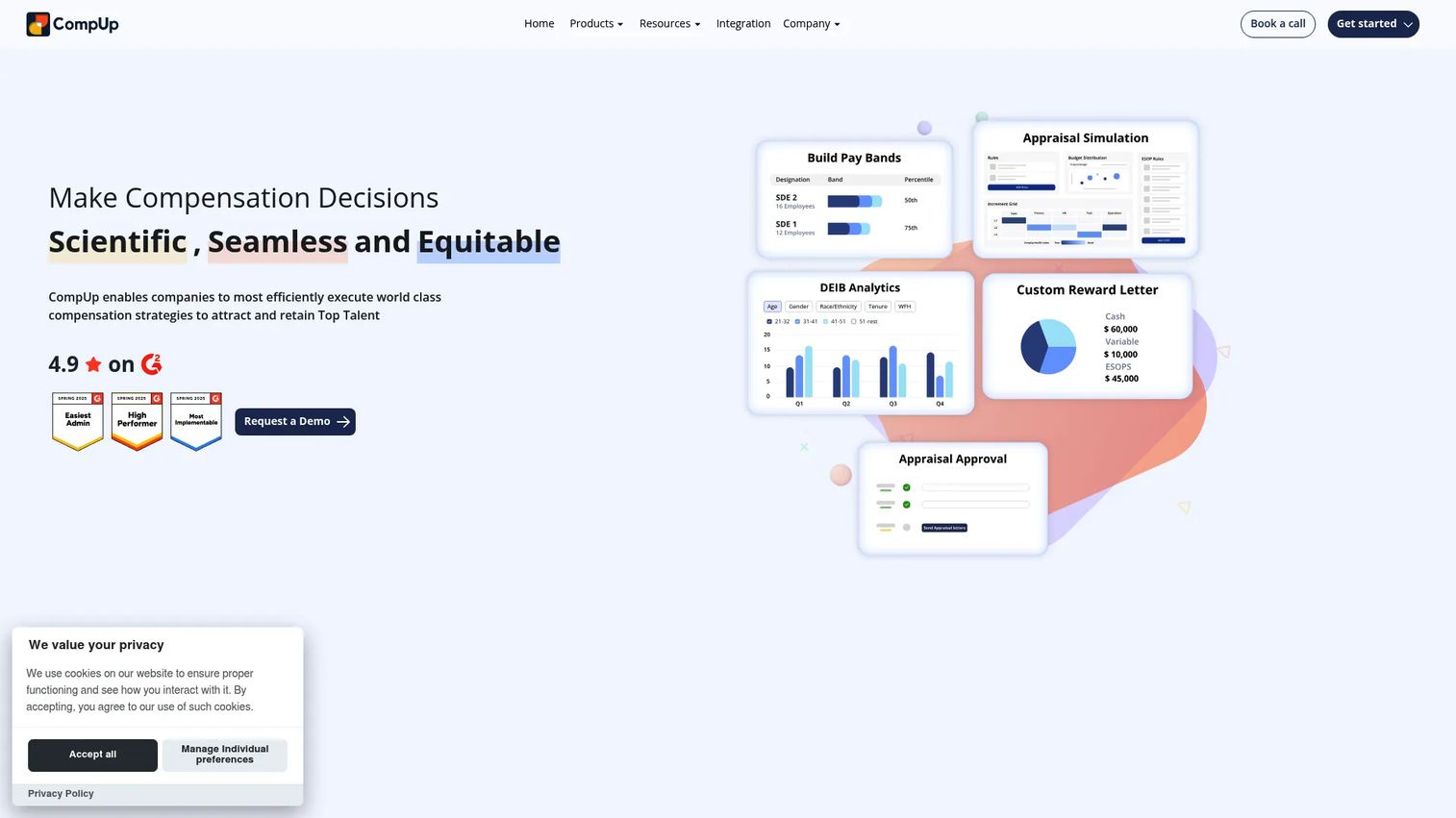
CompUp is compensation management software spanning planning, benchmarking, reporting, pay transparency, and equity analysis. It targets scaling teams that want compensation operations and pay equity workflows together as they grow, rather than buying separate tools at each stage.
Best for: HR and rewards teams managing compensation planning, benchmarking, and pay equity workflows as they scale.
Key strengths
- Compensation planning and appraisal cycles: Manages the comp processes where equity is created or eroded.
- Salary structuring and analytics: Combines budget forecasting and compensation analytics with structure decisions.
- Pay transparency and equity analysis: Multi-currency equity analysis suited to teams operating across regions.
Why choose CompUp
CompUp suits scaling organizations that want planning, benchmarking, and pay equity in a single growing platform. Its multi-currency support and analytics make it relevant for teams expanding into new regions. It holds a 4.9/5 rating on G2, the highest in this list, reflecting strong satisfaction among its user base.
CompUp pricing: CompUp's first-party pricing page does not show visible figures, though tiered plans including a benchmarking option are referenced. Pricing is effectively quote-based, so request a demo for numbers scoped to your team.
Considerations before you buy
Before you shortlist, run every candidate through the criteria that actually decide whether a pay equity system holds up.
Methodology you can defend
Ask the vendor to explain their statistical model in plain terms. If they cannot show you which variables explain a gap and which do not, the output will not survive a legal challenge or a board question. Defensibility starts with model transparency.
Remediation that respects a budget
Finding gaps is table stakes. Confirm the tool can simulate corrections, model budget impact, and prioritize adjustments. A remediation workflow that ties to approvals and documents rationale is what turns analysis into action.
Global and jurisdiction coverage
If you operate across borders, confirm multi-country analysis, currency handling, and reporting mapped to the jurisdictions you actually serve. EU Pay Transparency Directive readiness is the near-term test, but check the specific countries on your map.
Integration and data governance
Verify HRIS integration with your stack, plus payroll and comp planning connections. Then check governance: role-based access, audit trails, and security controls that pass procurement. Compensation data management is sensitive, so this is not optional.
Fit for your operating cadence
Decide whether you need continuous monitoring or scheduled reviews, and confirm the tool supports your cadence. The right answer depends on your org's maturity and the reporting deadlines you face.
Conclusion
The right pay equity software depends on which problem you are solving. If your priority is remediation depth and multi-jurisdiction compliance, PayParity leads with its R.O.S.A. engine and global reporting. If you want pay equity governing every compensation decision in real time, Syndio is built for that. For a clean, usable analyze-close-report-sustain workflow with strong global pay equity support, PayAnalytics delivers.
Teams running broader compliance programs should look at Affirmity, while enterprises that want equity analysis inside a full compensation platform will find beqom Pay Equity, Compport, Barley, and CompUp worth evaluating depending on configurability and scale needs.
The pattern across all of them: pay equity is now an ongoing operating requirement, not a one-time audit. Shortlist two or three vendors, then validate three things in a live demo with your own anonymized data: the methodology, the integrations, and the reporting. The tool that produces a defensible answer on your data, not a generic one, is the one that earns a place in your stack.
FAQs
Pay equity software is technology that analyzes compensation data, identifies unexplained pay differences tied to gender, race, or other characteristics, and supports remediation and reporting. In practice it ingests workforce and pay data, runs statistical analysis to surface gaps, helps you model corrections, and produces audit-ready reporting for leadership and regulators. It turns pay equity from a one-time spreadsheet exercise into a repeatable, defensible process.
It combines compensation data with workforce variables like job level, location, tenure, and performance, then applies statistical pay analysis, usually regression, to separate explainable pay differences from unexplained ones. The unexplained portion tied to protected characteristics is the pay gap. The quality of the conclusion depends on defensible methodology, so model transparency matters as much as the result itself.
Prioritize global and multi-jurisdiction support, enterprise-grade security, audit trails, robust reporting, and deep HRIS integration with systems like Workday, SAP, ADP, and UKG. Beyond features, look for cross-functional governance: role-based access that lets HR, legal, finance, and the board work from the same analysis without exposing raw pay data. The goal is a system defensible enough to survive due diligence.
It prepares jurisdiction-specific reports, documents the rationale behind pay decisions, and monitors compliance across regions on an ongoing basis. For laws like the EU Pay Transparency Directive and state-level pay data requirements, the software maps your analysis to each framework so you are not rebuilding reports country by country. Continuous monitoring means you meet deadlines from a position of readiness rather than scrambling.
Yes, provided it supports multiple countries, currencies, languages, and reporting frameworks. Global pay equity coverage is often the key differentiator between vendors, because a multi-country employer faces overlapping reporting obligations that a single-jurisdiction tool cannot handle. Confirm the platform covers the specific countries on your map before committing.
Typically compensation, job, employee, location, level, and often performance or tenure data, pulled from your HRIS and payroll systems. Data hygiene and a clean job architecture matter enormously, because the analysis is only as reliable as the inputs. Inconsistent levels or messy job mapping will undermine even the strongest statistical model.
Ongoing monitoring beats a one-time review. Many teams run analysis quarterly or biannually, and also on events like merit cycles, promotions, acquisitions, and new-hire cohorts. The right cadence depends on your organization's maturity and the reporting deadlines you face, but continuous pay equity monitoring catches drift before it compounds.
Compare methodology and statistical rigor, remediation depth, global and jurisdiction coverage, security and governance, and how well the workflow fits your team. The most reliable test is to run a real, anonymized dataset through your shortlist of two or three vendors during a demo. The tool that produces a defensible, well-documented answer on your own data is the one worth buying.