You evaluate three emotion recognition tools. All three promise to read faces, voices, and sentiment in real time. None of them tell you the one thing you actually need to know: will the output survive your workflow, your latency budget, and your legal review?
That gap is the whole problem. Emotion recognition software is easy to describe and surprisingly hard to evaluate. The global emotion detection and recognition market sits at roughly USD 71.10 billion in 2026 and is projected to reach USD 253.28 billion by 2033 at a 19.9% CAGR, with software alone accounting for 59.1% of that spend, according to Coherent Market Insights (2024). The category is real, it is growing fast, and most buyer-facing content stops at a definition.
This guide does not. It centers the decisions that matter when you compare emotion recognition AI for a real project: input type (face, voice, text, or multimodal), real-time versus batch processing, SDK or API versus hosted service, and the privacy and compliance posture that determines whether you can ship at all. The same evaluation muscle applies whether you are vetting affective computing platforms or building interactive product experiences, which is why teams comparing these tools often also study adjacent categories like AI governance tools, best AI agents, and AI customer service software when scoping a build.
By the end, you will know which tool fits a webcam-based engagement study, which fits a voice-first conversational product, and which fits an enterprise computer vision pipeline.
What's inside
This guide is for product teams, CX and UX researchers, marketing researchers, and developers comparing emotion detection software for a specific job. We selected tools that are current, documented, and clearly built for emotion or facial affect analysis, then ranked them by category fit and breadth of use. For each tool you get an overview, key strengths, ideal use cases, and verified pricing or licensing context where it is publicly available. We weighted four criteria throughout: input type and multimodal support, real-time versus batch processing, SDK or API delivery, and privacy posture.
TL;DR
- Best for research-grade multimodal studies: iMotions, with Affectiva facial coding plus eye tracking, EEG, and GSR in one platform.
- Best for privacy-first, browser-based emotion AI: MorphCast, processing facial expressions on-device with no server round-trip.
- Best for voice-first conversational products: Hume AI, with empathic voice and expression measurement built for real-time inference.
- Best for embeddable face analysis SDKs: Visage Technologies and FaceReader SDK, for teams shipping facial expression recognition inside their own apps.
- Best for enterprise vision pipelines: Viso Suite, for teams building custom computer vision systems that can fold in emotion-related analysis.
What emotion recognition software is
Emotion recognition software is technology that uses AI and machine learning to infer emotional states from human signals such as facial expressions, voice, speech prosody, text, or physiological data, then returns structured outputs like emotion labels and confidence scores. It sits inside the broader field of affective computing, the discipline focused on systems that recognize, interpret, and respond to human affect.
The terminology around this category gets muddy fast, so it helps to separate the adjacent terms:
- Emotion detection software and emotion recognition AI are often used interchangeably to describe the inference engine itself.
- Facial emotion recognition software narrows the input to the face, reading expressions and facial action units.
- Facial expression recognition is the underlying technical task: mapping muscle movements to discrete expressions.
- Multimodal emotion recognition combines two or more inputs, for example face plus voice, to produce a more robust read.
- Emotion AI is the umbrella marketing term most vendors use.
Why confidence scores and probability distributions matter: a serious tool does not just hand you "happy." It hands you a probability distribution across emotion classes, each with a confidence score. A frame might return 62% joy, 18% surprise, 12% neutral, and the rest spread across other states. That structure is what lets you set thresholds, filter noise, and decide when a signal is strong enough to act on. A tool that only emits a single hard label is hiding the uncertainty you need to manage.
Much of the academic grounding traces back to Paul Ekman's discrete emotion model and James Russell's circumplex model of valence and arousal. Some tools classify into a fixed set of discrete emotions. Others output continuous dimensions. Knowing which model a vendor uses tells you a lot about how their output will behave in your workflow.
How emotion recognition software works
Inputs the software can analyze
Emotion recognition tools differ most in what they consume. The common inputs:
- Facial images and live video: The most widely supported input in commercial tools. The model reads expressions, head pose, and facial landmarks from a still frame or a video stream.
- Audio and speech prosody: Voice-based tools analyze tone, pitch, rhythm, and energy rather than the words themselves. This is what powers real-time emotion detection in call analysis and conversational AI.
- Text: Closer to sentiment and emotion classification from language, often used alongside other signals.
- Physiological signals: EEG, GSR (skin conductance), ECG, and heart rate variability. These are specialized, common in research-grade and clinical contexts, and usually require dedicated hardware.
Facial and voice inputs dominate commercial deployments because they need no special sensors beyond a camera or microphone. Physiological inputs are more specialized and tend to show up in academic and biometric research settings.
How models classify emotions
The pipeline is consistent across most tools. First, feature extraction isolates the relevant signal: facial landmarks, action units, prosodic features, or embeddings. Next, model inference runs those features through a trained network. The model then maps the result to emotion labels and emits probability or confidence outputs across the possible classes.
Where tools diverge is the output schema. Some return a fixed set of discrete emotions, typically the six or seven Ekman categories plus neutral. Others return richer affect states or continuous valence-arousal coordinates. Webcam-based emotion analysis tools often surface engagement, attention, and confusion as derived states on top of raw emotion classes. The right schema depends entirely on what your downstream system can consume.
Why real-time processing matters
Real-time inference matters when the system has to respond inside the moment: an adaptive learning experience that reacts to confusion, a driver monitoring system that flags drowsiness, or a conversational interface that adjusts its tone. Latency here is a hard requirement, not a nice-to-have.
Batch analysis is enough when you are studying recorded sessions after the fact, like ad testing or UX research, where you can process video in bulk and read the results later. The deployment architecture follows from this split. Browser-based emotion AI and embedded SDKs keep processing close to the user, which cuts latency and often improves privacy by avoiding a server round-trip. Cloud APIs centralize the model and simplify updates. Match the architecture to whether you need an answer in 100 milliseconds or in an overnight job.
Best emotion recognition software for 2026
The table below summarizes the shortlist. Each tool is then covered in depth, ordered by breadth of category fit, with the strongest commercial and technical matches first.
| # | Product | Intent | Key use case | Pricing | G2 rating |
|---|---|---|---|---|---|
| 1 | iMotions | Research-grade multimodal | Biometric and facial coding studies | Quote-based | Not rated |
| 2 | MorphCast | Privacy-first facial emotion AI | Browser-based real-time emotion analysis | From $199/mo | Not rated |
| 3 | Visage Technologies | Face analysis SDK | Embedded face tracking and emotion estimation | Custom quote | 3.8/5 |
| 4 | Hume AI | Multimodal and voice emotion AI | Empathic voice and conversational interfaces | Free, from $3/mo | Not rated |
| 5 | FaceReader SDK | Embeddable facial coding | Research and training apps with FACS | From €20,000/yr | Not rated |
| 6 | Face++ | Computer vision APIs | Face detection with emotion attributes | Free tier available | 3.7/5 |
| 7 | Kairos | Face recognition API | Identity plus facial analytics in product | From $0.65/call | Not rated |
| 8 | Viso Suite | Enterprise computer vision | Custom vision pipelines with emotion analysis | Free, from $25/mo | Not rated |
| 9 | Affectiva | Emotion AI SDK | Media testing and in-cabin sensing | From $25,000 | 4.3/5 |
| 10 | Phebi | Voice emotion intelligence | Market research and CX voice analysis | Usage-based | Not rated |
1. iMotions
iMotions is multimodal human behavior research software that collects and analyzes biometric data in a single platform. Its facial expression analysis is powered by Affectiva facial coding, and it integrates eye tracking, EEG, GSR, and ECG so researchers can synchronize emotion signals with other physiological streams. This is the tool research teams reach for when a webcam read alone is not enough.
Best for: Academic, commercial, or research teams running multimodal biometric studies where emotion data needs to align with eye tracking or physiological signals.
Key strengths
- Multimodal integration: Combines facial expression analysis, eye tracking, EEG, GSR, and ECG in one synchronized timeline.
- Affectiva facial coding: Built-in facial coding gives research-grade emotion classification without a separate SDK.
- Study-grade workflows: Stimulus presentation, data collection, and analysis are designed for controlled experiments.
Why choose iMotions: If your work involves customer experience research, marketing research, or academic study where you need to correlate facial affect with attention or arousal, iMotions consolidates the whole stack. It is built for rigor, not for embedding emotion detection into a consumer app.
iMotions pricing: Pricing is quote-based. The site offers subscriptions and licenses for commercial and academic use, plus student licenses, and directs buyers to contact sales for a tailored quote. No public numeric price is published, and there is no free tier.
2. MorphCast
MorphCast is emotion AI software that analyzes facial expressions in real time, entirely in the browser. Its HTML5 SDK runs on-device with no server round-trip, which makes it a strong fit for privacy-conscious web and app experiences. The engine reads over 100 facial signals and surfaces engagement, attention, confusion, and stress alongside core emotion classes.
Best for: Teams building privacy-first interactive video, engagement, or emotion-aware web experiences that need real-time emotion insights without sending video to a server.
Key strengths
- In-browser, server-free processing: Facial analysis happens on-device, so raw video never leaves the user's machine.
- Privacy-first by design: The on-device model aligns with GDPR-conscious data handling out of the box.
- Real-time engagement signals: Tracks attention, confusion, and stress, not just discrete emotions, for live web experiences.
Why choose MorphCast: When your constraint is privacy and your context is the browser, the server-free architecture removes an entire category of compliance risk. It is purpose-built for webcam-based emotion analysis on live web pages and interactive media.
MorphCast pricing: Self-service plans are Minimal at $199/month, Plus at $499/month, and Pro at $999/month, with an Enterprise tier available on request. Pricing uses a subscription plus pay-as-you-go model with included stream hours and overage billing beyond that usage.
3. Visage Technologies
Visage Technologies is an AI and computer vision company specializing in face tracking, analysis, and recognition SDKs. Its FaceAnalysis module estimates gender, age, and emotion, while FaceTrack handles real-time face tracking, head pose, gaze, and landmarks. Emotion estimation sits inside a broader face analysis suite, which matters when you need more than one face signal.
Best for: Teams that need a face-tracking, analysis, or recognition emotion recognition SDK they can embed across platforms.
Key strengths
- Full face analysis suite: Emotion estimation ships alongside tracking, head pose, gaze, and landmark detection.
- Cross-platform SDK: Designed to embed into custom applications rather than run only as a hosted service.
- Real-time tracking: FaceTrack delivers live face and gaze data suitable for interactive applications.
Why choose Visage Technologies: If emotion is one signal among several you need, like gaze and head pose for an attention study, a unified SDK beats stitching together separate vendors. It fits developers building facial expression recognition into their own product.
Visage Technologies pricing: The pricing page lists FaceTrack LITE, a free or promotional mobile license for up to 10,000 users, and FaceTrack, which is available via custom quote. No public numeric price is shown, so commercial pricing is handled through quote requests. Visage holds a 3.8/5 rating on G2.
4. Hume AI
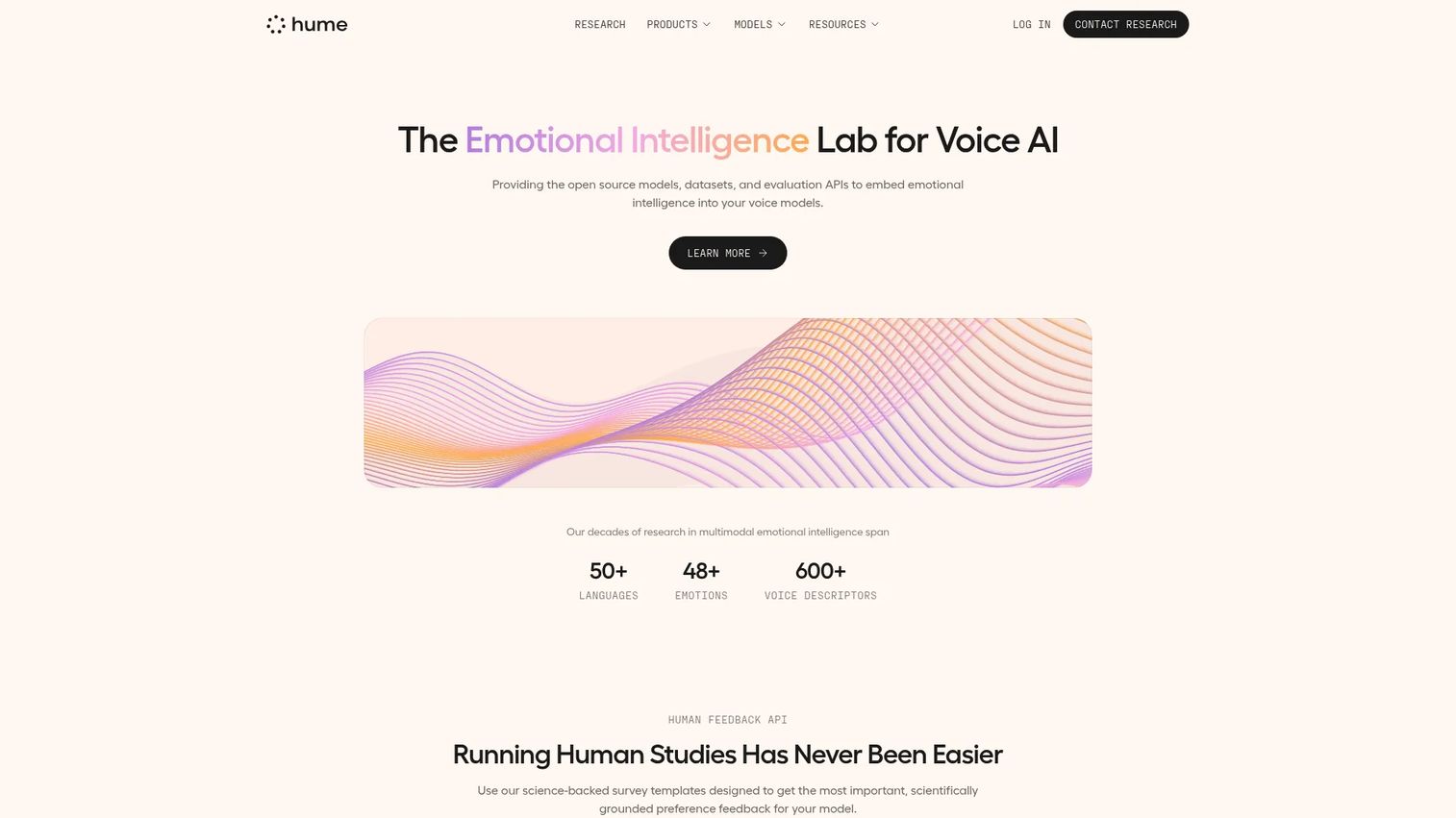
Hume AI is an AI platform for emotionally intelligent voice and conversational applications. Its Empathic Voice Interface (EVI) delivers real-time voice AI, and its expression measurement spans voice, face, and text where supported. This is the tool to evaluate when emotion needs to live inside a live conversation, not just a recorded analysis.
Best for: Teams building voice-first products with emotional intelligence, where multimodal inference shapes how the system responds.
Key strengths
- Empathic Voice Interface: Real-time voice AI that reads and responds to vocal emotion as the conversation happens.
- Multimodal measurement: Expression measurement across voice, face, and text gives a richer read than any single input.
- Developer-ready SDKs: TypeScript, React, and Python SDKs make the API straightforward to wire into a product.
Why choose Hume AI: Multimodal emotion recognition matters most for empathetic interfaces, where a voice tool that ignores facial cues, or vice versa, misreads the moment. Hume is built for real-time inference inside conversational products, with a developer-first API.
Hume AI pricing: Hume publishes a tiered structure that starts with a Free plan at $0, then Starter at $3/month, Creator at $7/month, Pro at $70/month, Scale at $200/month, and Business at $500/month, with a custom Enterprise tier. Usage-based overage applies on some tiers, and the free plan makes early evaluation easy.
5. FaceReader SDK
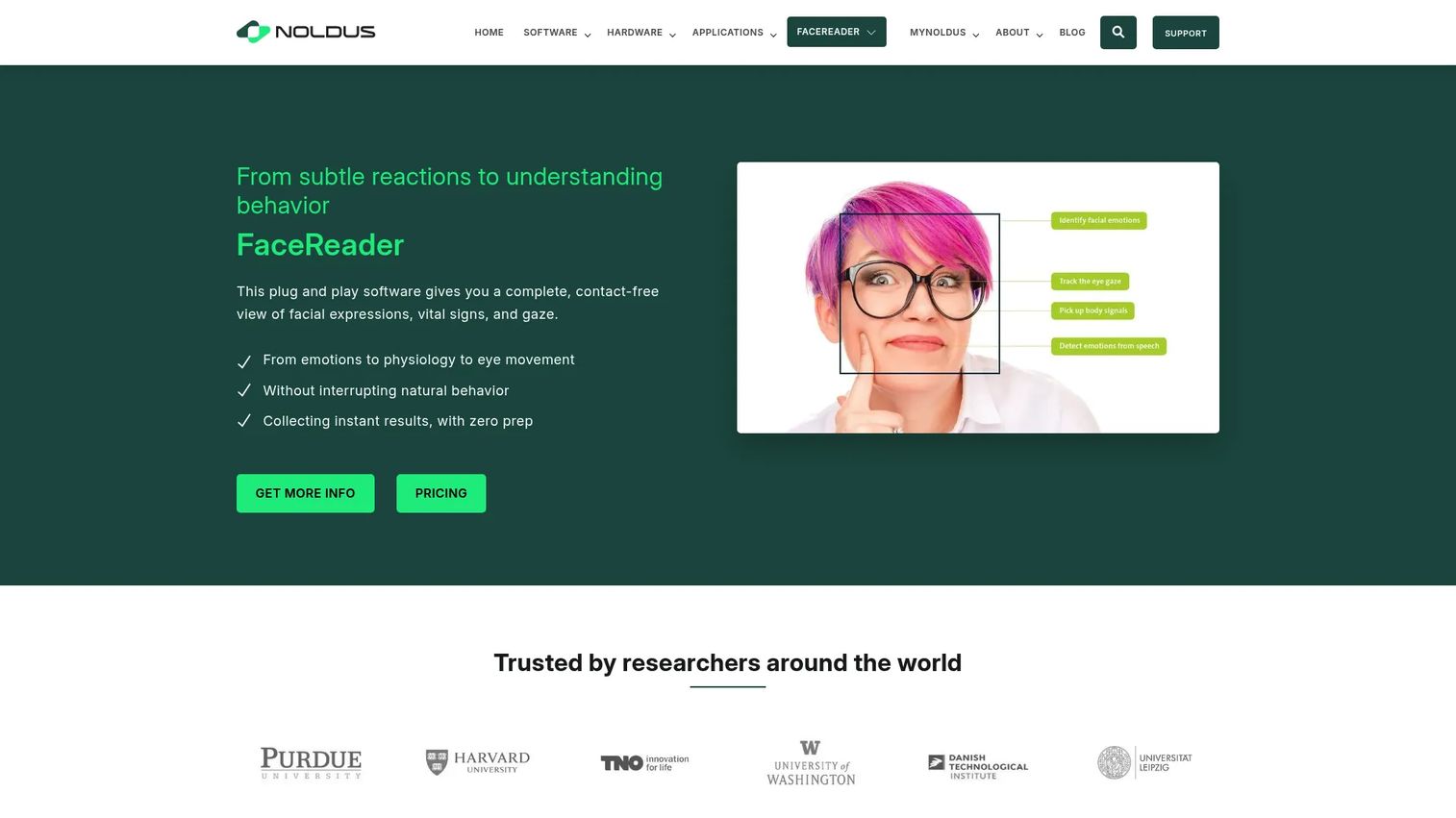
FaceReader SDK lets developers embed Noldus FaceReader facial-expression analysis into custom applications. It performs automatic facial expression analysis, detects FACS action units, and supports custom expressions and physiology-related modules. FaceReader is a long-established name in academic facial coding, and the SDK brings that engine into your own software.
Best for: Teams building research or training applications that need embedded, validated facial-expression analysis with real-time data export.
Key strengths
- FACS action unit detection: Goes below discrete emotions to the underlying facial action units researchers rely on.
- Embeddable SDK: Brings FaceReader's analysis engine directly into custom applications and live workflows.
- Custom expressions: Lets teams define and detect their own expression categories beyond the defaults.
Why choose FaceReader SDK: When you need facial coding with academic pedigree but want it running inside your own application rather than a standalone desktop tool, the SDK is the bridge. It fits real-time data export into research and training pipelines.
FaceReader SDK pricing: The SDK carries a minimum purchase price of €20,000 per year (about $22,000), per Noldus' published guidelines. This is licensing built for funded research and commercial application teams rather than casual evaluation.
6. Face++

Face++ is an AI computer vision platform offering face, body, OCR, and related recognition APIs and SDKs. Its face detection returns landmarks and attributes, including emotion-related outputs, alongside broader capabilities like body detection and gesture recognition. It is a developer platform first, with emotion analysis as one attribute among many.
Best for: Developers and enterprises that need facial recognition plus broader computer vision APIs, where emotion-related attributes are part of a larger pipeline.
Key strengths
- Broad API surface: Face, body, gesture, and OCR APIs in one platform reduce the number of vendors you integrate.
- Attribute-rich face detection: Returns landmarks and attributes including emotion-related signals.
- Flexible delivery: Offers both cloud APIs and SDKs for different deployment needs.
Why choose Face++: If emotion is a secondary signal inside a wider computer vision project, the platform breadth means one API and one billing relationship. It suits teams that need facial expression recognition as a feature, not the whole product.
Face++ pricing: The platform confirms a free plan plus Pay As You Go, prepaid Daily/Monthly capacity plans, and license-based pricing. Public numeric prices are not shown on the pricing pages, but the free tier lets developers start testing without commitment. Face++ holds a 3.7/5 rating on G2.
7. Kairos
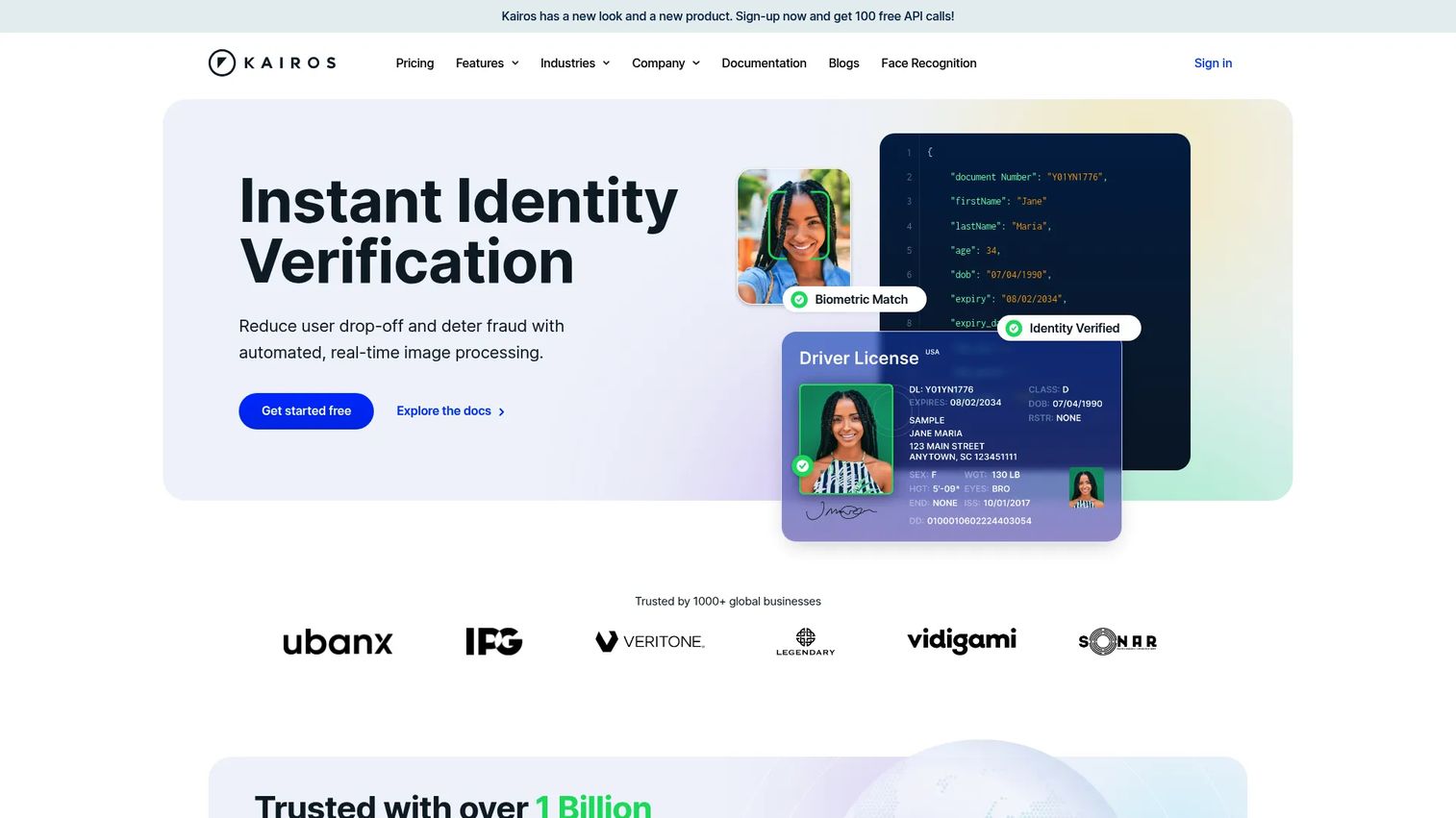
Kairos is AI identity verification and face recognition software built for developers and businesses. It handles face detection, identification, and liveness or anti-spoof detection, with facial analytics that fit into product workflows. Kairos leans toward identity and face analysis, with emotion-related computer vision available in that broader context.
Best for: API-first teams that need face recognition and identity verification, with facial analytics folded into product flows.
Key strengths
- API-first delivery: Built for developers who want face analysis wired into a product through a clean API.
- Liveness detection: Anti-spoof and liveness checks add a security layer that pure emotion tools lack.
- Volume-based pricing: Per-call pricing scales down as usage grows, which is friendly to early-stage projects.
Why choose Kairos: When your product needs identity verification and face analytics together, a single API covers both rather than bolting on a separate emotion vendor. It fits teams building face analysis directly into product workflows.
Kairos pricing: Public usage-based pricing starts at $0.65 per API call for the first 1,000 calls and drops to $0.50 per call from 1,001 to 5,000, decreasing further with volume. Cloud API plans begin with a free trial, while on-premises and self-hosted pricing is license-based and custom.
8. Viso Suite
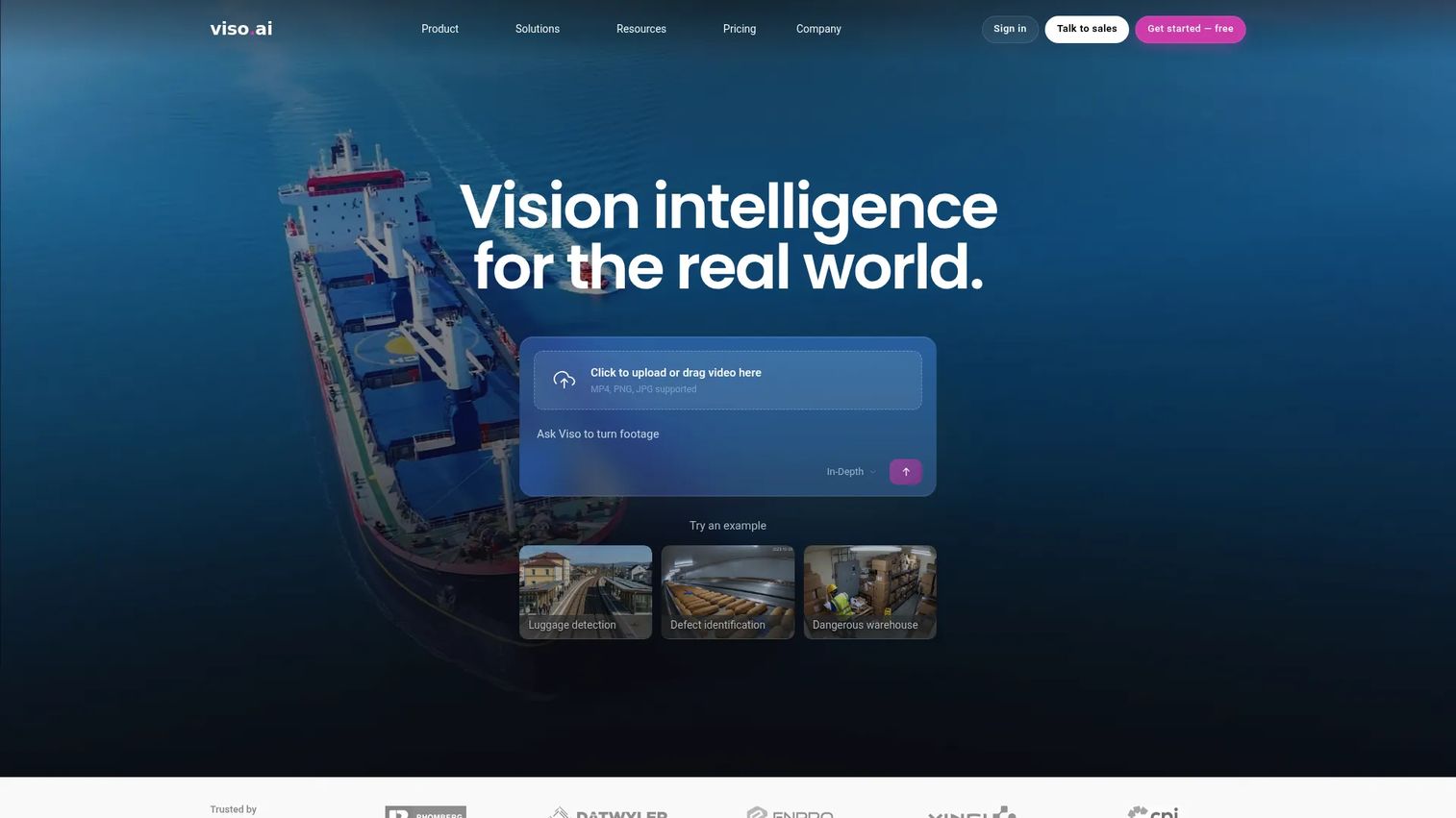
Viso Suite is end-to-end computer vision infrastructure for building, deploying, and operating AI vision applications. Its no-code and low-code app creation covers data collection, annotation, model training, deployment, and monitoring, and emotion-related analysis can sit inside broader vision pipelines. This is the platform for teams who treat emotion detection as one module in a larger custom system.
Best for: Enterprise teams building and operating custom computer vision applications at scale, where emotion analysis is part of a wider pipeline.
Key strengths
- End-to-end pipeline: Covers data collection, annotation, training, deployment, and monitoring in one platform.
- Edge device management: Manages and deploys models to edge devices with enterprise security controls.
- No-code app builder: Lets teams assemble vision applications, including emotion-related modules, without heavy engineering.
Why choose Viso Suite: If emotion analysis is one component of a custom vision system you intend to run at scale, an infrastructure platform beats a single-purpose API. It fits enterprise teams who own the full vision lifecycle.
Viso Suite pricing: The pricing page shows a Free plan at $0/month, Pro at $25/month, and Business at $50/month billed annually, with Enterprise priced as a custom platform fee based on company size. The free tier lets teams evaluate the platform before committing.
9. Affectiva
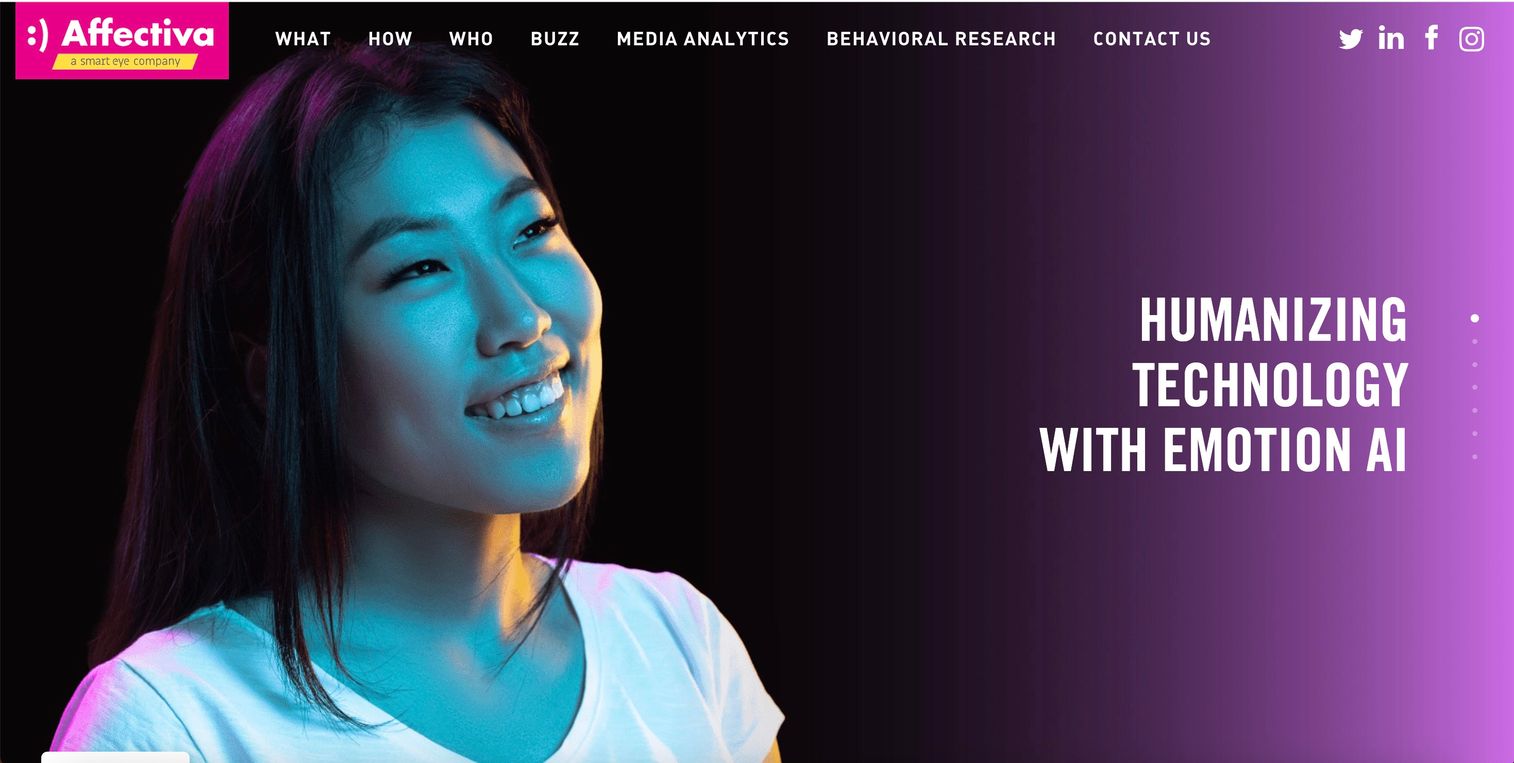
Affectiva, now part of Smart Eye, is emotion AI software for understanding human emotional and cognitive states from facial and other non-verbal cues. It detects complex states from facial expressions, gestures, body posture, and voice, and powers both media analytics for ad and content testing and in-cabin sensing for automotive. It is one of the most established names in the category, and it underpins facial coding in several other research tools.
Best for: Teams that need on-device emotion AI for media analytics, qualitative research, or vehicle interior sensing.
Key strengths
- Emotion SDK: A dedicated SDK for embedding emotion AI into media testing and research applications.
- Media analytics: Purpose-built workflows for ad testing, qualitative research, and entertainment content testing.
- Automotive in-cabin sensing: Driver and occupant monitoring built for real-time inference in the vehicle.
Why choose Affectiva: When your work spans marketing research and driver monitoring, a single vendor with proven facial coding covers both. Its 4.3/5 G2 rating reflects a track record in media analytics that few competitors match.
Affectiva pricing: Commercial licenses start at $25,000, per the company's commercial license page. There is no public free tier, which positions Affectiva for funded commercial and research deployments rather than casual testing.
10. Phebi
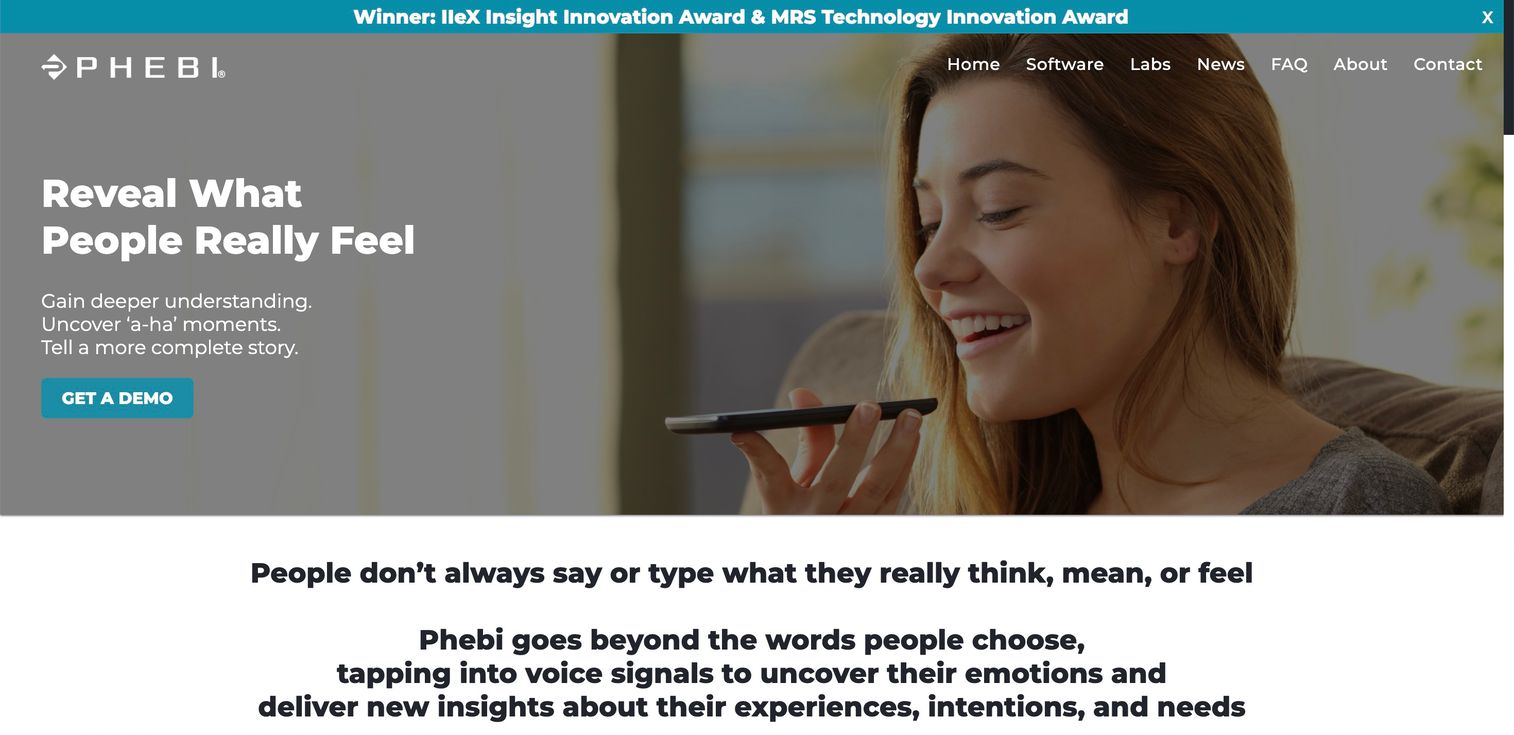
Phebi is voice-driven emotion intelligence software for market research and customer experience teams. It collects voice and video responses, detects and scores nonconscious emotions from speech, and produces transcripts, charts, showreels, and AI summaries. Where most of this list leans facial, Phebi centers the voice, which makes it a useful complement for research workflows.
Best for: Market research and CX teams that need voice-based emotion analysis and qualitative insight generation.
Key strengths
- Voice and video emotion analysis: Detects and quantifies nonconscious emotion from spoken responses.
- AI co-pilot and reporting: Interactive emotion reports, transcription, and showreels turn raw audio into shareable insight.
- Research-native workflows: Built around survey-style response collection rather than live web embedding.
Why choose Phebi: When your research depends on what people say and how they say it, a voice-first tool captures signal that facial-only tools miss. It fits marketing research and customer experience research where spoken response is the primary data.
Phebi pricing: Pricing is usage-based on the volume of audio or video processed, offered as pay-as-you-go project pricing or enterprise licenses. No public numeric price is shown, so scoping a quote means sharing your expected volume.
How to choose the right emotion recognition software
Match the input type to the use case
The single biggest mistake in this category is choosing on feature count instead of input fit. A facial-only tool solves a different problem than a voice-only tool, and a multimodal tool solves a third. If you are studying recorded ad reactions, facial coding is your signal. If you are analyzing call center conversations, voice prosody is. If you are building an empathetic conversational agent, you likely need both.
Start from the signals your use case actually produces, then shortlist tools that read those signals natively. A longer feature list does not help if it does not cover your input.
Check deployment and latency requirements
Deployment model is a workflow decision, not a technical footnote. Browser-based emotion AI and embedded SDKs keep inference close to the user, which matters for real-time UX and for privacy. Cloud APIs centralize the model and simplify versioning. On-device and edge processing reduce bandwidth and latency for constrained environments.
Ask the hard latency question early: do you need a result in milliseconds, or is an overnight batch job fine? The answer eliminates half the shortlist immediately.
Review privacy, consent, and bias controls
Before any deployment, validate how the vendor handles data. Look for on-device processing options, clear retention policies, GDPR alignment, and documentation on consent flows. Ask for model transparency: which populations was the model trained and validated on, and how does it perform across demographics?
Bias documentation is not optional for biometric-style inference. A vendor that cannot tell you how the model behaves across skin tones, lighting, or age groups is a vendor you cannot validate. The same governance discipline that applies to broader AI governance tools and best AI cybersecurity solutions applies doubly here.
Validate integration and data output
Structured output is what makes emotion signals usable. Confirm that the tool emits confidence scores and probability distributions, not just hard labels, and that it exports in a format your stack can consume. Check whether it pushes into your CRM, analytics, research, or product pipeline cleanly.
Emotion data that cannot flow into the system that needs it is a research curiosity, not a workflow input. Treat export and integration as a hard requirement, the same way you would when comparing AI customer service software or best AI meeting assistants.
Where emotion recognition software is used
Customer experience and UX research
Teams use emotion signals to measure how users actually react to a flow, where friction spikes, and which moments drive engagement. The signal complements behavioral analytics: a drop-off tells you where users leave, while an emotion read suggests how they felt as they left. Treat it as a measurement aid that informs decisions, not a standalone verdict on whether a design works.
Healthcare and mental health monitoring
Emotion-aware signals can support monitoring, triage, and research in clinical and wellness contexts, for example tracking affect over time or flagging changes for follow-up. This is a sensitive area. Any deployment here needs strong privacy controls, clinical oversight, and explicit consent. The cost of a false read is far higher than in a marketing study, so caution and validation matter more, not less.
Automotive and driver monitoring
In-cabin sensing pairs emotion analysis with attention and drowsiness tracking to support driver safety. This is a real-time emotion detection problem by definition: the system has to flag a drowsy or distracted driver in the moment, which demands low-latency, on-device inference. Architecture choices here are safety choices, which is why automotive deployments favor embedded SDKs over cloud round-trips.
Education, entertainment, and interactive experiences
Adaptive learning platforms use engagement and confusion signals to adjust pacing. Games, robots, and immersive installations use real-time emotion reads to respond to a participant in context. The common thread is that the signal feeds back into the experience as it happens, which makes browser-based or embedded processing the natural fit for these interactive applications.
Marketing and content testing
Researchers use emotion tools to measure response to ads, landing pages, and media, often by recording facial reactions during exposure and analyzing them afterward. Because this involves recording faces or voices, ethical collection and explicit consent are not optional. The strongest marketing research programs document what they collect, why, and for how long, before a single participant sits down.
Privacy, ethics, and compliance considerations
Get consent right
Emotion recognition processes biometric-style data, which in many jurisdictions triggers explicit consent requirements. Participants and users should know what is being collected, why, how long it is retained, and who can access it. Transparency is not just a legal hedge, it is what keeps the data usable: consent gathered cleanly upfront is consent that survives audit. Build the consent flow before you build the analysis.
Understand bias and accuracy limits
Emotion inference varies with context, population, lighting, camera quality, and how the model was designed and trained. A model that performs well on its training distribution can perform very differently on yours. The fix is not to trust vendor benchmarks. It is to run a validation pass on your own use case, with your own population and conditions, and measure performance before you ship. Where a vendor publishes bias documentation, read it; where it does not, treat that absence as a finding.
Protect data and minimize retention
The governance basics apply with extra weight here: encrypt data in transit and at rest, control access tightly, and set retention to the minimum your use case requires. The strongest posture is to avoid storing raw biometric or video data at all when an on-device, server-free architecture lets you process and discard. Minimizing what you retain shrinks both your compliance surface and your breach exposure.
Common mistakes to avoid
Each of these is an implementation pattern, paired with the better approach.
- Treating emotion labels as ground truth. A model's "happy" is a probability, not a fact. Instead, work with confidence scores and probability distributions, set thresholds, and act only on signals strong enough to clear them.
- Skipping the privacy review until after you build. Retrofitting consent and retention controls is painful and risky. Instead, scope consent, retention, and data handling in the design phase, before you write integration code.
- Choosing a tool without validating latency. A tool that benchmarks well in a demo can stall in your real-time loop. Instead, test inference latency under your actual load and architecture before committing.
- Ignoring input quality. Poor lighting, low-resolution video, or noisy audio degrades every model. Instead, control capture conditions and validate that the tool performs on the input quality you will actually have in production.
- Skipping bias validation on your own population. Vendor accuracy claims reflect the vendor's test set, not yours. Instead, run a validation pass across the demographics, lighting, and devices your real users represent.
Conclusion
The category breaks down cleanly once you stop reading feature lists and start with your own constraints. For research-grade multimodal studies, iMotions consolidates facial coding with physiological signals. For privacy-first, browser-based work, MorphCast keeps processing on-device. For voice-first conversational products, Hume AI is built for real-time multimodal inference. For embeddable face analysis, Visage Technologies and FaceReader SDK bring validated engines into your own app. And for enterprise vision pipelines, Viso Suite gives you the full lifecycle.
The decision always comes back to four questions: which input type your use case produces, whether you need real-time or batch processing, whether you want an SDK, API, or hosted service, and whether the vendor's privacy and bias posture survives your review. Answer those four honestly and the shortlist of ten narrows to two or three fast. Compare those finalists on a real sample of your own data, under your own conditions, before you sign anything.
FAQs
Emotion recognition software is used to measure emotional response across customer experience and UX research, healthcare and mental health monitoring, automotive driver monitoring, education and interactive experiences, and marketing and content testing. In each case it acts as a measurement aid that adds an affective layer to behavioral or contextual data, rather than a standalone decision-maker.
Accuracy depends heavily on lighting, camera quality, input resolution, model design, and whether your use case matches the model's training context. A tool that performs well in controlled conditions can behave differently in the wild, which is why you should validate any facial emotion recognition software on your own population and conditions rather than trusting published benchmarks.
Sentiment analysis classifies the polarity of language as positive, negative, or neutral, working primarily from text. Emotion recognition infers specific affective states such as joy, frustration, or surprise from signals like facial expressions, voice prosody, or physiological data. Emotion detection is generally the more complex task because it aims at the psychological state behind the signal, not just the polarity of the words.
It depends entirely on the vendor's architecture, retention policies, consent flow, and deployment model. On-device and browser-based processing that never sends raw video to a server reduces compliance exposure, while cloud-based tools require closer scrutiny of data handling. Validate consent, retention, encryption, and GDPR alignment before deployment, since emotion data is typically treated as biometric-style data.
Common inputs are facial images and live video, audio and speech prosody, text, and physiological signals like EEG, GSR, and ECG. Facial and voice inputs dominate commercial tools because they need only a camera or microphone, while physiological inputs are more specialized and usually require dedicated hardware. Not every tool supports every input, so match the tool to the signals your use case produces.
Marketing and media research, customer experience, automotive, healthcare, education, and entertainment are among the most active sectors for emotion AI. Enterprises account for roughly 64.3% of global emotion detection and recognition adoption by end user in 2026, per Coherent Market Insights (2024), reflecting heavy use in CX, advertising, and in-cabin automotive sensing where emotional signals tie directly to outcomes.
Start with input type and confirm the SDK reads the signals your use case produces, whether facial, voice, or multimodal. Then check real-time support against your latency budget, confirm the delivery model is an embeddable SDK rather than a hosted-only API, and review the privacy posture including on-device processing and retention. Finally, validate structured output and confidence scores, and confirm the SDK integrates cleanly with your existing product or research pipeline.