Your procurement contact asks for the carbon footprint of one product line. Not the whole company. One SKU, cradle-to-gate, with the methodology attached so their auditor can check it.
You open the spreadsheet. Supplier data lives in one tab, emission factors in another, and last quarter's assumptions in a version nobody trusts. Three people have edited it. None of them remember why row 40 uses a different factor than row 41.
That is the moment most teams realize a spreadsheet stopped being the tool. Product carbon footprint reporting breaks when product data, supplier inputs, emission factors, and standards all have to reconcile at once. The market has grown to match that pressure. The product carbon footprint software category reached $2.17 billion in 2025 and is projected to hit $5.20 billion by 2031, per Mordor Intelligence (2026).
This guide compares eight PCF software tools by the criteria that actually decide the purchase: standards coverage, data workflow, auditability, and implementation effort.
What's inside
This guide is for founders, sustainability leads, and operations teams comparing product carbon footprint software in 2026. It skips the theory and focuses on the buying decision.
We selected tools based on four criteria:
- Standards coverage: ISO 14067, GHG Protocol Product Standard, EN 15804, and PEF alignment
- Data workflow: imports, APIs, supplier data handling, and integration depth
- Auditability: calculation traceability and assumption transparency
- Fit and effort: who the tool is built for and how fast it reaches first value
Every pricing figure and rating below was checked against first-party sources at the time of writing.
TL;DR
- Best for construction and product LCA: One Click LCA, with deep standards coverage and BIM integrations
- Best for API-led workflows: Climatiq, with an emission factor API and PCF Studio
- Best for manufacturing production data: Glassdome and Ecochain, built around factory and portfolio footprinting
- Best for enterprise SAP ecosystems: SAP Sustainability Footprint Management, native to ERP workflows
- Best for deep LCA modeling: Sphera LCA for Experts, with a large managed dataset
- Best for food and beverage brands: CarbonCloud, built around Scope 3 and supplier engagement
What is product carbon footprint software?
Product carbon footprint software calculates the greenhouse gas emissions tied to a single product across its life cycle, then produces reporting that stands up to standards and audit review.
It differs from corporate carbon accounting. Carbon accounting measures emissions at the organization level across Scopes 1, 2, and 3. PCF software zooms in on one product, one recipe, one SKU. The question shifts from "what did the company emit this year" to "what does this specific product emit, and can I prove the number."
It also differs from full lifecycle assessment software. Full LCA models many impact categories, water use, land use, toxicity, and more. PCF is the carbon slice of that work, often built on the same methods but scoped to greenhouse gas output.
Two scopes matter most in practice:
- Cradle-to-gate PCF: emissions from raw material extraction through the factory gate, before the product ships
- Cradle-to-grave PCF: the full picture, adding distribution, use, and end-of-life
Core capabilities to expect:
- Emission factors: access to vetted databases so you are not sourcing coefficients by hand
- Standards alignment: ISO 14067, the GHG Protocol Product Standard, EN 15804 for construction, and PEF in Europe
- Supplier data intake: structured ways to collect primary data from your supply chain
- Calculation traceability: a record of which factor and assumption produced each number
- Report generation: outputs formatted for auditors, customers, and regulators
The right tool turns a fragile spreadsheet into a repeatable calculation that survives scrutiny from a customer, an investor, or a procurement committee.
When to use product carbon footprint software
Choose it when you need product-level reporting
A customer wants the footprint of the exact product they buy, not your company average. That means product-specific emissions, primary supplier data, and defensible product claims. PCF software structures that data so each product carries its own auditable number, ready to share when a buyer or regulator asks.
Choose it when spreadsheets are breaking down
One product in a spreadsheet is manageable. Fifty products, each with a supply chain and quarterly updates, is not. Version control fails, assumptions drift, and no one can reconstruct how a figure was reached. PCF software handles the data volume and keeps an audit trail that a manual file cannot.
Choose it when you need standards alignment
If your reporting has to satisfy ISO 14067 or the GHG Protocol Product Standard, freeform math will not clear an audit. These tools bake the methodology into the calculation, so your results map to the framework your customer or regulator expects, without you rebuilding the logic each time.
Comparison table
Here is the side-by-side view. Pricing and ratings reflect first-party sources checked at the time of writing. Several vendors price by quote, which is common for products sold into complex supply chains.
| # | Product | Best for | Key differentiator | Pricing | G2 rating |
|---|---|---|---|---|---|
| 1 | One Click LCA | Construction and product LCA | BIM integrations and broad standards coverage | Free tier; quote-based plans | 4.5/5 |
| 2 | Climatiq | API-led emissions workflows | Emission factor API with PCF Studio | Free Starter; Data Pro €250/mo; PCF Pro from €4,900/yr | Not rated |
| 3 | Glassdome | Manufacturing production data | Production monitoring plus PCF and CBAM reporting | Quote-based | Not listed |
| 4 | Manglai | AI-assisted sustainability reporting | AI data import and Copilot workflows | Quote-based | Not listed |
| 5 | SAP Sustainability Footprint Management | Enterprise SAP ecosystems | ERP-native footprint calculation | Price upon request | 4.3/5 |
| 6 | Sphera LCA for Experts | Deep LCA modeling | 20,000+ dataset managed LCA database | 45-day free trial | 4.0/5 |
| 7 | Ecochain | Manufacturing portfolio footprinting | Product and portfolio LCA at scale | Professional €290/mo; Business €640/mo | 5.0/5 |
| 8 | CarbonCloud | Food and beverage brands | Scope 3 and supplier engagement | Contact for pricing | Not rated |
Best 8 product carbon footprint software for 2026
1. One Click LCA
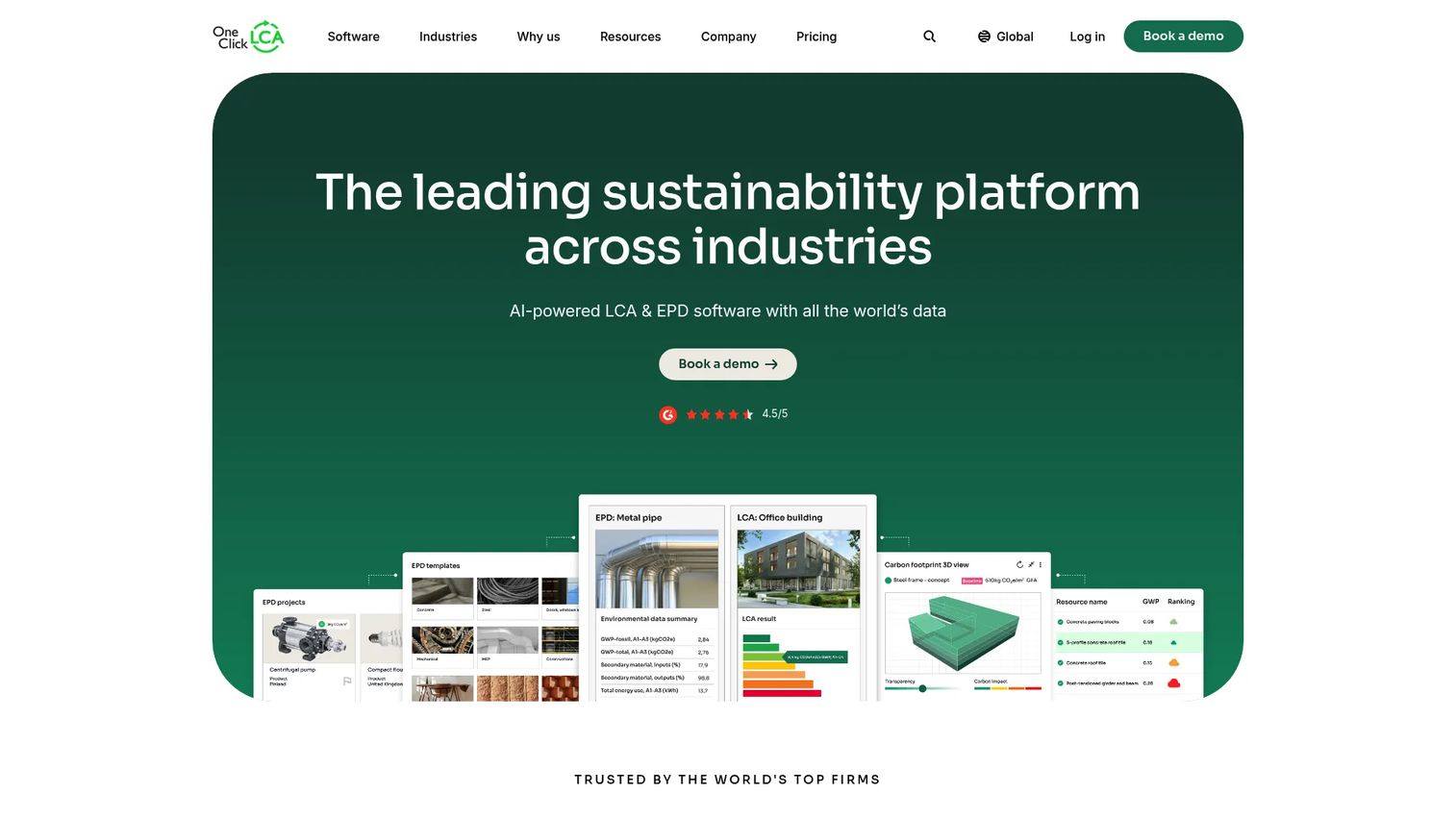
One Click LCA is a lifecycle assessment platform built for construction, infrastructure, and product sustainability workflows. It handles embodied carbon calculation, compliance reporting, and product LCA across a wide set of standards. Teams working in the built environment use it to generate audit-ready reports without leaving their design workflow.
Best for: Teams needing construction-focused LCA and embodied-carbon software with BIM integrations.
Key features
- LCA and embodied carbon workflows
- BIM and IFC software integrations
- Compliance and report generation for construction standards
- Standards coverage including EN 15804
- Free student and university licenses
Why choose One Click LCA: If your PCF work sits inside construction or infrastructure, its BIM integrations and standards depth fit the workflow better than a general-purpose tool. It is a strong pick when embodied carbon and product LCA both matter.
One Click LCA offers a free tier, and its Designer, Expert Pack, and Power Pack plans are quote-based. A Business pack is available to purchase online. Request a quote through the vendor for numeric pricing.
One Click LCA holds a 4.5 out of 5 rating on G2.
2. Climatiq
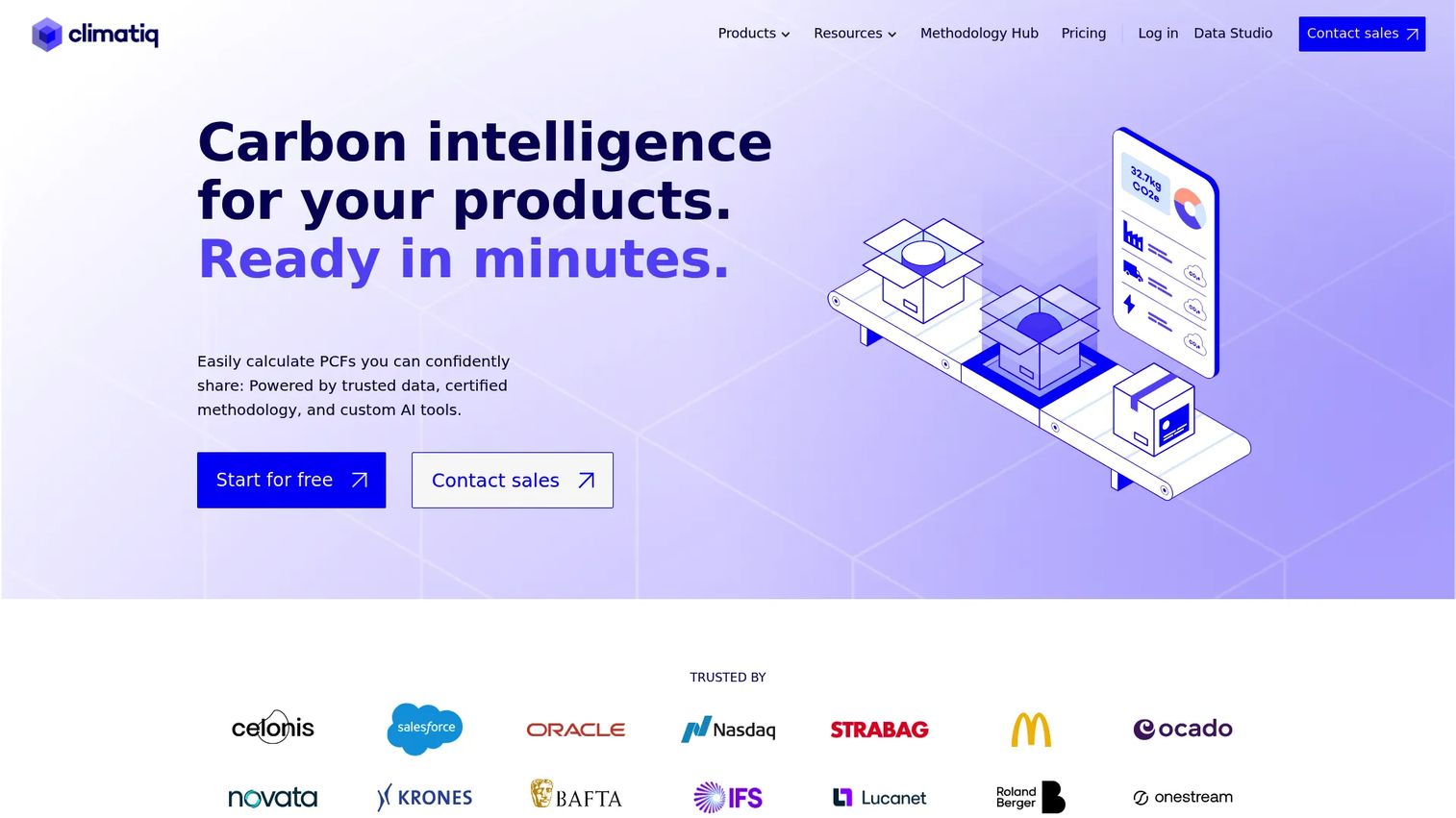
Climatiq is a carbon intelligence platform built around emissions data and calculation APIs. It gives developers and analysts a REST API with a large emission factor library, plus PCF Studio for product footprints and Data Studio for reporting. This is the tool for teams that want to embed carbon calculation directly into their own product or workflow.
Best for: Teams needing carbon emissions data, calculation APIs, and reporting tools they can embed.
Key features
- REST API with 944k+ emission factors
- Excel add-in and Google Sheets add-on
- PCF Studio for product carbon footprints
- Data Studio for emissions reporting
- Methodology transparency on calculations
Why choose Climatiq: If your team has engineering capacity and wants carbon math inside your own systems, the API-first approach fits better than a closed dashboard. It suits developer-led and analyst-led workflows equally.
Climatiq offers a free Starter plan. Data Pro runs €250 per month or €2,000 per year. PCF Pro starts from €4,900 per year, and Enterprise is custom. USD and GBP are available on request.
Climatiq does not yet have a substantive G2 rating, with no reviews recorded on its listing.
3. Glassdome
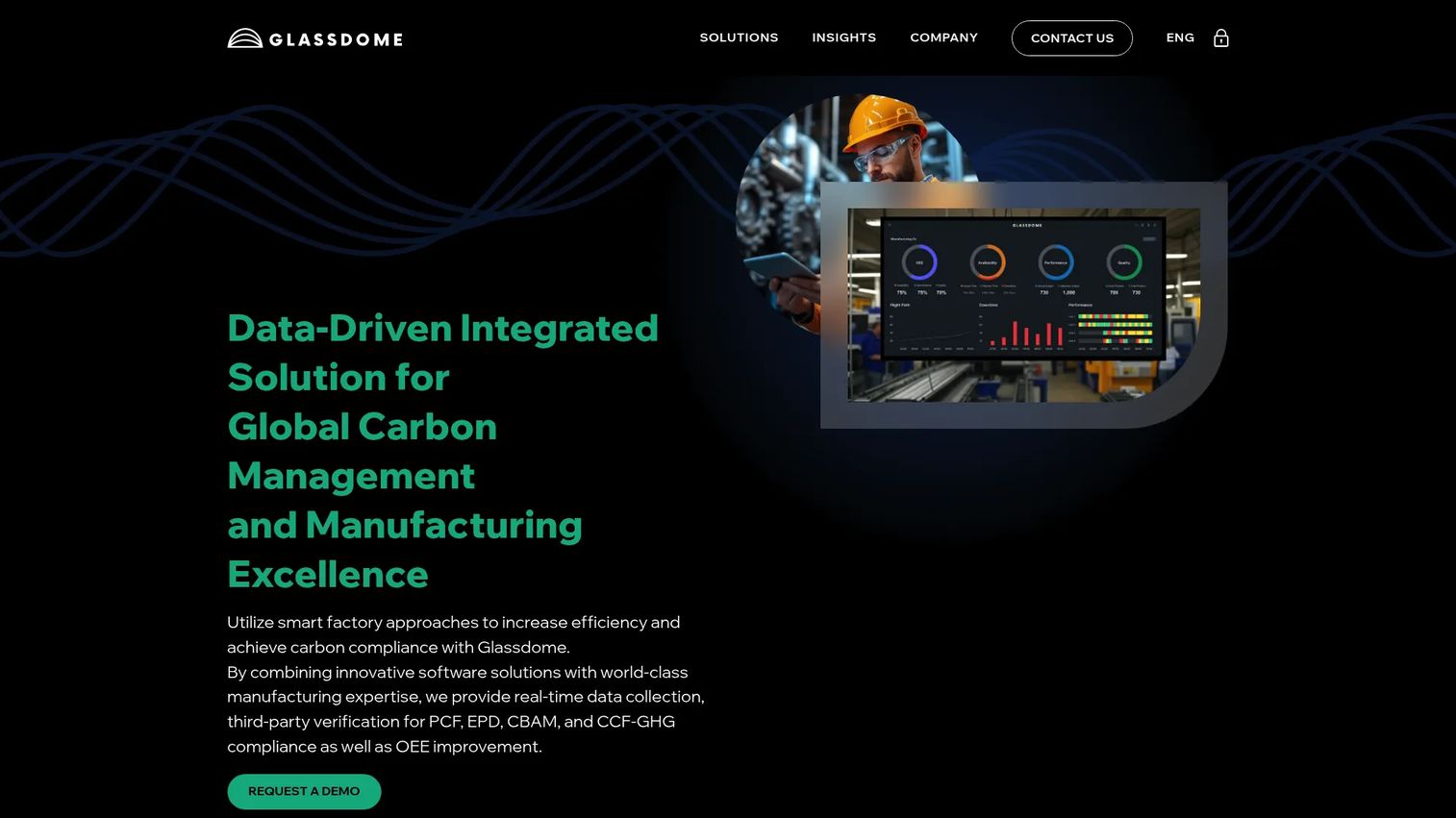
Glassdome is manufacturing software that pairs real-time production monitoring with automated carbon and compliance reporting. It calculates product carbon footprints from actual factory data and generates reports for PCF, CBAM, EPD, and CCF requirements. Manufacturers running legacy MES and ERP systems use it to turn production data into compliance-ready numbers.
Best for: Manufacturers needing production monitoring plus carbon and compliance reporting.
Key features
- Real-time production monitoring and OEE
- Automated reporting for PCF, CBAM, EPD, and CCF
- Integration with legacy MES and ERP systems
- Regional hosting options
- Primary data from the factory floor
Why choose Glassdome: If your footprint should reflect measured production rather than estimates, the production-monitoring foundation is the differentiator. It fits manufacturers who want operational data and carbon reporting in one place.
Glassdome lists Foundation, Professional, and Enterprise plans, each priced by contact. Reach out through the vendor for a quote.
4. Manglai
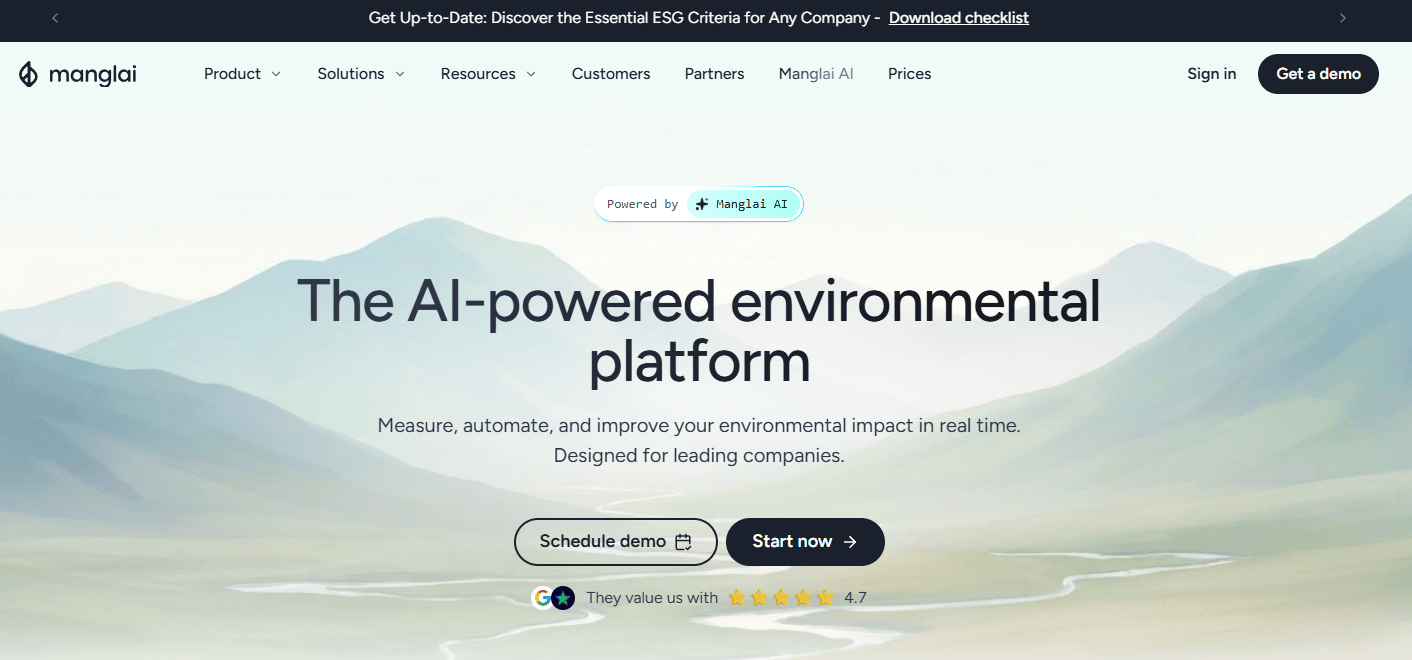
Manglai is an AI-assisted environmental management platform for measuring, automating, and reporting sustainability data. It covers carbon footprint measurement across Scopes 1, 2, and 3, and produces audit-ready reports aligned to frameworks like the GHG Protocol and ISO 14064. Its AI features handle data import and action planning so smaller teams can move faster.
Best for: Companies needing environmental data, carbon accounting, and audit-ready sustainability reporting.
Key features
- Carbon footprint measurement for Scopes 1, 2, and 3
- Audit-ready reports aligned to GHG Protocol and ISO 14064
- AI-assisted data import
- Copilot and action plan workflows
- Standards-mapped outputs
Why choose Manglai: If a lean team needs to cover both corporate and product-level reporting without a large analyst function, the AI-assisted import reduces manual data work. It suits companies scaling their sustainability reporting for the first time.
Manglai lists Starter, Pro, and Enterprise plans on 12-month subscriptions. Prices vary by facilities, sector, and organization size, so contact the vendor for a figure.
5. SAP Sustainability Footprint Management
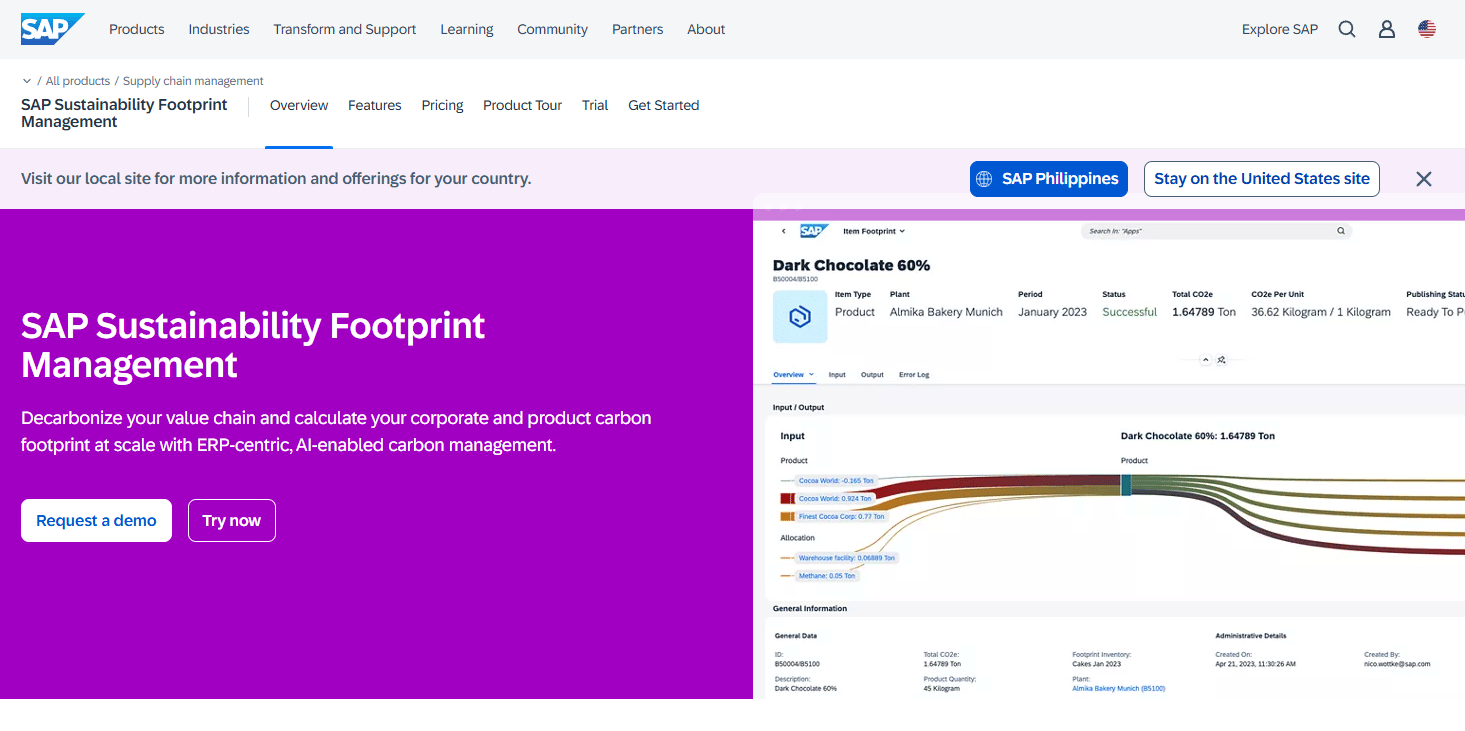
SAP Sustainability Footprint Management is ERP-centric software for calculating and managing product and corporate carbon footprints at scale. It pulls from connected operational data and supplier information, then feeds footprint calculations back into business processes. For enterprises already running SAP, it keeps carbon data inside the systems finance and operations already use.
Best for: Enterprises that need SAP-native product and corporate carbon footprint calculation inside ERP workflows.
Key features
- ERP-centric carbon footprint calculations
- 45,000+ pre-delivered emission factors
- Automated emission factor management
- Footprint analytics
- Integration into existing business processes
Why choose SAP Sustainability Footprint Management: If your operational data already lives in SAP, calculating footprints inside that environment avoids exporting data to a separate tool. It fits large enterprises with mature ERP deployments.
SAP prices by request. The product is sold in blocks of 50,000 records with a minimum of three blocks, and a partner-only cloud test and demo tenant is available. Contact SAP for a quote.
SAP Sustainability Footprint Management holds a 4.3 out of 5 rating on G2.
6. Sphera LCA for Experts
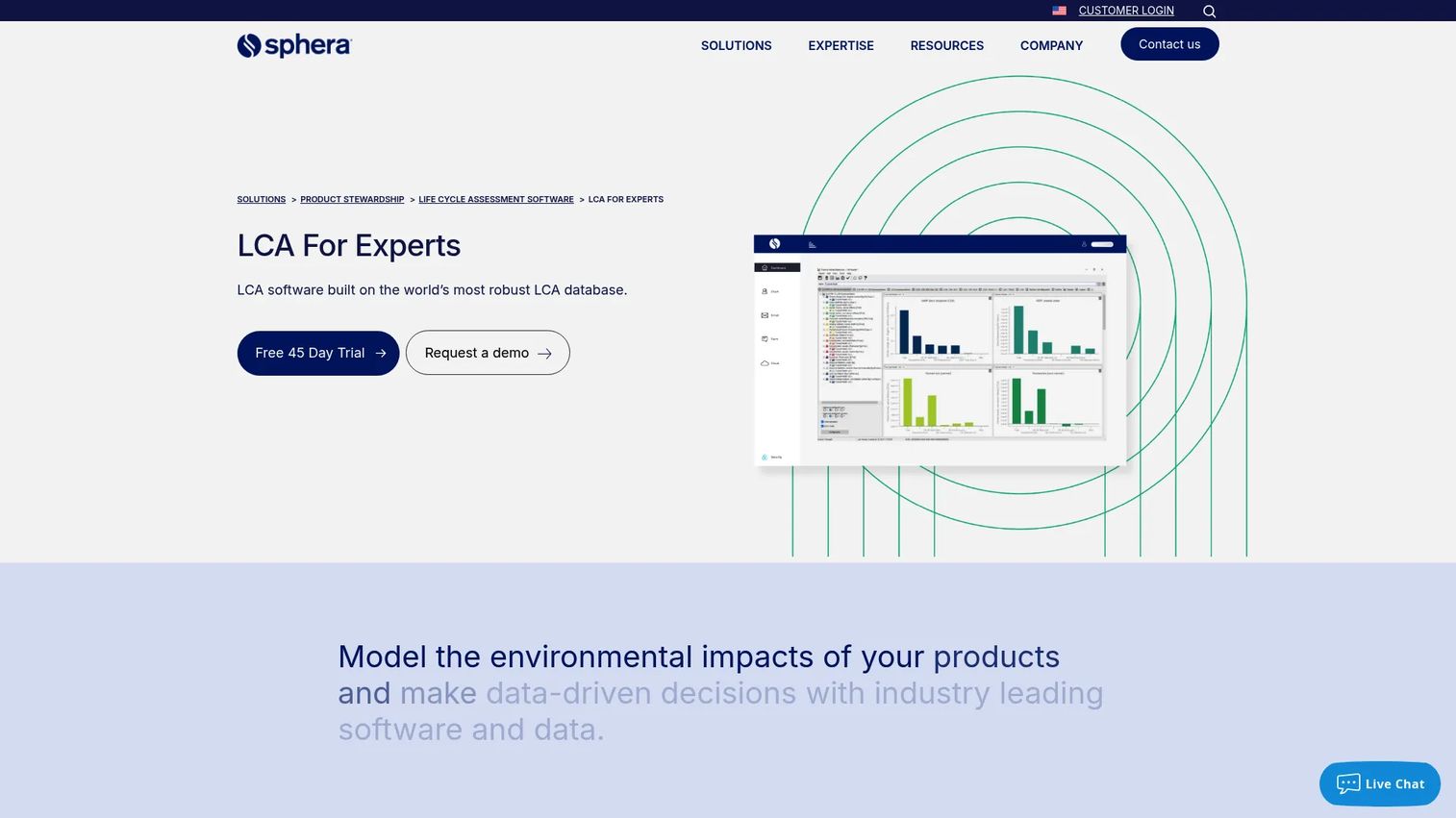
Sphera LCA for Experts is lifecycle assessment software for modeling detailed product environmental impacts using Sphera's managed LCA database. It targets teams doing rigorous, granular LCA work where dataset quality and modeling depth matter more than speed of setup. The Managed LCA Content database backs the modeling with 20,000+ datasets.
Best for: Teams needing detailed product LCA modeling with Sphera-managed environmental datasets.
Key features
- Managed LCA Content database with 20,000+ datasets
- Customizable report templates
- Deep product impact modeling
- 45-day free trial
- Academic license options
Why choose Sphera LCA for Experts: If your work demands granular, expert-grade LCA rather than a fast product number, the dataset depth and modeling flexibility fit that rigor. It suits specialists and consultancies handling complex product analysis.
Sphera offers a free 45-day trial. Commercial pricing is not published on the product page, and demo or request-info options are available. Contact Sphera for pricing.
Sphera holds a 4.0 out of 5 rating on G2 at the company level.
7. Ecochain
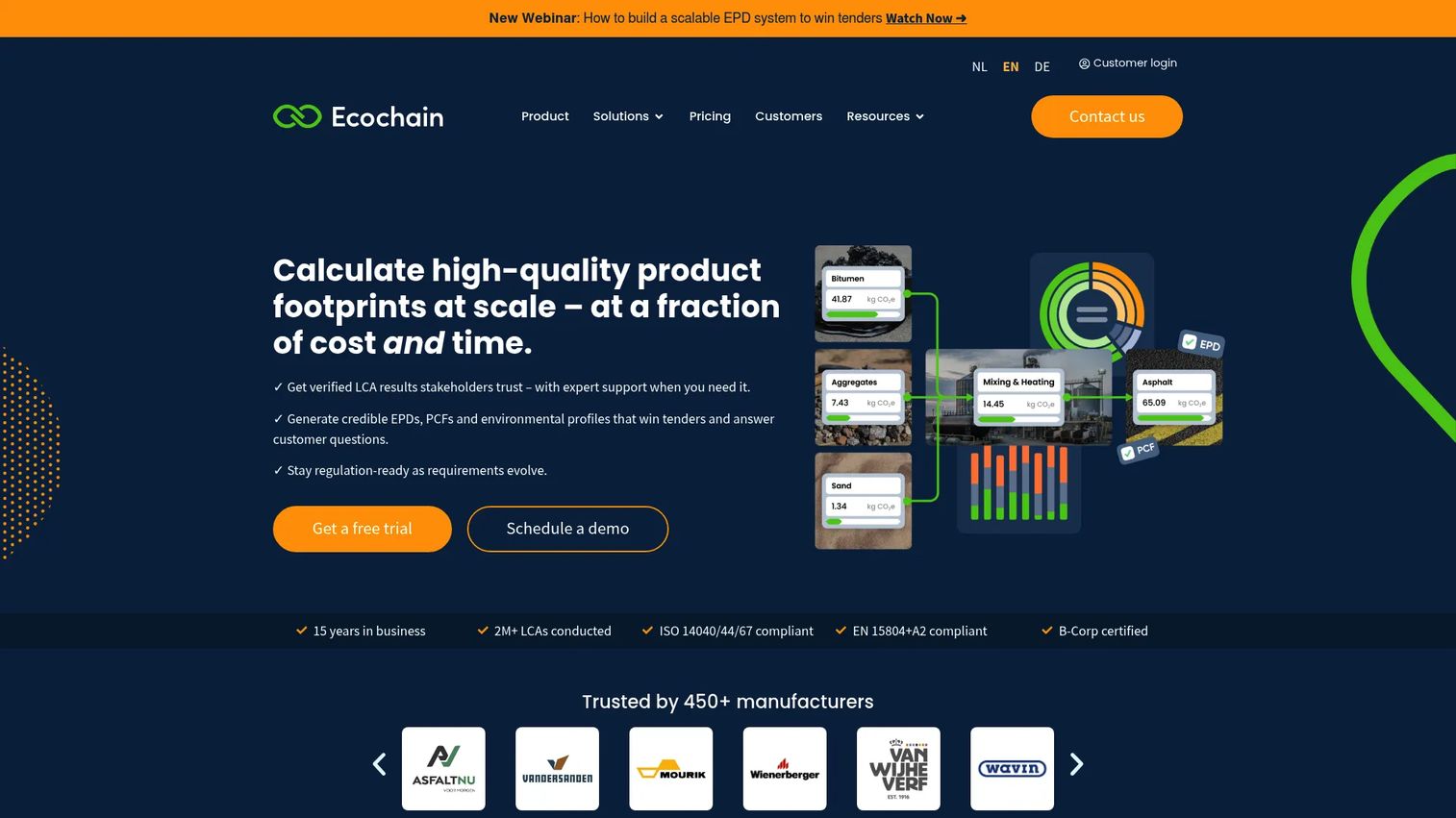
Ecochain is LCA automation software for industrial manufacturers to measure, manage, and communicate product environmental impact. It handles product and portfolio footprinting, EPD and PCF generation, and scenario analysis. Manufacturers with many SKUs use it to footprint at scale rather than one product at a time.
Best for: Manufacturers needing scalable LCA software for product footprints, EPDs, and PCFs.
Key features
- Product and portfolio footprinting
- EPD and PCF generation
- Scenario analysis and impact modeling
- Free trial available
- Monthly or annual billing
Why choose Ecochain: If you need to footprint a whole product portfolio rather than a single item, its portfolio-level approach fits that scale. It works well for manufacturers standardizing PCF and EPD output across many products.
Ecochain's Professional plan starts from €290 per month and Business from €640 per month, with monthly or annual billing. Enterprise is custom, and a free trial is available.
Ecochain holds a 5.0 out of 5 rating on G2, based on a single review at the time of writing.
8. CarbonCloud
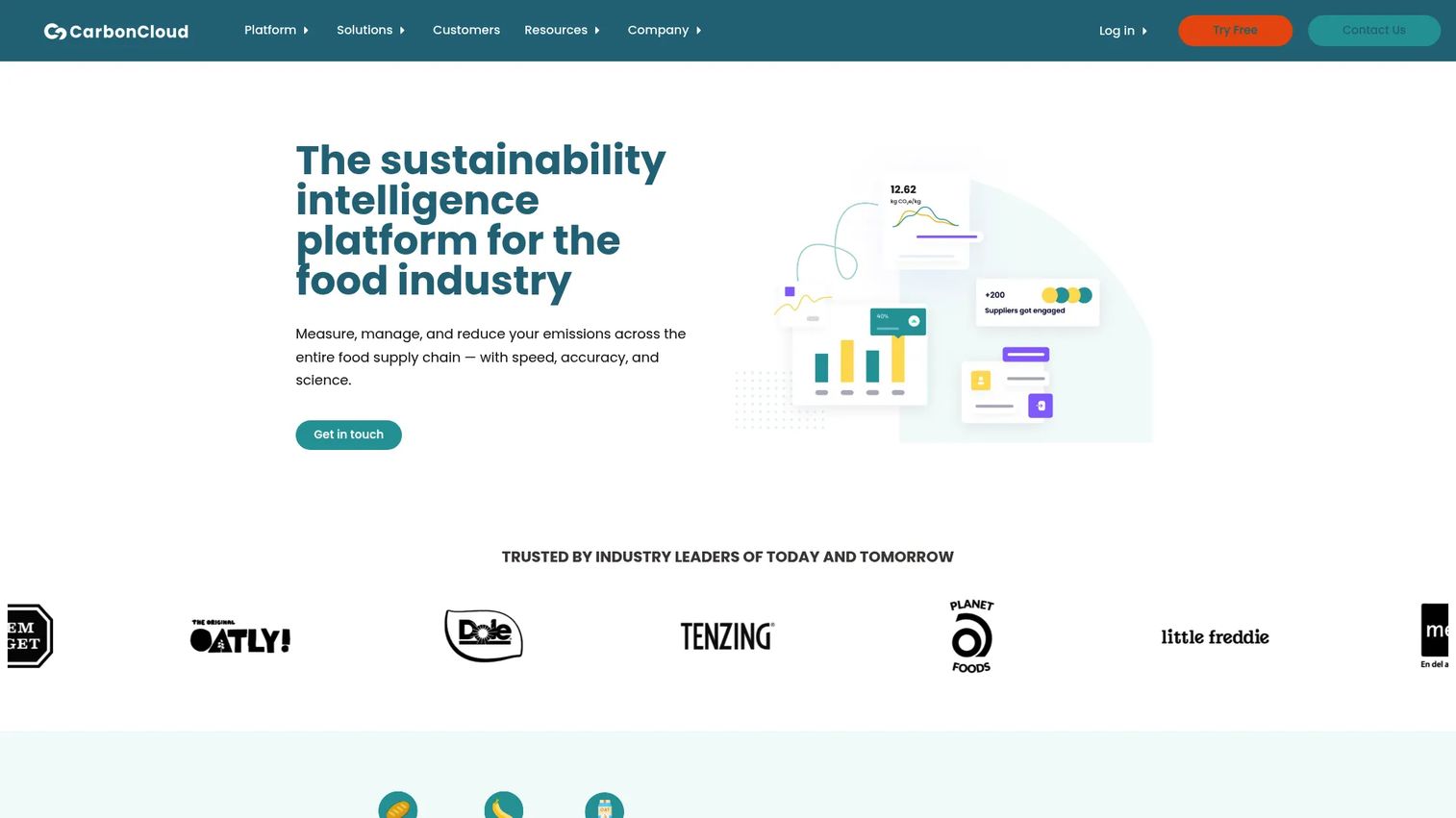
CarbonCloud is a sustainability intelligence platform for food-industry emissions measurement, management, and reduction. It automates Scope 3 calculations, runs supplier engagement workflows, and produces product carbon footprints with carbon labeling. Food and beverage brands use it to trace emissions through complex agricultural supply chains.
Best for: Food and beverage companies needing emissions data and supply-chain carbon accounting.
Key features
- Automated Scope 3 calculations
- Supplier engagement workflows
- Product carbon footprint calculations
- Carbon labeling for products
- Food-industry emissions data
Why choose CarbonCloud: If you operate in food and beverage, its focus on agricultural Scope 3 and supplier data fits that industry better than a general tool. It suits brands that need product-level carbon labels for retail.
CarbonCloud doesn't publish plan prices and points prospects to its team instead. The ClimateHub database is free for internal use, but commercial use requires a conversation with the vendor for pricing.
CarbonCloud does not yet have a G2 rating, with insufficient reviews recorded on its listing.
Considerations
Standards and methodology
Confirm exactly which frameworks the tool supports and whether it maps to your specific requirement. ISO 14067 and the GHG Protocol Product Standard cover general product footprints. EN 15804 matters for construction, and PEF applies in Europe. A tool that names the standard in its output saves you an argument with an auditor later.
Data workflow and integrations
Look at how data gets in and out. Check import formats, whether an API exists, and how supplier data is collected and structured. If your operational data lives in an ERP or MES, native integration removes a manual export step. The audit trail should record which factor and assumption produced each result.
Auditability and transparency
Your number is only as good as your ability to defend it. Verify that the tool shows the emission factor and assumption behind every calculation, not just a final figure. Traceable methodology is what separates a report a customer trusts from one they question.
Scalability and implementation effort
One product is easy. A portfolio is the real test. Ask how the tool handles many SKUs, recurring updates, and new product lines. Weigh setup time against how fast you reach a usable first footprint, especially if a lean team owns the work.
Pricing and support
Several vendors here price by quote because deals vary with supply-chain complexity and record volume. Ecochain and Climatiq publish numeric entry prices, which helps early-stage teams budget. For quote-based tools, ask what drives the number and what onboarding support is included.
Conclusion
The right product carbon footprint software depends on where your data lives and what your reporting has to survive.
For construction and product LCA with strong standards coverage, One Click LCA is the pick. If you want carbon calculation embedded through an API, Climatiq fits. Manufacturers weighing production data should compare Glassdome and Ecochain, while food and beverage brands will find CarbonCloud built for their supply chain. Enterprises on SAP get the tightest fit from SAP Sustainability Footprint Management, and specialists needing deep modeling should look at Sphera LCA for Experts.
Start with the two questions that narrow the field fastest: which standard must your output satisfy, and where does your product and supplier data already live. Answer those, then shortlist the two or three tools that match. Most vendors offer a trial or a demo, so validate the data workflow before you commit.
Whatever you choose, the goal is the same. Turn a fragile spreadsheet into a repeatable, auditable number that clears customer, investor, and procurement scrutiny.
Start your journey with Guideflow today!
FAQs
Carbon accounting measures emissions at the organization level across Scopes 1, 2, and 3 for a reporting period. A product carbon footprint measures emissions for one specific product across its life cycle. Carbon accounting answers what the company emitted; PCF answers what a single product emits and whether you can prove it.
Not always. A PCF is the greenhouse gas slice of a full lifecycle assessment, which also covers water, land use, and other impacts. If you only need the carbon number for a product claim or customer request, a PCF-focused calculation is enough. Full LCA matters when you need the broader environmental picture.
ISO 14067 and the GHG Protocol Product Standard are the core frameworks for product footprints. EN 15804 governs construction and building products, and PEF is the European Commission's product environmental footprint method. Confirm the tool maps to whichever your customer or regulator requires.
It depends on data readiness more than the software. With clean supplier data and a defined product boundary, a cradle-to-gate PCF can come together quickly. Collecting primary supplier data is usually the longest step, and quality PCF software shortens the rest with vetted emission factors and built-in methodology.
Yes, several tools generate the product-level emissions data these requirements draw on. CBAM needs embedded emissions for imported goods, and a digital product passport carries product data including environmental attributes. Tools like Glassdome explicitly support CBAM reporting alongside PCF output.
You need a defined product boundary, a bill of materials, and emission factors for each input. Primary supplier data strengthens accuracy, while the software supplies factor databases where primary data is missing. Cleaner input data means a more defensible final number.
Accuracy comes from methodology and data quality, not the file format itself. What PCF software adds over a spreadsheet is version control, a consistent audit trail, and vetted emission factors applied the same way every time. That consistency is what makes the number hold up under audit, where a manual spreadsheet often does not.