A customer types their address into your checkout form. They fat-finger the ZIP, drop the apartment number, or spell the street wrong. Your database accepts it. Three weeks later, the package bounces, support fields an angry ticket, and finance eats the reshipment cost. Multiply that by every failed delivery, every returned mailer, every undeliverable invoice, and you have a data quality problem hiding inside your revenue numbers.
Bad address data compounds quietly. It corrupts your CRM, inflates your shipping costs, breaks compliance reporting, and quietly drags on checkout conversion when forms reject valid inputs or accept broken ones. For product teams, this is not a mailing-room concern. It is an activation, retention, and operational reliability concern. The category is growing fast because the stakes keep rising: the global address verification software market is projected to grow from $1.83 billion in 2025 to $2.87 billion by 2030, a 9.6% CAGR, according to Research and Markets.
Address validation software sits at the point of capture and inside your existing records. It standardizes messy input, confirms an address is real and deliverable, and enriches it with the metadata your systems need. The right tool depends on whether you need real-time verification at signup, bulk cleanup of a legacy list, deep international address verification, or a developer-friendly API. This guide breaks down eight strong options, what each one is built for, and how to match a tool to your actual workflow.
What's inside
This guide is written for product managers, growth teams, RevOps, and developers who need cleaner address data without adding permanent operational drag. We picked tools across four workflows: real-time verification at the point of entry, batch cleansing of existing databases, API-first integration for engineering teams, and global coverage for international operations.
We evaluated each option on five criteria:
- Accuracy and coverage across US and international addresses
- Workflow fit for real-time, batch, or hybrid use
- Integrations with your existing stack via API, SDK, or no-code connectors
- Trust signals like USPS CASS certification and DPV confirmation
- Pricing transparency and how it scales with volume
TL;DR
- Best overall for API and autocomplete: Smarty, for developer-friendly address verification with strong US and international coverage.
- Best for broad data quality: Melissa, when address verification lives inside a larger contact-data cleansing platform.
- Best for location intelligence: Radar, when you need geofencing and maps alongside address capture.
- Best for direct mail workflows: PostGrid, when address quality feeds print and mailing automation.
- Best for global coverage: Loqate, for verification and capture across 250+ countries.
- Best for identity-linked verification: Twilio, when address checks tie into fraud and onboarding flows.
What is address verification software?
Address verification software is a tool that standardizes, validates, and enriches postal addresses to confirm they are real, correctly formatted, and deliverable. It compares an input address against authoritative reference data, such as USPS records in the US, corrects errors, appends missing components, and flags anything undeliverable.
The distinction between address validation and address verification is subtle but useful. Validation checks that an address is correctly structured and exists in official records. Verification goes further, confirming the address is deliverable to a real location. Most modern tools do both, and marketing copy uses the terms interchangeably.
Core capabilities you should expect from address validation software:
- Real-time address verification: Validate addresses at the moment of entry, at signup, checkout, or form submission, before bad data lands in your database.
- Bulk address verification: Cleanse and standardize existing lists in batch, correcting legacy records at scale.
- Address autocomplete: Suggest complete, verified addresses as users type, reducing keystrokes and input errors.
- Address standardization: Normalize formatting so every record follows a consistent structure for deduplication and matching.
- API and SDK access: Integrate verification directly into your product, checkout, or backend systems.
- International address verification: Validate addresses across dozens or hundreds of countries, with transliteration and local formatting.
- Postal certification: Support for USPS CASS certification and DPV (Delivery Point Validation) confirms deliverability to the exact mailbox and unlocks postal discounts.
- Geocoding and enrichment: Append latitude, longitude, and metadata for routing, analytics, and downstream systems.
USPS CASS certification matters specifically for US mailing. It confirms a vendor's software can accurately match and standardize addresses against USPS data, which is what qualifies mail for automation discounts. DPV takes that a step further by confirming a specific delivery point actually exists. If you send physical mail in the US, both are non-negotiable trust signals.
When to use address verification software
Reduce checkout and signup friction
Every extra field, every rejected submission, every "please enter a valid address" error costs you conversions. Address autocomplete and real-time verification fix this at the source. As a user types, the tool suggests complete, verified addresses, cutting keystrokes and eliminating typos before they enter your system. Fewer form errors means less abandonment, and clean data at capture means less remediation later. For product teams tracking activation and checkout completion, this is one of the highest-leverage places to deploy verification.
Clean legacy databases in bulk
Most companies are sitting on years of accumulated address rot: duplicate records, outdated formats, typos, and addresses that were never deliverable. Bulk address verification runs your entire list against reference data, standardizes formatting, corrects errors, and flags undeliverables. This feeds directly into deduplication, CRM hygiene, and reactivation campaigns. Clean data means your mailing lists stop wasting spend and your analytics stop lying to you.
Support shipping, logistics, and compliance workflows
Validated, standardized addresses are the backbone of reliable delivery. When every address matches postal records and carries DPV confirmation, failed deliveries drop, shipping costs fall, and customer communications actually arrive. Beyond logistics, standardized address data supports compliance reporting, tax jurisdiction assignment, and audit trails. For teams operating across regions, international address verification keeps global operations accurate without manual cleanup.
Comparison table
The table below summarizes each tool's intent, core use case, pricing, and rating so you can shortlist quickly. Pricing reflects publicly listed values at the time of writing; verify current figures against each vendor before purchasing.
| # | Product | Intent | Key use case | Pricing | G2 rating |
|---|---|---|---|---|---|
| 1 | Smarty | API-first verification | US and international verification with autocomplete | Free trial; Professional from $50/mo | 4.6/5 |
| 2 | Melissa | Data quality suite | Contact data cleansing at scale | Free tier; PAYG from $40 | 4.4/5 |
| 3 | Radar | Location intelligence | Geofencing, maps, and address capture | Free tier available | N/A |
| 4 | PostGrid | Mailing automation | Address quality feeding print and mail | Available via dashboard | 4.9/5 |
| 5 | Loqate | Global verification | Address capture across 250+ countries | Pay-as-you-go from $100 | 4.4/5 |
| 6 | Twilio | Identity and verification | Phone and identity signals in onboarding | Verify from $0.05/verification | N/A |
| 7 | Postalytics | Direct mail automation | Campaign creation, sending, tracking | Free plan; Marketer from $199/mo | 4.4/5 |
| 8 | Placekey | Location identity | Place matching and deduplication at scale | Free tier; Silver from $2,400/yr | 4.9/5 |
1. Smarty
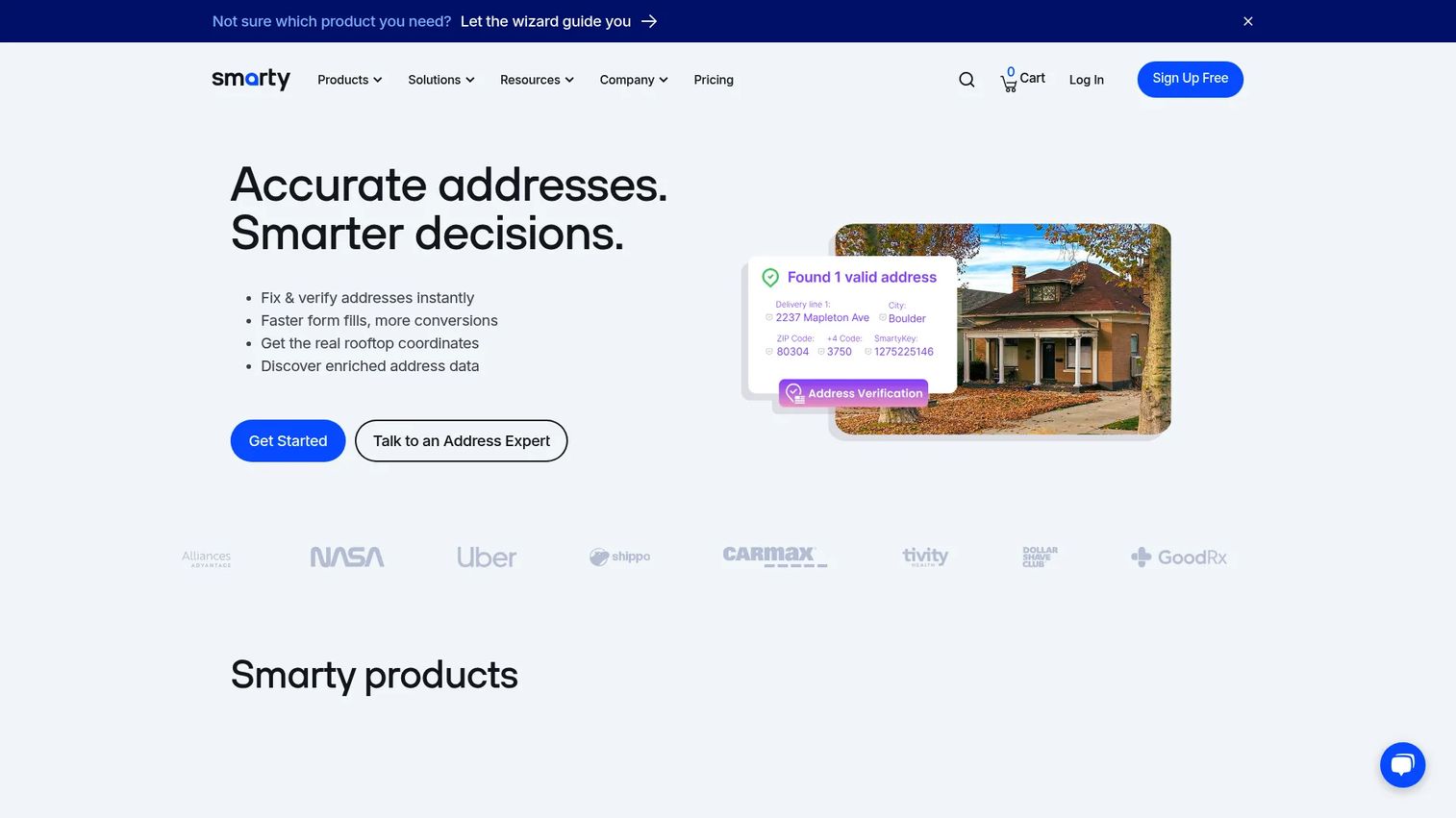
Smarty is an address intelligence platform built for teams that want verification, autocomplete, and geocoding delivered through clean, fast APIs. It handles both US and international addresses, and its documentation is a favorite among developers who want to ship verification without wrestling with a heavy integration. If you need an address checker that slots into your checkout, signup, or backend with minimal engineering lift, Smarty is a strong first look.
Best for: Teams that need API-based address verification and autocomplete with developer-friendly docs.
Key strengths
- US and international verification: Validate addresses across US records and international datasets from a single platform.
- Address autocomplete: Suggest verified addresses as users type, cutting input errors and keystrokes at the point of capture.
- Geocoding and reverse geocoding: Append coordinates for routing, mapping, and analytics workflows.
Why choose Smarty: Smarty fits product and engineering teams that value speed and clarity. The API is well-documented, verification is fast, and the autocomplete layer directly supports checkout conversion. If your primary need is embedding real-time verification into a live product without a long implementation cycle, Smarty is built for exactly that motion.
Smarty pricing: Smarty offers a free trial covering 42 days or 1,000 address lookups. The Professional plan starts at $50 per month, and a Custom quote-based plan is available for higher volumes. Pricing is publicly listed on Smarty's site.
2. Melissa
Melissa is a data quality provider whose address verification sits inside a broader suite covering email, phone, name, and identity verification. It validates addresses for the US, Canada, and 250+ countries, and supports both real-time API calls and batch cleansing. For teams that treat address quality as one piece of a larger contact-data hygiene problem, Melissa consolidates several validation needs under one roof.
Best for: Organizations that need contact data cleansing, address verification, and identity verification at scale.
Key strengths
- Global address verification: Validate addresses across the US, Canada, and 250+ countries with standardization and enrichment.
- Multi-attribute verification: Verify email, phone, and name data alongside addresses for complete contact records.
- Batch and real-time deployment: Run verification via API for live capture or in batch for bulk address verification of legacy lists.
Why choose Melissa: Melissa fits teams that want more than address checking. If you are cleaning up a CRM riddled with bad emails, disconnected phones, and malformed addresses all at once, a single-vendor data quality platform reduces integration overhead. The tradeoff is breadth over depth in any single category, which suits teams solving a broad hygiene problem rather than one narrow use case.
Melissa pricing: Melissa's pricing is product-specific. A free tier (GAV Free) covers 250 records per month. US address verification is available pay-as-you-go starting at $40 for 10,000 credits, with annual subscription plans starting at $5,145 for 1 million records per year and unlimited plans from $16,000. Pricing is listed publicly on Melissa's site.
3. Radar
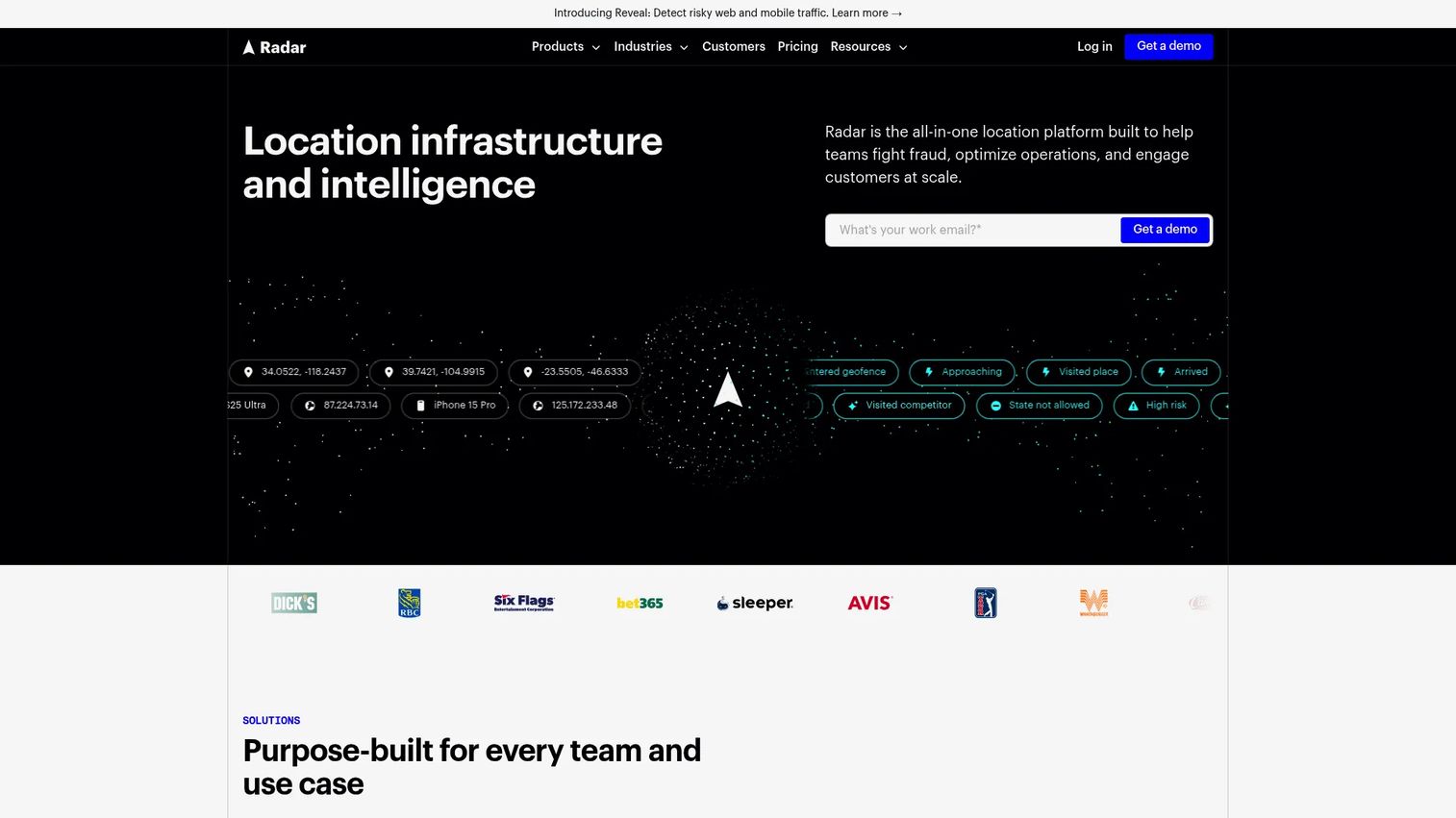
Radar is a location infrastructure platform that pairs address capture with geofencing, maps, geocoding, and fraud tooling. It is built for teams that need location intelligence as a first-class capability, not just address validation. If your product depends on knowing where users are, routing them, or detecting geo-based fraud, Radar keeps address verification and location logic in one stack.
Best for: Businesses that need location data, geofencing, maps, or geo-compliance and fraud tooling in one platform.
Key strengths
- Geofencing: Create unlimited geofences with meter-level accuracy for location-triggered workflows.
- Maps platform: Access geocoding, search, routing, and custom map styles from one API.
- Fraud detection: Use GPS, Wi-Fi, IP, Bluetooth, and sensor data for geo-compliance and fraud prevention.
Why choose Radar: Radar fits product teams building location-aware experiences where address capture is one input among many. If you need geofencing and maps alongside address validation, consolidating them in Radar avoids stitching together separate vendors. It is less of a fit for teams whose only need is straightforward postal verification.
Radar pricing: Radar's terms state its services are available without charge, and the platform offers a free tier. A specific paid pricing table was not publicly visible at the time of writing, so confirm current pricing directly with Radar before committing to production volumes.
4. PostGrid
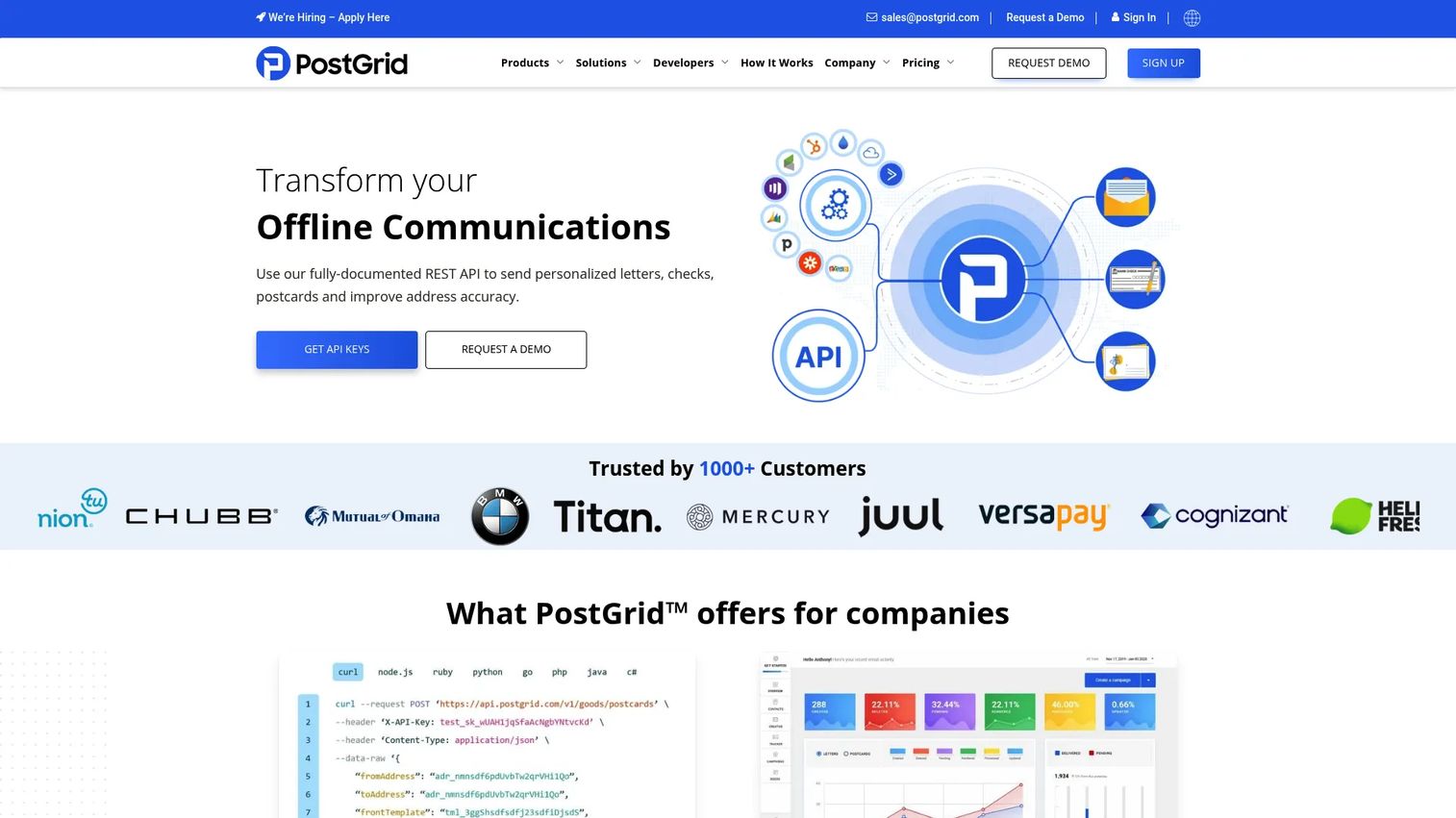
PostGrid connects address verification to offline communications: letters, postcards, checks, and direct mail. It offers US and Canada address verification with autocomplete and batch verification, plus international coverage across 245+ countries. For teams whose address quality feeds a physical mail workflow, PostGrid ties validation and execution into a single API and dashboard.
Best for: Businesses that need to automate direct mail and address verification workflows together.
Key strengths
- Print and mail API: Send letters, postcards, and checks programmatically with verified addresses.
- US and Canada verification: Validate addresses with autocomplete and bulk address verification for cleaner lists.
- International coverage: Verify addresses across 245+ countries for global mail operations.
Why choose PostGrid: PostGrid fits operations and marketing teams that connect address quality directly to what gets printed and shipped. Verifying an address is only valuable if the resulting mail arrives, and PostGrid closes that loop by pairing verification with mail execution. It carries a strong 4.9/5 rating on G2, reflecting satisfaction among mail-focused teams.
PostGrid pricing: PostGrid lists its product areas publicly, but specific dollar amounts are surfaced through the dashboard rather than a public pricing table. Request pricing directly from PostGrid to match your mail volume and verification needs.
5. Loqate
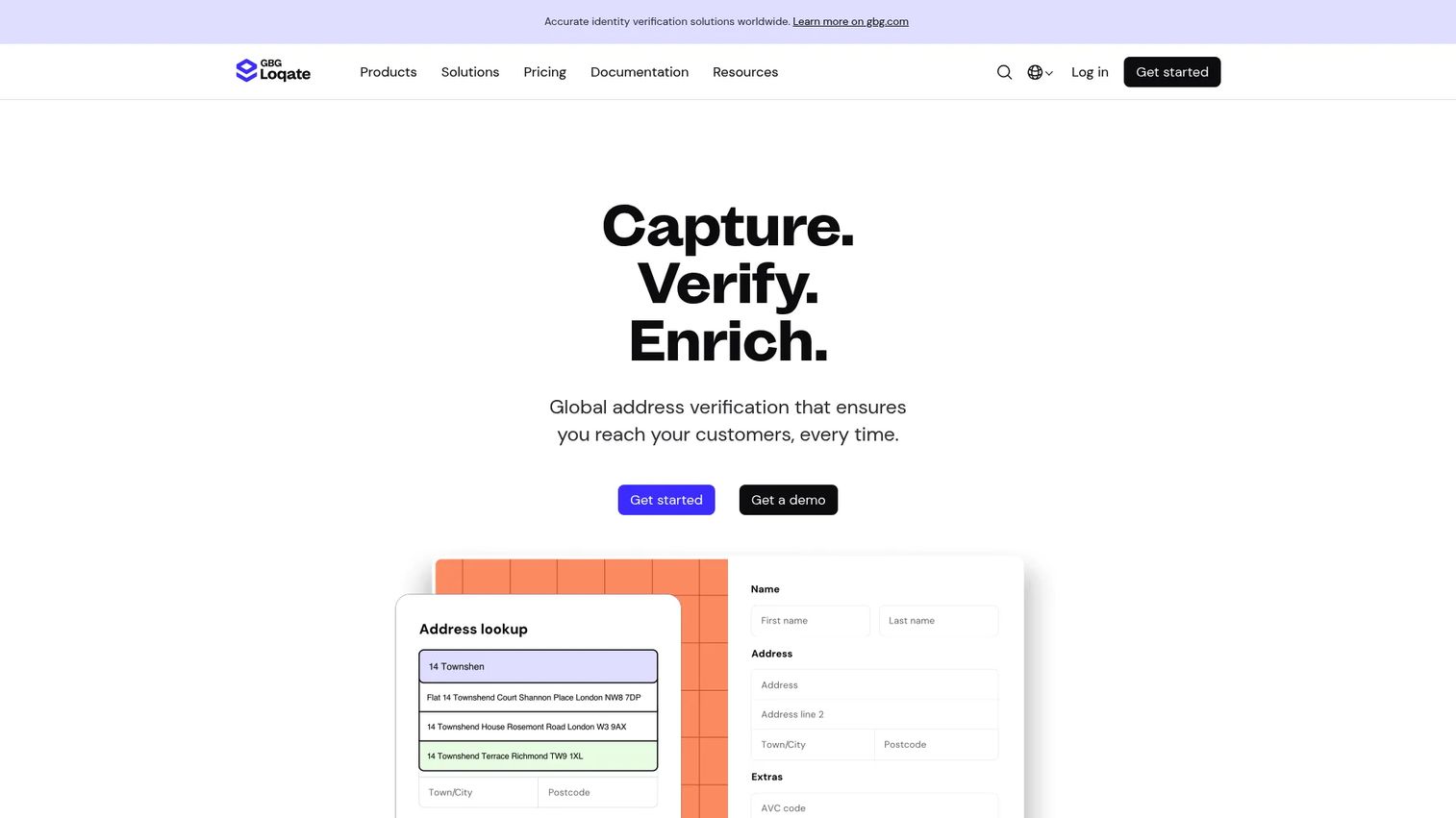
Loqate, part of GBG, is a global address verification and capture platform built for international operations. It handles address capture, email validation, and phone validation, with coverage that spans hundreds of countries. For teams selling across borders, Loqate's depth of international address verification and transliteration support makes it a natural fit for global customer data workflows.
Best for: Businesses needing global address verification and capture with adjacent data validation services.
Key strengths
- Address capture: Autocomplete and verify addresses at the point of entry to reduce checkout friction.
- Email validation: Confirm email deliverability alongside address data for complete records.
- Phone validation: Validate phone numbers to round out contact-data quality.
Why choose Loqate: Loqate fits teams whose customer base spans many countries and who need consistent, standardized address data everywhere they operate. The global coverage and capture-first design make it strong for reducing international checkout friction. If your operations are primarily US-only, a more focused domestic tool may cover your needs with less overhead.
Loqate pricing: Loqate offers pay-as-you-go top-up plans starting at $100, with $300 and $1,000 options, plus bespoke pricing for larger needs. A 45-day free trial is available. Pricing is listed publicly on Loqate's US pricing page.
6. Twilio user authentication and identity

Twilio approaches verification from the identity and fraud angle. Its User Authentication and Identity suite combines two-factor authentication, phone number validation, and identity signals that teams use to confirm who a user is and reduce fraud during onboarding. Address data enters the picture as one signal in a broader identity check rather than a standalone postal validation product.
Best for: Teams needing programmable customer verification, 2FA, and phone-identity checks at scale.
Key strengths
- Verify API: Add two-factor authentication and login protection to onboarding flows.
- Lookup API: Validate phone numbers and retrieve identity signals during signup.
- Silent Network Authentication: Confirm identity across multiple channels without added user friction.
Why choose Twilio: Twilio fits teams that connect verification to fraud prevention and onboarding rather than mailing. If your priority is confirming a user is legitimate before granting access, and address is one of several signals you evaluate, Twilio's programmable, usage-based model integrates cleanly. Teams that need pure postal CASS-certified verification will pair it with a dedicated address tool.
Twilio pricing: Twilio uses pay-as-you-go pricing with a free trial. Verify starts at $0.05 per verification. Lookup includes free validation and reformatting, with inbound caller identification at $0.01 per request and identity match at $0.10 per request. Rates are listed publicly on Twilio's pricing page.
7. Postalytics
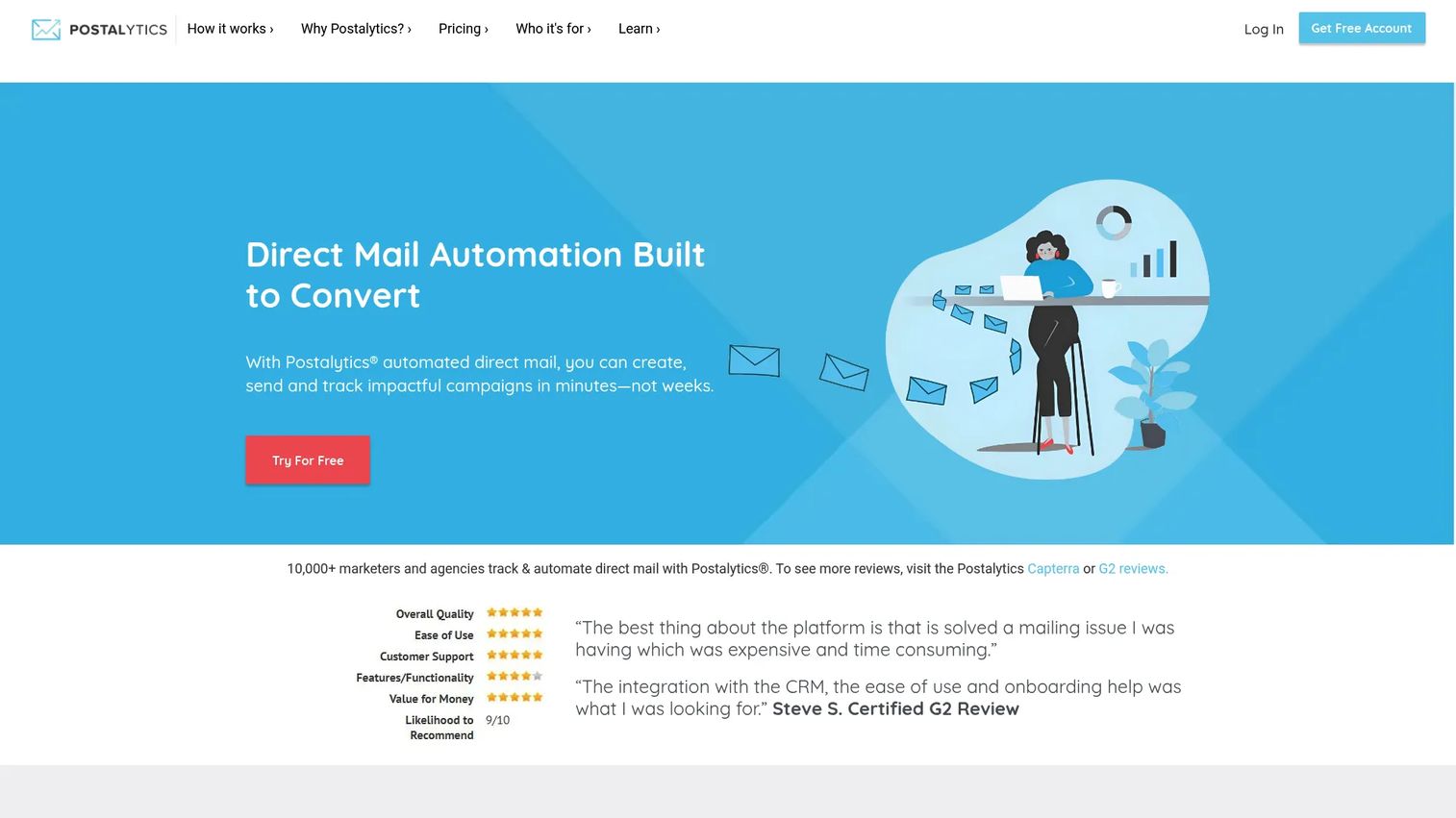
Postalytics is direct mail automation software that folds address verification into campaign creation, sending, and tracking. It fits marketing and operations teams that run direct mail at scale and need addresses cleaned before pieces go out. Verification here is a means to an end: making sure the mail you send actually lands and that you can track what happens after.
Best for: Teams that want automated direct mail with CRM integration and tracking.
Key strengths
- Direct mail editor: Design and build mail campaigns without leaving the platform.
- Tracking and analytics: Monitor delivery and response to measure campaign performance.
- Direct mail API: Trigger verified, personalized mail programmatically from your systems.
Why choose Postalytics: Postalytics fits marketers who treat direct mail as a measurable channel rather than a one-off. Address verification protects deliverability, and the tracking layer ties mail spend to outcomes. If you need standalone bulk verification without the mail-automation layer, a dedicated verification API will be a leaner choice.
Postalytics pricing: Postalytics offers a Free plan, a Marketer plan at $199 per month, and Pro and Agency plans at $399 per month, plus per-piece pricing and higher-volume options. Pricing is listed publicly on the Postalytics US pricing page.
8. Placekey
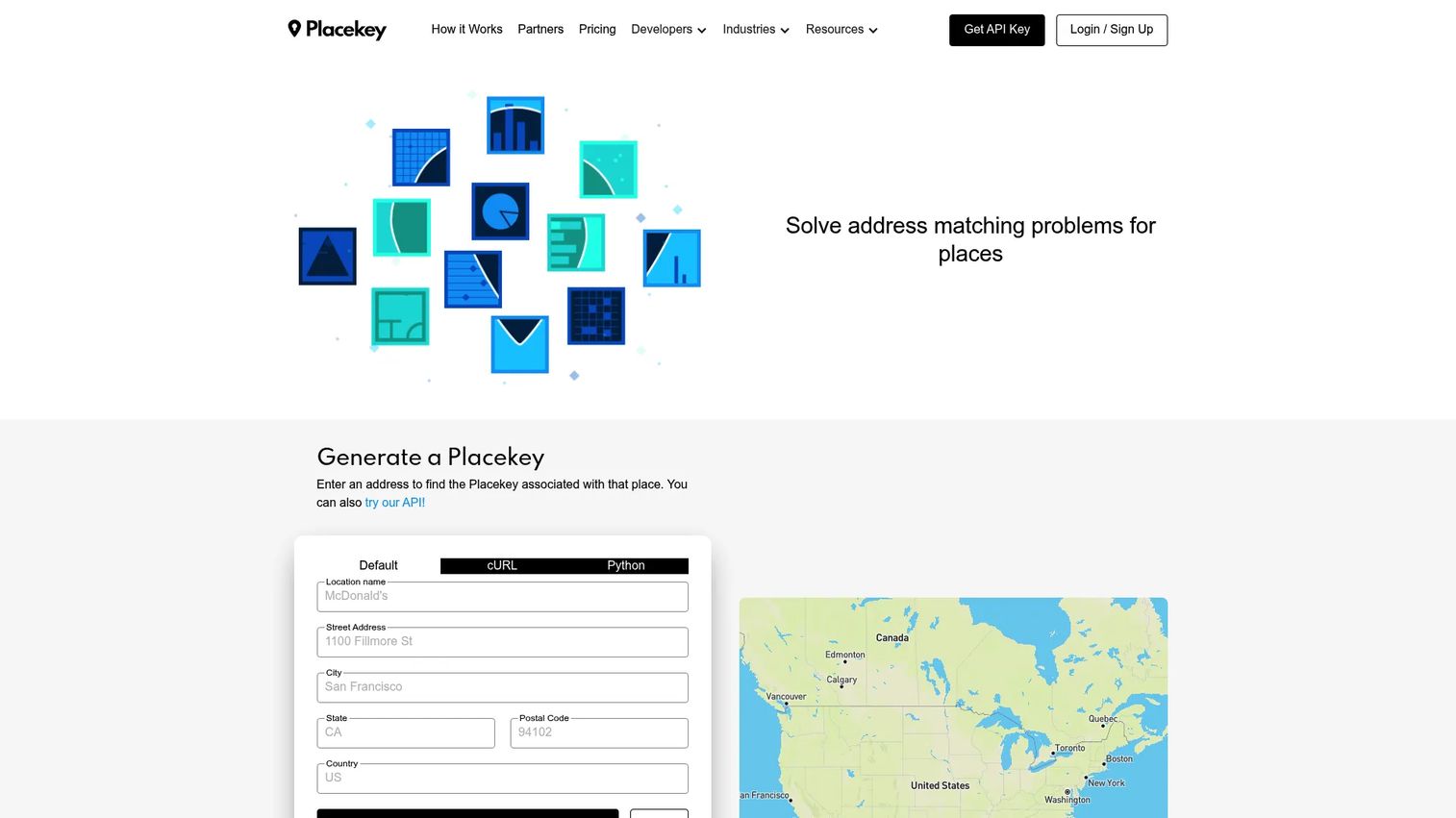
Placekey takes a different approach: it assigns a universal identifier to every physical place, making it easy to match, dedupe, and join address and location data across sources. Rather than only validating deliverability, Placekey solves the harder problem of entity resolution, knowing that two differently formatted records point to the same real-world place. For data teams wrangling messy location data, that is a distinct kind of value.
Best for: Teams that need a place identifier API for address and POI matching at scale.
Key strengths
- Placekey API: Retrieve universal place identifiers from addresses, coordinates, or place names.
- Entity resolution: Match and dedupe records that point to the same physical place or POI.
- Bulk uploads and integrations: Process large datasets and plug into developer workflows with libraries and connectors.
Why choose Placekey: Placekey fits data and analytics teams whose challenge is joining and deduplicating location data across systems, not just confirming deliverability. The universal identifier solves matching problems that standard verification cannot. Teams whose only need is postal validation for mailing will find a CASS-certified verification tool more directly aligned.
Placekey pricing: Placekey offers a free tier with 10,000 lookups per day. The Silver plan is $2,400 per year, Gold is $12,000 per year, and Enterprise starts at $36,000 per year for 30M+ lookups. Pricing is listed publicly on Placekey's pricing page.
Considerations before you buy
Picking address verification software is less about which tool is "best" and more about which one matches your operational motion. Run through this checklist before you commit.
Coverage and accuracy
Confirm the tool covers every region where you operate. A US-only tool will not serve a global customer base, and international address verification quality varies widely by country. Ask for accuracy benchmarks and reference data sources, and test with a sample of your own messy records rather than trusting marketing numbers.
Postal certification and compliance
If you send physical mail in the US, USPS CASS certification and DPV confirmation are essential. They unlock postal discounts and confirm real deliverability. Beyond mail, check that the vendor's data handling meets your compliance requirements for privacy and data residency, especially if you operate across jurisdictions.
Workflow fit: real-time versus batch
Decide whether you need real-time address verification at the point of entry, bulk address verification for existing records, or both. Most teams need both eventually. A tool that handles autocomplete at capture and batch cleansing of legacy data covers the full lifecycle without a second vendor.
Integration and maintainability
Evaluate the API, SDK, and no-code integration options against your stack and your engineering bandwidth. A clean API matters if developers own the integration; no-code connectors matter if a product or ops team maintains it. Factor in ongoing maintenance, because verification logic that rots as your product changes creates the same data quality problem you set out to solve.
Conclusion
The right address verification software depends entirely on your workflow, not on which vendor has the loudest marketing. If you need developer-friendly real-time verification and autocomplete, Smarty is the strongest starting point. For broad contact-data cleansing beyond addresses, Melissa consolidates the job. Teams needing location intelligence alongside verification should look at Radar, while global operations are well served by Loqate's 250+ country coverage.
If your address data feeds physical mail, PostGrid and Postalytics tie verification to execution and tracking. For identity-linked and fraud-focused onboarding, Twilio integrates address as one signal among many. And if your real challenge is matching and deduplicating location data across systems, Placekey's universal identifier solves a problem standard validation cannot touch.
Start by naming your primary motion: real-time capture, bulk cleanup, global coverage, or location matching. Then shortlist the two tools that fit it, run a test against your own messy data, and let accuracy on your records decide. Clean address data pays for itself in fewer failed deliveries, lower support load, and cleaner analytics.
FAQs
Address validation confirms an address is correctly structured and exists in official records, while address verification goes further to confirm the address is deliverable to a real physical location. In practice, most address validation software does both, and vendors use the terms interchangeably. The distinction matters most when deliverability, not just format, drives your outcomes.
Verification reduces form errors, prevents "invalid address" rejections of legitimate inputs, and cuts keystrokes through autocomplete. Fewer errors and less typing means less cart abandonment at the address step. It also keeps bad data out of your database, so downstream shipping and communications work as expected.
USPS CASS certification confirms that a vendor's software can accurately match and standardize US addresses against official USPS data. It is the signal that qualifies mail for automation discounts and confirms the software meets postal accuracy standards. Combined with DPV, which confirms a specific delivery point exists, it is essential for any US mailing workflow.
Real-time verification fits the point of entry, validating addresses at signup or checkout before bad data enters your system. Batch verification, or bulk address verification, fits cleaning existing databases and mailing lists at scale. Most teams eventually need both, so tools that handle real-time capture and batch cleansing cover the full lifecycle.
For broad global coverage, Loqate spans hundreds of countries with transliteration support, and Melissa covers the US, Canada, and 250+ countries. PostGrid verifies addresses across 245+ countries for international mail. Prioritize tools with multi-country coverage and local formatting if your customer base crosses borders.
Yes, and autocomplete is often the best front-end layer for conversion. As a user types, the tool suggests complete, verified addresses, cutting keystrokes and eliminating typos at the source. Smarty, Loqate, and PostGrid all offer address autocomplete alongside verification.
For product managers, clean address data ties directly to activation, checkout completion, and support deflection. Real-time verification reduces form friction that hurts conversion, while accurate data lowers "where is my order" tickets and prevents CRM decay. It is a data quality investment that shows up in retention and operational metrics, not just the mailing room.
Absolutely. It supports onboarding by reducing signup friction, fraud reduction by flagging suspicious or nonexistent addresses, CRM hygiene through deduplication and standardization, and campaign accuracy so your mailings and communications reach real people. Any workflow that depends on customer address data benefits from verification.