Your CFO wants incremental revenue, not impressions. Your media plan keeps fragmenting across networks. And every retailer with a loyalty card is now pitching you ad inventory.
That tension is why retail media platforms have become the fastest-growing line item in most digital budgets. Retail media ad spend worldwide is projected to reach $136 billion in 2024, according to Kevel (2024), and the broader market is estimated at roughly $140 billion in 2024, climbing to about $165 billion by 2026, per Intouch (2024). The pull is simple: these platforms sit at the point of purchase, where intent is highest and first-party data is cleanest.
But scale alone does not justify a budget shift. The ANA reports that 56% of advertisers already use five or more retail media networks, and 58% plan to add more next year (Kevel, 2024). More networks means more dashboards, more measurement formats, and more chances for spend to leak into channels that cannot prove a sales lift.
So the real question for a digital marketer is not "should I spend on retail media." It is "which retail media platforms deserve my budget, what is each one actually good at, and what do I need to verify before I commit." That is what this guide answers. If your stack work also touches measurement and audience infrastructure, it pairs naturally with how you think about your customer data platform and your data visualization tools for reporting the results.
What's inside
This guide covers eight retail media platforms worth evaluating for a 2026 retail media strategy. It is built for growth marketers, demand gen leads, ecommerce marketers, and media buyers who need to decide where to test spend first, not a definition lesson.
We selected platforms based on four criteria that matter most when you are allocating budget:
- Reach and shopper intent at the point of purchase
- First-party data access for targeting and audience building
- Measurement quality, especially closed-loop and SKU-level reporting
- Activation breadth across onsite, offsite, and in-store media
Each platform below is tied to a buying decision: where it fits, what data it unlocks, and what to confirm before you move money.
TL;DR
Short on time? Here is the decision shortcut.
- Best for sheer scale and store-plus-digital reach: Walmart Connect
- Best for high-intent commerce demand capture: Amazon Ads
- Best for brand-safe omnichannel reach: Target Roundel
- Best for grocery and CPG loyalty targeting: Kroger Precision Marketing and Instacart Ads
- Best for warehouse-club fit: Costco Velocity
- Best for health, wellness, and pharmacy context: Walgreens Advertising Group
- Best for electronics and high-consideration buys: Best Buy Ads
Most marketers should pair one high-intent network with one test-and-learn network, then expand based on measured incrementality rather than reach claims.
What is a retail media network?
A retail media network is a retailer-owned advertising platform that lets brands buy ad placements across the retailer's own digital and physical properties, using the retailer's first-party shopper data to target and measure campaigns. A retail media platform is the technology layer that powers that network: the ad server, audience tools, reporting, and activation surfaces.
The category exists because retailers sit at the point of purchase. They know what shoppers browse, add to cart, and actually buy. That shopper data is the asset, and retailer monetization of it has become a major profit center.
Here is how the pieces fit:
- First-party data: Logged-in, purchase-based shopper data the retailer owns directly. No third-party cookies required, which matters as signal loss continues.
- Closed-loop measurement: The retailer ties ad exposure to actual sales, often at the SKU level, so you can see whether a campaign moved units rather than just impressions.
- Onsite retail media: Ads on the retailer's own site and app, like sponsored search and product listings, where shopper intent is highest.
- Offsite retail media: The retailer activates its shopper data across the open web, social, and connected TV, extending reach beyond its own properties.
- In-store media: Screens, shelf-edge displays, audio, and point-of-purchase activation inside physical stores. By 2026, about 38.7% of large-format grocery, pharmacy, and mass retail chains are expected to deploy in-store digital media, driving $5.94 billion in retail media demand, per Strategic Market Research (2024).
A quick note on terms. Commerce media is the broader category. It includes retail media plus any commerce-data-driven advertising, such as marketplaces, delivery apps, and financial platforms that monetize purchase signals. Retail media is the retailer-owned slice of that pie. When you hear someone reference commerce media platforms, they usually mean this wider ecosystem, with retail media networks as the anchor.
Four roles interact in every retail media buy: the retailer that owns the data and inventory, the brand that funds the campaign, the agency that often plans and executes, and the shopper whose behavior fuels both targeting and measurement.
When to use retail media platforms
Not every goal calls for retail media, and not every retail media dollar belongs onsite. Use these three patterns to pattern-match your own situation.
Launching products where shoppers are already buying
When you introduce a new SKU or push a seasonal item, onsite retail media puts your product in front of shoppers at the exact moment they are searching a category. This matters because you are not creating demand from scratch, you are capturing it. Success looks like strong sponsored-search conversion, incremental units sold, and a healthy share of category search.
Extending performance media with first-party audience access
When your prospecting on social and search is hitting diminishing returns, offsite retail media lets you activate a retailer's purchase-based audiences across the open web. The advantage is targeting built on real buying behavior, not modeled lookalikes. Success looks like lower wasted spend, better return on ad spend against verified shoppers, and audiences you can actually tie back to sales.
Building an omnichannel budget mix across onsite, offsite, and in-store
When your brand depends on both ecommerce and store-driven sales, omnichannel retail media lets you coordinate onsite, offsite, and in-store media under shared measurement. This matters because shoppers move between app, web, and aisle. Success looks like consistent messaging across touchpoints and a unified read on incrementality rather than siloed channel reports.
Retail media platform comparison
The table below is a fast-scan view, not the full story. Read it for fit, then go to the item section for the detail that actually drives a budget decision. Most of these platforms price through direct sales rather than public rate cards, so treat pricing as "contact required" unless noted, and confirm minimums during your evaluation. Public G2 ratings are sparse in this category, so we only list a rating where a verified score exists.
| # | Product | Intent | Key differentiation | Pricing | G2 rating |
|---|---|---|---|---|---|
| 1 | Walmart Connect | High, broad mass-retail | Massive store-plus-digital reach with closed-loop measurement | Contact sales | Not listed |
| 2 | Amazon Ads | Very high, commerce search | Dominant demand capture across sponsored ads and DSP | Usage-based (CPC, CPM, vCPM) | 4.3/5 |
| 3 | Target Roundel | High, brand-conscious | Brand-safe omnichannel reach with self-serve reporting | Contact sales | Not listed |
| 4 | Kroger Precision Marketing | High, grocery loyalty | Basket-level and SKU-level grocery measurement | Contact sales | Not listed |
| 5 | Instacart Ads | Very high, grocery delivery | Close-to-purchase grocery activation with closed-loop reporting | CPC and CPM by format | 4.3/5 |
| 6 | Costco Velocity | High, warehouse club | Differentiated membership audience and warehouse context | Contact sales | Not listed |
| 7 | Walgreens Advertising Group | High, health and wellness | Pharmacy-adjacent first-party data across channels | Contact sales | Not listed |
| 8 | Best Buy Ads | High, high-consideration | Electronics shopper context across onsite, offsite, in-store | Contact sales | Not listed |
1. Walmart Connect
Walmart Connect is Walmart's retail media network for advertising across Walmart's site, app, stores, and offsite channels. It pairs one of the largest mass-retail shopper bases in the United States with closed-loop measurement, so brands can connect ad exposure to actual transactions. For a digital marketer, the appeal is scale plus the ability to reach the same shopper online and in the aisle.
Best for: Brands and marketplace sellers that want to reach Walmart shoppers across both digital and in-store retail media placements.
Key strengths
- Sponsored search: Capture high-intent shoppers at the moment they search a product category onsite.
- Onsite display: Build visibility across Walmart's site and app where purchase decisions happen.
- Offsite media: Extend Walmart's first-party shopper data beyond its own properties across the open web.
Why choose Walmart Connect: If your products sell through Walmart or you need broad mass-market reach with store-plus-digital coverage, Walmart Connect gives you scale few networks can match. It fits brands that care about omnichannel retail media and want closed-loop reporting tied to real sales rather than modeled estimates.
Walmart Connect pricing: Walmart Connect does not publish public rate cards. Pricing is handled through direct sales, and the official site routes advertisers to its contact form. Confirm minimum spend, managed-service versus self-serve access, and which placements are gated to larger budgets before you commit. Treat any quoted minimum as a planning input, not a fixed entry price.
2. Amazon Ads
Amazon Ads is the dominant retail media platform for commerce-driven demand capture. It spans sponsored ads, display, video, audio, streaming TV, and Amazon DSP, which means you can move from bottom-funnel search to upper-funnel awareness inside one ecosystem. For marketers, the draw is intent at unmatched scale, paired with closed-loop performance data on the world's largest commerce platform.
Best for: Brands and advertisers selling products or services across Amazon's ad ecosystem who want high-intent demand capture.
Key strengths
- Sponsored Products and Sponsored Brands: Win category search and shelf position where shoppers are ready to buy.
- Display, video, audio, and streaming TV: Reach shoppers across formats and devices beyond the search results page.
- Amazon Stores and Amazon Live: Build a branded destination and engage shoppers through interactive formats.
Why choose Amazon Ads: When the buying moment happens on Amazon, this is where demand capture lives. It fits brands that need to defend share, launch products into active search, and tie spend to verified sales. Amazon Ads holds a 4.3 out of 5 rating on G2, reflecting broad advertiser adoption.
Amazon Ads pricing: Amazon does not publish a single starting price. Sponsored ads are typically priced on CPC, vCPM, or CPM, Amazon DSP runs on cost plus fees or fixed CPM campaigns, and Amazon Ad Server uses negotiated rates. You can create a Store for free, but that does not make the ad products free. Model your CPCs by category and confirm DSP minimums before scaling.
3. Target Roundel
Target Roundel is Target's retail media network for reaching Target shoppers across onsite and offsite channels. It is built for brands that want brand-safe environments and the ability to connect ecommerce behavior with store-driven shopping. Roundel Media Studio adds self-service reporting and campaign management, which matters for marketers who want hands-on control over optimization.
Best for: Brands advertising to Target shoppers through retail media and omnichannel campaigns that span digital and store.
Key strengths
- Target Product Ads: Place products in front of shoppers actively browsing relevant categories onsite.
- Display, CTV, programmatic, search, social, and influencer: Activate Target's shopper data across a wide channel mix.
- Roundel Media Studio: Manage campaigns and pull reporting through a self-service interface.
Why choose Target Roundel: If brand safety and a premium retail context matter to your media plan, Roundel offers brand-conscious reach with omnichannel retail influence. It fits marketers who want to bridge online and in-store behavior and value self-serve reporting alongside managed support.
Target Roundel pricing: Roundel does not list public pricing. The platform operates on a contact-sales model, so reach out to scope minimums, self-service versus managed options, and which premium placements require larger commitments. Verify how closed-loop measurement is delivered and what reporting cadence you can expect before allocating budget.
4. Kroger Precision Marketing
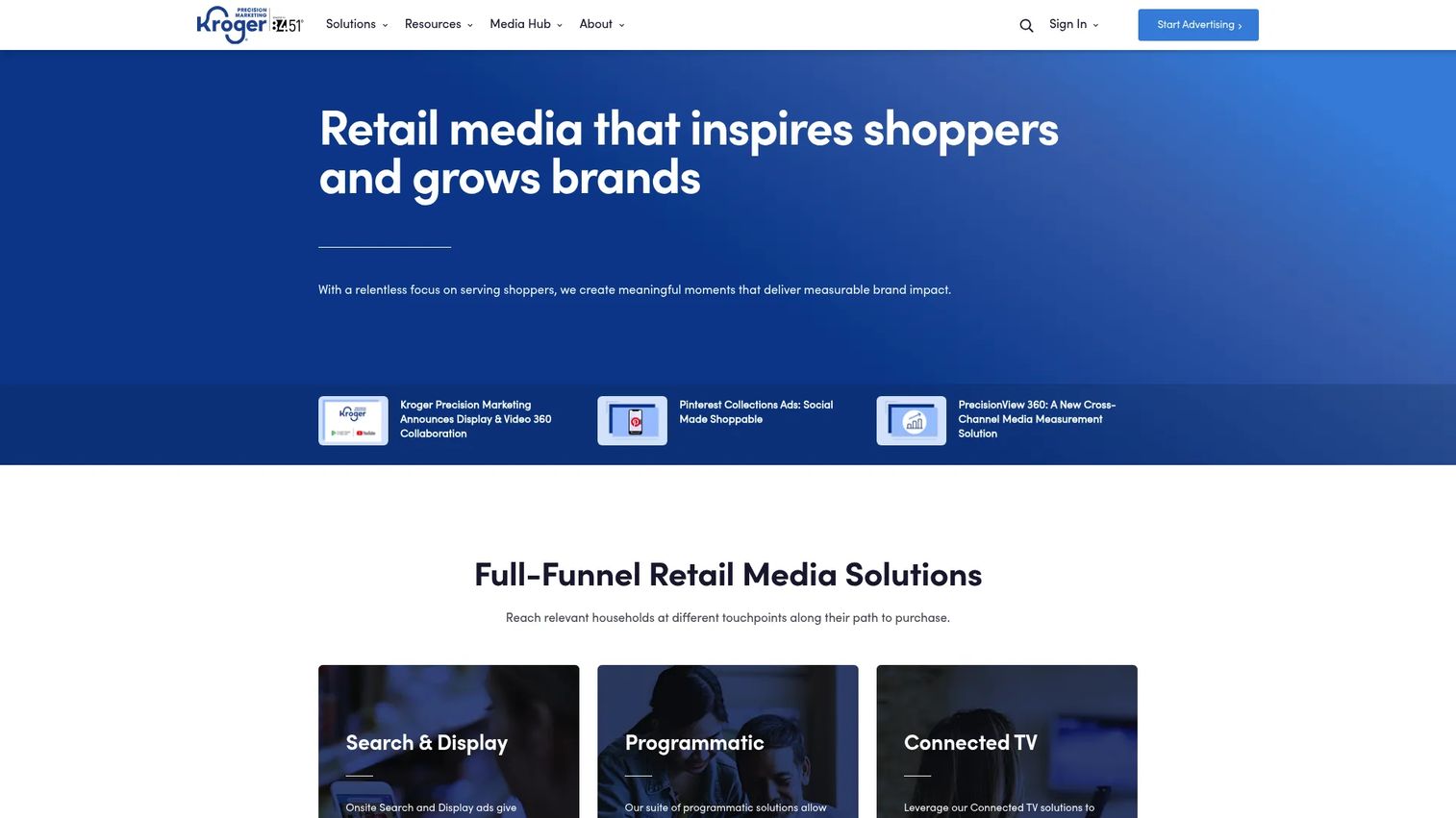
Kroger Precision Marketing is Kroger's retail media and advertising platform for reaching shoppers with purchase-based audiences and sales measurement. Grocery and CPG marketers care about it for one reason: basket-level outcomes. Kroger's loyalty data ties ad exposure to what shoppers actually buy, which makes incrementality far easier to defend than in general-merchandise environments.
Best for: CPG and brand advertisers targeting Kroger shoppers with grocery retail media built on loyalty data.
Key strengths
- Search and display advertising: Reach shoppers onsite as they plan and build grocery baskets.
- Programmatic, connected TV, and offsite advertising: Extend Kroger's first-party shopper data across the open web and streaming.
- Onsite brand activations, social, influencer, email, and push: Engage loyalty shoppers across multiple owned touchpoints.
Why choose Kroger Precision Marketing: For grocery and CPG brands, basket-level and SKU-level measurement is the differentiator. Kroger's purchase-based audiences let you target real buyers and measure whether a campaign shifted units, not just clicks. It fits marketers who need to prove incremental sales to skeptical finance partners.
Kroger Precision Marketing pricing: Kroger does not display public pricing, and access runs through its advertising team. Confirm audience minimums, the measurement methodology behind its closed-loop reporting, and how basket-level data is shared back to you before committing budget. Ask specifically how incrementality is calculated so you can compare it against your other networks.
5. Instacart Ads
Instacart Ads is a commerce media platform that sits unusually close to the moment of purchase. Because shoppers are actively building a cart for delivery, intent is high and basket influence is direct. For grocery and CPG marketers, that proximity makes Instacart a strong test-and-learn environment with fast feedback loops and closed-loop reporting.
Best for: CPG brands and retailers running grocery retail media campaigns at scale on a delivery-first platform.
Key strengths
- Sponsored products, display, shoppable video, and inspiration ads: Reach shoppers across formats while they fill a live cart.
- Shoppable Pages: Build free brand destinations that turn browsing into add-to-cart moments.
- Closed-loop reporting via Ads Manager: Tie spend to actual purchases and manage campaigns in one place.
Why choose Instacart Ads: Few platforms get this close to the point of purchase. Instacart fits marketers who want to influence basket composition, test creative quickly, and measure conversion against real grocery transactions. It carries a 4.3 out of 5 rating on G2.
Instacart Ads pricing: Instacart prices by format rather than subscription. Shoppable Pages are free, sponsored products run on CPC, and display, shoppable video, and inspiration ads run on CPM. There is no public fixed starting price, so model your costs by format and confirm any campaign minimums in Ads Manager before scaling spend.
6. Costco Velocity
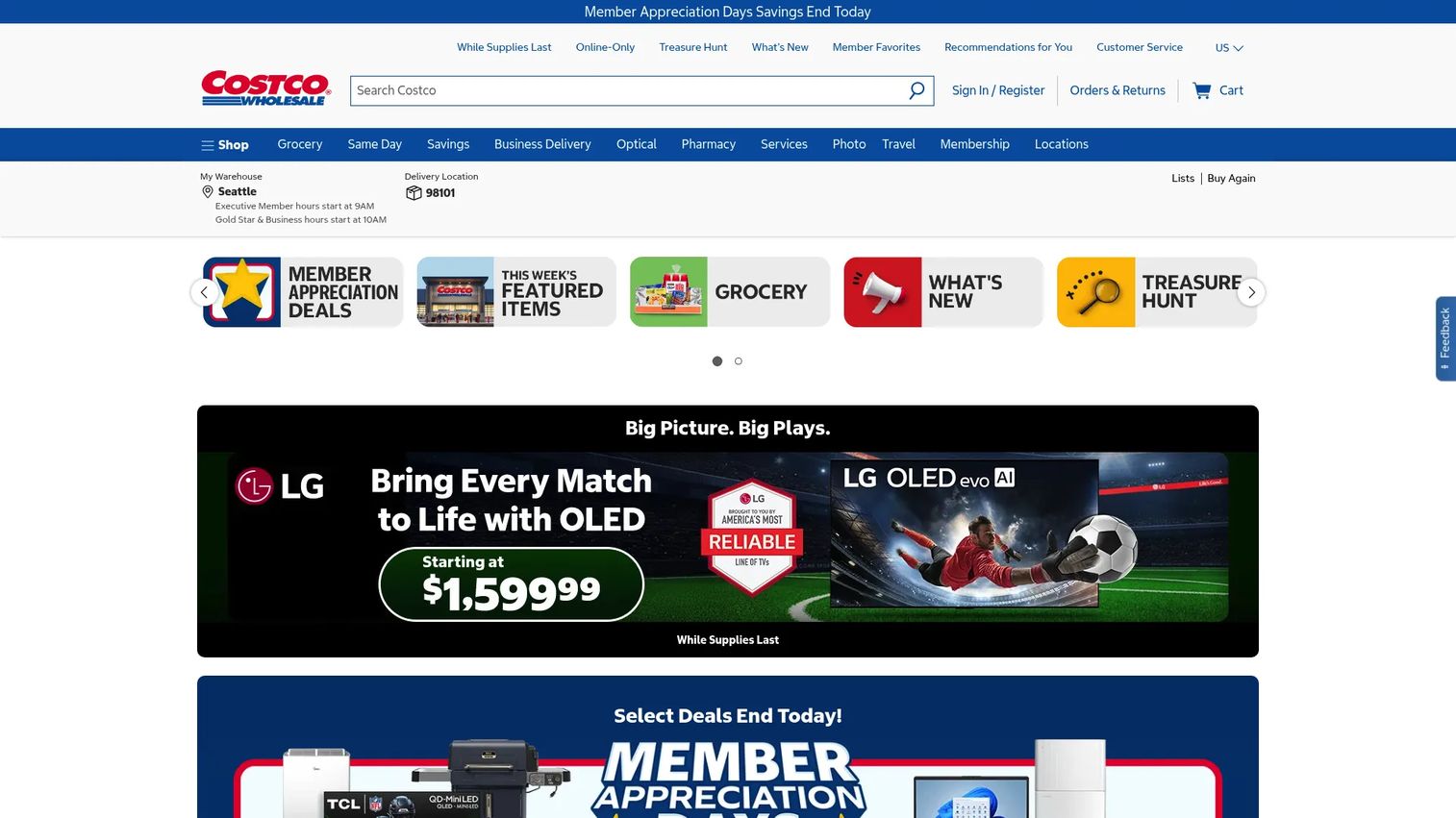
Costco brings a narrower but distinctly valuable audience to the retail media conversation through its Velocity advertising program. The warehouse-club model means high-spend, loyal members and a shopping context unlike any open marketplace. For brands with strong warehouse-channel fit, that audience quality can outweigh the smaller reach.
Best for: Brands with a strong product fit in warehouse retail that want to reach high-value Costco members.
Key strengths
- Warehouse-club audience: Reach loyal, high-basket members in a differentiated retail context.
- Membership-driven first-party data: Target based on a purchase base built around renewing members.
- Channel-fit context: Align campaigns with the bulk-buying behavior unique to the club model.
Why choose Costco Velocity: If your brand already performs in warehouse retail, the audience fit can be exceptional. It rewards marketers who match creative and offers to bulk-buying behavior rather than treating it like a general retail buy. Costco itself runs on membership pricing, with Gold Star and Business memberships at $65 per year and Executive at $130 per year, which signals the high-commitment shopper base behind the network.
Costco Velocity pricing: Costco does not publish public advertising rate cards for its retail media program, so access and pricing run through its advertising team. Verify inventory availability, creative requirements, and audience-fit guidance before committing, since the value here depends heavily on category match rather than raw scale.
7. Walgreens Advertising Group
Walgreens Advertising Group is Walgreens' retail media division, offering onsite, offsite, and in-store advertising powered by myWalgreens first-party data. Its edge is context: health, wellness, beauty, and pharmacy-adjacent shopping behavior that is hard to reach cleanly anywhere else. For brands in those categories, the shopper data is the draw.
Best for: Brands seeking retail media reach across Walgreens' onsite, offsite, and in-store channels in health and wellness categories.
Key strengths
- Onsite and in-app display and search: Reach shoppers as they browse health and wellness categories.
- Offsite media across programmatic, CTV, social, and search: Activate myWalgreens data beyond owned properties.
- In-store audio, signage, and coupon solutions: Influence shoppers at the physical point of purchase.
Why choose Walgreens Advertising Group: For health, wellness, beauty, and pharmacy-adjacent brands, category fit drives results. Walgreens' first-party data reaches shoppers in moments that general retail networks rarely capture. It fits marketers who need contextual relevance and measurable outcomes in regulated, high-consideration categories.
Walgreens Advertising Group pricing: Walgreens does not publish public pricing, and access runs through its advertising team. Confirm minimums, the scope of in-store activation, and how closed-loop measurement is reported back, especially given the compliance sensitivities of health-adjacent categories. Clarify data-handling terms early in your evaluation.
8. Best Buy Ads

Best Buy Ads is the retail media platform for reaching Best Buy shoppers across onsite, offsite, in-store, and app placements. Its strength is the high-consideration electronics shopper: someone researching a major purchase over days or weeks. For brands with long evaluation cycles, accessories, or seasonal buying moments, that context is hard to replicate.
Best for: Brands and agencies advertising consumer electronics to Best Buy shoppers across the funnel.
Key strengths
- Search ads and sponsored products: Capture shoppers actively researching electronics onsite.
- Display across BestBuy.com, the app, and the open web: Stay present through long consideration cycles using shopper data.
- Video, social, community, and direct ads: Reach shoppers across formats and decision stages.
Why choose Best Buy Ads: Electronics buying is rarely impulsive, so persistent, contextual presence matters. Best Buy Ads fits brands with high-consideration products, accessory attach opportunities, or seasonal spikes who want to reach researchers across onsite, offsite, and in-store touchpoints. It supports an omnichannel retail media approach for categories where the path to purchase is long.
Best Buy Ads pricing: Best Buy does not publish public pricing, and its site routes advertisers to a contact form. Confirm minimum spend, available placements, and measurement detail before committing, and ask how onsite and offsite performance is reported together so you can judge full-funnel incrementality.
Considerations before you allocate budget
Before you move money into any retail media platform, run it through this checklist. The goal is to avoid paying for reach you cannot measure.
Audience match
Verify that the retailer's shopper base overlaps with your real buyers. A massive audience that rarely buys your category is wasted reach. Ask for category-level audience sizing tied to first-party data, not blended traffic numbers.
Measurement quality
Push hard on closed-loop measurement. Confirm whether the platform reports SKU-level outcomes, how it defines incrementality, and whether you get raw data or only summary dashboards. If a network cannot show sales lift, treat its impressions skeptically.
Onsite versus offsite mix
Decide where each dollar belongs. Onsite retail media captures high-intent shoppers, offsite retail media extends first-party audiences across the web, and in-store media reaches shoppers in the aisle. The right mix depends on your funnel, not the retailer's pitch.
Creative requirements and budget thresholds
Each platform has its own creative specs, minimums, and managed-service thresholds. Confirm production costs, minimum spend, and which premium placements gate behind larger budgets before you commit.
Integration with analytics and CRM
Check how campaign data flows back into your stack. Clean integration with your analytics, CRM, and reporting layer is what lets you compare retail media against the rest of your media mix. Tie results back into your customer data platform thinking and your broader brand advocacy and reporting workflows so the numbers are comparable.
Incrementality testing
Run a holdout or geo test before scaling. Incrementality, not last-click ROAS, tells you whether retail media spend produced sales you would not have gotten anyway. Build this into your first 90 days, not your annual review.
Conclusion
The pattern across these eight platforms is clear. The biggest networks, Walmart Connect and Amazon Ads, win on scale and high-intent demand capture. The grocery and specialty players, Kroger Precision Marketing, Instacart Ads, Costco Velocity, Walgreens Advertising Group, and Best Buy Ads, win on category fit and basket-level or high-consideration context. Target Roundel sits between, offering brand-safe omnichannel reach with self-serve control.
The smartest first move is not to spread budget thin. Start with one high-intent network where your products already sell, then add one test-and-learn network that fits your category, and measure both on incrementality. Let verified sales lift, not reach claims, decide where the next dollar goes.
A strong retail media strategy in 2026 treats commerce media as a measurable performance channel, not a tax on shelf space. Pick where intent and first-party data align with your buyers, demand closed-loop measurement, and expand only what proves it works.
FAQs
A retail media network is a retailer-owned advertising platform that lets brands buy placements across the retailer's site, app, and stores, using the retailer's first-party shopper data to target and measure campaigns. Because it sits at the point of purchase, it offers closed-loop measurement that ties ad exposure to real sales. Walmart Connect, Amazon Ads, and Kroger Precision Marketing are common retail media network examples.
Retail media is the retailer-owned slice: advertising on a specific retailer's properties using its shopper data. Commerce media is the broader category that includes retail media plus any commerce-data-driven advertising, such as marketplaces, delivery apps, and financial platforms that monetize purchase signals. Put simply, all retail media is commerce media, but not all commerce media platforms are retailers.
Grocery-focused networks usually fit CPG best because they offer basket-level and SKU-level measurement. Kroger Precision Marketing stands out for loyalty-data targeting, and Instacart Ads sits close to the point of purchase with fast feedback loops. Walmart Connect adds mass-market scale if your products sell broadly across categories.
They use closed-loop measurement, matching ad exposure to actual purchases through the retailer's first-party data. Stronger platforms report SKU-level outcomes and run incrementality tests, such as holdouts, to show whether a campaign drove sales you would not have gotten otherwise. Always confirm how a network defines incrementality before trusting its reported lift.
Most marketers start onsite, because onsite retail media captures shoppers at the highest point of intent and produces the clearest closed-loop measurement. Once onsite is performing, offsite retail media extends the same first-party audiences across the open web to widen reach. In-store media is worth layering in when store-driven sales are a meaningful part of your revenue.
Prioritize audience match, measurement quality, and activation breadth across onsite, offsite, and in-store. Confirm the platform offers closed-loop and ideally SKU-level reporting, that its shopper data overlaps with your buyers, and that campaign data integrates with your analytics and CRM. Budget thresholds and creative requirements should be verified before you commit.
Omnichannel retail media coordinates onsite, offsite, and in-store activation under shared measurement, so you reach shoppers consistently across app, web, and aisle. The value comes from unified reporting that reads incrementality across touchpoints rather than in channel silos. Platforms with strong first-party data and closed-loop measurement make that coordination far easier to defend to finance.