You set a daily budget, launched the campaign, and watched the clicks roll in. Half of them never converted. Not because your landing page was weak. Because the clicks were never human.
Invalid traffic is the quiet line item nobody approves but everybody pays. Bots, click farms, competitors burning your budget, the same IP hitting your ad nine times before lunch. It does not just waste spend. It corrupts the data you optimize against, so your bid strategy learns from noise and your reporting tells a story that never happened.
The numbers are not small. Lunio's Global Invalid Traffic Report (2026) puts the invalid traffic rate at 8.51% across major search and social platforms, tied to more than $63B in wasted spend in 2025. Improvado (2026) estimates annual advertiser losses from invalid traffic, click fraud, and bot networks at more than $100B. The click fraud software market itself reached $1.4B in 2025 and is projected to hit $3.8B by 2034, per Dataintelo (2025). That growth is a tell. Advertisers are done eating the loss.
Click fraud protection software is how you stop paying for traffic that was never going to buy. The right tool watches every click, scores it in real time, and blocks the bad sources before they drain another dollar. The wrong tool gives you a dashboard full of alerts and no action. This guide separates the two.
If you are also auditing the rest of your acquisition stack, it is worth reviewing your ab testing tools, your affiliate marketing software, and your ai writing tools for marketers at the same time, since fraud distorts the signals every one of those tools depends on.
What's inside
This guide compares 7 click fraud tools for advertisers running Google Ads, Meta Ads, Microsoft Ads, and multi-channel PPC. It is written for digital marketers, PPC managers, and agency buyers who suspect invalid traffic is eating into ROI and want a clean shortlist instead of a vendor pitch.
We chose tools based on six things that actually matter when you are signing a contract: channel coverage, blocking speed, reporting depth, pricing transparency, integration quality, and setup effort. Every pricing figure and G2 rating below was pulled from each vendor's live pages. Where a vendor keeps pricing custom, we say so rather than guess.
TL;DR
- Best for widest channel coverage: TrafficGuard protects Search, Performance Max, Social, Affiliate, and Mobile from one platform.
- Best all-around for SMBs and agencies: ClickCease covers Google, Meta, and Microsoft Ads with fast setup and transparent pricing.
- Best for spend-based scaling: ClickGuard prices by ad spend, so the cost tracks your budget.
- Best for enterprise and deep analytics: Lunio offers custom, ad-spend-based pricing and a 14-day traffic audit.
- Best lowest entry price: Clixtell starts at $10/month and bundles call tracking with fraud protection.
- Best for budget-conscious buyers: Fraud Blocker pairs clear entry pricing with a 7-day free trial.
- Best for compliance and click-level detail: ClickPatrol leads on GDPR-proof positioning and granular fraud analysis.
What is click fraud software?
Click fraud software is a category of tools that detect, score, and block invalid traffic on paid advertising campaigns before that traffic drains budget or pollutes performance data. It sits between your ads and your landing pages, inspecting every click, and uses behavioral and technical signals to separate real buyers from automated or fraudulent activity.
Invalid traffic is any click or impression that does not come from a genuine, interested human. It includes clicks from bots, click farms, competitors trying to exhaust your budget, web crawlers, traffic routed through proxies and VPNs, and repeated manual clicks from the same source. Left unchecked, it inflates costs, skews conversion data, and trains automated bidding on the wrong inputs.
A capable PPC fraud blocking tool typically delivers:
- Real-time detection that scores clicks as they happen, not hours later
- Automated blocking that adds fraudulent IPs and devices to platform exclusion lists without manual work
- Channel coverage across Google Ads, Meta Ads, Microsoft Ads, and often affiliate and display
- Click-level transparency so you can see why each click was flagged
- Reporting and alerts that surface patterns, refund evidence, and traffic quality trends
- Compliance and integrations that connect to your ad accounts and respect data privacy rules
The distinction worth holding onto: detection tells you fraud happened, blocking stops it, and reporting proves it. The strongest tools do all three. Weaker ones stop at detection and leave you to act manually.
When to use click fraud software
Protect Google Ads spend
Search and Performance Max campaigns are exposed because they bid on high-intent keywords where competitors and bots cluster. A single fraudulent click on an expensive commercial keyword can cost more than a hundred legitimate ones combined. Google Ads click fraud protection cuts the waste and, just as important, feeds cleaner conversion signals back into Smart Bidding so your automated strategies optimize against real demand.
Defend multi-channel PPC
If you run Meta Ads, Microsoft Ads, and affiliate traffic alongside search, fraud does not stay in one lane. Bot networks hit every channel they can monetize. Running separate point solutions per platform leaves gaps and fragments your reporting. Cross-platform protection gives you unified, real-time blocking and one source of truth for traffic quality across the whole account.
Improve reporting and budgeting
Invalid traffic does more than waste money. It distorts CAC, inflates click volume, and makes ROAS look worse than your real campaigns deserve. When 8% of your clicks are fake, every conversion-rate calculation is off by 8%. Treat click fraud tools as measurement infrastructure, not just a shield. Clean traffic means attribution your CFO will actually believe.
Comparison table
Here is the shortlist at a glance. Pricing and G2 ratings were verified from each vendor's live pages in 2026. Use this to narrow to two finalists, then test on one campaign set before committing.
| # | Product | Intent | Key differentiation | Pricing | G2 rating |
|---|---|---|---|---|---|
| 1 | TrafficGuard | Agencies, performance marketers | Widest channel coverage, AI bot detection | 7-day free trial; pricing on request | 4.4/5 |
| 2 | ClickCease | SMBs, agencies | Google, Meta, Microsoft Ads in one tool | From $63/mo (billed annually) | 4.6/5 |
| 3 | ClickGuard | Growing PPC budgets | Spend-based pricing, behavioral tracking | From $74/mo | 4.7/5 |
| 4 | Lunio | Enterprise, multi-channel | Custom pricing, deep traffic analytics | Custom; 14-day audit | 4.6/5 |
| 5 | Fraud Blocker | Budget-conscious advertisers | Clear entry pricing, real-time scoring | From $79/mo | 4.5/5 |
| 6 | Clixtell | Small teams, agencies | Fraud protection plus call tracking | From $10/mo | 4.5/5 |
| 7 | ClickPatrol | Compliance-focused teams | GDPR-proof, click-level analysis | From €59/mo (billed annually) | 4.9/5 |
1. TrafficGuard
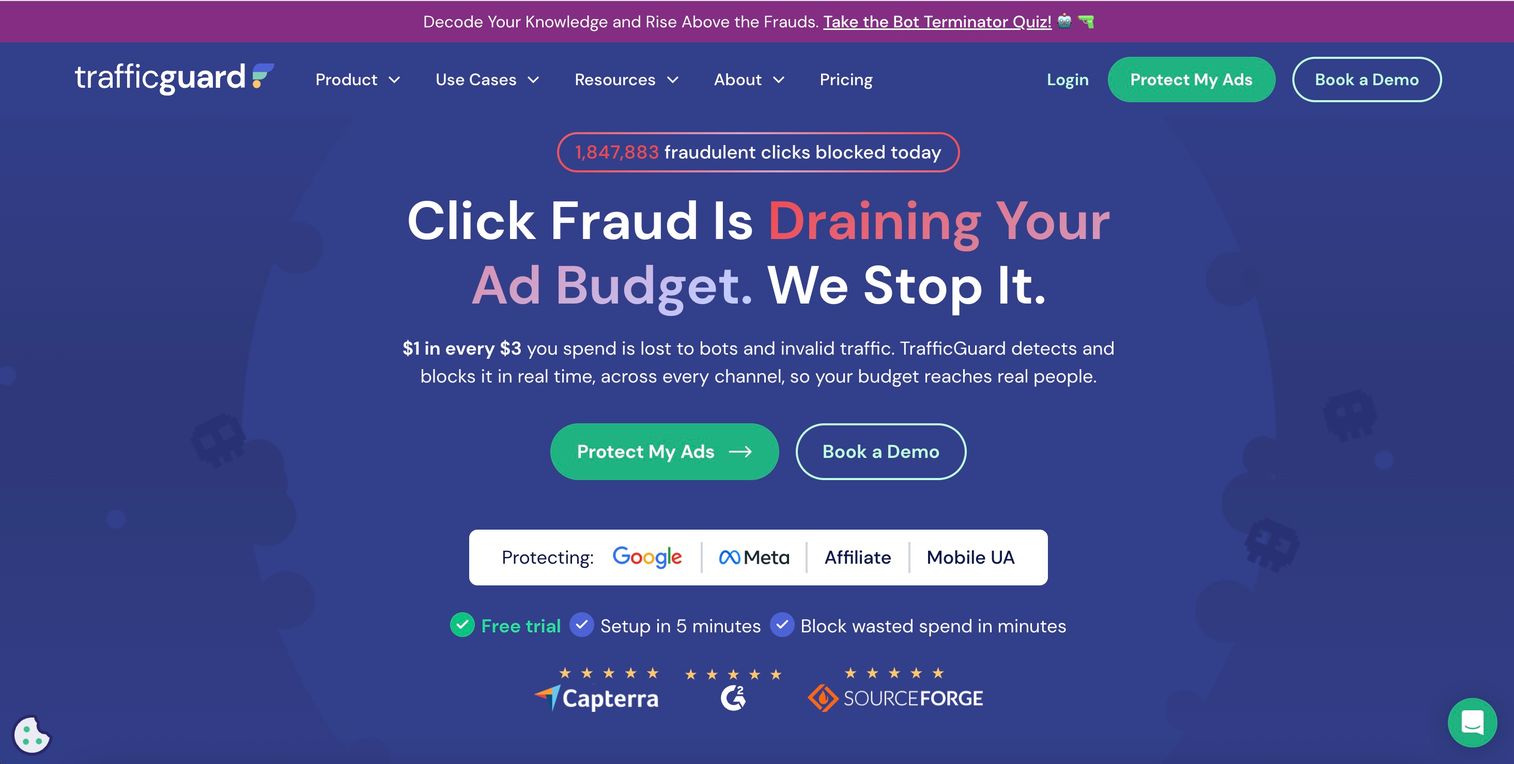
TrafficGuard is an AI-powered traffic protection platform built for performance marketers and affiliates who need to filter bots and invalid traffic across the full spread of paid channels. Where many tools focus narrowly on search, TrafficGuard extends protection to Search, Performance Max, Social, Affiliate, and Mobile, which makes it a strong fit for teams running diverse acquisition mixes from a single dashboard.
The platform leans on machine learning to spot patterns a static rule set would miss. It combines AI bot detection, VPN and proxy detection, a smart rule engine, and flow-based routing to filter traffic before it reaches your ads. Real-time analytics give you visibility into what is being blocked and why, while IP enrichment and JavaScript challenges add layers most lighter tools skip.
Best for: Performance marketers and affiliate teams that need broad, multi-channel coverage with granular traffic visibility.
Key strengths
- AI bot detection: Machine learning models catch evolving bot patterns rather than relying on fixed blocklists.
- Cross-channel coverage: One platform protects Search, Performance Max, Social, Affiliate, and Mobile traffic.
- Smart rule engine and routing: Flow-based routing and custom rules let you filter and redirect suspicious traffic in real time.
Why choose TrafficGuard: If your spend is spread across search, social, affiliate, and mobile, point solutions leave gaps. TrafficGuard consolidates that protection and gives affiliates and performance teams the IP enrichment and JS challenge tooling needed to validate traffic quality at scale, not just flag it after the fact.
TrafficGuard pricing: TrafficGuard includes a free 7-day trial on all plans. The site shows a simple pricing structure, but no public numeric figures were listed at the time of writing, so plan to request a quote tied to your traffic volume. TrafficGuard holds a 4.4/5 rating on G2.
2. ClickCease
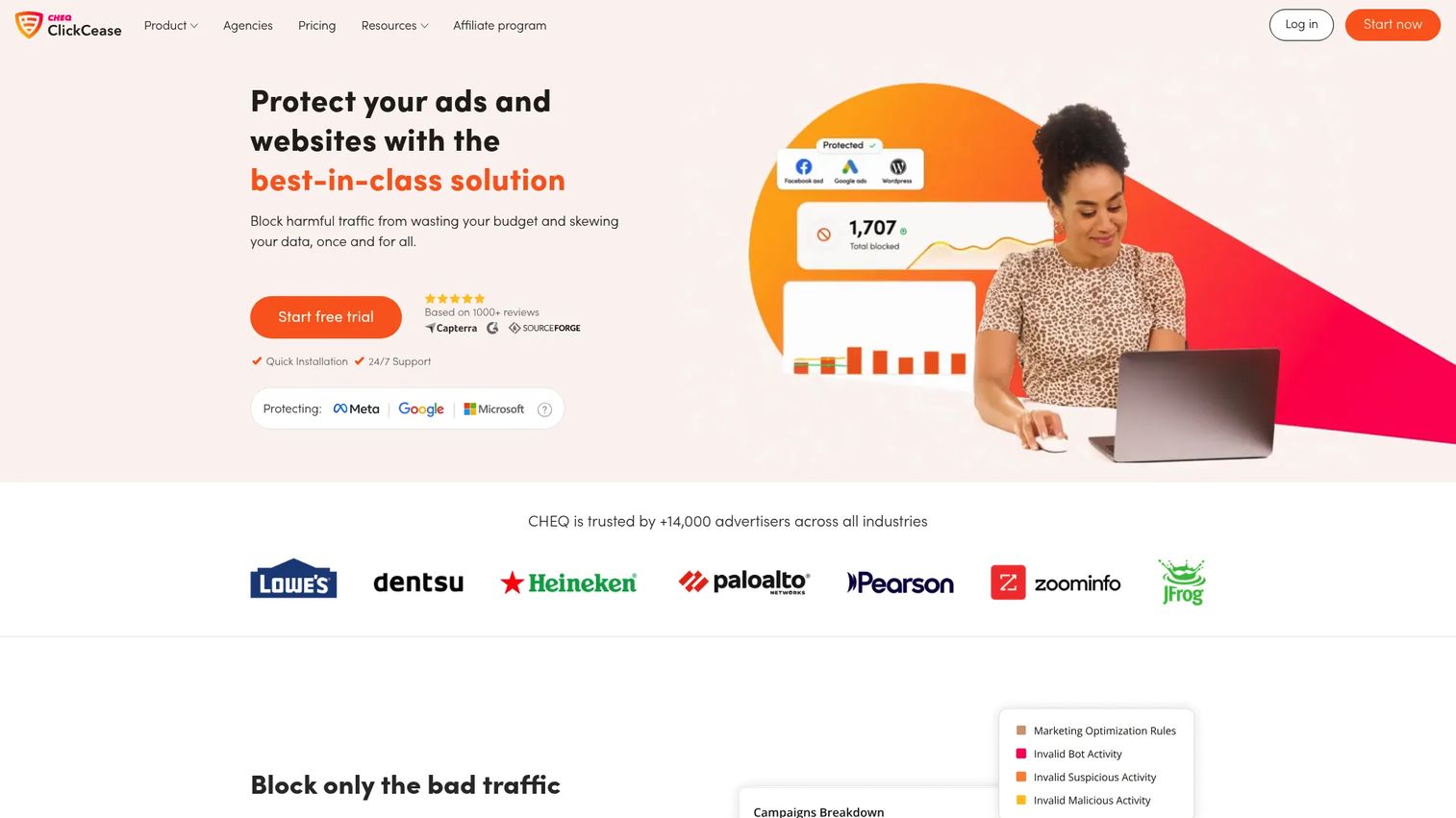
ClickCease is one of the most widely adopted click fraud tools, and for good reason: it protects Google Ads, Microsoft Ads, and Meta Ads from a single account with fast setup and minimal hand-holding. ClickCease blocks invalid traffic in real time, runs ad and bot protection with fraud reporting, and gives you custom rules for geo targeting, device detection, and click thresholds.
For paid media teams that want one all-around tool rather than a stack of point solutions, ClickCease hits a practical balance. The setup is quick, the support is responsive, and the rule controls are flexible enough for agencies managing multiple accounts without being overwhelming for a solo marketer.
Best for: Advertisers and agencies that want simple, reliable protection across Google, Meta, and Microsoft Ads.
Key strengths
- Multi-platform coverage: Real-time invalid traffic blocking across Google Ads, Microsoft Ads, and Meta Ads in one place.
- Custom rules and controls: Geo targeting, device detection, and threshold settings let you tune what gets blocked.
- Fraud reporting and analysis: Detailed reports back up refund claims and show traffic quality trends over time.
Why choose ClickCease: It is the safe default for teams that want broad coverage without a steep learning curve. The brand has scale and trust behind it, and the rule engine flexes from solo accounts to agency portfolios.
ClickCease pricing: Public pricing starts with the Starter plan at $63/month, Pro at $78/month, and Advanced at $93/month, all billed annually. The pricing page offers a 7-day free trial and frequently runs a 30% off promotion on the first three months. There is no permanent free tier. ClickCease carries a 4.6/5 rating on G2.
3. ClickGuard
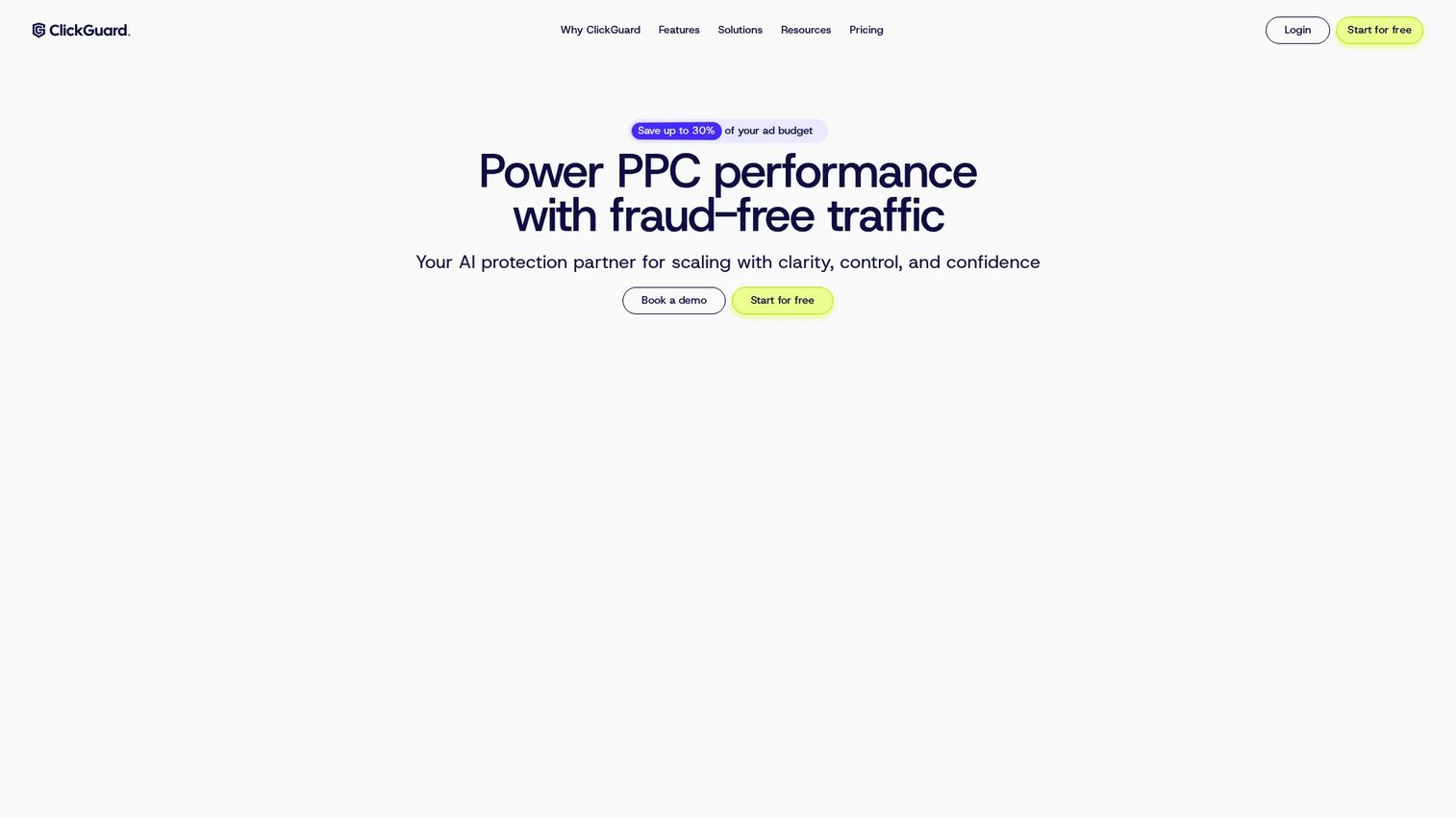
ClickGuard is a click fraud protection platform whose pricing scales with your monthly ad spend, which makes it a natural fit for budgets that are actively growing. ClickGuard delivers real-time click fraud detection, behavioral analysis, and visitor tracking across Google, Meta, and Microsoft Ads, so you get granular insight into who is clicking and why.
The spend-based model means small accounts pay less and larger accounts get more coverage as they scale, without renegotiating a contract every quarter. For advertisers who want clarity on what they are committing to before stepping up to a bigger plan, the tiered structure is easy to read.
Best for: Advertisers with growing PPC budgets who want pricing that tracks their spend.
Key strengths
- Real-time click fraud detection: Suspicious clicks are flagged and blocked as they happen.
- Behavioral analysis: Visitor tracking and behavior signals separate genuine intent from automated clicks.
- Multi-platform protection: Coverage across Google, Meta, and Microsoft Ads from one dashboard.
Why choose ClickGuard: The spend-based pricing rewards efficiency. If your account is climbing, you are not locked into an oversized flat fee, and the behavioral tracking gives you the click-level detail to justify the spend internally.
ClickGuard pricing: Pricing starts at $74/month for the Lite plan, with Standard at $119/month and Pro at $159/month, plus a Custom tier for larger accounts. Prices scale with monthly ad spend, and the platform offers monthly, quarterly, and yearly billing along with a free trial. ClickGuard holds a 4.7/5 rating on G2.
4. Lunio
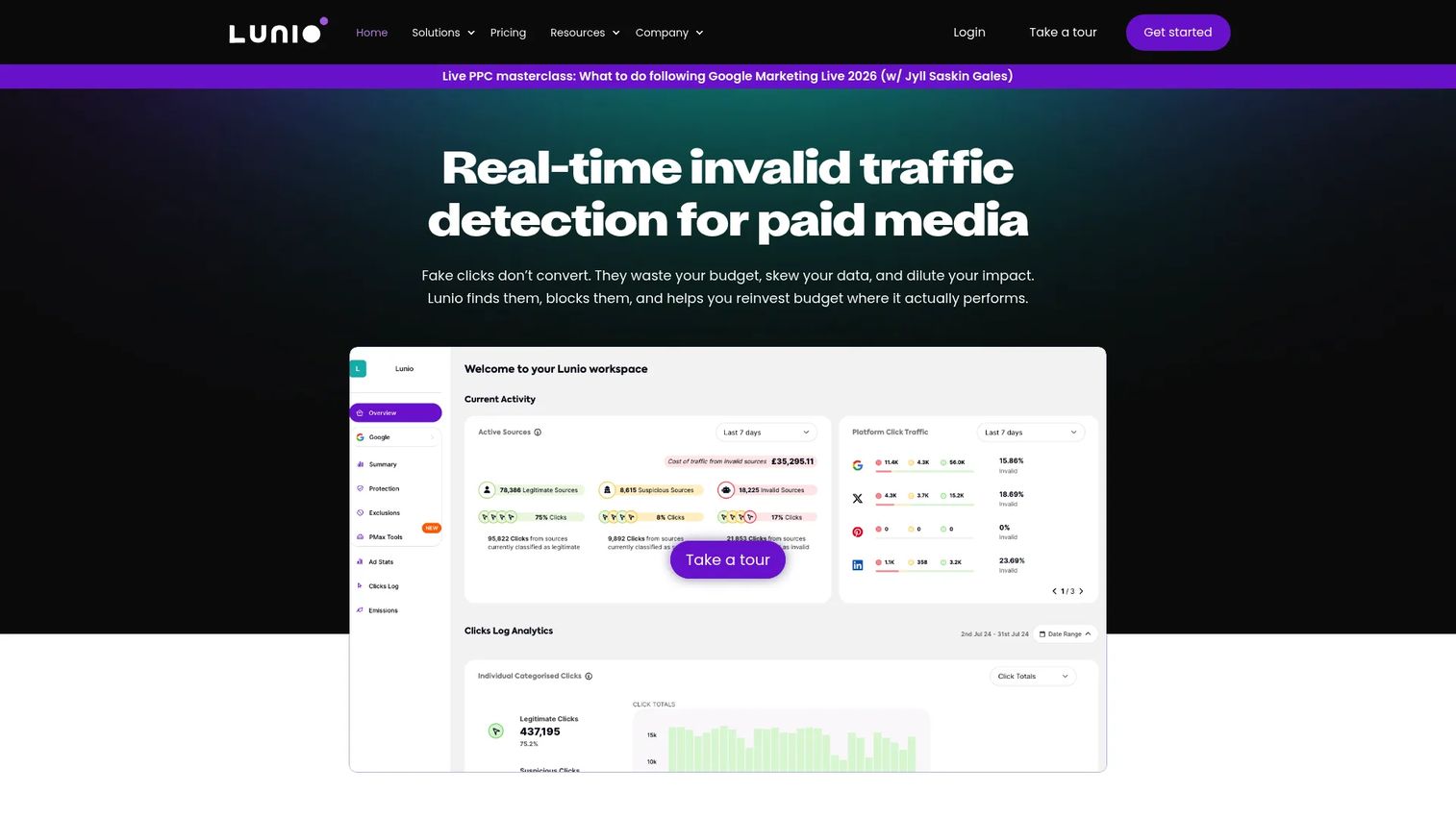
Lunio is an AI-powered invalid traffic detection platform aimed at performance marketers and larger teams that want depth of analysis across every paid channel. Lunio detects invalid traffic in real time, protects across major ad platforms, and layers on campaign analytics and traffic legitimacy reporting that go beyond simple block-and-forget.
The pitch here is analytical rigor. Lunio does not just block bad clicks. It reports on traffic quality at a level enterprise teams can take to a board meeting, which matters when you are defending ad spend protection decisions across a large, multi-channel budget. The 14-day traffic audit lets you see your real invalid traffic rate before you commit.
Best for: Larger teams and enterprise advertisers that want tailored quoting and deep traffic analytics.
Key strengths
- Real-time invalid traffic detection: Fraudulent and non-converting traffic is identified as it arrives.
- Multichannel protection: Coverage spans the major paid media platforms, not just search.
- Campaign analytics and legitimacy reporting: Detailed traffic-quality reporting supports budget and bidding decisions.
Why choose Lunio: When the budget is large and the reporting needs to hold up under scrutiny, Lunio's analytics depth earns its keep. The free 14-day audit is a low-risk way to quantify your invalid traffic problem before signing anything.
Lunio pricing: Lunio uses custom, tailored pricing rather than fixed public tiers. The pricing page directs you to contact the team for a customized plan and describes cost as a small fraction of ad spend. The 14-day traffic audit is free. Lunio carries a 4.6/5 rating on G2.
5. Fraud Blocker
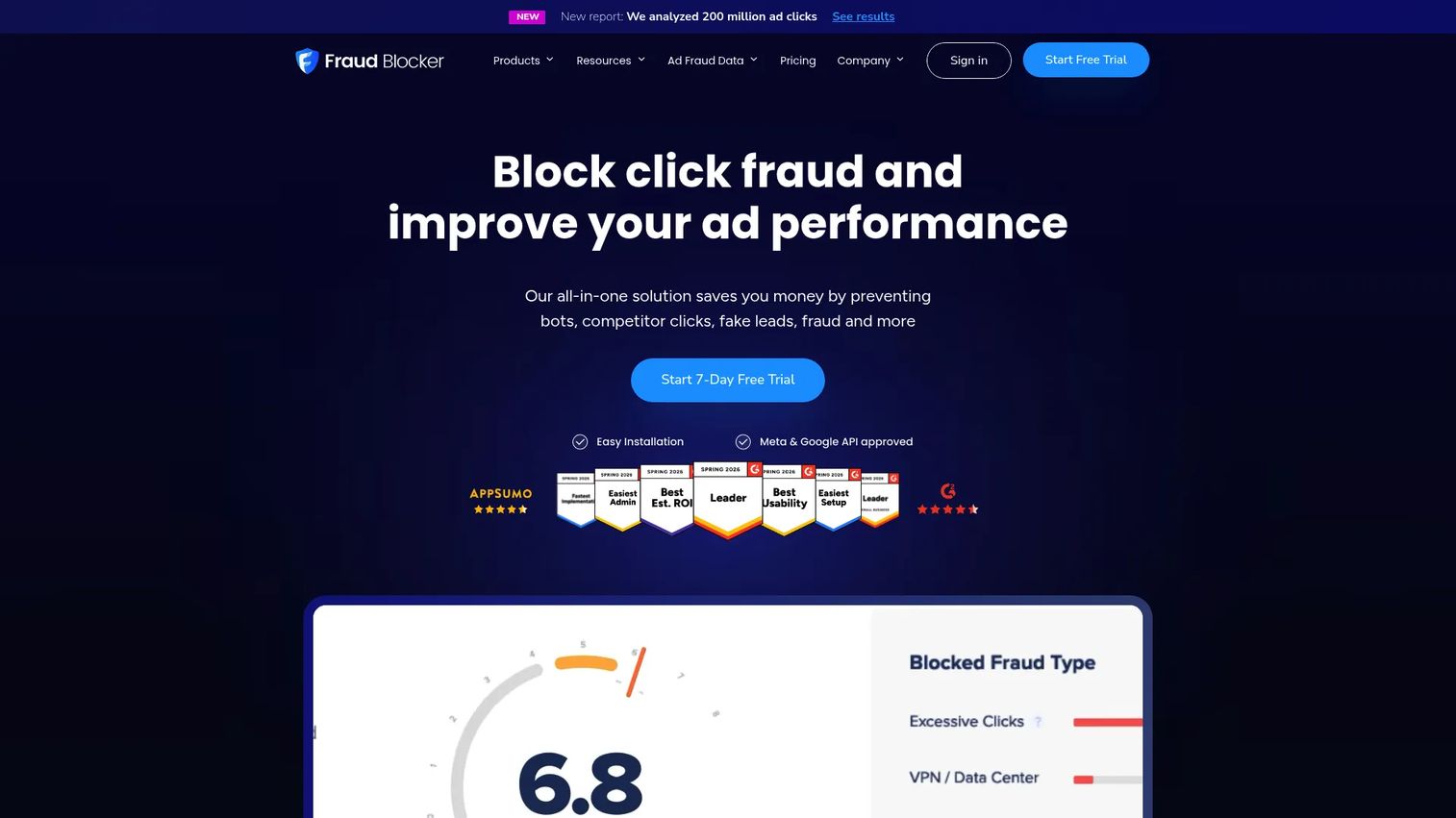
Fraud Blocker is a click fraud protection tool that analyzes traffic in real time and blocks suspicious sources automatically, with pricing transparent enough to evaluate without a sales call. Fraud Blocker combines real-time fraud monitoring and scoring, device fingerprinting, VPN and Tor detection, and automated blocking with customizable rules to cover Google and Meta campaigns.
For budget-conscious buyers, Fraud Blocker keeps things grounded in value. The report clarity is a recurring strength: you can see exactly what was blocked and why, which makes it easy to confirm the tool is earning its monthly fee rather than just generating alerts.
Best for: Advertisers and marketers who want straightforward, affordable click-fraud detection and blocking.
Key strengths
- Real-time fraud monitoring and scoring: Every click is scored on arrival so bad traffic is caught immediately.
- Device fingerprinting: VPN and Tor detection plus fingerprinting catch sources that mask their identity.
- Automated blocking with custom rules: Suspicious sources are blocked automatically against rules you control.
Why choose Fraud Blocker: Clear pricing and a free trial make this an easy first step for teams new to PPC fraud blocking. The reporting is clean enough that you can prove value fast, which matters when you have to justify every tool to the budget owner.
Fraud Blocker pricing: The Standard plan starts at $79/month, Pro at $99/month, and Enterprise at $489+/month, with annual and quarterly billing options available. A 7-day free trial is included; there is no permanent free tier. Fraud Blocker holds a 4.5/5 rating on G2.
6. Clixtell
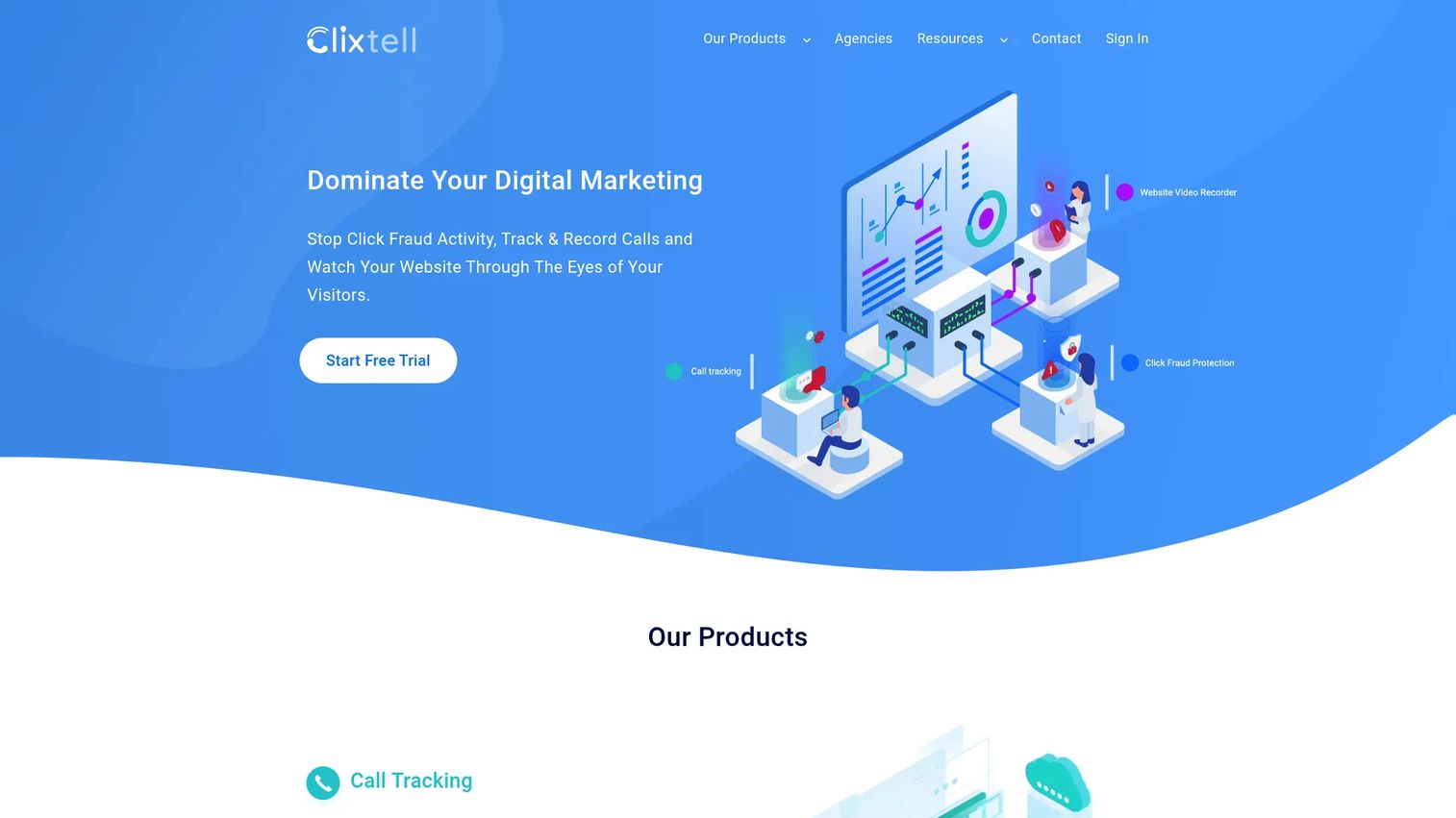
Clixtell is a dual-purpose platform that pairs automated click fraud protection with call tracking and website visitor analytics, which gives PPC teams more than just a fraud shield. Clixtell blocks invalid traffic automatically, tracks inbound calls and their analytics, and records website sessions so you can see how real visitors behave after the click.
That combination is the differentiator. If your campaigns drive both form fills and phone calls, having fraud protection and call tracking under one roof reduces tool sprawl and gives you a fuller picture of conversion quality. Session recording adds a layer of behavioral context that pure fraud tools do not offer.
Best for: Small teams and agencies that want click fraud protection plus call tracking and visitor analytics in one tool.
Key strengths
- Automated click fraud protection: Invalid traffic is detected and blocked without manual intervention.
- Call tracking and analytics: Inbound calls are tracked and measured alongside click data.
- Website session recording: Video recordings show how genuine visitors interact after they arrive.
Why choose Clixtell: For teams that care about call conversions as much as form fills, the bundled call tracking is a genuine consolidation play. The low entry price makes it accessible for small businesses that want fraud protection without a large commitment.
Clixtell pricing: Clixtell starts at $10/month for the Basic plan, with Standard at $30/month and Advanced at $80/month, all billed monthly. A 14-day free trial is available. Clixtell carries a 4.5/5 rating on G2.
7. ClickPatrol
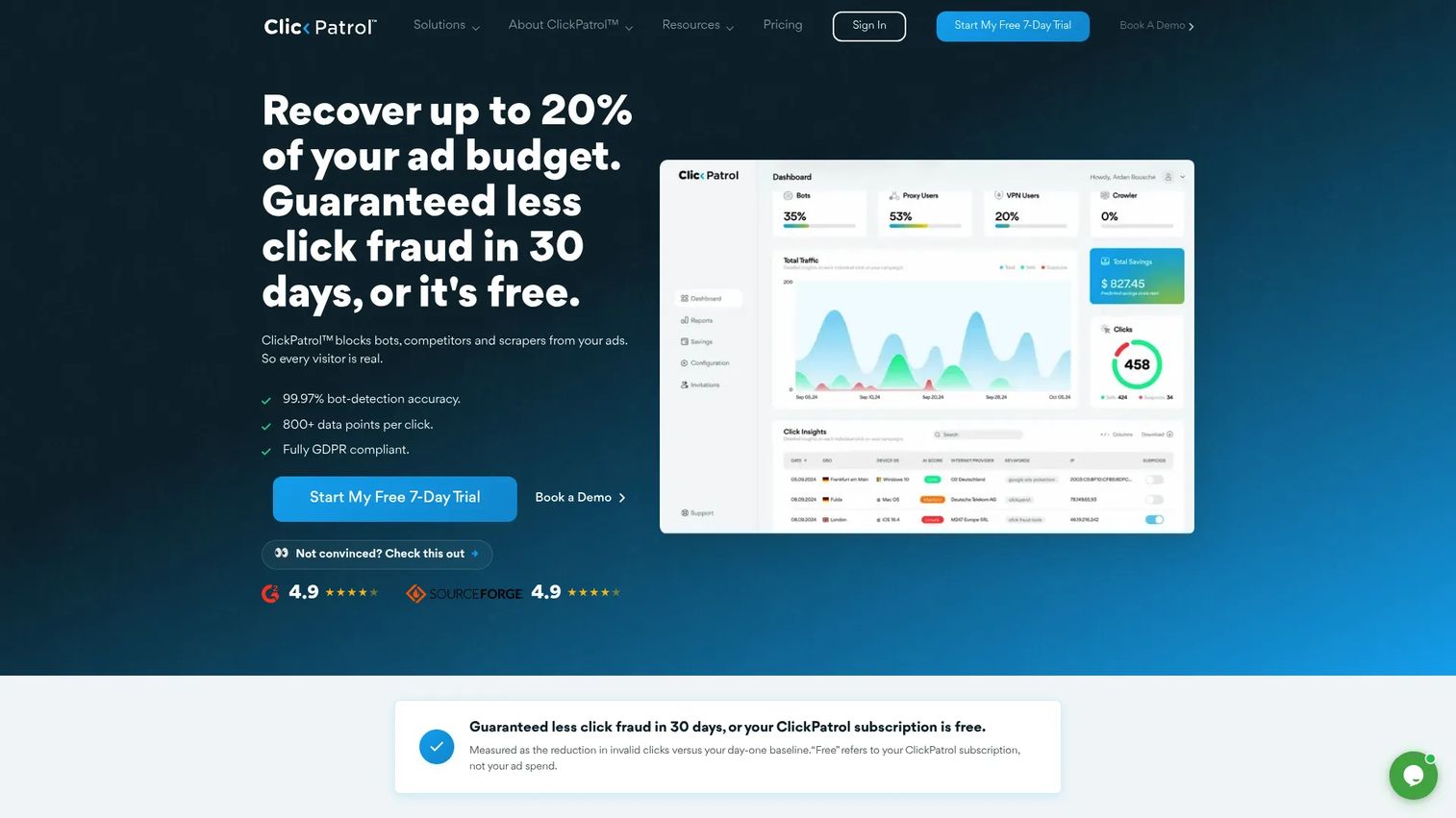
ClickPatrol is a click fraud protection platform built to block bots, competitors, and scrapers from your ad traffic, with a strong emphasis on data compliance. ClickPatrol runs real-time fraud detection, automatic IP, device, and geo blocking, and form spam protection, all positioned as GDPR-proof for teams that take data privacy seriously.
The compliance angle is the standout. For European advertisers and agencies handling regulated data, GDPR-proof positioning removes a procurement hurdle that other tools leave open. ClickPatrol also keeps your remarketing and conversion data clean by filtering out the junk before it reaches your audiences, and supports Performance Max alongside the major platforms.
Best for: Advertisers and agencies that prioritize compliance and granular fraud detail.
Key strengths
- Real-time fraud detection: Invalid clicks are caught and blocked as they happen.
- Automatic IP, device, and geo blocking: Bad sources are excluded automatically across multiple dimensions.
- Form spam protection and clean data: Filtering keeps remarketing and conversion data free of fraudulent noise.
Why choose ClickPatrol: If compliance is non-negotiable and you want click-level analytics depth, ClickPatrol's GDPR-proof positioning and detailed fraud reporting make it a strong candidate, especially for agencies that need a transparent plan structure and an agency quote path.
ClickPatrol pricing: ClickPatrol offers a 7-day free trial, then Traffic Security Starter at €59/month and Traffic Security PRO at €69/month, both billed annually. An Agency and Brand Traffic Security tier is available on request. ClickPatrol holds a 4.9/5 rating on G2, the highest on this list.
Considerations before you buy
A shortlist is only useful if you know what to weigh. Run every finalist through these criteria before committing budget.
Channel coverage
Map the tool's coverage to your actual channel mix. If you run search only, most tools fit. If you run Meta Ads, Microsoft Ads, affiliate, and mobile, you need a platform built for breadth, or you will end up stitching together point solutions and fragmenting your reporting.
Blocking versus reporting
Confirm the tool blocks automatically, not just reports. Automated blocking adds fraudulent IPs to your exclusion lists without manual work. A tool that only flags fraud leaves you doing the blocking by hand, which does not scale across multiple accounts.
Pricing model fit
Decide whether flat-rate or spend-based pricing suits your trajectory. Spend-based pricing tracks your budget, which helps growing accounts. Flat tiers give predictability. Either way, verify the entry tier covers your channels before you assume the cheapest plan works.
Reporting depth and compliance
Check that reports give you click-level transparency and refund-ready evidence, since recovering wasted spend depends on documentation. If you handle EU data, confirm GDPR compliance early so it does not stall procurement later.
Setup and integration
Look at how the tool connects to your ad accounts and whether setup is self-serve. Fast time-to-value matters, especially when you want to prove ROI on the tool itself within the first billing cycle.
Conclusion
There is no single best click fraud software for every team. The right pick depends on your channel mix, your traffic volume, and whether you care most about price, automation, or reporting depth.
For the widest channel coverage across search, social, affiliate, and mobile, TrafficGuard leads. For a simple all-around option spanning Google, Meta, and Microsoft Ads, ClickCease is the safe default. ClickGuard suits growing budgets with its spend-based model, while Lunio fits enterprise teams that need analytics they can defend. On price, Clixtell starts lowest and bundles call tracking, Fraud Blocker keeps entry clear and affordable, and ClickPatrol wins on compliance and click-level detail.
The next step is simple. Shortlist two tools that match your channel mix, run each on one campaign set during their free trials, and compare the invalid traffic each one catches against your real spend. The tool that recovers the most budget while feeding cleaner data back into your bidding is the one worth keeping. Clean traffic protects both your PPC budget and the campaign health your reporting depends on.
FAQs
Click fraud software detects and blocks invalid traffic on paid ad campaigns before it wastes budget. It inspects every click using behavioral and technical signals, scores it in real time, and automatically adds fraudulent IPs and devices to your platform exclusion lists. The result is cleaner traffic, less wasted spend, and more accurate conversion data.
For Google Ads, the tool monitors clicks on your search, display, and Performance Max campaigns, looking for patterns like repeated clicks from one IP, traffic through proxies and VPNs, and bot signatures. When it identifies invalid traffic, it adds those sources to your Google Ads IP exclusion list automatically. This protects spend and feeds cleaner signals into Smart Bidding.
Yes. Several tools on this list, including ClickCease, ClickGuard, and Lunio, protect Meta Ads and Microsoft Ads alongside Google Ads. Cross-platform coverage matters because bot networks target every channel they can monetize. Running unified protection gives you one source of truth for traffic quality instead of fragmented reporting across separate point tools.
It depends on how much invalid traffic your account sees. With industry invalid traffic rates above 8%, even a modest budget loses real money to fake clicks. Tools like Clixtell start at $10/month, so the math often works even for small accounts. Run a free trial first to measure your actual fraud rate before committing.
Pricing in 2026 ranges widely. Clixtell starts at $10/month, ClickCease from $63/month, ClickGuard from $74/month, and Fraud Blocker from $79/month. ClickPatrol starts at €59/month, while TrafficGuard and Lunio use custom pricing tied to your traffic or ad spend. Most vendors offer a free trial, so you can test before you pay.
Common signals include repeated clicks from the same IP, traffic routed through proxies and VPNs, device fingerprints that mask identity, bot behavior patterns, abnormal click timing, click farm signatures, and known fraudulent IP ranges. Stronger tools combine these with machine learning to catch evolving bot patterns that fixed blocklists miss.
The best tools do both. Automated blocking adds fraudulent sources to your ad platform exclusion lists in real time, without manual work. Reporting then documents what was blocked and why, which supports refund claims and shows traffic quality trends. Tools that only report leave you to block manually, which does not scale across multiple accounts.
Match the tool to your channel mix first, then weigh pricing model, blocking automation, reporting depth, and compliance needs. Confirm the entry tier covers all your channels, that blocking is automatic rather than alert-only, and that reports give click-level transparency. Shortlist two finalists, run their free trials on one campaign set, and keep the one that recovers the most budget.