A service calls another service. That one waits on a database. The database is under load, so the response stalls. Now three requests are blocked behind one slow dependency, and the whole flow grinds. Anyone who has run distributed systems knows the pattern: tight coupling turns a small hiccup into a cascade.
That is the problem message queue software exists to solve. Instead of forcing services to wait on each other in real time, a queue lets a producer drop a message and move on. A consumer picks it up when it is ready. The two never have to be online at the same moment. This asynchronous messaging model is what makes microservices, cloud-native apps, and event-driven architecture reliable at scale.
The category is growing fast. The global message queue software market was valued at roughly $2.28 to $2.46 billion in 2024 and is projected to reach about $5.3 billion by 2035, at close to 8% CAGR, according to WiseGuy Reports (2025). More teams are decoupling monoliths, and more workloads are moving to real-time and distributed patterns.
For technical buyers and presales engineers, the hard part is not understanding queues. It is choosing among them. RabbitMQ alternatives, IBM MQ alternatives, managed cloud services, and streaming platforms all show up in the same shortlist, and they do not all solve the same job. This guide compares eight message queue software options so you can narrow the list before you commit to a proof of concept. If you spend time helping prospects validate infrastructure choices, you may also find our roundups of the best event management software and best event planning software useful for adjacent stack decisions.
What's inside
This guide is a buying reference for technical evaluators, architects, and presales teams comparing message queue software for microservices, cloud-native apps, and hybrid integration. We selected eight tools based on reliability and delivery guarantees, routing and protocol support, managed versus self-hosted deployment options, ecosystem fit, and enterprise readiness. The list mixes classic message brokers you run yourself with fully managed queue services from the major clouds, plus two streaming platforms that technical buyers routinely evaluate alongside pure queues. Each entry includes verified pricing where public, a G2 rating where available, and honest fit guidance.
TL;DR
- Best open-source broker for routing: RabbitMQ, for teams that want mature routing and filtering, multi-protocol support, and free self-hosting.
- Best for enterprise and hybrid integration: IBM MQ, for regulated and legacy-heavy organizations that need durable messaging across on-premises and cloud.
- Best managed queue for AWS: Amazon SQS, for cloud-first and serverless messaging teams that want zero broker maintenance.
- Best for Microsoft-centric stacks: Azure Service Bus, for enterprise messaging with queues and pub/sub inside Azure.
- Best lightweight cloud-native option: NATS, for real-time microservices and low-latency communication.
- Best for event streaming at scale: Apache Kafka, when your workload is log-based streaming, not a pure point-to-point queue.
When you weigh these best message queue software alternatives, match the tool to your deployment model first, then to your delivery guarantees. Everything else follows from those two decisions.
What is message queue software?
Message queue software is middleware that lets applications communicate asynchronously by sending messages through an intermediary queue instead of calling each other directly. A producer writes a message. The queue holds it. A consumer reads it when ready. That decoupling is the whole point.
Under the hood, message queue software supports a set of core concepts every technical buyer should know:
- Asynchronous messaging: producers and consumers operate independently, so neither blocks the other.
- Point-to-point queue: a message goes to exactly one consumer, ideal for work distribution and job processing.
- Publish/subscribe: a message is broadcast to many subscribers at once, ideal for event fan-out.
- Durable messaging: messages persist to disk so they survive broker restarts and failures.
- Acknowledgments: consumers confirm receipt so the broker knows when it is safe to remove a message.
- Routing and filtering: the broker directs messages to the right queue based on rules, keys, or headers.
- Delivery guarantees: at-most-once, at-least-once, or exactly-once semantics, depending on your reliability needs.
Queue vs pub/sub, and how a message bus differs
The most common confusion is queue vs pub/sub. A point-to-point queue delivers each message to one consumer. Publish/subscribe delivers each message to every interested subscriber. Many brokers, including RabbitMQ and Azure Service Bus, support both.
A message bus, or an enterprise service bus (ESB), goes further. It adds transformation, orchestration, and protocol mediation on top of transport. A queue moves messages. An ESB moves messages and applies business logic in between. Compared with calling an API directly, a queue adds buffering and failure isolation. Compared with a database, a queue is built for transient, ordered flow rather than long-term storage. Understanding these distinctions is what keeps a shortlist honest.
When to use message queue software
Not every system needs a broker. But three patterns almost always justify one.
Decouple services
When one service should not have to wait on another, a queue sits between them. The producer writes a message and moves on. If the consumer is down, the message waits. This gives you retries, buffering, and failure isolation for free. One slow or failing component no longer takes the rest of the system with it, which is the foundation of resilient microservices and event-driven architecture.
Handle bursty workloads
Traffic is never smooth. A flash sale, a batch job, a wave of notifications, all create spikes that overwhelm downstream systems. A queue absorbs the burst and lets consumers process at a steady rate. E-commerce checkout flows, email and push notifications, background job processing, and scheduled tasks all use queues to smooth load and protect fragile downstream services.
Support hybrid and cross-cloud integration
Modern estates span on-premises data centers, multiple clouds, and different runtimes. Message queue software provides a reliable transport layer across all of them. Here, durable messaging, security, and interoperability matter most. A broker with cross-region replication and broad protocol support becomes the connective tissue for hybrid integration, moving events between systems that were never designed to talk to each other. Serverless messaging patterns, where functions consume from a managed queue, fit here too.
Comparison table
Use this table to narrow the shortlist before the deeper reviews below. Read it deployment-model first: decide whether you want a self-hosted message broker or a managed service, then compare on differentiation, pricing, and rating. Pricing and ratings reflect verified, publicly available values at the time of writing.
| # | Product | Intent | Key differentiation | Pricing | G2 rating |
|---|---|---|---|---|---|
| 1 | RabbitMQ | Open-source broker | Mature routing, filtering, and multi-protocol support | Free and open source; commercial support via Broadcom | 4.1/5 |
| 2 | IBM MQ | Enterprise messaging | Durable, hybrid messaging across legacy and modern systems | From USD 312 (1-year term); free Lite tier | 4.3/5 |
| 3 | Apache ActiveMQ Artemis | Open-source broker | Multi-protocol messaging with HA and clustering | Free and open source | 5.0/5 |
| 4 | Amazon SQS | Managed queue | Fully managed, serverless-friendly queueing on AWS | Free tier: 1M requests/month; usage-based | 4.3/5 |
| 5 | Azure Service Bus | Managed messaging | Enterprise queues and pub/sub, Azure-native | Basic, Standard, Premium tiers; no upfront cost | 3.9/5 |
| 6 | NATS | Cloud-native messaging | Lightweight single-binary pub/sub and streaming | Open source | 4.0/5 |
| 7 | Apache Kafka | Event streaming | Durable, replayable log-based streams at scale | Open source | Not listed |
| 8 | Redis Streams | Stream data structure | Append-only streams inside the Redis ecosystem | Free, Essentials from $0.007/hr, Pro from $0.014/hr | 4.5/5 |
1. RabbitMQ
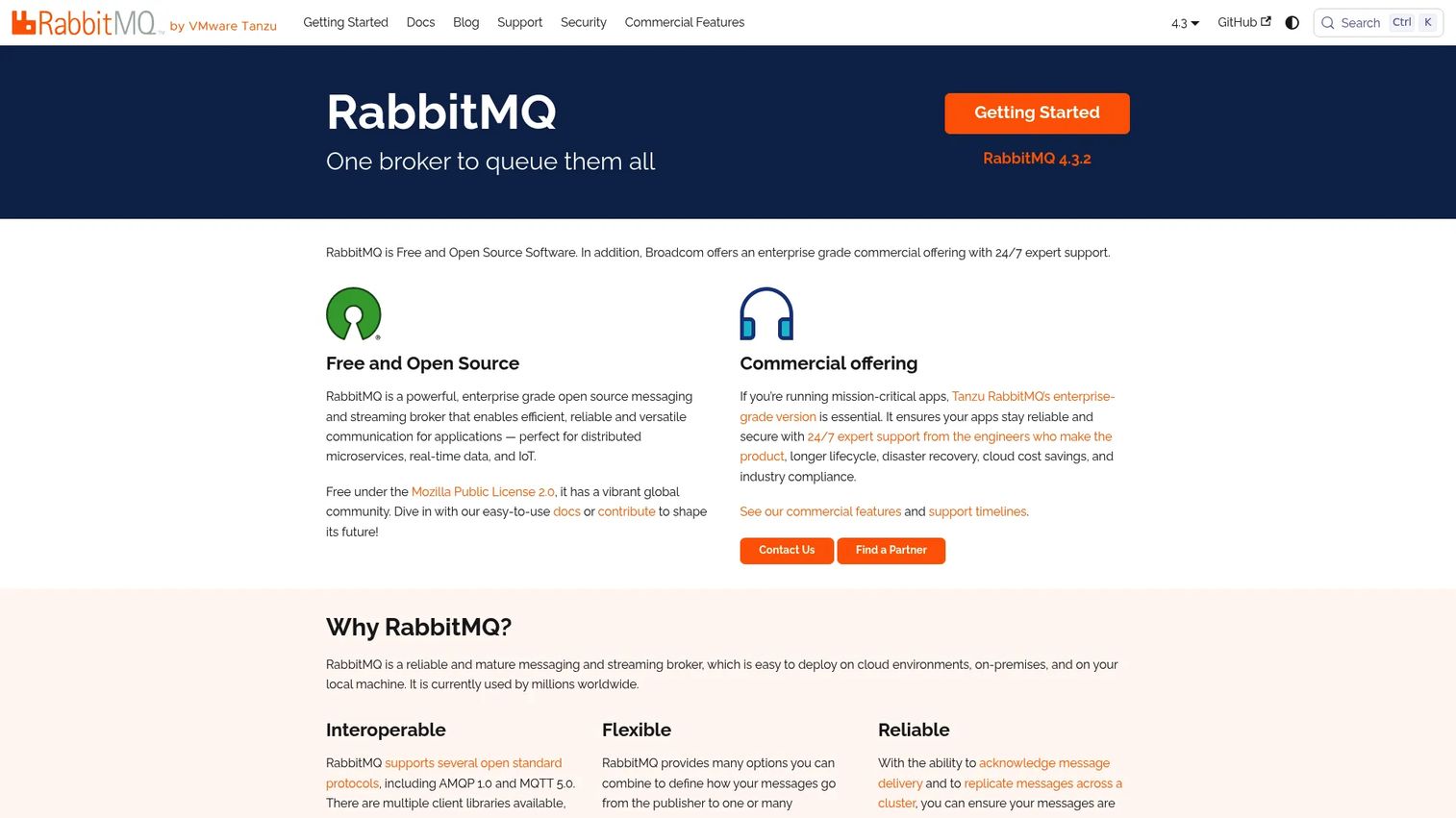
RabbitMQ is one of the most widely deployed open-source message brokers, and for many teams it is the default starting point. It handles classic point-to-point queueing and publish/subscribe patterns, plus streams and quorum queues for higher reliability. Its exchange model gives you fine-grained routing and filtering that few brokers match at this price point, which is zero for the core product. Broadcom offers a commercial Tanzu RabbitMQ offering for teams that want vendor support.
Best for: Teams needing a mature open-source message broker for distributed systems and event-driven applications.
Key strengths
- Flexible routing: Exchanges and bindings let you route and filter messages by key, header, or topic with precision.
- Multi-protocol support: Native AMQP 1.0 and MQTT 5.0 support means it fits a wide range of clients and IoT workloads.
- Reliability features: Acknowledgments, replication, streams, and quorum queues give you durable messaging when you need it.
Why choose RabbitMQ: If your workload needs sophisticated routing logic and you want full control over a self-hosted broker without licensing costs, RabbitMQ is hard to beat. It excels for microservices that pass work between many consumers and for teams comfortable operating their own infrastructure. It is a common landing spot for anyone comparing RabbitMQ alternatives and finding they still want its routing model.
RabbitMQ pricing: RabbitMQ is free and open source, with no license fee for self-hosting. Broadcom offers a commercial Tanzu RabbitMQ offering with enterprise support, but no public price is listed on the official site. For most teams, the practical cost is infrastructure and operational time, not software.
2. IBM MQ
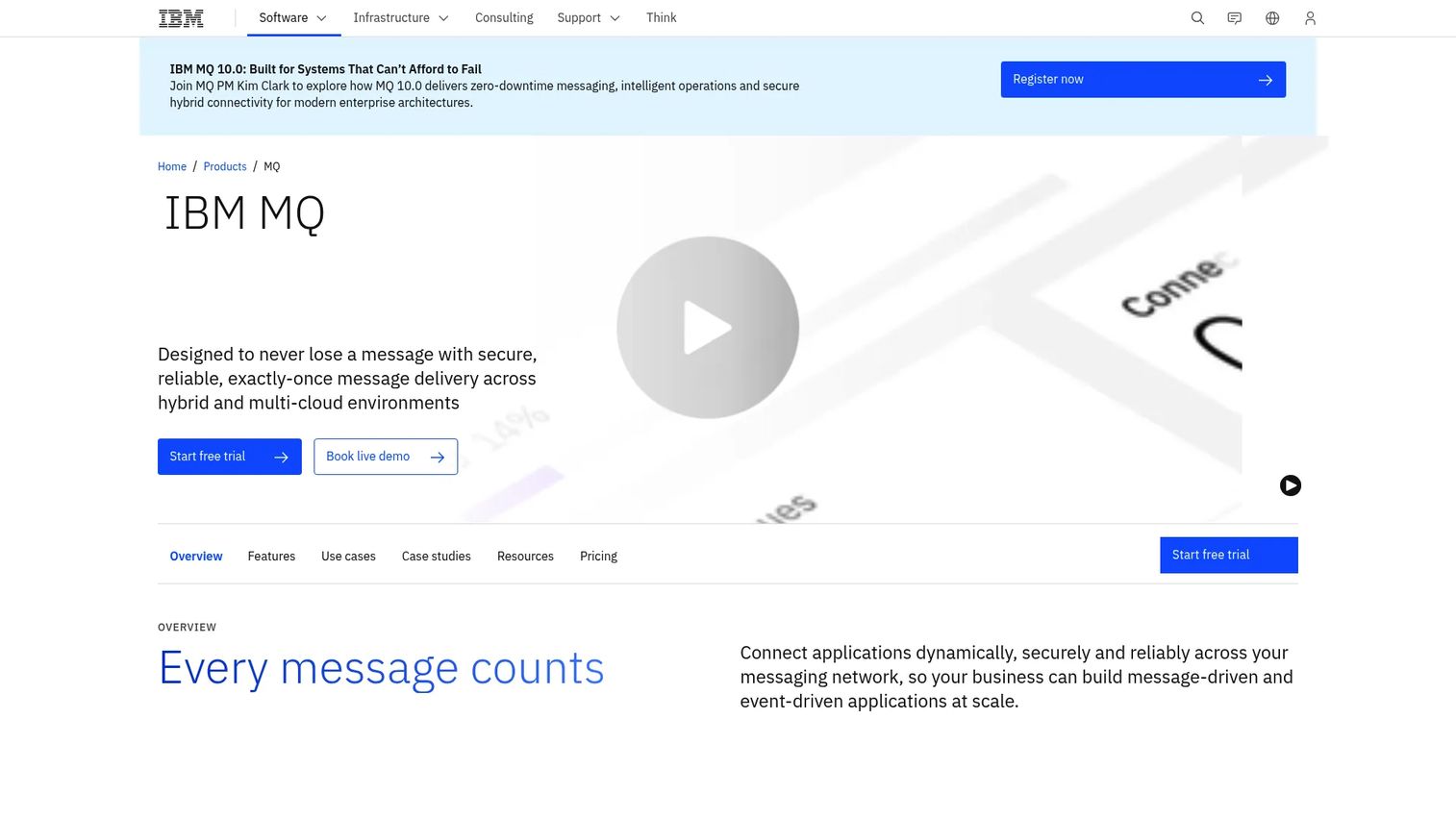
IBM MQ is the enterprise standard for reliable, durable messaging, and it has been trusted in banks, insurers, and government systems for decades. It connects applications and events across hybrid environments with strong delivery guarantees and native high availability. If your organization runs mainframes, legacy middleware, or strict compliance requirements, IBM MQ is almost always on the evaluation list.
Best for: Teams that need durable, exactly-once-style enterprise messaging across legacy and modern systems.
Key strengths
- Durable messaging: Native high availability and cross-region replication keep messages safe through failures.
- Broad deployment: Runs on cloud, private cloud, on-premises, and z/OS, which matters for hybrid integration.
- Enterprise reliability: Built for asynchronous messaging where losing a message is not an option.
Why choose IBM MQ: Regulated and legacy-heavy organizations choose IBM MQ when message loss carries real financial or legal risk. It fits teams that need one messaging backbone spanning old and new systems, and that value vendor support over self-hosting. Teams comparing IBM MQ alternatives often return to it for its track record in mission-critical environments.
IBM MQ pricing: IBM lists IBM MQ starting at USD 312.00 on a minimum one-year term. IBM MQ Advanced with AI Agents is USD 583.00 billed monthly on a one-year term, and IBM MQ as a Service (SaaS) is USD 727.00 per VPC per month, with a pay-as-you-go option at USD 1.02 per VPC per hour. A free MQ SaaS Lite tier covers up to 10,000 messages per month.
3. Apache ActiveMQ Artemis
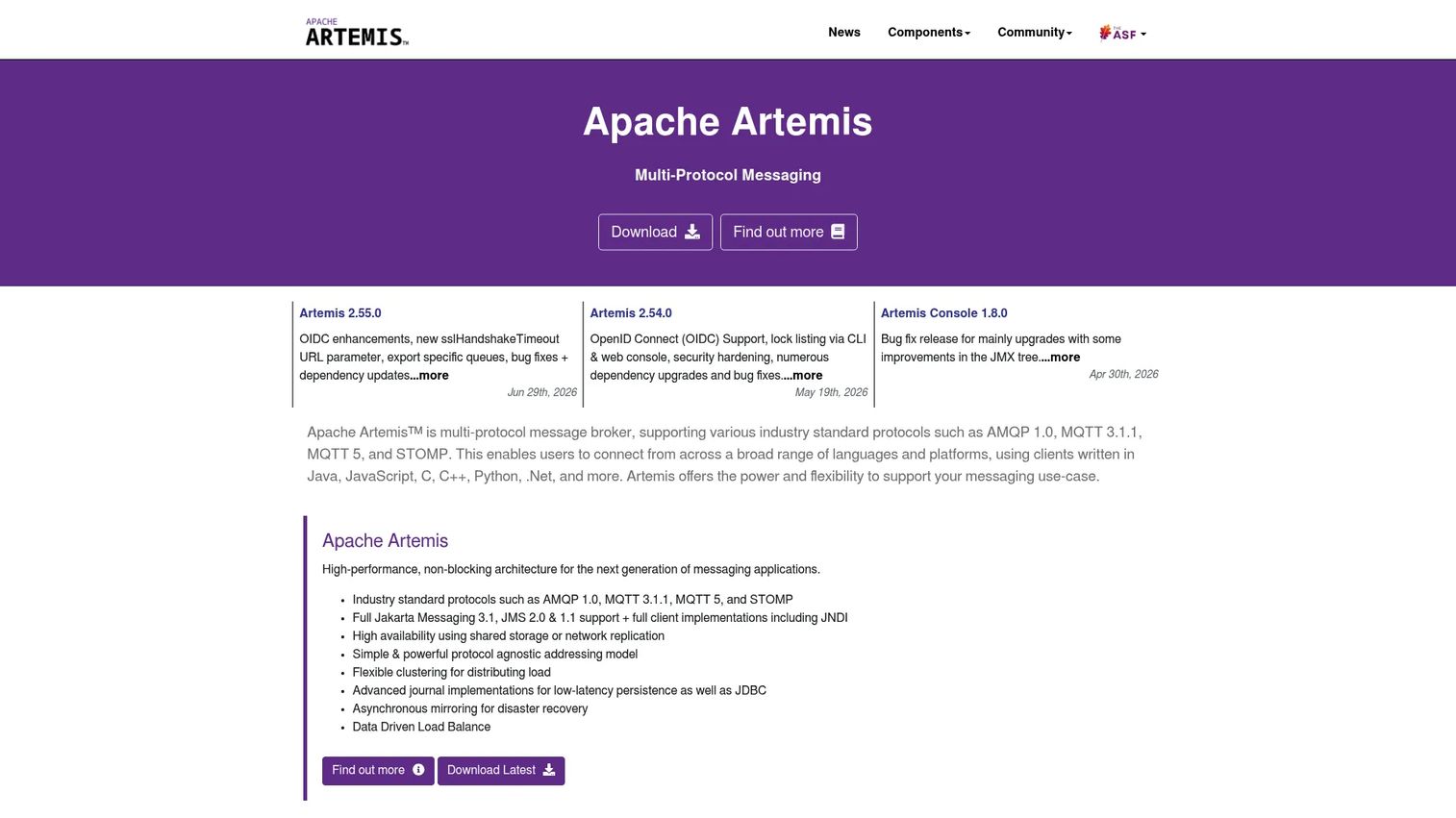
Apache ActiveMQ Artemis is the next-generation, high-performance broker in the ActiveMQ family, built on an asynchronous core. It supports a wide range of protocols and messaging patterns, with high availability through shared storage or network replication. Java teams and organizations that want a flexible, self-managed message broker frequently shortlist it.
Best for: Teams needing a high-performance open-source message broker for distributed systems and microservices.
Key strengths
- Multi-protocol messaging: Supports AMQP 1.0, MQTT 3.1.1, MQTT 5, and STOMP for broad client compatibility.
- High availability: Offers HA via shared storage or network replication to keep messaging online.
- Flexible clustering: Protocol-agnostic addressing and clustering give you room to scale and design your topology.
Why choose Apache ActiveMQ Artemis: Teams choose Artemis for application integration and self-managed environments where they want a capable broker without a commercial license. It fits well when you need multiple protocols on one broker and prefer to run your own infrastructure. Its Java roots make it a natural fit for JVM-heavy stacks.
Apache ActiveMQ Artemis pricing: Artemis is 100% open source software under the Apache Software License v2.0. There is no public pricing page or paid tier on the official site. As with any self-hosted broker, your real cost is infrastructure and the operational time to run it.
4. Amazon SQS
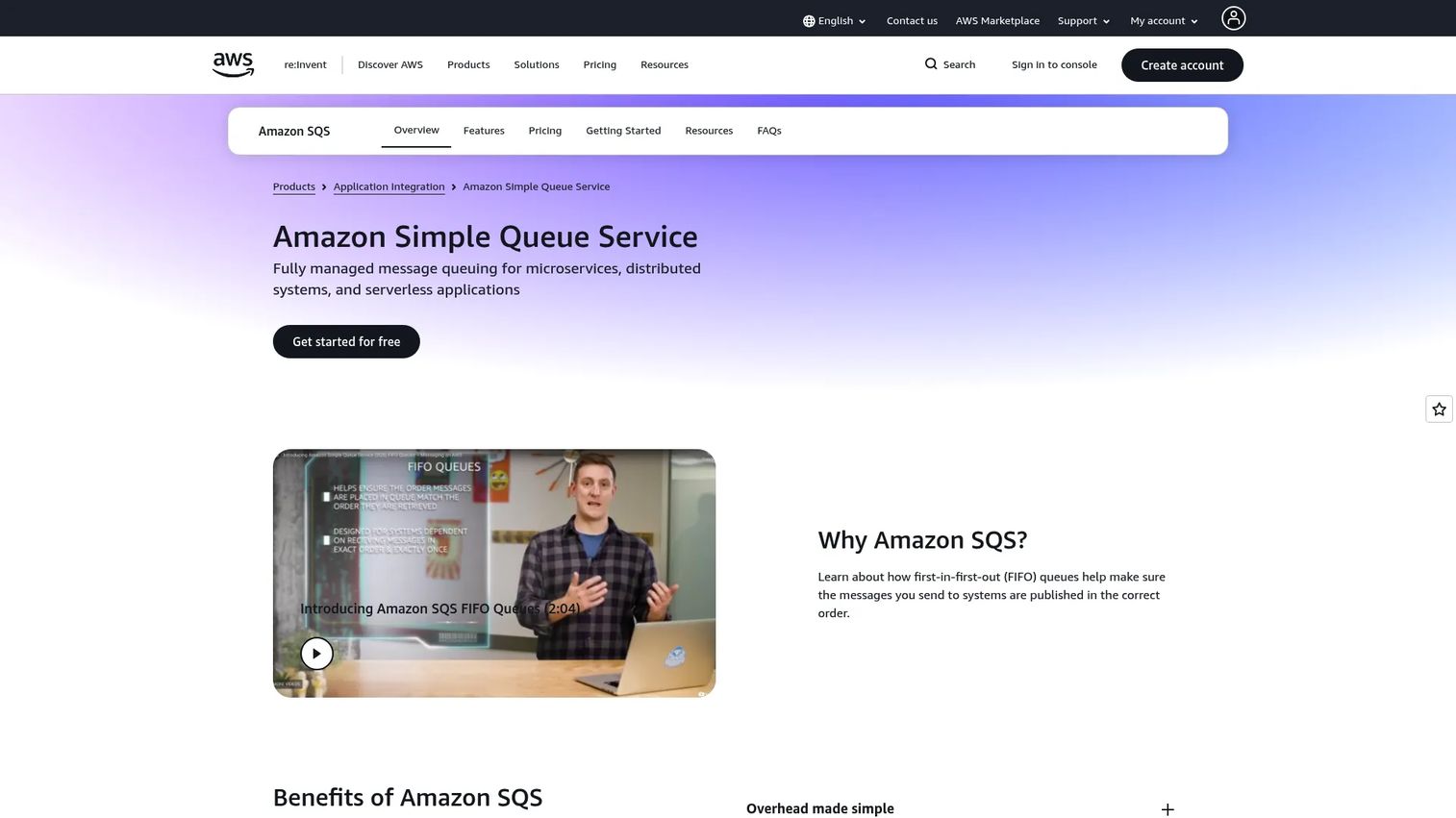
Amazon SQS is a fully managed message queuing service built for microservices, distributed systems, and serverless applications. There is no broker to run, patch, or scale. You create a queue and start sending, and AWS handles the rest. For cloud-first teams already on AWS, it is often the fastest path to decoupled architecture.
Best for: Teams needing highly scalable managed queueing for decoupled application components.
Key strengths
- Managed scaling: No servers to manage, and it scales to handle high throughput automatically.
- Reliable delivery: FIFO queues for ordered delivery, dead-letter queues, and long polling for efficient consumption.
- Serverless-friendly: Integrates cleanly with Lambda and other AWS services for serverless messaging.
Why choose Amazon SQS: Cloud-first teams choose SQS to avoid operating a broker entirely. It fits serverless workflows, event fan-out with SNS, and any AWS-native architecture where you want decoupling without infrastructure overhead. Server-side encryption with AWS KMS and batch operations round out the enterprise story.
Amazon SQS pricing: AWS states that Amazon SQS has no minimum fee and includes a free tier of 1 million requests per month. Beyond the free tier, pricing is usage-based per request, so you pay for what you send. This model suits teams that want costs to track directly with traffic rather than paying for idle capacity.
5. Azure Service Bus
Azure Service Bus is Microsoft's fully managed cloud messaging service for reliable application-to-application messaging and hybrid integration. It supports both queues and topics, so you get point-to-point queueing and publish/subscribe in one service. For teams already invested in Azure, it slots directly into the wider platform.
Best for: Teams needing managed enterprise messaging, queues and topics, and hybrid integration on Azure.
Key strengths
- Queues and topics: Reliable messaging with both point-to-point queues and pub/sub topics.
- Azure-native: Integrates directly with the Azure ecosystem for identity, monitoring, and deployment.
- Standards support: JMS 2.0 support over AMQP helps teams migrating from Java messaging systems.
Why choose Azure Service Bus: Microsoft-centric organizations choose Service Bus for enterprise messaging that fits their existing stack. It suits distributed app workflows, hybrid integration between on-premises and Azure, and teams that want managed reliability without running a broker themselves.
Azure Service Bus pricing: Microsoft states there is no upfront cost and no termination fees. Service Bus comes in Basic, Standard, and Premium tiers, with the pricing page offering estimates and a request-a-quote path rather than a fixed public starting number. Match the tier to your throughput and feature needs, from lightweight Basic queues up to Premium for high-scale, isolated workloads.
6. NATS
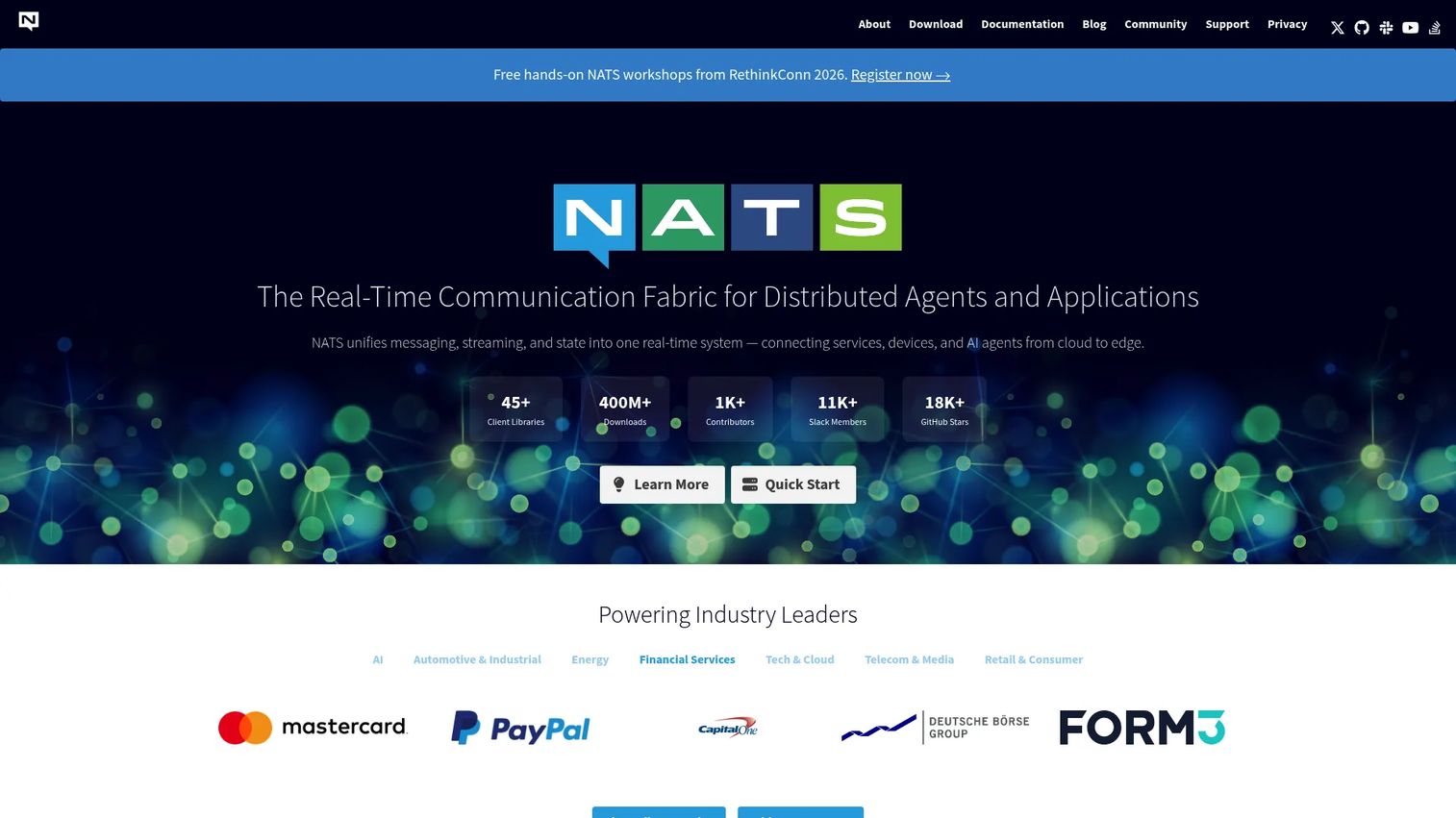
NATS is an open-source, high-performance messaging system built for distributed systems and cloud-native patterns. It ships as a single lightweight binary, which makes it simple to deploy and operate. When you need real-time, low-latency communication between many services, NATS is a strong candidate.
Best for: Teams building cloud-native microservices and event-driven systems.
Key strengths
- Lightweight deployment: A single binary keeps operations simple and startup fast.
- Flexible patterns: Supports pub/sub and request/reply messaging out of the box.
- Persistence with JetStream: JetStream adds durable messaging and streaming when you need it.
Why choose NATS: NATS fits teams that prize simplicity and speed in real-time systems, microservices meshes, and edge or IoT deployments. It excels for low-latency communication where a heavier broker would add overhead. JetStream gives you a persistence path when your requirements grow.
NATS pricing: NATS is open source, and the core project does not publish a public pricing page. As with other self-hosted options, your cost is the infrastructure you run it on plus operational time. Teams that want commercial backing typically explore support arrangements separately.
7. Apache Kafka
Apache Kafka is an open-source event streaming platform, and it is worth being precise here: it is not a pure message queue. Kafka publishes, stores, and processes streams of records in a durable, replayable log. Technical buyers evaluate it alongside queue software because it overlaps with many queue use cases, but it solves a different core problem.
Best for: Teams building real-time streaming data pipelines and applications.
Key strengths
- Durable log storage: Fault-tolerant, replayable storage of streams that consumers can re-read.
- Publish and subscribe: Publish and subscribe to streams of records at very high throughput.
- Stream processing: Kafka Streams and Kafka Connect handle in-stream processing and integration.
Why choose Apache Kafka: Choose Kafka when you need a durable event log that multiple consumers replay independently, such as analytics pipelines, event sourcing, or high-volume telemetry. Where a point-to-point queue removes a message once consumed, Kafka retains it, which is the key distinction. It overlaps with queue use cases but shines for log-based streaming, not simple work distribution.
Apache Kafka pricing: Apache Kafka is open source, and no public pricing is shown on the Apache Kafka website. Self-hosting is free, with cost coming from infrastructure and operations. Managed Kafka offerings exist through various cloud vendors, priced separately from the open-source project.
8. Redis Streams
Redis Streams is an append-only stream data structure inside Redis, built for event streams with consumer groups and message retention controls. If your team already runs Redis, Streams gives you lightweight queueing and event processing without adding another system to your stack. It sits close to your cache and application layer.
Best for: Real-time event streaming and consumer-group message processing inside Redis.
Key strengths
- Append-only writes: The XADD command writes events to a durable, ordered stream.
- Consumer groups: Multiple consumers share a stream and split work, with tracked acknowledgments.
- Replay and trimming: Commands for trimming, replay, and observability give you control over retention.
Why choose Redis Streams: Teams already invested in Redis choose Streams for lightweight queueing, event processing, and cache-adjacent workflows without introducing a dedicated broker. It excels when you want messaging close to your existing data layer and your throughput and durability needs are moderate. For heavy, long-retention streaming, a dedicated log platform may fit better.
Redis Streams pricing: Redis Streams is a data structure within Redis, so pricing follows the Redis Cloud plans. The Free plan is always $0.00 per hour, Essentials starts at $0.007 per hour, and Pro starts at $0.014 per hour, with a first $200 free noted on the pricing page. Self-managed open-source Redis carries no license fee.
Considerations before you choose
A shortlist is only useful if you evaluate the right things. Here is the checklist technical buyers and presales teams should run before committing to a proof of concept.
Delivery guarantees and durability
Decide whether you need at-most-once, at-least-once, or exactly-once semantics, because it changes everything downstream. Confirm how the tool handles acknowledgments and whether durable messaging is on by default or opt-in. A queue that silently drops messages under load will surface as a production incident later.
Deployment model and operational cost
A managed service removes broker operations but ties you to a cloud. A self-hosted message broker gives you control and portability across clouds and on-premises. Weigh the operational time to run your own broker against the flexibility it buys you, and be honest about your team's capacity.
Protocol and ecosystem fit
Check which protocols the tool supports, such as AMQP, MQTT, or JMS, and whether your existing clients and languages have solid libraries. Ecosystem fit determines how much glue code you write. A broker that speaks your stack's native protocols saves weeks of integration work.
Security and compliance
Look at encryption in transit and at rest, authentication, authorization, and audit logging. For regulated industries, confirm the tool meets your compliance requirements before it reaches procurement. Security is often the objection that stalls a technical evaluation, so surface it early.
Conclusion
The best message queue software is the one that matches your deployment model and your delivery guarantees, not the one with the longest feature list. For open-source routing and full control, RabbitMQ and Apache ActiveMQ Artemis lead. For enterprise and hybrid integration where message loss is unacceptable, IBM MQ is the reference. For managed, zero-operations queueing, Amazon SQS on AWS and Azure Service Bus on Azure are the obvious picks. For lightweight cloud-native messaging, NATS is fast and simple, while Apache Kafka and Redis Streams cover log-based and stream processing when a pure queue is not the right shape.
The practical next step: pick one managed service and one self-hosted broker from this list and run a small proof of concept with your real message shapes and load. You will learn more from an hour of hands-on testing than from any spec sheet. Narrow to two, test both, then commit.
FAQs
A message queue delivers each message to exactly one consumer, which suits work distribution and job processing. Publish/subscribe broadcasts each message to every interested subscriber, which suits event fan-out. Many message brokers, like RabbitMQ and Azure Service Bus, support both models in a single system.
They overlap but are not identical. A message broker is the running service that routes, stores, and delivers messages, while message queue software is the broader category that includes brokers and managed queue services. In everyday use, people often use the terms interchangeably.
Choose a managed service like Amazon SQS or Azure Service Bus when you want to avoid operating, patching, and scaling infrastructure, and you are comfortable running inside one cloud. Run your own broker when you need portability across clouds and on-premises, deep routing control, or to avoid per-request cloud pricing. The deciding factor is usually your team's operational capacity versus your need for control.
Prioritize encryption in transit and at rest, strong authentication and authorization, and audit logging for compliance. For regulated industries, confirm the tool meets your specific standards before procurement. Access control over which services can publish or consume from a queue is also critical to prevent unauthorized message flow.
Kafka can handle many queue use cases, but it is an event streaming platform, not a pure point-to-point queue. It retains messages in a replayable log rather than removing them after consumption, which is ideal for streaming and event sourcing. For simple work distribution where you want a message consumed once and gone, a traditional queue is often the cleaner fit.
It depends on your stack. RabbitMQ suits microservices that need rich routing, NATS fits low-latency cloud-native meshes, and Amazon SQS works well for AWS-native serverless microservices. Match the tool to your deployment model and latency requirements first, then to your delivery guarantees.
An acknowledgment is a consumer's confirmation that it processed a message, telling the broker it is safe to remove. Delivery guarantees describe how hard the system tries to deliver: at-most-once may drop messages, at-least-once may deliver duplicates, and exactly-once delivers once with no duplicates. Stronger guarantees add overhead, so choose the weakest level your use case can tolerate.
A queue moves messages between applications without altering them. An enterprise service bus (ESB) adds transformation, orchestration, and protocol mediation on top of transport, applying business logic in between. A queue is transport; an ESB is transport plus integration logic, which makes it heavier but more capable for complex enterprise integration.