Your feedback lives in eight places right now. A Slack thread from sales. Three abandoned spreadsheets. Support macros no one has read since Q2. A Notion doc a PM started and forgot. Two dozen "quick idea" emails from the founder.
The problem was never that you lack requests. It's that you can't trust any single view of them.
When a customer asks for the third time about the same integration, you have no way to know it's the same request as the one your AE logged last month. When leadership asks why you're building X instead of Y, you're reconstructing a decision from memory and vibes.
The feature request management software market sat around $1.2 billion in 2025 and is projected to reach $3.1 billion by 2034, growing at 12.4% annually, according to MarketIntelo (2025). That growth reflects a real shift: product teams are done running roadmap decisions out of scattered docs and Slack.
This guide is a practical buyer's comparison for the people who own that decision system.
What's inside
This guide is for product managers, product ops, and support-led teams who need to turn fragmented feedback into defensible roadmap decisions. It covers request capture, deduplication, prioritization, cross-functional collaboration, and closed-loop communication after you ship.
We picked these seven tools based on four criteria that matter to product teams:
- Capture breadth: how many channels (support, sales, in-app, reviews) feed the system
- Prioritization depth: whether you can weigh volume, revenue, effort, and strategy, not just raw votes
- Cross-functional fit: how well sales, CS, and product share one source of truth
- Closed-loop workflow: how easily you update requesters after a feature ships
TL;DR
Quick decision shortcuts if you already know your constraints:
- Best all-in-one for public boards plus roadmap plus changelog: Canny
- Best for combining support, feedback, and docs in one tool: Featurebase
- Best for structured, signal-driven prioritization at scale: Productboard
- Best if your team already lives in the Atlassian stack: Jira Product Discovery
- Best for AI-driven analysis of high-volume feedback: Unwrap
- Best for transparent, customer-facing idea forums: UserVoice
- Best for consolidating internal feedback into one backlog: Savio
If you want deeper reasoning behind each pick, keep reading. The comparison table and individual breakdowns cover pricing, fit, and honest tradeoffs.
What is feature request software?
Feature request software is a product feedback management tool that centralizes customer and internal requests, deduplicates them, and helps product teams prioritize what to build and communicate what shipped. It replaces the scattered mix of spreadsheets, Slack threads, and docs where requests usually die.
The core job is a loop: collect, organize, prioritize, ship, and close the loop. Most feature request tools sit between your support stack, your CRM, and your roadmap, turning raw input into structured, trusted signal.
Key capabilities to expect from a feature request tracker:
- Multi-channel capture: pull requests from support tickets, sales calls, in-app prompts, and public boards
- Tagging and categorization: group requests by theme, product area, or persona
- Request deduplication: merge repeat asks so one theme has one record
- Feature voting: let customers or internal teams signal demand
- Prioritization: weigh volume, revenue, effort, and strategic fit
- Status syncing: keep request states aligned with your delivery tool
- Integrations: connect to CRM, support, and engineering systems
- Closed-loop communication: notify requesters when something ships
The distinction that trips up most buyers: a feature voting board collects demand, but it does not make the decision for you. Good feature request management gives you the evidence to defend a decision. It does not replace product judgment.
When to use feature request software
Not every team needs a dedicated system on day one. Here's when the switch pays off.
Centralizing feedback from multiple teams
When support, sales, CS, and product all collect requests separately, you get duplicate conversations and lost context. A shared feature request management tool gives everyone one source of truth. Sales stops promising features that were already declined. Support stops re-explaining a request that's already on the roadmap. You stop hearing "didn't we already talk about this?" in every planning meeting.
Prioritizing what to build next
Roadmap pressure is relentless, and votes alone are a weak signal. Feature request tools help you weigh raw demand against revenue at stake, engineering effort, and strategic fit. When a stakeholder pushes their pet feature, you can point to the evidence: how many accounts asked, how much ARR is tied to it, and what it costs to build. That turns a political argument into a defensible decision.
Closing the loop after shipping
The moment you ship, the requesters who asked deserve to know. Closed-loop feedback (status updates, public roadmaps, changelogs) is where trust and retention compound. Customers who see their input turn into shipped features stay longer and keep sending signal. Teams that go quiet after collecting feedback train customers to stop bothering.
Feature request software comparison
Before the individual breakdowns, here's the side-by-side. Compare on fit first: whether you need public boards, deep prioritization, native Jira workflow, or AI analysis. Then weigh pricing against team size and G2 rating as a sanity check on real-world satisfaction.
| # | Product | Best for | Key differentiator | Pricing | G2 rating |
|---|---|---|---|---|---|
| 1 | Canny | All-in-one feedback, roadmap, changelog | Public boards plus revenue-linked prioritization | Free; Pro $79/mo billed yearly | 4.5/5 |
| 2 | Featurebase | Support plus feedback plus docs in one tool | Combines ticketing, feedback, help center, changelog | Free; Growth $29/seat/mo | 4.7/5 |
| 3 | Productboard | Signal-driven prioritization at scale | Structured prioritization on customer signals | Free; Plus $19/maker/mo | 4.3/5 |
| 4 | Jira Product Discovery | Atlassian-native product teams | Native handoff from idea to Jira delivery | Free (3 creators); Standard $10/creator/mo | 4.3/5 |
| 5 | Unwrap | AI analysis of high-volume feedback | Auto-grouping and demand quantification | From $24,000/year | 4.8/5 |
| 6 | UserVoice | Transparent customer idea forums | Revenue-weighted insights and public forums | Custom | 4.5/5 |
| 7 | Savio | Consolidating internal feedback | Centralizes requests from support and CRM tools | Essential $39/mo | 4.8/5 |
1. Canny
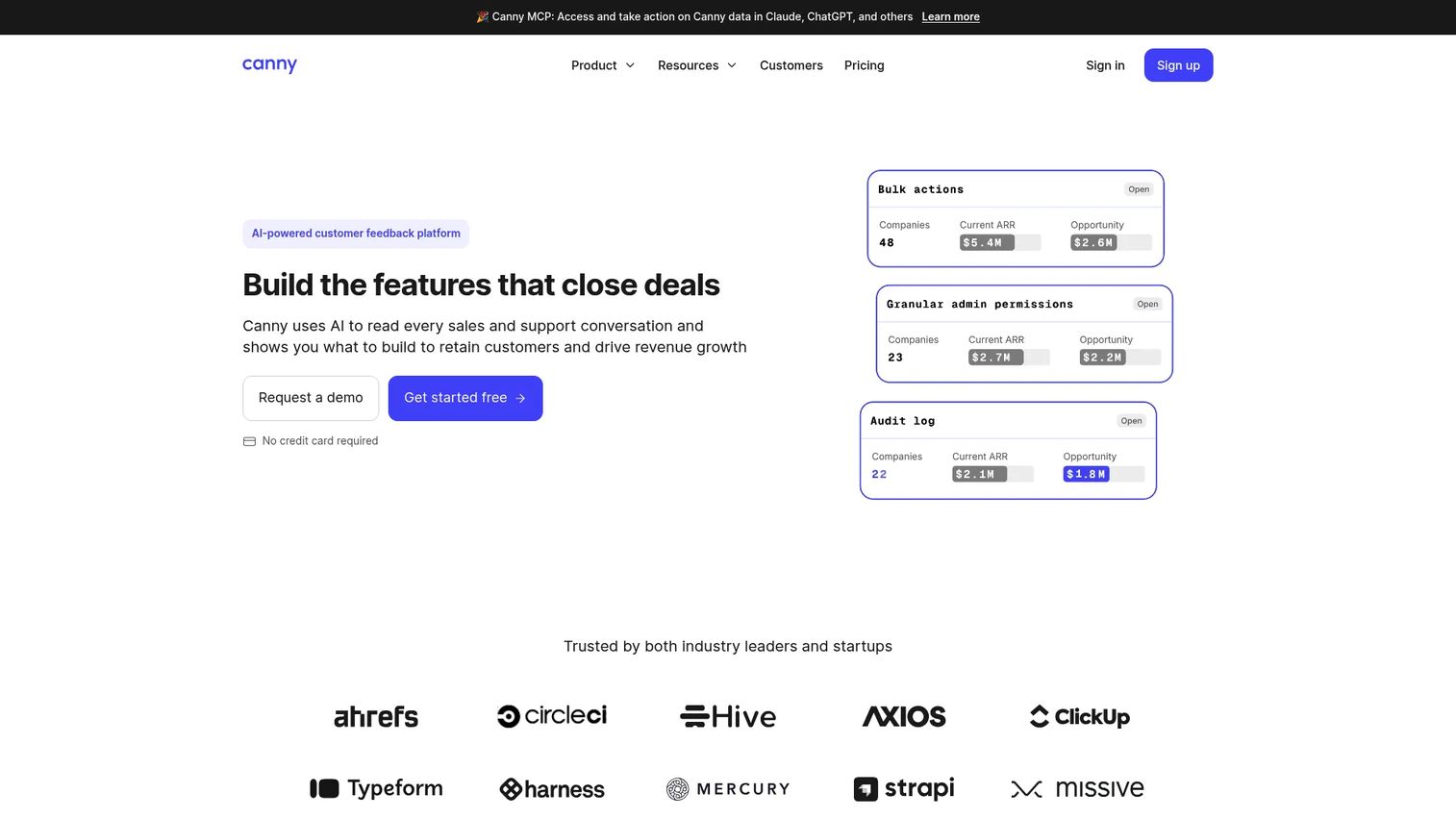
Canny is one of the most established names in customer feedback and roadmap software. It gives product teams a public feedback board, automated capture from your support and CRM tools, deduplication to keep one theme as one record, and a changelog to close the loop after you ship. It's built to cover the full lifecycle: collect, prioritize, and communicate.
The reason Canny lands on so many shortlists is breadth. You get customer-facing boards where users vote and comment, plus internal workflow coverage so your team can triage without leaving the tool. Revenue-linked prioritization is a standout: you can weight requests by the ARR tied to them, which turns "a lot of people want this" into "accounts worth $X want this."
Best for: Product teams that want one tool for collecting feedback, prioritizing a roadmap, and publishing changelogs.
Key strengths
- Public feedback boards with voting and comments
- Automated capture from support and CRM tools
- Request deduplication and merging
- Revenue-linked prioritization by account value
- Changelog and public roadmap for closed-loop updates
Why choose Canny: If you want a single tool that handles public feedback collection and internal roadmap work without stitching together three products, Canny is the safe, proven pick. It fits teams that value transparency with customers and want the changelog loop built in.
Canny pricing: Free plan at $0/month. Pro starts at $79/month billed yearly. Business is custom, quote-based, and billed yearly.
2. Featurebase
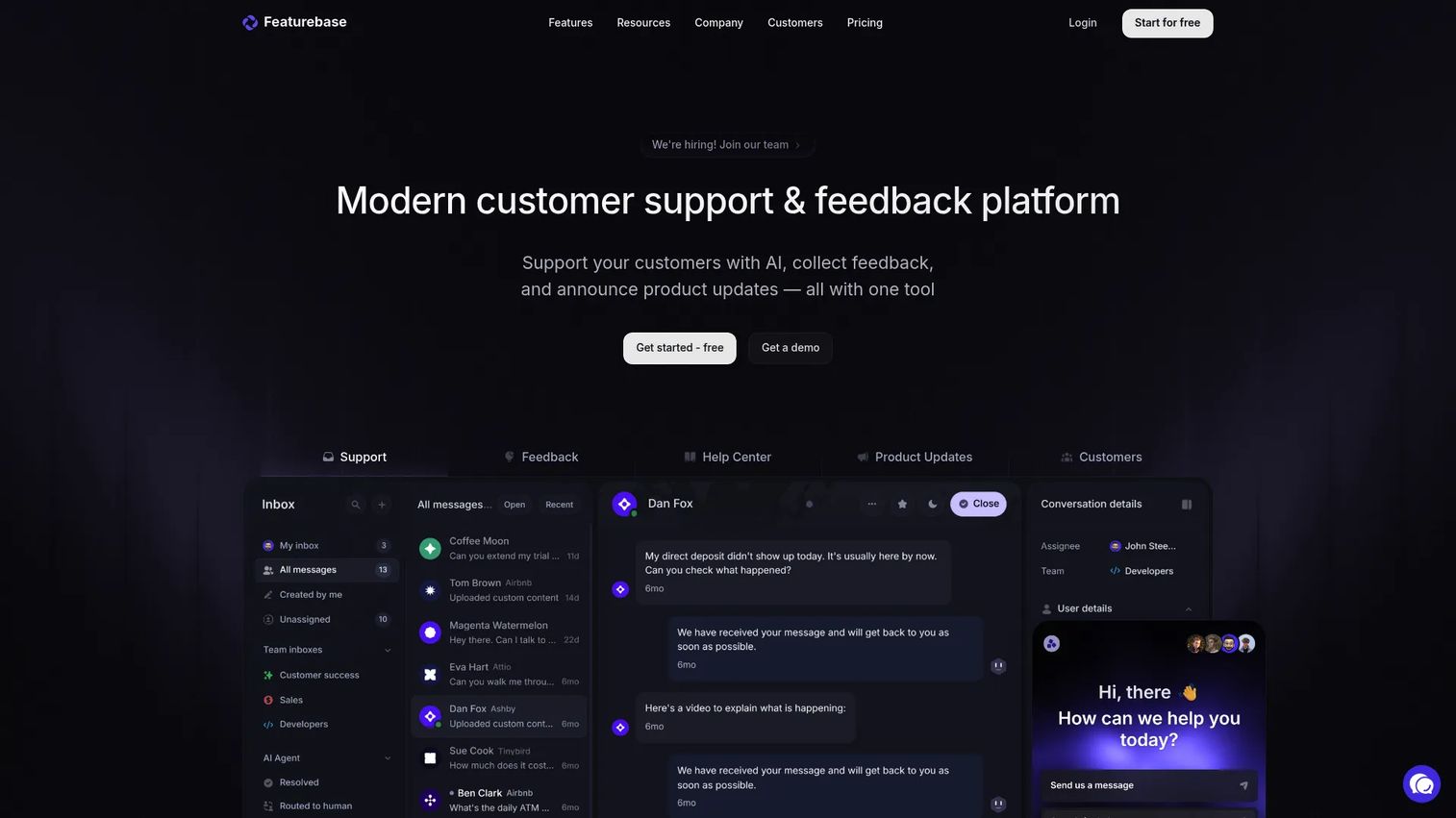
Featurebase takes a wider view than most feature request trackers. It bundles an omnichannel support inbox, an AI support agent, feedback and roadmap boards, a help center, and a changelog into one platform. For teams tired of paying for four tools that half-overlap, that consolidation is the pitch.
On the feature request side, you get public and private boards, request collection across channels, prioritization, and AI-assisted categorization that helps auto-tag and group incoming feedback. The balance here is between customer-facing feedback capture and internal workflow management, with support tooling sitting alongside it.
Best for: Teams wanting a single tool for support, feedback, help docs, and changelogs.
Key strengths
- Omnichannel inbox and ticketing
- AI support agent for deflection
- Public and private feedback and roadmap boards
- AI-assisted request categorization
- Help center and changelog in one platform
Why choose Featurebase: Choose Featurebase if your feedback problem and your support problem are the same problem. Support-led teams that want feedback capture wired directly into ticketing get the most value from the consolidated setup.
Featurebase pricing: Free plan available forever. Growth is $29/seat/month, Professional is $59/seat/month, and Enterprise is $99/seat/month, all billed yearly. AI resolution usage is billed at $0.49 per resolution on paid plans.
3. Productboard
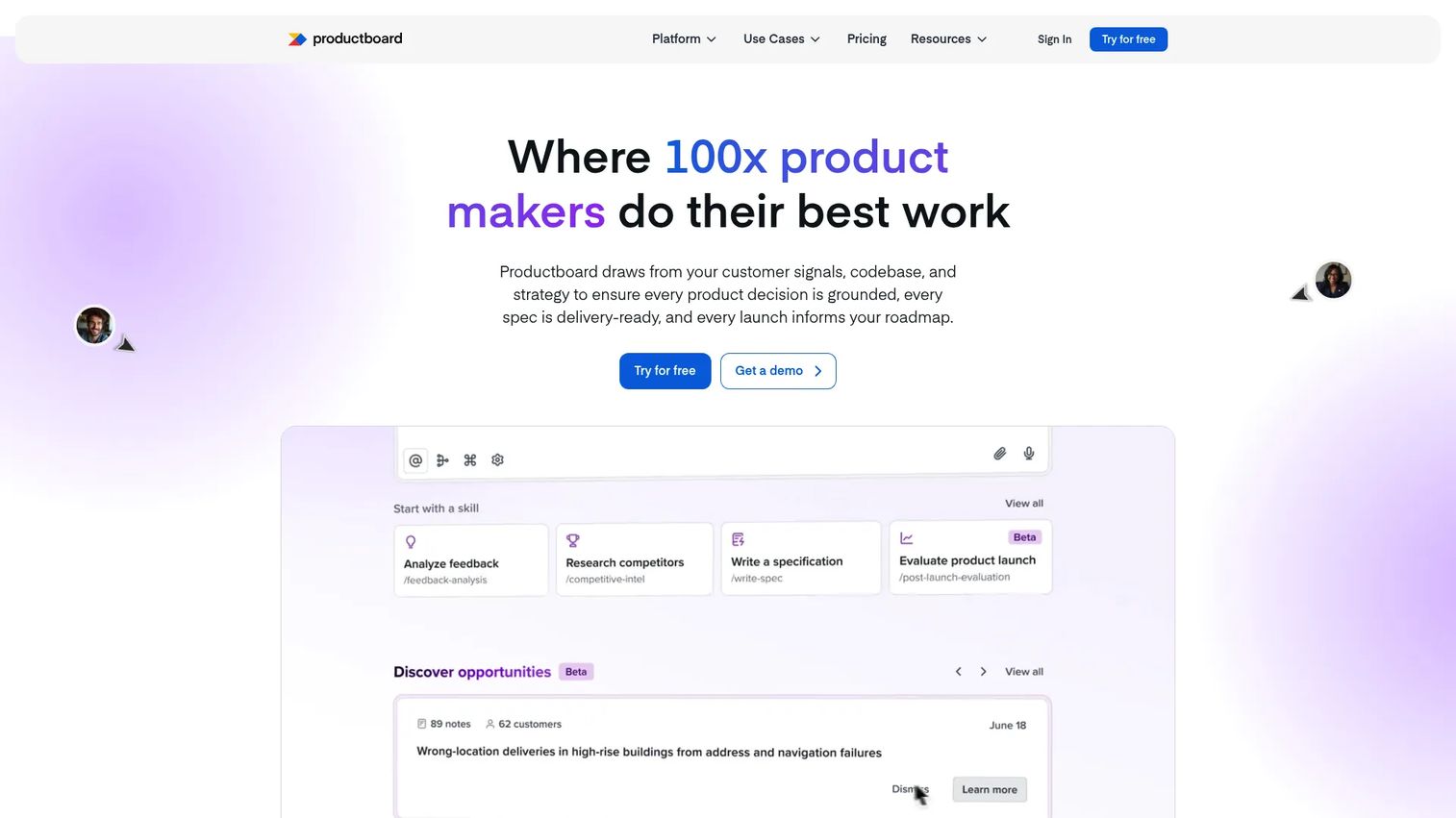
Productboard is a full product management platform, not just a feedback inbox. It's built for teams that treat prioritization as a discipline: collect customer signals, tie them to feature ideas, score against strategic criteria, and align stakeholders around a roadmap. If voting-only tools feel too thin for your decisions, this is the step up.
The strength here is structured prioritization. Instead of ranking by vote count, you build a defensible case from customer insights, feature scoring, and roadmap views your stakeholders can actually read. That depth is why larger product orgs gravitate toward it. It expects more setup and governance in return, so it rewards teams ready to invest in the process.
Best for: Product teams that need customer-signal-driven prioritization and roadmap alignment.
Key strengths
- Customer feedback and insights collection
- Prioritization scoring against strategic criteria
- Roadmap planning and stakeholder alignment
- Product portals for collaboration
- AI-assisted signal organization
Why choose Productboard: Pick Productboard when your prioritization needs to survive scrutiny from engineering, sales, and leadership at once. The tradeoff is setup investment, so it fits teams ready to run prioritization as an ongoing operating process, not a quick vote tally.
Productboard pricing: Free plan at $0. Plus is $19 per maker/month, Business is $59 per maker/month, and Enterprise is custom, all billed annually.
4. Jira Product Discovery
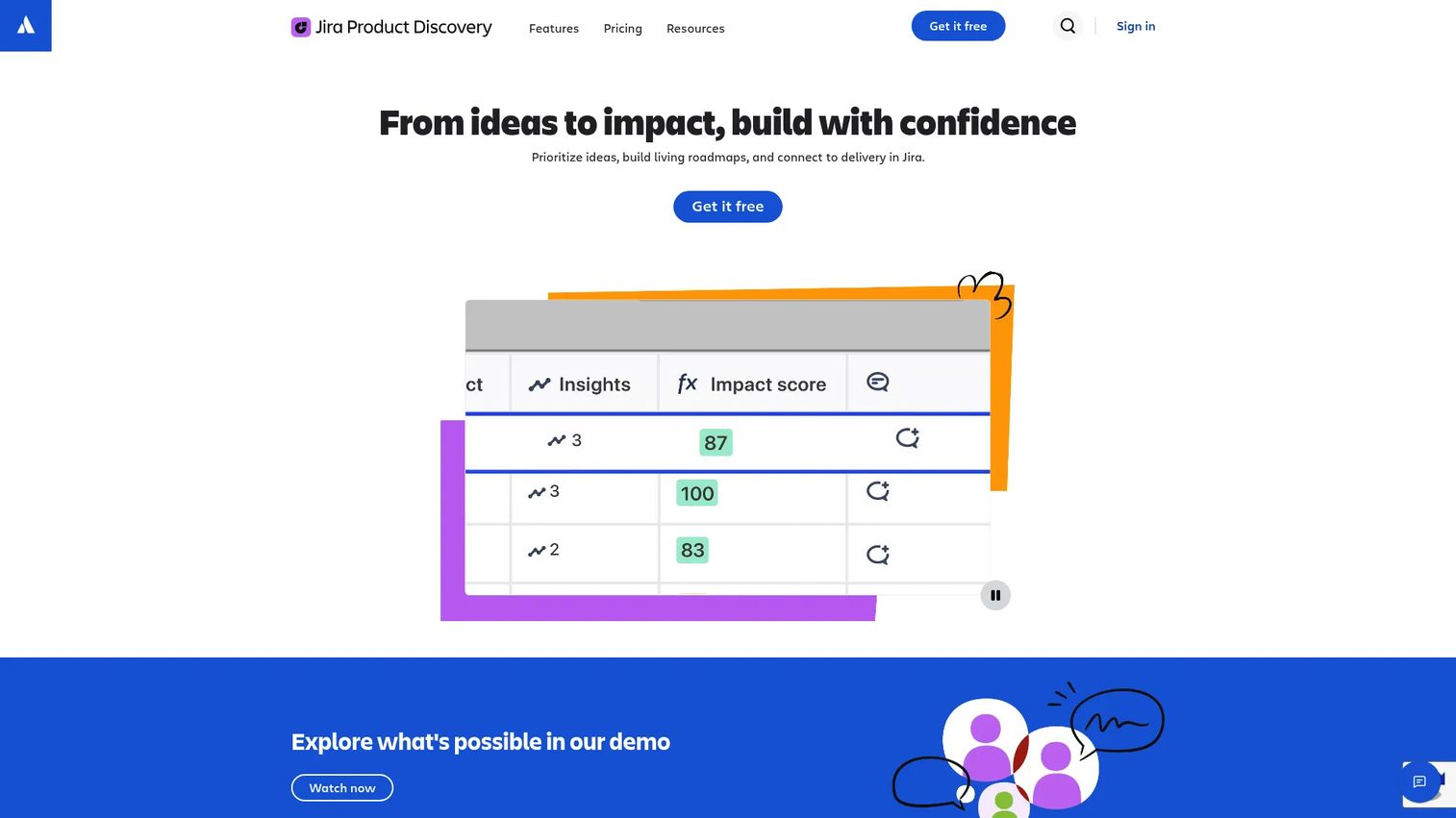
Jira Product Discovery is Atlassian's answer to the gap between idea collection and delivery. It captures ideas and insights, lets you prioritize with custom fields and formulas, and hands prioritized work straight into Jira delivery. For teams already living in the Atlassian stack, the native connection is the whole point.
The ecosystem advantage is real. When your engineers already work in Jira, moving a prioritized idea into an epic without a separate integration or export saves friction and keeps discovery and delivery in one lineage. You get flexible views to slice ideas by impact, effort, or custom scoring formulas you define.
Best for: Product teams that want to capture ideas, prioritize work, and connect discovery to Jira delivery.
Key strengths
- Ideas and insights capture
- Custom fields and formulas for prioritization
- Flexible views for slicing ideas
- Native Jira delivery handoff
- Roadmap sharing with stakeholders
Why choose Jira Product Discovery: If your delivery already runs on Jira, this keeps discovery and execution in one place with no export gymnastics. It fits Atlassian-native teams more than those wanting a polished public feedback board.
Jira Product Discovery pricing: Free for up to 3 creators. Standard is $10 per creator/month, Premium is $25 per creator/month, and Enterprise requires contacting sales.
5. Unwrap
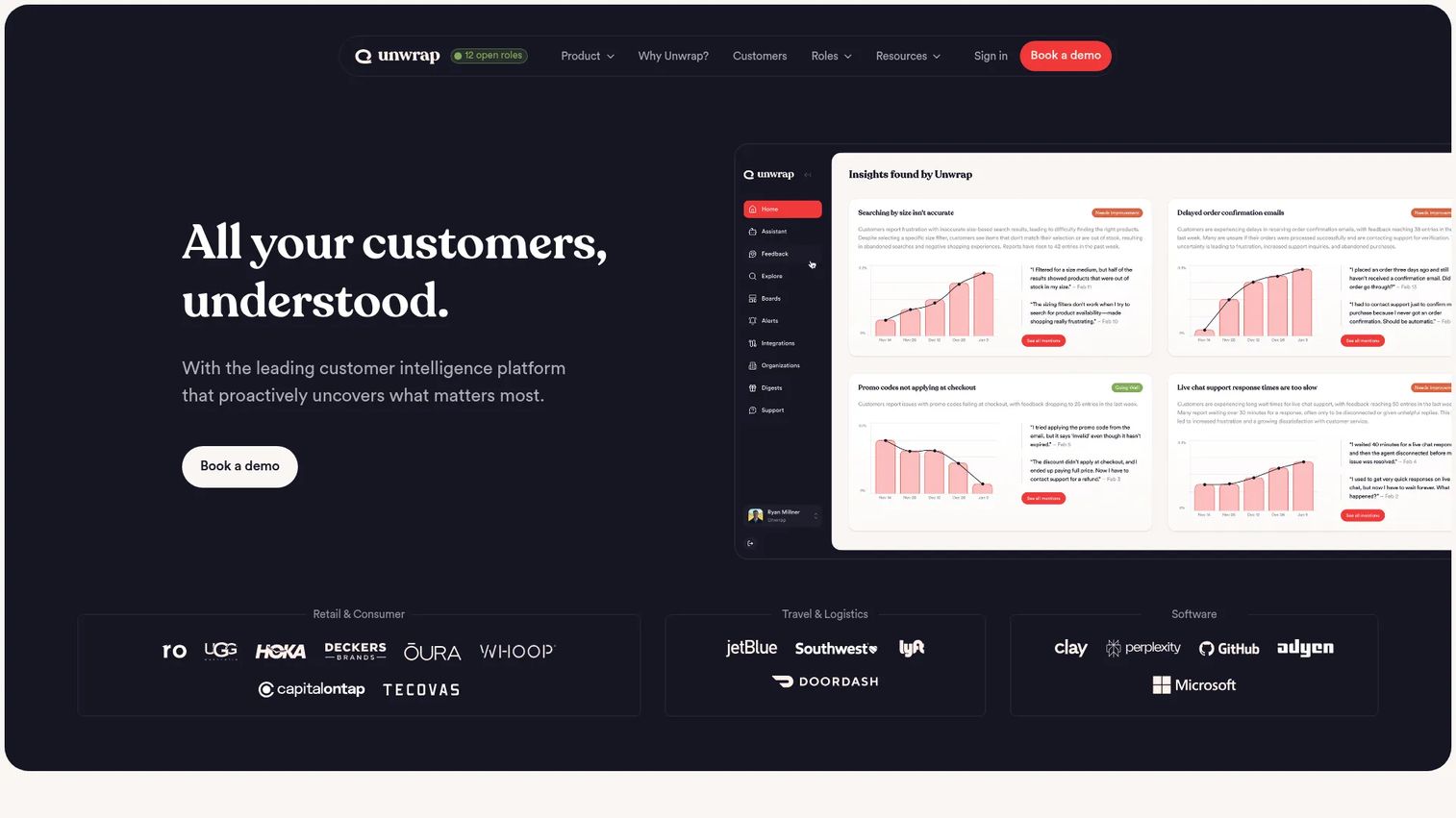
Unwrap is a different animal from an intake board. It's an AI-powered customer intelligence platform that ingests feedback from many sources, auto-tags and groups it, and quantifies demand so you can see what customers actually care about at scale. Where a voting board asks users to organize themselves, Unwrap does the organizing for you.
The standout is analysis, not collection. Its natural-language assistant, dashboards, and alerts help you spot emerging themes across thousands of data points, then tie those themes to shipped outcomes. For teams drowning in unstructured feedback across reviews, tickets, and calls, that grouping is the value. This is an enterprise-grade tool priced accordingly.
Best for: Enterprise teams that need AI-driven analysis of customer feedback across many sources.
Key strengths
- Proactive customer feedback insights
- Auto-tagging and theme grouping
- Demand quantification across sources
- Natural-language assistant and dashboards
- Alerts and automated responder
Why choose Unwrap: Choose Unwrap when your problem is making sense of feedback volume, not collecting more of it. It fits teams that want analysis and outcome tracking over a lightweight feedback board, and that have the budget for an enterprise platform.
Unwrap pricing: Custom plans starting at $24,000 per year, based on monthly feedback volume and integrations. No per-seat charging, and a 30-day trial based on your own data.
6. UserVoice

UserVoice is a customer intelligence platform with deep roots in public idea forums. Customers submit ideas, vote, and watch status change over time, which builds the kind of transparency that keeps a community engaged. On top of that, it layers AI-powered, revenue-weighted insights so you see which requests carry real financial weight.
The appeal is a mix of customer-facing transparency and back-end rigor. Product, CS, and revenue teams get a shared view of feedback that's weighted by account value, not just headcount. Its integration list is strong, connecting to Salesforce, Zendesk, Gainsight, Gong, Slack, Jira, and Azure DevOps so feedback flows in from where your teams already work.
Best for: Product, customer success, and revenue teams that need to consolidate feedback into prioritized, revenue-aware insights.
Key strengths
- Centralized customer feedback portal
- Public idea forums with voting and status
- AI-powered revenue-weighted insights
- Broad integrations across CRM and support tools
- Status communication back to requesters
Why choose UserVoice: Pick UserVoice when transparent, customer-facing feedback collection matters as much as internal prioritization. It fits teams that want a public forum plus revenue-aware scoring in one place.
UserVoice pricing: Pricing scales by feedback volume, tools used, and integrations connected. Public numeric prices are not listed; UserVoice directs buyers to talk to their team, and offers a 30-day free trial.
7. Savio
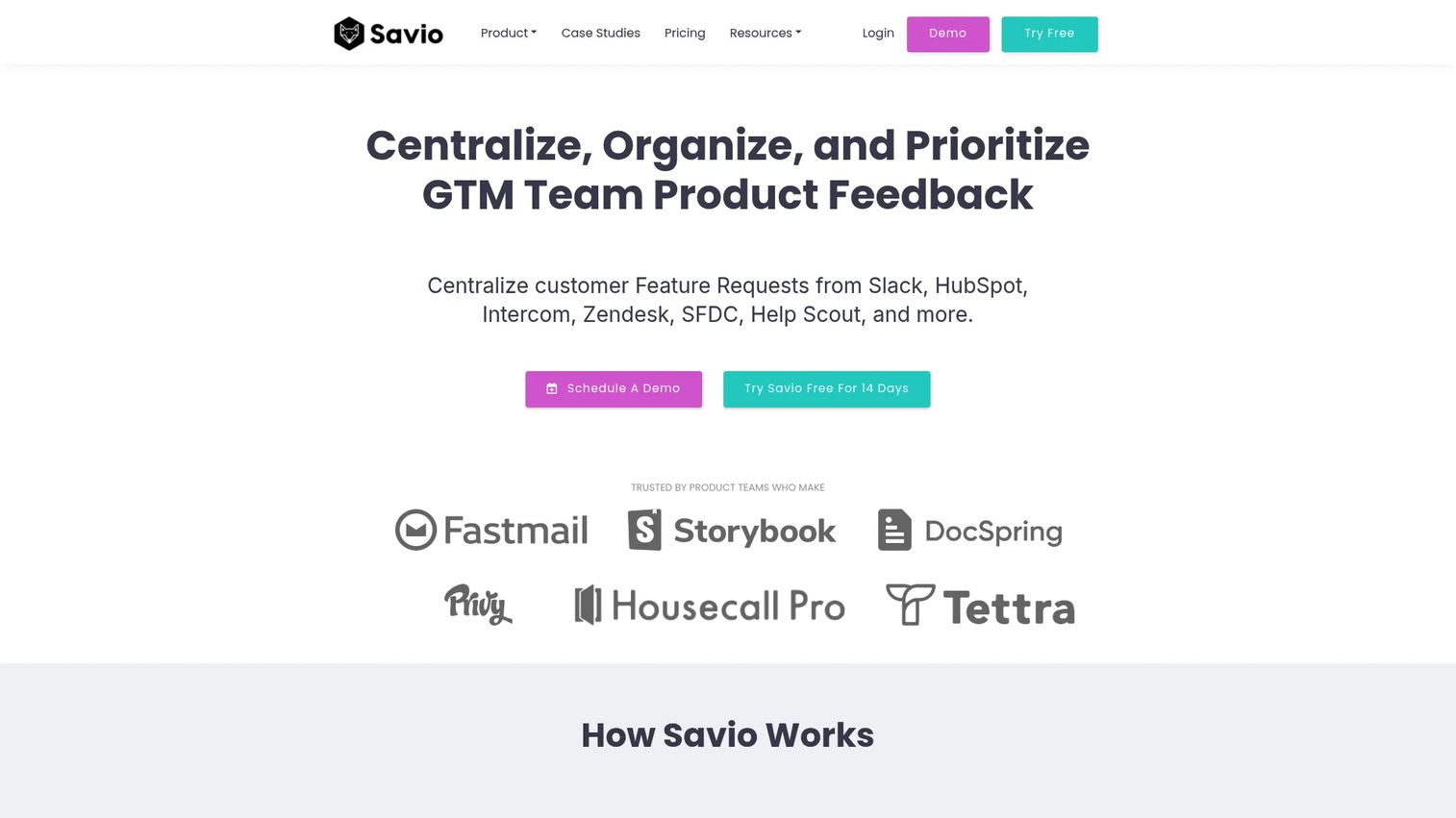
Savio is built around one job done well: consolidating scattered feedback into a single, prioritized backlog. It pulls requests from tools like Intercom, Help Scout, Slack, HubSpot, Salesforce, Zendesk, and email, then lets you prioritize using customer data, segmentation, and revenue or plan attributes. For teams whose feedback is fragmented across a support and sales stack, that consolidation is the entire value.
The focus is deliberate. Savio isn't trying to be a full product management suite. It's trying to make sure no request slips through the cracks and that prioritization reflects who's asking, not just how many. Voting boards, roadmaps, and close-the-loop customer updates round out the workflow.
Best for: SaaS product, support, and success teams that need structured feature-request tracking and roadmap prioritization.
Key strengths
- Centralize feedback from Intercom, HubSpot, Salesforce, Zendesk, and more
- Prioritize by customer segment, revenue, and plan
- Voting boards and public roadmaps
- Close-the-loop customer updates
- Structured backlog focused on feature requests
Why choose Savio: Choose Savio if your feedback is spread across a support and CRM stack and you want it unified without adopting a heavier platform. It fits teams that value focused request tracking over broad product management features.
Savio pricing: Essential is $39/month, Professional is $79/month, and Business is $249/month, each including 1 paid user with unlimited free users. Enterprise requires a call, and a 14-day free trial is available.
Considerations before you buy
A tool that demos well can still stall in month three. Run every option through this checklist first.
Capture channel coverage
Confirm the tool pulls from every channel your requests actually come from: support tickets, sales calls, in-app prompts, reviews, and public boards. A system that only captures what people manually submit will miss most of your real signal. Multi-channel capture is what separates a request inbox from a true feedback system.
Prioritization model
Decide whether raw votes are enough or whether you need revenue and effort weighting. Most product teams outgrow vote-only systems fast, because the loudest customers are not always the most valuable. Look for the ability to weight by ARR, segment, and strategic fit, then defend decisions with that evidence.
Cross-functional fit
Your feedback system only works if sales, support, and CS actually use it. Check that non-product teams can submit and view requests without heavy training. If the tool feels like a product-only silo, adoption dies and you're back to Slack threads within a quarter.
Closed-loop workflow
Verify how easily you notify requesters when a feature ships. Public roadmaps, changelogs, and status updates are what turn a one-way inbox into a trust-building loop. Teams that skip this train customers to stop sending feedback.
Maintenance burden
Every system decays as your product changes. Ask how much ongoing upkeep tagging, dedup rules, and integrations require. The best feature request management tool is the one your team still uses in month twelve, not just launch week.
Conclusion
The right feature request software depends on the shape of your problem, not a leaderboard. If you want one tool covering public boards, roadmap, and changelog, Canny is the proven all-in-one. If support and feedback are the same headache, Featurebase consolidates both. For prioritization that survives cross-functional scrutiny, Productboard rewards the setup investment.
Atlassian-native teams should default to Jira Product Discovery for the delivery handoff alone. Enterprise teams buried in feedback volume get the most from Unwrap's AI analysis. UserVoice fits when transparent customer forums plus revenue weighting matter equally. And Savio is the focused pick for unifying requests scattered across a support and CRM stack.
Your next step: shortlist two tools that match your capture channels and prioritization needs, then run a trial with real feedback from your last quarter. The tool that makes your last three roadmap decisions easier to defend is the one to buy.
FAQs
It's used to collect customer and internal feature requests, deduplicate them, prioritize what to build, and communicate what shipped. The goal is to replace scattered docs, spreadsheets, and Slack threads with one trusted system. Product teams use it to turn fragmented feedback into defensible roadmap decisions.
Weight each request by the revenue tied to it, the segment asking, engineering effort, and strategic fit, not just vote count. The loudest customers are rarely your most valuable ones. Most feature request tools let you score against multiple criteria so you can defend a decision with evidence, not headcount.
Feature request software focuses on capturing, deduplicating, and prioritizing incoming requests. Roadmap software focuses on planning and communicating what you'll build and when. Many tools now do both, but the request side is about intake and evidence, while the roadmap side is about sequencing and stakeholder alignment.
Yes. Most tools integrate with support platforms like Zendesk and Intercom and CRMs like Salesforce and HubSpot, so requests logged there flow into one backlog. This multi-channel capture is what stops requests from getting lost in tickets and call notes. Confirm your specific tools are supported before buying.
They give customers a transparent place to submit, vote on, and track requests, which reduces duplicate asks and shows your team what demand is strongest. Public boards also build trust: customers who see status change over time keep sending signal. They collect demand, though the prioritization decision still belongs to product.
Prioritize capture channel coverage, a prioritization model beyond raw votes, cross-functional adoption, and a closed-loop workflow for post-ship updates. Also weigh maintenance burden, since every system decays as your product changes. The best tool is the one your whole team still uses in month twelve.
Use a tool with deduplication that merges repeat asks into a single record, so one theme has one entry and accurate vote counts. AI-assisted categorization can auto-group similar requests as they arrive. Without dedup, you overcount some themes and undercount others, which corrupts your prioritization signal.
For teams already running delivery in Jira, it often is, because the native handoff from prioritized idea to Jira epic removes friction. It captures ideas, prioritizes with custom formulas, and shares roadmaps. Teams that need a polished public feedback board or heavier revenue weighting may want to pair it with or compare it against a dedicated tool.