Your company has 70 employees, two overextended ops people, and a board that just asked for a clean headcount-to-cost breakdown. Your employee records live in a payroll tool, a couple of spreadsheets, and everyone's memory. Time off approvals happen over Slack. Benefits questions route to whoever picks up the phone.
This is the moment most founders realize they don't have an HR system. They have HR chaos.
The core HR software market reached $14.34 billion in 2026, according to Mordor Intelligence, and the buying pressure is real: 69% of organizations now run HR on SaaS or hybrid cloud infrastructure, per ISG (2025). The category grew because scattered people data stops scaling past a certain headcount, and that headcount is usually somewhere between 40 and 80 employees for most SaaS teams.
The wrong system just becomes another admin layer. The right one becomes the company's employee operating system, the place where payroll inputs, compensation history, compliance records, and time-off policies live cleanly and trust-ably. This guide helps you find the right one.
What's inside
This guide compares 15 core HR platforms for 2026 and is built for founders, COOs, finance leads, and new People leaders choosing a system of record.
- Who it's for: Series B SaaS teams, typically 30 to 150 employees, replacing spreadsheets or upgrading from payroll-only tools
- How tools were selected: Category relevance, fit across company sizes, verified pricing, and G2 ratings
- Selection criteria: Employee records quality, payroll and benefits administration connections, compliance support, and employee self-service depth
- What to verify before signing: Migration effort, module costs, country coverage, and integration reliability with your existing stack
TL;DR
- Best for scaling SaaS teams: Rippling connects HR, payroll, IT, and finance workflows, reducing tool sprawl as headcount grows
- Best for first HRIS adoption: BambooHR or Humaans give lean People teams a clean system of record without heavy implementation
- Best payroll-first option for small teams: Gusto starts at $49/month and covers payroll, benefits, and onboarding for teams under 50
- Best for distributed or global hiring: Deel HR starts at $5 per employee per month and handles cross-border HR, contractor management, and compliance
- Best for enterprise HCM depth: Workday HCM, SAP SuccessFactors, or UKG Ready for organizations with complex workforce planning needs
- Best for India-based teams: Keka or greytHR for local payroll, attendance, and statutory compliance
What is core HR software?
Core HR software is the system of record for employee data, HR workflows, documents, payroll inputs, benefits information, time off, and compliance reporting.
It is the foundation layer of people operations. Every other HR tool, recruiting software, performance management, workforce scheduling, sits on top of it.
Key capabilities in a core HR system include:
- Employee profiles and records: Job history, compensation changes, manager relationships, documents, and custom fields
- Payroll data and coordination: Payroll inputs, deductions, pay schedule management, and sync with payroll processors
- Benefits administration: Enrollment, eligibility rules, carrier feeds, deduction management, and open enrollment workflows
- Time off and absence management: Policy configuration, accruals, approval workflows, and calendar visibility
- Employee self-service: Employees update their own information, request time off, and access pay stubs and documents without pinging HR
- HR documents and e-signatures: Offer letters, NDAs, policy acknowledgments, and onboarding paperwork
- Compliance reporting: Audit logs, EEO reporting, ACA tracking, and country-specific statutory requirements
- Workflow automation: Approvals, reminders, onboarding task assignment, and lifecycle event triggers
- Integrations: Connections to recruiting, accounting, identity management, payroll processors, and analytics tools
How core HR differs from adjacent categories:
Core HR is narrower than HCM (human capital management), which typically adds recruiting, learning, performance, and long-range workforce planning on top of the foundational layer. HRIS (human resources information system) substantially overlaps with core HR and the terms are often used interchangeably in vendor conversations. Payroll software may include core HR, but payroll processing alone rarely provides the full employee data management that a scaling team needs.
When to use core HR software
Centralize employee data before headcount outgrows spreadsheets
When headcount passes 30 to 50, manager changes, compensation updates, and remote hires start producing data that spreadsheets can't track reliably. Board reports and diligence requests slow down when nobody trusts the numbers. A core HR system becomes the single place where any authorized person can pull accurate, current data.
Connect payroll, benefits, and time off without manual reconciliation
Payroll errors become expensive as headcount grows. Benefits changes need to trigger deduction updates. PTO balances need to reflect approved time off. Each manual reconciliation step adds risk. A core HR system with payroll and benefits connections handles these handoffs automatically, so your ops team isn't rebuilding the same spreadsheet every pay period.
Give employees self-service for routine HR tasks
A People team at a 70-person company should not spend 30% of its time answering "how do I update my direct deposit?" questions. Employee self-service portals handle personal information updates, time-off requests, pay stub access, and benefits confirmations. For a Series B team, this is the difference between your People hire doing strategic work and running an internal helpdesk.
Core HR software comparison
The table below is a directional buying map. Pricing reflects verified data from vendor pricing pages. G2 ratings are from current G2 listings.
| # | Product | Best for | Key differentiator | Pricing | G2 rating |
|---|---|---|---|---|---|
| 1 | Rippling | Scaling SaaS teams | Unified HR, IT, payroll, and finance | From $8/employee/mo | 4.7/5 |
| 2 | BambooHR | SMB and early mid-market HRIS | Easy employee records and HR workflows | From $10.25/employee/mo | 4.4/5 |
| 3 | Paylocity | Payroll-centered U.S. HR teams | Payroll plus employee experience tools | Custom pricing | 4.4/5 |
| 4 | ADP Workforce Now | Established U.S. businesses | Payroll, compliance, and benefits depth | Custom pricing | 4.2/5 |
| 5 | Gusto | Small teams and startups | Payroll-first HR with approachable setup | From $49/mo | 4.6/5 |
| 6 | Deel HR | Global and distributed teams | Global HR, contractor, and employment workflows | From $5/employee/mo | 4.8/5 |
| 7 | Workday HCM | Enterprise workforce planning | Enterprise HCM, finance, and analytics depth | Custom pricing | 4.1/5 |
| 8 | HiBob HRIS | Modern mid-market companies | People analytics and employee engagement | Custom pricing | 4.5/5 |
| 9 | Personio | European SMB and mid-market | HR workflows and European compliance fit | Custom pricing | 4.4/5 |
| 10 | UKG Ready | Workforce-heavy organizations | HR, payroll, time, and workforce management | Custom pricing | 4.4/5 |
| 11 | SAP SuccessFactors | Large global enterprises | Global HR, payroll, and talent suite depth | From $1.96/user/mo (component) | 4.1/5 |
| 12 | Keka | India-focused HR and payroll | Payroll, attendance, and performance workflows | Free trial available | 4.4/5 |
| 13 | Humaans | Fast-moving startups and scaleups | Clean employee data and modern HR workflows | Custom pricing | 4.8/5 |
| 14 | greytHR | India-based SMBs | Payroll, attendance, and compliance support | From ₹2,495/mo | 4.4/5 |
| 15 | NEOGOV HRIS | Public-sector agencies | Government-focused HRIS workflows | Custom pricing | N/A |
Best 15 core HR software for 2026
1. Rippling
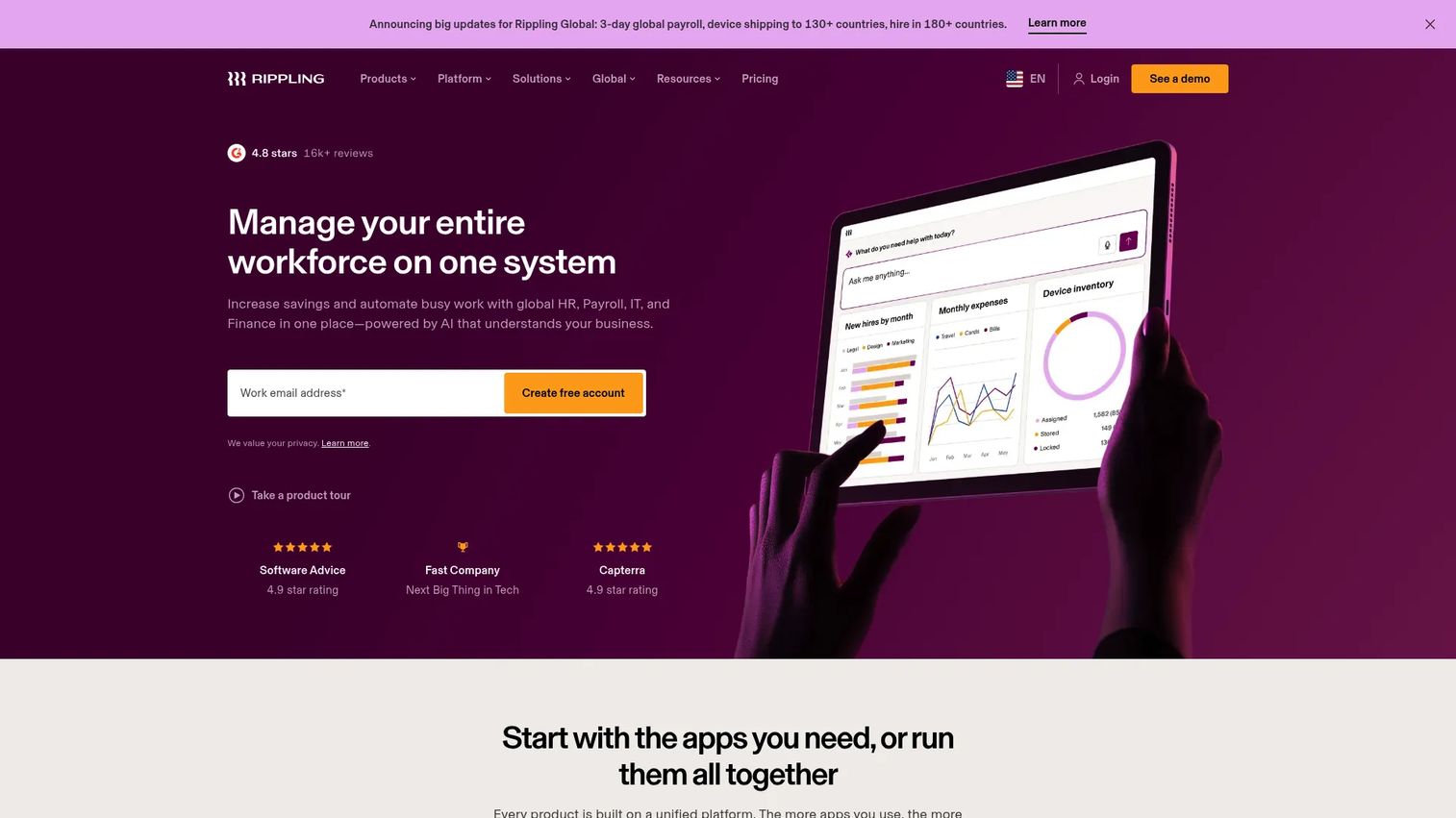
Rippling is a unified workforce platform that connects HR, payroll, IT, benefits, expense management, and finance workflows in a single system. For a Series B team, the value proposition is consolidation: One employee record triggers downstream actions in payroll, app provisioning, device management, and reporting. It is built for companies that are adding headcount fast and want fewer seams between people operations and IT operations.
Best for: Series B SaaS companies that want HR, payroll, identity, and IT workflows connected.
Key features
- Employee records and HRIS with lifecycle management
- Payroll and global payroll processing
- App provisioning and device management
- Expense management and corporate cards
- Workflow automation across HR, IT, and finance
Why choose Rippling: It fits companies where an HR change, like a new hire or a termination, should automatically trigger a cascade of IT and payroll actions without manual follow-up. Verify module costs and implementation scope closely before signing, as the total price grows with each product added.
Rippling pricing: Plans start at $8 per employee per month plus a monthly base fee, with final cost driven by selected modules and headcount. Contact Rippling for a quote.
G2 rating: 4.7/5
2. BambooHR
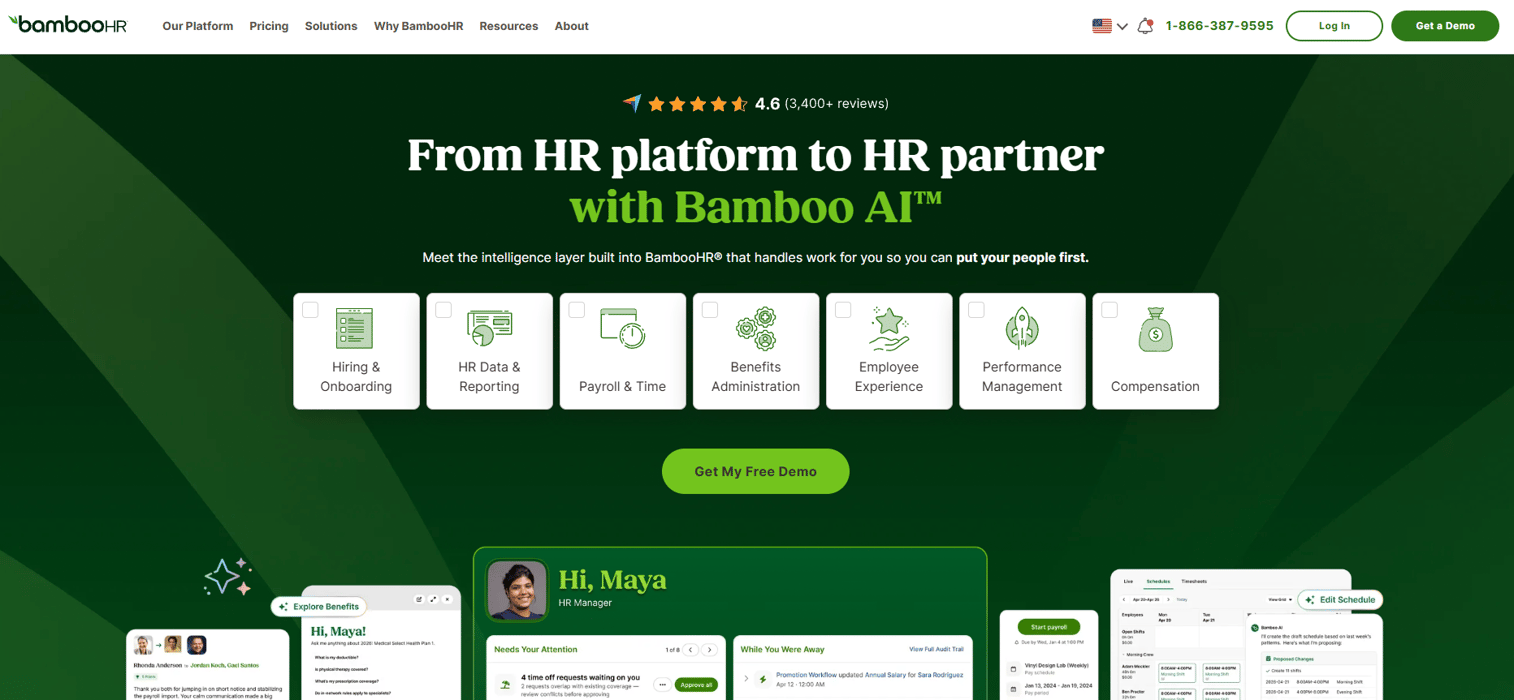
BambooHR is a clean, approachable HRIS for small and mid-sized businesses that need reliable employee records, onboarding, PTO tracking, and performance basics without an enterprise buildout. Teams moving from spreadsheets into their first serious HR system consistently name it as one of the fastest to adopt. Payroll, benefits administration, and time and attendance are available as add-ons.
Best for: Teams replacing spreadsheets and looking for a lean People team to centralize records quickly.
Key features
- Employee database with custom fields and document storage
- Time-off tracking with approval workflows
- Onboarding task assignment and checklists
- Performance reviews and goal tracking
- HR reporting and benchmarks
Why choose BambooHR: Strong option when the founder needs a system a new Head of People can run from day one without a lengthy implementation. Skip it if you need complex global payroll or deep workforce planning, as those require other platforms.
BambooHR pricing: Core plan is $10.25 per employee per month; Pro is $17.50; Elite is $25. For teams of 25 or fewer employees, flat monthly pricing applies: Core at $250/month, Pro at $425/month, and Elite at $650/month. Payroll is a separate add-on.
G2 rating: 4.4/5
3. Paylocity
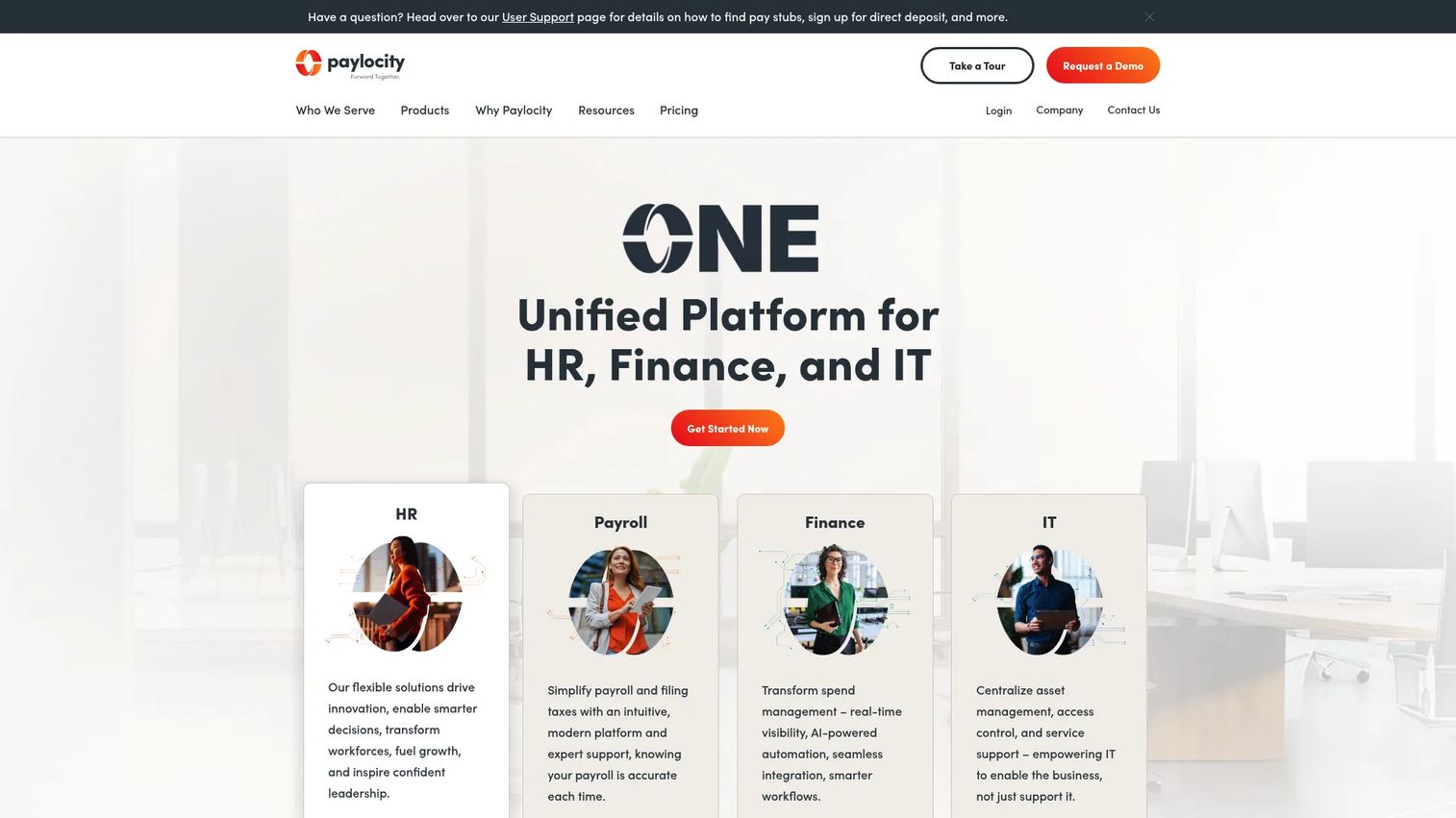
Paylocity is a unified platform for HR, payroll, benefits, time, talent, and employee experience built for U.S.-based teams. Its payroll reliability and compliance depth make it a strong choice for companies that have outgrown entry-level payroll tools but aren't ready for a full enterprise HCM suite. The platform also covers expense management, accounts payable automation, and IT access management.
Best for: U.S. companies that want payroll and HR managed under one vendor with employee experience tools included.
Key features
- Payroll processing and tax filing
- Benefits administration and open enrollment
- Time tracking and workforce management
- Employee self-service portal and mobile app
- Talent management and HR analytics
Why choose Paylocity: Best fit when payroll is the operational center of your HR work and you want employee experience features, like community tools and surveys, without a separate platform. Founders should run a detailed pricing conversation since costs are customized by employee count, modules, and service level.
Paylocity pricing: Pricing requires a quote. Paylocity directs prospects to contact sales for a customized package.
G2 rating: 4.4/5
4. ADP Workforce Now
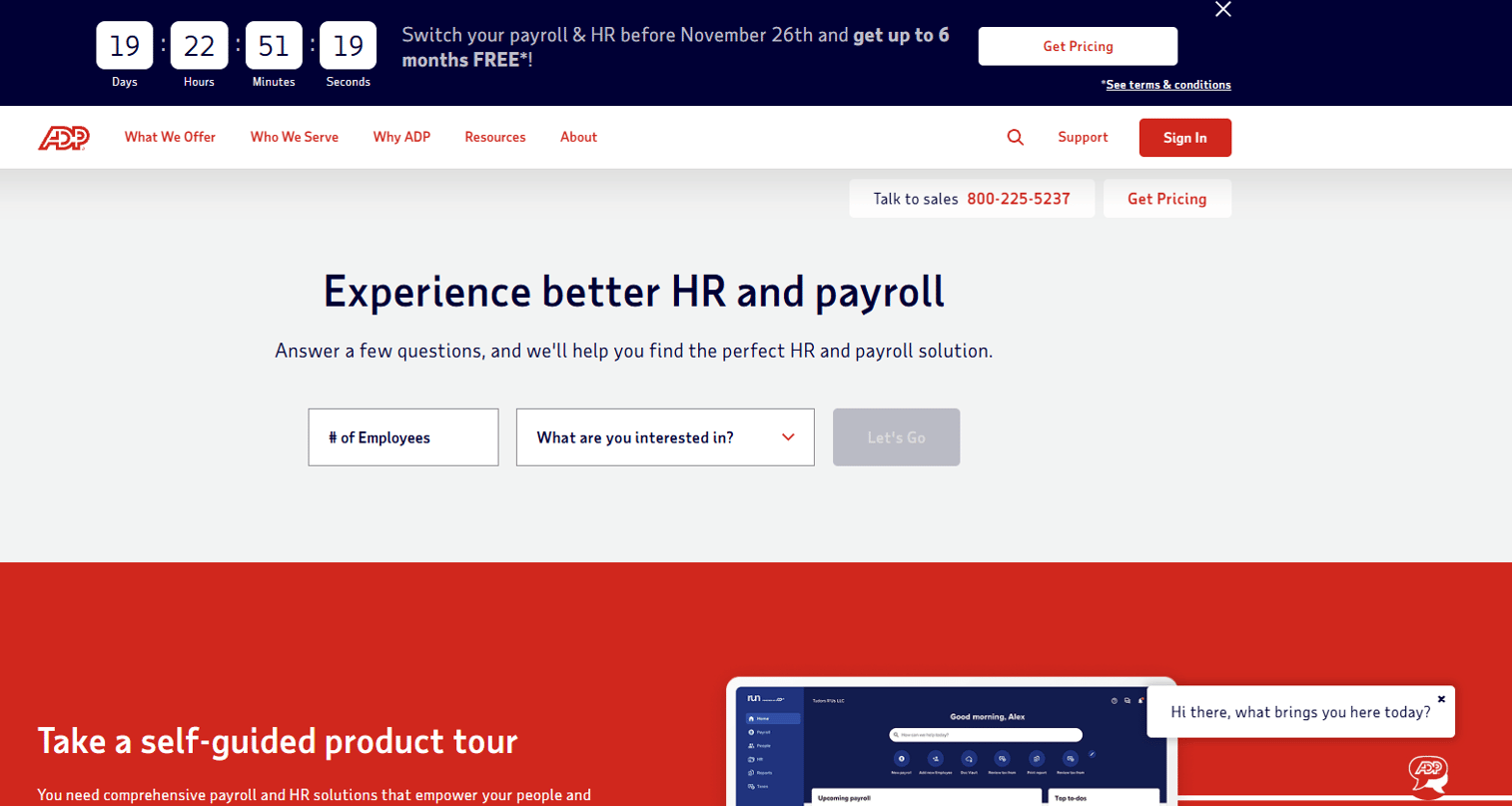
ADP Workforce Now is an established HR and payroll platform for midsize and growing businesses. It covers payroll, compliance, benefits, time tracking, talent acquisition, performance management, and compensation analytics. ADP's decades of payroll infrastructure and compliance depth make it a default shortlist option for U.S. companies prioritizing payroll maturity and regulatory coverage.
Best for: Companies that prioritize payroll reliability, compliance support, and an established vendor with broad service coverage.
Key features
- Payroll processing and tax compliance
- Benefits administration and carrier connections
- Compliance reporting tools and audit support
- Time and attendance management
- HR reporting and compensation analytics
Why choose ADP Workforce Now: Strong fit for teams that have had payroll errors or compliance issues with smaller tools and want a vendor with deep infrastructure. Check implementation costs, package configuration options, and customer support tiers before committing, as these vary significantly.
ADP Workforce Now pricing: ADP offers two package options (Plus and Premium) and directs buyers to contact sales for pricing.
G2 rating: 4.2/5
5. Gusto
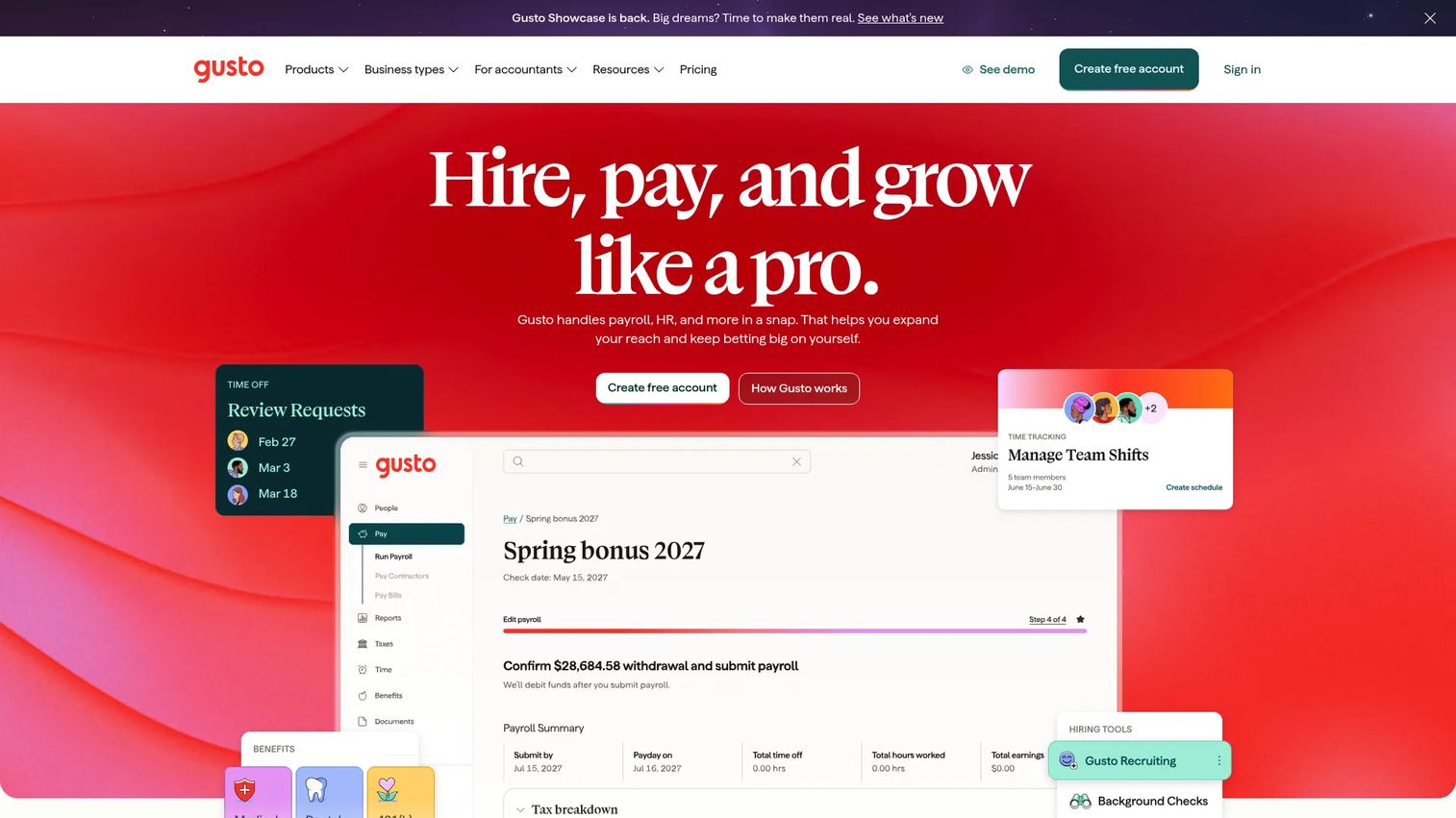
Gusto is a payroll-first HR platform built for startups and small businesses that need full-service payroll, benefits, onboarding, and time tools without a heavy implementation. It is one of the most accessible starting points for a founder who wants payroll and basic HR running in the same week. The platform also offers contractor payments and international workforce support in some markets.
Best for: Small SaaS teams that need payroll and basic HR moving quickly, without dedicated HR staff.
Key features
- Full-service payroll with automated tax filings
- Benefits administration including health, dental, and 401(k) connections
- Onboarding workflows and offer letter templates
- Time tracking and scheduling tools
- Employee self-service portal
Why choose Gusto: Best fit for teams under 50 that want payroll, compliance basics, and onboarding in a single tool they can configure themselves. Later-stage companies with complex performance management, workforce planning, or enterprise IT requirements will likely outgrow it.
Gusto pricing: Simple plan is $49/month plus $6 per person per month. Plus is $80/month plus $12 per person per month. Premium is $180/month plus $22 per person per month. All plans are billed monthly.
G2 rating: 4.6/5
6. Deel HR
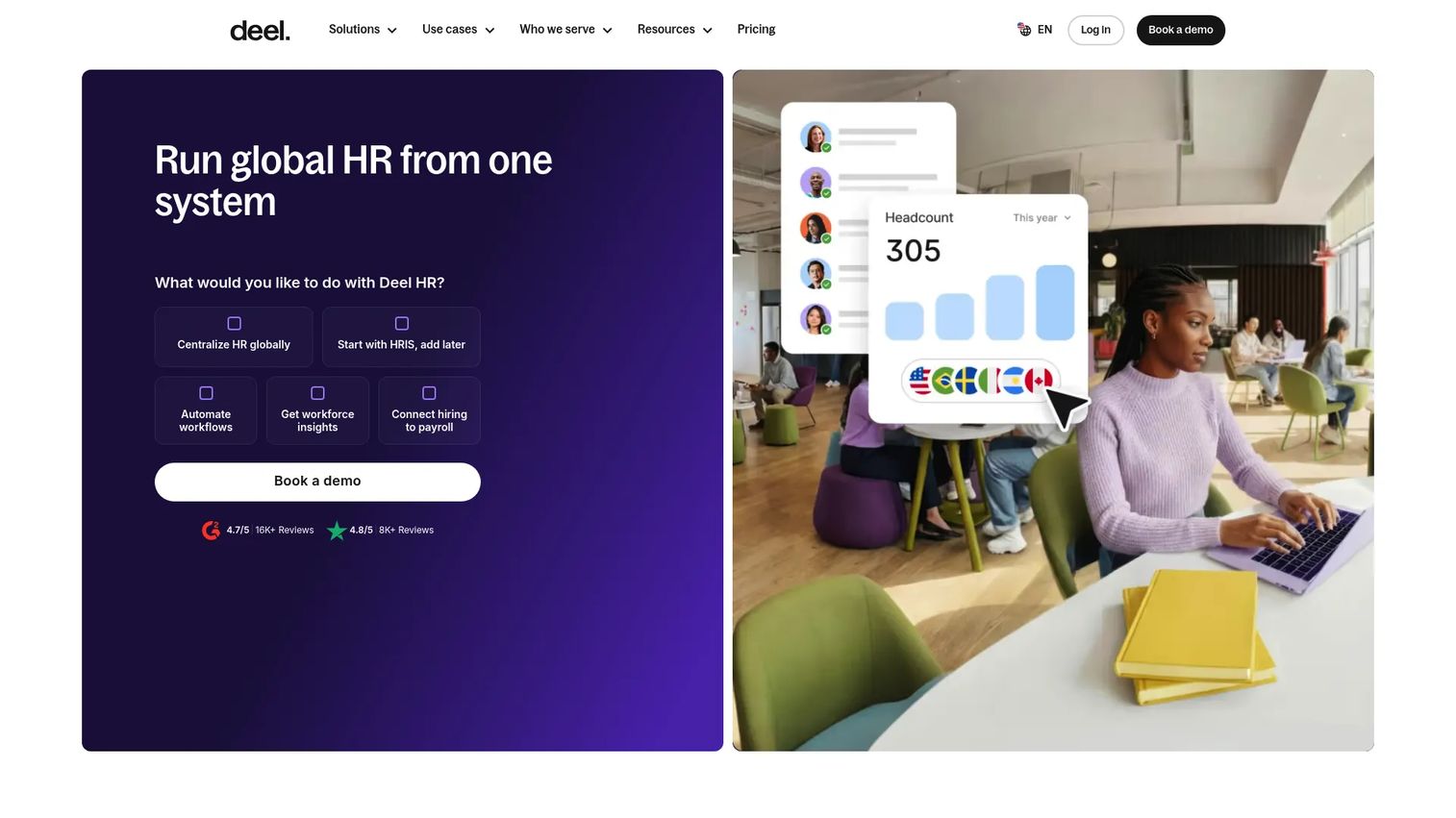
Deel HR is a global HR platform built for teams managing employees and contractors across multiple countries. The Core tier covers employee profiles, org charts, time off, job architecture, workflows, and people analytics. Advanced and Elite tiers add performance management, learning, workforce planning, and compensation management. Deel's strength is handling the complexity of global hiring, from worker classification to local compliance, inside one system.
Best for: Distributed SaaS teams hiring across borders who need HR, contractor management, and compliance in a unified platform.
Key features
- Global HRIS with employee profiles and org management
- Contractor management and worker classification support
- Document workflows and digital signatures
- Global payroll connections and compliance support
- Performance reviews, goals, and surveys (Advanced and above)
Why choose Deel HR: Strong option when global hiring risk and cross-border worker classification are real concerns for the founder. The Core tier at $5 per employee per month gives lean teams a solid HR foundation before they need advanced features.
Deel HR pricing: Core plan is $5 per employee per month. Advanced and Elite plan pricing requires contacting Deel. Recruiting is a separate add-on.
G2 rating: 4.8/5
7. Workday HCM
Workday HCM is an enterprise HCM suite for large organizations with complex workforce planning, HR data, finance alignment, talent management, and global operations. The platform covers core HR, talent acquisition, workforce management, global payroll, real-time analytics, and AI-powered workflows. It is a serious long-term infrastructure investment, not a lightweight starting point.
Best for: Large companies and enterprises that need workforce data connected to finance planning and global operations.
Key features
- Core HCM and global HR management
- Talent acquisition and optimization
- Workforce management, time, scheduling, and absence
- People analytics and financial planning alignment
- Employee self-service and AI-powered workflows
Why choose Workday HCM: Best fit when HR data needs to connect to enterprise financial planning and you have the implementation resources to match. For most Series B SaaS companies, it is more system than the team needs at that stage. Put it on the roadmap for when you're approaching 300 to 500 employees.
Workday HCM pricing: Cost is driven by modules, global scope, workforce size, and implementation partner fees. Contact Workday sales for a quote.
G2 rating: 4.1/5
8. HiBob HRIS
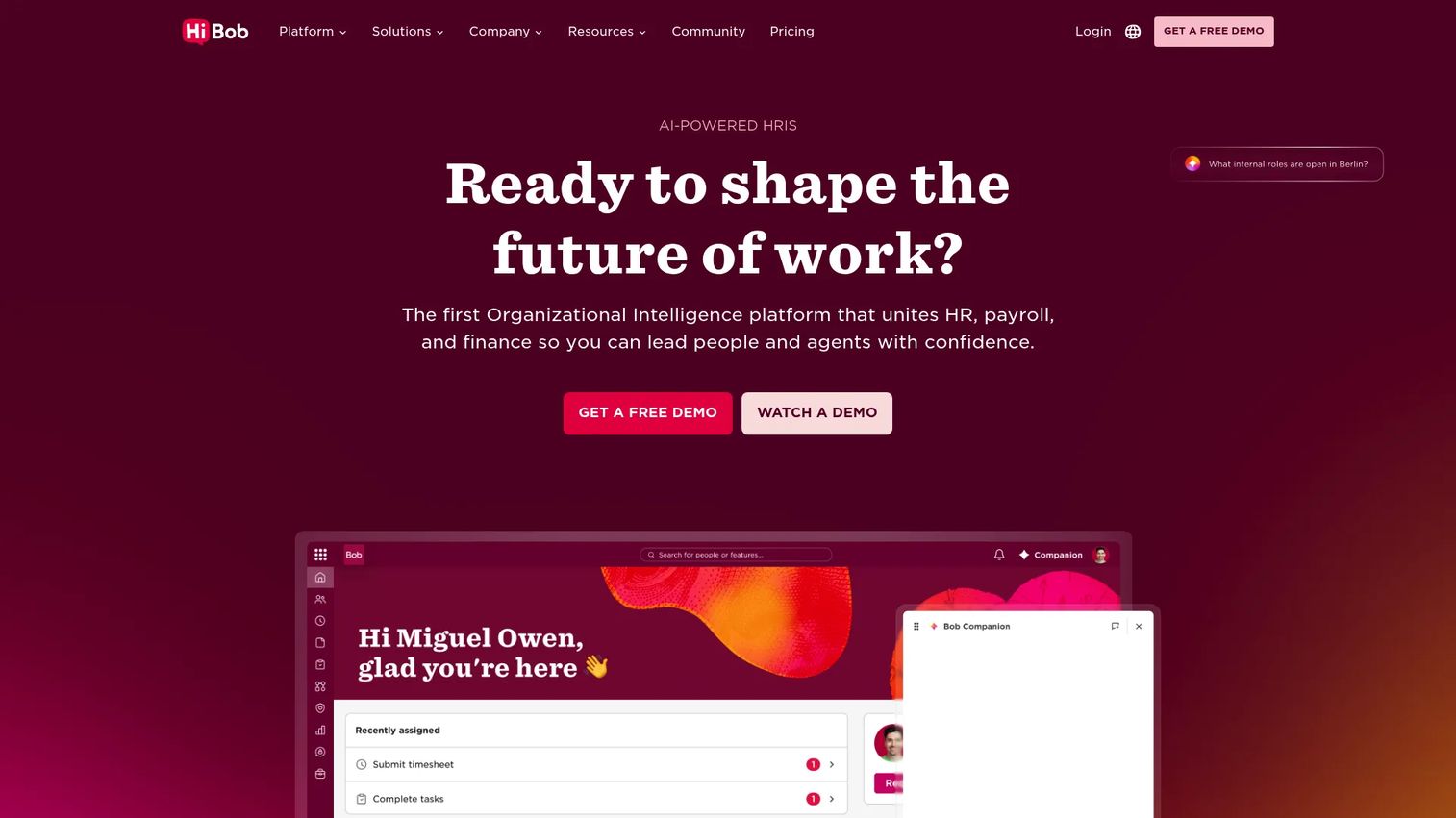
HiBob is a modern HRIS and people operations platform for mid-market, culture-focused, and distributed teams. It covers employee records, onboarding, compensation management, time off, and people analytics, with engagement tools layered on top. HiBob positions itself as more than a database: The platform surfaces workforce trends that help founders and People leaders make faster decisions.
Best for: Mid-market SaaS companies that want HRIS depth combined with employee engagement and people analytics.
Key features
- Employee records and organizational data management
- Onboarding and offboarding workflows
- People analytics and workforce reporting
- Compensation management tools
- Time off, attendance, and employee self-service
Why choose HiBob: Good fit when HR wants visibility into people trends, like engagement, compensation equity, and attrition signals, without buying a separate analytics tool. Verify payroll coverage and regional integrations for your specific hiring countries before shortlisting.
HiBob pricing: Pricing is customized based on company size, modules, and services. Contact HiBob for a quote.
G2 rating: 4.5/5
9. Personio
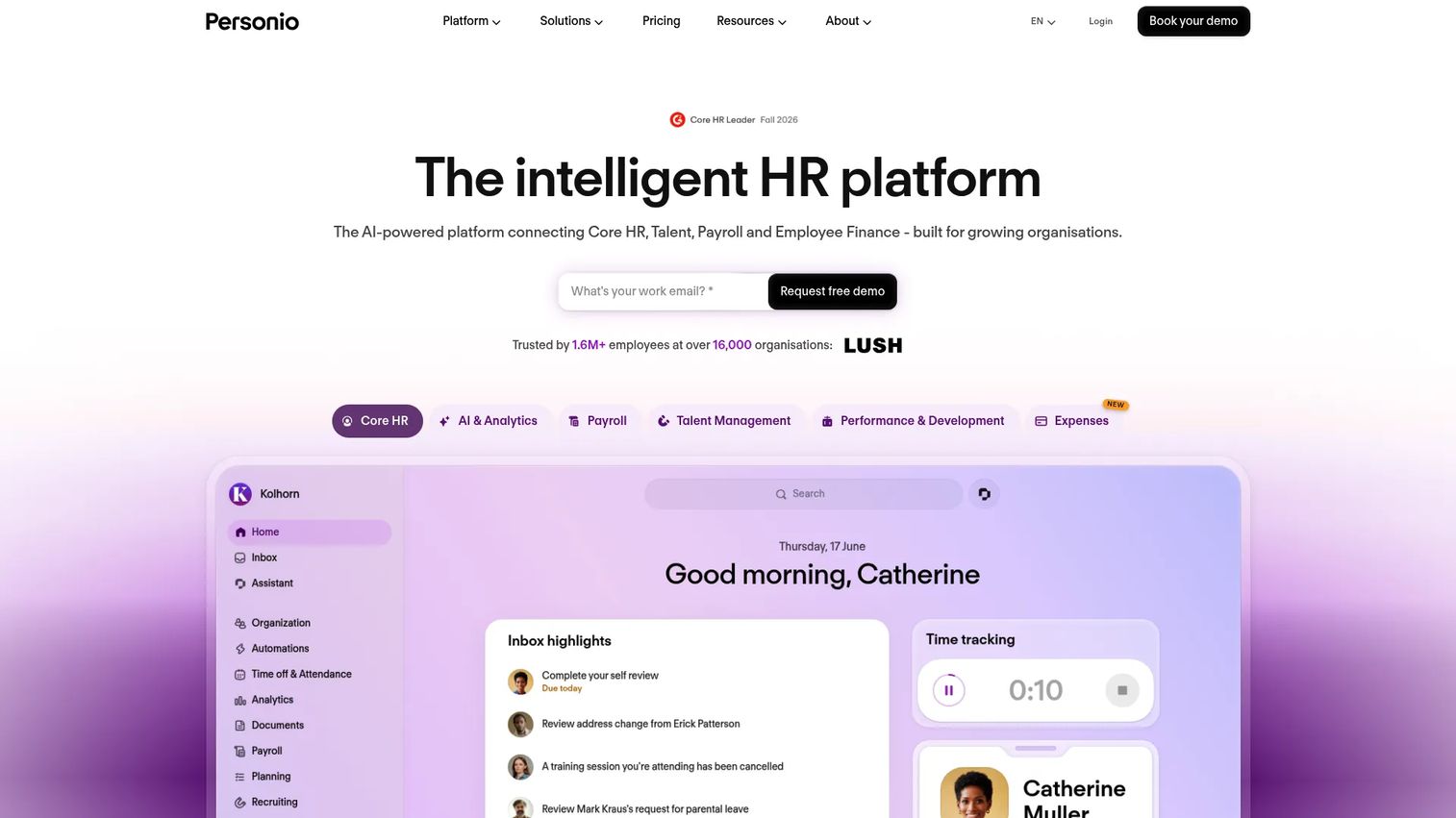
Personio is an HR platform built for European small and mid-sized companies. It covers employee records, absence management, workflow automation, recruiting, payroll preparation, and document management, with more than 200 integrations. Personio's compliance fit for EU and UK markets and its coverage of European employment law nuances make it the natural starting point for many European-headquartered SaaS teams.
Best for: European teams that need HR workflows, local compliance fit, and payroll preparation in one platform.
Key features
- Employee records and HR data management
- Absence management with policy configuration
- Workflow automation for approvals and HR processes
- Recruiting and onboarding tools
- Payroll preparation and 200-plus integrations
Why choose Personio: Strong fit for EU and UK-based teams that need one operating layer for HR processes across multiple countries. U.S.-centric SaaS teams without European headcount should check regional fit carefully before shortlisting.
Personio pricing: Core and Core Pro plans are priced per employee, with a personalized quote process.
G2 rating: 4.4/5
10. UKG Ready
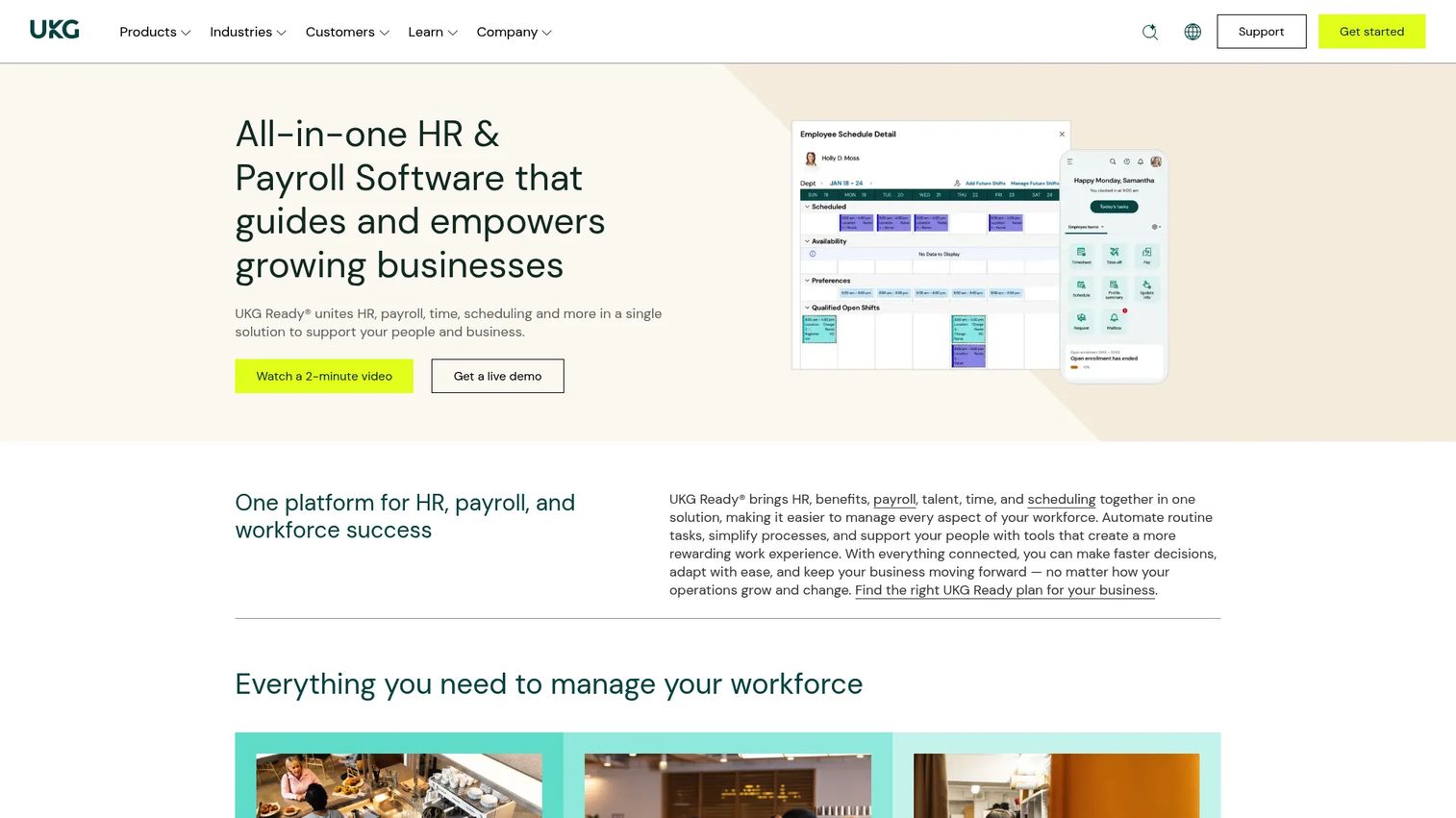
UKG Ready is an all-in-one HR, payroll, talent, time, and scheduling platform for small to midsize organizations. Its strengths are in workforce management depth, particularly scheduling, time tracking, and compliance tools for teams with hourly workers or complex shift patterns. UKG Ready also includes an AI assistant (Bryte) and mobile access.
Best for: Workforce-heavy organizations where attendance, scheduling, and labor compliance matter as much as employee records.
Key features
- Core HR and benefits administration
- Payroll processing with SmartCheck compliance review
- Time, attendance, and scheduling management
- Recruiting, performance, and learning tools
- Compliance reporting and workforce analytics
Why choose UKG Ready: Best fit when time tracking and scheduling are operational priorities, not afterthoughts. SaaS companies with mostly salaried, remote employees may find the workforce management depth more than they need. Cost is driven by modules, employee count, payroll scope, and scheduling complexity.
UKG Ready pricing: Four bundles are available (Start, Core, Plus, and Advanced), all requiring a personalized quote from UKG.
G2 rating: 4.4/5
11. SAP SuccessFactors
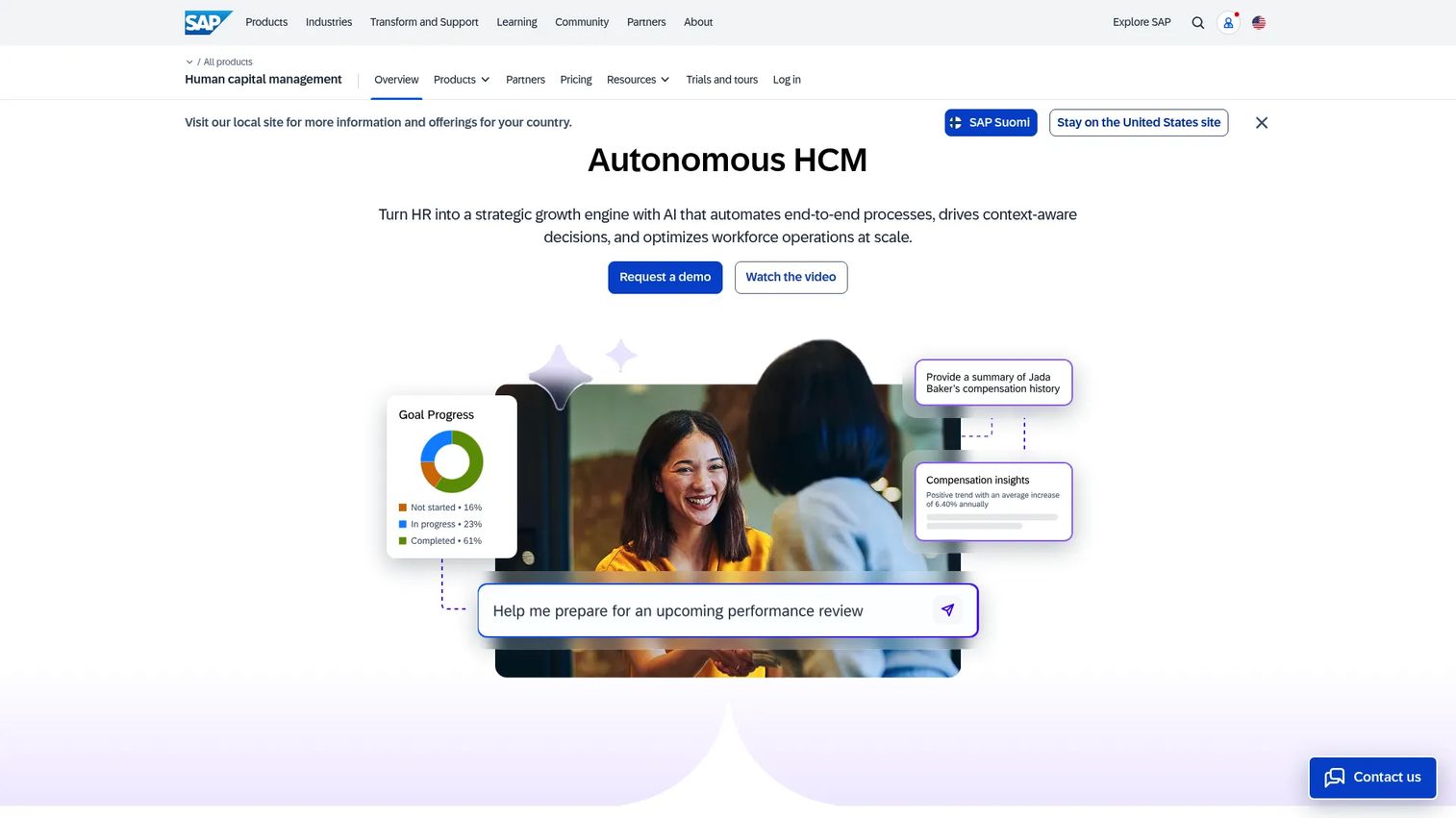
SAP SuccessFactors is a global enterprise HCM suite with core HR, payroll, HR service delivery, time management, talent management, learning, and compensation capabilities. It is designed for large and multinational organizations that need localized HR and payroll processes across many countries. Implementation by a certified SAP partner is required.
Best for: Global enterprises already invested in SAP infrastructure or planning an enterprise HR transformation at scale.
Key features
- Employee Central for core HR and global data
- Global payroll with country-specific compliance
- Time management and absence workflows
- HR service delivery and document management
- Talent suite covering learning, performance, and succession
Why choose SAP SuccessFactors: Right choice for enterprises with large, globally distributed workforces that need localized payroll, compliance, and talent processes in one platform. For most Series B SaaS teams, this is a future-state option, not a current-stage fit.
SAP SuccessFactors pricing: SAP publishes component-level pricing. Compensation Management starts at $1.96 per user per month; Employee Central Payroll starts at $11 per user per month. Full suite cost depends on modules, regions, and implementation scope.
G2 rating: 4.1/5
12. Keka
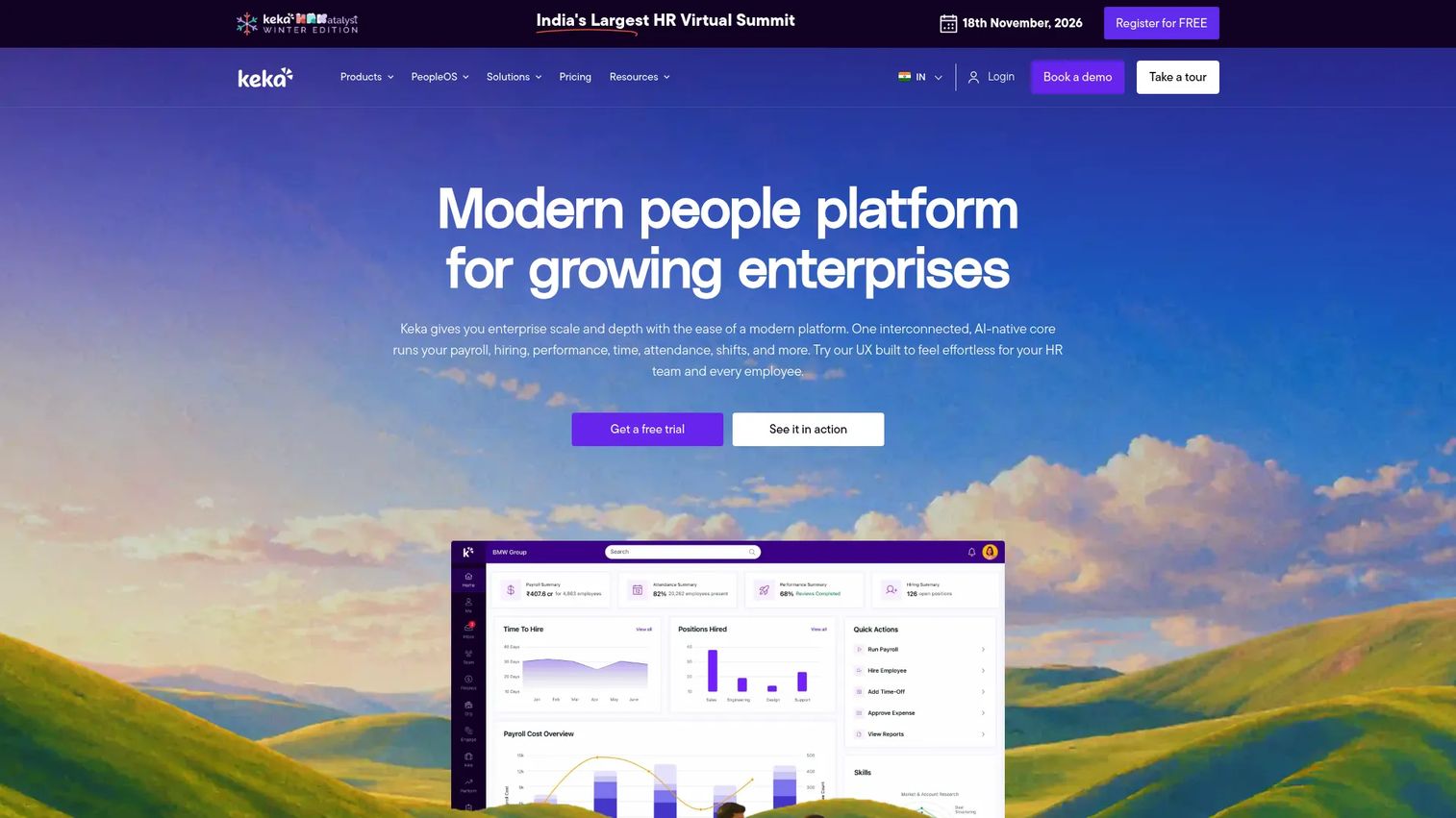
Keka is an HR, payroll, attendance, and performance platform popular with India-based teams. It covers employee profiles, payroll, leave and attendance management, performance reviews, project timesheets, and employee self-service. Keka also offers a professional services automation module for teams that track project-level resource utilization.
Best for: India-based companies that need HR, payroll, and attendance management in a single platform.
Key features
- Core HR and employee profiles
- Payroll processing and expense management
- Attendance and leave management
- Performance management and OKRs
- Timesheets and project resource tracking
Why choose Keka: Strong fit when payroll and attendance rules central to India's employment context are non-negotiable requirements. Global teams should verify country coverage and integration availability outside India before shortlisting.
Keka pricing: Foundation, Strength, Growth, and Pro plans are available, each with a free trial.
G2 rating: 4.4/5
13. Humaans
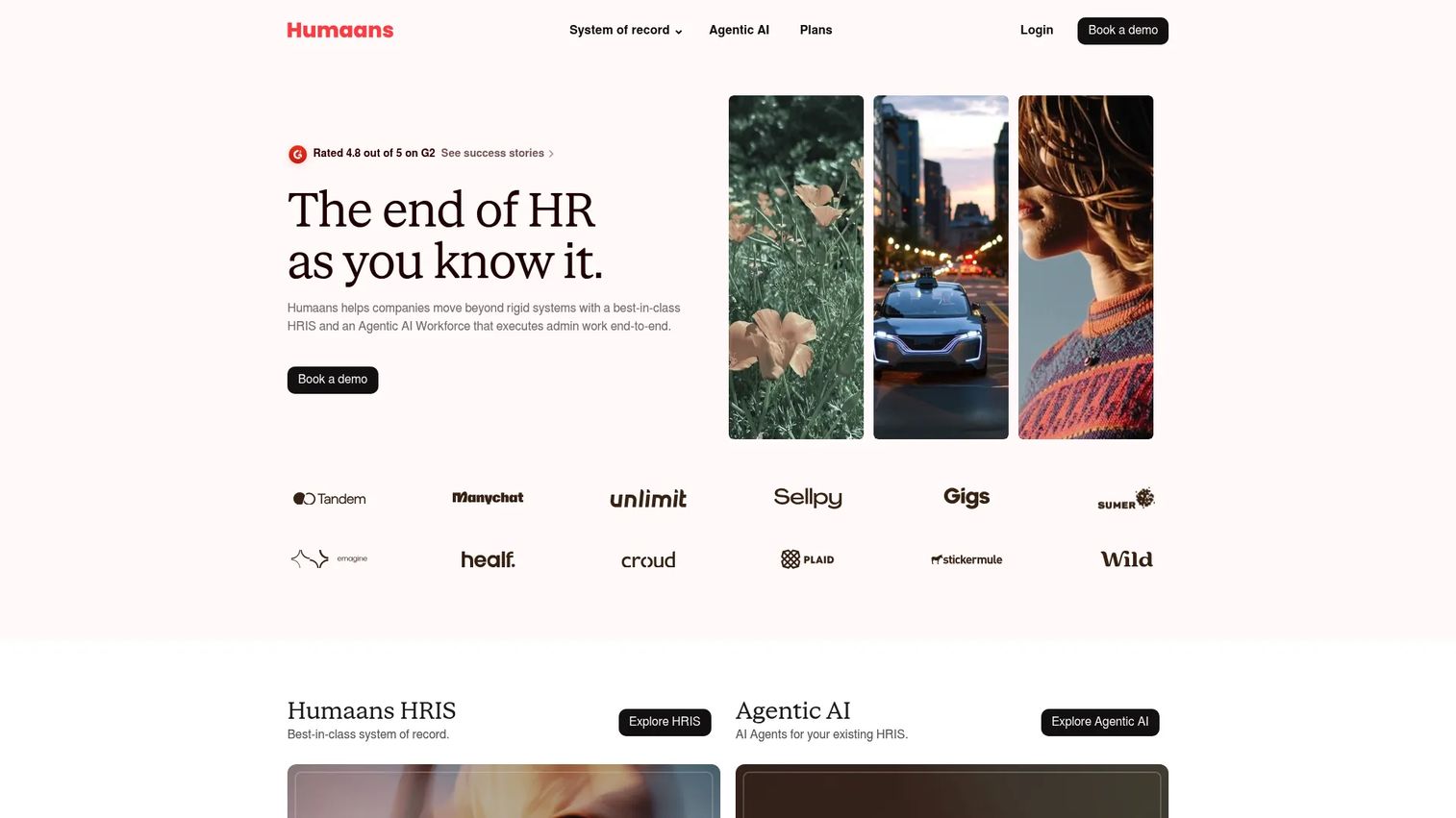
Humaans is a modern, AI-powered HRIS for fast-growing companies that want clean employee data, workflow automation, onboarding, integrations, and People Ops automation without the overhead of a heavy HR suite. It is built to serve as a clean integration layer, connecting to payroll, identity, and other tools the team already uses. The platform covers Growth, Enterprise, and Athena tiers.
Best for: Tech startups and scaleups that want a modern HRIS foundation with strong integration support and minimal administrative overhead.
Key features
- People directory and employee data management
- Document management and absence tracking
- Onboarding, offboarding, and workflow automation
- HR analytics and automated reporting
- Integrations and API access for custom connectivity
Why choose Humaans: Strong fit for technology-forward teams that want a clean, maintainable HRIS without locking into a full HCM suite. Companies that need native payroll processing built directly into the platform should verify coverage, as payroll relies on integrations rather than native processing.
Humaans pricing: Growth, Enterprise, and Athena plans are available. All require contacting sales for pricing details.
G2 rating: 4.8/5
14. greytHR
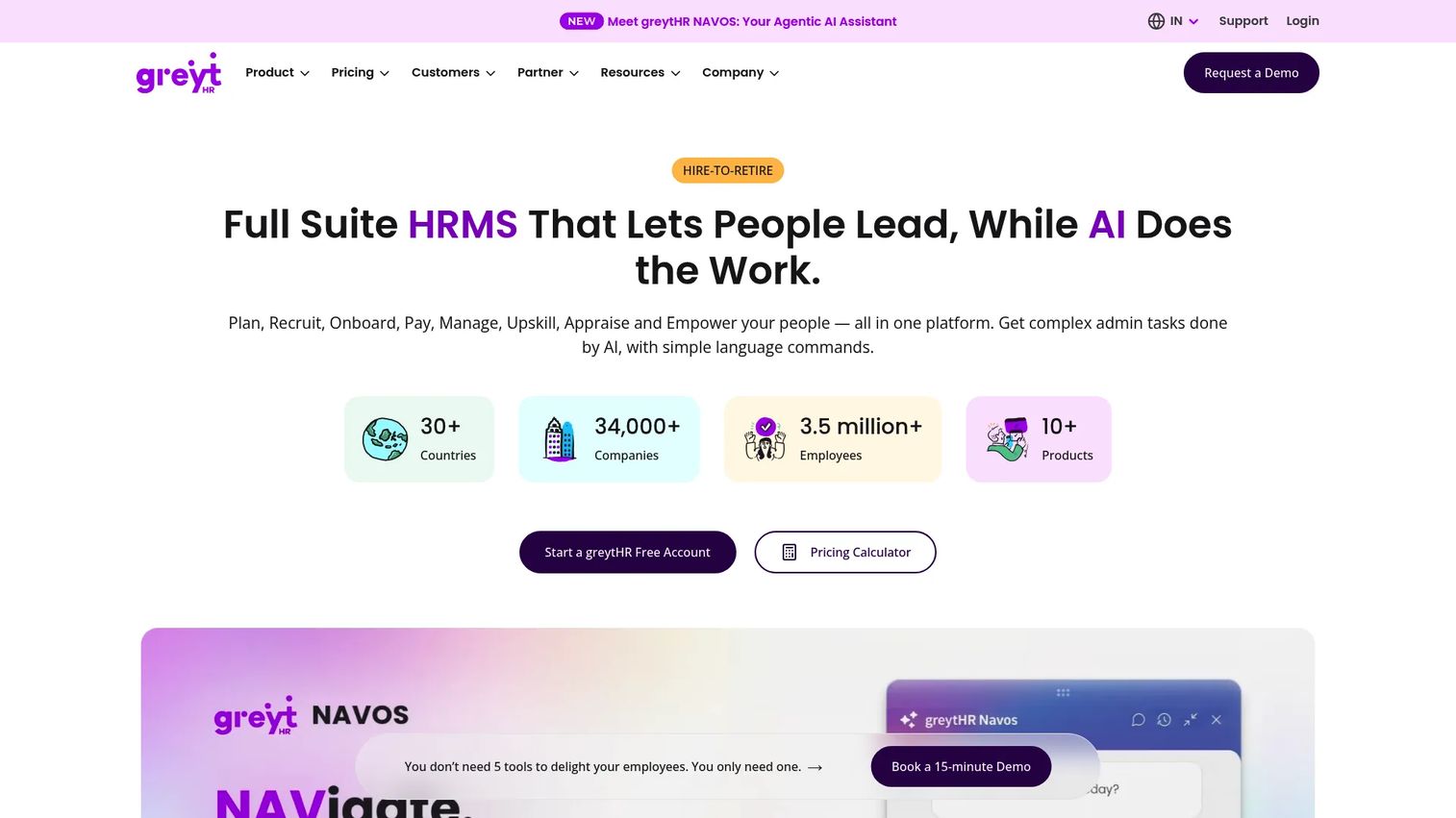
greytHR is an AI-first HR and payroll platform for India-based teams, with a focus on payroll processing, statutory compliance, leave and attendance management, and employee self-service. The platform includes an AI assistant (greytHR NAVOS) and covers the full employee lifecycle from onboarding to exit. A 7-day free trial is available.
Best for: India-based SMBs that need practical payroll, statutory compliance, and attendance management with accessible pricing.
Key features
- Payroll processing and statutory compliance
- Leave and attendance management
- Employee self-service portal (web and mobile)
- Employee onboarding and exit management
- Performance management and expense tracking
Why choose greytHR: Good fit when payroll and compliance for India's regulatory environment are the primary buying criteria. Teams outside India should verify regional support before moving forward.
greytHR pricing: Essential plan starts at ₹2,495 per month (includes 50 employees; ₹45 per employee above 50). Growth plan is ₹4,495 per month (includes 50 employees; ₹85 per employee above 50). Premium is custom-priced. A 7-day free trial is available.
G2 rating: 4.4/5
15. NEOGOV HRIS
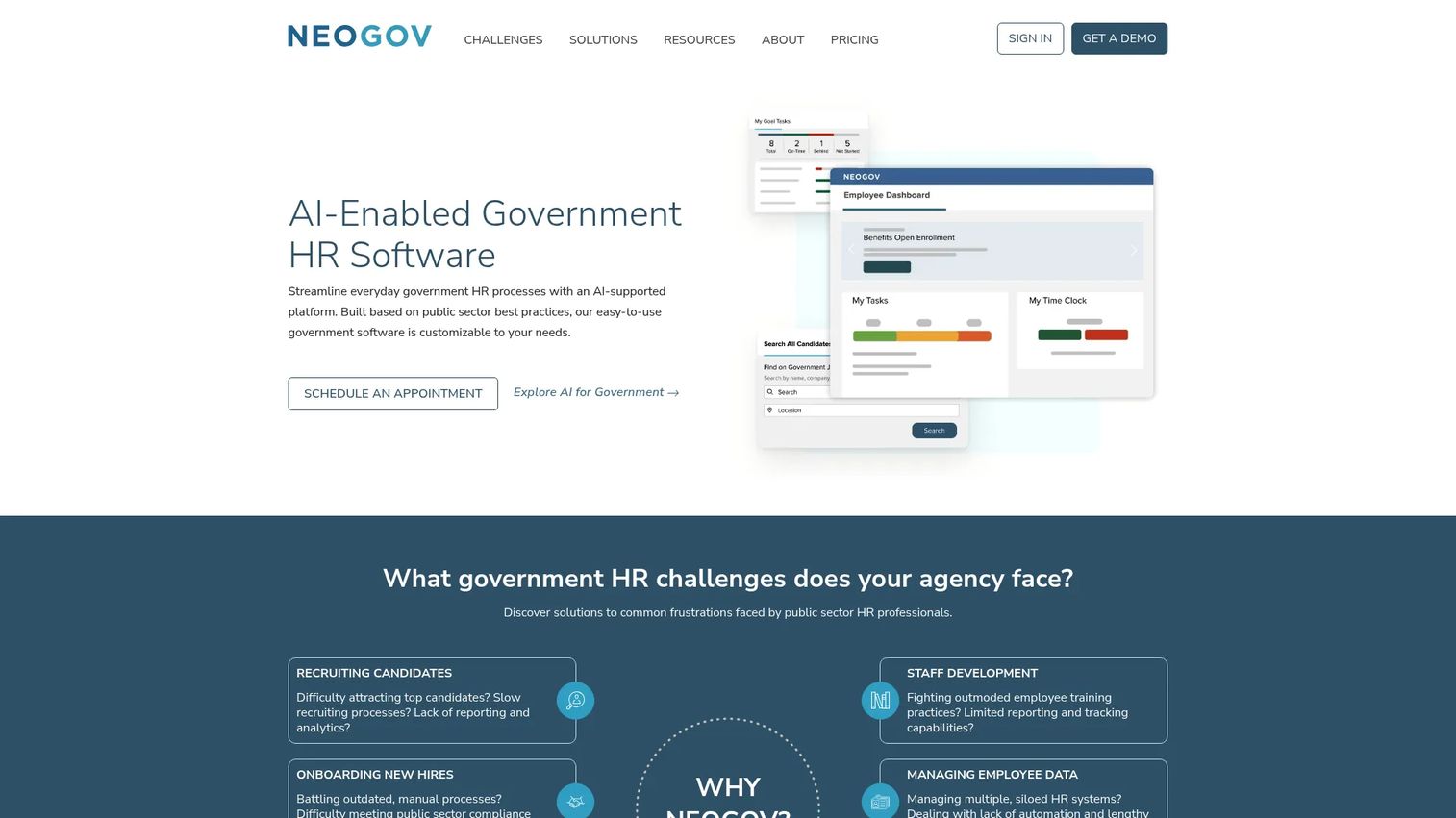
NEOGOV is a core HR and payroll platform built specifically for public-sector agencies. It covers centralized employee records, benefits administration, time and attendance tracking, payroll processing, compliance reporting, and employee self-service for government-specific HR workflows. The platform integrates with other NEOGOV modules for recruiting and onboarding.
Best for: Government agencies and public-sector HR teams with government-specific compliance and workflow requirements.
Key features
- Core HR and centralized employee records
- Benefits administration and open enrollment
- Time and attendance tracking
- Payroll processing and compliance reporting
- Employee self-service for pay stubs, benefits, and time off
Why choose NEOGOV HRIS: Right fit when public-sector HR requirements, like EEO reporting structures, civil service rules, and government approval workflows, shape every buying decision. Private-sector SaaS companies will find the commercial HRIS options on this list a better fit.
NEOGOV HRIS pricing: Pricing is customized based on selected modules, agency size, integrations, and implementation scope. Contact NEOGOV for a quote.
Considerations when choosing core HR software
System of record quality
The value of a core HR system is proportional to how much your team trusts the data in it. Evaluate whether employee profiles include full job and compensation history, manager relationships, documents, and a clean audit trail. If the system can't answer "who approved this salary change and when," it won't pass a board-level people review or due diligence request.
Payroll and benefits fit
Payroll-native tools are not automatically better than HRIS-first tools with payroll integrations. Verify payroll coverage by country, pay schedule complexity, benefits carrier connections, deduction management, and approval workflows. A payroll integration that breaks when you add a new state or a new benefit carrier will cost more in ops time than the subscription saves.
Implementation effort
Migration is the most underestimated cost in an HR system purchase. Count the data cleanup hours, the historical record import, the workflow configuration, and the employee rollout. For a 70-person company switching from spreadsheets, budget at least four to six weeks of ops time regardless of how fast the vendor says go-live happens.
Compliance and reporting
Compliance needs vary by country, state, headcount, industry, and worker classification. Check whether the platform covers audit logs, ACA compliance, EEO reporting, document retention rules, leave policy management, and regional statutory requirements for your actual hiring footprint. Don't buy for where you are today if you're hiring across two new states or countries in the next twelve months.
Tool consolidation versus specialization
Fewer systems reduce admin, but a broad platform may lack depth in a critical workflow. Map which tools the core HR platform replaces in the first quarter: Standalone payroll, an applicant tracking system, a time-off tool, or a separate benefits portal. The system earns its place only if the consolidation reduces manual work, not just the number of subscriptions.
Conclusion
The right core HR system depends on where you're hiring, how complex your payroll is, and what your People team can run without ongoing founder involvement.
For scaling SaaS teams that want HR connected to IT and finance, Rippling is the strongest consolidation bet. BambooHR and Humaans suit lean teams adopting their first real HRIS. Gusto is the fastest starting point for small teams prioritizing payroll. Paylocity and ADP Workforce Now go deeper on U.S. payroll reliability. Deel HR handles distributed global hiring. Workday HCM, SAP SuccessFactors, and UKG Ready serve enterprise complexity. NEOGOV HRIS is purpose-built for public-sector agencies. Keka and greytHR cover India-based payroll and compliance.
The practical next step: Shortlist three tools based on your hiring geography, payroll complexity, and headcount. Map which existing tools each platform replaces. Run a migration-readiness check, specifically how clean your current employee data is, before booking vendor demos. The system that earns its place in a Series B stack is one your new Head of People can trust and run without routing decisions back to you.
Start your journey with Guideflow today!
FAQs
Core HR software is the system of record for employee data, HR workflows, documents, payroll inputs, benefits information, and compliance reporting. It centralizes employee profiles, job history, compensation records, time off, and HR documents so that any authorized person can pull accurate data without chasing it across spreadsheets and payroll exports.
HRIS (human resources information system) is the broader system category that includes core HR capabilities. In practice, the terms overlap heavily, and most vendors use them interchangeably. When a vendor calls a product "HRIS," it typically includes core HR plus additional modules like recruiting, reporting, or benefits tracking.
HCM (human capital management) covers a wider talent and workforce suite, including recruiting, performance management, learning, compensation planning, workforce scheduling, and long-range analytics. Core HR is the data foundation underneath. Most enterprise HCM platforms include core HR as a module; most core HR systems don't include the full HCM talent layer.
Some core HR platforms include native payroll processing, while others integrate with separate payroll systems. Gusto and ADP Workforce Now include payroll natively. BambooHR and Humaans integrate with external payroll providers. Verify payroll coverage by country, pay schedule type, benefit deductions, and tax filing requirements for your specific operating model before committing.
The answer depends on headcount, geography, and payroll complexity. Rippling suits teams that want HR, IT, and finance workflows connected. BambooHR and Humaans work for lean teams adopting a first real HRIS. Gusto fits small teams prioritizing fast payroll setup. Deel HR handles cross-border hiring and contractor management. HiBob suits mid-market teams that want people analytics alongside core HRIS features.
Cost varies based on employee count, selected modules, payroll scope, country coverage, implementation requirements, and contract terms. Gusto starts at $49 per month plus $6 per person per month. BambooHR starts at $10.25 per employee per month. Deel HR Core starts at $5 per employee per month. Platforms like Workday HCM, Paylocity, and UKG Ready price by quote. Compare total first-year cost, including implementation and any add-ons, not only the base subscription rate.
For most SaaS teams, the trigger happens between 30 and 75 employees. Specifically, when employee data, payroll changes, time-off tracking, onboarding tasks, and compliance records each require repeated manual work to stay current, the operational cost of not having a system exceeds the cost of buying one. Board-level requests for clean headcount and cost data are often the forcing function.
The highest-priority connections are payroll, benefits administration, and identity management, since these involve data that changes frequently and must stay synchronized. Beyond those, verify integration depth with your accounting platform, your applicant tracking system, document storage, and analytics tools. Check whether integrations are bidirectional and whether they sync automatically or require manual triggers, since the difference matters significantly at the 100-employee mark.