Inventory changes daily. Offers expire by trim level. Leads pile up across six different inboxes. Then leadership asks which campaign moved vehicles, created appointments, and produced gross profit.
Most dealerships do not have a clean answer. The CRM shows one number, the ad platform shows another, and the texting tool shows a third. Connecting those systems to a single revenue story is where dealership marketing breaks down.
According to NADA Data (2025), 74.9% of U.S. franchised auto dealers' advertising spend went to digital media in 2025. That shift creates real pressure to prove that digital spend actually moves cars. A Cox Automotive Car Buyer Journey Study (2025) found that 75% of vehicle buyers used third-party websites during their shopping journey. Shoppers are already online. The question is whether your campaigns meet them with the right vehicle, offer, and message at the right moment.
The right automotive marketing platform closes that gap. It connects inventory signals, customer data, campaign delivery, and lead follow-up so your team can make decisions from one reliable picture rather than four disconnected ones.
What's inside
This guide is for dealership marketing managers, dealer-group growth teams, and agency operators accountable for leads, showroom visits, and attributable revenue. Nine platforms were evaluated against four criteria:
- Inventory and customer-data integration depth
- Campaign execution across paid, email, and SMS channels
- Lead response and communication workflows
- Attribution from campaign source to appointment, sale, and revenue
The list focuses on tools built for automotive workflows, not generic SEO or design utilities.
TL;DR
- Best for dealership data and lifecycle activation: Fullpath. Best fit for teams needing inventory-aware advertising, audience activation, and first-party data coordination across campaigns.
- Best for lead response and reputation management: Podium. Strong for dealerships prioritizing texting, reviews, and consolidated customer communication.
- Best for automotive CRM-led marketing: DealerSocket. Best for teams that want lead workflows and sales processes connected directly to a CRM.
- Best for VIN-level advertising and dealer-group management: BuyerBridge. Built for agencies and multi-location groups managing inventory feeds and multichannel campaigns.
- Best for visual vehicle merchandising: Spyne. Best for dealerships that need listing-ready vehicle imagery and creative assets at scale.
What is automotive marketing software?
Automotive marketing software is a category of dealership technology that uses customer, inventory, campaign, and lead data to attract shoppers, personalize outreach, manage advertising, and measure sales outcomes.
Generic marketing automation platforms can run email and pull basic reporting. Automotive marketing software goes further. It accounts for rapid inventory turnover, OEM incentive cycles, CRM and DMS data feeds, appointment workflows, and vehicle-specific attribution. Those constraints are not optional add-ons. They are the operating environment.
Core jobs automotive marketing software handles
- Customer-data unification across CRM, DMS, website, and campaign systems
- Audience segmentation by ownership history, equity position, service behavior, and browsing activity
- Inventory-aware advertising tied to VINs, price changes, and aging units
- Email and SMS automation for leads, customers, and service-lane audiences
- Reputation management, web chat, and review-request workflows
- Lead routing and speed-to-response automation
- Dealer website optimization, VDP conversion, and digital retail experiences
- Marketing attribution from campaign source to appointment, sale, and vehicle revenue
Generic marketing automation vs automotive marketing software
| Capability | Generic automation | Automotive marketing software |
|---|---|---|
| Inventory feed integration | Rare | Core feature |
| VIN-level advertising | Not supported | Standard |
| DMS and CRM data sync | Limited | Designed for this |
| Appointment and sale attribution | Manual workarounds | Built-in |
| OEM incentive alignment | Generic templates | Automotive-specific |
What success looks like
- Fewer stale campaigns after inventory or incentive changes
- Faster first response to inbound sales and service leads
- More attributable appointments from paid and lifecycle campaigns
- Reduced manual coordination across rooftops
- Clear visibility into which vehicles, channels, and audiences produce vehicle sales
When to use automotive marketing software
Move aging or priority inventory
VIN-level ads, price-drop campaigns, and vehicle-specific landing pages let you direct spend toward units that need attention. This only works when inventory data refreshes frequently enough to stay current. A campaign promoting a vehicle already sold costs money and trust.
Automate lead and owner communication
Triggered email and SMS can handle new leads, abandoned shoppers, service reminders, equity opportunities, and reactivation outreach. The key condition: This should connect with your CRM rather than create a parallel follow-up queue that nobody monitors consistently.
Prove which campaigns create appointments and sales
Attribution beyond clicks and form fills is the hardest problem in dealership marketing. The useful path connects campaign source, lead, appointment, and vehicle sale. Ask every platform you evaluate how it handles offline conversion matching and what data it needs from your CRM or DMS to produce that path.
Automotive marketing software comparison
No single platform covers every dealership operating model. A single-rooftop store with a two-person marketing team has different needs than a 40-store dealer group running campaigns across four states. Use the table below to identify the tools closest to your immediate bottleneck, then go deep on those entries.
| # | Product | Best for | Key differentiator | Pricing | G2 rating |
|---|---|---|---|---|---|
| 1 | Fullpath | Unified data, AI marketing, and lifecycle activation | Customer data platform with omnichannel automation | From $299/month | 4.9/5 |
| 2 | Podium | Lead response, reviews, and customer messaging | AI-powered shared inbox across calls, texts, and chat | Contact sales | 4.5/5 |
| 3 | DealerSocket | CRM-led automotive lead management | Integrated CRM, DMS, inventory, and digital retailing | Contact sales | 3.8/5 |
| 4 | Spyne | Vehicle imagery and listing-ready creative | AI-powered vehicle photography and merchandising | From $8/vehicle | 4.6/5 |
| 5 | Dealer Inspire | Dealership websites and digital retail | Personalized, data-driven dealer websites and VDPs | From $500/month | 4.5/5 |
| 6 | PureCars | Omnichannel automotive advertising | Customer data platform with AI audiences and campaign automation | Contact sales | 4.1/5 |
| 7 | Steer | Auto service shop communication and retention | Booking, texting, reviews, and campaign tools for repair shops | From $189/month | 4.4/5 |
| 8 | Kenect | Text-first dealership communication | AI scheduling, texting, reviews, and payment collection | Contact sales | 4.6/5 |
| 9 | BuyerBridge | Agency and dealer-group multichannel campaigns | Inventory-feed advertising across Meta, Google, TikTok, and more | Contact sales | 4.7/5 |
Best 9 automotive marketing software for dealerships
There is no universal winner here. Dealership data maturity, rooftop count, campaign ownership, inventory pressure, and CRM architecture all shape which platform delivers the most value. Each entry below names the operational scenario where that tool earns its place in the stack.
1. Fullpath
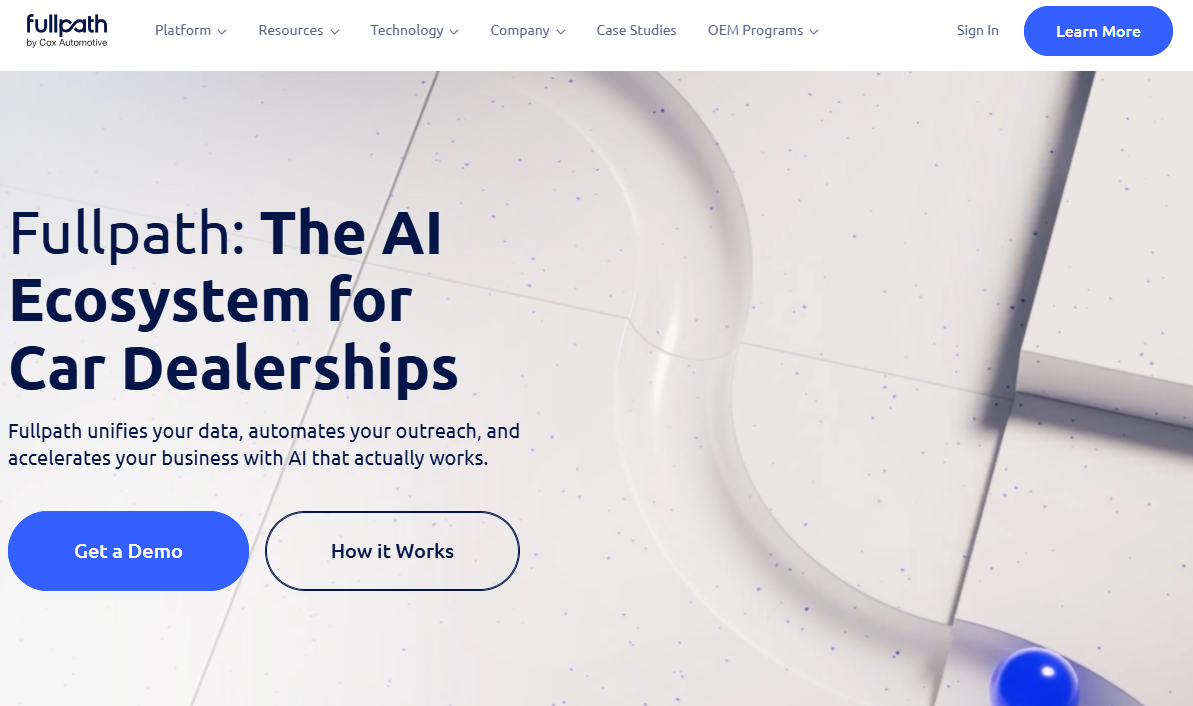
Fullpath is an AI-powered dealership marketing platform built around a customer data platform that unifies first-party data across the CRM, DMS, website, and ad channels. It runs omnichannel campaigns across email, SMS, search, social, display, and programmatic advertising, with inventory signals shaping who sees what and when. Marketing and showroom teams share the same shopper context, which reduces the gap between a campaign click and a meaningful sales conversation.
Best for: Dealer groups and single rooftops that need first-party data activation connected to inventory, campaigns, and sales activity.
Key features
- Customer data platform with identity resolution and unified shopper profiles
- AI-powered omnichannel marketing automation across email, SMS, search, social, and display
- VIN-level inventory advertising with real-time feed updates
- Agentic CRM with AI agents for lead handling, phone interactions, and task prioritization
- 200+ pre-built integrations and open API connectivity
Why choose Fullpath: Fullpath is the strongest fit when you want inventory signals, audience activation, and campaign delivery managed from a single data layer. It reduces the manual work of keeping campaigns current as inventory changes.
Fullpath pricing: Digital Advertising starts at $299 per month. VIN-focused advertising packages start at $1,100, and Search, Social, and Display packages begin at $1,900, neither of which includes ad budget. Contact Fullpath for current package availability.
G2 rating: 4.9/5
2. Podium
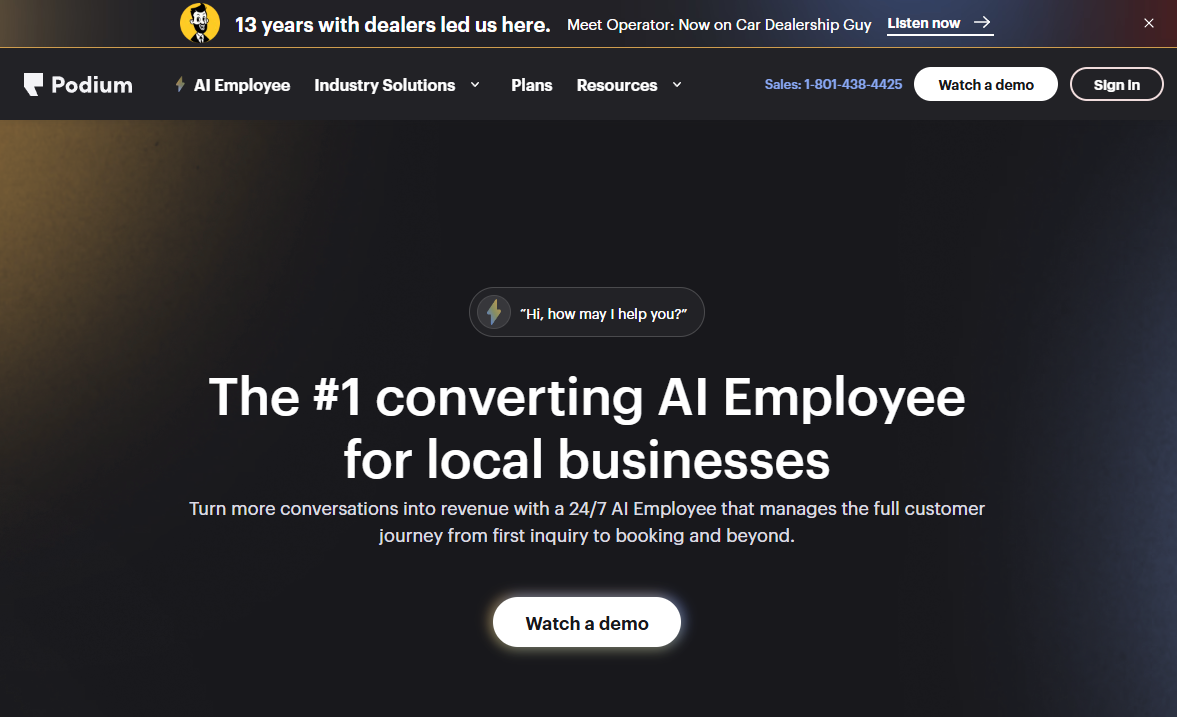
Podium is an AI-powered customer communication platform used by local businesses, including dealerships, for text messaging, web chat, reviews, lead capture, and payments. Response speed and conversation continuity often determine whether an inbound lead converts into an appointment. Podium consolidates those conversations into one shared inbox so nothing falls through because it arrived through the wrong channel.
Best for: Dealerships that want to consolidate webchat, customer texting, review requests, and payment conversations into one workspace.
Key features
- AI-powered shared inbox for calls, texts, chats, and social messages
- AI Employee for lead response, follow-up, and appointment booking
- Automated review request workflows
- Business phone system with call recording and transcription
- Payment request tools integrated into messaging threads
Why choose Podium: Choose Podium when missed calls, slow text responses, and low review volume are creating visible revenue leakage. It does not replace inventory advertising or a dealership CRM, but it fills the communication gap those tools leave open.
Podium pricing: Podium directs dealership buyers to contact sales for current pricing and packages. No standard plan price is listed on the website.
G2 rating: 4.5/5
3. DealerSocket
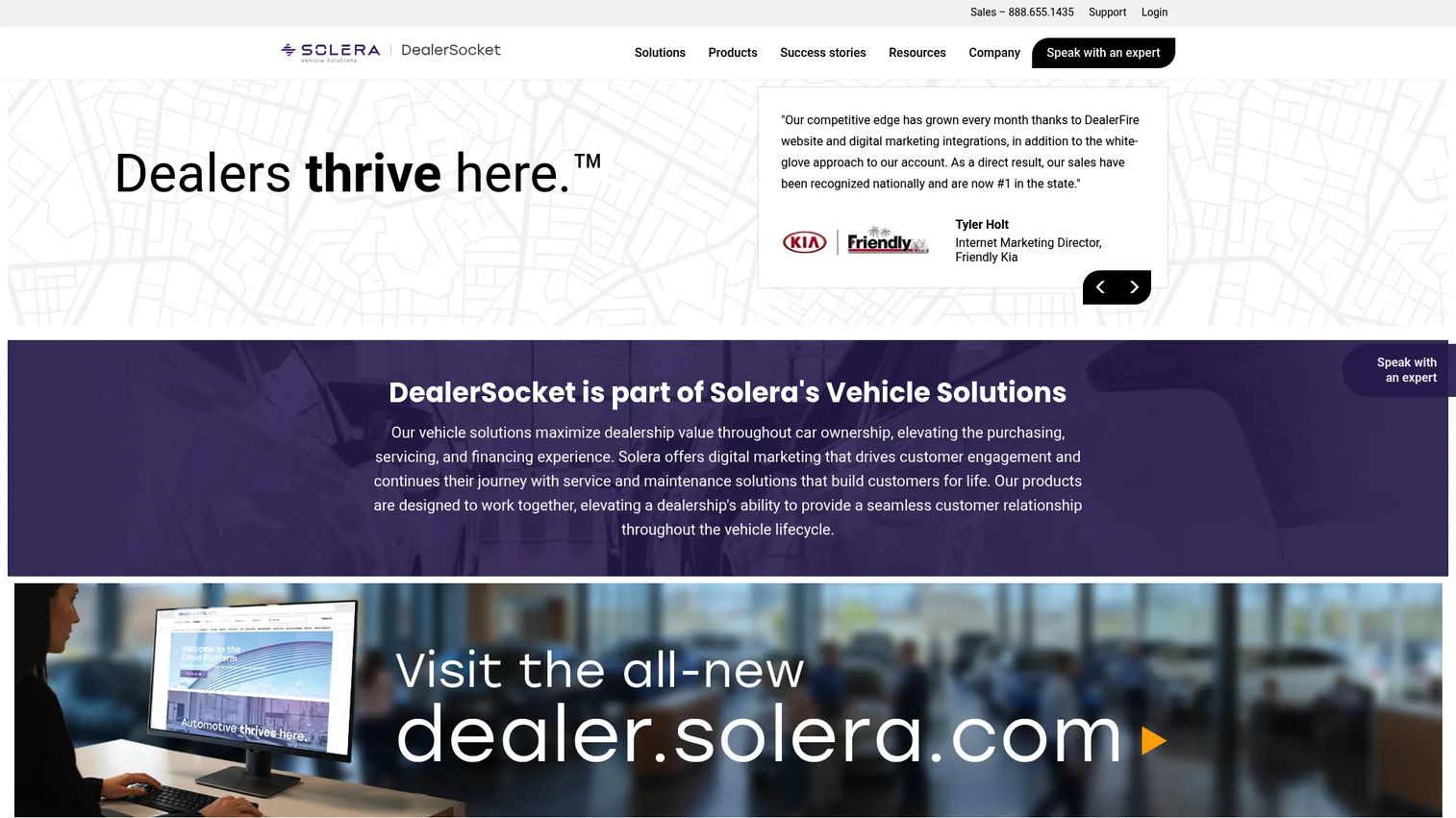
DealerSocket provides an integrated suite covering CRM, dealer management, inventory management, digital retailing, service, and credit for automotive dealerships. Its CRM includes sales, marketing, service, desking, communications, data mining, and digital retailing modules. Teams that need better lead governance and sales process consistency before adding more campaign channels will find this environment familiar.
Best for: Sales and marketing teams that want automotive lead management and follow-up operations inside a purpose-built dealership CRM.
Key features
- CRM with lead routing, sales follow-up, and data mining
- Inventory management with configurable workflows and multi-rooftop support
- Dealer management systems with accounting, sales, parts, and service
- Digital retailing and desking tools
- OEM and third-party integration support
Why choose DealerSocket: DealerSocket fits teams running a CRM-first operating model who need lead governance and process consistency before scaling campaign channels. It may not be the right standalone choice for teams primarily seeking a paid-media operating layer.
DealerSocket pricing: DealerSocket quotes pricing through a dealer consultation. Contact the sales team for current package details.
G2 rating: 3.8/5
4. Spyne
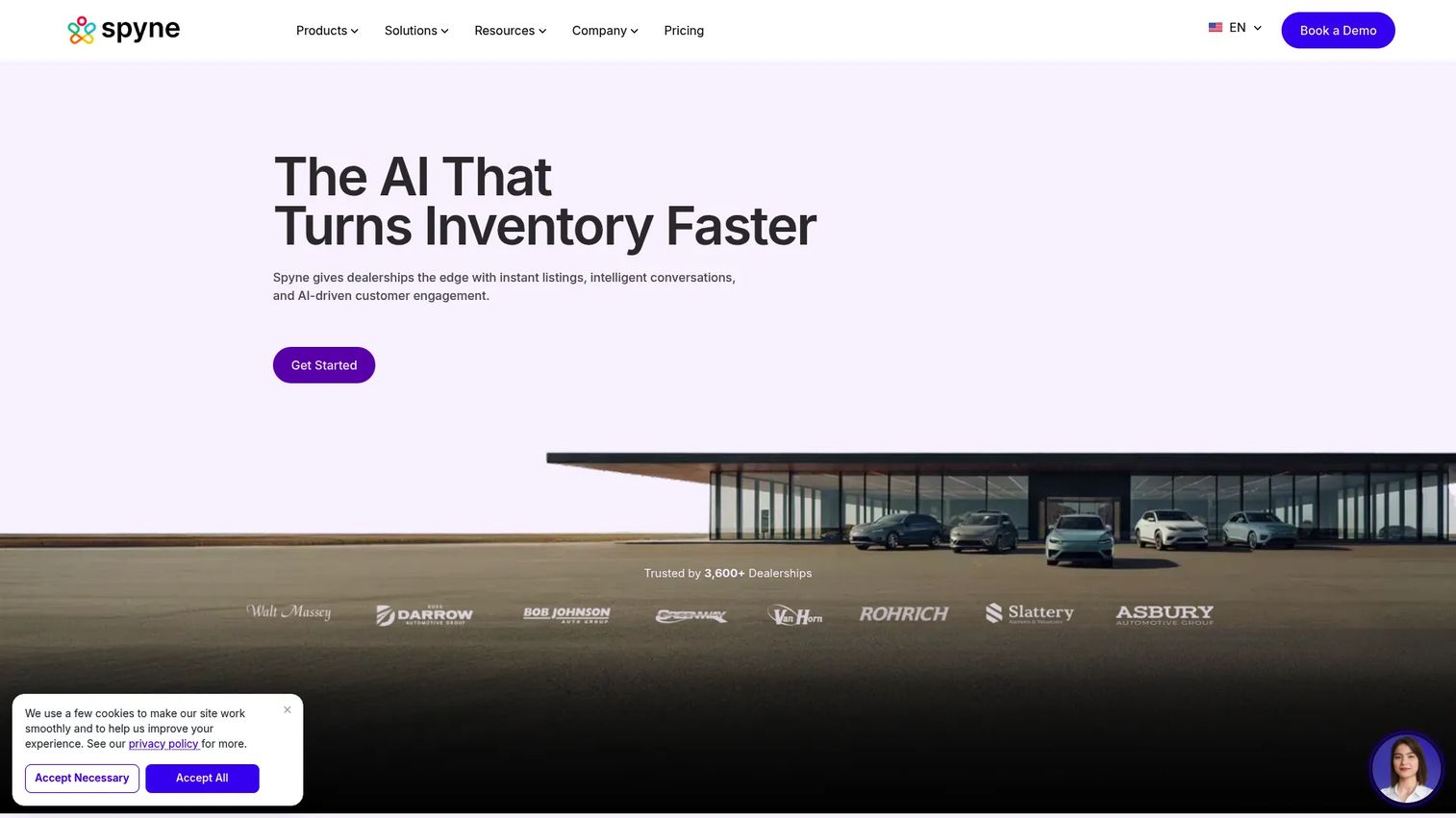
Spyne is an AI-native automotive retail technology platform focused on vehicle imagery, digital storefronts, and dealership sales engagement. Strong paid media cannot recover from weak listing visuals or inconsistent vehicle creative. Spyne addresses the merchandising problem directly: AI-guided capture, studio-grade image transformation, 360-degree spins, and automated license-plate masking run at dealership scale without requiring a photography crew.
Best for: Dealerships, marketplaces, and automotive retailers that need high-volume vehicle images and listing-ready creative assets.
Key features
- AI-powered vehicle photography and studio-grade image transformation
- 360-degree vehicle spins, feature videos, and immersive car tours
- AI-guided capture through Android and iOS SDKs
- Automated license-plate masking and intelligent image sequencing
- Conversational AI for lead capture, appointment scheduling, and follow-up
Why choose Spyne: Spyne is a compelling specialist when listings, VDP engagement, social creative, and ad assets are the bottleneck. It does not replace a CRM, attribution platform, or campaign management software, but it upgrades the inventory presentation layer those systems depend on.
Spyne pricing: Spyne lists 360-degree photography plans starting at $350 per month. Individual vehicle photography is priced at $8 per vehicle according to Spyne's own FAQ. Lite and Pro plan pricing is available through sales.
G2 rating: 4.6/5
5. Dealer Inspire
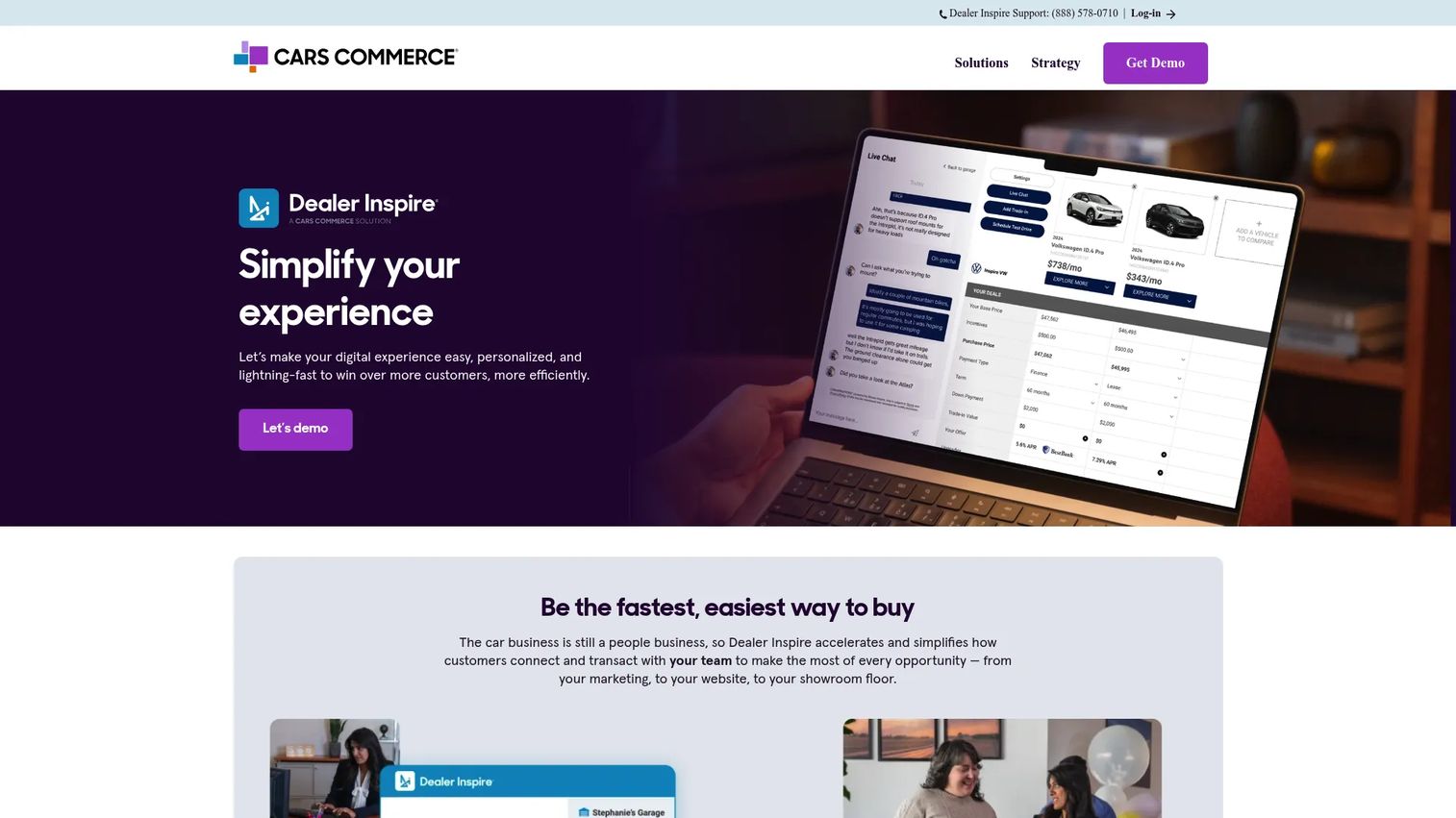
Dealer Inspire provides automotive dealerships with personalized, data-driven websites, digital retailing, messaging, marketing, and related technology. Campaign performance depends on the destination: Fast pages, usable VDPs, functional forms, and clear lead routing. Dealer Inspire treats the dealer website as a conversion asset rather than a digital brochure, integrating online retailing with payment estimates, trade-in tools, and deal collaboration.
Best for: Dealerships that need a purpose-built dealer website and digital retail experience connected to broader marketing activity.
Key features
- Personalized, data-driven dealer websites
- Vehicle detail page optimization and inventory search
- Online retailing with payment options, trade-ins, and approvals
- AI-powered inventory visibility for AI search results
- Chat, text messaging with generative AI assistance, and SMS marketing integration
Why choose Dealer Inspire: Choose this when the dealership's existing website creates conversion friction or cannot keep pace with inventory, offers, and mobile shopping behavior. It should complement, not replace, a CRM or lifecycle marketing platform.
Dealer Inspire pricing: The Dealer Inspire Unbound plan for independent dealers is $500 per month. OEM-program pricing is handled through custom proposals.
G2 rating: 4.5/5
6. PureCars
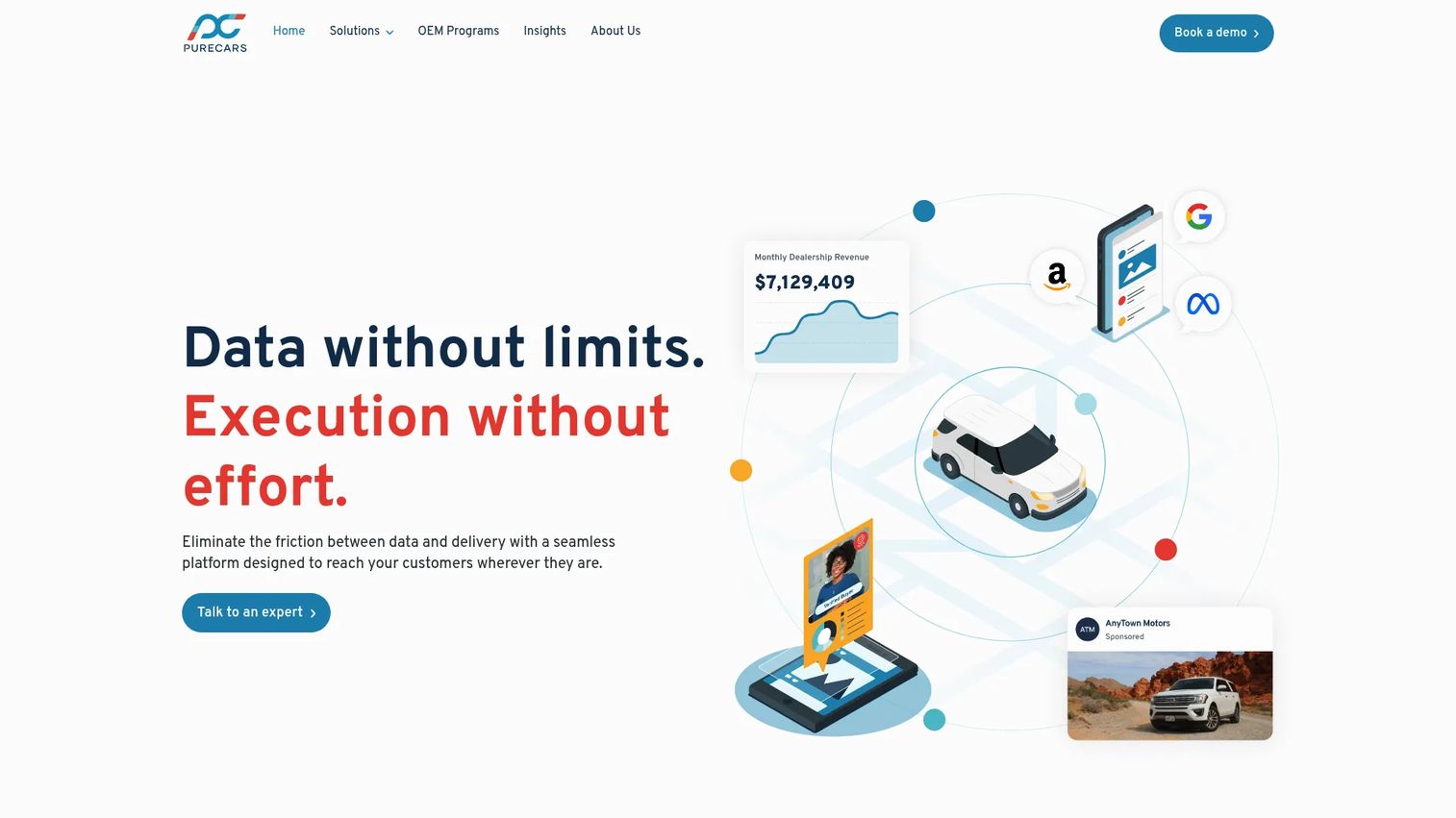
PureCars is an automotive marketing and customer data platform that consolidates dealership data, runs omnichannel advertising, and adds AI audiences and AI-powered customer conversations. Its scope spans search, social, display, video, OTT, direct mail, email, SMS, and BDC campaigns. Market insights and competitive benchmarking sit alongside campaign execution, which gives marketing teams more context when allocating budget across channels.
Best for: Automotive marketers who want dealer-focused paid-media operations, data-driven audience creation, and performance reporting under one platform.
Key features
- Customer data platform for consolidating and segmenting dealership data
- Omnichannel advertising across search, social, display, video, OTT, and direct mail
- AI Audiences for predictive targeting
- AI Conversations for automated sales and service communication
- Market insights, competitive benchmarking, and inventory analytics
Why choose PureCars: PureCars fits when paid media is the central growth engine and the team needs automotive context in campaign management. Validate how it integrates with your CRM and website provider before committing, since attribution depends on those connections.
PureCars pricing: PureCars prices through a dealer consultation process. Contact the sales team for current package details.
G2 rating: 4.1/5
7. Steer
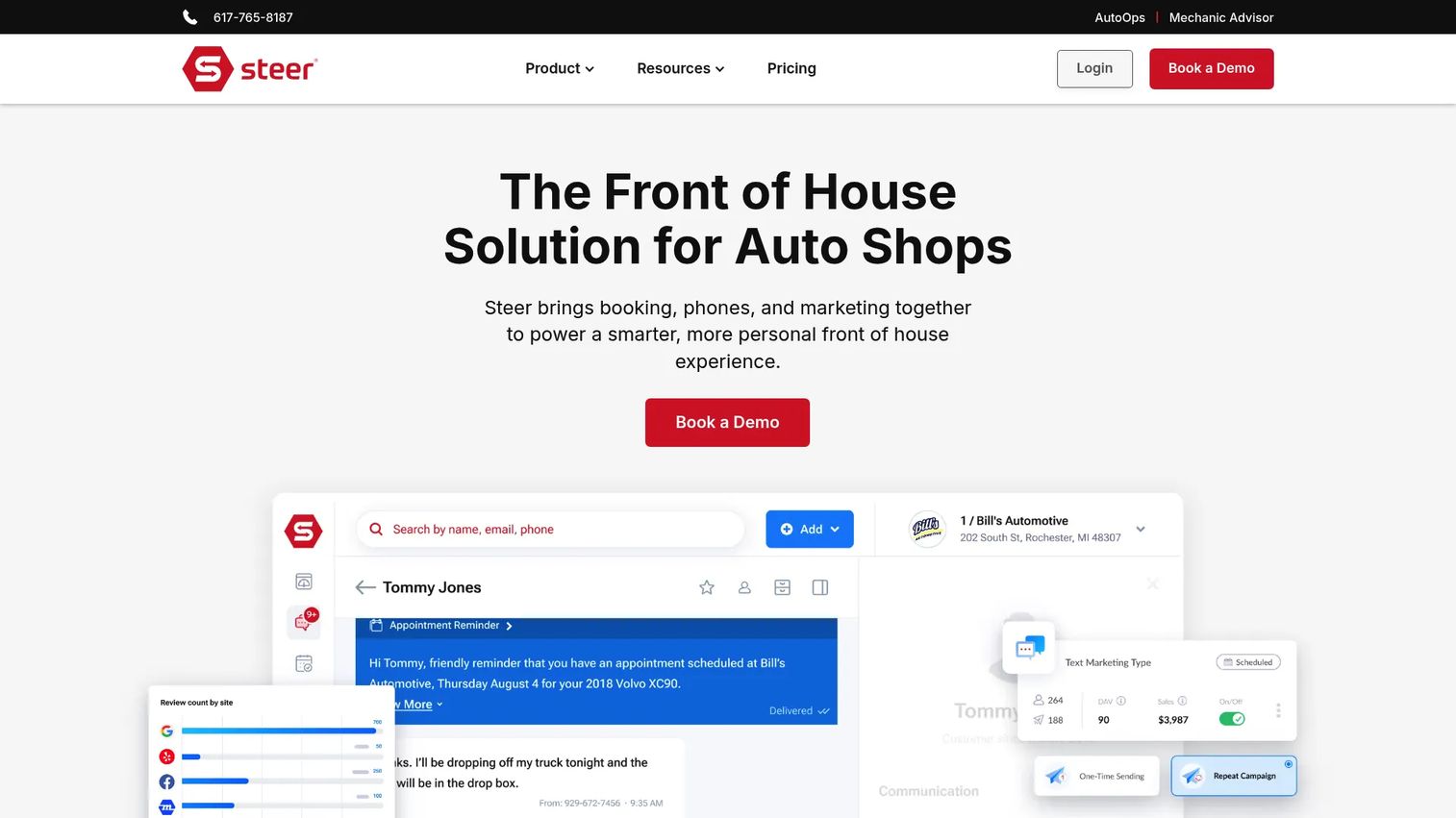
Steer is front-of-house software for auto repair shops combining online booking, two-way messaging, text and email campaigns, service reminders, reviews, call intelligence, and analytics. The platform is designed for independent and multi-location automotive service businesses. Its Opportunity Hub and CallerID+ help service teams identify and act on revenue opportunities without adding manual process steps.
Best for: Independent and multi-location auto repair, quick-lube, tire, and automotive service shops focused on customer communication, booking, and retention.
Key features
- Online booking and Reserve with Google integration
- Two-way messaging, text and email campaigns, and service reminders
- Review request automation and reputation management
- CallerID+ call intelligence and Opportunity Hub
- Website chat and analytics dashboards
Why choose Steer: Steer fits service-oriented automotive businesses when customer response, booking automation, and retention are the immediate problems. It is not designed as a full inventory advertising engine, so franchised new-car dealers should compare its scope against their specific communication and marketing stack before purchasing.
Steer pricing: Plans start at $189 per month for the Booking Tool, $479 per month for Essentials, and $629 per month for Ultimate. Enterprise pricing is custom. An AutoOps Pro add-on runs $80 per month per location.
G2 rating: 4.4/5
8. Kenect
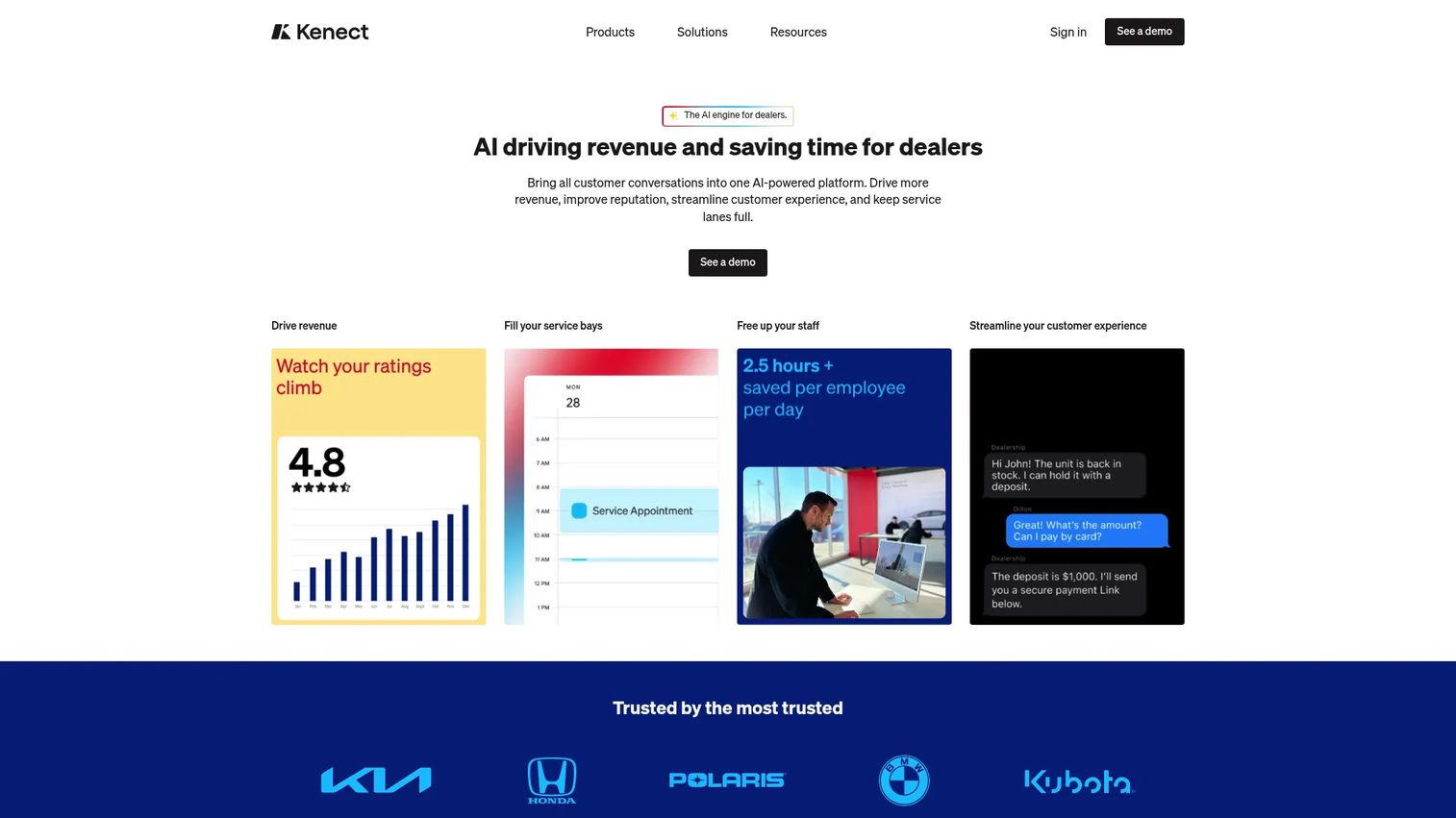
Kenect is an AI-powered customer communication platform for dealerships across automotive, equipment, RV, powersports, and marine segments. It combines text messaging, AI scheduling, an AI receptionist, payment collection, review generation, web chat, and DMS integrations into one platform. The speed-to-lead problem in dealership sales often comes down to communication tooling: Leads go cold because they arrive through channels sales teams do not monitor consistently.
Best for: Automotive, powersports, and equipment dealerships that want text-first communication across leads, customers, service teams, and review requests.
Key features
- AI scheduling and AI receptionist for inbound coverage
- Business text messaging and mass texting campaigns
- Payment collection integrated into messaging threads
- Review generation and reputation management
- Web chat, lead capture, and DMS integrations
Why choose Kenect: Kenect works well when teams need a consistent communication layer that sales, BDC, service, and marketing can all use without friction. Evaluate it alongside your existing CRM texting capabilities to avoid paying twice for similar functionality.
Kenect pricing: Contact Kenect for current pricing and package details.
G2 rating: 4.6/5
9. BuyerBridge
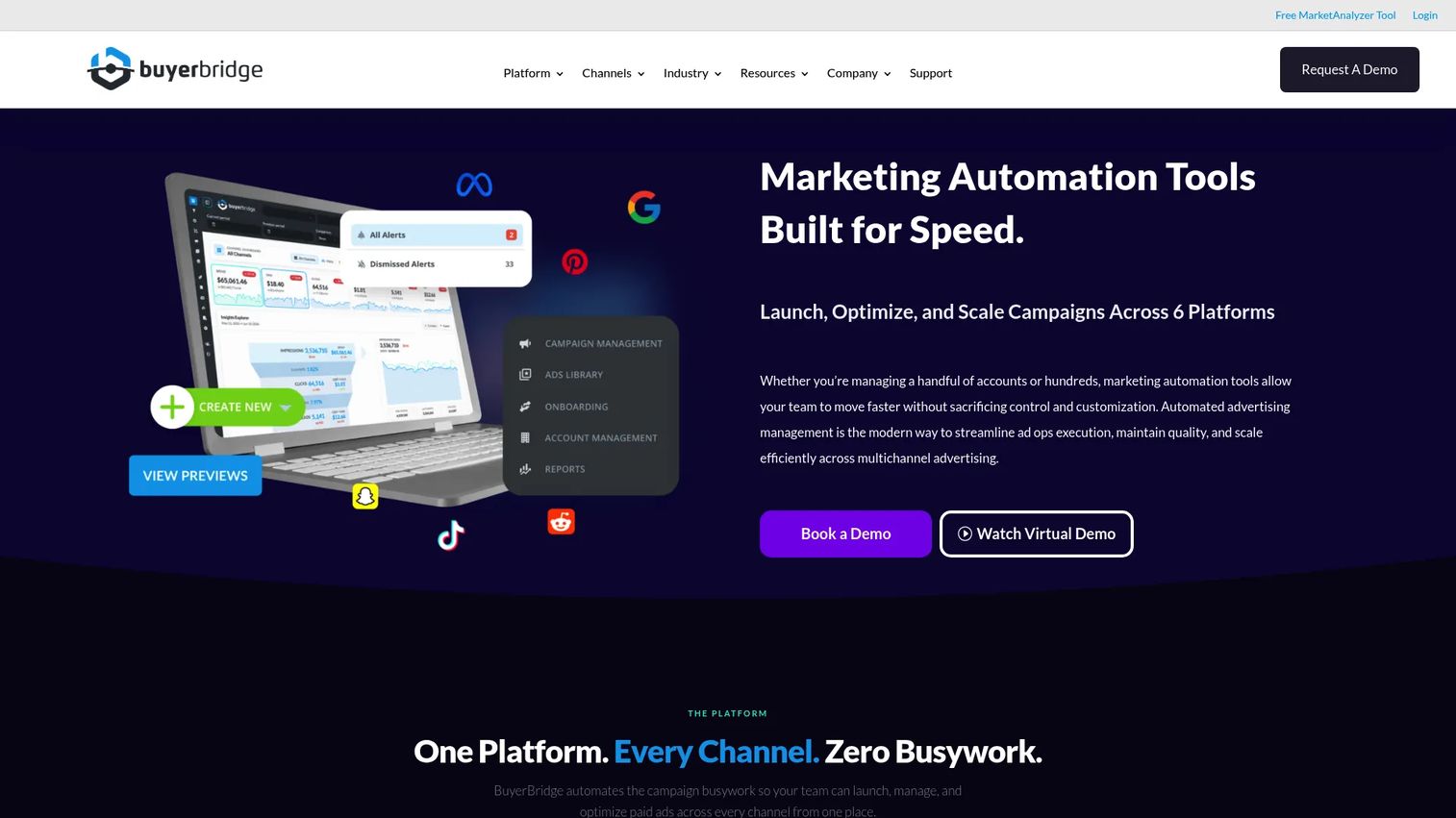
BuyerBridge is a multichannel advertising management platform built for agencies and automotive dealer groups. It runs inventory-feed campaigns across Meta, Google, TikTok, Pinterest, Snapchat, and Reddit from a centralized interface. Daily inventory synchronization keeps campaigns tied to current stock, and budget pacing, ad previews, campaign reporting, and client onboarding tools give agencies repeatable operational workflows across many accounts.
Best for: Automotive agencies and dealer groups that need standardized campaign execution, inventory-feed management, and budget control across multiple rooftops.
Key features
- Centralized campaign management across Meta, Google, TikTok, Pinterest, Snapchat, and Reddit
- Automotive inventory feed management with daily synchronization
- Budget pacing, campaign reporting, and ad previews
- Client account onboarding and management tools
- Core, Plus, and Elite packages with Google and Meta CAPI add-ons
Why choose BuyerBridge: BuyerBridge is most relevant when you manage campaign operations for multiple dealerships and need repeatable playbooks. Smaller single-location stores should compare implementation requirements against available marketing capacity before committing.
BuyerBridge pricing: BuyerBridge offers Core, Plus, and Elite packages, plus Google Integration and Meta CAPI add-ons. Contact BuyerBridge for current package pricing.
G2 rating: 4.7/5
Considerations when choosing automotive marketing software
Data connections that match your dealership reality
Verify the platform's DMS, CRM, inventory-feed, website, and ad-channel integrations before signing. Ask whether data refreshes are batch-based or near real-time. A campaign system cannot stay relevant if inventory, incentives, or customer activity arrive hours late. This single factor eliminates several otherwise capable platforms for dealerships with high daily inventory turnover.
Attribution beyond form fills
Ask specifically how the platform connects campaign activity to leads, appointments, and vehicle sales. Find out which system serves as the source of truth and how offline sales are matched back to media spend. Platforms that only report clicks and form fills leave you defending spend without a revenue story. Your best marketing analytics software stack should produce a clear funnel from ad impression to gross profit.
Operational ownership and adoption
Decide before purchasing who will build audiences, monitor campaigns, respond to messages, and act on reporting. Software cannot fix unclear ownership. It can make unclear ownership more expensive. The platforms here vary significantly in the level of ongoing setup and management they require from internal staff versus vendor-managed services.
Tool overlap and consolidation
Map your current stack first. Identify whether the new platform replaces a texting tool, review platform, CRM workflow, or ad dashboard you already pay for. Paying twice for customer texting or reputation management is common when platforms are added without an audit. The Digital Marketer's core objection applies here: "What does this replace?"
Scalability across rooftops and departments
Single-location dealers need speed and clear ownership. Dealer groups need permissions, standardized workflows, and reporting by store. Agencies need repeatable setup and clean routing. Confirm the platform's multi-rooftop architecture before signing if you expect to scale across locations.
How to choose the right automotive marketing software for your dealership
If your top issue is aging inventory
Start with Fullpath, PureCars, or BuyerBridge. Focus on VIN-level campaigns, inventory-feed refresh cadence, vehicle-specific landing pages, and reporting that shows which units were promoted and what resulted. The deciding factor is how tightly the platform connects inventory data to campaign delivery without manual intervention.
If leads wait too long for a response
Compare Podium, Steer, and Kenect. Focus on shared inboxes, response workflows, webchat, CRM handoff, text opt-in management, and after-hours coverage. A Alter Agents study from 2025 found 60% of car buyers used social media during the buying journey, which means inbound conversations arrive across more channels than a single inbox typically covers.
If marketing and sales do not share the same customer context
Evaluate DealerSocket and Fullpath. The deciding factor is whether your CRM, DMS, website behavior, and campaign data can connect without a spreadsheet-heavy process. This is also where best customer data platform thinking applies to dealerships: One unified customer record beats four partially overlapping ones.
If dealer-group campaign operations are the bottleneck
Start with BuyerBridge and Fullpath. Test campaign governance, inventory-feed controls, reporting by rooftop, budget pacing, and lead routing. Agencies managing multiple dealer accounts should prioritize client onboarding speed and standardized campaign playbooks.
If vehicle listings and creative are underperforming
Evaluate Spyne and Dealer Inspire. The priority is stronger listing presentation, better VDP conversion, faster creative production, and campaign-ready vehicle assets. Good social media marketing tools and paid search amplify strong listing creative. They cannot compensate for weak or inconsistent vehicle imagery.
Conclusion
Automotive marketing software should reduce manual coordination, not add another reporting dashboard to reconcile every Monday morning.
Here is the short routing guide for this list:
- Fullpath for inventory-aware activation and dealership data unification
- Podium for text-first lead response and review management
- DealerSocket for CRM-led dealership workflows and lead governance
- Spyne for vehicle imagery and listing-ready creative at scale
- Dealer Inspire for dealership websites and digital retail experience
- PureCars for omnichannel automotive advertising and AI-powered audiences
- Steer for service shop communication, booking, and customer retention
- Kenect for AI-powered dealership texting and reputation workflows
- BuyerBridge for agencies and multi-rooftop inventory-feed advertising
Shortlist two or three platforms that match your immediate bottleneck. Then run a vendor demo with a live question set: Show the inventory feed, show the lead handoff, show the attribution path, and show exactly what your team must do every day to keep campaigns current. That question set will tell you more than any feature matrix.
Start your journey with Guideflow today!
FAQs
Automotive marketing software is dealership-specific technology for managing campaigns, shopper data, inventory promotion, lead communication, and sales attribution. It differs from generic marketing automation because automotive teams need DMS, CRM, inventory-feed, and sales-event connections that most horizontal platforms were not built to handle natively.
Small dealerships should prioritize fast setup, strong lead response, and a clear owner for daily operations. Evaluate whether the tool replaces a texting, reviews, advertising, or campaign product you already use. Steer and Podium are worth considering for communication-heavy needs, while Fullpath suits stores ready to connect inventory and campaign data in one place.
Many platforms connect to DMS providers, but integration depth varies by vendor and DMS. Validate the refresh timing, which data fields are available, and whether that data supports both marketing audiences and sales attribution. Batch-based syncs that update overnight create stale campaign conditions for dealerships with high daily inventory turnover.
Yes. VIN-level ads, price-drop messaging, audience targeting by vehicle interest, and campaign reporting at the unit level all help direct spend toward inventory that needs attention. The underlying inventory feed must refresh frequently enough to prevent campaigns from promoting vehicles that are already sold or no longer in stock.
Dealer groups should focus on centralized campaign governance, multi-rooftop reporting, permissions by store and role, inventory-feed controls, CRM lead routing, and budget pacing. Test reporting at both the group level and individual store level before committing. Platforms that produce only aggregate group numbers create blind spots for individual rooftop performance.
No. An automotive CRM centers on customer records, lead management, sales follow-up, and appointment workflows. Automotive marketing software may include CRM features, but it typically extends into advertising, audience activation, website conversion, communication, and attribution. Some platforms, like DealerSocket, cover both domains. Others specialize in one.
Build the attribution path before evaluating outcomes: Campaign reach, engagement, lead creation, appointment set, appointment shown, vehicle sold, and retained service revenue. ROI claims are only useful when campaign data is matched to CRM and sales outcomes. Ask each vendor specifically how they connect media spend to a sold VIN and whether that path requires manual data exports.
Timing depends on the number of rooftops, data sources, DMS and CRM connections, inventory feeds, campaign migration, and user training required. A single-location communication tool can launch quickly. A multi-rooftop data and advertising deployment with full CRM and DMS integration needs structured onboarding. Ask vendors for a realistic implementation timeline with your specific stack before signing.