Your engineers version a BOM in one tool. Quality tracks change requests in another. Manufacturing works off a spreadsheet that's already three revisions behind. Procurement emails suppliers a part number that no longer exists. Nobody agrees on which file is current, and the launch date is fixed.
That gap between what teams think is true and what is actually true is where products slip, recalls start, and audits get ugly. Product lifecycle management software exists to close it. A PLM system becomes the single source of truth for product data, so concept, design, engineering, manufacturing, service, and retirement all reference the same governed record.
The market reflects how urgent this has become. The global PLM software market reached USD 50.17 billion in 2026 and is forecast to hit USD 73.91 billion by 2031 at an 8.06% CAGR, according to Mordor Intelligence (2026). Cloud PLM is the fastest-moving slice, projected to grow at a 14.0% CAGR through 2031 per MarketsandMarkets (2025). Smaller manufacturers are entering fast too: ABI Research (2025) expects SME share of PLM spend to climb from 26% in 2025 to 46% by 2035.
The problem is that "best PLM software" means something different for an enterprise aerospace manufacturer than for a 40-person hardware startup. Deployment model, governance depth, change control, and industry fit change the answer entirely. This guide sorts eight real PLM tools by that fit. If you also manage adjacent workflows, our roundups of contract lifecycle management software and audit management software cover the governance layers that often sit next to PLM.
What's inside
This guide is for product leaders, engineering managers, manufacturing and quality teams, and procurement stakeholders building a PLM shortlist. We picked eight platforms across the full spectrum, from enterprise suites to focused BOM and requirements tools, plus one adjacent work management option so you can see where PLM ends.
We evaluated each tool against four criteria that decide real-world fit: core PLM depth (BOM management, change control, product data), deployment model (cloud PLM versus on-premise PLM), collaboration and governance across teams, and implementation realism with pricing visibility where a vendor publishes it. Every rating and price below comes from verified vendor or G2 sources. For related buyer guides, see our lists of the best digital adoption platforms and best component content management systems.
TL;DR
- Best for enterprise complexity: Siemens Teamcenter, for multi-domain product development that spans mechanical, electrical, software, and simulation data.
- Best for retail and apparel: Centric PLM, purpose-built for consumer goods, fashion, and footwear lifecycles.
- Best for regulated, multi-domain manufacturing: PTC Windchill, for enterprise product data management and digital thread traceability.
- Best for flexible configuration: Aras Innovator, a low-code PLM platform that adapts to unusual workflows without heavy custom code.
- Best for cloud-first, Salesforce-native buyers: Propel, unifying PLM, QMS, and PIM on one cloud platform.
- Best for BOM-first teams: OpenBOM, for lean engineering and manufacturing teams that live in bills of materials and procurement.
What is PLM software?
PLM software is a system that centralizes all product data and processes across a product's lifecycle, from concept through design, engineering, manufacturing, service, and retirement, into a single governed source of truth. It connects the people, data, and workflows that would otherwise live in disconnected tools and spreadsheets.
A PLM system does more than store files. It governs how product information changes and who can change it, then propagates those changes downstream so every team works from the current record. That governed flow of data across the lifecycle is what practitioners call the digital thread, and it is the backbone of traceability.
Core PLM capabilities usually include:
- BOM management: Structured, versioned bills of materials that stay consistent across engineering, manufacturing, and procurement.
- Engineering change management: Governed change requests, approvals, and revision control with visible downstream impact.
- Product configuration management: Rules and options for product variants and configurations.
- Collaboration: Shared workspaces for engineering, quality, supply chain, and manufacturing.
- Compliance and traceability: Audit-ready records that trace requirements, changes, and decisions across the lifecycle.
- Document and CAD data management: Version-controlled design files, 3D viewing, and markup.
PLM overlaps with adjacent systems but is not the same. ERP runs the business transactions (orders, inventory, finance). PDM manages design files and revisions, a subset of what PLM does. ALM governs application and software lifecycle, which modern PLM increasingly connects to for software-driven products. The distinction matters most when you scope a project, because buying the wrong category is a common and expensive PLM implementation mistake.
When to use PLM software
Manage product data across teams
Reach for PLM systems when product data is scattered and nobody trusts the "latest" version. Engineering keeps CAD in one repository, quality logs issues in a separate tool, manufacturing works from exported spreadsheets, and supply chain emails part numbers back and forth. PLM solutions consolidate that into one product data management layer so a change in engineering is visible everywhere it matters.
Control change without losing traceability
Use PLM tools when revisions, approvals, and downstream impacts need a governed workflow instead of an email thread. Engineering change management inside a PLM system routes requests, captures approvals, and records who changed what and why. When an auditor or a customer asks how a part reached its current state, the digital thread answers instead of a frantic file search.
Scale launches and compliance
Choose a PLM system when product launches, audits, or regulated workflows outgrow spreadsheets and shared drives. As SKUs multiply and compliance requirements tighten, manual coordination breaks down. PLM for manufacturers adds the structure that keeps time to market predictable, keeps quality records audit-ready, and keeps distributed teams aligned on one product definition.
PLM software comparison
Here are the eight PLM solutions in this guide side by side. Pricing and G2 ratings below reflect verified vendor and G2 sources at the time of writing. Several enterprise PLM vendors publish quote-based pricing only, which is normal for this category and flagged as such.
| # | Product | Intent | Key differentiation | Pricing | G2 rating |
|---|---|---|---|---|---|
| 1 | Siemens Teamcenter | Enterprise PLM | Multi-domain lifecycle across mechanical, electrical, software, simulation | From $165.38/user/mo (Teamcenter X Essentials) | 4.3/5 |
| 2 | Centric PLM | Retail and consumer goods PLM | End-to-end lifecycle for fashion, footwear, apparel | Quote-based | 4.3/5 |
| 3 | PTC Windchill | Regulated enterprise PLM | Product data management and digital thread | Quote-based | 4.1/5 |
| 4 | Aras Innovator | Configurable PLM | Low-code platform, Community Edition available | Quote-based; free Community Edition | 4.4/5 |
| 5 | Propel | Cloud PLM on Salesforce | Unified PLM, QMS, PIM | Quote-based | 4.3/5 |
| 6 | OpenBOM | BOM and PDM | BOM, CAD data, procurement workflows | From $30/seat/mo (billed yearly) | 4.2/5 |
| 7 | Jama Software | Requirements and traceability | Live Traceability for complex products | Quote-based | 4.3/5 |
| 8 | Wrike | Work management (adjacent) | Project and task coordination layer | From $0/user/mo | 4.2/5 |
1. Siemens Teamcenter
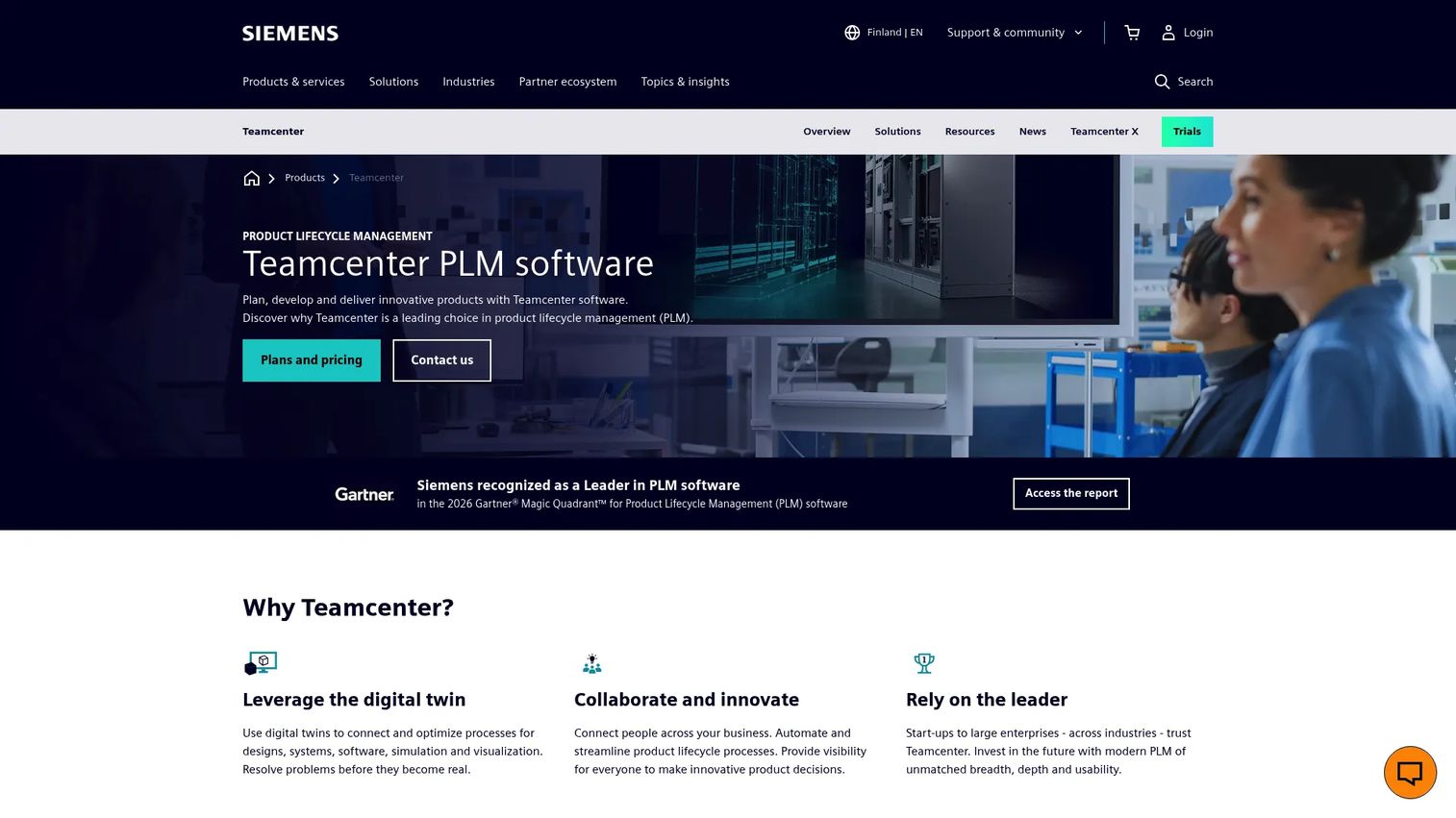
Siemens Teamcenter is enterprise PLM software for planning, developing, and delivering products across engineering and manufacturing. It is built for organizations whose product definition spans multiple domains at once, and it handles that breadth as a single governed system rather than a set of bolted-together modules. Both cloud and on-premise PLM deployment paths are available, which matters for large manufacturers with existing infrastructure and data residency requirements.
Best for: Enterprises needing a scalable PLM system for complex, multi-domain product development.
Key strengths
- Cross-domain development: Manages mechanical, electrical, electronic, software, and simulation data in one product record.
- Requirements, BOM, and cost management: Connects requirements, bill of materials, and product cost so decisions stay tied to the same data.
- Document and change management: Includes document management, 3D viewing and markup, governed change management, and analytics.
Why choose Siemens Teamcenter: If your product is genuinely multi-disciplinary, spanning hardware, electronics, and embedded software, Teamcenter's ability to unify those domains into one digital thread is its core case. It fits large manufacturing organizations that need depth over simplicity and have the appetite for a serious PLM implementation.
Siemens Teamcenter pricing: Teamcenter X, the cloud PLM edition, comes in four tiers: Essentials, Standard, Advanced, and Premium. Essentials starts at $165.38 per user per month, verified on Siemens' pricing page. Standard, Advanced, and Premium require a quote. There is no free tier. Siemens says you can start on a preconfigured tier and upgrade as needs grow. G2 rates Teamcenter 4.3/5.
2. Centric PLM
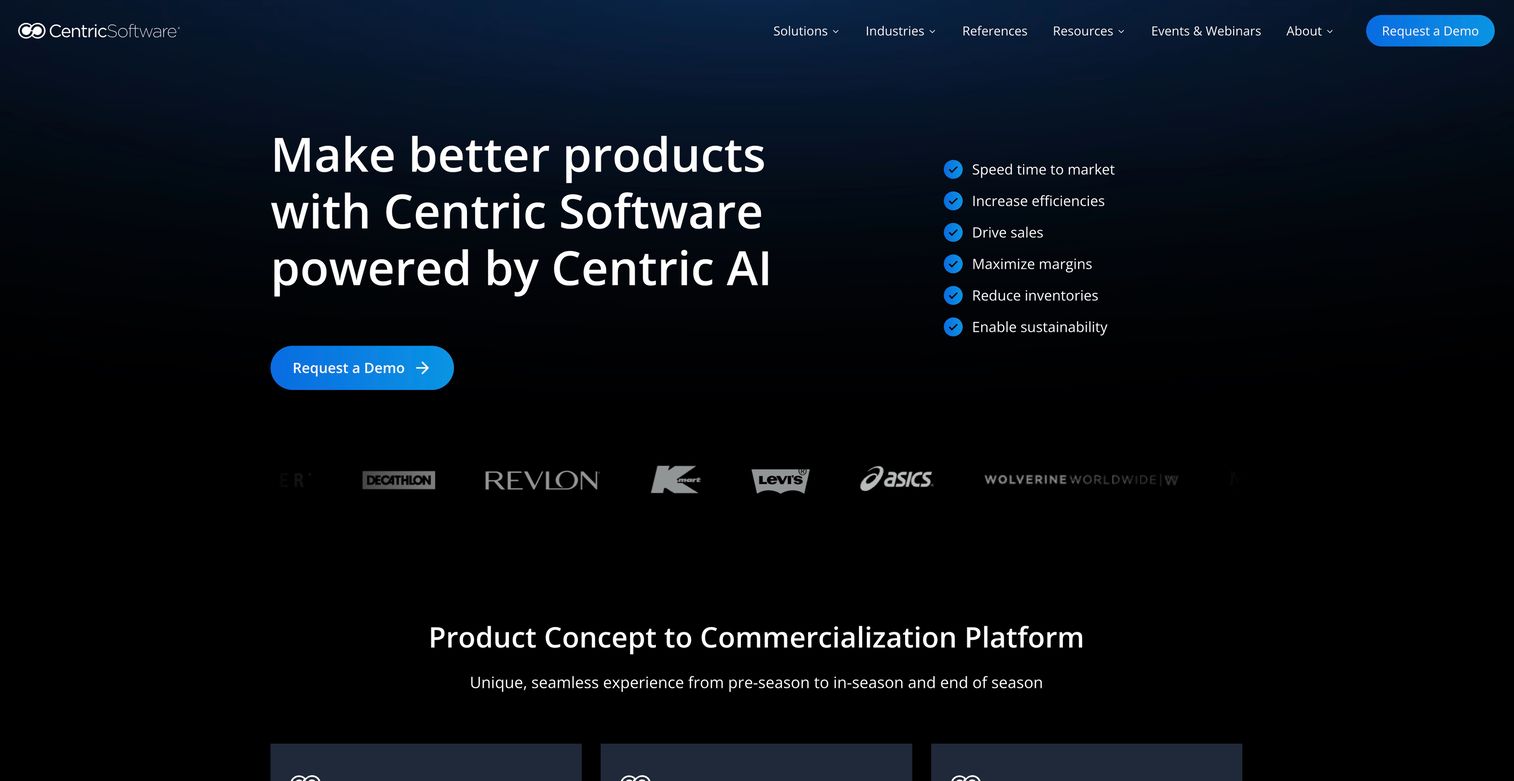
Centric PLM is cloud-based product lifecycle management software built specifically for consumer goods brands, retailers, and manufacturers. Where a generic PLM suite treats every industry the same, Centric is shaped around the realities of fashion, footwear, apparel, and consumer goods: seasonal calendars, design-to-launch speed, and heavy collaboration with external suppliers and sourcing partners.
Best for: Enterprise consumer goods teams needing end-to-end PLM collaboration and product data control.
Key strengths
- End-to-end lifecycle: One platform for design, sourcing, prototyping, testing, certification, and launch.
- AI-powered collaboration: AI-assisted product development and collaboration across internal and external teams.
- Product data and workflow management: Structured product data, BOM management, and workflow control tuned for consumer goods.
Why choose Centric PLM: For retail and apparel teams, a horizontal PLM suite often forces awkward workarounds for seasonal ranges and supplier collaboration. Centric fits better here because the lifecycle stages, terminology, and workflows already match how these teams operate, which shortens time to value and cuts customization overhead.
Centric PLM pricing: Centric Software does not publish public pricing on its site, so plans are quote-based. Reach out to Centric for pricing scoped to your product range and team size. G2 rates Centric PLM 4.3/5.
3. PTC Windchill
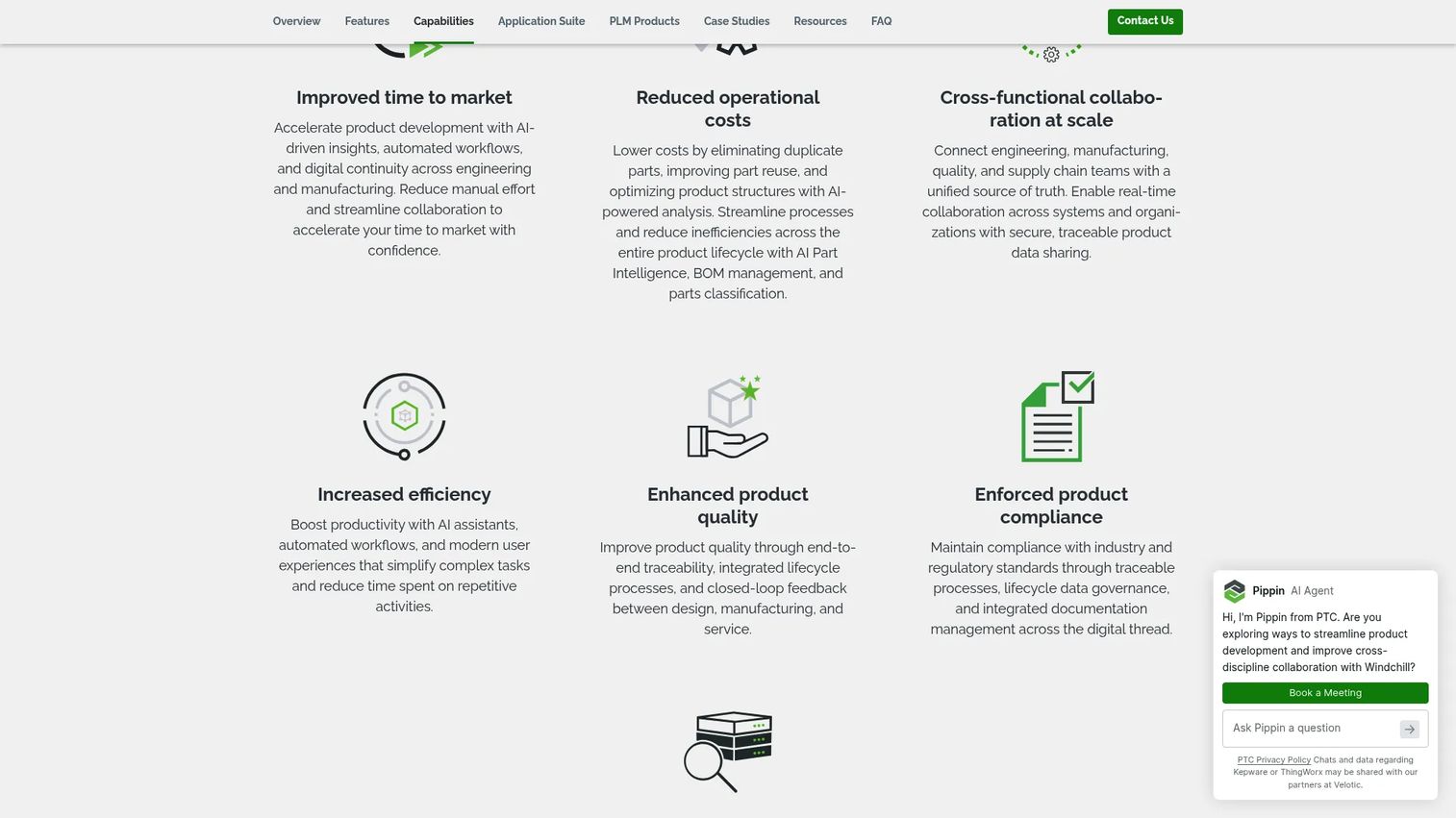
PTC Windchill is enterprise PLM software for managing product data, BOMs, change processes, and collaboration across the product lifecycle. It is a strong fit for organizations where product complexity and regulatory scrutiny are both high, and where the digital thread has to hold up under audit. Windchill emphasizes data integrity and controlled collaboration across engineering, supply chain, and quality.
Best for: Large manufacturing teams needing enterprise PLM and digital-thread collaboration.
Key strengths
- BOM management: Structured bill of materials management across the product record.
- Engineering change and configuration management: Governed change processes and configuration control for complex products.
- Collaborative development: Product and supplier development workflows that connect internal and external stakeholders.
Why choose PTC Windchill: Windchill fits complex, regulated, or multi-domain organizations that need product data management with strong traceability and IP security. If your engineering change management has to survive external audits and cross multiple product lines, Windchill's data control and digital thread depth are the draw.
PTC Windchill pricing: PTC does not expose a public product price for Windchill; pricing is quote-based and scoped through a PTC conversation. Because deployment scale and module mix drive cost, request a quote tailored to your environment. G2 rates PTC Windchill 4.1/5.
4. Aras Innovator
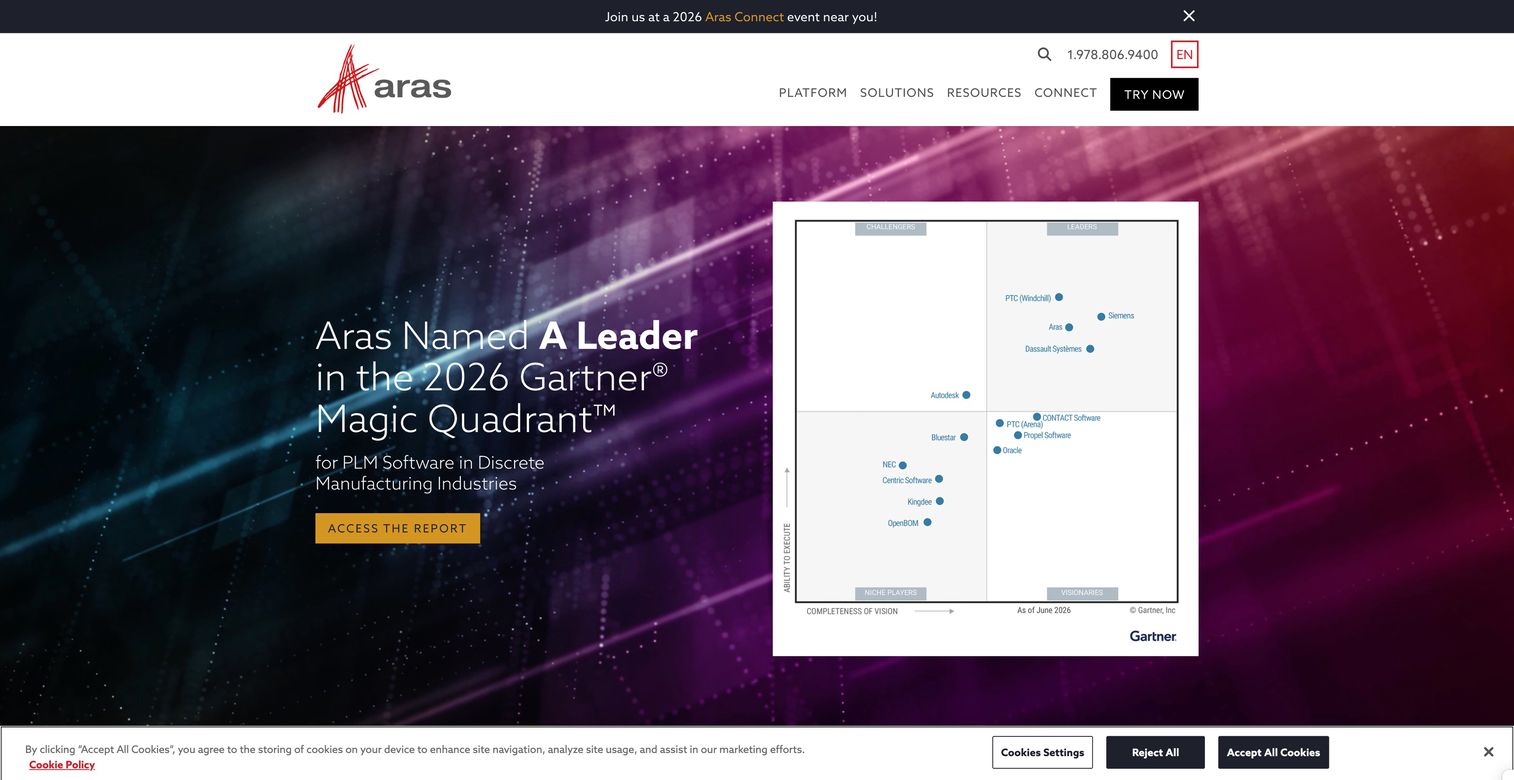
Aras Innovator is an enterprise PLM platform for managing product lifecycles, change control, and digital thread workflows, with a low-code foundation that sets it apart. Instead of forcing your processes to fit the tool, Aras lets teams configure and extend the platform to match how they actually work, which is valuable when your product or process does not fit a standard mold.
Best for: Large enterprises needing configurable PLM and change-management workflows.
Key strengths
- Product Data Platform: A single source of truth for product data across the lifecycle.
- Low-code development: Build custom applications and adapt workflows without heavy hand-coding.
- Application Library: Prebuilt change management, document control, and compliance tracking.
Why choose Aras Innovator: When your requirements outgrow off-the-shelf PLM configuration, Aras's low-code model lets you adapt the platform to unusual workflows and evolve it over time. It fits enterprises that want configurability and long-term adaptability alongside solid change and configuration management. Cloud and hybrid deployment options add flexibility.
Aras Innovator pricing: Aras offers a free Community Edition limited to 50 named users, useful for evaluation and smaller efforts. The paid Aras Subscription (SaaS and Standard) is quote-based; contact Aras for pricing. G2 rates Aras Innovator 4.4/5, the highest in this guide.
5. Propel
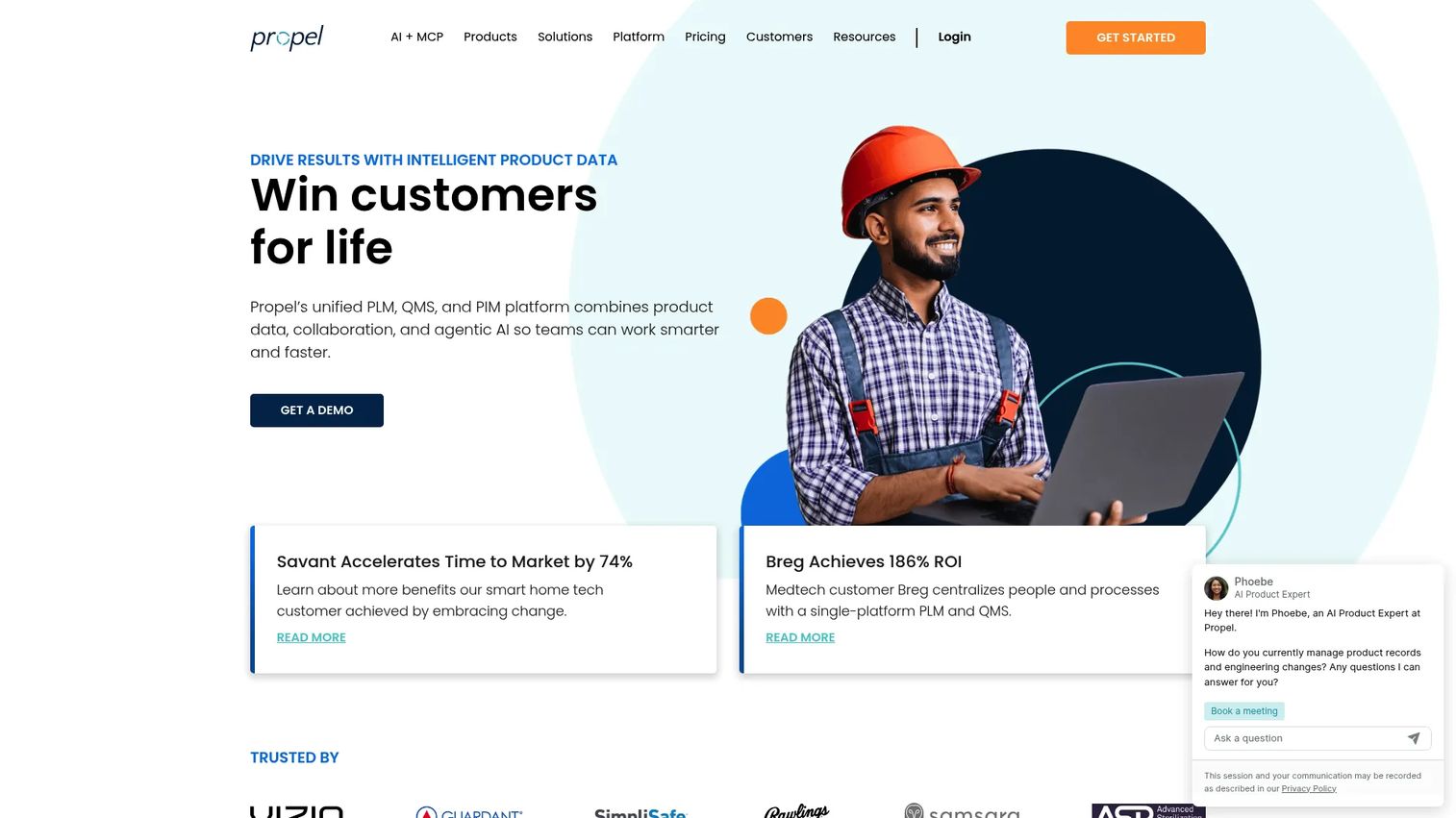
Propel is cloud-based product lifecycle, quality, and product information management software built natively on Salesforce. That foundation is its differentiator: Propel unifies PLM, QMS, and PIM on one cloud platform, so product data, quality records, and commercial product information share a single system instead of living in separate silos.
Best for: Manufacturers needing a unified Salesforce-based PLM, QMS, and PIM platform.
Key strengths
- PLM: Cloud PLM for product data and lifecycle management.
- QMS: Quality management connected to the same product record.
- PIM: Product information management for commercial and customer-facing data.
Why choose Propel: Teams already invested in Salesforce, or building modern connected and hardware products, gain from Propel's cloud-first, unified approach. Keeping PLM, quality, and product information on one platform reduces the integration work that separate systems demand, which suits organizations that prize a single cloud stack over best-of-breed sprawl.
Propel pricing: Propel uses quote-based pricing that depends on team structure and needs; its pricing page shows sample annual license fee ranges but no public starting price. Contact Propel for a scoped quote. There is no free tier. Propel holds a 4.3/5 rating on Capterra.
6. OpenBOM
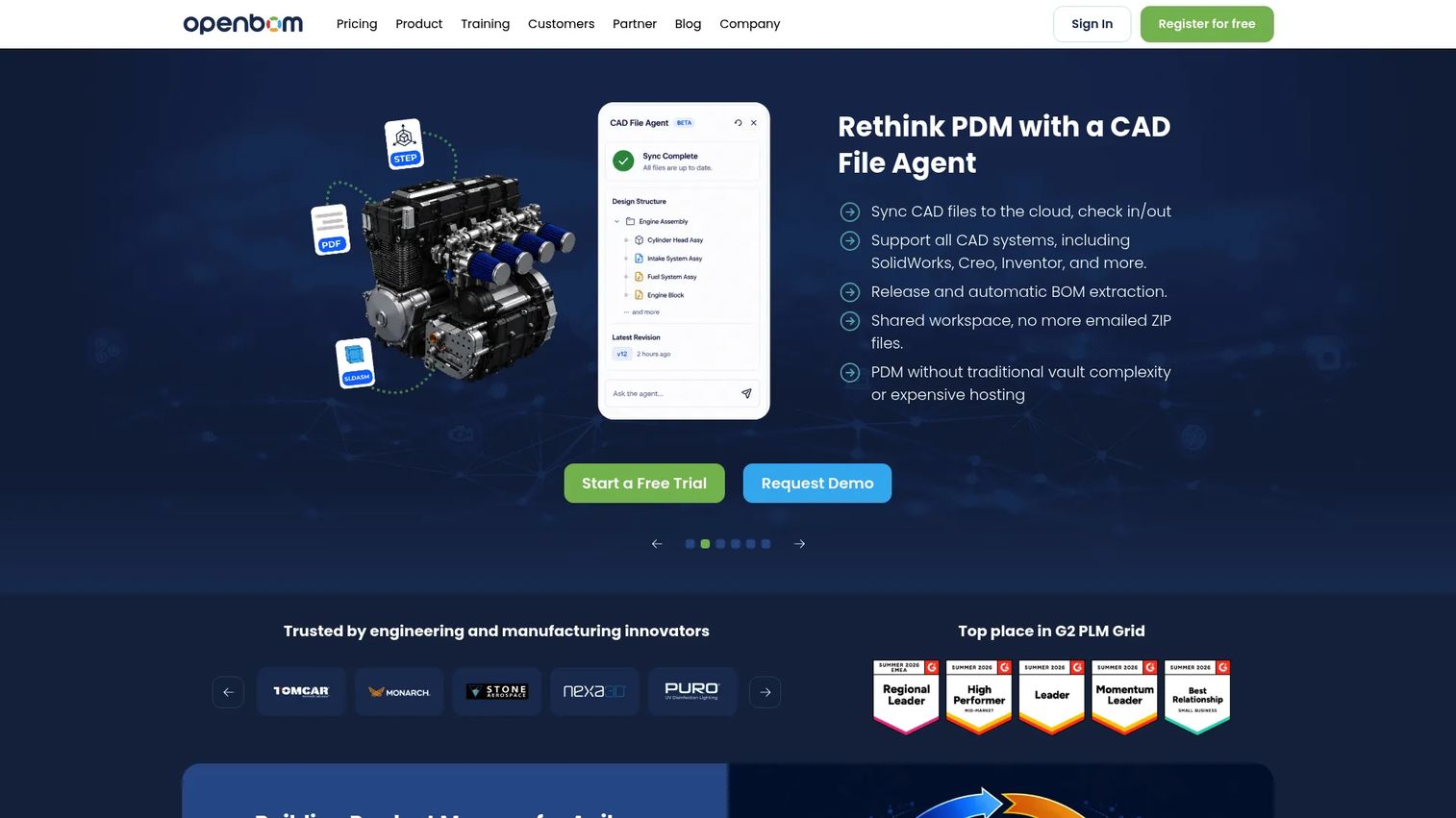
OpenBOM is cloud SaaS for BOM management, PDM and PLM, inventory, procurement, and product data collaboration. It takes a lightweight, bottom-up approach: instead of a heavy enterprise suite, OpenBOM starts from the bill of materials and connects the data, suppliers, and procurement workflows around it. That makes it approachable for smaller or more specialized teams.
Best for: Manufacturing and engineering teams managing BOMs, CAD-linked product data, and procurement workflows.
Key strengths
- BOM management: Deep, flexible bill of materials management as the core of the platform.
- CAD file management: File management and revision control linked to CAD tools.
- Inventory and procurement: Inventory control and procurement workflows tied to the BOM.
Why choose OpenBOM: When your center of gravity is the BOM and supplier coordination rather than a full enterprise lifecycle, OpenBOM delivers focused depth without the weight of a large suite. It fits lean engineering and manufacturing teams that want structured product data and procurement workflows they can stand up quickly.
OpenBOM pricing: OpenBOM publishes clear pricing. The Professional Team plan is $55 per seat per month billed monthly, or $30 per seat per month billed yearly. The Company plan is $165 per seat per month monthly, or $90 per seat per month yearly. Enterprise is custom. A free tier covers up to 2,000 data records with unlimited read-only users, and data-record add-ons scale from there. G2 rates OpenBOM 4.2/5.
7. Jama Software
Jama Software is a requirements, test, and risk management platform for complex product and systems development. It sits adjacent to PLM: where a full PLM system governs the product record and BOM, Jama governs the requirements and verification discipline that defines what the product must do and proves it does. For programs where requirements traceability is the make-or-break factor, that focus is the point.
Best for: Teams building complex regulated products that need requirements traceability and review workflows.
Key strengths
- Live Traceability: Real-time traceability linking requirements, tests, and defects.
- Requirements authoring: Structured authoring and review of requirements.
- Test management: Test management and defect logging tied to requirements.
Why choose Jama Software: In regulated industries like medical devices, aerospace, and automotive, verification and validation discipline is not optional. Jama fits product development programs that need airtight requirements traceability and review workflows, often running alongside a PLM system rather than replacing it. Treat it as the requirements backbone of your digital thread.
Jama Software pricing: Jama does not publish numeric pricing. It uses a single licensing model with four license types (Creator, Stakeholder, Reviewer, Test Runner) and says it does not charge for hosting, reviewers, file storage, or the hosted sandbox. Request pricing directly from Jama. There is no free tier. G2 rates Jama Software 4.3/5.
8. Wrike
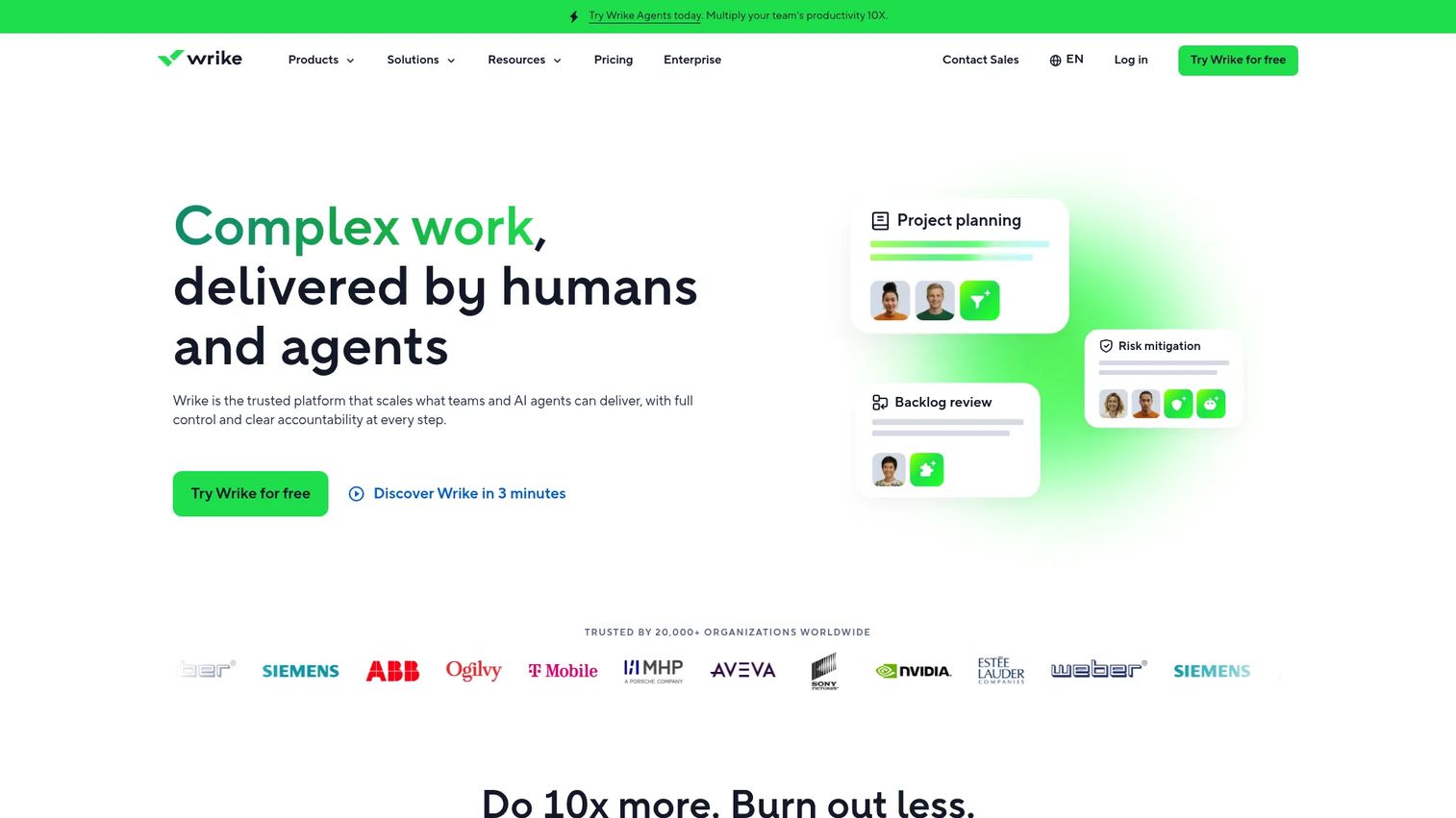
Wrike is work management and project management software for teams. It is not a PLM system, and this section is here to draw the line clearly. Some product organizations evaluate Wrike as a lightweight coordination layer for product development, handling tasks, timelines, and cross-team visibility. That is useful, but it does not manage BOMs, engineering change control, or the digital thread.
Best for: Teams needing customizable project and work management with collaboration and reporting.
Key strengths
- Project and task management: Structured tasks, projects, and cross-team coordination.
- Dashboards and Gantt charts: Visual planning and reporting for timelines and workloads.
- AI-assisted automation: AI-assisted workflow automation to reduce manual coordination.
Why choose Wrike: Choose Wrike when your gap is coordination, not product data governance. It excels at managing the work around product development: launch plans, cross-functional tasks, and reporting. Pair it with a real PLM system rather than expecting it to replace one. Understanding this boundary is exactly what separates PLM software from adjacent workflow tools.
Wrike pricing: Wrike publishes public plans, all billed annually per user. Free is $0 per user per month. Team is $10 per user per month. Business is $25 per user per month. Pinnacle and Apex are quote-based. A free plan and free tiers make Wrike easy to trial. G2 rates Wrike 4.2/5.
Considerations before you buy PLM software
Before you commit to any PLM system, run your shortlist through these criteria. The right PLM comparison is less about feature counts and more about fit with your operating model.
Deployment model: cloud PLM vs on-premise PLM
Cloud PLM lowers infrastructure overhead and speeds rollout, which is why the cloud segment is growing fastest in this market. On-premise PLM still wins where data residency, IP control, or existing infrastructure demand it. Some vendors offer both, plus hybrid. Decide this early, because it narrows your list quickly.
Governance and change management
Look at how the tool handles engineering change management: request routing, approvals, revision control, and downstream impact. Governance depth is what turns scattered data into a trustworthy digital thread. A tool that logs changes but does not enforce workflow will not survive an audit.
Industry and lifecycle fit
A discrete manufacturer, an apparel brand, and a medical device team have different lifecycles. Match the tool to your industry's stages, terminology, and compliance needs. A purpose-built fit reduces customization and speeds adoption more than any generic feature list.
Implementation realism and pricing visibility
PLM implementation is a project, not a switch you flip. Weigh data migration, integration with ERP and CAD, and change management for the people who will use it daily. On PLM pricing, expect quote-based models from enterprise vendors and clearer per-seat pricing from lighter tools. If you are also standardizing internal processes, our guides to contract management software and marketing resource management software cover adjacent governance systems.
Conclusion
The best PLM software for 2026 depends entirely on your operating model, not on a feature scorecard. For multi-domain enterprise complexity, Siemens Teamcenter and PTC Windchill lead. For retail and apparel lifecycles, Centric PLM is the specialist. For configurability, Aras Innovator's low-code platform adapts where rigid suites cannot. For cloud-first, Salesforce-native teams, Propel unifies PLM, QMS, and PIM. For BOM-first teams, OpenBOM gives focused depth at transparent pricing. Jama Software owns requirements traceability alongside PLM, and Wrike handles the coordination layer around it.
Start with the two or three tools that match your industry and deployment model, then pressure-test them against your real change-management and traceability needs. The right PLM system pays back in fewer version errors, cleaner audits, and faster time to market. Narrow by fit first, then run a scoped proof of concept before you commit. If your evaluation touches adjacent workflows, our roundup of the best event management software and best loyalty management software may help round out the stack.
FAQs
PLM software is a system that centralizes product data and processes across a product's entire lifecycle, from concept through design, manufacturing, service, and retirement. It creates a single source of truth so engineering, quality, manufacturing, and supply chain teams all work from the same governed product record.
For manufacturers, PLM software governs BOM management, engineering change management, and product configuration so distributed teams stay aligned on one product definition. It reduces version errors, keeps compliance records audit-ready, and shortens time to market by removing the manual coordination that spreadsheets and email create.
PDM (product data management) focuses on managing design files, CAD data, and revisions. PLM is broader: it manages the full product lifecycle, including requirements, BOMs, change processes, collaboration, and compliance. PDM is effectively a subset of what a complete PLM system covers.
Neither is universally better; it depends on your needs. Cloud PLM lowers infrastructure overhead, speeds rollout, and scales easily, which is why it is the fastest-growing segment. On-premise PLM suits organizations with strict data residency, IP control, or existing infrastructure requirements. Many vendors now offer hybrid deployment.
Common PLM implementation challenges include data migration from legacy systems, integrating with ERP and CAD tools, and driving user adoption across teams. The biggest risk is treating PLM as a technology install rather than a process change, which undermines the governance and digital thread the system is meant to deliver.
PLM software improves traceability by maintaining a governed digital thread: every requirement, revision, change request, and approval is linked and time-stamped. When a customer or auditor asks how a part reached its current state, the system reconstructs the full history instead of relying on scattered files and memory.
Expect two models. Enterprise PLM vendors typically use quote-based pricing scoped to deployment scale and module mix. Lighter tools publish per-seat pricing, sometimes with a free tier. Beyond license cost, factor in implementation, data migration, integration, and training, which often exceed the software fee itself.
PLM software is heavily used in discrete manufacturing, automotive, aerospace and defense, industrial equipment, electronics, medical devices, and consumer goods including fashion, footwear, and apparel. Any industry with complex product data, regulatory requirements, or multi-team collaboration across a product lifecycle benefits from a PLM system.