Your user session lookup is slow. Cart state keeps dropping. A config flag read is adding 40ms to every request. The instinct is to throw a faster server at it, but the actual question is simpler: Does your application know the identifier before it asks for the data? If yes, a key value database is probably what you need.
The harder question is which one. Key value stores represented 35.2% of NoSQL market revenue in 2025, according to Market Research Future (2026), and the global market is projected to grow from $7.5 billion in 2024 to $19.3 billion by 2034 at a 10% CAGR (Market.us, 2025). The category spans in-memory caches, persistent embedded engines, distributed cloud databases, and fully managed services. Each carries a different cost structure, operational burden, and failure model.
For product managers, the choice is not purely a latency benchmark. Pick the wrong operating model and your roadmap absorbs the infrastructure debt. Pick the wrong durability guarantee and a node restart causes data loss your users notice. Do you need a cache, a durable store, or a managed distributed database that handles both?
What's inside
This guide is for product managers and technical leads evaluating key value databases for B2B SaaS workloads. Nine products were selected based on:
- Workload fit: How well each option handles caching, sessions, configuration, and real-time reads
- Deployment model: Managed cloud, self-hosted, or embedded engine
- Durability and consistency: What happens when a node restarts or a region fails
- Pricing visibility: Whether costs can be modeled before committing
TL;DR
- Best overall for in-memory workloads: Redis handles caching, sessions, queues, and richer data structures in one platform
- Best managed cloud option: Amazon DynamoDB fits teams standardized on AWS that want to reduce database operations work
- Best for high-scale, low-latency workloads: Aerospike suits demanding transaction volumes with predictable performance
- Best lightweight cache: Memcached covers simple, ephemeral caching without the overhead of broader database features
- Best embedded storage engine: RocksDB gives teams fast local persistence inside an application or another database system
What is a key value database?
A key value database stores data as pairs, where a unique key points to a value that the application retrieves, updates, or deletes through direct lookup.
The key is a unique identifier, typically a string such as user:48291 or session:abc123. The value can be a string, number, binary object, JSON blob, or serialized object. The application always knows the key before querying, which is what makes direct lookup so fast.
Keys, values, and key value pairs
A simple key value pair looks like this:
user:48291 → {"plan":"pro","onboarding_complete":true}
The model is deliberately flat. There are no joins, no schema enforcement, and no relational constraints. The application owns the data shape inside the value, which gives teams flexibility but also shifts data modeling responsibility away from the database.
How key based CRUD operations work
Get, put, update, and delete are the core operations. Reads retrieve a value by key. Writes create or overwrite a key. Deletes remove a key. The model is optimized for known access patterns. Broad ad hoc queries, like "find all users on the pro plan," require extra indexes, a secondary data store, or a richer data model.
Architectures compared
| Architecture | What it means | Best for | Main planning question |
|---|---|---|---|
| In-memory | Data served primarily from RAM | Caching, sessions, real-time reads | Does the workload fit memory and durability requirements? |
| Persistent | Data written to durable storage | Embedded apps, durable local state | How will compaction, backup, and recovery be managed? |
| Distributed | Data replicated or partitioned across nodes | Global apps, high availability | What consistency and operations model does the team need? |
| Managed cloud | Provider handles infrastructure operations | Teams optimizing for delivery speed | How do usage patterns affect cost and portability? |
Key value databases versus document and relational databases
A key value store fits direct lookup workloads where the application nearly always knows the identifier. Relational databases fit joins and transactional relationships across multiple tables. Document databases fit flexible records where the application needs richer querying, filtering, or partial updates without knowing the key in advance.
When to use key value databases
Serve cached application data
Page fragments, API responses, permission checks, computed results, and rate-limit counters all benefit from fast key-based retrieval. Cache invalidation and TTL configuration are product reliability decisions, not just implementation details. A stale permission check or an expired rate-limit entry affects users directly.
Manage sessions and user state
Authentication sessions, cart contents, onboarding progress, and temporary workflow state are natural fits. Losing session state during a deployment or failover creates avoidable friction at exactly the moments that affect activation and early retention. Design for what happens when the store becomes temporarily unavailable.
Store configuration and service metadata
Feature flags, service discovery data, tenant settings, and workflow coordination data work well here. The access pattern is almost always a direct read by a known key. This use case favors predictable low latency and clear ownership over who can write and when.
Key value database comparison
The table below compares nine key value databases by deployment model, strongest workload fit, pricing, and G2 rating. Pricing and ratings were verified from vendor pricing pages and live G2 listings in October 2026.
| # | Product | Best for | Key differentiator | Pricing | G2 rating |
|---|---|---|---|---|---|
| 1 | Redis | Broad in-memory workloads | Rich data structures and broad ecosystem | Free tier; Pro from $0.014/hr | 4.5/5 |
| 2 | Amazon DynamoDB | Managed AWS workloads | Serverless key value and document database | Usage-based; 25 GB free | 4.3/5 |
| 3 | Aerospike | Large-scale, low-latency systems | Hybrid memory and storage architecture | Free CE; Cloud from $3/hr | 4.4/5 |
| 4 | Memcached | Simple ephemeral caching | Lightweight distributed memory cache | Free and open source | N/A |
| 5 | RocksDB | Embedded durable storage | Write-optimized LSM persistent engine | Free and open source | N/A |
| 6 | FoundationDB | Distributed transactional workloads | Ordered key value store with ACID transactions | Free and open source | N/A |
| 7 | Oracle NoSQL Database | Oracle-aligned enterprise workloads | Managed and on-premises key value options | Free tier; from $0.0064/read unit/mo | 4.1/5 |
| 8 | MongoDB Atlas | Key value plus document query needs | Managed document database with key-based access | Free tier; Dedicated from $0.08/hr | 4.5/5 |
| 9 | ArangoDB | Multi-model applications | Key value, document, graph, and search in one engine | Free CE; Cloud pricing on request | 4.6/5 |
Best 9 key value databases for 2026
1. Redis
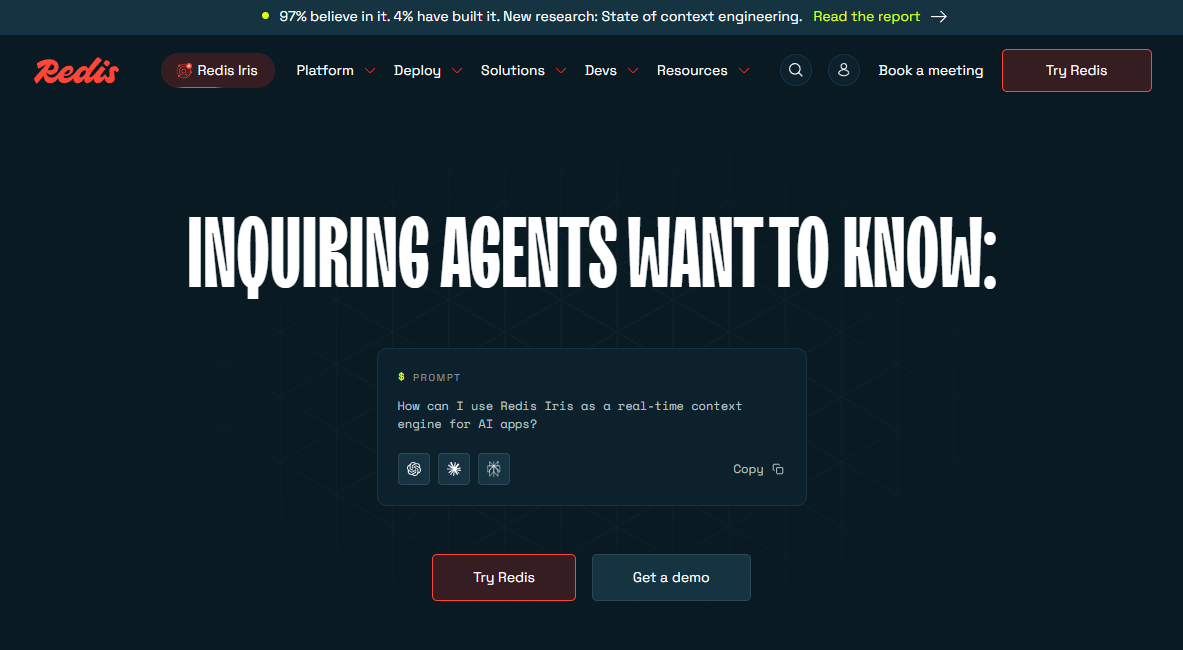
Redis is an in-memory database and real-time data platform covering caching, vector search, NoSQL storage, streaming, and pub/sub messaging. It supports a richer value model than a plain string cache, including hashes, sorted sets, lists, bitmaps, and JSON documents. Teams use it for session storage, rate limiting, real-time counters, leaderboards, and queues alongside basic key-value caching.
Best for: Product teams that need low-latency access to frequently used application data across multiple real-time patterns, not just a single cache layer.
Key features
- In-memory storage with native data structures: Hashes, sets, sorted sets, lists
- Vector search and JSON document storage
- Clustering, replication, and automatic failover
- TTL expiration controls per key
- Active-Active geo-distribution for multi-region writes
Why choose Redis: It covers the broadest range of in-memory workloads on this list. When your product has several performance-sensitive workflows, session state, rate limiting, queuing, and real-time counters, Redis handles them from one platform rather than requiring separate tools.
Redis pricing: Redis Cloud has a Free tier (up to 30 MB), an Essentials shared tier from $0.007/hour (approximately $5/month), and a Pro dedicated tier from $0.014/hour with a $200/month minimum. Open-source Redis is free to self-host under the RSALv2 and SSPLv1 licenses.
G2 rating: 4.5/5 (verified October 2026)
2. Amazon DynamoDB
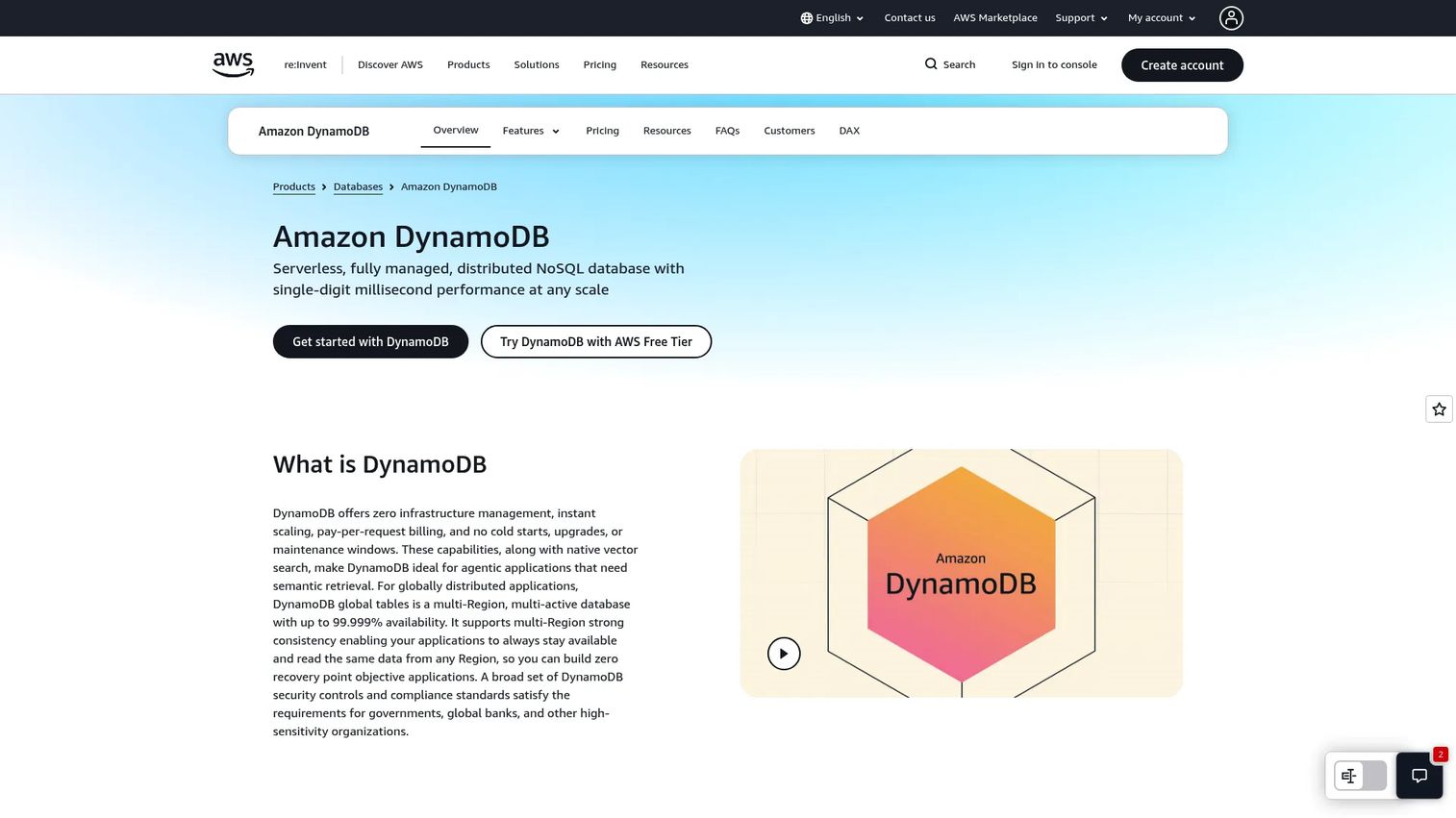
Amazon DynamoDB is a fully managed AWS database supporting both key value and document data models. It removes server provisioning entirely and scales read and write capacity automatically. Core capabilities include multi-region active-active replication through Global Tables, ACID transactions, TTL-based item expiration, and native integration with DynamoDB Streams for event-driven architectures.
Best for: SaaS products already standardized on AWS that want to reduce database operations work without giving up global scalability.
Key features
- On-demand and provisioned capacity modes
- Multi-region active-active Global Tables
- ACID transactions across multiple items
- Time to Live expiration per item
- Native vector search and DynamoDB Streams integration
Why choose Amazon DynamoDB: The fit is strongest when operational speed and AWS-native governance matter more than portability. Access pattern design still requires upfront work, even with a fully managed service. Model your read and write volumes early because scan-heavy queries, secondary indexes, and global replication each affect costs differently.
Amazon DynamoDB pricing: DynamoDB uses usage-based pricing with no fixed starting price. The AWS Free Tier includes 25 GB of storage, 25 provisioned write capacity units, and 25 provisioned read capacity units each month. On-demand capacity charges per read and write request consumed. Standard table storage costs $0.25 per GB-month; Standard-IA costs $0.10 per GB-month.
G2 rating: 4.3/5 (verified October 2026)
3. Aerospike
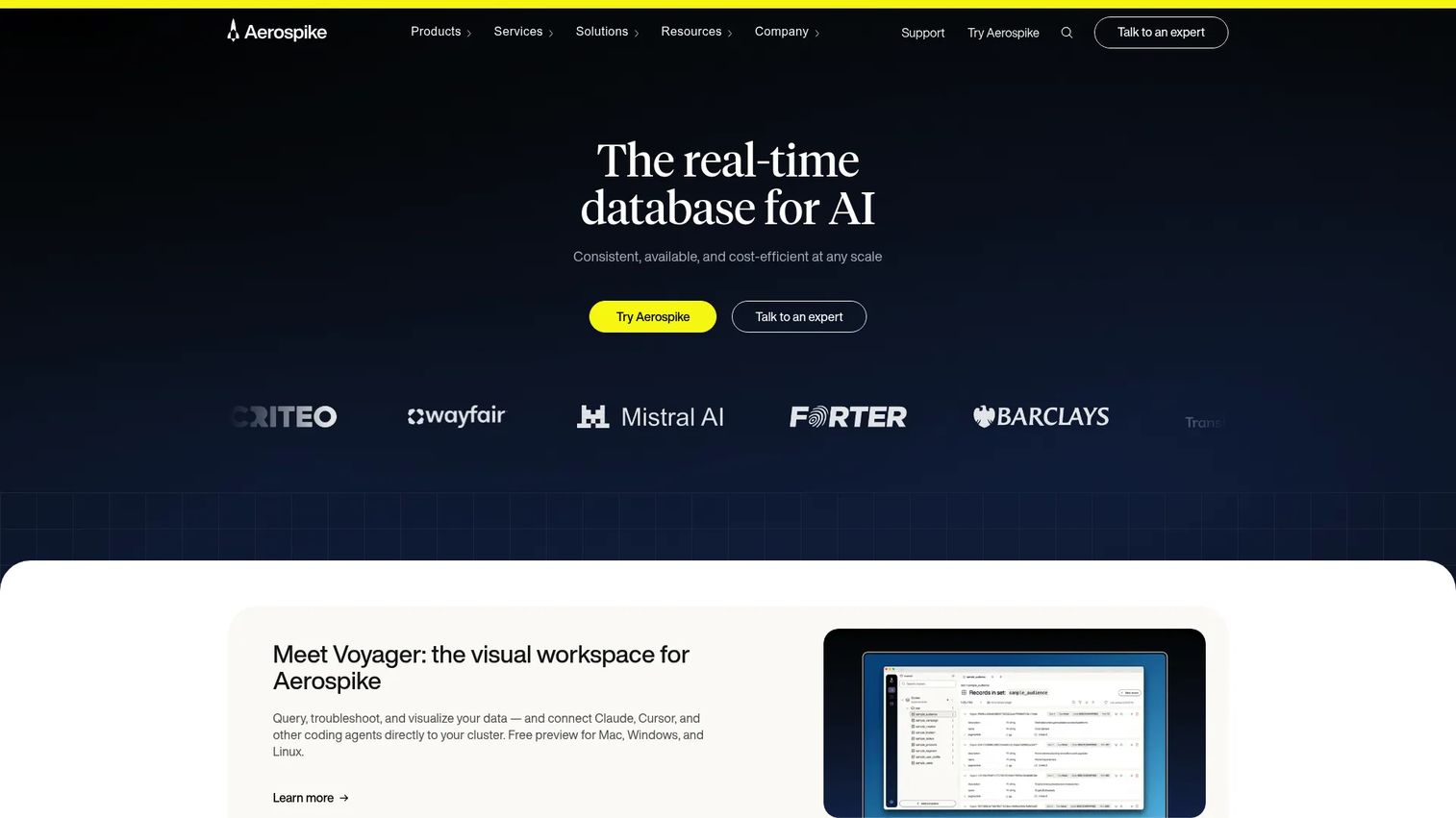
Aerospike is a real-time distributed NoSQL database built for mission-critical, high-throughput workloads. Its Hybrid Memory Architecture stores primary indexes in RAM while persisting data to flash or SSDs, which allows it to handle large datasets without requiring the data to fit entirely in memory. It supports key value, document, and graph data models within one platform.
Best for: Teams building real-time applications where predictable tail latency and high availability are direct product requirements, such as fraud detection, personalization engines, and financial transaction processing.
Key features
- Hybrid Memory Architecture: Indexes in RAM, data on flash
- Distributed ACID transactions and strong consistency options
- Cross-datacenter replication and active-active deployments
- Self-healing cluster with auto-sharding
- Multi-model support: Key value, document, graph
Why choose Aerospike: Its architecture is purpose-built for workloads where latency predictability at scale matters more than operational convenience. Evaluate tail latency, recovery behavior, replication configuration, and total infrastructure cost at your projected 12-month scale before committing.
Aerospike pricing: The Community Edition is free and supports up to 8-node clusters and 2.5 TB of data. Enterprise Edition pricing requires contacting sales. Aerospike Cloud publishes indicative hourly examples: A resilient cache small configuration starts at $3/hour, a line-of-business application at $34/hour, and a central system-of-record configuration at $125/hour, based on AWS us-east-1 pricing.
G2 rating: 4.4/5 (verified October 2026)
4. Memcached
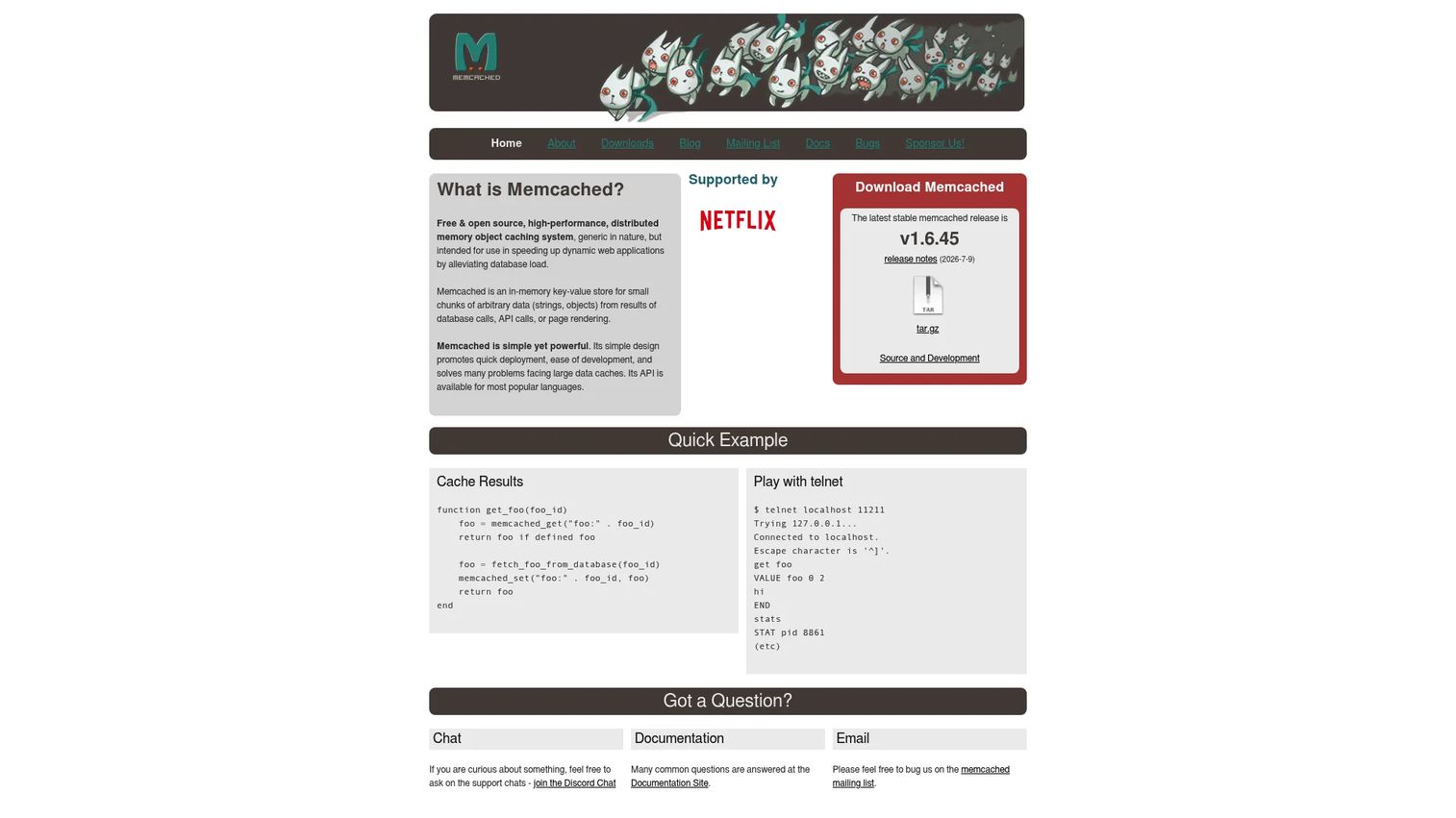
Memcached is a free, open-source distributed in-memory caching system designed specifically for reducing database and application load. It holds data in memory across a pool of servers and retrieves it by key. When a node restarts, that node's data is gone. That is a deliberate design constraint, not a gap, because Memcached is built for ephemeral cached values, not durable storage.
Best for: Developers and infrastructure teams that need fast, temporary object caching with a minimal operational footprint and can accept data loss when cache nodes restart.
Key features
- Distributed in-memory key value caching
- Built-in proxy for routing requests across backend servers
- TLS support for secure connections
- Flash storage via extstore for overflow capacity
- Text and Meta text protocols with multi-language client support
Why choose Memcached: It remains a valid choice when the product only needs ephemeral cache behavior and the team values a narrow, well-understood tool over a feature-rich platform. Plan for cache miss behavior explicitly. A cache miss that sends every request to the underlying database can create a hidden bottleneck that the cache was supposed to prevent.
Memcached pricing: The open-source software is free. Managed Memcached offerings are available through cloud providers such as AWS ElastiCache, where pricing varies by instance type and region. Check the relevant provider's pricing page for current figures.
5. RocksDB
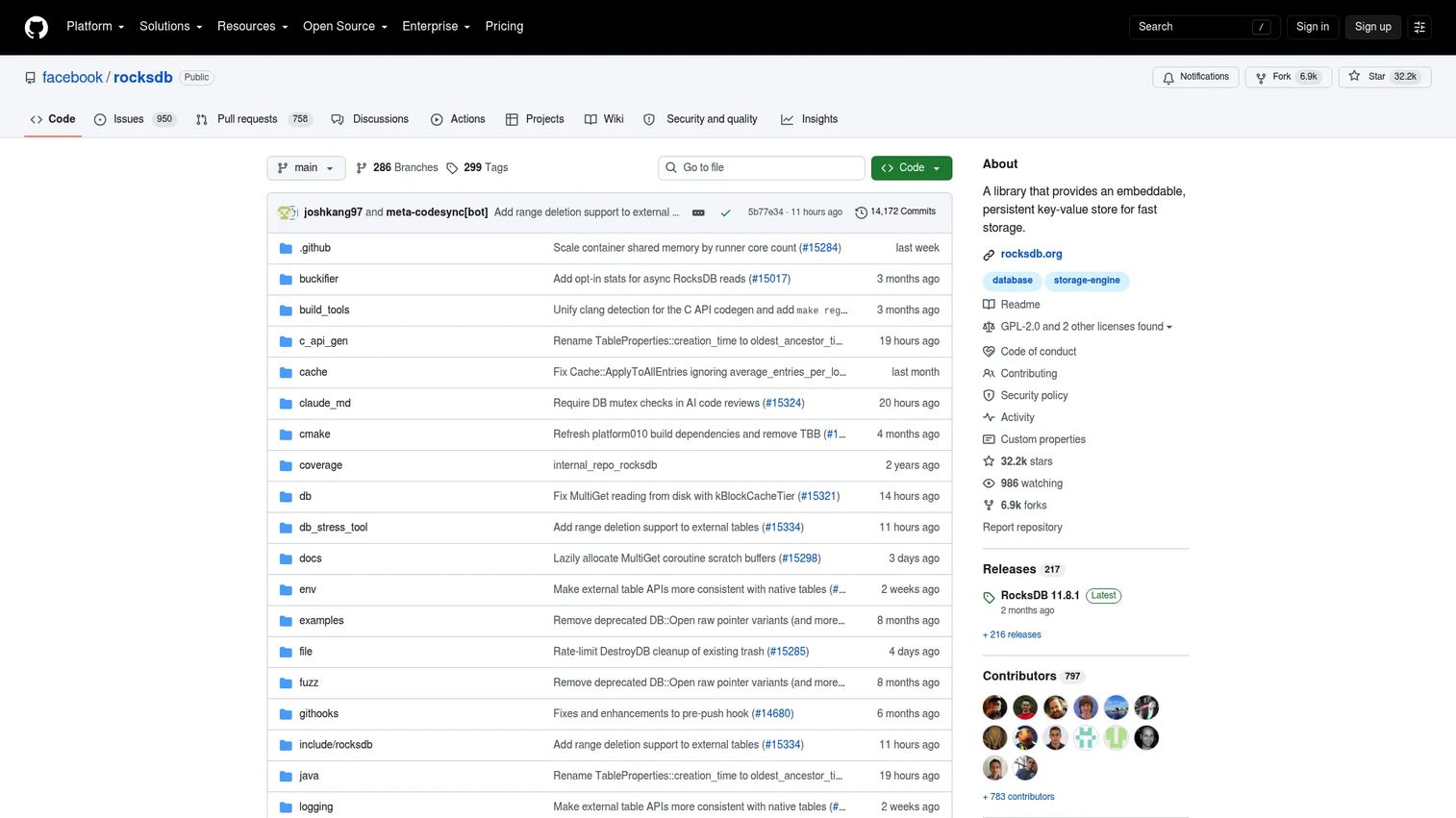
RocksDB is an embeddable C++ persistent key value store optimized for fast local storage, including flash and RAM. Rather than running as a separate server, RocksDB links directly into the application process. Several widely-used databases use RocksDB as their underlying storage engine, making it foundational infrastructure for the broader data ecosystem.
Best for: Engineering teams that need durable, low-latency local key value storage inside a service, mobile system, edge device, or storage platform, where managing an external database server adds unwanted complexity.
Key features
- Persistent key value storage for arbitrary byte streams
- Log-structured merge-tree (LSM) design with multithreaded compaction
- Column families, transactions, and write batches
- Range scans and iterators
- Configurable compaction settings and snapshot support
Why choose RocksDB: Embedding the database removes a network hop and external server dependency. The tradeoff is that the application now owns storage tuning, compaction behavior, disk sizing, backup, and failure handling. This fits teams with strong engineering control over their application architecture. Budget roadmap time for observability and disaster recovery before launch.
RocksDB pricing: RocksDB is free and open-source software. It is released under a dual license covering Apache 2.0 and the GNU General Public License v2.0. Check the official GitHub repository for current license details.
6. FoundationDB
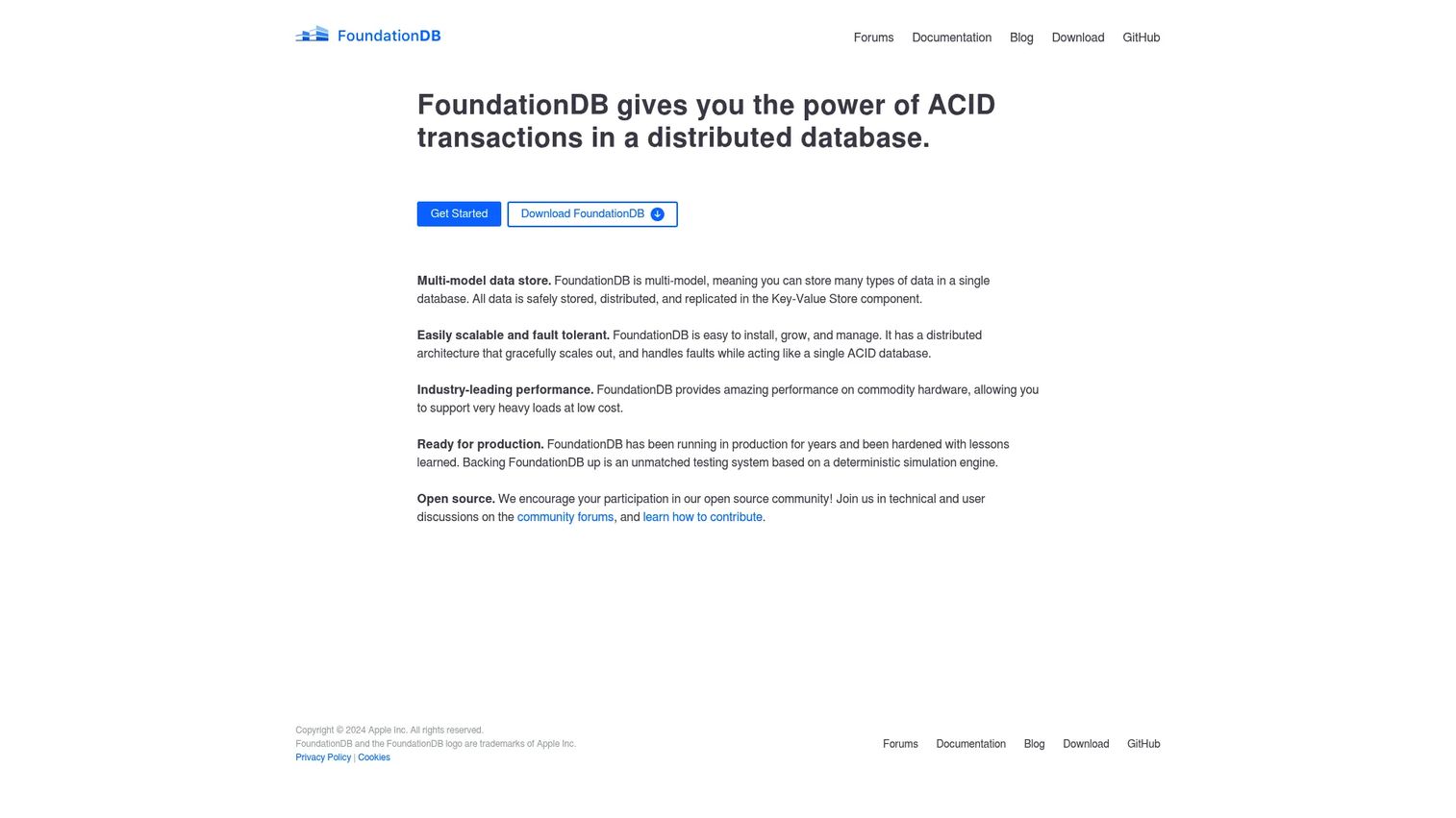
FoundationDB is an open-source distributed database built around an ordered key value store with ACID transactions. Keys are stored in sorted order, which enables efficient range reads across key prefixes. Its layer model allows higher-level data models, such as document or record-oriented storage, to be built on top of the core transactional key value foundation.
Best for: Engineering teams building complex distributed data systems where strong transactional guarantees are a hard requirement and the team has the platform expertise to operate it.
Key features
- Ordered key value storage with range read support
- Distributed ACID transactions across the full dataset
- Automatic data distribution and replication
- Fault tolerance with deterministic simulation testing
- Extensible layer model for document and record-oriented storage
Why choose FoundationDB: It suits systems where transactional correctness across many keys matters more than operational convenience. It is not the default shortcut for a small application team evaluating caching options. Before adopting it, validate the team's operational expertise, upgrade strategy, backup ownership, and the engineering cost of building higher-level abstractions on top of the layer model.
FoundationDB pricing: FoundationDB is free and open-source software. The official website does not list managed service options. Verify current license terms and any community-maintained deployment tooling before starting.
7. Oracle NoSQL Database
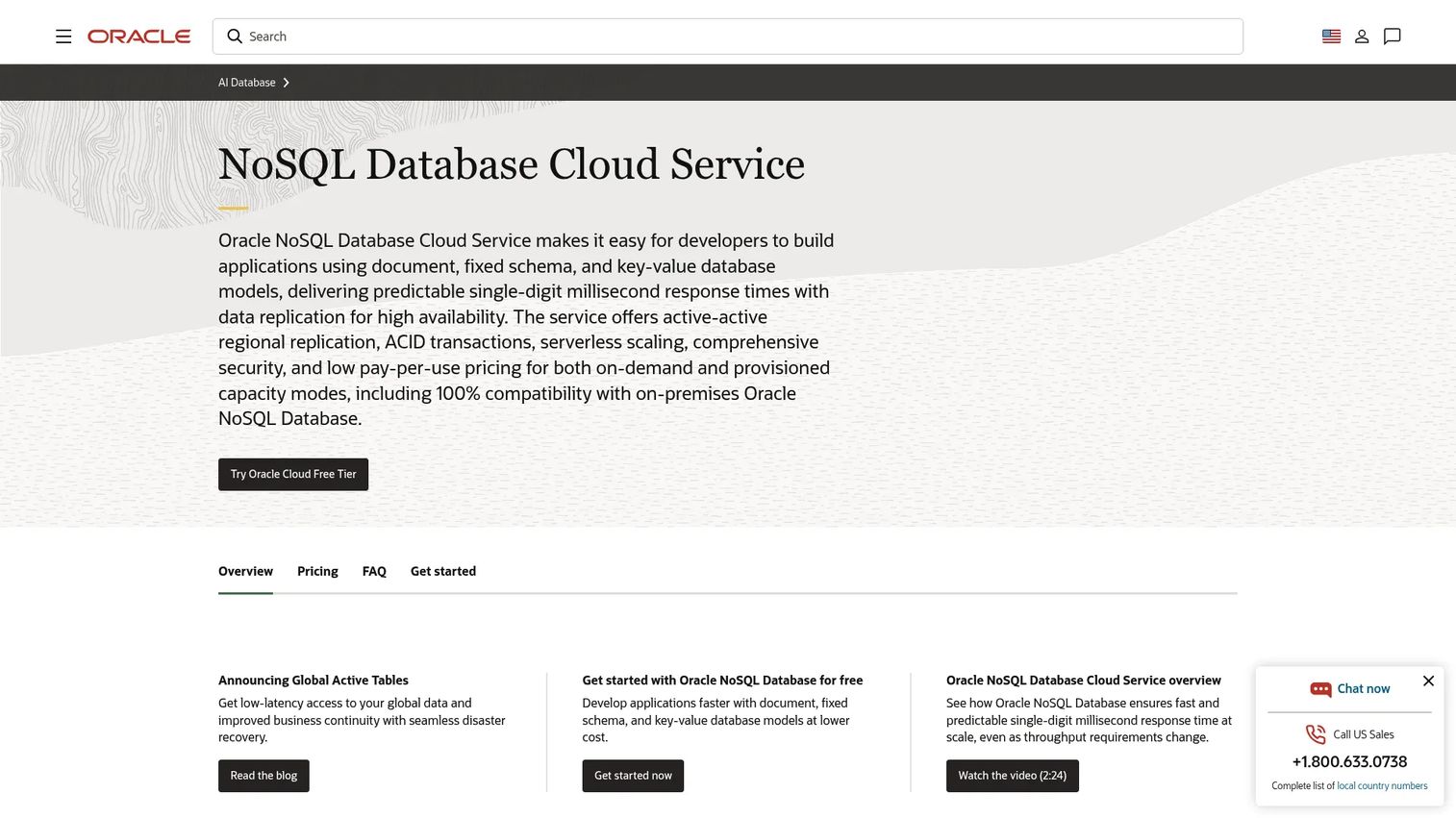
Oracle NoSQL Database is a fully managed NoSQL cloud database supporting document, fixed-schema, and key value data models. It offers active-active regional replication, ACID transactions, and automatic encryption. The product runs on Oracle Cloud Infrastructure and integrates with Oracle Cloud IAM for access control. An on-premises deployment option exists for organizations with requirements that prevent full cloud migration.
Best for: Enterprise product teams running key value or document workloads within an Oracle-aligned stack, where identity, procurement, and adjacent data services already operate inside the Oracle environment.
Key features
- Document, fixed-schema, and key value data models
- Active-active regional replication
- ACID transactions with automatic encryption
- Provisioned and on-demand capacity pricing
- Integrated Oracle Cloud IAM and automatic patching
Why choose Oracle NoSQL Database: The case strengthens when the Oracle environment already handles adjacent workloads and consolidating vendors simplifies governance, procurement, and support. Avoid choosing it solely because it sits inside an existing procurement relationship. Evaluate it on workload fit, latency requirements, and total cloud cost against the alternatives.
Oracle NoSQL Database pricing: An Always Free tier includes up to 25 GB of storage per table and 50 read and write units per table for up to three tables. Provisioned capacity starts at $0.0064 per read unit per month and $0.1254 per write unit per month, with storage at $0.066 per GB per month. On-demand and hosted-environment pricing require contacting Oracle for exact figures.
G2 rating: 4.1/5 (verified October 2026)
8. MongoDB Atlas
MongoDB Atlas is a fully managed, multi-cloud data platform. It is a document database at its core, but teams frequently use it for key value access patterns by retrieving a full document by its unique _id field. Atlas adds secondary indexes, Atlas Search, vector search, stream processing, and change streams, giving teams room to evolve the data model without migrating to another system.
Best for: Teams that need key-based access for some workflows but also expect richer document queries, flexible schemas, or evolving application data requirements as the product matures.
Key features
- Flexible document values with secondary index support
- Atlas Search and Atlas Vector Search
- Global deployment across AWS, Azure, and GCP
- Change streams for event-driven architectures
- Encryption, auditing, and policy enforcement
Why choose MongoDB Atlas: Choose it when a pure key value store would create awkward workarounds for querying, filtering, or flexible user records. The operational overhead is higher than a single-purpose cache, but the data model flexibility pays off when the roadmap requires multiple access patterns. Ask whether the product will need filtering, search, or evolving schemas within the next 12 months.
MongoDB Atlas pricing: A permanent Free tier is available. The Flex tier starts at $0.011/hour with a cap of approximately $30/month. Dedicated clusters start at $0.08/hour, which works out to roughly $56.94/month at minimum. Pricing varies by cloud provider, region, and cluster configuration.
G2 rating: 4.5/5 (verified October 2026)
9. ArangoDB
ArangoDB is a native multi-model database combining graph, document, key value, and full-text search capabilities in a single engine with one query language, AQL. Teams choose it to reduce the number of separate database systems when the application genuinely needs multiple data models. Running one database instead of four separate specialized ones simplifies operations and removes synchronization complexity between systems.
Best for: Product teams whose roadmap combines key-based lookups with connected data relationships, flexible documents, or contextual graph queries.
Key features
- Native graph, document, and key value data models in one engine
- AQL declarative query language with joins, graph traversals, and aggregations
- ArangoSearch full-text search and ranking
- Horizontal scaling with sharding and synchronous replication
- Web-based administration interface with graph visualization
Why choose ArangoDB: It fits teams that need richer relationships or contextual queries without running separate database products for each access pattern. Avoid adopting it for hypothetical future multi-model needs. Tie the choice to a current graph, search, or contextual data requirement with a defined product owner before committing.
ArangoDB pricing: The Community Edition is free. ArangoDB Cloud includes a 14-day free trial without a credit card. Cloud and Enterprise paid plans require contacting sales for pricing. Check the official site for current availability by region and cloud provider.
G2 rating: 4.6/5 (verified October 2026)
Considerations when choosing key value databases
Match the database to the access pattern
Start with the product question: Does the application nearly always know the key before it asks for the data? If the product needs broad search, reporting, or unpredictable filters across many records, a pure key value model adds complexity rather than removing it.
Choose the operating model deliberately
Self-managed, managed cloud, embedded, and distributed options each carry different engineering costs. A lower infrastructure bill from an open-source embedded engine can become a higher engineering bill when the team owns upgrades, backups, failover testing, and capacity planning. Model the total cost of ownership, not just the licensing cost.
Define durability and consistency requirements
Separate cacheable data from data that cannot be lost. Document what happens if a node restarts, a region fails, or a user receives stale state. Memcached and a Redis cache without persistence lose data on restart. RocksDB and FoundationDB write to durable storage. DynamoDB and Atlas provide managed durability with configurable consistency levels.
Model cost against workload shape
Ask engineering to estimate read volume, write volume, data size, replication scope, and retention requirements. Usage-based pricing is attractive early, then changes rapidly as traffic grows. DynamoDB's on-demand mode and Atlas Flex work well at low scale; the per-request cost compounds quickly at high volume.
Plan observability before launch
Require dashboards covering p50 and p99 latency, error rate, cache hit ratio, hot key concentration, storage growth, and cost. Instrumentation belongs in the launch plan. Discovering that you cannot distinguish a slow read from a failed read after a production incident wastes the roadmap capacity you saved by choosing a managed service.
Conclusion
Each database on this list solves a specific version of the key value problem. Redis handles the broadest range of in-memory workloads and fits most teams as a starting point. DynamoDB removes server operations for AWS-native products. Aerospike handles large-scale, latency-sensitive workloads where tail latency predictability is a hard requirement. Memcached covers simple ephemeral caching without the overhead of a full platform. RocksDB gives engineering teams fast durable storage embedded directly in the application.
FoundationDB suits distributed systems where transactional guarantees matter more than operational convenience. Oracle NoSQL Database is the natural fit inside Oracle-aligned enterprise environments. MongoDB Atlas works when key-based access overlaps with document queries and evolving schemas. ArangoDB serves products that genuinely need multiple data models without running separate database systems.
Pick by the access pattern and operating model your team can sustain, not by benchmark headlines alone. Then instrument it before users do.
Start your journey with Guideflow today!
FAQs
A key value database stores data as unique key and value pairs, where the application retrieves, updates, or deletes a value through direct lookup by its key. Unlike relational databases, there are no joins or schema constraints. The application always knows the identifier before querying, which makes the access pattern extremely fast for the right workloads.
Caching is a common use case, but the two are not the same thing. Some key value databases provide persistence, replication, ACID transactions, and long-term storage. A cache like Memcached is ephemeral by design and loses data on restart. Redis, DynamoDB, and FoundationDB can serve as durable application databases, not just caching layers.
The model fits authentication sessions, caching, rate limits, user preferences, feature flags, counters, application configuration, and any high-frequency lookup where the identifier is known before the query. The key factor is predictable access patterns. If the product needs flexible querying or reporting across many records without a known key, a document or relational database is a better fit.
In-memory systems like Redis and Memcached serve data primarily from RAM, which keeps reads fast but means a restart can lose data that was not explicitly persisted. Persistent systems like RocksDB and FoundationDB write data to durable storage, which survives restarts but adds write latency. Redis supports optional persistence through snapshots and append-only files, giving teams a middle path depending on the durability requirement.
Yes. MongoDB Atlas and ArangoDB both support key-based retrieval where the application fetches an entire document by its unique identifier. The operational and performance characteristics differ from purpose-built key value stores. Document databases add flexibility for richer querying and indexing, at the cost of higher complexity and typically higher resource usage than a narrow key value store.
Redis and Memcached are the most common choices for caching. Evaluate TTL expiration controls, eviction policy, replication for availability, and how the application handles cache misses before choosing between them. Redis fits teams that want caching alongside other in-memory patterns. Memcached fits teams that want a narrow, well-understood cache with a minimal operational surface.
Managed cloud databases like Amazon DynamoDB and MongoDB Atlas Atlas fit serverless architectures because they scale independently of the application and eliminate server provisioning. Compare scaling behavior, per-request pricing at your expected volume, latency by region, and integration with the rest of your cloud stack. DynamoDB integrates tightly with the AWS Lambda and API Gateway ecosystem. Atlas works across AWS, Azure, and GCP.
Start with a joint PM and engineering decision document covering access patterns, SLOs, durability requirements, consistency expectations, cost model at projected scale, operational ownership, migration plan, observability strategy, and what happens to users if the database slows down or becomes unavailable. Treat the choice as a product decision with infrastructure consequences, not purely an infrastructure decision.