Your planners live in one tool. Your logistics team lives in another. Your ERP holds the master data, and none of it agrees when a supplier slips a week. So the team burns a morning reconciling numbers before anyone can decide what to actually do. Sound familiar?
That gap between data and decision is the real problem supply chain suites are built to close. Most teams do not lack dashboards. They lack a single place where planning, visibility, and execution meet fast enough to act. The Supply Chain Suites Software market reflects how urgent this has become: Mordor Intelligence sized the broader supply chain management software market at USD 36.39 billion in 2026, projected to reach USD 56.01 billion by 2031 at a 9.01% CAGR, with solutions like suites holding 55.72% share in 2025.
The trouble is that "suite" can mean almost anything. Some are sprawling logistics platforms. Some are deep planning engines. Some are modular systems you assemble one capability at a time. Buy the wrong shape and you inherit an implementation project nobody adopts. This guide sorts them by the bottleneck they actually solve, so you can shortlist based on where your team is stuck, not on which vendor has the longest feature list.
What's inside
This guide compares eight supply chain suites for teams that need visibility, planning, simulation, and integration in one stack. We picked them based on end-to-end coverage, planning and what-if depth, ERP, TMS, and API integration, visibility and deviation detection, sustainability support, and how realistically a team can adopt them. The list mixes broad logistics platforms with more specialized planning tools, because a "suite" is not always the right answer. Sometimes the sharper specialist wins. Each entry names who it fits and what it does not try to be.
TL;DR
- Best for large logistics-heavy enterprises: Siemens Supply Chain Suite, for network, warehouse, and transportation optimization at scale.
- Best for modular planning and simulation: Siemens Software Supply Chain Suite (SCS), for teams assembling capabilities module by module.
- Best for adoption-first, AI-native planning: Flowlity, rated 4.9/5 on G2, for mid-market teams that need planners to actually use the tool.
- Best for connected enterprise planning: SAP Integrated Business Planning and Oracle SCM Cloud, if you already run their ecosystem.
- Best for fast scenario-based decisions: Kinaxis RapidResponse and o9 Solutions, for concurrent planning and disruption response.
- Best for retail and manufacturing at scale: Blue Yonder Luminate, for planning and execution orchestration.
What is a supply chain suite?
A supply chain suite is an integrated software platform that combines planning, visibility, simulation, and execution across the flow of goods, from demand signals through inventory, transportation, and delivery. Where a point solution solves one job, a suite is meant to connect those jobs on a shared data foundation so decisions in one area reflect constraints in another.
Most suites cluster around a handful of capability buckets. Understanding these buckets is how you tell a real end-to-end supply chain suite from a repackaged planning tool.
- Network and transportation planning: Route optimization, network design, freight rate management, and transportation planning that decide how goods move and at what cost.
- Inventory and demand planning: Demand planning, inventory planning, and replenishment logic that balance service levels against carrying cost.
- Visibility and exception detection: Supply chain visibility that surfaces deviations early, so a delayed shipment becomes an alert instead of a month-end surprise.
- Scenario simulation and what-if analysis: Scenario planning and digital twin style modeling that let you test a network change, supplier switch, or demand shock before committing.
- Integration: ERP integration, TMS integration, CRM connectivity, and API integration that keep a unified data model in sync across systems.
- Sustainability and KPI tracking: CO2 tracking, sustainability reporting, and operational KPIs that increasingly sit alongside cost and service as decision criteria.
The distinction that matters most: breadth of coverage versus depth in any one area. A suite that touches everything shallowly can leave your hardest problem underserved. A deep specialist can solve that problem but force integration work elsewhere. The right choice depends on where your pain actually lives.
When to use a supply chain suite
Not every team needs a full suite. Here is how to tell when the category earns its cost.
Unify planning and execution
When spreadsheets and disconnected point tools can no longer keep pace with your complexity, a suite starts to pay off. The signal is friction: planners and logistics teams working from different numbers, decisions delayed while people reconcile data, and no single view of what changed. A suite with a unified data model gives cross-functional teams one source of truth, which is less about reporting and more about decision speed.
Simulate scenarios before making changes
When leaders need to test a move before making it, what-if analysis becomes essential. Rerouting freight, shifting inventory buffers, switching a supplier, or redesigning a network all carry downstream effects that are hard to reason about in a spreadsheet. Scenario planning and digital twin style modeling let you run those changes virtually, compare outcomes, and commit with evidence instead of instinct.
Improve visibility across the chain
When the recurring problem is late detection, a visibility-led suite is the fix. Disconnected data and manual exception handling mean disruptions surface after they have already cost you. Supply chain visibility with early deviation detection turns that reactive loop into operational control, flagging the shipment, supplier, or inventory position that needs attention before it becomes a fire.
Comparison table
The table below is a starting filter, not a verdict. Read the Intent column first to find the suites that match your bottleneck, then dig into the sections that follow. Pricing across this category is almost universally quote-based, so treat "custom" as the norm and budget for implementation alongside licensing.
| # | Product | Best for | Key differentiator | Pricing | G2 rating |
|---|---|---|---|---|---|
| 1 | Siemens Supply Chain Suite | Logistics-heavy enterprises | End-to-end network, warehouse, and transportation optimization | Custom | Not listed |
| 2 | Siemens Software Supply Chain Suite (SCS) | Modular planning and simulation | Module-based optimization with what-if analysis | Custom | Not listed |
| 3 | Flowlity | Adoption-first AI planning | Probabilistic demand and inventory planning | Custom | 4.9/5 |
| 4 | SAP Integrated Business Planning | SAP-aligned enterprises | Connected demand, supply, and inventory planning | Custom | 4.3/5 |
| 5 | Oracle SCM Cloud | Oracle-aligned enterprises | Integrated cloud planning and execution | Custom | 4.0/5 |
| 6 | Kinaxis RapidResponse | Fast scenario response | Concurrent planning and disruption modeling | Custom | 4.0/5 |
| 7 | o9 Solutions | Cross-functional enterprise planning | Integrated planning and modeling at scale | Custom | Not listed |
| 8 | Blue Yonder Luminate | Retail and manufacturing at scale | Planning and execution orchestration | Custom | Not listed |
1. Siemens Supply Chain Suite
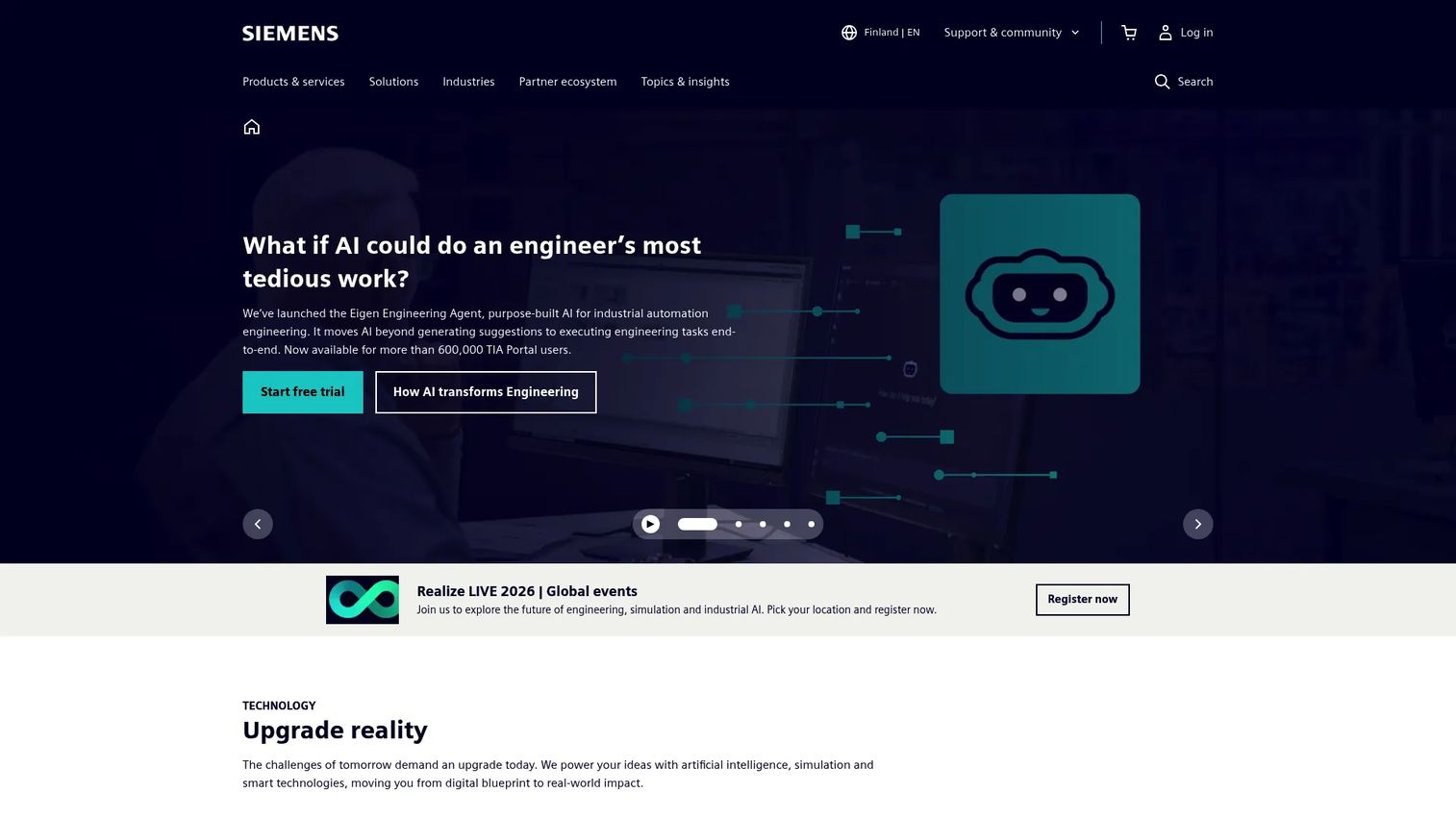
Siemens Supply Chain Suite is a modular logistics planning and optimization platform built for organizations whose bottleneck is the physical movement and storage of goods. It brings supply chain network visibility, network design, warehouse planning, and transportation planning together on one platform, with sustainability analysis layered across the flow. If your hardest problems are network shape and logistics cost, this is where the suite earns its keep.
Best for: Manufacturers and logistics-heavy enterprises that need end-to-end logistics optimization software across a complex physical network.
Key strengths
- Network and warehouse optimization: Plans and optimizes network design and warehouse operations so capacity, flow, and cost stay balanced.
- Transportation and freight rate management: Combines transportation planning with freight rate management to decide how goods move and at what cost.
- Sustainability analysis: Layers supply chain sustainability and CO2 tracking into logistics decisions, not as a bolt-on report.
Why choose Siemens Supply Chain Suite: Choose it when logistics is the center of gravity. The platform is strongest for teams optimizing warehouses, transportation lanes, and network design rather than teams whose primary need is demand forecasting. Its visibility and deviation detection give operations control over a distributed physical network, which is where large manufacturers feel the most pain.
Siemens Supply Chain Suite pricing: Siemens direct prospects to contact sales for a quote, which is standard for enterprise logistics platforms. Budget for implementation and integration alongside licensing, and expect scoping to depend on network complexity and module selection.
2. Siemens Software Supply Chain Suite (SCS)
Siemens Software Supply Chain Suite (SCS) is the modular, cloud-based framing of Siemens' logistics and planning capabilities, built around a holistic data model so each module reads from the same foundation. It appeals to teams that want to assemble capabilities one at a time, network optimization now, transportation and intralogistics optimization later, rather than commit to a monolith on day one. Simulation and what-if analysis run across the modules, which is the point of the shared model.
Best for: Large manufacturers and logistics teams that want modular supply chain software they can grow into rather than a single fixed deployment.
Key strengths
- Module-based architecture: Lets teams adopt network, transportation, and intralogistics optimization independently, so scope tracks the actual bottleneck.
- Holistic data model: Keeps every module reading from one data foundation, which is what makes cross-module simulation meaningful.
- Scenario management: Runs what-if analysis across modules so a change in one area reflects constraints in another.
Why choose Siemens Software Supply Chain Suite (SCS): The modular approach fits teams that want to prove value in one area before expanding. It performs best when you can sequence adoption and let each module earn the next, which also helps with the adoption drag that sinks big-bang rollouts. SaaS delivery and API integration keep it connected to the rest of your stack as you scale.
Siemens Software Supply Chain Suite (SCS) pricing: Pricing is not disclosed, which direct visitors to contact sales. Expect a quote shaped by module selection and deployment scope. As with any modular purchase, the total cost of ownership depends on how many modules you activate and how deeply you integrate them.
3. Flowlity
Flowlity takes an adoption-first, AI-native posture toward supply chain planning software. Instead of a broad logistics platform, it focuses on the planning decision loop: probabilistic demand forecasting, inventory optimization, and supply planning with constraints and collaboration. The bet is that a suite only works if planners trust it and use it daily, so Flowlity leans into forecast quality and usability. It holds a 4.9/5 rating on G2.
Best for: Mid-market teams that need AI-driven demand planning and inventory optimization planners will actually adopt.
Key strengths
- Probabilistic demand planning: Forecasts with probability ranges rather than single-point guesses, which sets more honest inventory targets.
- Inventory optimization: Balances service levels against carrying cost with recommendations planners can act on directly.
- Supply planning and collaboration: Handles capacity and constraints while keeping supply and demand teams working from the same plan.
Why choose Flowlity: Choose it when the bottleneck is planning quality and planner adoption, not physical logistics orchestration. Its closed-loop posture ties recommendations to execution feedback, so forecasts improve as reality lands. For teams that have been burned by planning tools nobody opened twice, the usability focus and strong G2 sentiment are the differentiators worth testing.
Flowlity pricing: Flowlity directs visitors to request a demo. Pricing is quote-based and scoped to your data and use case. When you evaluate total cost of ownership, weigh time-to-first-use heavily, because a planning tool that ramps fast and gets adopted returns value long before a broader suite finishes its rollout.
4. SAP Integrated Business Planning (IBP)

SAP Integrated Business Planning is SAP's cloud planning suite covering sales and operations planning, forecasting and demand planning, and response and supply planning. Its strongest argument is fit: if your master data, transactions, and ERP already live in SAP, IBP connects planning to execution without rebuilding integrations from scratch. It holds a 4.3/5 rating on G2.
Best for: Enterprises already invested in SAP that need connected demand, supply, and inventory planning.
Key strengths
- Sales and operations planning: Runs S&OP as a structured, recurring process rather than a quarterly spreadsheet exercise.
- Demand and supply planning: Combines forecasting with response and supply planning so plans stay aligned as signals change.
- SAP ecosystem fit: Connects planning to SAP transactional systems, which shortens integration work for existing SAP shops.
Why choose SAP Integrated Business Planning: The case is ecosystem gravity. For an SAP enterprise, IBP is the path of least integration resistance and brings enterprise governance and scale that large organizations require. It performs best when the surrounding stack is already SAP; teams on a mixed stack should weigh the integration reality against a more neutral planning tool.
SAP Integrated Business Planning pricing: SAP's pricing page directs visitors to request a demo. Pricing is quote-based and typically scoped by modules, users, and deployment. Factor implementation and the availability of SAP-experienced integrators into total cost, since those often dominate the first-year spend.
5. Oracle SCM Cloud
Oracle SCM Cloud is Oracle's broad cloud supply chain suite, spanning planning, manufacturing, logistics, procurement, and order management. It is one of the widest end-to-end offerings on this list, covering supply chain planning across demand, supply, and S&OP, execution across manufacturing and inventory, and order-to-cash workflows including global order promising and CPQ. It holds a 4.0/5 rating on G2.
Best for: Large organizations, especially existing Oracle shops, that want an integrated cloud SCM suite spanning planning and execution.
Key strengths
- Cloud suite breadth: Covers planning, manufacturing, inventory, procurement, and order management in one connected suite.
- Planning and execution workflows: Links supply chain planning to execution and order-to-cash so plans and operations share context.
- Enterprise integration: Connects with Oracle ERP and enterprise systems, easing data flow for organizations standardized on Oracle.
Why choose Oracle SCM Cloud: The breadth is the draw, and it is strongest for organizations already standardized on Oracle who want planning, execution, and order management under one roof. Scenario planning and analytics support decision-making across that scope. As with any suite this wide, adoption is the real project, so scope your rollout to the workflows that hurt most first.
Oracle SCM Cloud pricing: Oracle's public global price list shows related SCM service entries, but not one standalone number, so treat pricing as quote-based. Scope, modules, and user counts will drive the total, and implementation should be budgeted as a major line item.
6. Kinaxis RapidResponse
Kinaxis RapidResponse, now branded Maestro, is an AI-powered end-to-end supply chain orchestration platform built for speed of decision. Its concurrent planning model lets demand, supply, inventory, and order management update together, so a change in one area instantly reflects across the plan. That makes it a strong fit for teams that live in disruption and need to model responses fast. It holds a 4.0/5 rating on G2.
Best for: Enterprises that need concurrent planning and rapid scenario-based decision-making under frequent disruption.
Key strengths
- Concurrent planning: Updates demand, supply, inventory, and orders together so plans stay internally consistent in real time.
- Scenario planning and what-if analysis: Models disruptions and alternatives quickly, so teams can compare responses before committing.
- Real-time visibility: Surfaces supply chain visibility across the plan, turning disruption into a decision rather than a scramble.
Why choose Kinaxis RapidResponse: Choose it when decision speed under disruption is the core problem. Concurrent planning is the differentiator: instead of running planning cycles in sequence, everything recalculates together, which shortens the gap between a signal and a stakeholder-aligned response. It performs best for enterprises whose bottleneck is responsiveness rather than raw logistics network design.
Kinaxis RapidResponse pricing: Kinaxis directs visitors to request a demo. Pricing is quote-based and scoped to your planning footprint. Given the platform's focus on fast decision-making across functions, weigh how many teams will actually use it when you model total cost, since concurrent planning delivers most of its value when adoption is broad.
7. o9 Solutions
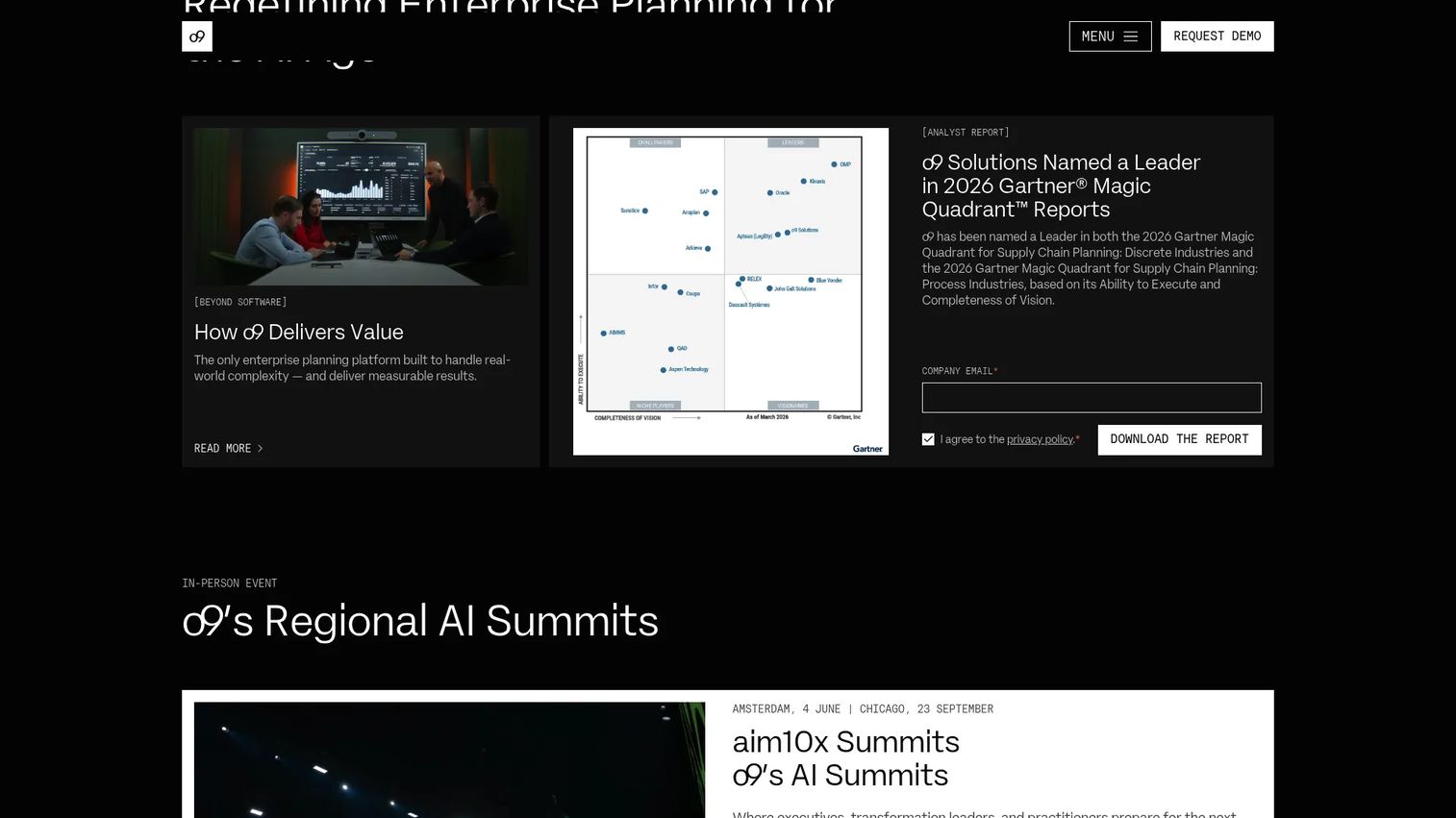
o9 Solutions positions itself as an enterprise planning platform built around a unified data model it calls a digital brain. It targets integrated planning across supply, demand, and commercial planning, with AI-driven modeling and scenario simulation on top. For large enterprises with complex, cross-functional planning needs, the appeal is one modeling environment that spans functions rather than a stack of disconnected planners.
Best for: Large enterprises that need cross-functional integrated planning and modeling across supply, demand, and commercial teams.
Key strengths
- AI-driven planning: Applies machine learning to forecasting and planning across functions on a shared data foundation.
- Scenario simulation: Runs what-if analysis and digital twin style modeling to test decisions before they hit operations.
- Unified data model: Connects supply, demand, and commercial planning so cross-functional plans stay coherent.
Why choose o9 Solutions: The draw is breadth of planning intelligence for complex enterprises. It performs best when the problem is fragmented planning across many functions and you want one modeling layer to unify them. That scope means a substantial implementation, so it fits organizations with the appetite and resources to invest in a platform that spans the planning stack.
o9 Solutions pricing: Pricing is quote-based and scoped to the number of planning use cases, functions, and users. Given the platform's enterprise scope, factor in a meaningful implementation and change-management investment when estimating total cost of ownership.
8. Blue Yonder Luminate
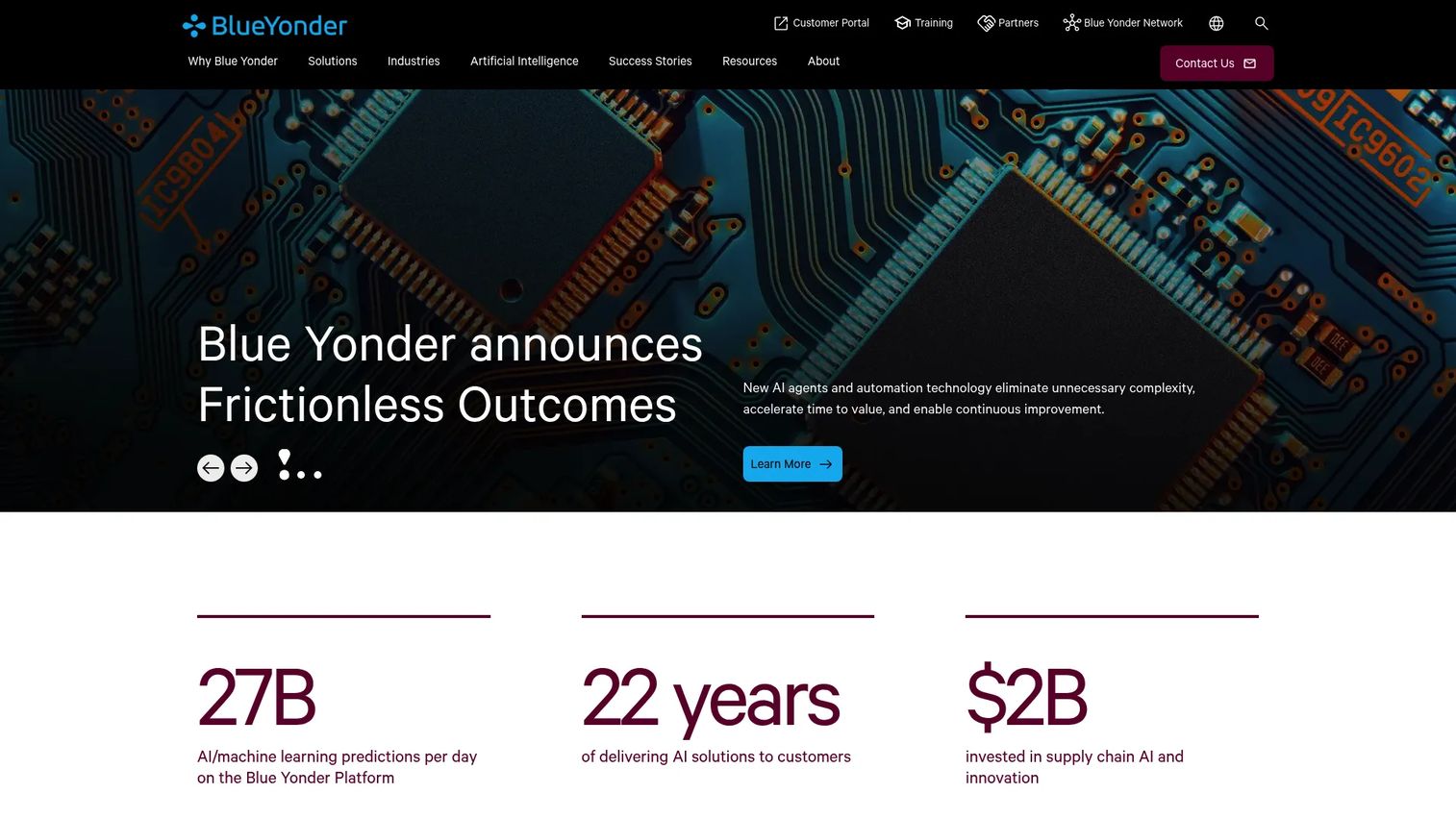
Blue Yonder Luminate is Blue Yonder's supply chain and retail software portfolio, built around planning, logistics, retail, and platform capabilities. It emphasizes AI and machine learning based planning and optimization, supply chain visibility, and orchestration across operations, with retail-specific strength in pricing, replenishment, and merchandising. That makes it a natural fit for large retail and manufacturing organizations running planning and execution at scale.
Best for: Large retailers and manufacturers that need enterprise planning and execution orchestration across the supply chain.
Key strengths
- Planning and execution orchestration: Coordinates planning with execution across operations so decisions and fulfillment stay connected.
- AI and ML optimization: Applies machine learning to planning and optimization at enterprise scale.
- Retail depth: Adds pricing, replenishment, and merchandising capabilities that matter for retail-heavy supply chains.
Why choose Blue Yonder Luminate: The portfolio is strongest where planning and execution need to work as one system at scale, particularly in retail and manufacturing. It performs best for enterprises that want optimization and orchestration under one umbrella rather than stitching planning and execution tools together. Given the breadth, plan the rollout around your highest-value workflows first and expand from there.
Blue Yonder Luminate pricing: Pricing is quote-based and scoped to the modules and scale you deploy. As with the other enterprise suites here, implementation and integration typically represent a significant share of first-year cost, so budget for the project, not just the license.
Considerations before you buy
Feature breadth is the easiest thing to compare and the least predictive of success. Use this checklist to pressure-test a shortlist against how your team actually works.
Integration reality
A suite is only as good as the data flowing into it. Confirm ERP integration, TMS integration, and API integration against your specific systems and versions, not a logo wall. Ask how the unified data model handles your master data, and how much custom work the vendor expects. Integration cost and timeline often dwarf licensing.
Adoption and time-to-value
The best suite is the one your team uses. Ask how long until planners and operators reach first meaningful value, and what the ramp looks like across roles. A modular rollout that proves value in one area beats a big-bang deployment that stalls in change management. Adoption drag is the quiet killer of supply chain software ROI.
Planning and simulation depth
Match depth to your bottleneck. If scenario planning and what-if analysis drive your decisions, test them on your real data, not a canned demo. Digital twin style modeling only helps if it reflects your network faithfully, so probe how the vendor builds and maintains that model.
Sustainability and reporting
CO2 tracking and sustainability reporting are moving from nice-to-have to decision criteria. If carbon sits alongside cost and service in your planning, confirm the suite treats sustainability as a native input, not a downstream report you assemble by hand.
Conclusion
There is no single best supply chain suite, only the best fit for where your team is actually stuck. Siemens Supply Chain Suite and its modular SCS framing fit logistics-heavy enterprises optimizing networks, warehouses, and transportation. SAP Integrated Business Planning and Oracle SCM Cloud make the most sense when you already run their ecosystem and want planning connected to execution. Kinaxis RapidResponse and o9 Solutions earn their place when planning intensity and fast scenario response are the core problem. Flowlity stands out for adoption-first, AI-native planning that mid-market teams will actually use. Blue Yonder Luminate suits retail and manufacturing running planning and execution at scale.
Shortlist based on your bottleneck, not the feature count. Name the one decision your team keeps getting wrong or slow, then test the two or three suites that target it directly on your own data. Feature breadth impresses in a sales deck. Adoption and decision quality are what show up in your numbers.
FAQs
A supply chain suite is an integrated software platform that combines planning, visibility, simulation, and execution across the movement of goods, from demand signals through inventory, transportation, and delivery. Unlike a single-purpose tool, a suite connects these functions on a shared data foundation so decisions in one area reflect constraints in another. The goal is faster, better-coordinated decisions across the end-to-end supply chain.
Prioritize integration with your existing ERP and TMS, planning and simulation depth matched to your bottleneck, supply chain visibility with early deviation detection, and realistic adoption fit for your team. Increasingly, CO2 tracking and sustainability reporting matter too. The most overlooked criterion is time-to-value: a suite nobody adopts returns nothing, regardless of feature breadth.
A point solution solves one job deeply, such as demand planning or route optimization. A suite connects many jobs on a shared data model so they inform each other. Suites win when your problem spans functions and disconnected tools are causing reconciliation drag. A point solution wins when one specific bottleneck needs more depth than any broad suite offers.
Yes. Scenario planning and what-if analysis are core to most modern suites, and several offer digital twin style modeling. These capabilities let you test network changes, supplier switches, inventory shifts, and freight reroutes virtually before committing. The value depends on how faithfully the model reflects your real network, so test simulation on your own data during evaluation.
For enterprise supply chain operations, ERP integration is usually table stakes. The suite needs clean master data and transactional signals to plan against, and that data typically lives in your ERP. Weak integration forces manual data movement, which undermines the visibility and decision speed the suite is supposed to deliver. Confirm integration against your specific ERP and version before buying.
Siemens Supply Chain Suite treats supply chain sustainability and CO2 tracking as native inputs to logistics decisions, which suits teams weighing carbon alongside cost and service. Broader planning platforms like o9 Solutions and Blue Yonder Luminate also increasingly embed sustainability metrics. The best fit is whichever suite treats sustainability as a planning input rather than a report you assemble after the fact.
It depends on your appetite for sequencing. Modular supply chain software, like the Siemens SCS framing, lets you adopt one capability at a time and prove value before expanding, which eases adoption. A more unified suite can offer tighter integration out of the box. The tradeoff is scope and adoption pace against integration effort, so match the shape to how your team can realistically roll out change.
Nearly every suite in this category uses quote-based pricing, so expect "custom" and budget beyond the license. Implementation, integration, and change management often exceed first-year licensing, especially for broad platforms. Evaluate total cost of ownership across a multi-year horizon, and weigh time-to-value heavily, because a suite that ramps fast and gets adopted returns value long before a slower, broader deployment does.