A clinical trial can look perfectly on track until someone asks for the missing documents, the approval history, and proof that the sponsor retained meaningful oversight throughout.
Shared drives and disconnected CRO handoffs create a visibility problem that does not announce itself until an inspection, an audit, or a due diligence review forces the question. By then, the manual reconciliation work is expensive, stressful, and sometimes impossible to complete cleanly. The global eTMF systems market was valued at $1.36 billion in 2025, according to MarketsandMarkets, reflecting how many organizations have already moved past spreadsheet-managed file plans. Yet 78% of surveyed organizations still use an eTMF system to manage TMF content rather than more modern approaches, per the 2025 State of TMF Industry Report - which means the buying decision is real and consequential.
eTMF software is evaluated on more than document storage. Sponsors need TMF completeness monitoring, controlled workflows, audit trails, and a setup model their clinical team can run after the implementation partner leaves. This guide helps you build a practical shortlist without a multi-quarter systems project.
What's inside
This guide compares seven eTMF platforms for clinical trial sponsors managing growing study portfolios. Every tool was evaluated against four criteria:
- Inspection readiness: Expected-document logic, completeness dashboards, and audit-trail depth
- Sponsor oversight: Cross-study visibility, CRO collaboration controls, and document exchange
- Implementation reality: Configuration ownership, migration support, and validation approach
- Integration fit: Native or documented connections to CTMS, EDC, and eSignature systems
The guide also covers when a standalone eTMF fits better than a fully integrated suite, and what to verify before you sign.
TL;DR
- Best for large, suite-based clinical operations: Veeva eTMF, particularly when CTMS and other clinical applications share the same platform
- Best for teams standardized on Medidata: Medidata eTMF reduces manual handoffs when Rave EDC and CTMS are already central to study operations
- Best for lean sponsor teams with a growing study portfolio: Viedoc eTMF Software offers configurable oversight without a heavy implementation footprint
- Best for document-intensive clinical programs: Trial Interactive eTMF, with AI-powered classification and real-time completeness dashboards
- Best for site-connected workflows: Florence eTMF, especially when site document exchange creates the most TMF risk
- Best for broad enterprise clinical infrastructure: Oracle Life Sciences eTMF for organizations already running Oracle clinical products
- Best for configurable regulated content: Montrium eTMF Connect when quality-system governance matters as much as clinical operations fit
What is eTMF software?
eTMF software is a regulated document management system that organizes, controls, tracks, and preserves the essential records required to demonstrate that a clinical trial was planned, conducted, monitored, and closed appropriately.
Unlike a generic file repository, an electronic trial master file system structures records around the trial lifecycle. It does not just store files. It enforces document expectations, tracks completeness against a configurable file plan, and generates the audit-trail evidence an inspector or auditor needs to reconstruct what happened and when.
What an electronic trial master file includes
An eTMF manages the structure and lifecycle of records across the full study arc:
- Protocols and amendments
- Investigator brochures and site qualification documents
- Informed consent records
- Monitoring reports and visit logs
- Site documents and delegation logs
- Safety and regulatory correspondence
- Training evidence and certification records
- Study closeout documentation
Core eTMF software capabilities
Purpose-built eTMF platforms deliver capabilities that a shared drive or generic document management system cannot replicate:
- Configurable file plan aligned to the DIA TMF Reference Model
- Metadata, document versioning, and controlled access by role
- Audit trails, approval workflows, and quality-control queues
- TMF completeness, timeliness, and quality dashboards
- Sponsor, CRO, and site collaboration with defined permissions
- Integration with CTMS, EDC, eSignature, and clinical data systems
- Document exchange, transfer, and archival support
- Migration and validation controls
eTMF software versus a document repository
| Capability | Shared drive or generic DMS | eTMF software |
|---|---|---|
| TMF reference-model structure | Manual folders | Configurable file plan |
| Completeness tracking | Manual reconciliation | Expected-document logic and dashboards |
| Audit trail | Inconsistent | Designed for controlled records |
| Sponsor oversight | Fragmented | Cross-study visibility |
| CRO collaboration | Email and exports | Role-based workflows and document exchange |
| Inspection preparation | Manual compilation | Searchable evidence and traceability |
An eTMF supports operational discipline, but does not independently make a sponsor compliant with any regulation. The platform provides structure; your SOPs, ownership model, and governance decisions determine whether that structure holds up under scrutiny.
When to use eTMF software
Replace fragmented sponsor and CRO document exchange
Document status lives across shared drives, partner systems, email threads, and weekly reconciliation calls. That fragmentation is not a workflow inconvenience. It is a visibility gap that shows up on inspection day. An eTMF creates a controlled source of truth with clear ownership and role-based access, so sponsors can see study status without asking.
Prepare for inspection readiness before closeout
Teams that wait until study close to assess TMF gaps face the worst version of the problem. Real-time completeness dashboards, expected-document lists, and quality-control workflows let operations teams identify and resolve gaps while the study is active, not after.
Connect trial documents to operating data
A growing sponsor benefits when study milestones, sites, documents, and operational data are connected through CTMS and EDC integrations. Integrated suites reduce reconciliation work at the cost of a larger implementation commitment. Standalone eTMF tools fit organizations with an established clinical stack that prefer to add a purpose-built layer rather than replace surrounding systems.
eTMF software comparison
A good eTMF decision starts with the operating model. A sponsor managing a few outsourced studies has different needs from an organization standardizing global clinical operations across multiple therapeutic areas.
Every vendor in this category sells through quote-based annual contracts. Contract drivers typically include study portfolio size, user access, modules, integrations, validation services, and migration scope. The table below reflects verified pricing posture as of October 2026.
| # | Product | Best for | Key differentiator | Pricing | G2 rating |
|---|---|---|---|---|---|
| 1 | Veeva eTMF | Enterprise sponsors and CRO networks | Integrated clinical operations platform with Expected Document Lists and TMF automation | Quote-based annual contract | 4.1/5 |
| 2 | Medidata eTMF | Teams standardized on Medidata Rave and CTMS | Connected eTMF within Medidata's clinical data and operations environment | Quote-based annual contract | 4.5/5 |
| 3 | Viedoc eTMF Software | Lean and mid-market sponsors | Configurable eTMF with study-based licensing and no per-seat fees | Quote-based, study-based licensing | 4.5/5 |
| 4 | Trial Interactive eTMF | Document-intensive clinical programs | AI-powered classification with real-time completeness dashboards | Quote-based annual contract | Not yet verified on G2 |
| 5 | Florence eTMF | Site-connected trial operations | SiteLink integration for sponsor-site document exchange | Quote-based annual contract | 5.0/5 (1 review) |
| 6 | Oracle Life Sciences eTMF | Large enterprise clinical ecosystems | Part of Oracle's broader clinical operations and CTMS portfolio | Quote-based annual contract | Not verified on G2 |
| 7 | Montrium eTMF Connect | Regulated teams needing quality-aligned workflows | Essentials and Growth tiers with inspector portal and TMF archiving built in | Quote-based (Essentials and Growth tiers) | 0 G2 reviews; 4.0/5 on Capterra (1 review) |
Best 7 eTMF software platforms for clinical trial sponsors in 2026
1. Veeva eTMF
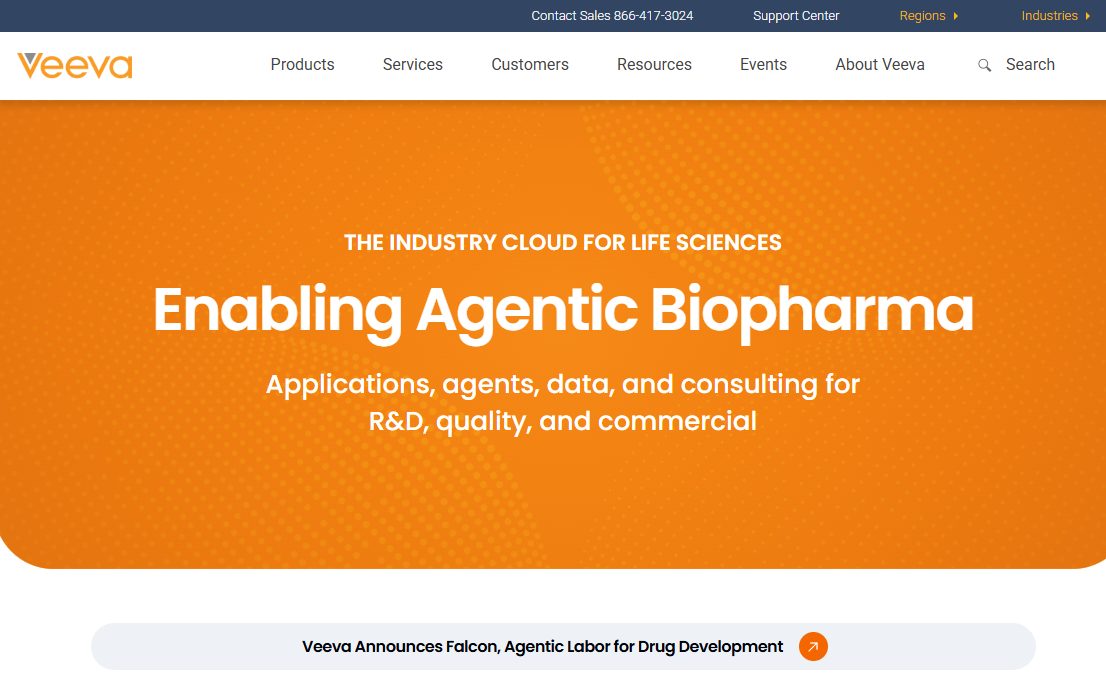
Veeva eTMF is a cloud-based electronic trial master file platform built on Veeva Vault, a purpose-designed content management infrastructure for life sciences. It manages document upload, version control, QC workflows, and approval routing alongside automated content classification and completeness tracking. Sponsors use it across complex global trials involving multiple CROs and investigator networks.
Best for: Life-sciences sponsors and CROs managing complex trials that need eTMF, CTMS, and related clinical workflows on a common platform.
Key features
- Expected Document Lists with automated content classification and matching
- TMF Bot for document classification and metadata extraction
- Risk-based document quality control with full audit-trail traceability
- Real-time collaborative authoring with Microsoft Office Online integration
- TMF Transfer for sponsor-CRO document exchange at study closeout
- Completeness reporting, timeliness tracking, and archival dashboards
Why choose Veeva eTMF: Veeva fits organizations that want to reduce manual reconciliation between eTMF and other clinical systems. When teams adopt connected Vault applications for CTMS and safety, document-level and study-level data share the same platform, which reduces the risk of version mismatches at closeout.
Veeva eTMF pricing: Veeva sells through quote-based enterprise agreements. Contract terms depend on study portfolio size, modules selected, user access, migration scope, and professional services. Request a full first-year and three-year cost view that includes configuration, validation, and implementation.
G2 rating: 4.1/5 on G2, verified October 2026
2. Medidata eTMF

Medidata eTMF is an electronic trial master file solution designed for organizations that already use Medidata's clinical data and trial management products. The platform automates document filing and metadata population, supports the DIA TMF Reference Model, and provides real-time dashboards for completeness, timeliness, and inspection readiness. Its strongest argument is the reduction of manual handoffs between study operations data and TMF records when Rave EDC and CTMS are already in use.
Best for: Clinical teams standardized on Medidata products that want less duplicate configuration and fewer reconciliation steps between systems.
Key features
- Automated document filing workflows integrated with Rave EDC and Medidata CTMS
- Metadata population and auto-naming on document ingestion
- DIA TMF Reference Model support
- Advanced search by content, title, and metadata
- Real-time dashboards for quality, timeliness, and completeness
Why choose Medidata eTMF: The case is strongest when Medidata is already central to clinical data capture. Organizations that run Rave EDC and CTMS on Medidata can reduce the configuration overhead of a separate eTMF vendor. If the organization does not use other Medidata products, the ecosystem advantage disappears and a purpose-built standalone eTMF may offer a cleaner implementation.
Medidata eTMF pricing: Commercial terms are quote-based and should be evaluated alongside any existing Medidata agreement. Ask vendors to price licenses, integration scope, implementation, validation, migration, and support separately so total first-year cost is visible before you sign.
G2 rating: 4.5/5 on G2
3. Viedoc eTMF Software
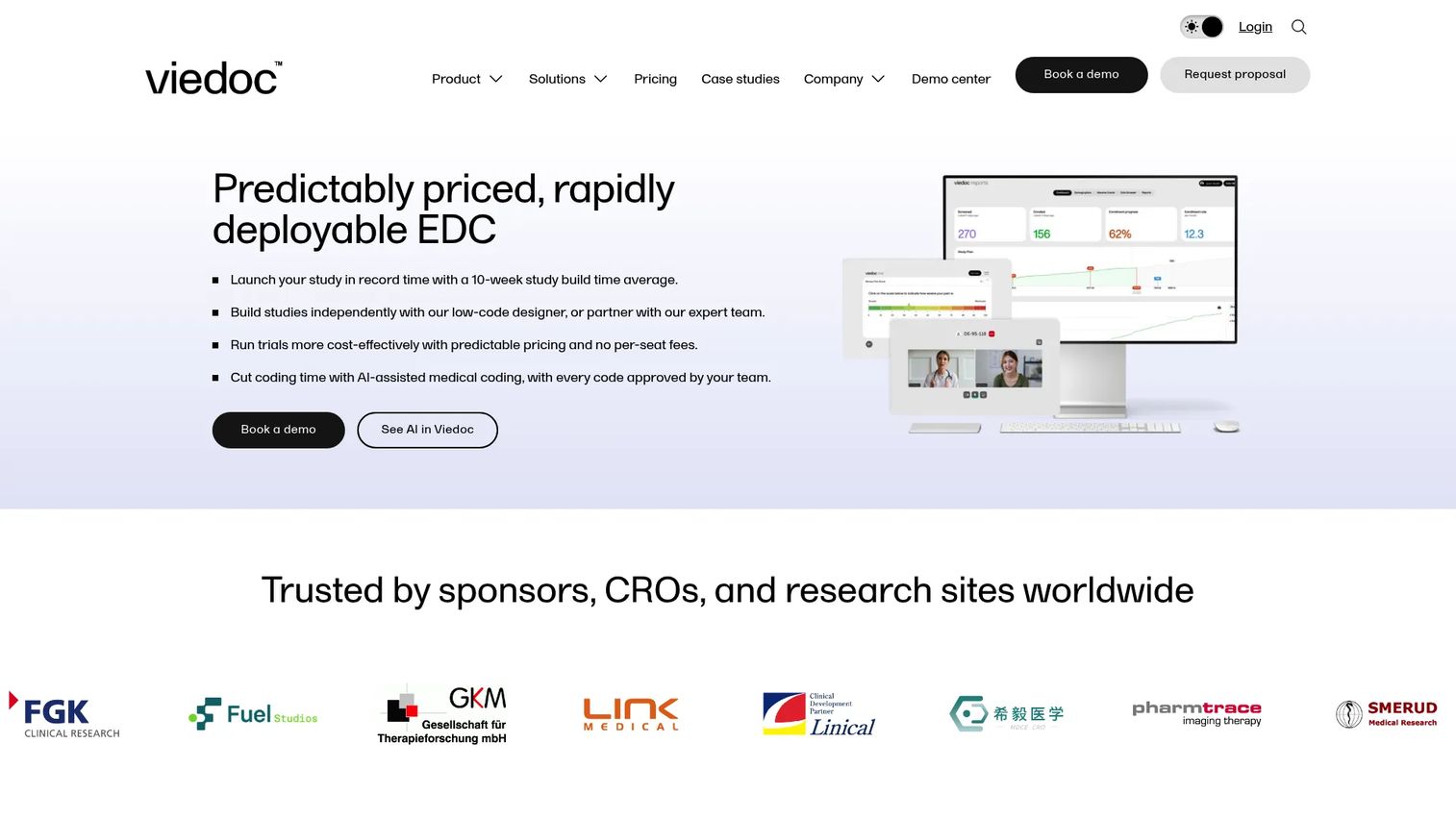
Viedoc eTMF Software is a secure, role-based electronic trial master file system for managing clinical trial documentation within the broader Viedoc eClinical suite. It supports the TMF Reference Model and Exchange Mechanism Standard, with customizable eTMF structure management and complete audit-trail reporting. Viedoc describes a study-based licensing model with unlimited users and no per-seat fees, which changes the total-cost math for teams expecting significant user growth.
Best for: Clinical research sponsors and CROs that need compliant, searchable, role-based TMF management without a heavy implementation footprint.
Key features
- Integration with the Viedoc eClinical Suite
- TMF Reference Model and Exchange Mechanism Standard support
- Customizable eTMF structure and document workflows
- Role- and permission-based TMF archiving
- Complete audit-trail reporting and document status indicators
- Document review, locking, preview, search, filtering, and annotation
Why choose Viedoc eTMF Software: Viedoc suits growing sponsors that want operational oversight without a system footprint that overwhelms a lean clinical team. The unlimited-user pricing model matters when study teams, CROs, and site staff all need access, since per-seat costs compound quickly across a multi-site trial. Confirm who configures the file plan, how quickly users can work independently, and what implementation support costs beyond the subscription.
Viedoc eTMF Software pricing: Viedoc uses study-based licensing with no public numeric prices. Contact Viedoc sales to get pricing for both the Single Study and Multiple License models, and ask specifically about configuration services, validation support, and migration assistance.
G2 rating: 4.5/5 on G2
4. Trial Interactive eTMF
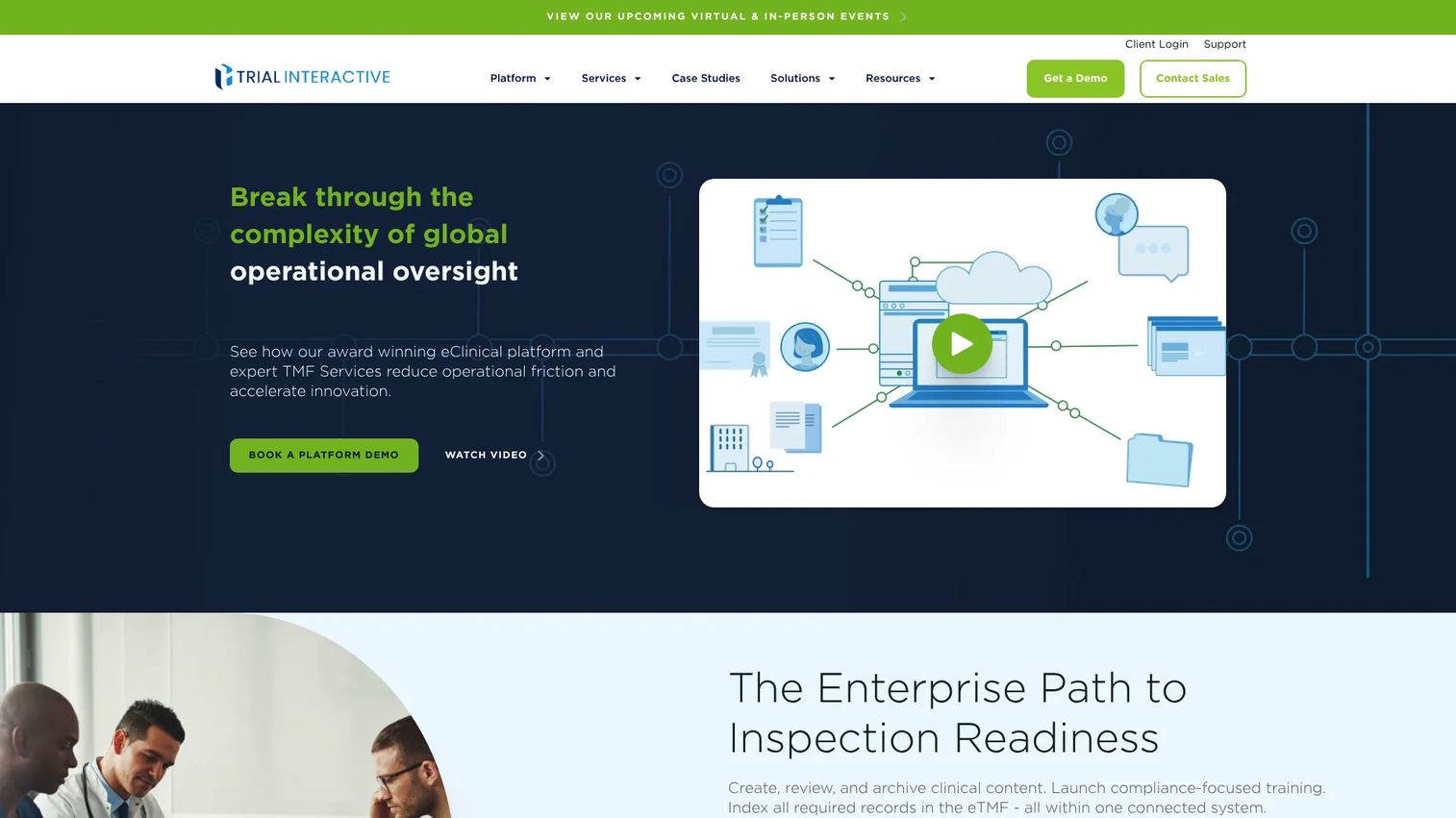
Trial Interactive eTMF is an AI-powered electronic trial master file platform for clinical trial document management, workflow automation, and inspection readiness. The platform uses AI-assisted record classification and metadata extraction to reduce manual filing work, and provides real-time TMF completeness and inspection-readiness dashboards. A mobile document capture capability called myTI supports CRA reconciliation in the field.
Best for: Pharmaceutical, biotech, and CRO teams managing document-intensive clinical programs that need automated classification alongside structured completeness tracking.
Key features
- AI-powered record classification and metadata extraction
- Real-time TMF completeness and inspection-readiness dashboards
- Mobile document capture and CRA reconciliation through myTI
- Workflow automation for QC, placeholders, queries, and milestones
- 21 CFR Part 11, Annex 11, GxP, GDPR, and audit-trail support
Why choose Trial Interactive eTMF: The AI classification layer is relevant when document volume is high enough that manual filing creates a backlog before completeness assessments are useful. Evaluate it when document management is the immediate operational bottleneck and you need structured collaboration across sponsors, CROs, and site teams without replacing every surrounding clinical system at once.
Trial Interactive eTMF pricing: Pricing requires a demo or sales engagement; no public numeric price is available on the vendor's website. When requesting a quote, ask for a per-study and portfolio estimate that includes workflow configuration, validation services, migration support, and training. Request a demo at trialinteractive.com.
5. Florence eTMF
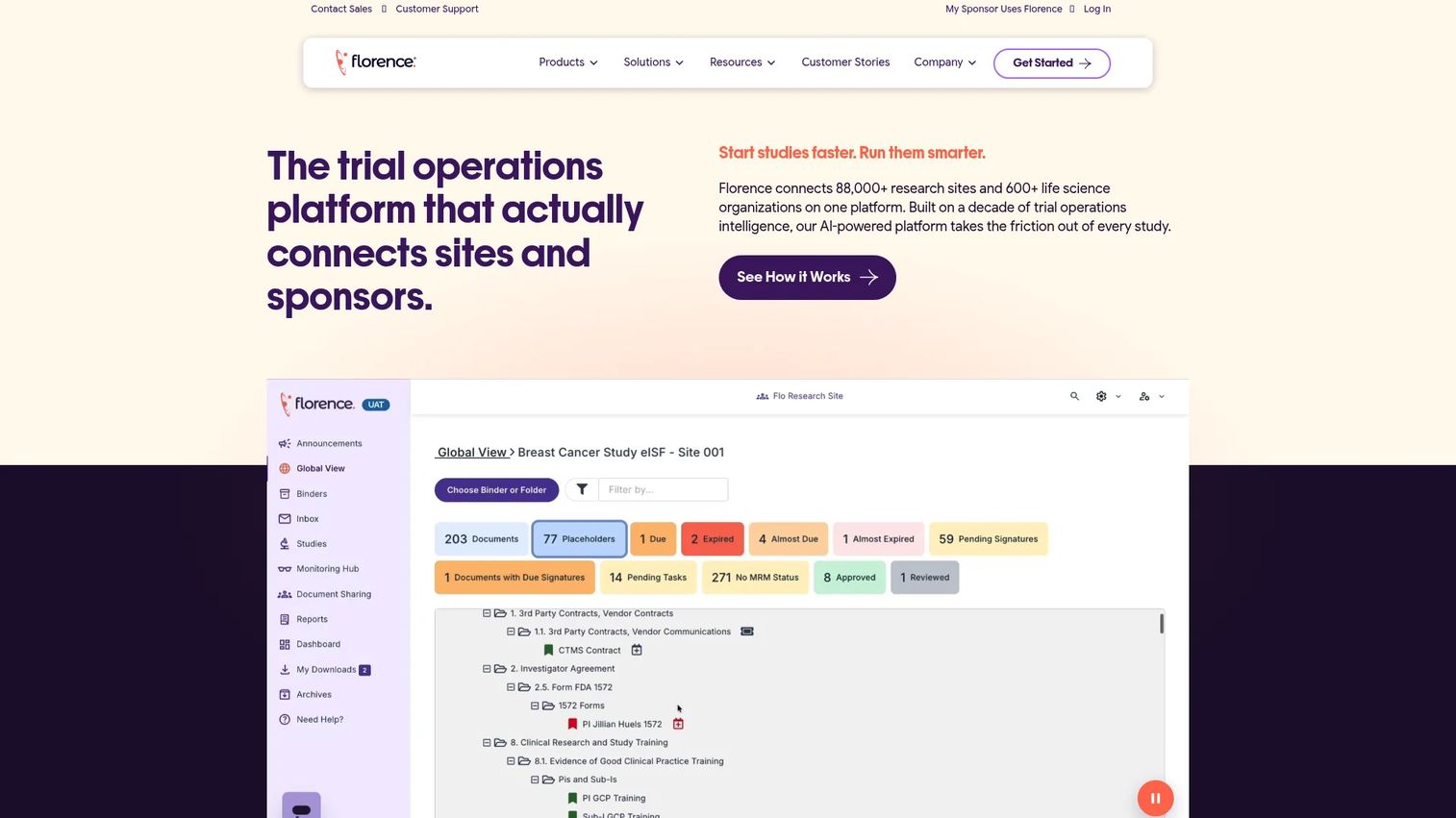
Florence eTMF is a cloud-based electronic trial master file platform focused on sponsor-site document coordination. Its SiteLink capability connects sponsor eTMF workflows to electronic investigator site files, which reduces the document exchange friction that creates TMF gaps at multicenter trials. The platform supports document creation, editing, signing, collection, and review alongside workflow automation and completeness dashboards.
Best for: Sponsors and CROs where site participation and site document exchange create the biggest TMF completeness risk.
Key features
- Document creation, editing, signing, collection, and review
- SiteLink integration for eISF and sponsor document exchange
- Workflow automation with dashboards and reporting
- Role-based collaboration for sponsor and site users
- Controlled document collection from investigator sites
Why choose Florence eTMF: Florence fits when site friction is the primary source of TMF risk. If missing or delayed site documents regularly delay completeness assessments, a platform built around sponsor-site coordination reduces the turnaround time and gives sponsors earlier visibility into outstanding records. Ask whether the platform reduces site document burden or simply shifts where work happens.
Florence eTMF pricing: Florence uses custom pricing based on organization size and study profile. Contact Florence sales at florencehc.com for a quote, and confirm whether modules such as SiteLink are included in the base agreement or priced separately.
G2 rating: 5.0/5
6. Oracle Life Sciences eTMF
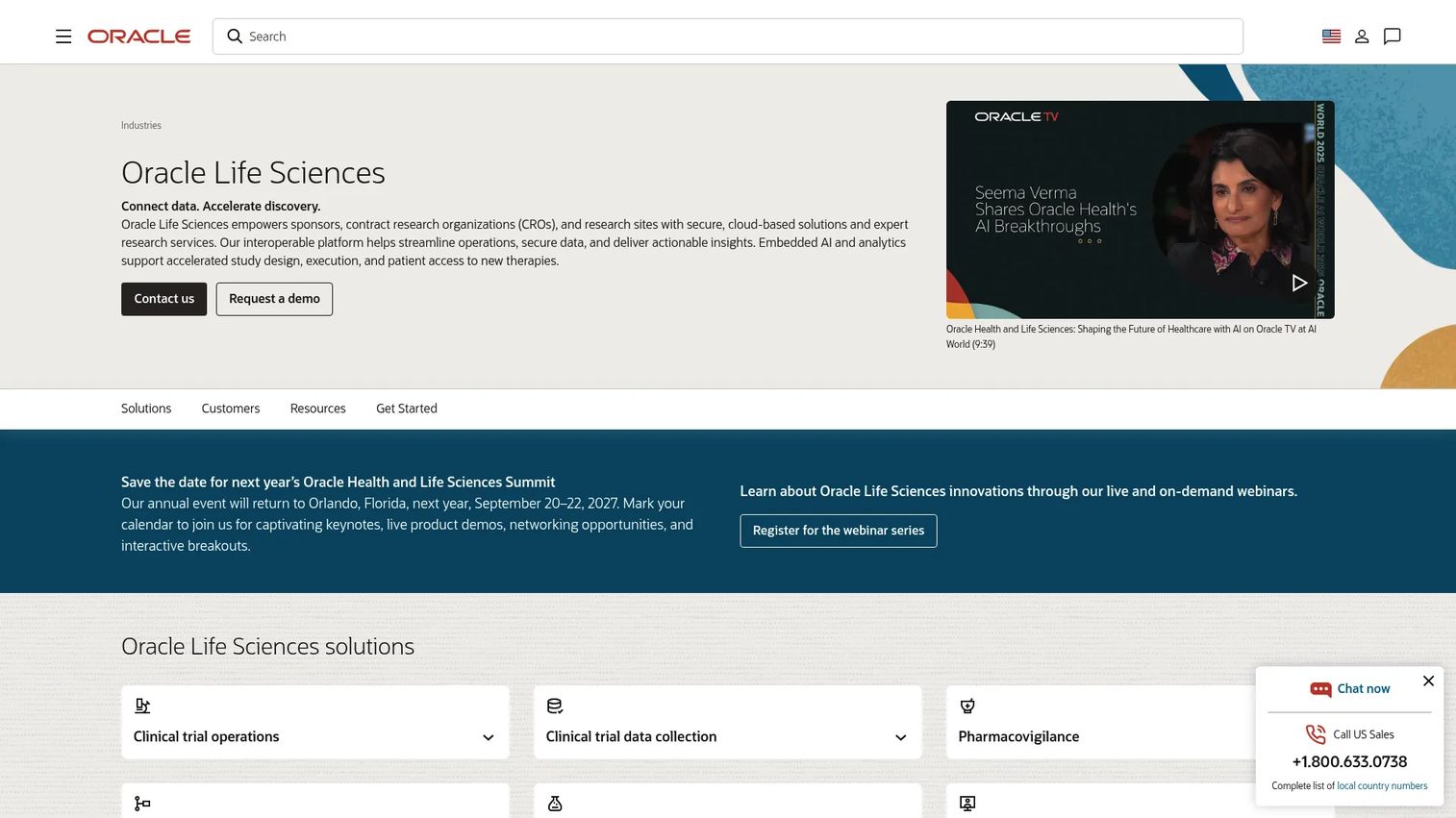
Oracle Life Sciences eTMF is a cloud-based electronic trial master file solution for organizing, managing, and accessing essential clinical trial documentation. It supports the CDISC TMF Reference Model v3.3.1, provides document metadata controls and permission management, and connects to Oracle's broader clinical trial management and site systems. Organizations already running Oracle Clinical One or other Oracle clinical products have the strongest argument for including it on a shortlist.
Best for: Enterprise sponsors that need eTMF within a large clinical operations and data management estate already aligned to Oracle.
Key features
- Centralized cloud repository for essential clinical trial documents
- Document metadata attributes and permission controls
- Support for the CDISC TMF Reference Model v3.3.1
- Document workflows, versioning, and audit-readiness support
- Integration capabilities with Oracle trial management and site systems
Why choose Oracle Life Sciences eTMF: Oracle belongs on a shortlist when an organization already runs Oracle clinical products or has enterprise architecture requirements that favor vendor consolidation. The total ownership cost picture is critical: A broader suite can simplify vendor management, but the implementation and governance commitment must match the near-term study portfolio, not a future state that may not arrive within the current contract term.
Oracle Life Sciences eTMF pricing: Oracle sells through enterprise agreements; no public pricing is available. Request a full scope that covers subscription fees, environments, integrations, validation, migration, training, support, and minimum contract terms before comparing to standalone alternatives.
7. Montrium eTMF Connect
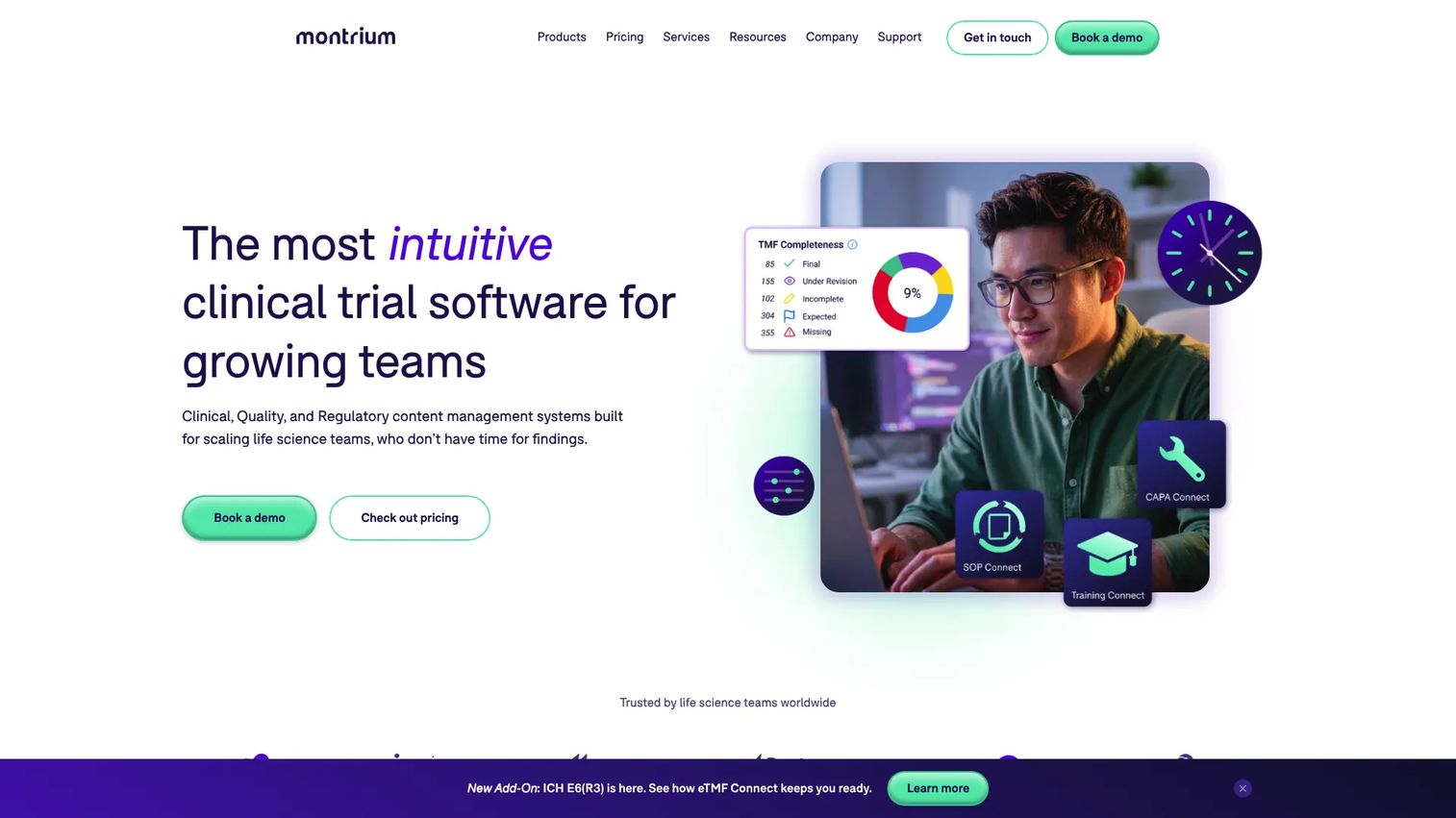
Montrium eTMF Connect is a cloud-based electronic trial master file platform for growing pharmaceutical, biotechnology, CRO, and clinical research organizations. It offers TMF Reference Model-aligned study structures, real-time completeness reporting, configurable review and approval workflows, and a built-in inspector portal that gives authorized reviewers direct access to trial documentation. Montrium publishes two tiers: Essentials (up to 10 users, 100GB storage) and Growth (unlimited users, 200GB storage, expanded workflow and reporting capabilities).
Best for: Clinical and quality teams that need configurable regulated content workflows alongside eTMF, with a structured tier model that grows as the portfolio grows.
Key features
- TMF Reference Model-aligned study structures and document indexes
- Real-time completeness reporting and inspection-readiness monitoring
- Configurable review and approval workflows
- Batch upload, indexing, and auto-filing
- Role-based access controls, audit trails, and version history
- Investigator site file repository and site document inbox
- 21 CFR Part 11 and Annex 11 electronic signatures
- Built-in TMF archiving and inspector portal
Why choose Montrium eTMF Connect: Montrium suits organizations where quality-system governance and configurable document workflows matter alongside clinical operations fit. The published tier structure (Essentials and Growth) gives buyers a clearer starting point for budget conversations than a fully opaque quote process. A proof-of-fit workshop before buying helps confirm the team can model its SOPs without creating an administrative maintenance burden.
Montrium eTMF Connect pricing: Both Essentials and Growth tiers require requesting pricing from Montrium at montrium.com/pricing. Ask specifically about document volume, additional storage, validation services, implementation, and support costs beyond the base subscription.
G2 rating: No G2 user reviews are available for Montrium eTMF Connect at time of publication. Capterra reports a 4.0/5 from a single review. Treat both as thin data points and weight peer references more heavily.
Considerations when choosing eTMF software
Match the operating model before comparing feature lists
Decide whether the sponsor will own the eTMF, rely on a CRO-operated system, or run a hybrid model. The software must support the required degree of sponsor oversight, partner access, and document exchange before any other evaluation criteria matters.
Test TMF completeness and quality workflows with your own scenario
Ask vendors to demonstrate missing-document logic, expected-document lists, dashboard filtering, overdue workflows, quality checks, and document lifecycle history using a real study from your portfolio. Screenshots confirm capability exists. A live walkthrough with your scenario confirms it works the way your team needs it to.
Map integrations to real document handoffs
List every system in your clinical stack that creates, receives, or references trial documents. Include your clinical trial management software, EDC, eSignature, site systems, safety database, and data repositories. Then identify which integrations are native, which require configuration, and which require custom development.
Price the implementation separately from the subscription
A contract covers subscription fees plus migration, validation, configuration, training, integrations, and ongoing administration. Require a first-year and three-year total-cost view. A tool that looks affordable on a per-study basis can become expensive when professional services and validation costs are added.
Confirm the migration and change-management plan before signing
Ask for a documented approach to metadata cleanup, legacy document mapping, file-plan governance, historical audit evidence, user training, testing, and go-live support. Implementation quality varies significantly across vendors. Reference customers who completed a migration similar to yours are more informative than a vendor-provided timeline estimate.
Conclusion
The eTMF decision is not primarily about feature lists. It is about which platform gives your clinical team inspection-ready oversight, a workable implementation path, and enough integration depth for the study portfolio you will run over the next three years.
For large, connected clinical operations: Veeva eTMF. For teams standardized on Medidata: Medidata eTMF. For growing sponsor teams that want configurable oversight without a heavy footprint: Viedoc eTMF Software. For document-intensive programs needing automated classification: Trial Interactive eTMF. For sponsors where site document exchange drives TMF risk: Florence eTMF. For broad enterprise clinical infrastructure: Oracle Life Sciences eTMF. For configurable regulated content with a structured tier model: Montrium eTMF Connect.
The practical next step: Build a two-vendor shortlist, run the same document-completeness scenario in both systems, and compare the full first-year implementation cost before you sign. Also see our guides on audit management software and best component content management systems for related regulated content decisions.
FAQs
eTMF software is a regulated document management system that organizes, controls, and preserves the essential records required to demonstrate that a clinical trial was planned, conducted, monitored, and closed appropriately. It goes beyond file storage to include structured filing against a configurable file plan, expected-document logic, completeness dashboards, audit-trail workflows, and sponsor and CRO collaboration tools.
A generic document management system stores and shares files. eTMF software adds the clinical trial-specific structure, expected-document logic, quality workflows, sponsor oversight visibility, and TMF Reference Model support that regulated trial documentation requires. The audit-trail depth and completeness tracking are the capabilities that a general-purpose DMS does not provide out of the box.
The DIA TMF Reference Model is widely used across the industry to standardize trial master file structure. Regulators reference it in inspection guidance, and most eTMF vendors use it as the baseline for their file plan templates. Buyers should confirm which model version the platform supports, how easily the organization can govern study-specific configuration, and whether updates to the reference model require vendor involvement or can be managed internally.
Most eTMF vendors use quote-based annual agreements, so there is no published price list. Contract value typically depends on study volume, user count, modules, integrations, validation services, migration scope, storage, and support tier. To compare platforms honestly, request first-year total cost and three-year total cost from each vendor, including all professional services.
Timeline depends on file-plan design, SOP maturity, migration scope, integration complexity, validation requirements, and partner onboarding. A greenfield implementation with limited legacy document migration can move faster than a migration from an existing system with years of study records. Ask each vendor for a phased plan that breaks out configuration, testing, training, and go-live milestones, and ask for reference customers who completed a comparable scope.
Yes. Many eTMF platforms connect to clinical trial management software and EDC systems, but integration depth varies considerably. Some connections are native and maintained by the vendor; others require custom configuration or third-party middleware. Ask vendors to demonstrate a realistic CTMS or EDC handoff, confirm whether the integration preserves consistent metadata, and verify whether changes to either system require re-validation of the integration.
Sponsor ownership gives stronger oversight and long-term control over trial documentation. A CRO-managed model reduces internal administration but can limit the sponsor's real-time visibility and make inspection preparation dependent on the CRO's responsiveness. A hybrid model can work when governance, document exchange protocols, and access rights are clearly defined in advance. The wrong answer is assuming the CRO's system provides adequate sponsor oversight without testing that assumption during a vendor evaluation.
A structured demo request should cover the following points:
- Show missing-document and overdue-document workflows using a real study scenario
- Show document version history and full audit trail for a specific record
- Show sponsor, CRO, and site permission controls and how they are configured
- Demonstrate a realistic CTMS or EDC document handoff
- Explain migration, validation, and implementation ownership in detail
- Provide a first-year cost estimate with professional services included
The demo walkthrough using your own study scenario is more informative than a vendor-scripted product tour. If the vendor cannot replicate your file plan in the demo environment, that tells you something important before you commit.