You run three studies across nine sites. Enrollment is behind at two of them. A monitoring visit is due next week, and the only record of it lives in someone's calendar. Your budget tracker is a spreadsheet that three people edit at once. When a sponsor asks for a status update, you spend an afternoon stitching answers together from email, shared drives, and memory.
That is the daily reality clinical trial management software was built to fix. A clinical trial management system, or CTMS, centralizes the operational side of a study, the sites, subjects, visits, milestones, documents, and money, so the whole team works from one record instead of a dozen scattered ones.
The stakes keep rising. The global CTMS market is projected at USD 2.56 billion in 2026, growing to USD 7.28 billion by 2035 at a 12.36% CAGR, according to Precedence Research (2025). Software components alone account for roughly 71.6% of that market in 2026, per Coherent Market Insights (2026), a signal that trials are getting more complex and teams are digitizing the work that used to live in spreadsheets and binders.
The problem is that "CTMS" covers a wide range of products. Some are built for research sites. Some are enterprise suites for sponsors and CROs. Some blur into adjacent categories like EDC or eTMF. If you pick the wrong operational model, you inherit workflows that fight your team instead of supporting it. Picking well means understanding lifecycle coverage, compliance controls, integrations, and how the system actually reports. The same clear-headed comparison applies to any regulated stack, whether you are evaluating audit management software or contract lifecycle management tools.
What's inside
This guide is for clinical operations leaders, research site managers, study coordinators, sponsors, and CRO teams who are comparing CTMS vendors and want a decision, not a glossary.
We built the shortlist around five criteria that separate a CTMS you tolerate from one you rely on:
- Lifecycle coverage from study startup through study closeout
- Compliance controls including 21 CFR Part 11, audit trail, and electronic signatures
- Integrations with EDC, eTMF, EMR, and financial systems
- Reporting and analytics depth, from dashboards to portfolio views
- Operational usability for the people running the work day to day
Each entry below explains where the tool fits, so you can pattern-match to your own operational model.
TL;DR
- Best for research sites and site networks: RealTime CTMS and Advarra, both built around site operations, scheduling, and financials.
- Best for enterprise sponsors and CROs: Veeva Vault Clinical and IQVIA, both offering end-to-end lifecycle orchestration.
- Best for teams wanting published, predictable pricing: SimpleTrials, a subscription CTMS and eTMF starting at $599/month.
- Best for a modern platform approach: Curebase, which connects CTMS thinking to decentralized and unified trial workflows.
- Best when EDC is the center of gravity: Medidata Rave, an enterprise data-capture platform that anchors the broader clinical data stack.
- Start here if you are new to the category: read the baseline CTMS explainer first, then compare vendors against your integration and compliance needs.
What clinical trial management software is
Clinical trial management software (CTMS) is a system that centralizes the operational data of a clinical study, sites, subjects, visits, documents, milestones, and finances, into a single source of truth across the trial lifecycle.
Think of it as the operational hub for research operations. Where an EDC captures patient data and an eTMF stores regulated documents, a CTMS tracks the study administration itself: who is enrolled, which sites are activated, when monitoring visits happen, and whether the budget is on track. It connects sponsors, CROs, sites, and study teams around one shared record.
Core capabilities of a CTMS
Most clinical trial management systems cover some or all of the following:
- Study startup and activation: site selection, contracts, and budgets, and regulatory startup tracking
- Site and subject tracking: enrollment, visit status, and screen-fail and retention metrics
- Calendars and monitoring: visit scheduling, monitoring plans, and task management
- Document and eTMF workflows: version control, eRegulatory, and document routing
- Reporting and analytics: dashboards, exports, and portfolio-level oversight
- Financial and billing support: protocol billing, participant payments, and accruals
- Compliance controls: 21 CFR Part 11 support, audit trail, electronic signatures, and access controls
- Integrations: EDC integration, EMR, eIRB, and payment and accounting systems
CTMS as an operational hub
The value of a clinical research management system is not any single feature. It is the single source of truth. When enrollment counts, visit status, document readiness, and budget accruals all live in one system, the whole team stops reconciling versions and starts making decisions.
That matters most across handoffs. A sponsor sees portfolio-level progress. A CRO sees site performance. A coordinator sees today's visits. Everyone works from the same data, updated in real time, which is where the operational payoff comes from. The best way to evaluate this is the same discipline you would apply to comparing contract management or component content management systems: map the workflow first, then match the tool.
When to use clinical trial management software
Centralize studies across multiple sites
A single study at one site can survive on spreadsheets. A portfolio cannot. Once you are running multiple protocols across multiple sites, manual trackers break down: versions drift, updates lag, and no one trusts the numbers. A CTMS gives every site and study a shared structure, so enrollment and visit status roll up automatically instead of being re-typed.
Improve reporting and oversight
Real-time visibility is the difference between reacting and steering. Dashboards that show enrollment pace, site activation status, and monitoring completion let operations leaders spot a lagging site in week three instead of month three. Portfolio-level reporting and analytics turn scattered status updates into decisions about where to add resources.
Reduce compliance and coordination risk
Regulated trials live and die on documentation. Audit trails, electronic signatures, and role-based access controls make it possible to show who did what, when, and with what authority. A CTMS that supports 21 CFR Part 11 reduces the risk that a coordination gap becomes an audit finding. The same governance mindset shows up when teams evaluate contract analytics or broader analytics platforms that drive ROI.
Comparison table
The table below sorts the eight options by relevance to CTMS buyers, from the baseline category approach through site-focused and enterprise platforms. Pricing is included where vendors publish it. Most enterprise CTMS vendors quote based on study volume, seats, and services, so several list pricing on request. G2 ratings reflect current listings at the time of writing, and several apply at the seller or broader-product level rather than a CTMS-only page.
| # | Product | Intent | Key differentiation | Pricing | G2 rating |
|---|---|---|---|---|---|
| 1 | CTMS (category baseline) | Understand the category before shortlisting | Defines lifecycle, compliance, and integration criteria | Varies by vendor | N/A |
| 2 | Advarra | Research sites and health systems | Site, financial, and regulatory workflow depth | On request | 4.4/5 |
| 3 | IQVIA CTMS | Enterprise sponsors and CROs | Single source of trial data, event-driven actions | On request | 4.3/5 |
| 4 | SimpleTrials | Teams wanting published pricing | CTMS and eTMF in one validated package | From $599/month | N/A |
| 5 | Curebase | Modern platform buyers | AI-powered eClinical platform | On request | N/A |
| 6 | Veeva Vault Clinical | End-to-end enterprise trials | Unified clinical ops and data platform | On request | 4.1/5 |
| 7 | Medidata Rave | EDC-centered trial stacks | Enterprise electronic data capture | On request | 4.7/5 |
| 8 | RealTime CTMS | Site networks and site operations | Site workflows plus contracts and accounting | On request | 4.3/5 |
Best clinical trial management software for 2026
1. CTMS (Clinical Trial Management System)
Before comparing vendors, it helps to anchor on what the category itself does. A CTMS is the baseline operational system for running a clinical study: it centralizes site, subject, visit, document, and financial data so teams stop working from disconnected trackers.
Best for: Teams new to the category who need a clear evaluation framework before shortlisting vendors.
Key strengths
- Lifecycle coverage: Tracks a study from startup and activation through monitoring and study closeout in one system.
- Single source of truth: Replaces spreadsheets and email threads with one operational record shared across sponsors, CROs, and sites.
- Compliance backbone: Supports audit trail, electronic signatures, and access controls that regulated workflows require.
Why choose the baseline CTMS approach: Understanding the category first keeps you from buying features you do not need or missing controls you cannot skip. Use the core capabilities list above as a scorecard. Every vendor below should be measured against lifecycle coverage, compliance depth, integration breadth, and reporting quality, in that order. This is the framing that separates a CTMS purchase from a spreadsheet replacement.
Pricing: There is no single price for "a CTMS." Costs vary by deployment model, study volume, seats, and services. Site-focused tools tend to publish subscription pricing, while enterprise suites quote based on scope. Treat pricing as a function of your operational model, not a headline number.
2. Advarra
Advarra offers clinical trial management systems built for research sites, health systems, and academic medical centers, including its Clinical Conductor and OnCore products. The focus is squarely on site and research operations: centralizing protocols, subjects, staff, financials, and billing in one place.
Best for: Research sites, health systems, and academic medical centers that need site-centric operational and financial management.
Key strengths
- Operational and financial depth: Manages operational, financial, and regulatory workflows together, including protocol billing.
- Centralized study administration: Brings protocol, subject, staff, financials, and billing into a single system.
- Ecosystem integrations: Connects with eReg, eSource, and EMR/EHR systems for a fuller research operations picture.
Why choose Advarra: If your center runs many studies and the financial side, coverage analysis, protocol billing, and payments, is as important as enrollment tracking, Advarra's site-first design fits. It is built for the reality that sites juggle sponsors, budgets, and compliance at once, and it centralizes that operational hub rather than treating finance as an afterthought.
Advarra pricing: Advarra does not publish public pricing, plan names, or a free tier. Expect a quote based on institution size and scope. Advarra's seller rating on G2 is 4.4/5, which reflects the seller broadly rather than a CTMS-only product listing.
3. IQVIA CTMS
IQVIA offers a SaaS clinical trial management solution built for life sciences teams that need configurable trial management alongside data capture. It positions itself around a single source of clinical trial data spanning the full lifecycle.
Best for: Life sciences teams and enterprise sponsors that want configurable trial management with connected data capture.
Key strengths
- Single source of trial data: Keeps operational and study data connected across the trial lifecycle.
- Real-time tracking and event-driven actions: Surfaces study status and triggers actions as events happen.
- Broad functional coverage: Spans study design, feasibility, patient recruitment, and electronic data capture.
Why choose IQVIA: IQVIA suits enterprise sponsors that want trial operations and data flowing through connected infrastructure rather than stitched-together point tools. If your studies are large, multi-region, and data-heavy, the value is in the connectivity, real-time visibility, and event-driven workflows across a wide functional footprint.
IQVIA pricing: IQVIA does not list public pricing; product pages route to demo and contact-sales flows. Expect enterprise, scope-based quoting. IQVIA's G2 rating is 4.3/5, drawn from the broader IQVIA profile rather than a CTMS-specific listing.
4. SimpleTrials
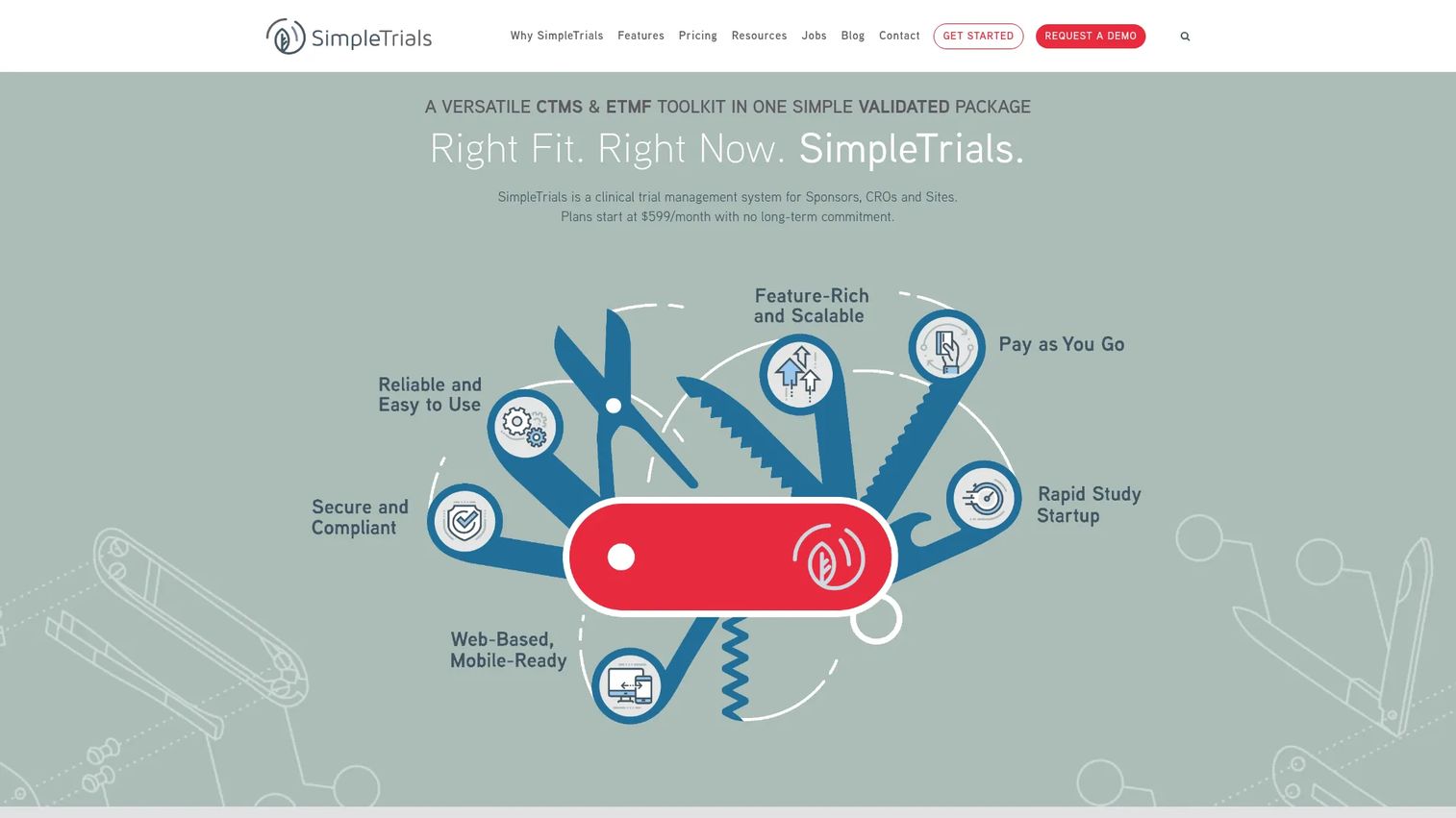
SimpleTrials is a cloud-based CTMS and eTMF for sponsors, CROs, sites, and vendors. Its distinguishing trait is straightforward: published subscription pricing and a package that pairs trial management with document management out of the box.
Best for: Clinical teams that want a subscription CTMS and eTMF with transparent pricing and no long procurement cycle.
Key strengths
- CTMS and eTMF together: Delivers trial management and a validated eTMF in one package.
- Full operational tracking: Covers site startup, subject tracking, calendars, documents, milestones, and participant payments.
- Connected reporting: Offers EDC integrations, reporting, alerts, and custom trackers.
Why choose SimpleTrials: For teams that value predictability, SimpleTrials removes the pricing guesswork that dominates enterprise CTMS buying. You get CTMS plus eTMF, study startup through study closeout coverage, and reporting without a bespoke implementation. It is a practical fit for smaller sponsors and CROs that need clear study administration fast.
SimpleTrials pricing: Plans start at $599/month, published on the vendor's site, with no long-term commitment required and annual prepay discounts available. There is no free tier.
5. Curebase
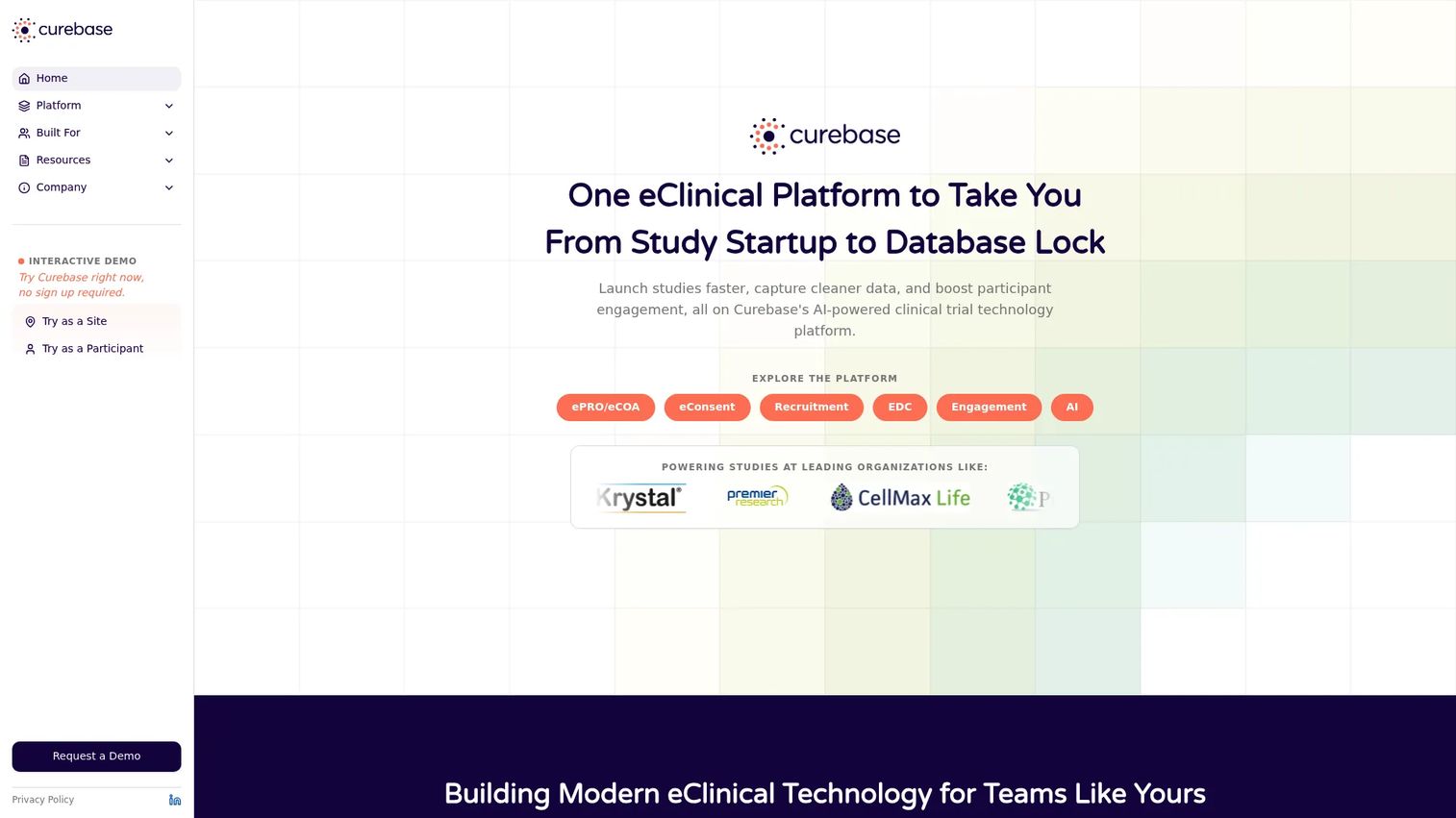
Curebase is an AI-powered eClinical platform that extends CTMS thinking into a broader, modern trial technology stack. It suits teams that want CTMS operations connected to decentralized and unified trial workflows rather than a standalone module.
Best for: Sponsors, CROs, and sites that want a modern platform approach spanning CTMS, data capture, and patient-facing tools.
Key strengths
- Unified eClinical platform: Connects trial operations with ePRO/eCOA, eConsent, and electronic data capture.
- Patient-centered workflows: Supports decentralized and hybrid trial models with patient engagement tools.
- AI-assisted operations: Layers AI across recruitment, data, and engagement.
Why choose Curebase: Teams choose a platform approach when they want fewer disconnected systems and more workflow continuity from operations to data to participants. If your studies lean decentralized or hybrid, Curebase's unified model keeps CTMS-style tracking in the same environment as consent and data capture, reducing the handoffs that fragment a stack.
Curebase pricing: Curebase does not publish pricing; the site directs visitors to schedule a demo. Expect scope-based quoting tied to platform footprint and study needs.
6. Veeva Vault Clinical
Veeva offers Vault Clinical, a cloud suite spanning clinical operations and clinical data management for life sciences. It is built for sponsors and CROs that want end-to-end trial management on a single platform rather than assembled components.
Best for: Sponsors, CROs, and life sciences teams managing clinical trials end to end on one unified platform.
Key strengths
- Clinical operations apps: Includes eTMF, CTMS, payments, study startup, and site connect.
- Clinical data apps: Adds EDC and clinical data management on the same platform.
- One cloud platform: Unifies operations and data for end-to-end trial management.
Why choose Veeva Vault Clinical: Veeva fits enterprises that want their eTMF, CTMS, study startup, and EDC to live in one governed environment. The appeal is alignment: clinical operations and data management on a shared platform means fewer integration seams and a tighter document-to-data trail across the lifecycle. It is a strong fit for regulated, large-scale programs.
Veeva Vault Clinical pricing: Veeva does not display public pricing; product pages point to contact sales. Expect enterprise, scope-based quoting. Veeva Vault's G2 rating is 4.1/5, reflecting Vault broadly rather than a Clinical-specific listing.
7. Medidata Rave
Medidata Rave is an enterprise electronic data capture and clinical trial data management platform. It is worth being explicit here: Rave sits at the EDC layer of the stack. For data-centric programs, it often anchors the broader clinical data management workflow that a CTMS coordinates around.
Best for: Sponsors and CROs running regulated clinical trials that need enterprise-grade EDC at the center of the stack.
Key strengths
- Electronic data capture: Captures site, patient, and lab data at enterprise scale.
- End-to-end data management: Handles data capture, management, cleaning, and reporting.
- Unified platform integrations: Connects with RTSM, Safety Gateway, Imaging, and other Medidata modules.
Why choose Medidata Rave: When the data workflow is your primary constraint, Rave's depth in capture, cleaning, and reporting is the draw. Understanding where CTMS ends and EDC begins matters here: a CTMS tracks operations, while Rave manages the trial data itself. Many enterprise teams run both, with the CTMS coordinating operations around a Rave-anchored data layer.
Medidata Rave pricing: Medidata does not publish public numeric pricing; its pages use tailored, contact-based language. Medidata Rave's G2 rating is 4.7/5, the highest on this list.
8. RealTime CTMS
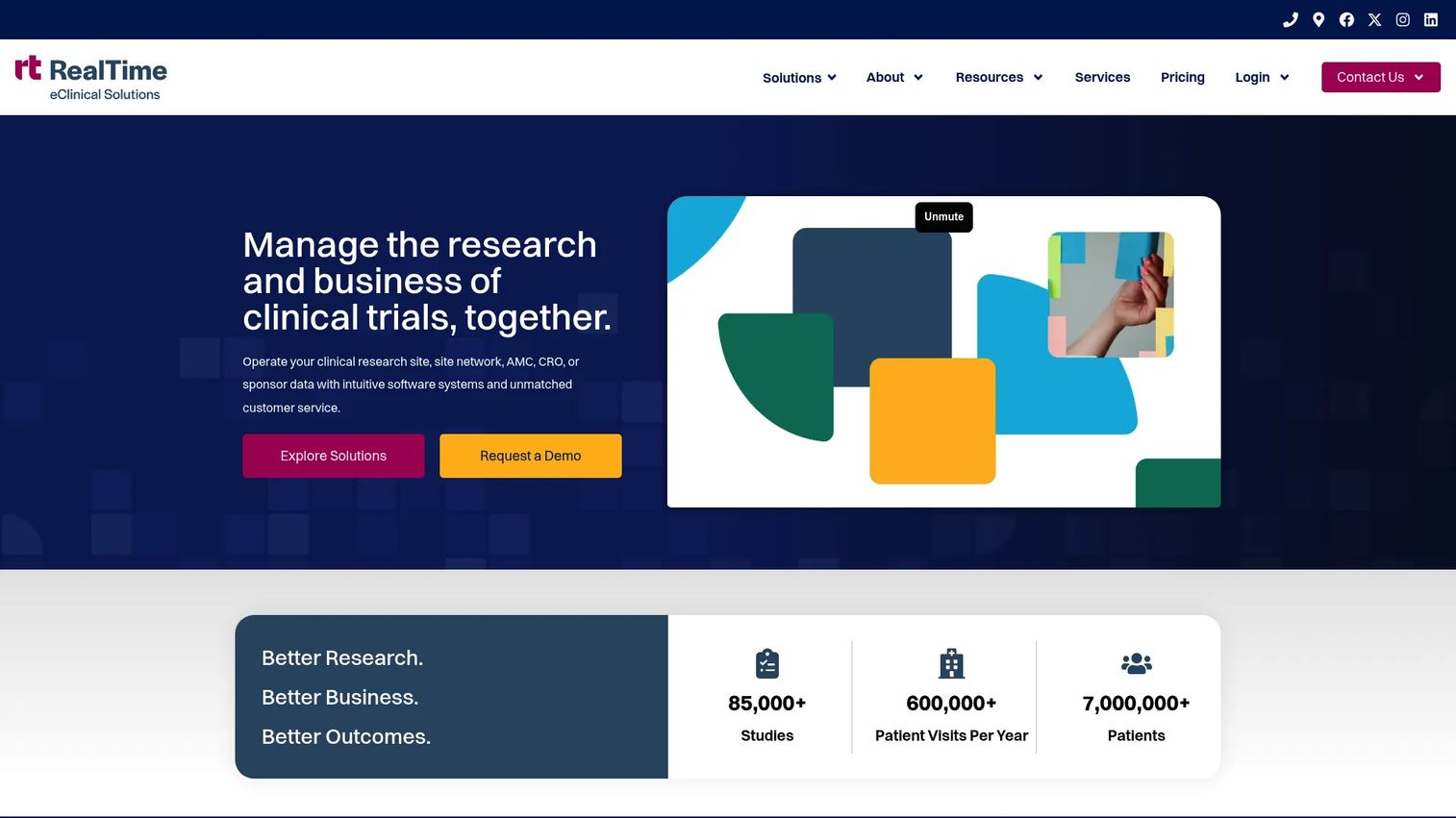
RealTime CTMS is clinical trial management software built for research sites and site networks. It centers on the operational reality of running studies at the site level: recruitment, scheduling, visit tracking, and the financial workflows sites depend on.
Best for: Clinical research sites and site networks that need CTMS plus integrated operational and financial workflows.
Key strengths
- Recruitment and patient database: Manages recruitment and a searchable patient database.
- Scheduling and visit tracking: Handles scheduling, task management, and patient visit tracking.
- Contracts, budgets, and accounting: Covers contracts and budgets, accounting, and reporting.
Why choose RealTime CTMS: Sites and site networks have different needs than sponsors, and RealTime is built for them. If your priority is running efficient site operations, keeping recruitment, scheduling, and finances in one operational hub, its site-first design fits the daily workflow. It suits growing site networks that need consistency across locations.
RealTime CTMS pricing: RealTime does not publish a public price; the site emphasizes a free demo and product configuration. Expect quote-based pricing tied to your site count and needs. RealTime's G2 rating is 4.3/5.
Considerations
Before you sign, pressure-test each option against the criteria below. The right CTMS matches your operational model, not just a feature checklist.
Compliance and validation
Verify that the system genuinely supports 21 CFR Part 11, not just markets it. Ask about the audit trail (is every change captured, timestamped, and attributed?), electronic signatures, and account-level access controls. For regulated trials, request the vendor's validation documentation and confirm how they handle system updates without breaking your validated state.
Integrations and interoperability
A CTMS is only as useful as the systems it connects to. Check for EDC integration, eTMF, EMR, eIRB, eRegulatory, billing, and participant payments. Ask whether integrations are prebuilt or custom, and confirm API availability and standards support such as HL7. Weak interoperability turns a single source of truth back into another silo.
Reporting and visibility
Look past the demo dashboard. Can you build the portfolio views your leadership actually needs? Confirm export options, real-time versus batched data, and whether reporting and analytics support workflow automation like alerts on lagging enrollment. The same evaluation rigor applies to any marketing analytics or agentic analytics purchase: shallow reporting is the fastest way to outgrow a tool.
Operational fit
Map the system to your real workflow: study startup, activation, monitoring, and study closeout, plus the handoffs between sites, CROs, and sponsors. A tool that fits site operations may not fit an enterprise sponsor, and the reverse is equally true. Match the operational model first.
Total cost and implementation effort
Sticker price is only part of the decision. Factor in implementation services, validation effort, ongoing administration, and the internal time to configure and maintain the system. A published subscription may cost less to start but require more internal admin; an enterprise suite may bundle services at a higher price. Weigh total cost against the effort your team can realistically absorb, the same way you would when evaluating event management or loyalty management platforms.
Conclusion
The best clinical trial management software is the one that matches how your team actually works.
If you run research sites or a site network, RealTime CTMS and Advarra are built for site operations, financials, and recruitment. If you are an enterprise sponsor or CRO managing large, multi-region programs, Veeva Vault Clinical and IQVIA deliver end-to-end lifecycle orchestration on connected infrastructure. If you want published, predictable pricing and CTMS plus eTMF out of the box, SimpleTrials is the practical choice. If your studies lean decentralized or you want a unified platform, Curebase connects operations to data and participants. And if EDC is your center of gravity, Medidata Rave anchors the data layer that a CTMS coordinates around.
Your next step: narrow by operational model first, then by compliance needs, then by integration stack. Shortlist two or three tools that fit your model, run each against the considerations checklist above, and ask every vendor to demonstrate the audit trail, integrations, and reporting on your actual workflow, not a canned scenario.
FAQs
A CTMS centralizes the operational side of a study: sites, subjects, visit schedules, monitoring, documents, milestones, and finances. It gives sponsors, CROs, and sites a single source of truth so the team tracks progress, manages compliance, and reports in real time instead of reconciling spreadsheets.
A CTMS manages study operations, who is enrolled, which sites are active, when visits happen, and how the budget tracks. An EDC captures the actual clinical data collected from patients. CTMS vs EDC comes down to operations versus data. Many enterprise teams run both, with the CTMS coordinating operations around an EDC-anchored data layer.
Both. Sponsors and CROs use a CTMS for portfolio oversight and cross-site visibility, while research sites use site-focused systems for recruitment, scheduling, visit tracking, and financials. Some platforms lean sponsor-side, others are built specifically for site operations, so match the tool to your role.
EDC integration and eTMF are usually the highest priority, followed by EMR, eIRB, eRegulatory, and financial systems for protocol billing and participant payments. Confirm whether integrations are prebuilt or custom, and check API availability and standards like HL7 so your CTMS stays a single source of truth rather than another silo.
For regulated trials in the US, yes. That means a complete audit trail, electronic signatures, and access controls, backed by validation documentation. Confirm the vendor supports Part 11 in practice and ask how they preserve your validated state when the system updates.
Compare lifecycle coverage from study startup to study closeout, compliance controls, integration breadth, reporting and analytics depth, and operational fit for your team. Then weigh total cost, including implementation, validation, and ongoing administration, against the internal effort you can realistically sustain.
CTMS vs Excel becomes a real question once you run multiple studies or sites. Spreadsheets break down when versions drift, updates lag, no one trusts the numbers, and audits demand a defensible audit trail. If reconciling status across trackers eats hours every week, you have outgrown Excel.
Dashboards turn scattered status updates into real-time visibility. Operations teams see enrollment pace, site activation, and monitoring completion at a glance, so a lagging site surfaces in week three instead of month three. Portfolio-level reporting and analytics support faster decisions about where to add resources across a trial lifecycle.