
A customer buys online. Your store thinks the item is still on the shelf. Two hours later, someone in the warehouse picks the same unit for a different order. Now you have an oversell, a refund, and a frustrated customer who will tell their friends.
That gap exists because inventory, fulfillment, and order status live in separate systems that do not talk to each other in real time. Retail order management software closes that gap. According to Forrester (2021), the global market for OMS software will nearly double to reach $1.9 billion by 2026, growing at a 12.3% CAGR, with retail and wholesale accounting for nearly 70% of total OMS spending. That spending is not happening because OMS is trendy. It is happening because fragmented order data costs real revenue every day.
If you own product, operations, or ecommerce outcomes, you already feel this. Oversells erode trust. Stock-outs kill conversion. Split shipments inflate cost. Manual handoffs between channels eat hours your team does not have. A retail order management system gives you one source of truth across channels, so an order placed anywhere routes to the right fulfillment node without a human babysitting it.
This guide is built for buyers in late research who need a decision, not a feature dump. The same evaluation discipline applies whether you are choosing an OMS, a contract lifecycle management software platform, or a loyalty management tool: match the system to your volume, complexity, and existing stack. We will keep it retail-specific and decision-led.
What's inside
This guide compares nine retail order management software options for teams that need omnichannel order visibility, inventory accuracy, and fulfillment automation. We picked tools across the spectrum, from enterprise-grade orchestration platforms to lean systems built for smaller retail and ecommerce operations.
We selected each tool based on four criteria: retail and omnichannel fit, integration depth across ERP, POS, WMS, ecommerce, and accounting, ability to scale with order volume and SKU complexity, and practical usefulness for a buyer narrowing a shortlist. Pricing and G2 ratings reflect what vendors publish and what reviewers report. Both change, so verify current figures before you sign.
TL;DR
- Best for enterprise retail operations: Aptos, for unified commerce and store-led fulfillment across channels.
- Best for complex omnichannel orchestration: IBM Sterling Order Management, for multi-node fulfillment at scale.
- Best for Salesforce-native teams: Salesforce Order Management, for order visibility wired into CRM and service.
- Best for enterprise commerce stacks: SAP Commerce Cloud, for composable commerce with order management built in.
- Best for smaller and mid-market teams: Cin7 Core and Zoho Inventory, for inventory control without enterprise overhead.
- Best for ecommerce and warehouse-driven brands: ShipHero, for fulfillment execution tied to shipping operations.
What is retail order management software?
Retail order management software is a system that captures, routes, fulfills, and tracks customer orders across every sales channel from a single source of truth, keeping inventory accurate and fulfillment coordinated end to end.
The order lifecycle runs from order capture through to cash collected, often called order-to-cash. A customer places an order on your site, in-store, on a marketplace, or through a sales rep. The OMS checks live inventory across locations, decides the best place to fulfill from, triggers the pick-pack-ship or pickup workflow, sends status updates to the customer, and posts the transaction to your financial systems. Done well, this happens without anyone manually re-keying data between tools.
A capable retail order management system should deliver:
- Real-time inventory visibility across stores, warehouses, and channels, so you stop overselling.
- Intelligent order routing that picks the optimal fulfillment node based on stock, distance, and cost.
- Fulfillment automation for ship-from-store, BOPIS, curbside, dropship, and returns.
- Order status visibility for both customers and internal teams, from placement to delivery.
- Dashboards and analytics on order volume, fulfillment performance, and exceptions.
- Integrations with ERP, POS, WMS, ecommerce platforms, and accounting tools.
Where does an OMS sit in the retail stack? It is the orchestration layer between your channels, where demand comes in, and your fulfillment systems, where supply goes out. ERP handles finance and procurement. POS runs the store. WMS runs the warehouse floor. The OMS coordinates all of them around a single order record, which is why integration depth matters more than almost any individual feature.
When to use retail order management software
Not every retailer needs a dedicated OMS on day one. These are the moments when one stops being optional.
Coordinate online and store orders without overselling
When you sell the same SKU online and in physical stores, inventory drifts out of sync fast. A unit sold at the register should disappear from the online available-to-sell count immediately. Without a shared order layer, it does not, and you sell stock you no longer have. An OMS keeps one live count across every channel, so the oversell-and-refund cycle stops.
Centralize order routing and fulfillment across channels
As you add channels, marketplaces, your own site, wholesale, the question of where each order ships from gets complicated. Should it ship from the nearest store, the regional warehouse, or a dropship partner? Manual routing rules break down. An OMS applies routing logic automatically, balancing speed, cost, and stock position on every order.
Give customers clearer order and delivery visibility
Customers expect to know where their order is at any moment. When status data is scattered across a warehouse system, a carrier portal, and a spreadsheet, your support team becomes the lookup tool. An OMS centralizes status so customers self-serve tracking and your team handles fewer "where is my order" tickets.
Reduce manual work in high-volume retail operations
At high order volume, manual handoffs do not just slow you down, they introduce errors that compound. Every re-keyed order is a chance for a wrong address, a missed line item, or a delayed ship. Fulfillment automation removes those handoffs, so your team manages exceptions instead of processing every order by hand.
Comparison table
Here is a side-by-side view of the nine retail order management platforms in this guide. Ratings and pricing shift over time, so treat these as a starting point and confirm current figures with each vendor.
| # | Product | Intent | Key use case | Pricing | G2 rating |
|---|---|---|---|---|---|
| 1 | Aptos | Enterprise unified commerce | Store-led omnichannel fulfillment | Quote-based | 2.9/5 |
| 2 | IBM Sterling Order Management | Enterprise orchestration | Multi-node fulfillment at scale | From 1.5c per line | 4.4/5 |
| 3 | Salesforce Order Management | CRM-native order management | Order visibility tied to service | Contact for pricing | 4.2/5 |
| 4 | SAP Commerce Cloud | Enterprise commerce stack | Composable B2B/B2C commerce | Price upon request | 4.3/5 |
| 5 | Cin7 Core | Mid-market inventory and orders | Channel sync and warehouse ops | From $349/mo | 4.1/5 |
| 6 | Zoho Inventory | Budget-friendly inventory | Multichannel order tracking | Free, then from $29/mo | 4.4/5 |
| 7 | inFlow Inventory | SMB order and inventory control | Ease-of-use inventory ops | From $129/mo | 4.6/5 |
| 8 | ShipHero | Ecommerce fulfillment and WMS | Warehouse-driven order execution | Quote-based | 4.5/5 |
| 9 | Webgility | Ecommerce automation layer | Sync orders, inventory, accounting | From $69/mo | 4.6/5 |
1. Aptos
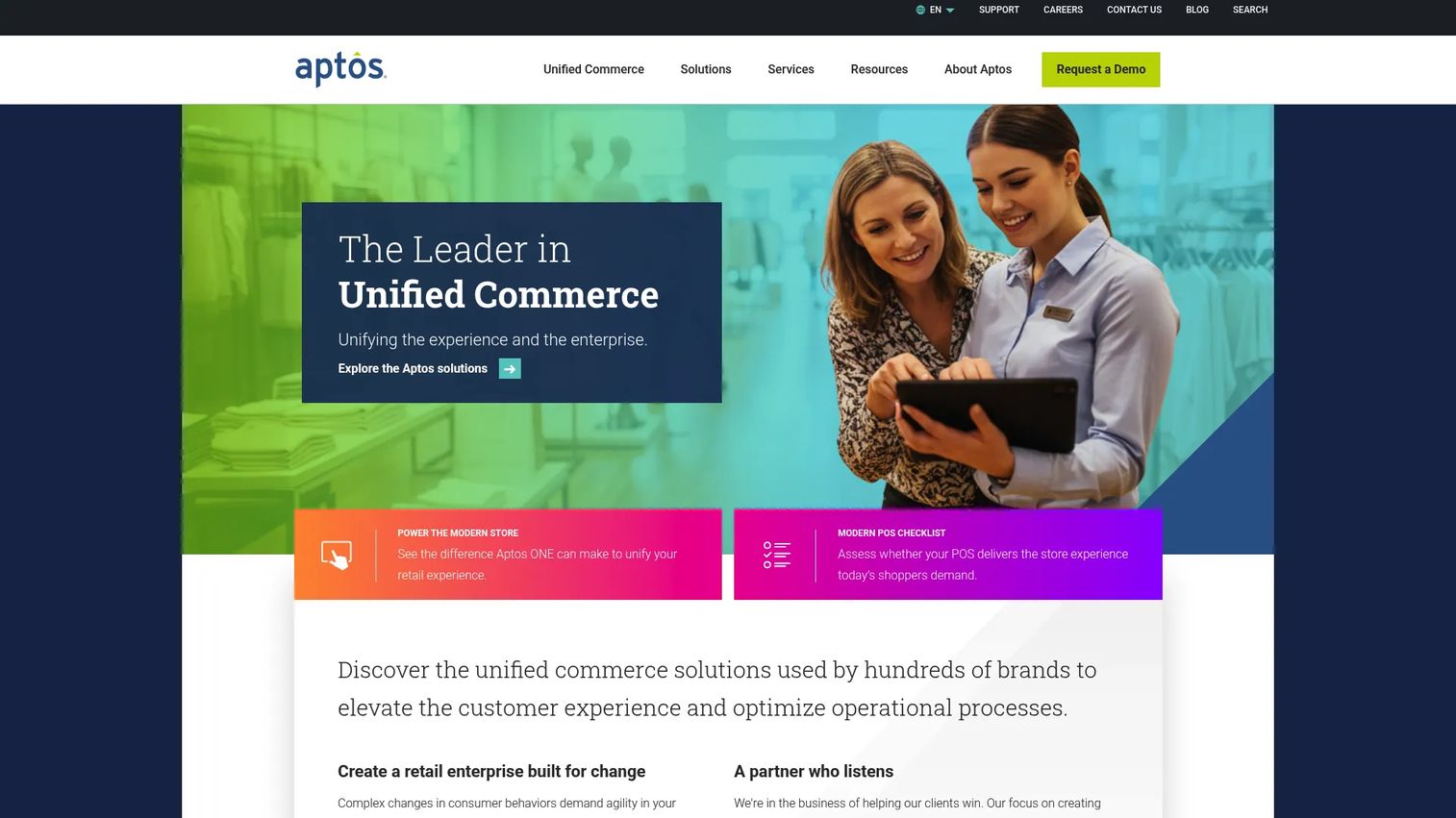
Aptos builds unified commerce software for retail, anchored by a modern, mobile-first POS and a set of operations tools that connect the store to every other channel. The platform is built around the idea that the store is a fulfillment node, not just a point of sale, which is exactly the model omnichannel retailers need in 2026. Aptos targets retailers who want enterprise inventory and order handling, clienteling, and centralized cloud operations under one roof.
Best for: Retailers needing unified commerce and modern store operations software across a large store fleet.
Key strengths
- Mobile-first modern POS: Store associates fulfill and sell from the floor, turning every location into a fulfillment point.
- Unified commerce across channels: One view of inventory and orders spanning stores, ecommerce, and other channels.
- Enterprise inventory and order handling: Built to manage high SKU complexity and order volume without breaking.
Why choose Aptos: Aptos fits retailers whose physical stores are central to the fulfillment model. If ship-from-store, BOPIS, and clienteling are core to how you compete, a retail-native platform built around the store gives you tighter control than a generic order management solution bolted onto an ecommerce stack.
Aptos pricing: Aptos does not publish public pricing. It is quote-based and scoped to your store count, channels, and operational complexity. Plan for an enterprise sales conversation rather than a self-serve signup.
2. IBM Sterling Order Management
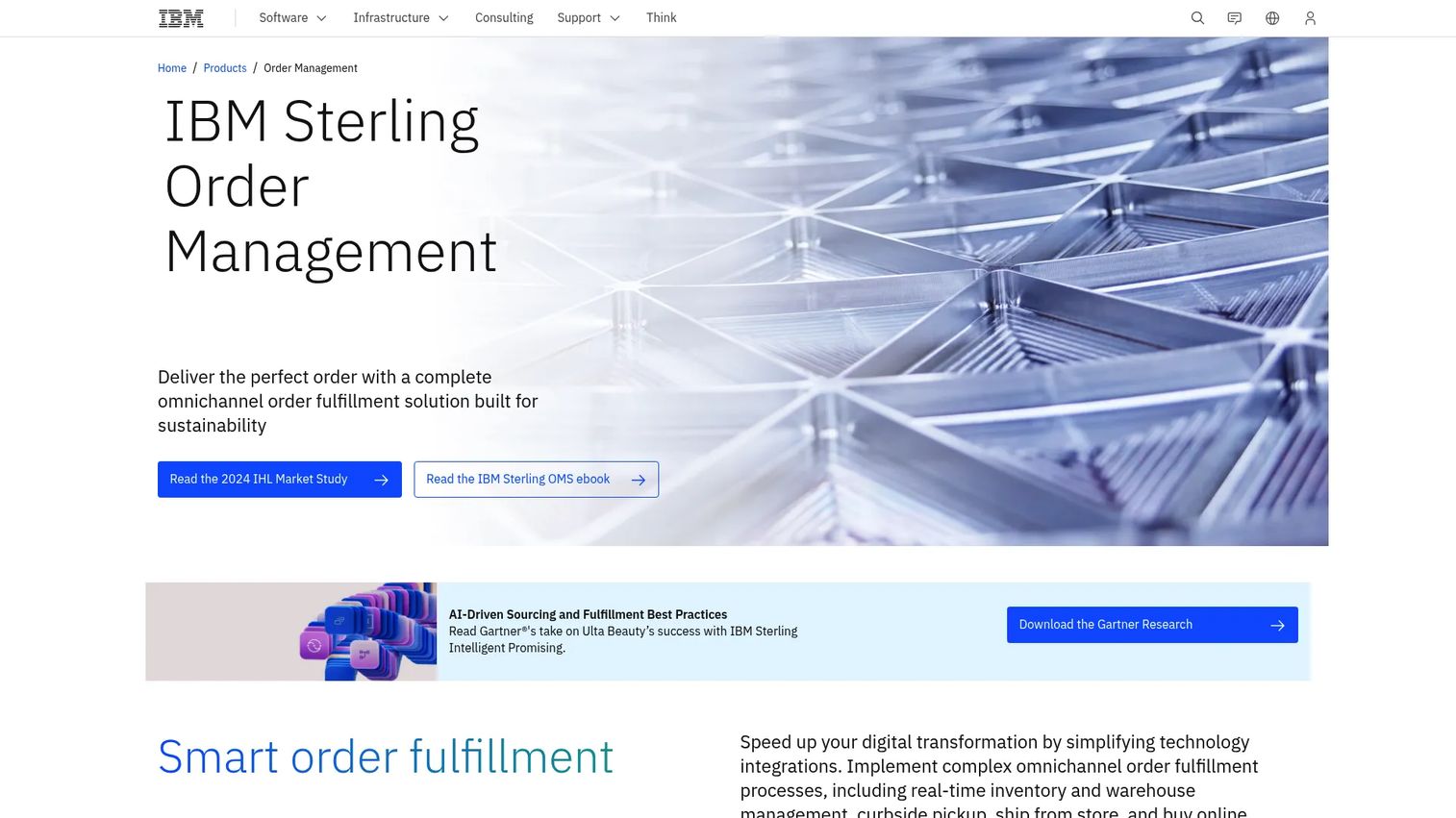
IBM Sterling Order Management is an omnichannel order fulfillment and orchestration platform built for complex retail operations. It handles real-time inventory across locations, intelligent order routing, and fulfillment workflows including curbside pickup and BOPIS. This is a heavyweight system designed for retailers with large catalogs, many fulfillment nodes, and demanding enterprise integration requirements.
Best for: Enterprises needing omnichannel order orchestration and multi-node fulfillment at scale.
Key strengths
- Real-time inventory and warehouse management: Live stock visibility across every node feeding accurate promise dates.
- Order orchestration across channels: Routing logic that balances cost, speed, and stock on every order.
- Curbside pickup and BOPIS support: Native store-fulfillment workflows for omnichannel retail.
Why choose IBM Sterling Order Management: When your order volume is high and your fulfillment network is complex, the depth of Sterling's orchestration earns its place. It is built to handle scale and edge cases that lighter tools are not designed for, which is why large retailers standardize on it.
IBM Sterling Order Management pricing: IBM publishes consumption-based pricing on a per-line basis. Editions include Essentials at 2.8 cents per line monthly, Standard at 4.5 cents per line monthly, and Professional listed from 1.5 cents per line. There is no free tier. Confirm current unit definitions with IBM, since the published page mixes labels.
3. Salesforce Order Management
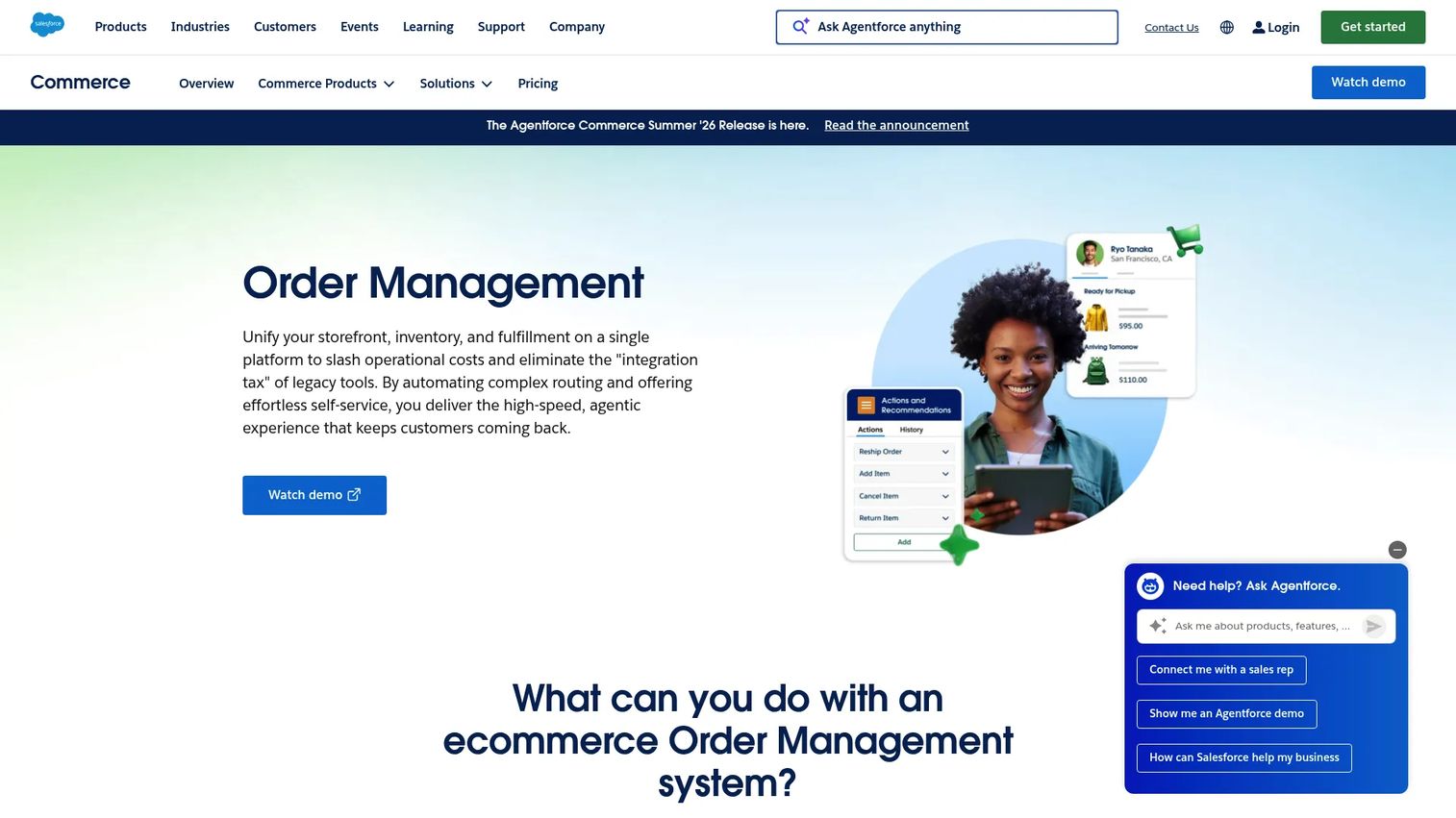
Salesforce Order Management unifies commerce, inventory, fulfillment, and service workflows on the Salesforce platform. For teams already running Salesforce CRM and Service Cloud, it connects the order record to the customer record, so support and sales work from the same data. It offers agentic order routing, distributed order management, and fulfillment workflows wired into the broader Salesforce ecosystem.
Best for: B2C and B2B commerce teams needing Salesforce-native order visibility, fulfillment, and service orchestration.
Key strengths
- Agentic order routing: Automated routing that adapts to inventory position and fulfillment rules.
- Distributed order management: A single order view across channels and fulfillment locations.
- Native CRM and service connection: Order data lives next to customer and case data for faster resolution.
Why choose Salesforce Order Management: If your team already lives in Salesforce, the value is the absence of a new integration project. Order, customer, and service data share one platform, which shortens "where is my order" resolution and keeps your customer order management software aligned with the rest of your GTM stack.
Salesforce Order Management pricing: Salesforce lists two editions, Order Visibility and Growth, both with contact-for-pricing. There is no public numeric price, so expect a sales conversation scoped to your order volume and edition needs.
4. SAP Commerce Cloud
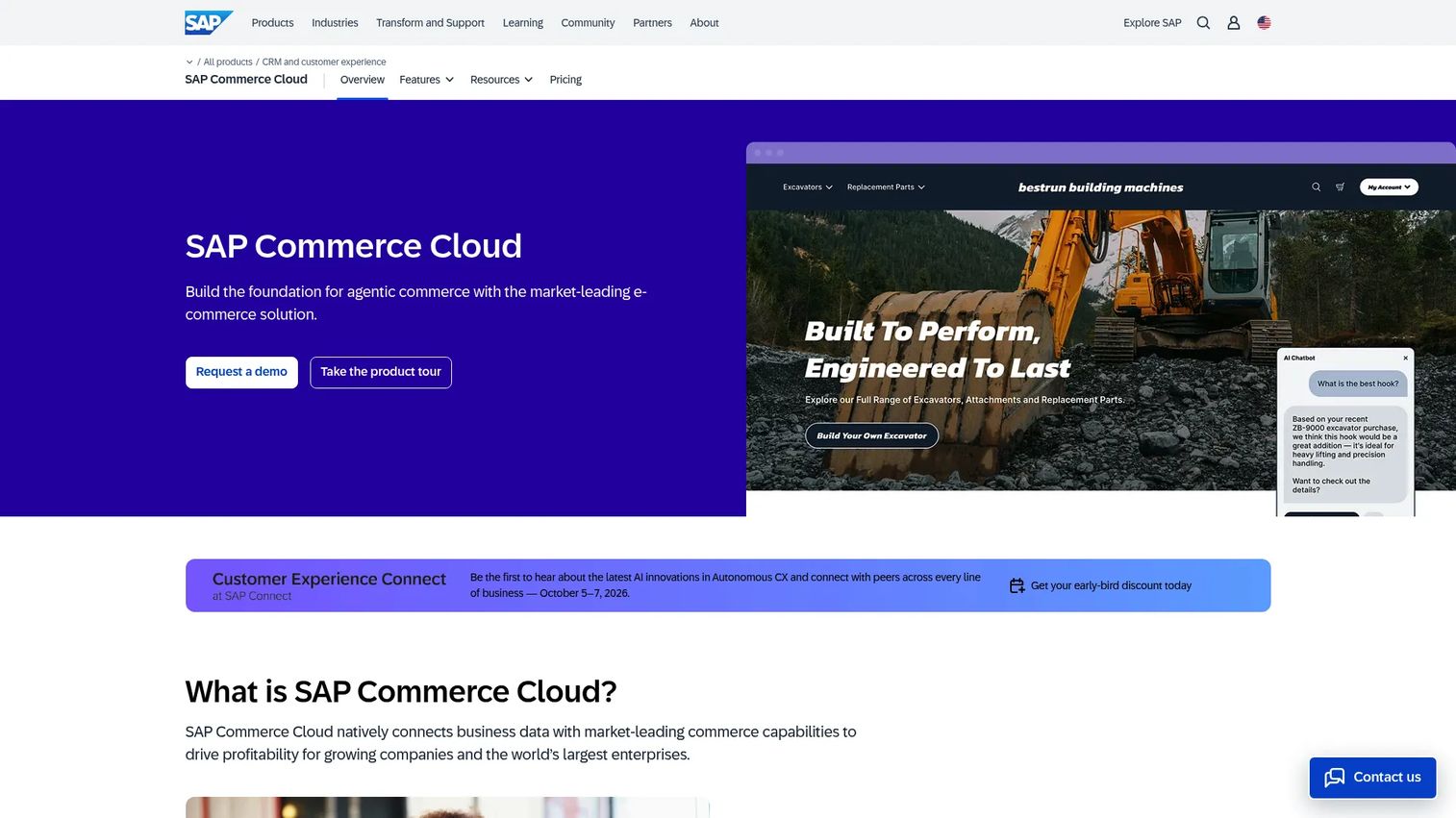
SAP Commerce Cloud is an enterprise commerce platform for B2B, B2C, and hybrid models, with order management capabilities embedded in a broader composable commerce stack. It supports headless architecture, API and event-driven integration, and the kind of enterprise scale, security, and AI capabilities large retailers require. For organizations standardizing on SAP across finance and operations, the commerce and order layer slots into an already-familiar ecosystem.
Best for: Large enterprises needing complex, scalable commerce across B2B and B2C with order management included.
Key strengths
- Composable commerce with APIs and events: Headless support for flexible front-end and integration architecture.
- B2B, B2C, and multi-business-model support: One platform spanning multiple commerce models.
- Enterprise scale, security, and AI: Built for high-volume, governed retail environments.
Why choose SAP Commerce Cloud: This is the order management platform for retailers who treat commerce as part of a larger SAP-centered architecture. If you already run SAP ERP, keeping commerce and order orchestration inside the same vendor relationship reduces integration friction across the order-to-cash flow.
SAP Commerce Cloud pricing: SAP shows price-upon-request for its editions, with pricing based on annual orders or gross merchandise value. There is no free tier. Editions include premier and cloud ERP variants, both scoped through SAP sales.
5. Cin7 Core
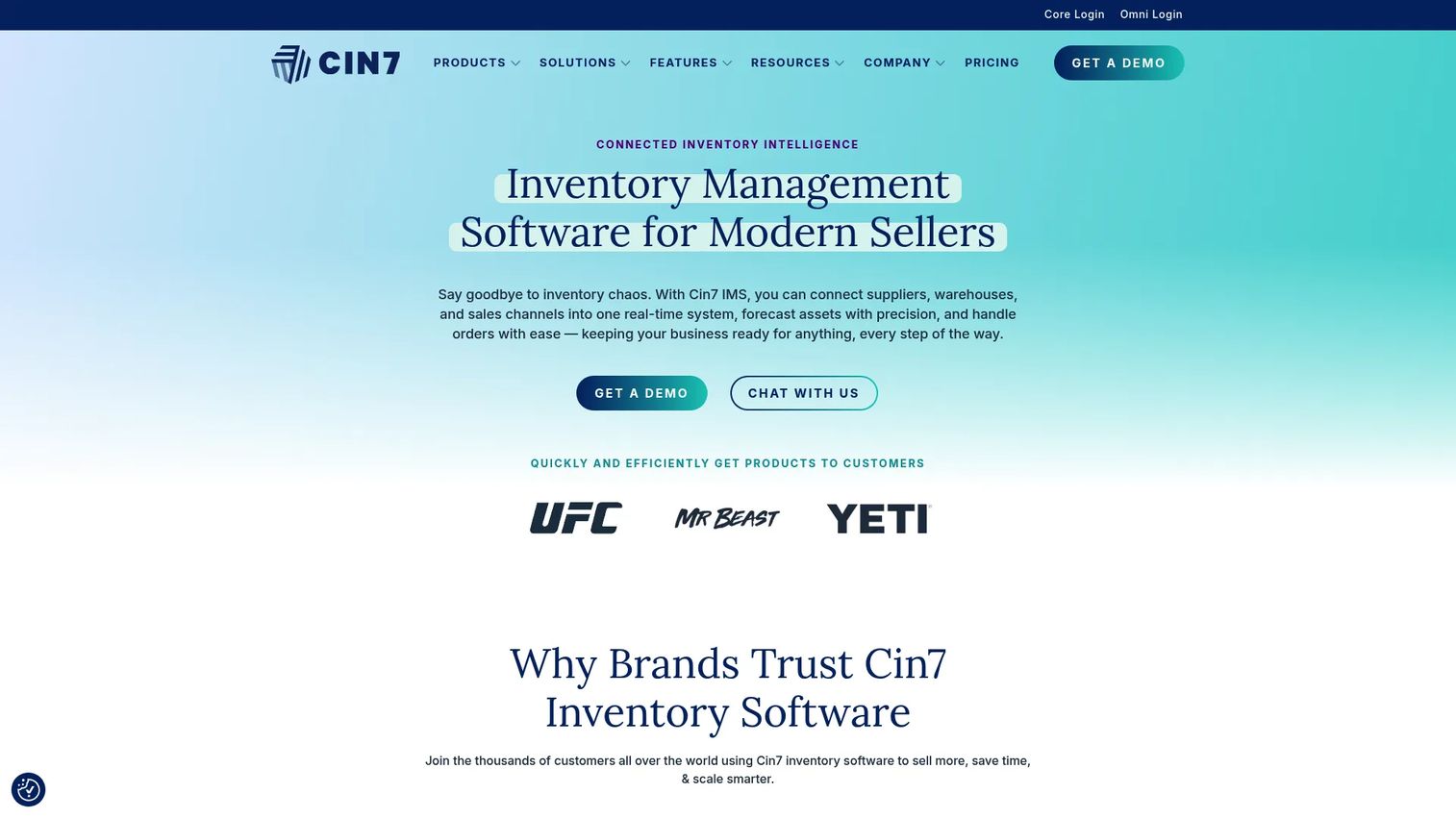
Cin7 Core is cloud inventory management software for product-based businesses that need inventory, sales-channel, and warehouse operations in one system. It is a practical fit for smaller retail and ecommerce teams that want stronger control over stock and orders without the cost and implementation weight of an enterprise platform. Cin7 Core connects to ecommerce and app integrations and supports advanced warehouse and material requirements workflows.
Best for: Product businesses needing inventory, sales channel, and warehouse operations in one system.
Key strengths
- Ecommerce and app integrations: Sync orders and stock across the channels you already sell on.
- Advanced warehouse management and MRP: Material requirements planning and warehouse control beyond basic inventory.
- Tiered user access: Plans scale from 5 to 15 users as your team grows.
Why choose Cin7 Core: Cin7 Core hits the sweet spot for mid-market retailers who have outgrown spreadsheets but do not need a six-figure orchestration platform. You get real channel syncing and warehouse depth at a published monthly price, which makes budgeting and procurement straightforward.
Cin7 Core pricing: Cin7 Core publishes monthly USD pricing: Standard at $349/month, Pro at $599/month, and Advanced at $999/month, plus an Omni plan with custom pricing. There is no free tier listed on the public pricing page.
6. Zoho Inventory
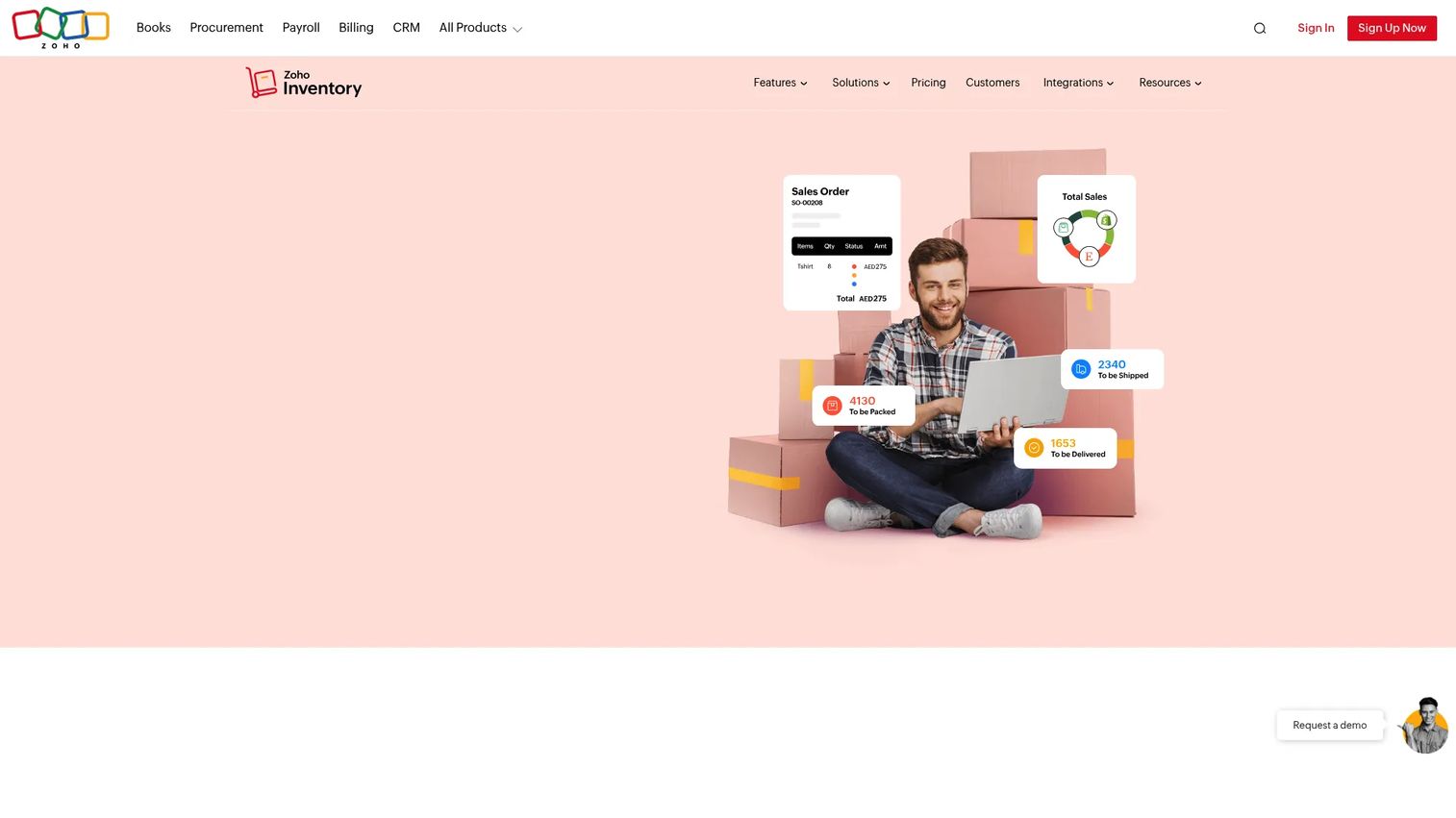
Zoho Inventory is cloud inventory software for tracking stock, orders, purchasing, warehousing, and multichannel sales. For budget-conscious teams already in the Zoho ecosystem, it delivers order tracking and inventory control inside familiar business software, with native ties to other Zoho apps and common ecommerce and accounting tools. It is a strong entry point for retailers who want order management without a heavy spend.
Best for: Businesses needing affordable inventory management with order, warehouse, and multichannel selling support.
Key strengths
- Multi-warehouse management: Transfers and bin locations across multiple warehouses.
- Serial and batch tracking: Barcode generation and scanning for accurate stock control.
- Purchase orders and vendor payments: Purchasing workflows built into the same system.
Why choose Zoho Inventory: Zoho Inventory is the pragmatic pick for smaller retailers who want capable order processing software without enterprise pricing. The free plan and low entry tier let you start small, and the deep Zoho ecosystem means accounting, CRM, and commerce can all live under one vendor.
Zoho Inventory pricing: Zoho offers a free plan, then Standard at $29 per organization per month, Professional at $79, Premium at $129, and Enterprise at $249, all billed annually. Add-ons are available on the pricing page.
7. inFlow Inventory
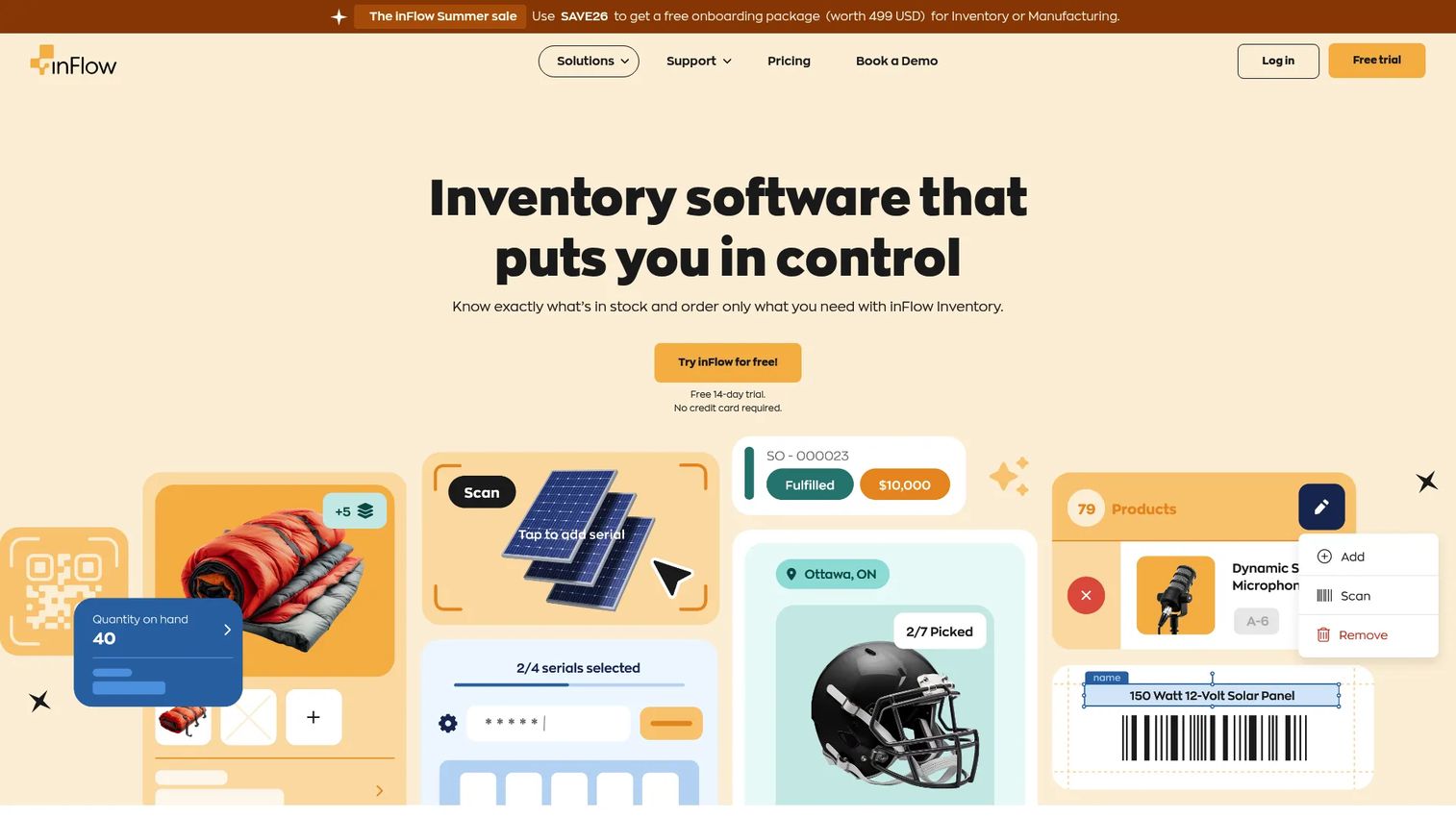
inFlow Inventory is inventory management software for tracking stock, sales, purchases, and reorder workflows. It targets small to mid-size businesses where ease of use matters as much as feature depth, giving teams real-time inventory tracking, sales and purchase order workflows, and low-stock reordering without a steep learning curve. For a lean retail operation, that approachability is often the deciding factor.
Best for: Small to mid-size businesses needing inventory, purchasing, and order management in one system.
Key strengths
- Real-time inventory tracking: Live stock counts that keep your available-to-sell numbers honest.
- Purchasing and sales order workflows: Order processing and procurement handled in one place.
- Low-stock alerts and reordering: Automated reorder triggers that prevent stock-outs.
Why choose inFlow Inventory: inFlow wins on usability. If your team is small and you want order and inventory control without a long implementation, inFlow gets you running quickly. It is an order management solution built for teams that value speed-to-value over exhaustive configurability.
inFlow Inventory pricing: inFlow publishes three self-serve annual plans: Entrepreneur at $129/month, Small Business at $349/month, and Mid-Size at $699/month, plus a quote-based Enterprise tier. A 14-day free trial is available with no credit card required.
8. ShipHero
ShipHero is warehouse management and fulfillment software for ecommerce brands and 3PLs. It ties order handling tightly to shipping execution, with real-time carrier rate shopping, inventory management, and order and returns workflows. For warehouse-driven retail teams, ShipHero treats fulfillment as the core job, not an afterthought, which is why high-volume ecommerce brands lean on it.
Best for: High-volume ecommerce brands and 3PLs needing WMS and fulfillment operations control.
Key strengths
- Real-time carrier rate shopping: Compares carrier rates per order to control shipping cost.
- Inventory management: Stock visibility tied directly to warehouse execution.
- Order and returns management: Outbound and reverse logistics handled in one system.
Why choose ShipHero: ShipHero is the pick when fulfillment execution is your operational bottleneck. If you run your own warehouse or operate as a 3PL, the tight link between order data and shipping operations drives down cost-per-order and tightens delivery performance more than a general-purpose OMS would.
ShipHero pricing: ShipHero does not expose public plan pricing on its site, so pricing is quote-based and scoped to your order volume and warehouse footprint. Plan to talk to sales for a tailored quote.
9. Webgility
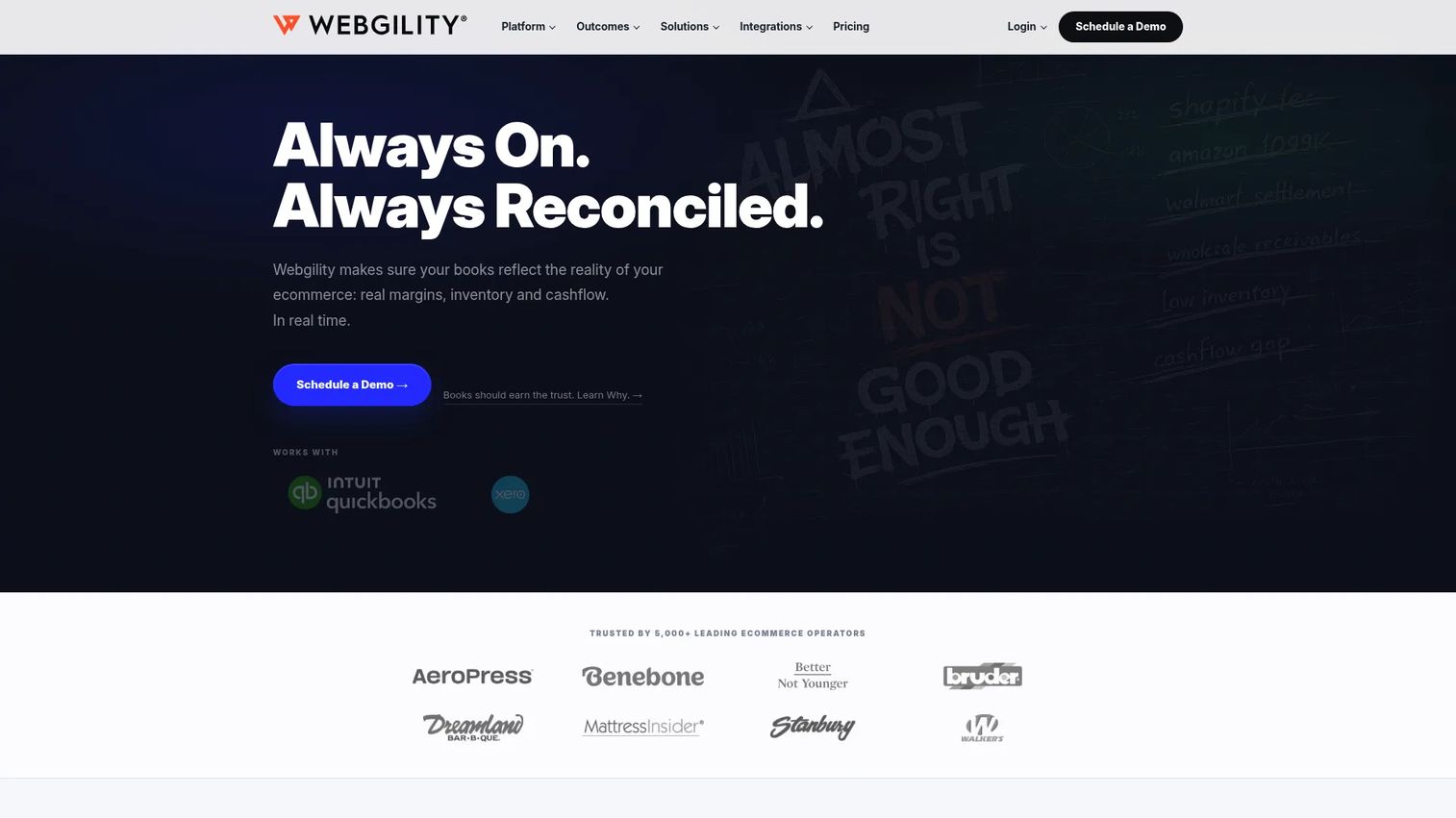
Webgility is ecommerce automation software that syncs multichannel sales, inventory, and accounting data into QuickBooks or Xero. Rather than replacing your order systems, it acts as the automation and integration layer that connects ecommerce platforms, marketplaces, and back-office accounting, eliminating the manual data entry that drains finance and ops teams. For multichannel sellers, it is the glue between selling and bookkeeping.
Best for: Multichannel ecommerce sellers needing automated bookkeeping and inventory sync.
Key strengths
- Order-level reconciliation: Matches orders to accounting records automatically.
- Real-time inventory sync: Keeps stock counts aligned across channels and back office.
- Accounting automation into QuickBooks and Xero: Removes manual entry between sales and finance.
Why choose Webgility: Webgility fits sellers whose main pain is the gap between sales channels and accounting. If reconciliation and data entry are eating your team's hours, Webgility automates that back-office workflow, freeing people to manage exceptions instead of copying numbers between systems.
Webgility pricing: Webgility publishes annual-billed plans for QuickBooks Online and Xero: Pro at $69/month, Advanced at $129/month, Complete at $299/month, and Complete Enterprise at $599/month. Add-ons cover extra orders, sales channels, and historical data import.
How to choose the right retail OMS
The nine platforms above split cleanly by scale and operational model. Use that to narrow fast.
If you run a large store fleet where physical locations are central to fulfillment, Aptos and IBM Sterling Order Management give you the omnichannel orchestration and store-fulfillment depth that complexity demands. If your stack is already standardized on Salesforce or SAP, Salesforce Order Management and SAP Commerce Cloud reduce integration drag by keeping order data inside an ecosystem your teams already know.
For mid-market and smaller retail or ecommerce teams, Cin7 Core, Zoho Inventory, and inFlow Inventory deliver real inventory accuracy and order control at published, predictable prices. If fulfillment execution is your bottleneck, ShipHero wires order handling to warehouse and shipping operations. And if the gap between selling and accounting is your daily friction, Webgility automates that sync.
Your next step is simple. List your channels, your integration requirements across ERP, POS, WMS, ecommerce, and accounting, and your order volume and SKU complexity. Then book demos with the two or three platforms that match that profile. The same disciplined evaluation pays off across adjacent purchases too, whether you are comparing an event management tool, a customer data platform, or an audit management system. If your evaluation involves walking stakeholders through software workflows, an interactive demo from Guideflow lets your team experience each option at their own pace through a guided path.
Start your journey with Guideflow today!
FAQs
Retail order management software captures orders from every channel, checks live inventory, routes each order to the best fulfillment location, and tracks it through delivery. It gives retailers one source of truth for orders and stock, which prevents oversells, speeds fulfillment, and keeps customers informed on order status.
Inventory management software focuses on tracking stock levels, purchasing, and reorder points. An OMS goes further by orchestrating the full order lifecycle: capture, routing, fulfillment, status updates, and order-to-cash across channels. Many smaller tools blend both, but at scale the OMS is the layer that coordinates fulfillment, not just counts units.
Prioritize real-time inventory visibility across locations, intelligent order routing, fulfillment automation for ship-from-store and BOPIS, clear order status tracking, and analytics on fulfillment performance. Above all, weigh integration depth, since an OMS is only as good as its connections to your ERP, POS, WMS, ecommerce, and accounting systems.
At minimum, look for ERP integration for finance and procurement, POS integration for store transactions, WMS integration for warehouse execution, ecommerce integration for your online channels, and accounting integration for reconciliation. The more of these run natively, the less manual data entry and custom middleware you maintain.
Yes, when manual order handling, overselling, or scattered status data start costing you sales and support hours. Smaller retailers do not need an enterprise platform. Tools like Zoho Inventory, inFlow Inventory, and Cin7 Core deliver order and inventory control at accessible prices, so you get the core benefits without enterprise overhead.
An OMS maintains one live inventory count across every channel and location, updating in real time as orders come in and stock moves. That single source of truth eliminates the lag between a sale and a stock decrement that causes oversells. Accurate available-to-sell numbers mean fewer cancellations, fewer refunds, and more trust.
Map your sales channels, your order volume, your SKU complexity, and your existing systems first. Then evaluate each OMS on retail and omnichannel fit, integration depth, fulfillment model support, and total cost including implementation. Run demos with two or three finalists using your real workflows, not generic scenarios.
It varies widely with complexity. Lighter inventory and order tools for smaller teams can go live in days or weeks. Enterprise orchestration platforms with many integrations, fulfillment nodes, and custom routing rules often take several months. Scope your integration requirements early, since they drive most of the timeline.