82% of B2B SaaS marketing leaders use interactive demos to evaluate tools before talking to vendors (Wynter, 2024 to 2025 B2B SaaS Buyer Study). 67% prefer a rep-free experience (Gartner, 2025). Demos do most of the selling now. So when you launch yours and the completion rate sits at 45%, you want to know if that's good.
This guide builds the benchmark picture from independent research (Gartner, Forrester, McKinsey, Unbounce, Wyzowl, TrustRadius, Wynter) published 2024 to 2026. Plus a clear take on what those numbers actually mean for your demo program. Use these as anchors. Then layer in your own buyer intent data. That always tells a sharper story than any industry average.
TL;DR
- 67% of B2B buyers prefer a rep-free experience. 70% prefer a fully digital, self-service buying experience (Gartner, August to September 2025 survey of 645 buyers).
- 82% of B2B SaaS marketing leaders use interactive demos to evaluate tools before talking to vendors (Wynter, 2024 B2B SaaS Buyer Journey Study).
- Pages with interactive elements show 3.1x the all-website average time on page, and 65% engagement rate versus 52% for static pages (Outgrow GA4 benchmarks, 2025 to 2026).
- Median B2B SaaS landing page conversion sits at 3.8%. Top performers hit 8 to 15% (Unbounce 2025 Conversion Benchmark Report; Daydream 2026).
- Personalization drives a 5 to 15% revenue lift on average. Leading companies generate 40% more revenue from personalization than average performers (McKinsey, Next in Personalization).
What you'll find in this guide
- Why static benchmarks miss the point: it's not engagement, it's buyer intent
- Demand-side benchmarks anchored in current B2B buyer research
- Engagement benchmarks pulled from independent interactive content studies
- Conversion benchmarks from independent SaaS landing page reports
- The personalization premium, with hard numbers on the lift
- An honest section on when interactive demos aren't the right tool
- A five-step playbook to fix underperforming demos
The real benchmark isn't engagement. It's buyer intent.
Most demo benchmark articles measure the wrong thing.
They tell you to track completion rate, time on demo, and CTA clicks. Those metrics are fine. They're not the point.
The point of an interactive demo is to replace other approaches with something that actually works:
- The homepage explainer video. Passive. Unmeasurable. Skipped by most viewers, with Wistia's 2025 data showing engagement drops below 20% on content over 20 minutes.
- The "book a demo" gate. High friction. Slow time to value. Loses prospects to vendors who offer self-serve product access.
- The post-call Loom recording. Prospects don't watch them. Sellers get no signal back.
Self-serve product experiences are better because they capture buyer intent. Which features did the buyer explore? Where did they drop? What did they come back to? That data is the benchmark. A 50% completion rate without intent context just tells you someone clicked Next.
Why buyers are into self-serve explorations
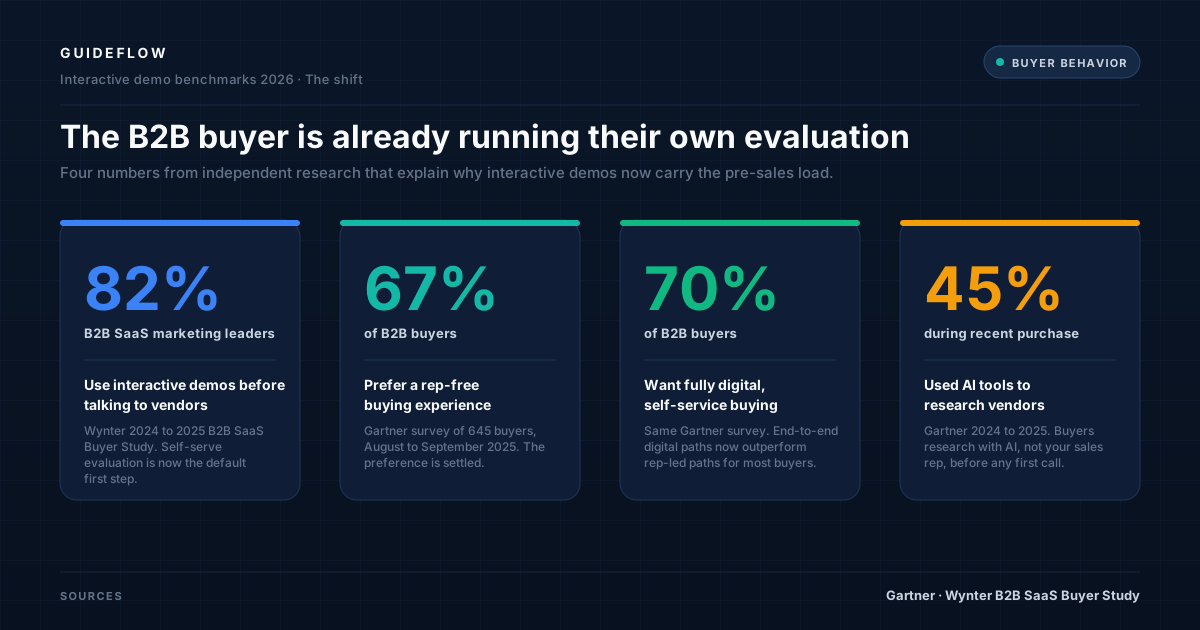
Gartner's survey of 645 B2B buyers (August to September 2025) found two numbers that matter:
- 67% prefer a rep-free experience
- 70% prefer a fully digital, self-service buying experience
45% used GenAI during a recent purchase to research vendors. 73% actively avoid suppliers who send irrelevant outreach (Gartner, 2024). 69% report inconsistencies between what vendor websites say and what sales reps say.
The pattern is clear. Buyers complete more of the purchase decision alone. They use AI to research. They distrust outbound that feels generic.
TrustRadius 2025 buyer research adds a second layer. 77% of buyers consult user reviews during the purchase process. Only 23% of buyer-side conversations happen with vendor-supplied references.
Translation: research happens outside your control. Your demo has to do the work your sales team used to do, before sales gets involved.
That changes what "good" looks like. A 45% completion rate in 2020 was a content quality signal. In 2026, it's a pipeline signal.
Engagement benchmarks from independent research
No public dataset exists for interactive demo engagement specifically. The closest authoritative anchors come from interactive content research, video benchmarks, and SaaS landing page reports.
Here's what they say.
Time on page
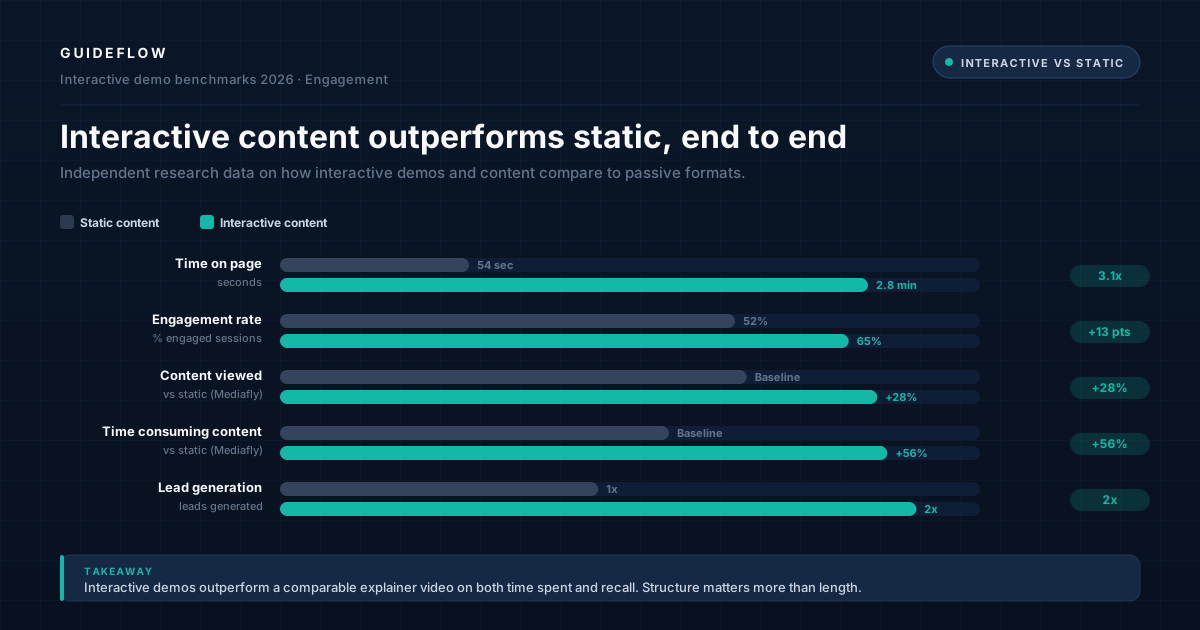
Outgrow's 2025 to 2026 GA4 analysis: interactive pages average 2.8 minutes of time on page. The all-website average is 54 seconds. That's a 3.1x lift.
GA4 engagement rate also climbs. Static pages sit near 52%. Interactive pages hit 65%.
For your interactive demo, expect engagement times of 2 to 4 minutes when prospects make it past step one. Below 1 minute usually points to a hook problem on the opening screen.
Completion patterns
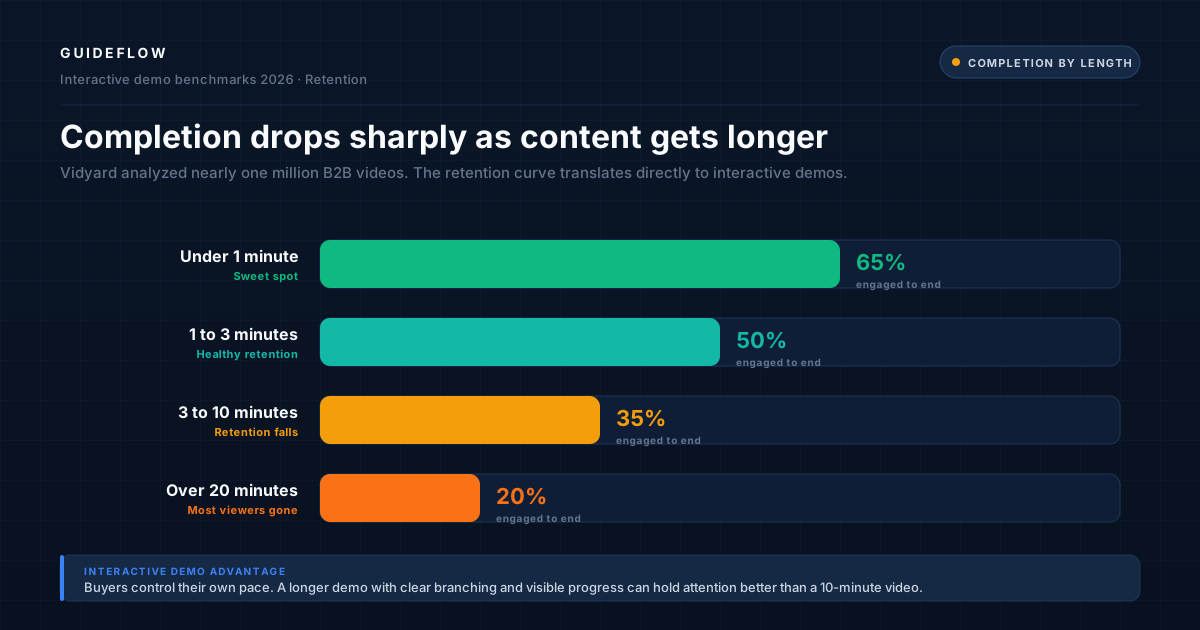
Vidyard's 2025 Video in Business Benchmark Report analyzed nearly 1 million B2B videos. The retention curve is steep:
| Content length | Engaged to end |
|---|---|
| Under 1 minute | 65% |
| 1 to 3 minutes | ~50% |
| 3 to 10 minutes | ~35% |
| Over 20 minutes | 20% |
Interactive demos follow a similar curve, with one critical difference. Buyers control their own pace. So a longer demo with clear branching and visible progress can hold attention better than a 10-minute video.
Structure matters more than length.
Engagement lift vs. static content
Mediafly's B2B buyer research found that interactive content gets viewed 28% more often than static content. Buyers spend 56.2% more time consuming it.
Marketing LTB's 2025 to 2026 research is more direct. Interactive content generates 2 to 3x more engagement than static content. 72% of consumers are more likely to remember brands that use it.
For B2B SaaS, expect interactive demos to outperform a comparable explainer video on both time spent and recall.
Conversion benchmarks for B2B SaaS
The Unbounce 2025 Conversion Benchmark Report analyzed 57 million conversions across 41,000 landing pages.
- Median B2B conversion rate: 6.6%
- Median B2B SaaS conversion rate: 3.8%
- Top 10% of B2B SaaS: 8 to 15%
First Page Sage's 2026 B2B Landing Page report and Daydream's 2026 SaaS analysis triangulate to this picture:
- Self-serve product pages: 4 to 10%
- Demo request pages: 1.5 to 4%
- Content pages: 0.5 to 2%
Where interactive demos sit in this picture
Interactive demos sit upstream of these conversion events, not in place of them. The right question isn't "does my demo convert at the landing page benchmark?" It's "do engaged demo viewers convert at higher rates than visitors who didn't engage?"
Marketing LTB's 2026 analysis suggests they do. Interactive content drives 2x more leads than static content. Interactive case studies increase demo form submissions by 22 to 30%. Companies with 10 or more pieces of interactive content see a 33% lift in revenue.
A working assumption: prospects who complete an interactive demo convert to an SQO at 2 to 4x the rate of visitors who only viewed a static page.
CTA conversion inside the demo
No vendor-independent benchmark exists for in-demo CTA click-through. The best proxy: interactive lead-capture forms see 35% lower drop-off than standard forms (Outgrow, 2026). Gated calculators convert at 25 to 45% versus 9 to 14% for static PDFs.
Translated for interactive demos: a mid-demo or end-demo CTA should convert at meaningfully higher rates than a standalone web form. The viewer has already invested time and gotten value before the ask.
Benchmarks shift by funnel stage
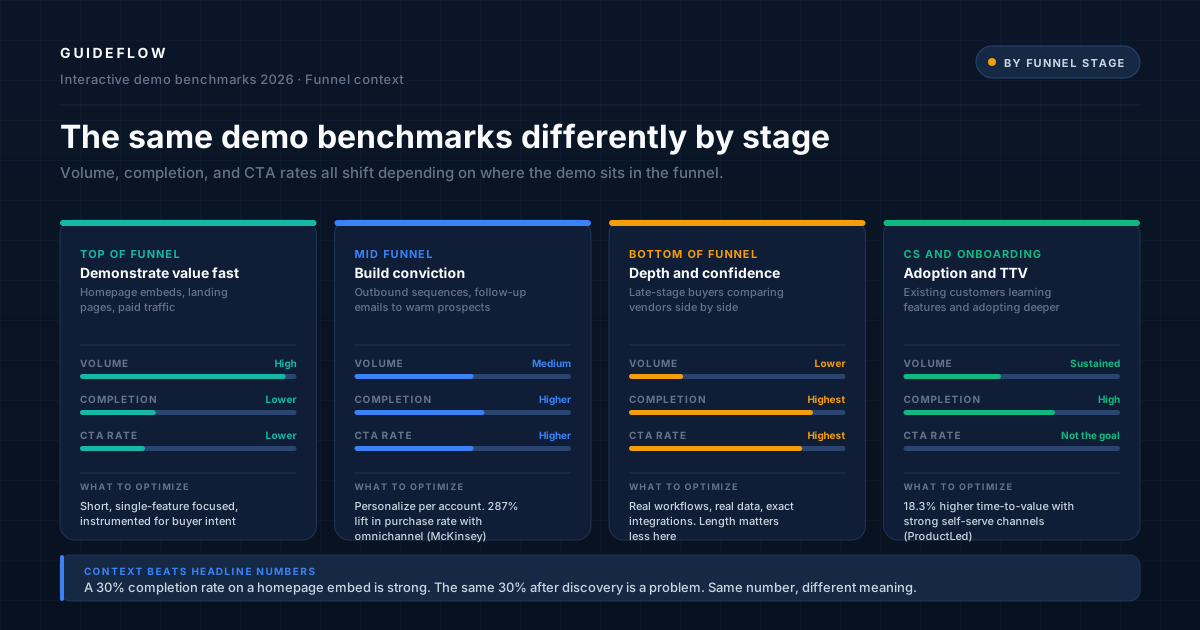
The same demo placed in two different funnel positions produces very different numbers. Plan for that before setting targets
Top of funnel
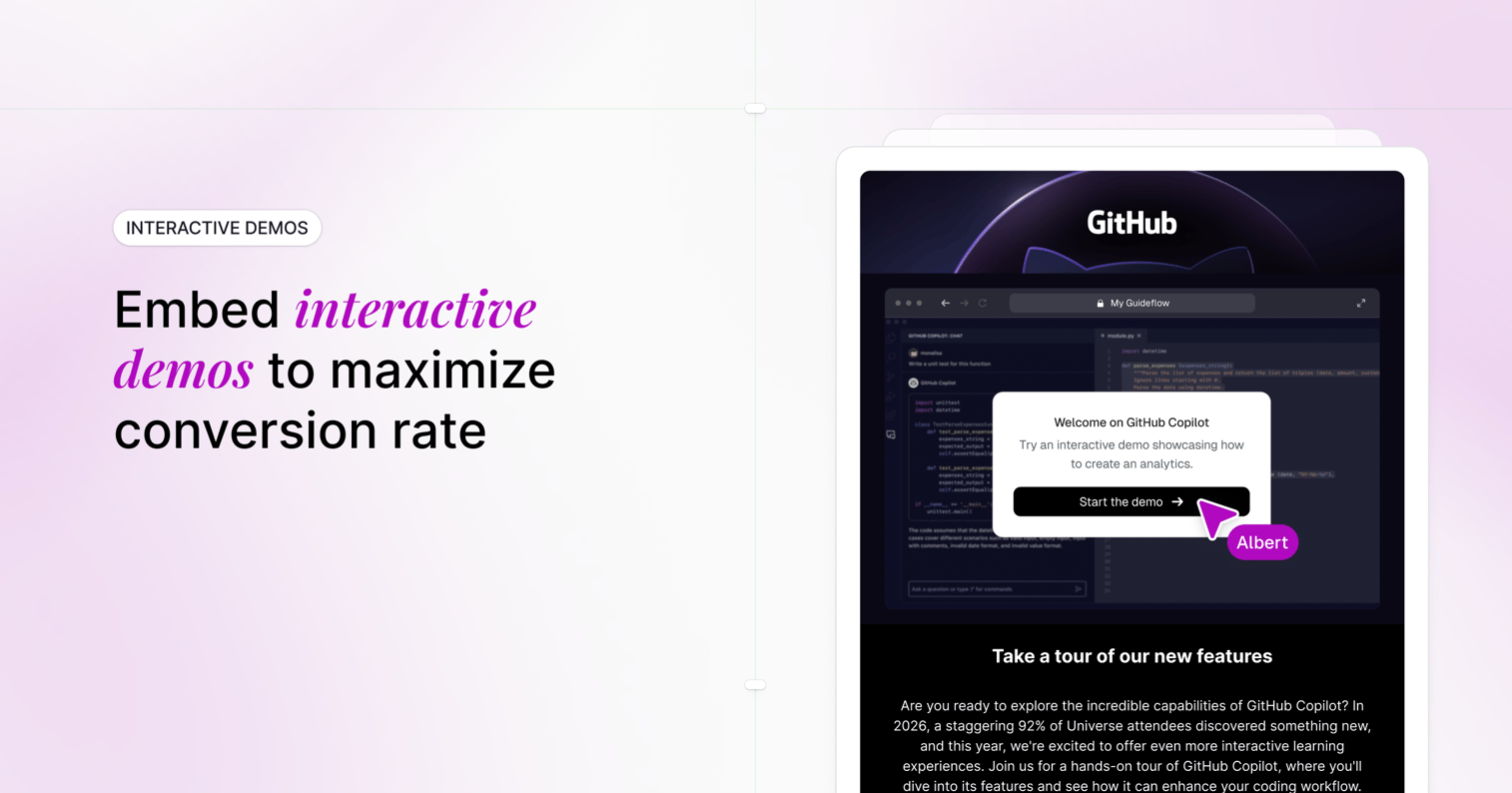
Homepage embeds, landing pages, paid traffic. Cold audience. The job is to demonstrate value fast.
Expect lower completion and higher volume. Forrester predicts more than 50% of large B2B purchases will go through digital self-serve channels in 2025. Top-of-funnel demos increasingly carry the full evaluation load. Keep them short, focused on a single feature, and instrumented for buyer intent.
Mid funnel
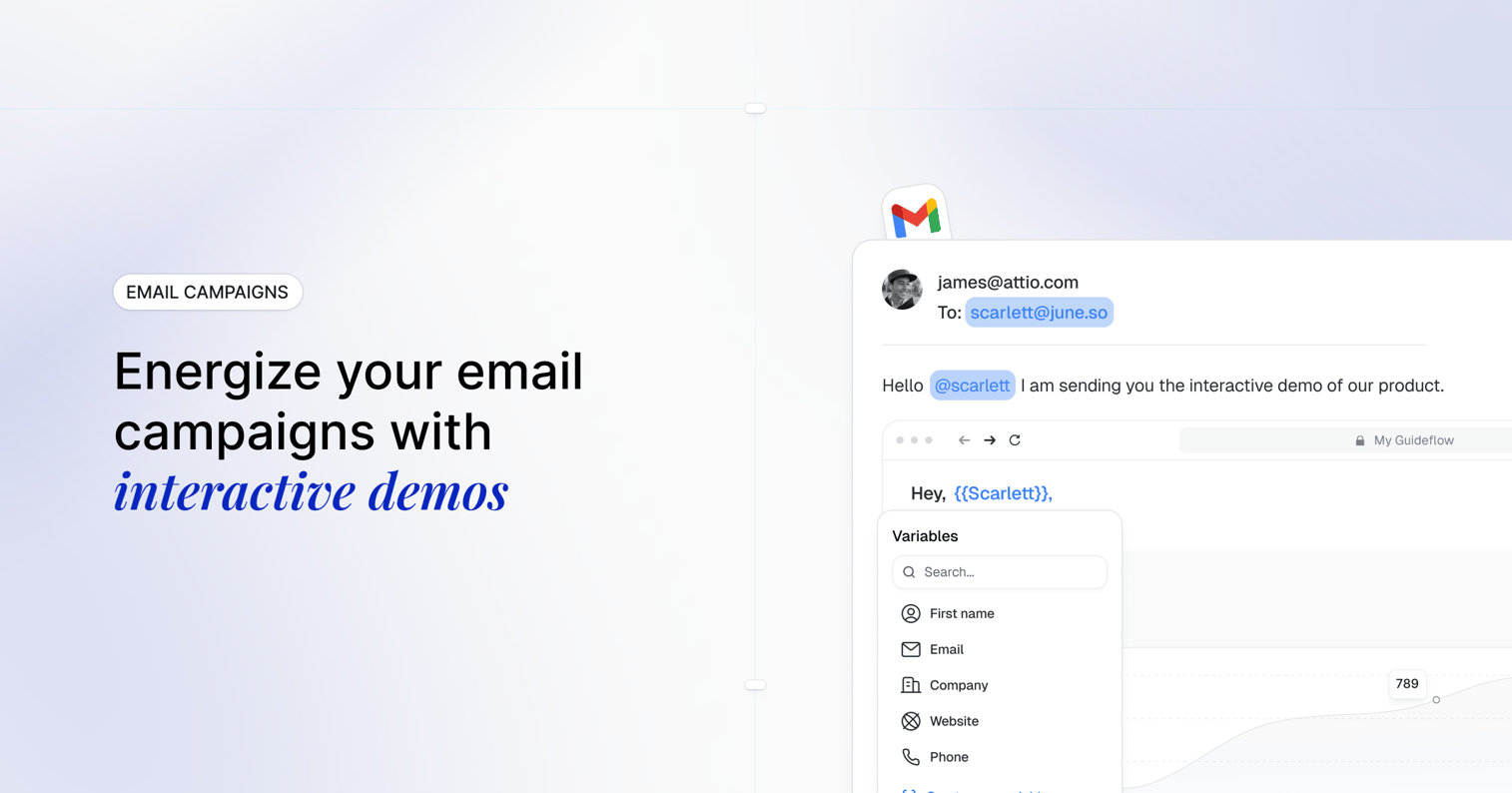
Outbound sequences, follow-up emails to warm prospects. The job is to build conviction before a meeting.
Expect higher completion and deeper intent signals. McKinsey research on omnichannel B2B selling found that omnichannel strategies deliver 287% higher purchase rates than single-channel approaches in complex deals. Presales teams increasingly rely on sandbox demos to support these omnichannel motions. A personalized interactive demo plus sales follow-up consistently outperforms either alone.
Bottom of funnel
Late-stage buyers comparing vendors. The job is depth and confidence. Expect the highest completion and CTA rates of any funnel stage. Length matters less here. Specificity matters more. Real workflows, real data, exact integrations.
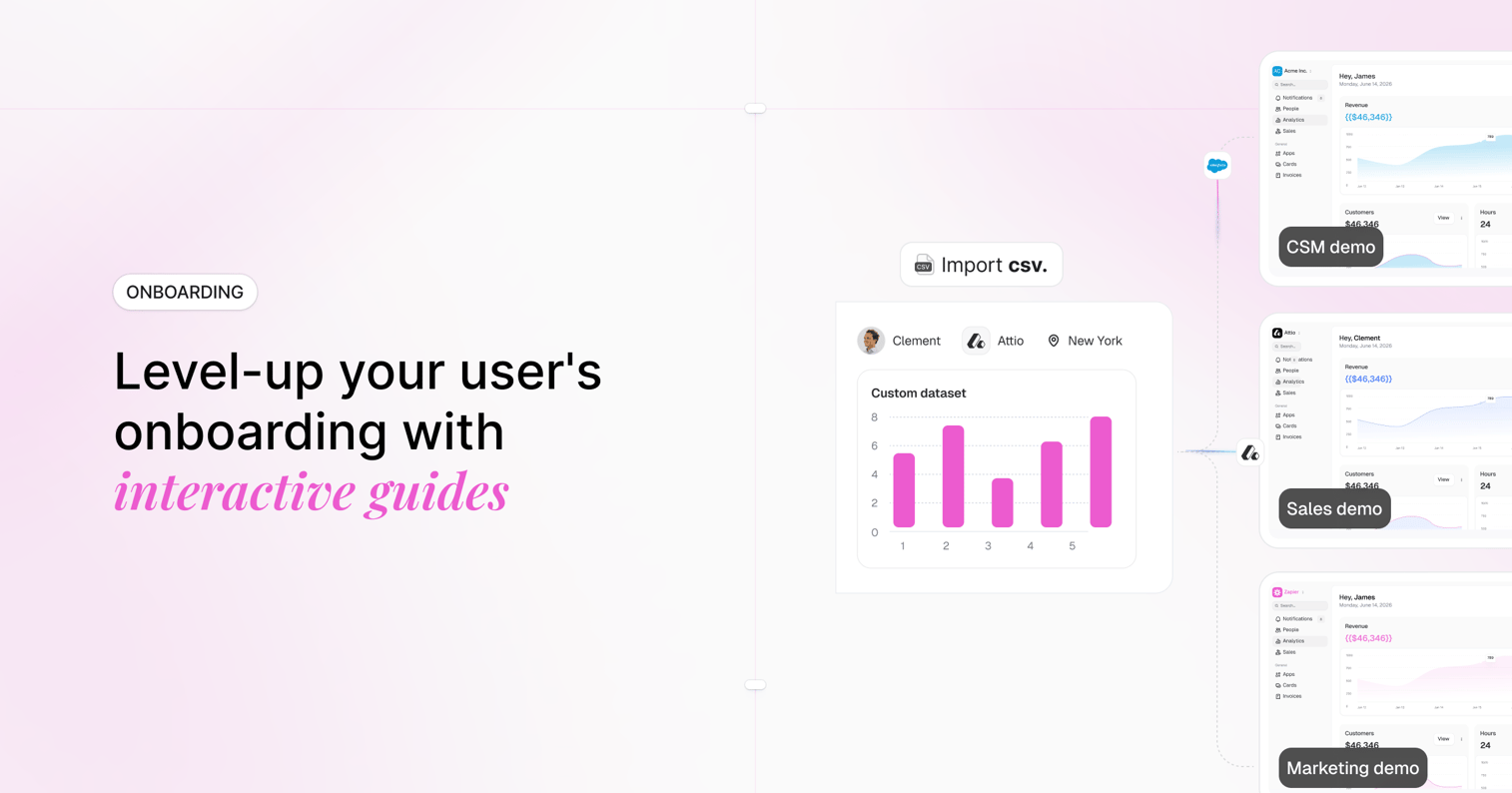
Customer success and onboarding. Existing customers learning features. Lead capture doesn't apply.
Success metrics shift to feature adoption, support deflection, and time to value. ProductLed's State of B2B SaaS 2025: companies with strong self-serve channels score 18.3% higher on time-to-value delivery. Onboarding demos embedded in help centers and lifecycle emails contribute directly to that lift.
The personalization premium
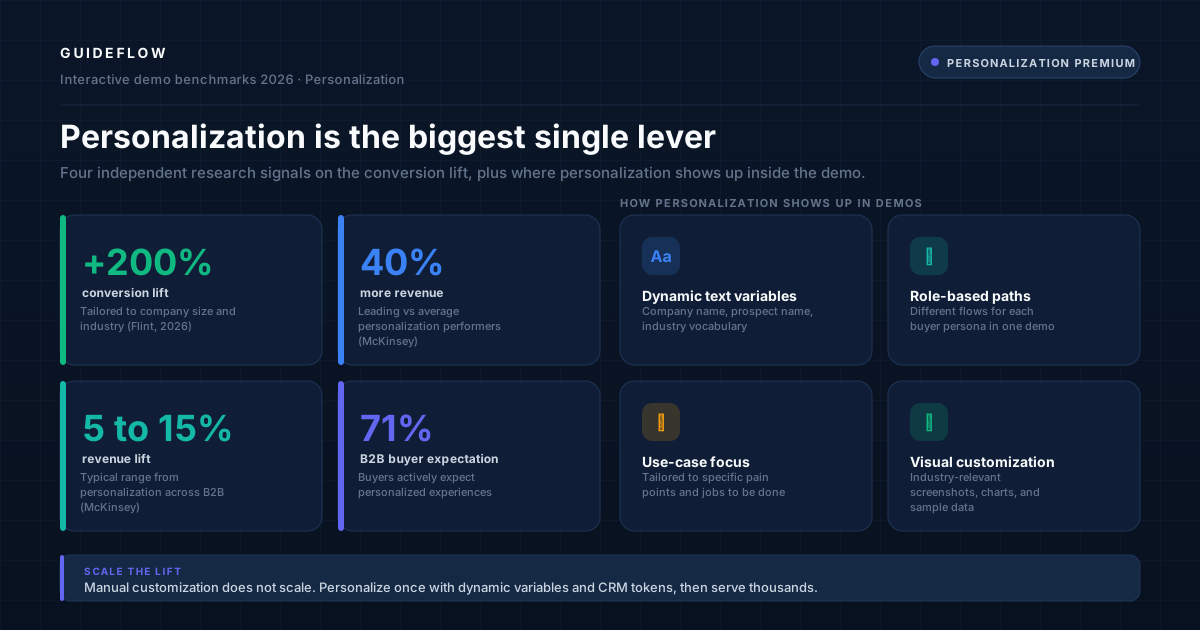
Personalization is the biggest single lever on demo performance. The data is unambiguous.
- 71% of B2B buyers expect personalized experiences. Leading companies generate 40% more revenue from personalization than average performers (McKinsey).
- Personalization typically drives a 5 to 15% revenue lift and 10 to 30% improvement in marketing-spend efficiency.
- 82% of B2B marketing decision-makers say buyers expect tailored experiences (Forrester, State of B2B Personalization, December 2024).
- Tailoring landing page messaging to specific company sizes and industries can increase conversion rates by more than 200% (Flint, 2026).
For interactive demos, personalization shows up four ways:
- Dynamic text variables. Company name, prospect name, industry vocabulary
- Role-based paths. Different flows for different buyer personas in the same demo
- Use-case focus. Tailored content for specific pain points or jobs to be done
- Visual customization. Industry-relevant screenshots and data
Manual customization doesn't scale. A demo personalized one prospect at a time doesn't make economic sense at top-of-funnel volume. Platforms that personalize demos for every prospect through dynamic variables, CRM-linked tokens, and account-based logic let you personalize once and serve thousands.
How to read your numbers
Three caveats before you compare to anything above.
Sample size matters more than headline rate. Wait for 200 to 500 sessions before drawing conclusions. Earlier data misleads in both directions.
Mobile and desktop perform differently. Mobile completion typically runs 10 to 15% lower than desktop. 70% of B2B research now involves mobile devices (Surface Labs, 2026). Segment by device before comparing.
Funnel context dominates raw numbers. A 30% completion rate on a homepage embed is strong. The same 30% on a demo sent to a hot prospect after discovery is a problem. Same number, different meaning.
Five ways to fix underperforming demos
1. Audit the first step
The first step decides whether viewers continue or bounce. If you're losing 30% or more before step two, the problem isn't your demo content. It's upstream. Common causes: unclear value proposition on the opening screen, slow load times, ambiguous instructions, a hook that doesn't match the page that drove the click.
The fix: shorter, sharper opening copy and a more obvious first interaction.
2. Trim length and copy density
Interactive content research is consistent. Shorter focused content beats longer content unless the audience is deep in evaluation. Review analytics for drop-off points. Those steps are candidates for cutting or combining. Target 25 to 30 words per step. Short sentences. Clear action verbs. If a step doesn't directly support the viewer's next action, it's adding friction.
3. Add role-based branching
Branching lets one demo serve multiple personas. A marketing team and a sales team care about different features. A 200-person company and a 5,000-person company evaluate differently.
Start with two or three branches. Expand based on which paths get selected.
4. Place CTAs at decision points, not just at the end
Mid-demo CTAs catch viewers at natural decision points before they drop off. Match CTA language to intent level. Early-stage viewers respond to "see the full product." Late-stage viewers respond to "talk to sales" or "start a trial."
Multiple CTA types capture different readiness levels. A primary action plus a secondary action beats a binary choice.
5. Personalize at the scale your funnel needs
The McKinsey data above is the strongest argument for moving from generic to personalized. Use dynamic variables for company names, role-specific content, and industry examples. Connect your demo platform to your CRM so personalization runs automatically.
What top interactive demo programs share
Four patterns separate the top 10% from average performers.
Clear value in the first 30 seconds
Top demos communicate outcome, not process. Not "here's how to create a report" but "see how teams cut reporting time by 50%." Small difference in framing. Large difference in completion.
Multiple CTAs across the experience
High performers mix primary CTAs with secondary actions: a related demo, a downloadable resource, a free trial. A demo center hosting these alternatives keeps engaged viewers active even when they aren't ready to convert.
Mobile-responsive design
70% of B2B research now involves mobile devices. A demo that degrades on mobile loses meaningful traffic before step two. Test on mobile. Fix it before optimizing anything else.
Step-level analytics on every demo
Top teams track engagement at the step level, not just overall completion. Step-level data reveals which features generate interest and where attention drops. Sales follow-up gets sharper. Marketing targeting gets sharper. Sales teams using demo centers report 3.2x higher closure rates through better prospect engagement. Without that granularity, every optimization is guesswork.
Turn buyer intent into pipeline
Benchmarks only matter if you act on them. The real value of interactive demo data is using buyer intent to prioritize sales follow-up and improve targeting. A prospect who completes 80% of your demo and clicks pricing is signaling intent. That signal beats a form fill with no engagement context.
Build workflows that route high-intent viewers to sales immediately. Route lower-intent viewers into nurture sequences that address the steps they actually viewed. Step-level data also informs content strategy. If viewers consistently drop off at step 8, that step needs work. If one feature drives the most engagement, surface it in your other channels.
Teams running multiple demos benefit from centralizing this data in one place. Sales and marketing work from the same view of what's resonating with buyers.
The numbers that matter most are your own
Industry benchmarks give you anchors. They aren't targets. The strongest benchmark is your own demo program's data, segmented by traffic source, persona, and funnel stage. Build that picture over 90 days. Iterate. Repeat.
The buyer behaviors driving this category (rep-free preference, distrust of vendor outreach, demand for self-serve product access) are already settled. Build for those. Measure against research. Improve against yourself. Want to see what your interactive demos benchmark to?
Create one with Guideflow in 2 minutes 30 seconds. Teams already using it report +30% conversion rates.
FAQs about interactive demo benchmarks
Monthly for ongoing optimization. Weekly during new demo launches. Catch issues early, before too much traffic moves through a broken experience.
Yes. B2B shows longer engagement times and lower volumes per session. The research-heavy buying motion takes time. B2C shows higher volumes and shorter sessions. All the data in this guide is B2B-specific.
Wait for 200 to 500 sessions before drawing conclusions. Segment by traffic source where possible. Smaller samples get distorted by traffic mix, a single high-engagement account, or day-of-week effects.
Mobile completion typically runs 10 to 15% lower than desktop for the same demo. 70% of B2B research now involves mobile devices (Surface Labs, 2026). Mobile-first design matters more every year.
Yes. Enterprise demos show longer engagement and multiple viewers per account. Buying committees average 13 or more stakeholders (Forrester 2025 Buyers' Journey Survey). Track unique accounts alongside individual sessions. SMB benchmarks focus on individual conversion velocity.
Industry-specific public benchmark data for interactive demos is limited. Compare against your own historical performance and the adjacent B2B research above. Your own analytics, segmented by industry and funnel stage, are the most reliable benchmark you have.