A sensitive file moves to a personal cloud drive at 11pm. A contractor accesses a customer database they've never touched before. A departing employee downloads a sales list the day after submitting their notice.
The problem isn't a shortage of logs. Security teams already have more raw activity data than they can process. The problem is knowing which signals need investigation, and having enough context to act before data leaves the organization.
According to the Ponemon Institute's 2025 Cost of Insider Risks Global Report, the average annualized cost of insider risk reached $17.4 million per organization, and organizations analyzed 7,868 insider incidents - up from 3,269 in 2018. Insider threat management software exists to convert that volume into defensible, prioritized cases rather than alert fatigue.
This guide compares 10 insider threat management platforms, explains how the category differs from adjacent tools, and gives product managers a practical framework for cross-functional evaluation.
What's inside
- A definition of insider threat management software and how it differs from DLP, UEBA, and SIEM tools
- A side-by-side comparison of 10 platforms with verified pricing context and G2 ratings
- Product manager relevant buying criteria: Privacy controls, telemetry, integrations, and maintenance burden
- Guidance on structuring a proof of concept before committing to a platform
Selection criteria used: Behavioral detection depth, investigation workflow quality, privacy and governance controls, integration coverage with SIEM and DLP stacks, and operational fit for cross-functional programs.
TL;DR
- Best for dedicated enterprise investigations: Proofpoint Insider Threat Management for organizations needing investigation-led behavioral context and adaptive data protection
- Best for Microsoft 365 environments: Microsoft Purview Insider Risk Management for teams standardizing on Microsoft's security and compliance stack
- Best for data-centric risk visibility: Varonis Data Security for programs prioritizing sensitive data discovery and permissions analysis
- Best for privacy-conscious behavioral analytics: DTEX for teams that want risk-adaptive monitoring with pseudonymization built in
- Best for granular endpoint monitoring: Teramind for security teams that need detailed session evidence and activity reconstruction
- Best for SIEM-led security operations: Securonix User and Entity Behavior Analytics for mature teams running insider risk detection inside a broader detection workflow
What is insider threat management software?
Insider threat management software helps organizations detect, investigate, and reduce risk from employees, contractors, partners, and other trusted users by combining activity monitoring, behavioral analysis, data context, and response controls.
This category differs from a firewall or perimeter defense. The threat already has authorized access. The challenge is distinguishing normal activity from behavior that signals data misuse, credential abuse, or inadvertent exposure.
What these platforms do
Core capability areas across the category include:
- Behavioral baselining: Establish normal patterns for individual users, teams, devices, and data access - then flag meaningful deviations
- Risk scoring and prioritization: Rank activity using identity context, data sensitivity, activity sequence, and how far it deviates from established baselines
- User activity monitoring: Capture activity across endpoints, cloud applications, collaboration tools, browsers, and identity systems
- Data protection: Detect risky uploads, copying, printing, or exfiltration of sensitive data before it leaves controlled environments
- Investigation workflows: Assemble timelines, forensic evidence, identity context, and case management details for analyst review
- Response controls: Trigger coaching, escalation, DLP policy enforcement, or access restriction based on risk level
- Privacy safeguards: Apply pseudonymization, role-based access, scoped investigations, and audit logs to protect employee data
How insider threat management differs from adjacent tools
| Category | Primary job | What it contributes to insider risk |
|---|---|---|
| Insider threat management | Detect and investigate risky insider behavior | Behavioral context, evidence timelines, risk prioritization |
| DLP | Control sensitive data movement | Policy enforcement and exfiltration controls |
| UEBA | Identify anomalous behavior statistically | Anomaly detection across users and entities |
| SIEM | Centralize and correlate security events | Broad visibility and security operations workflows |
| User activity monitoring | Record endpoint and user activity | Detailed activity reconstruction and evidence |
| Data security platform | Discover and protect sensitive data | Data classification, permissions, and exposure context |
Mature programs typically integrate several of these layers. No single tool replaces the others, and product managers involved in security reviews should understand where each category's coverage begins and ends.
When to use insider threat management software
Detect risky behavior before data leaves the organization
Unusual download volumes, privileged access outside normal hours, mass file copying, or AI tool use involving sensitive content are all signals that raw log monitoring misses. Insider risk platforms combine identity, data sensitivity, and behavioral sequence to surface the cases worth investigating, while reducing noise from benign policy events.
Investigate incidents with complete evidence
When an incident does occur, analyst productivity depends on timeline quality, not just alert volume. Investigation workflows that surface identity context, sensitive data classification, and endpoint evidence in one place allow teams to move from alert to defensible case without manually assembling data from five separate systems.
Scale insider risk governance across product changes
New file export features, AI copilots, integration endpoints, and permission model changes shift the organization's risk profile with every release. A platform that integrates into release reviews and connects product event instrumentation to security operations reduces the engineering cost of staying current. For product managers, that connection between release cadence and risk surface is directly actionable.
When to prioritize this category:
- Repeated data exfiltration incidents or near-misses
- Increased remote or contractor access without corresponding visibility
- A growing Microsoft 365, SaaS, or cloud footprint where activity spans multiple systems
- Upcoming regulatory or customer security reviews requiring documented insider risk controls
- New AI workflows handling sensitive customer or financial data
Insider threat management software comparison
The table below covers each platform's primary fit, differentiating capability, pricing model, and verified G2 rating. Pricing figures were verified from vendor pages and G2 in October 2026. Where vendors require a quote, that is noted.
| # | Product | Best for | Key differentiator | Pricing | G2 rating |
|---|---|---|---|---|---|
| 1 | Proofpoint Insider Threat Management | Enterprise insider risk investigations | Investigation-led behavioral context across endpoints, cloud, email, and GenAI | Contact sales | 4.3/5 |
| 2 | Microsoft Purview Insider Risk Management | Microsoft 365 security and compliance teams | Native Microsoft data, identity, and compliance integration | From $10/user/month (bundled) | Not verified |
| 3 | Varonis Data Security | Data-centric insider risk programs | Sensitive data discovery, permissions analysis, and abnormal access detection | Contact sales | 4.7/5 |
| 4 | DTEX | Privacy-conscious behavioral risk programs | Risk-adaptive monitoring with privacy-preserving pseudonymization | Contact sales | Not verified |
| 5 | Teramind | Granular endpoint monitoring and investigations | Detailed user activity recording and session replay | Contact sales | 4.6/5 |
| 6 | Syteca | Mid-market privileged access and user monitoring | Privileged access management combined with session monitoring | Contact sales | 4.7/5 |
| 7 | Forcepoint Insider Threat | DLP-led data protection programs | Real-time risk scoring tied to dynamic DLP policy enforcement | Contact sales | 4.2/5 |
| 8 | Incydr | Data movement and file exfiltration investigations | Insider risk visibility across endpoints, cloud apps, email, and source code | Contact sales | 4.1/5 |
| 9 | Securonix User and Entity Behavior Analytics | SIEM-led security operations teams | Behavioral analytics integrated into a broader detection and response workflow | Contact sales | 4.0/5 |
| 10 | Netwrix Auditor | Audit-driven hybrid environment visibility | Change tracking, access auditing, and compliance reporting | Free Community Edition available; enterprise pricing by quote | Not verified |
Best 10 insider threat management software for 2026
1. Proofpoint Insider Threat Management
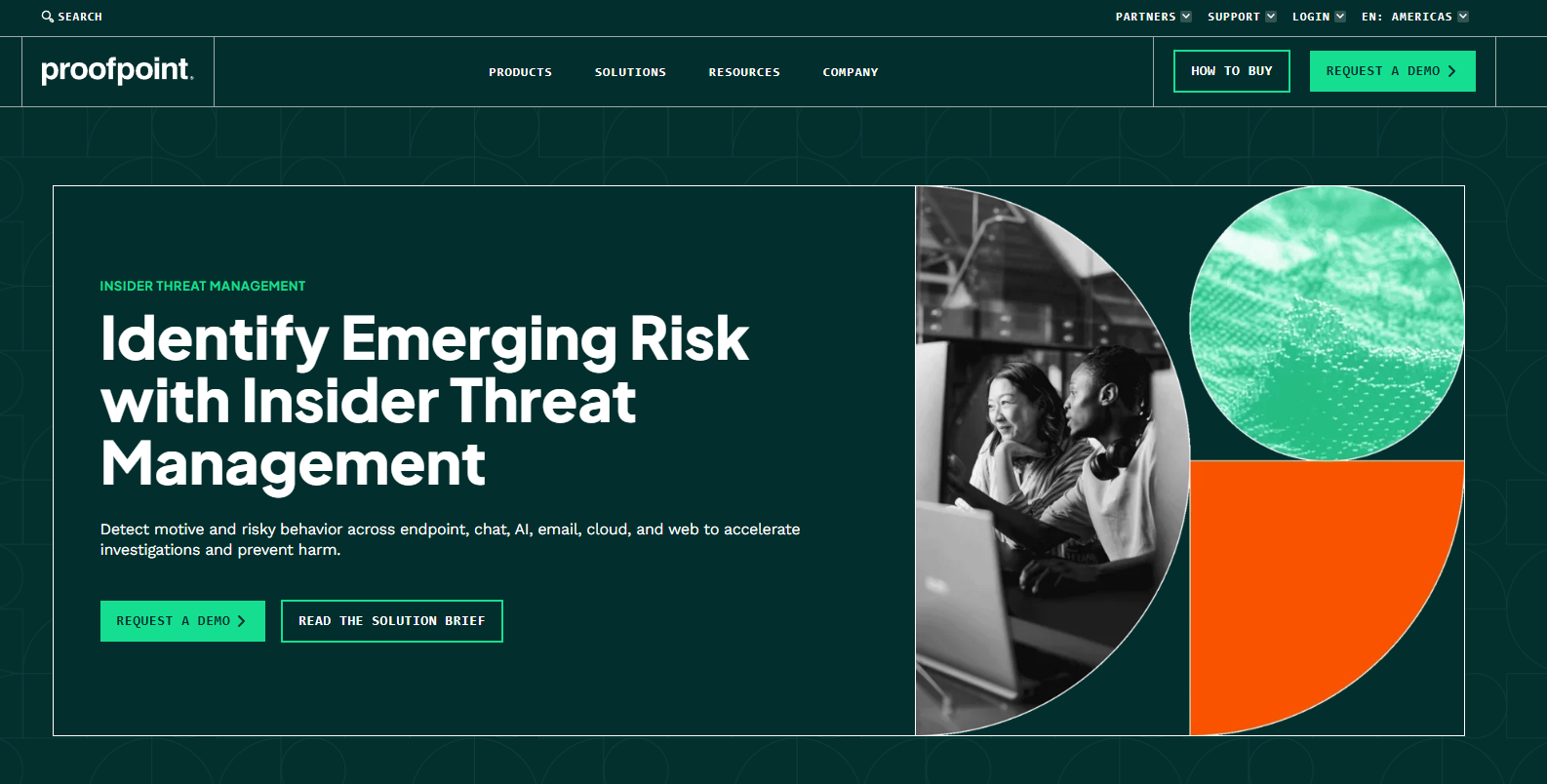
Proofpoint Insider Threat Management is a dedicated insider risk platform built for enterprise security teams that need to connect user behavior, data movement, communications, and endpoint context into defensible investigation cases. The platform covers activity across endpoints, browsers, cloud storage, email, web, and GenAI channels, and pairs that visibility with behavioral and sentiment analysis to surface motive alongside risk signals.
Best for: Large enterprise security teams that need dedicated insider threat investigations, adaptive data protection, and investigation workflows that support forensic evidence collection.
Key features
- Real-time activity monitoring across endpoints, browsers, cloud, and email
- Behavioral and sentiment analysis for motive and risk context
- Prebuilt and customizable risk detection rules
- Timeline-based investigations with forensic evidence collection
- Privacy controls: Anonymization, masking, and role-based access
Why choose Proofpoint Insider Threat Management: Choose this platform when your security program has mature governance requirements and needs to move from raw monitoring to structured, attorney-ready cases. Product managers supporting enterprise security reviews will find that the privacy controls, role-based access model, and investigation audit logs map well to cross-functional sign-off requirements.
Proofpoint Insider Threat Management pricing: Proofpoint directs prospects to contact sales for pricing. No tier structure or starting price is displayed on the vendor's pricing page.
G2 rating: 4.3/5
2. Microsoft Purview Insider Risk Management
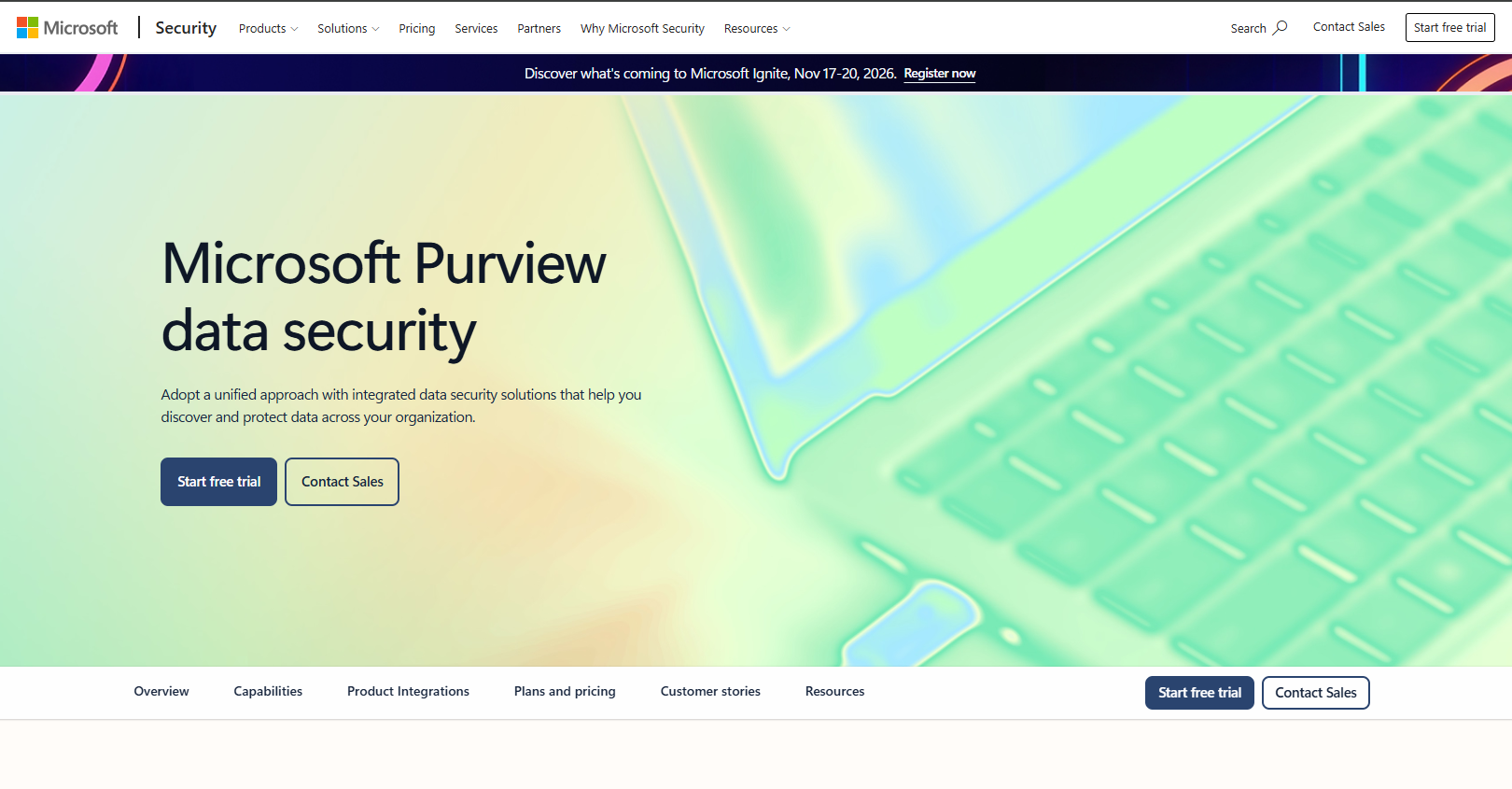
Microsoft Purview Insider Risk Management is a compliance and detection solution built into the Microsoft Purview suite. It correlates Microsoft 365 activity signals, Microsoft Graph data, and third-party indicators to surface policy violations, data leakage, intellectual property theft, and security violations. Its value is tightly bound to existing Microsoft licensing and ecosystem coverage.
Best for: Security and compliance teams standardizing on Microsoft 365 who want insider risk controls that share data natively with Microsoft Defender, Microsoft Entra, and Microsoft information protection tools.
Key features
- Microsoft 365 activity signals and Microsoft Graph correlation
- Policy-based detection with configurable risk indicators and thresholds
- Privacy-by-design controls: Pseudonymization, role-based access, admin opt-in, and audit logs
- Case management, alert triage, and investigation workflows
- Optional forensic evidence add-on for visual incident insights
Why choose Microsoft Purview Insider Risk Management: The native integration across Microsoft collaboration, files, email, and identity removes the need to build connectors for the data sources that matter most to Microsoft-centric organizations. Evaluate whether your existing licensing tier includes Insider Risk Management, since it is bundled into Microsoft Purview Suite and Microsoft 365 E5 rather than priced as a standalone product.
Microsoft Purview Insider Risk Management pricing: Available as part of the Microsoft Purview Suite at $12.00/user/month (billed annually) or Microsoft 365 E5 at $60.00/user/month (billed annually). A lower-cost bundle for Microsoft 365 Business Premium starts at $10.00/user/month annually.
3. Varonis Data Security
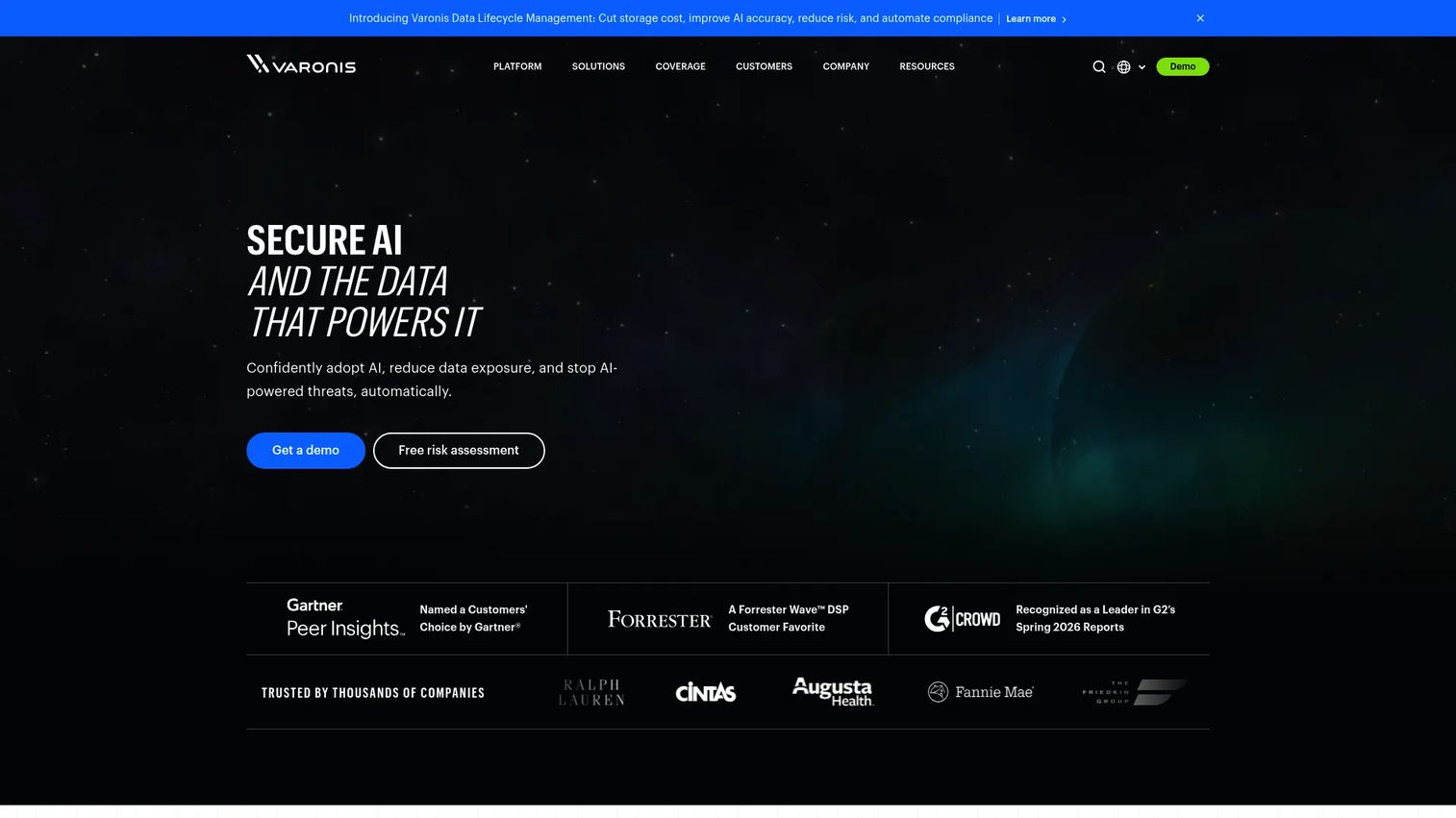
Varonis Data Security approaches insider risk through the data estate rather than the endpoint. The platform discovers and classifies sensitive data, analyzes permissions and entitlements, automates remediation of risky misconfigurations, and detects abnormal access patterns across cloud storage, SaaS platforms, file systems, and databases. If your primary question is "who can access what, and who is accessing it abnormally," Varonis answers it at scale.
Best for: Enterprises that need to map sensitive data exposure, reduce unnecessary permissions, and detect abnormal access before it becomes an incident.
Key features
- Sensitive data discovery and classification across cloud and on-premises environments
- Permissions and entitlement analysis with automated remediation
- Abnormal access detection and behavioral monitoring
- Data access activity monitoring with investigation context
- Cloud and hybrid data visibility across SaaS and file systems
Why choose Varonis Data Security: Product managers supporting security reviews should consider Varonis when the core question is data exposure rather than endpoint behavior. It answers where sensitive data lives, who can reach it, and which access patterns deviate from normal, which maps directly to the data governance and access model questions that come up during enterprise procurement reviews.
Varonis Data Security pricing: Varonis does not display pricing on its website. Contact sales or request a quote through the vendor's pricing page.
G2 rating: 4.7/5
4. DTEX
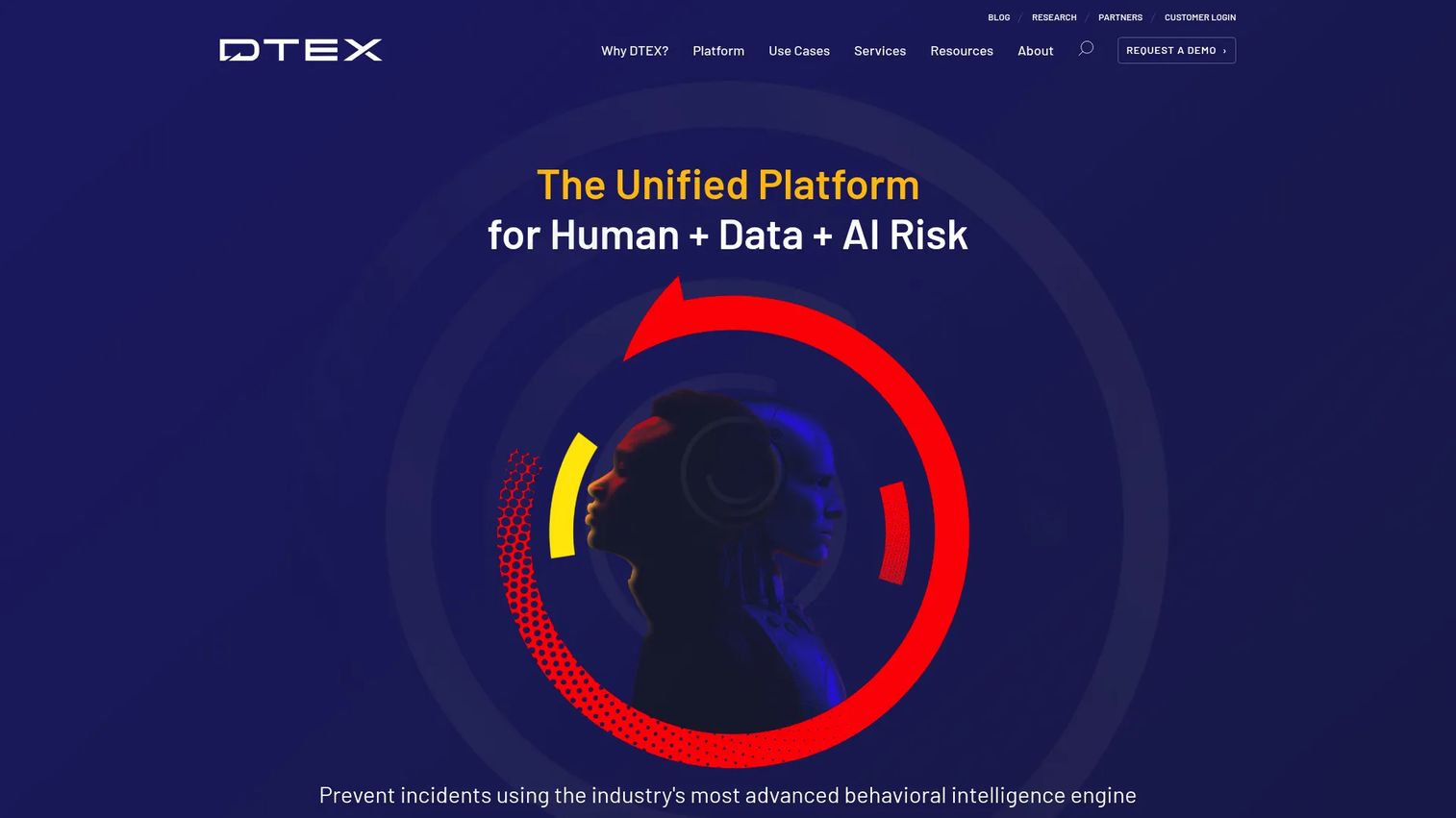
DTEX is a behavioral risk platform that unifies human, data, and AI risk signals into a single detection and investigation workflow. Its architecture focuses on user activity metadata rather than full content capture, pairing that with pseudonymization controls that keep employee identities protected until a formal investigation is opened. The platform also covers AI-driven activity, which makes it relevant for organizations that have deployed GenAI tooling across their workforce.
Best for: Enterprise security teams that want privacy-conscious behavioral analytics, AI risk monitoring, and investigation workflows that satisfy legal and HR stakeholder requirements.
Key features
- Behavioral risk scoring across human, data, and AI activity
- User activity metadata collection with privacy-preserving pseudonymization
- Risk-adaptive monitoring with configurable investigation workflows
- AI Risk Management and Triage Guardian Agent capabilities
- Integration with DLP, SIEM, and identity stacks
Why choose DTEX: The pseudonymization architecture is the clearest differentiator for organizations where legal, HR, or privacy teams require formal approval before a named employee's activity is exposed to investigators. Test the quality of risk signals and the investigator workflow in a proof of concept before committing, since the metadata-focused approach involves different trade-offs than full endpoint capture.
DTEX pricing: DTEX does not display pricing on its website. Contact sales for contract details.
5. Teramind
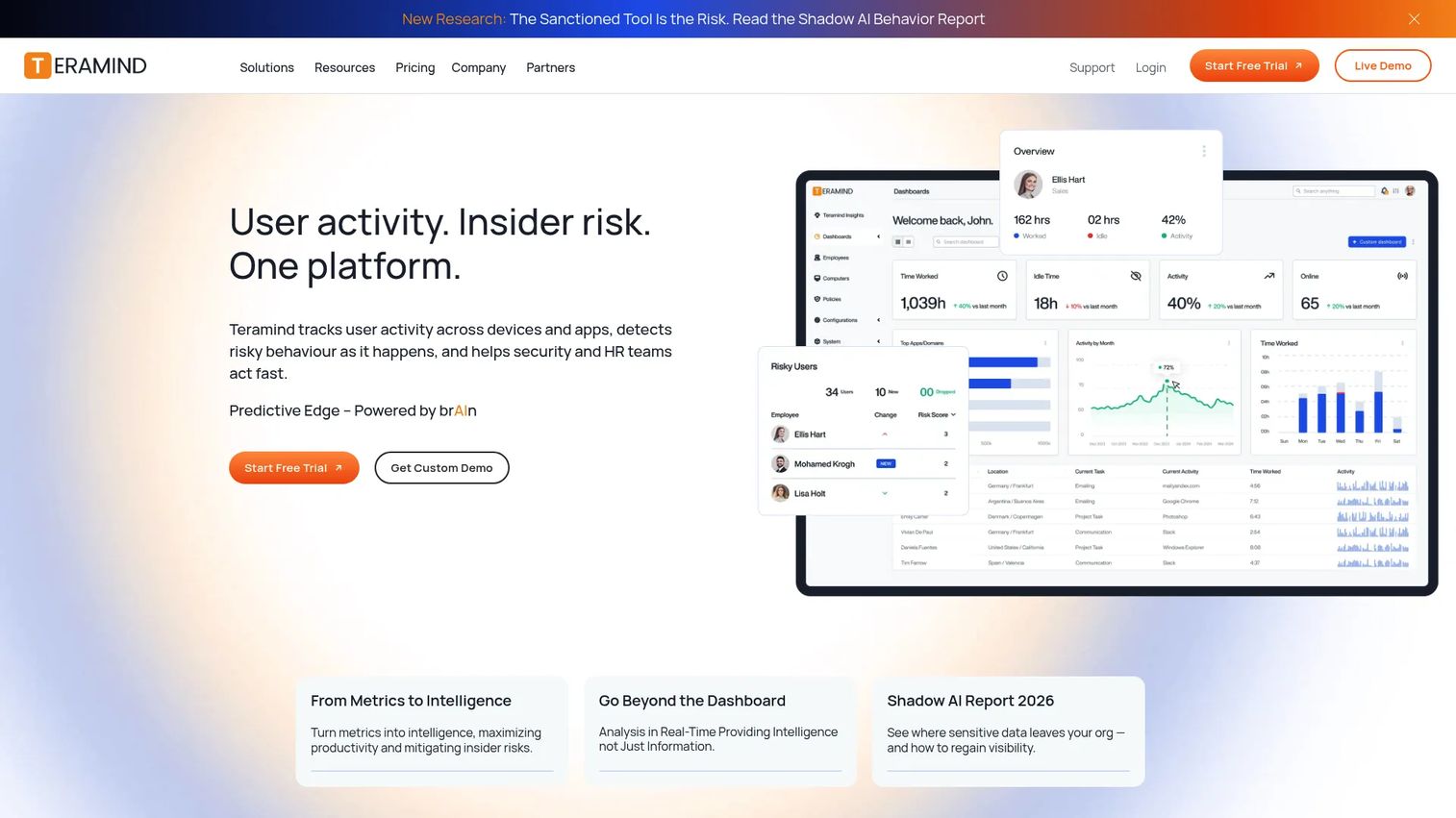
Teramind is a workforce analytics and insider risk platform built on granular endpoint activity monitoring. It captures screen recordings, application usage, keystrokes, file activity, and web behavior, and pairs that visibility with behavior-based alerts, DLP rules, and productivity analytics. For investigation teams that need to reconstruct exactly what happened during an incident, Teramind's session replay is one of the most detailed available.
Best for: Organizations that need session-level evidence for investigations, policy enforcement, and activity reconstruction across a managed endpoint fleet.
Key features
- Endpoint activity monitoring including keystrokes, applications, and web activity
- Screen recording and live session replay
- Behavior-based alerts and anomaly detection
- Data loss prevention rules and activity blocking
- Productivity analytics and user behavior reporting
Why choose Teramind: Granular monitoring supports detailed investigation and policy enforcement, but the governance questions are proportionally more complex. Before deploying, align with legal, HR, and privacy stakeholders on monitoring scope, proportionality, data retention, and which user populations fall under which policy. Product managers evaluating Teramind should map monitoring policies to employee, contractor, and privileged-user segments explicitly.
Teramind pricing: Teramind offers Starter, UAM, and DLP plans with pricing available on request, plus an Enterprise and Government tier at custom pricing. Yearly billing includes an 8% saving. A free trial is available.
G2 rating: 4.6/5
6. Syteca
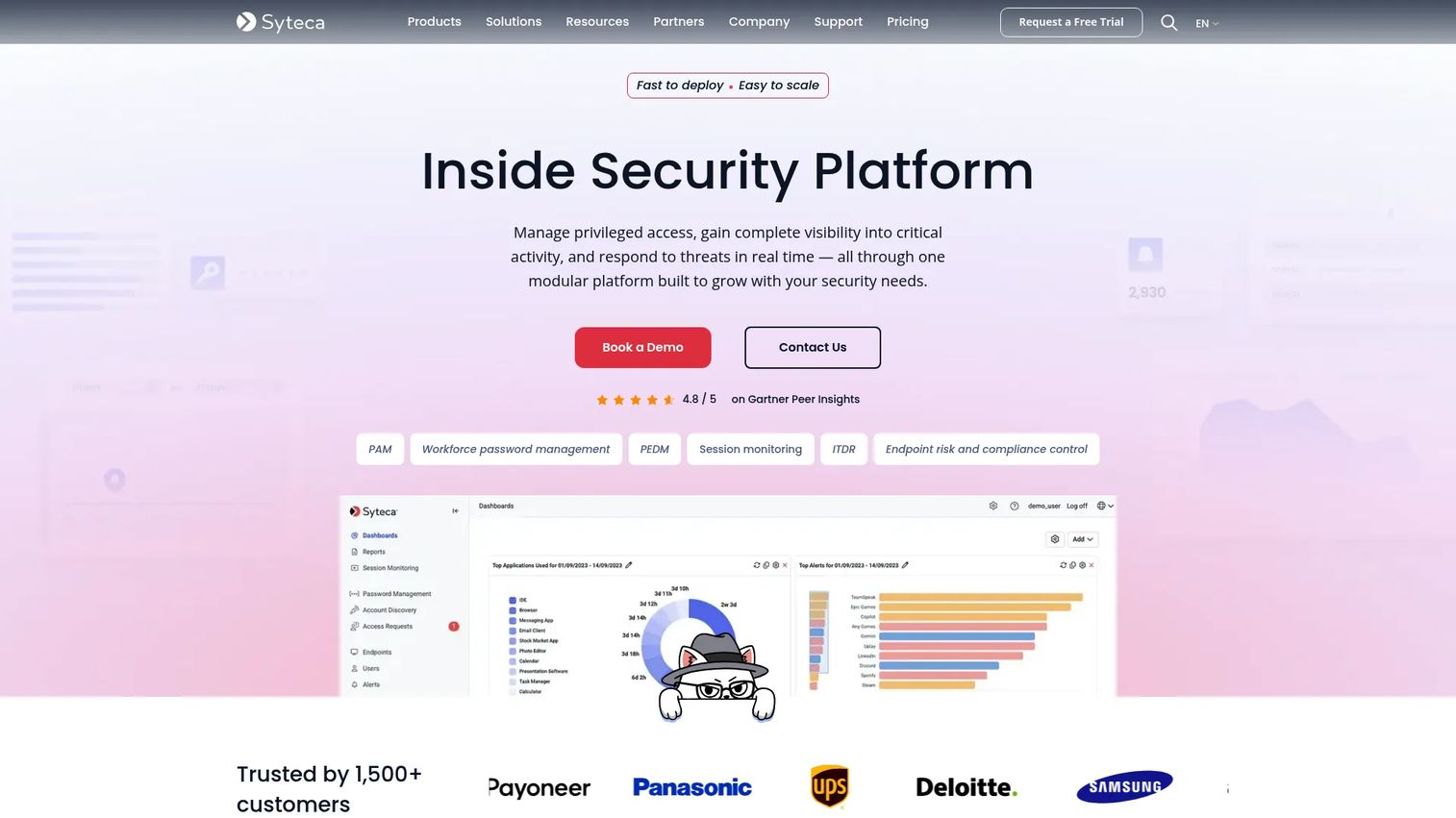
Syteca combines privileged access management, session monitoring, workforce password management, and insider threat detection into a single platform. It covers Windows, macOS, and Linux endpoints, and adds real-time alerting, process termination, and user blocking alongside audit-ready session recordings. The platform suits organizations that want to address privileged access risk and endpoint visibility from one tool rather than assembling separate point solutions.
Best for: Mid-market and enterprise security teams that need unified privileged access control, session monitoring, and insider threat detection with auditable session security.
Key features
- Privileged access management with account discovery, MFA, and time-based restrictions
- Session monitoring and recording across Windows, macOS, and Linux
- Workforce password management with credential vaulting and rotation
- Real-time threat detection, alerting, and user blocking
- Endpoint risk and compliance control
Why choose Syteca: The combination of privileged access management and monitoring in one platform reduces the tool count for teams whose primary insider risk exposure runs through privileged accounts and contractor access. Validate endpoint coverage breadth and reporting workflows during a proof of concept, particularly for hybrid or multi-OS environments.
Syteca pricing: Syteca customizes pricing based on requirements. Contact sales or request a quote through the vendor's pricing page.
G2 rating: 4.7/5
7. Forcepoint Insider Threat
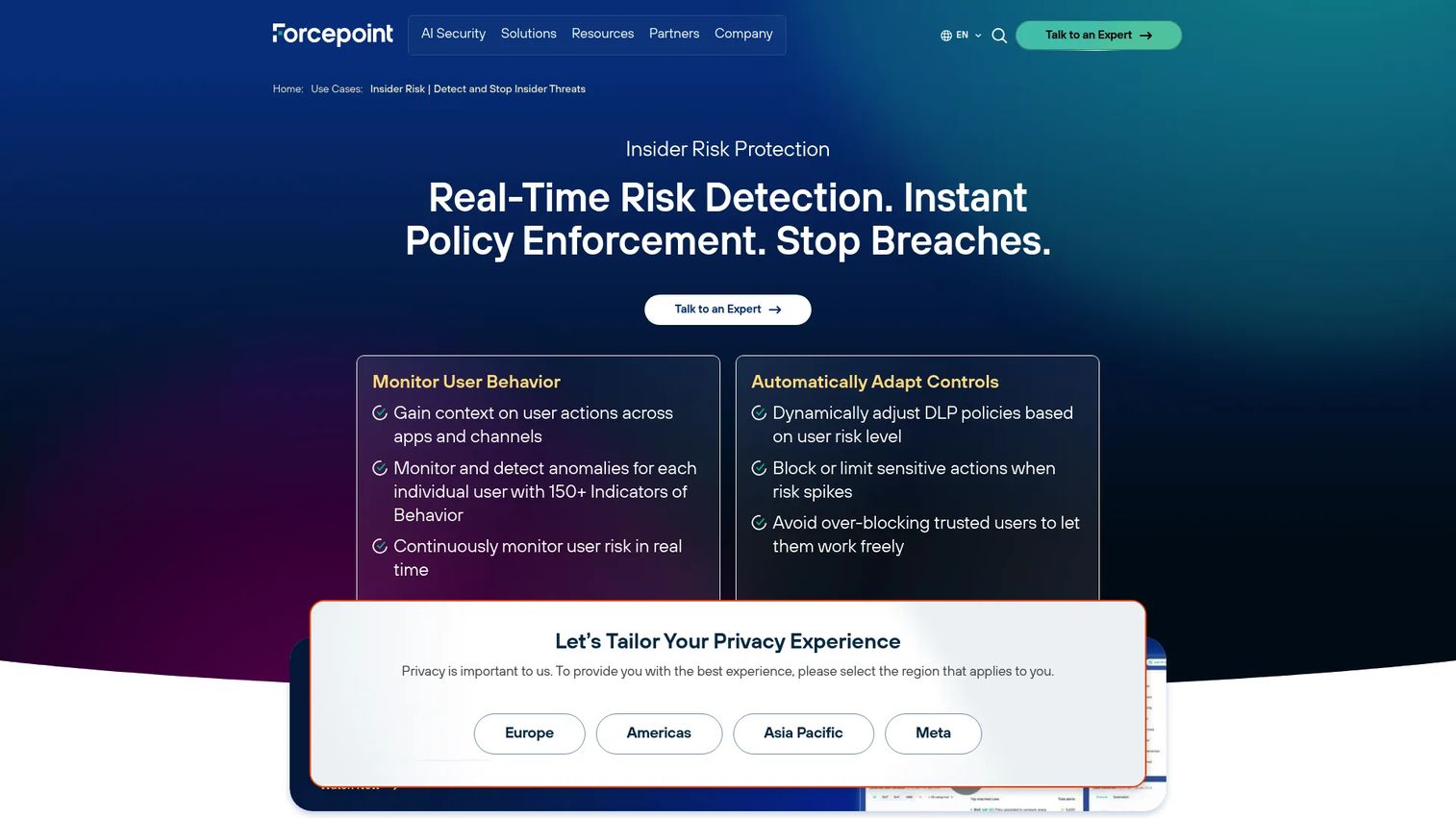
Forcepoint Insider Threat integrates insider risk detection directly with data loss prevention and enterprise security controls. The platform scores user risk in real time using behavioral anomalies, policy violations, and contextual signals, then dynamically adjusts DLP policy enforcement based on that score. Organizations that want detection and enforcement to move together, rather than running as separate programs, will find this integration approach relevant.
Best for: Enterprise security teams that prioritize enforcement alongside detection and want insider risk scores to directly drive DLP policy adjustments.
Key features
- Real-time user risk scoring from behavioral anomalies and policy violations
- Monitoring across applications and channels with 150+ behavioral indicators
- Dynamic DLP policy enforcement tied to risk level
- Investigation context, case management, and video replay
- Integrations with SIEM, Jira, and ServiceNow
Why choose Forcepoint Insider Threat: The key proof of concept question for Forcepoint is whether dynamic risk-to-DLP enforcement reduces false positives enough to make analyst workload manageable. If your organization already runs Forcepoint DLP, the integration path is shorter. Evaluate SIEM and ticketing integration depth if those workflows are central to your security operations.
Forcepoint Insider Threat pricing: Pricing is not displayed on the vendor's website. Contact sales for contract details.
G2 rating: 4.2/5
8. Incydr
Incydr focuses specifically on insider risk driven by data movement. It monitors file activity across endpoints, cloud applications, email, browsers, Salesforce, and source code repositories, then surfaces risk-prioritized signals around exfiltration, policy non-compliance, and training gaps. Its PRISM risk prioritization model connects file movement context to investigation and response, distinguishing it from a generic DLP policy enforcer.
Best for: Security teams investigating risky file movement, cloud uploads, removable media activity, and data exfiltration patterns across a SaaS-heavy environment.
Key features
- File movement visibility across endpoints, cloud, email, browsers, and source code
- PRISM risk prioritization and investigation context
- Watchlists and forensic search across monitored activity
- Response controls for correcting mistakes, blocking activity, and containing threats
- Security education with 70+ embedded video lessons for user correction
Why choose Incydr: Incydr is most compelling when sensitive files routinely move between collaboration tools, cloud drives, endpoints, and external destinations, and when the investigation team needs a purpose-built tool rather than a DLP module inside a broader suite. Validate data classification depth and source code monitoring coverage during a pilot if those are central use cases.
Incydr pricing: Incydr offers Professional, Enterprise, and Gov editions. Contact sales for pricing across all tiers.
G2 rating: 4.1/5
9. Securonix User and Entity Behavior Analytics
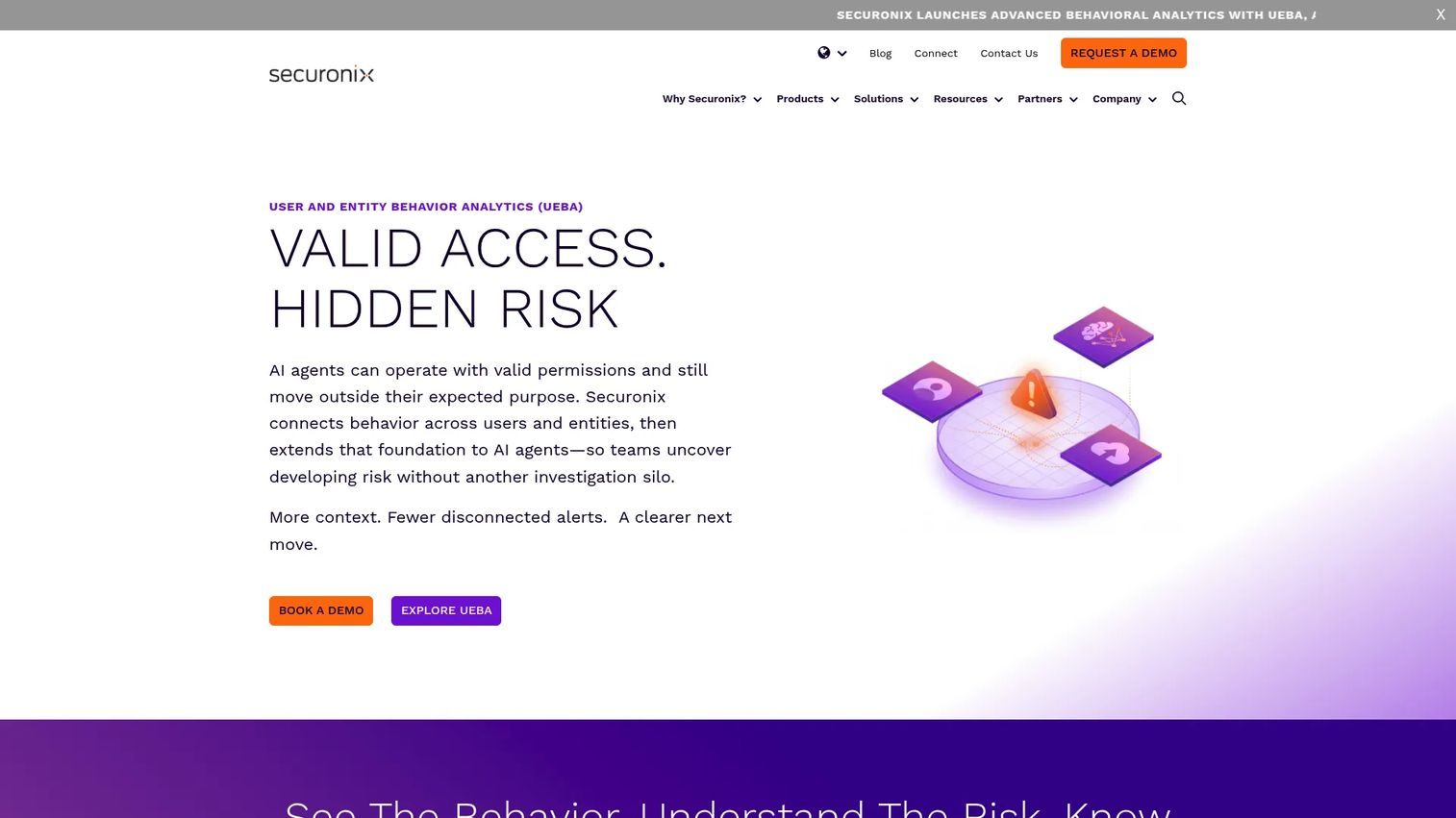
Securonix User and Entity Behavior Analytics detects insider threats, identity misuse, and abnormal behavior by analyzing rare activity, unusual access patterns, volume spikes, suspicious sequences, and privilege misuse across a broad telemetry base. It connects human and machine signals into unified investigations and enriches those signals with identity, asset, threat intelligence, and data sensitivity context. Securonix UEBA is available standalone or integrated with its Unified Defense SIEM.
Best for: Mature security operations teams that want insider risk detection signals inside a SIEM-led detection and investigation program with broad telemetry correlation.
Key features
- Behavior-driven analytics for rare activity, access anomalies, and privilege misuse
- Context enrichment using identity, location, asset, and data sensitivity signals
- Dynamic risk prioritization connecting human and machine signals
- Threat investigation workflows with unified case management
- Security operations integrations for SIEM-led triage
Why choose Securonix User and Entity Behavior Analytics: The platform rewards operational maturity. Teams that have clear telemetry sources, a defined triage model, and analysts ready to tune detections get the most from Securonix UEBA. Product managers can contribute meaningfully here by ensuring product event data is consistently instrumented and meaningful to the detection models.
Securonix User and Entity Behavior Analytics pricing: Securonix does not display pricing on its website. Pricing is sales-assisted and may vary by data volume, user count, or module configuration.
G2 rating: 4.0/5
10. Netwrix Auditor
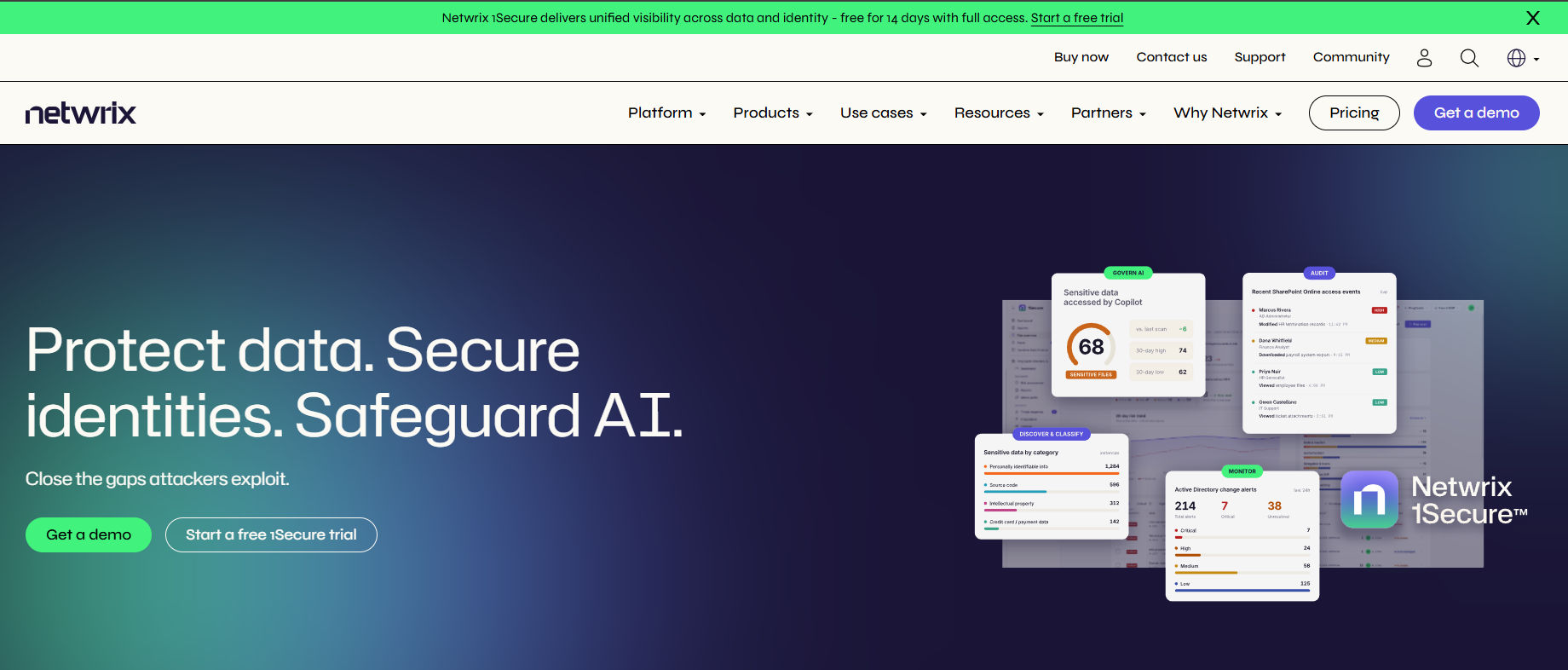
Netwrix Auditor is a visibility and auditing platform for tracking changes, access activity, configurations, and user behavior across hybrid IT environments. It audits Active Directory, Microsoft Entra ID, Exchange, file servers, SharePoint, SQL Server, VMware, and Windows Server, and surfaces that data through interactive investigation search, predefined compliance reports, and real-time behavior anomaly alerts. For organizations where insider risk requirements start with auditability and access change visibility, Netwrix provides a practical foundation.
Best for: IT and security teams that need centralized access auditing, change tracking, and compliance reporting across on-premises and hybrid systems.
Key features
- Interactive audit data search and investigation
- Predefined reports, dashboards, and compliance reporting
- Real-time alerts and behavior anomaly detection
- Auditing across Active Directory, file servers, SharePoint, SQL Server, and VMware
- RESTful Integration API for connecting audit data to other security workflows
Why choose Netwrix Auditor: Netwrix is the right starting point when audit trails, access change tracking, and compliance reporting are the immediate priority, and when the team is not yet ready to operate a full behavioral analytics program. Assess whether the behavioral analytics depth and investigation workflow match your longer-term insider risk program requirements before committing.
Netwrix Auditor pricing: A Free Community Edition is available with daily change-summary reports. Full-featured Enterprise Advanced licensing requires a commercial license, available by contacting sales.
Considerations when choosing insider threat management software
Behavioral context and alert quality
Count defensible cases, not total alerts generated. Ask vendors during a proof of concept to demonstrate how the platform combines identity, data sensitivity, device posture, historical behavior, and activity sequence into a single risk score. Test it against known benign anomalies and known risky patterns drawn from your own environment.
Data coverage and telemetry mapping
Before shortlisting, map the systems that matter: Endpoint, email, cloud storage, collaboration tools, source code repositories, CRM, privileged administration, and AI tooling. Product managers can add direct value here by identifying which product events and admin actions need instrumentation to make security telemetry meaningful.
Privacy controls and stakeholder governance
Evaluate pseudonymization options, role-based access for investigators, case approval workflows, audit logs, data retention limits, and de-anonymization controls. Involve legal, HR, privacy, and employee relations stakeholders before rollout. The program governance structure matters as much as the detection capability.
Investigation workflow and response depth
Assess how quickly an analyst can move from an alert to a complete evidence timeline. Test session details, data classification context, case management, ticketing handoff, and automated response options. A platform that generates good signals but requires five manual steps to build a case creates its own bottleneck.
Integration depth and maintenance burden
Confirm integration coverage with SIEM, SOAR, DLP, IAM, EDR, ticketing, and cloud platforms. Ask who owns detection tuning after each product release, new data source onboarding, or access model change. The best platform is the one the security team can operate without constant engineering escalation.
Conclusion
Insider threat management sits at the intersection of security operations, data governance, privacy, and cross-functional program ownership, which is exactly why product managers are increasingly part of the evaluation.
Proofpoint Insider Threat Management fits dedicated enterprise investigation programs. Microsoft Purview Insider Risk Management is the pragmatic choice for Microsoft-standardized environments. Varonis Data Security stands out when data exposure and permission analysis are the core problem. DTEX and Teramind offer complementary strengths in behavioral analytics and detailed activity monitoring. Forcepoint, Incydr, Securonix, Syteca, and Netwrix Auditor each fit more specific operating models, from DLP-integrated enforcement to audit-first hybrid environments.
The evaluation approach that consistently produces better outcomes: Start with two to four platforms that match your data estate and security operating model. Test each against the same real investigation scenarios, including false positive handling, privacy control verification, and analyst workflow. Measure containment time, alert quality, and investigator confidence, not feature checklists.
For a broader look at related security tooling, the cloud data security software and AI security posture management tools guides cover adjacent categories worth evaluating alongside this one.
Start your journey with Guideflow today!
FAQs
Insider threat management software helps organizations detect, investigate, and reduce risk from employees, contractors, and other trusted users who have authorized access to systems and data. It combines behavioral baselining, activity monitoring, data context, and investigation workflows to convert raw signals into defensible cases. Unlike perimeter security, it focuses on activity that is already inside the network.
Data loss prevention (DLP) focuses on controlling sensitive data movement through policy enforcement, blocking, and alerting on specific data types crossing boundaries. Insider threat management adds user behavior context, risk scoring, investigation case management, and the ability to prioritize which policy events actually need investigation. Most mature programs run both, with DLP controls feeding behavioral context into the investigation layer.
Core capabilities to evaluate include behavioral baselining, user activity monitoring across endpoints and cloud applications, data classification context, investigation timelines, case management, privacy controls, and integrations with SIEM and DLP stacks. The features that matter most depend on your risk model. An organization prioritizing data exfiltration needs different depth than one focused on privileged account misuse.
Coverage varies significantly by vendor and integration architecture. Some platforms monitor cloud storage, collaboration tools, and browsers natively; others require connectors or agents. AI tool monitoring is a newer capability that not all vendors support at the same depth. Test the exact SaaS applications, cloud services, browsers, and AI workflows your organization uses during a proof of concept rather than relying on vendor coverage claims.
Run the same scenarios across each platform being evaluated. Include a suspicious data movement event, an abnormal access pattern, a privileged account activity case, a benign anomaly that should not escalate, and a privacy-restricted investigation that requires formal approval to de-anonymize. Measure how quickly analysts can move from alert to evidence, how many false positives each scenario generates, and how well the platform's privacy controls satisfy your legal and HR requirements.
No. SIEM platforms collect and correlate broad security telemetry across the entire environment, supporting threat detection well beyond insider risk. Insider threat management tools add specialized behavioral analysis, data movement context, and investigation workflows that a general-purpose SIEM typically lacks depth in. Some vendors, including Securonix, integrate UEBA capabilities inside a SIEM-oriented platform, which can reduce the number of tools needed for teams that already run SIEM-led operations.
Product managers can improve event instrumentation to make product telemetry useful as security telemetry, document data flows and access models clearly enough for security teams to evaluate them, identify high-risk workflows introduced by new features or integrations, and include security review as a standard step in the release planning process. When product changes introduce new file export capabilities, AI features, or permission models, flagging those proactively reduces the time security teams spend discovering new risk surfaces after the fact.
Key controls to assess include role-based access for investigators, pseudonymization of user identities before an investigation is formally opened, audit logs of all investigator actions, data retention and deletion policies, case approval workflows that require formal sign-off before de-anonymizing a subject, and escalation paths that involve legal, HR, and privacy stakeholders. Organizations should design the governance structure around the platform's controls before rollout rather than after the first investigation.