Your front desk agent is toggling between five tabs to check someone in. Reservations live in one system, housekeeping runs off a printed sheet, payments route through a separate terminal, and the OTA rates last synced sometime this morning. Every handoff is a place where a room gets double-booked or a guest waits ten minutes for a key.
That fragmentation is expensive. The global hotel management software market is projected to grow at a 7.6% CAGR to reach roughly USD 8.8 billion by 2034, according to Polaris Market Research (2024). The money is moving because operators are done stitching together tools that do not talk to each other. They want reservations, front desk, housekeeping, distribution, and payments running on one system, with clean data underneath.
Picking the wrong platform is not a small mistake. Migration eats weeks, retraining eats goodwill, and hidden per-transaction fees quietly eat margin. So this guide skips the feature dump. It evaluates hotel management software the way an operator actually decides: by property type, operational complexity, integration needs, and total cost of ownership. If you run a boutique inn, an enterprise story built for 400-key resorts will slow you down. If you run a hotel group, a solo-property tool will cap your growth.
The same evaluation discipline that helps you compare software also shows up in adjacent categories like loyalty management and marketing automation, where fit-first thinking beats feature counting every time.
What's inside
This guide covers 8 hotel management software platforms chosen for operational fit, not marketing polish. We selected each one based on four criteria: how well it unifies core operations (reservations, front desk, housekeeping), the strength of its API and distribution connectivity, pricing transparency and total cost of ownership, and how it scales across property types from single inns to multi-property groups.
It is written for hotel operators, hospitality founders, and revenue and operations leaders who need to compare platforms quickly and shortlist two or three worth a real trial. Each entry includes what the platform does best, who it fits, verified pricing where public, and the questions worth asking before you sign.
TL;DR
- Best overall fit for independent and mid-market operators: Cloudbeds, for its all-in-one PMS, channel manager, and booking engine on one cloud platform.
- Best for enterprise hotel groups: Oracle OPERA Cloud, when process standardization and governance across many properties matter more than simplicity.
- Best for small hotels, inns, and B&Bs: Little Hotelier, for essentials-first setup and a 450+ channel distribution reach.
- Best for automation and guest experience: Mews, a cloud operating system for tech-forward and multi-property operators.
- Best transparent entry pricing: eviivo, at $50 per month for a single property with integrated PMS and channel manager.
- Best usage-based pricing: Hotelogix, billed per booked room night for operators who want cost tied to occupancy.
What is hotel management software?
Hotel management software is a centralized platform that runs a property's core operations, including reservations, front desk check-in and check-out, housekeeping, payments, distribution to booking channels, and reporting. Most modern systems are built on a property management system (PMS) as the operational core, with connected modules layered on top.
The category is often shortened to PMS or hotel PMS, and sometimes labeled HMS (hotel management system). Buyers should not get stuck on the acronyms. What matters is whether the software covers the operational surface your property touches every day and whether the modules share one clean data layer.
Core modules to expect from modern hospitality management software:
- Property management system (PMS): the operational core for reservations, room assignments, and the front desk.
- Channel manager: syncs rates and availability across OTAs like Booking.com and Expedia to prevent overbooking.
- Booking engine: powers commission-free direct bookings on your own website.
- Housekeeping and operations: room status, task assignment, and maintenance tracking.
- Payments: integrated card processing and folio management.
- Reporting and analytics: occupancy, ADR, RevPAR, and performance dashboards.
- API integrations: connectivity to revenue management, POS, CRM, and accounting tools.
Two structural shifts define the category in 2026. First, cloud has won. Cloud deployment models account for roughly 60 to 65% of hotel software installations, per Industry Research (2024) and Mordor Intelligence (2025), and over 73% of mid-to-large hospitality businesses had adopted cloud-based PMS by 2024 according to MarketGrowthReports. Second, unified data matters more than any single feature. When reservations, housekeeping, and payments write to one system, you kill double entry and the reconciliation work that comes with it. A strong API ecosystem extends that further, letting your PMS pass clean data to the specialized tools you already run.
When to use hotel management software
Centralize front desk and reservations
If your team manages check-ins, check-outs, room assignments, and the booking calendar across separate tools or paper, a unified PMS is the first fix. One system for the front desk removes double entry, prevents the double-booking that happens when two channels update out of sync, and gives every shift the same live view of the property. This is the baseline case that applies to almost every property, from a 12-room guesthouse to a 300-key hotel.
Connect distribution and direct booking
When you sell across multiple OTAs and also want to grow commission-free direct bookings, channel manager and booking engine capabilities move to the top of the list. A channel manager keeps rates and availability synced across every channel in near real time. A booking engine converts your own website traffic into direct reservations, cutting the OTA commission that quietly compresses margin on every third-party booking. Small and medium properties captured about 57% of hospitality PMS spend by 2025, per Mordor Intelligence, and distribution reach is a big reason independents invest.
Standardize operations across multiple properties
Groups and portfolios need shared dashboards, consistent reporting, and governance across sites. When you run more than one property, the priority shifts from single-site convenience to multi-property visibility: consolidated reporting, standardized rate structures, centralized user permissions, and the ability to compare performance across the portfolio from one screen. This is where enterprise-grade and group-focused platforms earn their cost.
Comparison table
The table below summarizes each platform by intent, key differentiation, pricing, and G2 rating. Pricing and ratings change often, so verify both on the vendor's site at the time you evaluate. Many hospitality vendors use quote-based pricing tied to property size, room count, and selected modules.
| # | Product | Intent | Key differentiation | Pricing | G2 rating |
|---|---|---|---|---|---|
| 1 | Cloudbeds | All-in-one for independents and mid-market | Unified PMS, channel manager, and booking engine | Quote-based (Flex, One, Experience, Enterprise) | 4.3/5 |
| 2 | Mews | Automation-forward operating system | Cloud PMS, RMS, embedded payments | Quote-based (Essentials, Advanced, Enterprise) | 4.8/5 |
| 3 | RoomRaccoon | All-in-one for independent properties | PMS, booking engine, channel manager, dynamic pricing | 30-day free trial; quote-based tiers | Not published |
| 4 | Little Hotelier | Small hotels, inns, and B&Bs | 450+ channel manager, mobile app, direct booking | Room-based, 30-day free trial | 4.5/5 |
| 5 | Oracle OPERA Cloud | Enterprise hotel groups | Enterprise PMS with Oracle integration platform | Contact sales | Not published |
| 6 | eviivo | Independent properties, transparent pricing | Integrated PMS, website manager, channel manager | From $50/month single property | 3.9/5 |
| 7 | Hotelogix | Cloud PMS with usage-based pricing | Per booked room night pricing, POS, channel manager | From $0.55 per booked room night | 4.3/5 |
| 8 | Roommaster | All-in-one for hotels and groups | Cloud PMS, booking engine, channel manager | Quote-based | 4.5/5 |
1. Cloudbeds
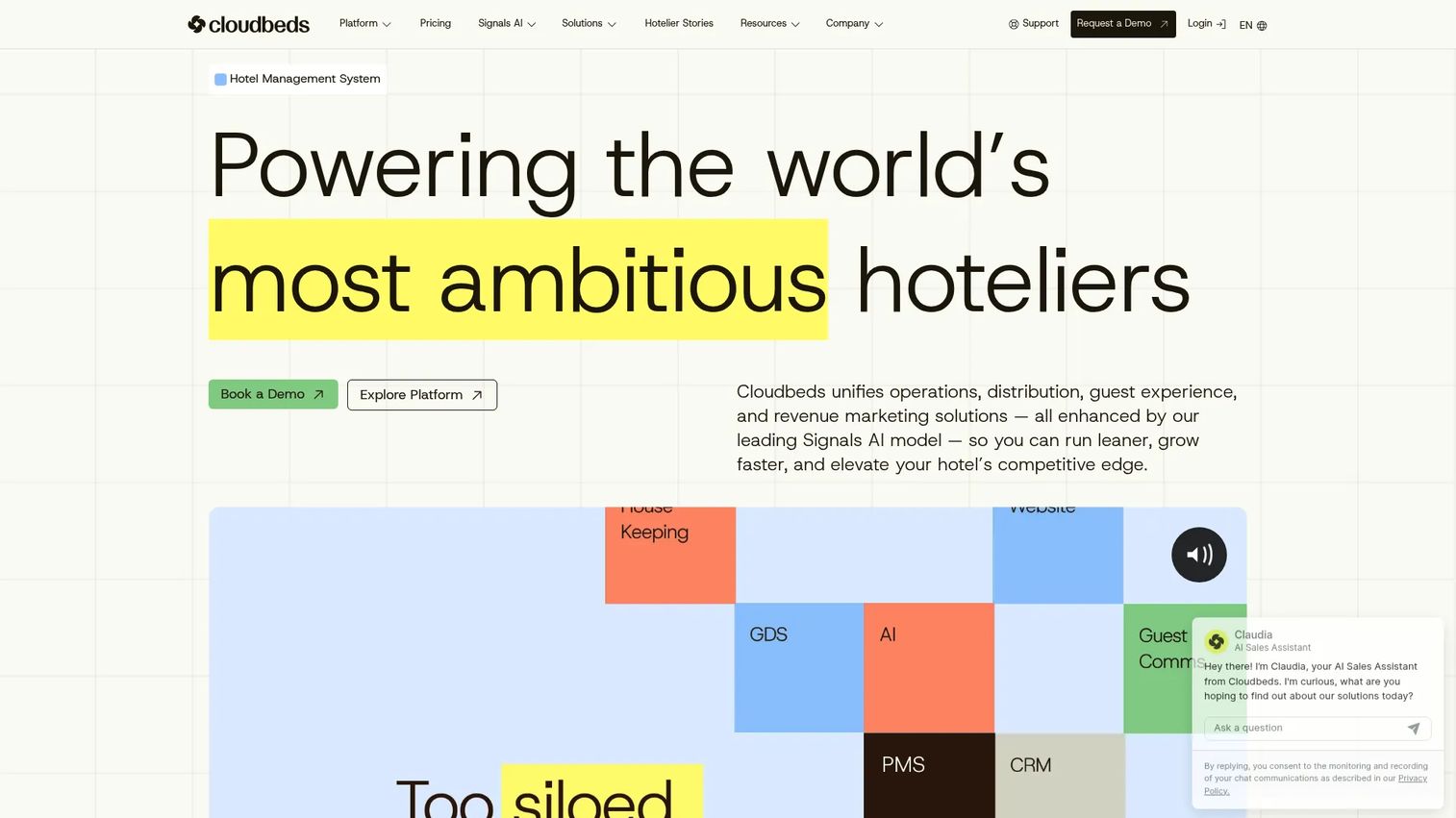
Cloudbeds is a hospitality management platform that brings PMS, channel management, and a booking engine together for hotels and lodging properties. It is the safe default for operators who want one cloud system running reservations, front desk, distribution, and reporting without duct-taping separate tools. For most independent and mid-market properties, it is the broad benchmark other platforms get compared against.
Best for: Independent hotels and lodging operators who want an all-in-one property management platform on one cloud login.
Key strengths
- Unified PMS core: Reservations, front desk, and room management run in one system, removing double entry across shifts.
- Built-in channel manager: Rates and availability sync across OTAs to prevent overbooking without a separate tool.
- Native booking engine: Converts your website traffic into commission-free direct bookings.
Why choose Cloudbeds: The value is consolidation. Instead of paying for and reconciling a PMS, a channel manager, and a booking engine separately, you run them as one platform with shared data. That matters most for lean teams who cannot afford an integration project every time something breaks. The connected marketplace also lets you extend into revenue management and payments as you grow.
Cloudbeds pricing: Cloudbeds uses quote-based pricing across four plans: Flex, One, Experience, and Enterprise. No public numeric price is listed; pricing is tailored to property size and the modules you select. Request a quote through the pricing page, and ask specifically what payment processing fees and add-on module costs are included so your total cost of ownership is clear before you commit.
2. Mews
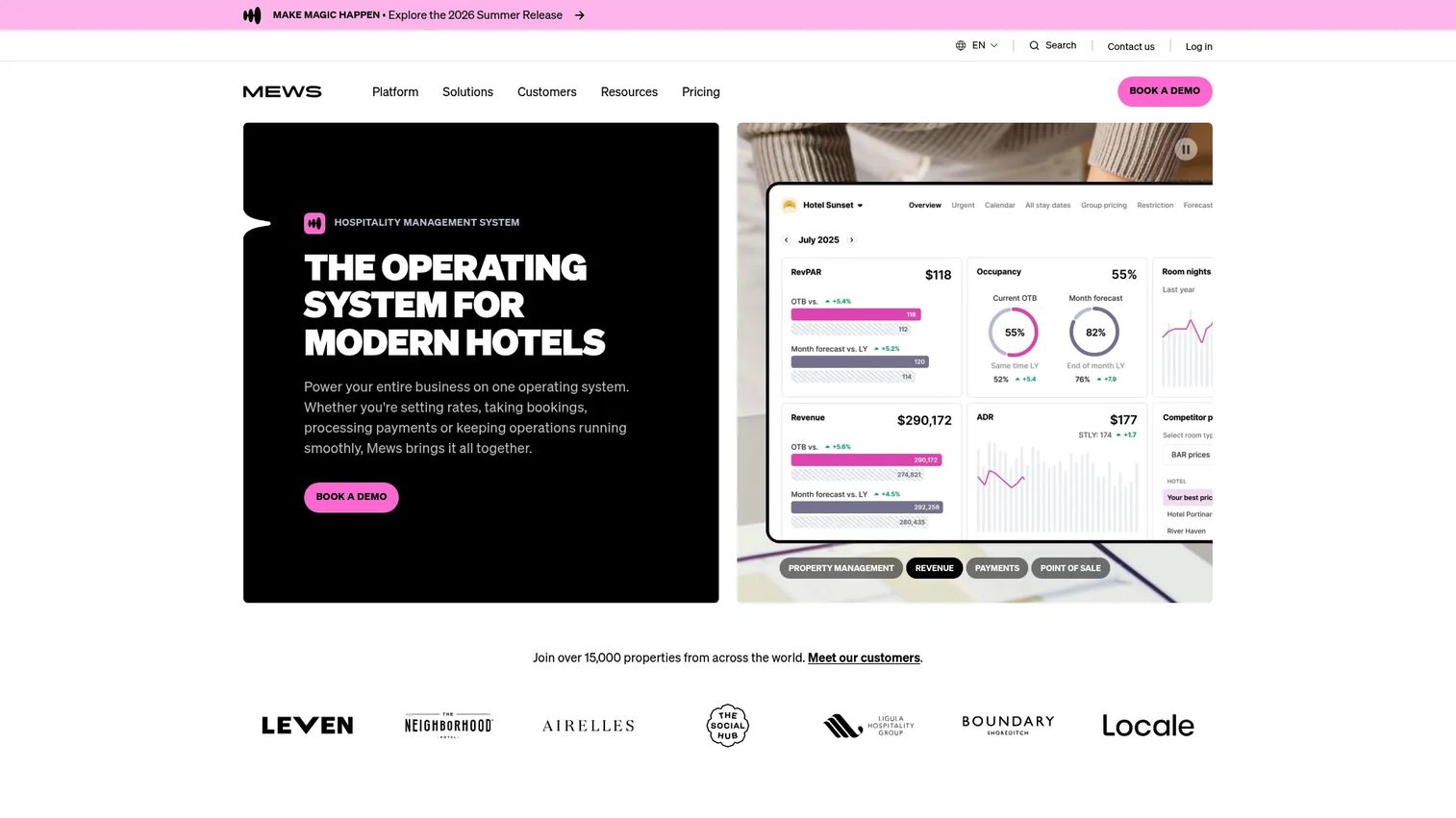
Mews is a cloud hospitality operating system built for hotels and multi-property operators who prioritize automation and guest experience. It pairs a property management system with a revenue management system and embedded payments, so pricing decisions and transactions live inside the same platform as operations. Mews tends to attract tech-forward properties that want to automate repetitive front desk work.
Best for: Hotels and multi-property operators who want an all-in-one operating system with automation and revenue management built in.
Key strengths
- Automation-first workflows: Automates check-in, check-out, and routine front desk tasks to free staff for guest-facing work.
- Embedded payments: Card processing and folio handling run natively, reducing terminal and reconciliation friction.
- Built-in revenue management: Rate and pricing logic sits inside the platform rather than in a bolt-on tool.
Why choose Mews: Mews earns its place when your team wants to remove manual steps from daily operations and manage revenue without a separate system. It holds a 4.8/5 rating on G2, one of the strongest scores in this category, which reflects how operators feel about the day-to-day experience. Ask about rollout timelines and support coverage during implementation, since operating systems reward a clean migration.
Mews pricing: Mews lists three plans, Essentials, Advanced, and Enterprise, without a public dollar amount. Pricing is quote-based and depends on property profile and modules. When you request a quote, confirm which capabilities sit in each tier and what payment processing economics look like, since embedded payments affect your effective cost per transaction.
3. RoomRaccoon
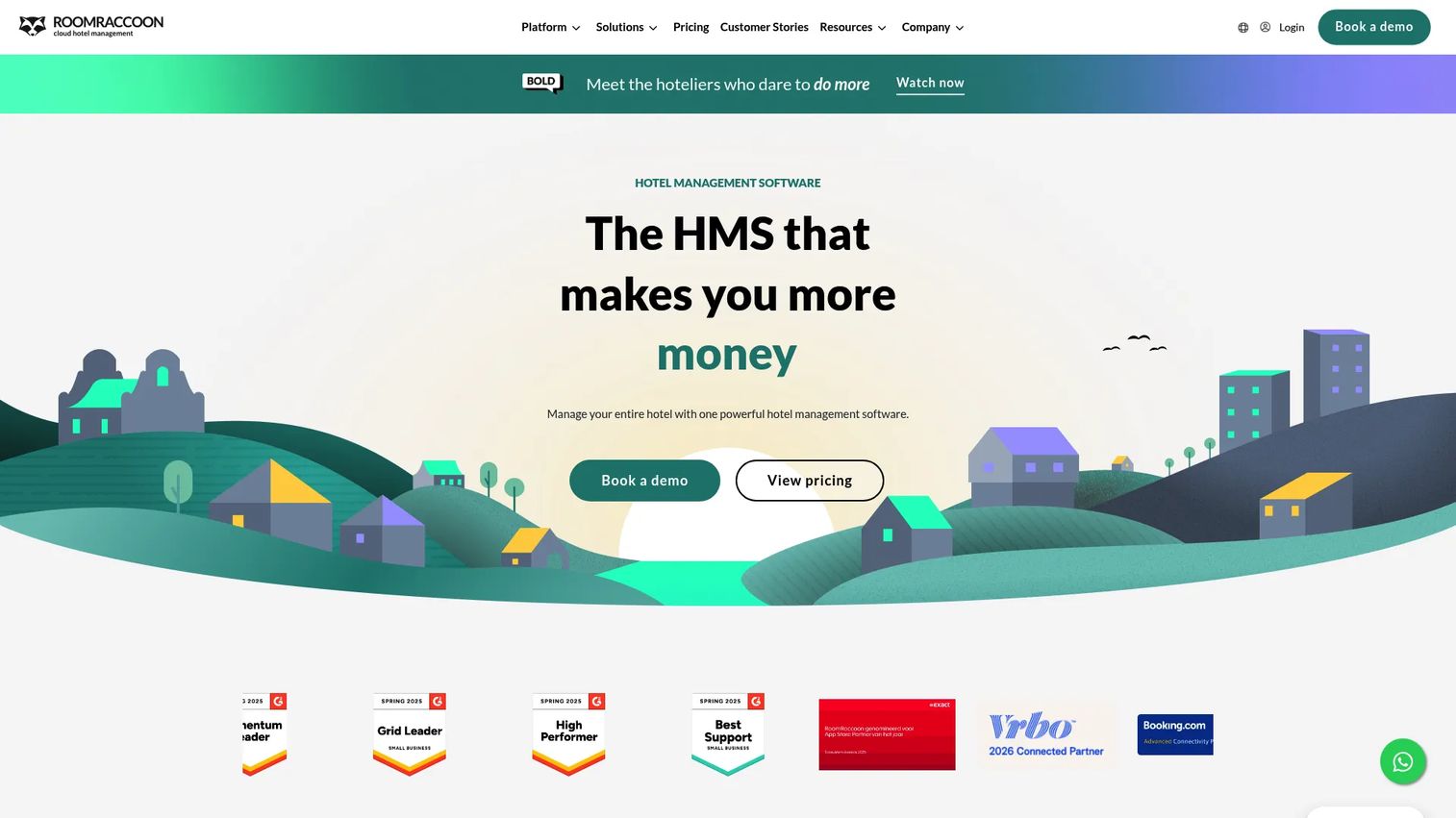
RoomRaccoon is all-in-one hotel management software built for independent properties and small-to-mid-sized hospitality operators. It combines a PMS, booking engine, channel manager, payment processing, automated guest communication, dynamic pricing, and housekeeping tools in one stack. The appeal is breadth without complexity for properties that do not have an IT team.
Best for: Independent hotels and small-to-mid-sized properties that want a complete PMS stack in one place.
Key strengths
- Automated guest communication: Triggers confirmations and pre-arrival messages without manual sending.
- Dynamic pricing: Adjusts rates based on demand signals to protect revenue.
- Housekeeping tools: Room status and task tracking keep operations coordinated in one view.
Why choose RoomRaccoon: The best return goes to independent operators who want automation, direct bookings, and distribution without managing multiple vendors. Automated messaging and dynamic pricing do work a small team would otherwise do by hand. If your property is growing but you are not ready for enterprise complexity, it sits in a practical middle ground.
RoomRaccoon pricing: RoomRaccoon offers a 30-day free trial and structures plans across Entry, Essential, Premium, and Pro tiers. Public numeric starting prices were not clearly listed at review, so request current pricing directly and confirm what each tier includes for channel connections, payment fees, and guest messaging volume before deciding.
4. Little Hotelier
Little Hotelier is all-in-one hotel management software purpose-built for small accommodation providers. It pairs a direct booking engine with a channel manager connected to 450+ booking channels, plus a mobile app and property management calendar. The design goal is essentials-first: get a small property live quickly without an enterprise implementation.
Best for: Small hotels, guesthouses, and B&Bs that need an all-in-one operations and distribution platform without heavy setup.
Key strengths
- 450+ channel distribution: Broad OTA reach keeps availability synced across a large channel network.
- Mobile app: Manage bookings and property status from a phone, which fits owner-operators on the floor.
- Direct booking engine: Captures commission-free reservations from your own site.
Why choose Little Hotelier: It is built for the operator who wears every hat and wants software that works out of the box. The mobile-first approach and simple calendar suit properties where the owner is also the front desk. Larger properties or groups needing deep multi-property governance will outgrow it, and that is fine; it is not trying to be an enterprise platform.
Little Hotelier pricing: Little Hotelier offers a 30-day free trial and structures pricing around plan tiers including Basic, Pro, and Revenue Optimiser, with pricing based on room count. Exact numeric prices were not exposed in the accessible pricing page content at review, so confirm the current room-based rate for your property size and ask which plan includes the Revenue Optimiser tools you need.
5. Oracle OPERA Cloud
Oracle OPERA Cloud is Oracle's cloud-based hospitality platform for hotel property management and related operations. It covers property management, reservations, housekeeping, and reporting, with integration handled through the Oracle Hospitality Integration Platform. This is enterprise-grade software built for large hotel groups and complex, multi-property operations.
Best for: Hotels and hospitality groups that need an enterprise PMS platform with deep governance and standardized processes across many properties.
Key strengths
- Enterprise property management: Handles complex, high-volume operations across large portfolios.
- Oracle integration platform: Connects to a broad ecosystem of hospitality and enterprise systems via a structured API layer.
- Reporting and analytics: Standardized, portfolio-level reporting for governance and performance oversight.
Why choose Oracle OPERA Cloud: OPERA Cloud is the fit when process standardization, governance, and scale matter more than lightweight simplicity. Large groups need consistent workflows and consolidated reporting across every property, and Oracle's ecosystem depth supports that. Expect a more involved implementation and a sales-led evaluation; this is a platform you plan a rollout around, not one you switch on over a weekend.
Oracle OPERA Cloud pricing: Oracle does not publish public pricing for OPERA Cloud and uses a contact-and-demo sales motion. Pricing depends on property count, module selection, and contract terms. Because enterprise deployments carry implementation and integration costs beyond the license, ask for a full total cost of ownership breakdown including onboarding, integration work, and support tiers before comparing it against lighter platforms.
6. eviivo
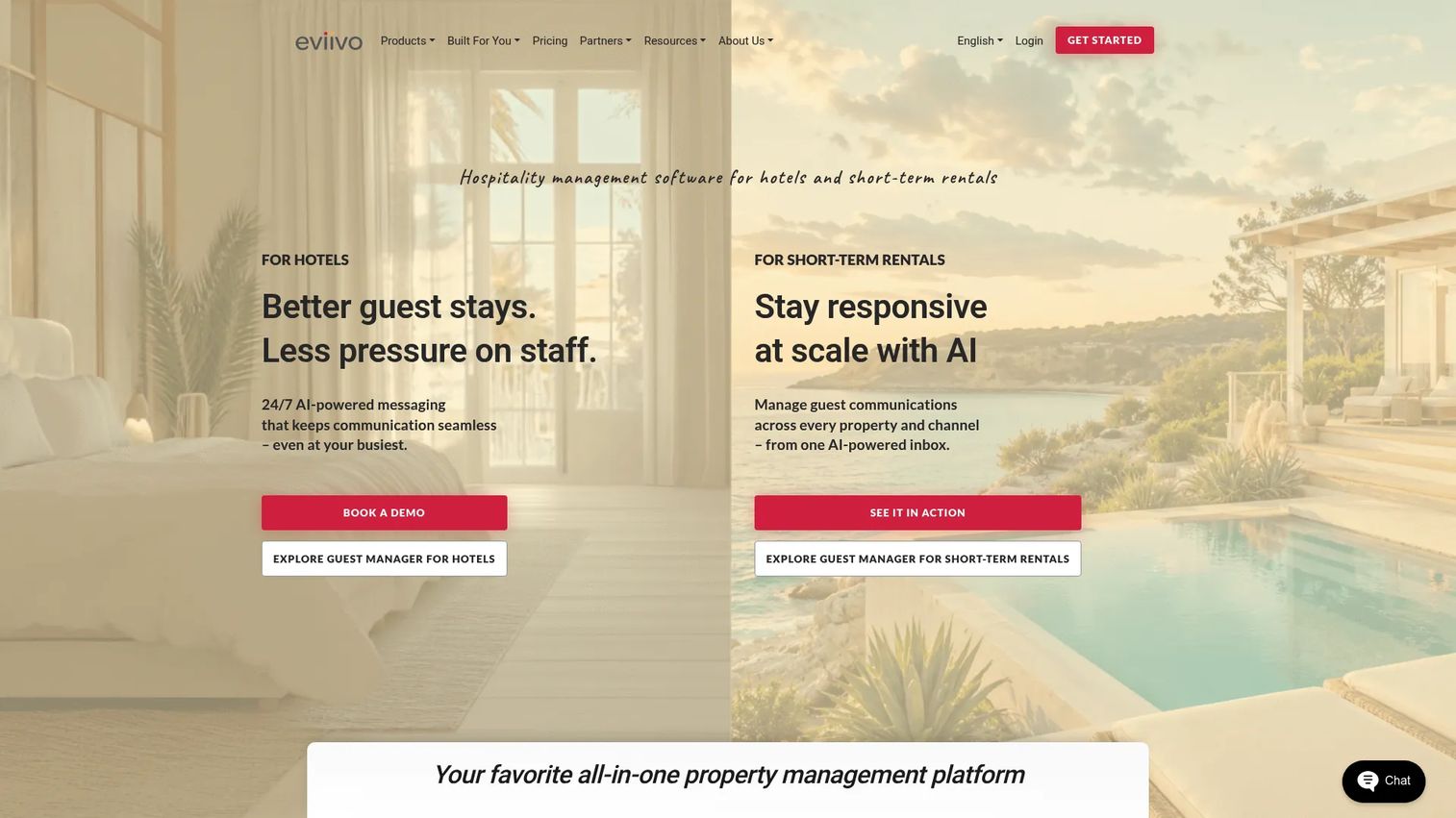
eviivo is an all-in-one hospitality PMS and booking platform for independent accommodation businesses. It combines a property management system with a booking calendar, rates, availability, invoicing, and compliance tools, a website manager and booking engine, and a channel manager with OTA synchronization plus guest, payment, promo, performance, owner, and mobile tools. The draw is broad operational coverage with transparent entry pricing.
Best for: Independent hotels, B&Bs, vacation rentals, and multi-property operators who want an integrated PMS and channel manager with clear pricing.
Key strengths
- Website manager and booking engine: A direct booking site with SEO, multilingual, and multicurrency support.
- Channel manager: OTA synchronization to keep availability accurate across booking sources.
- Broad tool set: Guest, payment, promo, performance, and owner tools cover most independent-property needs.
Why choose eviivo: For value-conscious independents, eviivo delivers wide operational coverage at a price you can see upfront, which is rare in this category. The multilingual, multicurrency booking site suits properties serving international guests. It carries a 3.9/5 rating on G2, so weigh reviewer feedback on support and setup against the pricing clarity when you evaluate.
eviivo pricing: eviivo starts at $50 per month for a single property and $125 per month for a multi-property configuration, with the exact cost varying by inventory and selected features. There is no free trial, but the first 30 days after onboarding are free. Note that the pricing page also lists optional add-ons and payment processing fees, so factor those into your total cost of ownership.
7. Hotelogix
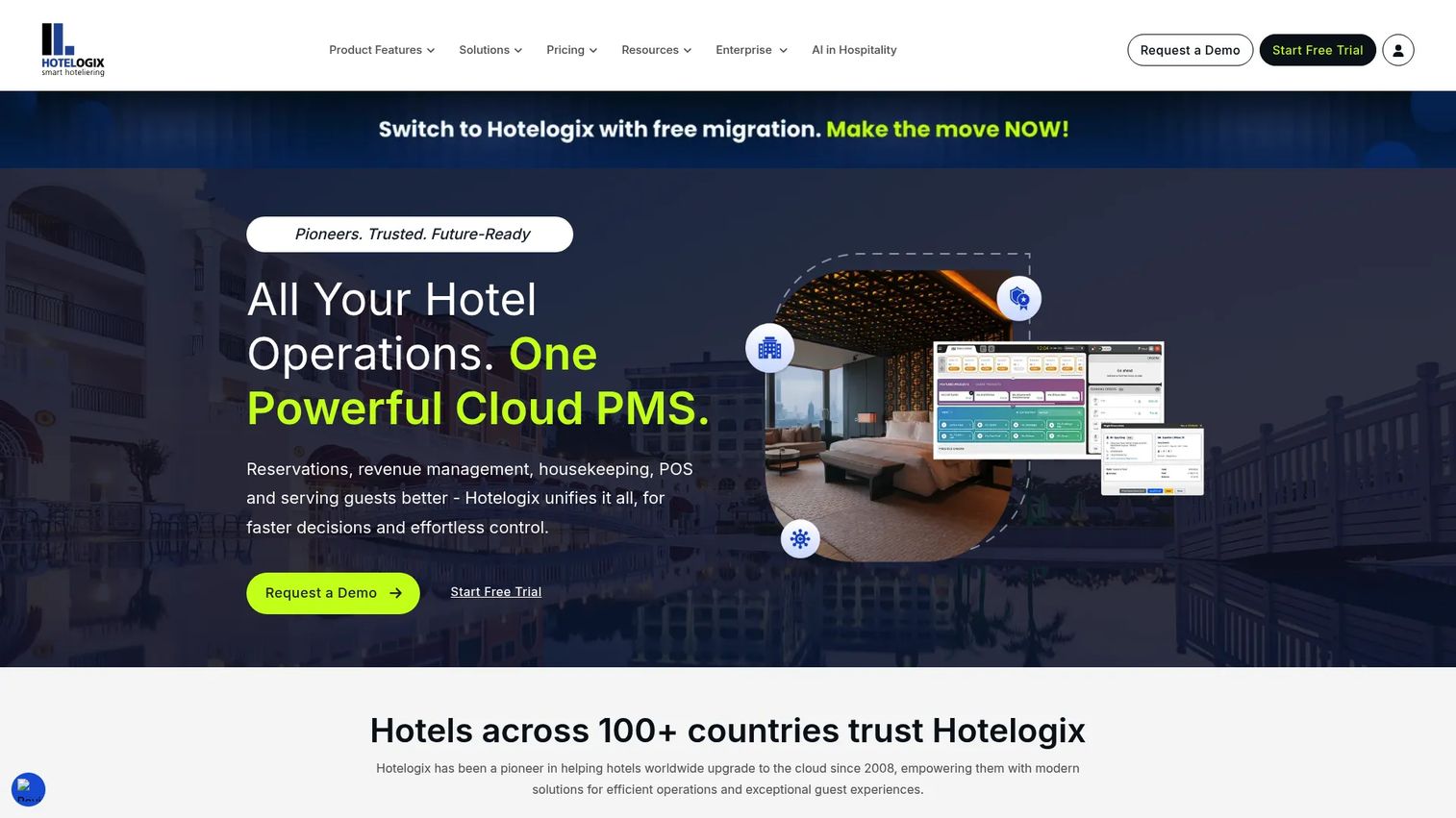
Hotelogix is cloud-based hotel property management software for running reservations, front desk operations, housekeeping, POS, and channel and OTA management. It is a practical all-around cloud PMS for hotels and multi-property operators who want operational depth without enterprise overhead. Its usage-based pricing model is a distinctive fit for properties that want cost tied to occupancy.
Best for: Hotels and multi-property operators who want a cloud PMS with usage-based pricing linked to booked room nights.
Key strengths
- Reservation and front desk operations: Core daily workflows covered in one cloud system.
- Housekeeping and POS: Room status and point-of-sale handled inside the platform.
- Channel and OTA management: Distribution kept in sync to protect against overbooking.
Why choose Hotelogix: The per-booked-room-night model appeals to operators who want software cost that scales with actual business rather than a flat seat fee. That said, compare it against the modern all-in-one platforms above on integration depth and reporting; usage pricing is attractive, but fit still comes down to how well the workflows match your operation. It holds a 4.3/5 rating on G2.
Hotelogix pricing: Hotelogix publishes usage-based pricing: a Fixed Plan at $0.55 per booked room night (billed annually with a minimum 60% occupancy assumption) and a Pay Later Plan at $1.00 per booked room night with no upfront cost. Pricing varies by room count and add-ons, and some pages indicate quote-based pricing, so confirm the exact structure for your property and model the annual cost against your real occupancy.
8. Roommaster
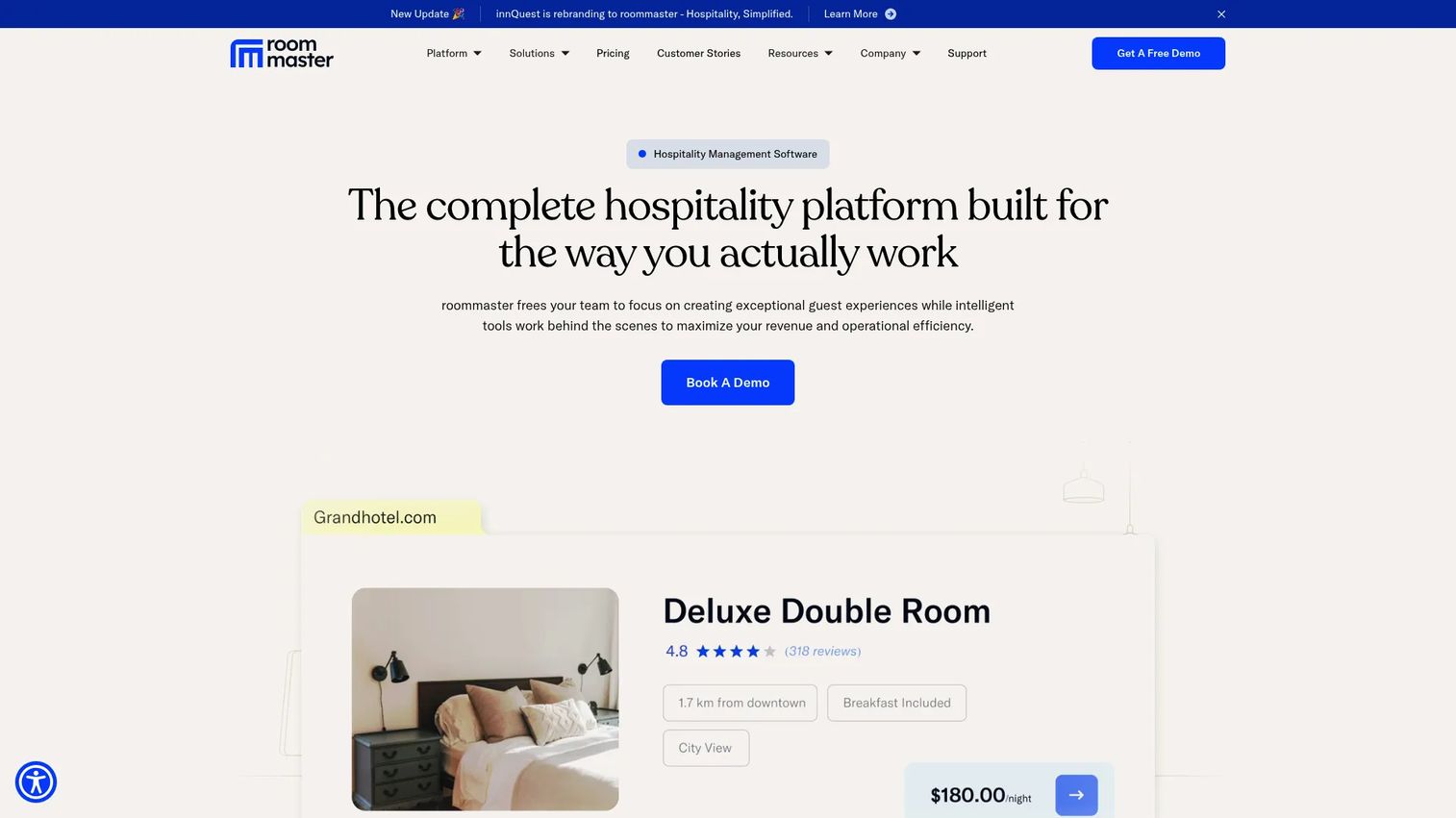
Roommaster is hospitality management software for hotels and other properties, combining a cloud PMS and reservation management with a booking engine, channel manager, payments, and guest experience tools. It targets operators who want operational control and hospitality-specific depth in one platform, including group booking management.
Best for: Hotels and multi-property operators who want an all-in-one platform with hospitality-specific operational depth.
Key strengths
- Cloud PMS and reservations: Core operations and reservation management in one system.
- Booking engine and channel manager: Direct bookings and OTA distribution handled together.
- Payments and guest experience tools: Transactions and guest-facing workflows built in.
Why choose Roommaster: Roommaster suits operators who want a serious, hospitality-focused platform with control over reservations, distribution, and group bookings. It holds a 4.5/5 rating on G2, which points to satisfied operators. Because it is an all-in-one platform, plan the onboarding carefully and confirm which integrations you will need beyond the native modules so nothing critical falls outside the system.
Roommaster pricing: Roommaster uses quote-based pricing tailored to property size and operational needs; no public numeric price is listed. Request a personalized quote and, as with any all-in-one platform, ask what onboarding, payment processing, and integration costs are included so you can compare total cost of ownership fairly against the transparent-pricing options on this list.
How to choose the right hotel management software
Before you sign anything, run the shortlist through a consistent checklist. The differences that matter show up in operations and cost, not in the marketing.
Unified operations coverage
Confirm the platform genuinely covers reservations, front desk, housekeeping, and payments on one data layer. A "PMS" that still needs three bolt-on tools to run a shift is not saving you the double entry you are paying to eliminate. Map the software against a real day of operations at your property.
Distribution and direct booking
Check which OTAs the channel manager supports and how fast rates and availability sync. Then confirm the booking engine can capture commission-free direct bookings from your own site. For most independents, growing direct revenue is the fastest way to offset software cost.
API integrations and interoperability
Your PMS should pass clean data to the revenue management, POS, CRM, and accounting tools you already run. Ask for the integration list and the API documentation. A closed system forces manual exports; an open one lets your stack grow without re-entry.
Total cost of ownership
Look past the sticker or the quote. Add implementation, onboarding, payment processing fees, per-transaction charges, and add-on module costs. Usage-based models like per-booked-room-night can be cheaper at low occupancy and pricier at scale, so model the annual number against your real bookings.
Support and implementation maturity
Ask about onboarding timelines, migration support, and support hours. A great platform with a rough migration still costs you weeks of disruption. Talk to a reference property of similar size before committing.
Conclusion
The right hotel management software depends on your property type, team size, integration needs, and how much operational complexity you carry, not on which vendor markets hardest. For most independent and mid-market operators, Cloudbeds is the safe all-in-one benchmark. Enterprise groups that need governance and scale should shortlist Oracle OPERA Cloud. Small hotels, inns, and B&Bs are well served by Little Hotelier, while Mews suits automation-forward and multi-property teams. If pricing transparency matters most, eviivo shows its numbers upfront, and Hotelogix ties cost to occupancy. RoomRaccoon and Roommaster round out the field for independents and operators wanting hospitality-specific depth.
Do not buy on the demo alone. Shortlist two or three platforms, then test each against a real operational scenario: a same-day walk-in, a group booking, a channel rate change, and a checkout with a split folio. Whichever handles your actual day with the least friction is the one worth signing. When you compare platforms, apply the same fit-first discipline you would to any event management or community management tool: match the software to the job, verify the total cost, and confirm it scales with you.
FAQs
A property management system (PMS) is the operational core that handles reservations, front desk, room assignments, and folios. Hotel management software is the broader platform that includes the PMS plus connected modules like a channel manager, booking engine, housekeeping, and reporting. In practice, most modern hotel management solutions are built around a PMS, so buyers often use the terms interchangeably.
At minimum, look for a PMS core, a channel manager for OTA distribution, a booking engine for direct reservations, housekeeping and operations tools, integrated payments, and reporting. Strong API integrations matter too, so the platform can connect to revenue management, POS, CRM, and accounting tools. The goal is one system that removes double entry across daily operations.
Pricing varies widely and depends on property size, room count, and modules. Some vendors publish transparent rates, such as eviivo starting at $50 per month for a single property, and Hotelogix billing from $0.55 per booked room night. Many enterprise and mid-market platforms, including Cloudbeds, Mews, Oracle OPERA Cloud, and Roommaster, use quote-based pricing, so always factor implementation, payment processing, and add-on costs into total cost of ownership.
Little Hotelier is purpose-built for small hotels, guesthouses, and B&Bs, with essentials-first setup, a mobile app, and a channel manager connected to 450+ channels. eviivo and RoomRaccoon are also strong fits for independents, offering broad operational coverage without enterprise complexity. Small properties should prioritize fast setup, direct booking, and a manageable total cost of ownership.
Oracle OPERA Cloud is built for large hotel groups that need enterprise governance, standardized workflows, and portfolio-level reporting across many properties. Mews and Roommaster also serve multi-property operators well, with Mews leaning into automation and Roommaster offering hospitality-specific depth and group booking management. Groups should evaluate multi-property visibility, centralized permissions, and consolidated reporting.
The highest-value integrations connect your PMS to revenue management, point-of-sale, CRM, accounting, and payment processing. A channel manager integration with your key OTAs is essential to prevent overbooking. Ask for the full integration list and API documentation, since an open API ecosystem lets your stack grow without forcing manual data re-entry between systems.
Implementation ranges from a few days for essentials-first platforms aimed at small properties to several weeks or more for enterprise deployments with data migration and multiple integrations. Cloud hotel management software is generally faster to deploy than legacy on-premise systems. Ask each vendor for a realistic timeline, migration support details, and a reference property of similar size.
For most operators, yes. Cloud deployment now accounts for roughly 60 to 65% of hotel software installations, and over 73% of mid-to-large hospitality businesses had adopted cloud-based PMS by 2024, per MarketGrowthReports. Cloud systems offer remote access, automatic updates, faster deployment, and easier integrations than on-premise software, which is why the category has shifted decisively toward cloud-based hotel management solutions.