You can run a small practice on duct tape for a while. A calendar here. Intake forms there. Notes in one system. Claims somewhere else. Then one denial, one missed consent form, or one locked-out clinician turns "cheap" into expensive fast.
The behavioral health market was valued at USD 4.42 billion in 2025, according to Mordor Intelligence, and demand for mental health services keeps outpacing capacity. That pressure lands on the administrative layer of every practice: Documentation, scheduling, billing, and secure client communication. A 2025 Behavioral Health Business survey found that 85% of provider respondents used multiple EHR or care-coordination systems that were partially integrated or siloed. That fragmentation costs clinicians time they do not have.
Mental health software is not just a convenience purchase. It is the operating system for care delivery, revenue cycle, client communication, and recordkeeping. Choosing the wrong platform means rebuilding later under pressure.
This guide compares 12 mental health software platforms across pricing, clinical fit, billing depth, telehealth, and security so you can build a shortlist faster.
What's inside
This guide covers software for mental health professionals, including therapists, group practice owners, behavioral health clinics, and ABA organizations. Tools were selected based on:
- Clinical documentation depth and note workflow
- Scheduling, client portal, and intake handling
- Billing, claims, and revenue cycle support
- Telehealth capability and security controls
- Pricing transparency and migration feasibility
Pricing and G2 ratings were verified at drafting time. Where pricing requires a sales conversation, this guide names the cost drivers so you can go in prepared.
TL;DR
- Best for solo and small group therapy practices: Sessions Health, SimplePractice, and TherapyNotes cover private-practice documentation, billing, and portals without enterprise overhead
- Best for behavioral health groups and clinics: Valant, AdvancedMD, and ClinicMind offer deeper clinical workflows and revenue cycle support worth evaluating at scale
- Best for structured clinical documentation: ICANotes stands out when template-driven notes and behavioral health specificity drive the purchase decision
- Best for telehealth-heavy practices: TheraPlatform fits practices that deliver a significant share of care virtually and want purpose-built session tools
- Best for ABA and autism care organizations: CentralReach is the specialized pick for applied behavior analysis and IDD service workflows
- Pricing shortcut: Compare base plans alongside claims fees, payment processing rates, telehealth add-ons, and per-clinician costs before drawing any conclusions from monthly starting prices
What is mental health software?
Mental health software is a clinical and administrative platform that helps therapists, counselors, psychiatrists, and behavioral health organizations manage client records, documentation, scheduling, telehealth, billing, and secure client communication.
The category blends several functions that are sometimes sold separately:
- Mental health EHR (or EMR): Electronic health records for clinical documentation, diagnosis codes, treatment plans, assessments, and progress notes. Many buyers use EHR and EMR interchangeably for this context.
- Practice management: Scheduling, reminders, intake forms, client portal, and reporting.
- Billing and revenue cycle: Claims submission, ERA processing, payment collection, superbills, and denial management.
- Telehealth: Secure video sessions with scheduling, documentation, and sometimes interactive client tools.
- Client engagement: Secure messaging, online booking, forms, and payment.
- Security controls: Role-based permissions, audit logs, encryption, backup practices, and business associate agreement availability.
Important distinction
Not every platform fits every practice model. A tool purpose-built for solo therapy practices will feel lightweight to a 20-clinician behavioral health clinic. A clinic-scale EHR may feel over-engineered and expensive for a two-person counseling group. The right question is not which platform has the most features; it is which platform fits the operating model you are running today and the one you are building toward.
When to use mental health software
Replace scattered practice workflows
A solo therapist can survive a mix of calendar tools, intake PDFs, note templates, and payment links for a while. The hidden cost shows up in duplicated data entry, missed follow-ups on outstanding claims, and the cognitive overhead of context-switching between systems. When more than two workflows live in separate tools with no integration, consolidating into a single mental health practice management platform typically saves more time than it costs.
Standardize documentation across clinicians
Group practices face a documentation consistency problem that solo clinicians do not. When five clinicians write notes in five different formats, supervision is harder, audit response is slower, and payer disputes take longer to resolve. A shared EHR with standard templates and role-based access keeps records consistent and audit-ready without adding administrative overhead.
Tighten billing, claims, and payments
Billing is often the reason practices switch platforms. Manual claims, missed ERAs, slow denial follow-up, and payment collection friction can cost a practice more than the software subscription many times over. Mental health billing software that automates claim submission, reconciles ERAs, and generates superbills on demand changes the math on what a platform actually costs.
Mental health software comparison
The table below compares all 12 tools across the dimensions that matter most for shortlisting. Use it as a starting filter, not a final decision. Pricing and G2 ratings were verified in November 2026.
| # | Product | Best for | Key differentiator | Pricing | G2 rating |
|---|---|---|---|---|---|
| 1 | Sessions Health | Solo and small group therapy | Therapy-first EHR with scheduling, portal, billing, and telehealth | From $39/mo | 4.8/5 |
| 2 | SimplePractice | Solo and small private practices | Broad all-in-one practice management platform | From $49/mo | 4.1/5 |
| 3 | TherapyNotes | Documentation and billing-focused practices | Therapy-specific notes and integrated billing | From $69/mo | 4.4/5 |
| 4 | Valant | Behavioral health groups and clinics | Behavioral health EHR with measurement-based care | Custom pricing | 2.9/5 |
| 5 | ICANotes | Structured clinical documentation | Template-driven behavioral health note generation | From $35/mo | 3.6/5 |
| 6 | AdvancedMD | Clinics wanting EHR and billing infrastructure | Broader medical practice management with mental health workflows | From $130/provider/mo | 3.6/5 |
| 7 | ClinicMind | Practices needing billing and revenue cycle support | EHR with revenue cycle management and credentialing | Custom pricing | 4.6/5 |
| 8 | TheraNest | Accessible therapy practice management | Notes, scheduling, billing, and portal in one package | Contact TheraNest | 4.3/5 |
| 9 | TheraPlatform | Teletherapy-first practices | Telehealth, therapy activities, and client engagement tools | From $39/mo (regular) | 3.9/5 |
| 10 | BestNotes | Behavioral health and addiction treatment | Admissions CRM and clinical documentation workflows | From $59/user/mo | 4.1/5 |
| 11 | CarePaths EHR | Behavioral health organizations | EHR, telehealth, and measurement-based care with a free tier | Free tier available | N/A |
| 12 | CentralReach | ABA and autism care organizations | Purpose-built for autism and IDD clinical and billing workflows | Custom pricing | 3.7/5 |
Best 12 mental health software tools for 2026
1. Sessions Health

Sessions Health is a HIPAA-supporting cloud EHR and practice management platform built for mental health professionals. It covers clinical documentation, scheduling, billing, client portal, intake forms, telehealth, and AI-assisted documentation tools in a single system. The platform targets solo practitioners and group practices that want a therapy-focused operating system without hospital-grade complexity.
Best for: Solo and group therapy practices that want a focused therapist EHR covering documentation, billing, and client communication.
Key features
- Custom progress notes, treatment plans, assessments, and intake forms
- Online booking, calendar sync, and appointment reminders
- Billing, electronic claims, ERAs, eligibility checks, and AutoPay
- HIPAA-supporting client portal with secure messaging and payments
- Integrated telehealth and AI Assist documentation tools
Why choose Sessions Health: Choose it when the practice wants a therapy-first platform that handles both clinical and administrative basics without feeling like a scaled-down hospital system.
Sessions Health pricing: A free tier covers up to 3 clients. The Professional plan runs $39/month for unlimited clients, with additional practitioners at $29/month each. Telehealth adds $10/month per practitioner, electronic claims start at $0.25 per claim, and AI Assist adds $35/month per practitioner.
G2 rating: 4.8/5
2. SimplePractice

SimplePractice is one of the most widely used private-practice platforms for therapists and wellness professionals. It covers scheduling, notes, intake forms, client portal, billing, payments, and telehealth. The platform appeals to solo clinicians and smaller groups that want broad coverage without piecing together multiple tools.
Best for: Solo clinicians and small practices that want broad private-practice management without committing to a clinic-scale system.
Key features
- Client portal with intake forms and secure messaging
- Scheduling, appointment reminders, and group appointments
- Progress notes, customizable documentation, and treatment plans
- Billing, insurance claims, and online payment collection
- Telehealth sessions and ePrescribe add-on
Why choose SimplePractice: Choose it when the practice values a familiar, broad platform and wants scheduling, documentation, telehealth, and payments managed from one place.
SimplePractice pricing: A 30-day free trial is available. Plans start at $49/month (Starter), $79/month (Essential), and $99/month (Plus). Add-ons such as ePrescribe and AI-assisted documentation carry additional costs.
G2 rating: 4.1/5
3. TherapyNotes

TherapyNotes is a behavioral health EHR and practice management platform built around clinical documentation and billing discipline. It covers therapy note templates, diagnosis code search, scheduling, electronic claims, ERAs, eligibility verification, superbills, payment processing, telehealth, and a secure client portal. Practices that prioritize clean note workflows and reliable billing often migrate to TherapyNotes when simpler tools start to show gaps.
Best for: Therapy practices where documentation quality and billing reliability matter more than a broad wellness platform.
Key features
- Therapy note templates with diagnosis-code search
- Electronic claims, ERAs, eligibility verification, and superbills
- Scheduling and automated appointment reminders
- Secure client portal, messaging, and online bill pay
- HIPAA-supporting telehealth with standard and premium options
Why choose TherapyNotes: Choose it when a practice wants structured documentation and billing workflows that hold up under payer scrutiny. The per-clinician pricing model scales reasonably for small groups.
TherapyNotes pricing: A 30-day free trial is available. The Solo plan runs $69/month. The Group plan starts at $79/month for the first clinician, then $50/month per additional clinician. Electronic billing adds 14 cents per claim, payment processing runs 3.1% plus 30 cents per transaction, and ePrescribe adds $65/month per prescriber.
G2 rating: 4.4/5
4. Valant
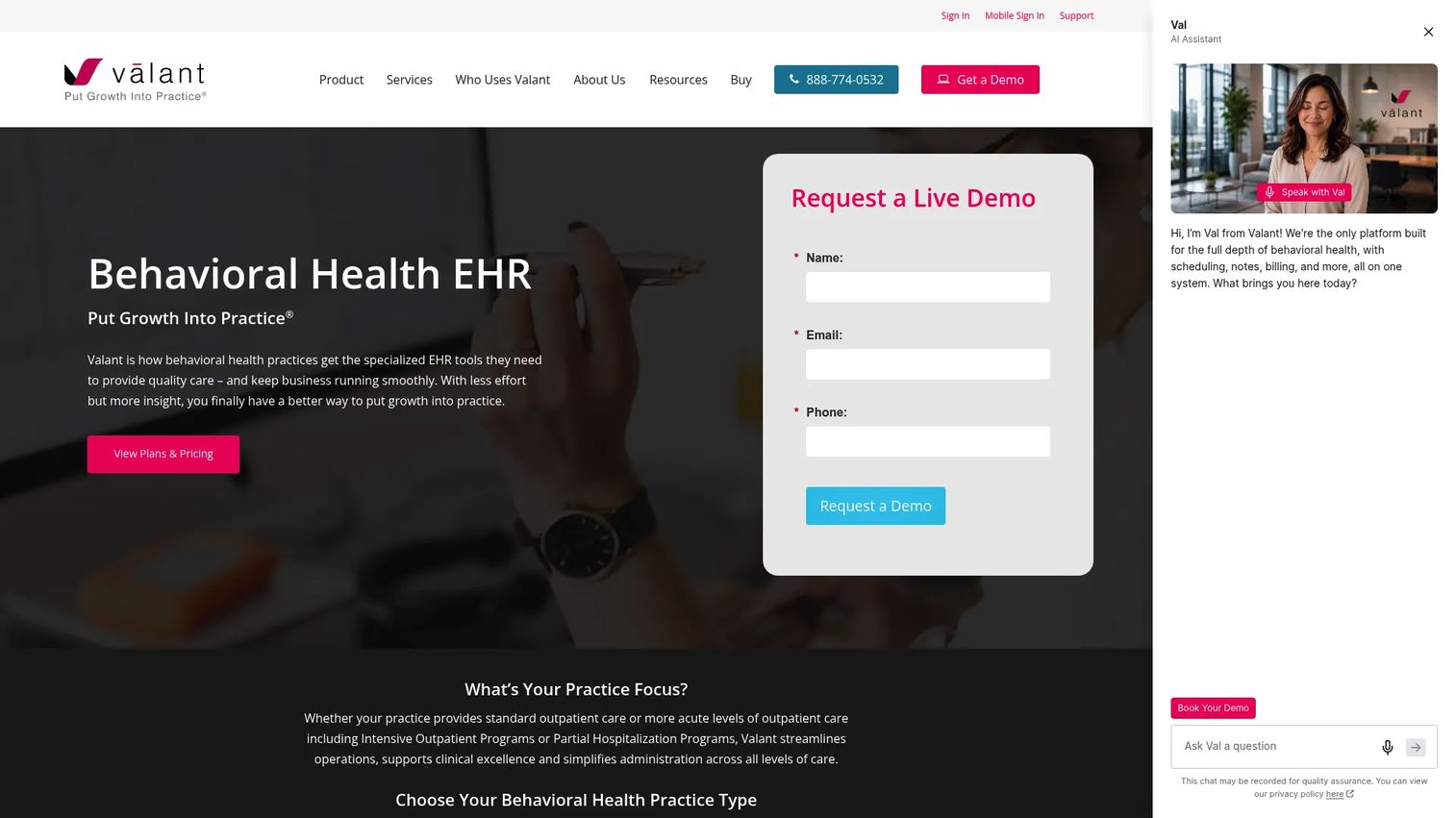
Valant is a behavioral health EHR built for outpatient psychiatry, group therapy practices, and IOP or PHP programs that need deeper clinical and administrative workflows. It covers behavioral health documentation, measurement-based care, scheduling, billing, revenue cycle management, telehealth, and a patient portal. Organizations that need more structure than a lightweight private-practice tool can provide typically evaluate Valant alongside other clinic-scale platforms.
Best for: Behavioral health group practices and clinics that need structured clinical workflows, measurement-based care, and practice analytics.
Key features
- Behavioral health documentation and AI Notes Assist
- Measurement-based care and outcomes tracking
- Scheduling, billing, claims, and revenue cycle management
- MYIO patient portal and telehealth
- Utilization review and group therapy tools
Why choose Valant: Choose it when the organization needs behavioral health EHR specificity beyond what a lightweight private-practice tool delivers, and when measurement-based care tracking is a priority.
G2 rating: 2.9/5
5. ICANotes
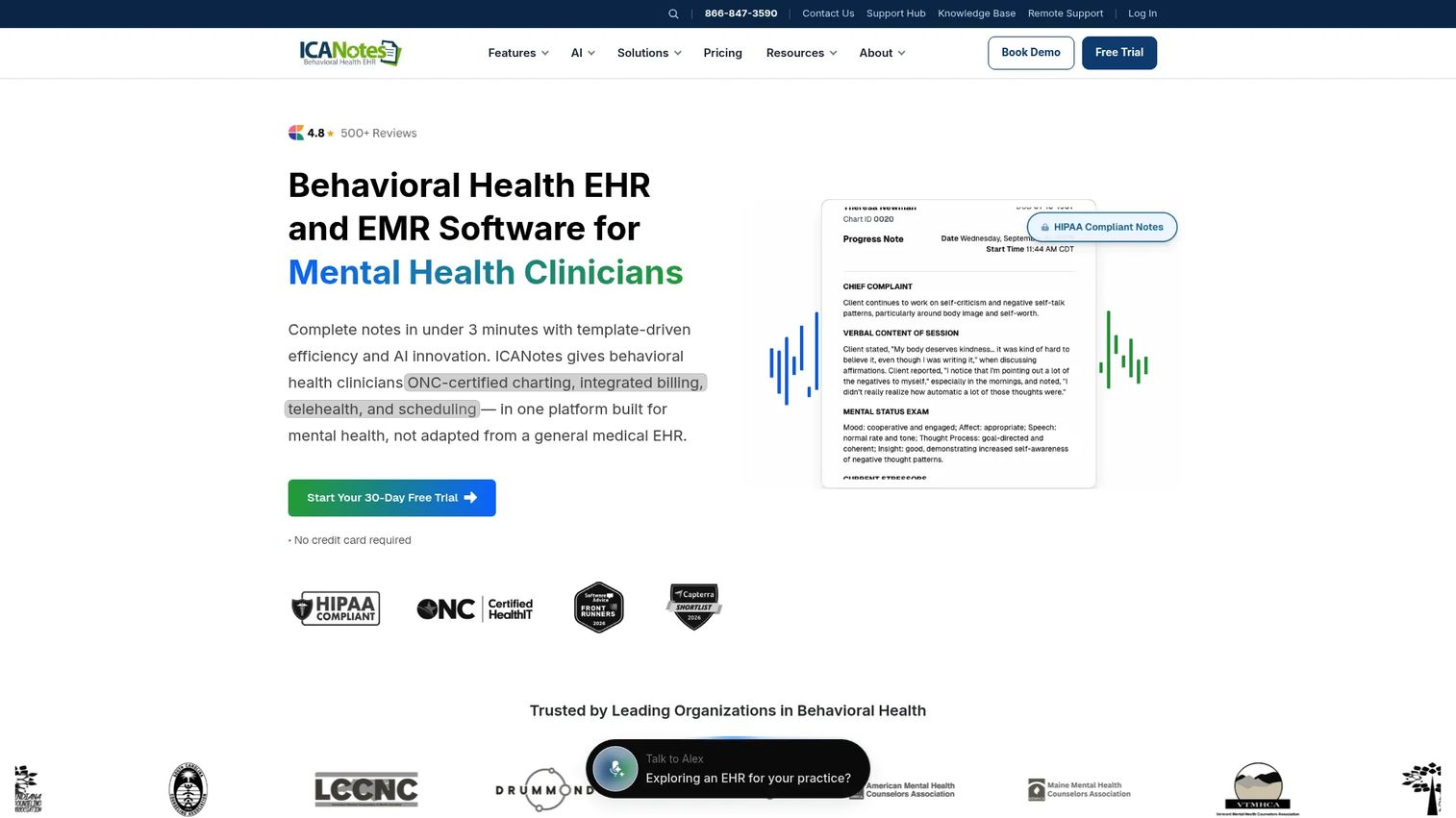
ICANotes is a behavioral health EHR known for its button-driven, structured note generation. Clinicians build progress notes by selecting from pre-structured prompts rather than writing freeform, which produces consistent behavioral health documentation across a team. The platform also covers scheduling, billing, patient portal, secure messaging, telehealth, and electronic prescribing.
Best for: Clinicians who want structured clinical note generation and behavioral health documentation support rather than blank text fields.
Key features
- Button-driven behavioral health clinical note templates
- Treatment plan templates and psychiatric workflow support
- Electronic prescribing and medication management
- Integrated billing, claims, and scheduling
- Telehealth and AI Scribe
Why choose ICANotes: Choose it when consistent, structured behavioral health documentation is the primary pain and clinicians need guided prompts rather than freeform note writing.
ICANotes pricing: Plans start at $35/month for Part-Time Notes Only (up to 60 notes per month). Full-Time Non-Prescribing runs $75/month. Full-Time Prescribing runs $213/month with a $99 activation fee. Telehealth, AI Scribe, and claims are available as add-ons.
G2 rating: 3.6/5
6. AdvancedMD

AdvancedMD is a cloud-based practice management and EHR platform serving a range of medical specialties, including mental health. It covers customizable EHR templates, scheduling, billing, claims management, revenue cycle services, telehealth, patient engagement tools, ePrescribing, and reporting. Practices that want broader medical infrastructure alongside mental health workflows typically consider AdvancedMD when other purpose-built behavioral health tools feel too narrow.
Best for: Clinics that want mental health workflows inside a broader medical practice management platform, with strong billing and revenue cycle infrastructure.
Key features
- Mental health EHR with customizable charting templates
- Claims management, billing, and revenue cycle services
- Telehealth and patient portal
- ePrescribing and EPCS
- Scheduling, reporting, and analytics
Why choose AdvancedMD: Choose it when the practice wants a broader medical platform and can handle a more involved implementation process. Revenue cycle services at 4 to 8% of collections may suit groups that want to outsource billing entirely.
AdvancedMD pricing: AdvancedMD Now starts at $130/provider/month on a month-to-month basis after a 30-day free trial. Specialty-specific plans run $429 to $1,070/provider/month. Revenue cycle management is priced at 4 to 8% of collections.
G2 rating: 3.6/5
7. ClinicMind
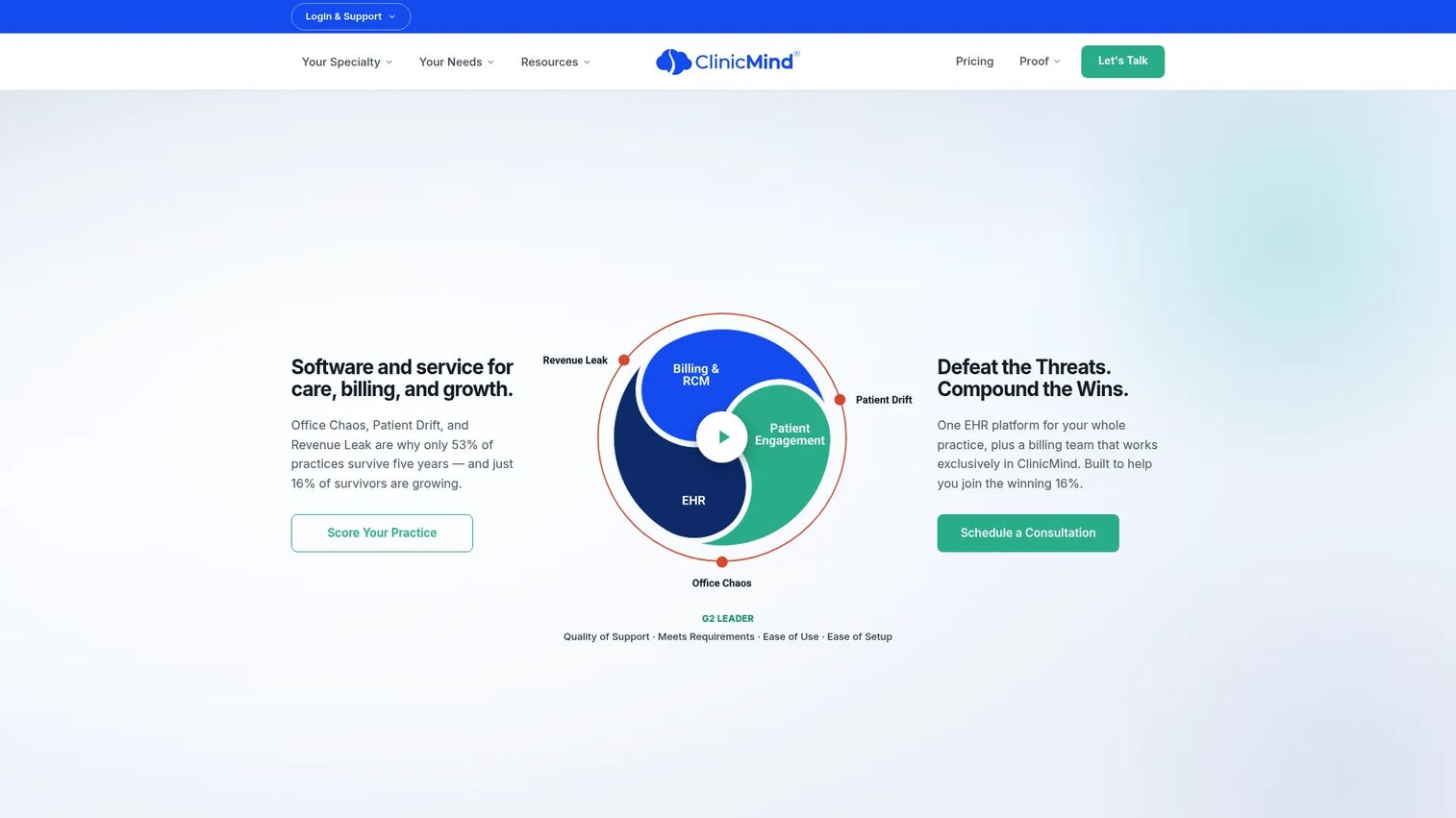
ClinicMind is an ONC-certified EHR and practice management platform that pairs clinical documentation with hands-on revenue cycle support. Beyond the software, ClinicMind offers credentialing, payer enrollment, and billing services, which makes it more of an operational partner than a standalone tool. It serves chiropractic, mental health, physical therapy, and multidisciplinary practices.
Best for: Behavioral health practices that want software plus revenue cycle and credentialing support, not just a note editor with a billing module.
Key features
- AI-powered clinical documentation and SOAP notes
- Revenue cycle management and billing workflows
- Credentialing and payer enrollment services
- Patient engagement, secure messaging, and scheduling
- Telehealth and ePrescribing
Why choose ClinicMind: Choose it when billing and operational support are as important as the platform itself, and the practice wants a partner that handles credentialing and payer enrollment.
ClinicMind pricing: ClinicMind states software access fees are minimal and directs prospects to a consultation. A telehealth add-on starts from $40/provider/month. A Virtual Front Desk service runs $300/month for 300 minutes on a 12-month term.
G2 rating: 4.6/5
8. TheraNest
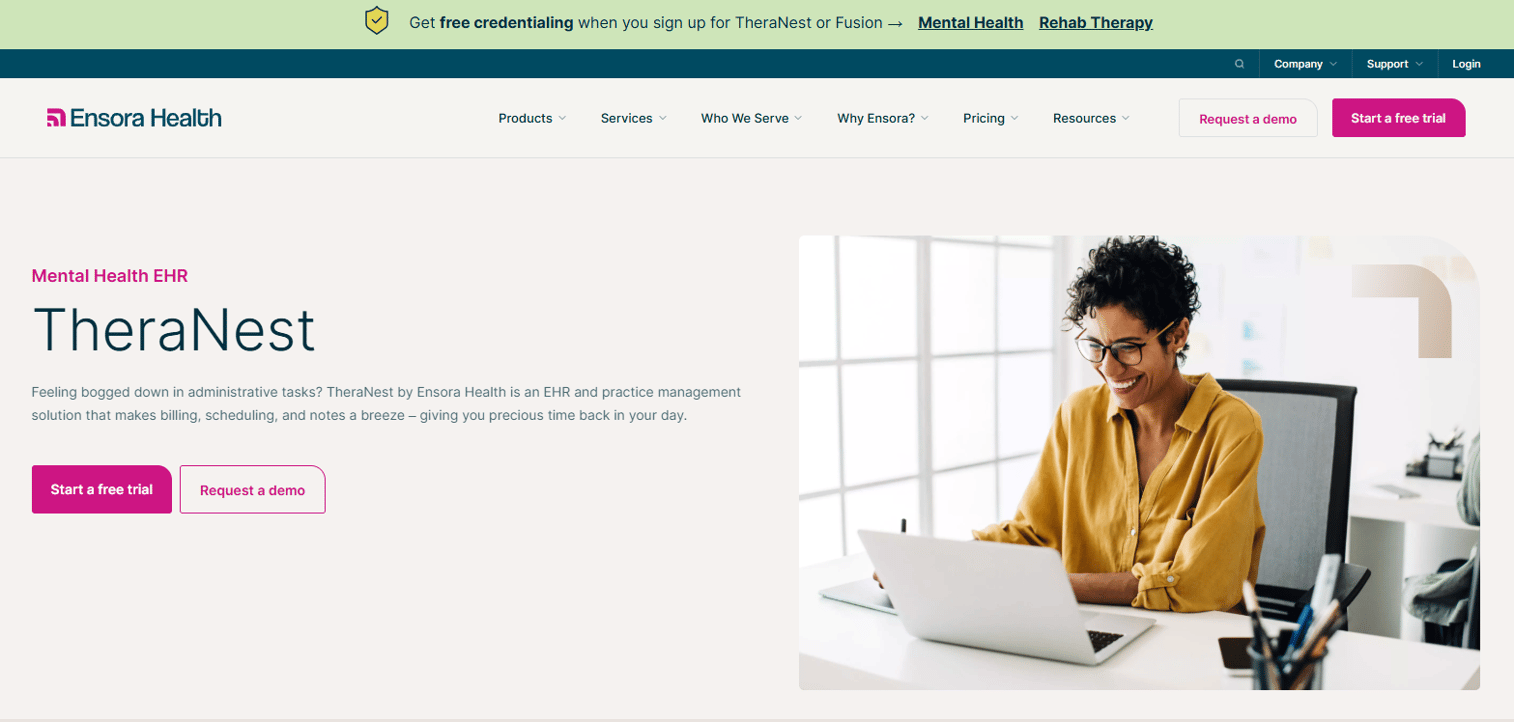
TheraNest is practice management software for therapists, psychologists, social workers, and counselors. It covers therapy notes, scheduling, client portal, billing, payments, and telehealth, with a focus on accessible workflows for private practitioners and small therapy groups.
Best for: Small therapy practices that want a practical practice management tool without moving to a clinic-scale system.
Key features
- Therapy notes and treatment plans
- Calendar, scheduling, and appointment reminders
- Client portal and intake forms
- Billing, payments, and insurance support
- Telehealth sessions
Why choose TheraNest: Choose it when the practice wants therapy-focused workflows at a scope appropriate for a small or solo operation.
TheraNest pricing: Contact TheraNest directly for current plan details and trial availability before comparing against other options.
G2 rating: 4.3/5
9. TheraPlatform
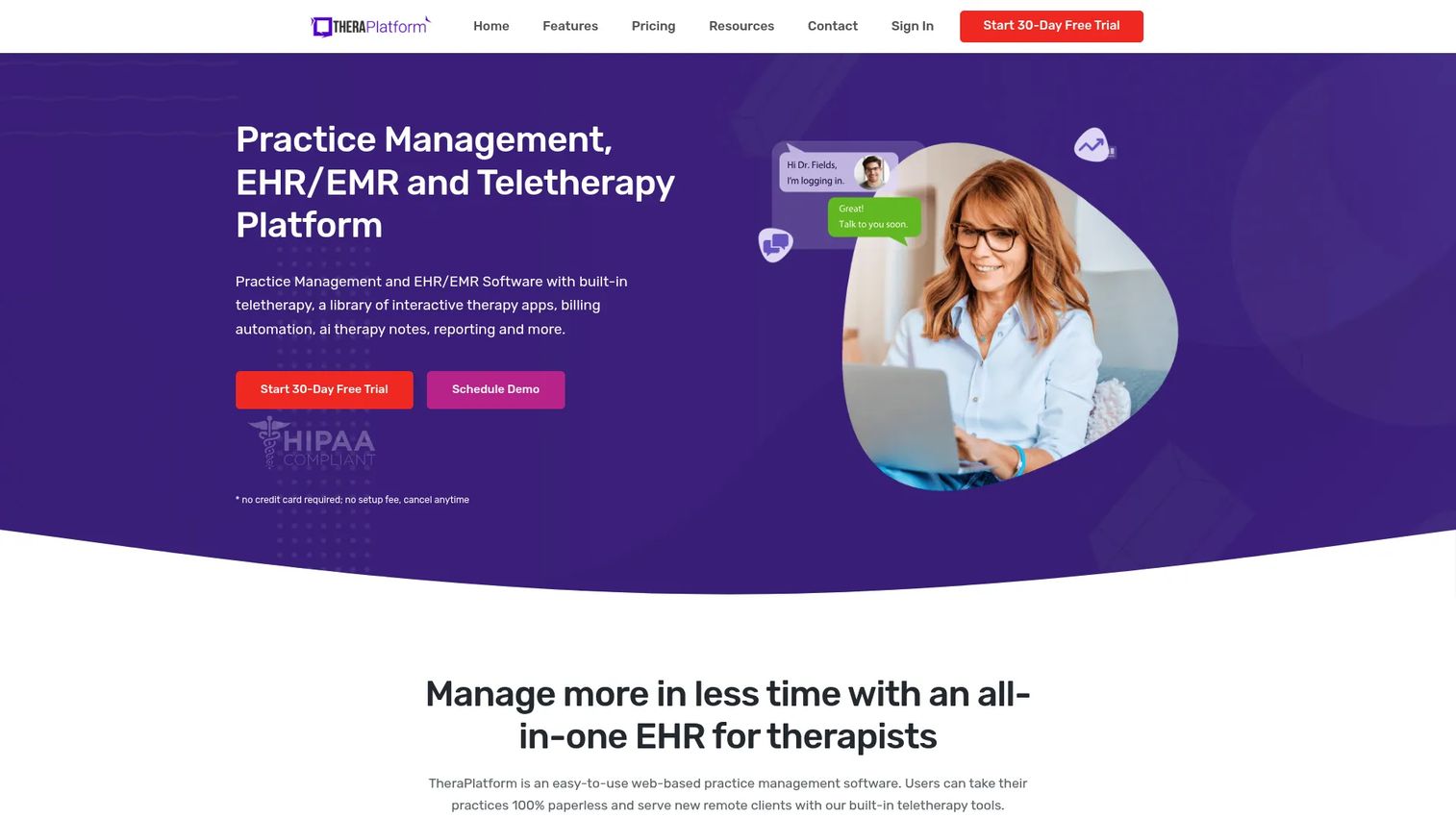
TheraPlatform is a HIPAA-supporting practice management, EHR, and teletherapy platform built around virtual care delivery. Beyond standard video sessions, it includes interactive therapy apps, games, and client resources inside the session environment. It also covers scheduling, documentation, billing, insurance claims, and a client portal with secure messaging.
Best for: Therapy practices that deliver a meaningful share of care virtually and want more than a generic video conferencing link.
Key features
- HIPAA-supporting video conferencing and teletherapy
- Built-in interactive therapy apps and session resources
- Scheduling with client self-booking and calendar management
- Documentation, notes, assessments, and treatment plans
- Billing, invoicing, insurance claims, EOBs, and ERAs
Why choose TheraPlatform: Choose it when virtual care is central to the practice model and the clinical team wants session tools, client engagement features, and billing in one place.
TheraPlatform pricing: A 30-day free trial is available with no credit card required. Regular monthly pricing runs $39/month (Basic), $69/month (Pro), and $79/month (Pro Plus). Promotional introductory prices of $19.50, $34.50, and $39.50 may apply for new customers.
G2 rating: 3.9/5
10. BestNotes
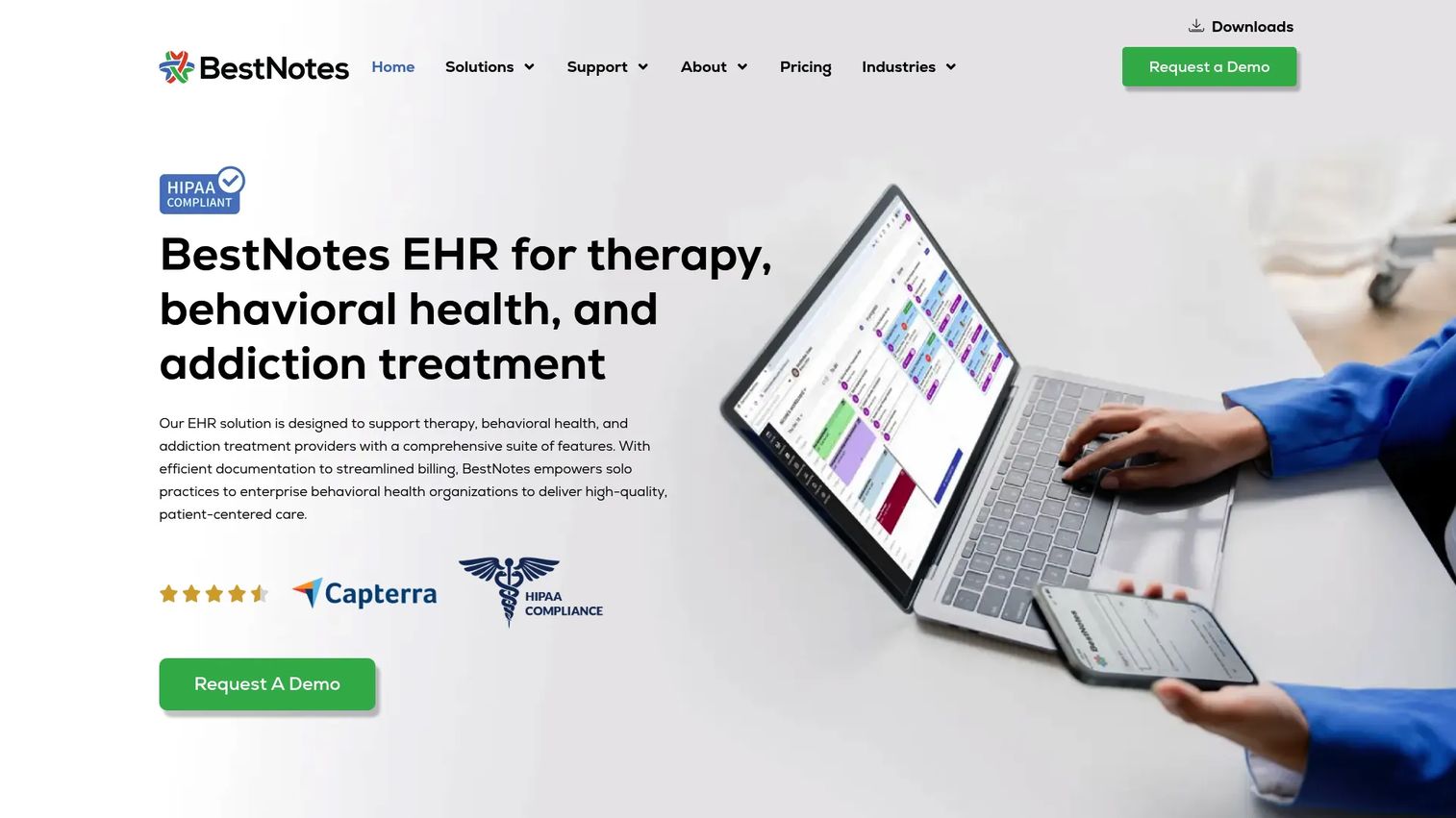
BestNotes is a behavioral health EHR and EMR platform commonly used by mental health, addiction treatment, and substance use programs. Its CRM-style admissions workflow sets it apart from standard EHRs: Intake, referral tracking, admissions, and longitudinal care coordination run through the same system as clinical documentation and scheduling. It also includes AI ambient listening and dictation tools.
Best for: Behavioral health and addiction treatment organizations where admissions tracking, intake management, and clinical documentation need to run through a single connected system.
Key features
- Customizable AutoNotes clinical documentation
- CRM-style admissions, intake, and patient portal
- Calendar and appointment scheduling
- Secure staff collaboration and messaging
- AI integrations including ambient listening and dictation
Why choose BestNotes: Choose it when the organization runs structured intake and admissions workflows alongside clinical care, and those workflows need to be traceable from referral through discharge.
BestNotes pricing: Pricing starts at $59/user/month for 1 to 10 users, then $25/month per additional user from 11 to 100, and $13/month per user beyond that. A $100 setup fee applies. Month-to-month contracts. No free trial.
G2 rating: 4.1/5
11. CarePaths EHR
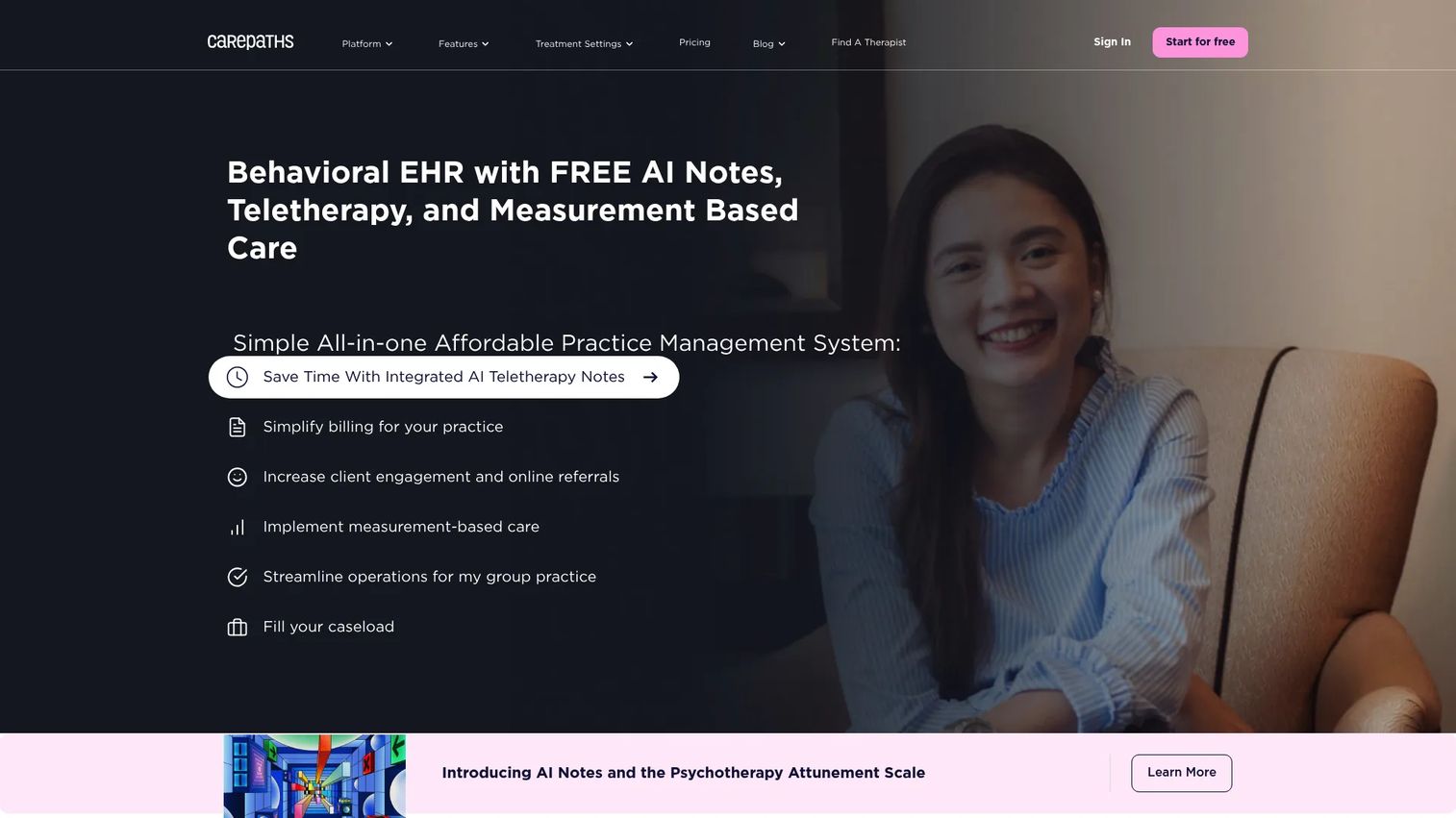
CarePaths EHR is a behavioral health EHR and practice management platform covering clinical documentation, teletherapy, scheduling, billing, outcomes tracking, AI-generated clinical notes, and ePrescribing. A free measurement-based care tier covering up to 30 clients per clinician makes it one of the few options with meaningful functionality at no cost.
Best for: Behavioral health organizations that want EHR and telehealth workflows with outcomes tracking, and practices that want to test clinical tools before committing to a subscription.
Key features
- Clinical documentation and customizable forms
- Teletherapy with group session support
- Measurement-based care and outcomes tracking
- AI-generated clinical notes and ePrescribing
- Scheduling, patient portal, and mobile app
Why choose CarePaths EHR: Choose it when outcomes measurement and clinical documentation need to run together, or when the practice wants to evaluate a fully functional free tier before upgrading.
CarePaths EHR pricing: A free Measurement Based Care tier covers up to 30 clients per clinician. The EHR and Measurement Based Care plan runs $49/month. A Getting Started plan is available at $10/month for up to 15 sessions. Psychiatry EHR pricing runs $98/month. Group pricing is available at $49/month per licensed therapist.
12. CentralReach
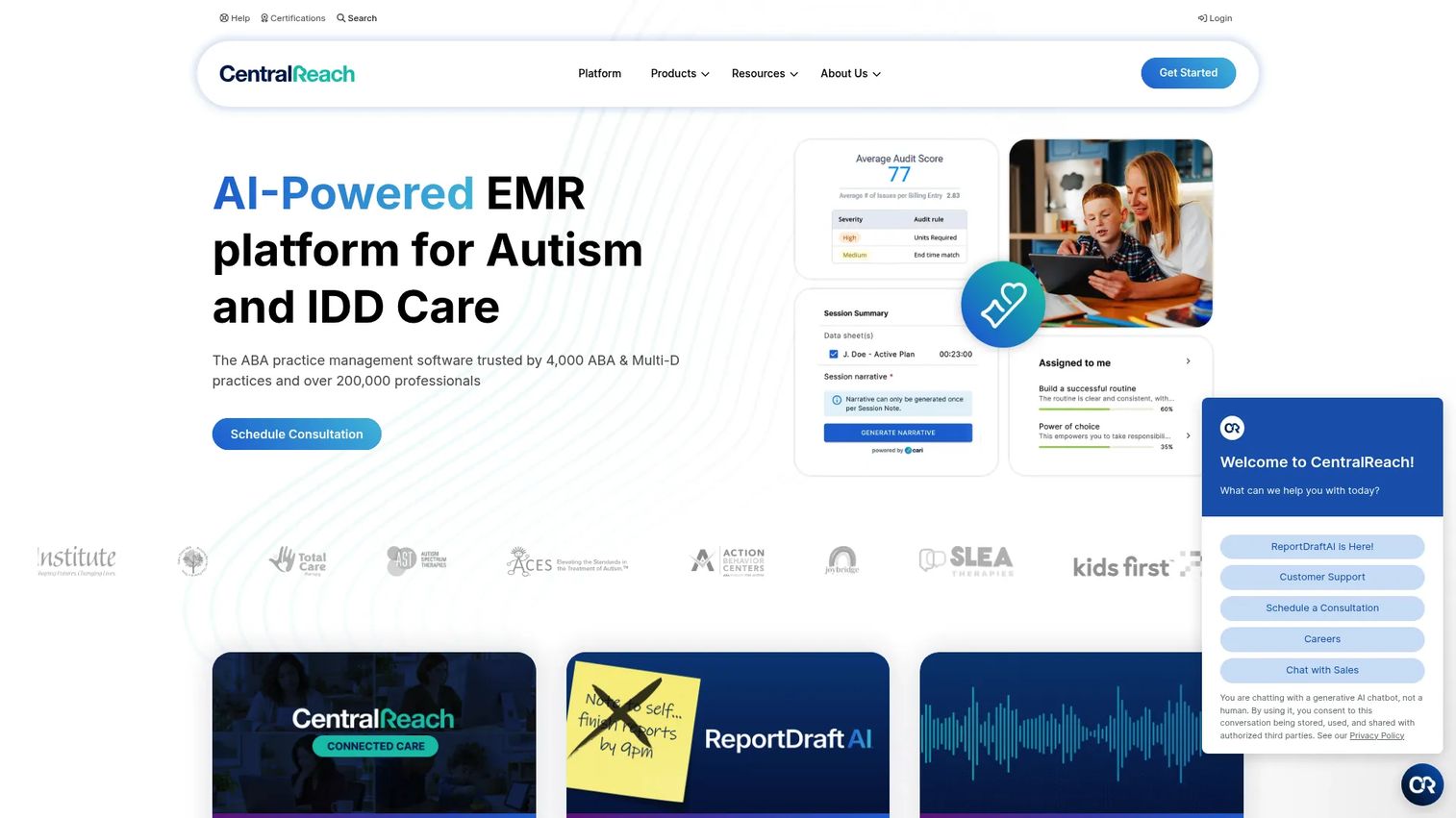
CentralReach is an AI-powered EMR and practice management platform built for autism care, ABA organizations, and intellectual and developmental disability service providers. It handles clinical data collection, scheduling, authorization management, billing, claims, and revenue operations, with learning and training modules built for the ABA workforce. The platform is not a general mental health EHR; it is purpose-built for the clinical and operational realities of ABA and IDD care.
Best for: ABA therapy practices, autism care organizations, and IDD service providers that need clinical data collection, authorization workflows, and billing built around that operating model.
Key features
- ABA clinical data collection and session documentation
- Scheduling and authorization management workflows
- Billing, claims management, and revenue operations
- Learning and training modules for ABA staff
- Reporting and analytics
Why choose CentralReach: Choose it when the organization delivers ABA or autism services and needs workflows that reflect ABA practice, not adapted general EHR templates.
CentralReach pricing: Core platform pricing is determined by customer order and active seat count. The Assessments product (ABLLS-R and AFLS) starts at $120/learner/year. Contact CentralReach for broader platform pricing based on organization size and selected modules.
G2 rating: 3.7/5
Considerations when choosing mental health software
Documentation fit
Test the note workflow before signing anything. Run a progress note, a treatment plan, and an intake assessment in the actual product. A calendar that syncs beautifully does not matter if clinicians avoid the documentation module because it is cumbersome.
Billing and revenue cycle depth
Compare what the base subscription includes versus what costs extra. Claims fees, ERA processing, payment processing rates, and clearinghouse costs can add meaningfully to the monthly total. The cheapest base price often costs more over a quarter once billing add-ons are included.
Practice size and care model
Match the platform to the operating model, not the feature count. Solo therapy, group practice, psychiatry, addiction treatment, ABA, and multi-site behavioral health clinics each have different documentation, billing, and reporting needs. Buying for the wrong model creates friction immediately after onboarding.
Security and access controls
Verify role-based permissions, audit trails, encryption practices, secure messaging, and business associate agreement availability before signing. Avoid taking vendor marketing language about HIPAA at face value; ask specifically what security controls are configurable by administrators.
Migration and implementation effort
Ask what data migrates, what does not, who owns setup, and how clinicians are trained. Psychotherapy notes, historical claims, recurring appointments, and client contact records are common migration risk areas. Know the answers before the contract is signed, not after.
Conclusion
The right mental health software for 2026 depends on the gap you are actually trying to close: Scattered workflows, inconsistent documentation, slow billing, or limited telehealth capacity.
For solo and small group therapy practices, Sessions Health, SimplePractice, and TherapyNotes are the strongest starting shortlist. All three cover the core private-practice stack: Notes, scheduling, portal, billing, and telehealth. Sessions Health stands out on modern UX and free tier availability. TherapyNotes earns its place when billing discipline is non-negotiable.
For behavioral health organizations that need more clinical or operational depth, Valant, AdvancedMD, and ClinicMind are worth comparing alongside a shortlist of requirements, particularly around credentialing, revenue cycle, and measurement-based care.
ICANotes fits when structured documentation is the primary pain. TheraPlatform fits when telehealth is the core delivery model. BestNotes fits addiction and behavioral health programs with structured admissions workflows. CentralReach is the clear choice for ABA and autism care.
The next step: Pick three platforms based on practice model, run the same test workflow in each, and then compare total monthly cost including add-ons before making a final call.
Start your journey with Guideflow today!
FAQs
Mental health software is a clinical and administrative platform that combines EHR or EMR functionality with scheduling, billing, telehealth, client portals, intake management, and secure recordkeeping. Many buyers use the terms mental health EHR, behavioral health EHR, and therapy practice management software for overlapping needs, though some platforms specialize more heavily in one area than others.
For a solo therapist, the decision usually comes down to note workflow, client portal, telehealth, billing, and price. Sessions Health, SimplePractice, TherapyNotes, and TheraPlatform are all worth evaluating. Run a progress note and a billing cycle in each before choosing, since workflow feel matters more than feature lists at this scale.
Group practices need multi-clinician scheduling, role-based permissions, shared billing workflows, supervision support, and reporting across clinicians. TherapyNotes, Sessions Health, Valant, AdvancedMD, and ClinicMind are the platforms most commonly evaluated at this scale. The right choice depends on whether clinical depth or billing infrastructure is the primary bottleneck.
Pricing varies considerably by provider count, documentation features, billing tools, telehealth, payment processing, and implementation support. Entry plans range from free tiers (Sessions Health, CarePaths) to $39 to $99/month for solo or small group setups. Clinic-scale platforms often carry custom pricing. Always compare base subscription, claims fees, payment processing rates, and any implementation costs together before drawing a conclusion from a headline price.
An EHR is typically the clinical record component, covering progress notes, treatment plans, assessments, and diagnoses. Mental health software often refers to a broader category that also includes scheduling, billing, telehealth, intake forms, client communication, and reporting. Many platforms combine all of these into one system, while others focus on the EHR layer and integrate with separate billing or scheduling tools.
The core feature set for most practices covers clinical documentation, treatment plans, assessments, scheduling, client portal, telehealth, billing, payment collection, and reporting. The right mix shifts by practice type: An ABA organization needs clinical data collection and authorization management; a solo therapist needs clean note templates and simple billing. Match the feature list to the actual workflow, not a generic checklist.
Look for role-based access controls, audit trails, end-to-end encryption for data in transit and at rest, secure messaging that keeps communications inside the platform, and backup and disaster recovery practices. Business associate agreement availability is essential for HIPAA-supporting workflows. Avoid assuming any platform makes a practice automatically compliant with applicable regulations; that determination involves your own legal and security review.
Export current records from the old system first, then map which data types the new platform can import. Recreate note templates, intake forms, and recurring appointment structures before go-live. Run parallel workflows briefly to catch scheduling or billing errors early. Psychotherapy notes and historical billing records are the highest-risk migration areas. Training clinicians on the new note workflow before the first live session prevents most of the friction that slows adoption in the first month.
The terms are used interchangeably in most mental health contexts. EHR (electronic health record) technically refers to a system designed to share records across providers, while EMR (electronic medical record) refers to records within a single practice. In practice, most mental health platforms use one term or the other without meaningful functional difference. Focus on the clinical and administrative capabilities rather than the label.
CentralReach is the purpose-built choice for ABA and autism care organizations. General mental health EHRs typically lack the clinical data collection, authorization management, and ABA-specific billing workflows that ABA programs require. If the organization runs both ABA and traditional therapy, evaluate whether a single platform can serve both models or whether two purpose-built tools are a better fit. For a broader look at the aba therapy software category and behavioral health software options, those guides cover the landscape in more detail.