You booked eight recurring groups this week. Three ran on time. Two had attendance logged in a spreadsheet that nobody reconciled against the schedule. One group note got written from memory two days later. And the billing team is still asking why a claim bounced because a client showed up but was marked absent.
That is not a therapy problem. It is an operations problem. Recurring group sessions break generic EHRs because those tools were built to document one clinician meeting one client. A group is eight clients, one or two facilitators, shared content, individual participation notes, and a billing trail that has to tie back to who actually attended.
The market is moving fast. The online group therapy platform market sits at USD 0.9 billion in the U.S. alone and is forecast to grow at an 11.8% CAGR, according to Strategic Revenue Insights (2025). More programs are running groups than ever, and the admin drift compounds with every added session.
The tool you pick decides whether recurring groups run like a machine or leak revenue and documentation gaps every week. This guide compares the seven that handle it best.
What's inside
This guide is for behavioral health teams, group practices, and PHP or IOP programs evaluating software to run recurring groups without the manual chaos.
We selected tools based on four criteria that matter for group operations:
- Recurring session management: scheduling, rosters, and enrollment across weekly or daily groups.
- Attendance and billing linkage: how session attendance flows into billing and claims.
- Documentation depth: shared group notes plus individual member documentation.
- Telehealth and compliance: telehealth for group therapy, client portal access, and audit-ready documentation.
Each tool includes verified pricing where public, a G2 rating where available, and a clear read on who it fits.
TL;DR
- Best overall for group therapy workflows: ICANotes, for deep behavioral health charting, attendance linked to claims, and telehealth.
- Best for outcome-driven behavioral health teams: Valant, for measures, reporting, and configurable clinical workflows.
- Best for PHP and IOP programs: Behave Health, for roster management, multi-facilitator documentation, and facility operations.
- Best for small group practices: Sessions Health, for an integrated EHR with a strong client portal and low entry price.
- Best for documentation-heavy workflows: TherapyNotes, for payer-ready notes and practical admin.
- Best for solo and small practices wanting simplicity: SimplePractice, for all-in-one practice management.
- Best for practices wanting scheduling, notes, and billing in one place: TheraNest, for straightforward group practice management.
What is group therapy software?
Group therapy software is a behavioral health EHR or practice management platform built to schedule, document, and bill recurring group sessions where multiple clients meet with one or more facilitators at the same time.
It differs from a generic mental health EHR in one core way: it treats the group as the unit of work, not the individual appointment. A general EHR forces you to duplicate a single-client workflow eight times. Group therapy software creates one session, enrolls a roster, captures attendance per client, generates a shared note plus individualized documentation, and routes billing and claims based on who actually attended.
Core capabilities to expect:
- Recurring scheduling and roster management for weekly or daily groups with enrollment controls.
- Attendance tracking with statuses that feed billing rather than living in a separate log.
- Group therapy notes software that produces both a shared session note and per-member documentation.
- Billing and claims tied to attendance, so a no-show does not become a rejected claim.
- Telehealth for group therapy that supports real multi-participant video, not just one-to-one calls.
- Client portal for intake, messaging, scheduling, and payments.
- Audit-ready documentation that holds up to payer review and compliance audits.
The distinction matters most for higher-acuity programs. PHP software and IOP software have to document daily attendance and participation for many clients across many groups, then bill it cleanly. Generic tools were never built for that volume or that structure.
When to use group therapy software
Run recurring groups without spreadsheet drift
If you run weekly or daily groups, manual scheduling and side spreadsheets create silent errors. Recurring sessions with roster management keep the schedule, the attendees, and the billing trail in one place. No reconciliation, no guessing who was there.
Document participation for many clients at once
A single group session needs one shared note and individual documentation for each member. Group therapy notes software generates both from one workflow. That cuts the "wrote it from memory two days later" problem and keeps documentation audit-ready.
Support telehealth and hybrid group programs
Remote and hybrid groups need telehealth for group therapy that handles multiple participants, plus a client portal for scheduling and intake. The right tool reduces the admin overhead of running groups across in-person and virtual formats without adding chaos.
Group therapy software comparison
Here is how the seven tools stack up on fit, primary use case, pricing, and G2 rating. The strongest fit for recurring group operations leads the list. Prices reflect published rates at the time of writing; several vendors quote custom pricing.
| # | Product | Best for | Key use case | Pricing | G2 rating |
|---|---|---|---|---|---|
| 1 | ICANotes | Behavioral health teams with complex documentation | Charting, attendance linked to claims, telehealth | From $35/month | Not listed |
| 2 | Valant | Outcome-driven behavioral health teams | Measures, reporting, configurable workflows | Custom pricing | 2.9/5 |
| 3 | Behave Health | PHP and IOP programs | Roster management, multi-facilitator docs, RCM | Custom pricing | Not listed |
| 4 | Sessions Health | Small group practices | Integrated EHR, client portal, telehealth | From $0/month | Not listed |
| 5 | TherapyNotes | Documentation-heavy workflows | Payer-ready notes, scheduling, billing | From $69/month | 4.4/5 |
| 6 | SimplePractice | Solo and small practices | All-in-one practice management | From $49/month | 4.1/5 |
| 7 | TheraNest | Scheduling, notes, and billing in one place | Group practice management | Custom pricing | 4.2/5 |
Best 7 tools for group therapy software in 2026
1. ICANotes
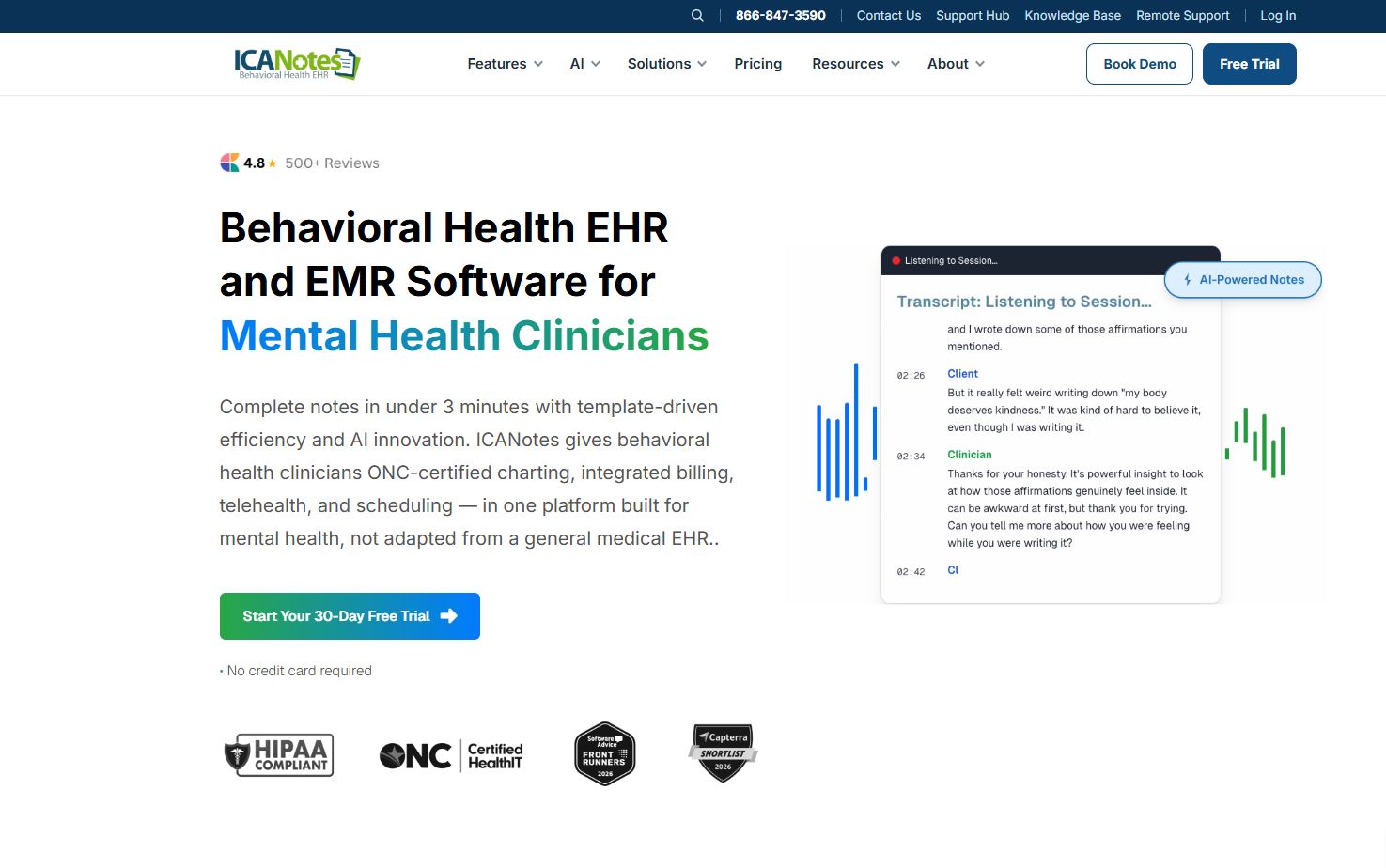
ICANotes is a behavioral health EHR built for clinicians who document heavily. Its menu-driven charting handles assessments, progress notes, SOAP notes, treatment plans, and discharge summaries, and it pairs that with billing, scheduling, telehealth, and a patient portal in one system. For group work, it supports recurring and one-time schedules, facilitator and co-facilitator workflows, and attendance that links directly to billing and claims.
That last point is what separates it for group operations. When a client attends, the attendance status flows into the claim. When they no-show, the claim reflects it. You are not reconciling a separate log against the schedule after the fact.
Best for: Behavioral health practices that need deep charting, billing, telehealth, and scheduling in one system.
Key strengths
- Menu-driven charting for assessments, notes, treatment plans, and discharge summaries
- Facilitator and co-facilitator workflows for group sessions
- Attendance linked to billing and claims
- HIPAA video sessions for telehealth groups
- AI-powered documentation assistance
Why choose ICANotes: If your documentation burden is high and your billing depends on clean attendance data, ICANotes handles the full loop from schedule to claim. It fits teams that value charting depth over minimalist design.
Pricing: Plans are priced by clinician type. Full-time non-prescribing clinicians start at $75/month, and notes-only plans start at $35/month. Prescribing clinician plans run higher, with a $99 activation fee on some tiers. The first non-clinical user is free.
2. Valant
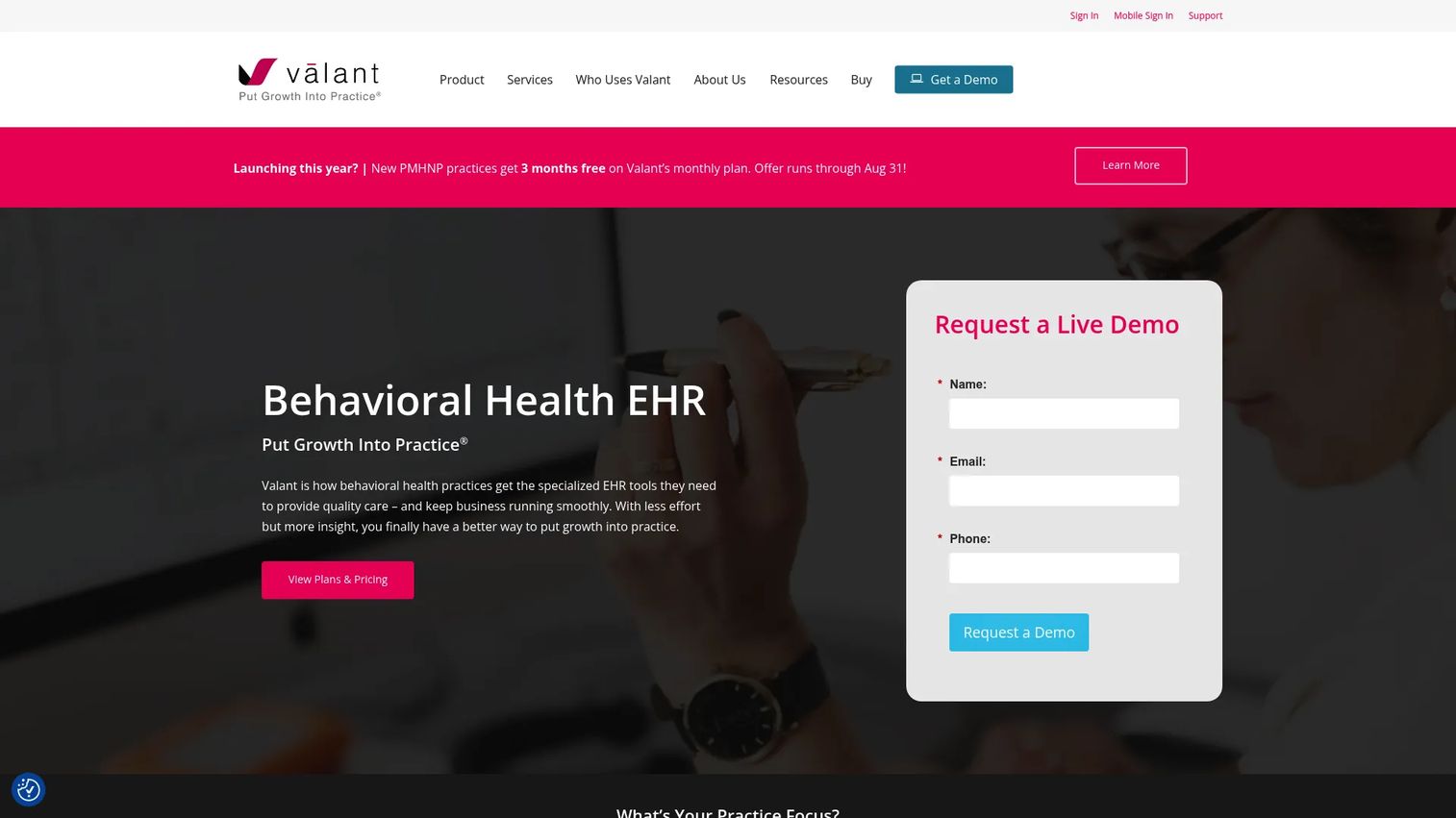
Valant is a behavioral health EHR and practice management platform built for outpatient, IOP, and PHP practices that care about outcomes. Alongside clinical documentation and billing, it emphasizes outcome measures and clinical reporting, which is what teams need when payers or leadership ask for data on whether groups actually work.
For recurring groups, Valant supports scheduling and enrollment, attendance tracking, and billing tied to attendance, with multi-patient appointment creation so you build a group once rather than one client at a time.
Best for: Behavioral health practices that need a specialized EHR with configurable workflows and outcome measurement.
Key strengths
- Clinical documentation with configurable workflows
- Practice management and billing tied to attendance
- Outcome measures and clinical reporting
- Multi-patient appointment creation for groups
- Patient portal and telehealth
Why choose Valant: If your program is judged on outcomes and operational efficiency, Valant's measures and reporting give you defensible data. It fits mid-sized behavioral health teams over solo clinicians.
Pricing: Valant does not publish a starting price. Pricing is customized and quote-based, so you request a plan tailored to your practice size and workflow needs. Valant holds a 2.9/5 rating on G2.
3. Behave Health

Behave Health is an all-in-one behavioral health platform spanning CRM, EHR, RCM, and ERP workflows. It is framed around facility operations, which is exactly what higher-acuity group programs need. For PHP and IOP teams, it handles roster management, individual participation capture, multi-facilitator documentation, and billing enablement, plus telehealth group support.
Higher-acuity programs run many groups per day for many clients. Behave Health is built for that volume, treating the operational load of a facility as the core problem rather than an afterthought bolted onto a solo-clinician tool.
Best for: Behavioral health organizations needing an integrated, facility-focused operations platform for PHP and IOP.
Key strengths
- Roster management for daily group programs
- Individual participation capture within group sessions
- Multi-facilitator documentation workflows
- Integrated CRM, EHR, RCM, and ERP
- Telehealth group support
Why choose Behave Health: If you run a PHP or IOP program with daily groups and complex billing, Behave Health treats the whole facility operation as one system. It fits organizations over individual practitioners.
Pricing: Behave Health uses custom, quote-based pricing across its Healthcare Provider and Support Provider plans. There is no public fixed price and no free tier, so you contact them for a quote scoped to your program.
4. Sessions Health

Sessions Health is a HIPAA-compliant EHR for mental health practices that packs scheduling, documentation, billing, insurance claims, telehealth, and a strong client portal into one integrated system. The portal handles intake, secure messaging, payments, and appointment management, which reduces the admin work of running groups for smaller teams.
It fits solo and small group practices that want an integrated system without enterprise complexity or enterprise pricing. Its AI note assist speeds up documentation, and its scheduling includes calendar sync and automated reminders.
Best for: Solo and group mental health practices needing an all-in-one EHR at a low entry price.
Key strengths
- Scheduling with calendar sync and automated reminders
- Client portal with intake, secure messaging, and payments
- Integrated telehealth, billing, and insurance claims
- AI note assist for faster documentation
- Reporting across the practice
Why choose Sessions Health: If you run a smaller practice and want an integrated EHR without a steep price, Sessions Health covers scheduling, notes, billing, and telehealth in one place. It fits teams that value simplicity and cost.
Pricing: Sessions Health offers a free plan for up to three active clients. The Professional plan starts at $39/month for the first practitioner, plus $29/month for each additional practitioner. Integrated telehealth is a $10/month add-on per practitioner, and electronic claims run $0.19 to $0.25 per claim.
5. TherapyNotes

TherapyNotes is behavioral health practice management software with EHR, scheduling, billing, telehealth, and documentation tools. It is known for therapist-friendly, payer-ready notes and practical admin support, including 24/7 phone and email support and free client data import on every plan.
For group practices, it offers unlimited clients, appointments, and notes, plus secure messaging and a custom client portal. The documentation is built to hold up to payer review, which matters when a claim depends on note quality.
Best for: Mental health practices needing an all-in-one EHR with scheduling, billing, telehealth, and strong documentation.
Key strengths
- Unlimited clients, appointments, and notes
- Payer-ready documentation
- Secure client and staff messaging
- Custom client portal
- Basic telehealth included on every plan
Why choose TherapyNotes: If clean, defensible notes are your priority and you want practical support without hunting for it, TherapyNotes fits documentation-heavy practices. Group pricing scales predictably per clinician.
Pricing: The Solo plan is $69/month. The Group plan is $79/month for the first clinician plus $50/month per additional clinician, and the same structure applies to enterprise setups of 30 or more users. Every plan starts with a free 30-day trial. TherapyNotes holds a 4.4/5 rating on G2.
6. SimplePractice
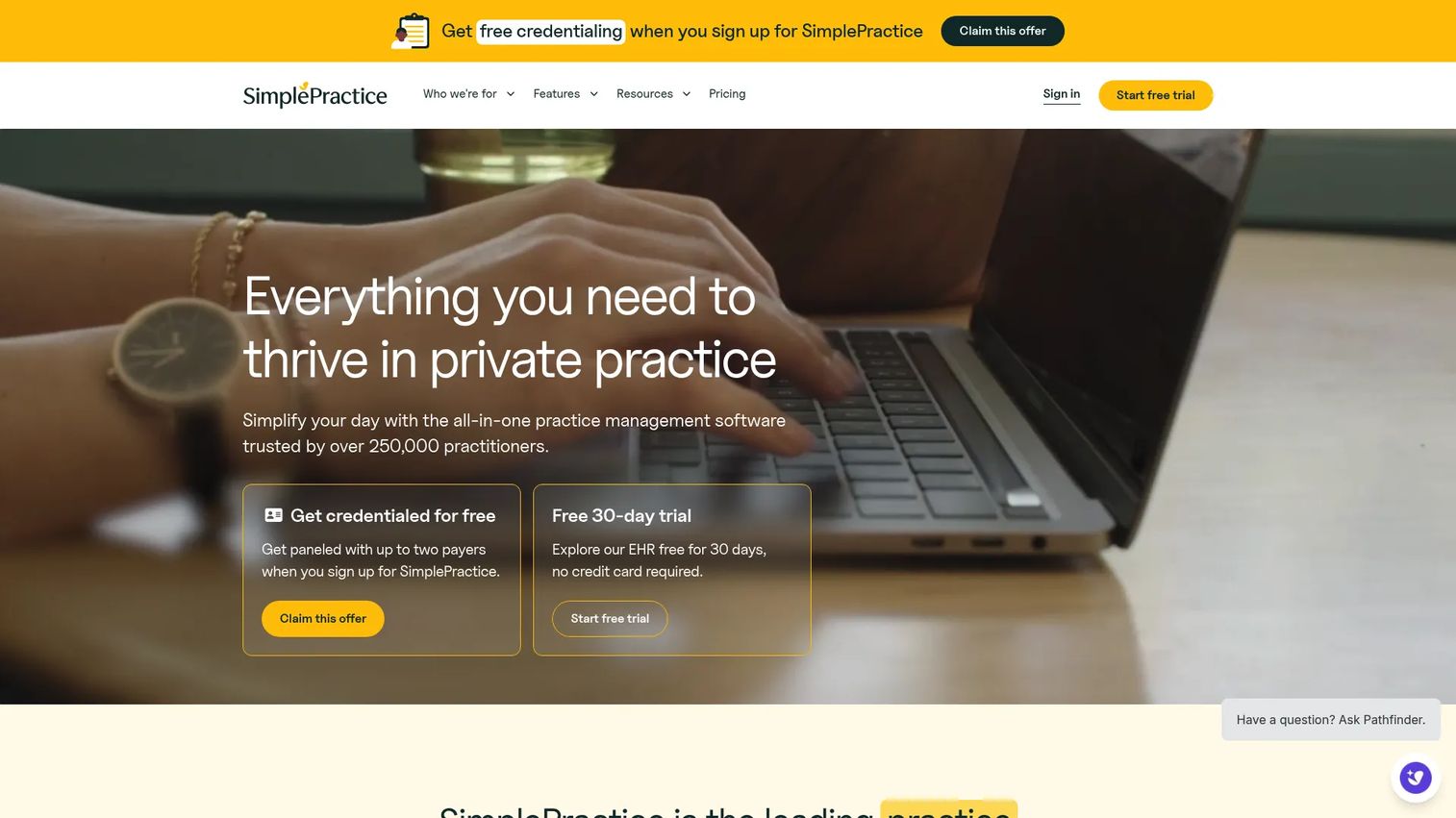
SimplePractice is practice management software for therapists and private practice clinicians. It covers appointment scheduling and client booking, billing and payments, telehealth, and a client portal in one broad platform. It works well for smaller teams that want a single tool for the whole practice rather than a specialized group operations engine.
The strength here is breadth and ease of use. If your group work sits alongside a busy individual caseload, SimplePractice handles both without forcing you into two systems.
Best for: Private practice mental health clinicians who need an all-in-one EHR and practice management platform.
Key strengths
- Appointment scheduling and client booking
- Billing and payments
- Telehealth and client portal
- Broad practice management coverage
- Straightforward setup for smaller teams
Why choose SimplePractice: If you want one platform for individual and group work and value simplicity over specialized group operations, SimplePractice covers the practice broadly. It fits solo and small teams.
Pricing: The Starter plan is $49/month, Essential is $79/month, and Plus is $99/month. There is a 30-day free trial and a limited-time 50% off offer for the first three months. SimplePractice holds a 4.1/5 rating on G2.
7. TheraNest
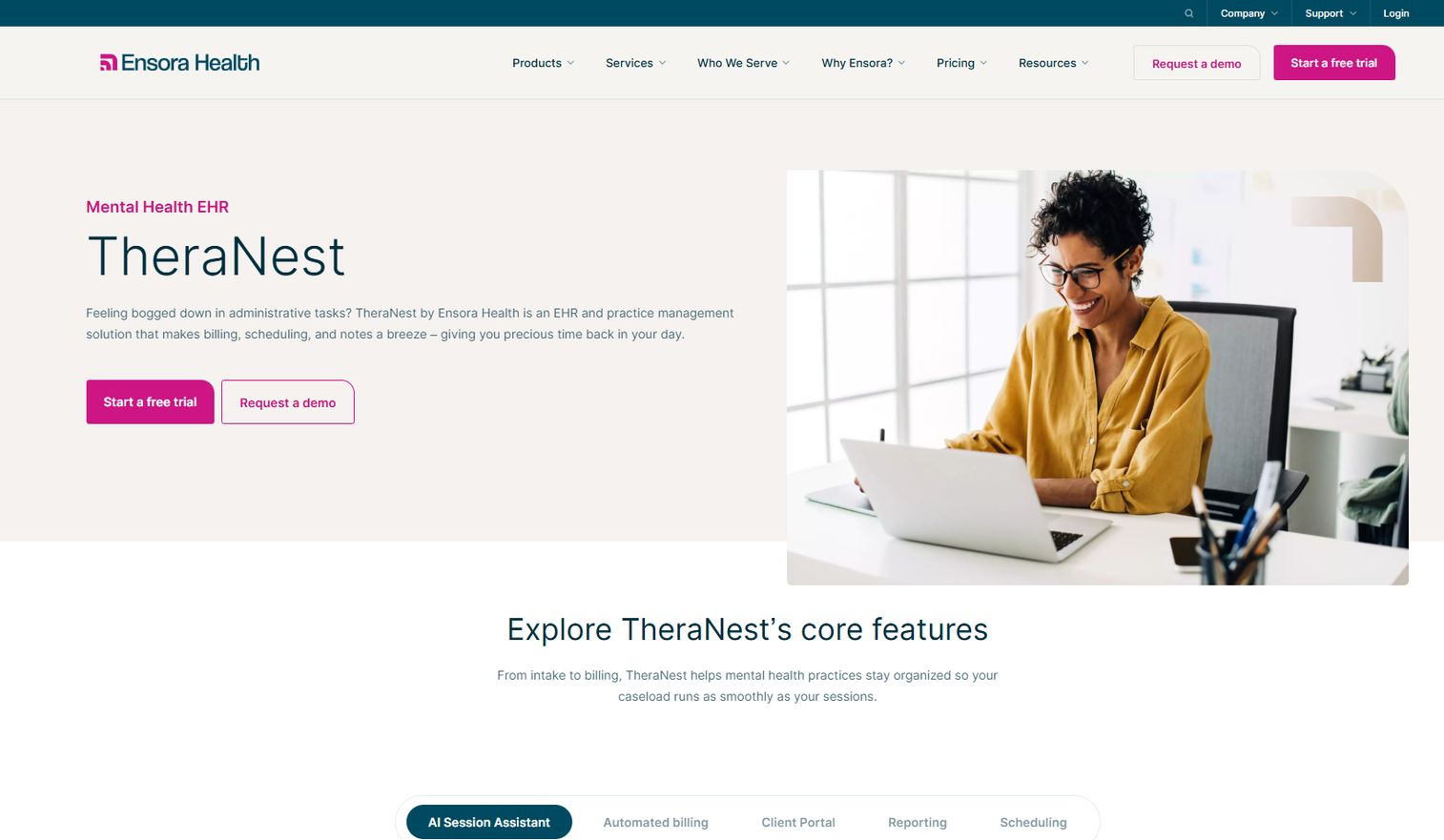
TheraNest, now part of Ensora Health, is a mental health EHR and practice management platform for solo and group practices. It brings group scheduling, automated billing, telehealth, and a client portal together in one lower-complexity system, with an AI Session Assistant to speed up notes.
It fits practices that want scheduling, notes, and billing in one place without heavy configuration. The workflow leans toward straightforward group practice management rather than facility-scale operations.
Best for: Mental health practices that need scheduling, notes, billing, and client portal workflows in one system.
Key strengths
- Group scheduling and calendar management
- Automated billing
- Client portal for engagement
- AI Session Assistant for documentation
- Telehealth support
Why choose TheraNest: If you want a practical group practice management tool that keeps scheduling, notes, and billing together without complexity, TheraNest fits. It suits solo and small group practices.
Pricing: TheraNest now routes through Ensora Health and describes flexible plans with a free trial rather than a public starting price. Contact them for a quote scoped to your practice. TheraNest holds a 4.2/5 rating on G2.
Considerations before you buy
Use this checklist to pressure-test any tool against how your groups actually run.
Recurring scheduling depth
Confirm the tool creates recurring weekly or daily groups with roster management, not just repeated single appointments. Ask how enrollment changes mid-series are handled. Shallow recurring support is where spreadsheet drift starts.
Attendance-to-billing flow
Verify that attendance statuses feed billing and claims directly. A client marked present should generate a clean claim; a no-show should not. If attendance lives in a separate log, you will reconcile it manually forever.
Shared and individual documentation
Check that group notes software produces both a shared session note and individualized documentation per member. Payers and auditors expect individual participation captured, not one generic note copied across a roster.
Real telehealth for groups
Test telehealth for group therapy with real multi-participant video, not one-to-one calls stretched to fit. Confirm the client portal supports intake, scheduling, and payments for group members.
Compliance and claims workflow
Review how the tool keeps documentation audit-ready and how claims move end to end. For PHP software and IOP software, daily attendance volume and payer scrutiny are higher, so the claims workflow has to be tight.
Conclusion
The best group therapy software depends on group size, billing complexity, and documentation load.
For behavioral health teams with heavy charting and attendance-driven billing, ICANotes handles the full loop from schedule to claim. Outcome-driven teams get defensible data from Valant. PHP and IOP programs running daily groups fit Behave Health's facility-scale operations. Small practices that want an integrated EHR at a low price should look at Sessions Health, while documentation-heavy teams get payer-ready notes from TherapyNotes. SimplePractice and TheraNest cover broader practice management for solo and small teams that want one tool for everything.
Start with how your recurring groups run today: where attendance drifts, where notes fall behind, where claims bounce. Then shortlist the two tools that fix those specific gaps and run a trial before you commit.
FAQs
A good group therapy EHR treats the group as the unit of work, not the individual appointment. It handles recurring scheduling with roster management, links attendance directly to billing and claims, and generates both shared and individual documentation from one session. Anything that forces you to duplicate a single-client workflow across a roster will create errors at scale.
In a purpose-built tool, attendance statuses feed billing automatically. When a client is marked present, the system generates a claim tied to that attendance; a no-show does not. This removes the manual reconciliation step where a separate attendance log gets matched against the schedule, which is where most claim rejections and revenue leaks start.
Yes, but confirm it supports real multi-participant video rather than one-to-one calls. ICANotes, Behave Health, Sessions Health, TherapyNotes, SimplePractice, and TheraNest all offer telehealth. For hybrid programs, check that the client portal handles intake, scheduling, and payments for group members alongside the video sessions.
A complete group therapy note includes a shared session component covering the group topic, interventions, and overall dynamics, plus individual documentation for each member's participation, response, and progress. Payers and auditors expect the individual layer, not one generic note copied across the roster. Audit-ready documentation captures both from a single workflow.
Yes. A general mental health EHR is built to document one clinician meeting one client, so groups force you to repeat that workflow for every attendee. Group therapy software creates one session, enrolls a roster, captures attendance per client, and routes billing based on who attended. The difference shows up most in higher-volume programs.
PHP software and IOP software should handle daily attendance for many clients across many groups, capture individual participation, and keep billing and claims tight under higher payer scrutiny. Roster management, multi-facilitator documentation, and audit-ready records matter most. Behave Health and Valant are built for this level of operational load.
Many do. ICANotes supports facilitator and co-facilitator workflows, and Behave Health handles multi-facilitator documentation for group sessions. If you run groups with two clinicians, confirm both can document their contributions to the same session and that attendance and billing reflect the co-facilitated structure.
For small practices, Sessions Health offers an integrated EHR with a free tier for up to three active clients and a Professional plan from $39/month. SimplePractice and TheraNest are also strong for solo and small teams that want broad practice management. Pick based on whether you need low cost, breadth, or a strong client portal.